
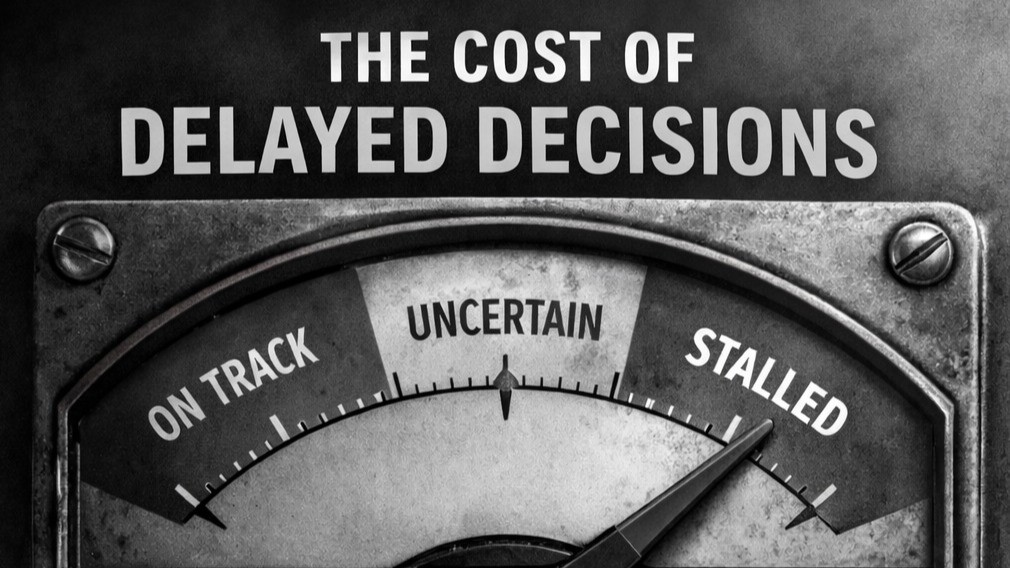

If the only number you check on Monday morning is revenue, you are always three months behind the real problem. And by the time you see it, you’ve already paid for it.
The decision you didn’t make on Monday just cost you a Thursday stockout. Not metaphorically.
Here is how it actually plays out.
The Scene
It was a Tuesday afternoon.
Sarah, the founder of a $4M apparel brand, was on a call with her supplier. Her top-selling hoodie (38% of last month’s revenue) was sitting at 8 weeks of cover. Not alarming.
The supplier offered her a pre-production slot for the next batch at a 4% discount if she committed within 48 hours.
She needed to check the cash flow first. And confirm the sales forecast. And make sure marketing wasn’t planning anything that would spike demand before the order arrived.
She said: “Let me get back to you by the end of the week.”
By Friday, the slot was gone. A competitor took it.
Two weeks later, that competitor launched a similar colourway. The trend picked up. Demand for Sarah’s hoodie spiked faster than her 8 weeks of cover could absorb. She burned through stock in 5 weeks instead of 8.
By the time she went back to her supplier for a rush order, the pre-production slot was long gone.
She was no longer a planned order. She was an urgent one.
And urgent requests don’t get the 4% discount. T
hey get a rush premium – an additional charge for pushing her order ahead of the queue.
She paid it. Because she had no choice.
That is the real cost of “let me get back to you.” And then there are some more which you will read about in a while.
The Invisible Tax of Deferral
Most DTC founders think of a deferred decision as a pause.
A moment of caution.
A responsible holding pattern while better information arrives.
It isn’t.
And here is why you keep doing it, not because you are reckless, but because the cost of the deferral is invisible at the moment you defer.
The supplier slot gets filled. The demand spike happens two weeks later. The rush premium lands on the invoice four weeks after that. And the stockout shows up in the P&L a month after that.
By the time you feel the cost, you have forgotten the Tuesday decision that caused it.
So the deferral habit persists.
Because it never feels expensive in the moment. It only feels expensive in retrospect.
And retrospect in a DTC business is usually 60–90 days too late.
The 3 Pain Points Underneath Every Deferred Decision
Pain Point 1: No Decision Rule Means Every Decision Becomes a Meeting
Sarah didn’t know she was deferring a critical decision on Tuesday. She thought she was being careful.
That is what happens when there are no pre-defined decision rules.
If Sarah’s business had a rule – “any SKU generating more than 30% of monthly revenue with a supplier discount available gets an automatic approval up to $X without requiring a meeting” – the hoodie reorder would have been approved in 20 minutes.
No cash flow check needed.
No forecast confirmation.
No Friday deadline missed.
Without that rule, the decision needed Sarah, her ops lead, her bookkeeper’s cash flow update, and a marketing check-in. Four dependencies. Two days. One missed window.
92% of SMEs report missing opportunities they couldn't act on in time. Most of them didn't lack the information to decide. They lacked a system for deciding without convening.
Pain Point 2: The Cost Is Invisible at the Moment of Deferral
Sarah deferred on Tuesday. The competitor launched two weeks later. The rush premium landed on the invoice four weeks after that. The stockout showed up in the P&L a month after that.
If her P&L showed a line item called “Cost of Tuesday’s Deferred Decision: $43,000,” she would never defer the same way again.
It doesn’t. So she does.
This is the leading indicator problem.
Most DTC founders watch revenue, the lagging number.
By the time revenue shows the damage from a pattern of deferred decisions, that pattern has been running for months.
The inputs that feed revenue health, decision latency, inventory cover, supplier relationship quality, and campaign timing were degrading long before the P&L reflected it.
A business that makes decisions in 4 hours looks identical to a business that makes decisions in 4 days on a revenue dashboard. Until it doesn’t.
Pain Point 3: “We’ll Figure It Out Later” Is a Culture, Not a One-Off
The first deferral is a judgment call.
The tenth is a habit.
The hundredth is a culture.
When you defer decisions consistently, your team learns to defer too.
- Ops leads stop raising flags because they know the decision won’t happen quickly.
- Marketing teams stop syncing with inventory because nobody makes a call fast enough for it to matter.
- Suppliers stop offering preferential terms because your brand has a reputation for slow responses.
The deferral culture is invisible from the inside.
From the outside, it looks like a brand that is always slightly behind.
The Cascade: How One Deferred Decision Triggers Five Consequences
Let’s go back to Sarah. And make this concrete.
Tuesday: Supplier slot committed to a competitor. Pre-production discount of 4% on an $80K order, that’s $3,200 gone.
Two weeks later: Competitor launches a similar colourway. Demand for Sarah’s hoodie spikes. Her 8-week cover starts burning faster than forecast.
Five weeks after Tuesday: Hoodie is out of stock. Sarah goes back to her supplier for a rush order. She is no longer a planned customer. She is an urgent one. The supplier adds a rush premium, $4,500 above the standard order price.
The same week: WISMO tickets spike. Customers who ordered before the stockout are waiting for delayed dispatch confirmations. The support team is diverted from a pricing query that needs resolution.
The following month, three one-star reviews land on the product page. Conversion rate on the hoodie drops for two weeks. Sarah’s supplier, who offered her the 48-hour window, prioritises a competitor’s standing order next season. Sarah’s lead time extends from 6 weeks to 9.
Three months later: Retention on the cohort of customers who experienced the stockout is below her brand’s average. The customers who waited either cancelled, went elsewhere, or left a review.
Total cost of one Tuesday deferral: conservatively $40,000–$55,000.
The decision itself would have taken 20 minutes. The deliberation took three days. The cascade took three months to fully reveal itself.
That is not a stockout problem. That is a decision system problem.
What a Founder Who Decides Fast Actually Looks Like
Two founders. Same supplier call on Tuesday.
Sarah – no decision rule: Needs to check cash flow. Confirm the forecast. Check with marketing. Says “let me get back to you.” By Friday, the slot is gone. The cascade begins.
A founder with a decision rule: SKU generating more than 30% of monthly revenue. Supplier discount available. Rule triggered. Approval sent within the pre-set limit. Supplier confirmed by Wednesday morning. Slot secured. Discount captured.
Same Tuesday. Different financial future.
The difference isn’t intelligence. It isn’t even data. It’s a rule that existed before Tuesday arrived.
The Leading Indicators of Decision Speed
Your revenue number tells you what has already happened.
These five inputs tell you whether your business is getting faster or slower at decisions and stronger or weaker as a result:
Average decision latency: how many hours from a trigger to a decision for your top 5 recurring decision types?
Decision rule coverage: what percentage of your recurring decisions have a pre-defined rule, threshold, or owner? Everything else becomes a meeting.
Supplier window capture rate: What percentage of time-sensitive supplier opportunities did you act on within the available window in the last 90 days?
Campaign-to-inventory sync rate: What percentage of your last 10 campaigns were launched with confirmed inventory cover for the promoted SKUs?
Cascade frequency: how often does one missed decision create a second problem within the same week?
These don’t appear on a P&L.
They compound quietly, improving or degrading the financial strength of your business month by month, while the revenue number tells you a story that is already three months old.
3 Things You Can Do This Week
Step 1: Map your last three missed windows to the decision that wasn’t made
Not to blame anyone. To find the pattern.
In almost every case, there is a Tuesday moment – a point where a decision was available and deferred. Name it. Cost it.
Step 2: Write three decision rules
Pick your three most common recurring decisions – reorder trigger, supplier commitment threshold, and markdown trigger.
Write the rule in advance.
Define the threshold, the owner, and the time limit.
When the rule exists, the meeting becomes a confirmation, not a debate.
Step 3: Run a decision latency audit
For the last five significant decisions in your business, track:
When was the trigger?
When was the decision made?
What was the gap?
What did that gap cost, directly and in cascade?
Most founders discover that 70-80% of their decision time is spent gathering data, not making the call.
That is the system problem, not the judgment problem.
The Question Worth Sitting With
A business that decides in 4 hours looks identical to a business that decides in 4 days – on a revenue dashboard.
The difference shows up in the supplier relationships, the inventory health, the WISMO rate, the retention curve, and the gross margin – long before it shows up in the top line.
How many decisions in your business last week sat in a “we’ll figure it out” holding pattern and what did each day of that delay actually cost you?
Not the obvious cost. The cascade.
You know you are fed up with these unexpected costs that keep appearing on your P&L.
Right time to:
Book a free 30-minute Operations Maximizer session → calendly.com/arti-retainup-core5-os/operations-maximizer-strategy-session
Arti is a fractional COO and eCommerce operations consultant helping DTC founders in the $3-$8M range identify and fix the six operational leaks quietly draining their cash: using the CORE5 OS framework. Built from scaling and closing a $20M DTC brand.