

And the hardest part of that sentence isn’t the closure. It’s the “couldn’t see.”
Because the information existed.
The signals were there.
I just wasn’t looking at the right things.
And by the time the surprises arrived, the decisions I made in response to them did more damage than the surprises themselves.
What We Were Watching
At IndiaRush, we watched revenue. Every day.
The number was the signal we trusted. If revenue was up, the business was fine. If it dipped, we looked for a marketing explanation.
We never asked what was happening underneath the revenue number, because the revenue number always seemed to have an answer.
We had five hero SKUs driving 80% of that revenue.
Everything in the business was built around them.
Our inventory, our supplier relationships, our marketing spend, our fulfilment capacity.
When they performed, the business performed.
That felt like a strategy. It was actually a concentration of risk we hadn’t named yet.
In one quarter, three things happened. None of them was connected. All of them hit the same cash position.
The Three Surprises

- A competitor launched a new design, and the trend shifted faster than we expected.
Products that had been selling consistently began to slow.
We had stock in transit, ordered at the previous velocity, based on numbers that were already out of date by the time the goods arrived.
The inventory that should have turned in 30 days was sitting at 90 days.
We didn’t see it coming because we weren’t tracking the competitive landscape with enough frequency to catch the signal early.
By the time it was visible in our revenue, the stock was already on the water.

- A supplier went silent mid-production.
We had open orders, committed delivery dates, and customers waiting.
We scrambled to find an alternative manufacturer but a new manufacturer doesn’t know your product, your quality standards, or your tolerances.
The goods arrived late.
They didn’t match what we’d shown on the website.
Customers who had waited through the delay cancelled on receipt.
The ones who kept the order returned it.
Our return rate on that SKU spiked to levels we had never seen, and the cost of processing those returns – shipping, restocking, write-offs on unsellable inventory – landed on a cash position that was already stretched from the excess stock problem.
- Then a Facebook algorithm change hit our best-performing campaigns.
The acquisition cost on our hero SKUs climbed.
The campaigns that had been generating revenue efficiently were now generating it at a loss.
Revenue dropped.
The inventory that those campaigns were supposed to move didn’t move with them.
We had no alternative channel with enough scale to absorb the shift – no diversified email programme, no organic presence strong enough to compensate – so the platform’s decision directly and immediately affected our cash position.
Three surprises.
Three completely different causes.
And we responded to each one separately, as if they were three independent problems, rather than seeing them as three simultaneous pressures on the same underlying cash position.
Here is what I understand now that I didn’t understand then.
The Real Problem Wasn’t the Surprises
The surprises were painful.
But the decisions we made in the weeks after were what actually compounded the damage.  When the competitor launched and stock started slowing, we ran a discount to move it faster, which eroded the margin on units we would eventually have sold anyway. When the supplier ghosted us and the replacement product generated returns, we over-ordered from the new supplier to compensate for the uncertainty, which tied up more cash in a SKU that was already underperforming. When the algorithm changed and acquisition costs climbed, we cut ad spend abruptly on campaigns that needed optimisation, not elimination, which accelerated the revenue drop rather than managing it.
Every one of those decisions made sense in the moment.
We were under pressure and we were reacting to what was immediately in front of us. But pressure decisions don’t have the luxury of context.
You can’t see the full picture when you’re managing a crisis, because the crisis consumes the attention that context requires.
The surprise created the pressure.
The pressure corrupted the decision.
The corrupted decision created the next problem.
And because we were still watching revenue as the primary signal, we couldn’t see the chain forming until it was already several links long.
The Signals Were There. We Weren’t Looking At Them.
Each of the three surprises had a signal that appeared before it became a crisis.
I just wasn’t tracking the right things to see it.
When the competitor launched and the trend started shifting, our sales velocity on those SKUs was already slowing quietly, gradually, before the revenue numbers moved.
If we had been tracking weeks of cover on our hero SKUs, we would have seen the inventory piling up before the stock arrived on the water. We would have had time to slow down the next order.
Instead we saw the revenue dip and looked for a marketing explanation.
When the supplier went silent, we had no early warning because we had no relationship history to read.
This supplier was relatively new and we hadn’t built the depth of trust or communication that would have told us something was wrong before the silence arrived.
With our longer-standing suppliers, we would have sensed it.
With this one, we had nothing to go on.
If we had been tracking supplier relationship depth – not just who we were buying from, but how well we knew them, how much visibility we had into their operations, and whether we had a backup if they failed – we would have known this was a single point of failure before it became one.
A new supplier with no backup and no relationship depth is not a bad luck story. It’s a visibility gap.
When the Facebook algorithm changed and acquisition costs started climbing, we compensated by increasing our ad spend.
If we had been tracking how long our cash was locked before it came back, we would have known that our position couldn’t absorb a drop in revenue or an increase in ad spend without consequences.
We felt the tightness. We never measured it.
The information that would have changed every one of those decisions existed.
It just wasn’t on the dashboard we were looking at.
Revenue told us what had already happened.
The inputs underneath it – velocity trends, contribution margin, weeks of cover, cash conversion cycle, supplier relationship depth – were telling us what was about to happen. We weren’t reading them.
None of these are difficult to track.
All of them would have shown us the problems forming before the surprises arrived.
And if we had seen the problems forming, the decisions we made in response would have been different because we would have made them from clarity rather than from pressure.
Where This Lives in CORE5 OS
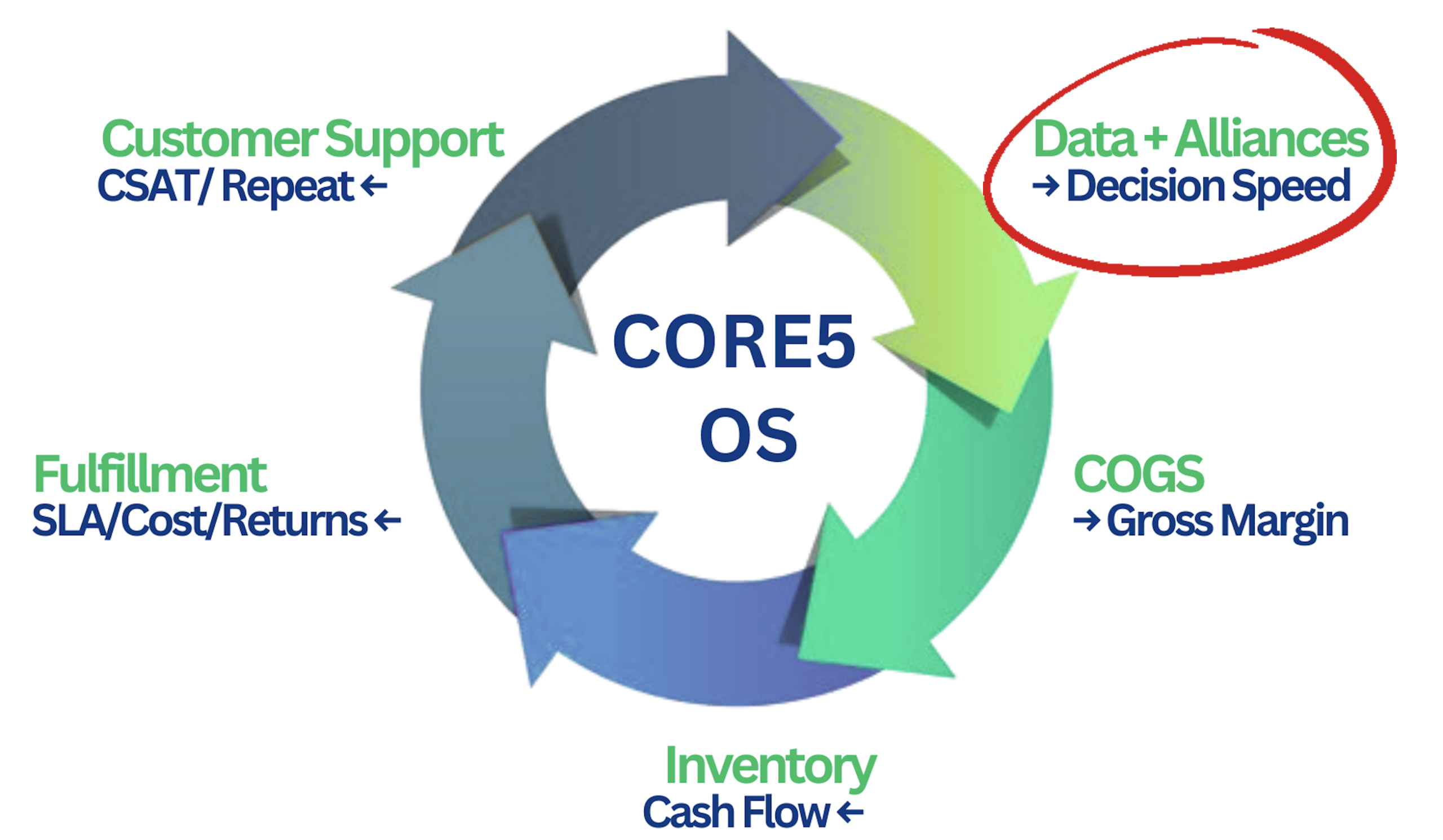
Every one of the three surprises at IndiaRush came from the Data + Alliances pillar
This is the area that determines whether you have the data visibility and the supplier relationships to see what’s coming and respond with options rather than scrambling.
The competitor launch was a data failure.
We weren’t tracking SKU-level velocity frequently enough to see the trend shifting before the stock was already on the water.
The supplier failure was an alliance’s failure.
We hadn’t built the relationship depth or the backup supplier network that would have given us options when a new supplier went silent.
The algorithm change was both – we weren’t measuring our cash conversion cycle, and we had no alternative channel relationship strong enough to absorb the acquisition shift.
All three consequences landed in the Inventory → Cash Flow pillar -> excess stock, return processing costs, and cash stretched by an ad spend increase the position couldn’t support, all hitting simultaneously.
That’s the connection CORE5 OS is built to show.
A gap in one pillar doesn’t stay in one pillar.
It creates pressure on the others.
And when three gaps exist simultaneously, as they did at IndiaRush, the pressure compounds faster than any single fix can address.
- Fixing the inventory without fixing the supplier relationship means the next supplier failure creates the same problem.
- Fixing the supplier relationship without fixing the data visibility means the next trend shift still catches you with the wrong stock.
- Fixing the data visibility without fixing the channel dependency means the next algorithm change still hits your revenue before you have an alternative.
The fix has to address the system, not the individual leak. That’s the whole point.
One Thing You Can Do This Week
Pick one of the five inputs – contribution margin per SKU, return rate, weeks of cover on top sellers, cash conversion cycle, or supplier relationship depth – and look at the direction it’s been moving over the last 90 days.
Not the number. The direction.
Direction matters more than the number. Because direction tells you where you’re going. The number only tells you where you’ve been.
The Question Worth Sitting With
What are you not seeing in your business right now and how much time do you have before it becomes a surprise?
I didn’t close a failing business. I closed a business that ran out of time to fix what I couldn’t see.
The visibility gap between what was happening and what I was tracking was the real problem.
Not the competitor.
Not the supplier.
Not the algorithm.
Those were the surprises.
The visibility gap was the condition that made each surprise a crisis rather than a manageable problem.
Need help in understanding the direction in which you are moving?
Book a free 30-minute Operations Maximizer session → calendly.com/arti-retainup-core5-os/operations-maximizer-strategy-session
Arti is a fractional COO and eCommerce operations consultant at RetainUP, helping DTC founders with $3-$8M annual revenue identify and fix the operational leaks quietly draining their cash, using the CORE5 OS framework.
Built from scaling and closing a $20M DTC brand.