


Every extra unit you ordered “just in case” is a bet you placed against your own cash flow.
And unlike most bets, this one feels responsible when you make it.
NOTE:
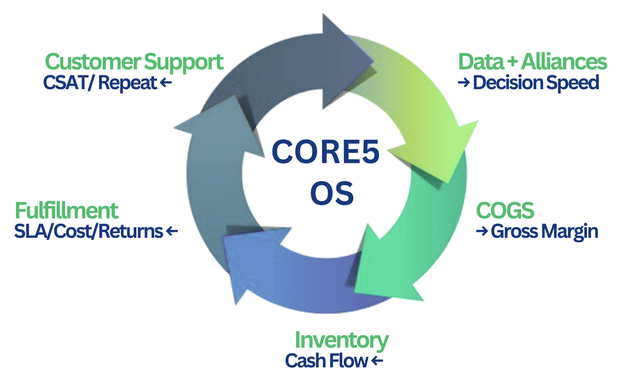
This topic lives in the Data + Alliances → Decision Speed pillar of CORE5 OS: the area that determines whether decisions in your business are driven by evidence or by the emotions that fill the gap when you do not trust the evidence.
The Question Nobody Hears You Ask
A founder posted on Reddit recently:
“I feel like I’m running a warehouse, not a business.”
But buried in her post was the real culprit.
Not the inventory.
Not the supplier.
One quiet question she asked herself every time she placed a purchase order:
“What if next month is bigger?”
And then a few extra units were added to the PO.
It feels like the right call.
It feels like planning.
It feels like the responsible thing to do when you’ve worked this hard to build something and you cannot afford to lose a sale.
It almost always isn’t.
Why The Fear Feels Rational
Here is the thing about FOMO buying – it isn’t irrational. It’s built on a real experience.
A stockout doesn’t just cost you the immediate sale.
Research shows that 75% of customers who encounter an out-of-stock product go straight to a competitor.
You’ve felt that.
You’ve watched your bestseller run dry during a campaign and seen the traffic go somewhere else.
The fear that drives over-ordering was created by something that actually happened.
The problem isn’t the fear. The problem is that the response to that fear – buying more every single time, on every order, across every SKU – compounds into a pattern the founder never consciously chose.
You didn’t decide to overbuy. You decided to be careful.
Once. And then again. And again.
Until careful became the default and the default started draining your cash.
The Three Faces of FOMO Buying
FOMO doesn’t show up the same way every time. It has three distinct patterns and recognising which one is yours is the first step to breaking it.
1. Fear of stockouts – the protective over-order
You add buffer units because you’ve stocked out before and you’re not doing it again. The buffer feels small. Across 20 SKUs, placed every 6 weeks, it isn’t small at all. It’s a systematic over-investment in protection that your cash flow is quietly paying for.
2. Panic buying during highs – the spike that became the new normal
Sales spike. Maybe it’s a good month. Maybe it’s a campaign. Maybe a creator posted about your product and traffic tripled for a week. The instinct is to reorder at the spike level because what if this is the new normal?
It usually isn’t. The spike passes. The inventory doesn’t. And the over-order placed during the high becomes a clearance problem three months later.
3. The fake scarcity backfire – buying into panic you didn’t create
A competitor runs a “only 2 left” campaign. Or you run one yourself. The artificial scarcity signals demand and somewhere in the supply chain, a buying decision gets made based on perceived urgency rather than actual velocity.
You bought into panic that was manufactured. The inventory arrived.
The panic was gone. The stock remained.
What The Fear Is Actually Costing
The damage from FOMO buying never arrives as one invoice. Unfortunately, none of those invoices feel expensive when they happen.
The protective over-order: You add a 20% buffer on every purchase order. On a $400,000 annual inventory investment, that’s $80,000 in excess stock sitting in your warehouse at any given time. At a 25% annual carrying cost (storage, insurance, handling) that’s $20,000 a year you are paying to feel safe.
Not $20,000 in one payment. About $1,667 a month. Every month. Whether the buffer sells or not.
The spike misread: A good week arrives. Sales triple. You reorder at triple velocity because what if this is the new normal? The spike lasts two weeks. You bought eight weeks of cover at that level. The remaining six weeks of that order sit in the warehouse for 90 days and eventually you clear at a 30% markdown.
On a $15,000 order placed at spike level, that markdown costs you $4,500 in margin you will never recover.
The compounding reality: Both of these happen simultaneously. Across multiple SKUs. Multiple times a year. The $20,000 carrying cost and the $4,500 markdown don’t feel connected. But they came from the same Tuesday decision – the one where the question was “what if next month is bigger?” and the answer was always yes.
Where This Lives in the CORE5 OS
Fear-based buying is a Data + Alliances problem, specifically the decision speed output of that pillar but it doesn’t stay there.
When every PO is inflated by anxiety rather than evidence, the excess stock lands in your Inventory pillar and immediately starts compressing your Cash Flow.
And because the over-order was emotional rather than planned, the supplier relationship that could have given you flexibility, smaller batches, shorter lead times, and the ability to course-correct was never built.
CORE5 OS surfaces where the fear is showing up across all five pillars, not just in the warehouse.
The Shift: From Fear-Based to Evidence-Based
You don’t need a new system to break this pattern. You need one discipline.
Before adding any buffer units to a PO, write down the specific reason.
Is it based on a data signal? A trend line, an upcoming campaign, a seasonal pattern you’ve seen before, a supplier lead time that justifies extra cover?
Or is it based on a feeling? A memory of the last stockout, a competitor's urgency message, a general anxiety that this month might be bigger than last?
That one question, asked every single time, starts to separate the rational buffers from the fear-based ones.
You won’t eliminate buffers and you shouldn’t. Some of them are genuinely justified.
But you’ll stop adding them automatically. And that pause is where the cash starts to come back.
The Connection with the ‘Forecasting Trap: Why you keep buying more than you need?
The forecasting Trap is about data you can’t trust due to fragmented systems, inaccurate records, and tools that don’t agree with.
This is different. This is about data you won’t trust because the fear is louder than the evidence.
A founder with good data and FOMO buying will still over-order. Because the decision isn’t being made by the spreadsheet. It’s being made by the memory of the last stockout, the anxiety about next month, and the quiet voice that says, “what if this is the one time you got it wrong?”
Understanding which root cause is yours changes everything about the fix.
The Question Worth Sitting With
The last time you added buffer units to a PO, what was the reason?
A data signal or a feeling?
And how much of what you ordered that day is still in your warehouse right now?
Need help with FOMO?
Book a free 30-minute Operations Maximizer session → calendly.com/arti-retainup-core5-os/operations-maximizer-strategy-session
Arti is a fractional COO and eCommerce operations consultant helping DTC founders with $3-$8M annual revenue identify and fix the operational leaks quietly draining their cash, using the CORE5 OS framework.
Built from scaling and closing a $20M DTC brand.