


Every time you place a PO at a quantity your demand doesn’t justify, you’re not making a business decision. You’re making a supplier’s business decision on their behalf.
Your unidirectional thinking (lower per-unit cost) led you to meet the supplier’s MOQ and now you’ve lost agility. You are locked with a specific product design or color for a year or more i.e., stuck with “dead stock” until it sells or is disposed of.
The MOQ Trap Most Founders Accept Without Question
Here is how the trap works…
Your supplier requires a minimum order of 500 units.
Your 90-day sales velocity says you need 200. You know this. You can see it in the data.
In addition, it’s a new product and your projected demand is max 300.
And you ordered 500 anyway.
Not because the business needs 500. Because the supplier requires it.
The gap between 200 and 500, those 300 extra units, goes straight into your warehouse, where they will sit for weeks, sometimes months, consuming storage fees and tying up the working capital you needed for something else entirely.
This happens across every SKU.
Every order cycle.
Until the cumulative effect of supplier-dictated quantities becomes a structural cash constraint you've stopped noticing because it's been there so long it feels normal.It isn’t normal. It’s a negotiation you never had.
The Real Cost of MOQ Compliance
Most founders never calculate what the supplier’s minimum orders are actually costing them. They accept the MOQ as a fixed constraint, the price of doing business, and manage around it.
Let’s put a number on it.
You have 10 SKUs. Each SKU has an MOQ of 400 units.
Your actual demand across those SKUs averages 220 units per 90-day cycle.
You’re ordering 180 units per SKU per order, above what demand justifies, just to meet the minimum.
| SKU Count | MOQ Per SKU | Actual Need | Over-order | COGS Per Unit | Excess Capital |
|---|---|---|---|---|---|
| 10 | 400 units | 220 units | 180 units | $22 | $39,600 per cycle |
That's nearly $40,000 per order cycle sitting in your warehouse because a supplier requirement, not your demand signal, set the order quantity.Over four order cycles per year: $158,400.
Not $158,400 in one bill.
$158,400 in capital that’s permanently occupied, converting slowly into revenue instead of being available for ads, growth, or the reorder on your bestseller that’s about to stock out.
Why Founders Don’t Renegotiate
There are three common reasons founders accept MOQs without negotiating them.
- You assume the MOQ is non-negotiable. It almost always is. Suppliers set their minimums based on production economics, but those economics have flexibility, especially for a founder who pays on time, orders consistently, and communicates reliably. The number on the order form is a starting point, not a ceiling.
- You haven’t built the relationship that makes negotiation possible. Negotiating MOQs requires a supplier relationship with sufficient trust and mutual benefit that both parties are willing to engage in a commercial conversation. Founders who treat suppliers transactionally, order placed, invoice paid, repeat, have never created the conditions for that conversation.
- You haven’t quantified the cost of compliance. It’s very difficult to have a negotiation about a number you’ve never calculated. When you know that your current MOQ structure is tying up $158,400 annually in excess inventory, the conversation with your supplier has a different weight. You’re not asking for a favour. You’re presenting a business case.
Three Approaches to Renegotiating MOQs
1.The data-led conversation: Come to the negotiation with your actual 90-day velocity per SKU. Show your supplier what you’re actually selling versus what you’re being asked to buy.
The ask: lower the MOQ to a quantity that reflects real demand, with a commitment to order more frequently.
Suppliers often prefer more frequent, reliable orders over large infrequent ones as smaller orders improve their production planning and reduce their payment risk.
Frame it as a mutual benefit.
2.The SKU consolidation trade: If you’re carrying multiple SKUs from the same supplier, consider offering to consolidate your catalogue in exchange for lower minimums on the SKUs you keep.
Fewer SKUs, each with more reliable volume, are often more valuable to a supplier than a wide SKU list with unpredictable demand per product.
3. The payment terms exchange: Suppliers set MOQs partly to protect their cash flow. If you can offer faster payment terms, paying in 15 days instead of 30, or partially upfront, you may be able to negotiate lower minimums in return. The supplier’s cash risk decreases. Your MOQ flexibility increases.
The cost to you is timing, not capital.
None of these works in the first conversation with a new supplier. They work when you've built the kind of relationship where both parties understand each other's commercial constraints and are willing to find a structure that works for both sides.Where This Lives in CORE5 OS
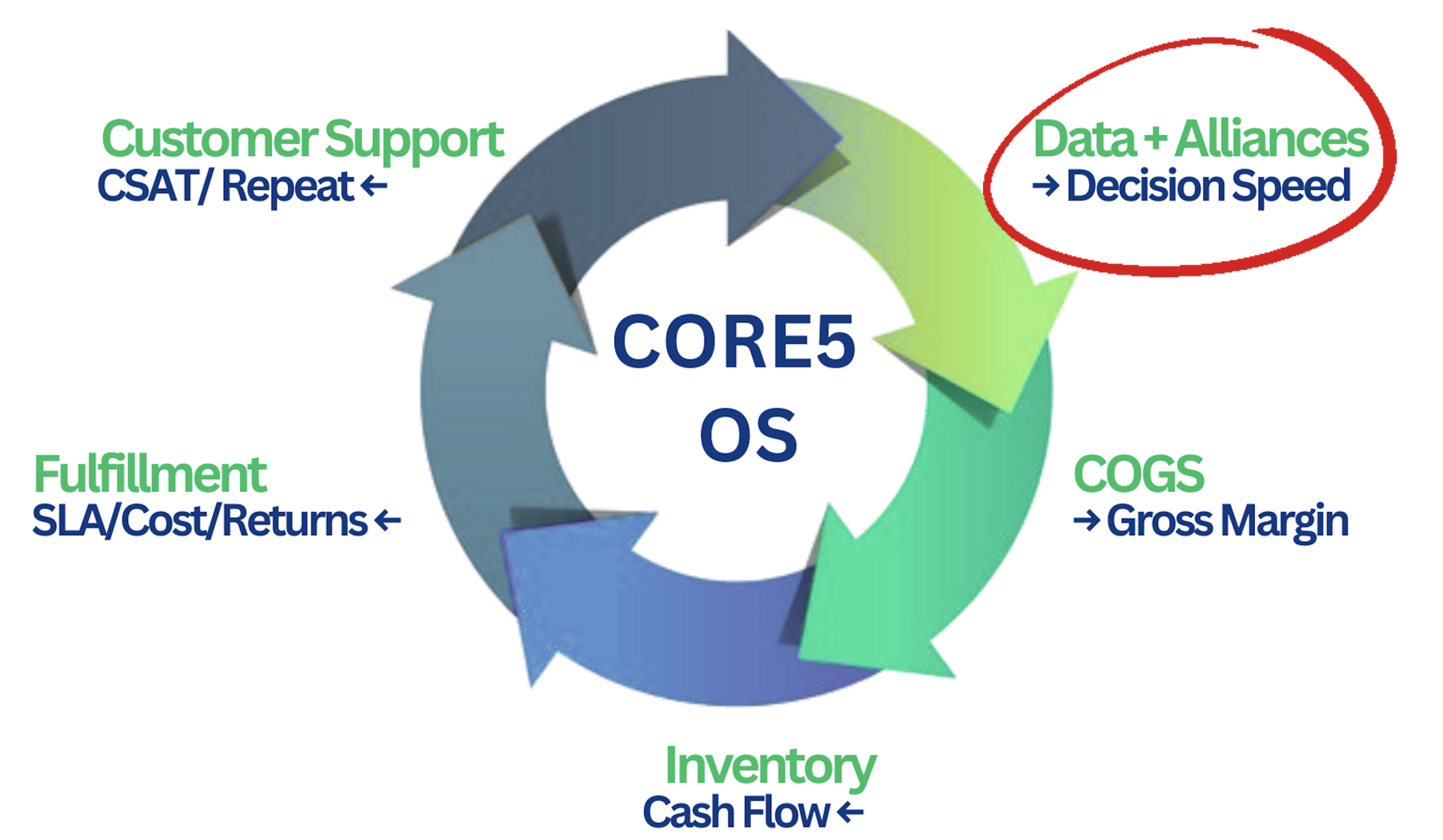
MOQ compliance is a supplier alliance problem with direct Cash Flow consequences.
The CORE5 OS framework treats supplier terms as a negotiable operating variable, not a fixed constraint, because at the $3-$8M stage, the difference between buying at MOQ and buying at real demand is often the difference between a cash-tight month and a manageable one.
The Question Worth Sitting With
Pull your last three purchase orders.
What percentage of each order was driven by your demand data and what percentage was driven by your supplier’s minimum?
If the honest answer is that supplier minimums are setting your order quantities rather than your sales velocity, you don’t have an inventory problem.
You have a terms problem. And terms are negotiable.
Want to know what your current MOQ structure costs you annually?
Book a free 30-minute Operations Maximizer session → calendly.com/arti-retainup-core5-os/operations-maximizer-strategy-session
Arti is a fractional COO and eCommerce operations consultant at RetainUP, helping DTC founders with $3-$8M annual revenue identify and fix the operational leaks quietly draining their cash, using the CORE5 OS framework.
Built from scaling and closing a $20M DTC brand.