

Calling your customers impatient is the most expensive belief a DTC founder has.
And this belief does not let you see that it’s YOUR process that never gave your customers a reason to be patient.
You think 820 WISMO tickets per month means there is a problem with your customer support team?
In reality, it means your fulfillment process is broken.
And the best part… you are spending money (CAC) to acquire these customers and they are paying you to let you know about the disconnection.
That’s what a WISMO ticket actually is.
Not a support problem.
A fulfillment failure receipt.
Let Me Show You What This Looks Like
You spent $45 acquiring a customer.
They placed an order.
They waited. They heard nothing for 36 hours.
No update, no tracking, no communication.
So they did what any of us would do… they emailed support asking where their order is.
Your support team responded.
Gave them the tracking link.
Resolved the ticket.
CSAT: positive.
You look at the dashboard.
Support is handling it.
Everything looks fine.
But here is what actually happened.
That customer didn’t contact you because they were impatient.
They contacted you because your process went silent at the exact moment their anxiety was highest… right after they handed over their money and before they had any proof it was coming back to them as a product.
The silence created the ticket.
Not the customer.
And that $45 you spent acquiring them?
It’s now attached to an experience that felt uncertain and friction-filled.
The next time they think about ordering, they will remember that feeling, even if they can’t articulate exactly why.
The Belief That’s Keeping You Stuck
Here is the thing about beliefs… they shape what you do next.
If you believe WISMO is a customer patience problem, you invest in faster support responses, better templates, smarter chatbots.
You measure how quickly your team resolves tickets. You pat yourself on the back when CSAT improves.
And the tickets keep coming.
Because you built a better bucket under a leaking pipe. You never fixed the pipe.
But if you believe WISMO is a fulfillment process problem, everything changes.
You stop asking "how do we handle these tickets better?" and start asking "why does our process keep generating them?" That question lives in operations, not in customer service.
And it has answers… specific, fixable answers.
The moment you move WISMO from the support team’s dashboard to the operations team’s responsibility, the question changes.
And when the question changes, the outcome changes.
The moment you move WISMO from the support team’s dashboard to the operations team’s responsibility, the qu
The Metric You Are Tracking Is the Wrong One
Most founders track WISMO as a percentage of total support tickets. That tells you how busy your support team is.
It does not tell you how broken your fulfillment process is.
The metric that actually matters is this:
WISMO Rate = WISMO tickets ÷ Total orders × 100
This tells you what percentage of your customers experienced enough anxiety about their order to contact you.
That is a fulfillment health metric. Not a support metric.
Here is what the benchmarks look like:
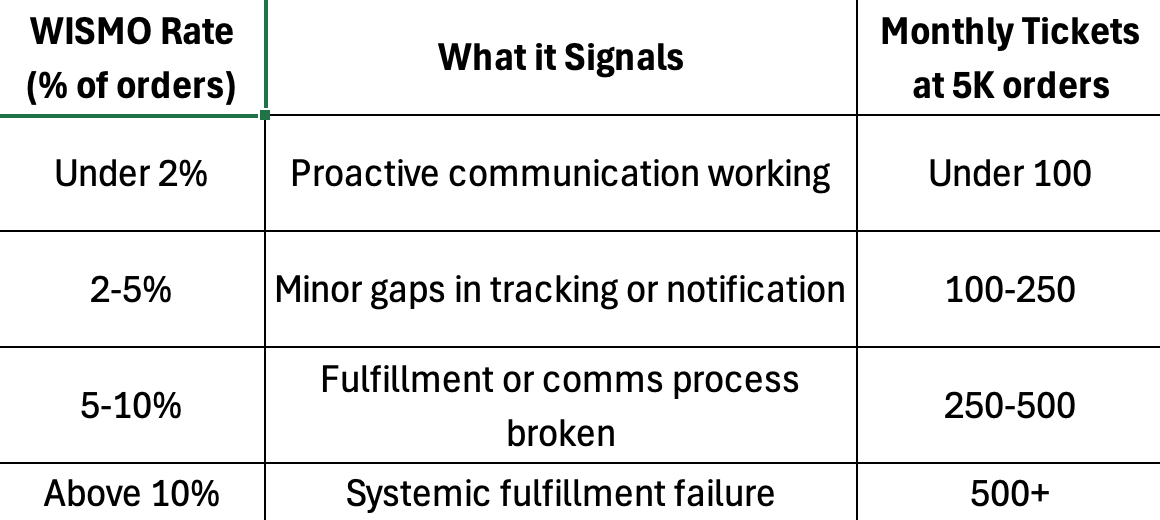
Most DTC brands I see are sitting in the third or fourth row without knowing it. Because they are measuring against total tickets, not total orders.
And the blended percentage against tickets looks manageable, so nobody sounds the alarm.
But when you calculate it against orders, the real picture appears.
And it is usually uncomfortable.
Where the Tickets Are Actually Coming From
WISMO doesn’t appear randomly. It clusters around four specific moments in the post-purchase journey where your process goes silent.
The Processing Black Hole: Your customer placed an order. They got a confirmation email. And then…. nothing. For 24, 36, sometimes 48 hours. No update. No tracking number. No communication. They are sitting there wondering if anything is happening. And after enough silence, they send a ticket.
The fix is simple. An automated “we’ve received your order and we’re preparing it” notification within 2 hours of purchase eliminates this entire category of WISMO. It costs nothing to send. It removes the silence that creates the anxiety.
The “Shipped” Black Hole: Your customer gets a “your order has shipped” email. They click the tracking link. It says “label created.” Two days later, it still says “label created.” They think the order is lost.
The problem is that most brands trigger the “shipped” notification when the label is printed, not when the carrier actually scans the package. That gap between label creation and first carrier scan is where trust breaks. Fix the trigger point and this category disappears.
The Carrier Handoff Gap: Your warehouse handed the package to the carrier. The carrier hasn’t scanned it yet. Tracking shows nothing for 18-36 hours. Three tickets arrive in that window from three customers who all assume something went wrong.
A single line at checkout – “tracking updates appear within 24-48 hours of shipping,” sets the expectation before the anxiety builds. A managed expectation never becomes a WISMO ticket. An unmanaged one almost always does.
Delayed Delivery with Zero Communication: Something went wrong downstream. Weather, carrier volume, a routing error. The estimated delivery date passed. Your customer heard nothing from you. So they contacted support.
This one is the most damaging and the most preventable. The moment a carrier flags a delay, your process should notify the customer before they notice. A customer who receives bad news proactively rarely sends a WISMO ticket. A customer who discovers it themselves almost always does.
And 69.7% of them won't buy from you again.
WISMO Rate Is the Lagging Number, the above “HOLES” are Leading Indicators
Your WISMO rate tells you what already happened. It tells you that your process failed somewhere in the last 30 days and customers felt it enough to contact you.
The four failure points above - the processing black hole, the shipped black hole, the carrier handoff gap, the delayed delivery with no communication - these are the inputs that determine your WISMO rate next month. They are the things you can actually fix. And fixing them is what moves the number.Most founders manage the lagging number.
They measure tickets, track resolution time, report CSAT.
All of this tells them how they handled what already happened.
The founders who reduce WISMO sustainably focus on the inputs.
They ask: which of the four failure points is generating our volume?
They fix that one first.
They measure whether it drops.
Then they move to the next one.
That is the difference between managing WISMO and eliminating it.
What This Actually Costs You
Each WISMO ticket costs between $5 and $25 to handle when you factor in support labour, tools, and overhead. For a brand generating 820 tickets a month, that is $4,100 to $20,500 a month – $49,200 to $246,000 a year – spent answering a question your process should have made unnecessary.
And that is just the direct cost.
The cost that doesn't appear on any dashboard is the LTV of the customers who didn't complain, they just didn't come back.You spent $45 acquiring them.
They had a silent, anxious post-purchase experience.
They never told you.
They just didn’t order again.
That’s the receipt your WISMO rate isn’t showing you.
3 Things You Can Do This Week
Step 1: Calculate your real WISMO rate
Pull last month’s WISMO tickets – every order status query across email, chat, and phone. Divide by total orders shipped that month. Multiply by 100. If you are above 5%, you have an operations problem wearing a support costume. If you are above 10%, it is urgent.
Step 2: Map your tickets to a failure point
Take your last 50 WISMO tickets and put each one into one of the four categories above. Whichever category has the most tickets is where you fix first. This takes 90 minutes and tells you more about your fulfillment process than any report you have run this quarter.
Step 3: Add one proactive touchpoint
Pick the failure point with the highest volume and add a single automated notification. If it is the processing black hole, send an “order being prepared” email within 2 hours of purchase. Measure your WISMO rate against total orders for the next 30 days. Most brands see 25-40% reduction from a single notification change.
The Question Worth Sitting With
Your support team is answering WISMO tickets every day. Your ops team is shipping orders every day.
And somewhere between the two, nobody is asking the question that connects both:
What percentage of our orders are generating a WISMO ticket and what does that number tell us about our fulfillment process, not our support team?
820 WISMO tickets a month is not a customer patience problem.
It is 820 customers telling you, at their own time and effort, that your process has a gap in it.
The question is whether you are reading them as complaints or as data.If some of the questions bothered you, it’s time for a deep dive.
Book a free 30-minute Operations Maximizer session → calendly.com/arti-retainup-core5-os/operations-maximizer-strategy-session
Arti is a fractional COO and eCommerce operations consultant at RetainUP, helping DTC founders in the $3-$8M range identify and fix the six operational leaks quietly draining their cash: using the CORE5 OS framework built from scaling and closing a $20M DTC brand.