
Key takeaways
- Subscription gifts beat discounts because a competitor can match 20% off tomorrow, while a gift leaves the customer nothing to compare.
- Subscription gifts go where subscribers decide to stay, between orders 1 and 3, with the biggest gift at order 3.
- For one RetainUP supplement client, fixing onboarding, gifts and milestones lifted order 1 to order 3 retention from 61% to 73%.
“Why would I give away product when I’m already giving 20% off?”
Every founder asks me this on the first call.
Because 20% off is the one offer your competitor can match tomorrow.

Why gifts work
1. Apples to Apples vs Apples to Oranges.
Sleep gummies at 10% off against sleep gummies at 20% off is apples to apples. The customer picks 20% in two seconds.
Now put 20% off against 15% off plus a free eye mask. That is apples to oranges. There is nothing to compare, so the customer stops doing maths.
And it costs less than it looks. One of our clients gives away a mouthwash tablet pack that costs them $1.44. The customer sees $18.70.
2. Something to wait for.
Nobody checks their bank statement for the 15% they saved. But everyone opens the box when they know something is inside.
3. It gets used with the product.
John Ruhlin wrote the book on gifting, Giftology. His first rule is to give something used every day. The eye mask goes on every night the gummy goes in.
4. It makes them feel special.
His second rule is to keep your logo off it. Nobody wants to be a billboard.
How to run it
1. Map the timing.
Most brands save gifts for loyal customers. Order 10, or the one-year box. By then the customer already decided.
The decision happens between orders 1 and 3. So that is where the gift goes.
Order 2 gets something small. Order 3 gets the biggest gift. Leave 4 and 5 empty, so nobody expects a reward in every box. Then come back at 6 and 12.
When we fixed onboarding, gifts and milestones for one supplement client, order 1 to order 3 retention went from 61% to 73%.

2. Use it to sell the bigger supply.
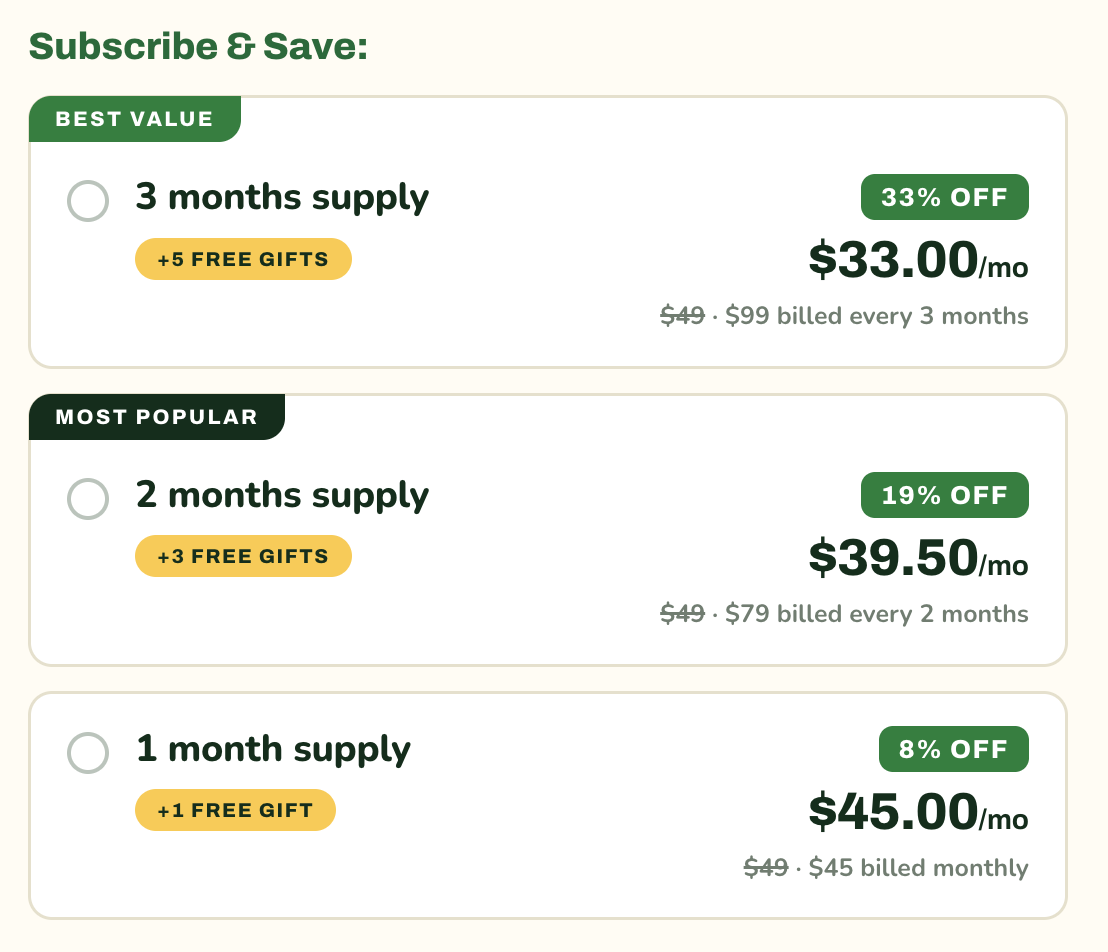
The gifts should grow with the plan. One month of sleep gummies gets one free gift, the eye mask. Two months gets three. Three months gets five.
A bigger discount on the 3-month pack still gets compared. Five gifts against one is an easy choice.
And one-time gets nothing. If one-time buyers get the same gifts, subscription has nothing left to offer them.
3. Tell them it’s coming.
A surprise can’t keep anyone, because they didn’t know it was coming.
IM8 puts the next six months of gifts on the product page, before you pay. Month 2 mixer. Month 3 shaker. Month 5 travel pouch.

So every order in between becomes a countdown. Then say it again in the upcoming-order email, a few days before the charge.
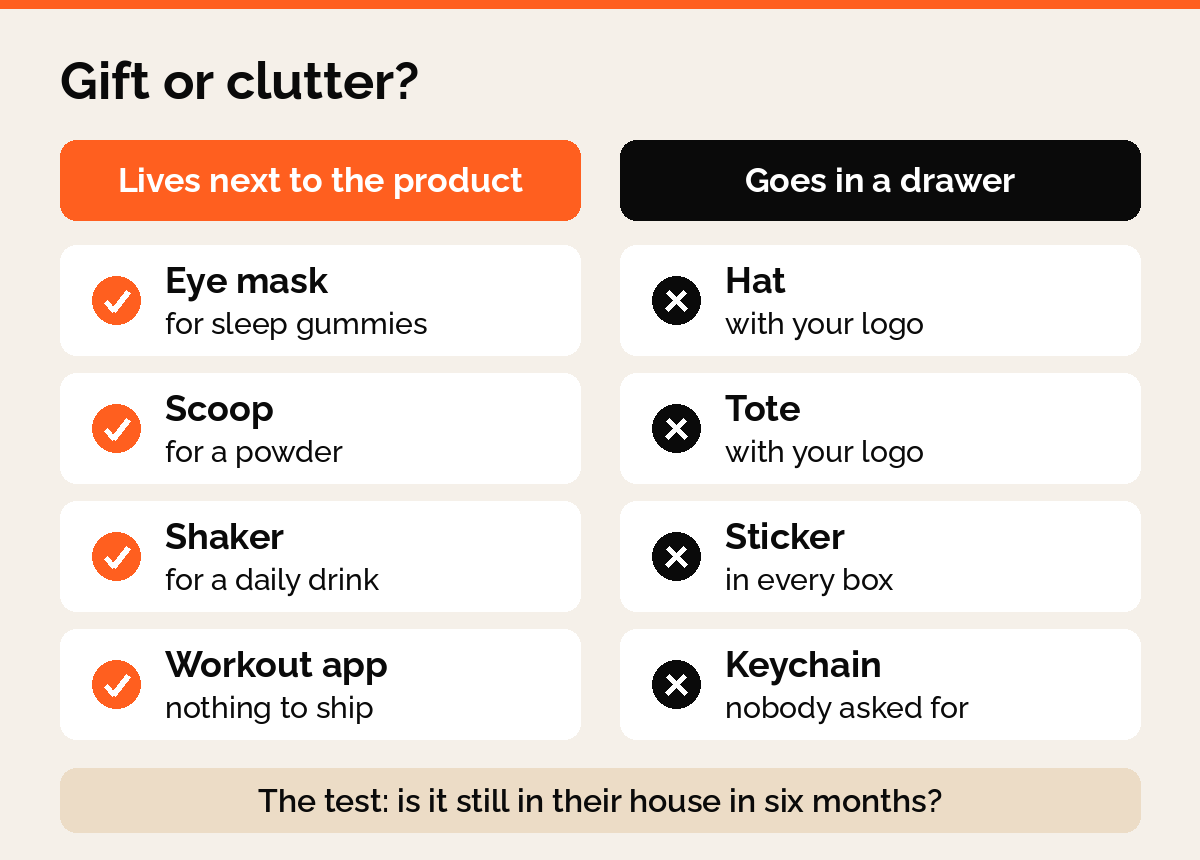
4. Pick a gift that lives next to the product.
Sleep gummies get an eye mask. A powder gets a scoop. A daily drink gets a shaker.
Not a hat. Not a tote with your logo on it.
It doesn’t even have to ship. Mars Men gives subscribers a 30-day workout app.
Ruhlin’s test works for all of them. Is it still in their house in six months?
5. Only promise what is in the warehouse.
Gifting gets hard operationally if you are not ready for it.
A subscriber paid for 3 boxes plus 2 free. Two months running, she got the 3. Her review said “I never got my free gifts. I have cancelled my subscription.”
The communication can break it too. One brand announced the gift right after the first order. Customers were reminded they had a subscription, and cancelled before the gift shipped.
Once you name a gift, you have written a delivery date into the subscription.
Your competitor can match 20% off tomorrow.
They can’t match the eye mask sitting on your customer’s bedside table.
We build gifting programs for subscription brands, from the timing and the gifts to the emails that announce them. If you want help with yours, book a call.