Key takeaways
- In one supplement brand we audited, 68% of quarterly subscribers were still active at day 95, against 54% on the monthly plan.
- IM8’s quarterly order collects $324 on day one against $128 for a monthly cycle, per its Q2 2026 investor deck.
- We give a 3-month plan 10% on top of the base subscription discount, and treat 20% or more as too much.
Prepaid keeps subscribers longer. In almost every set of numbers I have seen, a 3-month plan holds more people at month 3 and month 12 than a monthly one.
But that is only half the answer. The longer plan also needs a deeper discount, ships more product before anyone has proven they like it, and ends in one big renewal charge. Get those three wrong and the retention gain shows up in the cohort chart and never in the bank account.
Here is what the public data says, what our own client data says, and how we decide when a brand should lead with prepaid.
Which keeps subscribers longer, prepaid or monthly?
Prepaid and 3-month plans keep more subscribers than monthly plans. Eightx’s 2026 figures put 12-month retention at 28% for annual plans against 11% for monthly. In our own audit of a supplement brand, quarterly subscribers were still active at 68% by day 95, against 54% on monthly.
The gap comes from fewer chances to leave. A monthly subscriber decides 12 times a year. A quarterly one decides 4 times.
What counts as prepaid
Three different plans get called prepaid, and most articles mix them up. The difference matters for shipping cost and for how your platform counts the subscriber.
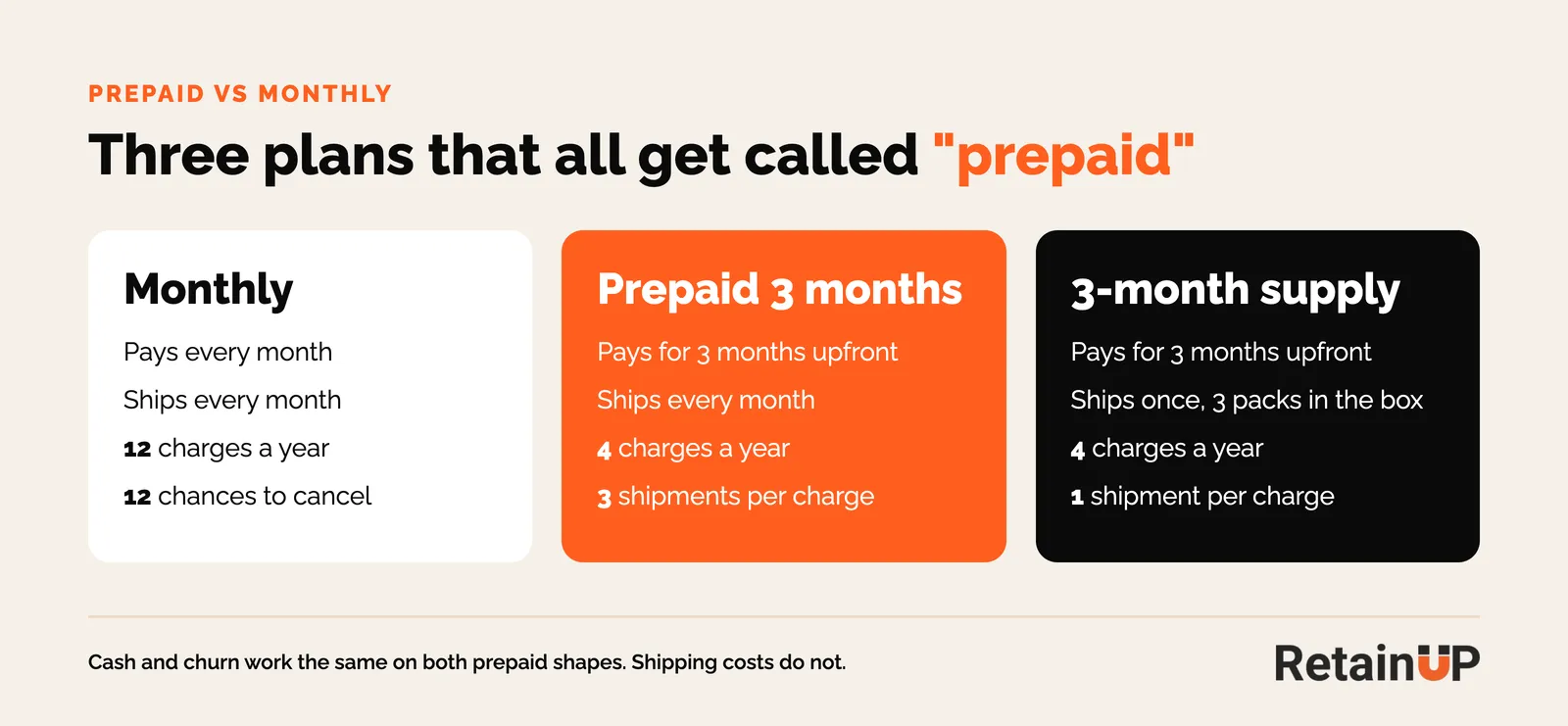
| Monthly | Prepaid (pay 3, ship monthly) | 3-month supply (pay 3, ship once) | |
|---|---|---|---|
| Charges a year | 12 | 4 | 4 |
| Shipments a year | 12 | 12 | 4 |
| Cash on day one | 1 month | 3 months | 3 months |
| Product owed after charge | None | 2 months | None |
| Shipping cost | Highest | Highest | Lowest |
| Best for | New or variable-use products | Perishables, coffee, boxes | Daily supplements and refills |
For most supplement brands we work with, the 3-month supply is the cleaner shape. One charge, one box, one renewal date. True prepaid makes sense when the product goes off, like coffee or fresh food, or when the monthly box itself is the experience.
Churn by billing period: the public numbers
Every public source points the same way. Longer billing periods churn less. The problem is that almost none of them say where the numbers come from.
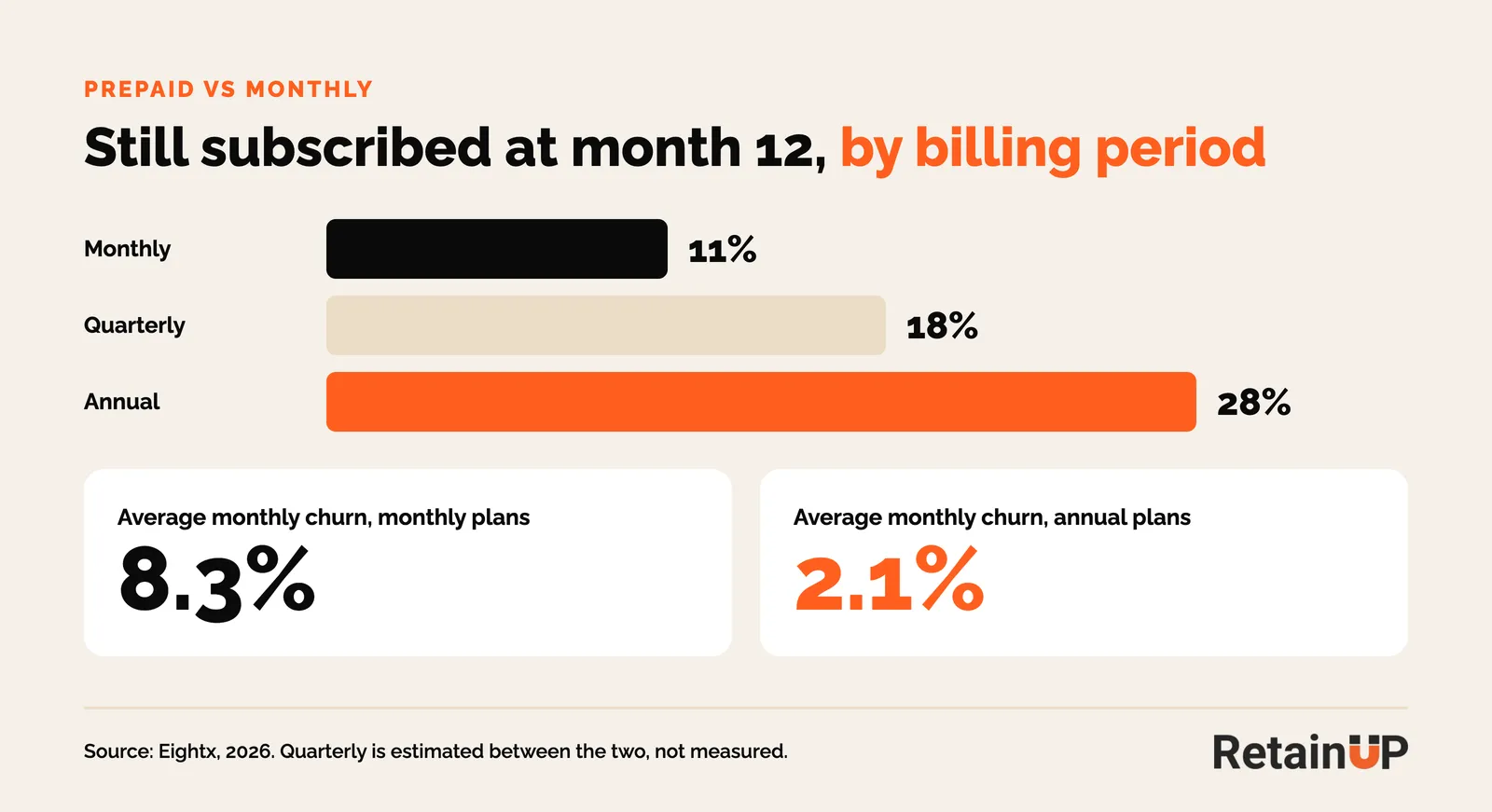
- Eightx puts average monthly churn at 8.3% on monthly plans and 2.1% on annual plans. Its quarterly figure of about 18% retained at month 12 sits between the two as an estimate.
- In an Ordergroove case study, Compass Coffee’s prepaid subscribers had 30% higher lifetime revenue and stayed for 73% more orders.
- The same case study says 62% more subscriptions renewed for a second prepaid term.
One warning on all of these. The people who pick a 6-month plan were already more committed. Some of the lift is the plan, and some is who chose it. Nobody publishes the split, so treat every lift number as the ceiling.
What our own data shows
This month we audited a supplement brand on Recharge with monthly, quarterly and annual plans running side by side. Same product, same funnel.
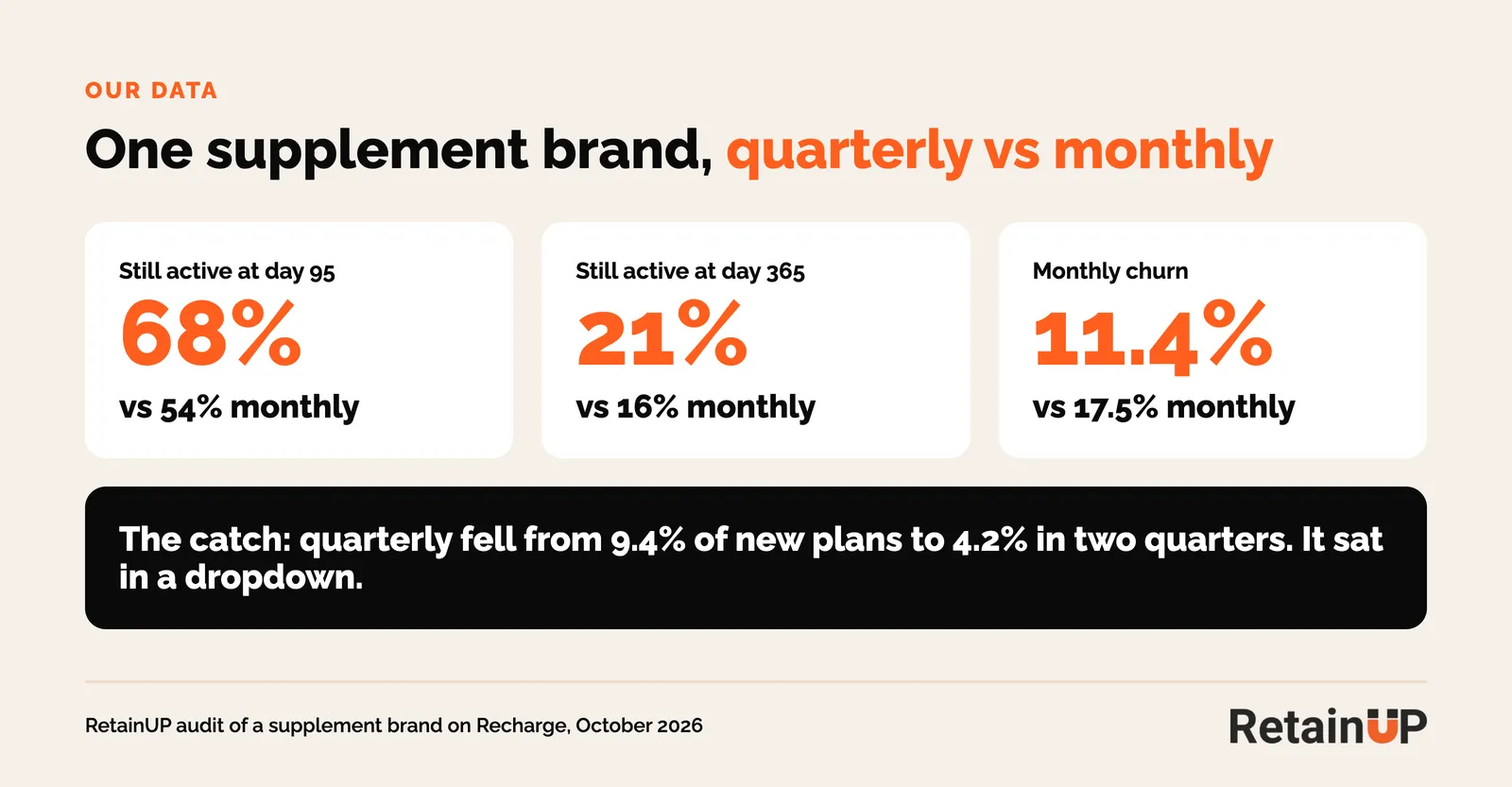
- Still active at day 95: 68% on quarterly, 54% on monthly.
- Still active at day 365: 21% against 16%.
- Monthly churn: 11.4% on quarterly, 17.5% on monthly.
- Annual was under 1% of plans. Nobody wanted it. It was a decoy.
And the part that hurt. Quarterly fell from 9.4% of new plans in Q1 to 4.2% in Q3. Nothing changed in the offer. The option sat in a dropdown on the quiz results page, and people stopped finding it.
Subscribers also tell you which way they lean. On another brand’s data, 73.3% of frequency changes made the interval longer. Hardly anyone asks to get product faster.
Why longer plans churn less
Longer plans churn less because the subscriber faces fewer renewal decisions, and because they are still around when the product starts to work.
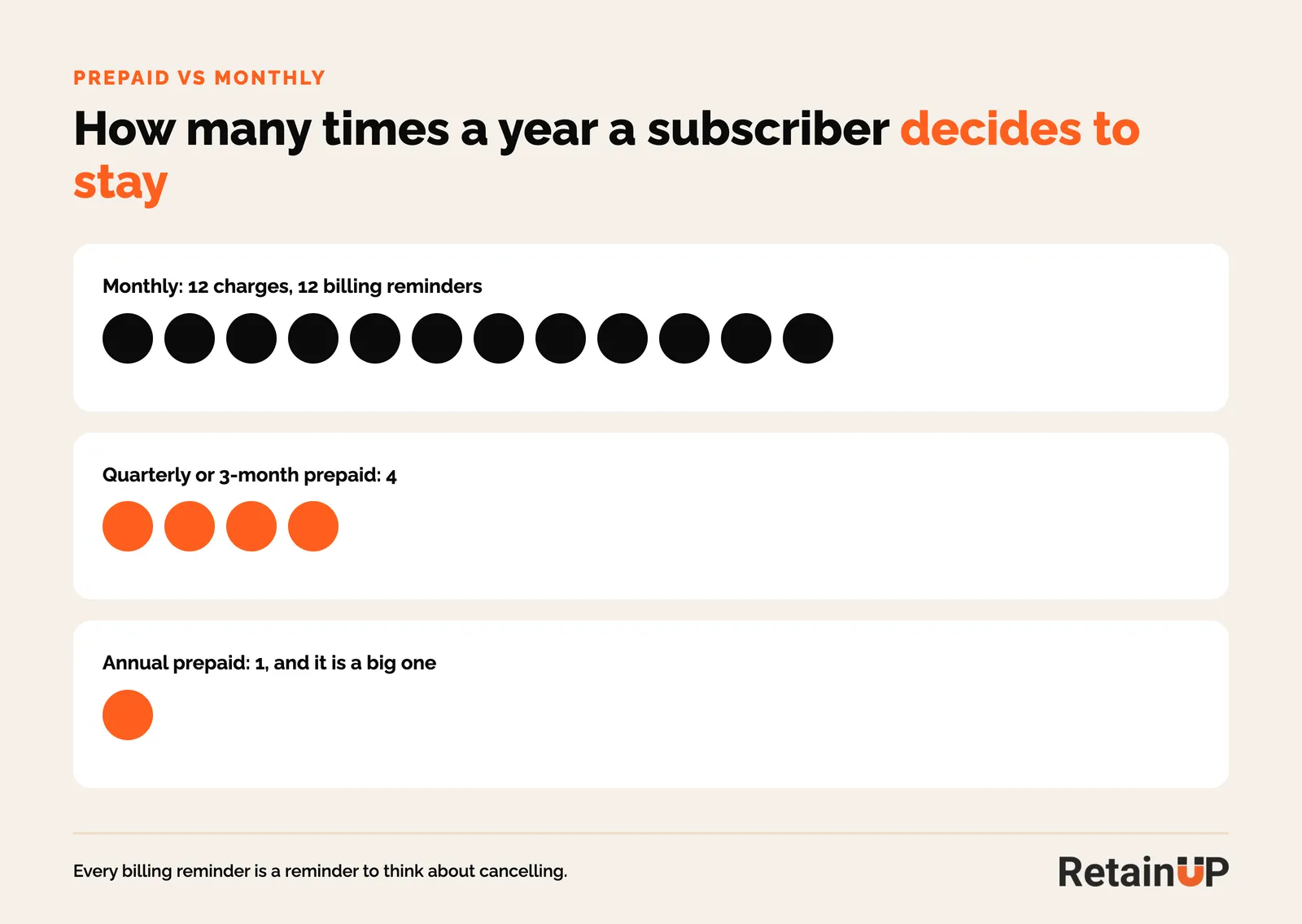
Every billing reminder is a reminder that a charge is coming. On monthly, that happens 12 times a year, and the first one lands before most supplements have done anything. Most of the benefits in this category take 60 to 90 days to feel. A monthly subscriber is asked to pay again at day 30, when they have felt very little.
A 3-month subscriber skips that first decision entirely. The first churn window, where most cohorts lose 30 to 40%, does not exist for them.
Cash flow and CAC payback
Prepaid pays back acquisition cost faster, often on day one. That matters more than the retention gain for most brands spending on Meta.
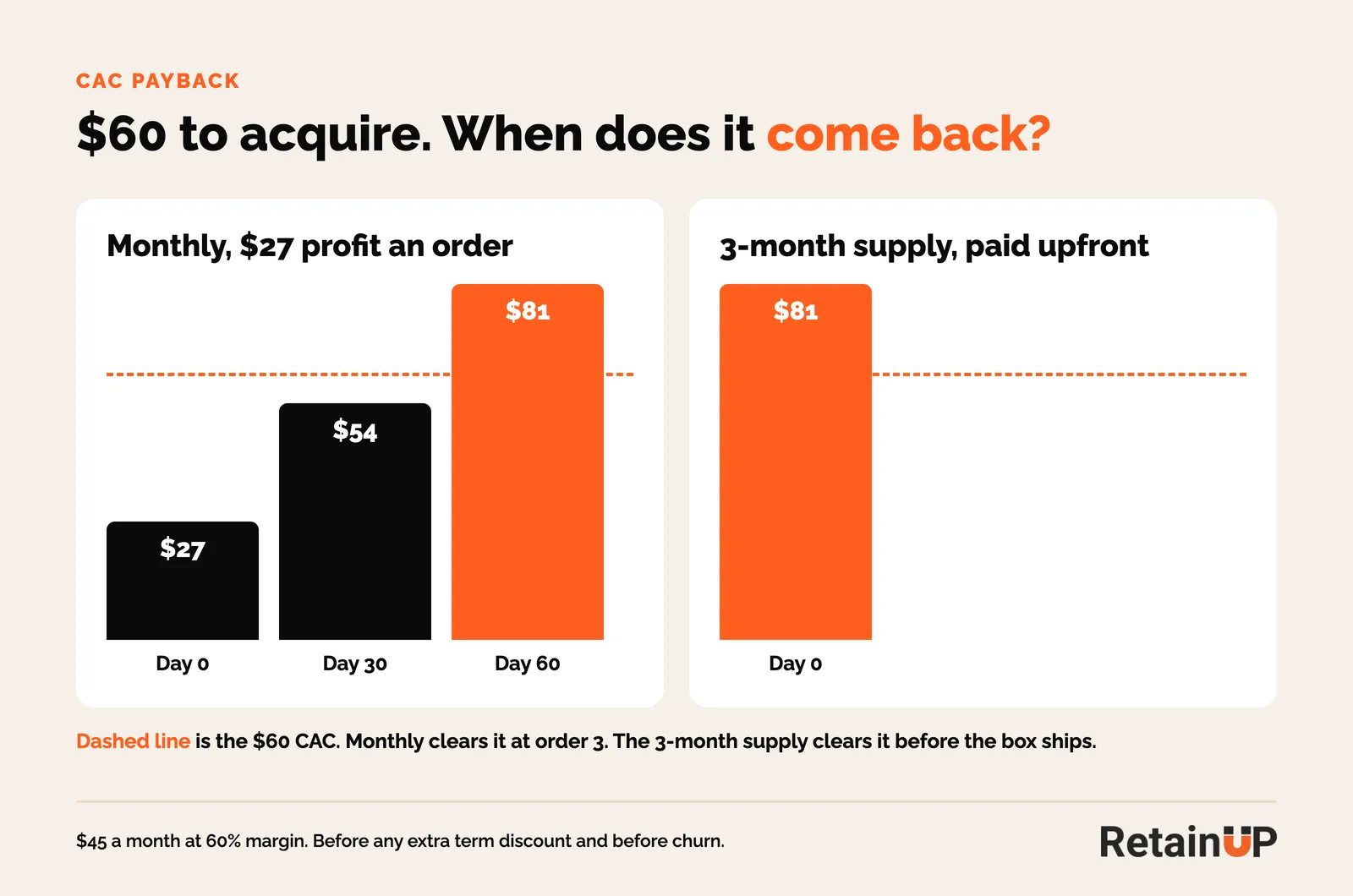
Take the numbers from our payback post. A $45 a month subscriber at 60% margin brings $27 of gross profit an order. You paid $60 to acquire them. On monthly, you get your money back at order 3, around day 60. A 3-month supply brings $81 of gross profit at checkout. Paid back before the box ships.
IM8 is the public example. Its quarterly plan went from nothing to more than half of revenue in about nine months.
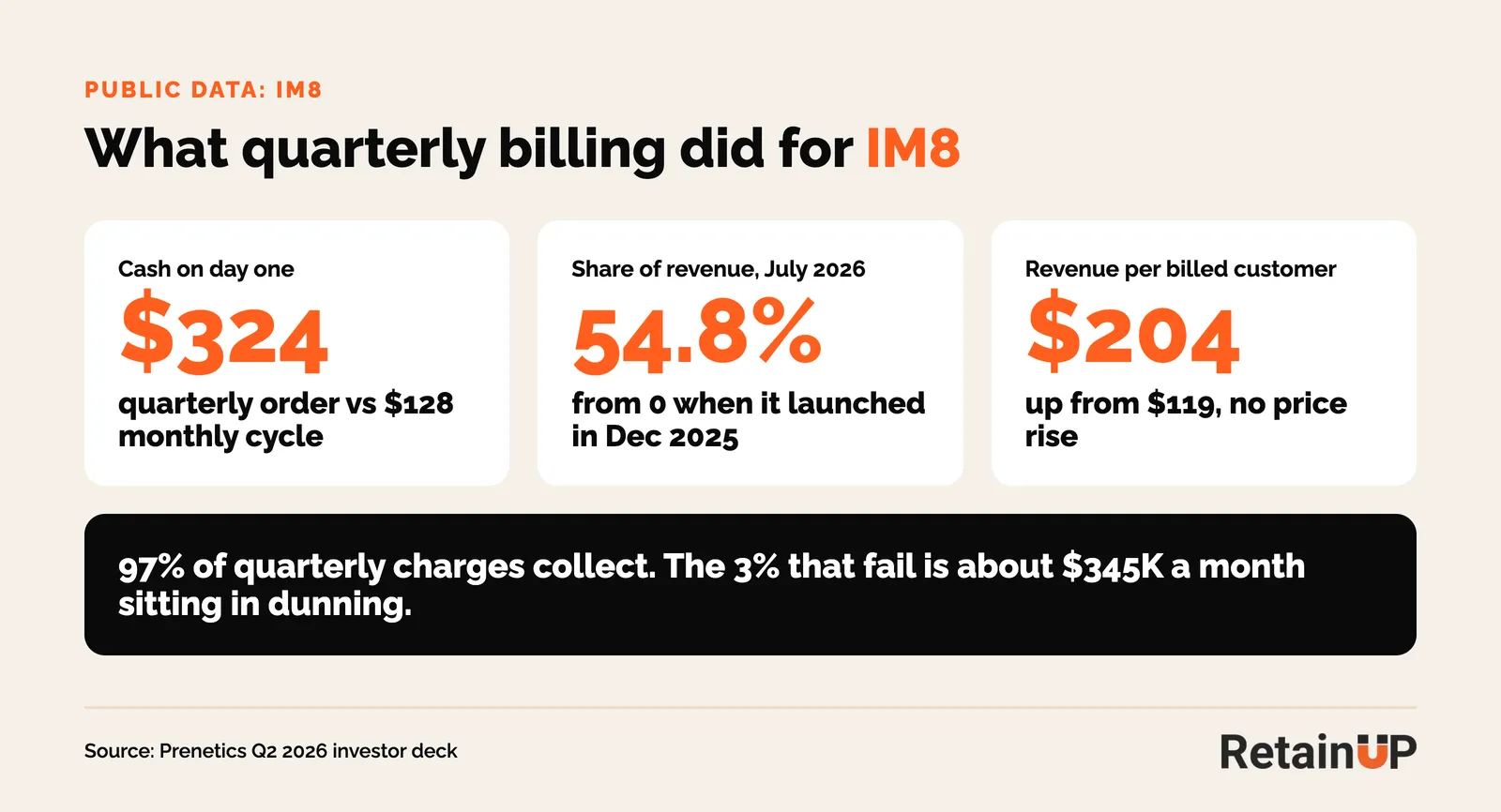
That is how IM8 survives a $300 blended CAC, as I wrote in the IM8 Q2 breakdown. One thing to watch: 97% of quarterly charges collect, so 3% fail. On a $324 charge, each failure costs far more than one on a $128 charge. Your dunning has to be ready before you push the bigger plan.
How much to discount each term
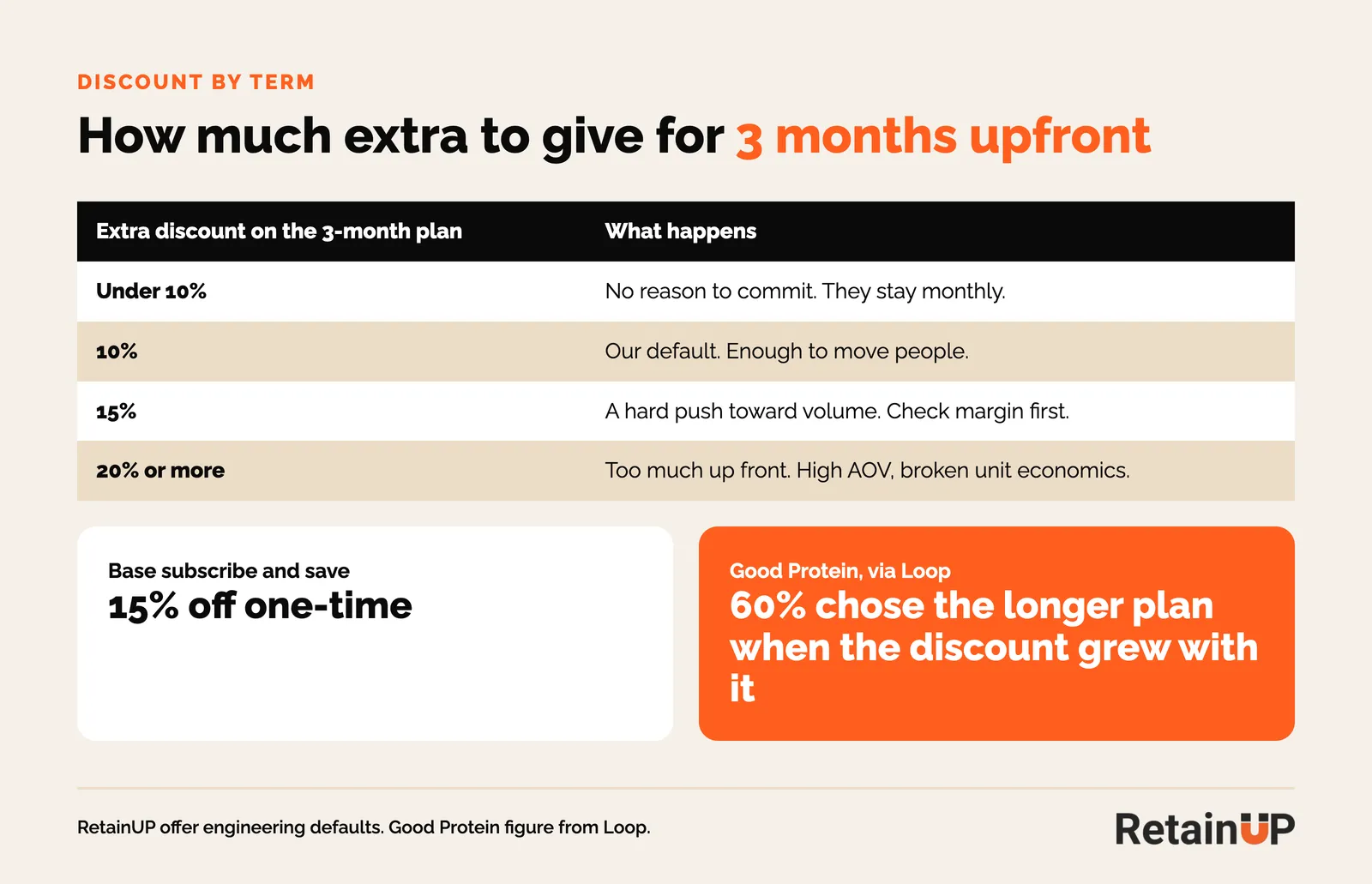
Give the 3-month plan about 10% on top of your normal subscription discount. Less than that and nobody moves. More than 20% and the margin breaks before the first renewal.
A worked example. One-time price $50. Subscription at 15% off is $42.50 a month. The 3-month plan at another 10% off is $114.75, against $127.50 for three monthly charges. That is $1.28 a day against $1.42. Show the per-day number on the page. People compare days, not totals.
The discount should grow with the commitment. When Good Protein did this, 60% of subscribers picked the longer plan, according to Loop. We cover the full ladder in the 3-tier offer stack.
Keep the price steady at renewal too. The supplement brand above charged about 25% less for the first order than for renewals. A 33% jump at renewal is a cancel reason you created yourself.
The renewal cliff at the end of the term
A prepaid term ends in one big charge, and that is where prepaid subscribers leave. Eightx puts first-renewal churn on annual plans at 25 to 35%. On a 3-month plan the cliff is smaller, but it comes four times a year.
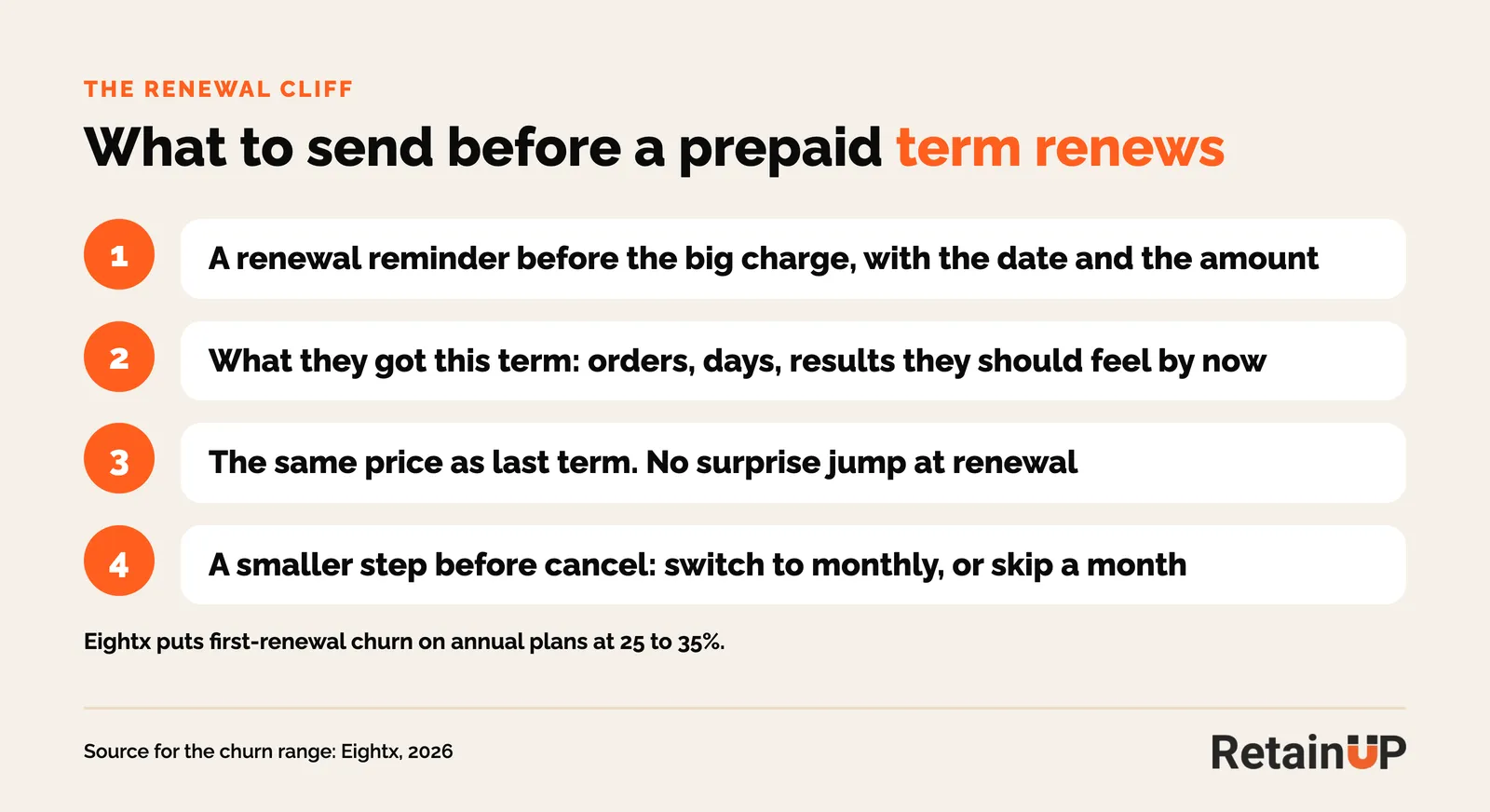
Most brands send the same billing reminder to a quarterly subscriber as to a monthly one. Then nothing for 80 days. The brand above had exactly that: from day 28 to day 90, the only email was the billing reminder.
Give the quarterly plan its own journey. And when a 3-month subscriber reaches the cancel flow, offer monthly before any discount. On one supplement brand we work with, a subscriber who moved from the 3-month plan to monthly instead of cancelling was worth $148 more in lifetime value.
When prepaid fits, and when monthly is better
Prepaid fits products used every day at a fixed dose, where results take weeks to show. Monthly is the better default when use varies a lot from person to person, or when you have not yet seen people come back for a second term.
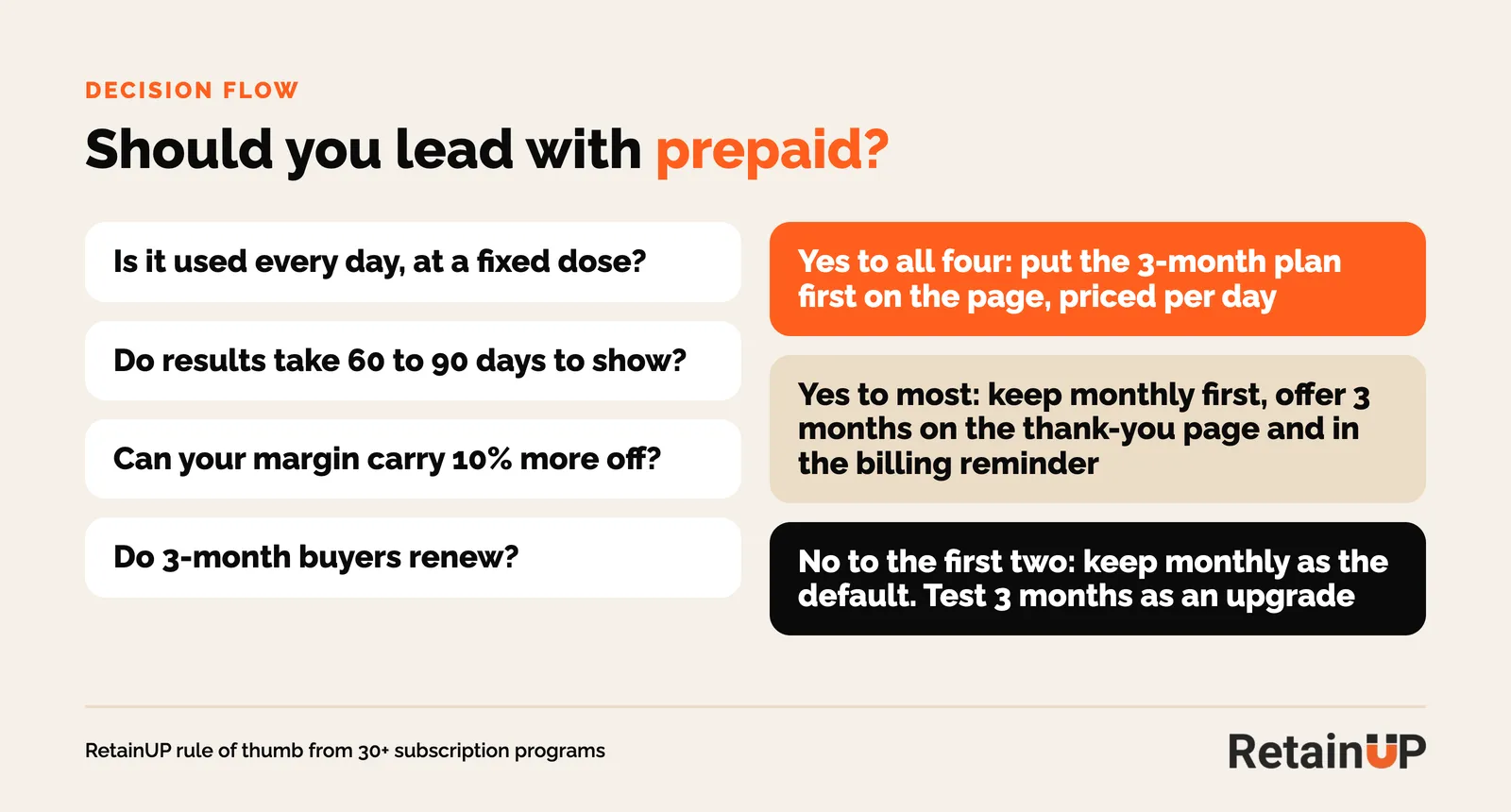
- Lead with 3 months for daily supplements, greens, creatine, collagen. Grüns and IM8 both push their quarterly plan.
- Keep monthly first for a new product with no repeat data. You are shipping three months of something nobody has tried.
- Avoid it on thin margins. The extra 10% has to come from somewhere, and a 3-month supply also triples the product cost on the first order.
- Watch the cohort read. Quarterly subscribers look like churn on a monthly chart. Read them by order, not by date.
Where to offer the longer plan
Offer it in more places than the product page. Most of the longer-plan upgrades we see happen after the first yes.
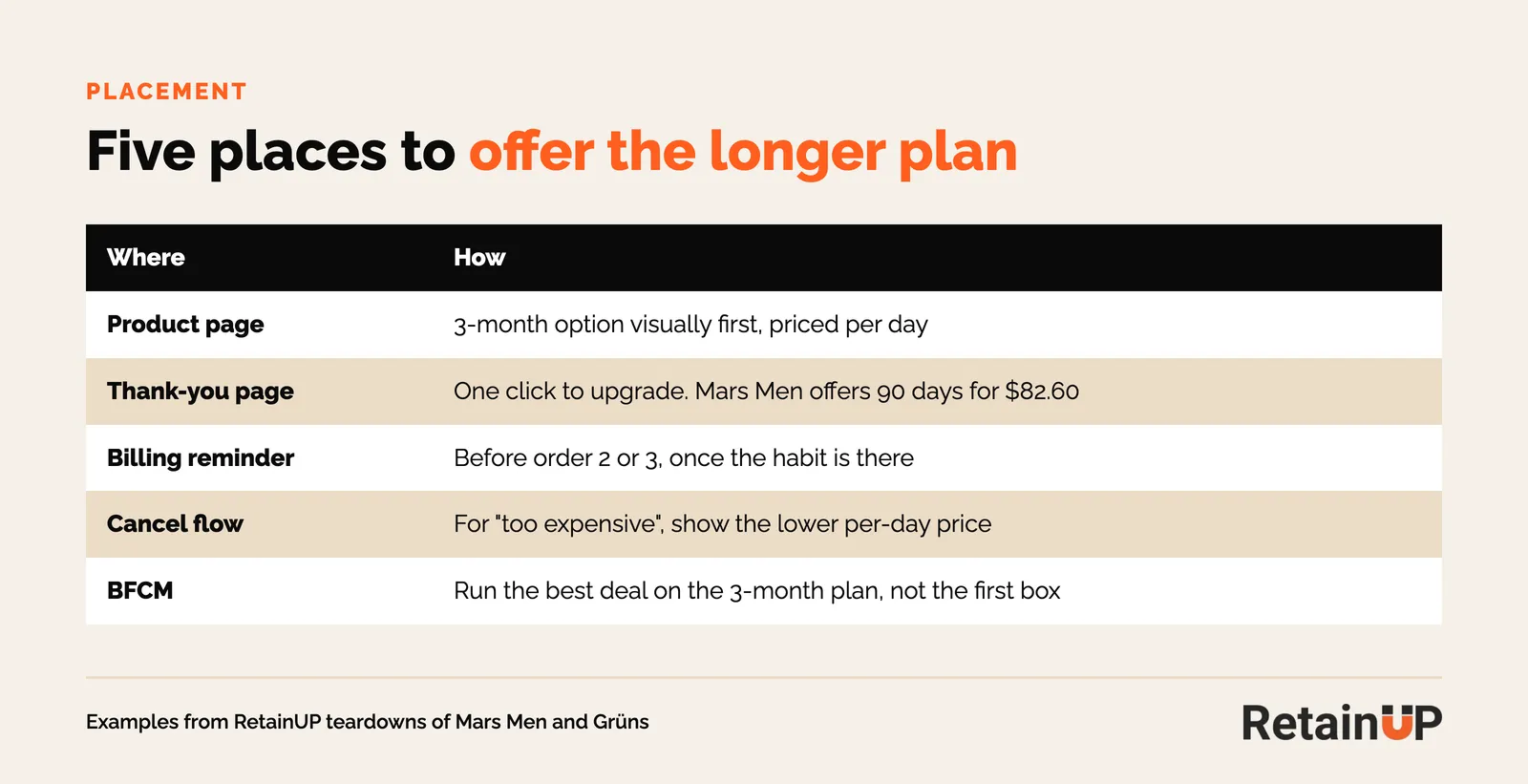
Mars Men sells 30 days at checkout and offers 90 days for $82.60 on the next screen. Grüns sells one frequency and upsells quarterly on the thank-you page. Both get the bigger order without making checkout harder.
Setup notes for Recharge and Loop
A few things that break when brands set this up themselves.
- On Loop, build supply length as a variant (1 month, 3 months), not as quantity. If quantity and frequency are separate, a subscriber who changes one can end up with 3 packs every month.
- On Loop, prepaid cannot be unticked once a plan group is saved. Build a new group instead.
- True prepaid creates three orders and three shipments per charge. Your 3PL and your reports need to know that.
- Recharge’s help centre requires the charge interval to be a multiple of the shipping interval. Check how it counts a prepaid subscription after the final charge before you read churn reports.
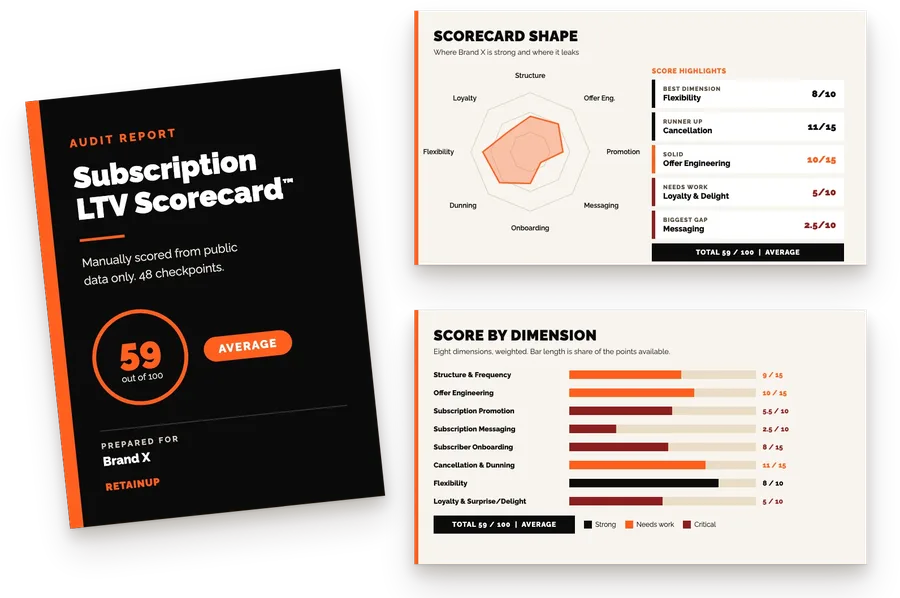
If you want to see where your own plans stand, our free subscription audit scores frequency and offer structure on the same checkpoints we use for Grüns and IM8.
FAQ
Do prepaid subscriptions reduce churn?
Yes. Longer terms mean fewer renewal decisions, so fewer people leave. In our audit data, quarterly subscribers churned 11.4% a month against 17.5% on monthly.
What discount should I give for a 3-month prepaid plan?
Around 10% on top of your base subscription discount. Under 10% rarely moves anyone, and 20% or more usually breaks unit economics.
Should I offer annual prepaid plans?
Usually no for a $1-10M consumable brand. In the brand we audited, annual was under 1% of plans. A 3-month plan gets most of the benefit with a smaller renewal cliff.
Is prepaid the same as a 3-month supply?
No. Prepaid charges once and ships every month. A 3-month supply charges once and ships once. Cash and churn behave the same, but the supply costs less to ship.
What happens when a prepaid term ends?
The subscriber faces one big charge. Send a renewal reminder with the date and amount, show what they got, keep the price the same, and offer monthly before they cancel.
Will prepaid hurt my conversion rate?
It can if it replaces monthly. Offer it next to monthly, priced per day, or as an upgrade on the thank-you page, so the first decision stays small.
One email a week on subscription retention: the numbers, the strategy, and what to fix first.

Rahi Jain
Rahi Jain is a subscription LTV specialist who helps $1M to $10M DTC brands reduce subscription churn and maximize LTV on Recharge, Skio, Stay AI and Loop.
More about Rahi