Key takeaways
- Everyday Dose scored 81 out of 100 on the Subscription LTV Scorecard™: 46 out of 50 for keeping subscribers, the best retention score we have given, and 35 for getting them.
- A gift with every order for the first year, bonus points at orders 3, 6, 9 and 12, and a referral that pays only when the friend stays to order 2 and 3.
- Dose Fam, a private Facebook group of 260,000 members, does the retention work no tool can copy. The gaps are before you subscribe: monthly shipping for every pack size and a price that jumps after order one.
Everyday Dose sits in the Subscription Scorecard Library next to every other brand scored on the same 48 checkpoints.
The biggest retention brands are cults. This is one.
Everyday Dose did about $100 million in 2025, by Forbes' estimate, and they have 250,000+ subscribers. They are rated 4.9 on Trustpilot across 9,500 reviews. Rare for any brand.
But the number that blew me away is this one. A private Facebook group with 260,000 members, where people post their coffee every morning, build Christmas gift bags, and share their loyalty tier like a trophy. You cannot buy that. Not with any money.
In the age of AI, people can copy your brand, your design, your product, in a weekend. They cannot copy your community. Ever.
So I scored their whole subscription program on 48 checkpoints. 81 out of 100. The best retention score we have ever given. And the lowest growth score.
Watch the full Everyday Dose breakdown
What is Everyday Dose?
Everyday Dose sells mushroom coffee: real coffee with lion's mane, chaga, collagen and L-theanine. Plus a matcha and a protein coffee. Jack Savage started it in 2020.
- Scale: a "nine-figure business" with 250,000+ subscribers, per the company. About $100M in 2025, per a Forbes estimate.
- Reviews: 4.9 on Trustpilot across about 9,500 reviews.
- Retail: 5,000+ doors in under 12 months, including Target and Sam's Club.
- Platform: Shopify, Skio for subscriptions (they moved from Recharge), Bubblehouse for rewards.
- Community: Dose Fam, a private Facebook group with 260,800 members.
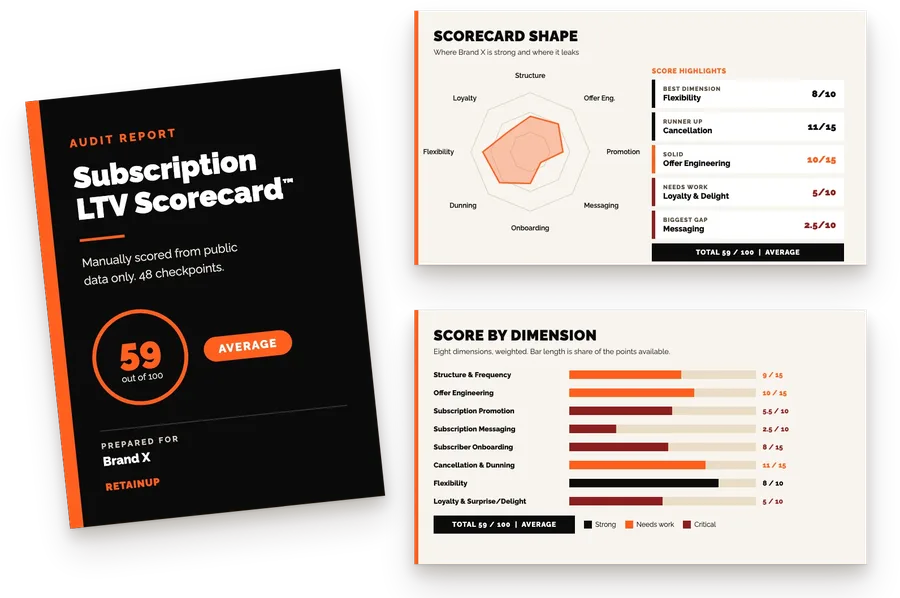
The Everyday Dose subscription scorecard: 81 out of 100
Scored 28 October 2026 and rescored 8 to 9 November 2026, from public data only, with the cart and checkout checked live. 8 dimensions, 48 checkpoints.
| Dimension | Score | Out of | Points lost |
|---|---|---|---|
| 1. Structure and frequency | 9 | 15 | 6 |
| 2. Offer engineering | 9 | 15 | 6 |
| 3. Subscription promotion | 8 | 10 | 2 |
| 4. Subscription messaging | 9 | 10 | 1 |
| Subscription growth | 35 | 50 | 15 |
| 5. Subscriber onboarding | 14 | 15 | 1 |
| 6. Cancellation and dunning | 13 | 15 | 2 |
| 7. Flexibility | 9.5 | 10 | 0.5 |
| 8. Loyalty and surprise/delight | 9.5 | 10 | 0.5 |
| Subscription retention | 46 | 50 | 4 |
| Total | 81 | 100 | 19 |
46 out of 50 on keeping subscribers, the best in the series. 35 out of 50 on getting them, the lowest. Second overall, right behind Grüns.
Three things to copy
First, invite people to your community before their first order arrives. Every shipping email skips the upsell and asks one thing: join Dose Fam.
Second, reward the orders that matter. A bonus at the 3rd, 6th, 9th and 12th order, and a gift with every box for the first year.
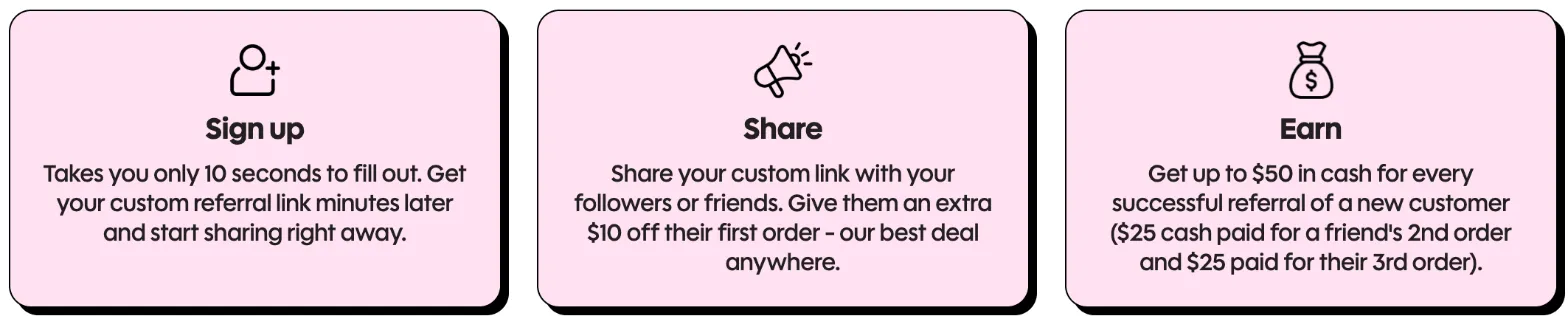
Third, pay referrers only when the friend stays. $25 when the friend places a second order, and another $25 at the third. This one I loved.
One thing to avoid. A first-order price that jumps on the second charge.
1. Structure and frequency: 9 out of 15
Here I look at how often the product ships and what choices you get. They do a good job of giving only two options, 30 or 60 servings, and one cadence, every month. We do not want too many options. Good.
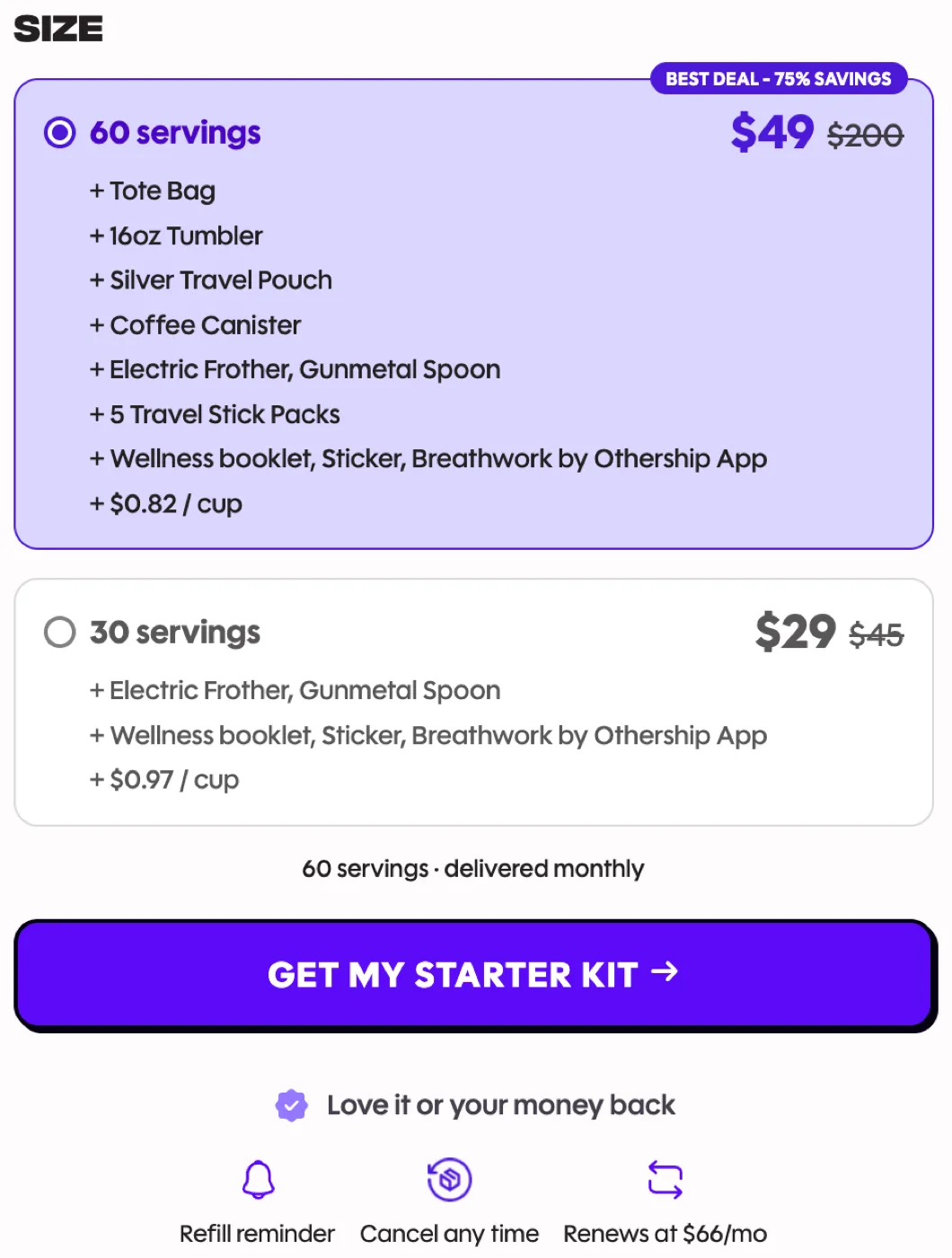
The default is 60 servings a month. Two cups a day. And as a coffee drinker, I agree. One cup is too little. Typically people have two cups a day, and coffee drinkers go up to three.
And they know this. Their founder wrote it in an email: "30 servings is one cup a day. And almost nobody drinks one cup a day." Great reason. But it sits in the email. On the product page it just says 60 servings, delivered monthly. The FAQ says "1 to 4 cups" a day, and nothing sits next to the frequency.
The problem? 90 servings. In the cart they offer 90 servings, and 90 servings also renews every 30 days. So $74 today. Then $99 every month. At one cup a day, that is three months of coffee landing every month.
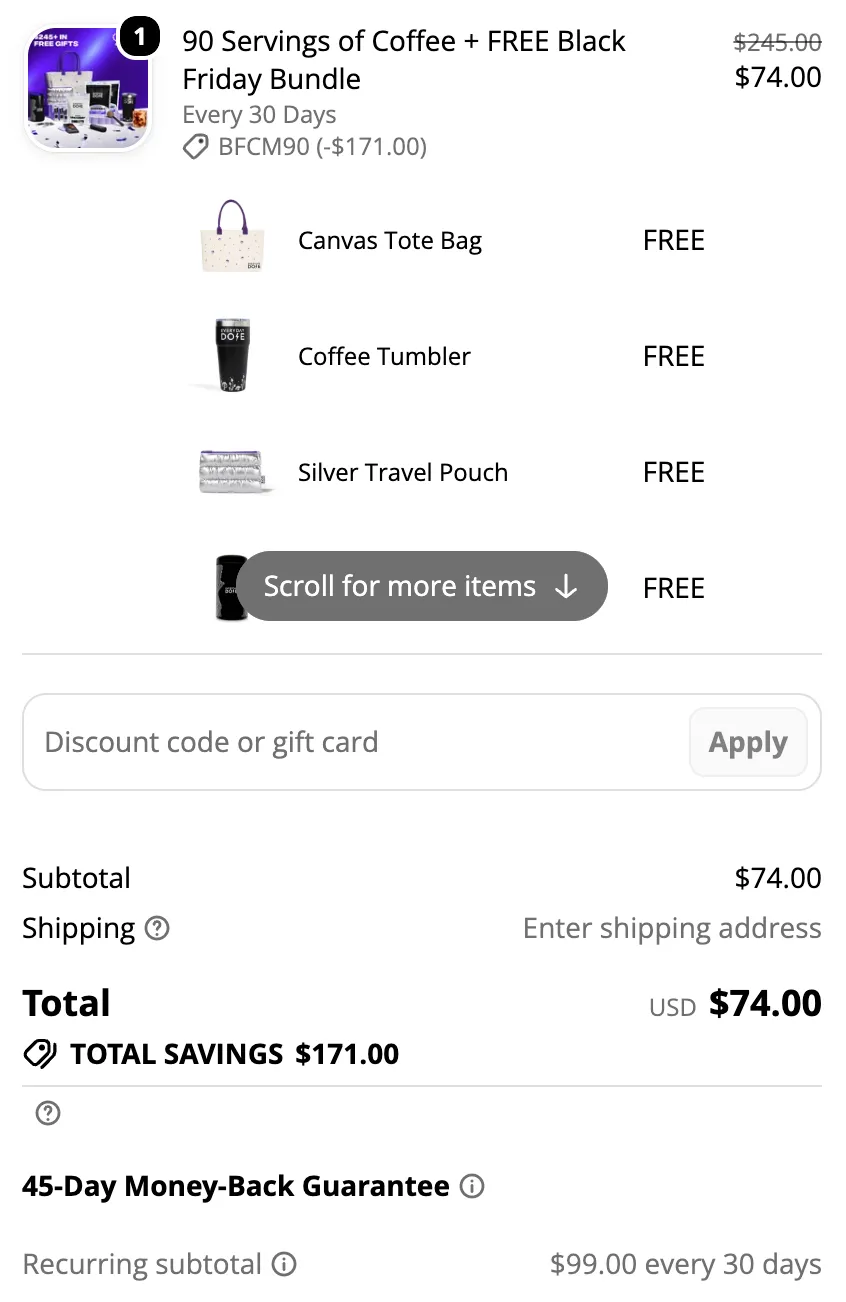
The FAQ even says you can pick every 60 or 90 days at purchase. The product page does not.
Ryze and Reformed do the same thing. Space Goods does it right: buy two, get one free, and the refills ship every three months. DIRTEA sells one pack, and you pick every four, six or eight weeks. Full marks for one thing: Coffee+, Matcha+ and Protein Coffee+ are all on subscription.
What I would change: say the reason next to the frequency, "60 servings is 2 cups a day for a month." And match the cadence to the pack, so 90 servings ships every 3 months.
Pack size and cadence out of step is easy to see in cohort data. The Subscription LTV Roadmap™ reads your subscriptions and shows how much over-supply is driving skips and cancels.
2. Offer engineering: 9 out of 15
Here I look at how the subscription is priced and structured. The first order is the most generous we have scored. The renewal is where they lose.
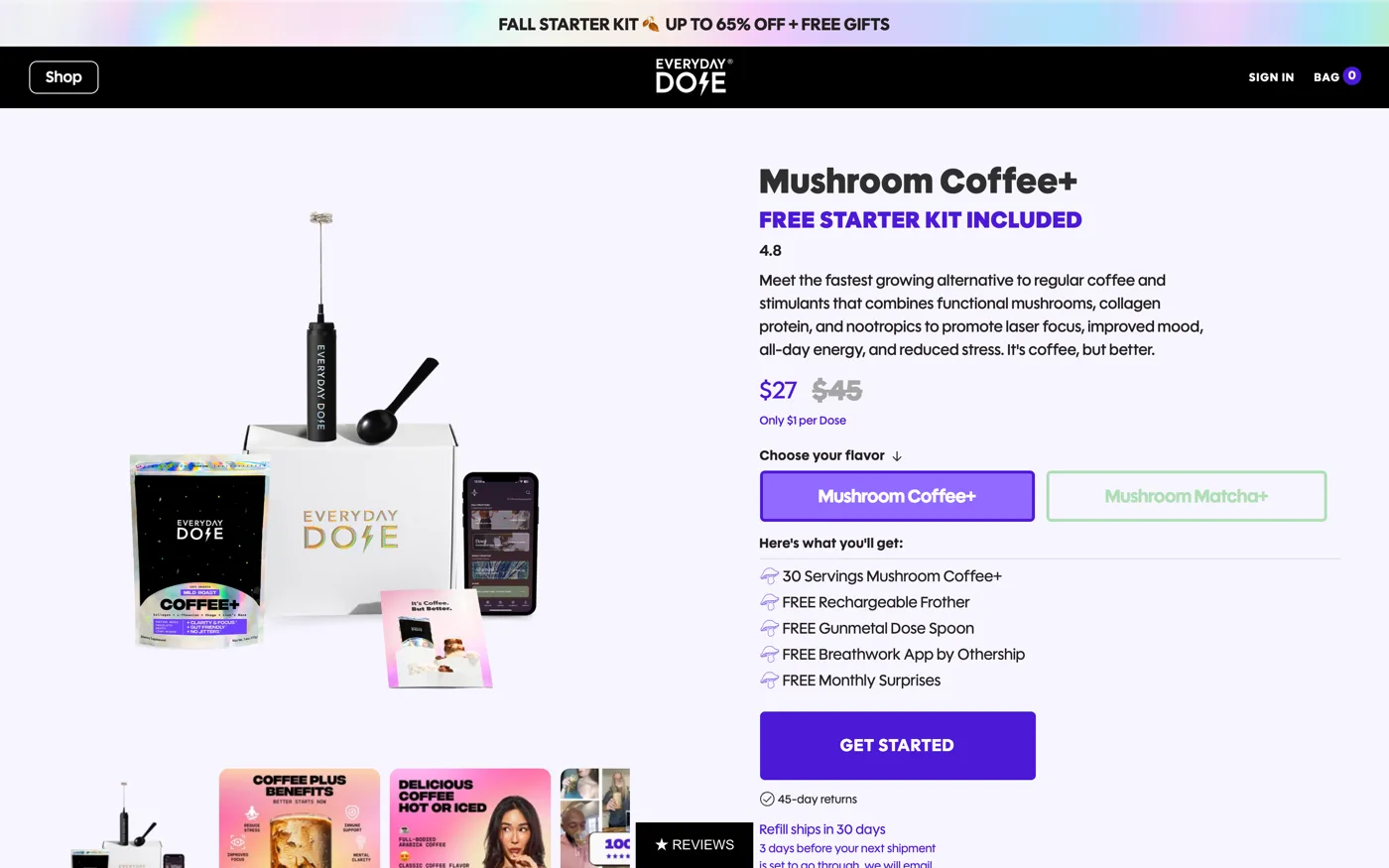
There is no one-time option on the product page. The only way in is "Get My Starter Kit". You can buy once, but you have to find it in the FAQ. One email even sells 5 stick packs for $10, no subscription, because they admit the subscription is what stops most people.
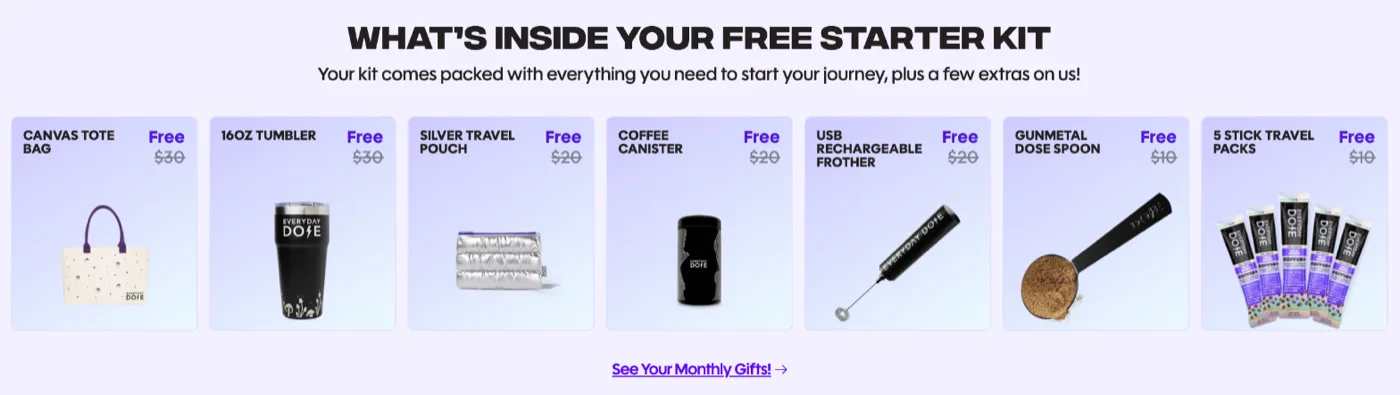
The starter kit is very generous. Seven free items, each with a dollar value on it: a tote, a tumbler, a frother and more. And right below, "See Your Monthly Gifts!" I love this.
The bigger packs get cheaper per cup on renewal: $36 for 30 servings, $66 for 60, $99 for 90. But there is no build-your-own box, and one frequency means nothing to price differently.
And the price goes up after the first order. $49 today. Then $66 a month. I am not a big fan of the first-month subscription discount. It increases churn, and people miss the renewal amount.
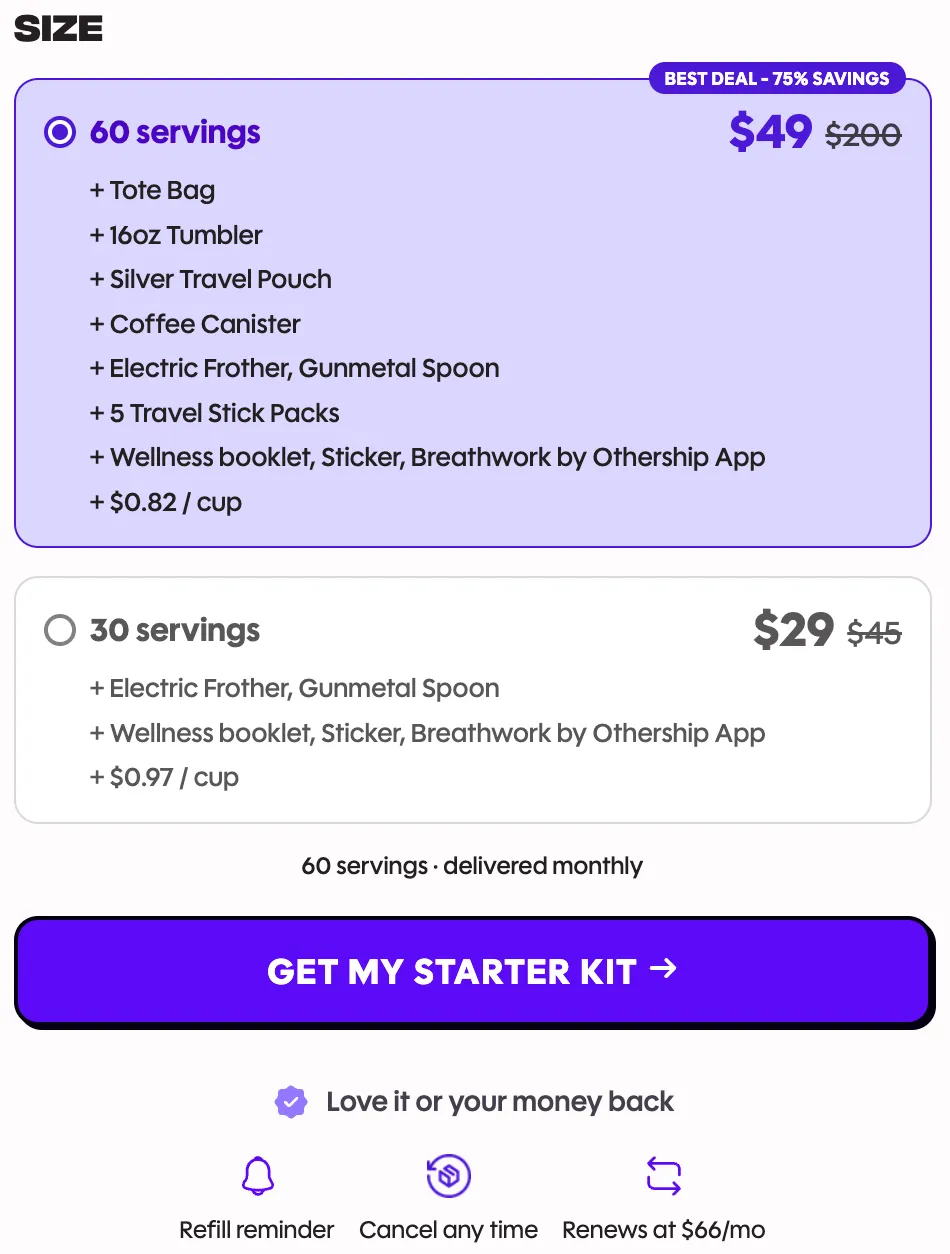
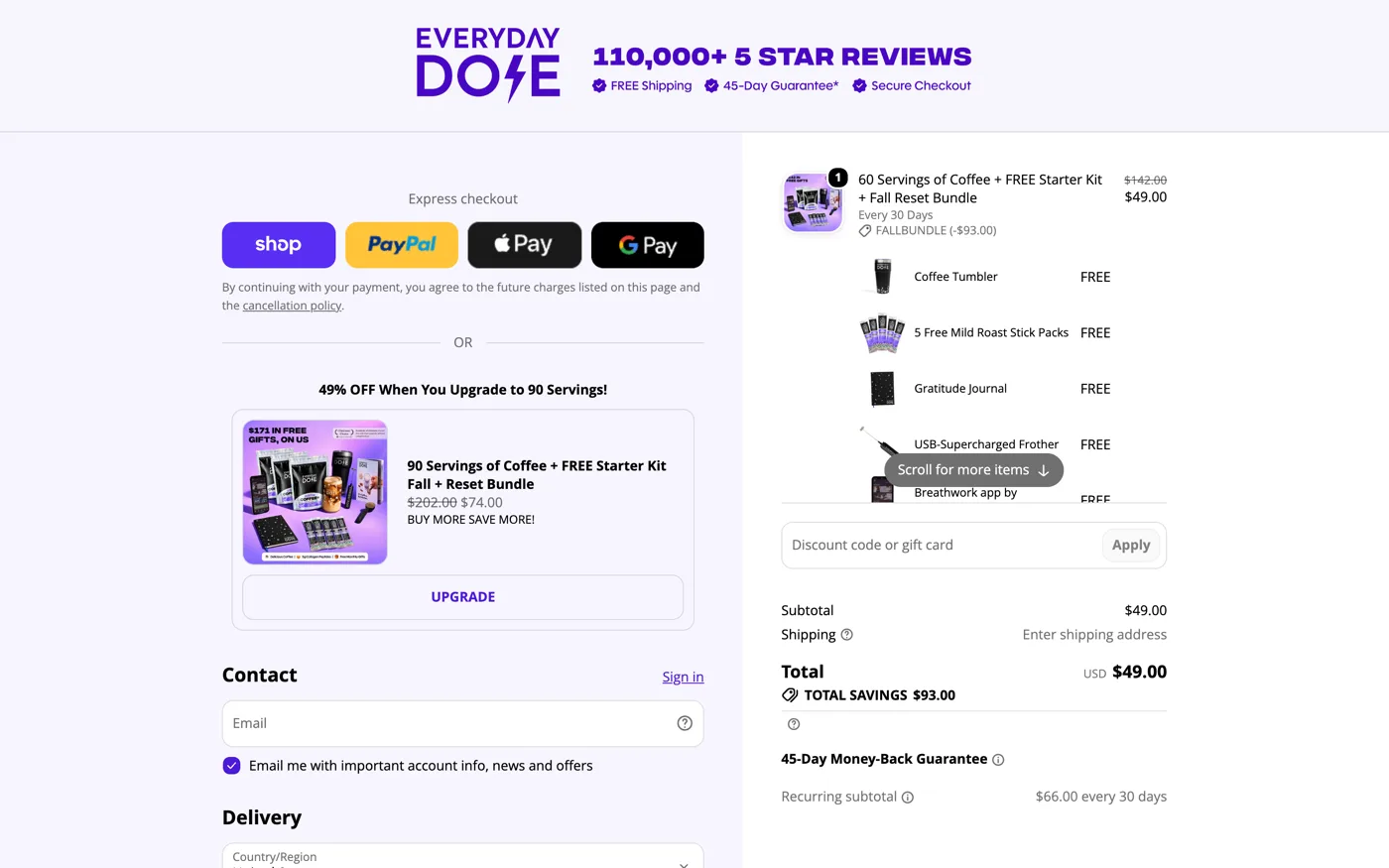
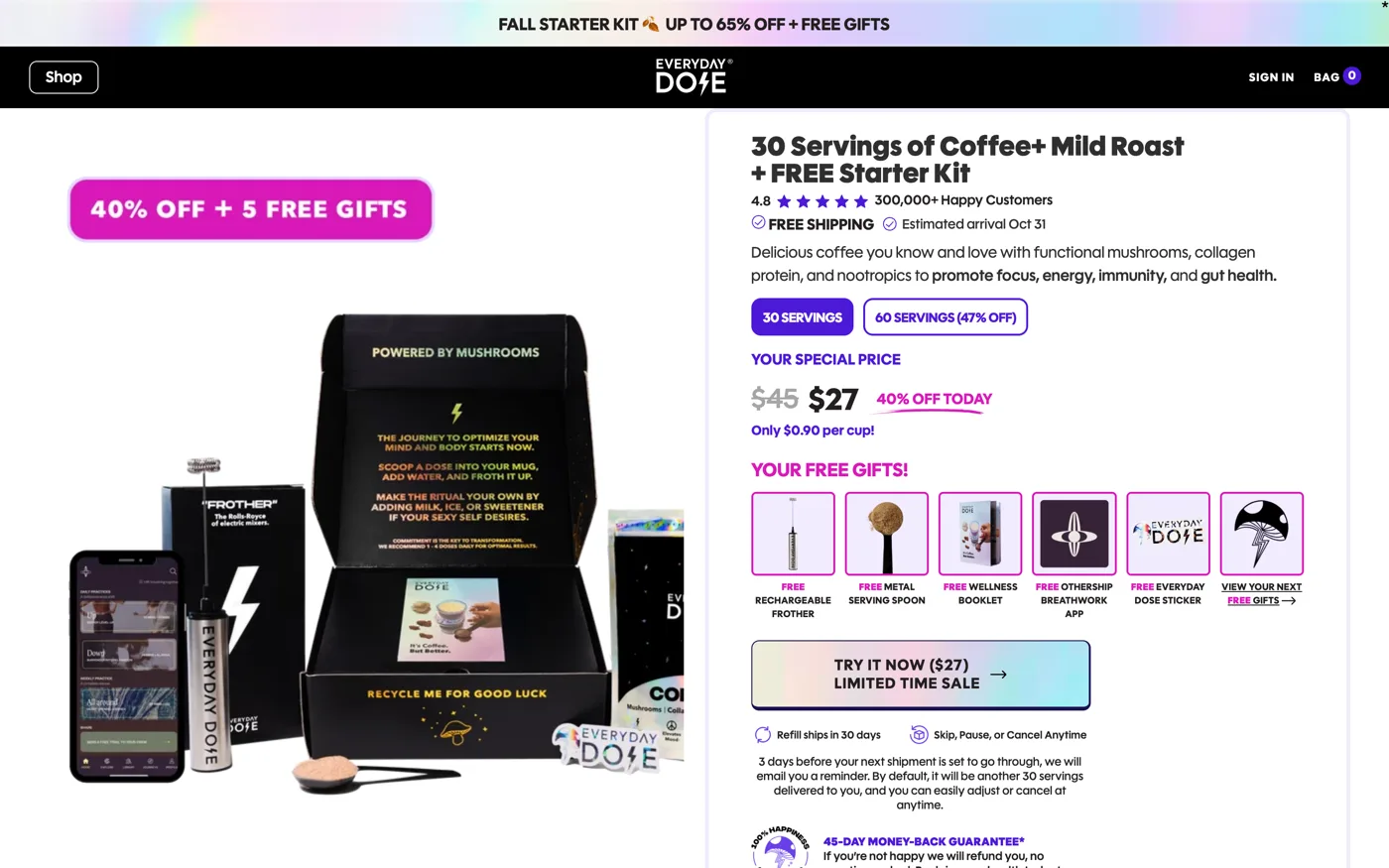
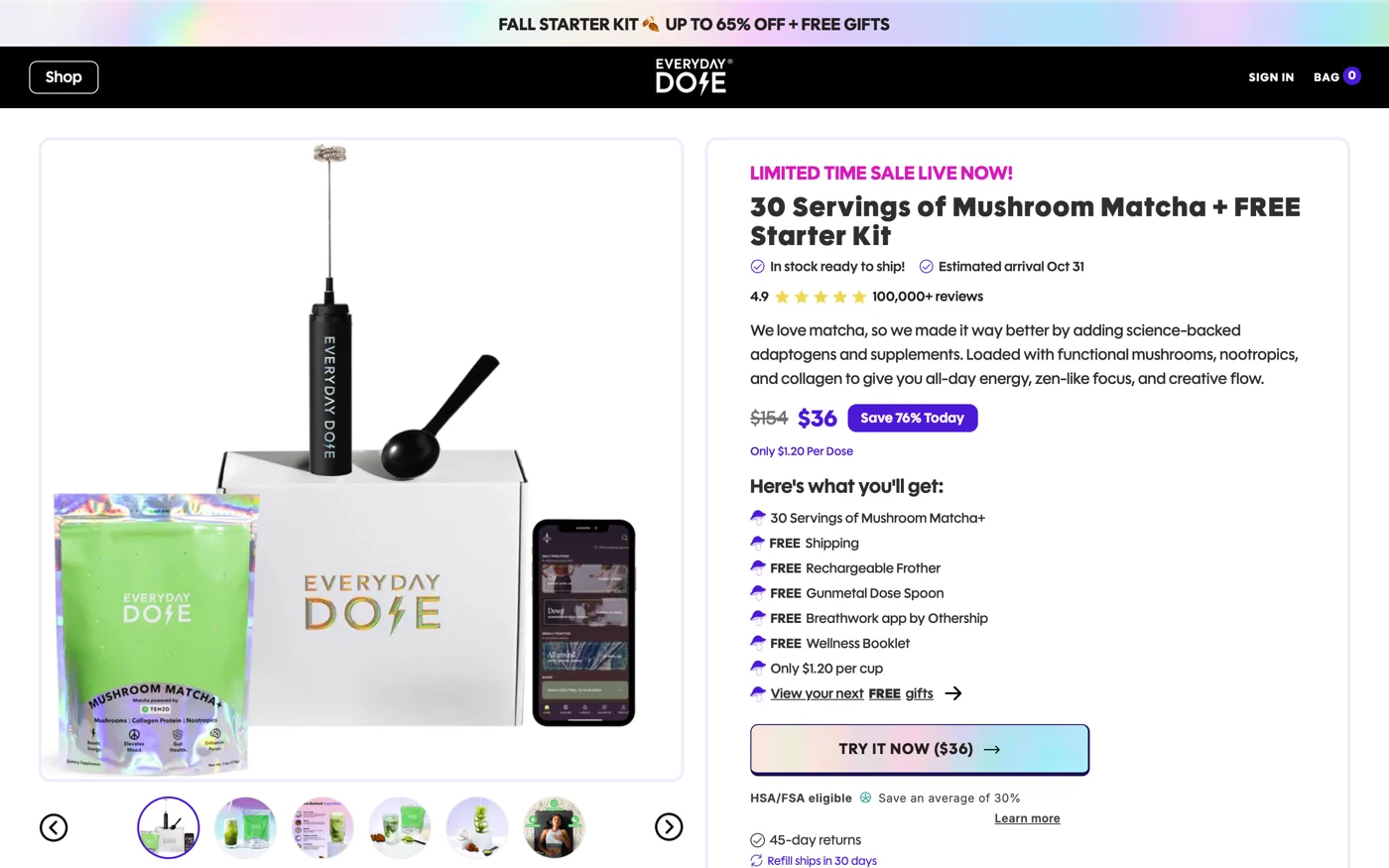
The first-order price also changes by page. $27 against a $45 anchor on one landing page, $36 against $154 for matcha on another. That is fair when you run many landing pages for paid traffic, but it adds up.
What I would change: keep one flat price from order one and give the welcome value as gifts. Reformed, Space Goods and DIRTEA all do this.
One flat price from order one, with the welcome value given as gifts, is an offer build. The Subscription LTV Maximizer™ sets up the offer, the starter box and the gift ladder in your subscription app.
3. Subscription promotion: 8 out of 10
Here I look at how hard the site pushes subscription over a one-time purchase. Subscription is the default. It is the only button on the page. The one-time option is out of sight. The cart sells it again, offering a bigger pack on subscription. The homepage and the top bar push the starter kit, and the starter kit is the subscription.
The benefits go past the discount: a gift every month, points on every order, the Othership app, and free shipping.
Where they lose is a dedicated page. There is none. Their FAQ does a better job than the site. It answers every worry before you subscribe: when you are billed, the reminder three days before renewal, how to skip, swap or change frequency, and how to cancel. That is exactly what a subscription page should cover.
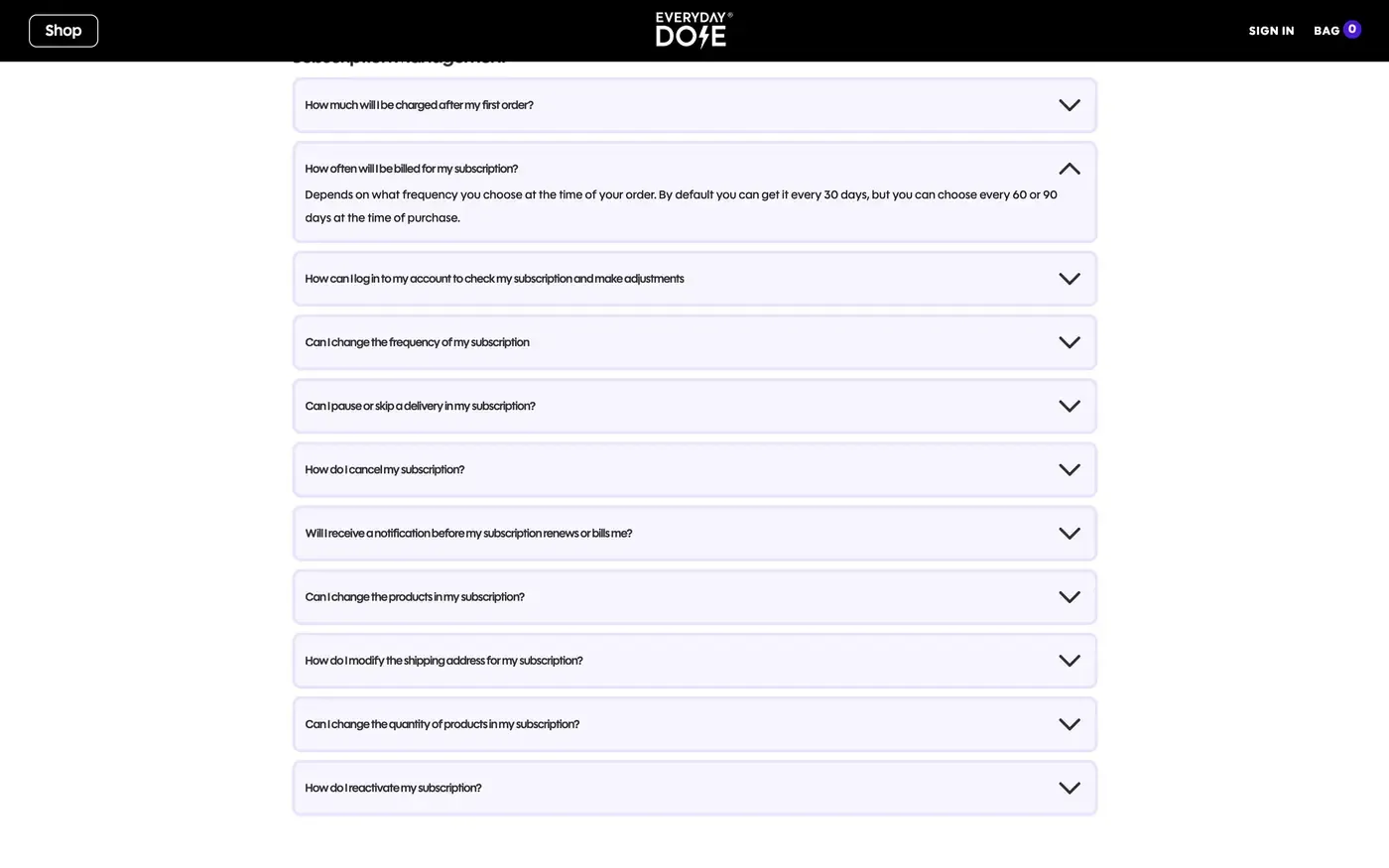
The terms also use four different names for one subscription.
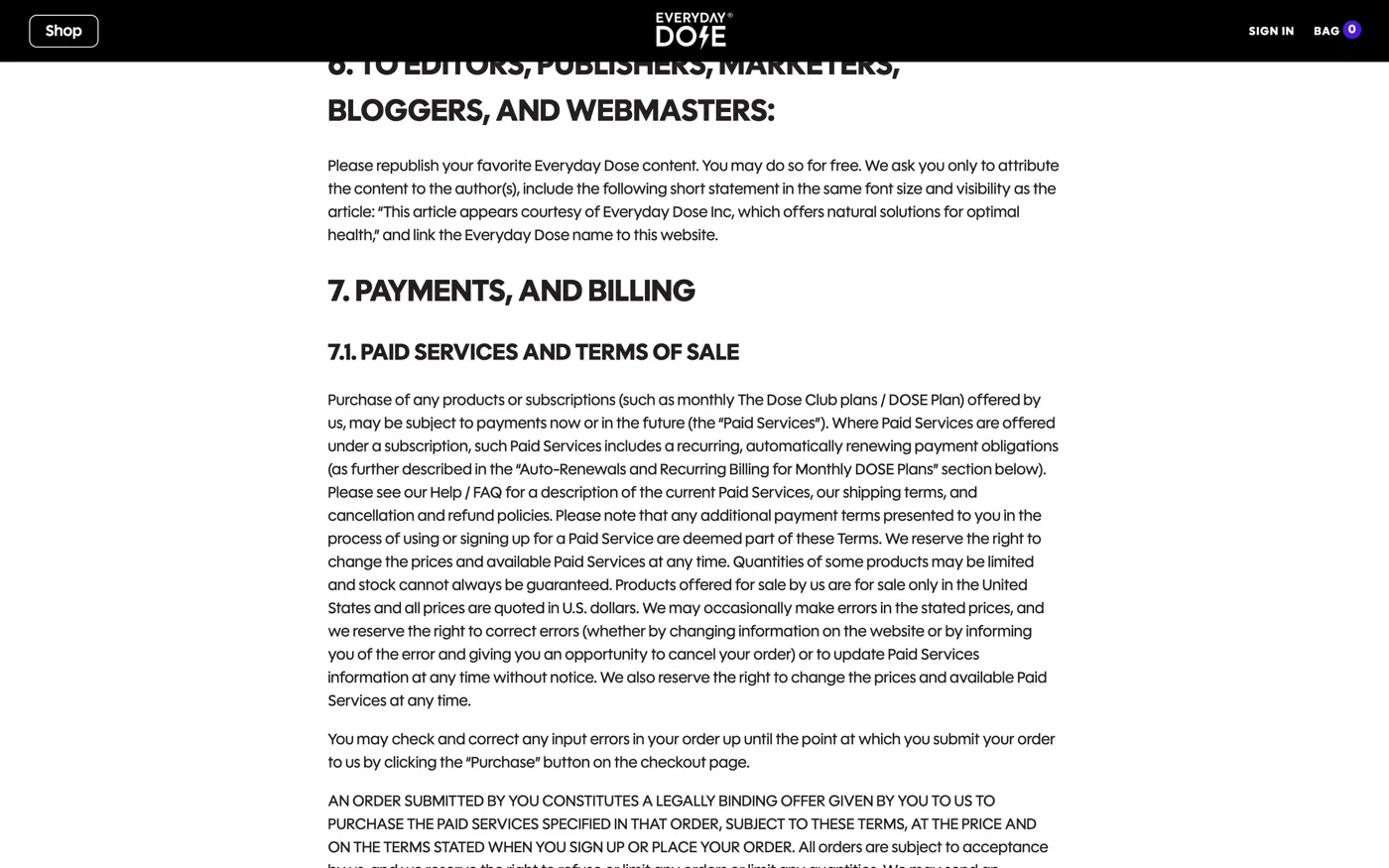
What I would change: turn the FAQ into a real subscription page, linked from the product page. Use one name.
A real subscription page, linked from the product page, is part of the Subscription LTV Maximizer™. It turns an FAQ like this one into the page that sells the plan.
4. Subscription messaging: 9 out of 10
Here I look at what the copy says about why you should subscribe. Very nicely done.
They tell you why. A landing page says 99% of people subscribe, because the change is long-term.
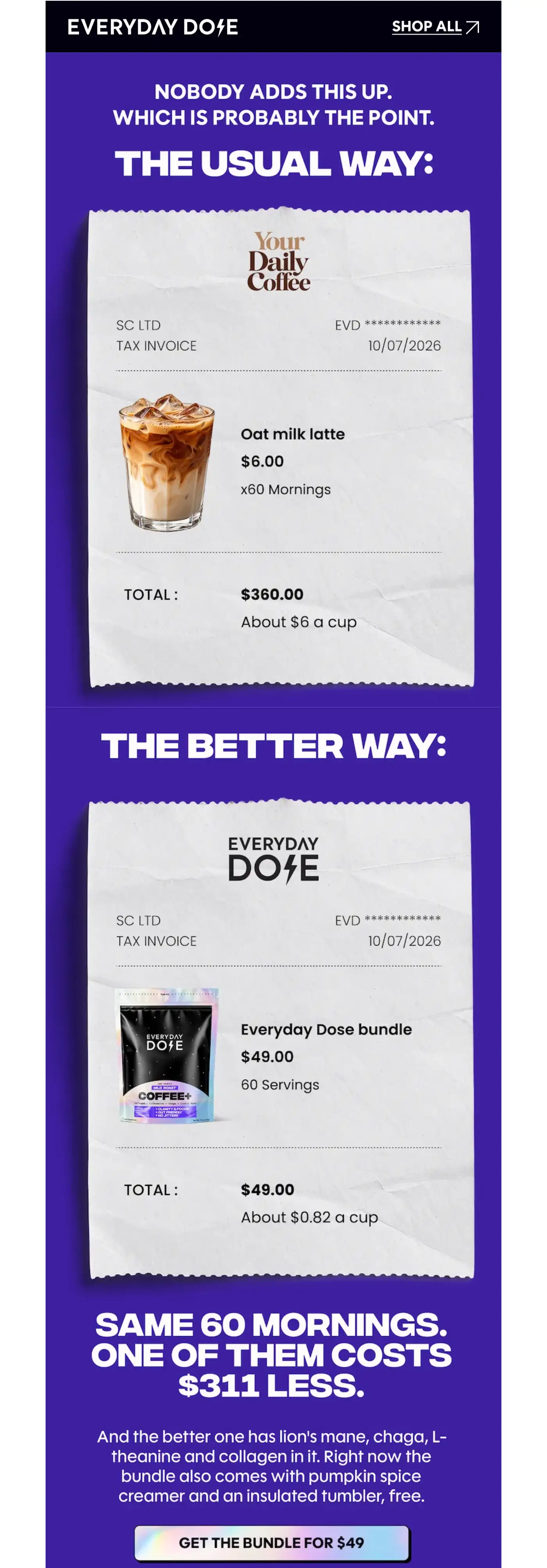
They answer the price before you ask. 82 cents a cup. And one email puts it next to your café latte. 60 oat milk lattes at $6: $360. 60 servings of Dose: $49. "Same 60 mornings. One of them costs $311 less."
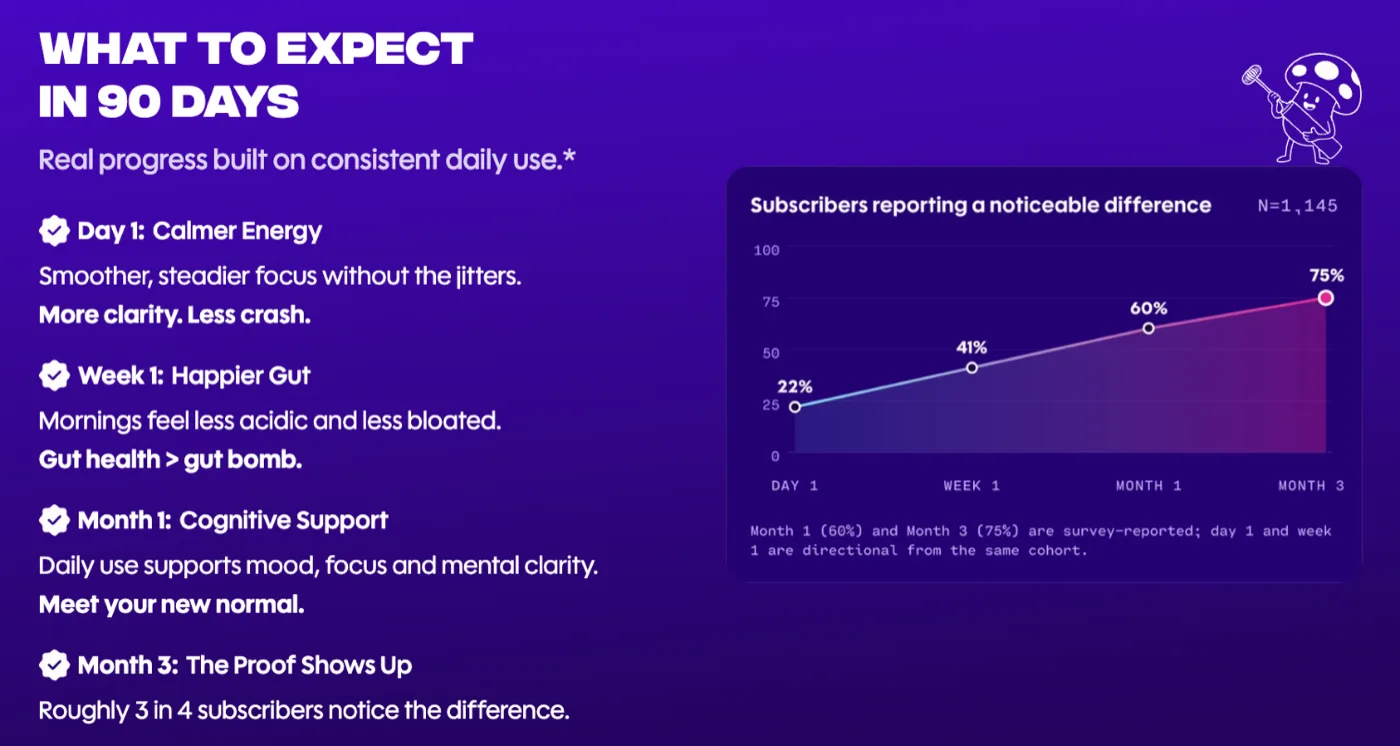
Then the timeline. "What to expect in 90 days": day one, calmer energy. Week one, happier gut. Month three, "The Proof Shows Up", backed by a chart from their own subscribers.
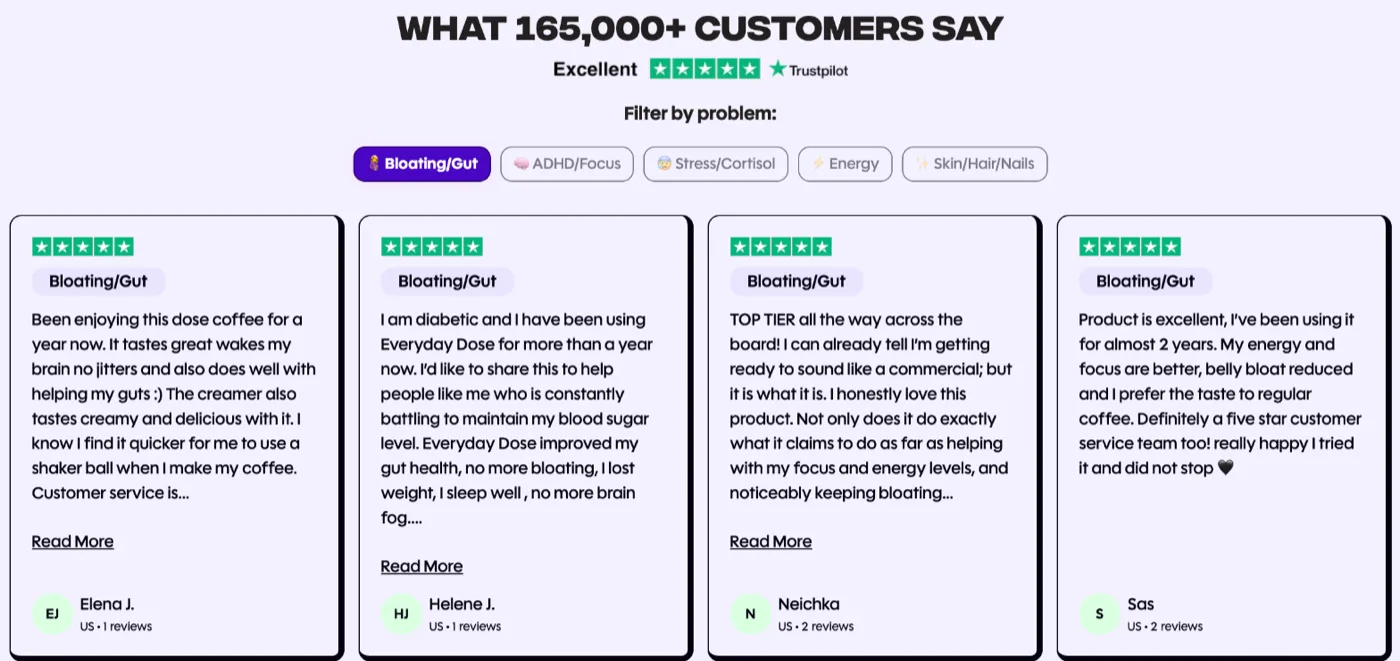
And the long-term customers are right on the product page. One review says a year, one says more than a year, one says almost two years. The guarantee is 45 days, because, in their words, the things people stay for take longer than two weeks.
One miss. A few landing pages. "Try it now" and "No monthly commitments" pull against the long-term message.
We pulled 49 of their emails from seven weeks. Almost one a day. Busy. They rotate three kinds: subscription stories, sales, and education. Every sale sells one thing, the starter kit, which is the subscription. And between sales, ingredients, recipes and lab results, and almost every one ends with subscribe and save.
5. Subscriber onboarding: 14 out of 15
Here I look at what happens in the first 30 to 90 days after someone subscribes. We could not find their welcome emails. The product page and the box do the job.
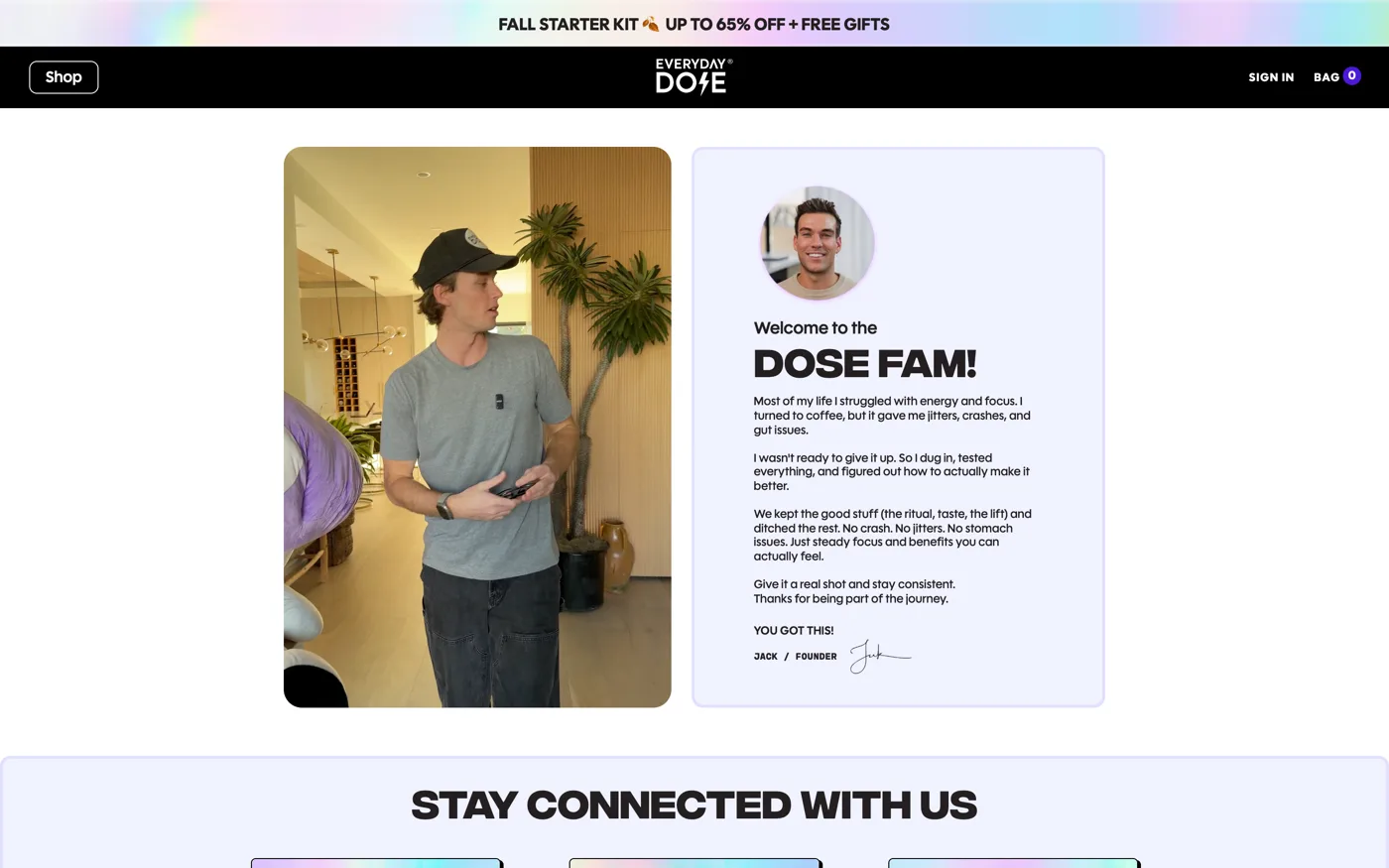
Easy start. Scoop, froth and customise, in 30 seconds. The box comes with a Dose Guide. And it is built around your morning. Their welcome page says it: "Your morning routine, made easy."
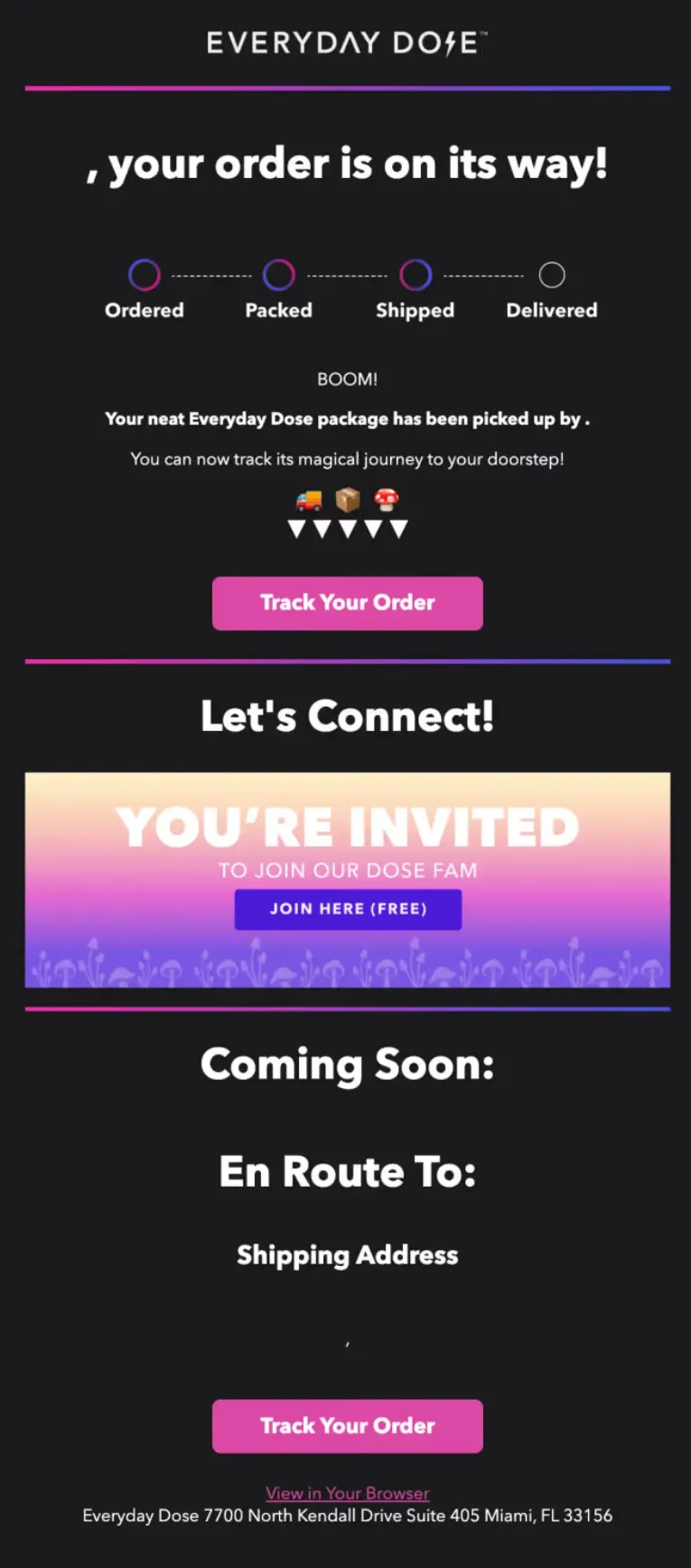
And look at their shipping emails. From the very first one, before your order is even delivered, they invite you to join the Dose Fam. Same in the shipped, out for delivery and delivered emails. They are that confident about their community. It handles buyer's remorse before the box even lands.
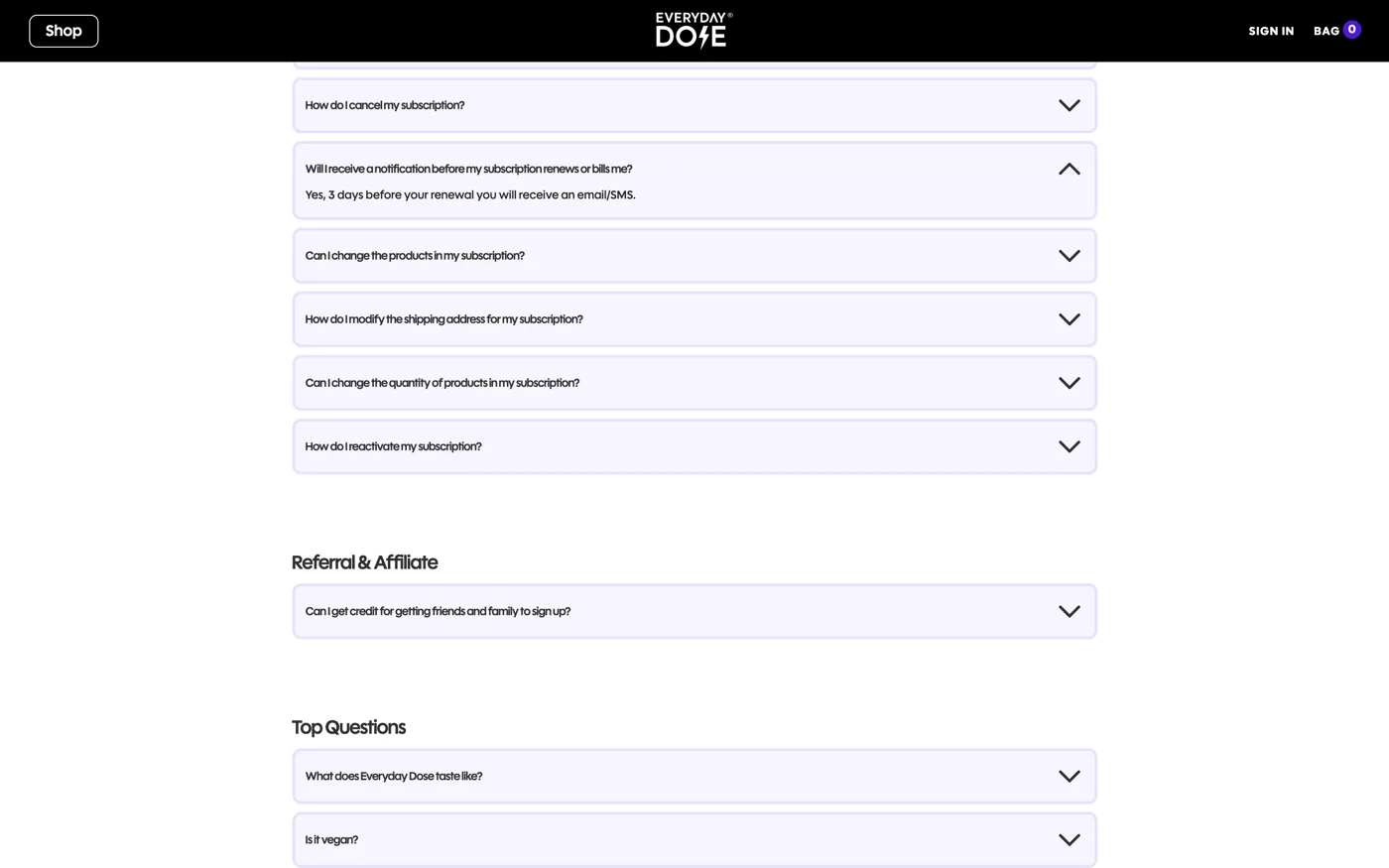
They remind you three days before every renewal, by email or text. The reminder subject line, per their own reply to a complaint, is "Your next freebie is coming!"
A few people complain about charges. Very few. Against 250,000 subscribers and a 4.9 on Trustpilot, that is very low.
Want to know how your onboarding compares with a brand that scores 14 out of 15? The free subscription audit runs the same checkpoints on your store and sends your top 3 leaks in 24 hours.
6. Cancellation and dunning: 13 out of 15
Here I look at how easy it is to leave, and how failed payments get handled. Cancellation is good. Clean. The steps are right in the FAQ: log in, go to Billing, click Cancel Subscription. All self-serve, no email needed. And no lock, no minimum number of orders before you can cancel.
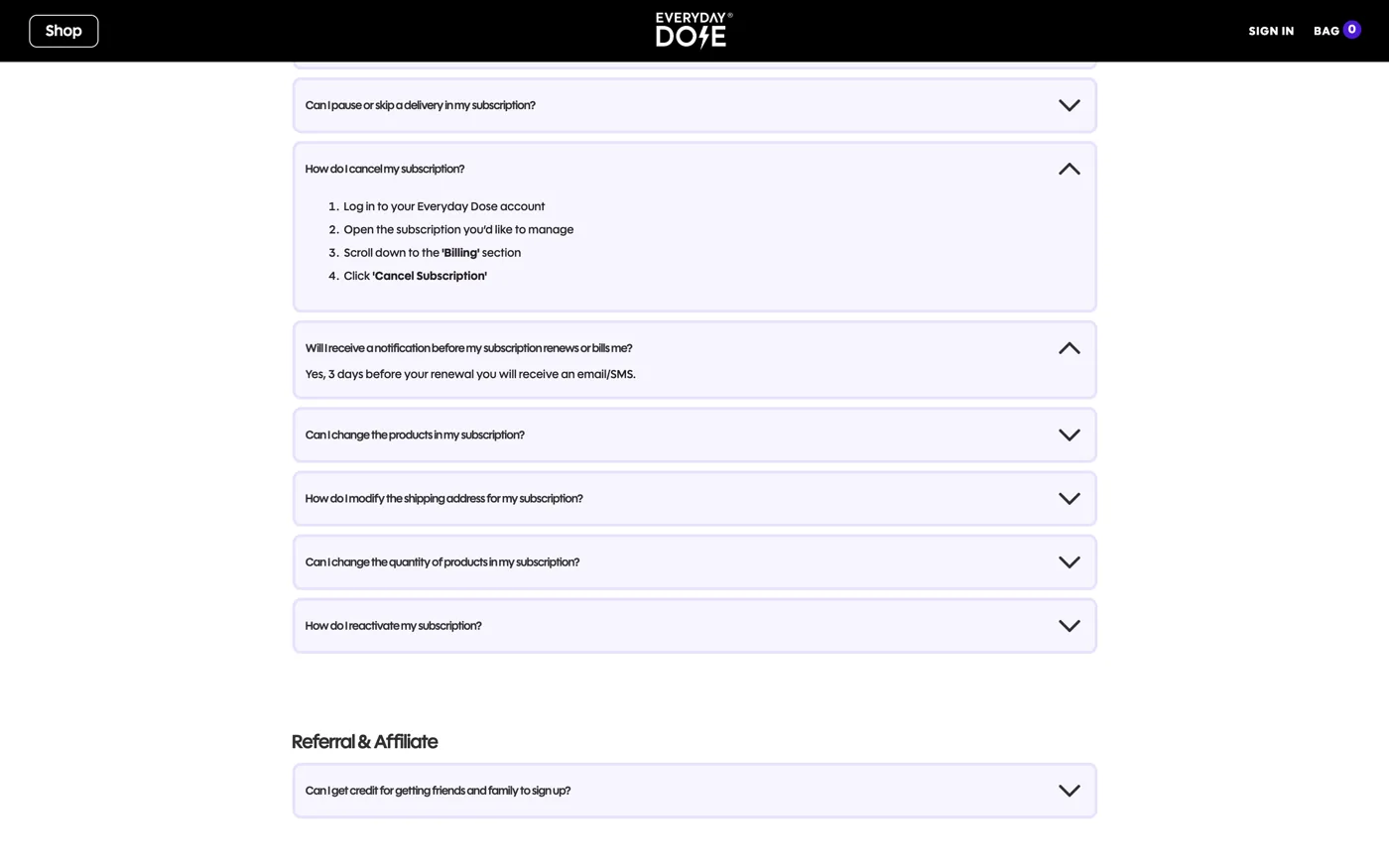
Before you cancel, they offer a skip. It sits in the same steps. And when you click cancel, a chat opens, so they get one more chance to help. Four payment methods at checkout, so failed payments should be rare.
Where they lose is the terms. They say you have to cancel before you are charged, and they use four names for the subscription. And pause ends after 90 days and starts charging again, which is behind several complaints from people who thought they had cancelled. Small issue. Worth fixing.
What I would change: plain terms with one name, and a reminder before a pause runs out.
Plain terms with one name, and a reminder before a pause runs out, are the kind of small fixes the Subscription LTV Optimizer™ ships every month after checking your store, app and Klaviyo.
7. Flexibility: 9.5 out of 10
Here I look at whether a subscriber can skip, pause, reschedule, change frequency or swap without contacting anyone. Everything is there.
Skip is the one they push. It is the first thing in the cancel steps, so if you have too much coffee at home, you skip a month instead of leaving. And the frequency is open once you subscribe. The FAQ says every two weeks, every two months, or, as a joke, "every 2 days!"
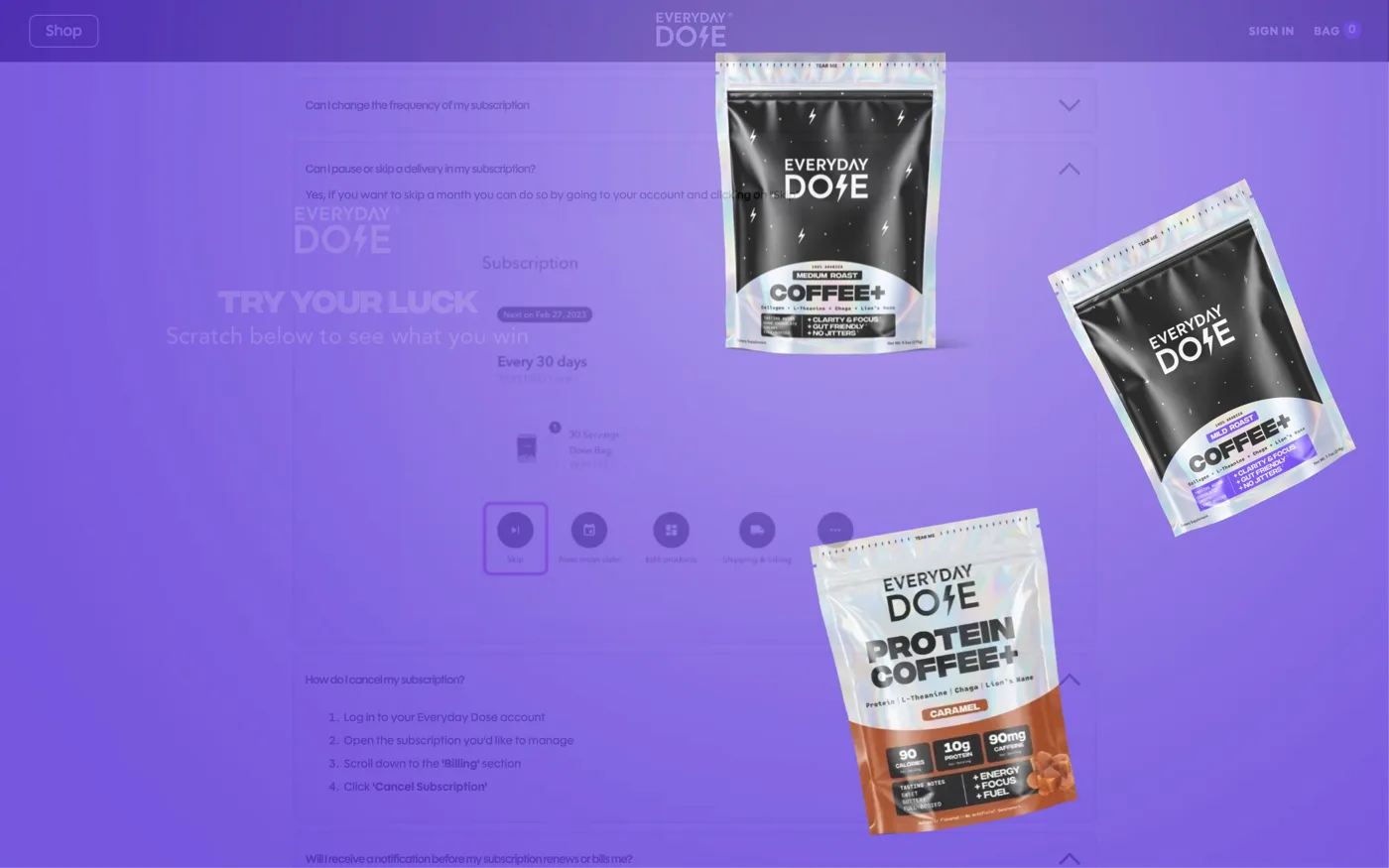
You can swap products too, "full control of your subscription." Want to try the matcha or add a creamer? Change the subscription. Do not cancel and start again. It is all self-serve, the portal is one click from the FAQ, and an email says you can skip, pause or cancel "in about 30 seconds." Reviews agree.
Self-serve skip, swap and frequency change, named in the FAQ and the reminder, are part of the portal and flow build in the Subscription LTV Maximizer™.
8. Loyalty and surprise/delight: 9.5 out of 10
Here I look at what a subscriber gets for staying. This is where they win.
They show you the rewards before you subscribe. Right on the product page: gifts throughout the year. And the first reward comes early. Order two, a coffee canister. Order three, a tumbler and a big points bonus.
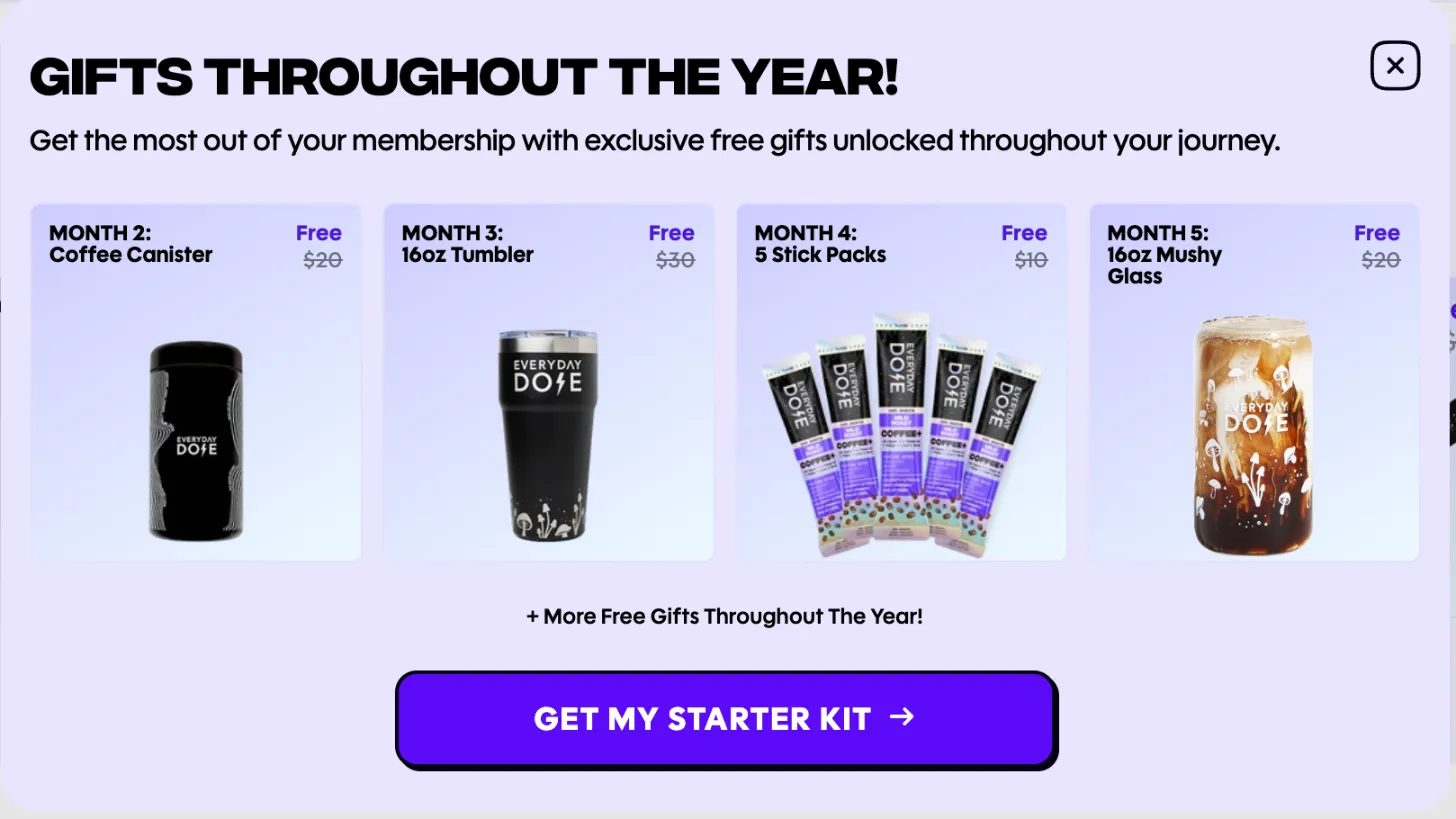
Every gift has a price on it, so you know what it is worth. Even the points are in dollars: 10,000 points is $20. And there is always something coming. A new gift with every order, 9 gifts in the first 12 orders. Every box has a reason to open it.
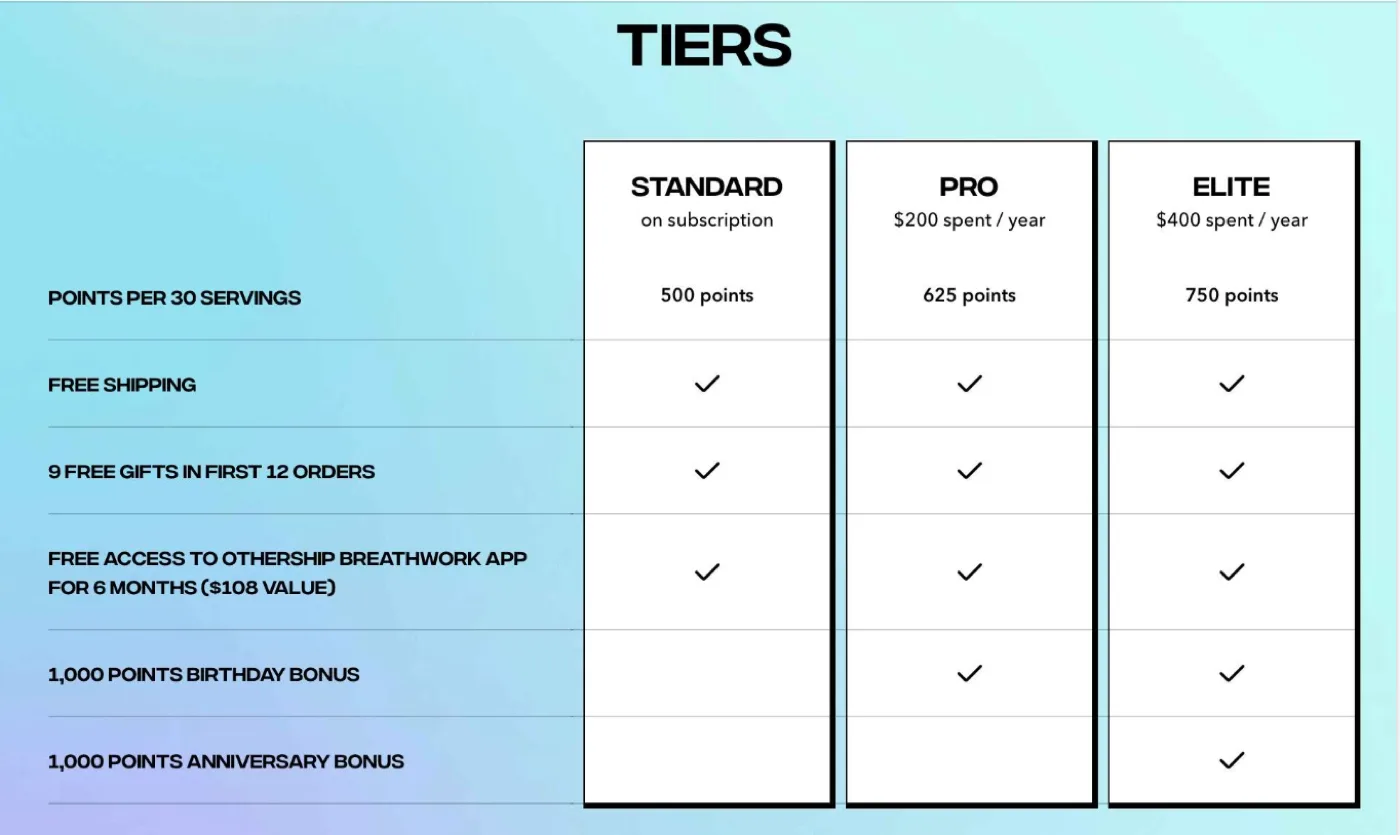
Then Dose Rewards: Standard, Pro and Elite. The more you spend in a year, the higher you go. And your account shows how close you are: "$181 away from Elite." When you reach Elite, they email you. At one year, a bonus.
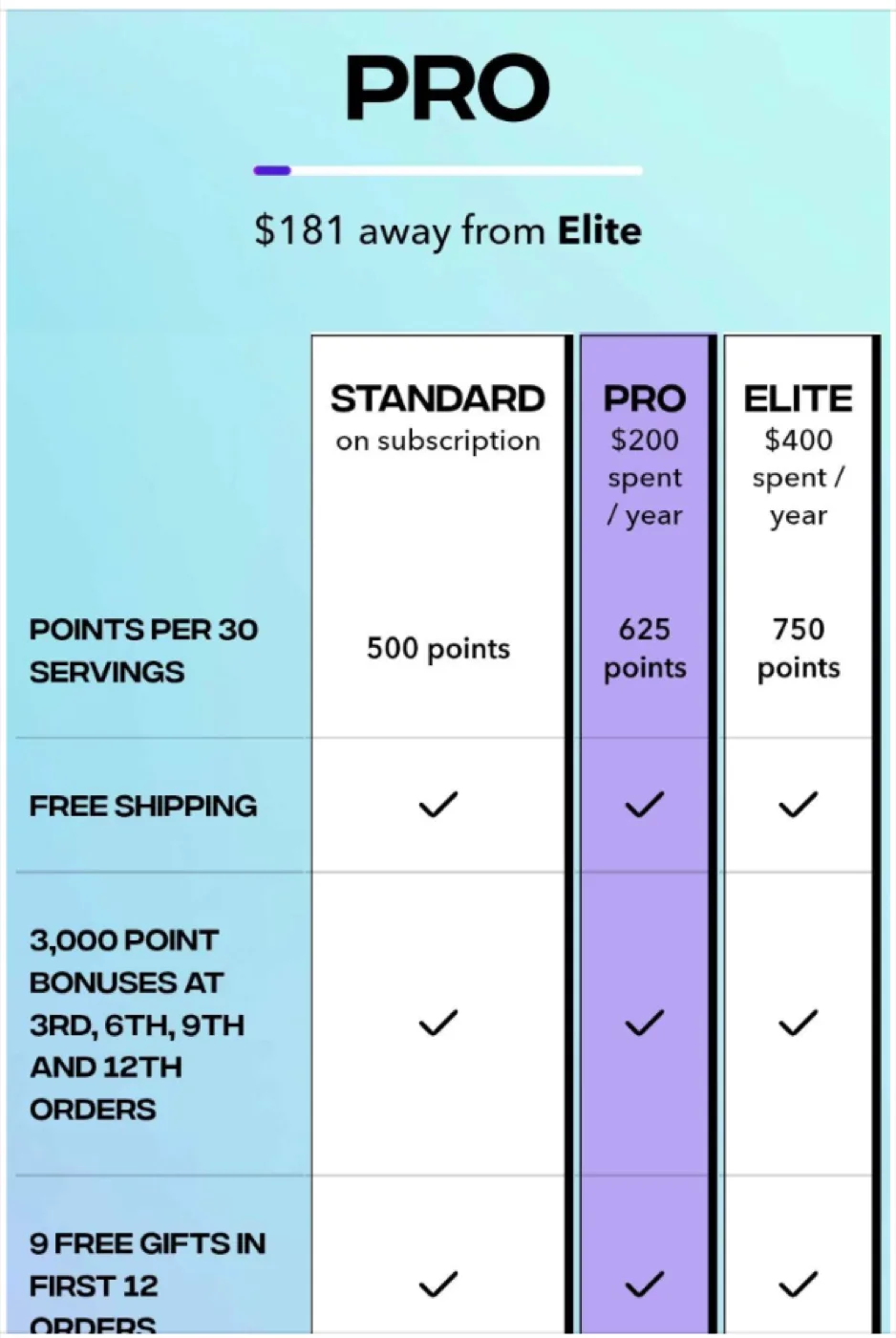
And people post it. Proudly. "Finally reached pro status!" "Not only did I make it to the Elite status but this month marks 1 year of drinking Everyday Dose and 1 year of joining the dose fam."
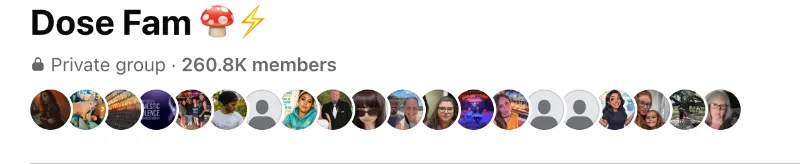
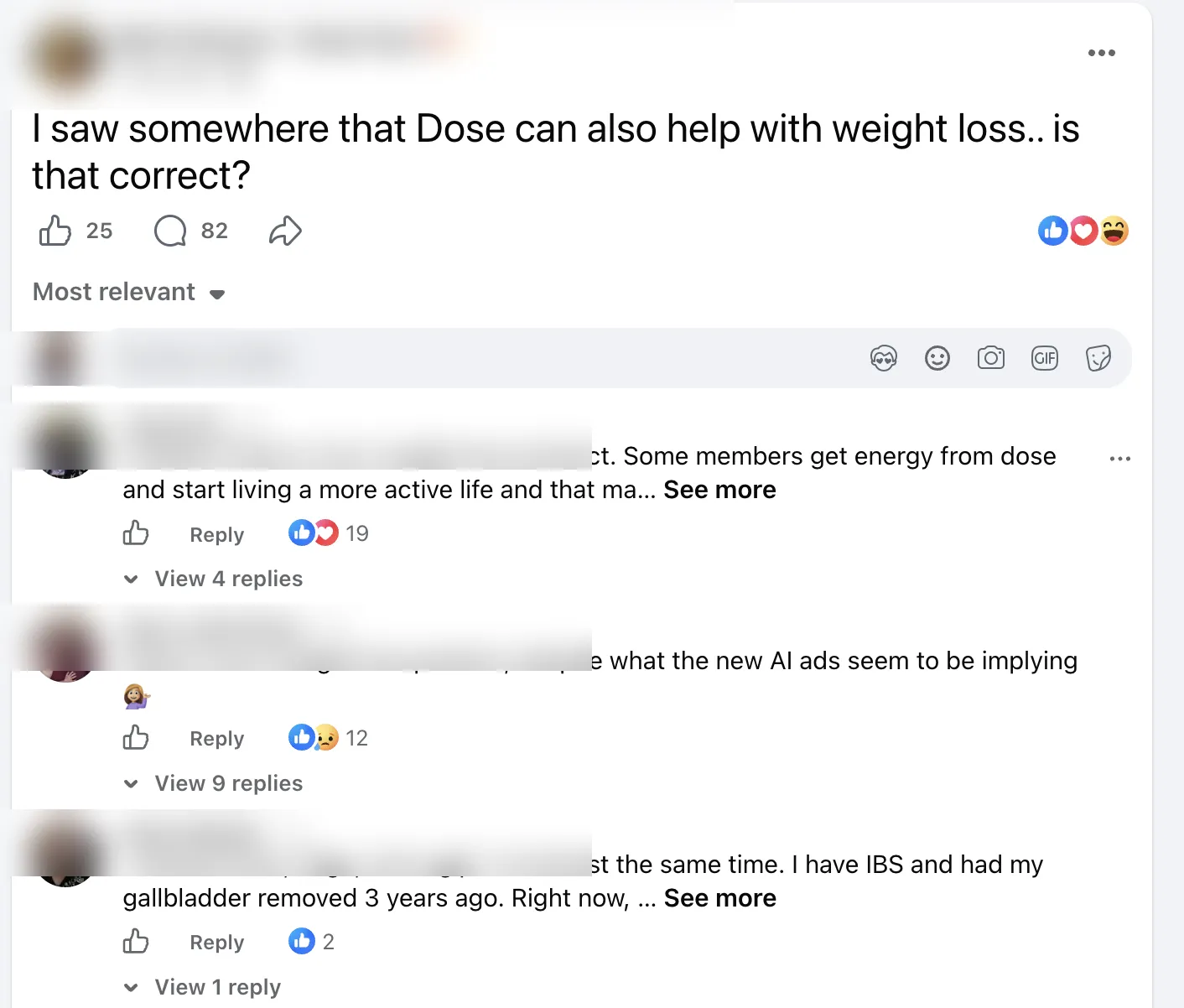
Because the real thing is the Dose Fam. 260,000 members, around 60 new posts a day. People post their coffee every morning and their unboxings. The admins reply to almost every post and welcome every new member by name. Someone asks if Dose helps with weight loss, and other members answer: Dose is coffee, not a weight loss product. The brand does not have to step in.
They plan Christmas gift bags together. One member handed out Dose samples at her Christmas bazaar. They have merch, Dose Fam hoodies. And when you see an older member sharing her vanilla protein coffee recipe, that is a masterclass of marketing.
This is a cult. If a brand can manage this, they do not need much else. You can copy the product, the formula, the website, the gifts. You cannot copy a community that took five years to build, and it shows everywhere, in their reviews and in their 4.9 on Trustpilot.
A gift with every order, bonus points at orders 3, 6, 9 and 12, and a referral that pays at the second order: the Subscription LTV Maximizer™ builds this ladder in your subscription app and Klaviyo.
How Everyday Dose compares to the other brands
We have scored six big subscription brands on the same 48 checkpoints. Everyday Dose sits second, right behind Grüns.
| Brand | Product | Score | Growth | Retention |
|---|---|---|---|---|
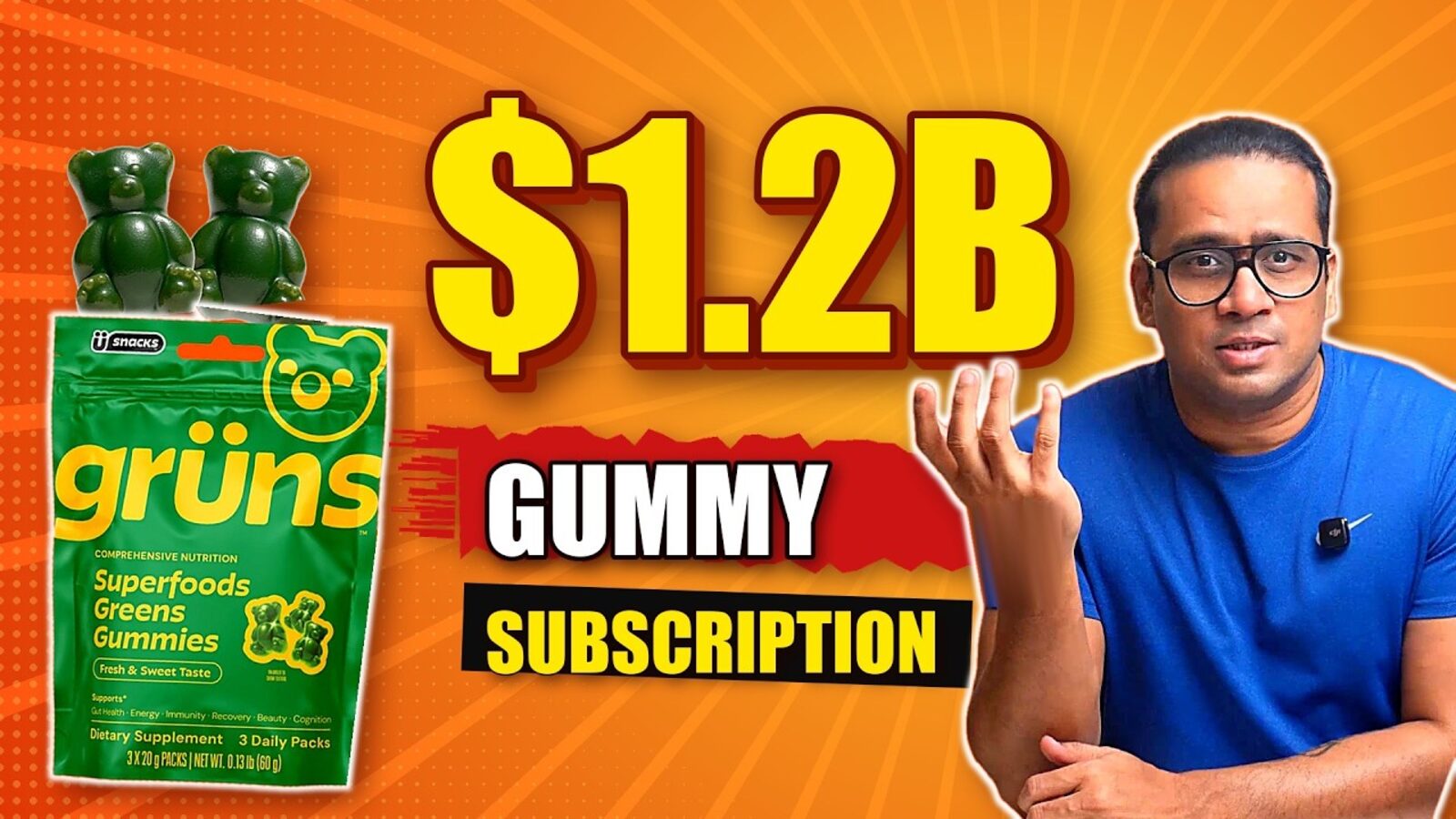
| Grüns | Daily nutrition gummy | 85.5 | 44.5 | 41 |
| Everyday Dose | Mushroom coffee | 81 | 35 | 46 |
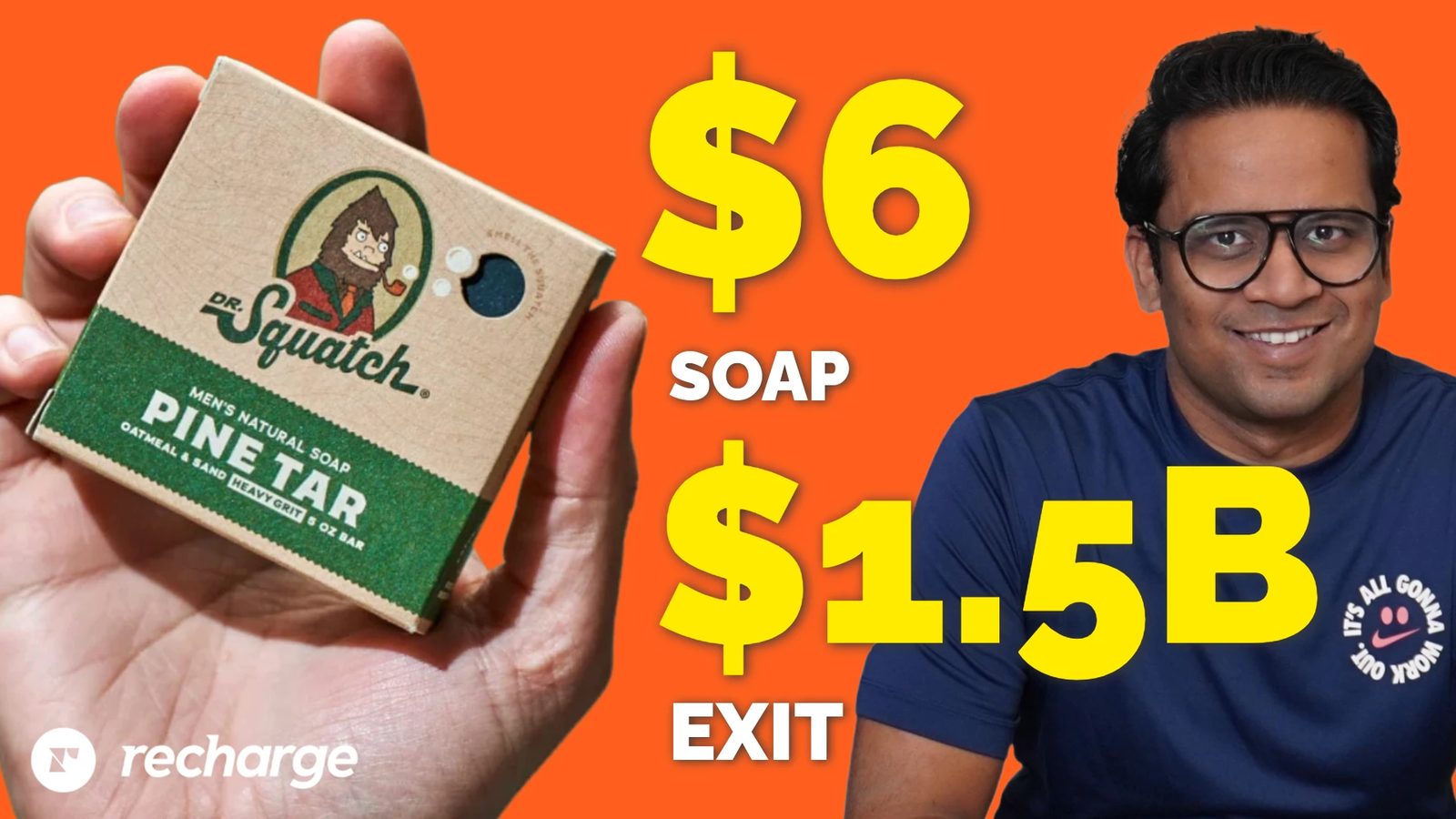
| Dr. Squatch | Natural soap | 73 | 37 | 36 |
| IM8 | Daily nutrition powder | 72 | ||
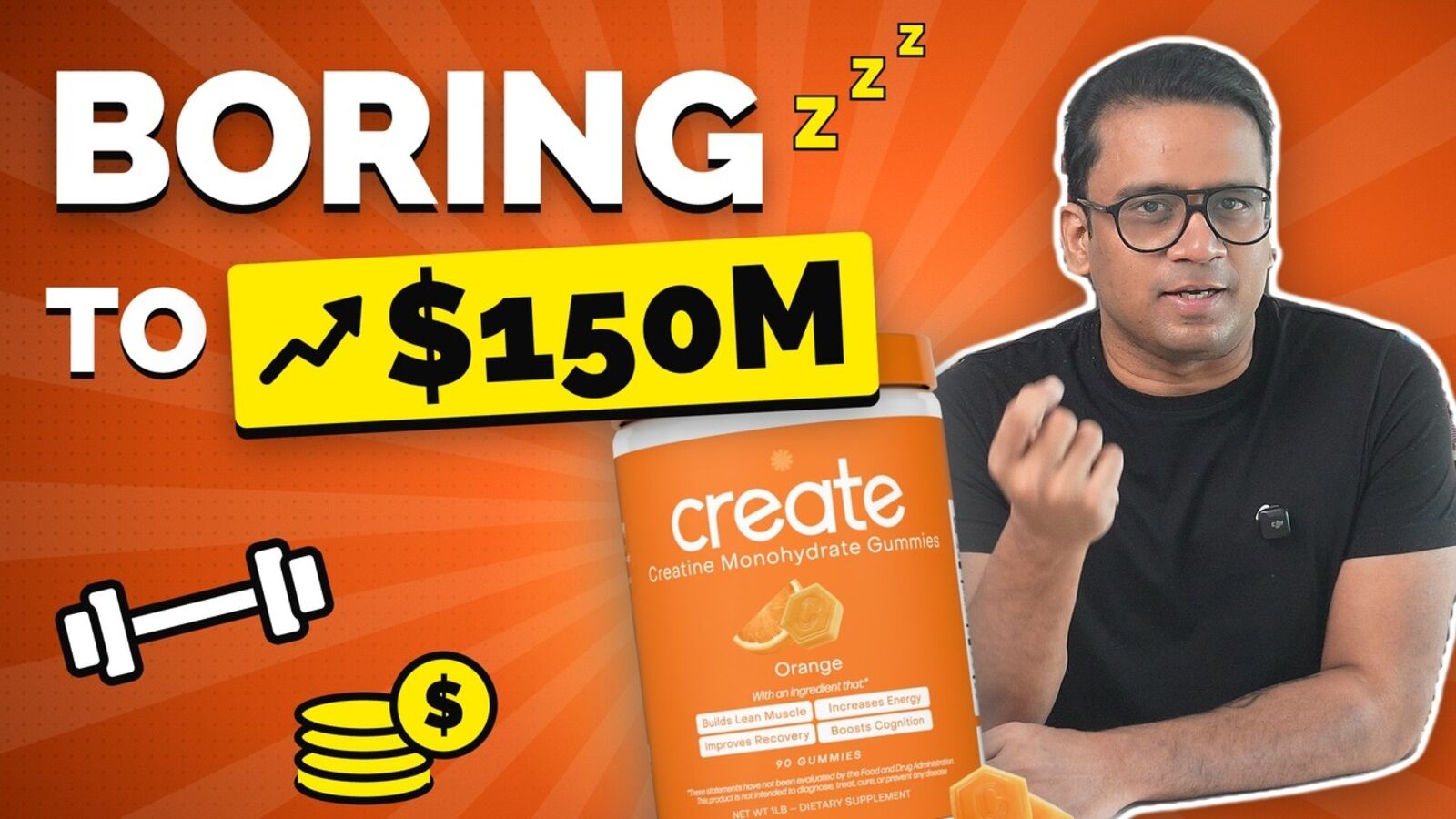
| Create | Creatine gummy | 67.5 | 38.5 | 29 |
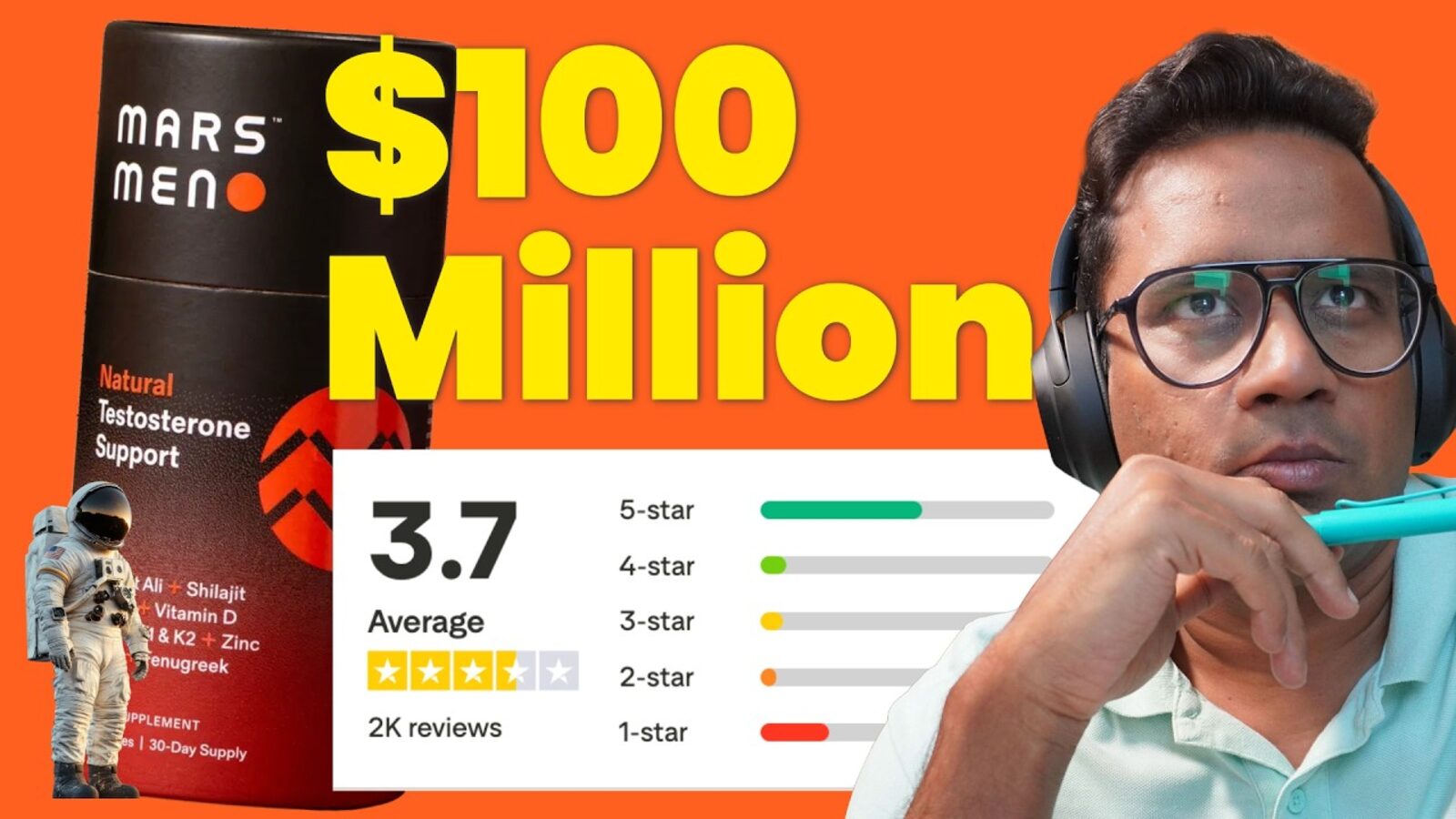
| Mars Men | Men's testosterone support | 62 | 41.5 | 20.5 |
Everyday Dose is the mirror image of Mars Men. Mars Men has the strongest front half after Grüns and the weakest back half. Everyday Dose has the weakest front half and the strongest back half. Mars Men gives every gift at order one. Everyday Dose spreads them across the first year.
Against Grüns, the other brand built on wanting the next box: Grüns uses a new limited flavour every six weeks. Everyday Dose uses a new gift with every order, plus a community. Grüns scores 5 out of 10 on loyalty. Everyday Dose scores 9.5. Grüns wins the front half, 44.5 against 35, because its offer and frequency are cleaner.
If your retention is strong but sign-ups are not, the Subscription LTV Roadmap™ shows where the front half leaks and gives you the 90-day plan in order.
Where Everyday Dose loses
Before you subscribe. Three things. The bigger packs ship too often, there is no page that explains the subscription, and the price jumps after the first order. Every one of these is cheap to fix, and none of them touches what makes people stay.
We help subscription brands get more subscribers to their third order. Everyday Dose even pays its referrers at the third order.
Want your program scored on the same 48 checkpoints? The free subscription audit runs the same scorecard on your store and ranks your top 3 retention leaks, in 24 hours.
FAQ
How does the Everyday Dose subscription work?
Everyday Dose sells its mushroom coffee as a starter kit on subscription, with 30 or 60 servings delivered every month. There is no one-time option on the product page. Subscribers can skip, pause, swap products or change frequency in their account, and get a reminder by email or text 3 days before each renewal.
How much does an Everyday Dose subscription cost?
When we checked in October 2026, the default 60-serving starter kit was $49 for the first order, then $66 every 30 days. 30 servings renewed at $36 and 90 servings at $99. The first order also carries seven free items, and every later order brings a gift with its dollar value shown.
How do you cancel an Everyday Dose subscription?
Log in to your Everyday Dose account, go to Billing and click Cancel Subscription. It is self-serve with no minimum number of orders. A skip option sits in the same steps, and a chat opens when you click cancel. If you pause, note that the pause ends after 90 days and billing restarts.
What is Dose Fam?
Dose Fam is the private Everyday Dose Facebook group, with about 260,000 members. Members post their morning coffee, recipes and unboxings, answer each other's questions, and share their rewards tier. Every shipping email invites new buyers to join before the first order arrives.
What are the Everyday Dose subscription rewards?
Every order in the first year brings a free gift, such as a coffee canister at order 2 and a tumbler at order 3, each with its dollar value shown. Subscribers also earn points, with bonuses at orders 3, 6, 9 and 12, and move through Standard, Pro and Elite tiers based on yearly spend.
One email a week on subscription retention: the numbers, the strategy, and what to fix first.

Rahi Jain
Rahi Jain is a subscription LTV specialist who helps $1M to $10M DTC brands reduce subscription churn and maximize LTV on Recharge, Skio, Stay AI and Loop.
More about Rahi