Key takeaways
- Grüns scored 85.5 out of 100 on the Subscription LTV Scorecard™, the highest of the six big subscription brands scored so far.
- It wins the first order with a 52% subscription anchor and stacked first-order offers, then keeps people with a new limited flavour roughly every six weeks.
- It loses most points on loyalty. No milestone roadmap, no gift at order 2 or 3, and nothing that rewards month 12.
Grüns sits in the Subscription Scorecard Library next to every other brand scored on the same 48 checkpoints.
80% of Grüns customers take it every single day. 95% take it at least 4 to 6 times a week. That is from their own survey of 3,000+ customers, and in supplements those numbers are rare.
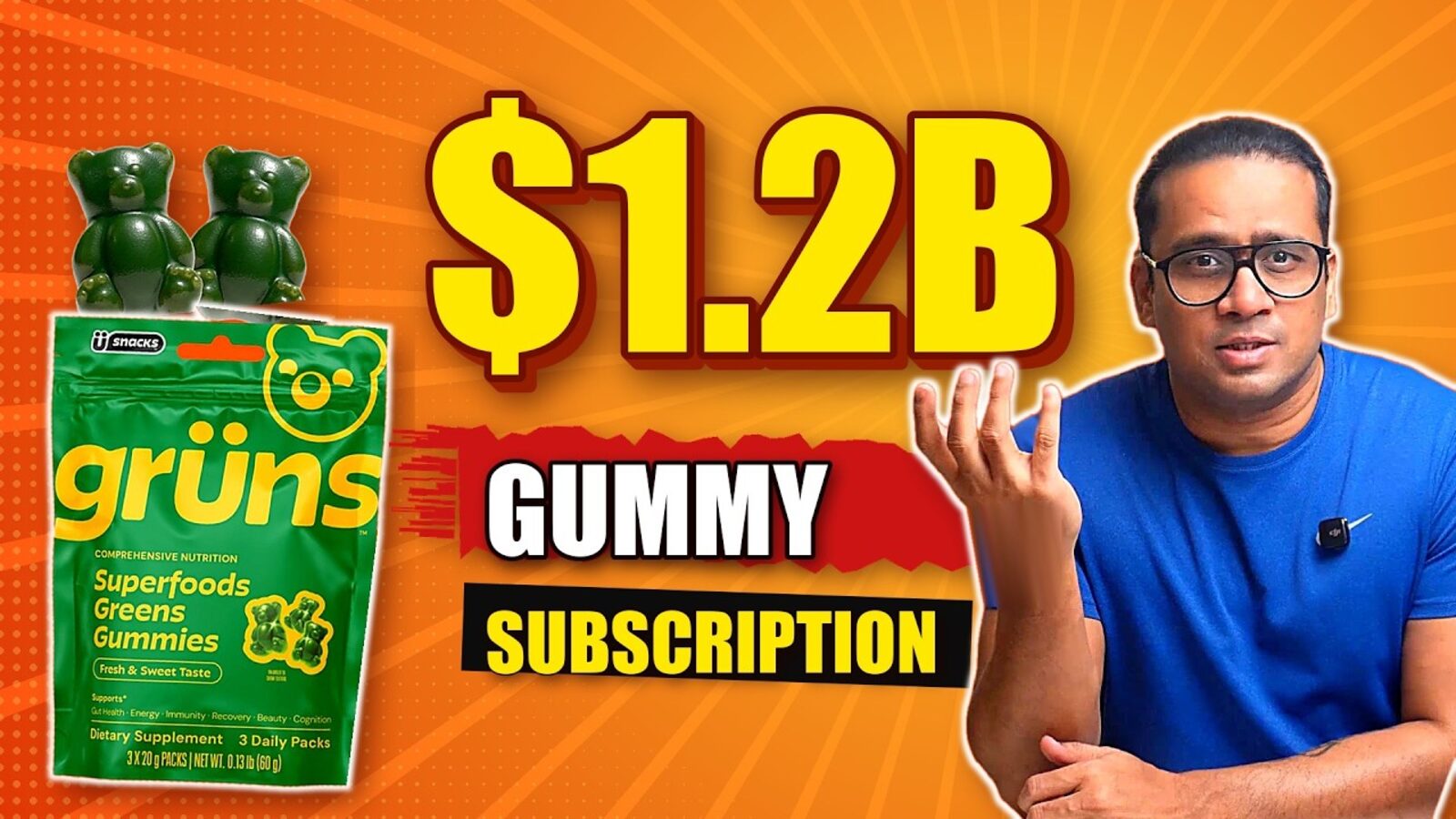
Grüns solved the product habit problem, built custom funnels, and sold to Unilever for a reported $1.2 billion, 30 months after launch. 90% of their direct revenue is subscription.
So I scored their whole subscription program on 48 checkpoints. 85.5 out of 100. The highest I have ever given.
This is the full written breakdown. If you are in a hurry, the video walks through every page on screen.

Watch the full Grüns breakdown, 25 minutes
What is Grüns?
Grüns is a daily nutrition gummy. 60+ ingredients in one pack, one pack a day, 28 packs in a pouch.
The product format is the strategy. No powder to mix, no pills to swallow. That is how you get to 80% of customers taking it every day.
Chad Janis started it in 2023 out of a Stanford dorm room. Profitable in about 14 months. Today it is over a million customers and 10 million gummies going out every day.
Most supplement brands start with the formula. He started with why people stop taking them. Inconvenient. Bad taste. Easy to skip. So he built the answer into the product.
- Platform: Shopify Plus, Skio for subscriptions, Postscript for text.
- Exit: Unilever, a reported $1.2B, announced 9 April 2026 and completed 1 June 2026. The terms were not disclosed.
- Retail: Target, Walmart, Costco and Sam's Club. So the 90% subscription figure is their direct business, not the whole company any more.
The Grüns subscription scorecard: 85.5 out of 100
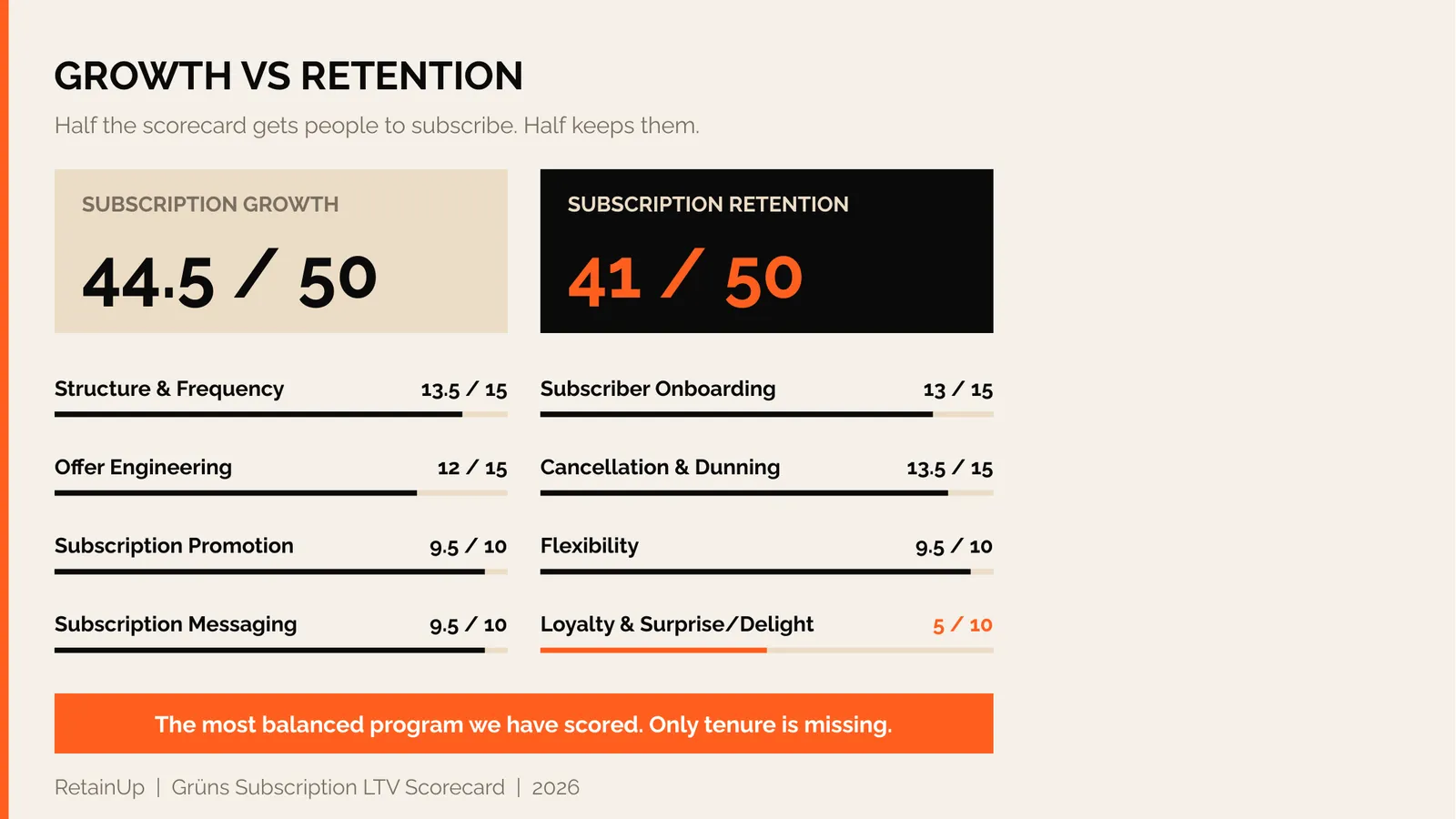
Scored 10 August 2026, from public data only. 8 dimensions, 48 checkpoints, everything from the product page to the cancel flow.
| Dimension | Score | Out of | Points lost |
|---|---|---|---|
| 1. Structure and frequency | 13.5 | 15 | 1.5 |
| 2. Offer engineering | 12 | 15 | 3 |
| 3. Subscription promotion | 9.5 | 10 | 0.5 |
| 4. Subscription messaging | 9.5 | 10 | 0.5 |
| Subscription growth | 44.5 | 50 | 5.5 |
| 5. Subscriber onboarding | 13 | 15 | 2 |
| 6. Cancellation and dunning | 13.5 | 15 | 1.5 |
| 7. Flexibility | 9.5 | 10 | 0.5 |
| 8. Loyalty and surprise/delight | 5 | 10 | 5 |
| Subscription retention | 41 | 50 | 9 |
| Total | 85.5 | 100 | 14.5 |
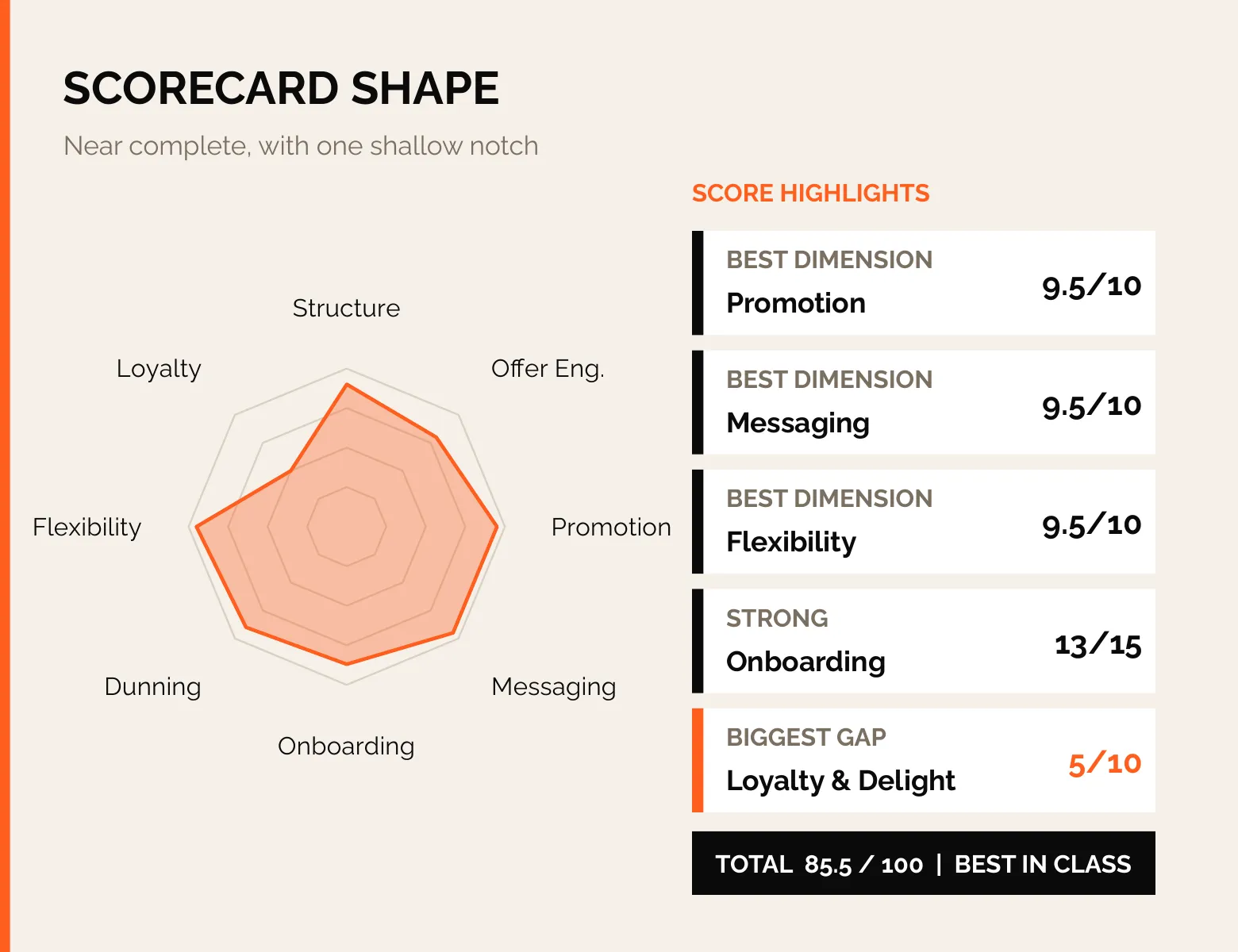
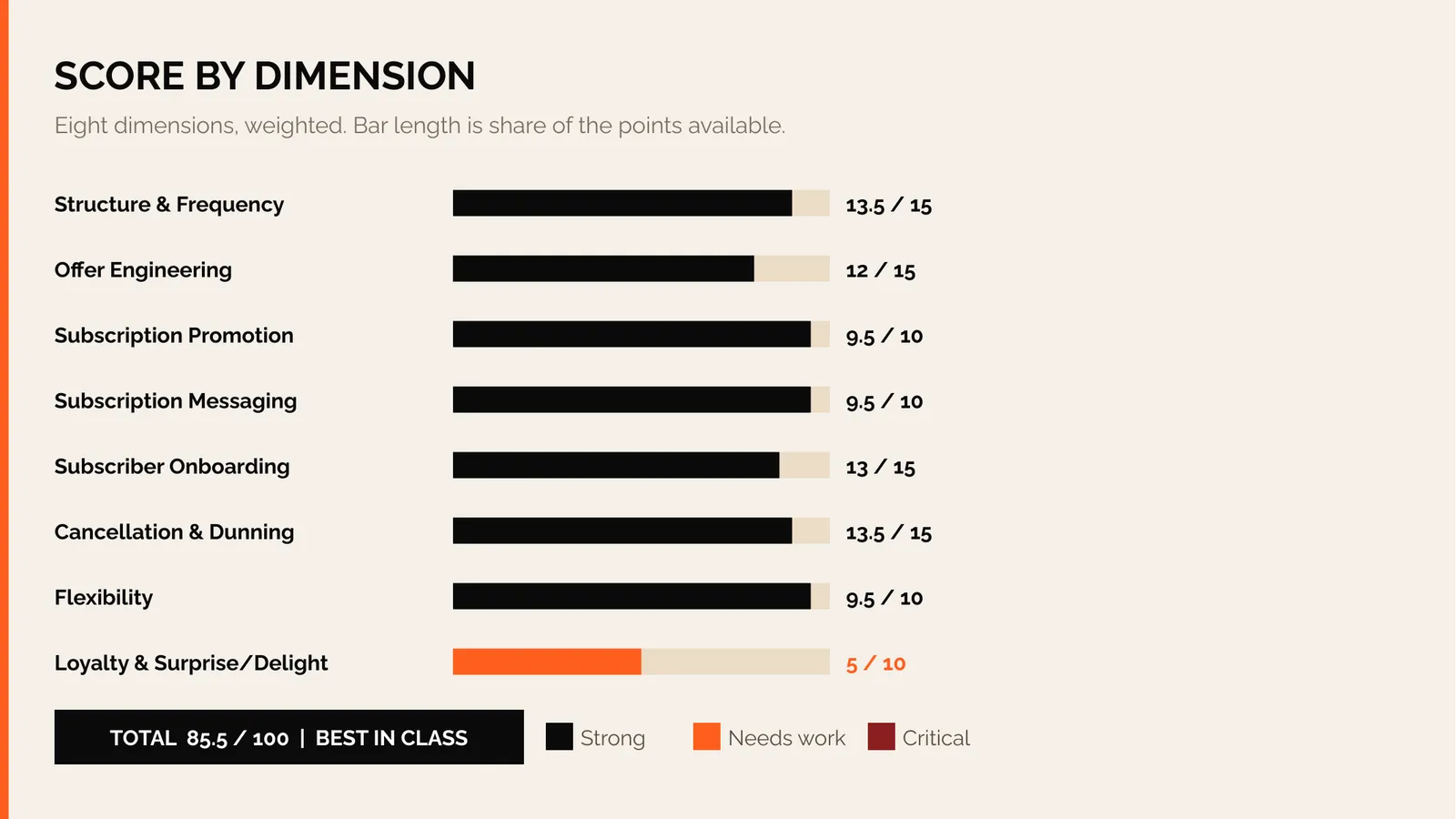
44.5 from getting you to subscribe, 41 from keeping you. That is the highest score we have given, and the only brand strong on both halves.
Three things stood out
First, everything is engineered to win the first order. A 52% discount, $40 off, free gifts. All of it is loaded onto month one. Then the upsells start. A quarterly upgrade the moment you check out, more offers waiting inside the portal. Grüns builds custom funnels for paid channels, and runs a different subscription offer on each landing page.
Second, their retention mechanism is not a habit or rewards. It is novelty. A new limited edition flavour lands roughly every 6 weeks. And customers can swap their next box to the new flavour by replying to a text message.
Third, for a brand this good at everything else, there is very little for a long-term customer. The flavour drops give you something to look forward to. But there is no milestone, no progress to track, and nothing that rewards you at 6 or 12 months.
1. Structure and frequency: 13.5 out of 15
Here I look at how often the product ships and what choices you get. Their cadence maths is right. But the choice is missing.
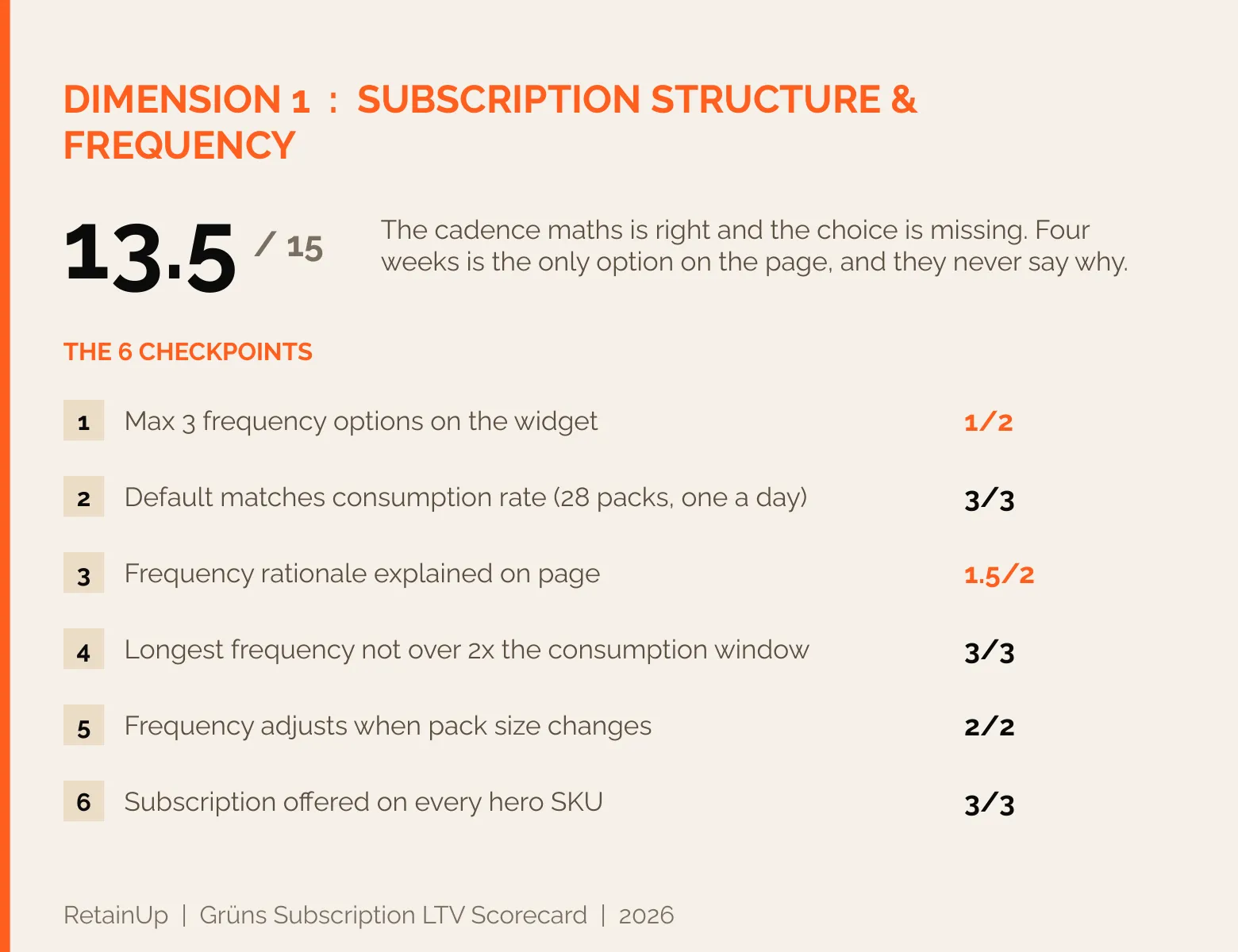
28 packs, one a day, shipping every 4 weeks. That is a perfect consumption match, and they get full marks for it. The quarterly plan ships 84 packs for 84 days, exactly one supply, and the subscription sits on every hero product: adults, kids and the Minions pack.
Where they lose is options. One cadence. Their own inspiration, AG1, sells a 90 day supply. Grüns sells quarterly too, they just make you buy monthly first and upgrade after. It seems to be becoming a trend. Earlier Mars Men, now Grüns. Less friction upfront, smaller ticket, then upsell the bigger one on the thank-you page or through the Gold membership emails.
And they never say why 4 weeks. The page shows you the maths, 28 packs, 28 days, but never the reason. There is a real one, and it is the smartest part of the whole program: their retention runs on limited flavour launches, and nobody swaps to a new flavour while a quarterly supply is still sitting in the cupboard.
What I would change: put a second cadence on the page, and say why 4 weeks is the right one. Keep the quarterly upgrade. It is working.
Not sure if your cadence matches how fast people use the product? The Subscription LTV Roadmap™ reads your Recharge, Skio, Loop or Stay AI data and shows which frequency your cohorts actually keep, in 3 working days.
2. Offer engineering: 12 out of 15
Here I look at how the subscription is priced and structured. The offer itself is excellent. The structure around it has gaps.
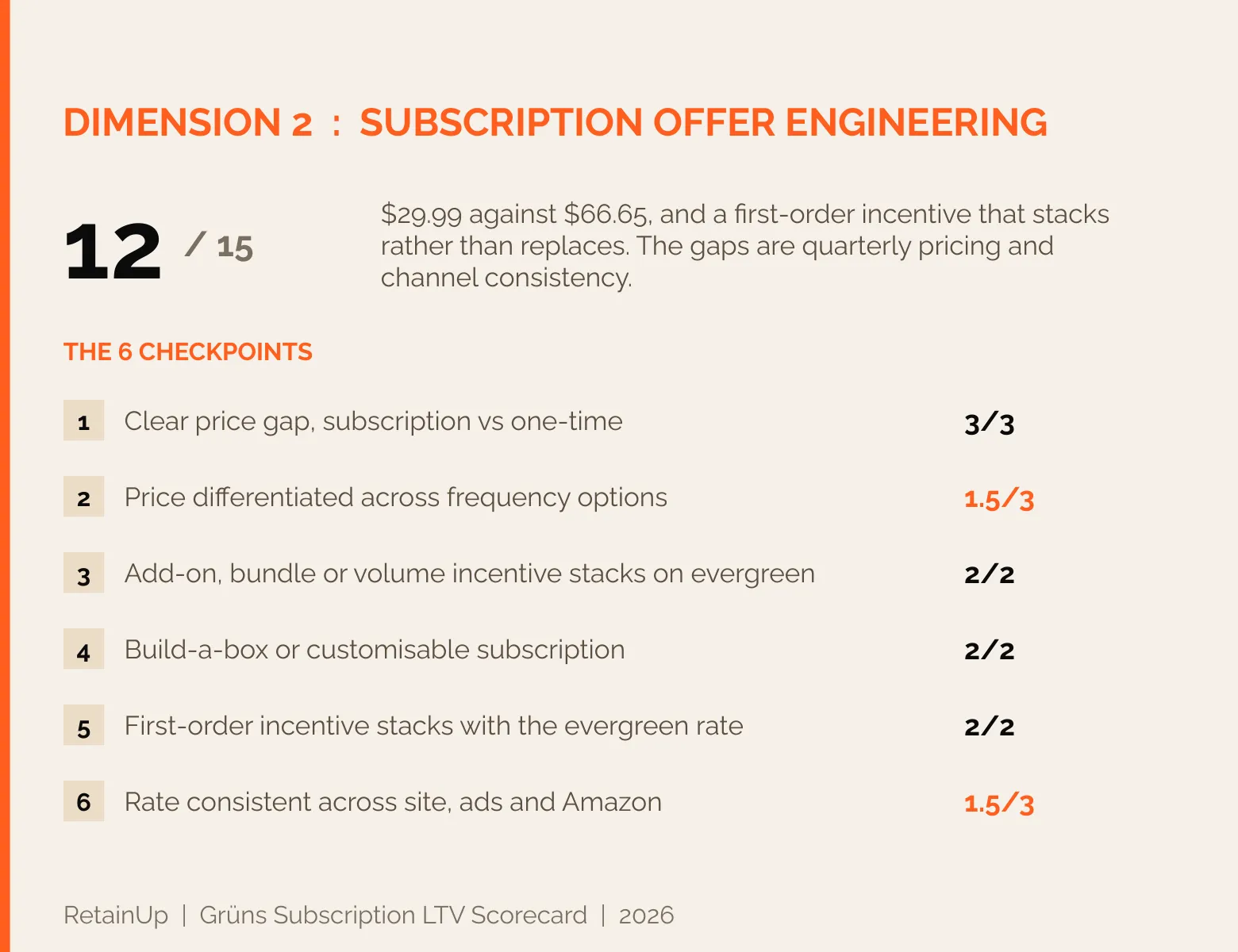
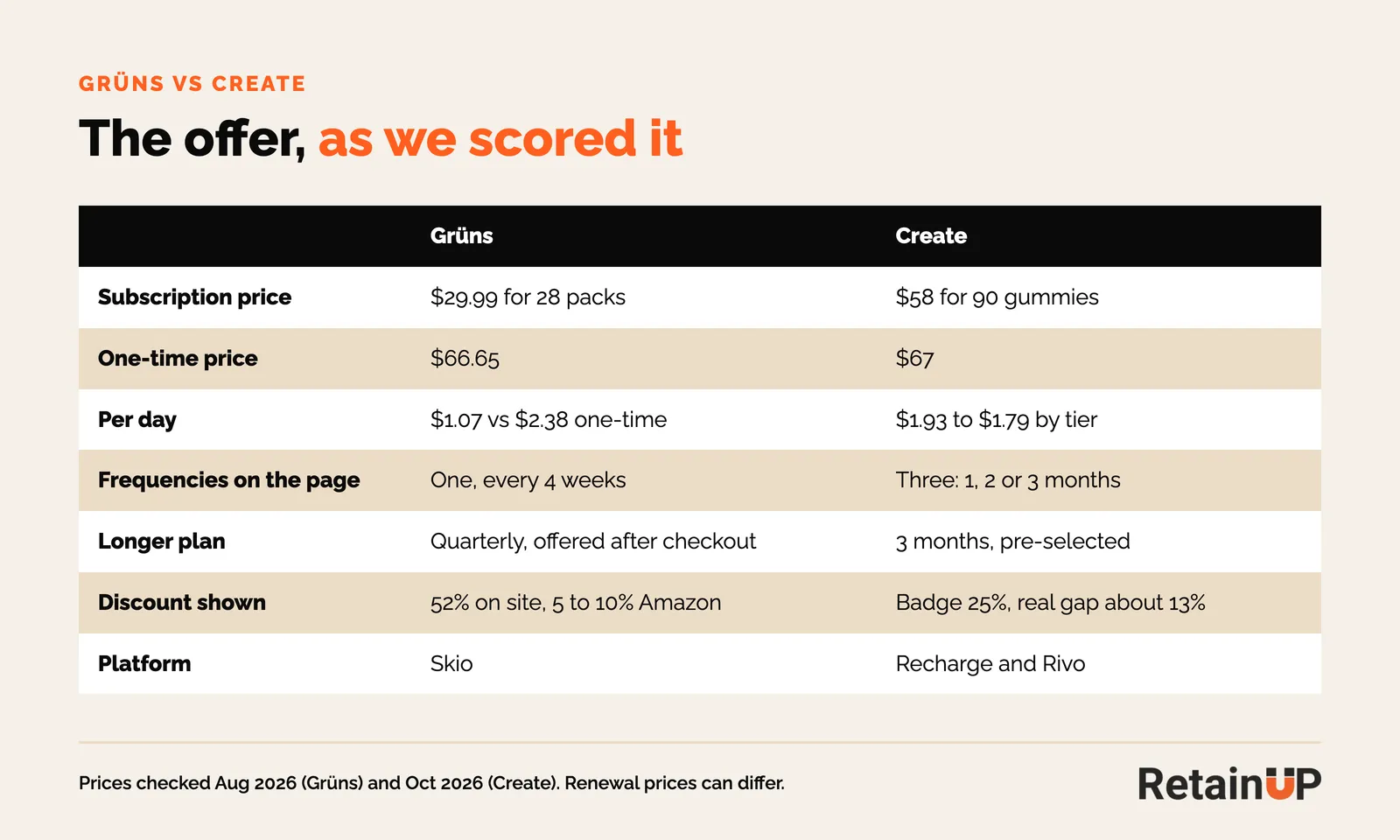
When we scored it, the subscription was $29.99 against $66.65 one-time. $1.07 a day against $2.38. Big gap. And the subscription renews at $49.99, which is $1.79 a day.
You get $40 off your first order and $20 off every repeat order. The first-order incentive stacks on top of the ongoing rate instead of replacing it. I never liked this approach. Many customers get confused about what they will actually pay from month two, because the number they saw at checkout is not the number that hits their card four weeks later, and it is easy to miss.
Grüns also sells the subscription to a household, not a person. They want your kids, your partner, and even your dog (not yet) taking their gummies. Two adults, one kid, add a kid supply right from the cart. Their logic is simple: kids are more likely to take it if you take it with them. Higher order value without a bundle.
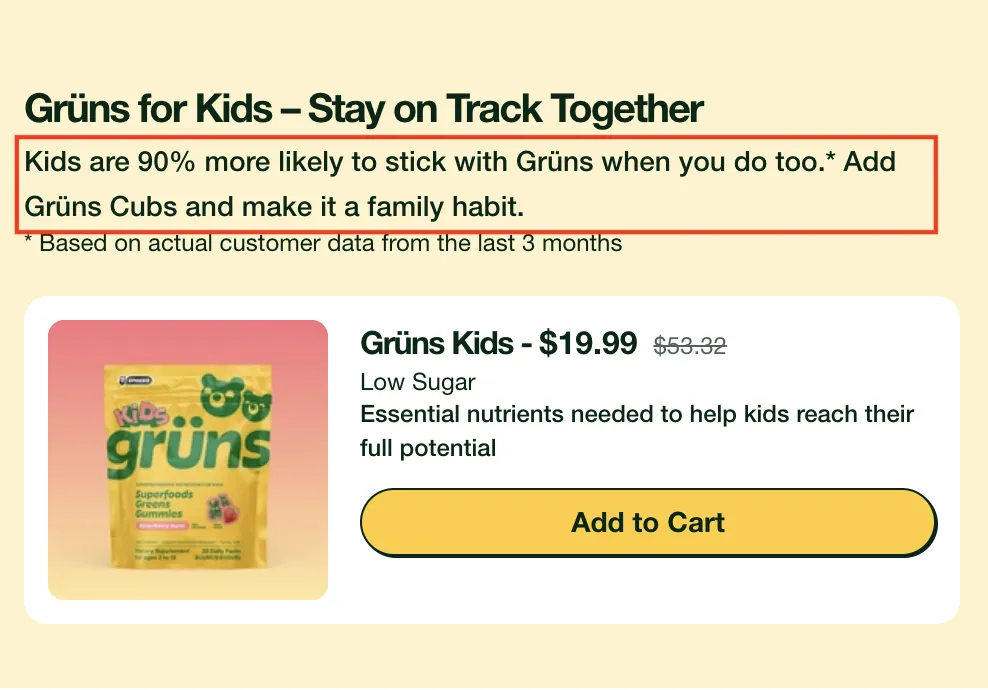
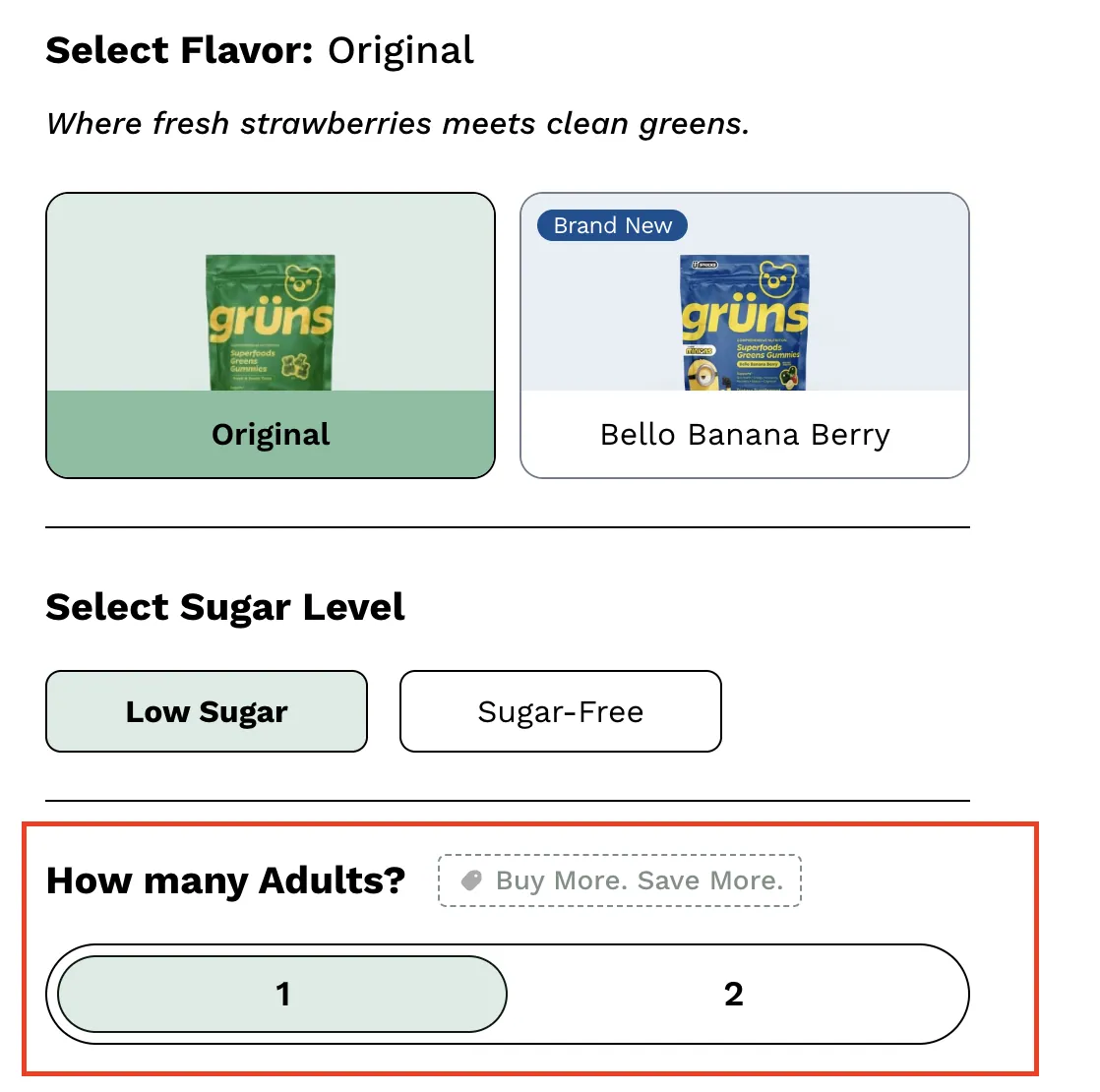
They are not big on free gifts, but they still test them on custom landing pages. Same product, different funnel, different offer. The main site is not where the tests live.
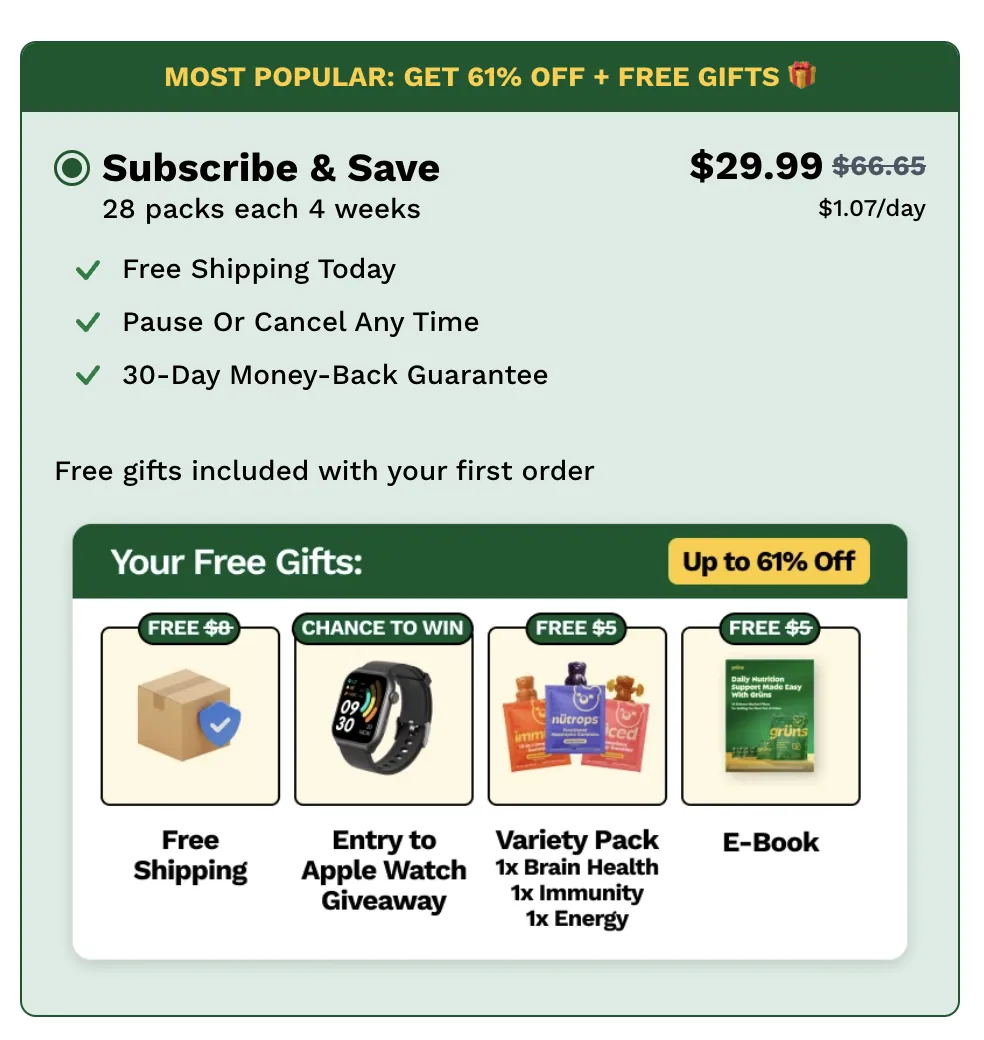
Where they lose points: the quarterly plan is cheaper per day, $1.67 against $1.79, but you cannot pick it on the widget. And the rate swings by channel. So the site and the ads anchor 52% off, Amazon Subscribe and Save sits at 5 to 10%, and influencer codes run anywhere from 20 to 60%, which means one shopper can see four different prices for the same pouch.
What I would change: show the quarterly price, so a longer commitment has a visible reward. Bring Amazon closer, so 52% off means the same thing everywhere. Keep the stacked first-order offer.
A second cadence on the widget, a quarterly price that shows its saving, and one rate across channels are build work. The Subscription LTV Maximizer™ sets up the offer and the product page widget in your subscription app, live in 30 days.
3. Subscription promotion: 9.5 out of 10
Here I look at how hard the site pushes subscription over a one-time purchase. Close to perfect. One naming problem.
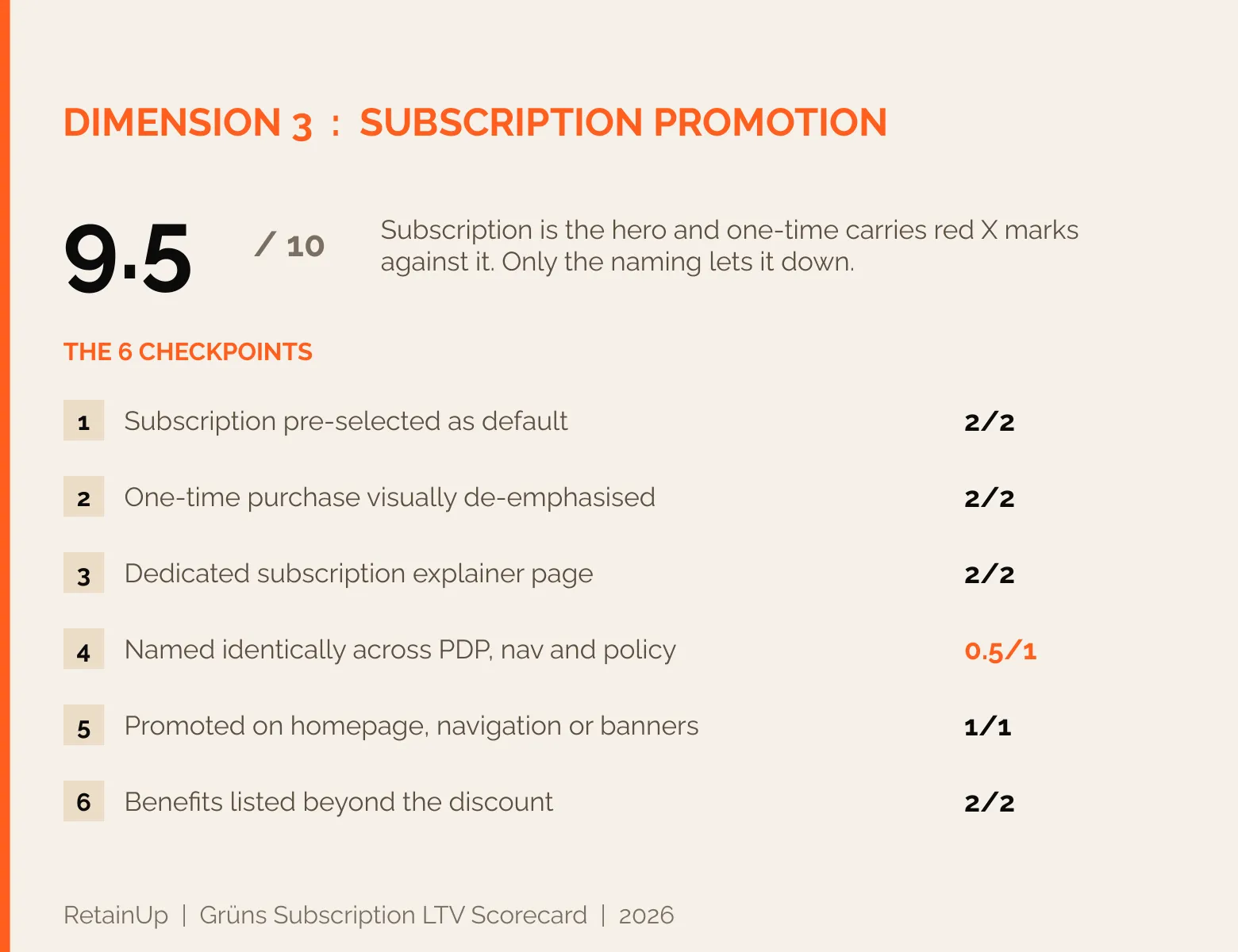
Subscription is pre-selected and tagged Most Popular. One-time purchase is not just played down. It carries red X marks listing what you lose: no free shipping, discount on the first order only.
They have a real explainer page for the program, and the benefits go past the discount. Exclusive flavours, early access, VIP partner perks. Rewards sit in the main menu and a free shipping banner runs across the top.
The half point goes on naming. Subscribe and Save, Autoship, Exclüsives, Green Gummy, Golden Gummy. So 5 names for one program.
What I would change: pick one name and use it everywhere. Customers get lost across 5, and so do AI agents when someone asks them to compare subscription options.
Want to know how your product page compares with Grüns on these checkpoints? The free subscription audit runs the same scorecard on your store and sends your top 3 leaks in 24 hours.
4. Subscription messaging: 9.5 out of 10
Here I look at what the copy says about why you should subscribe. They answer it with the product: "A habit that tastes so good, you'll actually want to keep it."
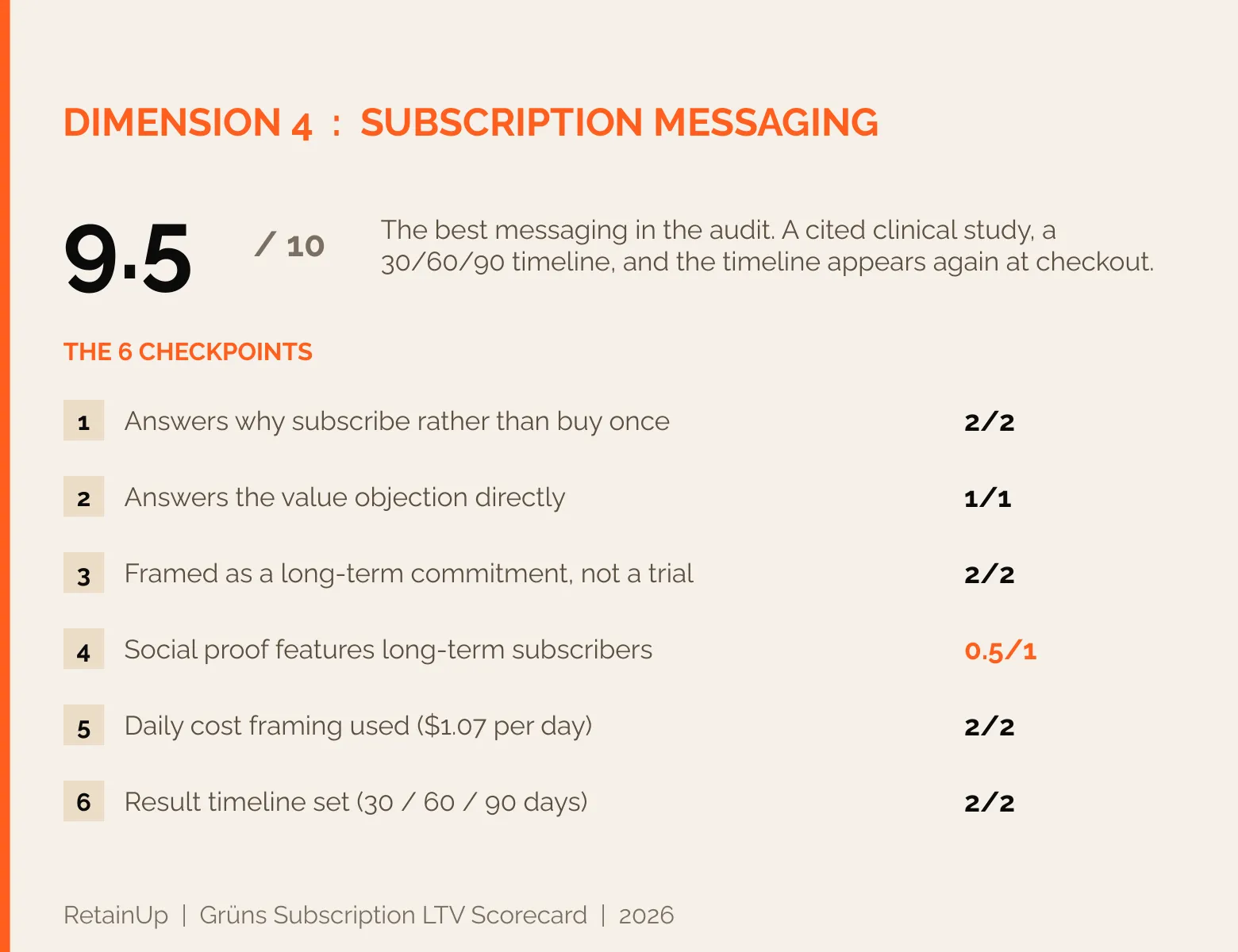
They handle the value objection with a comparison table against AG1, the brand that inspired them, and a cited 12-week clinical study that backs up what the page promises. Not a claim. Evidence. "25% off for life" and the 90-day framing sell a long-term habit, not a trial. And the daily cost is always on screen.
Then the part almost nobody does. The 30, 60 and 90 day results timeline, each with a review, sits on the checkout page. For a gummy brand the timeline matters more, not less. They do not take themselves seriously as a supplement brand, but they still promise supplement results. Most brands put this on the product page. Grüns puts it where the wallet is.
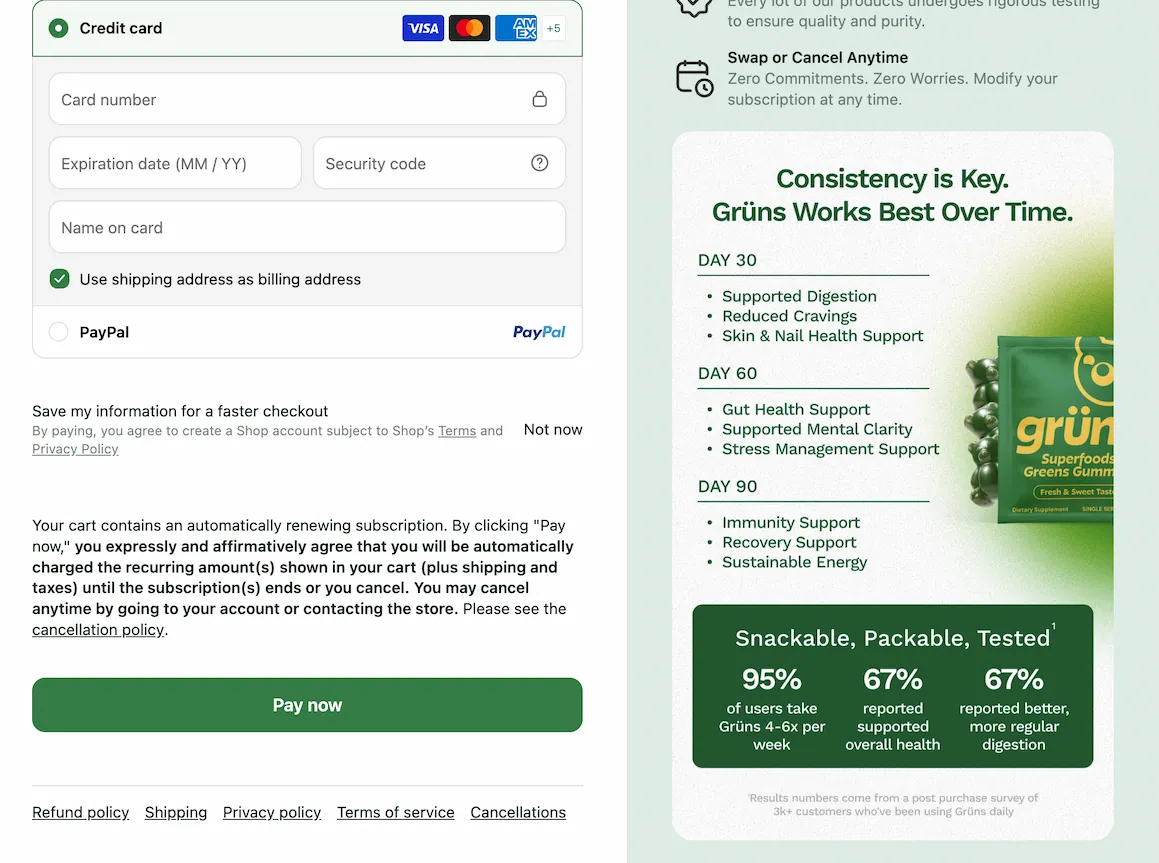
The half point goes on social proof. Their own survey says 80% take it daily, but the reviews on the widget are mostly first-week reactions. In ads, the messaging is tightly targeted by persona. The emails are less so. They mostly sell the benefits of a daily supplement and the welcome offer, not a GLP-1 user or a parent.
What I would change: lead reviews with tenure. You already have the data. You are just not showing the people behind it.
5. Subscriber onboarding: 13 out of 15
Here I look at what happens in the first 30 to 90 days after someone subscribes. This was the surprise.
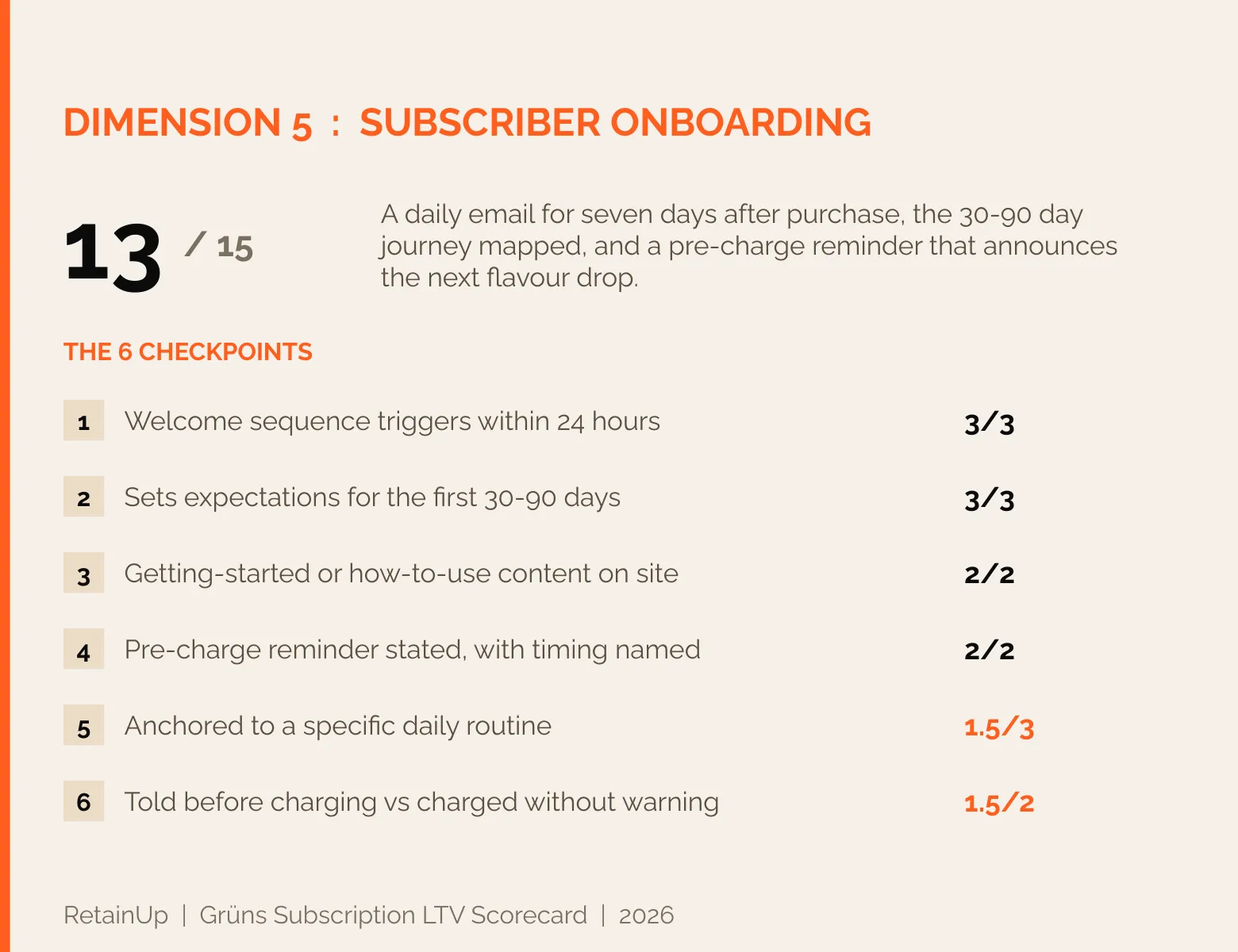
They are heavy on habit formation. So instead of going quiet after the order, they send seven emails in seven days. Rip, tap, enjoy. You are crushing it. You made it. A review ask on day five.
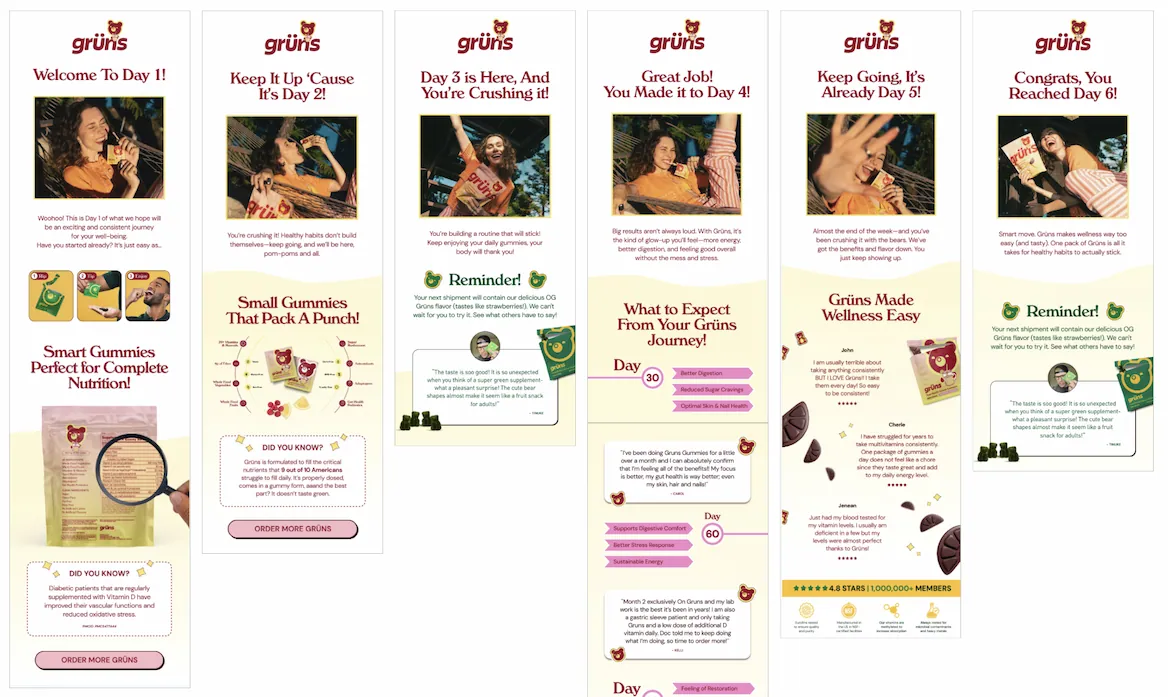
Then on day six, before the card gets hit: your next order is coming, and something extra is in it. Same email everyone else sends as a billing warning. And Grüns uses it to announce the next limited flavour, which turns the one email every brand treats as a legal notice into something a subscriber actually wants to open.
Where they lose is the routine anchor. Their copy says "anytime, anywhere" on purpose. That is a choice, not an oversight, and it fits the product. But it means nothing ties the gummy to a moment in your day. There are also a few complaints about being charged with no heads-up. A handful. Against 2,500+ reviews at 4.6.
What I would change: keep "anytime, anywhere" for acquisition. Add one anchor after purchase, because a habit needs a time and a place. We cover how in engineering a habit around your product.
Seven welcome emails and a pre-charge reminder that sells the next box take a Klaviyo build. The Subscription LTV Maximizer™ builds your onboarding emails and SMS with the subscription app events wired in.
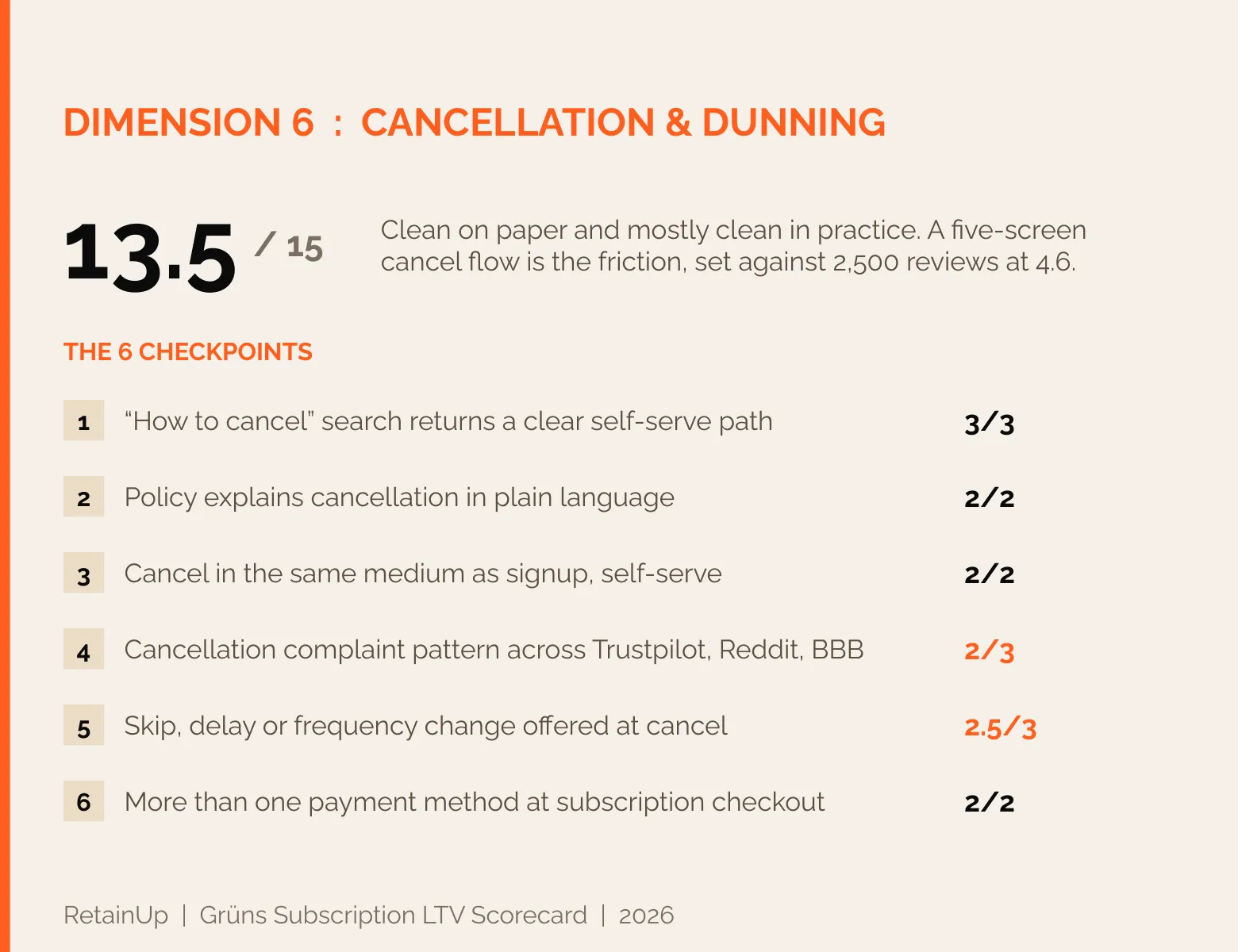
6. Cancellation and dunning: 13.5 out of 15
Here I look at how easy it is to leave, and how well failed payments get recovered. Clean on paper, and mostly clean in practice.
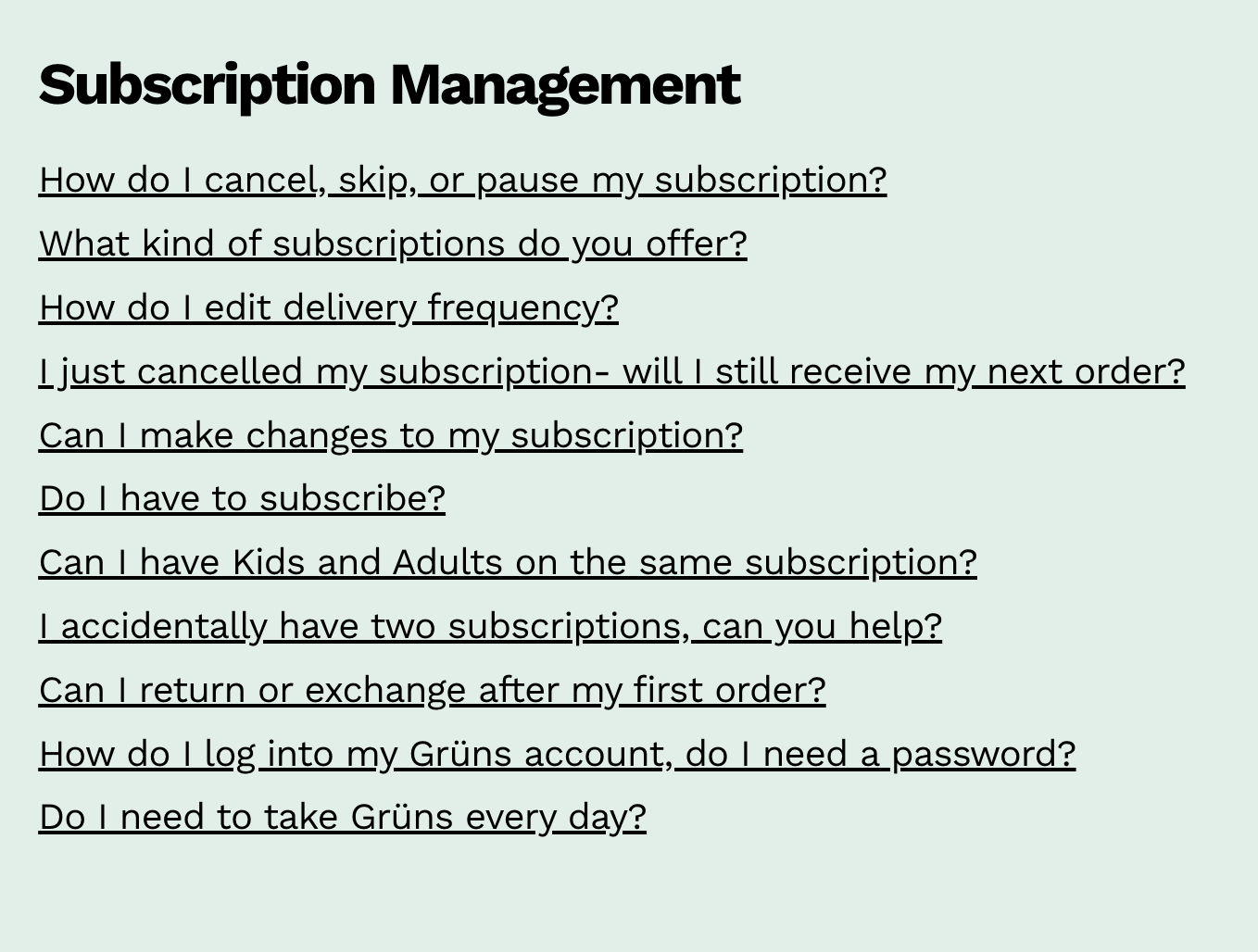
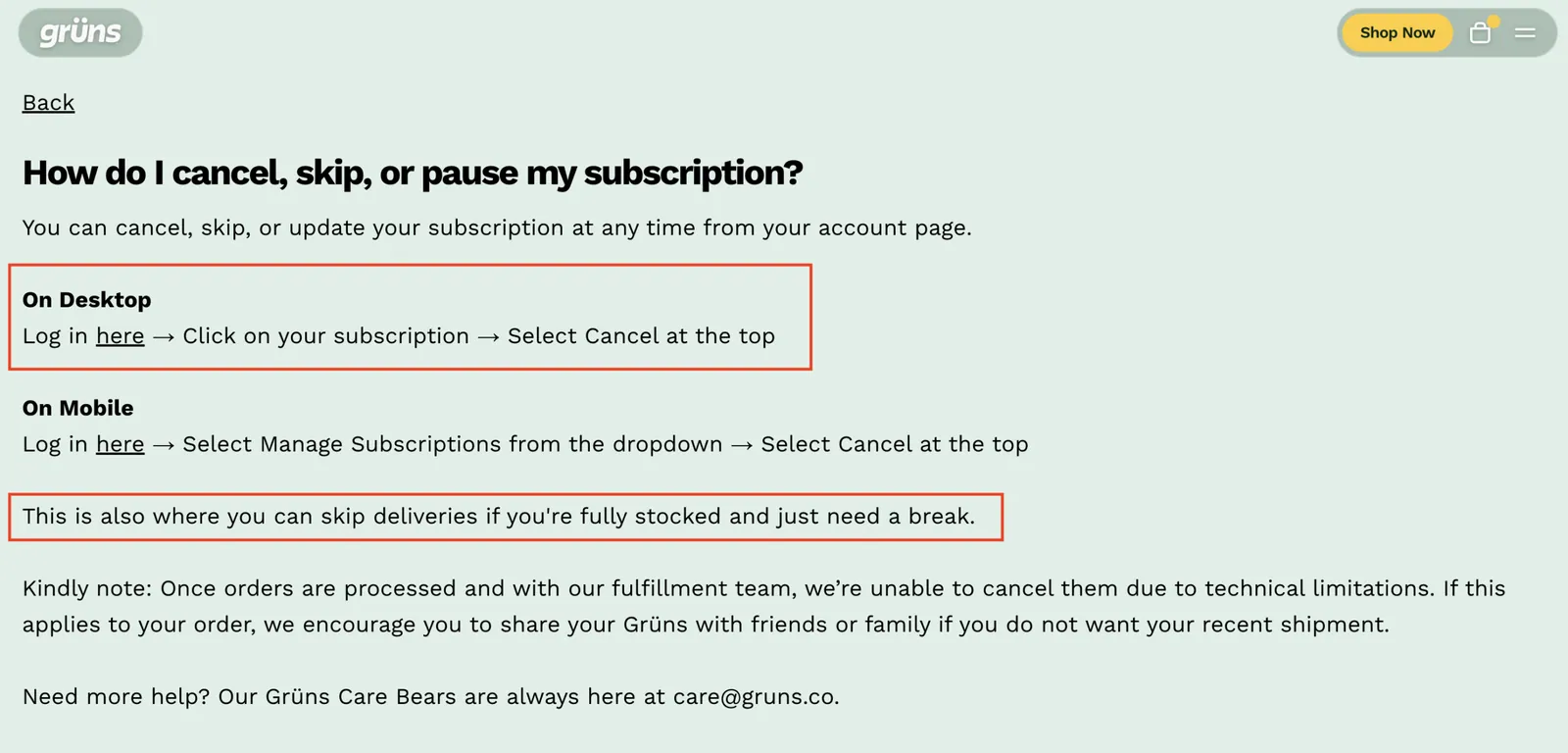
Search "how to cancel Grüns" and you land on their own help centre. Not Reddit. Their FAQ and help section is to die for. They tell you what to click and what you will see on the screen. You cancel where you signed up, in the Skio portal. Not by phone, not by email.
Payment options are wide. Shopify wallets, Shop Pay instalments, and HSA and FSA through Truemed. More ways to pay means fewer failed charges.
There is a complaint pattern. A cancel flow of five or more screens, and people saying they were charged after cancelling. It is real. But it sits against roughly 2,500 reviews at 4.6, and at that volume a few angry reviews are friction at scale, not a broken system.
What I would change: count the screens in the cancel flow. Save offers are fine. Five screens reads as a dark pattern even when it is not one. Our guide to cancel flow routing shows how to keep the save offers in fewer steps.
A cancel flow with a save path per reason, in fewer screens, is part of the Subscription LTV Maximizer™, along with payment recovery for the cards that fail.
7. Flexibility: 9.5 out of 10
Here I look at whether a subscriber can skip, pause, reschedule, change frequency or swap without contacting anyone. Everything is named, and most of it is shown.
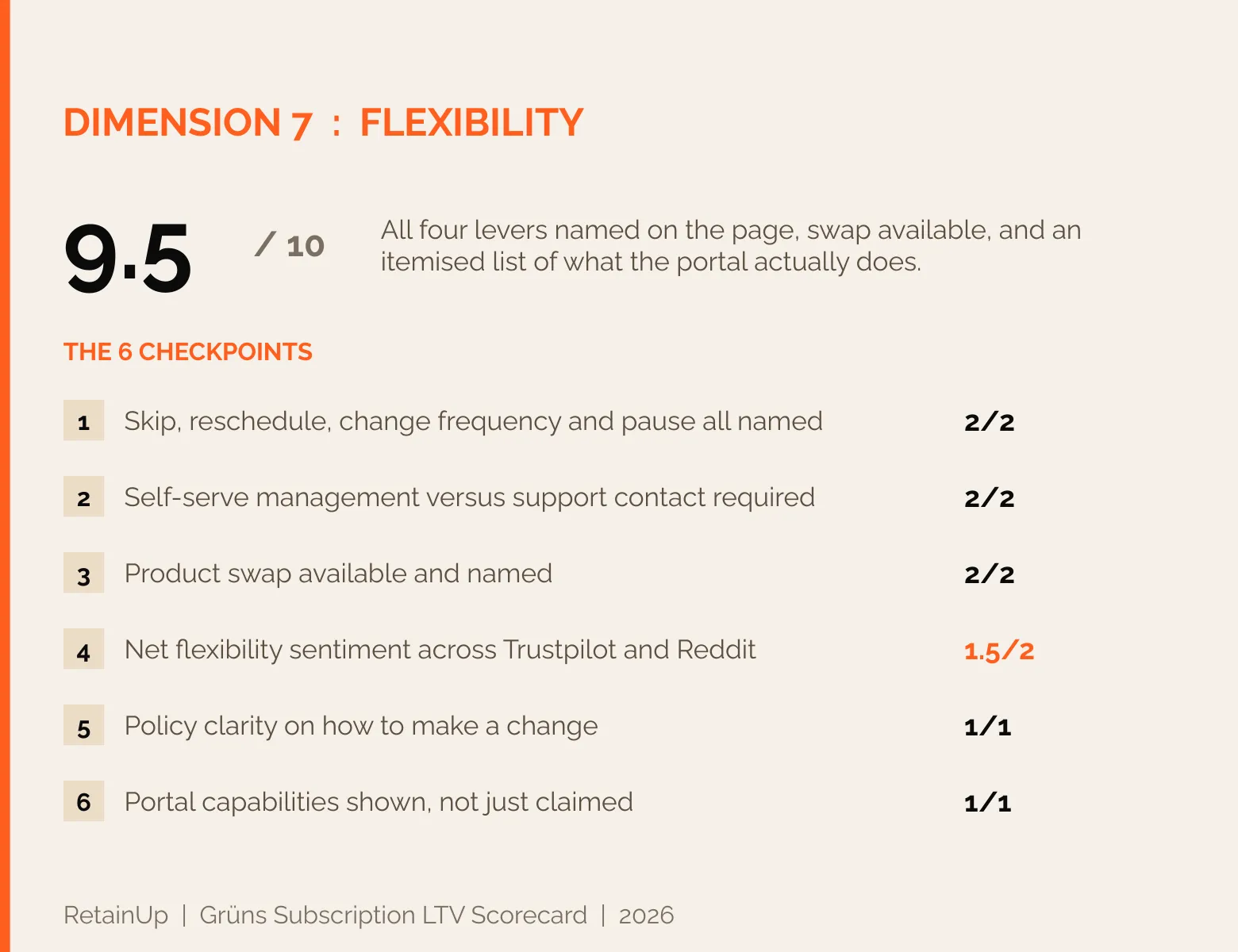
Skip, reschedule, change frequency and pause are all named, on the product page and in the help centre. Swap and add a product are named too. Most brands name one. And they hide the rest behind the cancel button, where a subscriber only finds them on the way out.
Management is self-serve. Only one thing needs an email: adding more than 2 pouches. And the help centre gives an itemised list of what the portal can do: log in, click Edit, save. Almost nobody publishes one.
What I would change: record a 30 second portal walkthrough. An itemised list earns you the point. A video earns you the customer.
If your portal can do all of this but nobody uses it, the Subscription LTV Optimizer™ checks your store, app and Klaviyo every month and ships the fixes, starting with the ones customers trip on.
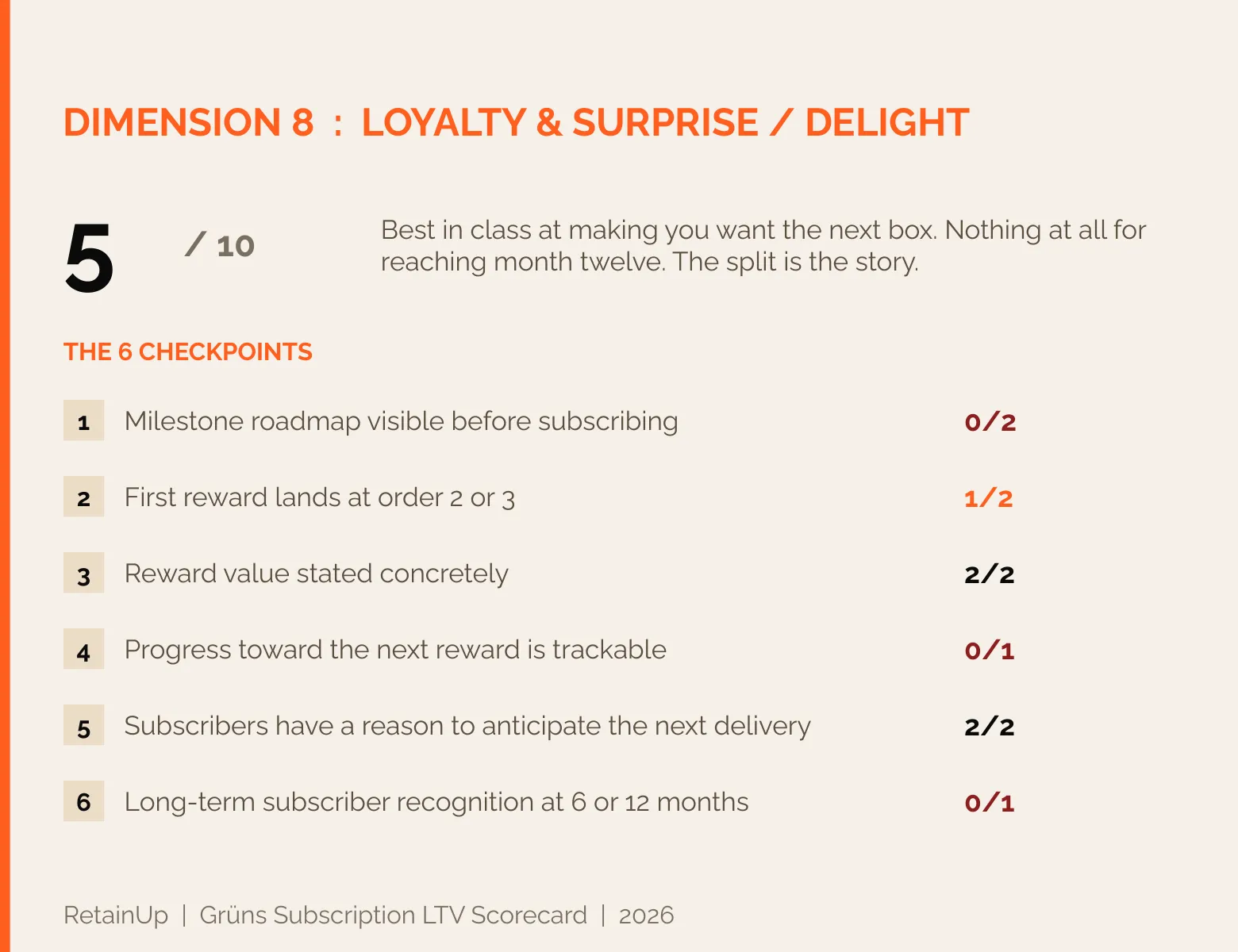
8. Loyalty and surprise/delight: 5 out of 10
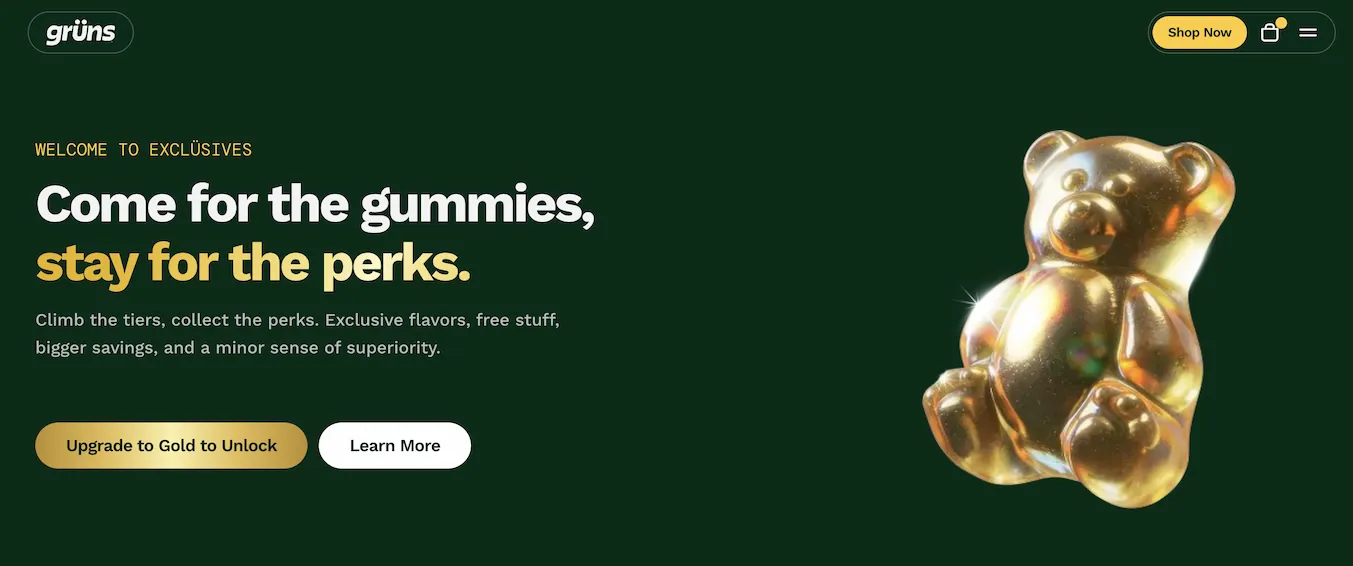
Here I look at what a subscriber gets for staying. Different model. Grüns positions itself closer to candy, Coke or Oreo than to a supplement brand. Oreo is famous for limited flavour drops. Coca-Cola launches limited editions around events like the FIFA World Cup.
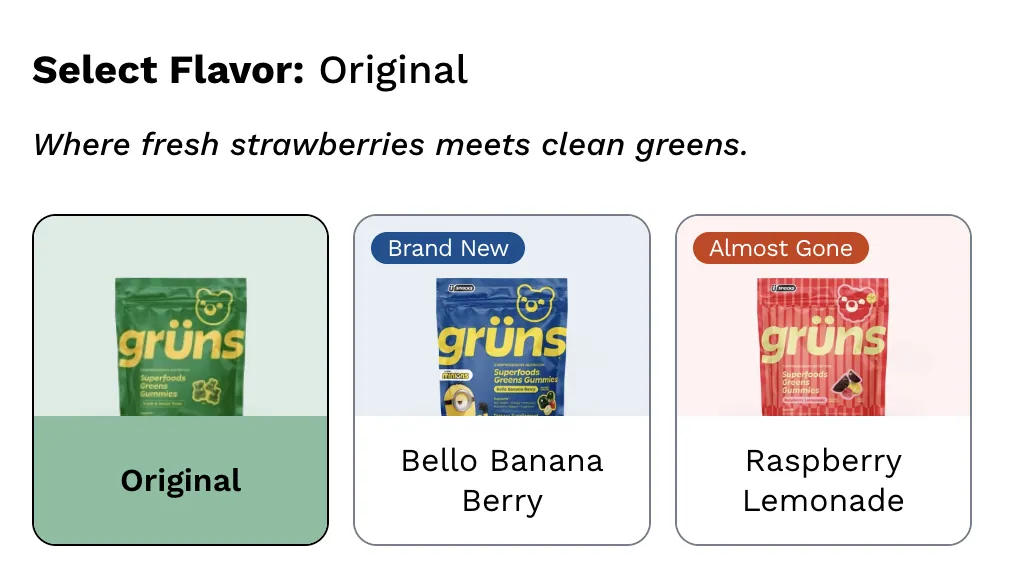
Grüns takes it further with licensed deals. A new flavour roughly every 6 weeks, 2 of the last 3 licensed, Popsicle and Minions. A new flavour drops, you get a text, you reply, and your next box is swapped. That is the whole flow. It is the strongest reason to want the next delivery we have scored anywhere. It also explains the four-week cadence. A quarterly subscriber sleeps through every drop.
And everything else they give, they give at the start. The VIP pass page is a tier table, not a reward schedule tied to order numbers. Nothing automatic lands at order 2 or 3; the free product is something you choose, not something that arrives. No progress tracking. No recognition at 6 or 12 months. The discount is for life by tier, never by tenure. They have a points program, but the perks are minor.
So they solved wanting the next box. Not staying for 12 of them.
What I would change: keep the limited edition program exactly as it is. Nobody does it better. Then put one automatic gift at order 2 or 3, show progress toward it in the portal, and recognise 6 and 12 months. 5 points sit here, more than every other gap combined. The milestone-based retention guide covers the ladder.
A gift at order 2 or 3 and a milestone ladder in the portal are what most brands are missing. The Subscription LTV Maximizer™ builds the rewards and milestone flows in your subscription app and Klaviyo.
How Grüns compares to other gummy brands
We have scored six big subscription brands on the same 48 checkpoints. Grüns leads the table.
| Brand | Product | Score |
|---|---|---|
| Grüns | Daily nutrition gummy | 85.5 |
| Everyday Dose | Mushroom coffee | 81 |
| Dr. Squatch | Natural soap | 73 |
| IM8 | Daily nutrition powder | 72 |
| Create | Creatine gummy | 67.5 |
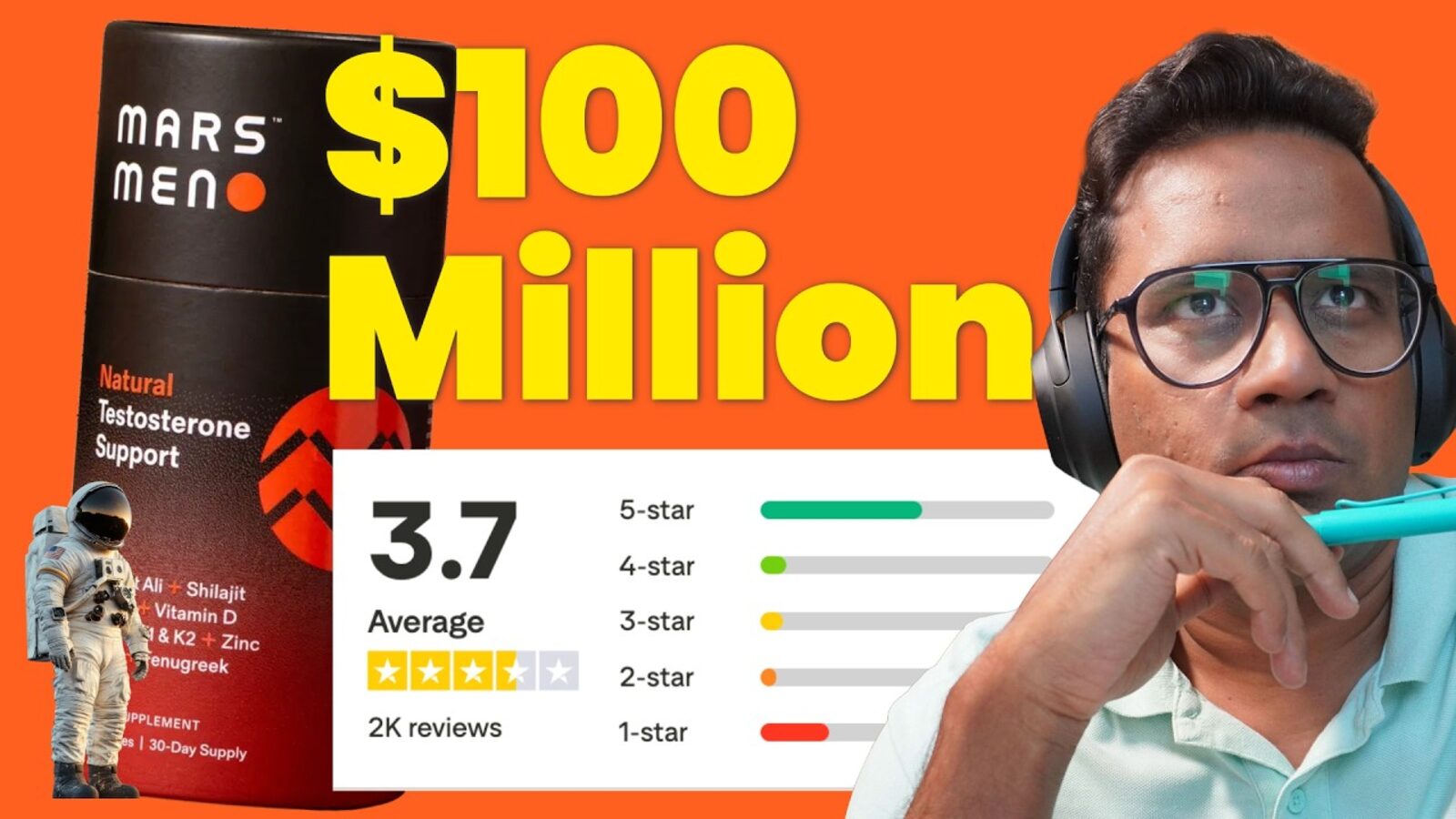
| Mars Men | Men's grooming | 62 |
Grüns vs Create: two gummy brands, 18 points apart
Create is the closest match. Both sell a daily gummy habit on subscription. Create says it runs at $150M a year with more than 100,000 active subscribers. It scored 67.5 to Grüns' 85.5, and the gap is almost all in what happens after the first order.
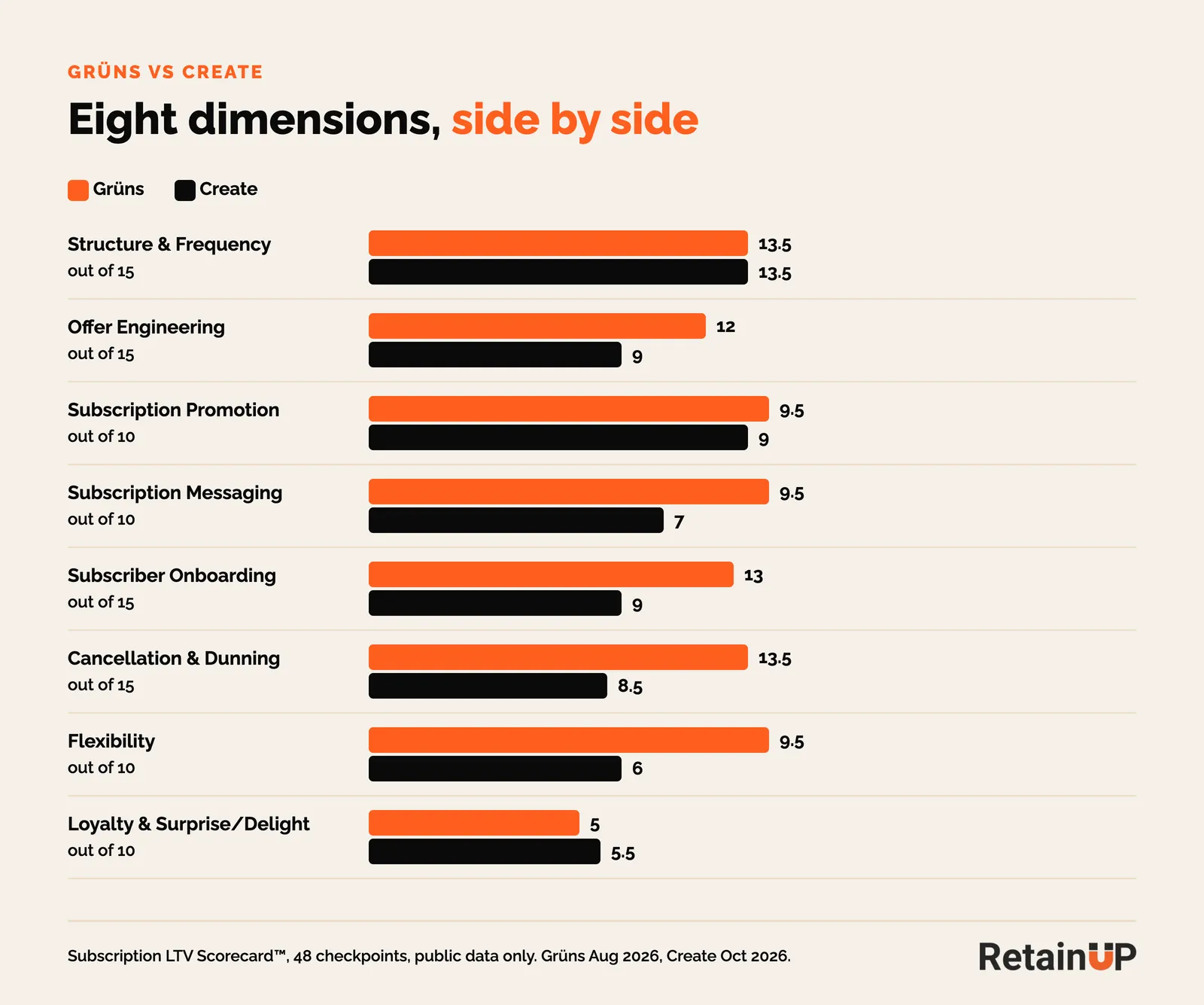
The two are close at getting people to subscribe, 44.5 against 38.5. They are far apart at keeping them, 41 against 29. Grüns wins six of the eight dimensions. They tie on structure and frequency, and Create edges ahead on loyalty by half a point, with a real points program that lives on a page not in the menu.
Create beats Grüns on frequency choice: 1, 2 and 3-month tiers, priced from $1.93 down to $1.79 a day. Grüns makes you find the quarterly plan after checkout. The biggest gap is cancellation, 13.5 against 8.5. Search "how to cancel Grüns" and you get Grüns' own steps. Search the same for Create and no Create page comes up. And yet Create has the better cancel screen, a founder note that knows you are "three weeks into something that takes four".
Full breakdown of the other side: the Create subscription scorecard.
Grüns vs Mars Men: the front half and the back half
Mars Men scored 62. 41.5 on growth, 20.5 on retention. Grüns won 89% of the growth points and 82% of the retention points. Mars Men won 83% and 41%. Same funding stage, both built on one hero product. One built the front half. Grüns built both.
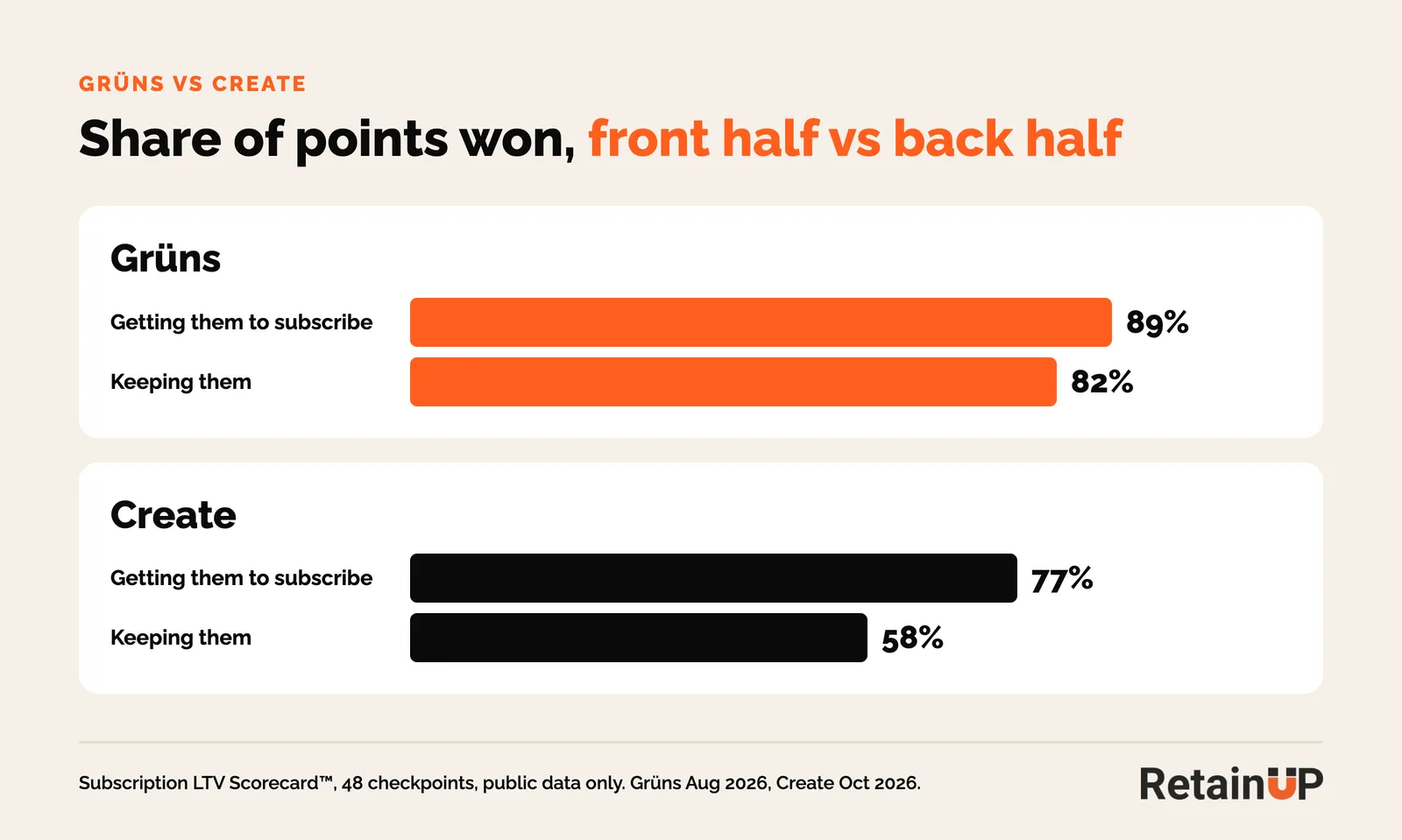
That shape is common. We see it in most programs built by a strong acquisition team. Mars Men is the extreme case. Create sits in between. Dr. Squatch is the most even, 74% against 72%, but lower on both. Grüns is the only one above 80% on both halves.
To see where your own program sits against these six, the Subscription LTV Roadmap™ scores your store and reads your cohort data, then hands you a 90-day plan of 30 to 50 changes in order.
Five things you can copy this week
None of this needs a licensing budget.
- The seven day welcome sequence. Silence in week one is when people decide it is not working.
- The pre-charge reminder that announces something new. Make the billing email worth opening.
- The red X block against one-time purchase. Show what a one-time buyer gives up.
- The itemised portal list. Tell people every change they can make, and how.
- The results timeline on the checkout page. Put the promise where the wallet is.
So Grüns solved adherence. Not loyalty. For most brands the problem is the other way around, and that one is easier to fix.
Want your program scored on the same 48 checkpoints? The free subscription audit runs the same scorecard on your store and ranks your top 3 retention leaks, in 24 hours.
FAQ
How does the Grüns subscription work?
Grüns ships a pouch of 28 daily gummy packs every 4 weeks, which matches one pack a day. A quarterly plan of 84 packs is offered as an upgrade after checkout rather than on the product page. Subscribers manage everything in a Skio portal: skip, reschedule, change frequency, pause, swap flavours or add products, without contacting support.
How much does a Grüns subscription cost?
On 10 November 2026 Grüns listed $49.99 for 28 packs on subscription against $66.65 one-time, about $1.79 a day against $2.38. When we scored it in August, a $29.99 first-order offer brought the first month to $1.07 a day. The quarterly plan works out cheaper per day, at about $1.67.
How do you cancel a Grüns subscription?
You cancel yourself in the Grüns customer portal, where you signed up. Their help centre gives click-by-click steps for desktop and mobile. Expect save offers on the way out: some reviewers counted five or more screens before the cancel went through, so check for the confirmation email.
Can you change flavours on a Grüns subscription?
Yes. Swap is named in the help centre and works in the portal. When a limited flavour launches, roughly every six weeks, subscribers get a text and can swap their next box to it just by replying. That text swap runs on Skio and Postscript, and it is the main reason Grüns keeps a four-week cadence.
Why does Grüns score higher than other subscription brands?
Grüns is strong at both halves of the program: 44.5 out of 50 on getting people to subscribe and 41 out of 50 on keeping them. Most brands are strong only on the first half. It loses most points on loyalty, with no milestone rewards and nothing that recognises 6 or 12 months.
One email a week on subscription retention: the numbers, the strategy, and what to fix first.

Rahi Jain
Rahi Jain is a subscription LTV specialist who helps $1M to $10M DTC brands reduce subscription churn and maximize LTV on Recharge, Skio, Stay AI and Loop.
More about Rahi