Key takeaways
- Dr. Squatch scored 73 out of 100 on the Subscription LTV Scorecard™: 37 for getting people to subscribe and 36 for keeping them, the most even split we have scored.
- It fixes the frequency at every 3 months and lets each subscriber choose how many bars come in the box. A $6 bar cannot carry a subscription, so they sell a $36 box.
- It loses most on onboarding, a frequency nobody explains, and a discount that changes from 7% to 50% depending on the page.
Dr. Squatch sits in the Subscription Scorecard Library next to every other brand scored on the same 48 checkpoints.
How do you put a $6 bar of soap on subscription? How do you put deodorant, shampoo and face wash in the same subscription? And does every product even need one?
Dr. Squatch had to answer all three, and the answers were good enough that Unilever bought them in 2025 for a reported $1.5 billion, with most of their sales coming from their own website.
Everything I had scored before was supplements. IM8, Mars Men, Grüns. One or two hero products at $50 to $100. Dr. Squatch starts at $6 and sells across ten categories.
So I scored their whole subscription program on 48 checkpoints. 73 out of 100. Let's see how subscription works for a small-ticket, multi-category, billion-dollar brand.

Watch the full Dr. Squatch breakdown
What is Dr. Squatch?
Dr. Squatch is a natural soap brand for men. It started with bar soap, and now sells deodorant, hair care, body wash, cologne and toothpaste too.
Jack founded it in 2013. Revenue was around $400 million in 2024, per trade press, and 85% of it came from their own website.
One thing to keep in mind before the score. Soap is not a supplement. Nobody uses it for results, and one bar lasts a different time for every person. That changes how a few checkpoints read.
- Platform: Shopify Plus, Recharge for subscriptions, Rivo for loyalty.
- Migration: more than 75,000 active subscribers moved from Cratejoy to Recharge, per the migration case study.
- Exit: Unilever announced the deal in June 2025, at a reported $1.5 billion, and completed it that September.
The Dr. Squatch subscription scorecard: 73 out of 100
Scored 28 August 2026, from public data only. 8 dimensions, 48 checkpoints, from the product page to the cancel flow.
| Dimension | Score | Out of | Points lost |
|---|---|---|---|
| 1. Structure and frequency | 10.5 | 15 | 4.5 |
| 2. Offer engineering | 11 | 15 | 4 |
| 3. Subscription promotion | 9 | 10 | 1 |
| 4. Subscription messaging | 6.5 | 10 | 3.5 |
| Subscription growth | 37 | 50 | 13 |
| 5. Subscriber onboarding | 9 | 15 | 6 |
| 6. Cancellation and dunning | 10.5 | 15 | 4.5 |
| 7. Flexibility | 8.5 | 10 | 1.5 |
| 8. Loyalty and surprise/delight | 8 | 10 | 2 |
| Subscription retention | 36 | 50 | 14 |
| Total | 73 | 100 | 27 |
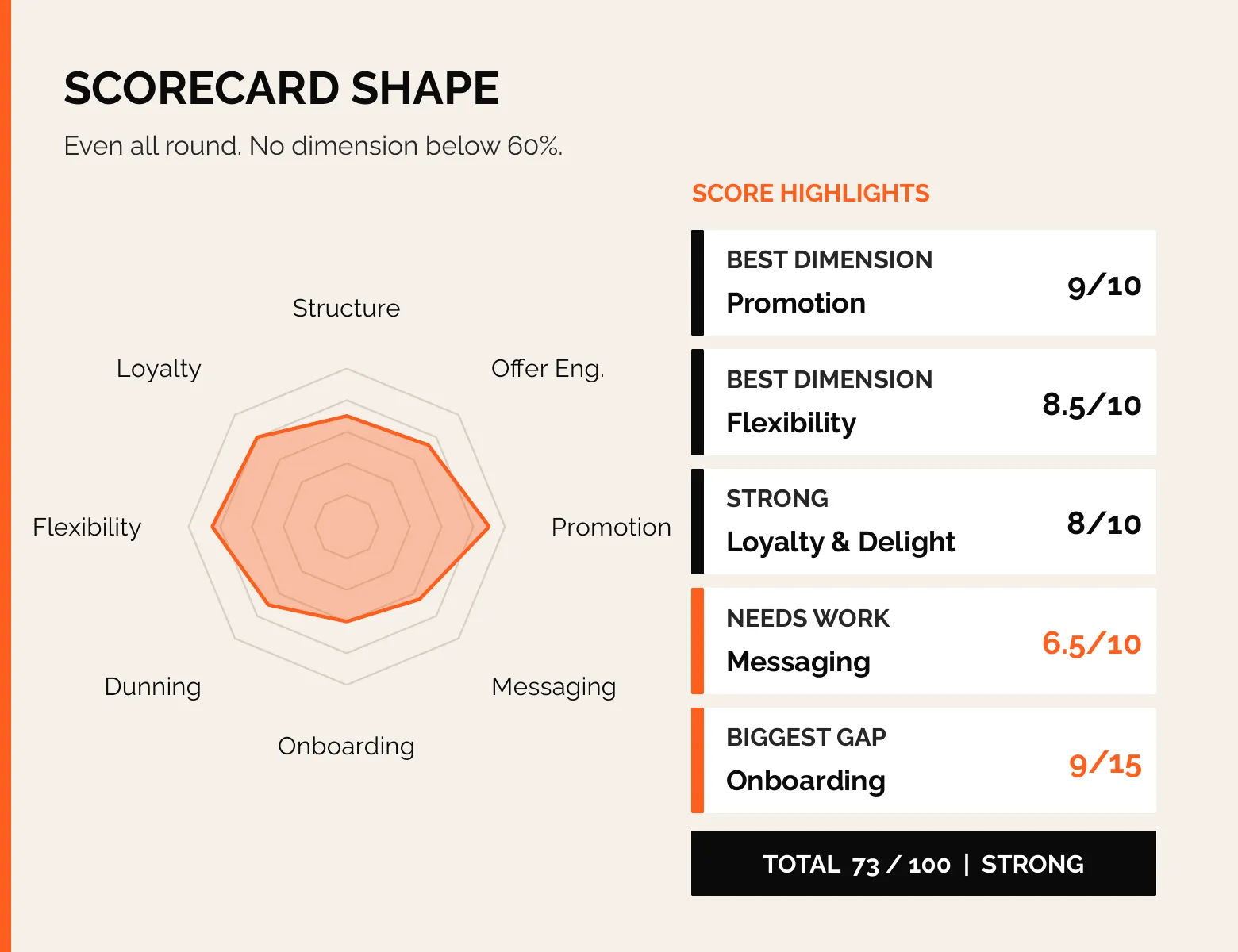
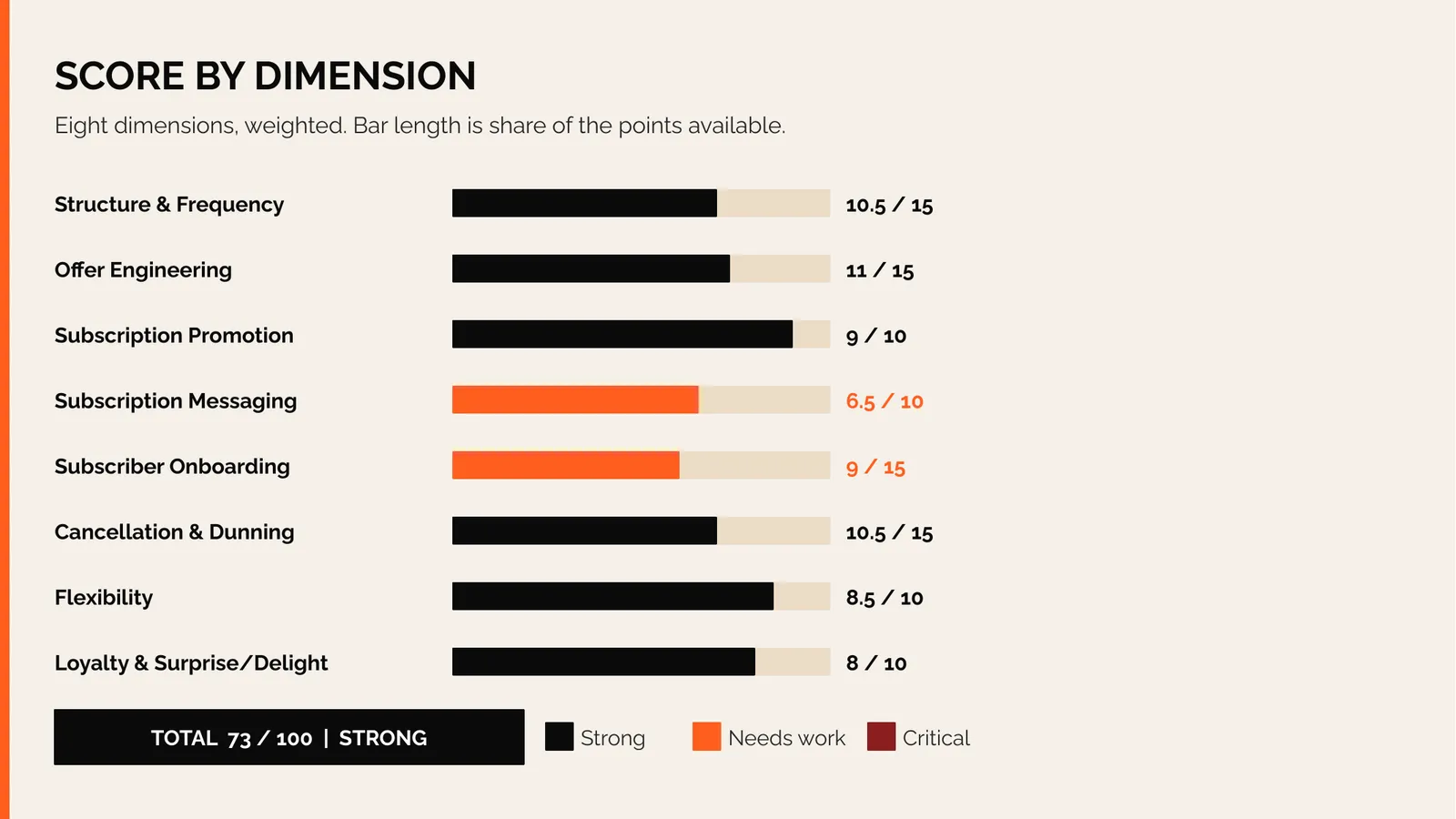
37 from getting you to subscribe, 36 from keeping you. Even all round. No dimension below 60%. One checkpoint, a save offer inside the cancel flow, could not be verified from outside and scores zero by our method. A live walkthrough could add up to 3 points.
Three things stood out
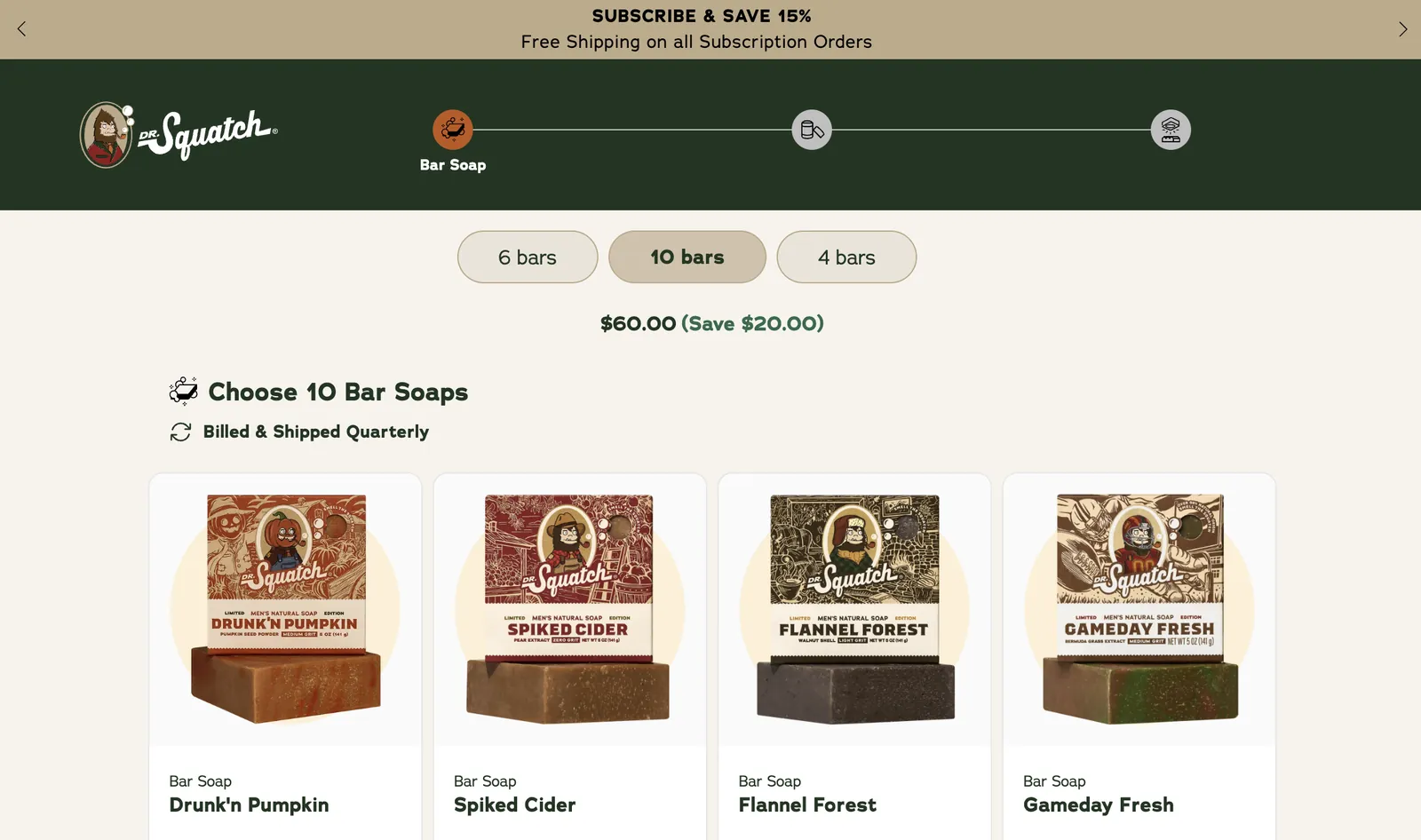
First, they fixed the frequency and let you choose the supply. Soap is very personal, so it is very tough to pick one frequency for everybody. So everything ships every 3 months, and you pick 2, 4 or 6 bars. 3 months is a good middle ground. The brand gets good LTV, and the customer gets enough flexibility without being overwhelmed.
Second, they merge everything into one subscription. You build the box, pick your scents, add deodorant or shampoo, and edit it later. Easier for the customer and for the brand.
Third, they do not talk about the subscription. Cologne and lip balm are not even on it. Most emails are about new scents and discounts. Subscribers get early access to new scents, and the promotional emails never say so.
1. Structure and frequency: 10.5 out of 15
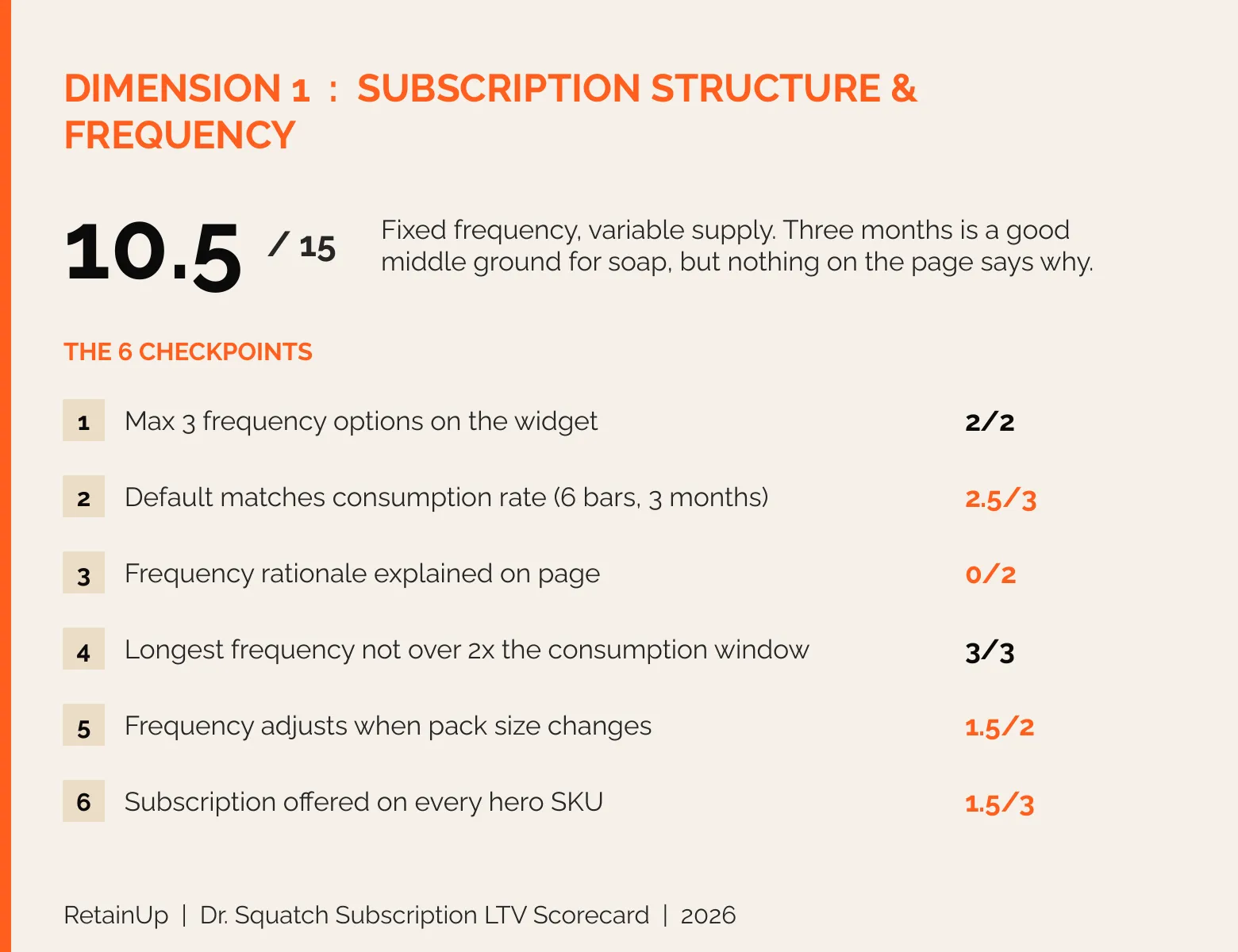
Here I look at how often the product ships and what choices you get. Fixed frequency, variable supply. Everything ships every 3 months and you decide how many bars come in the box. They are not fixing your cadence. They just do not know your frequency.
For soap, 3 months works, because it still makes sense if someone finishes their bars in 2 months and it still makes sense if 6 bars last them 8 months. Some brands keep it at 6 months. 3 months helps the customer and helps the brand on profitability. 6 bars every 3 months is a lot for one person, but the whole category does it, so it costs only half a point.
Where they really lose is the rationale. Nothing on the page says why 3 months. Or how long 6 bars will last. Zero points.
They do have monthly plans, 1, 2 or 3 bars a month, at a slightly higher price per bar. But no page on the site links to them. They load only by direct URL; we crawled 80 pages and found no link. And you cannot subscribe to cologne or lip balm, and I am not sure why.
What I would change: give a reason for 3 months and say how long 6 bars last. Let people choose the frequency, or at least test a monthly supply against 3 months. Native, Oars + Alps and Brickell all offer 1 to 3 month choices. And put the subscription on cologne and lip balm.
Fixed or flexible cadence is a data question, not a taste one. The Subscription LTV Roadmap™ reads your subscription data and shows which frequency and box size your best cohorts chose.
2. Offer engineering: 11 out of 15
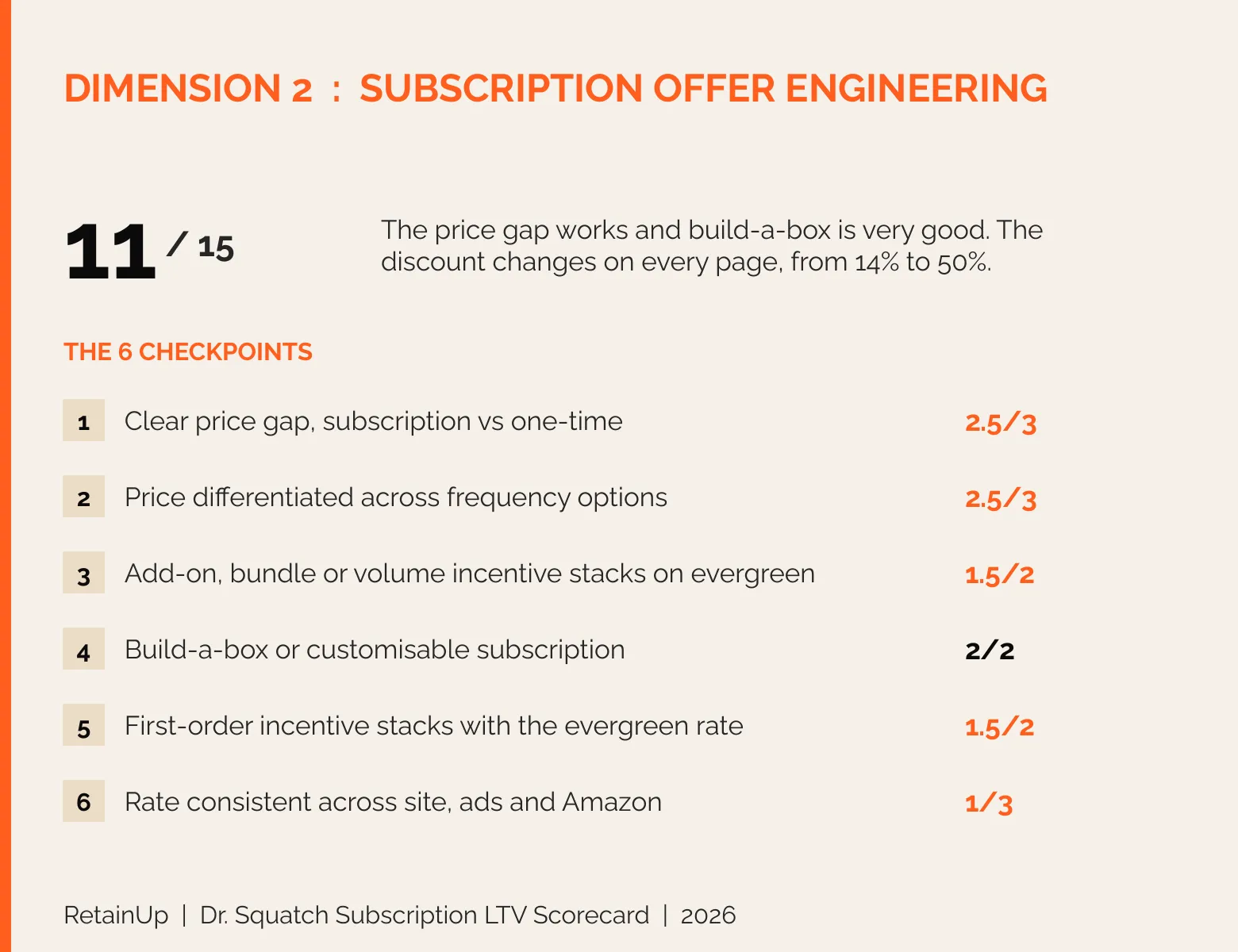
Here I look at how the subscription is priced and structured. The price gap is good. The pricing is confusing.
On subscription you pay $36 for 6 bars, against $39.90 one-time and a $42 anchor. That gap works, and the anchoring is good. The build-a-box is very good: choose your scents, a custom 6-pack, and an editable box.
But the discount changes depending on where you land. The subscription page says save 15%. The navigation says 25%. A banner says up to 30%. The free gifts page says 50% on your first order. The quiz says 20%. Amazon, 5 to 15%. The face wash 3-pack saves 14%, the deodorant and soap set 12%, the deodorant 6-pack 17%.
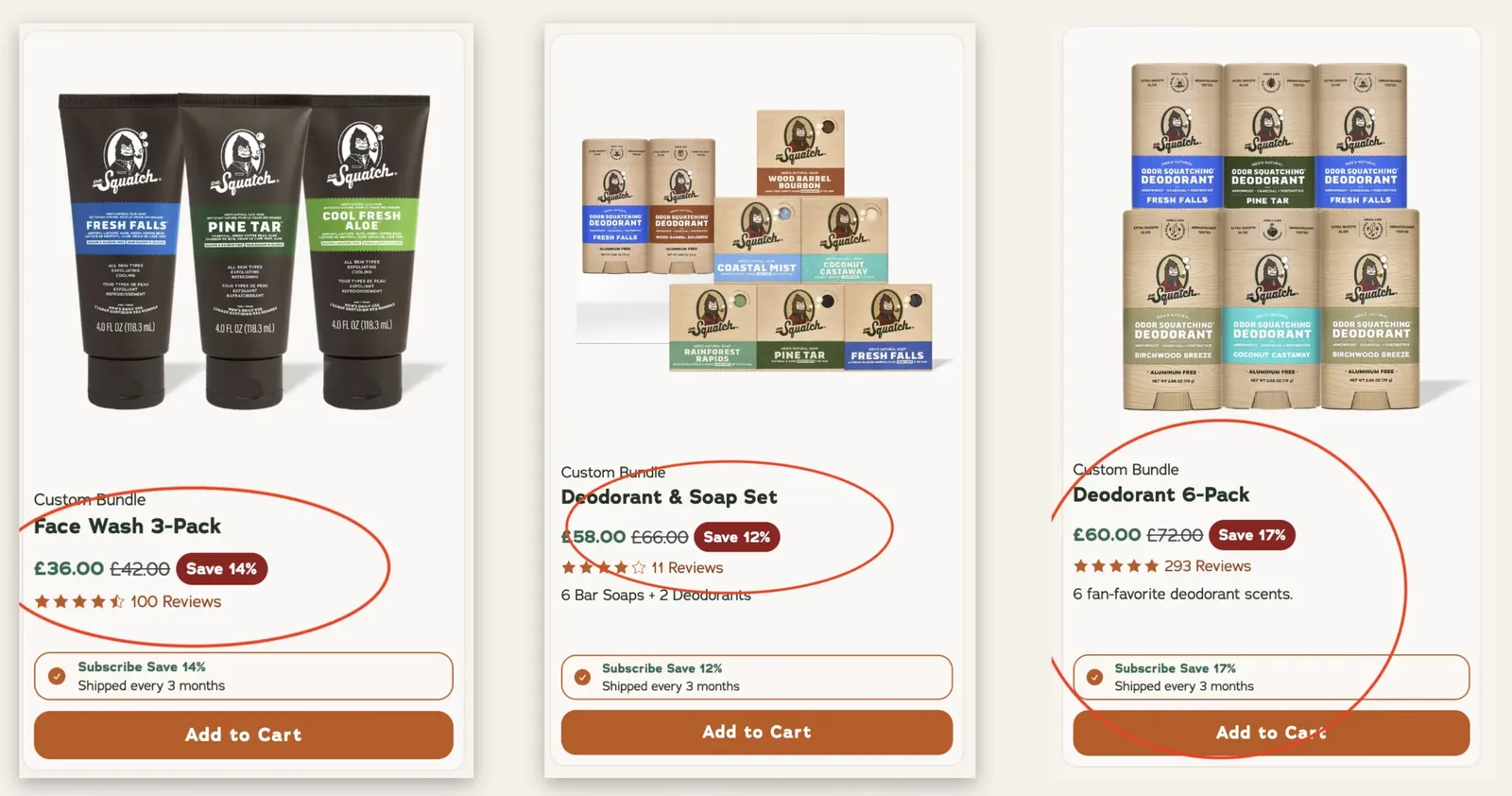
Here is why. Every 3-month bar costs $6, whether you take 2 bars or 20, and the only thing that moves is the crossed-out price, which switches between $7 and $8 a bar depending on the box size. So pick 3 bars and it says 25% off. Pick 4 and it says 14% off. Same $6 bar. They are not upfront about pricing, and maybe it is a marketplace thing, but it is still confusing for the customer.
What I would change: one subscription rate, said the same way on every page. Show the real price per bar. Keep build-a-box exactly as it is.
One subscription rate, said the same way on every page, and a build-a-box that shows the real price per item: the Subscription LTV Maximizer™ sets up the offer and widget in Recharge, Skio, Loop or Stay AI.
3. Subscription promotion: 9 out of 10
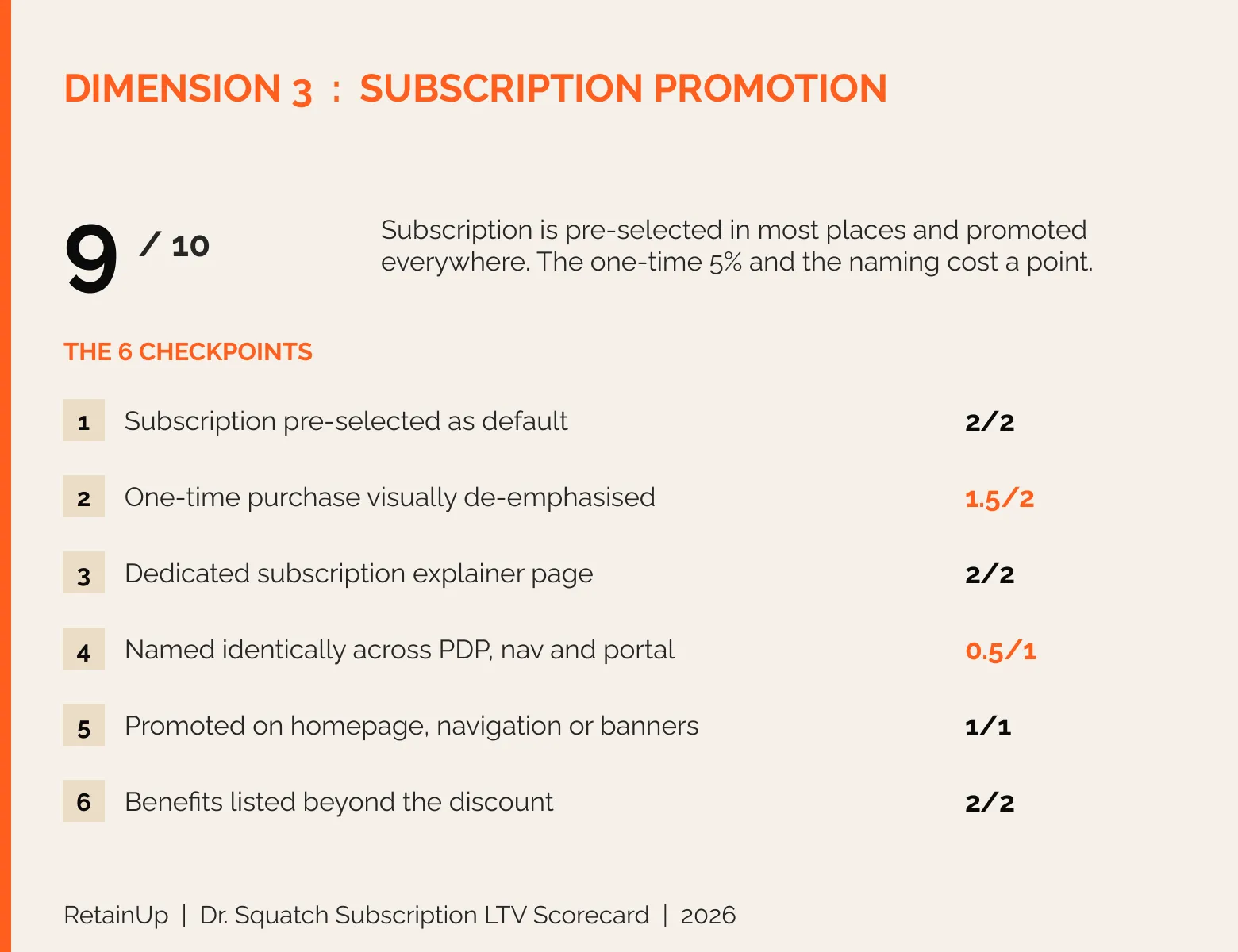
Here I look at how hard the site pushes subscription over a one-time purchase. In most cases, subscription is pre-selected. There is a dedicated explainer page, and the homepage and navigation promote it: "Subscribe once and relax."
The benefits go past the discount. Early access to new scents and flexibility lead, with free shipping too.
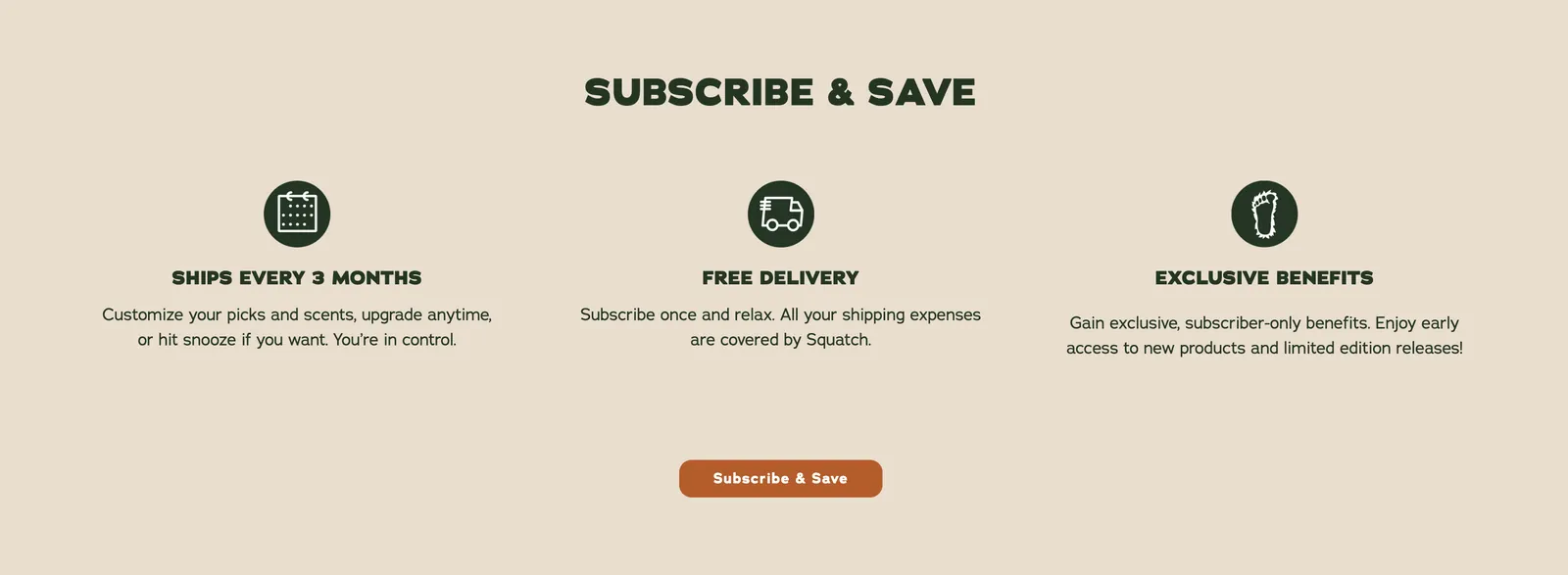
Where they lose: one-time is played down, but not much. It still carries its own 5% off. And the naming is confusing. Subscribe and Save on the product page, Subscribe in the navigation, Squatch Box in the portal.
What I would change: pre-select subscription on every product page, not most. Drop the 5% on one-time. Use one name everywhere.
4. Subscription messaging: 6.5 out of 10
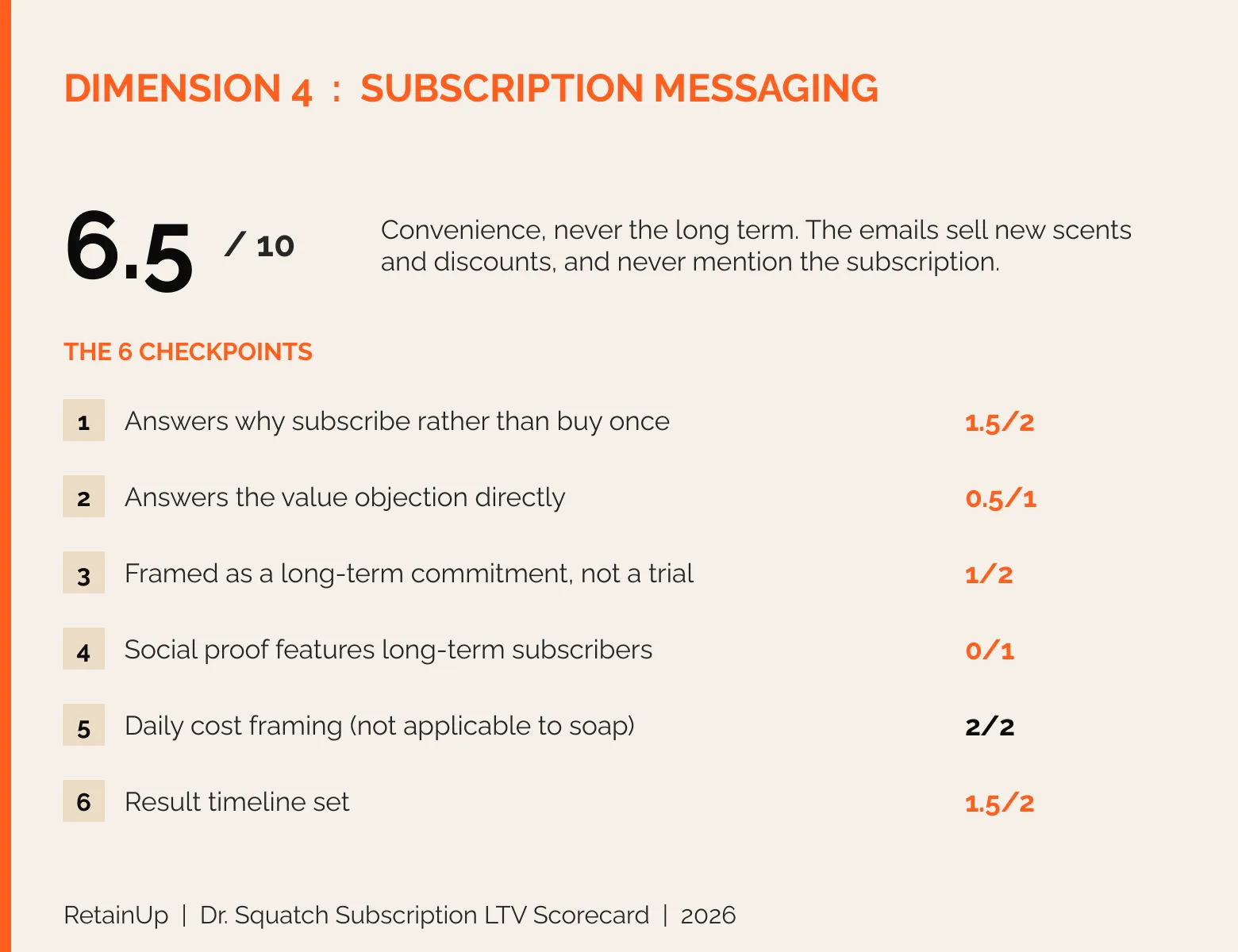
Here I look at what the copy says about why you should subscribe. They do explain it, but it is all convenience. Subscribe once and relax. Nothing about the long term.
The value objection is answered by the ingredients, indirectly. There is no long-term subscriber proof. "The guys who made the switch" says nothing about how long they stayed. Daily cost does not apply to soap, so it gets full credit. And there is no result timeline, because soap is not a results product. Some benefits should still be there.
Then the emails. They are not doing anything around subscription, which surprised me, because the rest of their email program is busy and clearly run by people who know what they are doing. Most are new arrivals and discounts, new scents around the Fourth of July and Labor Day, two or three drops a month. Mystery gifts and surprises, tied to their offers. Subscription is never mentioned in the promotional emails.
And here is the miss. Subscribers already get early access to new scents. Most of the emails are about new scents. They never connect the two.
What I would change: sell the subscription inside the drop emails. Early access is already a subscriber perk, so say it. Make the long-term case, not only convenience. Show long-term subscribers in the reviews.
If your promotional emails never mention the subscription, the Subscription LTV Optimizer™ adds it to the calendar every month, starting with the launches subscribers already get early.
5. Subscriber onboarding: 9 out of 15
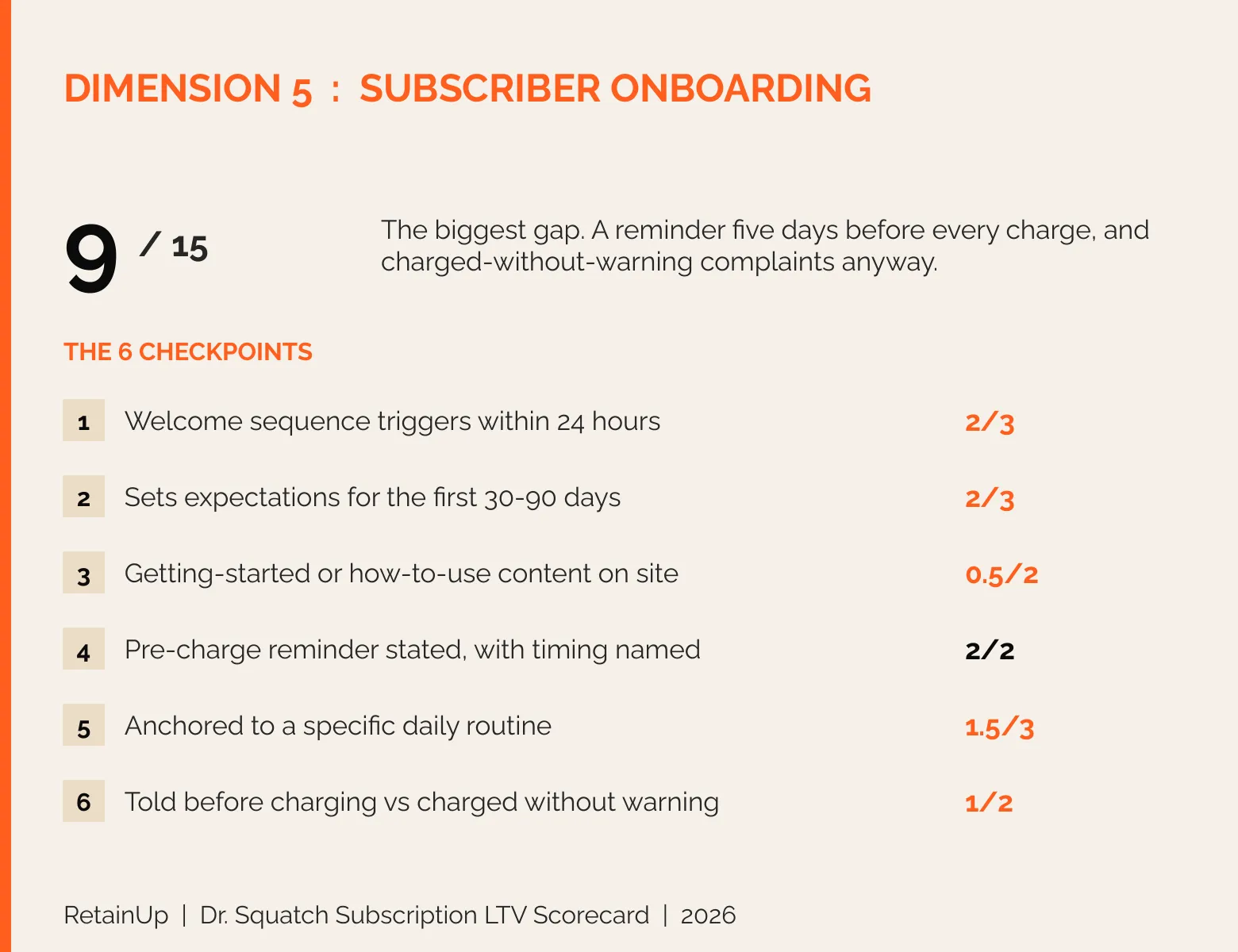
Here I look at what happens in the first 30 to 90 days after someone subscribes. This is their biggest gap.
There is a generic welcome email, but we could not find one for new subscribers. They are good with emails, so they might be sending it, and we gave them 2 out of 3. A judgment call. After purchase, there are very few subscription emails. And the getting-started path is messy, with little on the subscription side.
They send a reminder 5 days before every charge, documented in the help centre, and people still say they were charged without warning. It comes up again and again, so some customers are missing the reminder.
Bar soap is not tied to a routine either. Toothpaste gets morning and night. The hair kit gets a routine. The bar of soap gets nothing. Tying a product to a moment is the idea behind habit stacking.
What I would change: a welcome email for new subscribers, separate from the generic one. A getting-started page: what ships, when, and how to change it. And make the pre-charge reminder hard to miss.
A welcome for new subscribers, a getting-started page and a reminder people actually read are the first part of the Subscription LTV Maximizer™, built in Klaviyo on your subscription app events.
6. Cancellation and dunning: 10.5 out of 15
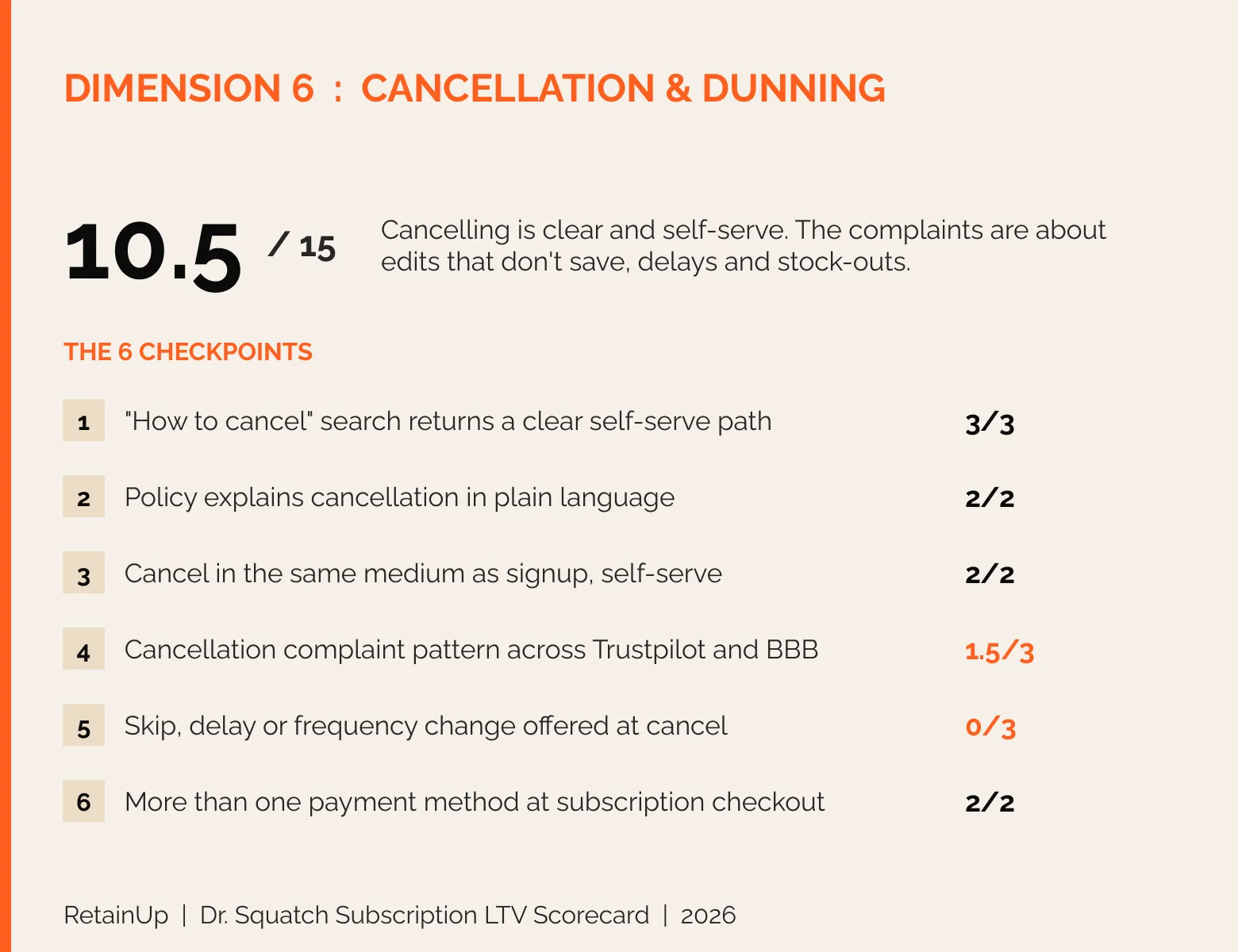
Here I look at how easy it is to leave, and how failed payments get handled. Cancelling is clean. Search how to cancel Dr. Squatch and their own help article comes up first, with numbered steps: dashboard, Manage Subscription, Cancel. "Cancel anytime with no fees, right from your account dashboard." You cancel online, where you signed up. Shop Pay, cards and instalments at checkout.
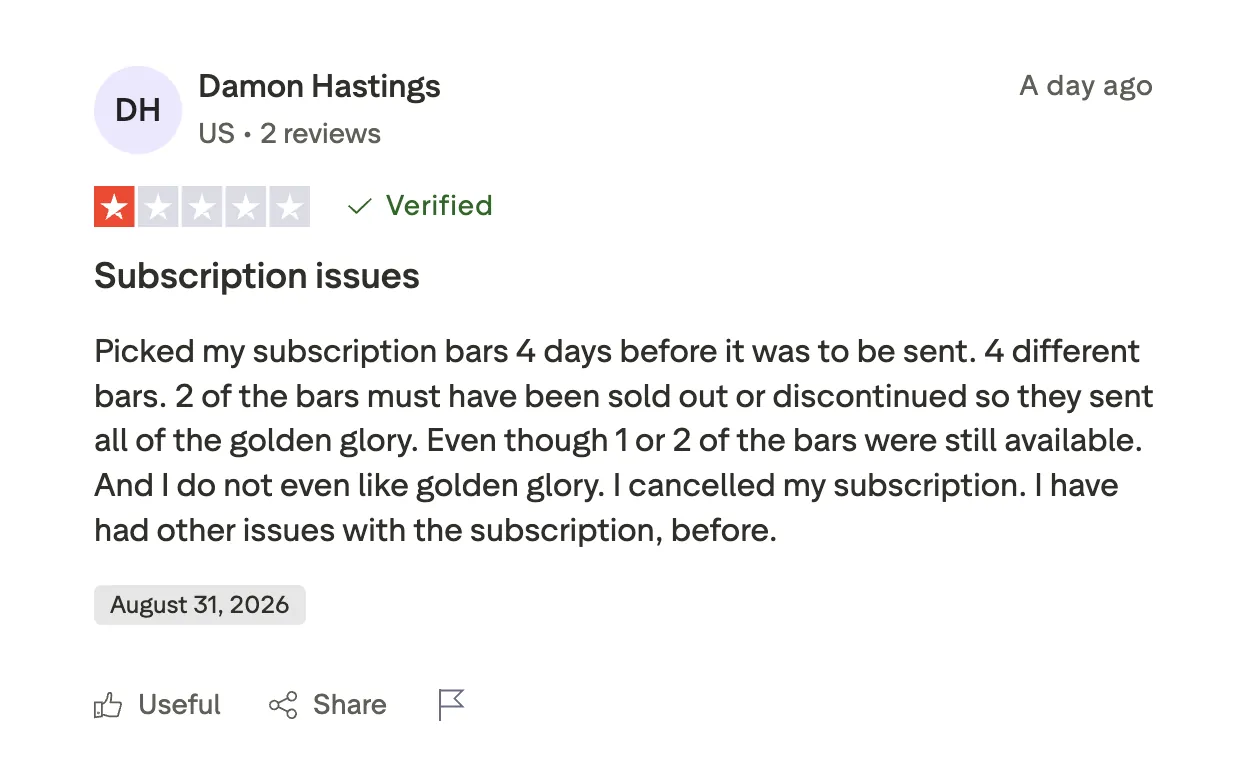
Where they lose is the complaint pattern. People edit their subscription and nothing happens. A lot of the issues are product related: delays, and scents going out of stock. Limited scents sell out, and a different bar ships without anyone being asked. People edited the box and still got the wrong one.
And we could not confirm a skip or delay offer inside the cancel flow, so that one scores zero.
What I would change: fix Edit Box so changes save. Tell subscribers early when a scent is out, and let them pick the next one. Keep cancel self-serve.
If edits do not save and stock-outs ship the wrong product, those are portal and app settings. The Subscription LTV Optimizer™ checks them every month and ships the fixes.
7. Flexibility: 8.5 out of 10
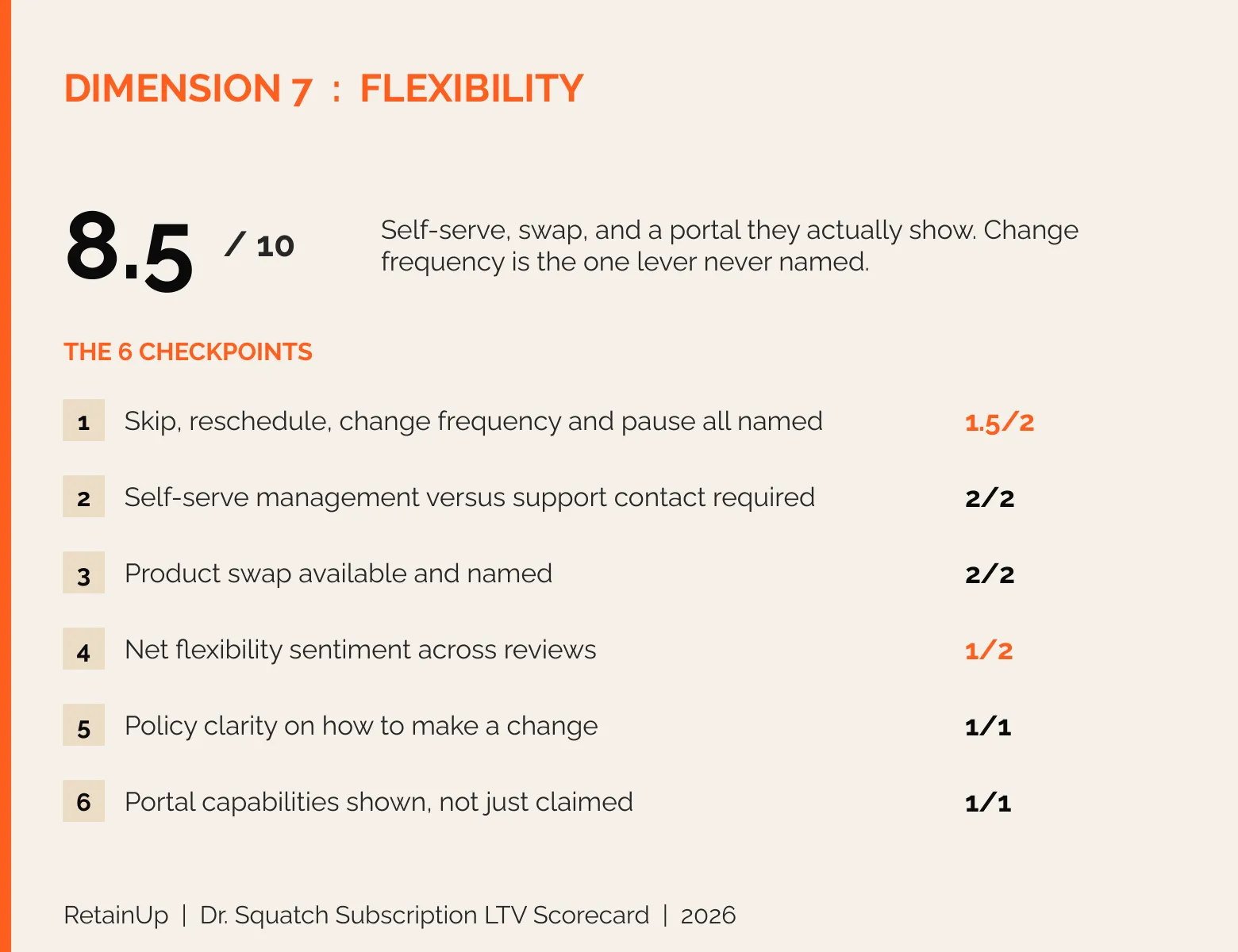
Here I look at whether a subscriber can skip, pause, reschedule, change frequency or swap without contacting anyone. Every brand offers skip and swap. Dr. Squatch is one of the few whose subscribers actually use them.
On Reddit and Trustpilot, subscribers talk about swapping scents and adding new ones before the box ships. I rarely see that. The fixed frequency is why: everyone knows a box is coming every 3 months, so they get the reminder, open the dashboard, and change the scents before it ships.
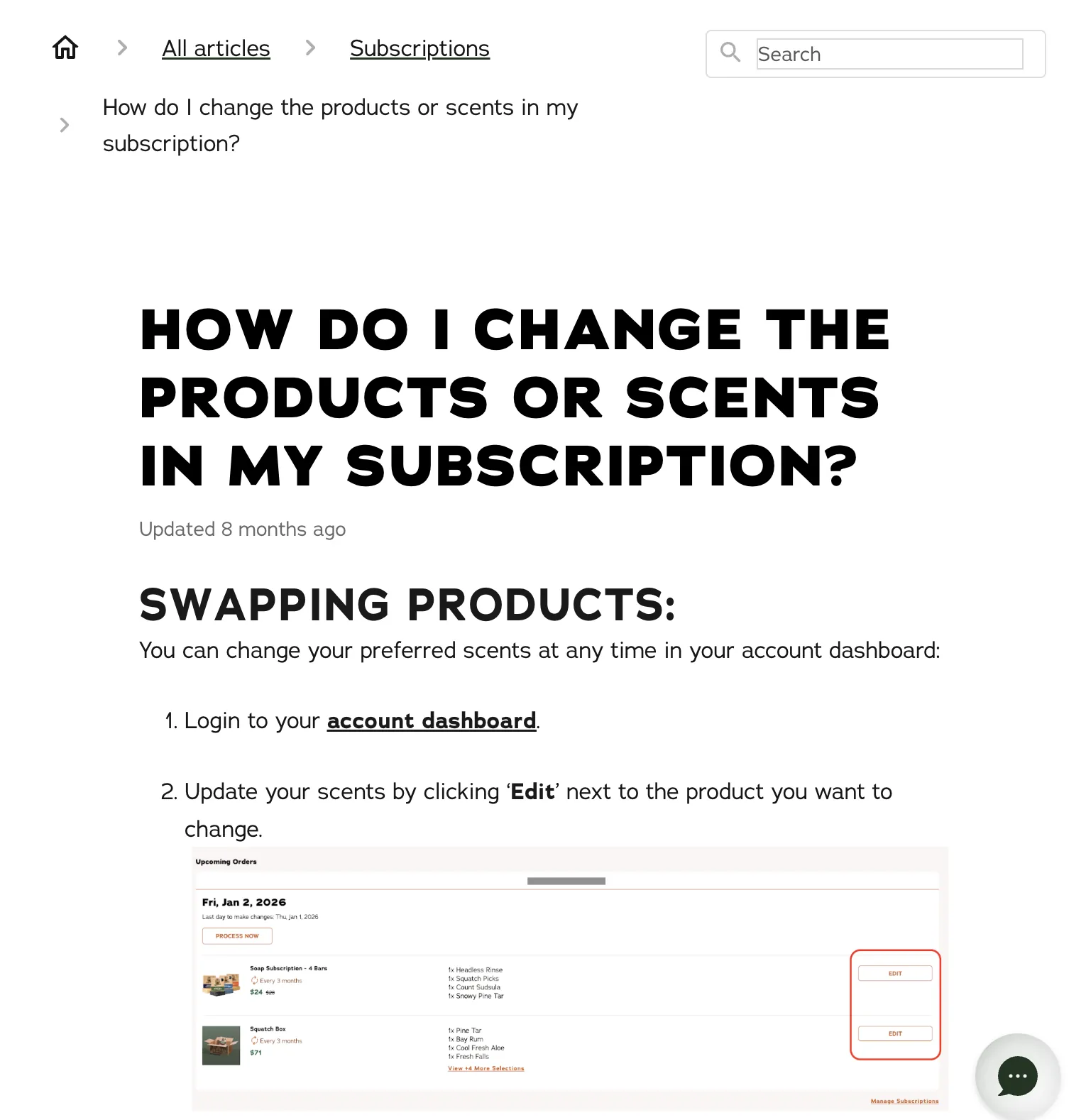
And the help centre shows a screenshot of the dashboard, so you know what you can change before you log in. Edit Box changes scents and products, adds or removes items. Every action is self-serve.
The sentiment is good, not perfect. A couple of people call the options "very cumbersome." And skip, pause, delay and cancel are all named. Change frequency is not.
What I would change: name change frequency on the product page, next to skip and pause. Keep the dashboard screenshot. Keep Edit Box front and centre, because people use it.
Want to see how your own skip, swap and portal score against Dr. Squatch? The free subscription audit runs the same 48 checkpoints on your store, free, in 24 hours.
8. Loyalty and surprise/delight: 8 out of 10
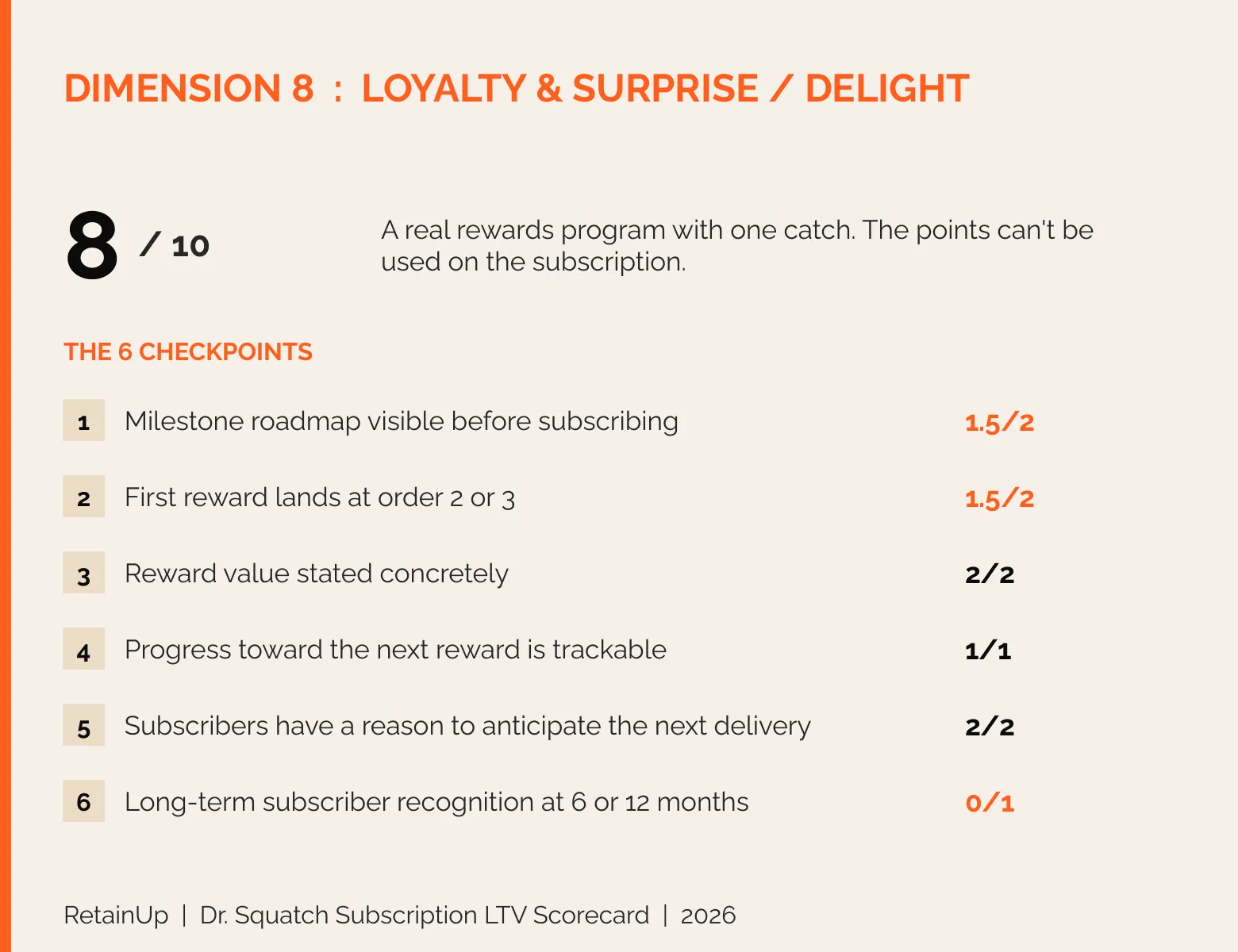
Here I look at what a subscriber gets for staying. They have a real rewards program. The tiers are public, the value is in dollars, 50 points is $5 off up to 300 points for $30 off, and you can track your points in your account.
There is a reason to want the next box too. Limited edition scents, with subscriber early access.
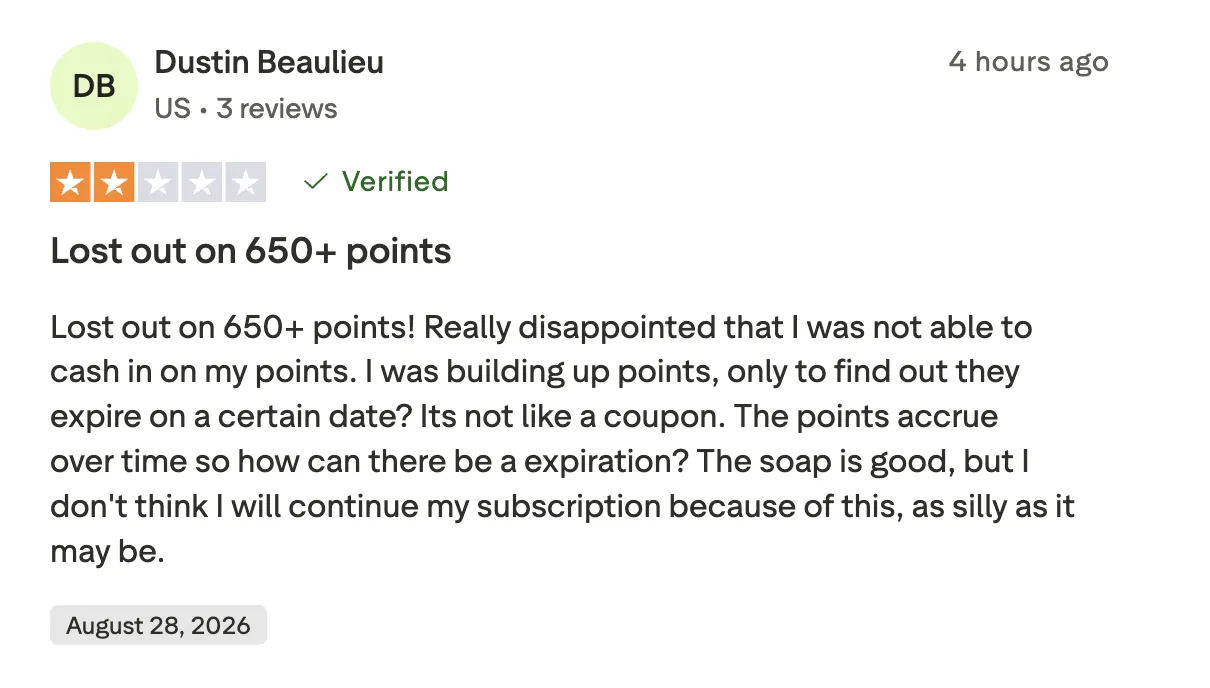
But you cannot use your points on the subscription, which is the one thing a subscriber pays for every 3 months, and the one place a reward would keep them longest. Redeem points on the site and the sale price goes back to full price. One subscriber wrote that he "should be allowed to redeem them on the sale price." Another lost 650 points to expiry and said he would cancel over it.
We see this in client data too. People cancel the subscription to spend their points, then subscribe again. Four boxes is a year of soap. By box eight, a subscriber has paid $400 to $500. A free bar at that point costs almost nothing.
The first reward is there, but not for everybody, and after that it is only points. Nothing recognises you at 6 or 12 months. The free gifts are for the first order only.
What I would change: let points pay for the subscription. Put a reward on the second and third box for every subscriber, not only points. Recognise subscribers at 6 months. The milestone-based retention guide covers the ladder.
Points that cannot pay for the subscription, and nothing at month 6, are fixable. The Subscription LTV Maximizer™ builds rewards that work on the subscription and a milestone at the boxes that matter.
How Dr. Squatch compares to Mars Men and the other brands
We have scored six big subscription brands on the same 48 checkpoints. Dr. Squatch sits third.
| Brand | Product | Score |
|---|---|---|
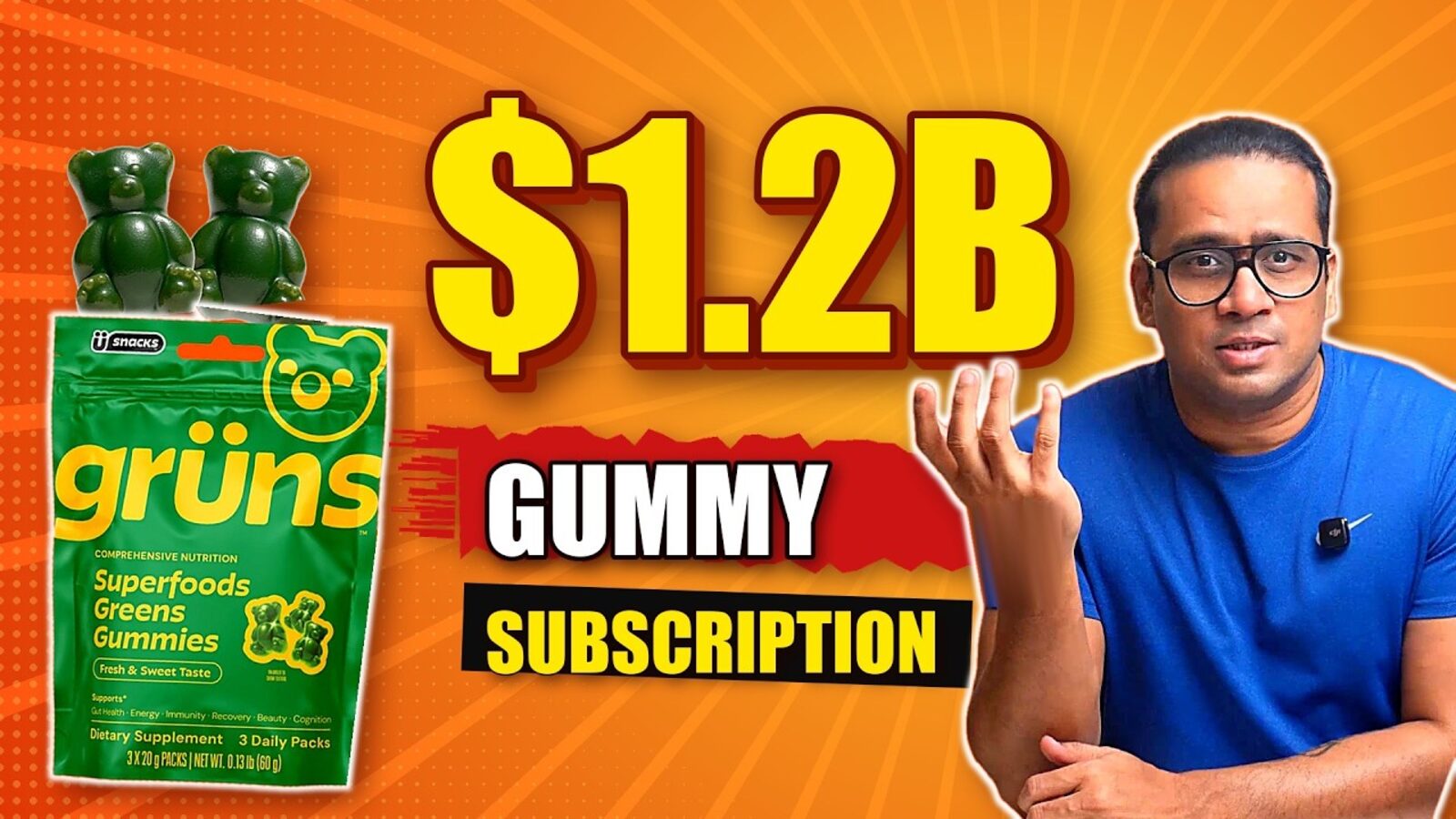
| Grüns | Daily nutrition gummy | 85.5 |
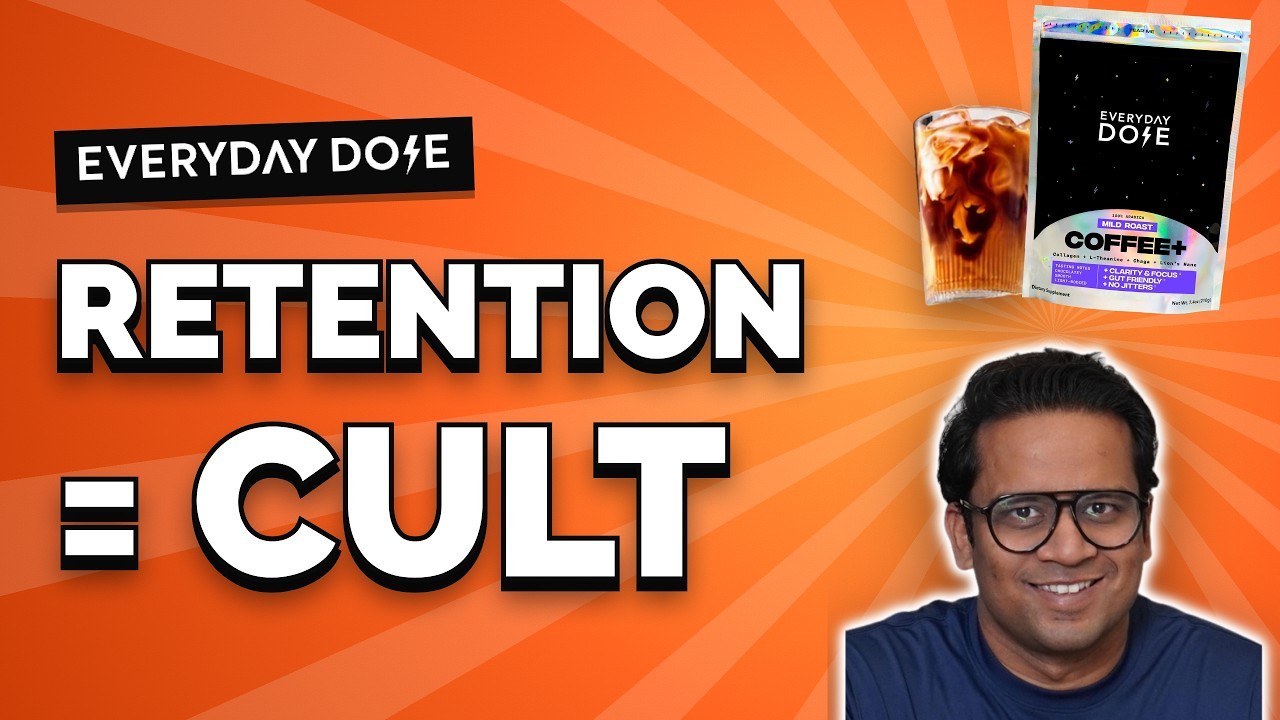
| Everyday Dose | Mushroom coffee | 81 |
| Dr. Squatch | Natural soap | 73 |
| IM8 | Daily nutrition powder | 72 |
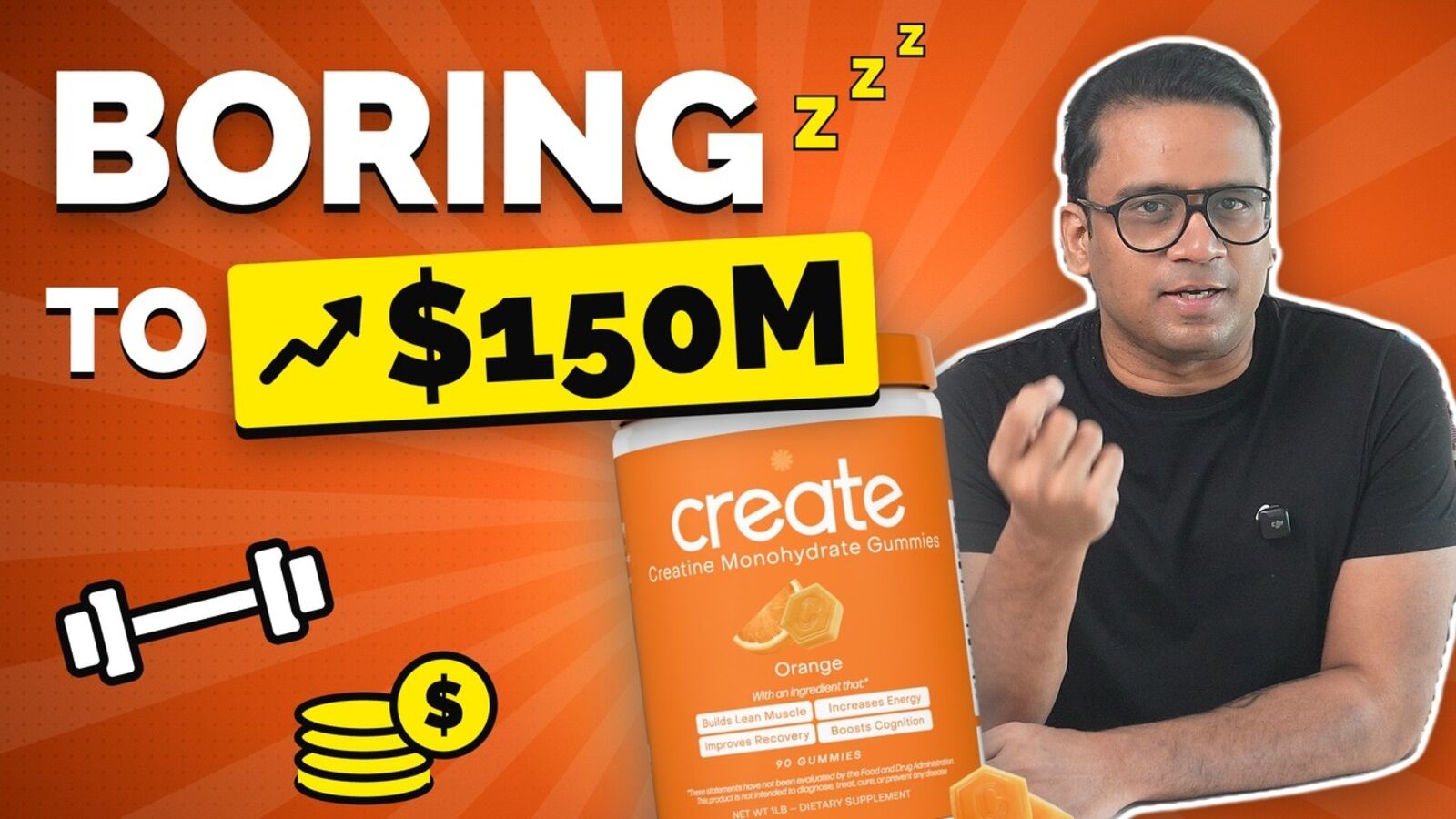
| Create | Creatine gummy | 67.5 |
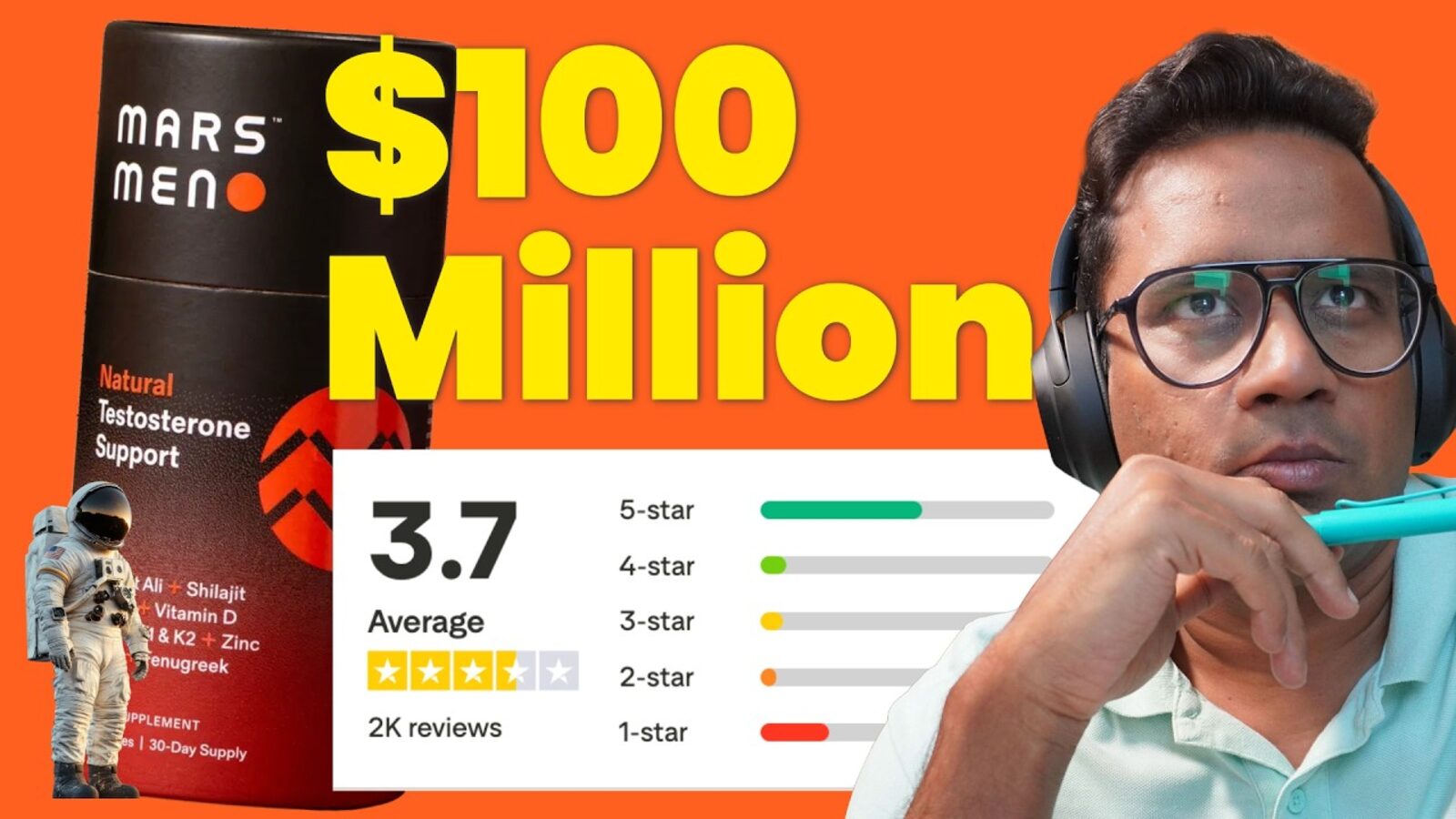
| Mars Men | Men's testosterone support | 62 |
Dr. Squatch vs Mars Men: two men's brands, two opposite models
Mars Men is the natural match. Both sell to men, both scored in August 2026. Dr. Squatch got 73, Mars Men 62. Mars Men actually wins more dimensions: structure, offer, messaging and onboarding. It loses most of what comes after the first order.
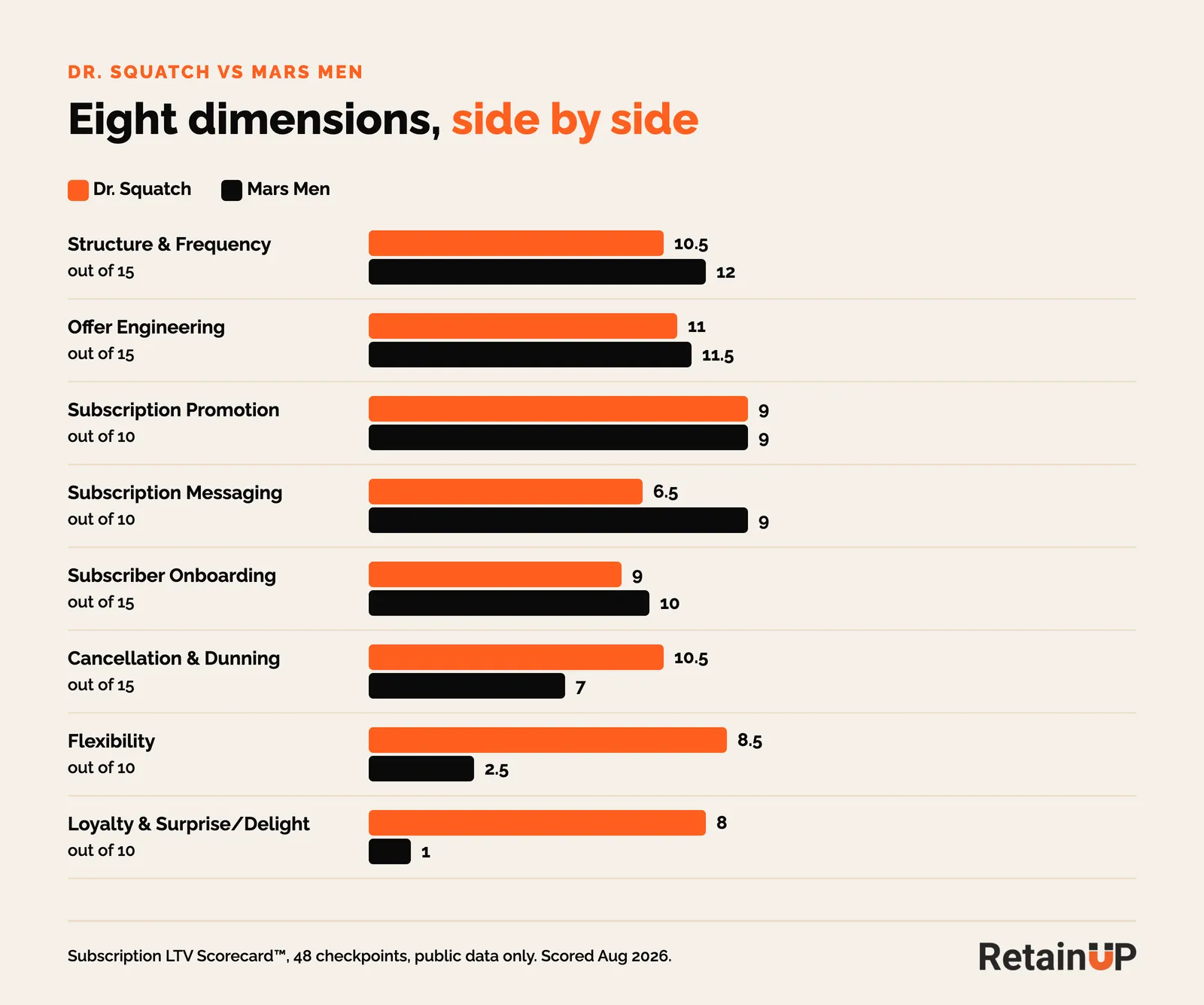
They solve how often to ship in opposite ways, and each way explains where its points come from. Dr. Squatch fixes the frequency at 3 months and you choose the supply. Mars Men sells one SKU of 150 capsules at 5 a day and ships every 30 days, with a 90-day supply offered after checkout.
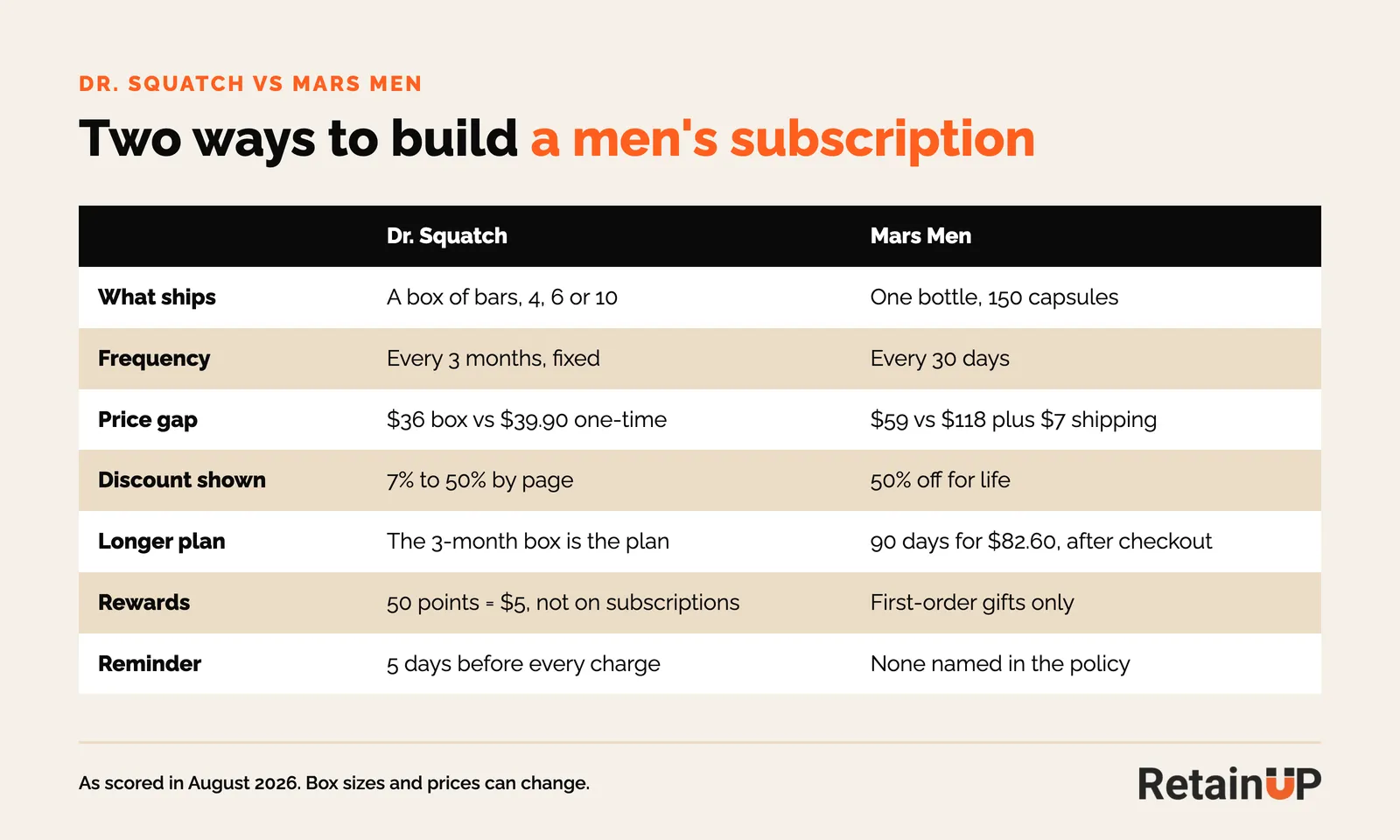
Mars Men wins the front half, 41.5 against 37, mostly on messaging. It answers "Do I have to sign up for a subscription?" on its own site and frames the cost as $1.96 a day. Dr. Squatch wins the back half, 36 against 20.5. Loyalty is the widest gap on the board, 8 against 1. Flexibility is next, 8.5 against 2.5. Mars Men has nothing to swap to.
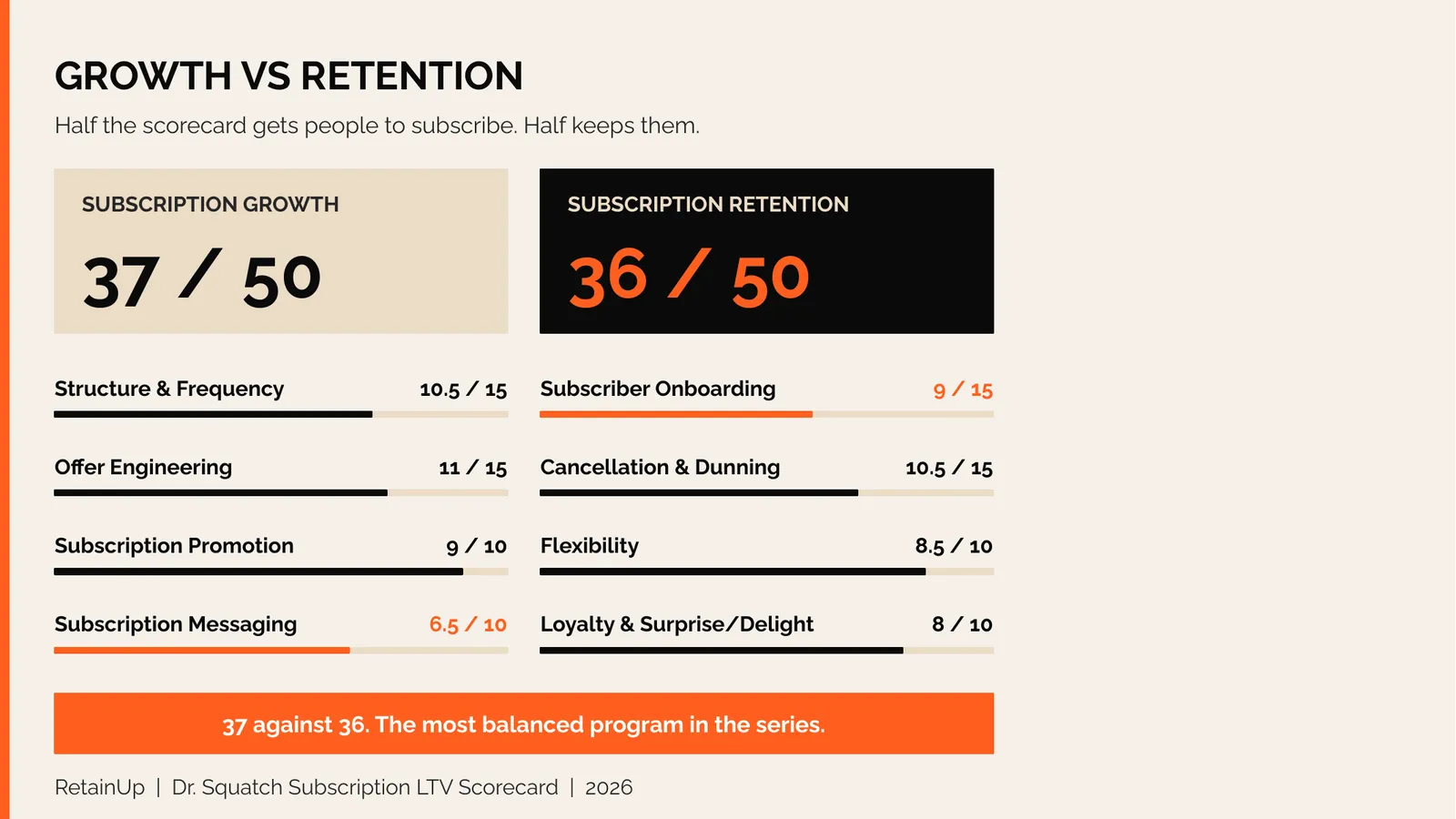
Mars Men won 83% of the growth points and 41% of the retention points. Dr. Squatch won 74% and 72%. Mars Men gets more people in. Dr. Squatch keeps more of the people it gets. Full breakdown of the other side: the Mars Men subscription strategy.
If you sell a low-ticket product and want to know whether a box or a monthly plan fits your data, the Subscription LTV Roadmap™ answers it from your own cohorts in 3 working days.
Four things you can copy this week
If you sell a small-ticket product, the biggest lesson is to put the box on subscription, not the single item. Then:
- Put a screenshot of your customer dashboard in the help centre, so people see what they can change before they log in.
- State rewards in dollars. 50 points is $5 off.
- Send a reminder 5 days before every charge.
- Give subscribers early access to new launches, and then tell them.
Want your program scored on the same 48 checkpoints? The free subscription audit runs the same scorecard on your store and ranks your top 3 retention leaks, in 24 hours.
FAQ
How does the Dr. Squatch subscription work?
Every Dr. Squatch subscription ships every 3 months, and you choose how many bars come in the box. Soap is personal, so they ask how much instead of how often. You pick scents, add deodorant, hair care or toothpaste, and edit the box later from your dashboard before it ships.
How much does a Dr. Squatch subscription save?
It depends on the page, anywhere from 7% to 50%. When we scored it, 6 bars were $36 on subscription against $39.90 one-time. Every 3-month bar costs $6 whatever box size you pick, but the crossed-out price changes, so the label reads 14% on some boxes and 25% on others.
Can you use Dr. Squatch reward points on a subscription order?
No. The Dr. Squatch help centre says points cannot be used on subscription orders. The rewards program is generous, with 50 points worth $5 off up to $30. But the one thing subscribers pay for every 3 months is the one thing points cannot touch, and some subscribers cancel to spend them.
How do you cancel a Dr. Squatch subscription?
You cancel yourself from your Dr. Squatch account dashboard: open Manage Subscription and choose Cancel. There are no fees and no phone call. Their help centre gives numbered steps, and a reminder email goes out 5 days before every charge if you would rather skip or edit the box instead.
How do you sell a cheap product like soap on subscription?
Sell a box instead of the single item. A $6 bar cannot carry a subscription on its own, so Dr. Squatch sells a $36 box. Then fix the frequency and let people choose the supply. If you sell small-ticket products, that is the part to copy.
One email a week on subscription retention: the numbers, the strategy, and what to fix first.

Rahi Jain
Rahi Jain is a subscription LTV specialist who helps $1M to $10M DTC brands reduce subscription churn and maximize LTV on Recharge, Skio, Stay AI and Loop.
More about Rahi