Key takeaways
- Mars Men scored 62 out of 100 on the Subscription LTV Scorecard™: 41.5 for getting people to subscribe and only 20.5 for keeping them.
- The offer is one of the strongest we have scored: $59 on subscription against $118 one-time, 50% off for life, and about $70 of gifts on the first order.
- Every incentive fires before the first renewal. Loyalty scores 1 out of 10, flexibility 2.5, and 19 BBB complaints in 12 months zero the cancel checkpoints.
Mars Men sits in the Subscription Scorecard Library next to every other brand scored on the same 48 checkpoints.
Mars Men did a hundred million dollars in eighteen months, and they did it with one product. No bundles. No flavours. Nothing else to buy.
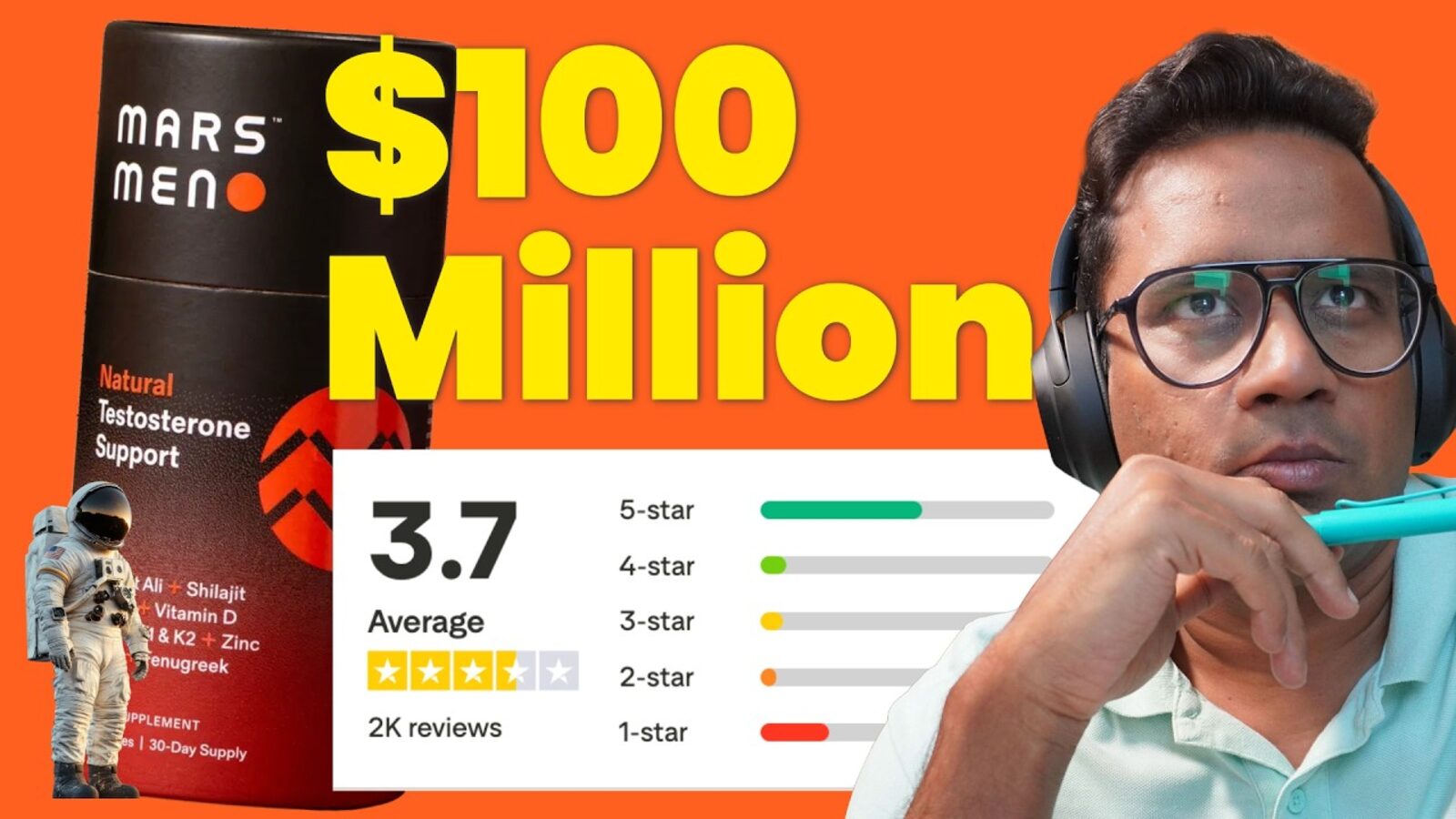
So how do you do $100 million on a single SKU? And why is their Trustpilot rating sitting at 3.7? And why have they never launched a second product?
I scored their subscription program on 48 checkpoints. 62 out of 100. Average. So how does an average program do $100 million? And raise $27.5 million? They must be doing something right. 41.5 of those points came from getting people to subscribe. Only 20.5 came from keeping them.
Watch the full Mars Men scorecard, 15 minutes
What is Mars Men?
Mars Men is a natural testosterone support supplement from Mars Health, founded by Benjamin Smith and Zach Stuck. One hero SKU: a 30-day starter kit, 150 capsules at 5 a day.
- Scale: a $100M run rate in under 18 months, profitable, 400,000+ customers.
- Funding: a $27.5M Series A led by L Catterton, March 2026.
- Offer: $59 on subscription against $118 one-time. 50% off for life, framed at $1.96 a day.
- Platform: Shopify, Stay AI for subscriptions, Klaviyo for email, Gorgias for support.
This is a team of conversion and paid marketing experts, and it shows. They know how to drive demand.
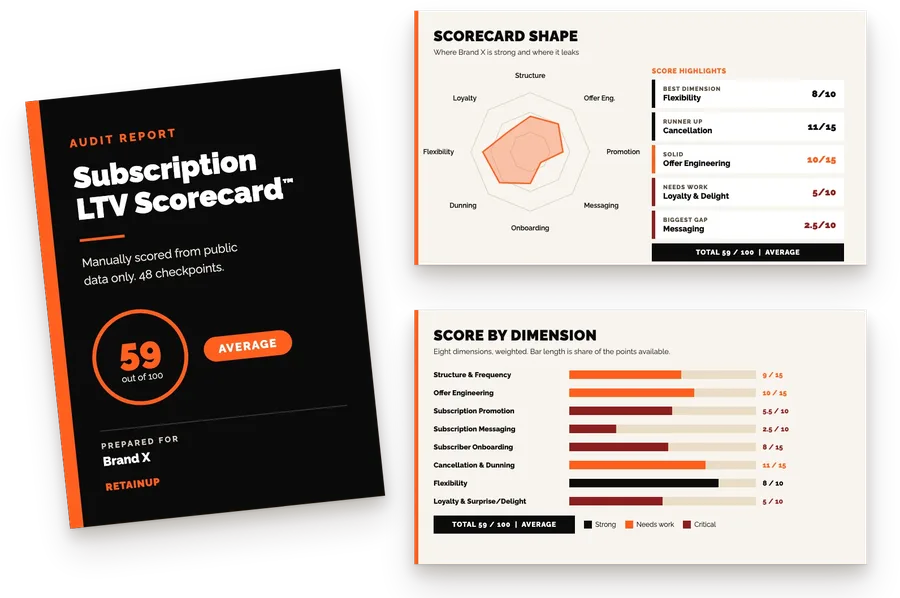
The Mars Men subscription scorecard: 62 out of 100
Scored 2 August 2026, from public data only, on the first published version of the scorecard. 8 dimensions, 48 checkpoints, from the product page to the cancel flow.
| Dimension | Score | Out of | Points lost |
|---|---|---|---|
| 1. Structure and frequency | 12 | 15 | 3 |
| 2. Offer engineering | 11.5 | 15 | 3.5 |
| 3. Subscription promotion | 9 | 10 | 1 |
| 4. Subscription messaging | 9 | 10 | 1 |
| Subscription growth | 41.5 | 50 | 8.5 |
| 5. Subscriber onboarding | 10 | 15 | 5 |
| 6. Cancellation and dunning | 7 | 15 | 8 |
| 7. Flexibility | 2.5 | 10 | 7.5 |
| 8. Loyalty and surprise/delight | 1 | 10 | 9 |
| Subscription retention | 20.5 | 50 | 29.5 |
| Total | 62 | 100 | 38 |
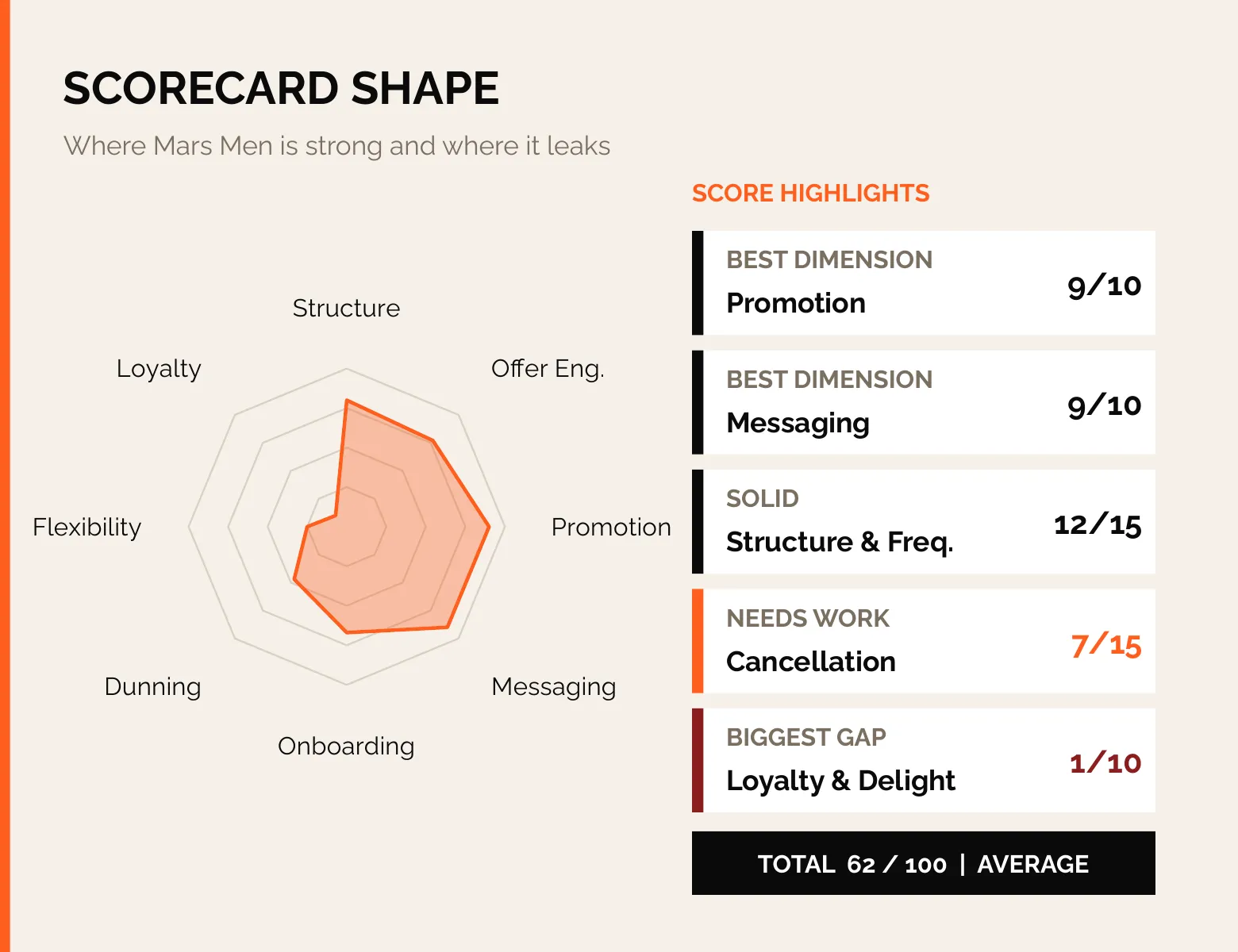
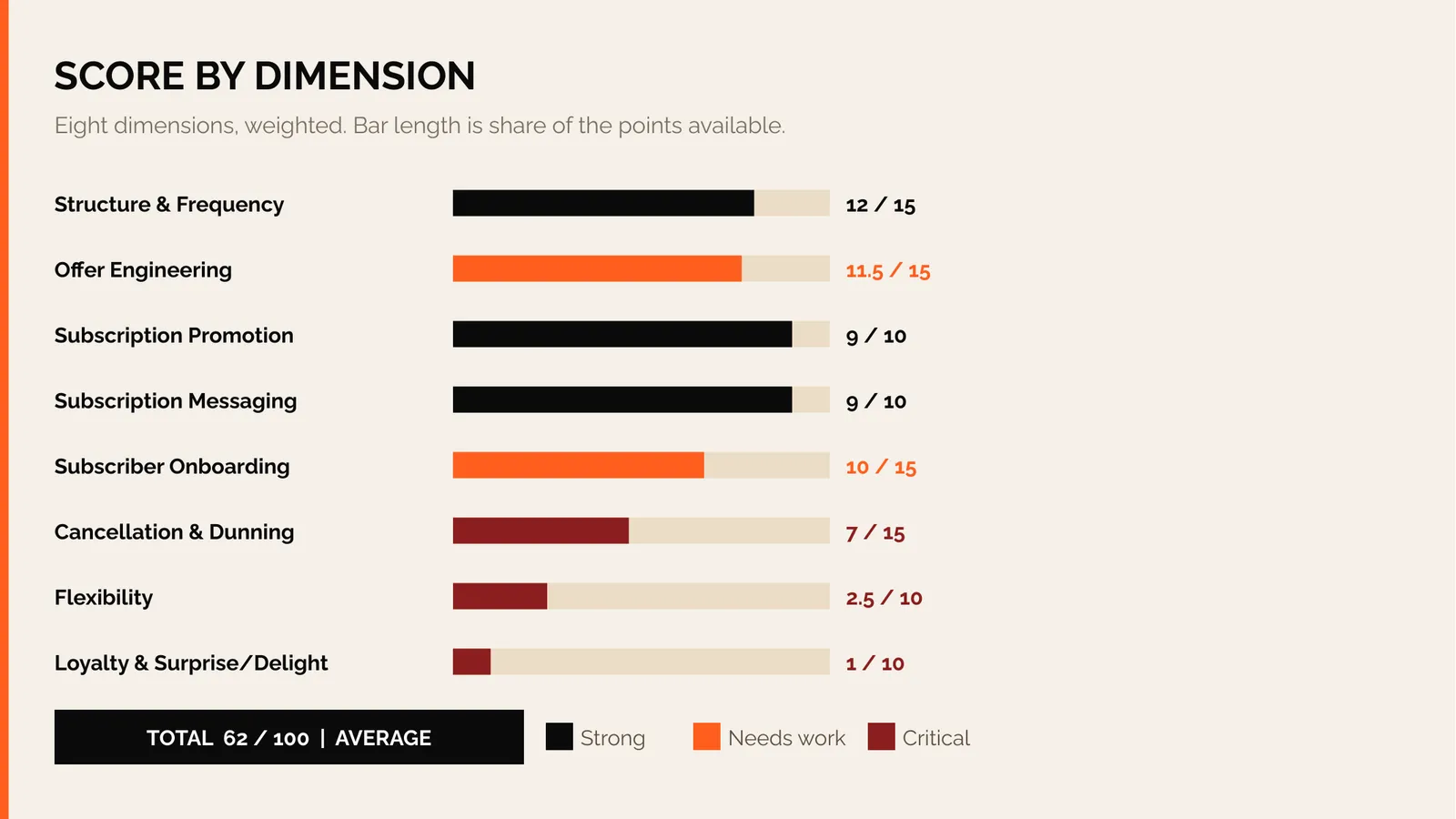
Front-loaded. 83% of the growth points, 41% of the retention points. Mars Men rescores the same on the newer rubric, because the checkpoint that changed covers rotating variety, and they have one product.
Three patterns kept coming back
First, everything is engineered for order one. $70 in gifts, fifty percent off for life, free shipping, and all of it fires before the first renewal. Then it stops.
Second, one SKU is a ceiling. There is nothing to bundle, nothing to swap into and nothing to add, so four checkpoints score zero for the same single reason. They need a second product for the same audience to hit the next $100 million.
Third, everything after the first purchase looks broken. Cancellations are not going through, people are charged after they cancel, and no reminder goes out before the card is hit. That reads as an operations failure, not a strategy one. Which means it is fixable. They just raised $27.5 million. Not a money problem.
1. Structure and frequency: 12 out of 15
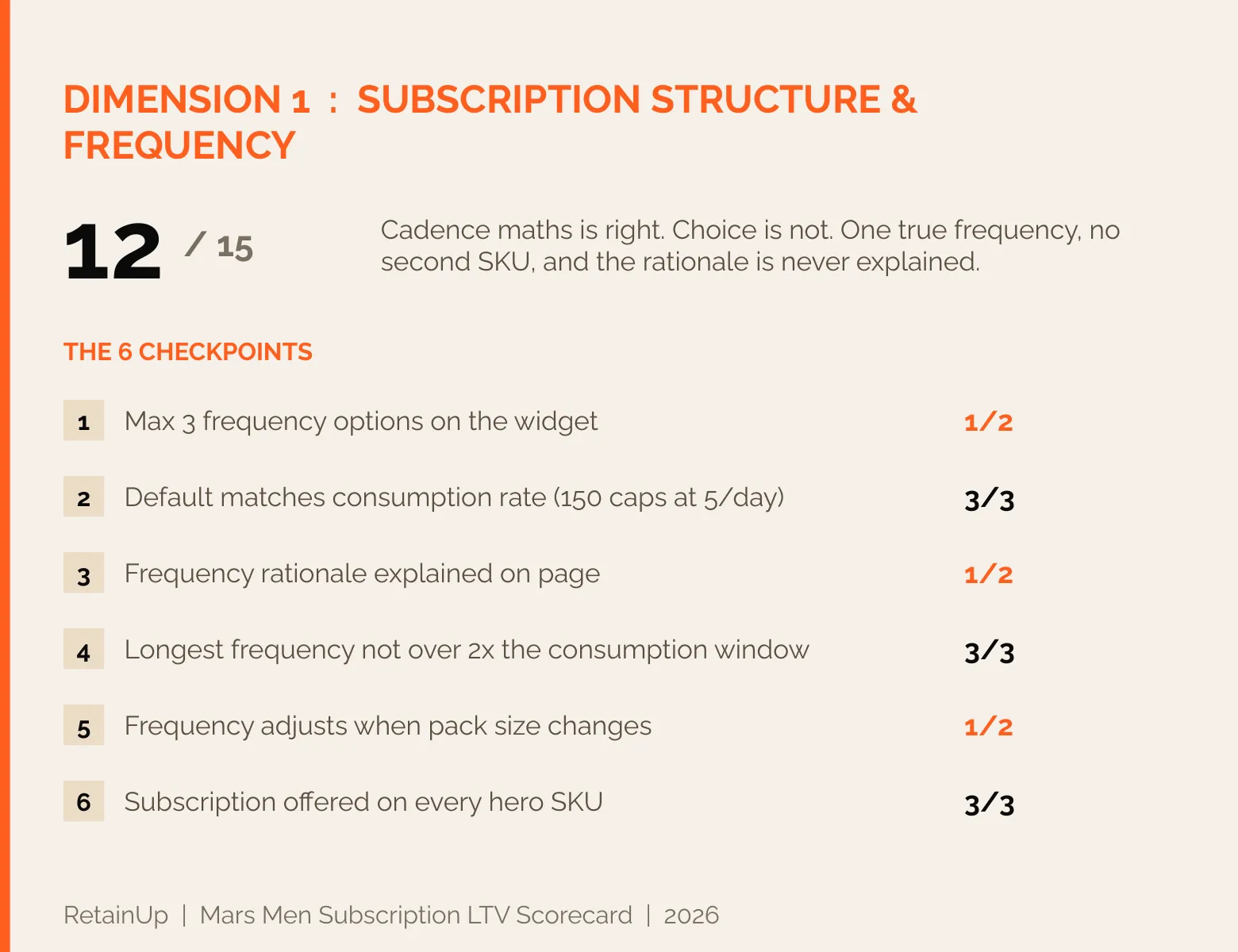
Here I look at how often the product ships and what choices you get. Cadence maths is right. Choice is not.
150 capsules at 5 a day is 30 days, and it ships every 30 days. Perfect match. And the 90-day supply is consumed over 90 days, and the one hero SKU defaults to subscription. Full marks on all three.
Where they lose: one true cadence. The 90-day option is a pack size, not a frequency choice on the widget. It shows up on the next screen after checkout, for $82.60. Small decision at checkout, bigger decision once you have already said yes. Take it and you are holding four months of product, and the first renewal is a long way off. Clever for AOV. Very clever.
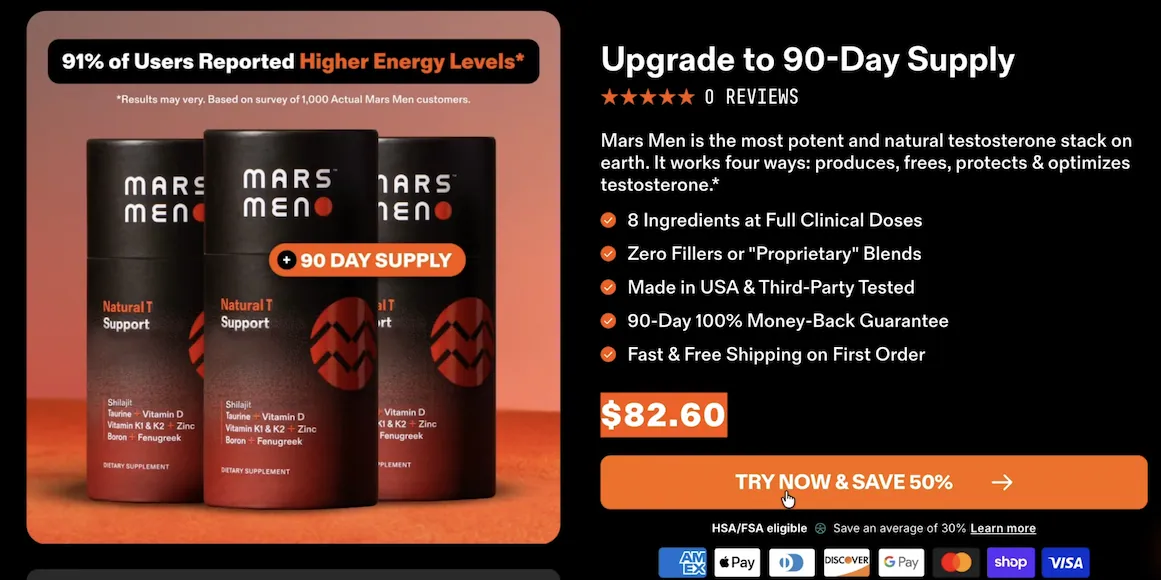
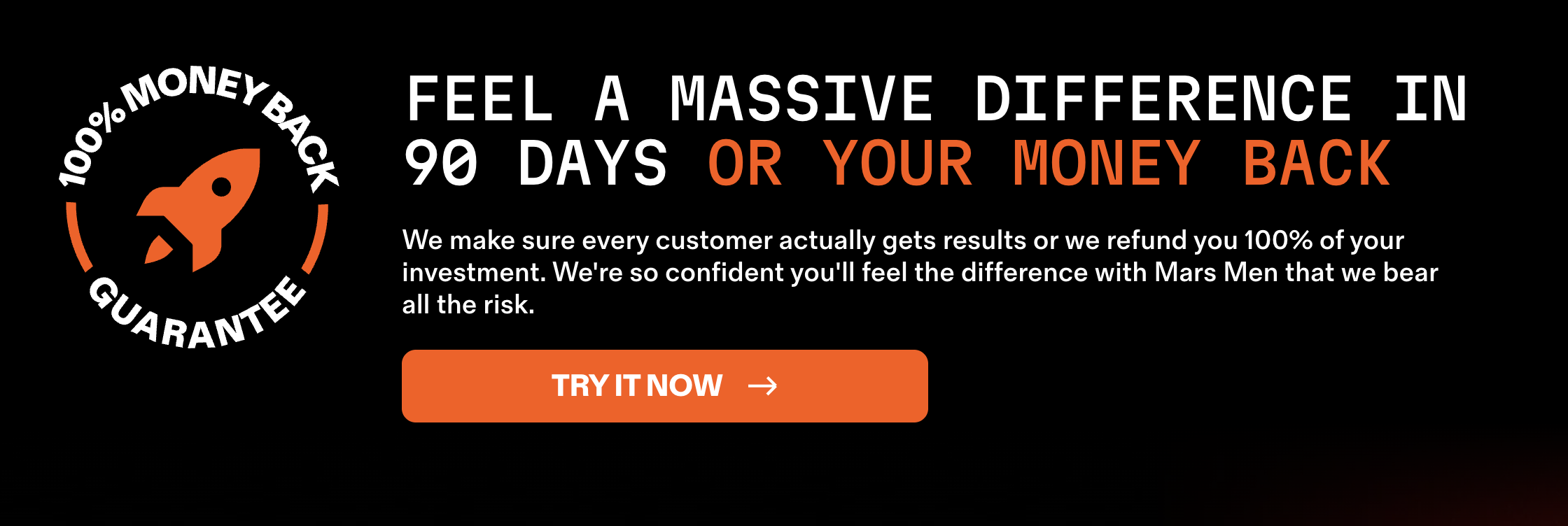
But Mars Men promises results over 90 days and its guarantee runs 90 days, while the default plan ships 30. A post-purchase upsell is patching something the product page should offer in the first place, and everyone who declines it goes back on the 30-day clock. And the page argues for recurring delivery without ever saying why 30 days.
What I would change: offer a real second cadence, not just a bigger pack. Say why 30 days is right, not only that it is better value. Put the 90-day plan on the product page.
Promising results over 90 days and billing every 30 is a common mismatch. The Subscription LTV Roadmap™ reads your data and shows whether a 90-day default would lift your cash and your retention.
2. Offer engineering: 11.5 out of 15
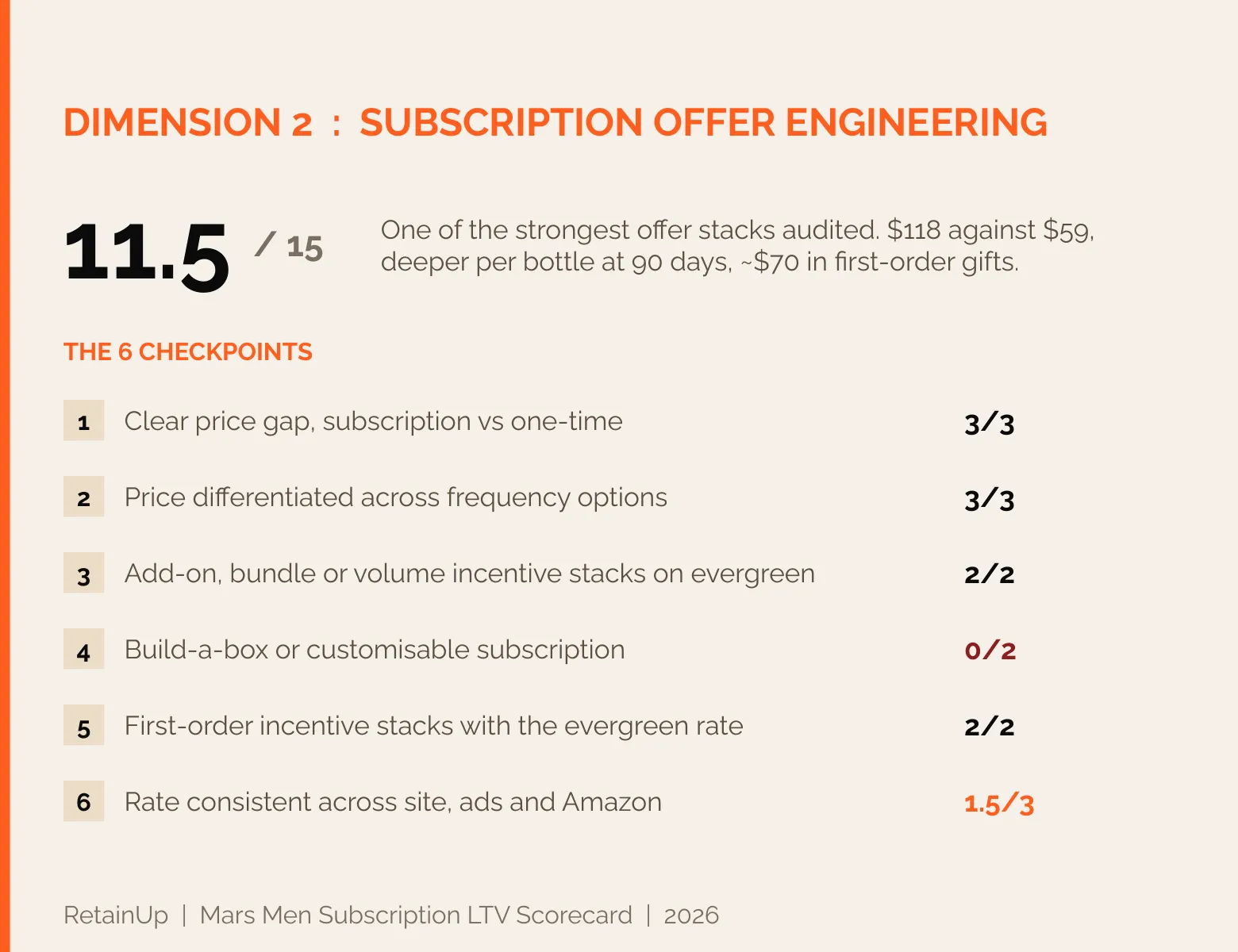
Here I look at how the subscription is priced and structured. One of the strongest offer stacks we have audited. Simple too.
One-time costs $118 plus $7 shipping. Subscription costs $59. Less than half the one-time total, for life. Nobody has to think.
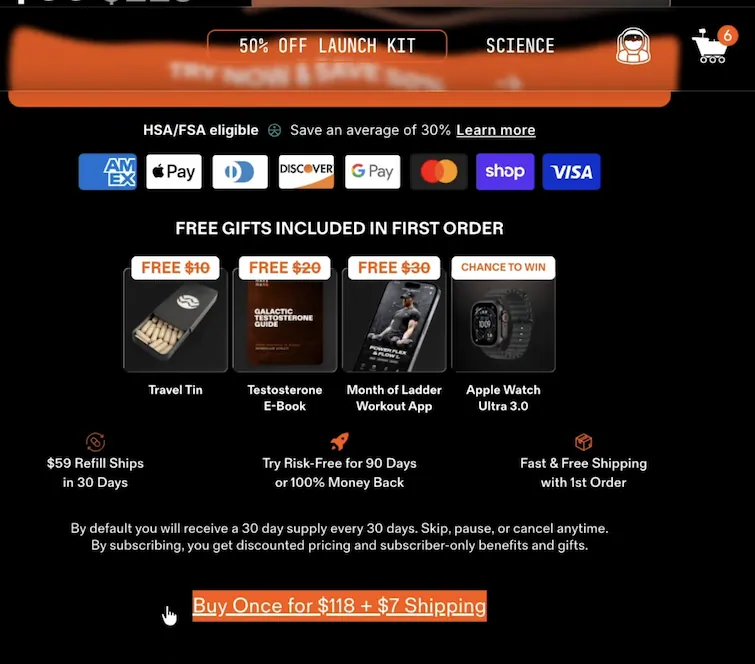
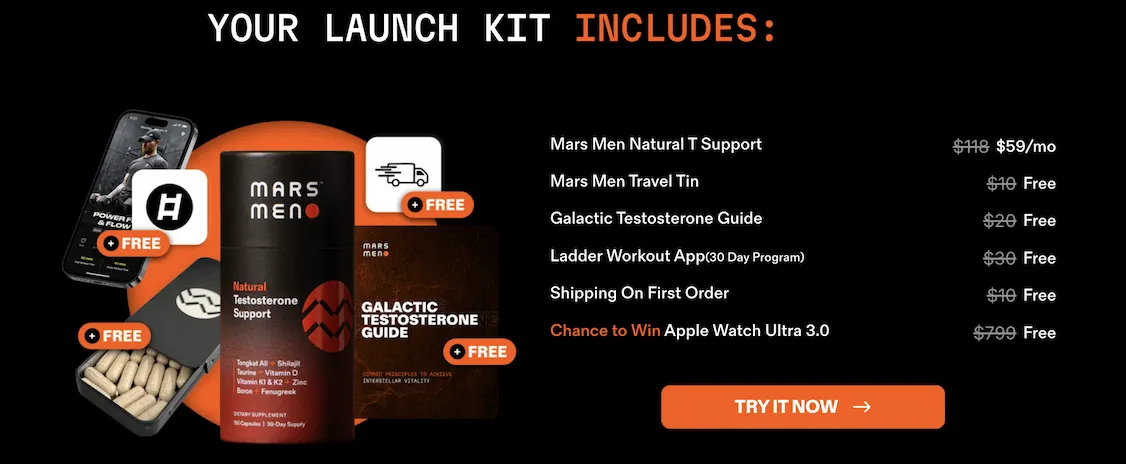
The price per bottle drops at 90 days, $59 down to $47. And the first order carries about $70 of free product, plus an ebook, a workout app trial and free shipping. One of the tightest first-order stacks I have scored.
Where they lose: there is no build-a-box, because there is only one product. And the rate holds on the site and in the ads, then diverges sharply on Amazon.
What I would change: add a second SKU so subscribers have something to grow into. Bring Amazon in line so "50% off for life" holds everywhere. Keep the first-order stack. It is working.
If your offer is already strong, the gap is usually what comes after it. Run the free subscription audit to see your back-half scores next to your front half.
3. Subscription promotion: 9 out of 10
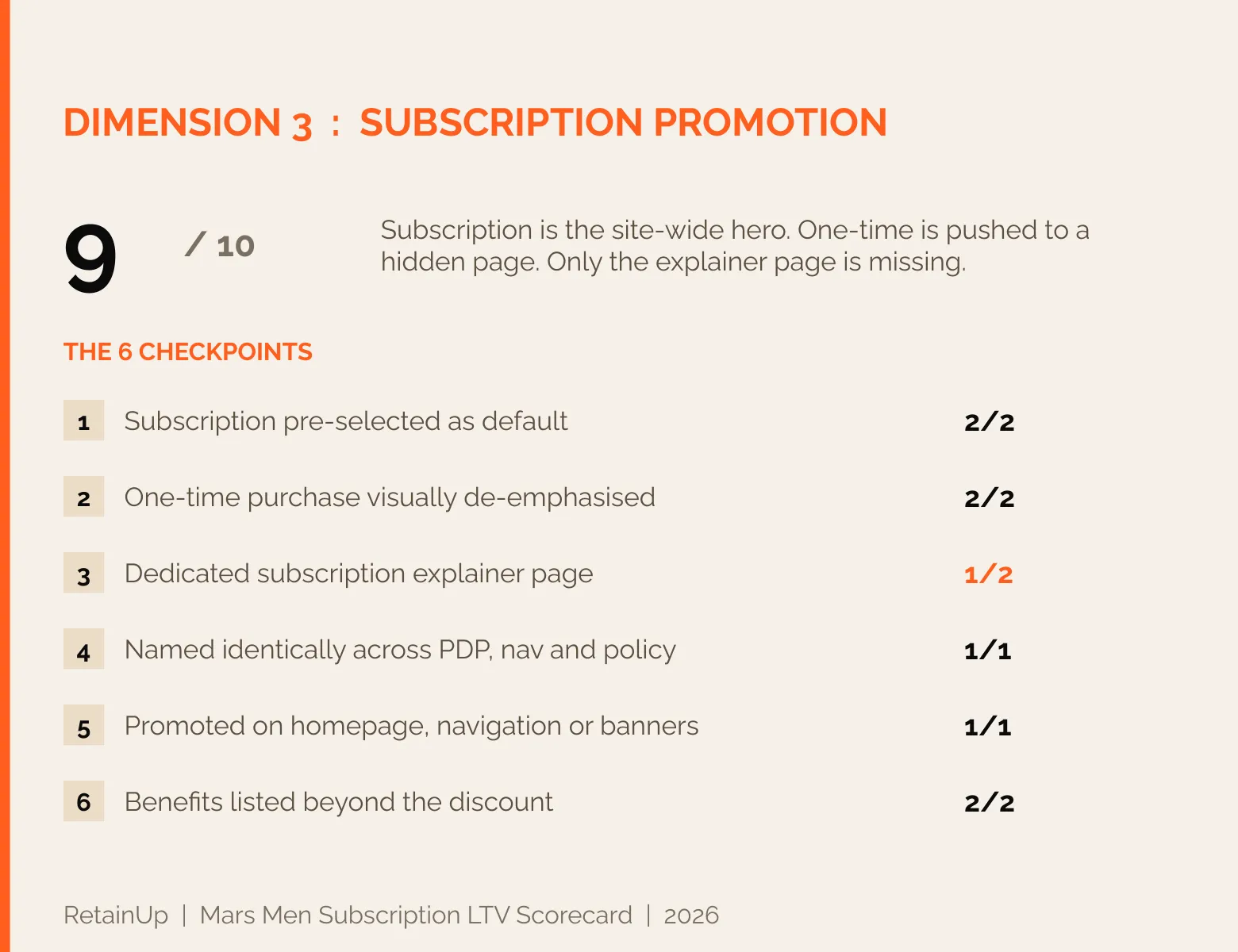
Here I look at how hard the site pushes subscription over a one-time purchase. Subscription is the site-wide hero. The widget defaults to Subscribe and Save, 50% off for life. One-time is removed from the widget entirely and lives on a hidden page.
They use one name, Subscribe and Save, on the product page, the navigation and the policy page. A sitewide banner promotes it, Manage Subscription sits in the menu, and the widget lists subscriber-only benefits and gifts.
The one point they lose: the explainer. The subscription page is legal text, not a page that sells the program.
What I would change: publish a real explainer page, not a legal policy. Give the program a name people can repeat. Keep subscription as the default. It is the strongest thing on the page.
4. Subscription messaging: 9 out of 10
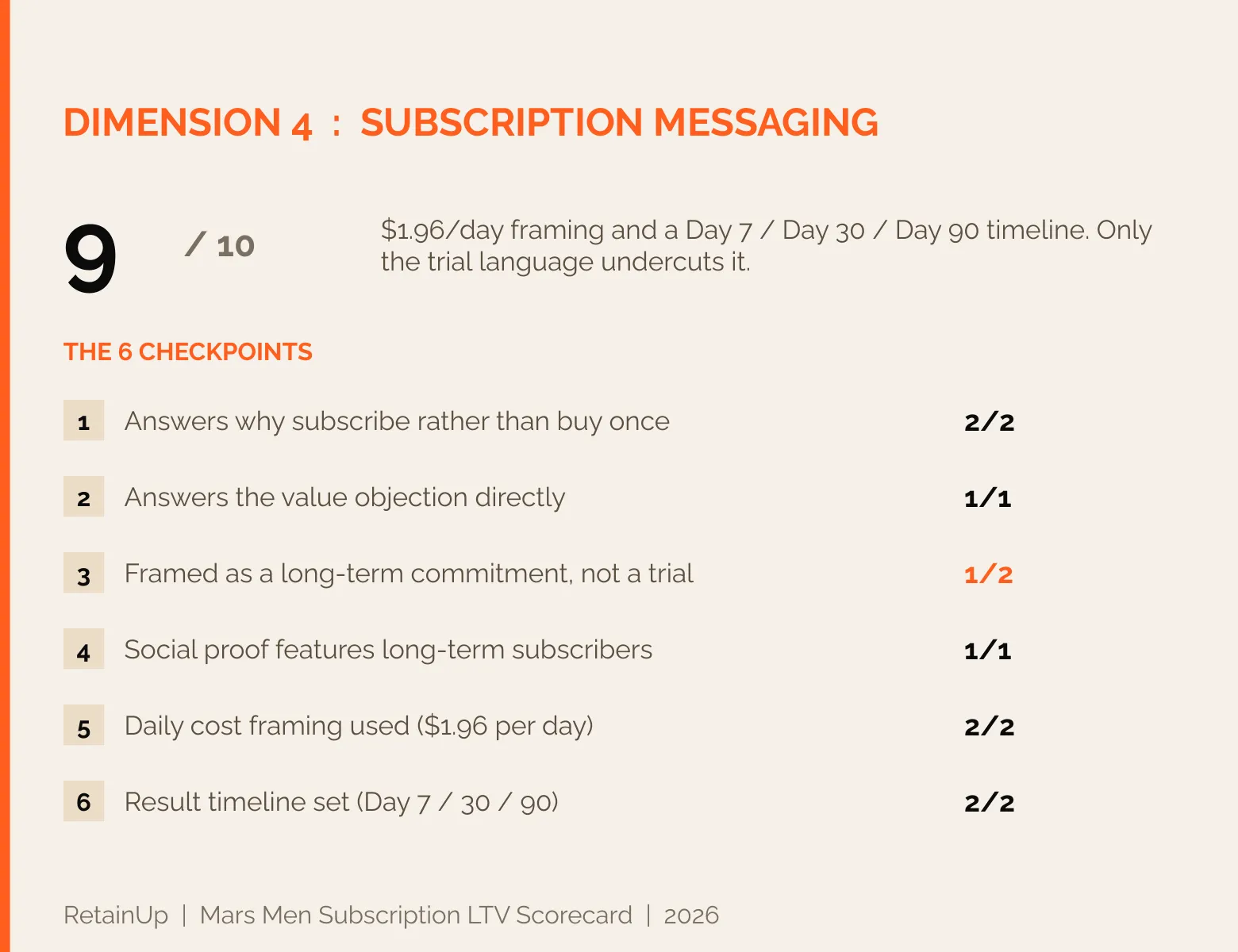
Here I look at what the copy says about why you should subscribe. Best part of the program.
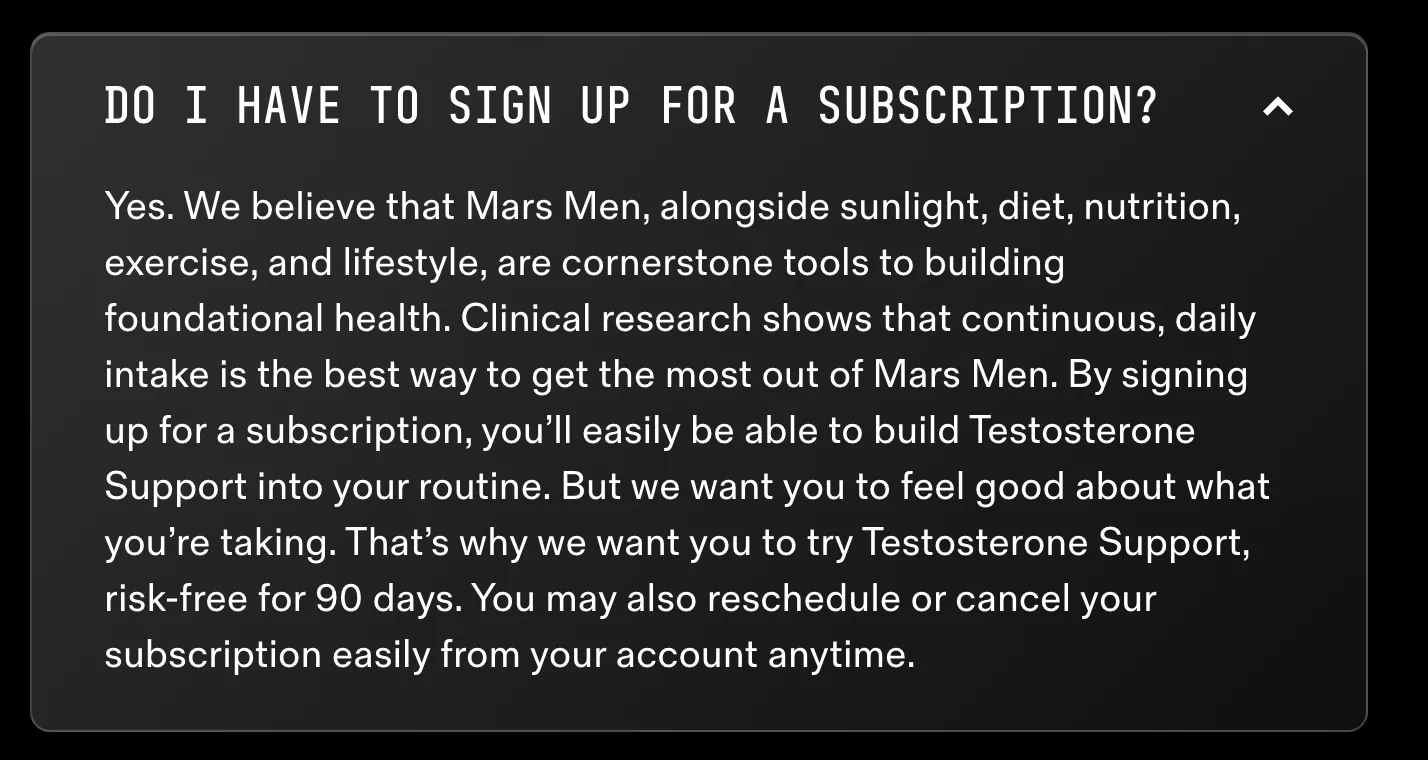
"Do I have to sign up for a subscription?" is a section on their site, with a real answer: continuous daily intake, built into your routine. Most brands offer subscription and never argue for it.
They answer the value objection with 8 ingredients at full clinical doses, zero fillers, and a cost comparison against competitors. The cost is framed at "only $1.96 per day." And they set a results timeline at day 7, day 30 and day 90, with a week-by-week roadmap.
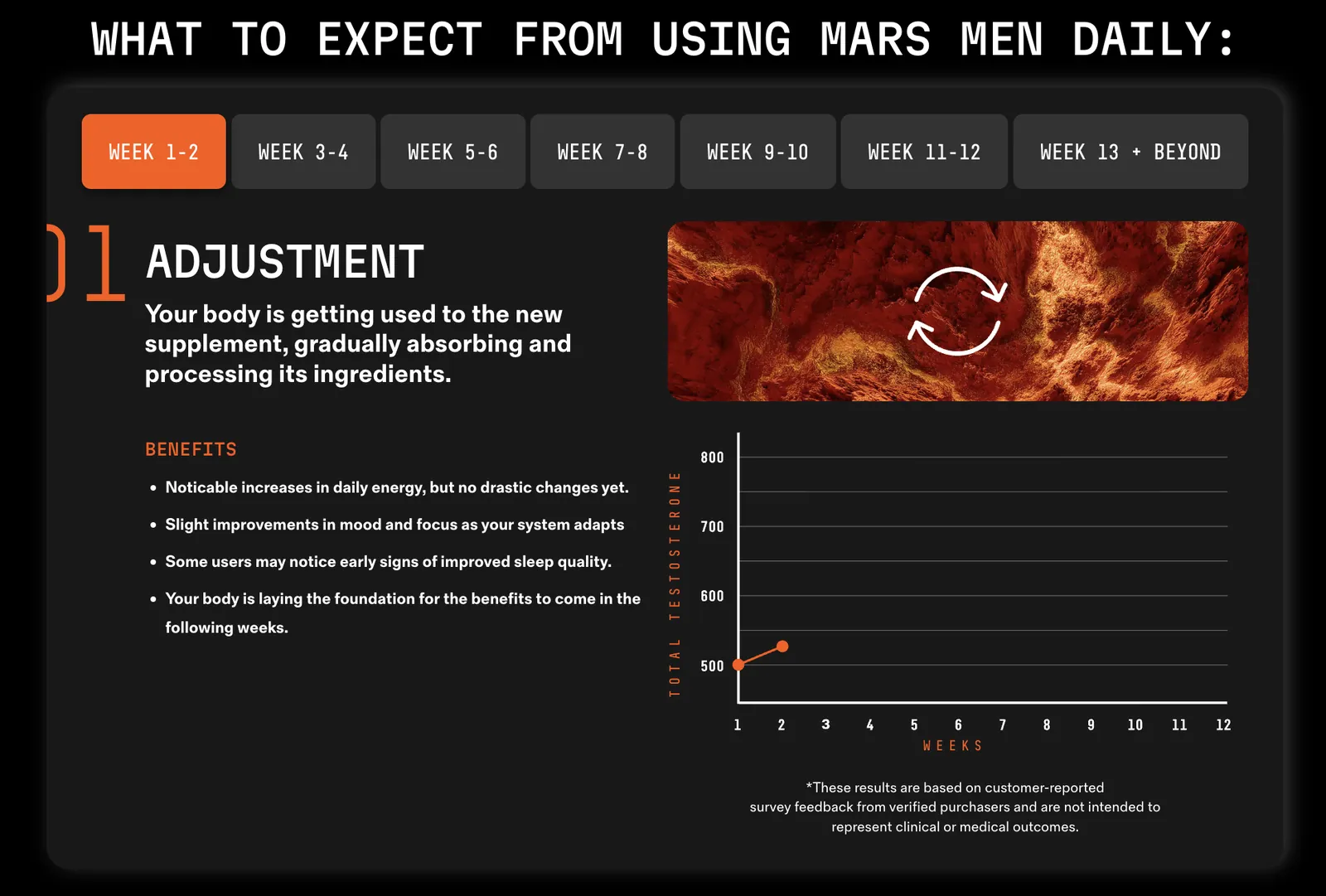
For a product whose benefits are mood and energy, which are invisible and slow and easy to doubt, telling the customer exactly when to expect what is the only way to get them through month two.
The pre-purchase emails lead with the problem, then the welcome kit, instead of ingredients or a founder story. They name why you need the product before they name the product.
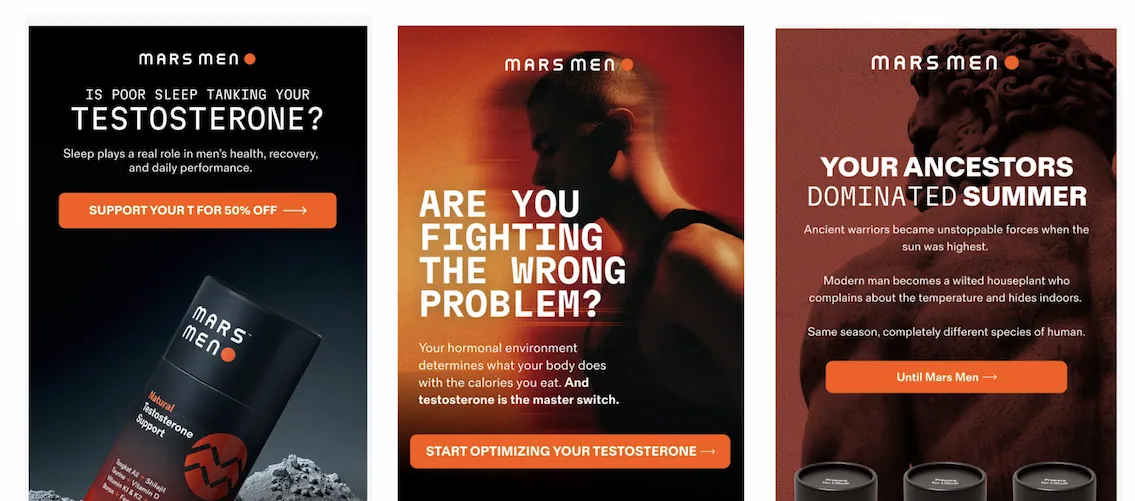
The one point they lose: heavy risk-free trial language undercuts "50% off for life."
What I would change: talk about the long term, what changes at 6 months and a year. Lead testimonials with tenure, not first-week results. Keep the day 7, 30, 90 timeline. It is the best copy on the site.
Results timelines like day 7, 30 and 90 belong in your emails as well as on the page. The Subscription LTV Maximizer™ builds them into the onboarding flow so the timeline arrives when each milestone does.
5. Subscriber onboarding: 10 out of 15
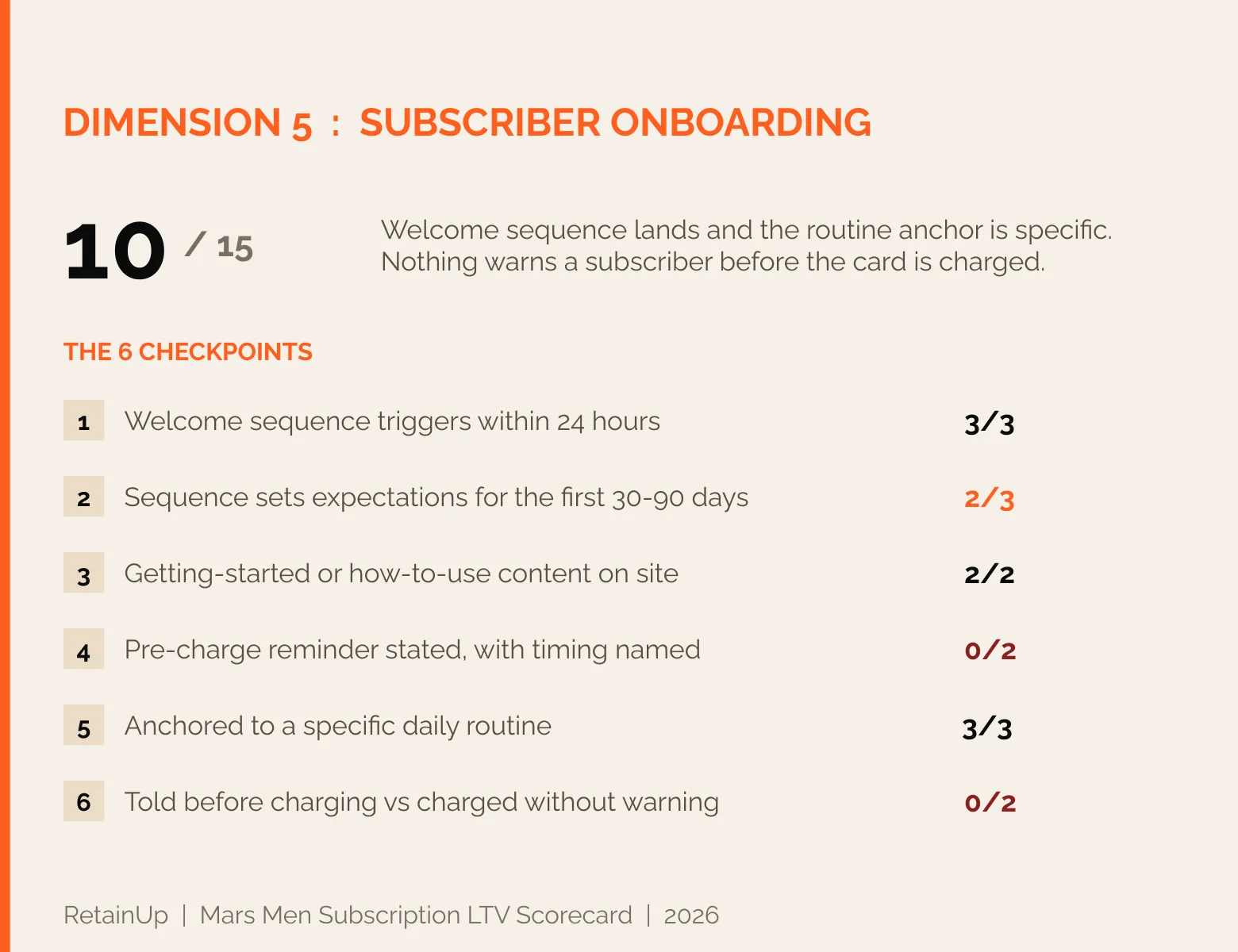
Here I look at what happens in the first 30 to 90 days after someone subscribes. The welcome sequence lands within 24 hours. Dosing and usage instructions sit on the site. And the routine anchor is specific: "5 capsules daily in the AM with food." Full marks on all three.
Then the gap. They will tell you exactly what happens on day 7, day 30 and day 90. What they will not tell you is when your card gets charged. The subscription policy names no reminder and no timing, and more than three different customers say they were charged without warning. Zero on both.
What I would change: a pre-charge reminder 3 to 5 days before every renewal, and say so in the policy. Stretch the welcome sequence across the full 90 days. Our guide to the subscription reminder email shows how to build it in Klaviyo.
No reminder before the charge is the fastest way to collect complaints. The Subscription LTV Maximizer™ builds a pre-charge reminder 3 to 5 days out and a welcome sequence across the full 90 days.
6. Cancellation and dunning: 7 out of 15
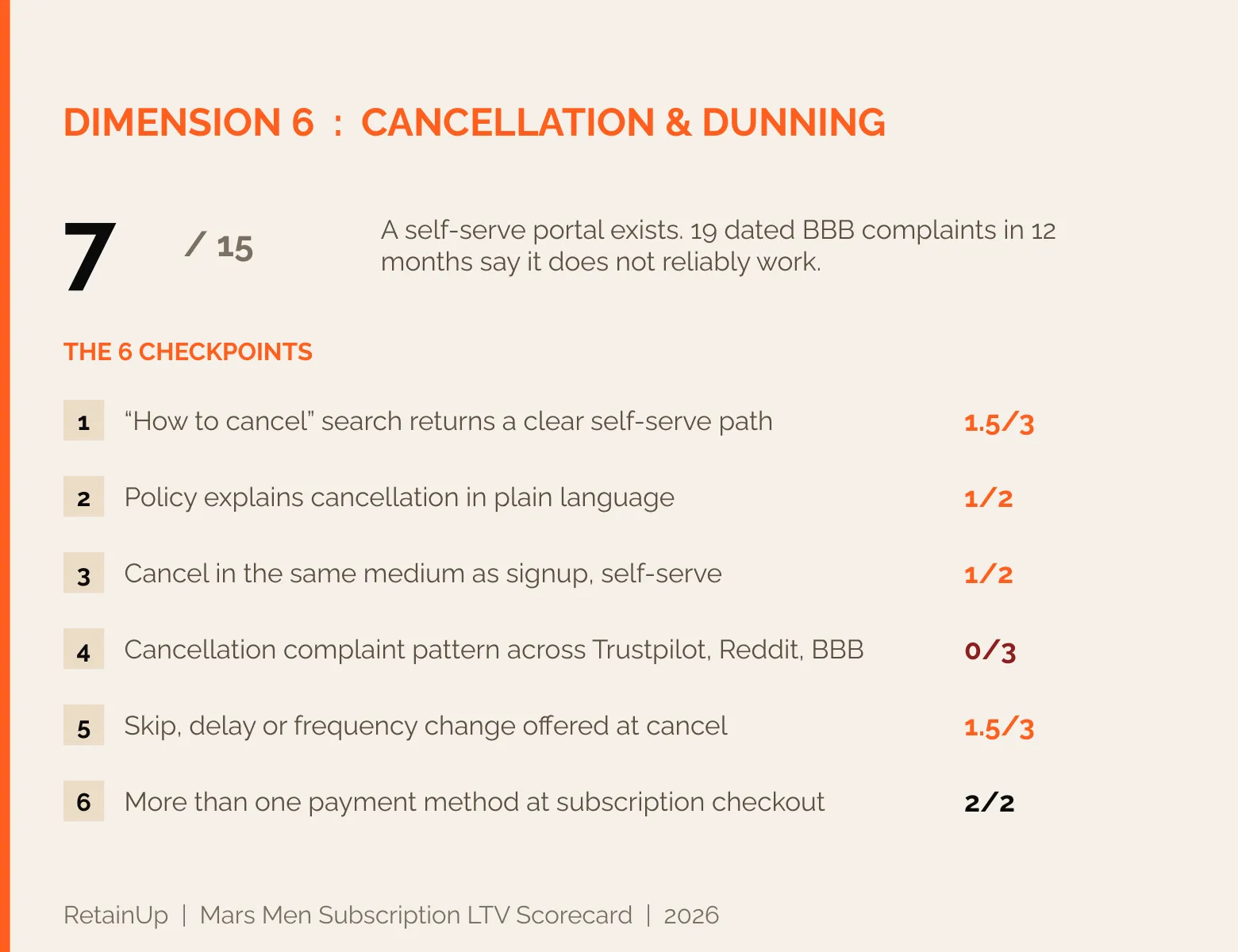
Here I look at how easy it is to leave, and how failed payments get handled. A self-serve portal exists. It does not reliably work.
Search how to cancel Mars Men and you get third-party cancel guides, not theirs. The policy is plain but vague, with no step-by-step. There is a cancel entry point, and reviews say it fails.
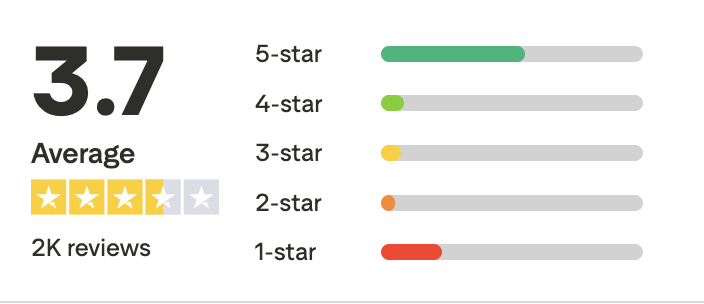
We counted 19 BBB complaints in 12 months, mostly charges after cancelling. That zeroes the complaint checkpoint. When we scored it, Trustpilot sat at 3.7 across 2,000 reviews: charged after cancelling, pause not working, support slow to reply.
At cancel, they show a pause video and a one-off discount, which read as obstacles. The one full score: eight payment methods, including Apple Pay and Shop Pay.
What I would change: fix how cancellations pass between Shop Pay and the subscription tool. Put one-click cancel, pause and skip inside the portal. Offer a frequency switch before any discount at the cancel screen. Our guide to cancel flow routing covers the order.
Charges after a cancel usually mean the app and the payment method are out of sync. The Subscription LTV Optimizer™ checks your subscription app, store and Klaviyo every month and fixes exactly this kind of leak.
7. Flexibility: 2.5 out of 10
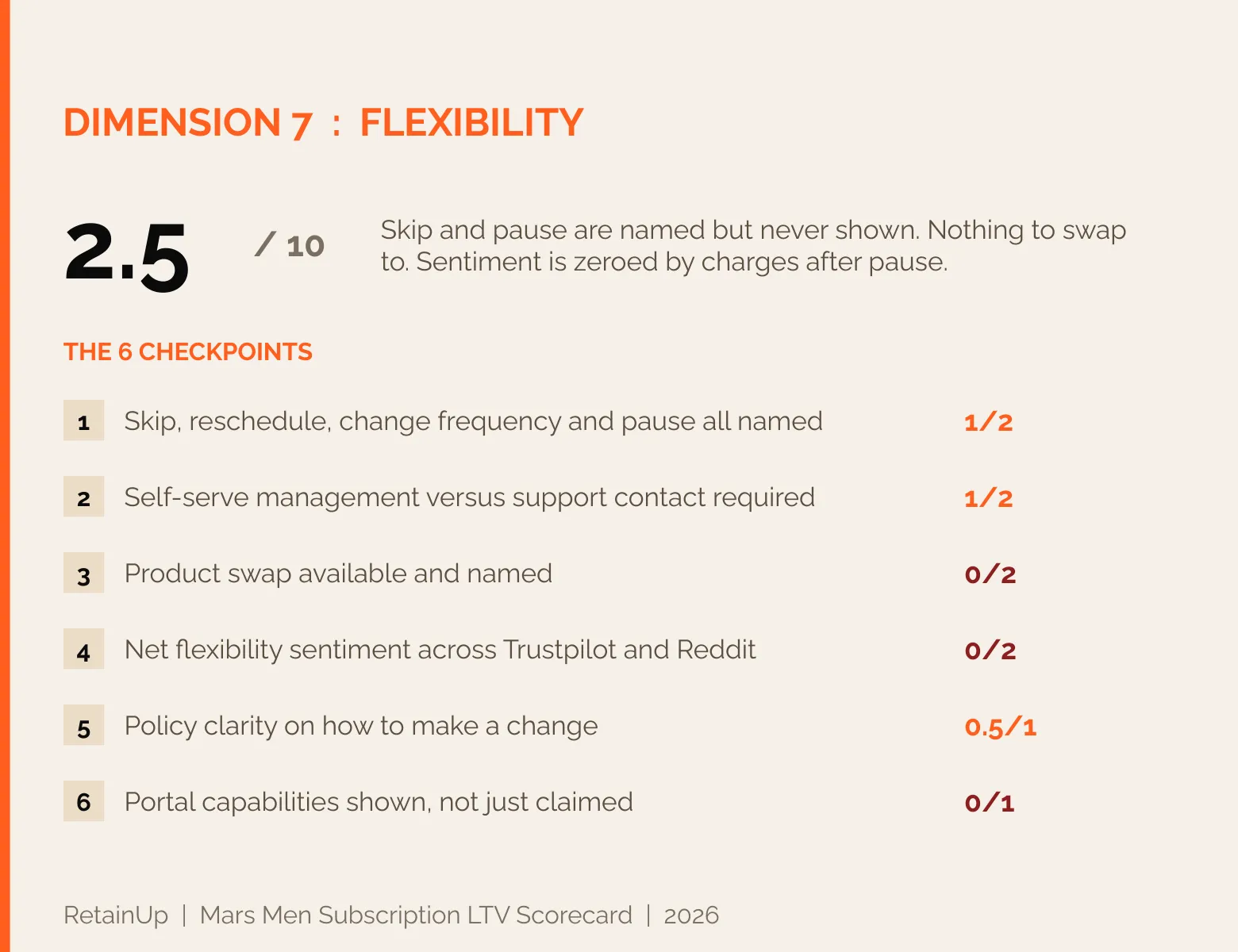
Here I look at whether a subscriber can skip, pause, reschedule, change frequency or swap without contacting anyone. Skip and pause are named. Never shown. Change frequency is missing from the product page.
Nothing to swap to. One product. And sentiment is zeroed by charges after pause: "cannot stop," people say. The portal is claimed but never shown, with no screenshot, video or list of what it can do. The policy points you at links in your order emails, and that is it.
What I would change: name change frequency on the product page next to skip and pause. Show the portal, a screenshot or a video, not a claim. And add a second SKU so a swap is possible at all. The flexibility ladder explains why the order of these options matters.
A portal that works, is shown on the product page, and offers skip and frequency change before cancel is part of the Subscription LTV Maximizer™, built in Recharge, Skio, Stay AI or Loop.
8. Loyalty and surprise/delight: 1 out of 10
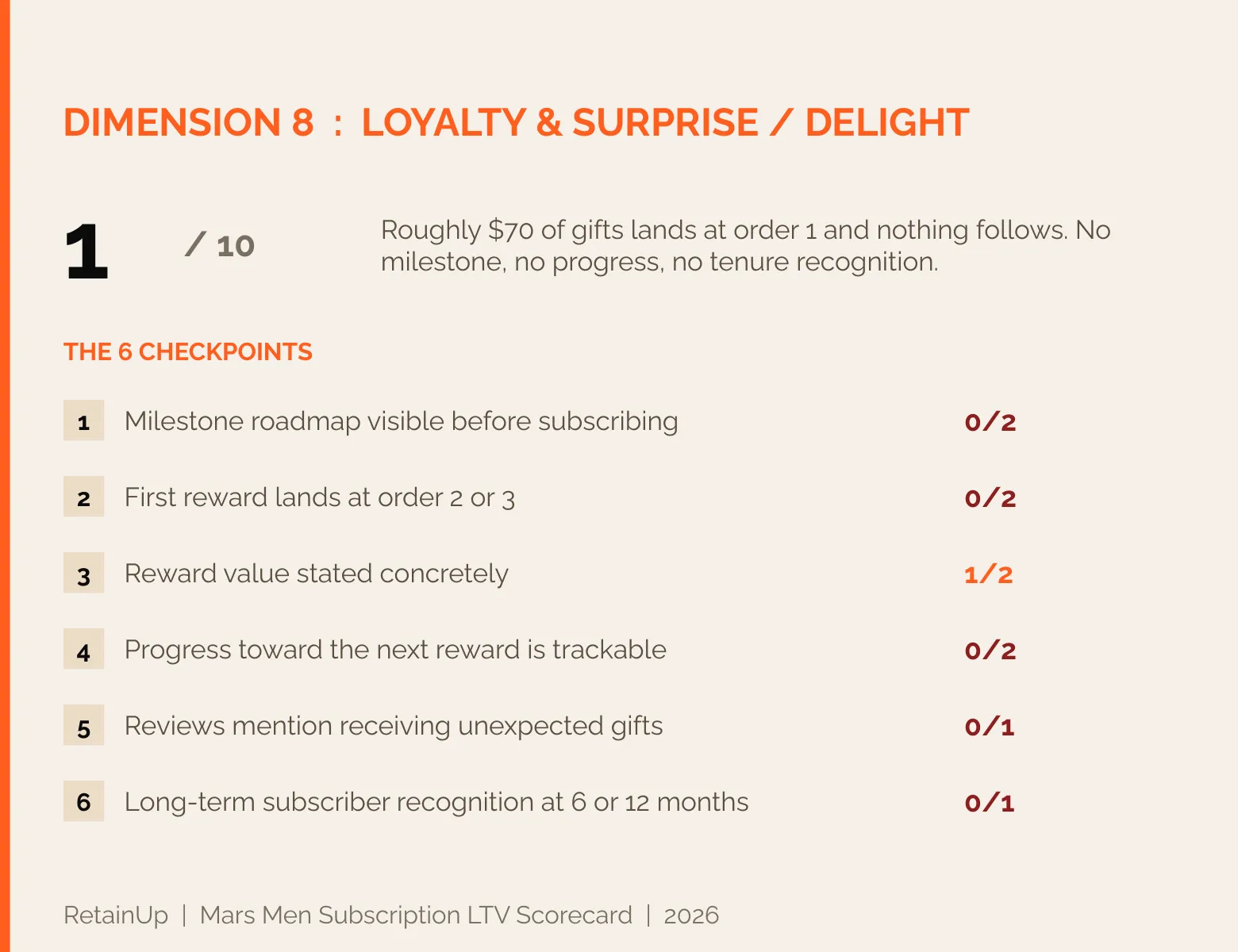
Here I look at what a subscriber gets for staying. Roughly $70 of gifts lands at order one. Then nothing.
No milestone roadmap. No reward at order 2 or 3; every gift is acquisition. No progress to track. No review anywhere mentions an unexpected gift. Nothing recognises 6 or 12 months, and a referral program is not tenure. The one point: the gifts are named and valued in dollars. They just all arrive at the start.
We see this on a lot of audits, where the whole delight budget is spent getting the first order and there is nothing left for the subscriber who stays to order three, four or twelve. Moving one of those gifts to order 2 or 3 costs the same and protects the renewal, which is the argument in gifts over discounts.
What I would change: put the first reward at order 2 or 3, not order 1. State its value in dollars so staying is worth calculating. Show progress toward the next reward inside the portal.
Moving one gift from order 1 to order 2 or 3 costs nothing extra. The Subscription LTV Maximizer™ builds the gift ladder and the milestone emails that make people reach order three.
How Mars Men compares to Dr. Squatch and the other brands
We have scored six big subscription brands on the same 48 checkpoints. Mars Men sits sixth.
| Brand | Product | Score |
|---|---|---|
| Grüns | Daily nutrition gummy | 85.5 |
| Everyday Dose | Mushroom coffee | 81 |
| Dr. Squatch | Natural soap | 73 |
| IM8 | Daily nutrition powder | 72 |
| Create | Creatine gummy | 67.5 |
| Mars Men | Men's testosterone support | 62 |
Mars Men vs Dr. Squatch: two men's brands, built for different halves
Both sell to men, both were scored in August 2026. Dr. Squatch got 73, Mars Men 62. Mars Men actually wins more dimensions: structure, offer, messaging and onboarding. It loses most of what comes after the first order.
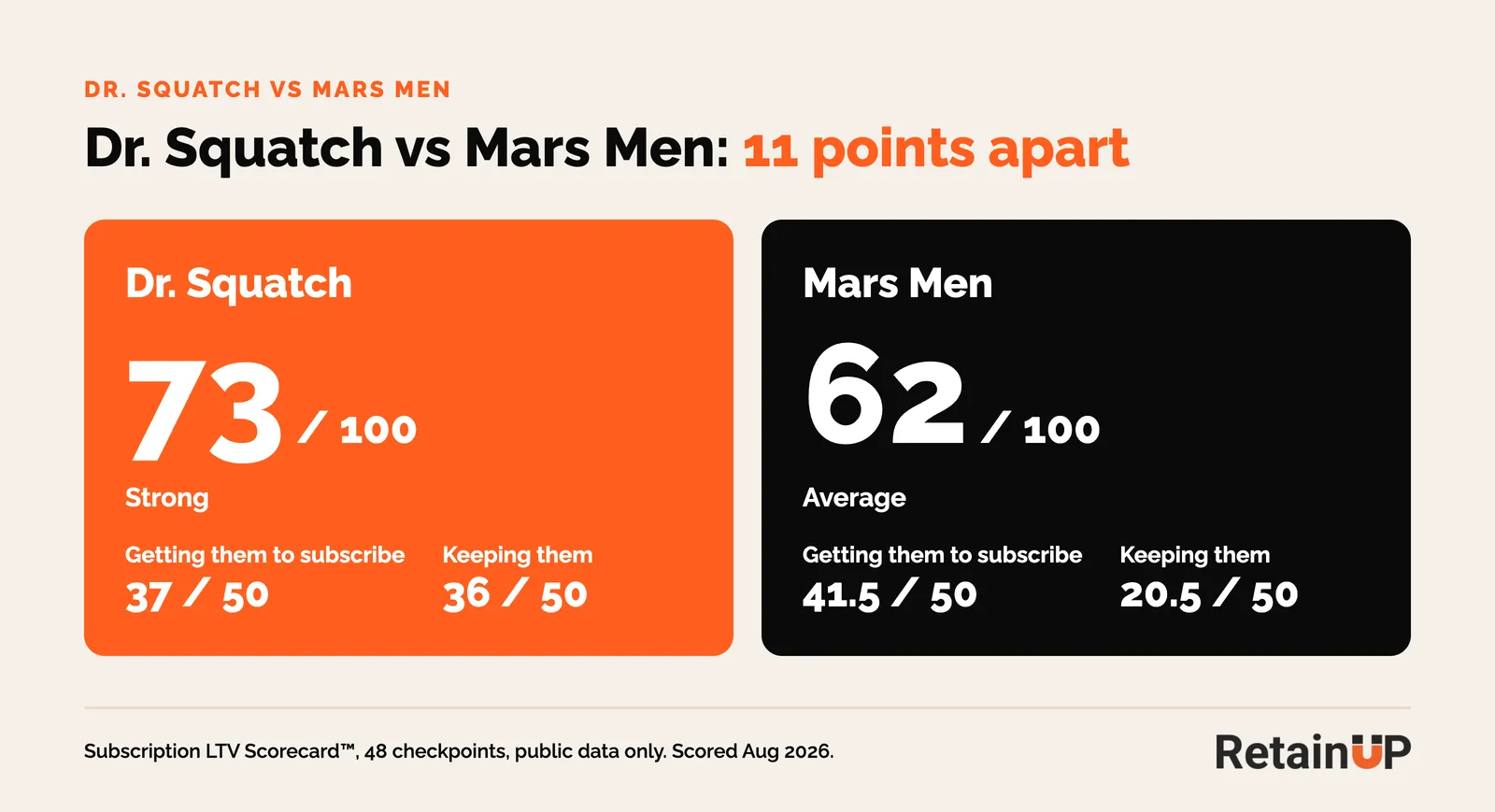
Mars Men wins the front half, 41.5 against 37. Dr. Squatch wins the back half, 36 against 20.5. Big gap. Loyalty is the widest gap on the board, 8 against 1. Dr. Squatch states rewards in dollars and gives subscribers early access to new scents. Flexibility is next, 8.5 against 2.5. Dr. Squatch subscribers actually use swap. Mars Men has nothing to swap to.
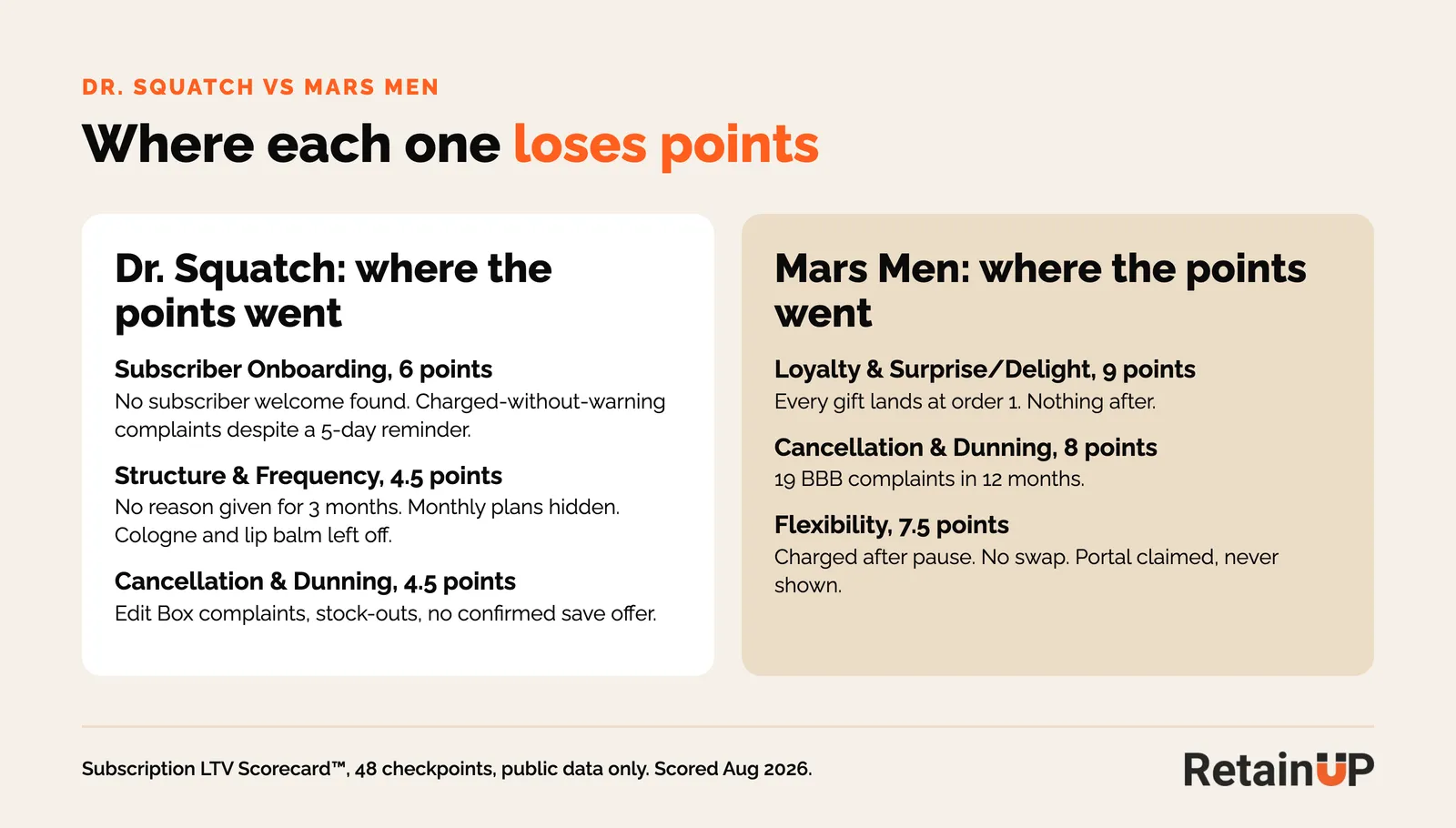
Full breakdown of the other side: the Dr. Squatch subscription strategy.
Mars Men vs Grüns: the same hidden 90-day plan
Grüns also hides its longer plan off the product page and sells it after checkout. Same pattern, two brands. But Grüns built the back half. 41 against 20.5 on keeping subscribers. Grüns gives people a reason to want the next box, a new flavour every six weeks. Mars Men gives every reason at the start.
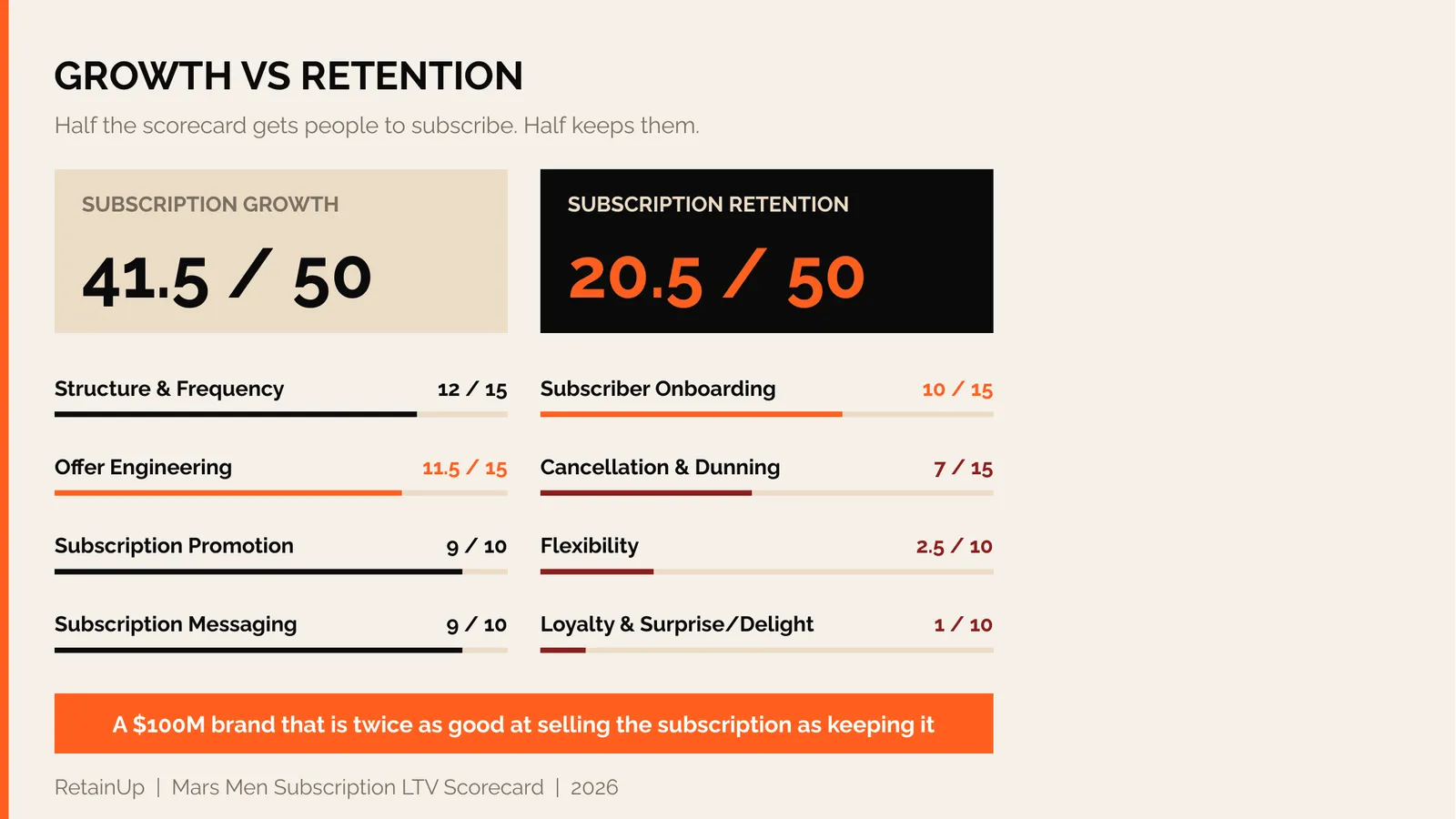
Mars Men won 83% of the growth points and 41% of the retention points, the most front-loaded program we have scored.
If your scores look like Mars Men, high at the front and low at the back, the Subscription LTV Roadmap™ gives you the 90-day plan to fix the back half first.
What to take from Mars Men
- Make the subscribe gap unmistakable. $59 against $125 with shipping. Nobody has to think.
- Answer "do I have to subscribe?" on the page, with a real argument.
- Set a results timeline at day 7, 30 and 90.
- Then move one gift to order 2 or 3, send a reminder before every charge, and make cancel work.
A hundred million dollars in eighteen months proves the product works, the funnel works, and the team knows exactly how to turn ad spend into a first order at scale. But they built that machine for order one. The back half is where the next $100 million is sitting.
Want your program scored on the same 48 checkpoints? The free subscription audit runs the same scorecard on your store and ranks your top 3 retention leaks, in 24 hours.
FAQ
How does the Mars Men subscription work?
Mars Men sells one product, a bottle of 150 capsules taken 5 a day, on a subscription that ships every 30 days. The subscription is the default on the product page at $59, half the $118 one-time price, for life. A 90-day supply is offered on the screen after checkout.
How much cheaper is the Mars Men subscription than buying once?
Mars Men charges $59 on subscription against $118 for one-time, plus $7 shipping on the one-time order. That is less than half the one-time total, for life. The first subscription order also carries about $70 of free product, an ebook, a workout app trial and free shipping.
How do you cancel a Mars Men subscription?
Mars Men says you can cancel through a self-serve customer portal linked from your order emails. In practice, many reviews and 19 BBB complaints in 12 months describe charges after cancelling or pausing. If you cancel, keep the confirmation and check your next statement.
Why does Mars Men score low on retention?
Mars Men scored 20.5 out of 50 on keeping subscribers because every incentive fires at order one. There is no reward after the first order, no reminder before each charge, nothing to swap to with a single product, and cancel and pause complaints zero several checkpoints. The front half scored 41.5 out of 50.
What can a subscription brand copy from Mars Men?
Copy the front half: an unmistakable price gap between subscription and one-time, an on-page answer to "do I have to subscribe?", and a day 7, 30 and 90 results timeline. Avoid spending the whole gift budget on order one, and send a reminder before every charge.
One email a week on subscription retention: the numbers, the strategy, and what to fix first.

Rahi Jain
Rahi Jain is a subscription LTV specialist who helps $1M to $10M DTC brands reduce subscription churn and maximize LTV on Recharge, Skio, Stay AI and Loop.
More about Rahi