Key takeaways
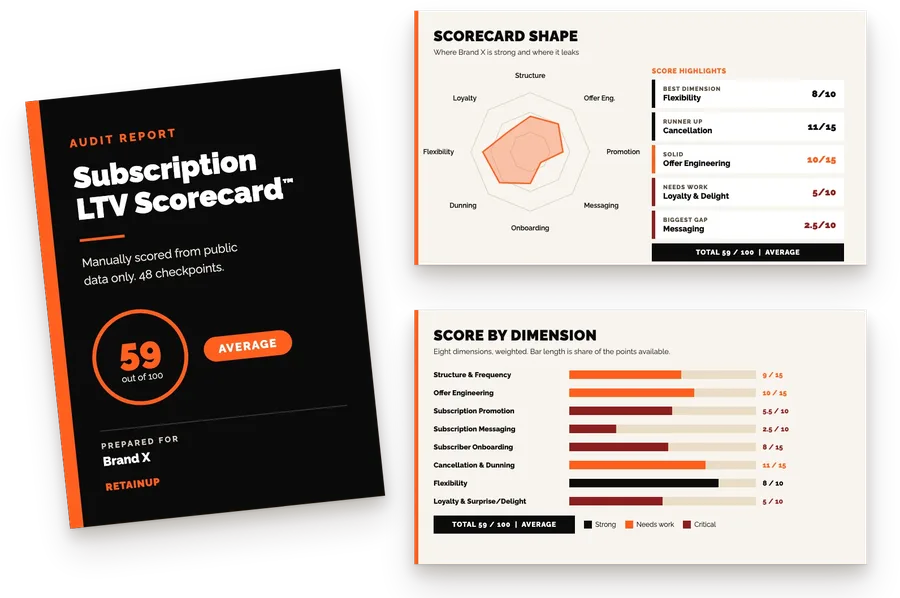
- IM8 scores 72 out of 100 on the Subscription LTV Scorecard™. The offer, the promotion and a gift roadmap published before checkout are among the best we have scored.
- It loses points on onboarding with no results timeline, flexibility that is mentioned once and never explained, and a cancel policy that contradicts the product page.
- The investor decks show the engine: 79% of new customers subscribe on order one, quarterly plans went from 0 to 55% of revenue in 9 months, and a $300 CAC pays back in 3 to 6 months.
IM8 sits in the Subscription Scorecard Library next to every other brand scored on the same 48 checkpoints.
I am obsessed with IM8. They built a $188M subscription engine in just 18 months.
A brand with David Beckham, NASA and the Mayo Clinic behind it should not need to be good at retention. Endorsement that size sells the first order on its own. IM8 is good at retention anyway, and that is the part worth studying.
I read their investor decks. 79% subscribe on the first order. 81% of revenue from repeat. But that was the deck talking. So I went to the site and scored the subscription program itself, 48 checkpoints across 8 dimensions, all from public data. Strong, with room to climb.
Watch the full IM8 scorecard, 15 minutes
What is IM8?
IM8 is a premium all-in-one supplement co-founded by David Beckham and Prenetics (NASDAQ: PRE). The flagship is Daily Ultimate Essentials: about 90 ingredients, NSF Certified for Sport, marketed as replacing 16 supplements.
- Launch: December 2024.
- Scale: $186M annual run rate by Q1 2026, and $20.9M in July 2026 alone. 140,000 active subscriptions by July.
- Advisors: Mayo Clinic, NASA, Cedars-Sinai, Yale-Griffin.
- Offer: $78 a month on subscription against $99 one-time, 20% off. Quarterly is 30% off.
- Platform: Shopify, Skio for subscriptions, Gorgias for support.
The IM8 subscription scorecard: 72 out of 100
IM8 scores 72 out of 100 on the current scorecard, Strong. It was scored in June 2026, before the 100-point rubric was published, on the original version: 8 dimensions of 10 points each, where it scored 64 out of 80. The breakdown below is that first scoring, dimension by dimension.
| Dimension (first scoring) | Score | Out of |
|---|---|---|
| 1. Subscription structure and frequency | 8 | 10 |
| 2. Offer engineering | 9 | 10 |
| 3. Flexibility | 7 | 10 |
| 4. Subscription promotion | 9 | 10 |
| 5. Loyalty and surprise/delight | 9 | 10 |
| 6. Retention copy | 8 | 10 |
| 7. Cancellation and dunning | 7 | 10 |
| 8. Subscriber onboarding | 7 | 10 |
| Total | 64 | 80 |
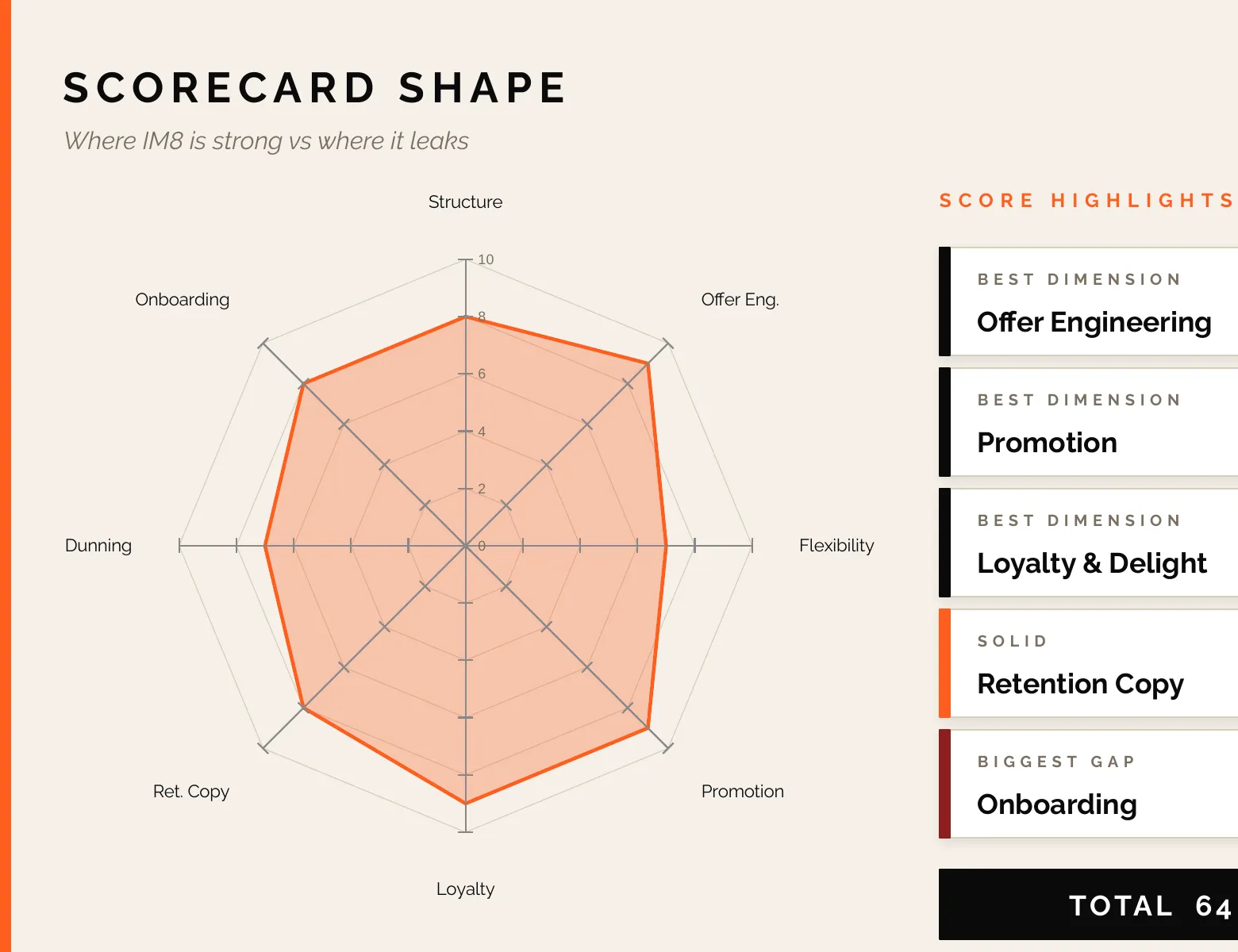
Three dimensions carry the program: offer, promotion and loyalty, all at 9. Three leak: flexibility, cancellation and onboarding, all at 7. The gap between them is the whole story.
Three things stood out
First, their offer engineering. They package subscriptions and offers more tightly than most brands, which drives a very high AOV. Not many options. No distractions. And the pricing is not offer heavy.
Second, their gifting. They lean on monthly gifts to keep subscriptions and build loyalty. Most brands add one or two gifts. IM8 gives out 6 to 10 in a year.
Third, their communication. Heavy on celebrity and medical endorsements, lighter on the science and on habit. With NASA and David Beckham, who needs to know about the ingredients?
1. Subscription structure and frequency: 8 out of 10
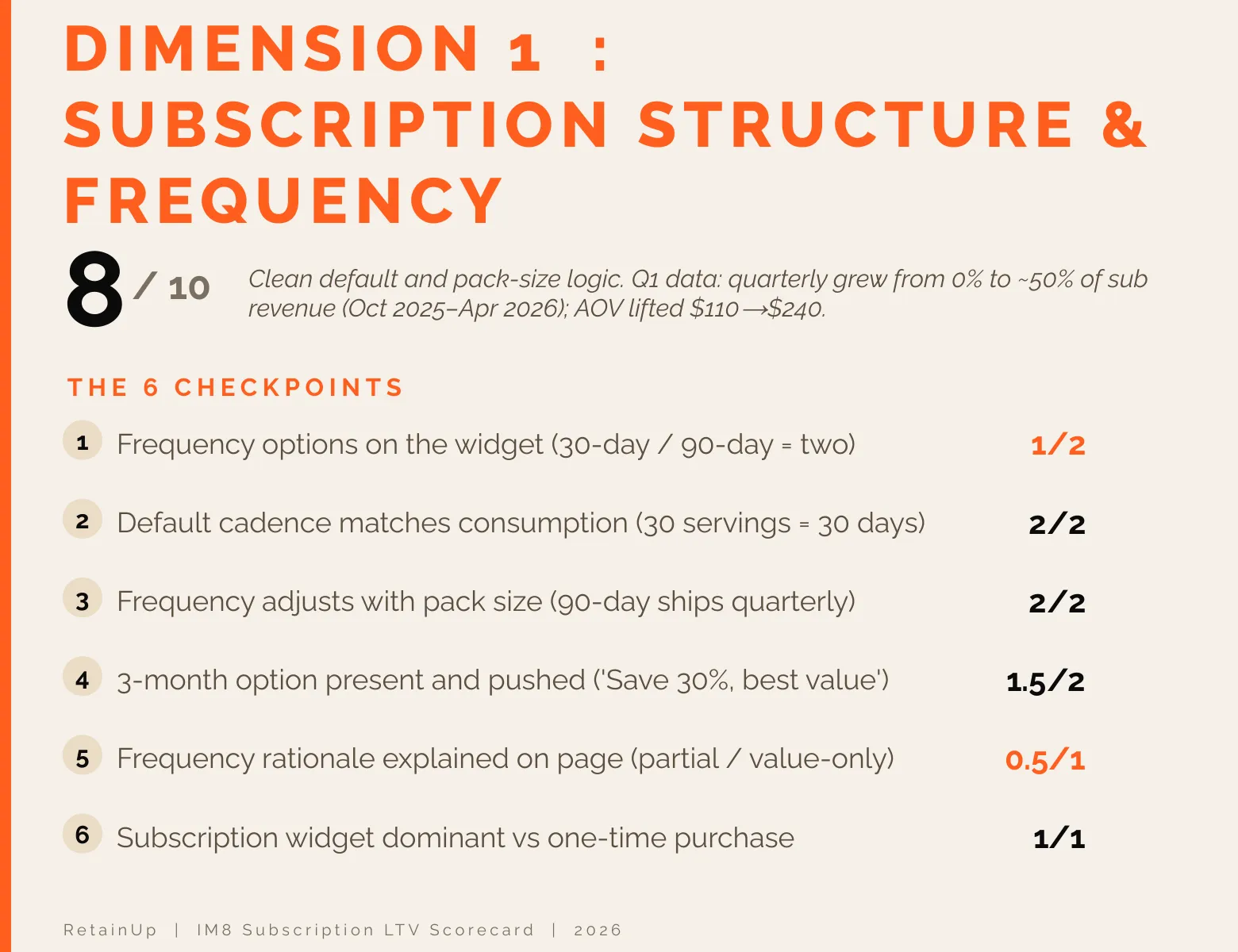
Here I look at how often the product ships and what choices you get. Clean default. Clean pack-size logic. Two frequencies, not six: 30 days and 90 days. 30 servings is 30 days, and the 90-day pack ships quarterly. The cadence matches how fast the product is used, so nobody ends up with four unopened tubs and a reason to cancel.
The 3-month option is there and pushed: "Save 30%, best value." The investor deck shows it working. Quarterly went from zero to about half of subscription revenue between October 2025 and April 2026, and new customer AOV went from about $110 to $240.
What I would change: explain why the cadence fits, not only that the bigger pack is better value.
Thinking about a quarterly default like IM8? The Subscription LTV Roadmap™ reads your cohort data and shows what a quarterly plan would do to your cash on day one and your retention.
2. Offer engineering: 9 out of 10
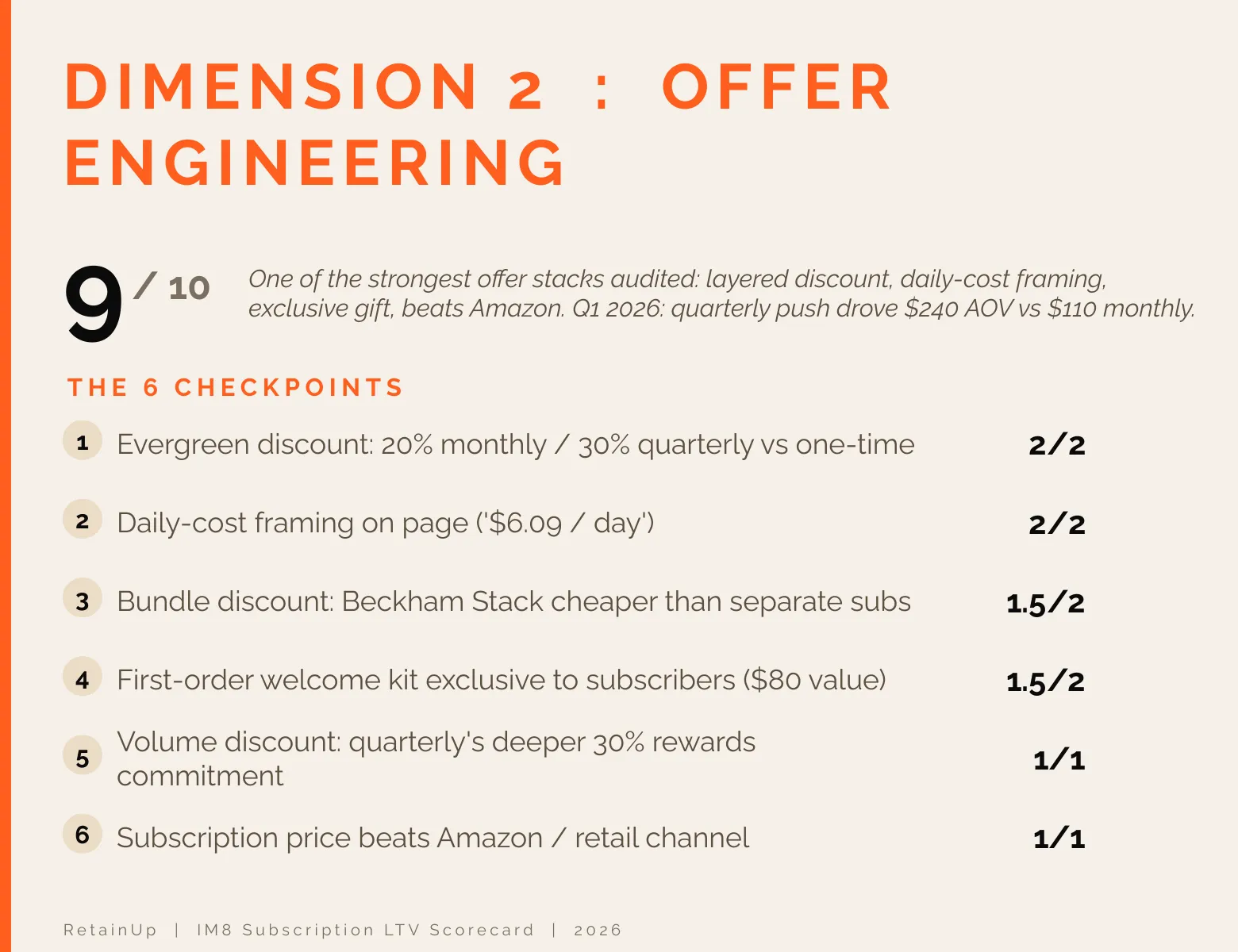
Here I look at how the subscription is priced and structured. Their strongest dimension. And one of the strongest offer stacks we have audited.
The discount is layered at 20% monthly and 30% quarterly, and it holds across every product and every bundle. So nothing on the site contradicts anything else on the site. They also beat their own Amazon price, which sounds obvious and almost nobody does.
Then the daily cost framing, about $6 a day. A $180 monthly charge is a decision. Six dollars is a coffee. Big difference. The Beckham Stack costs less than the separate subscriptions, and new subscribers get an exclusive welcome kit.
Most brands I score run three different discount rates across the product page, the subscription page and their ads, then wonder why the offer never feels credible. IM8 picked one number and repeated it.
What I would change: very little. Keep the stack and the daily framing, and keep beating Amazon on site.
A layered discount that holds on every product and channel, with a daily cost on the page, is the offer the Subscription LTV Maximizer™ builds in your subscription app, live in 30 days.
3. Flexibility: 7 out of 10
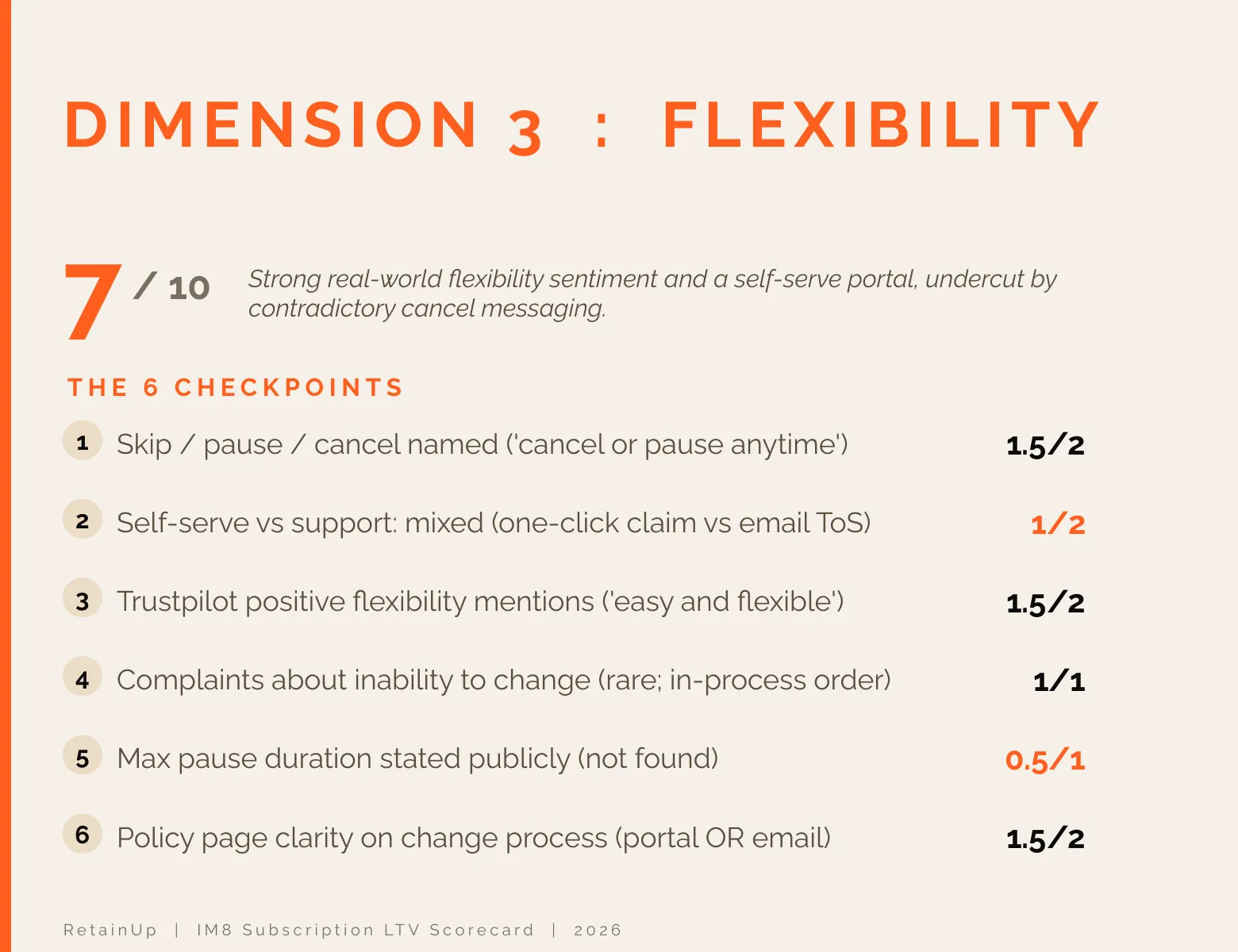
Here I look at whether a subscriber can skip, pause or change without contacting anyone. Sentiment is strong. Reviews call it "easy and flexible," and complaints about not being able to change are rare. Skio gives them a self-serve portal.
But flexibility is mentioned once. Never explained. The product page says "cancel or pause anytime." No maximum pause length is stated anywhere. And the self-serve claim is undercut by the terms, which point you to email.
What I would change: name skip, pause and cancel on the product page, state the maximum pause length, and keep every change self-serve.
If your portal can pause and skip but the page only says "cancel anytime", the Subscription LTV Maximizer™ names every option on the product page and in the reminder email.
4. Subscription promotion: 9 out of 10
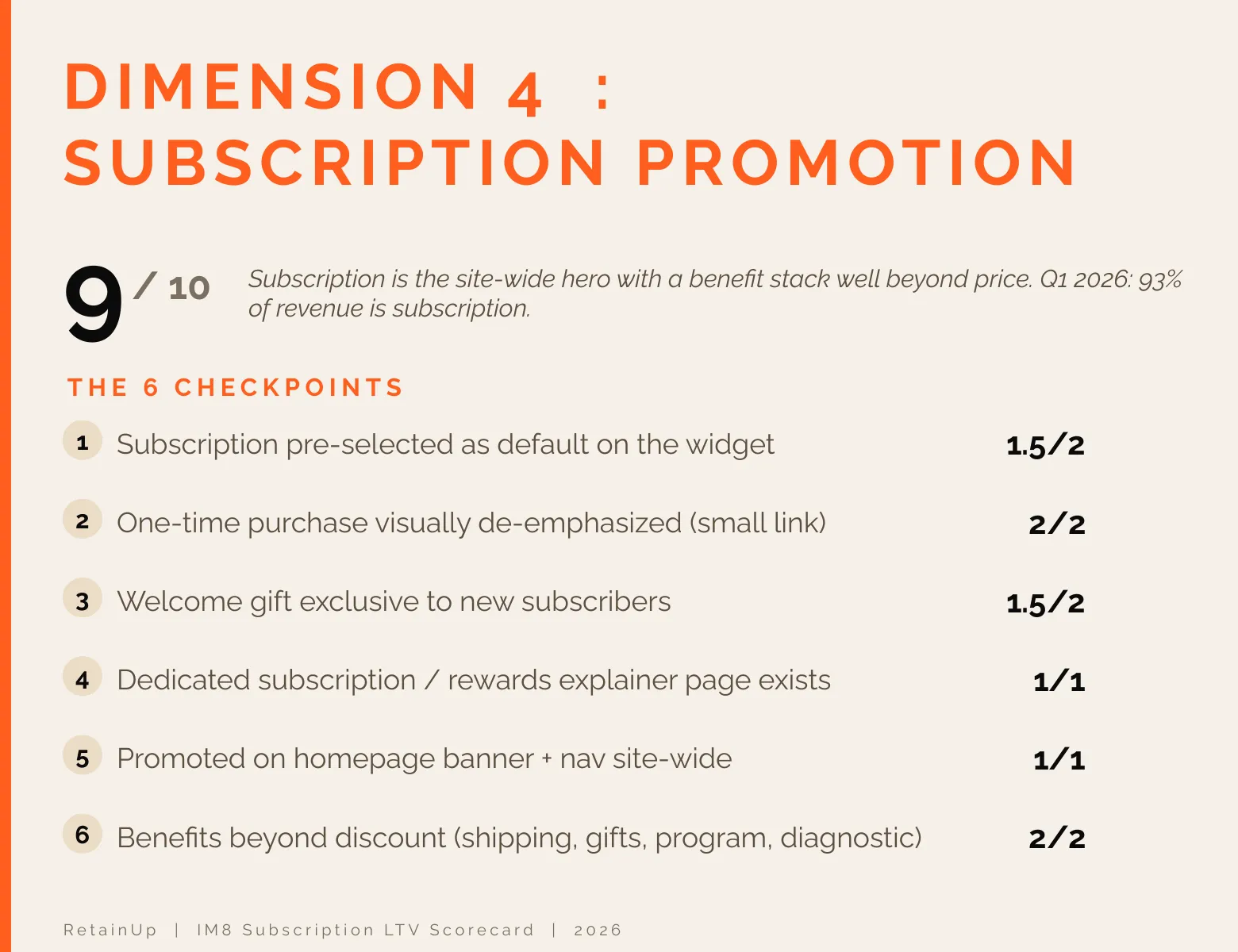
Here I look at how hard the site pushes subscription. Read the IM8 product page and count how many times it argues for subscribing. Almost never. Quietly done. The page sells a daily habit that happens to arrive every month. Subscription is the path. One-time is the exception you have to go looking for.
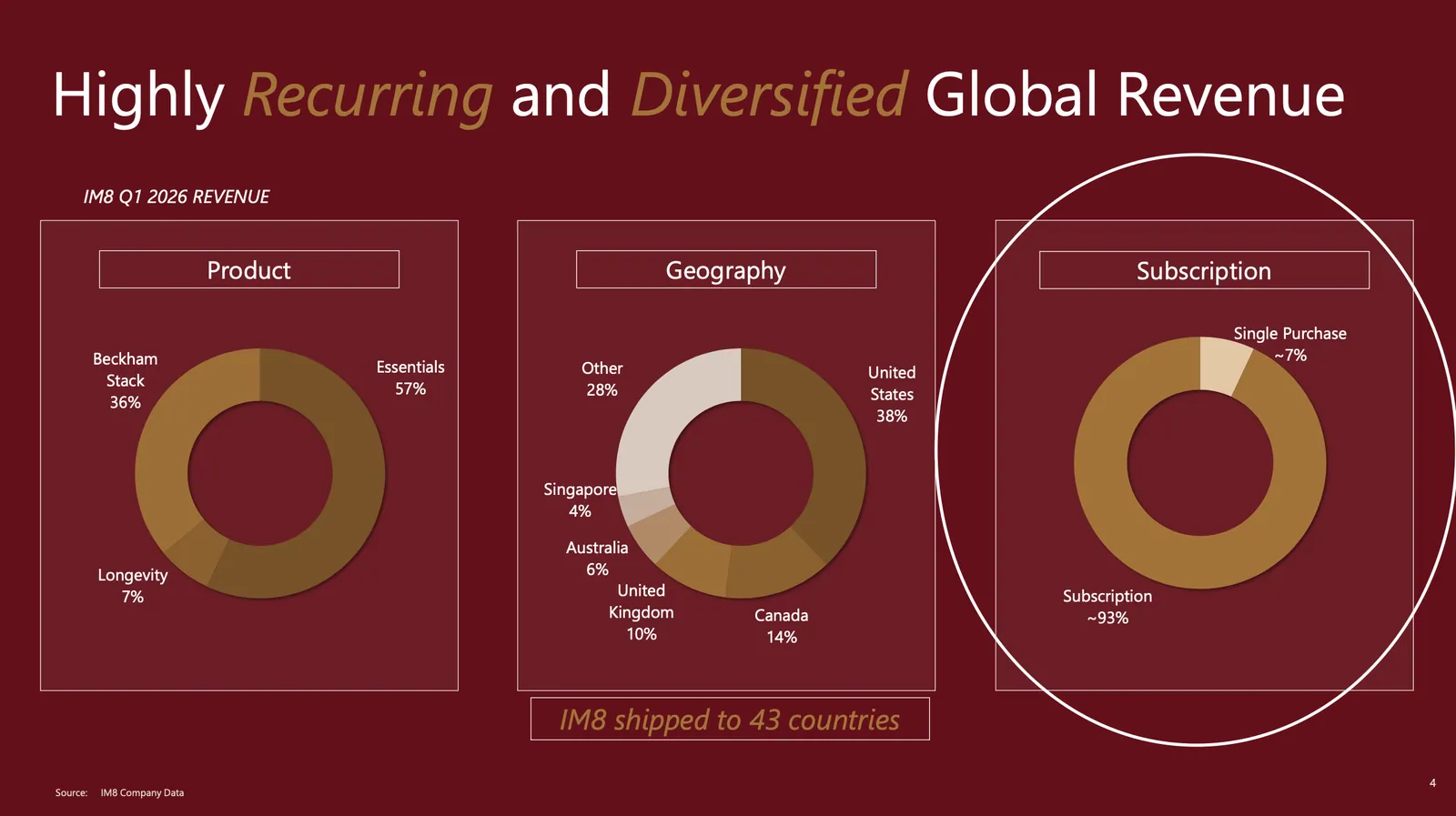
The benefit stack goes well past the discount: free shipping, the welcome kit, the 90-day program, a diagnostic perk. Price is one line among several. It shows in the numbers. Subscription was 93% of Q1 2026 revenue.
Compare that with the usual approach, a radio button offering 15% off and no argument for why the recurring version is better. A discount is not a reason to subscribe. It is a reason to buy once and cancel.
5. Loyalty and surprise/delight: 9 out of 10
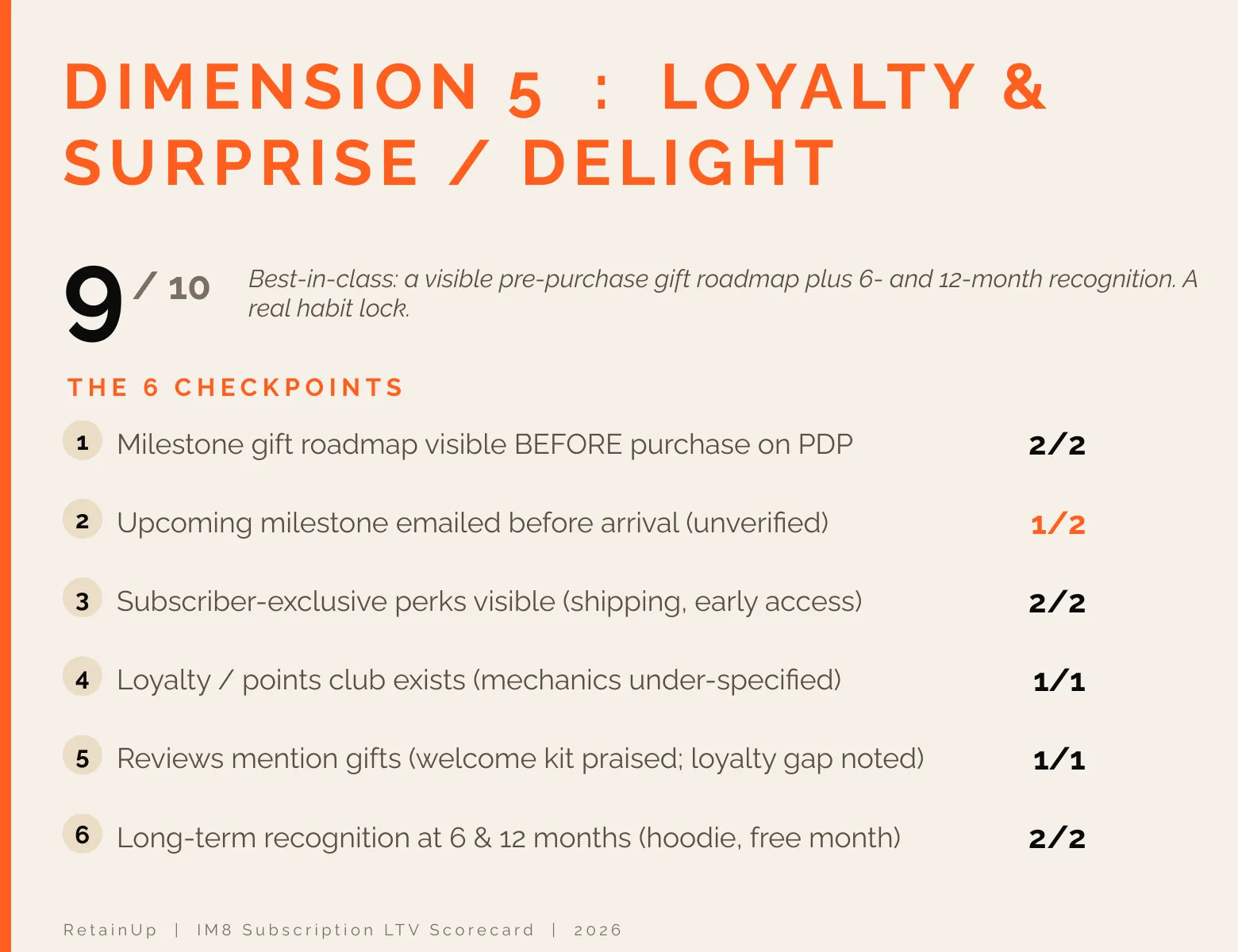
Here I look at what a subscriber gets for staying. This is where almost every brand scores near zero. And IM8 scores 9.
The gift roadmap is the best I have seen. By far. Six months of gifts published on the product page before you subscribe. You know what arrives in month 2, month 3, month 5.
Most brands run one or two gifts and reveal them after the charge, which turns a retention tool into a pleasant surprise. A surprise cannot be the reason someone stays, because they did not know it was coming. Publishing the roadmap turns gifting into a commitment. The subscriber is not staying for this month's product. They are staying because month three has something in it.
They also recognise subscribers at 6 and 12 months, a hoodie and a free month, which is rare enough that we score it on its own.
The one gap sits underneath. The welcome kit is first-order only, about $108 of value that a new customer gets and a 12-month subscriber does not. A renewing subscriber noticed and said so on Trustpilot. Every incentive that fires only at order one does this. The longer someone stays, the worse their deal gets against a stranger.
What I would change: add a tenure gift at month 6 or 12 worth close to the welcome kit, so renewers stop losing to new customers. The milestone-based retention guide covers how to build the ladder.
A gift roadmap shown before checkout is the most copyable thing on this page. The Subscription LTV Maximizer™ builds the roadmap, the monthly gifts and the 6 and 12 month recognition.
6. Retention copy: 8 out of 10
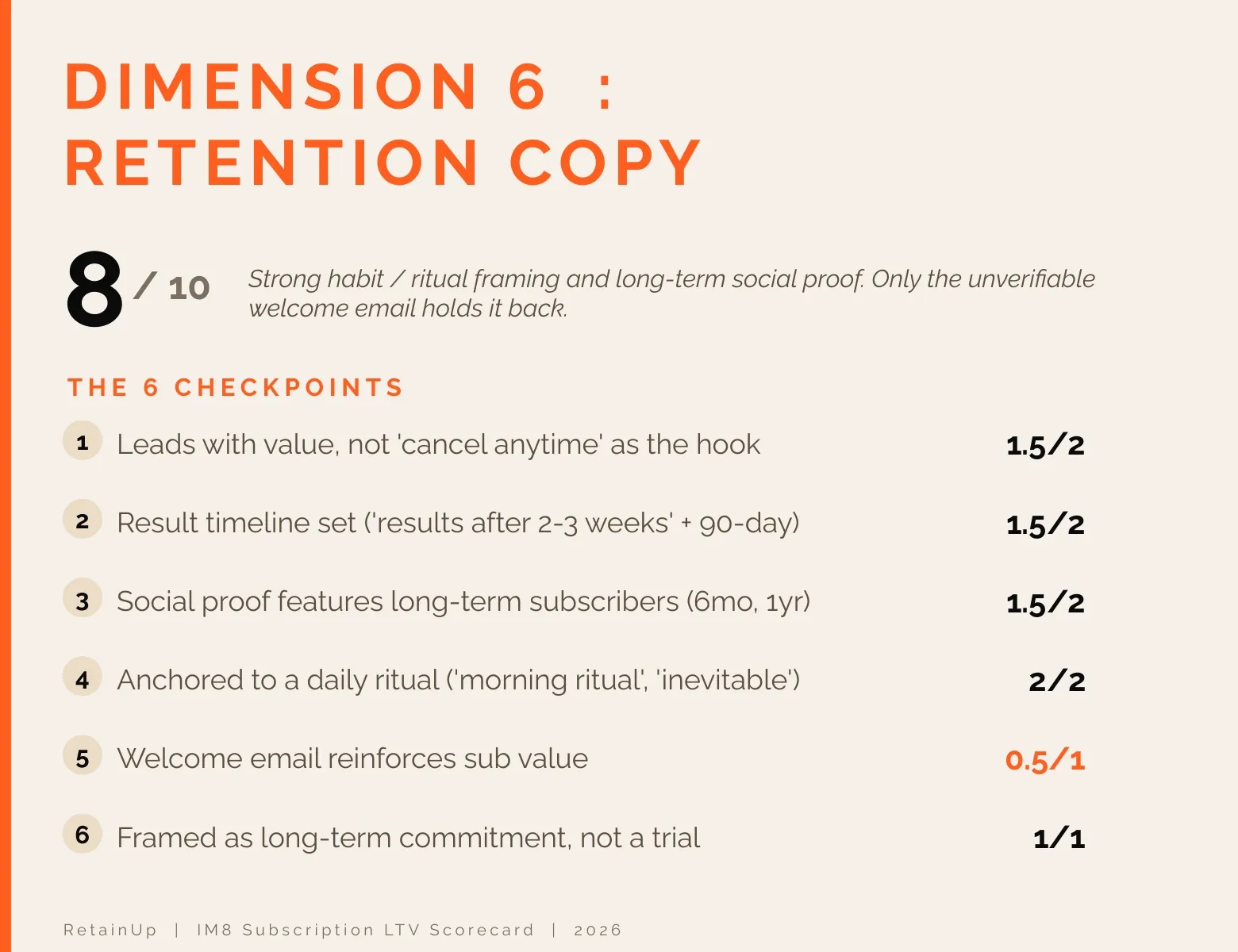
Here I look at whether the copy keeps people subscribed. Strong habit and ritual framing: "morning ritual." Long-term subscribers at 6 months and a year show up in the reviews. It leads with value, not "cancel anytime" as the hook. And it frames the subscription as a long-term commitment, not a trial.
Where it slips is the science. The page leans on Beckham, NASA and the Mayo Clinic more than on what the ingredients do and when you will feel them. "Results after 2 to 3 weeks" is there, but thin.
What I would change: lead with the result and a timeline, anchor it to the morning, and feature long-term subscribers more.
Want to see how your copy and the rest of your program score on the same checkpoints? The free subscription audit sends your top 3 leaks in 24 hours.
7. Cancellation and dunning: 7 out of 10
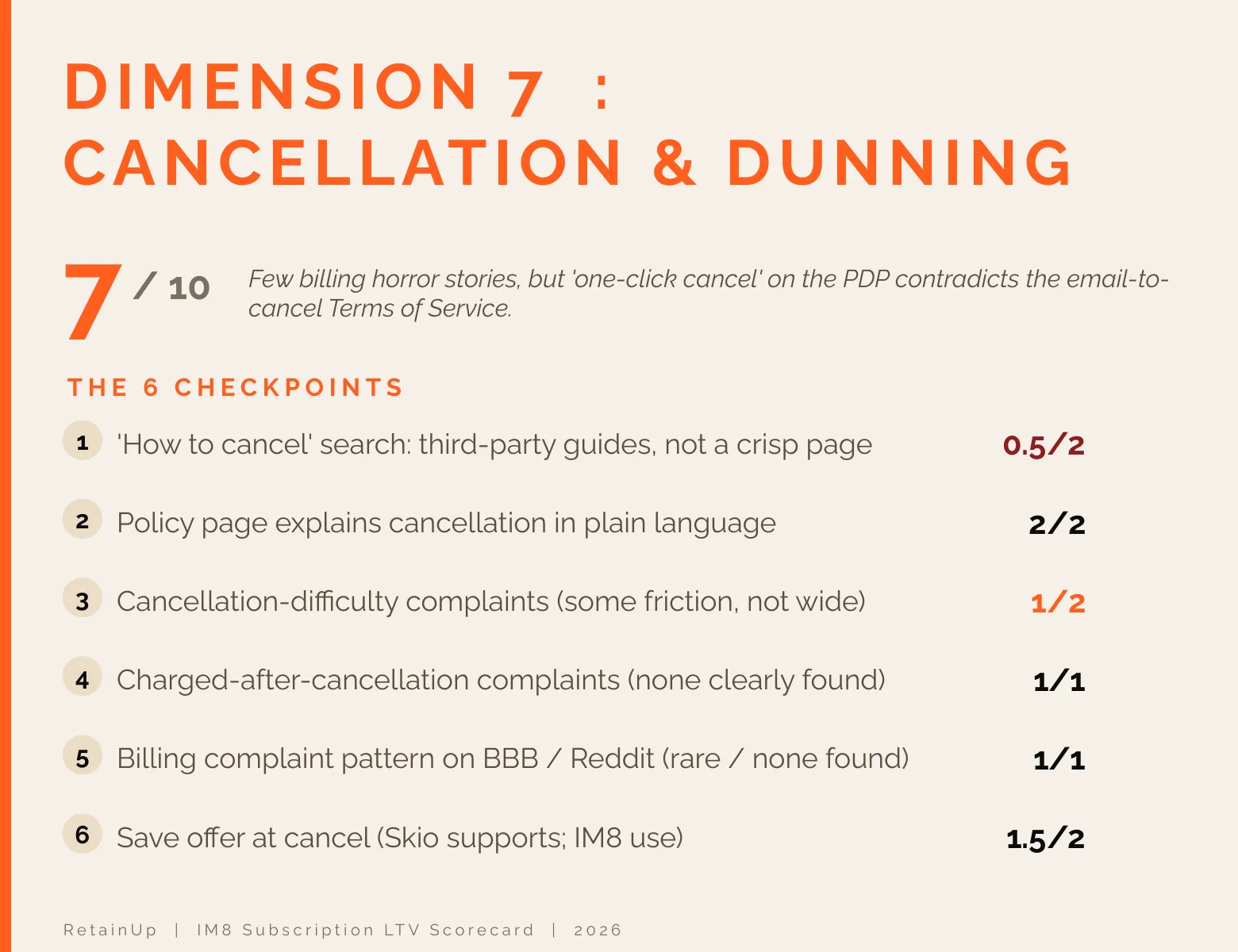
Here I look at how easy it is to leave, and how failed payments get handled. The product page says "cancel anytime with one click, no penalties, no hoops." The Terms of Service say you cancel by email. Both are live. Same website.
They run on Skio, which supports one-click self-serve cancel and save flows. So the capability is already paid for, and the policy page describes something slower than what the platform does. Search how to cancel IM8 and you get third-party guides, not a crisp page of theirs.
What is not in their reviews matters too. No pattern of charges after cancelling, no billing complaints. Trustpilot sits around 4.6 across a thousand-plus reviews, and the main negative theme is price, not billing. The problem is a mismatch between two pages, not a dark pattern.
What I would change: make the cancel page match the marketing. If the platform does one-click, say one-click. Add a save offer in the cancel flow. A half-day fix. See how we set up cancel flow routing.
A cancel page that matches the marketing, with a save offer in the flow, is part of the Subscription LTV Maximizer™. Most apps already support it; it just needs setting up.
8. Subscriber onboarding: 7 out of 10
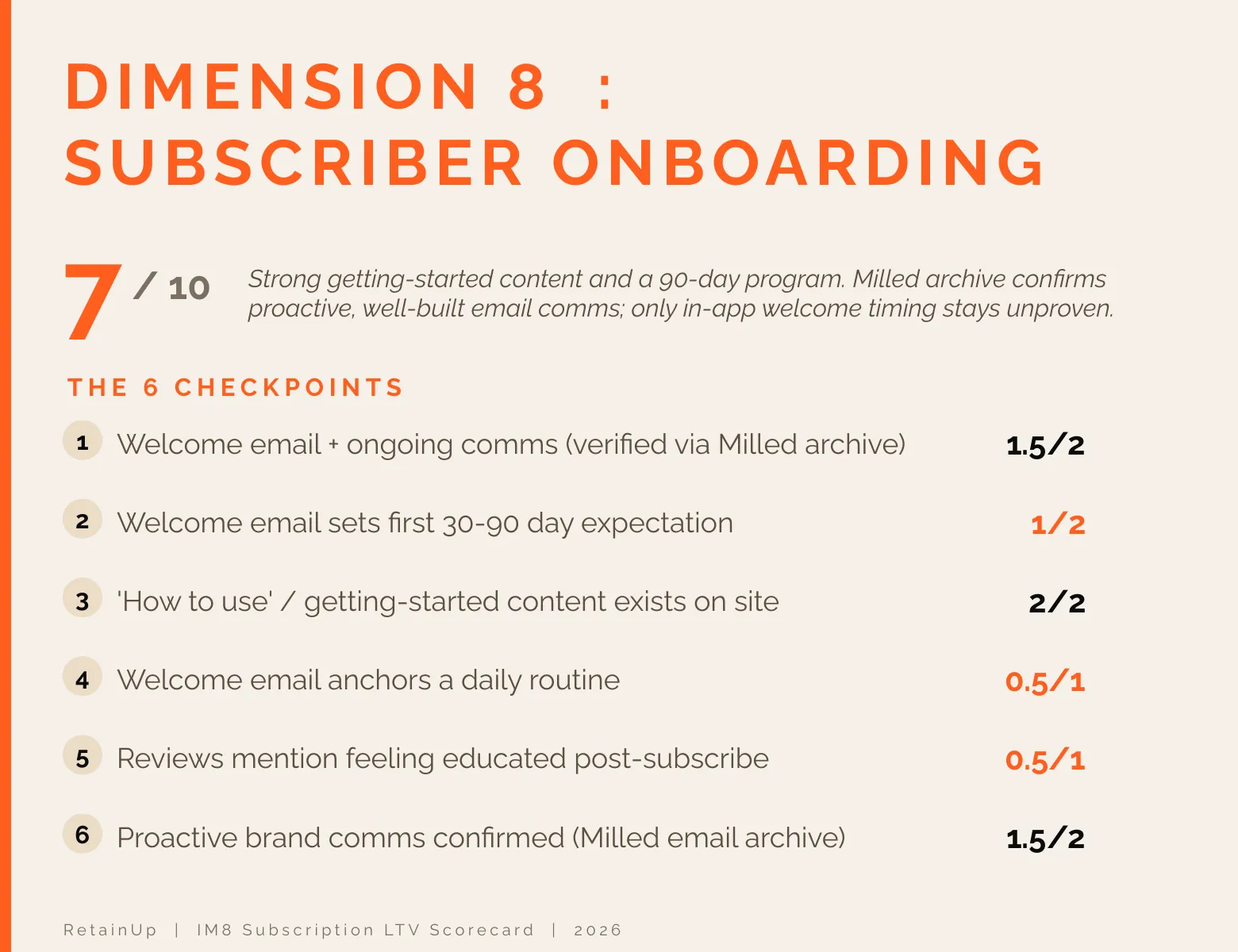
Here I look at what happens in the first 30 to 90 days. Strong getting-started content and a 90-day program. Their email archive shows proactive, well-built emails.
But onboarding never sets a timeline. Day 14? Day 30? Day 90? Nothing. The quarterly plan references a 90-day program, but a buyer on the monthly plan gets no arc at all.
For a supplement, that is the gap that decides month two. The product takes weeks to do anything a person can feel. A subscriber with no timeline experiences that silence as the product not working, and cancels with a reason they believe.
What I would change: one sentence, early, telling them when to expect something and what it will feel like. Our guide to subscription onboarding emails lays out the first 90 days.
A results timeline in the first 30 days is one email and one product page block. The Subscription LTV Maximizer™ builds the full first 90 days in Klaviyo.
IM8 by the numbers: what the investor decks show
IM8 publishes quarterly investor decks through Prenetics. I read the Q1 and Q2 2026 decks so you do not have to. In short: high AOV, high CAC, and high hopes. And some of it broke my own notions.
79% of new customers subscribe on the first order
For most health brands, 40 to 50% subscription attachment on new customers counts as a win. IM8 is at 79%, and 93% of Q1 revenue came from subscriptions. When 4 out of 5 new customers walk in already subscribed, the retention math looks different from day one. Conversion might dip, but at 3x the revenue, a 10 to 20% lower conversion rate is still a win.
Quarterly beat monthly, and I was surprised
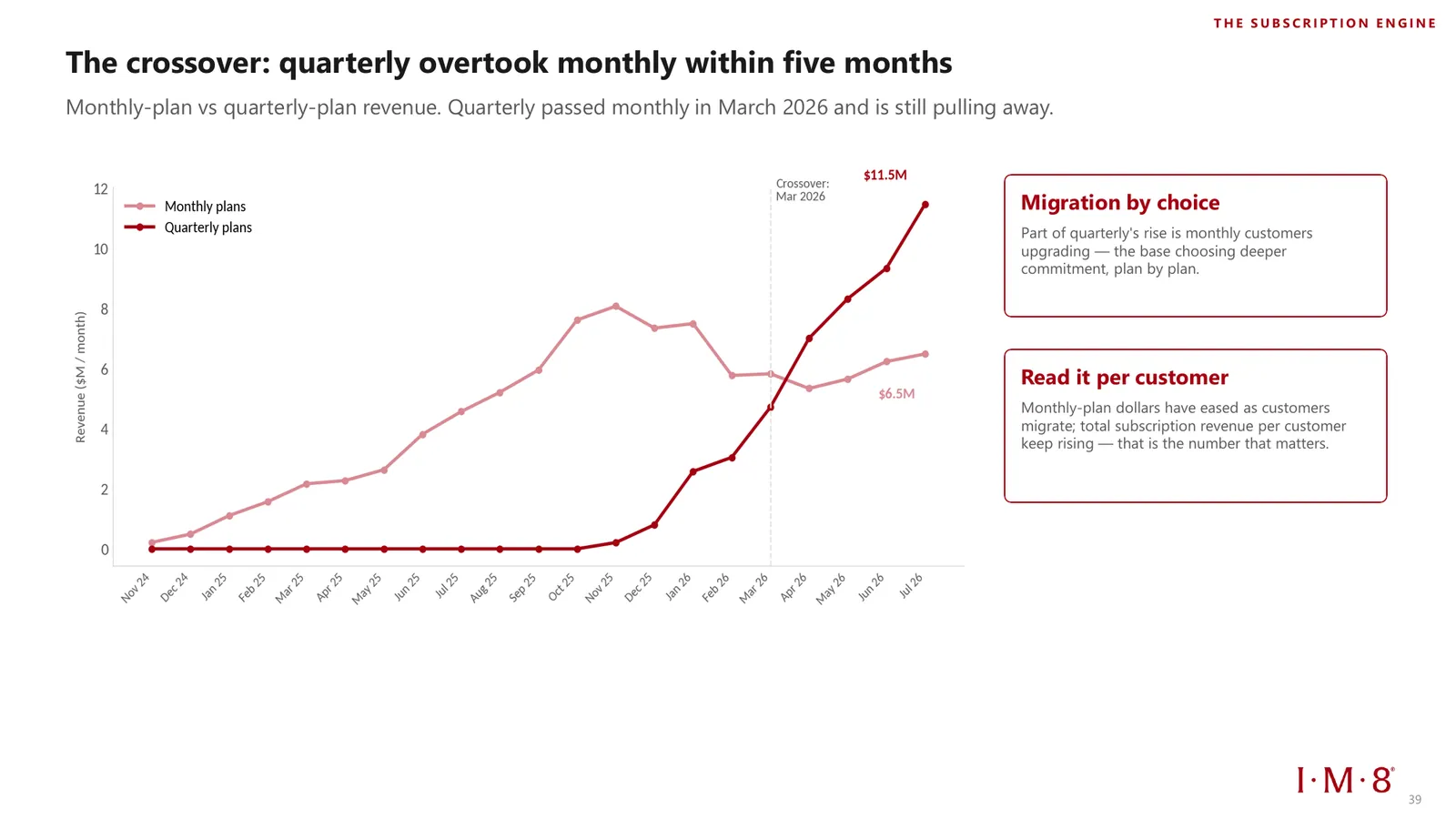
Quarterly plans launched at scale in December 2025. By March 2026 they passed monthly. By July they were 54.8% of all revenue. A quarterly order collects $324. A monthly cycle collects $128. Same product, same customer, 2.5x the cash on day one.
The cohorts show it. The January 2025 cohort, all monthly, reached $549 in revenue per customer after 12 orders. The January 2026 cohort, on quarterly, hit $587 by its 4th order. What took 12 orders in 2025 now happens in 4. They restructured the shape of the revenue curve by changing one thing: the default plan.
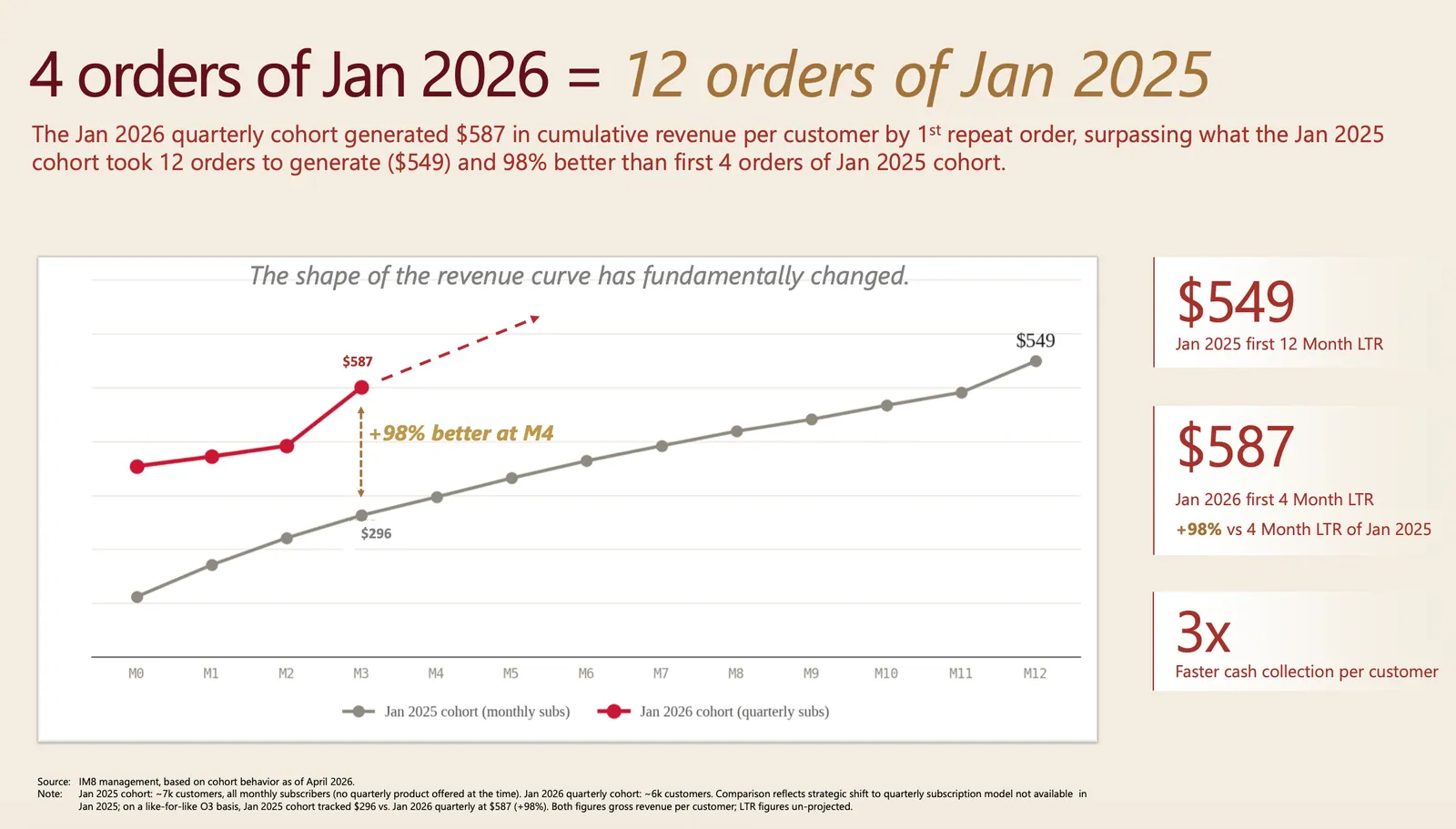
If you run this play, your monthly cohorts will look like they are dying for two quarters. Better to know that going in than to panic halfway through.
A $300 CAC that pays back in 3 to 6 months
IM8's blended CAC is $300. In July it came down to $239, for one month. Not sure how many brands could stomach that even after raising money. What makes it survivable is the billing, not the marketing. The blended first order is $207, but a quarterly order collects $324 on day one, three months of cash before you have earned it. Mature cohorts pay back in 3 to 6 months.
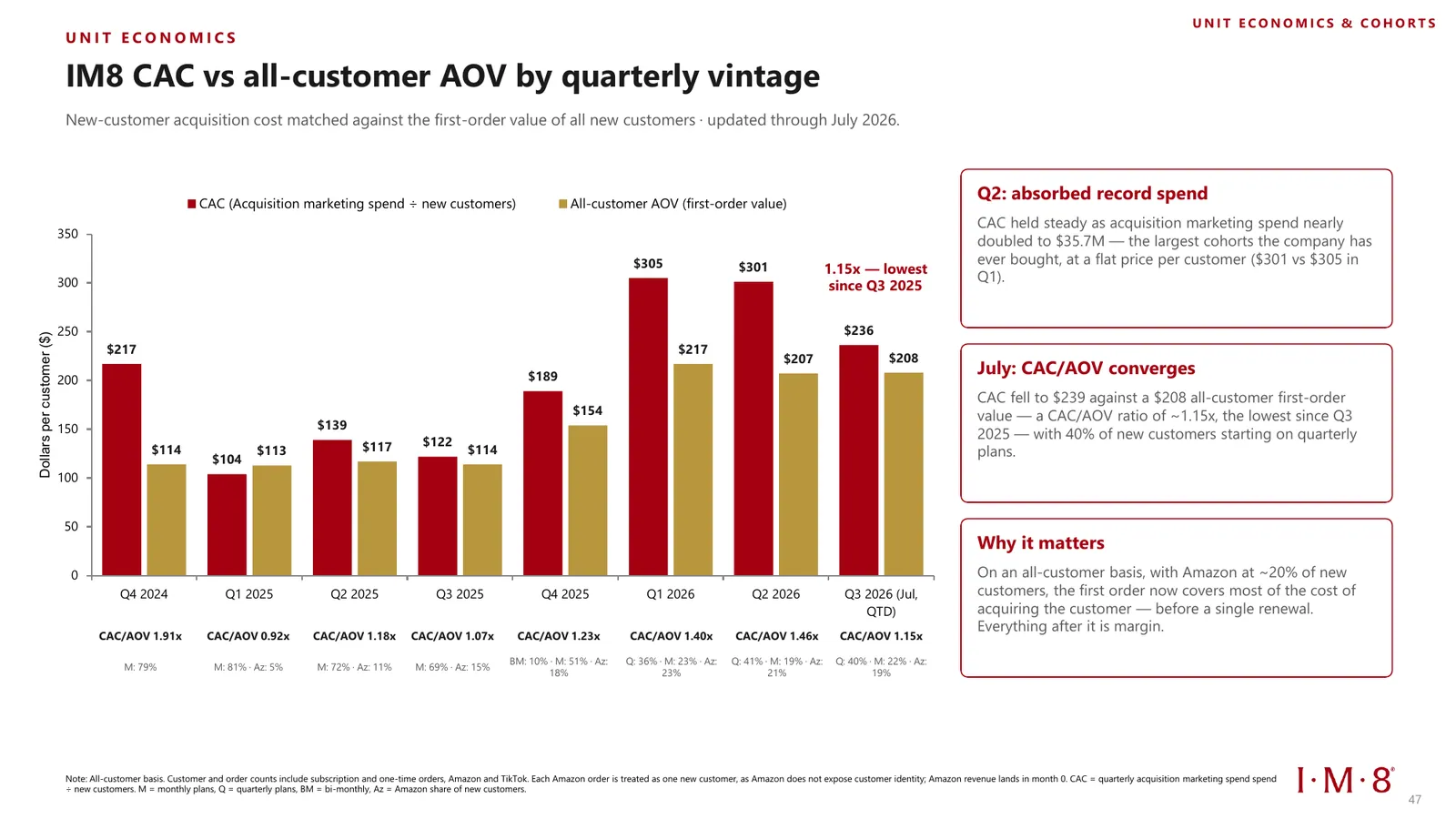
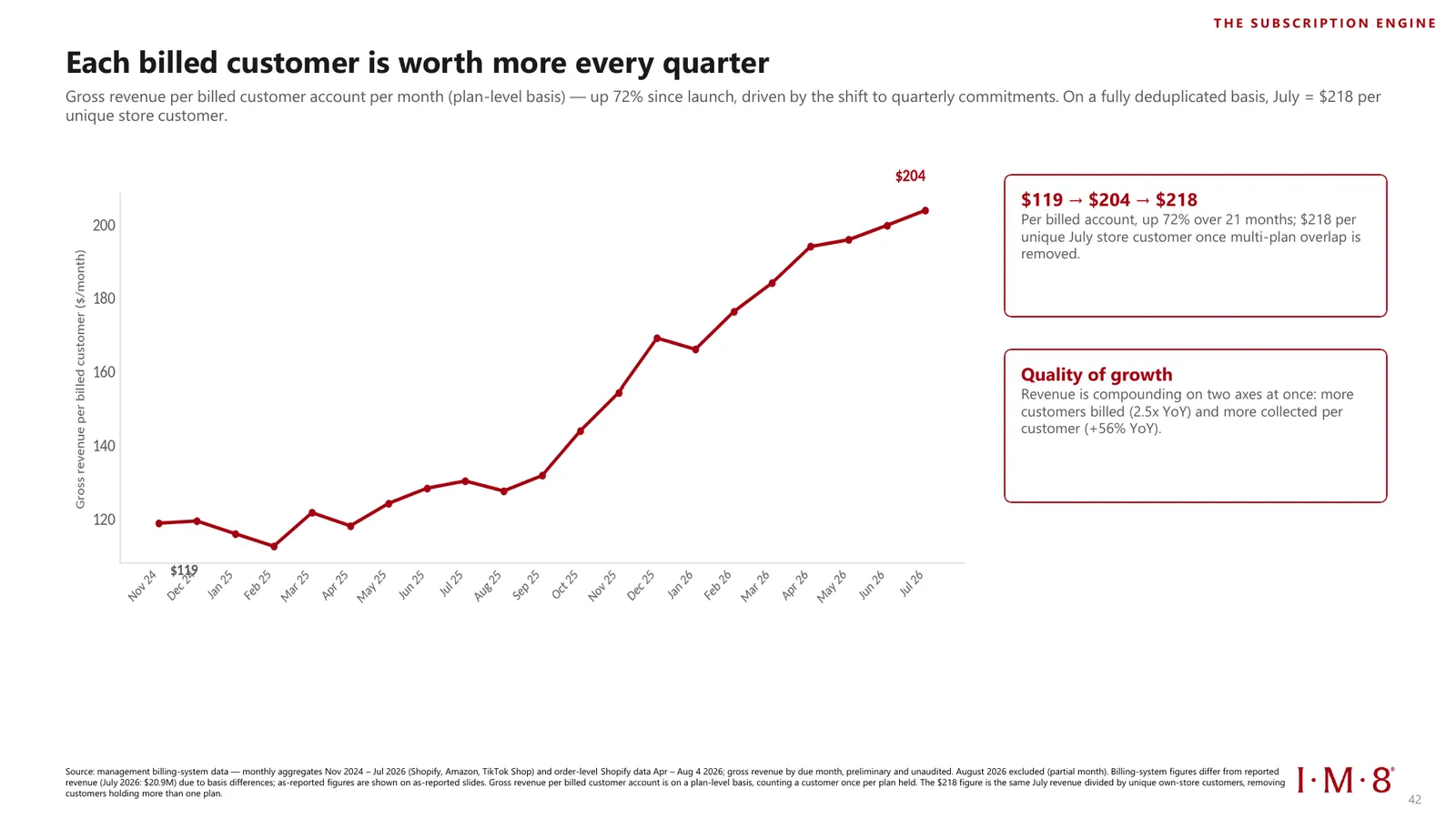
If you are fighting to shave $20 off your CAC, you are working on the wrong side of the equation. Move the AOV instead. New customer AOV hit $240 in Q1 2026, up from $111 in 2025, and revenue per billed customer went from $119 to $204 with no price increase. It is all billing frequency.
81% of revenue comes from repeat orders by order 12
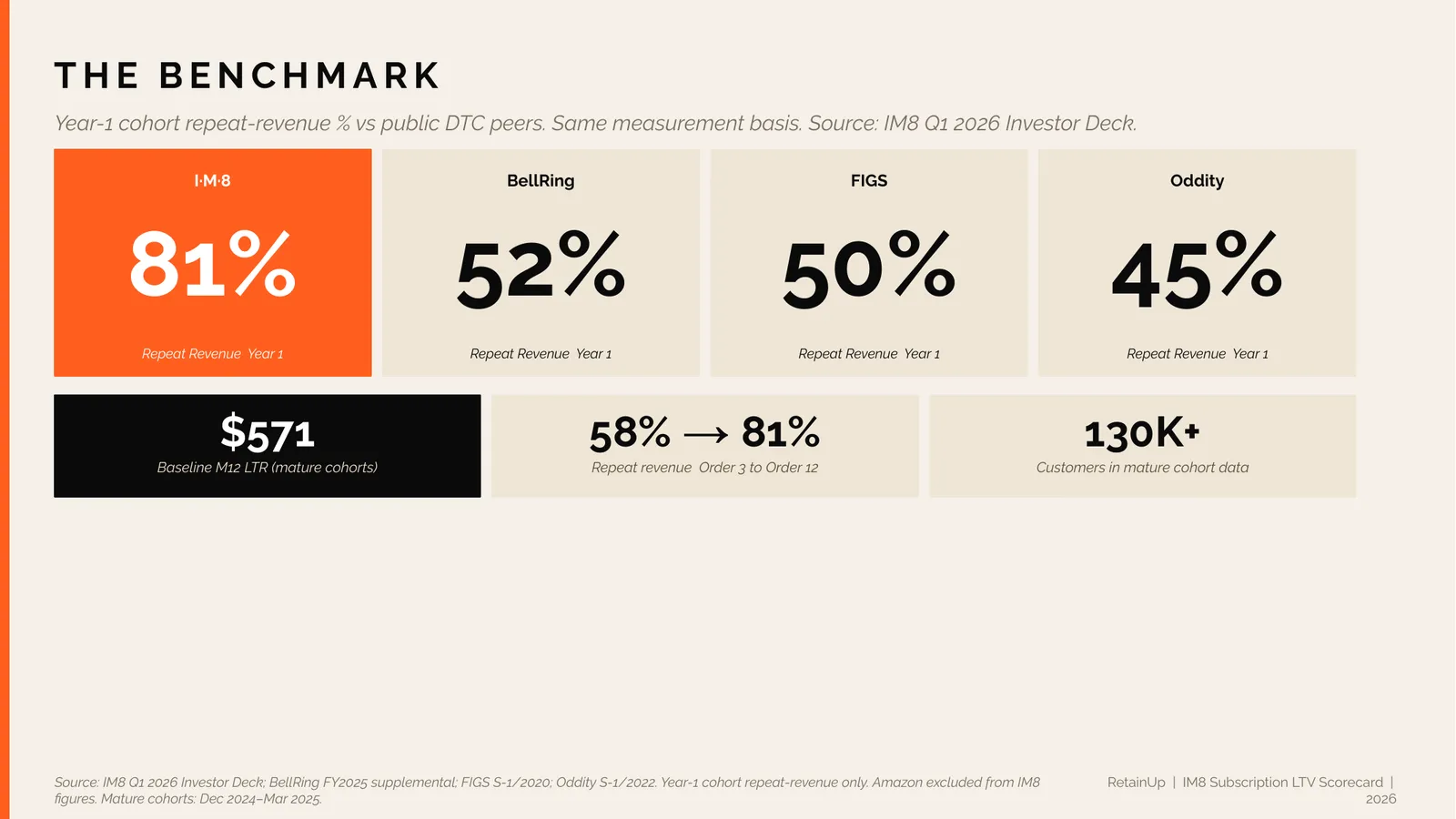
At IM8, 81% of a customer's revenue by their 12th order comes from repeat purchases. Only 19% from the first order. Software numbers. If they make $500 from a customer, $400 is repeat. Their deck puts that against BellRing at 52%, FIGS at 50% and Oddity at 45%.
14.2% still buying at month 20, with a pinch of salt
An independent US card panel tracked December 2024 cohorts across four brands. At month 20, still buying: IM8 14.2%, Thorne 11.4%, AG1 10.8%, Grüns 2.4%. P&G paid $3.8B for Thorne this year, and Thorne retains less at twenty months.
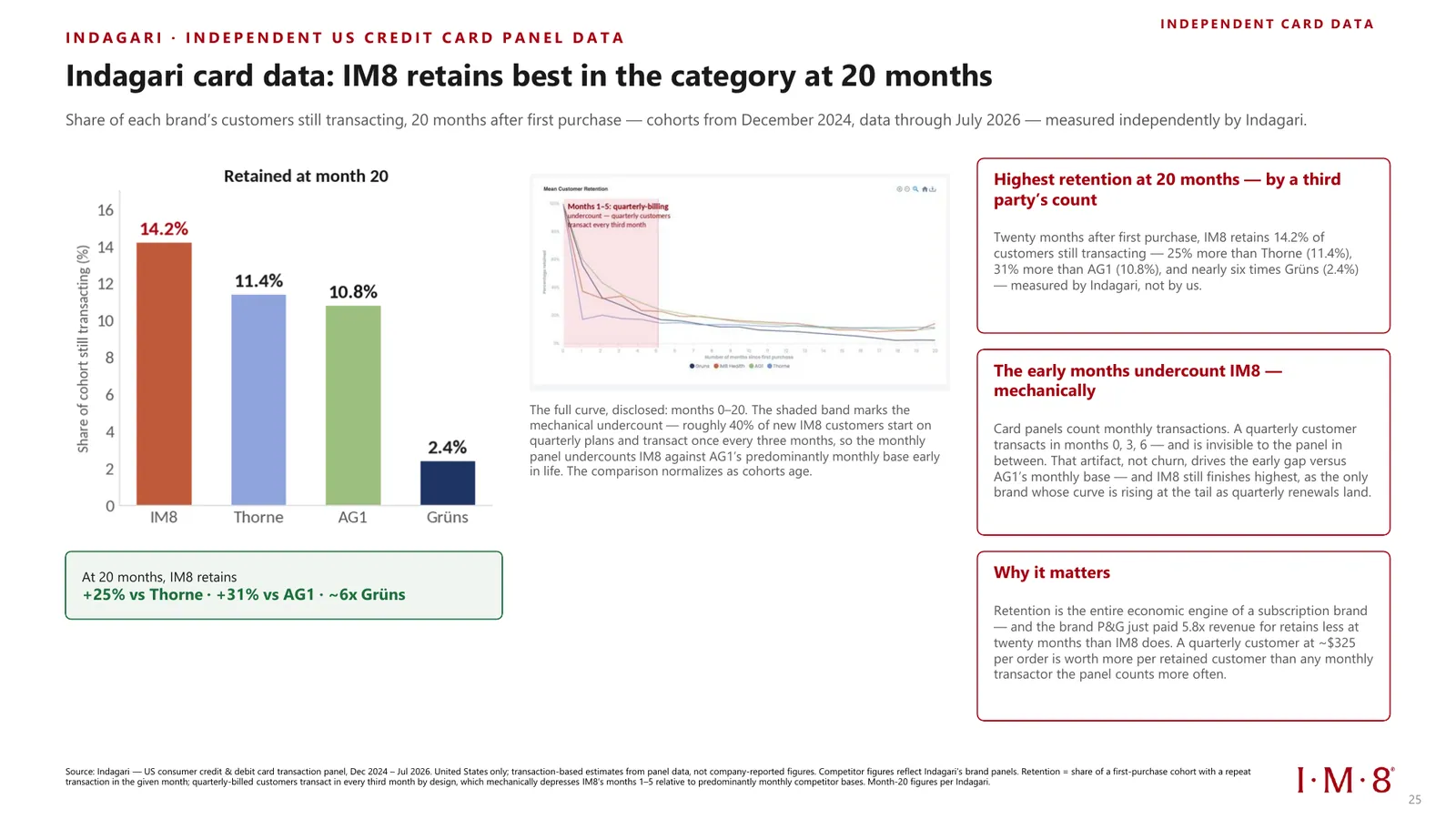
But the company is barely two years old, so that cohort is most likely small and made of the early loyal buyers. And half of the 140,000 subscriptions are under 3 months old. 16.9% are under 30 days. Only 10.4% are a year old. Most of the base has not had the chance to churn yet, so every retention number computed on it looks better than it is.
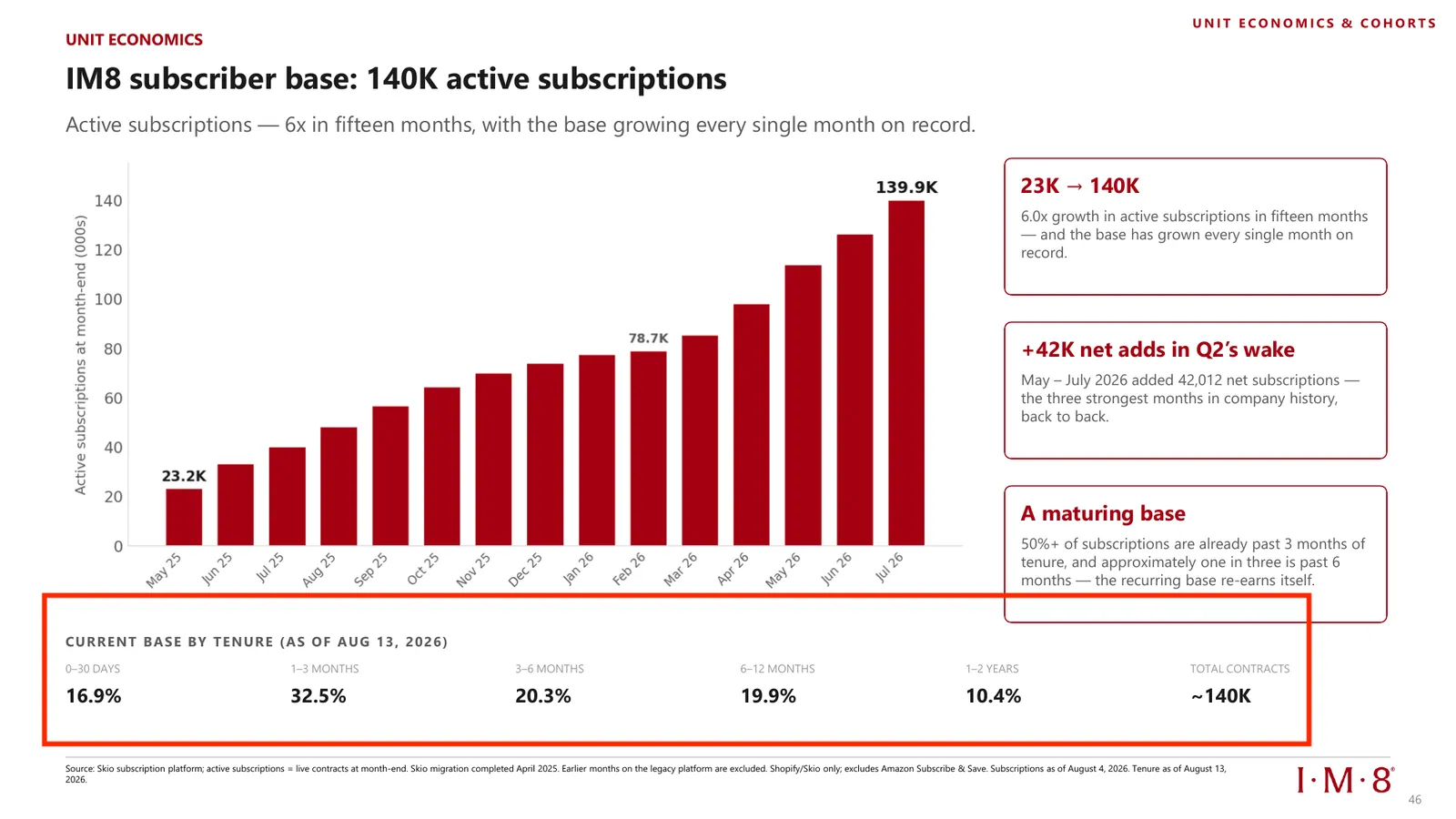
One more thing they never say out loud. Revenue from existing customers grew 3.5x. The whole business grew 4.3x. New customers are carrying more of the revenue than last year, not less. So put together, the impressive part of these decks is AOV, not retention, and the real test of whether that young base actually stays comes over the next four quarters. An AOV play more than a retention play, for now.
How IM8 compares to the other brands
We have scored six big subscription brands. IM8 sits fourth at 72, scored on the first rubric and shown on the 100-point scale.
| Brand | Product | Score |
|---|---|---|
| Grüns | Daily nutrition gummy | 85.5 |
| Everyday Dose | Mushroom coffee | 81 |
| Dr. Squatch | Natural soap | 73 |
| IM8 | Daily nutrition powder | 72 |
| Create | Creatine gummy | 67.5 |
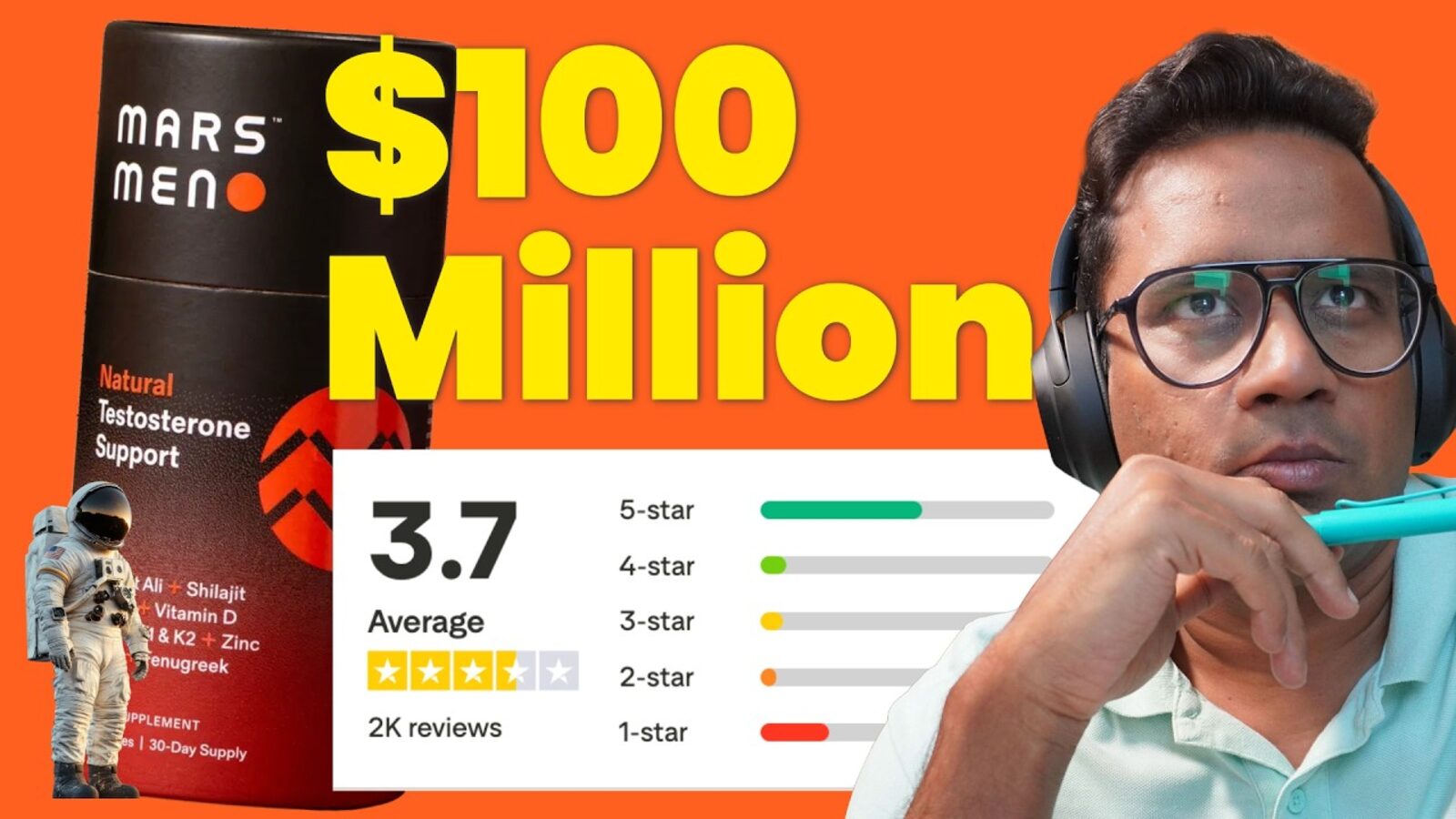
| Mars Men | Men's testosterone support | 62 |
IM8 and Grüns are the two daily nutrition brands in the series, and both run on Skio. Grüns hides its quarterly plan until after checkout. IM8 made quarterly the default, and it took over half of revenue in nine months. On loyalty, IM8 publishes a six-month gift roadmap. Grüns relies on flavour drops and scores 5 out of 10 there.
Against Mars Men, the other celebrity-scale supplement: both spend heavily on the first order. IM8 spreads gifts across six months and recognises 6 and 12 months. Mars Men spends it all at order one and scores 1 out of 10 on loyalty.
Already past 5,000 active subscribers? The Subscription LTV Optimizer™ checks your store, subscription app and Klaviyo every month and ships the fixes, the way a retention team would.
What to take from IM8
- Publish the gift roadmap before purchase, not after. A reward nobody knew about cannot hold anyone.
- Run one discount rate everywhere, including Amazon.
- Match the cancel policy to the cancel page. If the platform does one-click, say one-click.
- Set a results timeline, especially when the product takes weeks to work. Silence gets read as failure.
- Check what a two-year subscriber gets against a new one. If the new customer wins, that is your churn.
- Test a quarterly default. It changed the shape of IM8's revenue curve.
18 months old. Beckham, NASA, Mayo Clinic. Endorsement gets you the first order. Retention gets you the twelfth. Most brands with this much celebrity behind them skip the retention playbook and hope the wave holds. And IM8 knows the subscription game.
Want your program scored on the same 48 checkpoints? The free subscription audit runs the same scorecard on your store and ranks your top 3 retention leaks, in 24 hours.
FAQ
How does the IM8 subscription work?
IM8 sells its Daily Ultimate Essentials on a 30-day or 90-day subscription, with subscription pre-selected on the product page. Monthly saves 20% against the one-time price and quarterly saves 30%. Subscribers manage the plan in a Skio portal, and new subscribers get a welcome kit plus a published schedule of gifts for months 2 to 5.
How much does an IM8 subscription cost?
When we scored it, IM8 was $78 a month on subscription against $99 one-time, about $6 a day. The quarterly plan is 30% off the one-time price. A quarterly order collected about $324 at once, against $128 for a monthly cycle, per the Q2 2026 investor deck.
How do you cancel an IM8 subscription?
The IM8 product page says you can cancel anytime with one click, while the Terms of Service say to cancel by emailing customer care. In practice, use the customer portal first, and email support if you cannot find the option. Reviews show few billing complaints after cancelling.
What percentage of IM8 customers subscribe?
About 79% of new IM8 customers buy a subscription on their first order, and subscriptions made up 93% of revenue in Q1 2026, per the company's investor deck. By July 2026, 87% of revenue was recurring and quarterly plans made up 54.8% of all revenue.
What is IM8's customer retention rate?
An independent card panel found 14.2% of IM8's December 2024 customers still buying at month 20, ahead of Thorne, AG1 and Grüns. The company is young, though. Half of its 140,000 subscriptions were under 3 months old in July 2026, so long-term retention is still unproven.
One email a week on subscription retention: the numbers, the strategy, and what to fix first.

Rahi Jain
Rahi Jain is a subscription LTV specialist who helps $1M to $10M DTC brands reduce subscription churn and maximize LTV on Recharge, Skio, Stay AI and Loop.
More about Rahi