Key takeaways
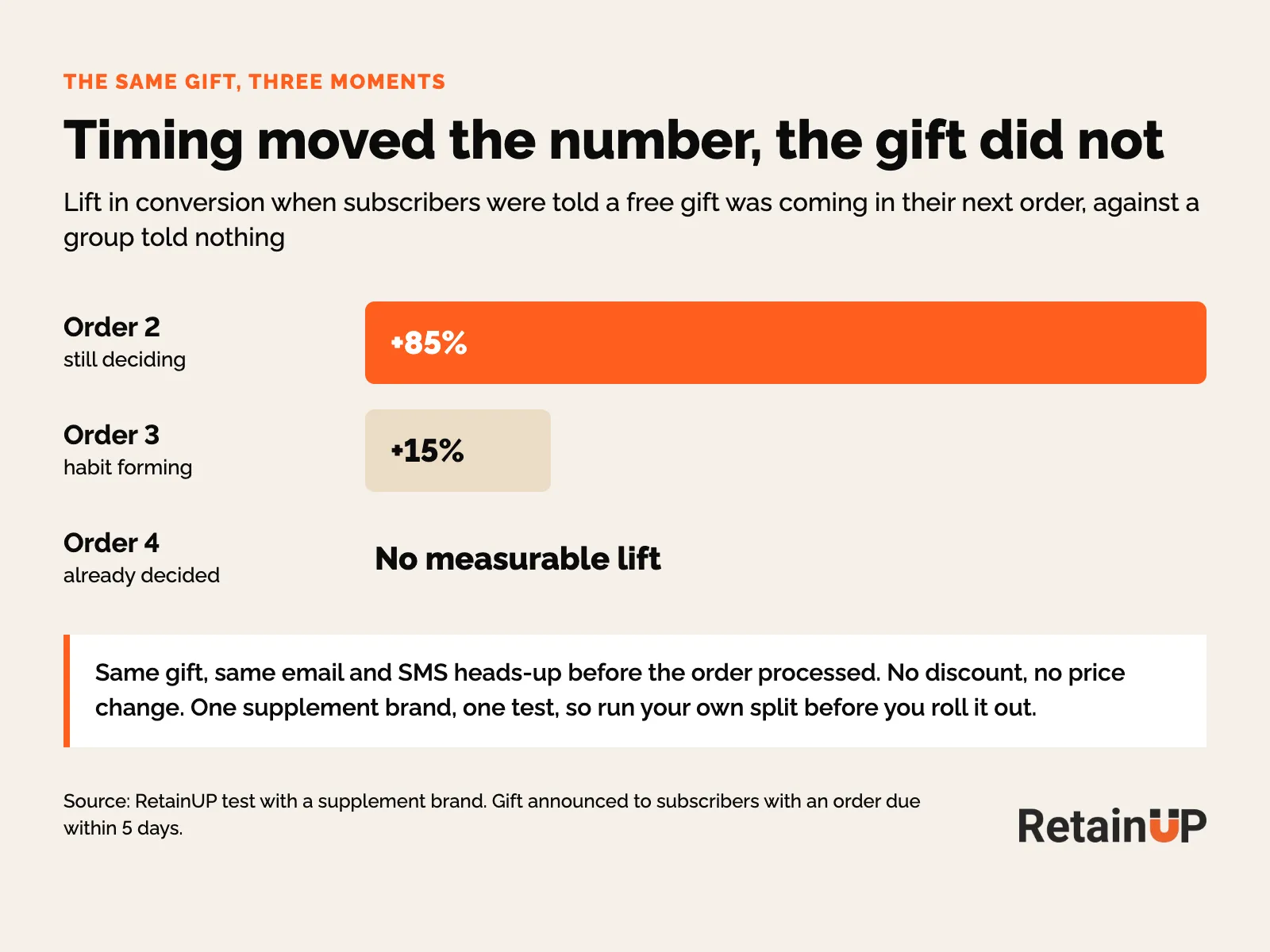
- Telling subscribers a free gift was coming in their next box lifted order 2 conversion 85% over the group told nothing.
- Across 9 brands audited in 2026, a median 73.6% reached order 2 and only 45.6% reached order 3.
- Loop reports 62% second-order retention with Streaks across 305K subscriptions, though the brands that adopt it were already better.
Most retention offers are sent on a calendar. The right ones are sent on an order number.
The subscriber on order 2 is not the same as the subscriber on order 6. Treat them the same and you waste the gift budget on people who were already going to stay. This page covers what a subscriber earns by staying, and it is one part of the subscription retention guide.
The welcome kit and the day-one discount sit in subscription perks, gifts and welcome kits. This page starts at order 2.
Why the order number matters more than the calendar
Risk changes with every charge, not every week. Two people who both signed up in March are in completely different places if one is on a monthly plan and the other is quarterly.
Order 2 is the heaviest moment. Across 9 subscription brands audited in 2026, a median 73.6% of new subscribers reached order 2 and only 45.6% reached order 3. Most of the loss happens at the second and third charge. No habit exists yet.
The novelty of order 1 has worn off. The customer is quietly deciding if this is worth continuing. By order 4, the habit is either formed or it is not. So your effort should be heaviest at order 2. Not month 2. Order 2.
The test: a gift announced before order 2
Timing beats value. Obvi, a supplement brand, had a familiar problem. Order 2 conversion was bleeding. Customers subscribed, received their first box, then cancelled before the second shipment hit. They had tried email sequences and discount offers. Nothing moved the number.
So they ran a different test, with Stay AI. Customers with an upcoming order date within 5 days were split into two groups. Group A got the standard experience. Group B was told, by email and SMS before the order processed, that a free gift would be included in their next order.
No discount. No price change. Just the knowledge that something extra was coming.
Group B converted 85% more than Group A. Not 5%. Not 15%. 85%. They didn't skip. They didn't cancel. They showed up for order 2.
Then the same test ran at later orders. It faded fast. At order 3 the lift was 15%. At order 4, nothing measurable. By then the decision is made. It is one brand and one test, so run your own split first.
Most brands do this backwards. The data says so. Loyalty milestones, VIP rewards, a surprise at order 10. Give the gift early, before loyalty is earned, and you create it. Not forever. Just long enough for the product to prove itself. Orders 2 and 3 are the bridge between a customer who tried you and a customer who trusts you. The gift buys you that bridge.
Run it on your own store this week
- Pull your order 2 cohort.
- Find customers with an upcoming order in the next 5 to 7 days.
- Tell one group in the upcoming order email that something extra is in their next box. Check first whether Klaviyo or your subscription app sends that email.
The value of the gift matters less than the timing of it.
The milestone ladder: orders 2, 3, 6 and 12
Map the gifts to the orders before a subscriber decides to stay. That decision happens between orders 1 and 3. So that is where the gifts go.

| Order | Reward | Why |
|---|---|---|
| 2 | A gift, announced before it ships | Highest-risk charge. The announcement does the work, so the gift can be small. |
| 3 | The biggest gift of the first three months | Still deciding. The last order where a gift still moved the number. |
| 4 and 5 | Nothing | Habit forming. An offer here trains people to expect a reward for continuing. |
| 6 | Recognition, or a free product | Roughly six months in. A milestone worth naming. |
| 12 | The biggest reward | The anniversary. This one is allowed to cost something. |
Leave 4 and 5 empty. A reward in every box creates discount dependency in your most loyal cohort. Never run two discounts in a row. Skio puts a gifting budget at roughly 2 to 5% of subscription revenue, and the empty orders keep you inside it.
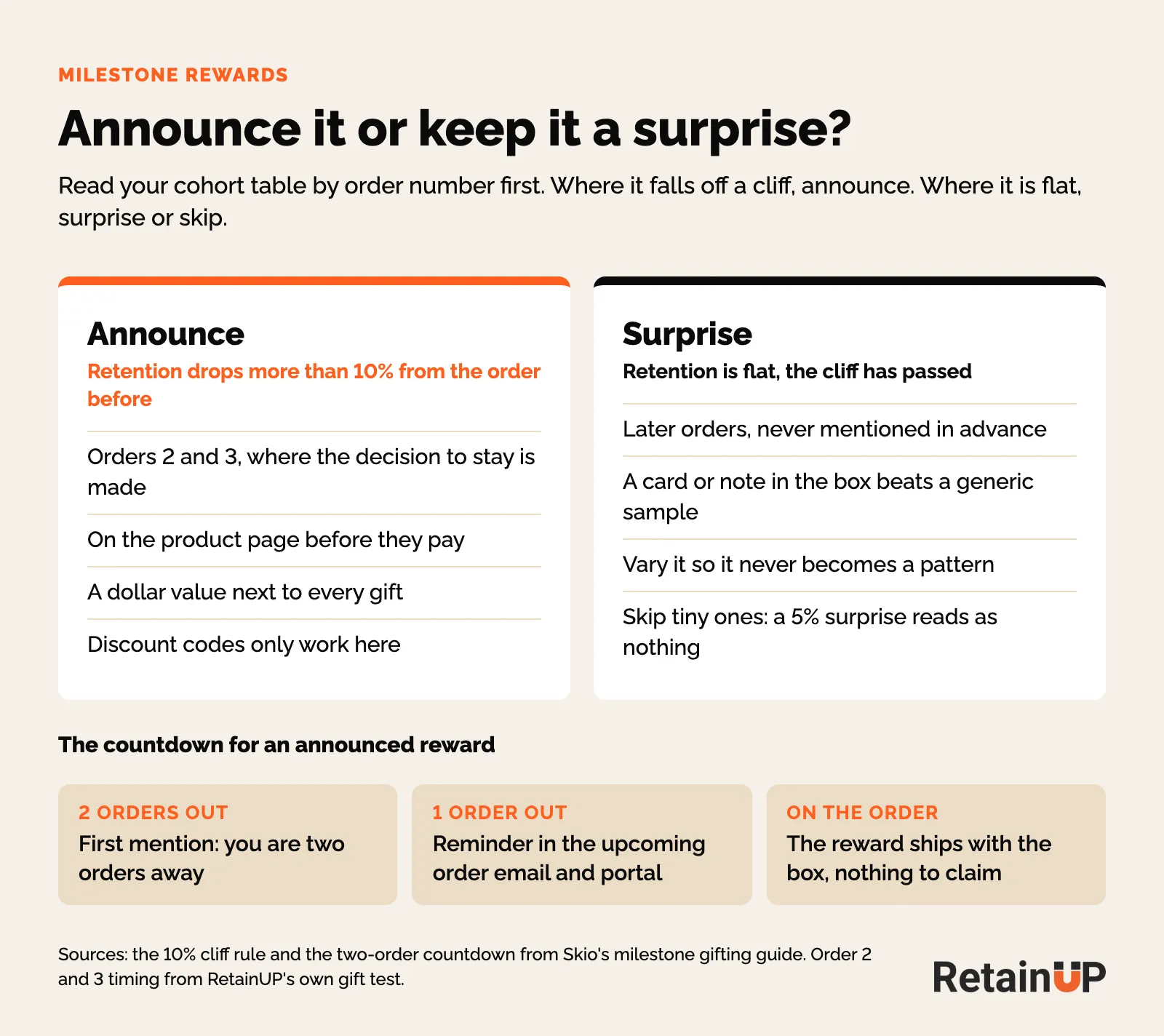
Your own cohort table can move a rung. Skio's rule of thumb: wherever retention drops more than 10% from the order before, that order gets an announced reward. Where it is flat, surprise or skip. So if your cliff is at order 4, the gift goes on 4.
When we fixed onboarding, gifts and milestones for one supplement client, order 1 to order 3 retention went from 61% to 73%. That was the whole package, not the gifts alone.
Other ladders worth knowing
Thomas Lalas names orders 1, 2, 4 and 12. Churn slows after order 4. So he makes that gift a "graduation" and promotes it ahead. Ours stays at 2, 3, 6 and 12.
And once the milestone gifts run out? Matthew Holman ran a wellness brand on a reward every two orders, then a top tier after order eight: 15% off every order, forever. In his words, it made staying feel like an achievement.
It does not have to be a product. Spacegoods, in a Bubblehouse write-up, gives double points at month 2, a free product at month 6 and a mystery gift at month 12.
Show the roadmap before they subscribe
A surprise can't keep anyone, because they didn't know it was coming. Anticipation is the retention mechanism, not just the gift.
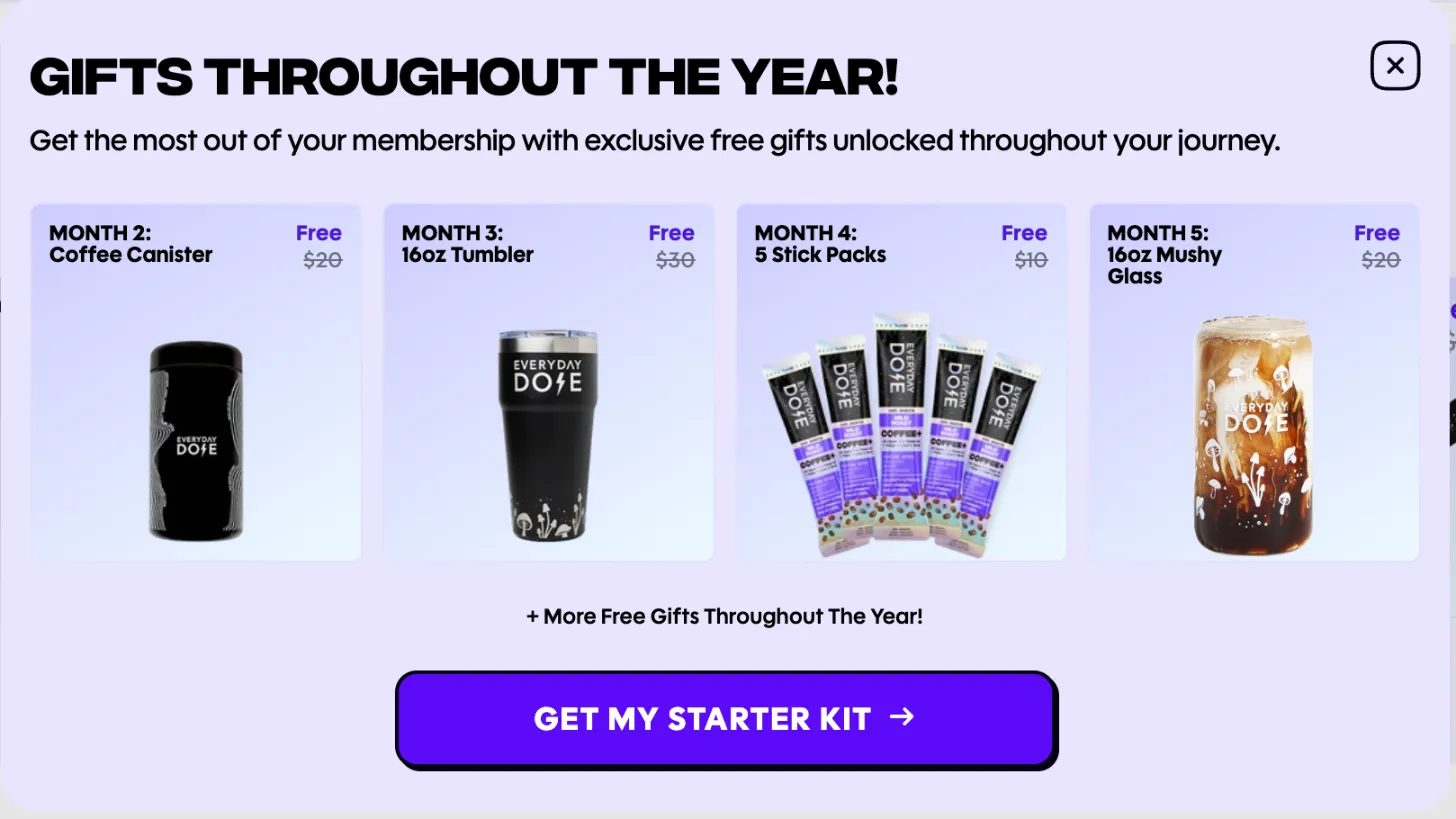
So the milestone roadmap goes on the product page, before the buyer pays. It answers "what do I get for staying?" before they ask it. Everyday Dose lists a gift for every month, each with its price. A coffee canister at month 2. A tumbler at month 3.
State the value as a number. IM8 lists a shaker bottle at $45 in month 3 and a travel pouch at $35 in month 5. Subscribers can work out what staying is worth. Which gifts to pick, and how cheap they can be, is in subscription perks.
Then tell them again every month, even before they reach it. Skio's timing is a good floor: first mention two orders out, a reminder one order out, then the reward on time, and the upcoming order email is the obvious slot for all three. The portal is the other one: a milestone tracker that names the next reward, which the subscription customer portal page covers.
Order 3 rewards other brands run
These come from Loop case studies. No control groups. So read them as examples, not proof.
- Livingood Daily, supplements: an extra 5% off applied automatically at order 3, 20% in total, with a portal banner shown after order 2. Loop reports churn going from about 10% to 2.26%.
- Campus Protein: a free branded BlenderBottle at order 3, then a gift at order 6.
- Good Protein: a free superfood green juice at order 3, 10% off at order 4, 25% off beyond order 5.
Good Protein's discounts climb with tenure. That rewards staying. A deeper discount at order 1 does the opposite.
Streaks: give them something to lose
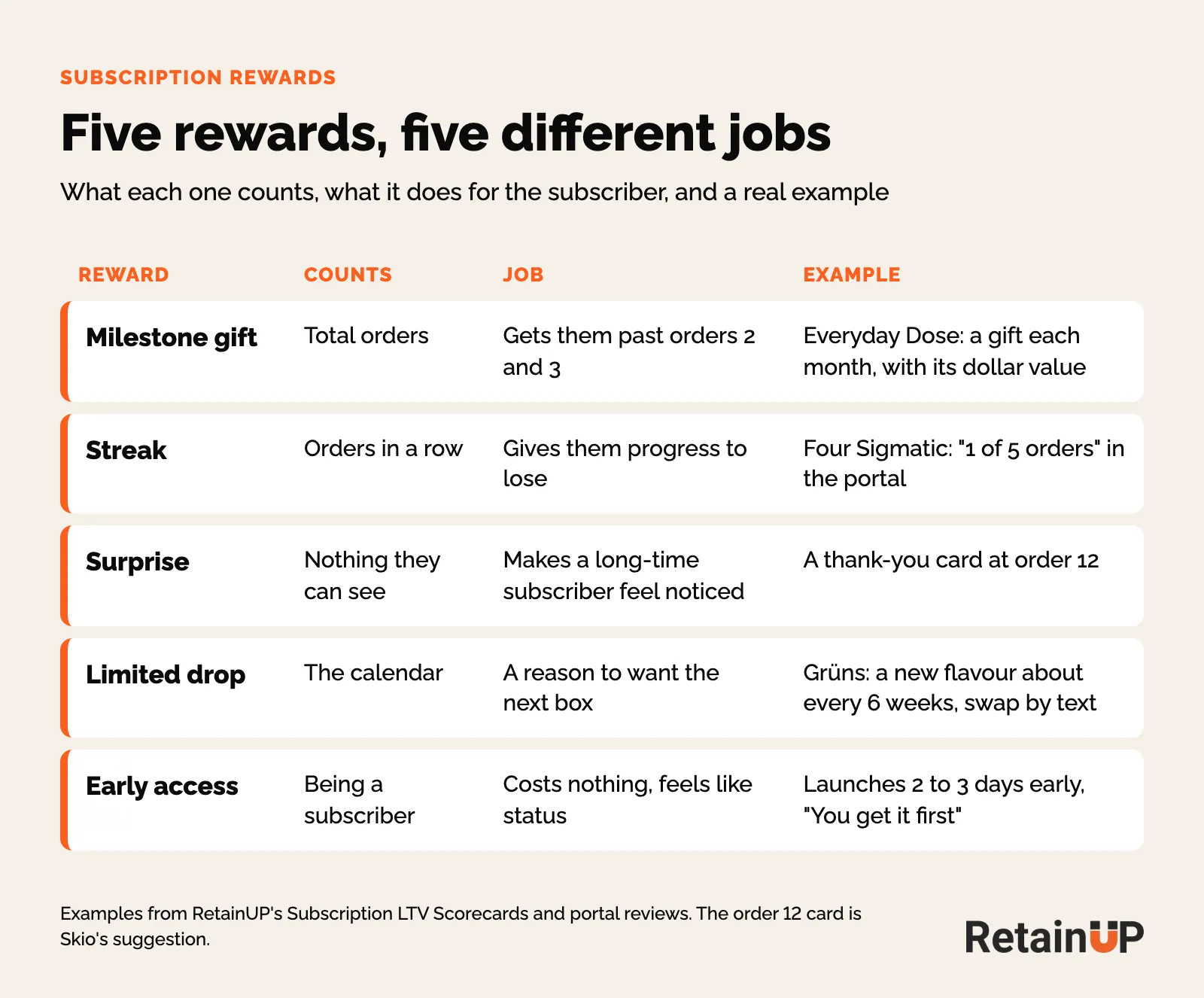
A milestone counts total orders. A streak counts consecutive ones. That is the stricter version. And it gives a subscriber something to lose.
Loop reports 62% second-order retention with Streaks across 305K subscriptions, but the caveat is a big one, because the brands that adopt gamification were already better, so it is not a clean lift.
Four Sigmatic runs it in the portal. Under the add-on carousel sits a Streaks tracker reading "1 of 5 orders".
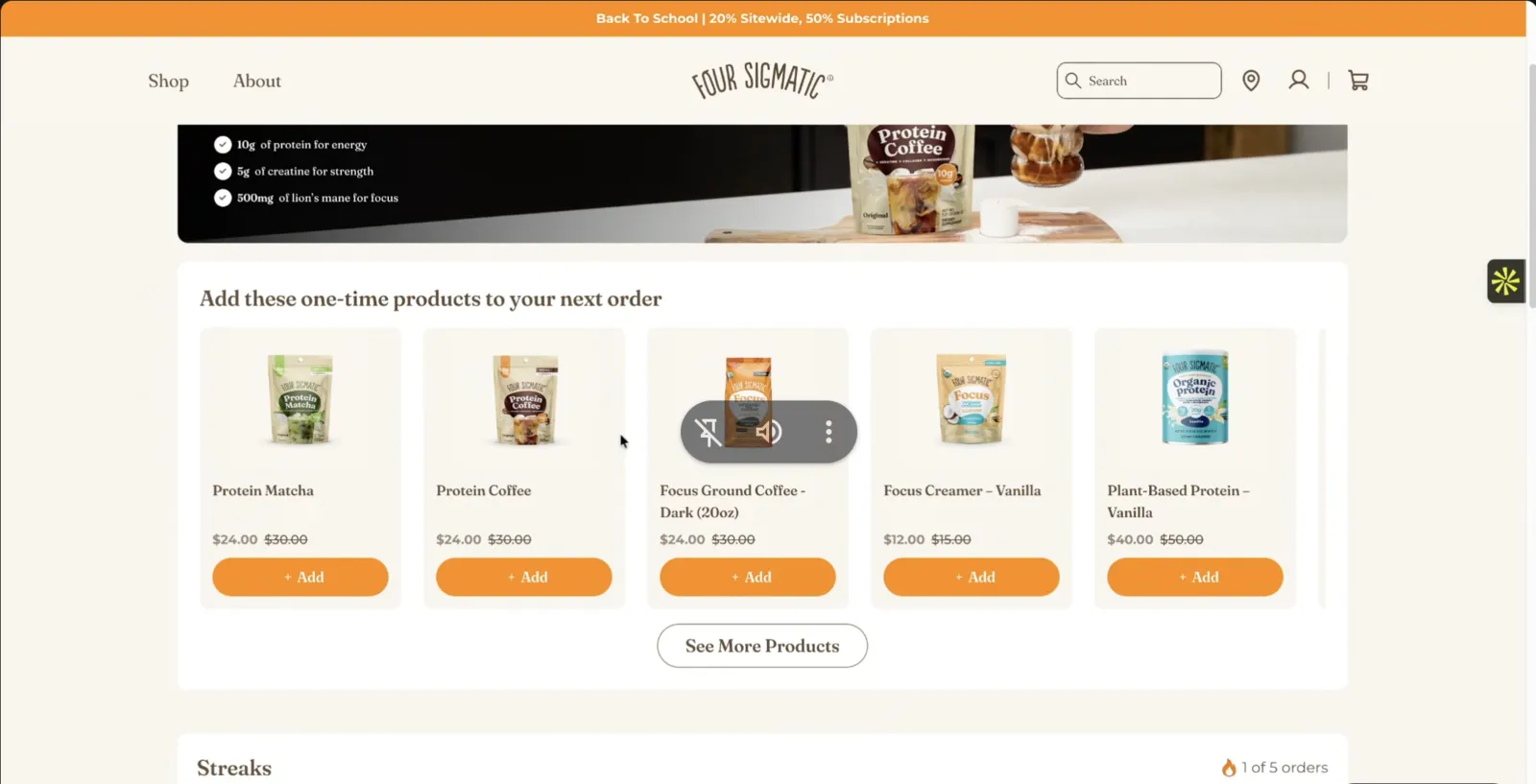
People will fight harder to protect progress than chase a new benefit. I have a 75-week streak on a pump app, and at this point it is part of who I am. Your subscribers work the same way. They don't think about rewards they haven't earned yet. Show them their streak, their tier, their next milestone gift, and it is a different conversation.
Skio now shows subscribers their streak before the cancellation options. That is the right place for it. Its portal streaks went live in April 2026. They count from zero the day you switch them on. In Loop, a skip does not break the streak, and it breaks only if no order lands by the scheduled date plus a grace period. So pick your rule before launch.
Surprise and delight is a different job
Milestones are predictable. Surprise and delight is not, and the psychology is different: delight, not expectation. It makes someone feel noticed. It cannot keep them, because a reward nobody knew about never entered the decision to stay.
So use both. Skio's example: a trial pack of another product at order 2, 10% off at order 3, a complementary product at order 10. Its guide is blunt about the small stuff. A $2 handwritten note beats a $10 generic sample. A 5% surprise discount is worse than none. And never mention a surprise in advance, or it becomes a milestone.
Mystery helps too. Scratch-off reveals and progress-based rewards raise engagement, and one tested line, "You left something behind... but there might be a surprise waiting", lifted engagement 60%.
Anticipation through limited drops
Grüns does not run a milestone ladder. Its retention mechanism is novelty. A new limited-edition flavour lands roughly every 6 weeks. Two of the last three were licensed. Subscribers swap their next box to it by replying to a text, built with Skio and Postscript.
It works. It is the best anticipation mechanic we have scored.
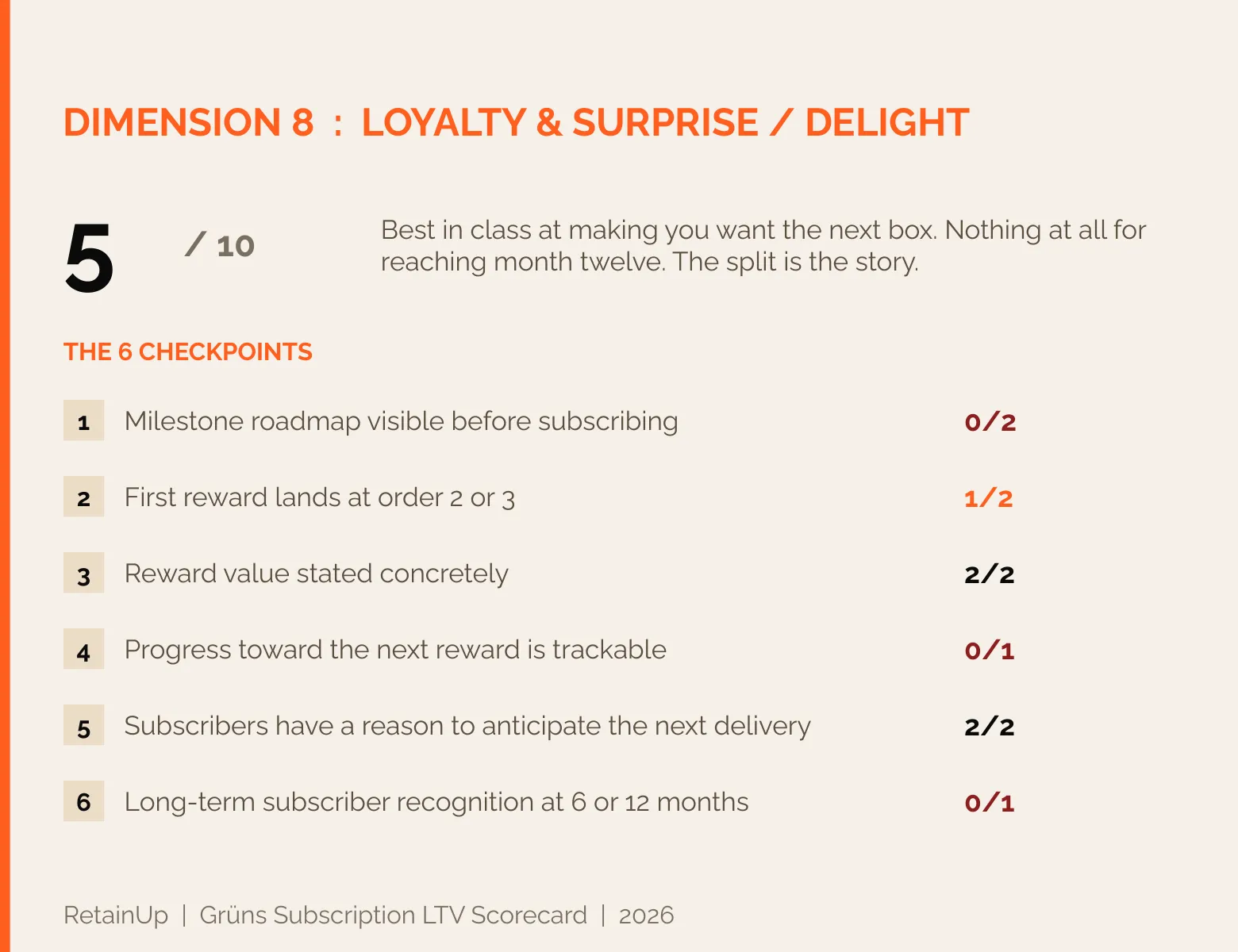
But for a brand this good at everything else, there is very little for a long-term customer. The flavour drops give you something to look forward to, but there is no milestone, no progress to track, and nothing that rewards you at 6 or 12 months.
Early access for subscribers
Early access costs nothing to give. Send launches and promotions to subscribers first. Two to 3 days before anyone else, with a subject line like "You get it first".
The bigger version runs at BFCM: a subscriber-only window before the sitewide sale, with one-tap add-ons by email or SMS. Good Protein took add-ons from 18% to 25% of subscription revenue in its BFCM month. The add-on side lives in add-ons and cross-sell for subscribers, and the sale itself in BFCM for subscription brands.
Where rewards backfire
Only promise what is already in the warehouse. Stock runs out. A subscriber paid for 3 boxes plus 2 free. Two months running, she got the 3. Her review said "I never got my free gifts. I have cancelled my subscription."
Timing can break it too. One brand announced the gift right after the first order, which reminded customers they had a subscription, and they cancelled before the gift shipped.
Watch for gaming. If people pause their way to the gift, Skio suggests a smaller reward or one that expires on pause.
And check the maths. A 2% lift on a $15 gift can lose money. Once you name a gift, you have written a delivery date into the subscription.
Points programs are their own trap, and subscription vs loyalty programs covers how to run both without them fighting.
How to tell if a reward is working
Judge a reward one order after it lands. A gift that keeps people to order 3 and loses them at order 4 bought one charge, so read the cohort by order number against the cohorts before launch, and hold a group back if you can.
- Retention at the milestone plus one order, against your pre-launch cohorts.
- Cost per retained subscriber: what the rewards cost, divided by the extra subscribers kept. Skio puts the line at under about 10% of LTV.
- Redemption rate on announced rewards. An unclaimed reward means the announcement never landed.
Setting up rewards in Skio, Stay AI, Recharge and Loop
Skio. Reward Milestones and Surprise and Delight, with a rule on completed orders. Set the trigger to fire when cycles completed equals 2, choose the gift, set the notification to email and SMS. The reward attaches as soon as the previous order processes, so the subscriber sees it coming, and milestones count across all of a customer's subscriptions, so someone who restarts does not get the same gift twice. A skipped order keeps its reward on that order number, and a cancelled order loses it. Reward Milestones then shows the coming gifts at the top of the portal. More in the Skio retention setup.
Stay AI. Same idea. It lives in the ExperienceEngine.
Recharge. Less native. But you can do it through Klaviyo with an order count filter. Recharge also supports streak-based milestones that count consecutive orders, and Recharge Rewards adds credits and punch cards in the portal.
Loop. Streaks and order-based rewards, which is where the Livingood and Good Protein examples above came from.
Whichever app you use, the subscriber should not have to do anything. The reward arrives with the order, or lands in the inbox before it ships.
If you would rather have the ladder built, the Subscription LTV Maximizer™ does it. It sets up the offer, widget, cancel flow, portal, payment recovery and pause and skip in Recharge, Skio, Stay AI or Loop. Plus the email and SMS that announce each reward. Live in 30 days, $5,000.
FAQ
What is a subscription incentives engine?
A subscription incentives engine is the rule system in your subscription app that adds a gift, discount or credit to a subscriber's order when they hit a set order number. Stay AI calls it ExperienceEngine, Skio calls it Surprise and Delight, and Recharge and Loop have their own versions. Because it runs on order number, a gift at order 2 reaches every subscriber at their own riskiest moment, whether that falls in week four or month three.
Which order should get the first subscription reward?
Order 2 should get the first reward, announced before it ships. In one supplement brand's test, telling subscribers a gift was coming lifted order 2 conversion 85%, order 3 by 15%, and order 4 not at all. The decision to stay happens between orders 1 and 3, so a reward saved for order 10 arrives after the customer already decided.
Should subscription gifts be a surprise or announced?
Announce them. A surprise can't keep anyone, because they didn't know it was coming. Put the reward roadmap on the product page before purchase, then remind subscribers in the upcoming order email and the portal. Keep surprise gifts for delight on top of the ladder, not instead of it.
How much should a subscription rewards program cost?
Skio suggests roughly 2 to 5% of subscription revenue. Leaving orders 4 and 5 empty keeps you inside that range. Check each gift against the lift it needs. A 2% lift on a $15 gift can lose money.
One email a week on subscription retention: the numbers, the strategy, and what to fix first.

Rahi Jain
Rahi Jain is a subscription LTV specialist who helps $1M to $10M DTC brands reduce subscription churn and maximize LTV on Recharge, Skio, Stay AI and Loop.
More about Rahi