Key takeaways
- Across 8 subscription brands RetainUP audited in 2026, a median 38% of failed subscription payments were recovered, with a range of 17.3% to 61.3%.
- One Loop brand recovered 17.3% of its failed orders, while the app's own count by revenue showed 41.2% for the same period.
- At one Loop brand, retries recovered 36.5% of bank declines and 5.8% of dead cards, so the card update ask decides the result.
Every subscription app reports a recovery rate. No two count it the same way. So when a brand asks us whether its 40% is good, the first answer is a question: 40% of what?
This post sets out what we found at 8 subscription brands we audited in 2026, before we changed anything: the spread, why the counts differ, and what moves the number. The how-to, from retry schedules to Shop Pay card updates, is in failed subscription payments.
What is a typical failed payment recovery rate?
Across 8 subscription brands we audited in 2026, the median brand recovered 38% of failed payments, and the range ran from 17.3% to 61.3%. The best brand got back more than three times the share the weakest did.
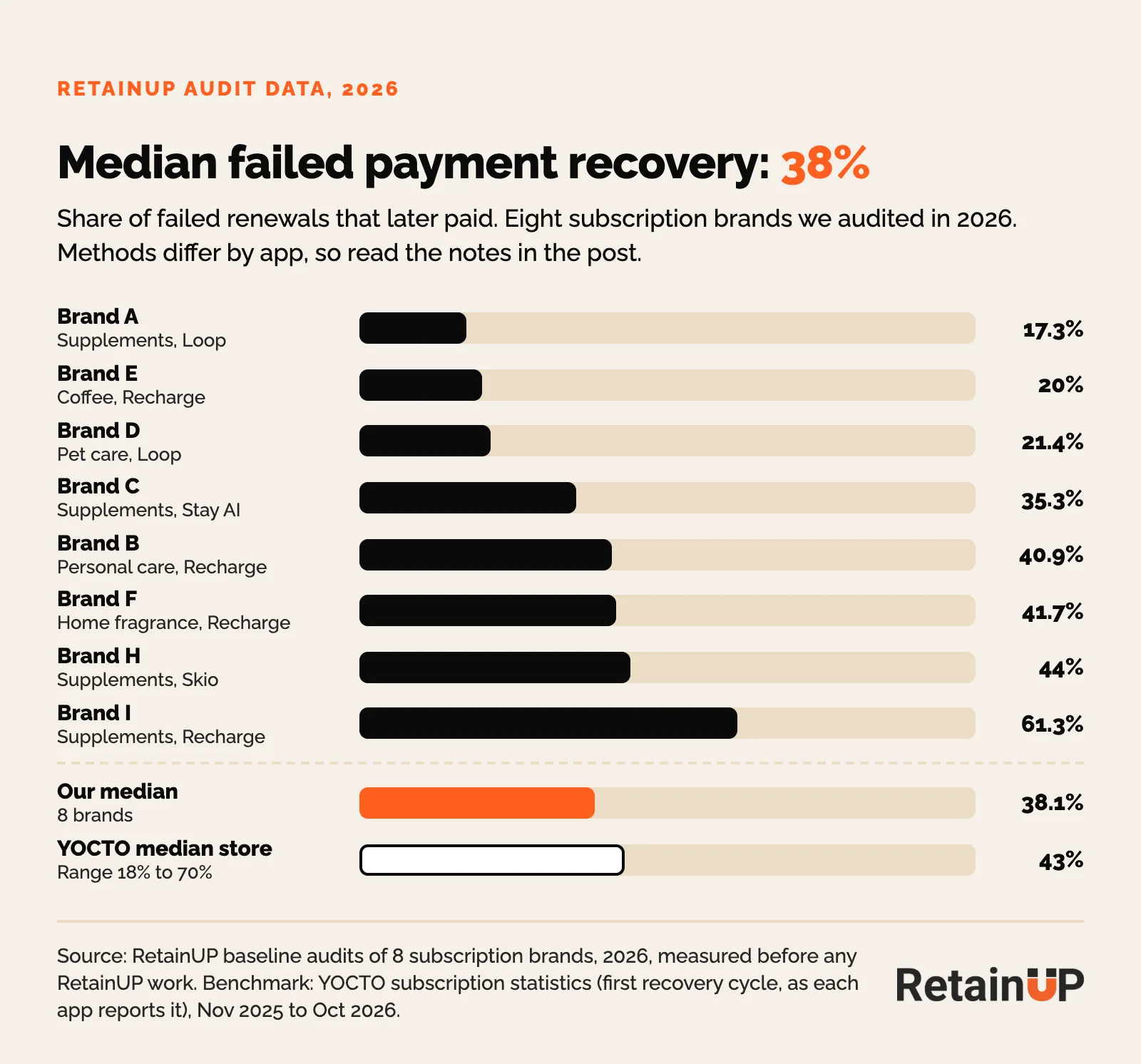
| Brand | Category | App | Recovered | How it was counted |
|---|---|---|---|---|
| Brand A | Supplements | Loop | 17.3% | Failed orders that later paid, from the retry log. Loop's own figure: 41.2% by revenue |
| Brand E | Coffee | Recharge | 20% | 10 of 49 failed charges, 31 still retrying |
| Brand D | Pet care | Loop | 21.4% | 358 of 1,674 failed orders, six months |
| Brand C | Supplements | Stay AI | 35.3% | One month (Aug 2026). Earlier months read 83% and 44.6% |
| Brand B | Personal care | Recharge | 40.9% | 947 failed charges, 40.9% recovered |
| Brand F | Home fragrance | Recharge | 41.7% | One month (Sep). August read 47.4% |
| Brand H | Supplements | Skio | 44% | Skio's dunning report, before our work |
| Brand I | Supplements | Recharge | 61.3% | 12 months of data |
| Median, 8 brands | 38.1% | |||
| YOCTO, median store | Mixed | Mixed | 43% | Range 18% to 70%. Middle half 34% to 56% |
YOCTO's subscription statistics put the median store at 43% in the first recovery cycle, as each app reports it, with a range of 18% to 70% and the middle half between 34% and 56%. Four of our eight sit inside that middle band. Three sit below it. Two of those three are Loop brands where we counted failed orders from the retry log, which can run far below the app's own figure, as Brand A shows below.
Why do recovery rates differ so much between brands?
Recovery rates differ as much from how they are counted as from how well a brand recovers. Before you compare two numbers, check the unit, the window and the month.
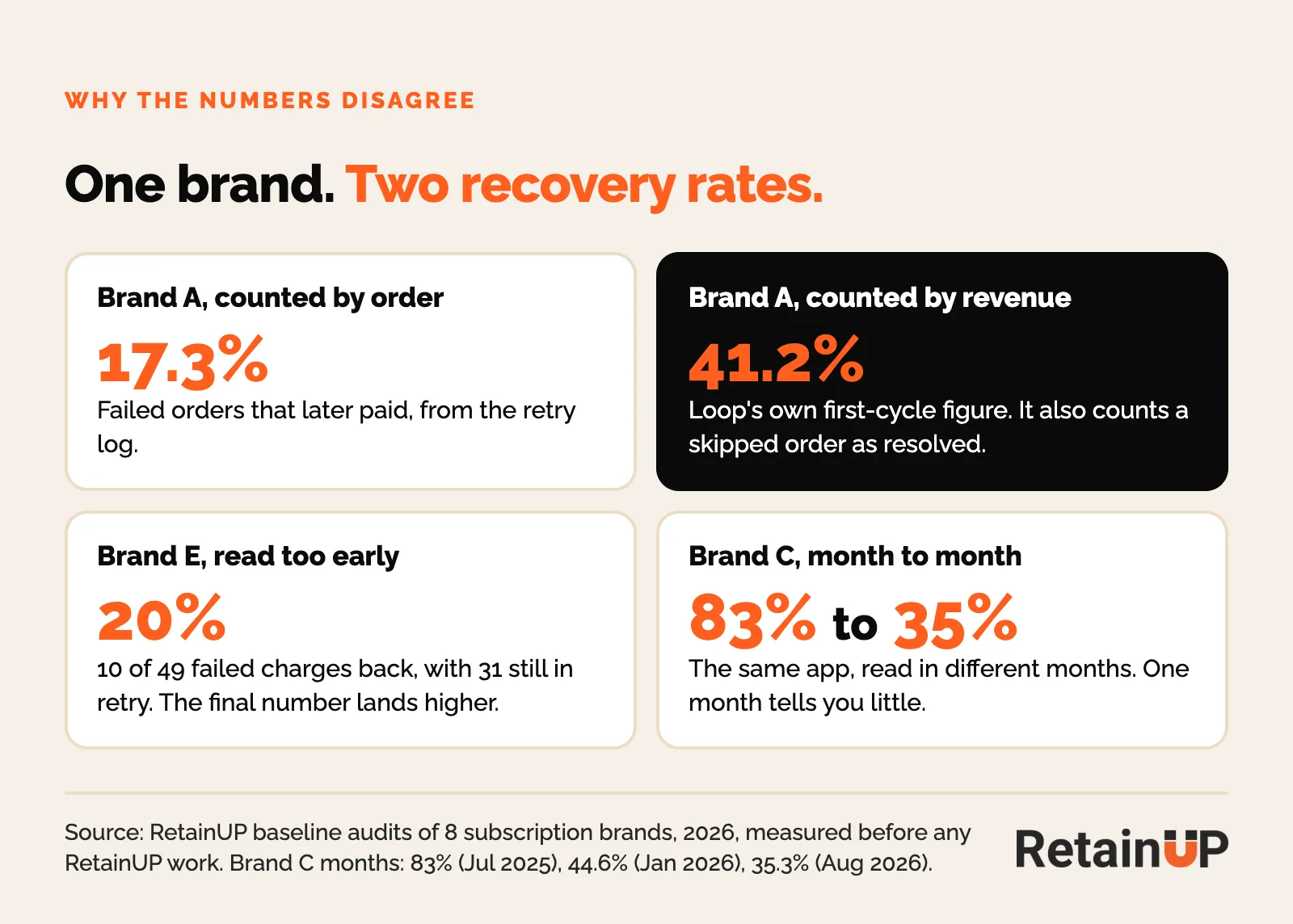
- Orders or revenue. Brand A recovered 17.3% of failed orders. Loop's own first-cycle figure, by revenue, read 41.2%, and it counts a skipped order as resolved.
- When you read it. Brand E sat at 20%, 10 of 49 failed charges, with 31 still in retry. Read before the window closes and the number runs low.
- Which month. Brand C read 83% in July 2025, 44.6% in January 2026 and 35.3% in August 2026, on the same app. One month tells you little.
- Retries or orders. A blended success rate that counts every retry attempt is a different number again. Count failed orders, then the share that later paid.
Recurly shows how far timing alone can move it. In one retailer's data published in April 2026, better retry timing lifted recovery from about 53% to 71% on the same set of failed transactions.
What moves the failed payment recovery rate?
The card update ask moves recovery more than extra retries, because close to half of failed payments are dead cards that no retry can reach.
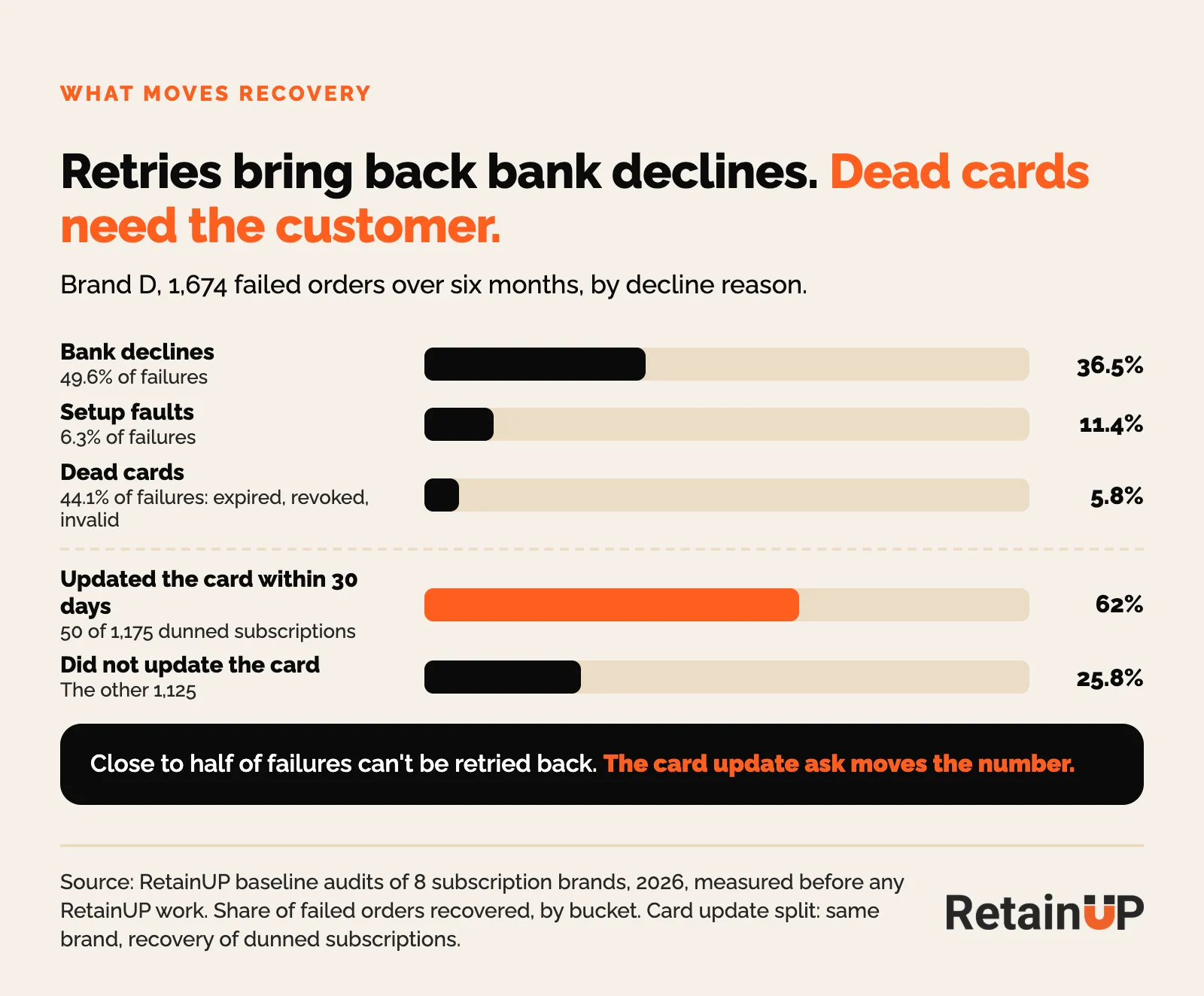
At Brand D, 1,674 orders failed over six months. Bank declines were 49.6% of them and came back 36.5% of the time. Dead cards, meaning expired, revoked or invalid, were 44.1% and came back 5.8%. Subscribers who updated their card within 30 days recovered 62.0%. The rest recovered 25.8%.
- Split by decline reason. Retry bank declines on day 1, 3, 5, 7, 10 and 14. Skip retries on dead cards and send the update link the same day, by email and SMS.
- Make the card update one click. For Shop Pay subscribers, send Shopify's own update link and the steps on shop.app.
- Pause, don't cancel, after the last retry. A cancelled Shop Pay subscription can't take a new card. Move paused subscribers to a winback flow after 30 days.
- Check the emails still send. At both Loop brands in this sample, the app's payment emails had stopped on their own, and nobody noticed.
Failed payments are the passive half of churn. The split, and why most brands never report it, is in active vs passive churn. If you switch apps, map the failed payment events with the Klaviyo event map and end with a winback flow for anyone who still falls through.
How we measured it
Every recovery rate comes from a baseline audit we ran in 2026 on each brand's own payment data, before RetainUP changed anything.
- Sample: 8 Shopify subscription brands audited in 2026. Four supplement brands, plus coffee, pet care, home fragrance and personal care. Apps: Recharge (4), Loop (2), Skio (1), Stay AI (1).
- Period: one month to 12 months before each audit, in 2025 and 2026, as shown in the table.
- Recovery rate: failed renewal payments that later paid, divided by failed renewal payments.
- Methods differ: at the two Loop brands we counted failed orders from the retry log. At Brands B and E we counted failed charges. At Brands C, F and H we used the app or dunning tool's own report. At Brand I we used 12 months of data. Brand E still had charges in retry.
- Caveats: eight brands is small, and the methods are mixed, so read the median as a rough middle. No figure is weighted by revenue. Brands that hire us may run low.
- RetainUP has worked with 80+ subscription brands. This dataset is narrower on purpose: only the brands we audited in 2026 with full data, measured the same way.
FAQ
What is a good failed payment recovery rate?
Above 44% beat seven of the eight brands we audited in 2026. The median was 38% and the best was 61.3%. YOCTO's median store recovers 43%, and its best 70%.
What is the average failed payment recovery rate for subscription brands?
Across 8 subscription brands we audited in 2026, the median was 38%, ranging from 17.3% to 61.3%. Methods differed by app, so treat it as a rough middle.
Why does my app show a different recovery rate from my own count?
Apps count by revenue or by order, and some count a skipped order as resolved. One Loop brand showed 41.2% by revenue in the app and 17.3% by order on the retry log.
How many times should I retry a failed subscription payment?
For bank declines, about six times over 14 days: day 1, 3, 5, 7, 10 and 14. For expired, revoked or invalid cards, skip retries and send the update link. Details in failed subscription payments.
Will more retries raise my recovery rate?
Only for bank declines. At one Loop brand, dead cards recovered 5.8% of the time, and they were 44.1% of failures. Those need the customer to update the card.
When should I measure recovery?
At the end of your retry window, by month, for at least three months. One brand read 20% with 31 of 49 failed charges still in retry, and another moved from 83% to 35% between months.
More from our 2026 audit data
Three posts from the same 2026 audit set, plus the retention bands we use.
- Subscription churn by order number: where subscribers drop off
- Cancel flow save rate benchmark: what 8 subscription brands actually save
- What's a good subscription retention rate?
Want your recovery rate counted the same way? The Subscription LTV Roadmap™ splits your failed payments into dead cards and bank declines, sizes what is lost and gives you the fixes in order, for $1,000. Or start with the free subscription audit.
One email a week on subscription retention: the numbers, the strategy, and what to fix first.

Rahi Jain
Rahi Jain is a subscription LTV specialist who helps $1M to $10M DTC brands reduce subscription churn and maximize LTV on Recharge, Skio, Stay AI and Loop.
More about Rahi