Key takeaways
- Failed payments are 20 to 40% of subscription churn (Paddle), but one Loop brand we audited ran 96 to 99% active churn every month.
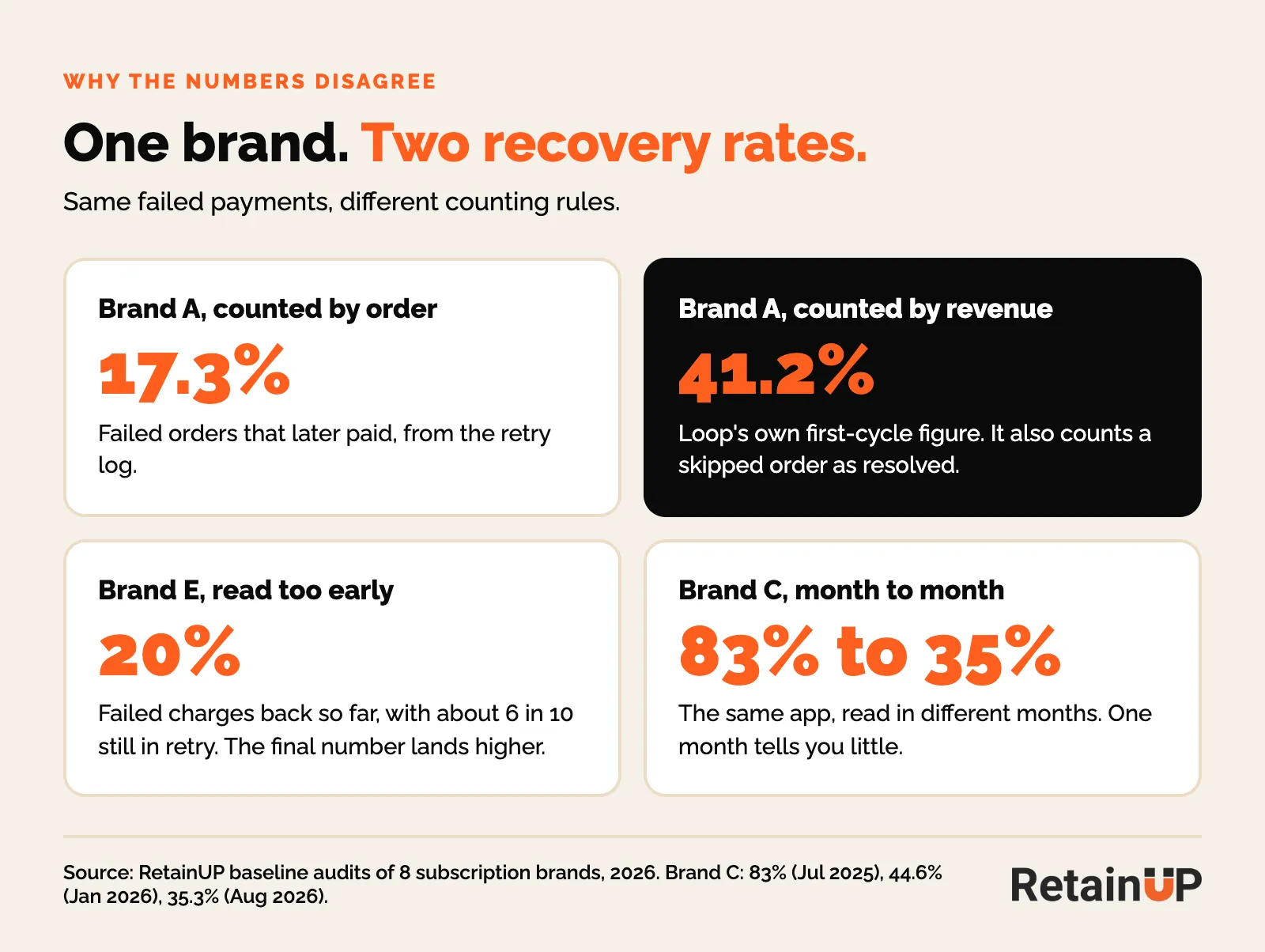
- One Loop brand read 41.2% payment recovery by revenue and 17.3% by order, from the same failed payments.
- At one Loop brand, about 9% of subscriptions marked active had not paid since their card first declined.
Every subscription founder I talk to is watching the same number.
Monthly churn rate.
And fixing the wrong thing.
Churn is two numbers. Active churn, or voluntary churn, is a subscriber cancelling. Passive churn, or involuntary churn, is a payment that fails and never recovers. So before you fix anything, split them, and check the active subscriber count you are dividing by. This page is part of the subscription metrics guide, and it covers how to measure both. The fixes live in the subscription churn guide.
Churn is two numbers
Most brands never separate them. One dunning sequence. One winback email. One exit survey.
One strategy for two completely different problems. Most retention work goes to the cancel button, and the failed cards drift out quietly.
| Active churn | Passive churn | |
|---|---|---|
| What happened | The subscriber decided to leave | The card failed and nobody caught it |
| Diagnose with | Exit survey and cancel flow reasons | Failed payment report and payment failure rate |
| Fix | Pause, skip or swap offer at cancellation | Card updater and an alert before the card expires |
| Recover | Targeted offer 30 to 60 days after cancel | Retries by decline reason, card update email and SMS |
Active churn is a decision. The subscriber clicked cancel, and they usually showed you why before they did it. So that half gets read through cancel reasons and cancel timing.
What is passive churn?
Passive churn is a payment that fails and never recovers. Nobody decided to leave. Recharge lists the usual causes: an expired card, insufficient funds, a maxed-out credit limit. And a PYMNTS and Flex Pay study found four in five failed payments were not the customer's fault.
Watch the name, though. Stripe uses passive churn for something else: a subscriber who keeps paying without using the product or ever choosing to renew. That is an engagement problem. Here, passive means the payment failed, the way Recharge and most subscription apps use it.
An expired card is not a cancellation decision, but most brands log it as one.
The split decides which work comes first. If 96% of your cancels are active, a better dunning flow will barely move the number.
How to classify the cancels your platform leaves blank
The rule we use is simple. Passive means the subscription was in payment recovery when it cancelled. Active is everything else.
The platform rarely makes it that easy. Look at the export. On one Loop brand, about 40% of cancellation events had the payment recovery field blank. Neither active nor passive. Just empty.
So we resolved them against the transaction log. Of the blank rows, almost none had ever recorded a failed payment, under 0.1%. Of the rows Loop had marked passive, 98.9% had. The blanks were active cancellations, and once they were filed that way the rows added up.
And that brand ran 96 to 99% active churn every month. A retention problem. The payments side could wait.
How to calculate active and passive churn
One row per month. Active subscribers at the start of the month, active cancels, passive cancels, then a rate for each against that opening base:
- Active churn rate = active cancels in the month ÷ active subscribers at the start of the month.
- Passive churn rate = passive cancels in the month ÷ active subscribers at the start of the month.
- Passive share of churn = passive cancels ÷ all cancels. This is the number to hold against the 20 to 40% benchmark.
- Revenue at stake = passive cancels × average order value × orders a subscriber has left. Run the same sum for active cancels. The bigger one is where you start.
On Recharge Pro and Enterprise, Enhanced Analytics shows the share of customers in dunning right now, and how many came through it still active or churned passively.
The formulas for blended churn and retention, and what each one hides, are in how to calculate subscription retention rate.
Three rules for the split
- Never show an "Unclassified" column. It invites the one question you cannot answer.
- Resolve the blanks against a second source, the transaction log, and write the method in a footnote. An inferred split that is not explained will be challenged.
- Suppress the launch month. Rates are inflated while the opening base is still doubling.
Involuntary churn benchmarks
Paddle and ProfitWell put involuntary churn at 20 to 40% of total churn. Recurly sees roughly 9 in every 100 renewal attempts decline and move into dunning. As a monthly rate, Loop's guide, quoting Recurly's benchmarks, puts involuntary churn at about 0.9% a month against 2.5% voluntary. And YOCTO's agency data puts it as one scheduled charge in seven failing on the first try.
It falls as order value rises. So low-AOV brands feel it most. Stripe's numbers:
| Order value | Involuntary churn |
|---|---|
| Under $10 | 14% |
| $10 to $100 | 9% |
| $100 to $1,000 | 6% |
| Over $1,000 | 4% |
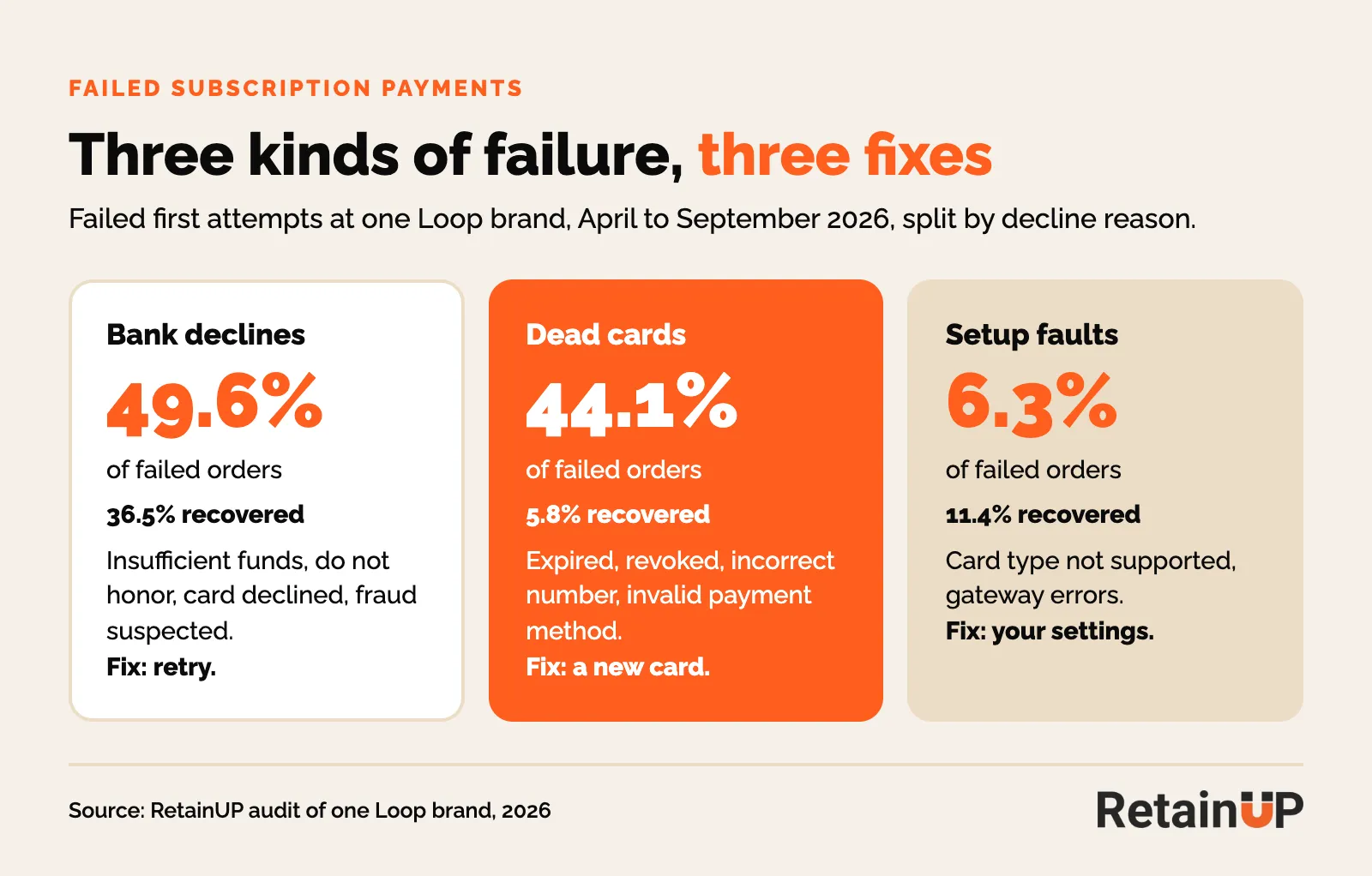
Read that range with care. It is an average across recurring businesses. Your own split can sit far outside it. The brand above was at 1 to 4% passive. And a supplement brand on Loop had 13% of renewals fail at the first attempt, and 35% of those failures were dead cards: invalid, revoked, incorrect number or expired. No retry reaches those. Payment teams call them hard declines. Insufficient funds is a soft decline, and soft declines are what retries are for. The rest of the payment numbers, by app and by category, are on the subscription benchmarks page.
Recharge puts total subscription churn at 5% to 8% a month. But monthly churn hides the leak, because new subscribers cover the ones you lost. So we judge a program on Order 3 retention by cohort, and use the active and passive split to decide where the work goes.
Recovery rate: by revenue or by order
Your subscription app reports a payment recovery rate. Check what it counts. Then check again.
On one Loop brand, Loop's own first-cycle recovery read 41.2%, by revenue. The transaction log read 17.3%, by order. Same failed payments. Different rule. Loop counts a skipped order as having left the cycle, not as lost.
How to count it
- Count failed renewals, not failed transactions. Group by order first. A transaction log records every retry. At one brand the log showed 8.4 attempts per failed renewal, and 11 on the worst, so a transaction count overstated the problem about eight times.
- Recovered means a successful charge landed after that subscription's last failure. That counts real saves, not a retry that happened to come before another decline.
- Report recovered orders over failed orders, monthly, from the log.
One month tells you little. Churn Buster says its recovery rate settles in about 90 days, because campaigns take weeks to close. For a yardstick, YOCTO's median store gets 43% of failed charges back in the first retry cycle.
The retry and card update work that moves this number is in failed payment recovery and the card update flow.

Your active subscriber count is too high
Your app counts everyone who has not cancelled as active.
That includes paused subscribers, people who pushed their next charge two months out, and people who skip every order. Some tools count a failed payment still in retry as active. Some of these subscribers have not paid you in a year. Some never will.
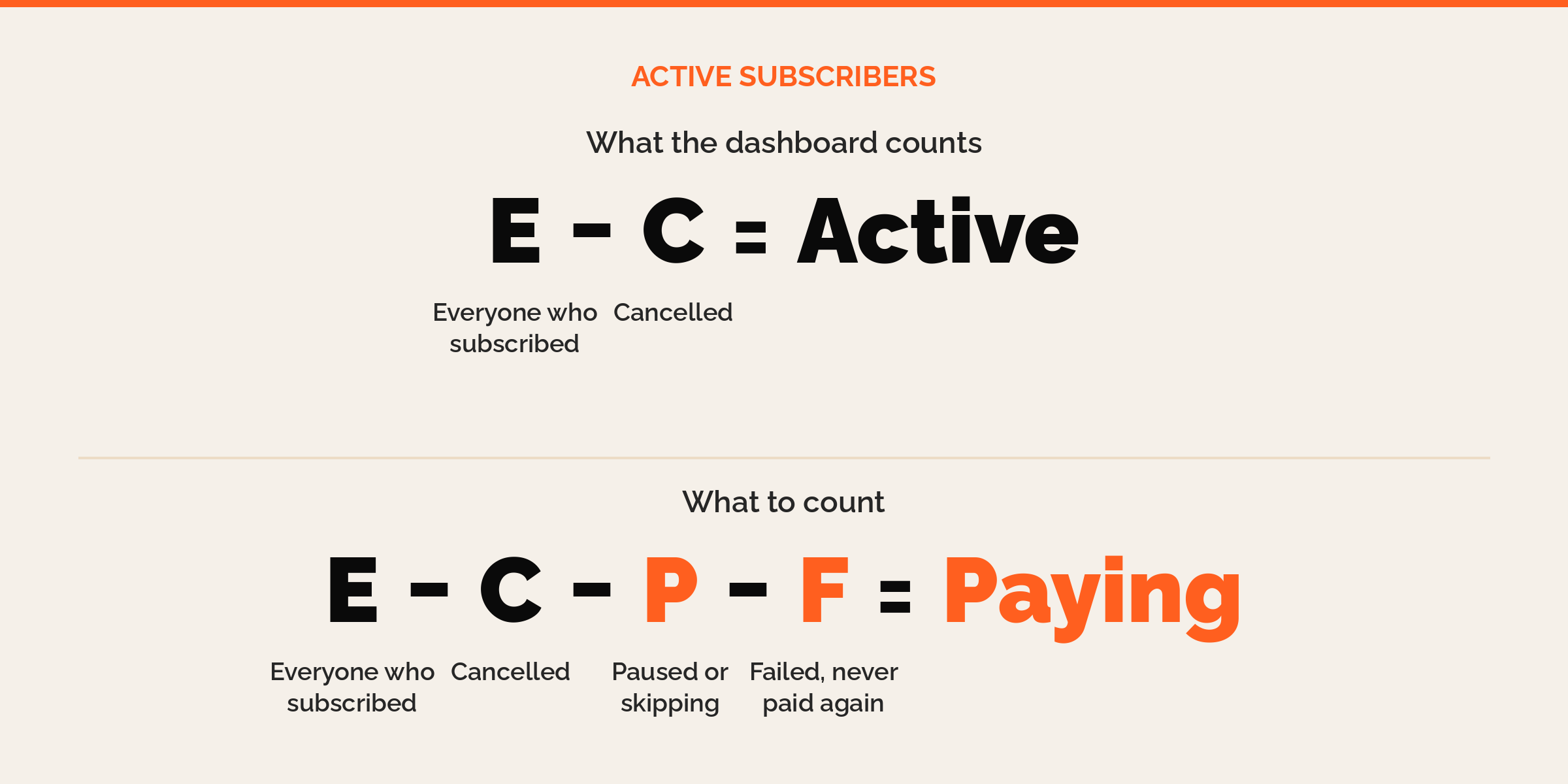
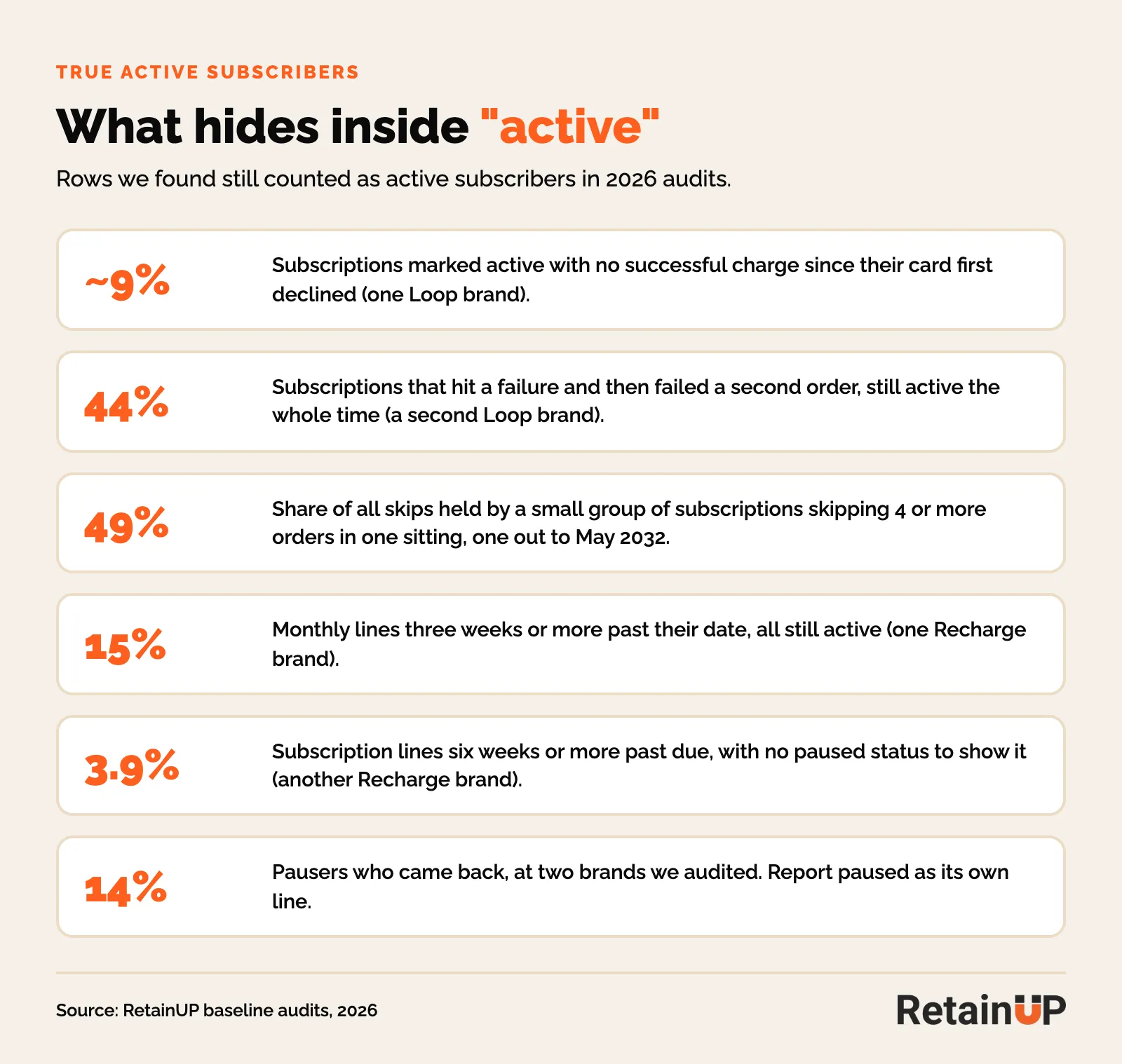
And the active count is the denominator for your churn rate. Inflate it and churn looks better than it is. Here is what we find inside it.
Repeat payment failures still marked active
At one Loop brand, about 9% of the subscriptions marked active had not taken a payment since their card first declined. They inflate the count, they use up retry attempts, and they explain why "card retry declined" was that brand's largest failure reason.
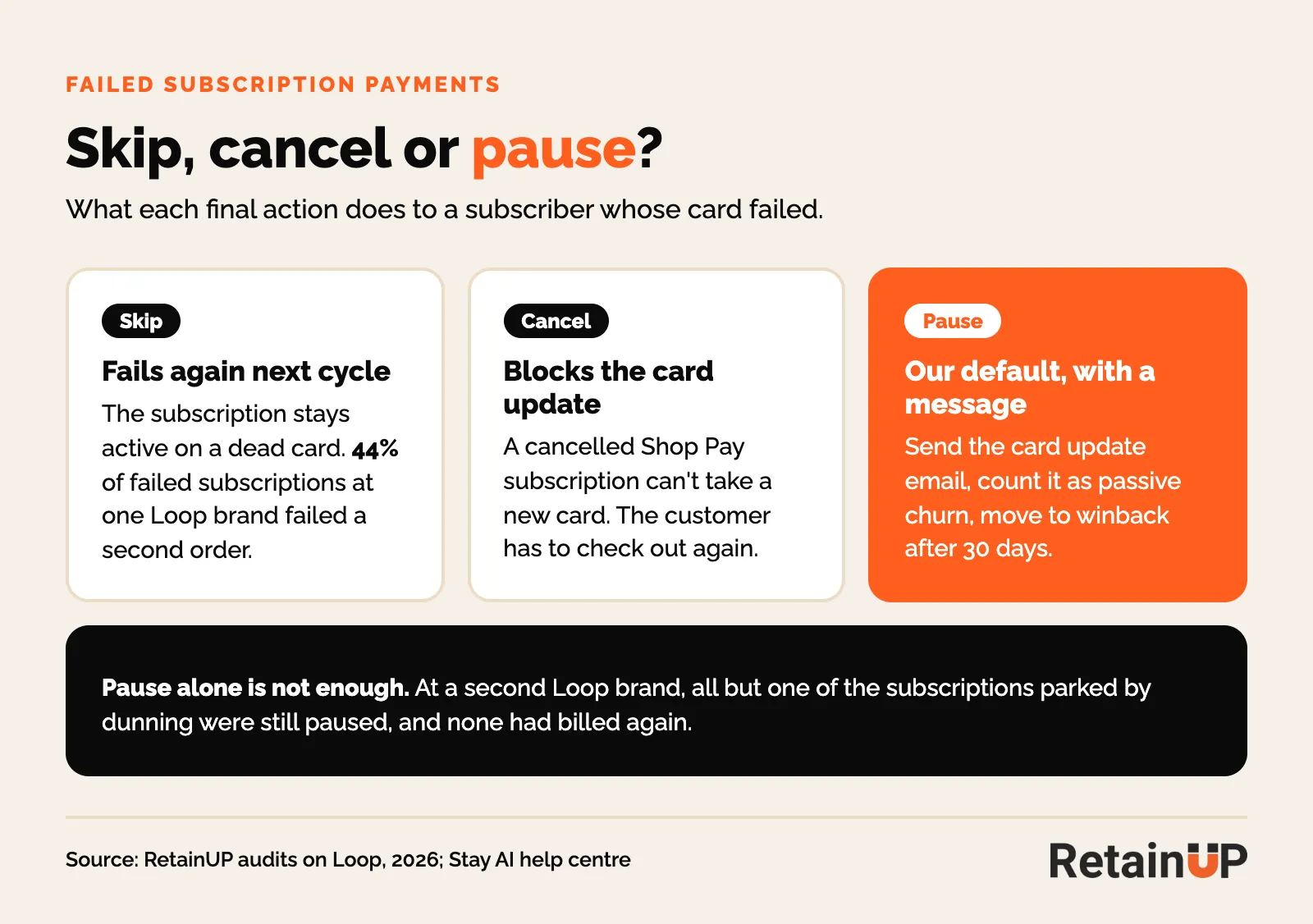
So why does it happen? Usually it is the setting after the last retry. Loop skips the order and keeps the subscription live. The next order bills. It fails again. At another Loop brand, 44% of subscriptions that hit a failure failed a second order, and they counted as active the whole time. Recharge goes the other way and cancels once a subscription reaches max retries. Skio cancels at the end of its retry schedule. Stay AI leaves it to a setting, Cancel Dunned Subscriptions, so check which way yours is set.
Pause has its own trap. At the first brand, dunning pauses were 5.2% of the base, mixed in with customer pauses, and none of them billed again. So set an end. Close anything parked after the last retry within about 30 days, count it as passive churn, and hand it to winback.
Serial skippers
A skip keeps the subscription active. Fine, once. Several skips in one sitting keep it active with no charge for months. At one Loop brand a small group of subscriptions held 49% of all skips, and one had skipped out to May 2032. At another, one subscriber skipped 9 orders in 71 seconds and then cancelled. How to read skip rates is in skip and pause analysis.
Long delays and paused lines
Some setups have no paused status, so a late line just looks active. At one Recharge brand, 3.9% of subscription lines were six weeks or more past their date. At another, 15% of monthly lines were three weeks or more late.
And paused subscribers are a separate number. A weak one. Only 14% of pausers came back at two brands we audited. At one, most of the paused pool was left over from a platform migration.
Subscriptions versus subscribers
A customer can hold two subscriptions, plus product switches and add-on lines. At one Recharge brand, line cancels ran 57% above subscriber churn. Pick one, say which on the report, and use it everywhere.
How to rebuild the real active count
We take the zombies out in this order:
- Start from the full subscription export, not a dashboard total. Check its population against a known count first. A platform export is often a slice.
- Remove never-recovered failures: no successful charge since the first decline.
- Remove serial skippers, with the next charge pushed months out after several skips at once.
- Remove stalled lines, weeks past their date with no charge, and anything four months or more late.
- Report paused as its own line, not inside active.
- Count customers or subscriptions, and say which.
Then tie it out. Every time. Subscribers must equal active plus churned plus paused. If they do not, the export covers something narrower than you assumed.
The short version, if you only have a minute: count subscribers who paid in the last billing cycle.
Other dashboard numbers that read high
Every number on a Recharge, Loop, Skio or Stay AI dashboard is accurate. Most of them can go up without a single customer paying you again.
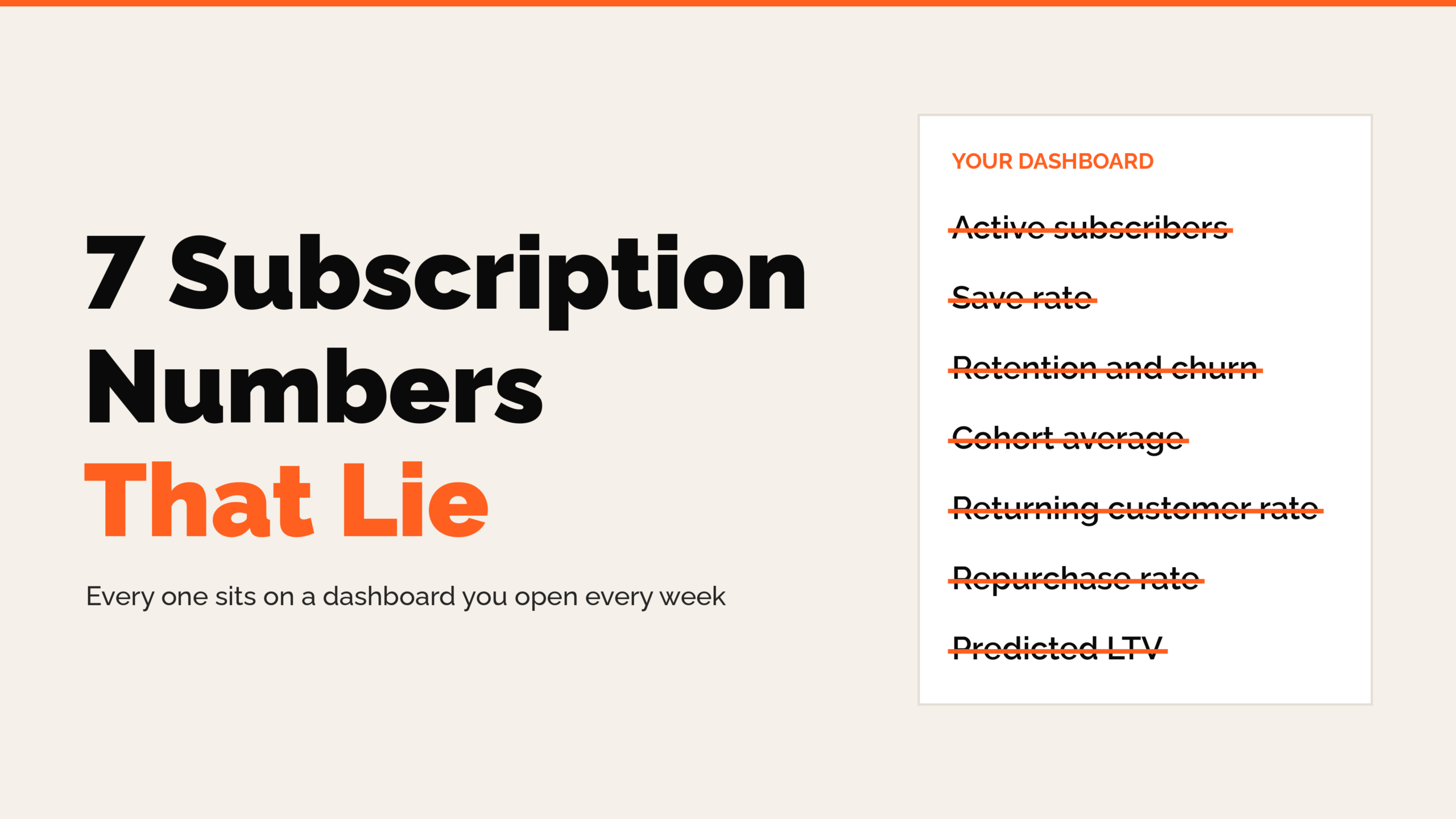
| Number | Why it reads high | Read instead |
|---|---|---|
| Save rate | Anyone who did not cancel today counts as saved, including the one who skips the next three orders | Subscribers still paying 60 days after the save |
| Retention and churn rate | One formula puts every plan in one number. A quarterly subscriber has had no chance to leave by month three | Order 3 retention, one row per plan |
| Cohort average | Includes last month's subscribers, who have not reached their second charge | Only cohorts old enough to reach that order |
| Shopify returning customer rate | Every rebill counts as a return, and it climbs when new customers drop | First-time buyers from last quarter who came back on their own |
| Repurchase rate | A subscriber's second order is a charge they did not stop | How many subscribers reach order 3 |
| Predicted LTV | Counts orders that have not happened yet | 12-month LTV from what a cohort actually paid |
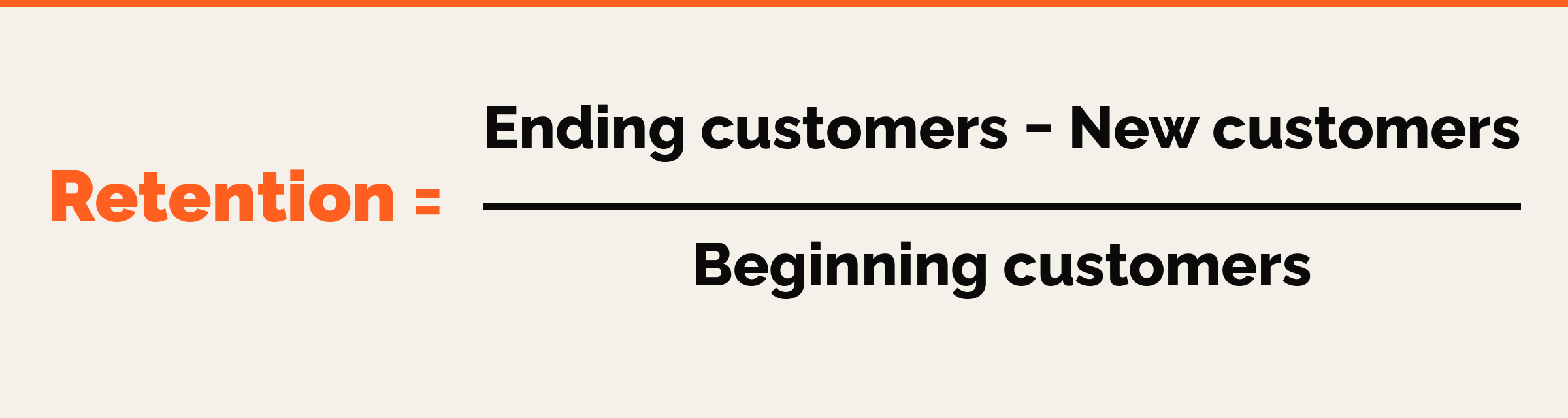
Most tools work out retention with the formula below, and churn rate is the same number upside down.
A founder told me, "We have a 43% save rate. It's a false economy." His cancel flow counted anyone who did not cancel that day as saved. Anyone. Almost none of the subscribers his cancel flow saved ever paid him again. Cohorts are read in subscription cohort analysis.
So whatever you read, split it. A blended number hides the answer.
If you want this done on your own data, the Subscription LTV Roadmap™ reads your subscription exports, splits churn and rebuilds the active count, then gives you a 90-day plan of 30 to 50 changes in order, in 3 working days, for $1,000. For a lighter first look, the free audit checks 48 points and names your top 3 leaks in 24 hours.
FAQ
What is passive churn, and how is it different from active churn?
Passive churn is a subscription payment that fails and never recovers, so nobody decided to leave. Active churn is a subscriber who decides to cancel. They need different fixes. Active churn is read through cancel reasons and timing and fixed with skip, pause and the cancel flow. Passive churn is read through the failed payment log and fixed with retries by decline reason and a card update email and SMS.
What percentage of subscription churn is involuntary?
Paddle and ProfitWell put involuntary churn at 20 to 40% of total churn. It runs higher for low-AOV products: Stripe puts it at 14% under $10 an order against 4% over $1,000. Your own split can sit far outside that range. One Loop brand we audited ran 96 to 99% active churn every month, so better dunning would have barely moved its churn rate.
Why is my active subscriber count higher than my paying subscribers?
Your app counts everyone who has not cancelled as active. That includes paused subscribers, serial skippers, lines weeks past their date and subscriptions that have failed payment again and again. At one Loop brand, about 9% of active subscriptions had not paid since their card first declined. Count subscribers who paid in the last billing cycle instead.
How do I classify cancellations with no reason or status?
Resolve them against the transaction log. A cancel is passive if the subscription was in payment recovery when it cancelled, and active otherwise. At one Loop brand, about 40% of cancel events were blank, and almost none of them had ever recorded a failed payment. Write the method in a footnote, and never report an unclassified bucket.
One email a week on subscription retention: the numbers, the strategy, and what to fix first.

Rahi Jain
Rahi Jain is a subscription LTV specialist who helps $1M to $10M DTC brands reduce subscription churn and maximize LTV on Recharge, Skio, Stay AI and Loop.
More about Rahi