Key takeaways
- At $1M a year and a $50 order, Loop Starter costs about $11,188 a year at list price against $20,788 on Recharge Starter, checked 3 November 2026.
- Loop lets you choose skip, pause or cancel after the last failed retry, while Recharge cancels the subscription and keeps its recovery emails out of Klaviyo.
- A Recharge to Loop migration leaves order history and analytics behind, and the subscription count drops because Recharge counts each product as a subscription.
Loop vs Recharge is the comparison we get asked about most by brands between 100 and 5,000 subscribers. Loop's own pages fill most of the search results, so most of what you read on it is written by one side.
We don't sell either app. RetainUP works inside both, so this compares them on the things our audits check: fees at your size, the portal, the cancel flow, failed payments, and what a move between them really costs. Prices were checked on 3 November 2026. For Skio and Stay AI as well, see the best Shopify subscription app comparison.
The short answer
Loop costs less at every size we model, includes bundles on its first paid plan, and gives you more control over failed payments. Recharge has the bigger set of integrations and a cancel flow on Starter. If you rely on a tool that only plugs into Recharge, that decides it. If not, Loop is the better value, provided someone sets it up.
Loop vs Recharge pricing
| App | Plans, checked 3 November 2026 | Source |
|---|---|---|
| Loop | Free to 50 active subscriptions. Starter $99/mo + 1.0%. Pro $399/mo + 0.75%. No per-order fee. Enterprise by quote. 14-day trial | Pricing page |
| Recharge | Starter $149/mo + 1.50% + 20¢, 60-day trial. Scale $499/mo + 1.25% + 20¢. Custom by volume | Pricing page |
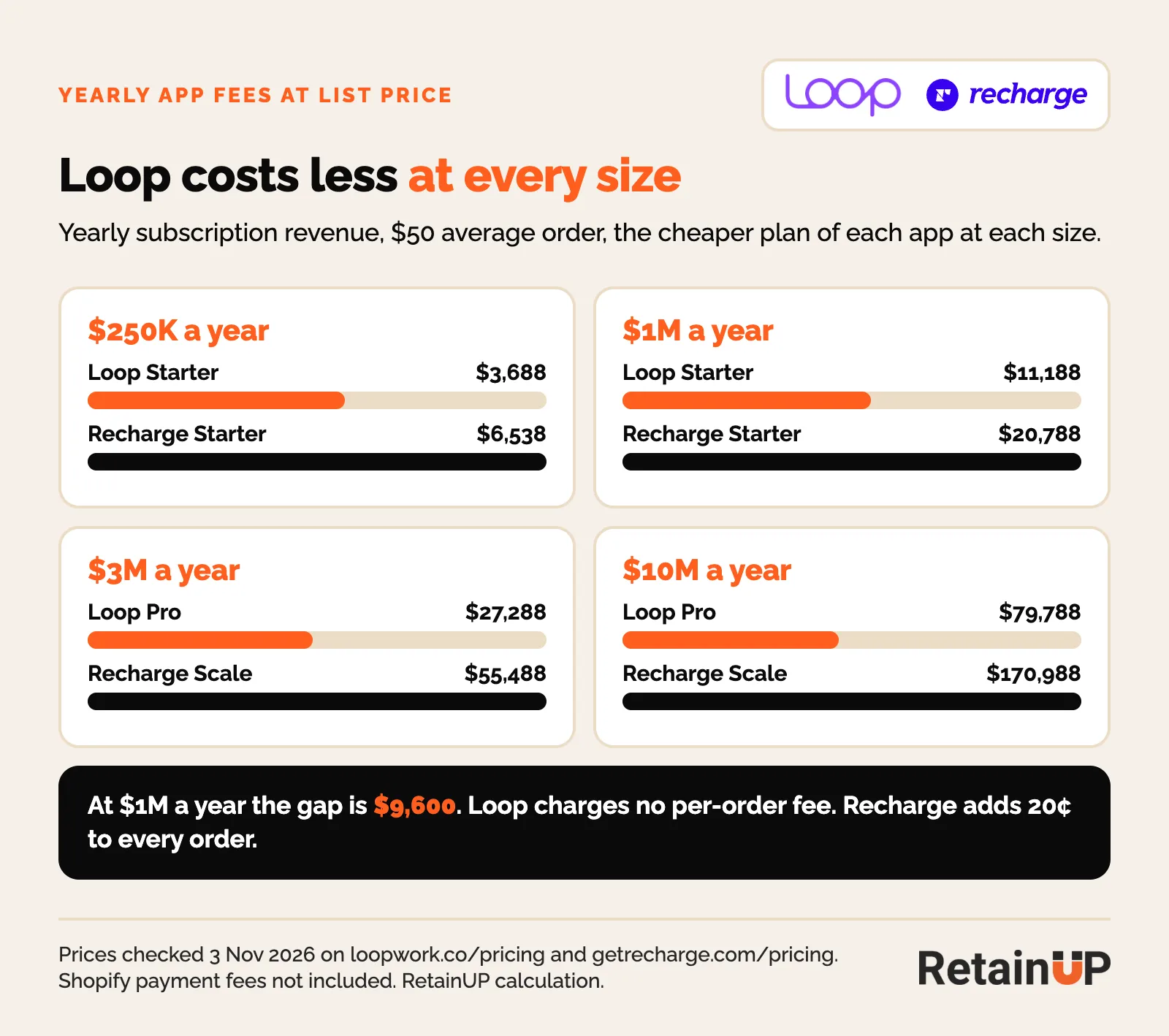
Recharge changed its prices in early November. On 1 November, Starter was $99 a month plus 1.49% and 19 cents. Here is the yearly bill now, at a $50 average order, on the cheaper plan of each app at each size.
| Yearly fees | $250K a year | $1M a year | $3M a year | $10M a year |
|---|---|---|---|---|
| Loop | Starter: $3,688 | Starter: $11,188 | Pro: $27,288 | Pro: $79,788 |
| Recharge | Starter: $6,538 | Starter: $20,788 | Scale: $55,488 | Scale: $170,988 |
The gap grows with you, from about $2,850 a year at $250K to about $28,000 at $3M. Most of it is the per-order fee: Loop charges none, and Recharge adds 20 cents to every order on top of its percentage. Shopify's own payment fees apply to both. Above $5M, get quotes.
What you get on each plan
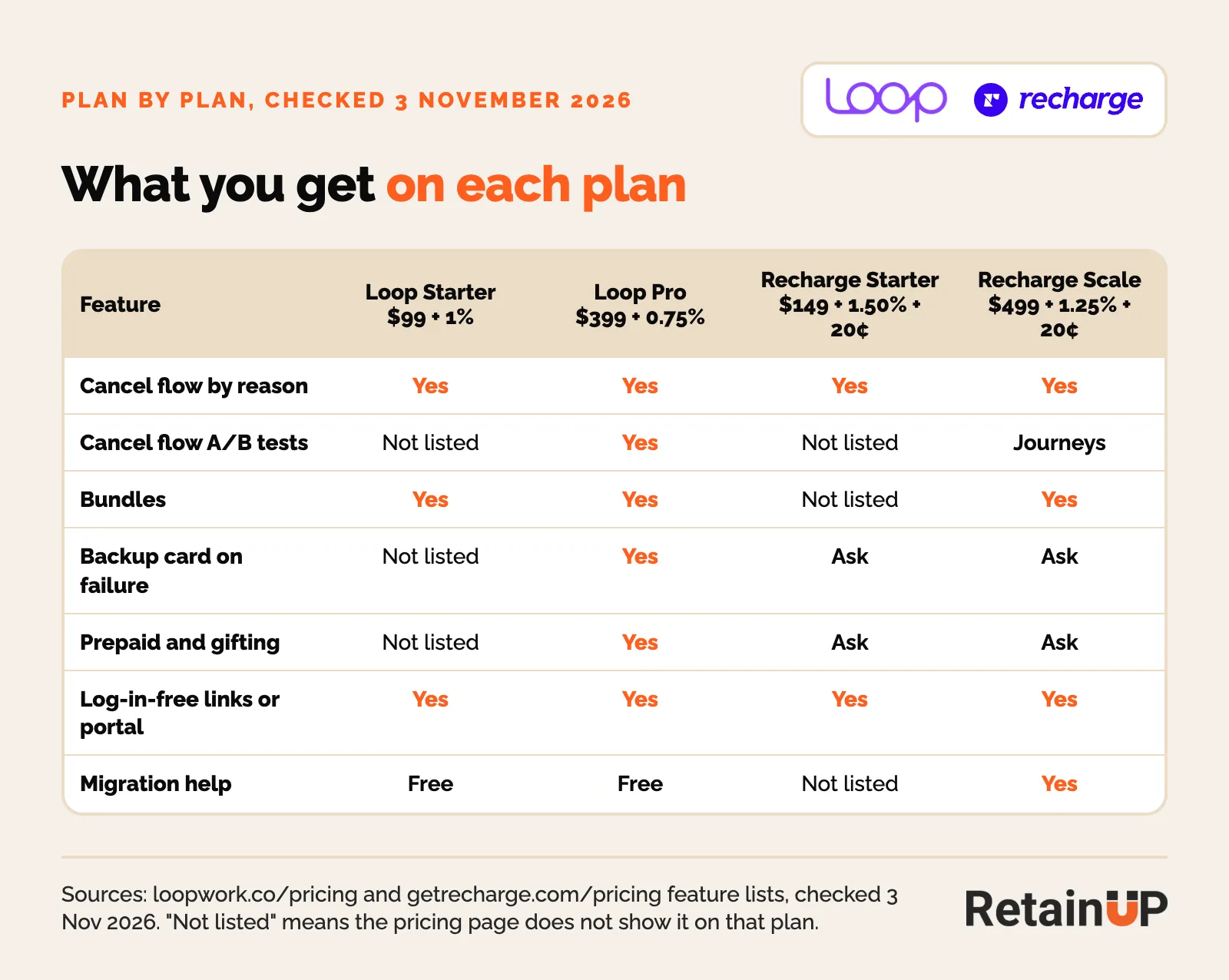
The plan lines matter more than the headline price. Loop puts bundles on Starter and keeps cancel flow A/B tests, the backup card and prepaid on Pro. Recharge puts its cancel flow on Starter and keeps bundles, journey tests and migration support on Scale.
Customer portal
Both let subscribers skip, swap, reschedule and pause on their own. Recharge offers passwordless login on Starter. Loop has a drag-and-drop portal editor and quick action links: one-click, pre-logged-in actions from an email or SMS, on every plan.
The test that matters is the same on both. From the upcoming order email, can a subscriber skip or swap in two taps? If the first screen is a login wall, the feature list does not matter. We set the portal up as the first stop before cancel, as covered in pause and skip.
Cancel flow
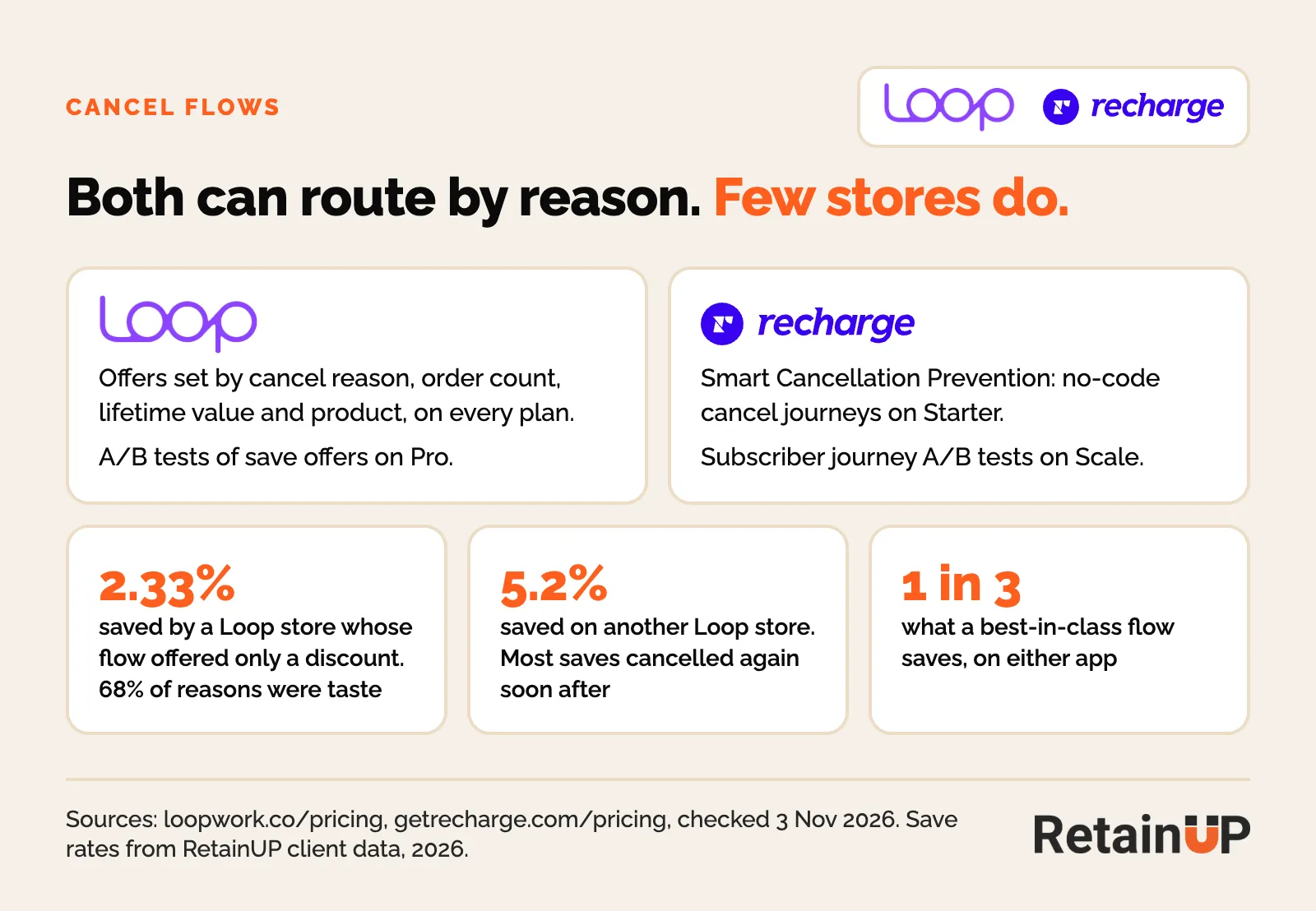
Both apps can route a cancel by its reason. Loop sets offers by reason, order count, lifetime value and product on every plan, and adds A/B tests of save offers on Pro. Recharge includes Smart Cancellation Prevention on Starter and subscriber journey A/B tests on Scale.
The tool is rarely the problem. A Loop store with about 300 subscribers came to us offering one thing at cancel, a discount. 68% of the reasons given were taste, and the flow saved 2.33%. On another Loop store the flow saved 5.2%, and most of those saves cancelled again soon after. A best-in-class flow saves 1 in 3 on either app. We took one from 14.8% to 29.6% in our cancel flow case study.
Failed payments: the setting to check
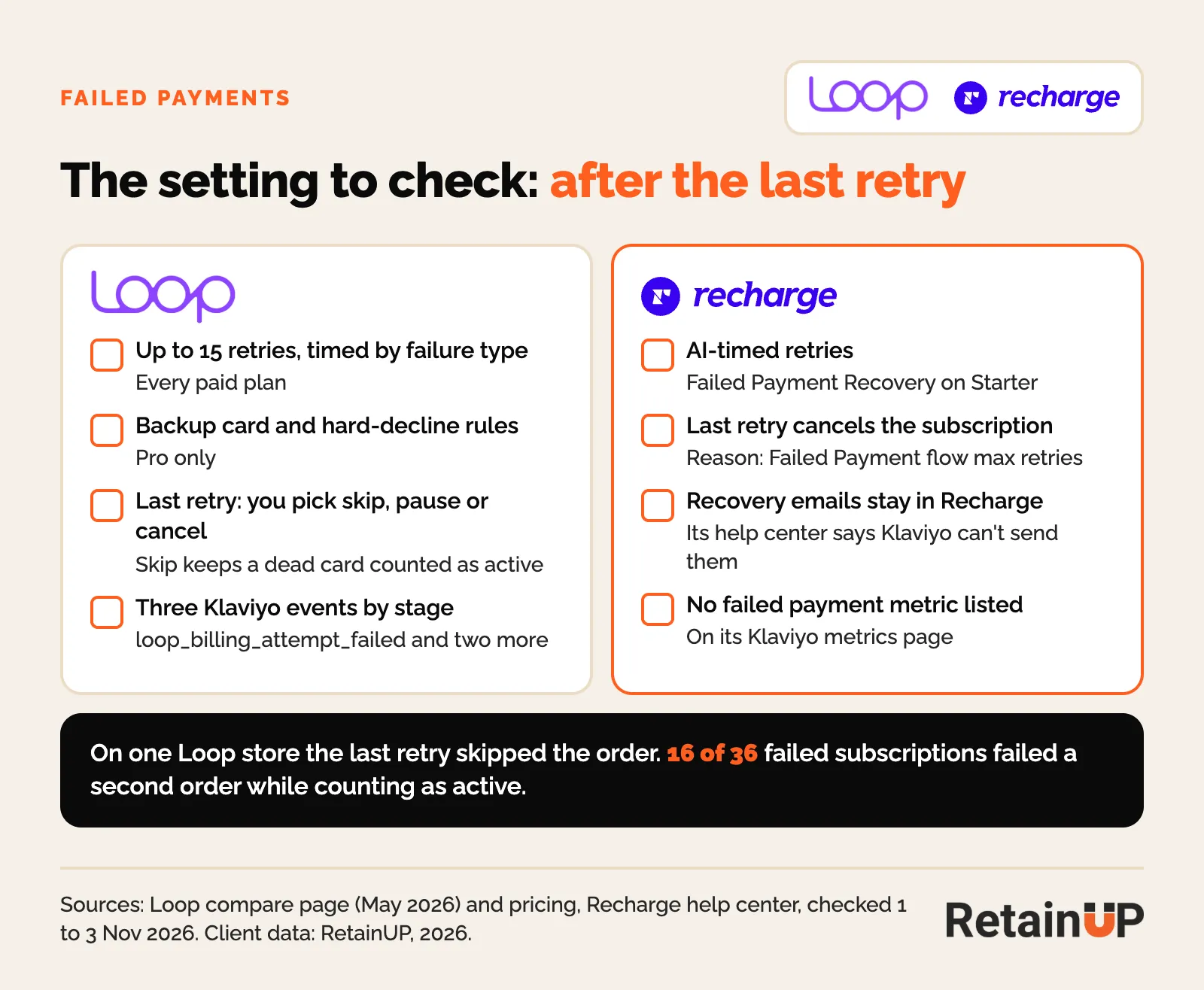
Ask one question on any demo: what happens after the last retry?
- Loop lists up to 15 retries timed by failure type on every paid plan, with a backup card and hard-decline rules on Pro. After the last retry you choose skip, pause or cancel. Its failed payment events go to Klaviyo in three stages.
- Recharge retries with AI timing on Starter, then cancels the subscription, with the reason "Failed Payment flow max retries". Its help center says Klaviyo cannot send its Failed Payment Recovery notifications, and its metrics page lists no failed payment metric.
Loop's choice is better, if you make it. On one Loop store the last retry was set to skip. The subscription stayed active, billed again and failed again: 16 of 36 failed subscriptions failed a second order while counting as active. In September the app's payment emails had stopped, against 184 retries. We switched the last retry to pause and send a card update email.
Both apps ship with settings that leak. The Subscription LTV Maximizer™ builds your new setup or migration on Loop or Recharge in 30 days, for $5,000. The retry schedule we use is in failed subscription payments.
Moving from Recharge to Loop
Loop says 400+ brands have moved to it from Recharge, and quotes about 2 weeks, free on every paid plan. Its Recharge migration policy explains how.
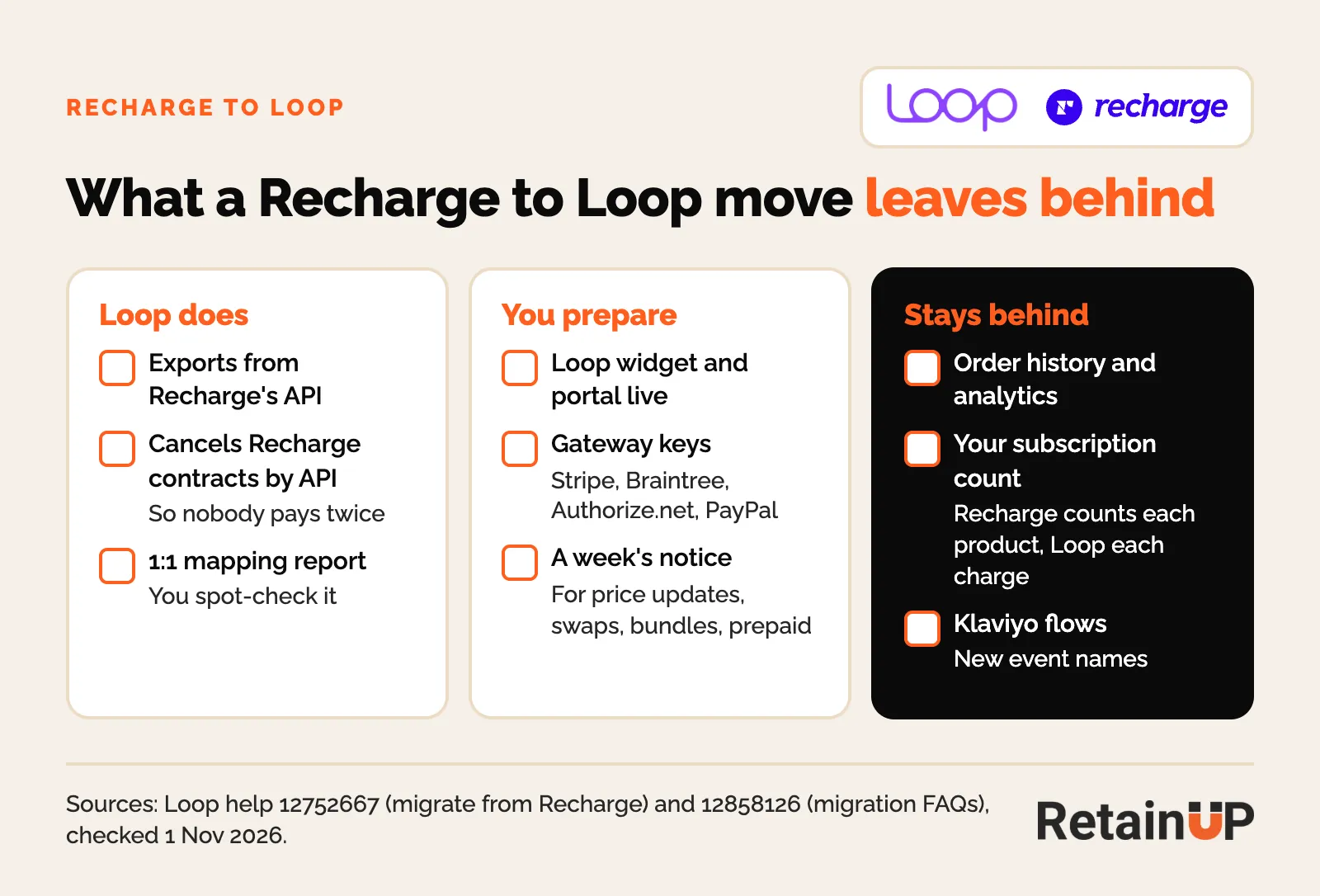
- Loop exports from Recharge's API, imports, then cancels the Recharge contracts by API so nobody is charged twice. You spot-check a 1:1 mapping report.
- You prepare the Loop widget and portal, gateway keys for Stripe, Braintree, Authorize.net or PayPal, and a week's notice for price updates, swaps, bundles and prepaid.
- Your subscription count drops. Recharge counts each product as a subscription. Loop groups them by charge.
- Order history and analytics stay behind, per Loop's migration FAQ. Export what you report on first.
- Those bulk cancels land in your data. On our Appstle to Loop move, raw data read 440 cancels in three months against 208 real ones.
Run the move with our subscription app migration checklist. Coming from Appstle or Seal instead? Read outgrowing Appstle, Seal or Shopify Subscriptions.
Klaviyo after the switch
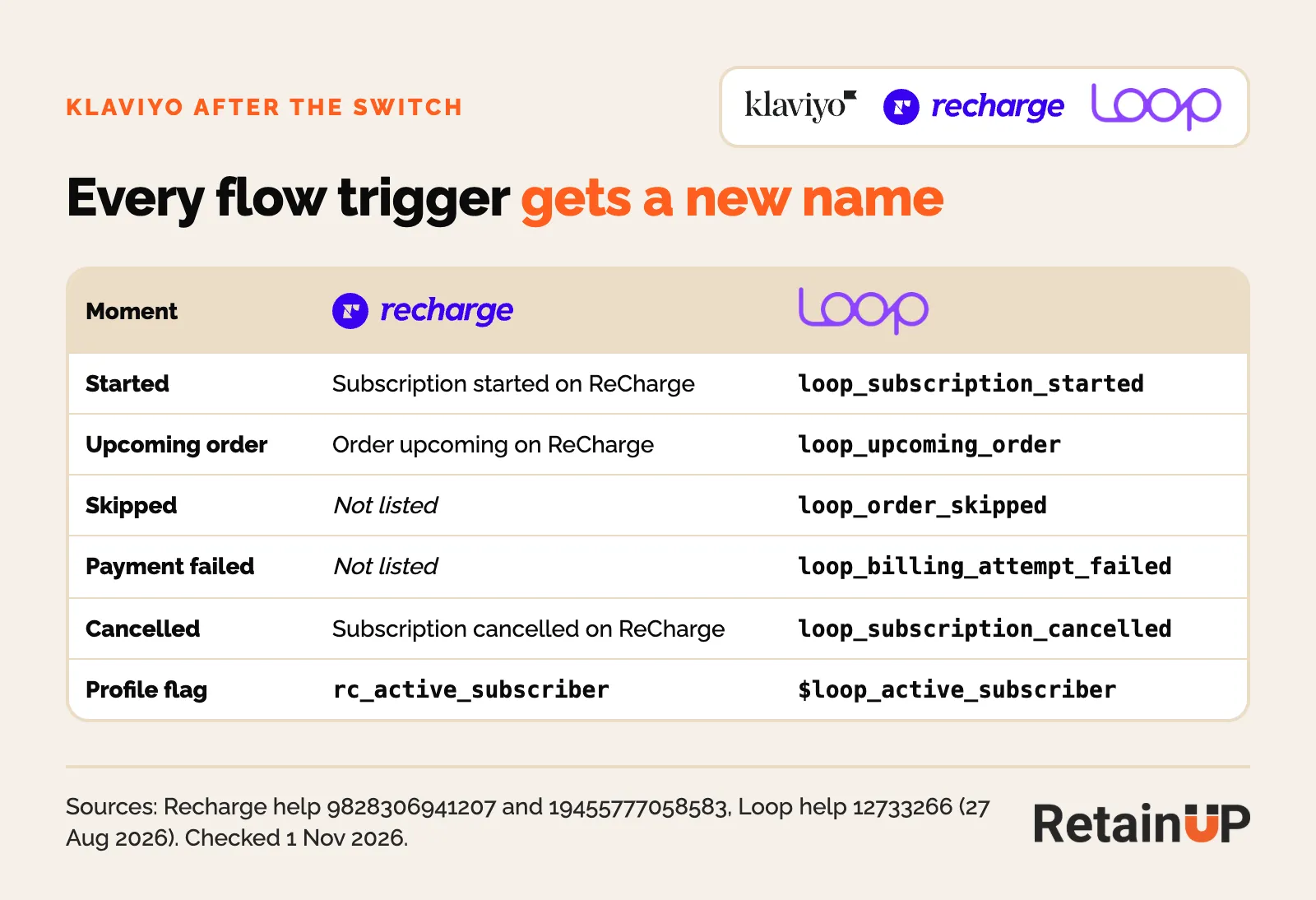
Every flow trigger changes name. "Order upcoming on ReCharge" becomes loop_upcoming_order. Recharge lists no skip or failed payment event, and Loop does, so a move to Loop is the moment to add a skip follow-up and a payment recovery flow. The full list for all four apps is in our Klaviyo event map, and the Loop setup we run is in Loop retention setup. On Recharge, see Recharge retention setup.
Which one should you pick?
- 100 to 2,000 subscribers: Loop Starter, unless an integration you depend on only works with Recharge.
- You need bundles below $1.7M: Loop Starter. On Recharge they need Scale at $499.
- You need cancel flow tests: Loop Pro at $399, or Recharge Scale at $499 for journey tests.
- Over $3M: get quotes from both, and from Recharge or Skio, which now share an owner and a fee line.
FAQ
Is Loop cheaper than Recharge?
Yes, at list price. At $1M a year and a $50 order, Loop Starter costs about $11,188 a year and Recharge Starter about $20,788, checked 3 November 2026. Loop has no per-order fee.
Is migrating from Recharge to Loop free?
Loop says its white-glove migration is included on every paid plan with no setup or migration fee, and usually takes about 2 weeks.
Why did my subscription count drop after moving to Loop?
Recharge counts each product as a subscription. Loop groups products by charge. Loop's Recharge migration policy says counts drop for that reason.
Does Loop keep my Recharge order history?
No. Loop's migration FAQ says history and analytics do not migrate. Export the reports you need before you uninstall Recharge.
Which has the better cancel flow, Loop or Recharge?
Both can route by reason. Loop sets offers by reason, order count, lifetime value and product on every plan, with A/B tests on Pro. Recharge has Smart Cancellation Prevention on Starter. The setup decides the save rate more than the app.
Does Recharge have bundles on Starter?
No. Recharge lists bundles on Scale at $499 a month. Loop includes build-your-own and preset bundles on Starter at $99.
More in the Migration and Setup Series
Guides for brands setting up, or just moved to, Recharge, Loop, Skio or Stay AI:
- Subscription app migration checklist: day by day, with what breaks
- Best Shopify subscription app 2026: Recharge vs Loop vs Skio vs Stay AI
- Klaviyo after a subscription app switch: every event name mapped
- Recharge vs Skio in 2026: what the acquisition changes
- Outgrowing Appstle, Seal or Shopify Subscriptions: when to switch and where
- Recharge retention setup, Loop retention setup, Skio retention setup and Stay AI retention setup
Choosing between Loop and Recharge, or moving? Both ship with settings that leak. The Subscription LTV Maximizer™ builds your new setup or migration in 30 days, for $5,000.
One email a week on subscription retention: the numbers, the strategy, and what to fix first.

Rahi Jain
Rahi Jain is a subscription LTV specialist who helps $1M to $10M DTC brands reduce subscription churn and maximize LTV on Recharge, Skio, Stay AI and Loop.
More about Rahi