Key takeaways
- Recharge data on about 1,750 supplement brands shows 49.1% of subscribers still active at order 3, while Skio puts it at 20 to 30%.
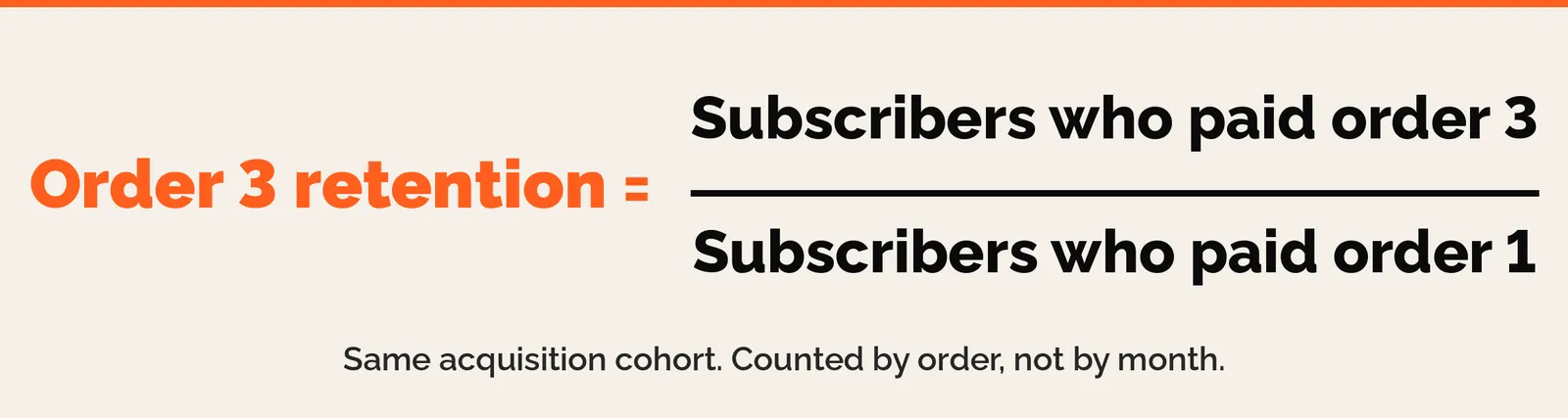
- Order 3 retention is subscribers who paid order 3 divided by subscribers who paid order 1, in the same cohort, counted by order.
- For supplements on a monthly plan, RetainUP rates order 3 retention under 45% as poor and over 72% as excellent.
Ask two subscription apps what good retention looks like for a supplement brand.
Skio says 70 to 80% of supplement subscribers churn before order 3. So 20 to 30% are left.
Recharge looked at about 1,750 supplement brands. 49.1% were still there at order 3.
Same product category. Same order. The answers are twice apart.
Loop adds a third number: 68% of all churn happens in the first three orders.
In a hurry? Watch the breakdown.

Why nobody agrees
Every tool calls a different number “retention”.
Shopify shows a returning customer rate. Lifetimely and Triple Whale show repeat purchase rate. Your subscription app shows 90-day retention or monthly churn.
Public brands like Hims & Hers report revenue retention, which counts dollars, not people.
Even when two tools say “order 3”, they count it differently.
Some count subscriptions, some count subscribers. One customer with two products is two subscriptions.
Some count a paused subscriber as retained. Some count a failed payment still in retry as active.
And most count by month. At month three, a monthly subscriber has paid three times and a quarterly one once.
So a number without its definition is just a number.
The one I use: Order 3 retention
Subscribers who paid order 3, divided by subscribers who paid order 1. Same cohort.
Why order 3:
- Order 2 can be an accident. They forgot they subscribed, or never knew. Order 3 is paid by someone who knew what they bought.
- Most churn has already happened. Loop puts it at 68% of all churn.
- It decides payback. At supplement CAC, order 3 is often the break-even order.
- It counts by order, not by month. Monthly and quarterly plans compare fairly.
How to calculate subscription retention rate
Subscribers who paid order 3, divided by subscribers who paid order 1, from the same cohort. A cohort is everyone whose first order landed in the same month.
Order 3 retention = paid order 3 ÷ paid order 1 × 100
Example: 400 subscribers paid their first order in March. 236 of them paid order 3. 236 ÷ 400 = 59%. That's average for a supplement brand.
The formula Google gives you (customers at the end, minus new customers, divided by customers at the start) breaks for subscriptions. New subscribers land in the same month and hide the ones you lost. And it runs on calendar months, while your subscribers decide on their order date.
Five rules before you trust the number
- Mature cohorts only. A cohort counts once everyone in it has passed their order 3 date, plus 30 days for skips and payment retries. On a monthly plan, that's about 4 months after the cohort month closes.
- Count by order, not by month. If your tool only shows months, filter to one frequency first. On a 30 day plan, order 3 is month 2. On a 90 day plan, it's month 6.
- Start from the first paid order. If you run $0 trials or samples, your order 2 is really order 1.
- Leave failed payments in retry out until they resolve.
- Decide how you count pauses. Most dashboards count paused subscribers as retained, so write your rule next to the number.
Where to find it in your app
- Skio: Analytics, Cohort Dashboard, Retention by order count. Switch the toggle to Subscribers.
- Loop: Analytics, Cohorts, Order-Level view. Filter by frequency and read monthly and quarterly plans separately.
- Recharge: Analytics, Subscription Journey, Subscription Retention by Order Number. Check it shows survival from order 1, not step rates like order 2 to order 3.
- No report? Export your subscription orders, drop the $0 orders, number each customer's orders by date, group customers by the month of their first order, then divide customers with an order 3 by customers with an order 1.
One more thing you'll see in a cohort table: month 0 below 100%. Most apps count subscriptions still active at the end of the month. In our data, 5.6% of monthly plan cancellations and 7.4% of quarterly plan cancellations happen on day 0. If your month 0 is below about 95%, look at your offer and how clearly you disclose the subscription.
The benchmarks
Three sources. Two published, one ours.
1. Recharge
About 1,750 supplement brands, updated October 2026, counted by order. The biggest sample with a published definition. Read the report
Their 2nd reorder is order 3. 49.1% make it. By order 7 it’s 15.5%, and by order 13 it’s 5.7%.
At the first reorder, supplements now do best of the six categories Recharge compared: 75.2%, against 73.3% for coffee and tea and 71.7% for pet supplies.
2. YOCTO
Stores YOCTO runs or has audited, November 2025 to October 2026. Read the report
Their median store keeps 52% to order 3. The weakest keep 27%, the best 73%.
By order 6 the median store keeps 20%, about one subscriber in five.
That’s within 3 points of Recharge at order 3, from different stores counted a different way.
3. Ours
From both and the cohorts we see at clients, these are the bands we use for supplements on a monthly plan:
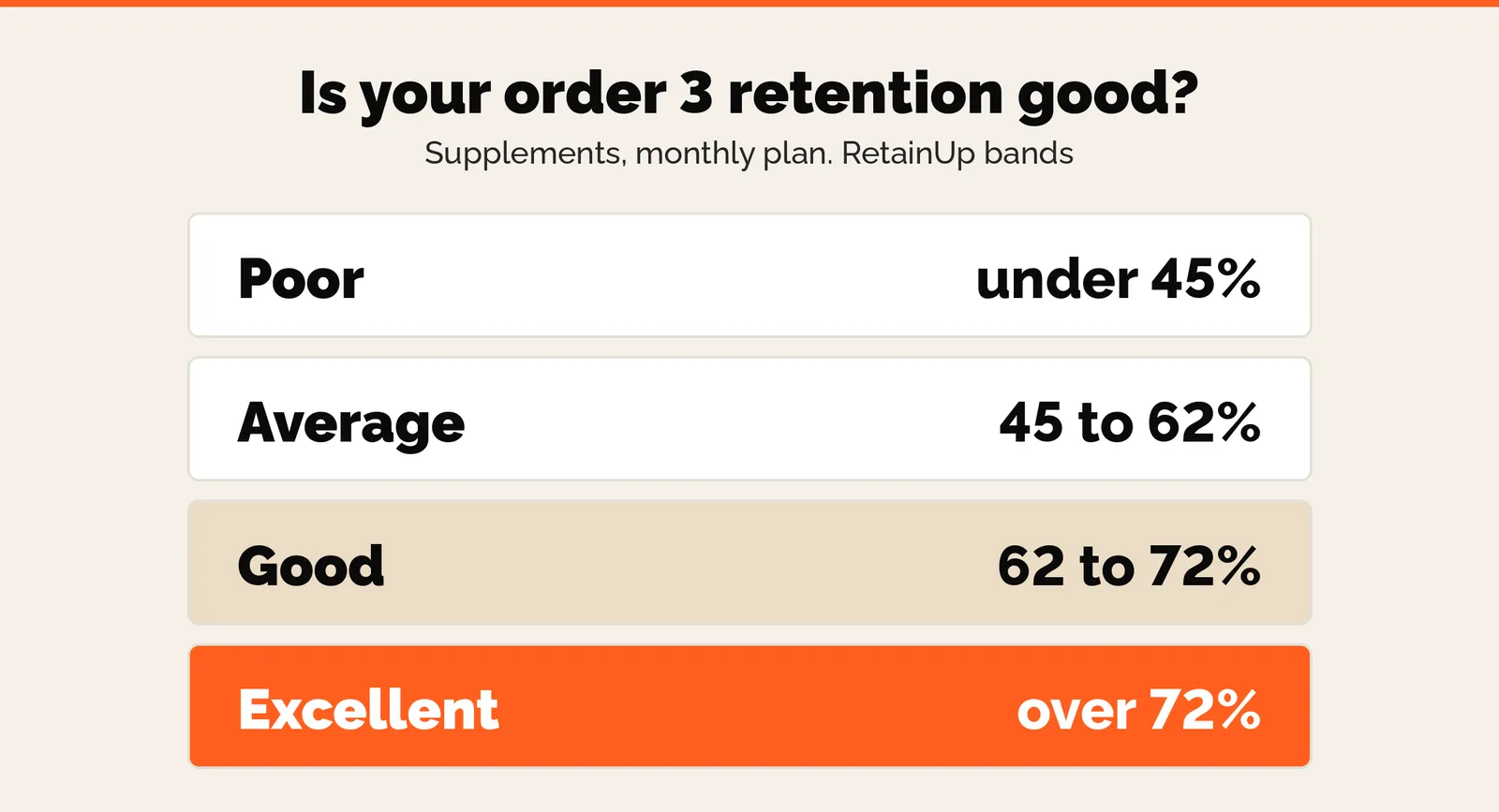
| Rating | Order 3 retention |
|---|---|
| Poor | under 45% |
| Average | 45 to 62% |
| Good | 62 to 72% |
| Excellent | over 72% |
These are our bands, not an industry standard. Nobody has published one on a clear definition yet.
To see which band you are in and what it costs you in LTV, try the subscription LTV calculator.
Where does yours sit?
If it’s low, check order 2 first.
If order 2 is weak, look at onboarding and the offer. If order 2 is fine and order 3 drops, look at results, routine and the price step after the first discount.
Under 45%: there’s real room to improve.
45 to 72%: you’re doing well, and there’s still room.
Above 72%: excellent.
Book a call and we’ll fix your order 3
FAQ
What is a good subscription retention rate?
For supplements on a monthly plan, we rate order 3 retention under 45% as poor, 45 to 62% as average, 62 to 72% as good and over 72% as excellent. These are RetainUP's bands, not an industry standard.
How do I calculate subscription retention rate?
Take one cohort, everyone whose first order landed in the same month. Divide the subscribers who paid order 3 by the subscribers who paid order 1, then multiply by 100. 236 of 400 is 59%.
Why do Recharge and Skio give such different retention numbers?
They count differently. Recharge's data on about 1,750 supplement brands puts order 3 at 49.1%, while Skio puts it at 20 to 30%. Some tools count subscriptions and some count subscribers, and some count paused subscribers as retained.
Is retention the same as monthly churn?
No. Order 3 retention follows one cohort by order. Monthly churn counts who left in a calendar month across every cohort, so new subscribers can hide the ones you lost.
How do I improve subscription retention?
Check order 2 first. If order 2 is weak, look at onboarding and the offer. If order 2 holds and order 3 drops, look at results, routine and the price step after the first discount. What moves it: a re-commit message before order 2 ships, a reward announced for order 3, and gift value moved from order 1 to orders 2 and 3. SunMed went from 61% to 73% on 90-day repeat purchase rate, and Boka from 41% to 63%.
One email a week on subscription retention: the numbers, the strategy, and what to fix first.

Rahi Jain
Rahi Jain is a subscription LTV specialist who helps $1M to $10M DTC brands reduce subscription churn and maximize LTV on Recharge, Skio, Stay AI and Loop.
More about Rahi