Key takeaways
- A cancel flow that matches the fix to the reason saves 17 to 33% of cancels. One that leads with a discount saves under 5%.
- “Too much product” is a timing problem. A discount saves about 1 in 10 of them, a skip or longer frequency about 4 in 10.
- At one of our brands, taste and quality were 68% of named reasons and price only 10%, yet every reason got the same discount.
This is one part of the subscription churn guide, which walks the whole topic in order.
You asked them why they left, and they picked the easiest answer: “Too expensive.”
You saw the data. Trusted it. Built the wrong fix.
Offered a discount at cancel, cut the price, and watched churn stay the same.
Your exit survey is not wrong. It is asking the right question at the wrong time. This page is the reason screen, and the screens around it are in the cancel flow structure.
Why a bigger offer barely moves save rate
Most brands run cancel flow tests the same way.
Pick an offer and show it to everyone.
Measure save rate.
Try a bigger offer and measure again.
Five tests later, save rate has barely moved.
The mistake is showing every subscriber the same screen. The subscriber who says “too expensive” and the subscriber who says “I have too much product” are not the same problem. One needs a price reframe, the other a skip option. A discount solves neither.
So routing moves save rate, and offer size comes a long way second. A cancel flow that identifies the reason before it responds recovers 17 to 33% of cancellations. A flow that skips the reason and leads with a discount saves under 5%.
And Loop’s own data, from 441,000+ cancel attempts across 87 brands, points the same way: a generic “here’s 10% off” screen saves about 6%, a three-stage cancel flow about 15%.
The reason-to-fix map
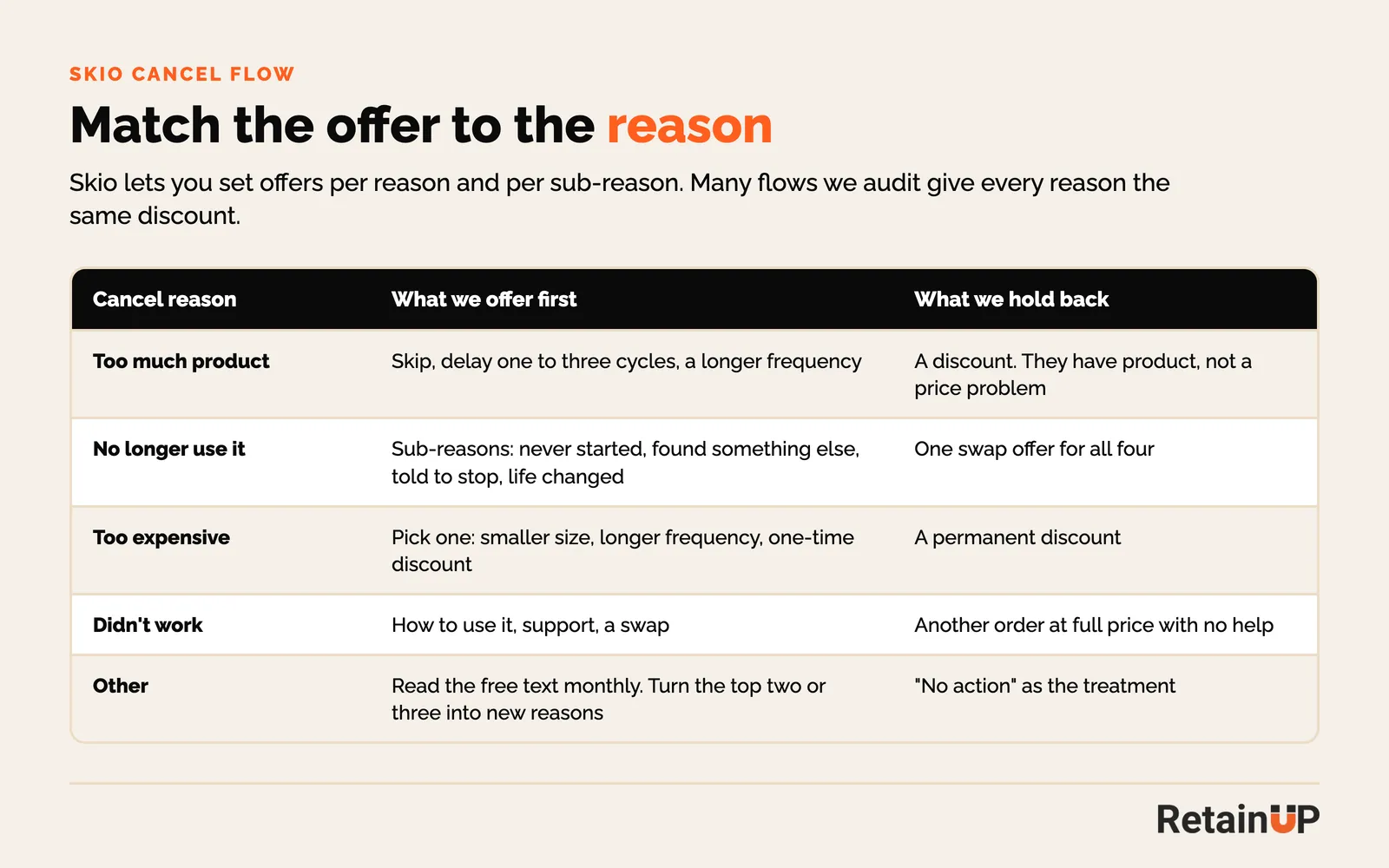
Five reasons, 2 to 3 sub-reasons each, and a treatment for each one.
Price is never price. It’s value and cost.
Product didn’t work is feel or expectations.
No longer use might be they never used it.
Here is the map we start from.
| Reason | Sub-reason | Show first | Hold back |
|---|---|---|---|
| Too expensive | I don’t see the value | Why it costs what it does, long-term reviews | A discount |
| Too expensive | I don’t have the budget | Longer frequency or smaller pack, then a strong discount | A permanent discount |
| Too much product | Comes too often, lasts longer than expected | Skip, delay, change frequency | A discount |
| Didn’t work | Not seeing results, didn’t like it | Results timeline, how to use it, then a swap, then support | Another order at full price with no help |
| Want something different | Flavour, format, size | A swap from a short list | A discount on the product they went off |
| No longer use it | Life changed, found something else, doctor advised, never got into the habit | Pause, swap, support, habit content | One swap offer for all four |
| Life reasons | Pet passed, medical, moving | Empathy, and an easy way back | Any offer at all |
| Other | Free text | Read it monthly, build new reasons | “No action” as the treatment |
Loop’s Cancellation Playbook maps it almost the same way, with quality issues sent to a support chat. Their map also lists pause. We leave it out for most reasons, because a skip or a frequency change fixes the timing and a pause only postpones it.
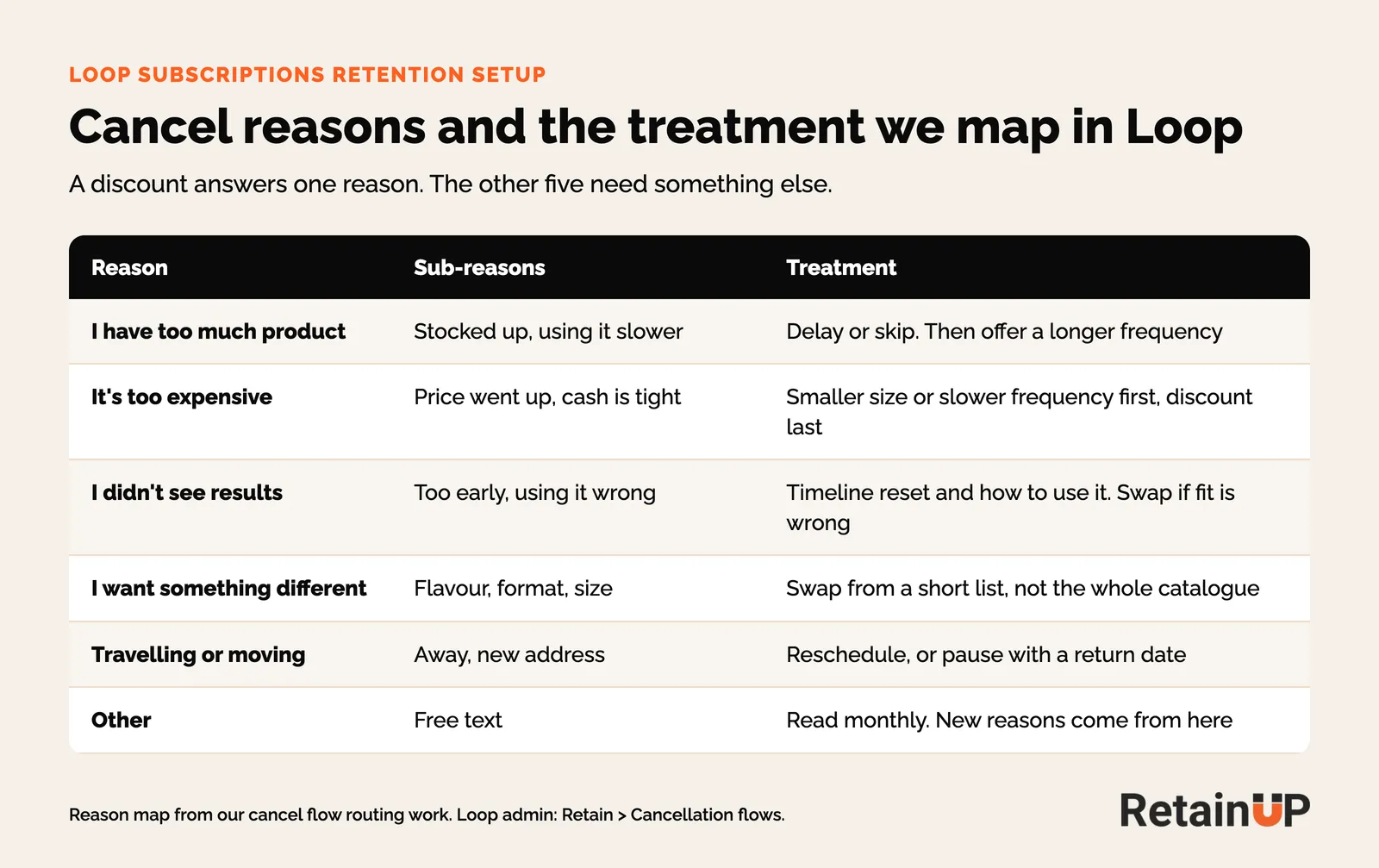
Add the reasons only your brand has. A coffee brand hearing “too much caffeine” can offer decaf, a half-caf blend or a smaller pack. “Cutting back on caffeine? You don’t have to cancel completely.”
Every big app can do this. Recharge calls it Cancellation Prevention. Loop has Cancellation flows, Stay AI has RetentionEngine, and Skio lets you add sub-reasons with an offer for each. On Skio, the full build is in our Skio cancel flow setup.
How to write the reason list
The list itself decides what you learn.
- Five to seven reasons. Stay AI’s setup guide says 10 at most.
- Use the customer’s words: “I have too much product.”
- People pick the first option on the list. Stay AI can shuffle the order to cut that bias.
- Leave failed payments out. Nobody picks “my card expired” on a survey, so that churn lives in failed payment recovery.
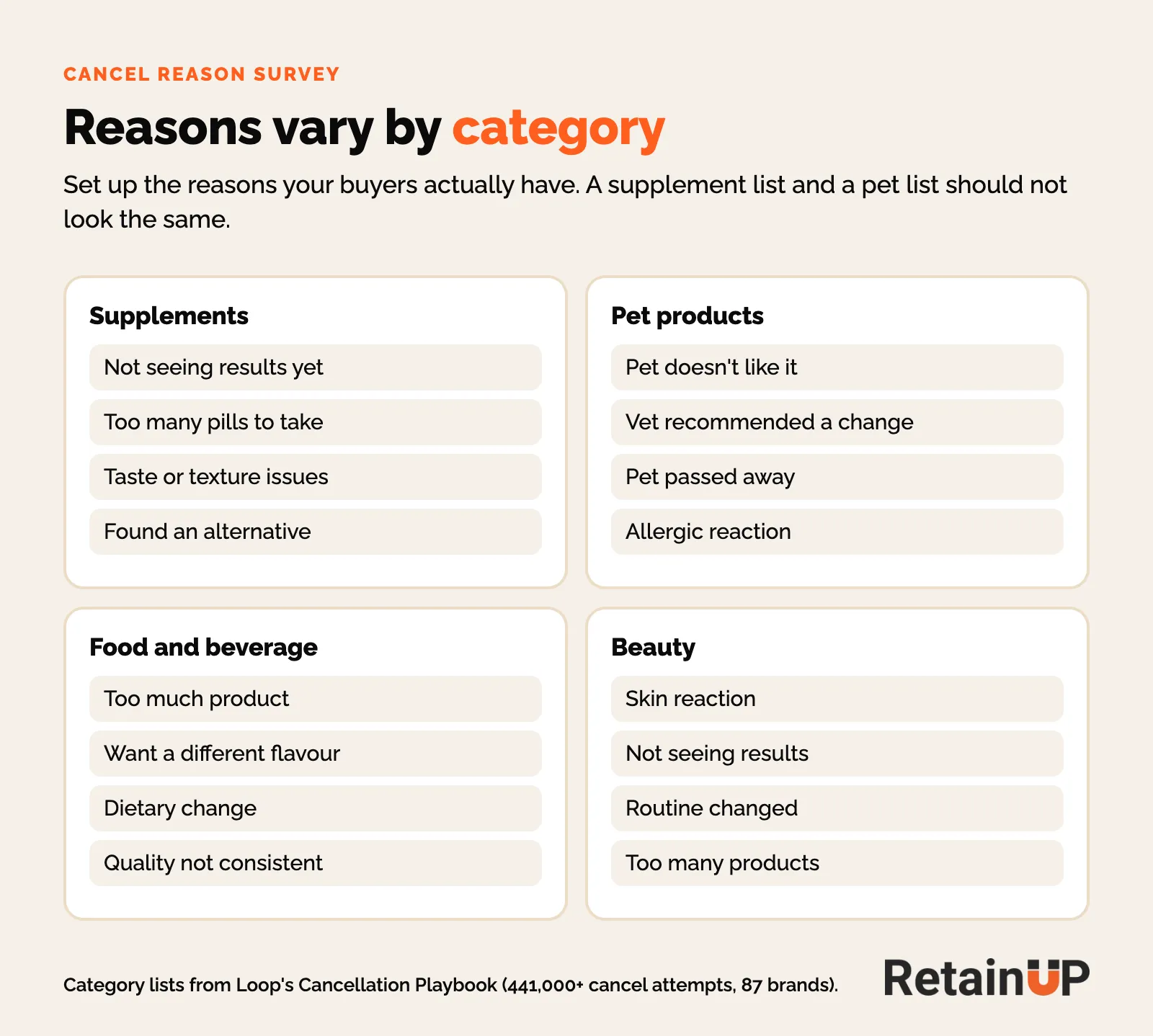
Reasons vary by category too.
Why “too expensive” wins every cancel survey
“Our product is good. The market is just cheap.” Every team believes it. And every cancel survey seems to confirm it.
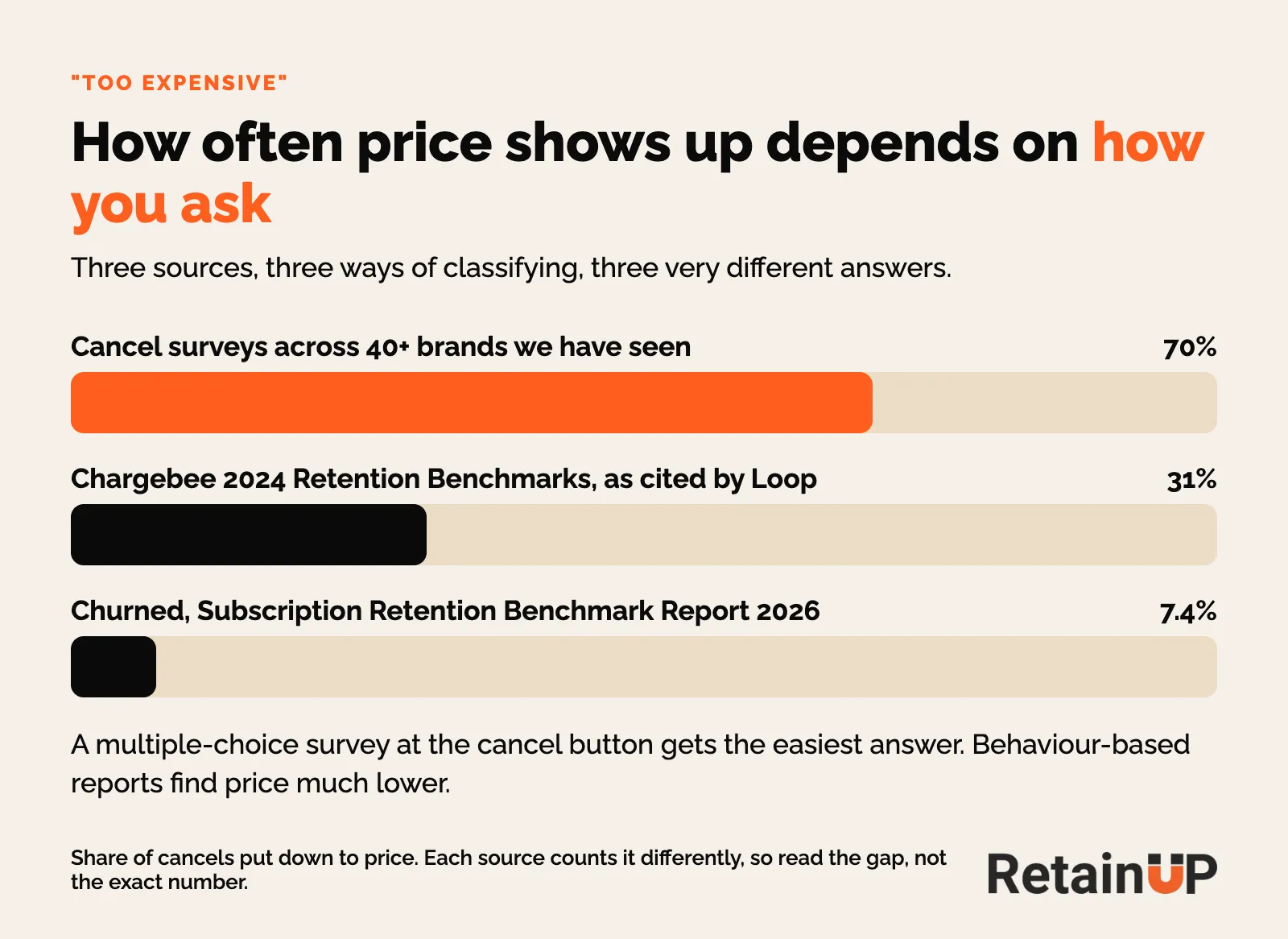
Across 40+ subscription brands, price came up 70% of the time.
Price is the only cancel reason that blames no one on the team. Finance sets the price, and finance is not in that meeting, which is why it survives every review.
The other answers are expensive to hear. “Too much product” means the cadence is wrong and someone has to change how often you ship. “I forgot I subscribed” means the onboarding never really existed. And “it didn’t work for me” puts the product itself in question.
So those answers get quietly ignored, and the discount goes out instead, the same discount that was written before the survey ran. It saves the few who left over price. It does nothing for the subscriber with three unopened boxes under the sink.
Outside data lands lower, and it moves with how the question is asked. Churned’s 2026 benchmark report puts price too high at 7.4% of cancels, behind disengaged at 48% and routine changed at 26.5%. Chargebee’s 2024 benchmarks, as cited by Loop, put price at 31% of voluntary cancels. Each one classifies differently. But none of them gets near 70%.
Two kinds of “too expensive”
What if I told you there is a Ferrari for $10K? You would take it immediately, because you know it is worth $200K.
Same $10K for a toaster. You would walk away.
Same price, completely different answer, because price is never the number. It is the transfer of value.
When a customer says price, they usually mean one of three things:
- I never felt the value match the cost.
- I forgot why I signed up in the first place.
- Something in month 2 or 3 made me doubt the product.
Price is the exit. So split it in two, and find the reason behind it.
“I don’t see the value”
Education. Why the product costs what it does, and long-term reviews from people who stayed. A discount here is wrong. They need a belief shift, and a price cut tells them the old price was too high.
“I don’t have the budget”
Empathy, then a cheaper way to stay. “We’ve all been there.” A longer gap between orders or a smaller pack first, then a real discount. Which discount, and how big, is in cancel offers that work.
“Too much product” goes to skip or frequency
The most stupid reason to cancel a subscription, and the brand caused it. It’s a timing problem.
The customer didn’t buy too much. You shipped too much.
It comes from one of two places: the habit broke and they stopped using it, or the frequency was wrong from day one. Most of the time, it’s the frequency, which is why the default frequency matters more than the number of options. Most subscribers never touch the frequency. They keep whatever you set. So get the default right. Count the servings, then divide by how much people actually use.
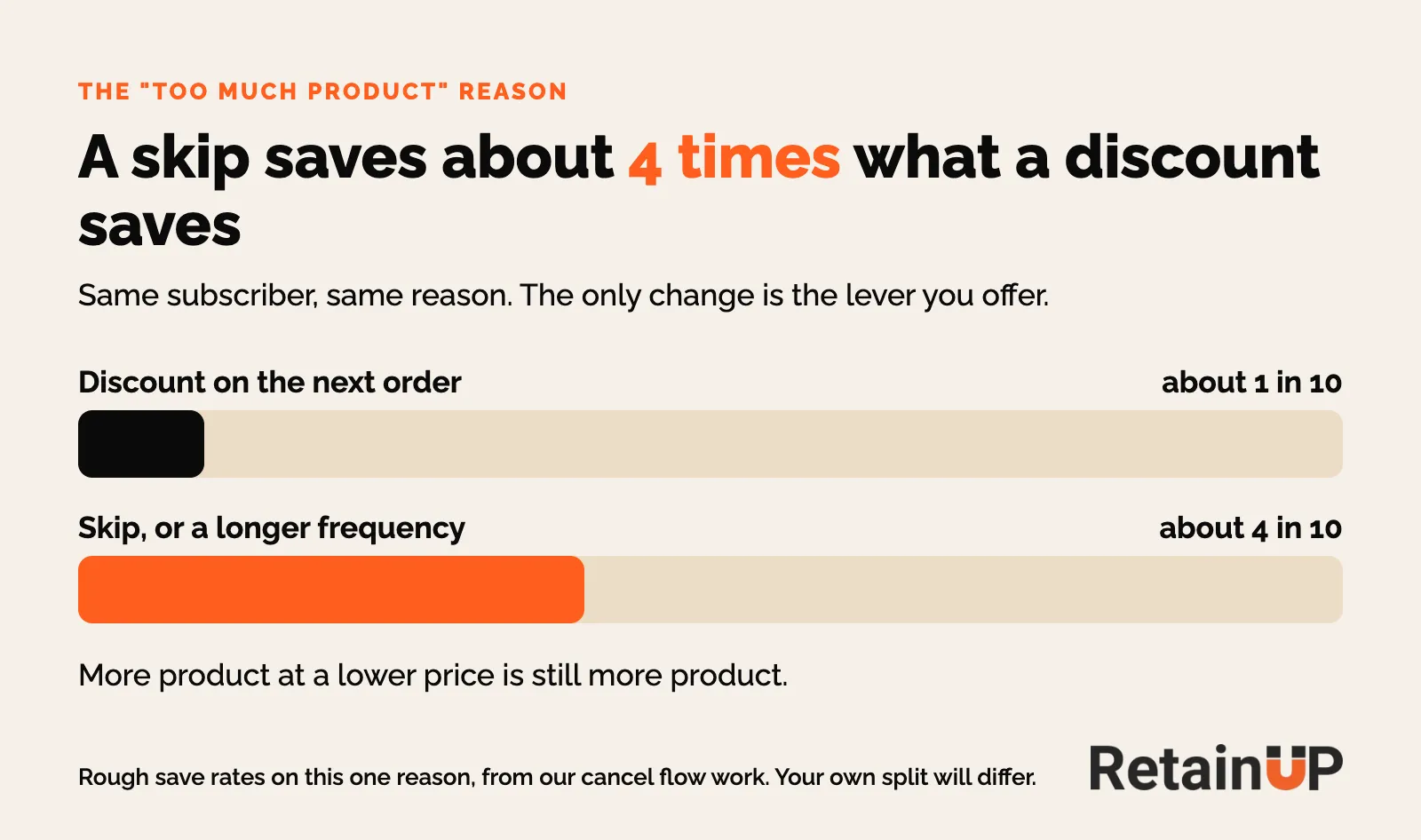
When they do say it, don’t send a discount, because a discount saves about 1 in 10. More product at a lower price is still more product.
A skip or a longer frequency saves about 4 in 10. Four times the save. The only change is offering the lever that fits the reason.
- Skip or delay the next order first, and show the new date on screen.
- Then change the frequency, so the pile never builds again. A 3-month subscriber can move to monthly as a lower commitment, framed as a choice and never a downgrade.
- Only offer a discount if they decline both.
Nick Shackelford at Brez adds rebuttals before the discount: give it to a friend, make it into mocktails, drop from a 12-pack to a 6. I agree, LTV will be lower. It’s still better than a cancel. The full ladder of skip, delay and frequency is in the flexibility ladder.
“Didn’t work” and “no longer use it”
“If you say it’s going to make you fly, you’re never going to get them to buy again.” A supplement founder told me that on a call.
Open your cancel reasons. “Product didn’t work” is sitting in there. It usually did work. The customer just checked on the date your ad gave them.
So the first screen for this reason is the results timeline. How long it takes, and what to expect. Swap product second. Contact support third, and if the answer was quality, send them straight to a support chat.
“No longer use it” needs sub-reasons more than any other answer, because the four people behind it want different things.
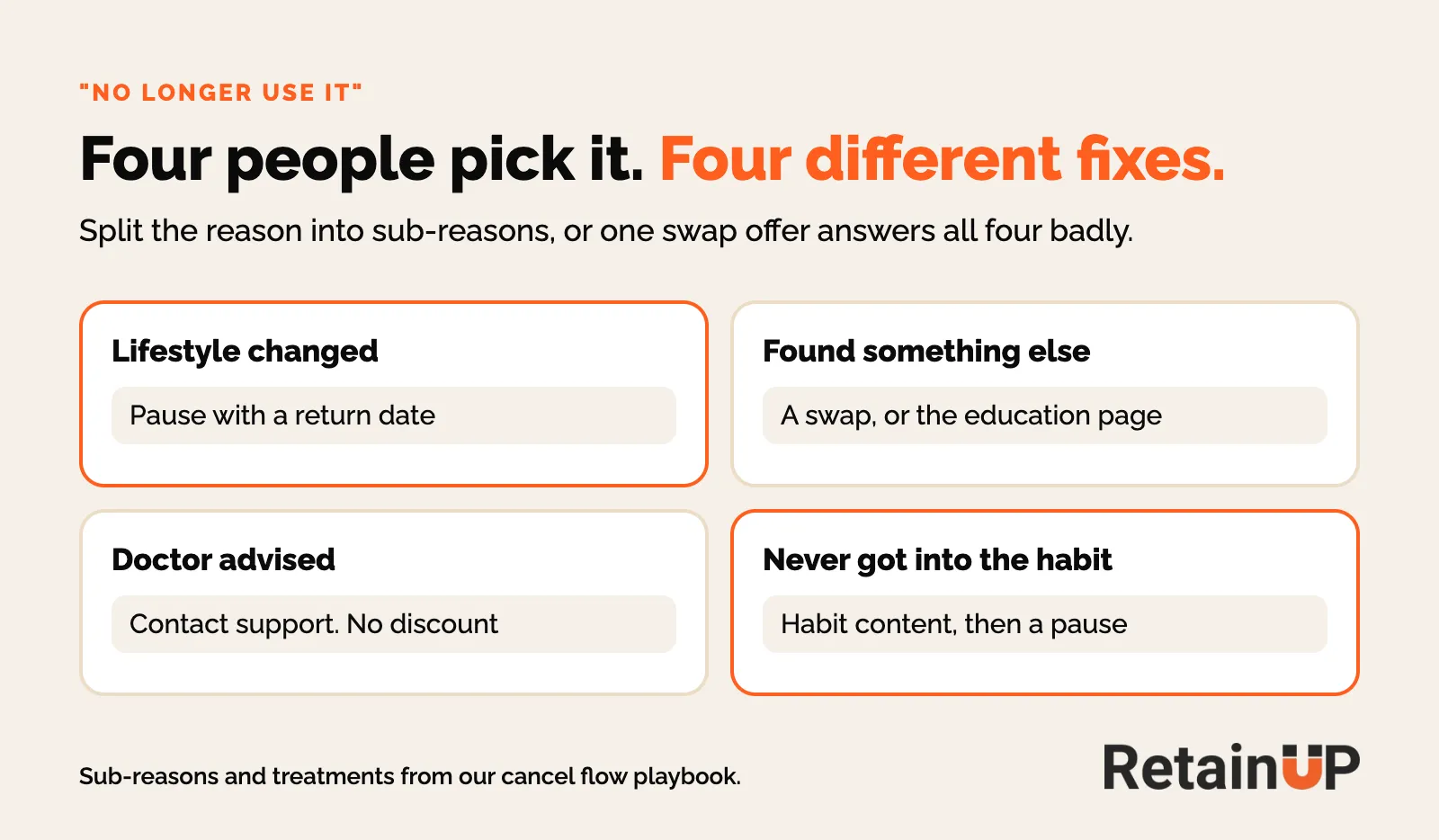
Life reasons, like a pet that passed, get empathy and no offer. They may return. And watch when these cancels land. At one of our brands, 2 in 3 cancels came right after the first order, so the fix sat in the first month, which getting past order 2 and order 3 covers.
What retention can’t fix: taste and product fit
Some reasons are product feedback, and a cancel flow can only soften them.
One of our brands on Loop had taste or texture as its top reason by far: 41% of all cancels. It wasn’t fading. With quality added, it was 68% of the named reasons. Price was 10%.
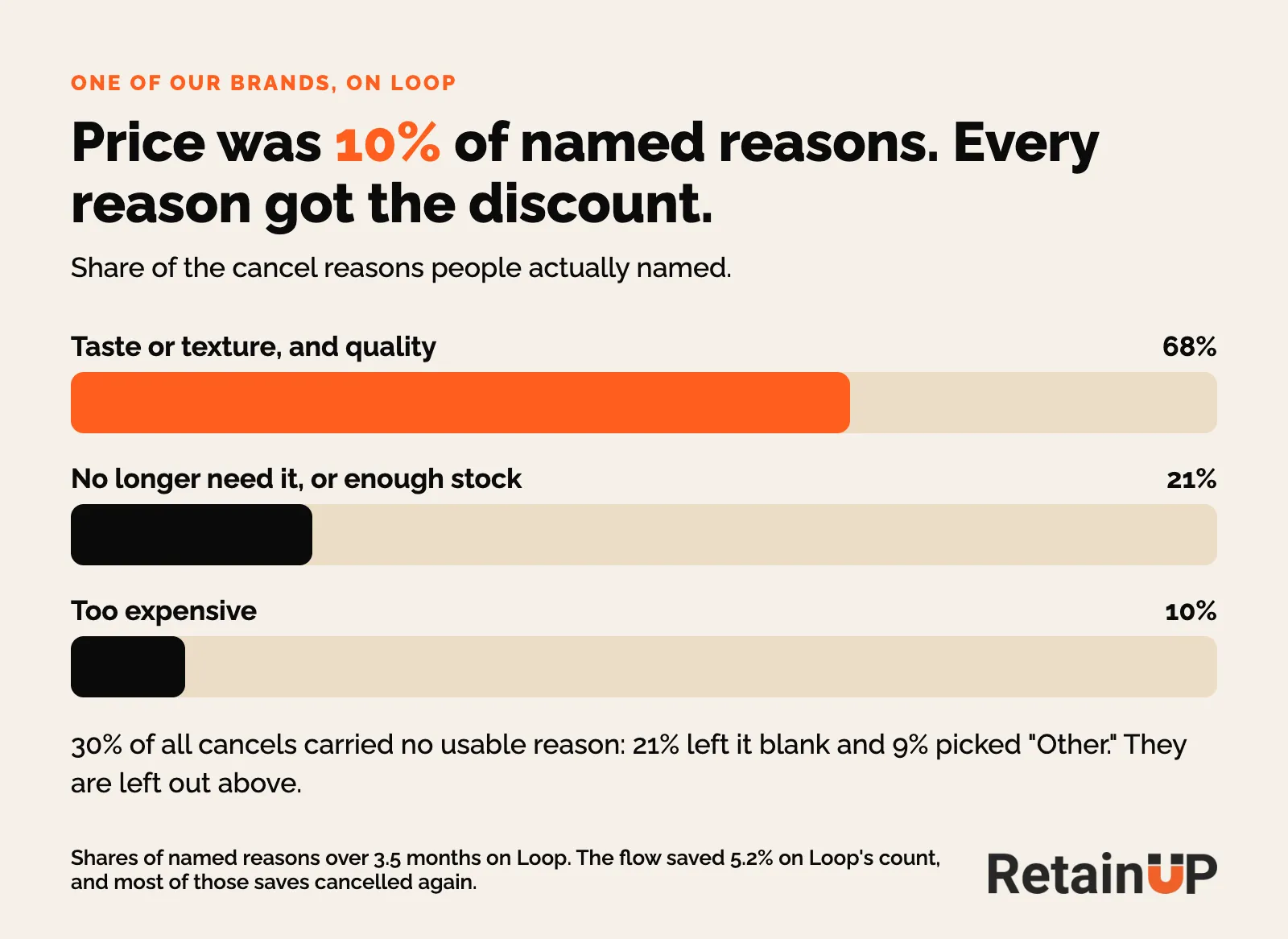
Every reason got the same offer, “Extra 10% off next 6 orders.” The taste screen was the biggest screen in the flow and saved nobody. Overall the flow saved 5.2% on Loop’s count, and most of those saves cancelled again soon after, some within a day.
So we rebuilt the reasons. For taste, the plan carries no discount at all:
- A tips screen first: how to take it, with food, chilled, plus a video from the founder.
- A swap between the kids and adult lines, or a smaller pack that works for them.
- A note on the 30-day guarantee.
The discount stays on the price reason only. Some customers can’t be saved. That is the product team’s number, and it belongs in their meeting.
TruHeight went the other way round. Taste issues drove 30% of their cancellations, so they reformulated, and cancellations dropped. Their save rate is 20.5%. The reason survey is product research if somebody reads it.
Report each reason as a share, and split it
A count of reasons tells you very little. Report each one as a share of the reasons people actually named, with the blanks and “Other” taken out, and show the blank share next to it.
At the same brand, 30% of cancels carried no usable reason. That was 21% with no reason at all, because the reason field was optional, plus 9% “Other.” So the first fix was making the reason required.
Then split it. By product, because a flavour problem on one line hides inside a healthy average. By plan. And by order number, since month 1 to 3 and month 4 onward need different treatments.
Read “Other” and the open text every month
You ask the question at the worst moment. The customer is already gone emotionally. They want out fast. They pick the first option on the list, and you record it as a pricing problem.
So add one open question at cancel: “What would have made you stay?” Open text forces a real answer. Check what your app allows first. In Recharge, survey answers stay optional, so you can’t force a written answer, though it does run AI over the “Other” replies.
Read the free text every month. When the same theme shows up 3 or more times, turn it into a named reason with its own fix.
The reasons people give in version one are not the reasons they give a year later. One brand started pushing subscription hard last quarter. Their number one cancel reason became “I did not know this was a subscription.” Nobody would have guessed that. It only showed up because someone read the reasons, and it is a checkout problem, covered in stopping day-zero cancellations.

Two questions work better earlier, on day 14 and day 60. Both live in usage check-ins and surveys.

A reason that only lives during the sale
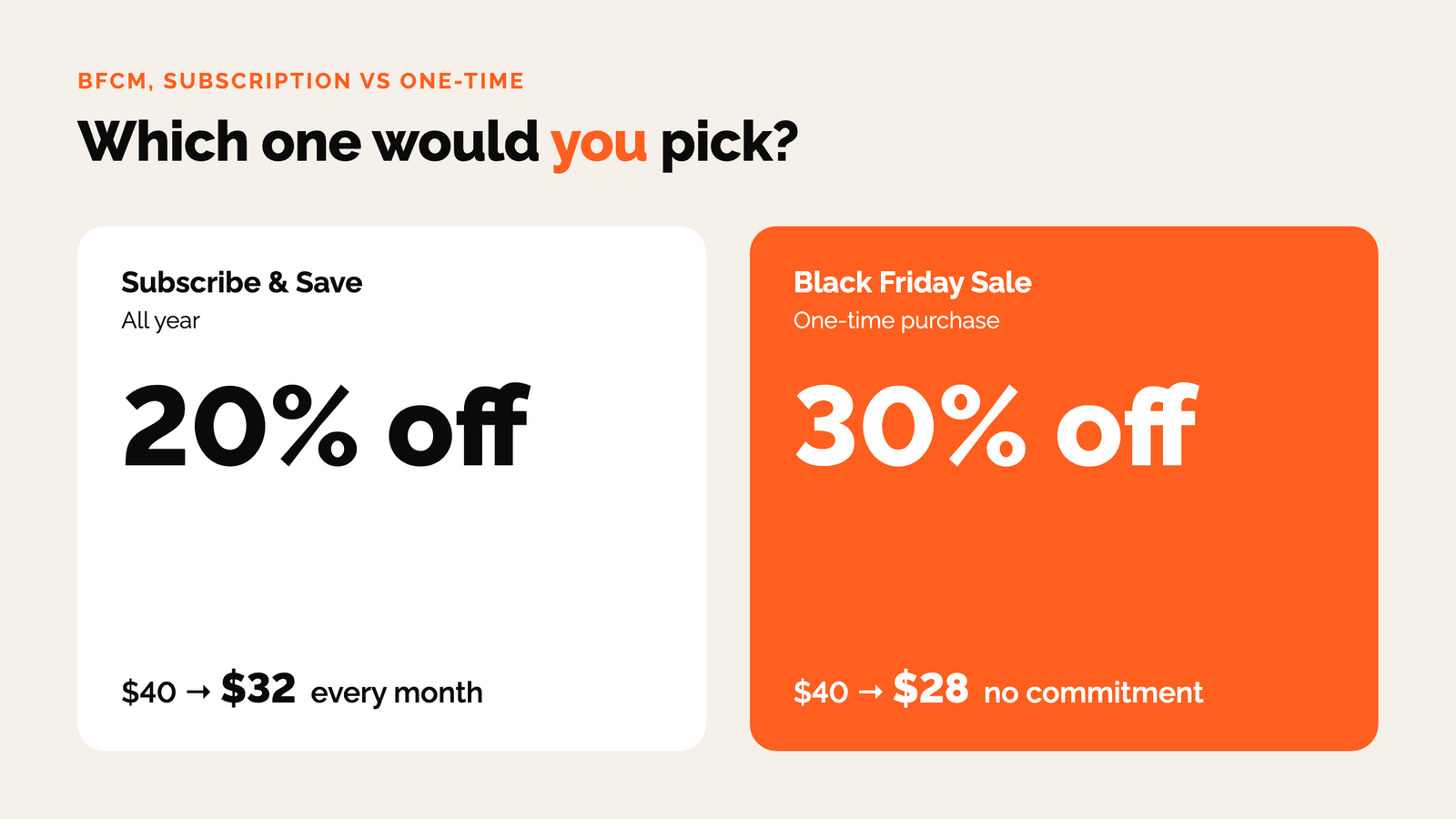
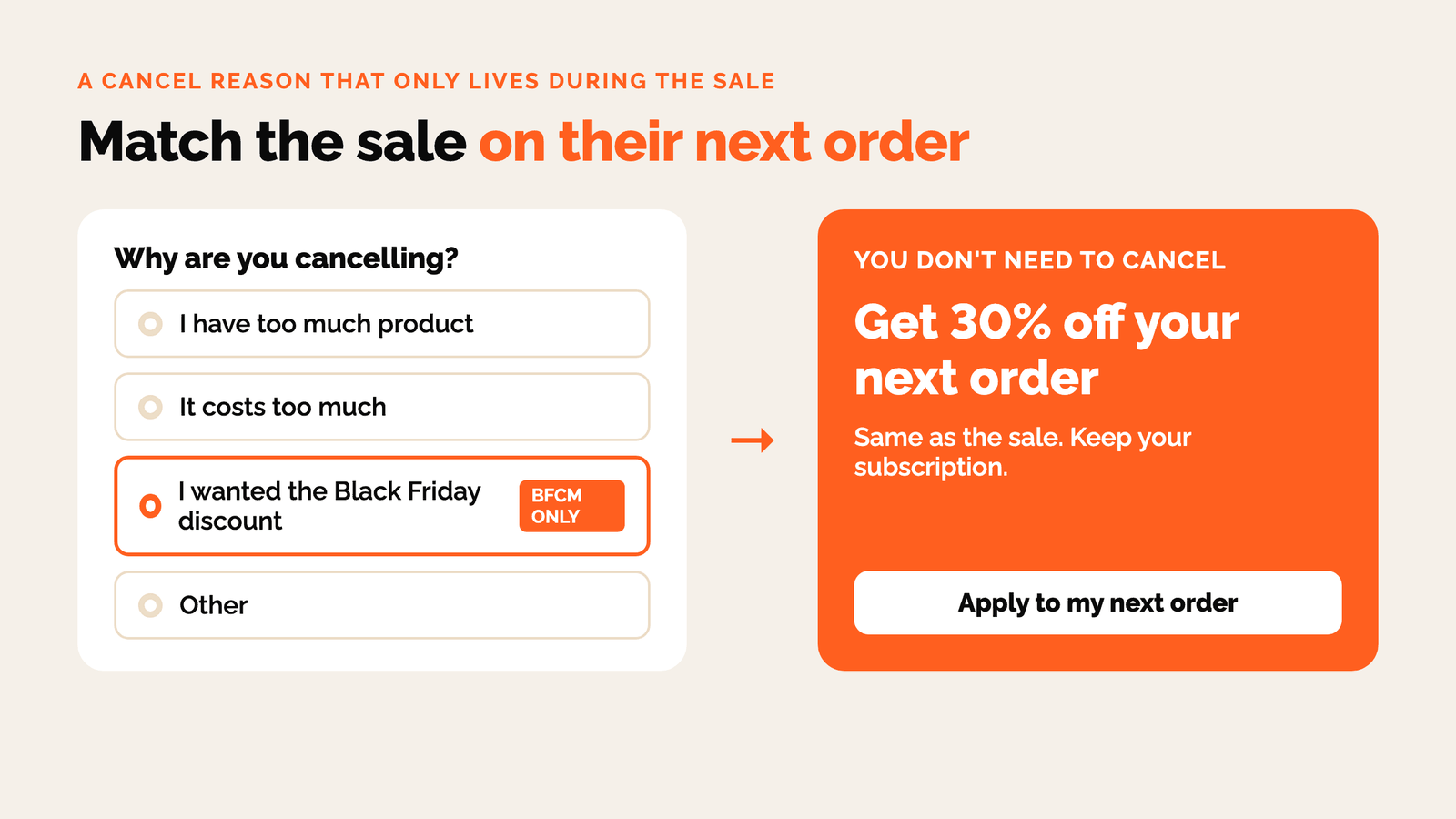
Around Black Friday a new reason shows up: “I wanted the sitewide discount.” Add it for the sale weeks only, and match the sale on their next order. The rest is in BFCM for subscription brands.
Keep the map moving
For SunMed on Skio, we moved the cancel flow save rate from 14.8% to 24.8%. About 1 in 4 now stays where it used to be closer to 1 in 7. The whole program is in the SunMed case study.

The reason map is never finished. A treatment that saved a third of one reason last year can save almost none of it today, and nothing in the dashboard tells you until you go looking. So read it monthly. One test at a time, four weeks each, as in how to A/B test a subscription program.
Reading the reasons every month and shipping the fix is the work of the Subscription LTV Optimizer™. Your store, subscription app and Klaviyo get checked every month and the fixes get shipped, for brands with 5,000+ active subscribers, at $3,000 a month.
FAQ
What are the most common subscription cancellation reasons?
Too expensive, too much product, the product didn’t work, no longer use it, and other. Price comes up most often in surveys, about 70% of the time across 40+ brands we have seen. It is usually the easiest answer to pick, though, and the real reason sits behind it.
Should a subscription brand offer a pause or a discount when customers cancel?
Neither by default. It depends on the reason they pick. Too much product gets a skip or a longer frequency first, and a discount saves only about 1 in 10 of them. A lifestyle change gets a pause with a return date, and only “I don’t have the budget” gets a real discount. Showing everyone the same discount saves under 5%.
Should the cancel reason be required?
Yes, where your app allows it, because a blank reason cannot be routed or fixed. At one brand we audited, 21% of cancels had none. Recharge keeps survey answers optional, so there you read the custom answers each month instead. Keep an “Other” option with a text box, and turn any theme that shows up 3 or more times into a named reason.
One email a week on subscription retention: the numbers, the strategy, and what to fix first.

Rahi Jain
Rahi Jain is a subscription LTV specialist who helps $1M to $10M DTC brands reduce subscription churn and maximize LTV on Recharge, Skio, Stay AI and Loop.
More about Rahi