Key takeaways
- Month one runs about 14 touches before the first charge: two emails in transit, an email and SMS on delivery, six in week one, then one a week.
- Grüns sends six emails in six days, one every morning of week one, and counts the day out loud in each subject line.
- SunMed moved month 3 retention from 61% to 73% after its onboarding and lifecycle flows went live on Skio.
This is one part of the subscriber onboarding guide, which walks the first 90 days.
A new subscriber pays you, then waits. Most supplement brands send two or three emails in month one. Order confirmed. Order shipped. Maybe a founder story. Then silence until the card gets charged.
That silence is where the second order goes. I pulled every cancellation from one brand and counted them by day since signup. Three days hold most of them: the signup day, the day the pre-charge reminder goes out, and the charge day. And everything that stops the last two has to be said in the weeks nobody is using.
What the month-one emails are for
One job. Get them using the product before the first renewal.
A subscriber who takes it every morning through the first bottle renews without thinking. One who takes it four times and leaves it on the shelf has already left, whether the cancel lands on day 30 or day 90.
Habits take around 66 days to set, not 21. So month one decides whether the product ever gets a slot in their day. The routine side of that is in building the habit with routine anchors.
Brands running a real onboarding flow cut month one churn by up to 25%. Around 10% of subscribers leaving before the first renewal is normal, so that is the number you are working against.
"We already have a subscription onboarding." If I had a dollar for every founder who said that on a call, I would have $137 by now. Most have 2 or 3 emails. Some with a good agency have 4 or 5.
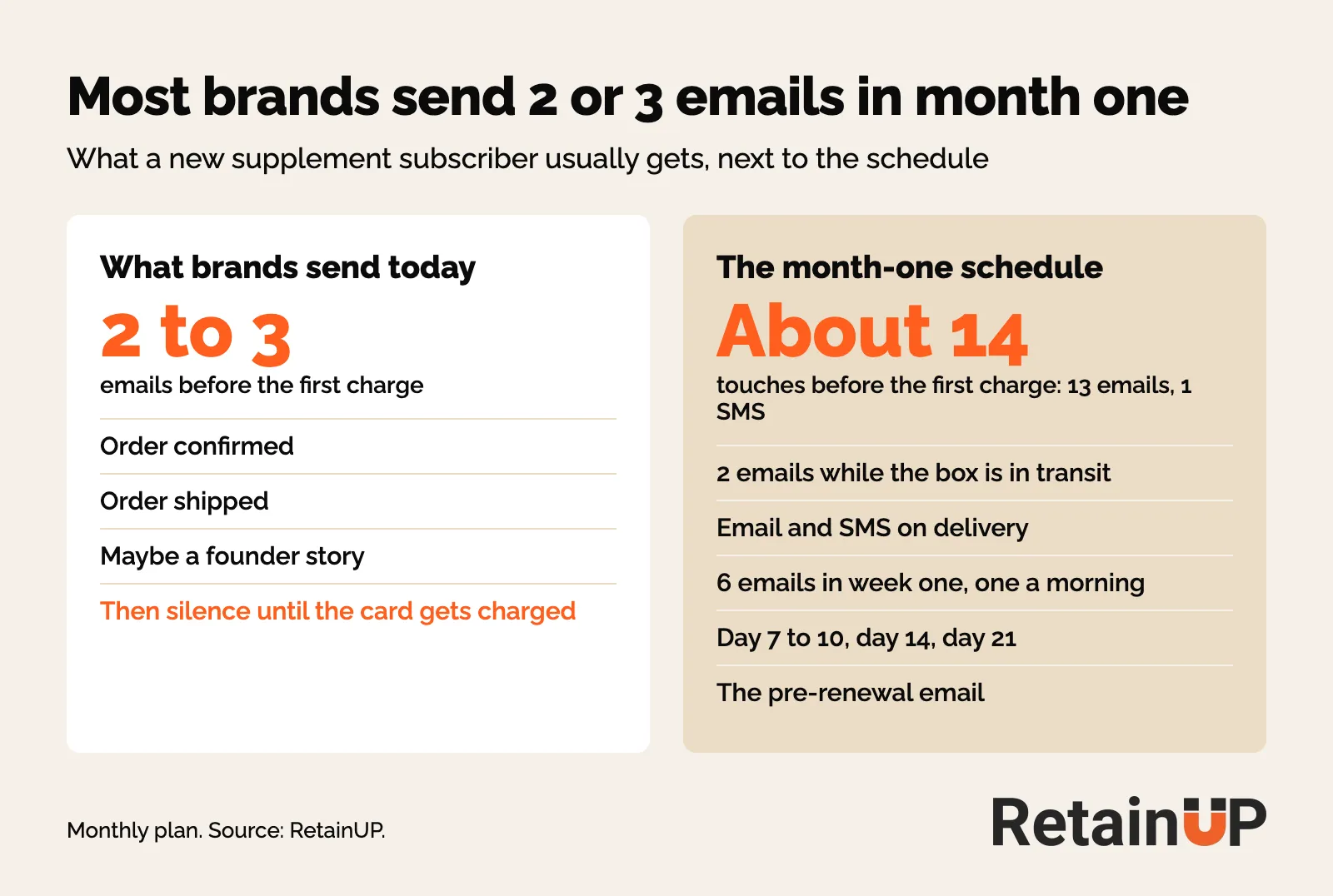
But a welcome flow is done in three days. Onboarding has to carry the momentum to the next charge. On a monthly plan that is 30 days, and on a quarterly plan it is 90, so the flow needs to be even longer.
The month-one schedule, day by day
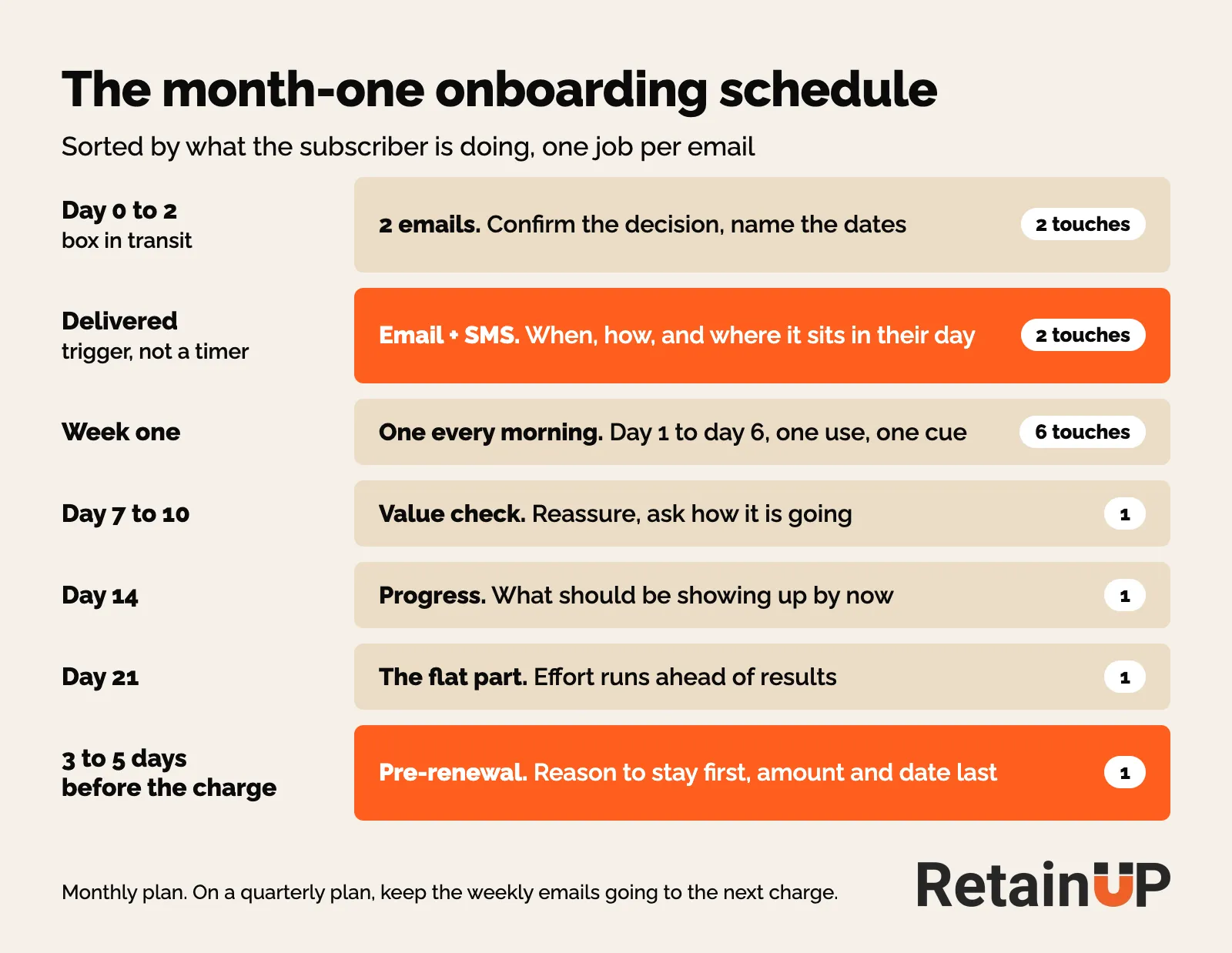
Most template sets hand you eight emails sorted by topic. Founder story, brand story, product features. Sort by what the subscriber is doing instead. Two emails while they wait, one email and one SMS when the box lands, one a day in week one, then one a week up to the pre-renewal email.
| When it sends | Its one job | |
|---|---|---|
| Welcome | Day 1, the day after the order | What they just committed to (product, how often, price, next charge date) and what the first week will feel like |
| What to expect | Day 1 to 2, while in transit | Build the connection, name the dates their results land on |
| It is here | On delivered, email plus SMS | When to take it, how to take it, where it sits in their day |
| Day 1 to day 6 | One a day, week one | One use, one habit cue, one small thing to notice |
| Value check | Day 7 to 10 | Reassure, reframe the results timeline, ask how it is going |
| Progress | Day 14 | What should be showing up by now |
| The flat part | Day 21 | Hold them through the stretch where effort runs ahead of results |
| Pre-renewal | 3 to 5 days before the charge | A reason to stay, then the amount and date at the bottom |
Day 0 to 2: while the box is in transit
Two emails. Nothing about managing the subscription.
Most people who cancel on their signup day do it inside 48 hours. Fast. Day zero holds 5.6% to 8.4% of cancellations at every billing frequency. They have not seen the product. Nothing to dislike yet. They are nervous, or they came for the offer. The checkout side of that problem is in stopping day-zero cancellations.
Thomas Lalas gives these two emails three jobs. Confirm the decision. Reduce the doubt with order updates and real people using the product. Then show the gifts still to come. The goal is a fair chance for the product when it lands.
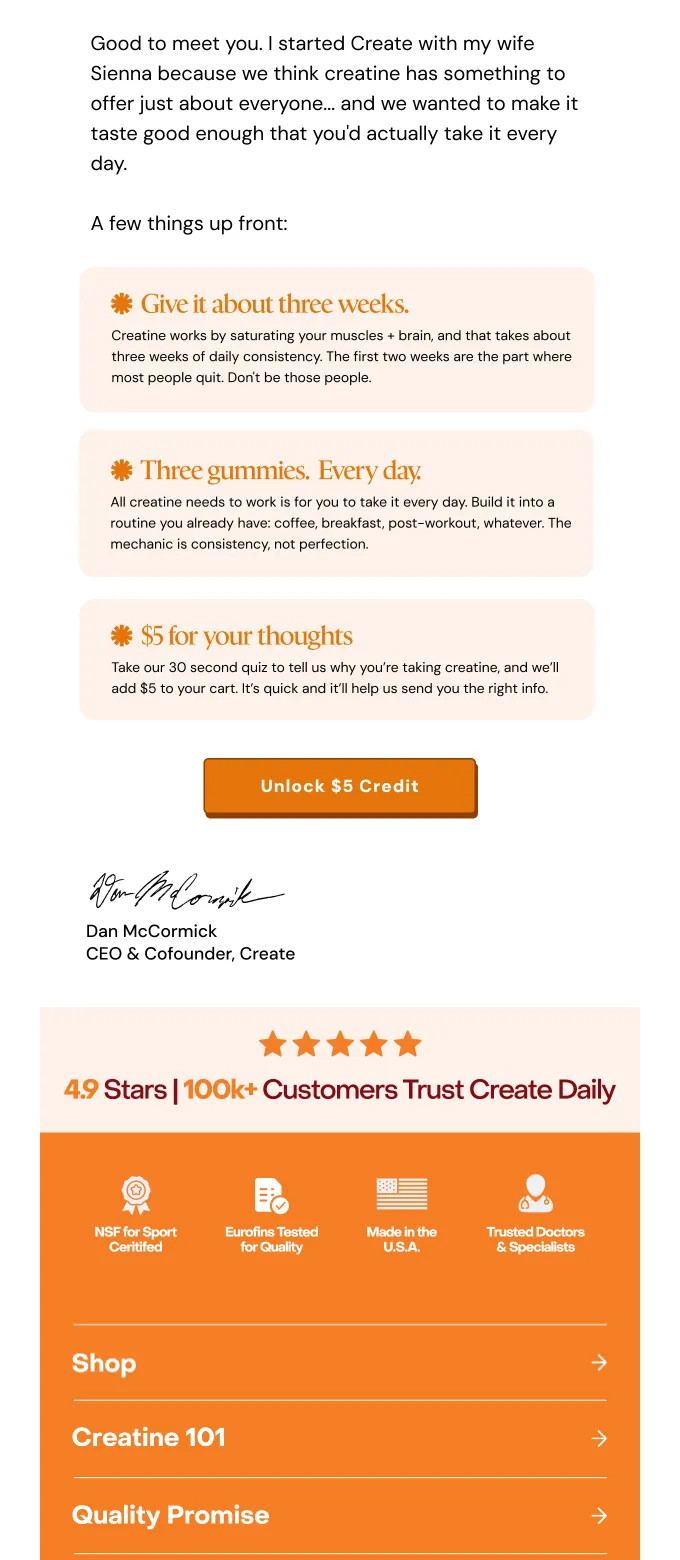
Create does this well. The welcome email comes from the co-founder. Give it about three weeks. Three gummies, every day. And $5 for a 30-second quiz on why you take creatine. It asks instead of selling. The rest of that program is in the Create subscription scorecard.
No upsells yet. Those belong on the post-purchase page.
Delivery day: one email and one SMS
Trigger on delivered, not on a timer. Most brands wait 3 to 4 days, then 7, then 7. Wrong. A how-to-take-it email that lands before the box is noise.
Three things in it. When to take it. How to take it. Where it sits in their day, tied to something they already do each morning. "Take it daily" gets ignored. "Stir it into the coffee you already make" gets done.
This one matters most. Do not worry about repeating yourself, most subscribers read selectively. The box itself carries the same job off email, and that is in the first box and the card inside it.
Week one: an email every morning
Six emails, six mornings, one job each. Most brands would call that spam.
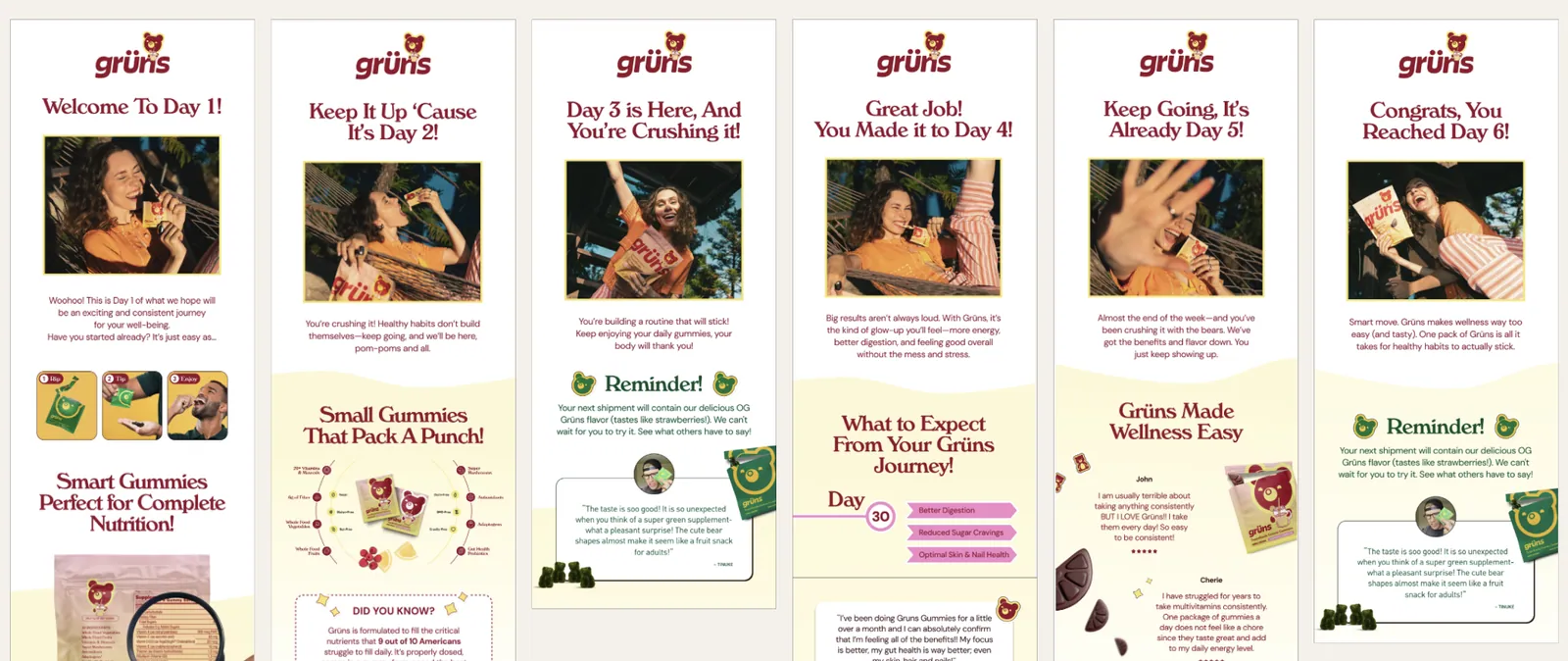
Grüns sends one every morning of week one, and the subject lines count it out loud. Welcome to day 1. Keep it up, it is day 2. Day 3 and you are crushing it. The gummy only works if it is taken daily, and week one decides whether it becomes a habit or a drawer item. More on how they run the rest in the Grüns subscription breakdown.
Look at what the six do. They mark the streak. They show other people mid-streak. They slip the next shipment date in twice, so nobody is surprised when the card gets charged, and they say what day 30 and day 60 should feel like before you have a reason to doubt it. And they keep asking for "Order More Grüns".
There is no universal email frequency benchmark. Someone building a daily habit needs daily emails. At least in the beginning.
Weeks two to four: progress and the flat part
Then one a week. The job shifts from use to belief.
Day 7 to 10: the value check
Most products do not show results in week one. The subscriber starts to wonder. So this email does not sell. It reassures, and gives them one thing to watch for. "Notice how your energy feels by 10AM" does more than "our product improves energy."
It is also where you ask how it is going. Two answers, never a no, and each gets its own follow-up. The questions are in usage check-ins and surveys.
Day 14 and day 21
Day 14 is progress. Day 21 is the flat part, where the effort has gone in and the result has not shown up yet, and that is the week people quit.
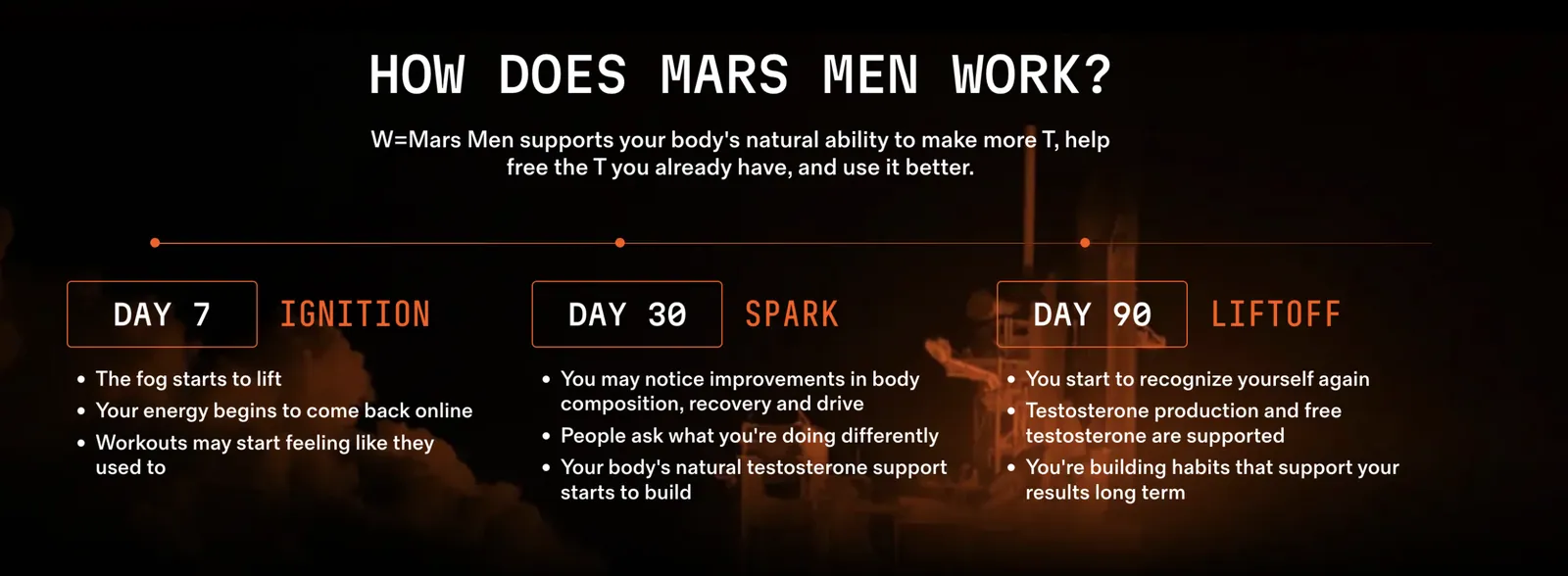
Supplements pay out slowly, so name the dates. Mars Men names three. Day 7, the fog starts to lift. Day 30, energy and recovery. Day 90, people ask what you are doing differently. A subscriber who knows what day 30 should feel like does not quit in week three. The full program is in the Mars Men subscription breakdown.
The pre-renewal email
It is the most opened email you have in month one. And at one brand the day it went out created its own cancellation day: more than three times the cancels of the day before, with the charge day bigger still.
So do not send a bill with a cancel button. Lead with a reason to stay, then what the product is doing for them, then what is coming next. The amount and date go at the bottom, skip and reschedule are the main buttons, and cancel stays available. Send it 3 to 5 days before the charge. The full build is in the upcoming billing reminder, and the three cancellation days are in cancellation day spikes.
Put the order 2 gift in it
If a gift ships with order 2, this email is where the subscriber finds out. Obvi tested it. Subscribers told by email and SMS, before the order processed, that a free gift was coming showed an 85% lift in order 2 retention. By order 4 the lift was gone. Announced after the charge, it does nothing. How to set up the milestones is in subscription rewards.
Too early backfires too. Announce it right after the first order and you mostly remind people they have a subscription. Everyday Dose puts the ladder on the product page, a canister at order 2 and a tumbler at order 3, and the reminder only confirms it.
Hero product only in month one
Every email in month one drives use of what they already bought. No cross-sell. No new products. Not yet. Some template sequences, like this one from Excelohunt, put an add-on email at day 14. I would hold it. After the first renewal lands, bring in the adjacent products. Splitting their attention before they have committed to the first one loses the people who have not found the value yet.
The same goes for brands with more than one hero. We sent a brand its new onboarding emails, and the founder came back with two words. "Too mixed." He was right. The brand sells a sleep drink, a matcha and a morning energy drink, and we had written one sequence for all three. So someone who bought the sleep drink got emails about morning focus. We rebuilt it into three versions. Now it splits by product.
Flow setup: when it starts and when it stops
These are the rules we build every onboarding flow on. Where the flow sits next to the other eight is in the core subscription email flows.
- Trigger it on your subscription app's subscription-started event in Klaviyo, not on Placed Order, so one-time buyers never get it. Event names per app are in subscription app events in Klaviyo.
- Leave out anyone who already has an active subscription. Attribuly's flow blueprint does the same, because a second subscription should not restart "welcome to day 1".
- Start it a day after the order. The order confirmation and shipping emails do their own job on day 0.
- Exit on cancel, pause or skip. Without that filter, cancelled subscribers keep getting "keep it up, it is day 4". We once saw a subscriber start a new subscription and cancel the old one through the onboarding email of the new one.
- Exclude onboarding subscribers from campaigns and from cart and browse abandonment. Tight communication.
- Name the steps delivery 1 and delivery 2, not month 1 and month 2, since frequency varies.
- Never send a discount to someone who has not used the product. They stopped taking it, not liking it.
Match the emails to the bottle
A supplement brand had 60-tablet bottles. The label said take 2 daily. Most customers took 1. So the bottle lasted 60 days, not 30. Their 30-day emails landed while customers still had product, and their 90-day emails landed after the habit was gone.
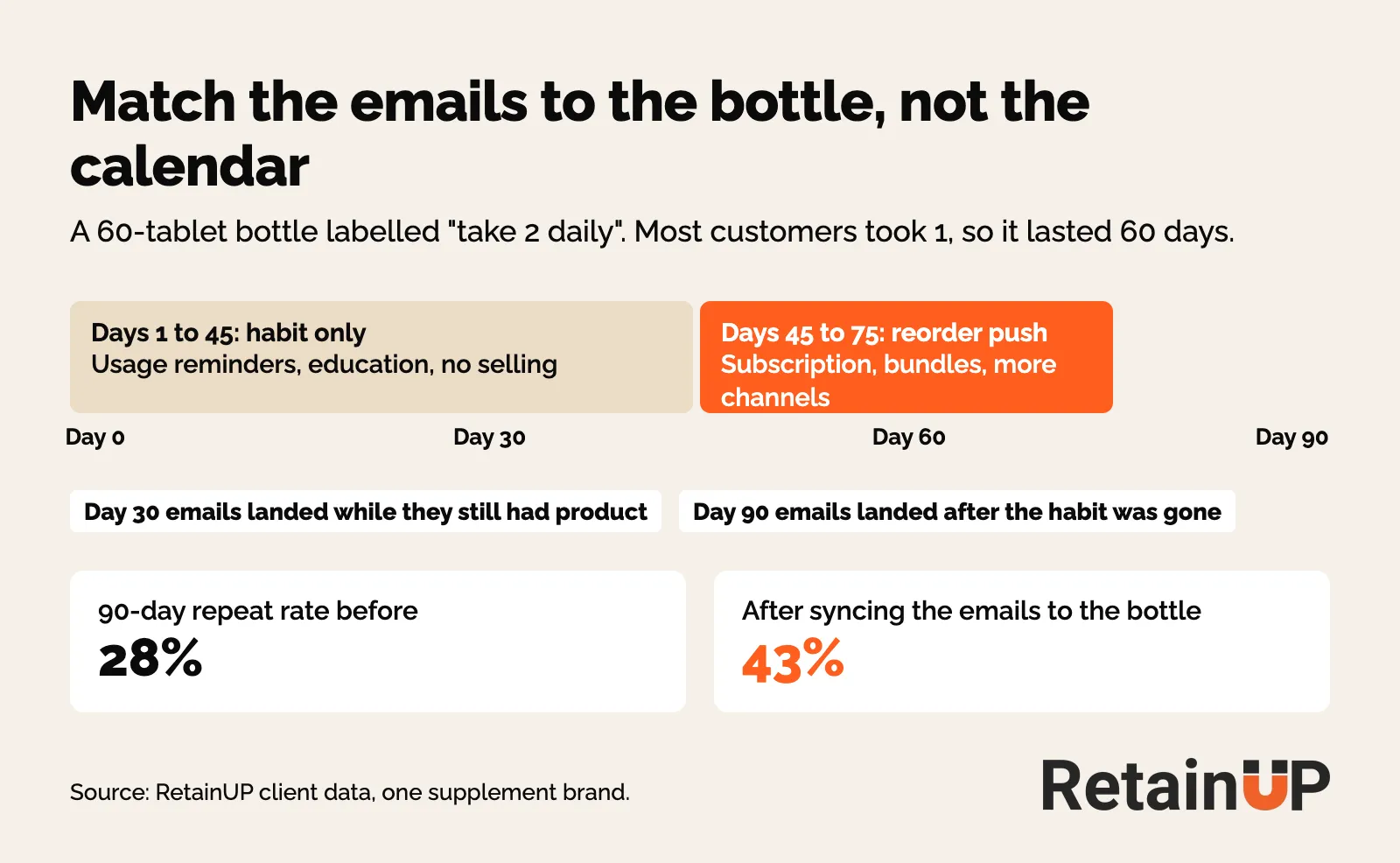
So we mapped the real consumption window. Days 1 to 45, habit only: usage reminders and education, no selling. Days 45 to 75, the reorder push. The 90-day repeat rate went from 28% to 43%.
What the schedule did for our brands

SunMed sells CBD supplements on Skio. Their onboarding is the five emails above, across the first weeks. Each asks how they feel and what CBD does over time. The third names skip, pause and adjust with a Manage Subscription button, so someone with too much product changes the plan instead of cancelling it.
Order 1 to order 2 retention went from 90.9% to 94.7%. Month 3 retention went from 61% to 73%, with every other flow in the build live too, so the onboarding does not get all the credit. The full build is in the SunMed case study.
A skincare brand ran a shorter version: day 0 welcome and identity, day 3 stack the routine, day 14 show progress, day 21 nudge. Their 90-day repeat purchase rate went from 22% to 35%.
How to tell if it is working
The KPI is second month retention. The 60-day repeat rate. Open rates on a daily week-one flow look low next to a campaign. That is fine.
And compare like-aged cohorts from before and after launch at 30, 60 and 90 days, as Skio suggests. That is how the SunMed number above was read. How to read the table is in subscription cohort analysis.
Then watch the full week around the first renewal, not the day your reminder fires. That email always makes a spike where it lands. If month 2 retention is below 70%, stop scaling acquisition and fix onboarding and the second charge first. Where new subscribers drop after that is in getting past order 2 and order 3.
If you want this schedule built and live, it is part of the Subscription LTV Maximizer™. The offer, widget, cancel flow, portal, payment recovery and pause and skip get built in Recharge, Skio, Stay AI or Loop, plus the email and SMS around them, live in 30 days for $5,000.
FAQ
How many emails should a subscription onboarding flow send?
About 14 touches in month one on a monthly plan, 13 emails and one SMS. Two emails while the box is in transit, one email and one SMS on delivery, six across week one, then one a week up to the pre-renewal email. On a quarterly plan, keep the first month and carry the weekly emails on to the next charge.
Is one email a day too many in week one?
Not when each one carries a single job. Week one is when the subscriber decides whether the product has a slot in their day, and Grüns sends six emails in six days for that reason. Someone building a daily habit needs daily emails at the start, and the volume drops to one a week after that.
When should a subscription onboarding flow start?
A day after the order, once the confirmation and shipping emails have gone out. Day zero holds 5.6% to 8.4% of cancellations at every billing frequency, and most of them happen inside 48 hours, so the first onboarding email has to land early.
Should onboarding emails explain how to pause or cancel?
Not in week one. Keep the early emails on use, and put skip, reschedule and swap in the pre-renewal email, where a subscriber who needs them will look. Some agencies teach pause and skip in the second email. Our builds wait until the habit has started: SunMed names skip, pause and adjust in its third onboarding email, the one that asks how the first week went.
What is the KPI for subscription onboarding emails?
Second month retention, the 60-day repeat rate. Brands running a real onboarding flow cut month one churn by up to 25%, and around 10% leaving before the first renewal is normal. If month 2 retention sits below 70%, fix onboarding and the second charge before you scale acquisition.
One email a week on subscription retention: the numbers, the strategy, and what to fix first.

Rahi Jain
Rahi Jain is a subscription LTV specialist who helps $1M to $10M DTC brands reduce subscription churn and maximize LTV on Recharge, Skio, Stay AI and Loop.
More about Rahi