
Key takeaways
- The Repeat Purchase Maximizer runs in three phases, Map, Activate and Sustain, across nine steps, and aims for a 40% 90-day repeat purchase rate.
- FreshCap reached a 79% returning customer rate without discounts by timing reorders to its hero SKU, lion’s mane powder, which sells again after 45 to 50 days.
- Email goes first in steps 4 to 8, and other channels come in at step 9, so execution stays simple.
I built a 10 million dollar brand on Facebook ads, and every month felt like sprinting to stay in place. Retention was the leak, and no email flow or loyalty app fixed it alone.
What fixed it was a system. Here is the one we use with health, beauty and food CPG brands doing at least 500K in revenue.
Why email alone does not fix retention
In 2012 I launched my own ecommerce brand. We crossed 10 million in annual revenue with over 1 million poured into Facebook ads. Retention was broken, and it quietly ate our profits.
I then started an email agency. We worked with 50 plus brands and drove 63 million in attributed revenue through campaigns, flows and abandoned carts. Retention still did not move much, because the leaks sat outside email.
Most brands run a welcome flow, an abandoned cart flow and a few post-purchase emails, then call retention handled. Loyalty, subscription and email each run in their own silo. Nobody plans what happens after the second order, how to treat VIPs, or how to win back lapsed buyers.
The brands that scale past $10M build one connected experience. It uses feedback, data and post-purchase patterns, and it times each message to when people actually buy.
The Repeat Purchase Maximizer: three phases

We call the system the Repeat Purchase Maximizer. It has three phases and nine steps, and the target is a 40% 90-day repeat purchase rate.
- Map: see who buys, what they buy and when they return, before you build anything.
- Activate: guide customers to the next order with the right message at the right time.
- Sustain: reward your best customers and catch the ones about to leave.
Each step gives a lift alone. Together they compound, which is how brands pass 40% without leaning on paid ads.

Phase 1: Map
Step 1: Analyze repeat patterns
Start with the catalog. Which SKUs do customers keep buying without a promotion, and how long until each one is reordered? A 60-day supplement bottle might come back after 55 to 65 days. A moisturizer might return after 40 days while a serum lasts 75.
That timing tells you exactly when to reach out. Then look at repeat purchase rate at 3, 6 and 12 months, median time to second order, VIP and lapsed counts, and CAC to LTV ratio by channel.

Step 2: Listen to customers
The numbers show what happens. Customers tell you why. Run post-purchase surveys, track NPS, send one survey to loyal customers and another to lapsed ones, and read your reviews for repeating themes.
You come away with the exact words customers use, which then go into your emails, offers and loyalty program.
Step 3: Map the journey
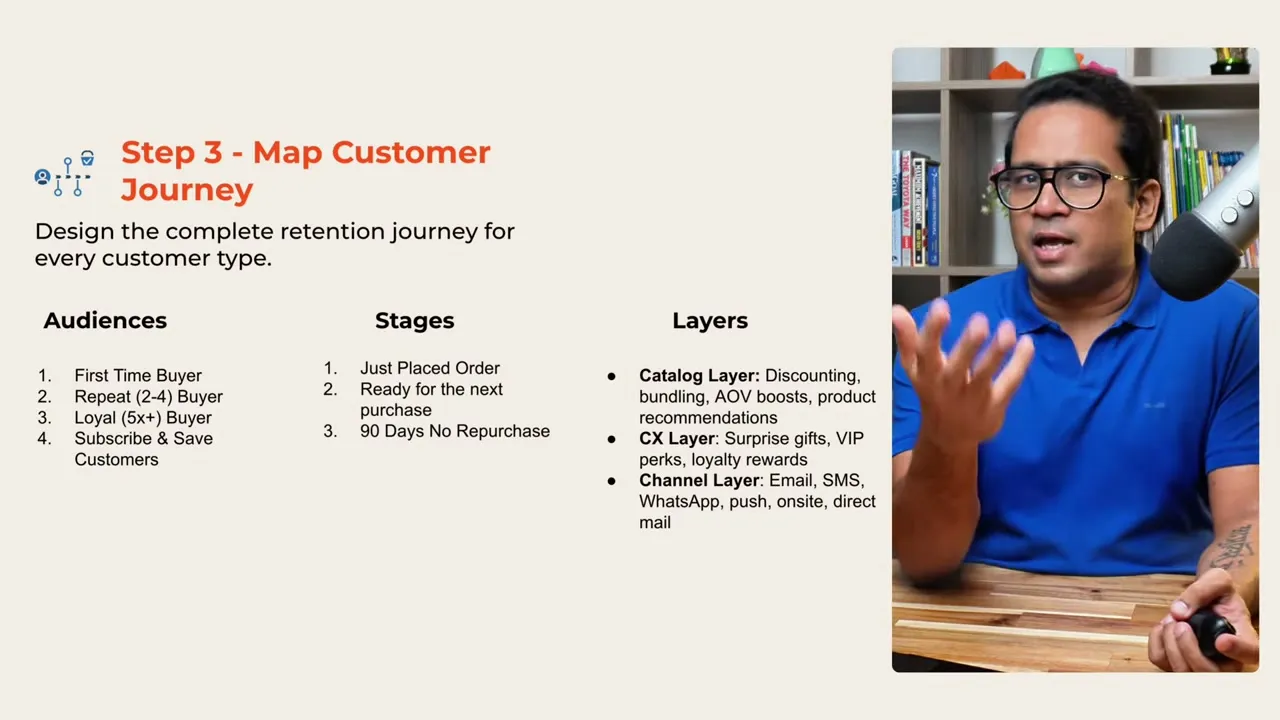
Take four audiences: first-time buyers, repeat buyers, loyal buyers and subscribers. Give each three stages: just ordered, ready for the next purchase, and 90 days without a reorder.
At each stage, answer five questions. Where is the customer now, what is the next step, which product or offer fits, which channel delivers it, and what small surprise can we add?
Stack three layers on top: catalog (offers, bundles, AOV), customer experience (gifts, VIP perks) and channel (email, SMS, WhatsApp, direct mail). The result is a 4 by 3 grid of 12 blocks. That grid is the central strategy that connects every tool, channel and segment.
Phase 2: Activate
Step 4: Build trust after the sale
In the first 15 days, send helpful touches: delivery updates, a check-in to confirm the product arrived and is in use, and a feedback request. First-time buyers get educational reassurance. Repeat buyers get suggestions based on past orders. Loyal customers get appreciation and extra perks.
Step 5: Accelerate reorders
Work SKU by SKU, since skincare timing differs from snacks or supplements. For each hero SKU, set replenishment reminders that match the usage cycle, plus cross-sells that fit what was bought. Someone who bought health supplements should see a complementary product, nothing random.
The goal is a reorder message that makes the customer think they were about to buy anyway.
Step 6: Scale subscription
For most CPG brands I recommend a subscription, and I treat it as central to the system. Installing an app like Recharge is only the start (our subscription guide covers the setup). The aim is to keep subscribers, so each stage gets a touch point:
- Onboarding for new subscribers
- Reminders before each shipment
- Support for pauses and skips
- Churn save messages when someone tries to cancel
- Win-back campaigns for former subscribers
- Milestone rewards, such as every third or fourth order
Let the data set the reward window. If people leave after month two, put the reward at month three. Churn falls and subscriber lifetime value rises.
By the end of this phase you should have roughly 10 repeat journeys built around your SKUs and subscription touch points.
Phase 3: Sustain
Step 7: Cultivate loyal customers
Your VIPs carry your revenue, so they deserve more than a thank-you email. Build perks, milestone rewards and status cues, then automate VIP onboarding, celebrations and tier upgrades. The point is to build a moat around your best customers. Our post on making your top 1% feel special goes further on this.
Loyalty should sit on top of your subscription. Many brands do not need a separate program, and VIP perks inside the subscription can be enough. If you do want one, make it different from the subscription, such as a membership.
Step 8: Reactivate customers
Reach out between 60 and 120 days after the last order, several times. Mix a personal check-in from the founder, a support check-in, a “we miss you” email and a routine restart offer. A one-time buyer gets a different message from a VIP. Winning someone back costs a fraction of acquiring a new customer.
Step 9: Engage omnichannel
We leave channels for last on purpose. Putting every channel into the strategy early makes execution too complicated. So steps 4 to 8 run on email only, and at step 9 we copy the same graphics, messages and offers to SMS, WhatsApp, on-site banners, push, direct mail, packaging inserts and a reorder button in the account page.
An email subscriber is not a repeat buyer. Someone can unsubscribe during Black Friday and still be a customer, so you need other ways to reach them.
The system in three brands

- FreshCap (mushroom supplements): many buyers bought once, and subscription churn was high. Lion’s mane powder reordered after 45 to 50 days, so we timed replenishment to it, paired it with a logical cross-sell, and rebuilt the subscription onboarding, reminders and churn saves. The returning customer rate hit 79% without discounts.
- Bokeh (premium oral care): the mint toothpaste reordered about every 60 days. We built replenishment flows, cross-sells for floss and toothbrush, early access to new flavors for repeat buyers, and educational content. Returning customer revenue grew 47%, and AOV rose too.
- Bioderma UAE: retention was split across email, retail and ecommerce. We unified the touch points, added an educational post-purchase flow for sensitive skin, and ran win-back campaigns to retail buyers who had not bought online in 90 days. Ecommerce repeat purchase rate rose 32%.
If you are stuck on the acquisition treadmill, start with one or two steps. FreshCap got its result without discounts, by building a habit around the product.
The same thinking sits behind our 4C framework for profitable growth. Want to see where your own subscription program leaks? Get a free subscription audit.