Key takeaways
- The first box has a 100% open rate. One card and one QR code beat a stack of leaflets nobody reads.
- Space Goods found warm-milk drinkers stayed longest, then printed that preparation on the insert for every new subscriber.
- Everyday Dose prints the instructions inside the lid and puts a frother in box 1, so the first cup gets made the way it is meant to.
Every email in month one fights an inbox. The box doesn't.
It lands on the counter and they open it. Most subscription brands spend that moment on a packing slip and some crinkle paper.
This page is the physical side of subscriber onboarding: box 1, the card, starter tools, and what changes in the refills. The emails have their own page, the month-one onboarding email schedule.
Why the box does what email can't
In 2001, Steve Jobs made one call before the iPod shipped. It had to arrive pre-charged.
Most products used to come with "Charge Before Use" stickers. Because the moment someone opens a box decides whether they keep what's inside. The first 30 seconds is the retention decision.
Now look at how most subscription boxes arrive. No guide. No instructions on how to use it. Welcome email lands 3 days after the box, and by day 7 the customer has already lost interest.
Thomas Lalas puts the box at a 100% open rate. Nobody skips it. So it should carry the most important instruction you have.
And his line I keep coming back to. "People need to be reminded more than they need to be taught." The card in the box is the first reminder. The emails repeat it.
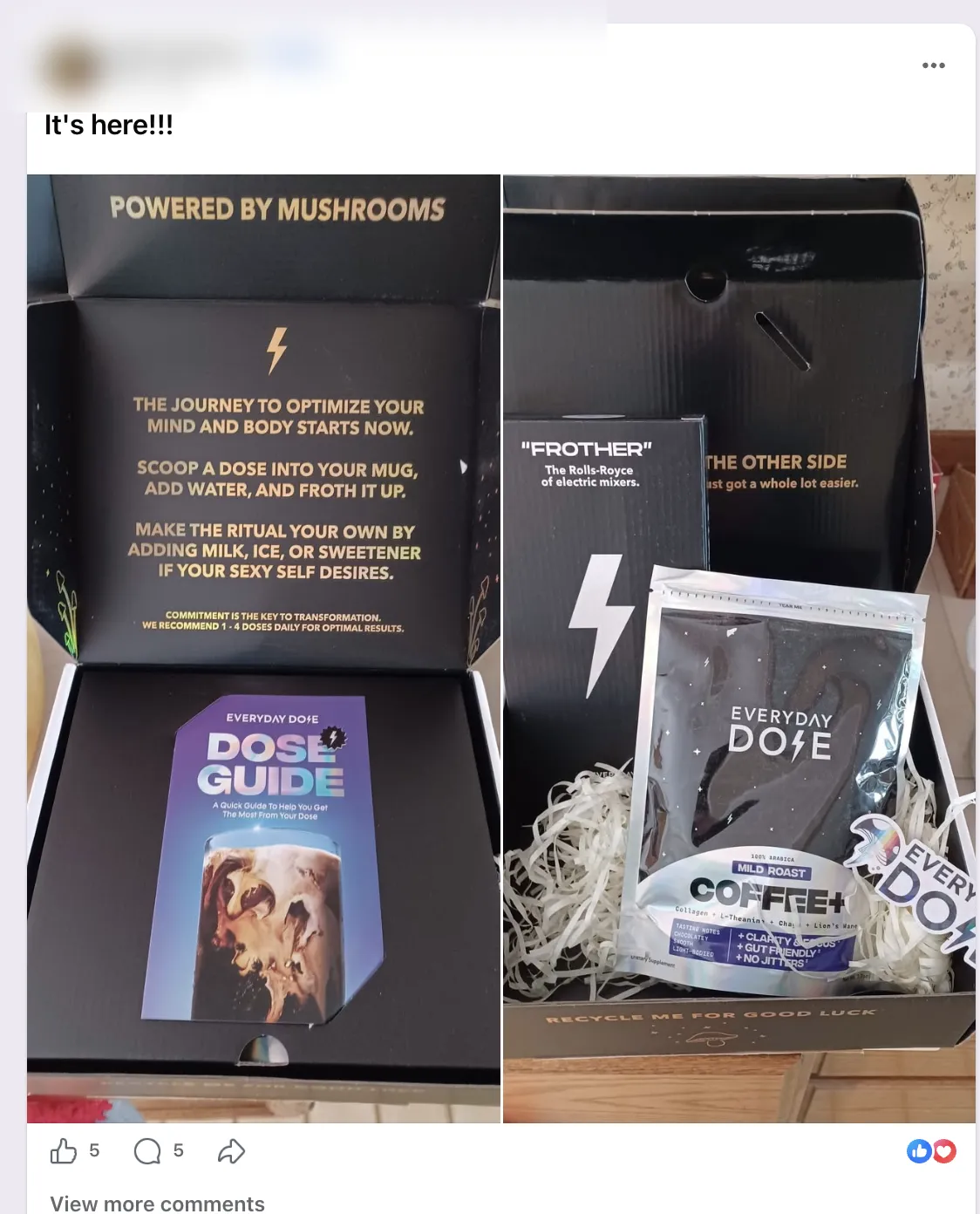
Everyday Dose gets this right. The instructions are printed inside the lid: scoop a dose into your mug, add water, froth it up. The Dose Guide sits on top. The frother is in the box. So the first cup is made the way it's meant to be made. Then members post the unboxing in Dose Fam, their Facebook group with about 260,000 members.
What to put on the card in the box
One card. Not a brochure, not a catalogue of everything else you sell.
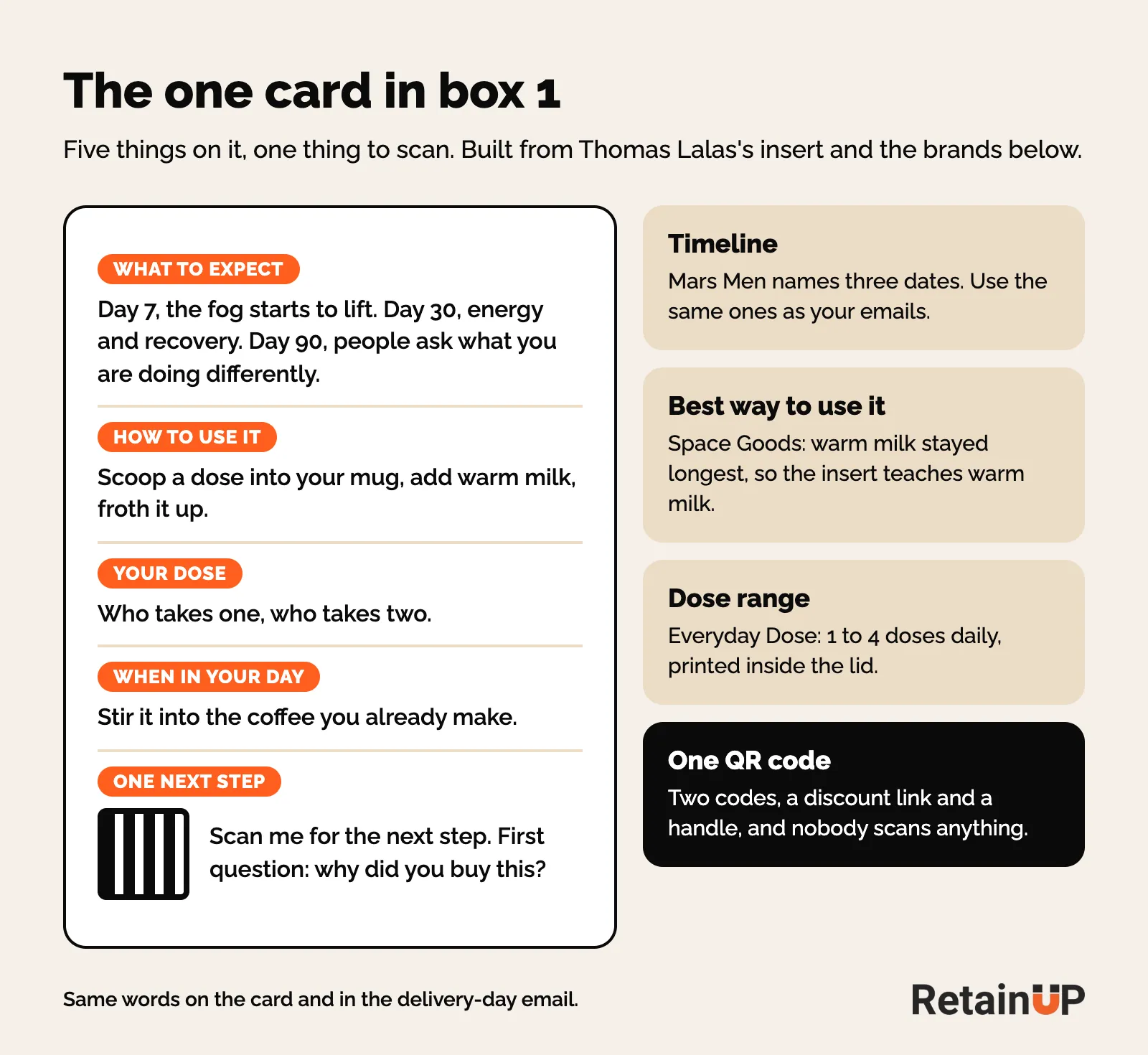
Lalas's version of the insert is a pamphlet with three things on it:
- The timeline of benefits, so they know what to watch for and when
- How to use it, step by step
- Who takes one dose and who takes two
Then one call to action. One QR code: "Scan me for the next step." Two codes and a discount link and a social handle and nobody scans anything.
The timeline
Supplements have one main problem: you can't feel them working. So the card pins each change to a day. Mars Men names three dates. Day 7, the fog starts to lift. Day 30, energy and recovery. Day 90, people ask what you are doing differently.
A subscriber who knows what day 30 should feel like does not quit in week three. Put the same three dates on the card that your emails use, word for word.
The dose
This one costs more than it looks. We worked with a supplement brand that sold 60-tablet bottles, and the label didn't match how people took them. The label said "Take 2 daily." Most customers took 1. The bottle lasted 60 days, not 30. The 30-day emails arrived while they still had product, and the cancels came in as "too much product".
If your dose is a range, say who sits where on the card. Everyday Dose prints "we recommend 1 to 4 doses daily" inside the lid. Better still, match the bottle to the shipping interval. That one is a subscription frequency decision.
The moment in the day
"Take it daily" slips. "Stir it into the coffee you already make" is a habit. The card should name the routine the product rides on, so the first use already happens in the right place.
Graza ships two bottles, Drizzle and Sizzle, and the card shows what each one is for. No thinking at the counter. More on routine anchors in building the habit.
Teach the best way to use it, not every way
Does coffee taste better with warm milk or cold water? For a coffee brand, that question can cost millions.
Space Goods sells mushroom coffee. They surveyed how customers made it: cold, hot, with milk, with water. Then they looked at who stayed longest. Warm milk. Every time. So that preparation went on the insert, and every new subscriber learns it from box 1.
Meanwhile most brands ship the box and wait. No timing. No ritual. Just a scoop and silence. So customers take it inconsistently. Miss days. Notice nothing. Quietly decide it doesn't work. Cancel. Your product works. Your customer just never learned how to use it.
So survey usage, find the pattern with the highest LTV, print it on the card. Never asked how people use it? Start with usage check-ins and surveys. Teach one way. Then keep teaching that one.
Ask why they bought, on the card
The thank-you page and the box are the two places with a 100% open rate. Use both to ask the same question: "Why did you buy this product?"
Ask it on the thank-you page. Then again on the card, behind the QR code. Someone who bought for sleep and someone who bought for energy should not get the same week two.
The card catches people after the product is in their hands. One or two questions, tops. "Why did you buy?" and "How often do you use it?" are enough to route someone.
Starter tools: frothers, spoons and the things they'd buy anyway
Make the first use effortless. If it needs charging, ship it charged. If it needs a frother, they should have one.
Lalas's rule for what to put in: gift what people would buy anyway to use alongside the product. "Think of everything that the customer would buy by themselves and sponsor it." For coffee, a frother, a spoon, a tumbler. For a dog supplement, a pill crusher. For anything kept in the fridge, containers or a magnet to log what they've taken.
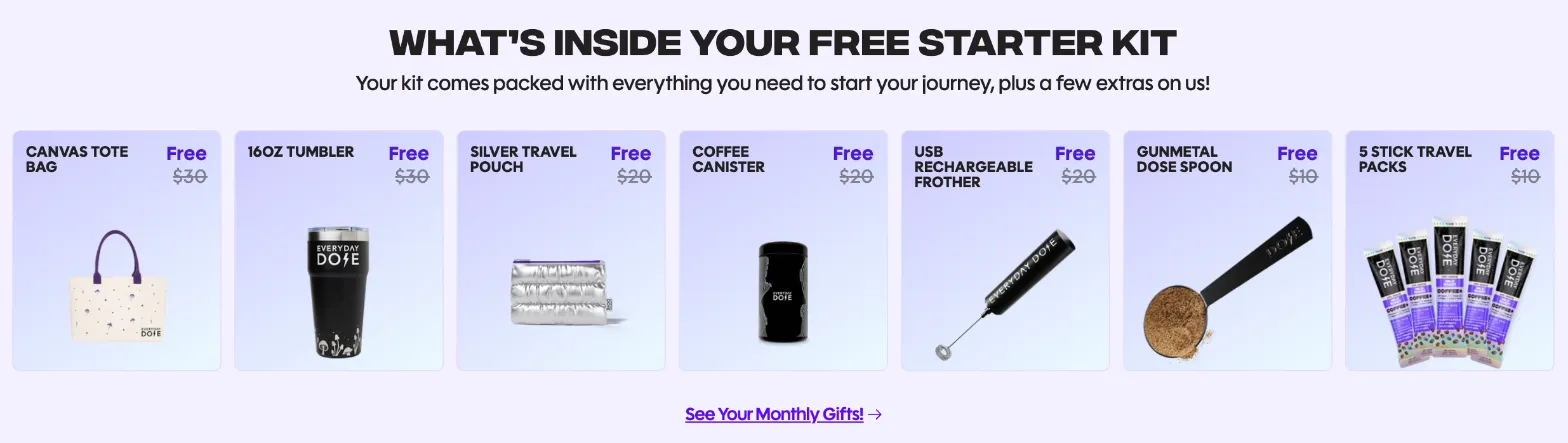
Everyday Dose's starter kit has seven items, each with a crossed-out price: tote $30, tumbler $30, travel pouch $20, canister $20, frother $20, spoon $10, stick packs $10. Most of it is there to make the morning cup easier. That's the test.
The three-question gift audit
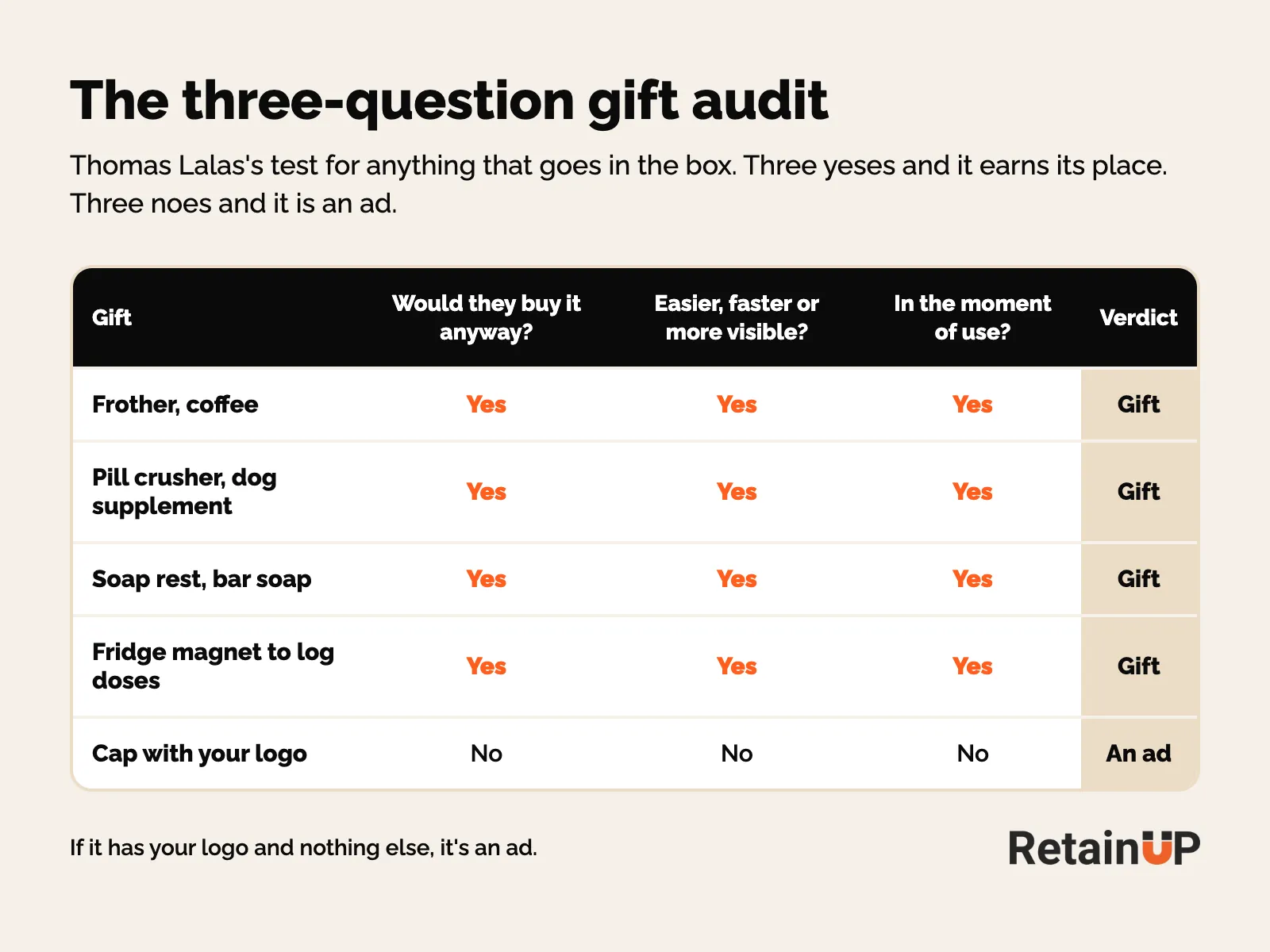
Lalas runs every gift through three questions:
- Would my customer buy this themselves to use alongside my product?
- Does it make the product easier to use, faster to get results from, or more visible in their daily routine?
- Does it belong in the moment they actually use my product?
If the answer to all three is no, you're not really giving them a gift. If it has your logo and nothing else, it's an ad.
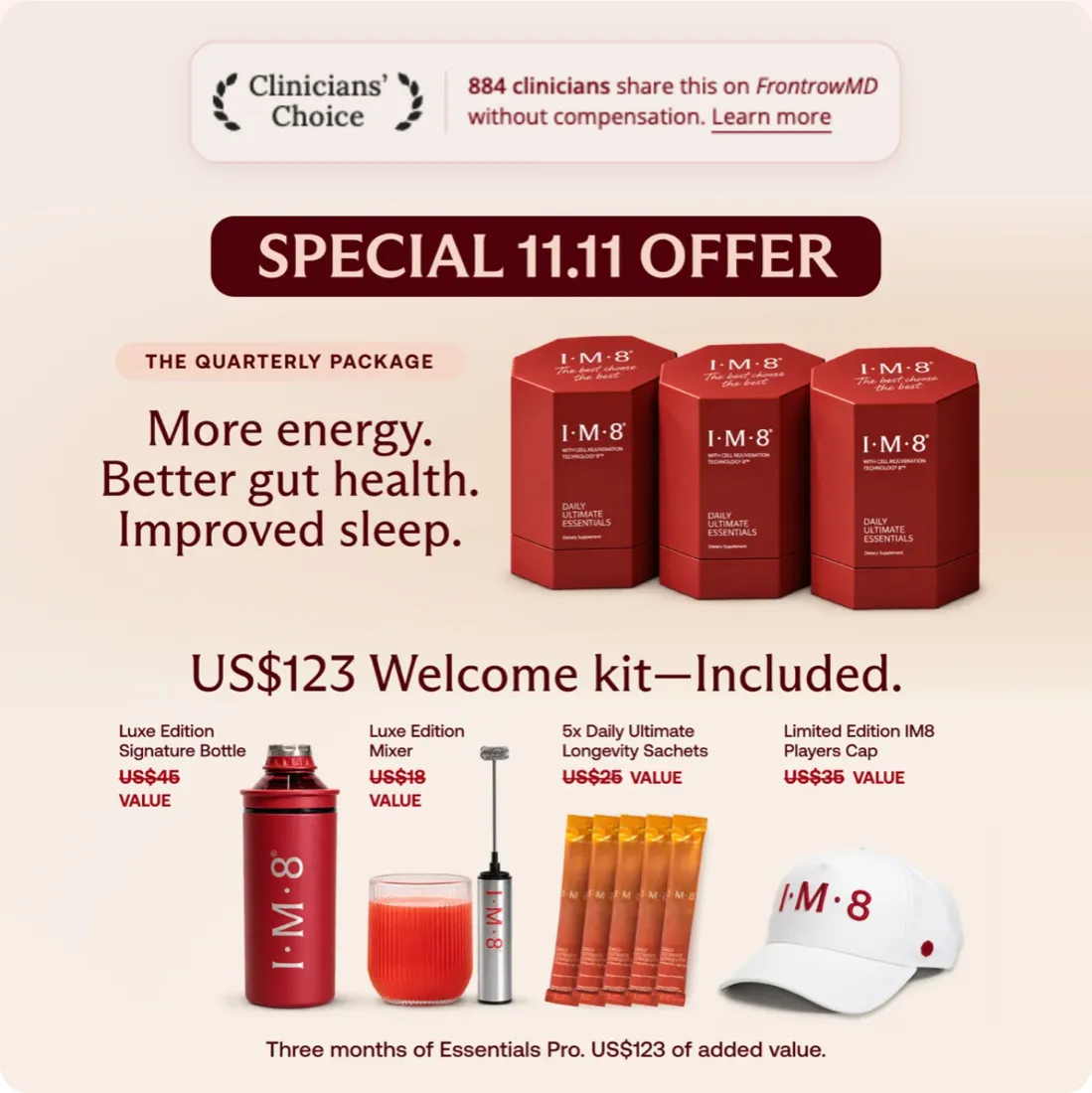
IM8's US$123 welcome kit passes on most of it. The bottle and the mixer get used every morning, and the cap is merch.
When the product can't take a tool
Some formats don't leave room. One of our coffee brands is moving to a metal spoon and a frother on the 25-serving plan, with a glass bottle added at 50. Their capsules get no gift for now. You can't froth a capsule. Don't force it.
Another of our brands sells goat milk soap. We picked a soap rest for the welcome gift, about $10. Not a lip balm. It's what they already tell people to put their soap on to dry, so it gets used every day. They don't do cards or stickers at all. Room in the shipping box. Check yours before you design anything.
Stickers and the small things
What's common between Apple, Glossier, Yeti and Red Bull? Stickers. And some are selling on eBay for over $500. A Glossier sticker on a laptop is the customer saying who they are.

Glossier's pink pouch is the same idea in packaging form.
A handwritten thank-you card belongs here too. Chewy sends handwritten cards and has no points program at all. One handwritten note generates more loyalty than a year of discount emails.
Box 1 vs the refills
Box 1 starts the habit. The refills keep it going. Getting people through those first charges is on getting past order 2 and order 3. Here is what changes in the box.
| Box 1 | Refills | |
|---|---|---|
| Job | First use done right | Keep the habit, mark progress |
| Card | Timeline, how to use, dose, one QR code, "why did you buy?" | Where they should be by now, the next milestone |
| Tools | Frother, spoon, scoop, bottle, whatever the first use needs | None needed again |
| Gifts | Welcome kit, subscription only | Milestone gift at order 2 or 3, told about in advance |
| Products | Hero product only | Adjacent products after the first renewal |
Hero product only in box 1
Every touch in month one should drive use of what they already bought. No cross-sell card. Splitting their attention before they've found value in the first product loses them. Adjacent products wait until after the first renewal.
Where the box gift has the most effect
Obvi tested a free gift on orders 2, 3 and 4, announced by email and SMS before the order processed.
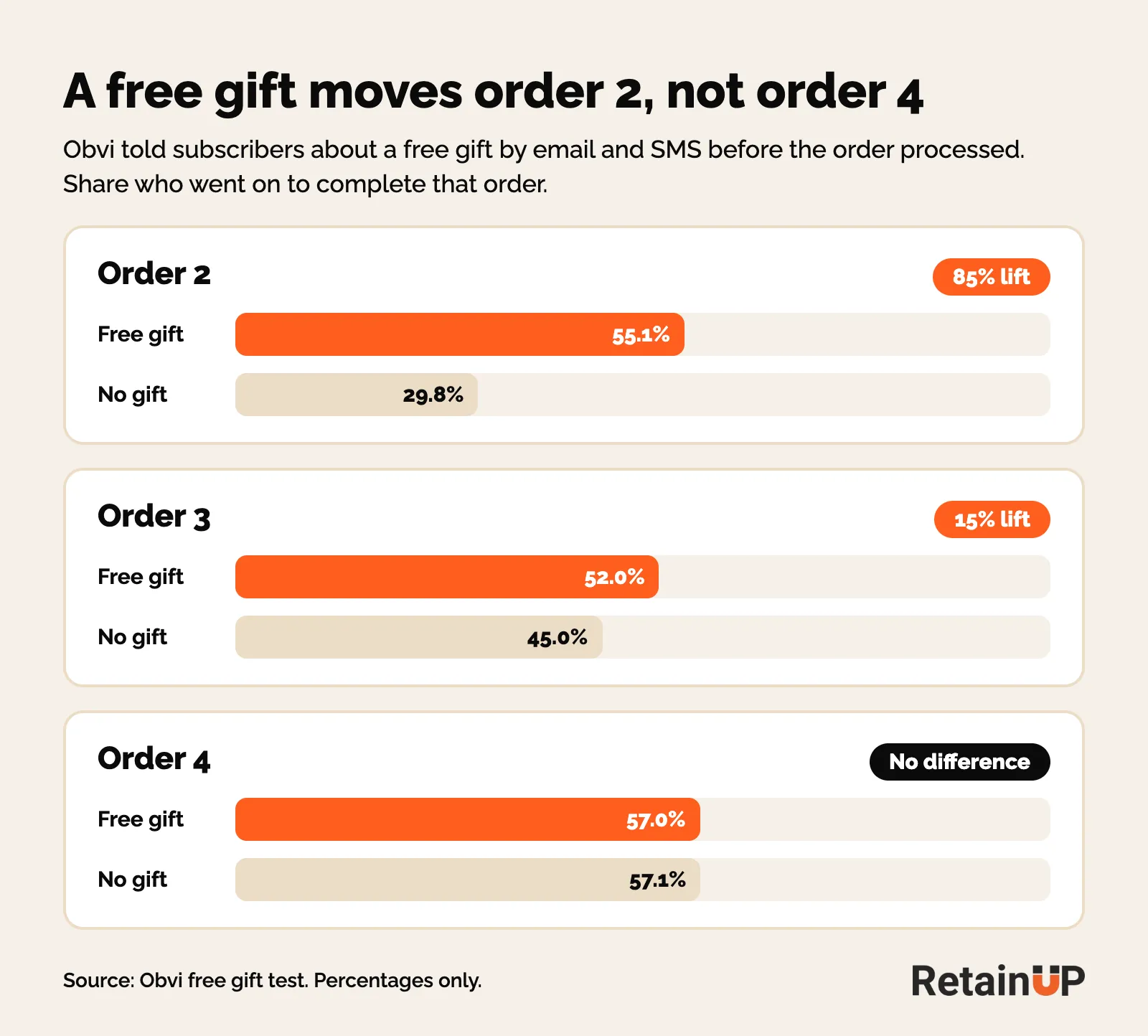
Order 2 got the lift. Order 4 got nothing. By order 4 they have either committed or not.
So the welcome kit opens, and the next physical gift goes in box 2 or 3. The full schedule is in subscription rewards and milestones. Pricing a welcome kit is in subscription perks and welcome kits.
Setting up box 1 in your subscription app
Your warehouse has to know which order is someone's first. Loop handles the starter kit with product swap flows. Loop's own example is a coffee subscription: order 1 has a roaster and beans, every order after has only the beans. Primal Queen goes a step further. Loop tags a first-time subscriber, and that order goes down a separate kitting line with different packaging and a welcome insert (Loop customer story).
Whatever the app, check two things before launch. The kit doesn't ship again on order 2. And the refill doesn't ship without the card on order 1.
Surprises stay surprises
You order small fries at Five Guys. They fill the cup to the top. Then dump an extra scoop straight into your bag. They never advertise it. Because the moment you announce it, it stops being a gift. It becomes an expectation.
Same in a subscription box. Announce a milestone gift, because anticipation is what keeps people. Don't announce a surprise sample or a note. Keep the two separate. And watch when you announce the milestone one.
And the box shouldn't be identical every time. Same box, same insert. Every time. That gives the customer nothing to look forward to.
How to know the card is working
Before you reprint it, three cheap checks:
- Give the QR code its own tracked link, so scans show up as a number you can watch. Test it on two or three phones before the print run.
- Hold the card back from part of box 1 for 60 days. Every other order, or alternate weeks. Then compare order-2 retention between the two groups. eCommerce Fastlane suggests the same holdout for any printed insert, and warns that small stores will get a fuzzy answer.
- Order your own box 1 as a new subscriber. Open it the way they do.
Size follows the job: a business-card size works for one QR code. Steps and a timeline need something closer to 4 by 6 inches.
Tie the box to the emails
The box and the delivery-day email should say the same thing. Trigger an email and an SMS the moment the order is marked delivered. Not on a timer three days later. Repeat the card: when to take it, how to take it, where it sits in their day.
Everyday Dose's shipping emails sell nothing. They track the order and ask one thing: join the group. It handles buyer's remorse before the box even lands. And people do. Once the box lands, they post their unboxing and welcome kit in the group.
Don't worry about repeating yourself. Most subscribers read selectively.
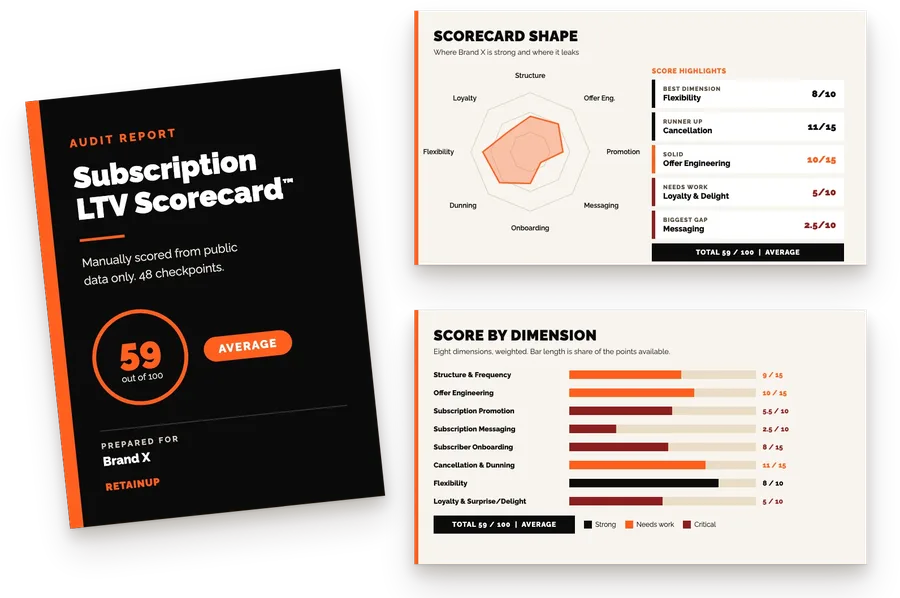
If you want the welcome kit, the box-1 insert and the month-one emails built together, that is part of the Subscription LTV Maximizer™: offer, widget, cancel flow, portal, payment recovery, pause and skip built in Recharge, Skio, Stay AI or Loop, plus email and SMS, live in 30 days, for $5,000. To see where your onboarding leaks first, the free subscription audit checks 48 points and sends your top 3 leaks in 24 hours.
FAQ
What should I put in a subscription box insert?
One card. On it: the timeline of results, how to use the product, the right dose for each kind of customer, and one QR code for the next step. Name the routine the product fits into, such as the morning coffee, instead of "take daily". If you know which way of using it keeps people longest, teach only that way. Add a short "why did you buy?" question behind the QR code so you can tailor the emails that follow.
Should the first subscription box be different from refills?
Yes. The first box should carry everything the first use needs: the card, any starter tool like a frother or scoop, and the welcome kit if you offer one. Refills drop the tools and carry a shorter card about progress and the next milestone. Keep box 1 to the hero product only, and introduce other products after the first renewal has gone through.
Do free gifts in subscription boxes improve retention?
They do when they arrive early and get used. In Obvi's test, a free gift lifted order-2 retention by 85%, order 3 by 15%, and order 4 not at all. Pick gifts the customer would buy anyway to use with the product, like a frother or a pill crusher. Check the lift covers the cost. A 2% lift on a $15 gift can lose money.
Is a handwritten note in the first box worth it?
Usually, yes, because it costs little and people remember being recognised longer than they remember a discount. Chewy has no points program and an 80%+ repeat purchase rate. Handwritten cards are part of how. Keep the note short and personal, and don't print a promo code on it. The box already has one job: getting the first use right.
Should I announce the gift in the next box?
Announce milestone gifts, keep small surprises unannounced. Anticipation of a milestone gift keeps people subscribed, so tell them before order 2 or 3 what is coming. A surprise sample or note works because nobody expected it. Time the announcement carefully, since telling people about a gift right after the first order can remind them to cancel before it ships.
One email a week on subscription retention: the numbers, the strategy, and what to fix first.

Rahi Jain
Rahi Jain is a subscription LTV specialist who helps $1M to $10M DTC brands reduce subscription churn and maximize LTV on Recharge, Skio, Stay AI and Loop.
More about Rahi