Key takeaways
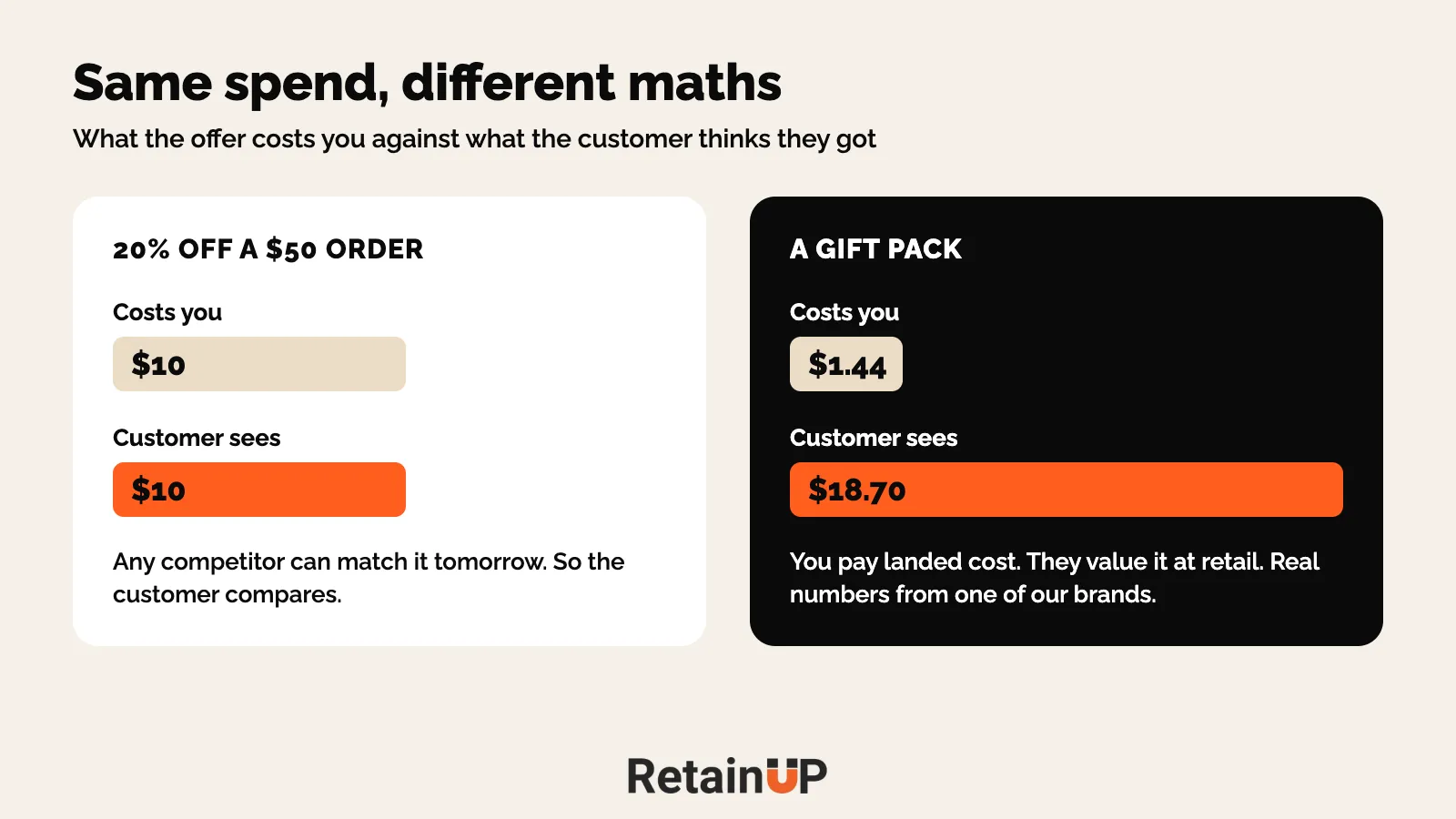
- A gift pack that costs one of our brands $1.44 reads as $18.70 to the customer. A 20% discount reads as exactly 20%.
- IM8 gives a US$123 welcome kit with its quarterly subscription, and one-time buyers get none of it.
- Gifts that grow with the plan (1 for a month, 3 for two, 5 for three) sell the bigger supply better than a deeper discount.
"Why would I give away product when I'm already giving 20% off?"
Every founder asks me this on the first call.
Because 20% off is the one offer your competitor can match tomorrow. A gift they can't. So this page covers every perk beyond the discount, and how to price it. It is one part of the subscription offer guide, which walks the whole offer in order.
Why gifts beat a deeper discount
Sleep gummies at 10% off against sleep gummies at 20% off is apples to apples. The customer picks 20% in two seconds.
Now put 20% off against 15% off plus a free eye mask. That is apples to oranges. There is nothing to compare, so the customer stops doing maths.

Someone asked me what the gift or the welcome kit actually does. It removes the apple to apple comparison. On a $50 item, 10% is five dollars, and nobody subscribes for five dollars. If you give nothing on one-time and two or three gifts on subscription, the choice stops being about the price. And it's easy to walk away from a five dollar discount. It's tough to walk away from a free gift.
There is a second reason. Nobody checks their bank statement for the 15% they saved. But everyone opens the box when they know something is inside.
None of this means you drop the discount, because you still need one evergreen rate, and how much to discount a subscription covers the bands: 15% is the safe default, and past 20% you start training deal seekers. Gifts are what you add on top, so you never have to push the percentage higher to win the comparison.
What 10% off really costs
Discounts cost more than most founders think. For most brands, a 10% discount can lower profits by 33% to 70%.
Take $100 in revenue. Marketing is $30. Cost of delivery (COGS, shipping and payment) is $30. OpEx is $20. Net profit: $20. Now take 10% off and keep everything else the same. Net profit comes down to $10.
To make $10,000 in profit, you now need to sell 1,000 units instead of 500.
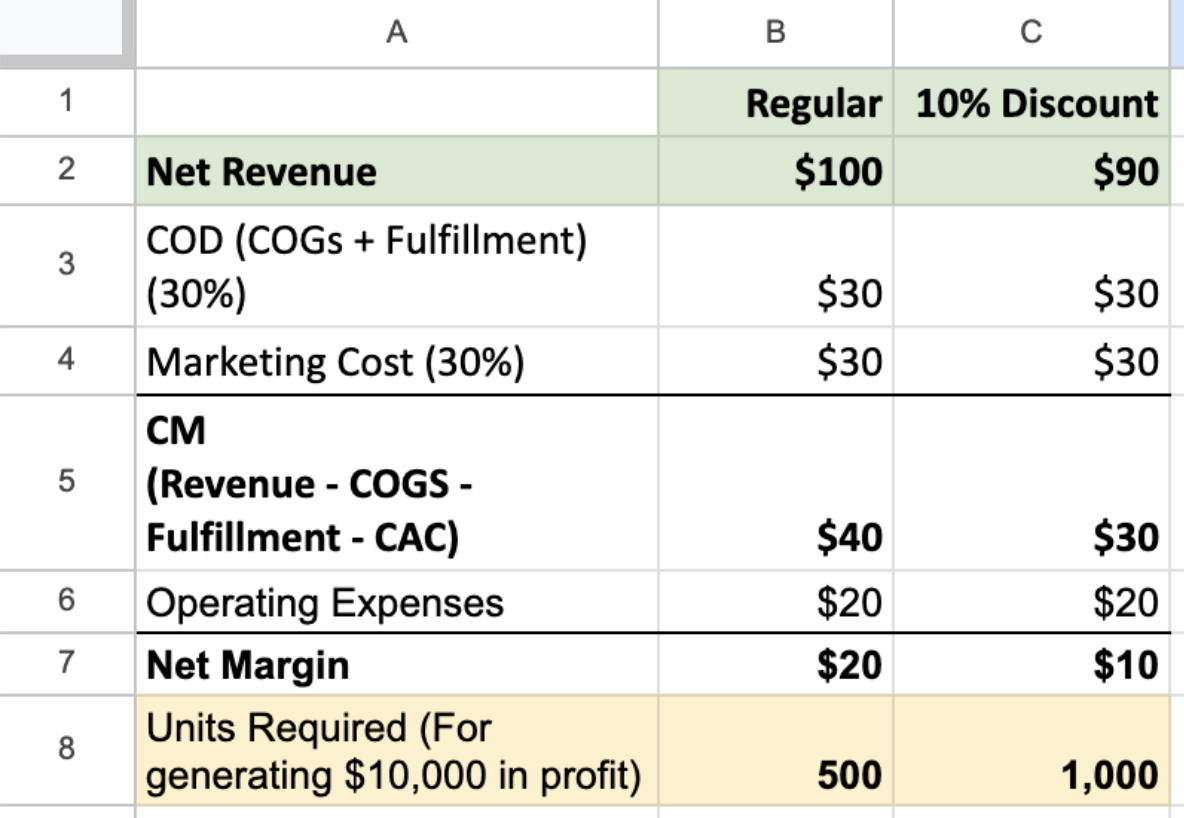
Marketing costs would need to go down by 33% to justify a 10% revenue loss. That doesn't happen.
And every time you discount, you teach your customer that your full price is wrong. You are not rewarding loyalty. You are training impatience. A gift that costs $1.44 is a very different line on the P&L.
What Costco, Chewy and Red Bull give instead of a discount
Costco renews 93% of memberships. Chewy has an 80% repeat purchase rate. Neither one needs a flash sale to keep a customer.
Costco replaced the discount with a win. The $1.50 hot dog, the same price since 1985, and gas 10 to 20 cents a gallon cheaper, which saves members $300 or more a year before they walk inside. Every visit, the customer feels like they won. So the $65 annual fee doesn't feel like a bill. It feels like a bargain.
Chewy replaced it with humanity. When a pet dies, a handwritten card arrives. Sometimes flowers. Over 1,000 hand-painted pet portraits go out every week, unrequested. New customers get a handwritten welcome note in their first order. And 83% of Chewy's revenue comes from Autoship subscribers. Not from ads. From people who never left.
Red Bull replaced it with identity. The F1 team. The athletes. You don't buy Red Bull because it is cheap. You buy it because of what it says about you.
Most subscription brands do the opposite. They give a first-order bribe, 30% off. Then on day 30 the full-price renewal hits, and the relationship feels like a bill. So ask yourself what your customer feels after order 2.
The welcome kit: subscription only, on top of the evergreen rate
A welcome kit is the gift that ships with the first subscription order. Done right, it gives a new buyer a reason to subscribe that one-time can never match.
Two rules. First, the kit comes only with subscription. Second, it stacks on the evergreen rate, so the subscriber gets the 15% and the kit. A welcome kit is not a deep discount. Keep it. It drives take rate.
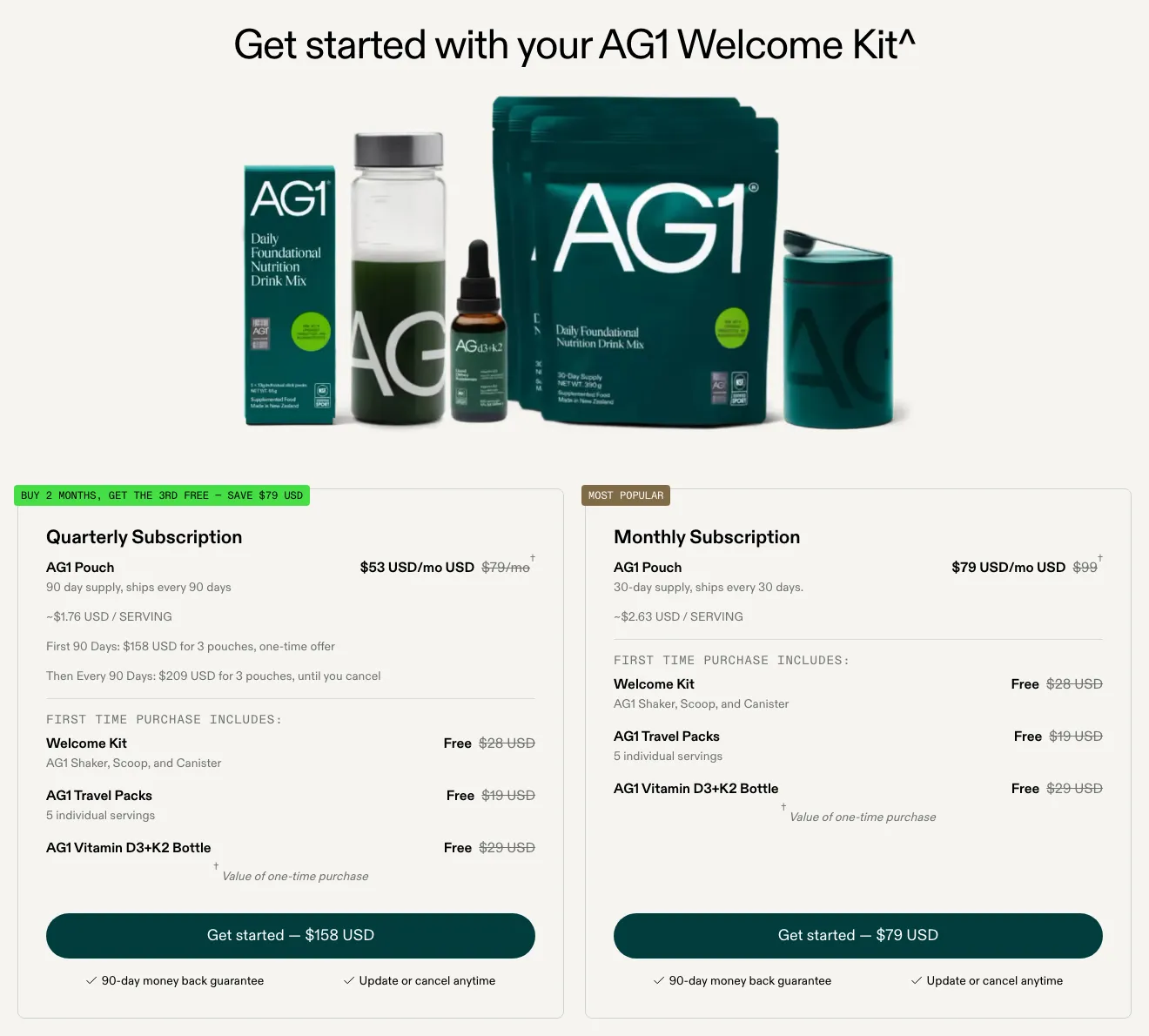
AG1 offers two plans, and both are subscriptions. Both come with the welcome kit: a shaker, travel packs and a D3+K2 bottle, $76 of value. Quarterly or monthly. That's the whole choice. One-time isn't on the main offer at all.
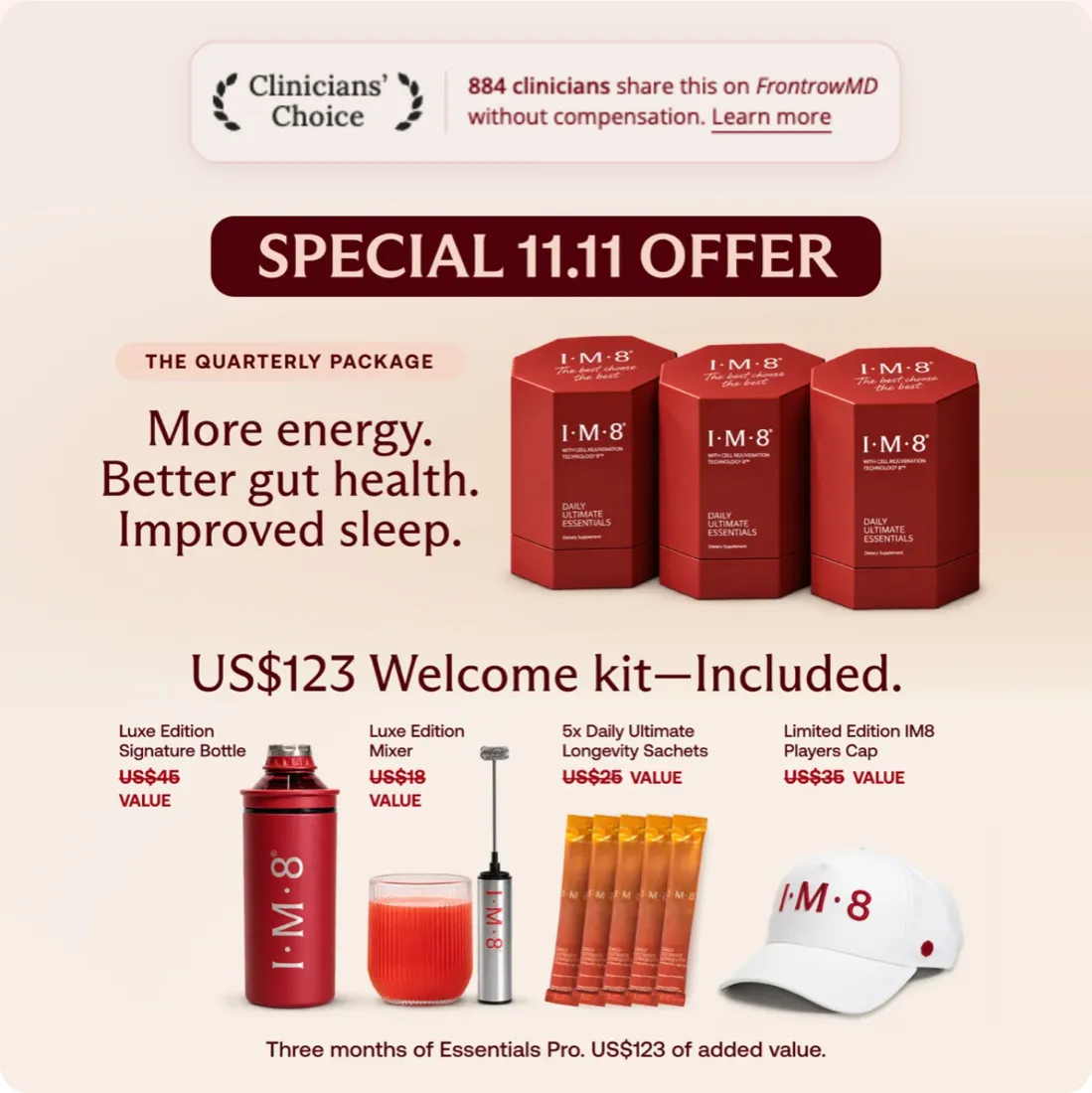
IM8 puts a US$123 welcome kit on the first order of its quarterly subscription.
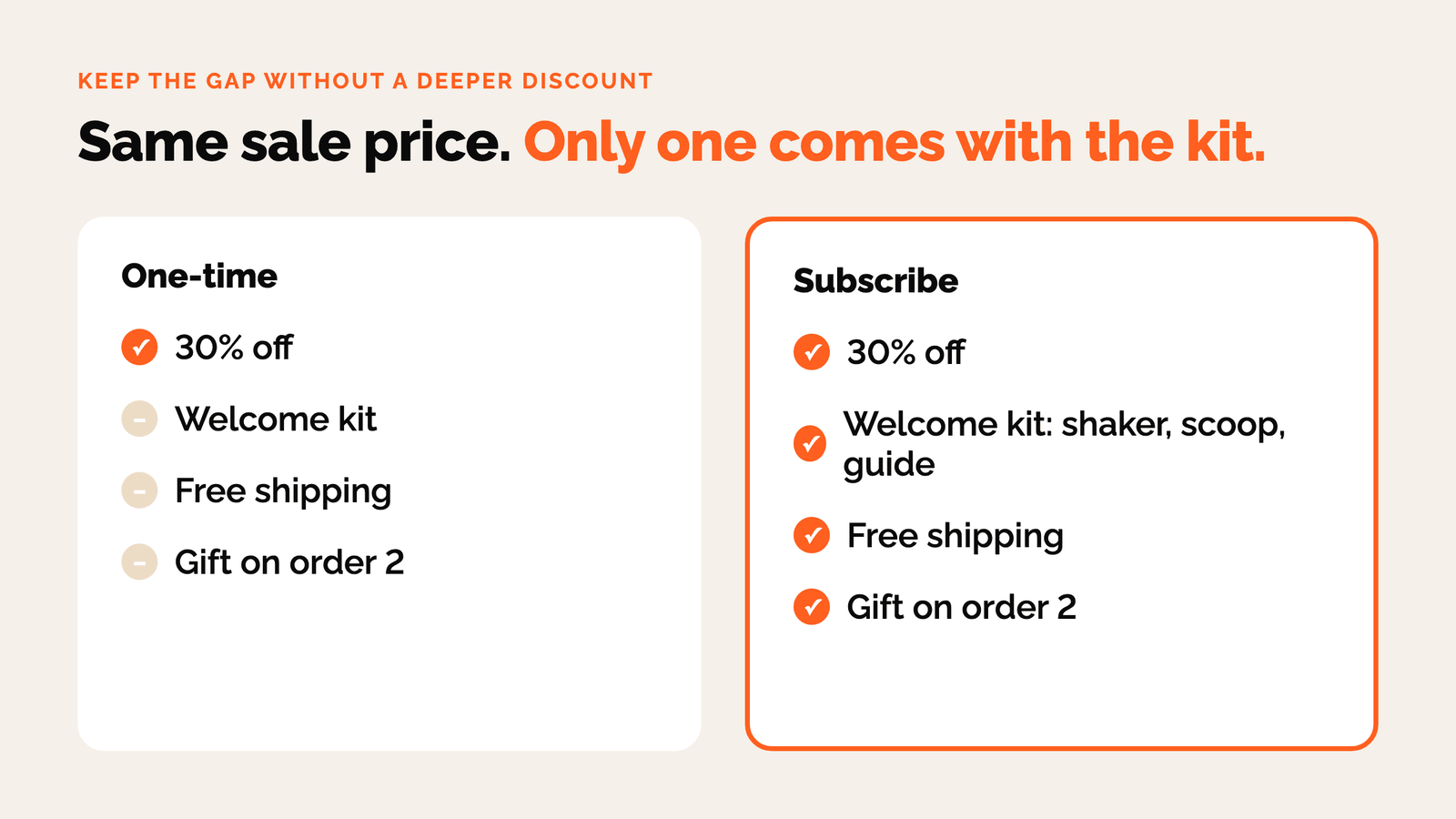
The same rule holds in a sale. During BFCM, one-time gets the sale price and subscription gets the sale price plus the kit. It keeps the gap without a deeper discount. When one-time is the better deal, your take rate drops in the biggest month of the year.
On the product page, show the kit on the subscription option, with its dollar value. Show only the gifts that apply to the plan selected. Never show an empty or missing gift. If take rate is the number you are trying to move, how to get more buyers to subscribe has the other five leaks.
Two ways a welcome kit backfires
The first is a kit worth more than the product. Some people subscribe, take the kit, and cancel the same day. They never planned to stay. If everything valuable sits on order 1, there is no reason to stay for order 2. So keep the welcome kit, and add gifts to orders 2 and 3. The full fix is in how to stop day zero cancellations.
The second is quieter. IM8's welcome kit is first-order-only, so a new customer gets it and a twelve-month subscriber does not. A renewing subscriber noticed and said so publicly on Trustpilot. Every acquisition incentive that fires only at order one creates this. The longer someone stays, the worse their deal gets against a stranger. Nobody designs that on purpose. A tenure gift at month six or twelve, worth something close to the kit, closes the loop.
Gift cost against perceived value
A gift costs less than it looks. One of our brands gives away a mouthwash tablet pack that costs them $1.44. The customer sees $18.70.
That gap is the whole case for gifts over discounts. A 20% discount costs you 20% of the order, and the customer values it at 20%. A gift costs you the landed cost. The customer values it at retail.
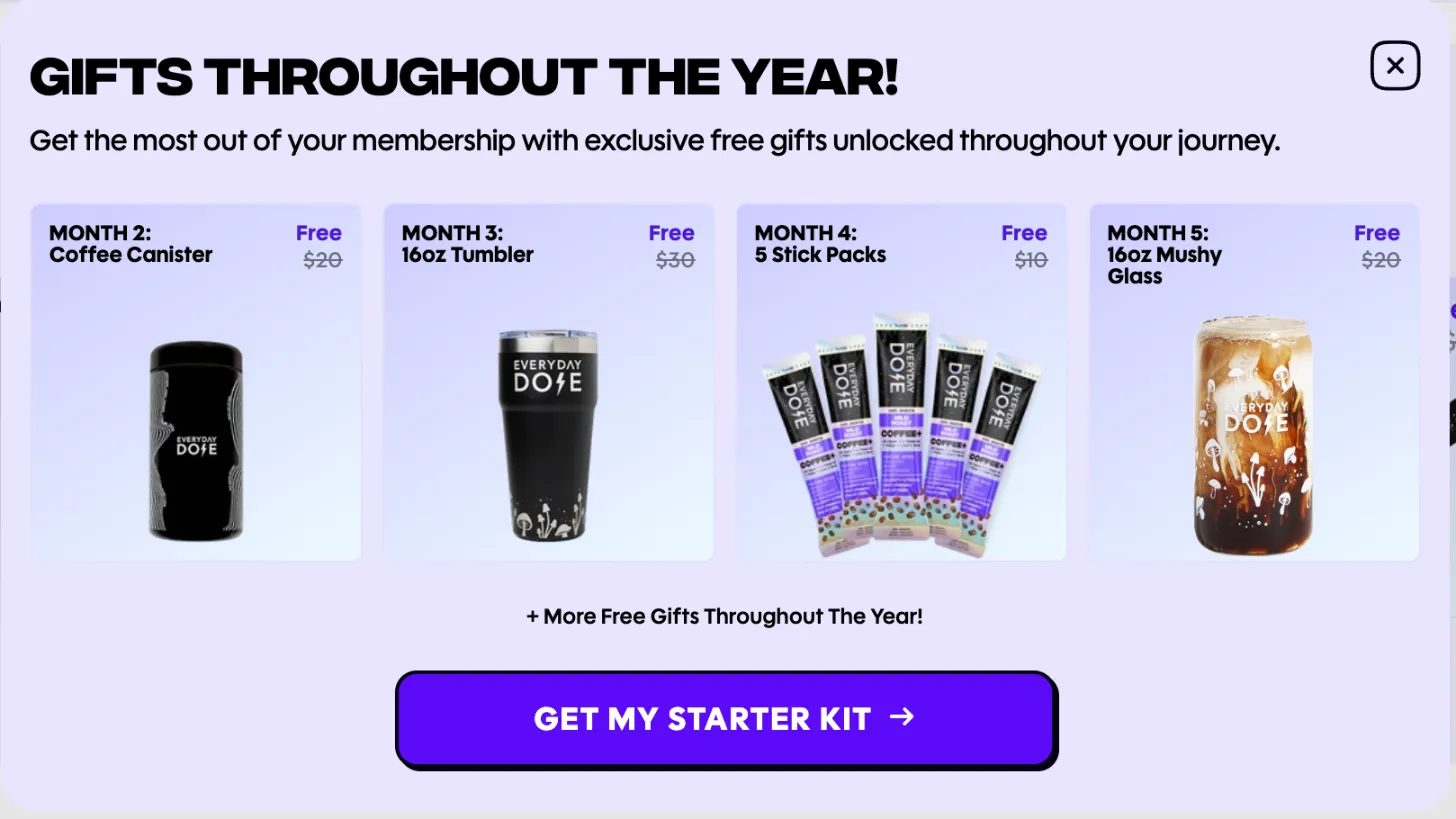
So put the dollar value on the page. IM8 lists a shaker bottle at $45 in month 3 and a travel pouch at $35 in month 5. The number makes the reward feel earned, and subscribers can work out what staying is worth. Everyday Dose does the same: a coffee canister at order 2, a tumbler at order 3, each with its value, 9 free gifts in the first 12 orders.
One check before you order 5,000 shakers. Make sure the retention lift covers the gift's cost. Thomas Lalas puts it simply: a 2% lift on a $15 gift can lose money.
If you are not sure, test it. Run the gift against a deeper discount on new subscribers and judge both at order 3, not at checkout. Intelligems has a setup for it. How to A/B test a subscription program covers sample size and how long to run it.
Gifts that grow with the plan length
Gifts can also sell the bigger supply. The gifts should grow with the plan. One month of sleep gummies gets one free gift, the eye mask. Two months gets three. Three months gets five.
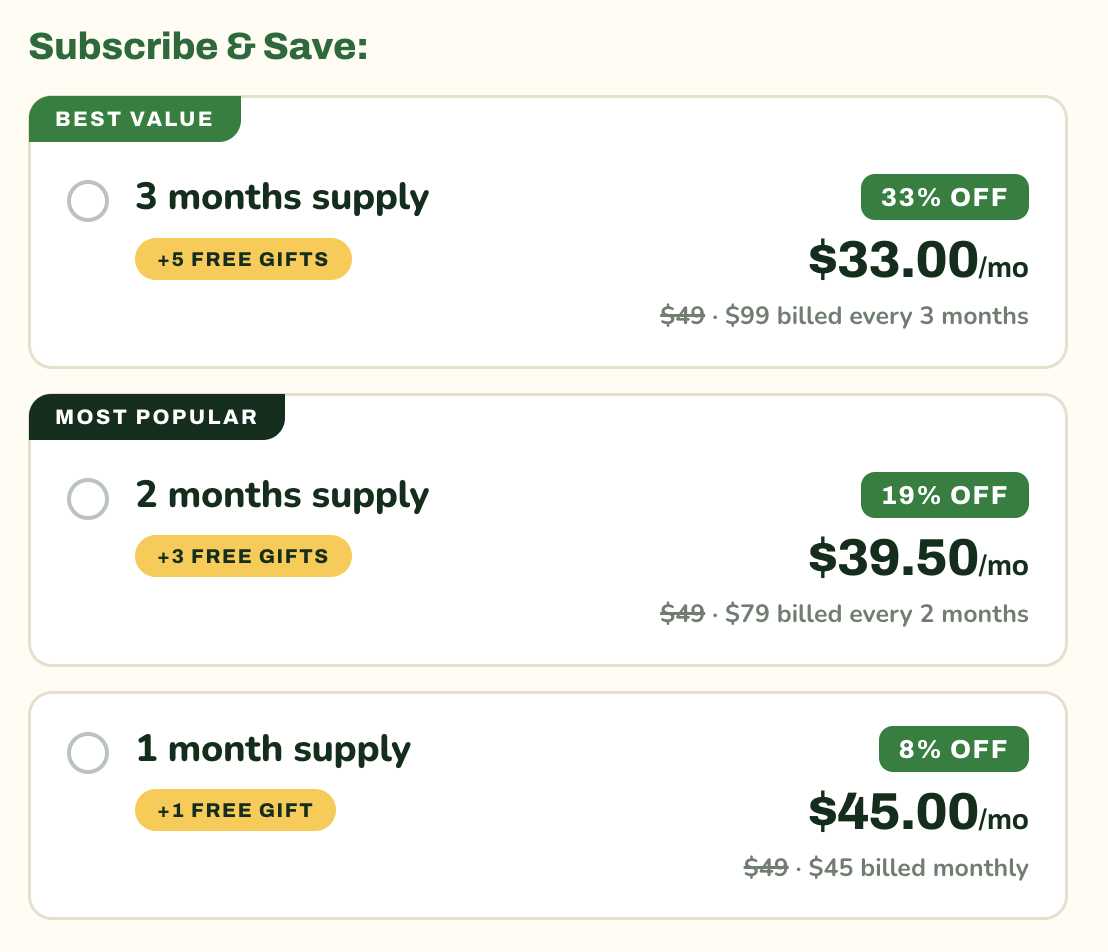
A bigger discount on the 3-month pack still gets compared. Five gifts against one is an easy choice. And a subscriber on a 3-month supply skips the month-one decision, where most brands lose 30 to 40% of a cohort, which is why prepaid and longer plans are worth pushing in the first place.
And one-time gets nothing. If one-time buyers get the same gifts, subscription has nothing left to offer them.
Pick a gift that lives next to the product
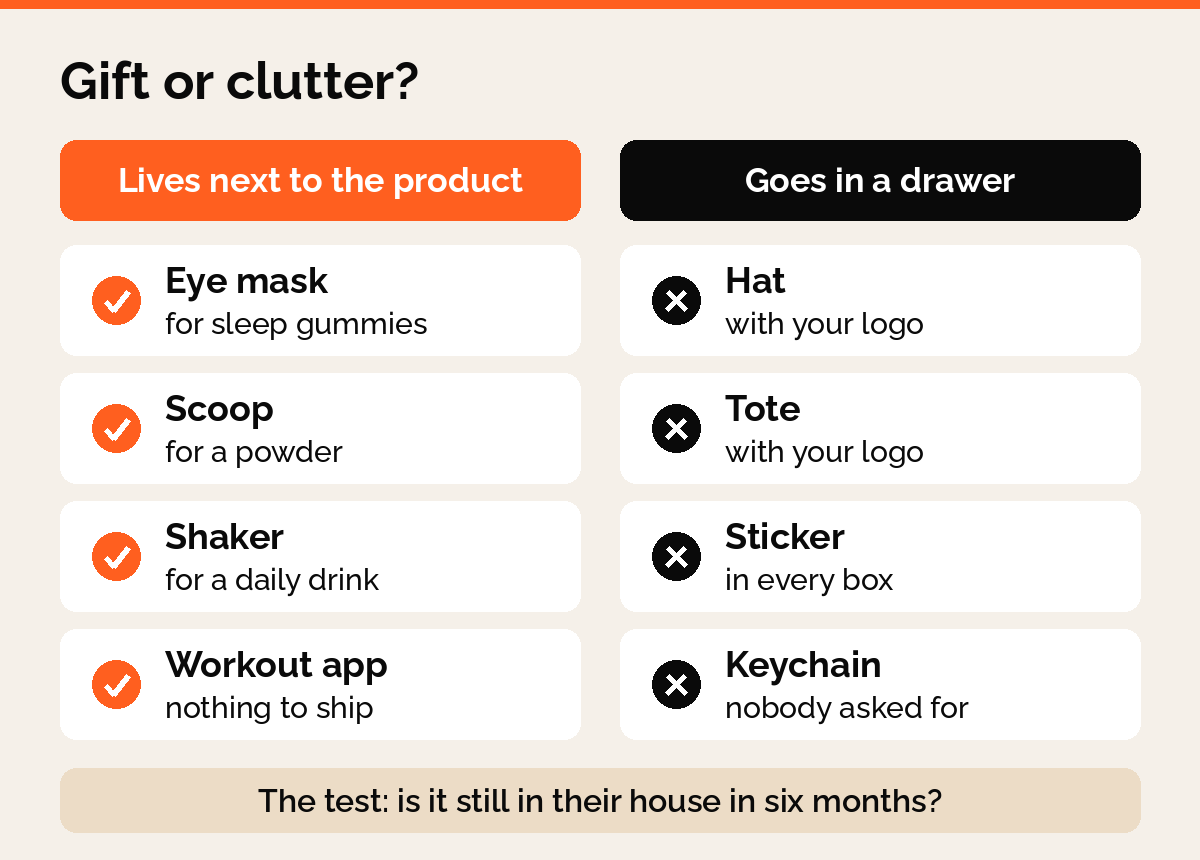
John Ruhlin wrote the book on gifting, Giftology. His first rule is to give something used every day, so the eye mask goes on every night the gummy goes in. His second rule is to keep your logo off it. Nobody wants to be a billboard.
Sleep gummies get an eye mask. A powder gets a scoop. A daily drink gets a shaker. Coffee gets a frother, a spoon or a tumbler, and a dog supplement gets a pill crusher. Not a hat. Not a tote. Not a sticker.
It doesn't even have to ship. Mars Men gives subscribers a 30-day workout app.
Lalas has a three-question audit for any gift:
- Would my customer buy this themselves to use alongside my product?
- Does it make the product easier to use, faster to get results from, or more visible in their daily routine?
- Does it belong in the moment they actually use my product?
If the answer to all three is no, you're not really giving them a gift. Ruhlin's test is shorter. Is it still in their house in six months?
Subscription perks that aren't a gift
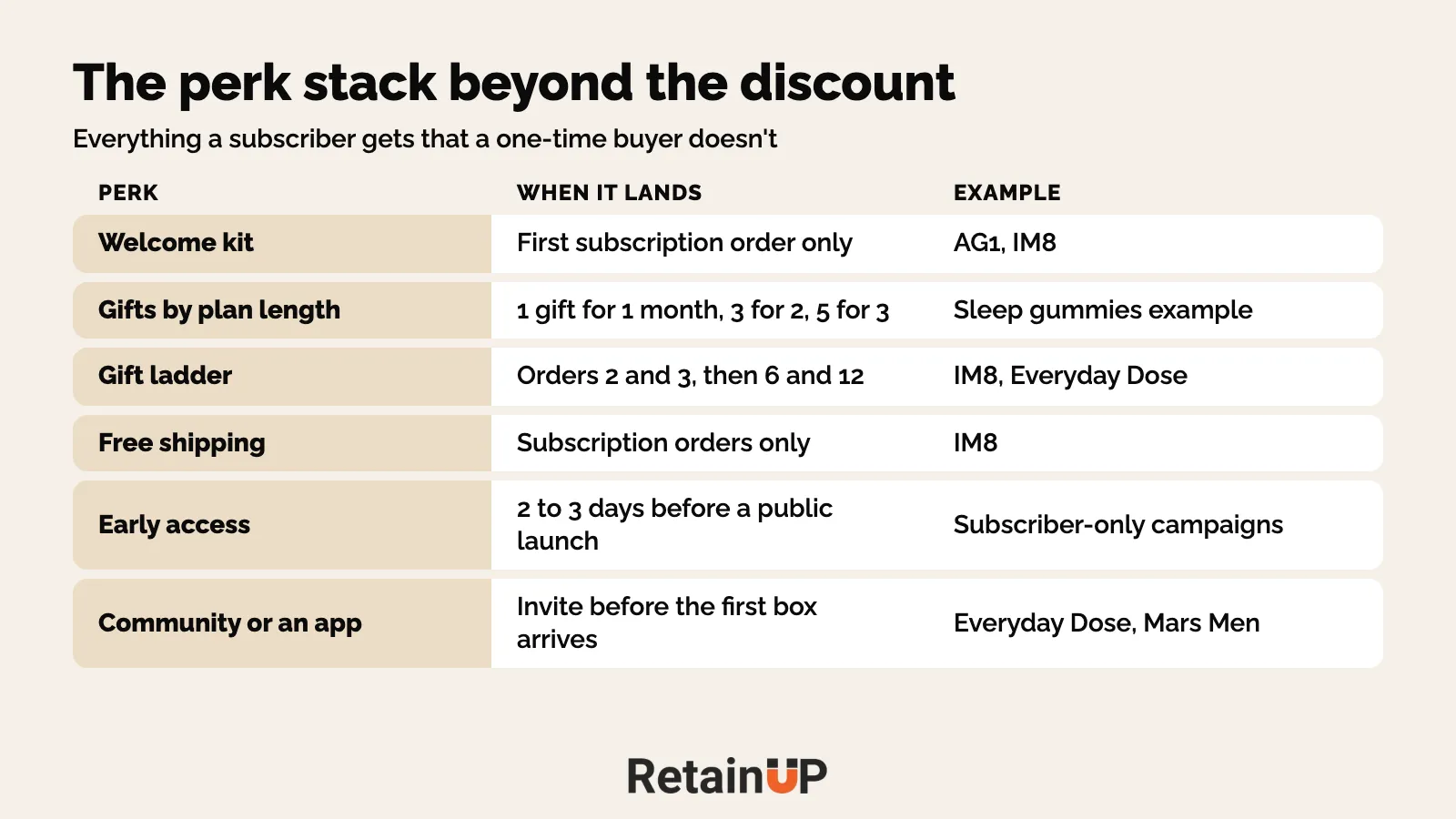
A gift is one perk. IM8 stacks more. Free shipping, the welcome kit, the 90-day program, a diagnostic perk. Price is one line among several.
Compare that with the standard approach: a radio button offering 15% off and no argument for why the recurring version is better. Discount alone is a reason to buy once and cancel.
Free shipping, for subscribers only
A benefit everyone gets cannot be a gift for anyone. The moment free shipping extends to one-time, it stops being a subscription reward. So keep it on the subscription option and charge shipping on one-time.
Early access
Send subscribers new launches and sales 2 to 3 days before anyone else, with a subject line that says so: "You get it first." It costs nothing to run. More on drops and early access in subscription rewards and milestone gifts.
A community they would lose
Everyday Dose has 260,000 people in a private Facebook group about mushroom coffee. The shipping email tracks your order, then asks one thing: join Dose Fam. A competitor can copy the formula, the website and the branding in a weekend, but they can't copy customers who stay because of each other. Our Everyday Dose scorecard has the rest.
Shopify's list of subscription perks adds priority support and member-only products. Same rule. One-time buyers don't get them.
Show the future gifts before they buy
A surprise can't keep anyone, because they didn't know it was coming.
IM8 puts the next six months of gifts on the product page, before you pay. Month 2 mixer. Month 3 shaker. Month 5 travel pouch.

That roadmap does two jobs. Before purchase it answers "what do I get for staying?" before the buyer asks it. After purchase, every order in between becomes a countdown. IM8 scores 9 out of 10 on loyalty in our IM8 scorecard, a dimension where almost every brand scores near zero.
Put it where the buyer decides, in the product page widget, then say it again in the upcoming-order email a few days before each charge. Which orders the gifts should land on, and the data behind orders 2 and 3, lives in subscription rewards and milestone gifts.
Only promise what is in the warehouse
Gifting gets hard operationally if you are not ready for it.
A subscriber paid for 3 boxes plus 2 free. Two months running, she got the 3. Her review said "I never got my free gifts. I have cancelled my subscription."
The communication can break it too. One brand announced the gift right after the first order. Customers were reminded they had a subscription, and cancelled before the gift shipped. Once you name a gift, you have written a delivery date into the subscription.
Setting up the welcome kit in Recharge or Skio
Every main app can add the kit. Each does it differently. Recharge has a guide for a free gift on the first subscription order. Skio's Surprise and Delight rules start at order 2, so the order 1 kit needs a separate setup, and Skio won't tell the subscriber about a gift until you switch on its email and SMS notifications. The order of work is in the subscription launch checklist.
If your offer is a discount and nothing else, the Subscription LTV Maximizer™ rebuilds it with the welcome kit, gift ladder and widget in Recharge, Skio, Stay AI or Loop, plus the cancel flow, customer portal, payment recovery, pause and skip, and the email and SMS around them. Live in 30 days, for $5,000. Or start with the free subscription audit: 48 checkpoints and your top 3 leaks in 24 hours.
FAQ
Are free gifts better than discounts for subscriptions?
Usually, yes, as long as there is still an evergreen discount underneath. Any competitor can match 20% off tomorrow. A gift turns the choice into apples to oranges, so the customer stops doing maths. And it costs less than it looks: a pack that costs one of our brands $1.44 reads as $18.70.
What should go in a subscription welcome kit?
Something used every day alongside the product, with your logo kept off. A shaker for a daily drink, a scoop for a powder, an eye mask for sleep gummies. AG1 ships a shaker, travel packs and a D3+K2 bottle, $76 of value. Ship it only with subscription, on top of the evergreen rate, so one-time buyers have a reason to switch.
What subscription perks and incentives work besides a discount?
A welcome kit on the first order, gifts that grow with the plan length, and gifts at orders 2 and 3 do the most work. Then free shipping on subscription only, early access 2 to 3 days before a public launch, and a community or app that one-time buyers can't join. Each perk only counts if one-time buyers don't get it. Show all of them on the product page, with a dollar value where there is one.
Should one-time buyers get the free gift too?
No. If one-time buyers get the same gifts, subscription has nothing left to offer them, and the gap that drives take rate disappears. Keep one-time on the price alone. The same holds in a sale: one-time gets the sale price, subscription gets the sale price plus the welcome kit, so the gap stays without a deeper discount.
How much should a subscription gift cost?
Low enough that the retention lift pays for it. Look at landed cost against retail value, and put the retail value on the product page, because that is the number the customer sees. A $15 gift that lifts retention by 2% can lose money. A gift that costs $1.44 and reads as $18.70 is the shape to aim for.
One email a week on subscription retention: the numbers, the strategy, and what to fix first.

Rahi Jain
Rahi Jain is a subscription LTV specialist who helps $1M to $10M DTC brands reduce subscription churn and maximize LTV on Recharge, Skio, Stay AI and Loop.
More about Rahi