Key takeaways
- Across 9 subscription brands audited in 2026, a median 73.6% of new subscribers reached order 2 and only 45.6% reached order 3.
- Most first-90-day cancels land on three days: signup day, the day the pre-charge reminder goes out, and the charge day.
- Obvi told subscribers a free gift was coming and lifted order 2 retention 85%. By order 4 the lift was gone.
A new subscriber pays you, then waits. Most brands fill that wait with an order confirmation and a shipping notice. Then nothing.
That silence is where the second order goes.
Subscriber onboarding is everything between signup and order 3. Across 9 subscription brands audited in 2026, a median 73.6% of new subscribers reached order 2 and only 45.6% reached order 3. Nine brands is a small sample, and brands that hire a retention consultant often have a problem, so it may run low. Still, the published numbers land close by. So the first 90 days decide whether half your subscribers stay at all.
I pulled every cancellation from one brand and counted them by day since signup. On monthly plans most of them sat on three days: signup day, the day the pre-charge reminder goes out, and the charge day. This guide walks the first 90 days in the order your subscriber lives them. Each stage links to the article that goes further, and the wider picture of lifetime value is in the subscription LTV guide.
Signup day: the cancel that comes before the box
Someone places a subscription order on your site. Ten minutes later, they cancel. They have not opened an email, they have not seen the product, and the box has not shipped.
At one brand, day zero held 5.6% to 8.4% of cancellations at every billing frequency. On a monthly plan it ranked second, behind only the charge day. So billing is ruled out. It is a signup problem.
There are two causes. The first is an offer worth more than the product, like the US$123 welcome kit IM8 gives with its quarterly subscription. Some people subscribe, take the kit, and cancel the same day. The second is fear of getting stuck. Other brands taught people that subscriptions are traps.
Most of these people are not unhappy. They are nervous. You cannot reach them on email, because onboarding has not started, and you cannot reach them with the product, because it has not arrived. So the cancel flow is the only place left. Give subscribers who have not received their first order their own cancel profile, which Recharge, Skio and Loop all let you build. Four Sigmatic does this well: "You haven't even tried your first cup yet." The main button keeps the order, cancel sits right there as the second option, and no discount. Then move gift value off order 1. The full build lives on stopping day-zero cancellations, in the churn guide. Around 10% leaving before the first renewal is normal. Put the basics in and spend your time on what comes next.
Month one: what to send and when
Month one has one job. Get them using the product before the first renewal.
"We already have a subscription onboarding." If I had a dollar for every founder who said that on a call, I would have $137 by now. Most have 2 or 3 emails. Some with a good agency have 4 or 5. But a welcome flow is done in three days. Onboarding has to carry the momentum to the next charge, and on a monthly plan that is 30 days.
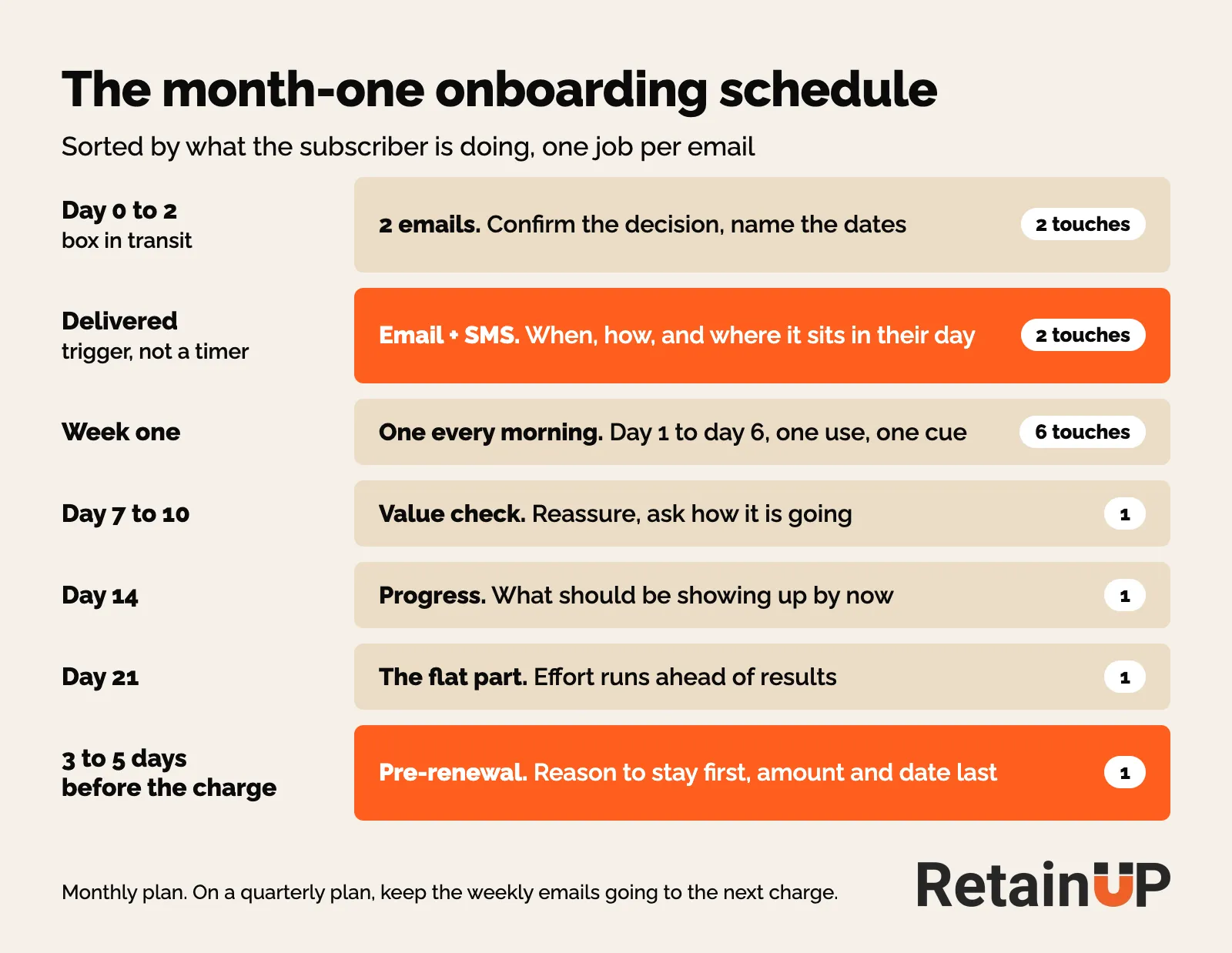
So sort the emails by what the subscriber is doing, not by topic. Two emails while the box is in transit. One email and one SMS when it lands. One a day in week one. Then one a week up to the pre-renewal email. That is about 14 touches before the first charge.
Start the flow on the app's subscription started event, and filter out anyone who has cancelled since. Recharge ships a New Subscriber Welcome template for Klaviyo. Turn off the Recharge email it replaces. Otherwise they get two.
Day 0 to 2: while the box is in transit
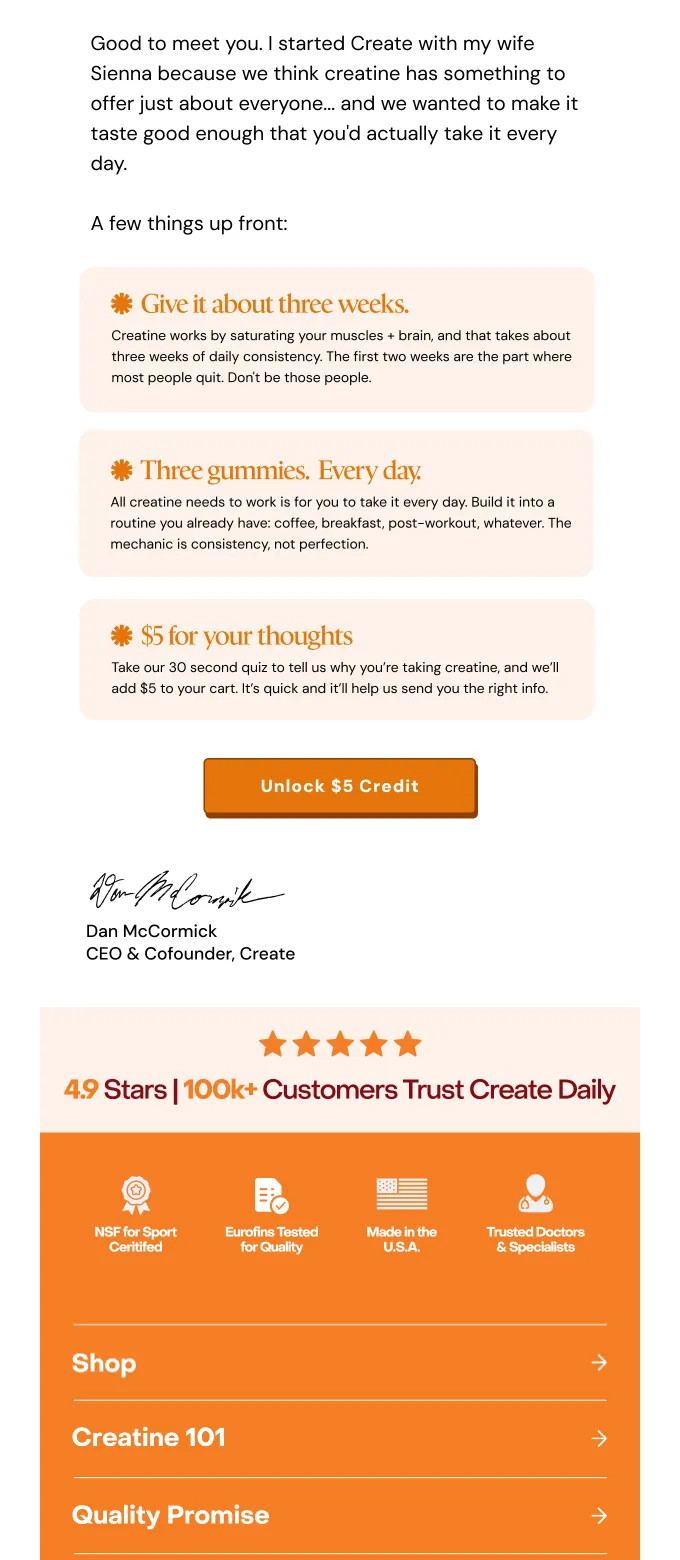
Most day zero cancels happen within 48 hours. Fast. So the first two emails have to land early. The first says what they just committed to and what the first week will feel like. The second names the dates their results land on. Create does this well. The welcome email comes from the co-founder. Give it about three weeks. Three gummies, every day. And $5 for a 30-second quiz on why you take creatine. Thomas Lalas, writing for Recharge, says to send these as plain text from the founder, not as a designed newsletter.
Nothing about the portal yet. No upsells either. The box has not landed.
Week one: an email every morning
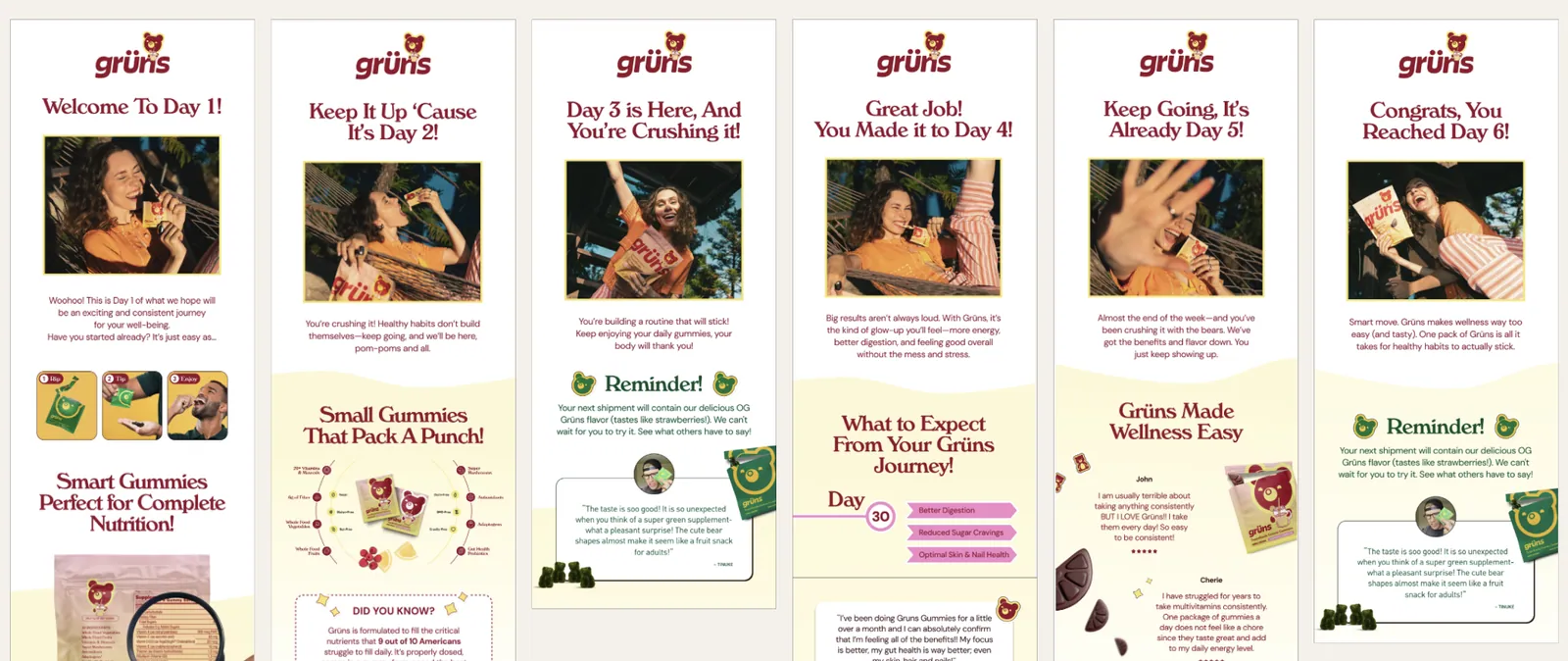
Grüns sends six emails in six days. Most brands would call that spam. The subject lines count the days out loud: welcome to day 1, keep it up it's day 2, day 3 and you're crushing it, right through to day 6. The gummy only works if it is taken daily, and week one decides whether it becomes a habit or a drawer item.
There is no universal email frequency benchmark. Someone building a daily habit needs daily emails. At least in the beginning.
Weeks two to four: the flat part
After week one, go weekly. Day 14 is progress. Day 21 is the flat part, where the effort has gone in and the result has not shown up yet, and that is the week people quit. Supplements pay out slowly, so name the dates. Mars Men names three. Day 7, the fog starts to lift. Day 30, energy and recovery. Day 90, people ask what you are doing differently.
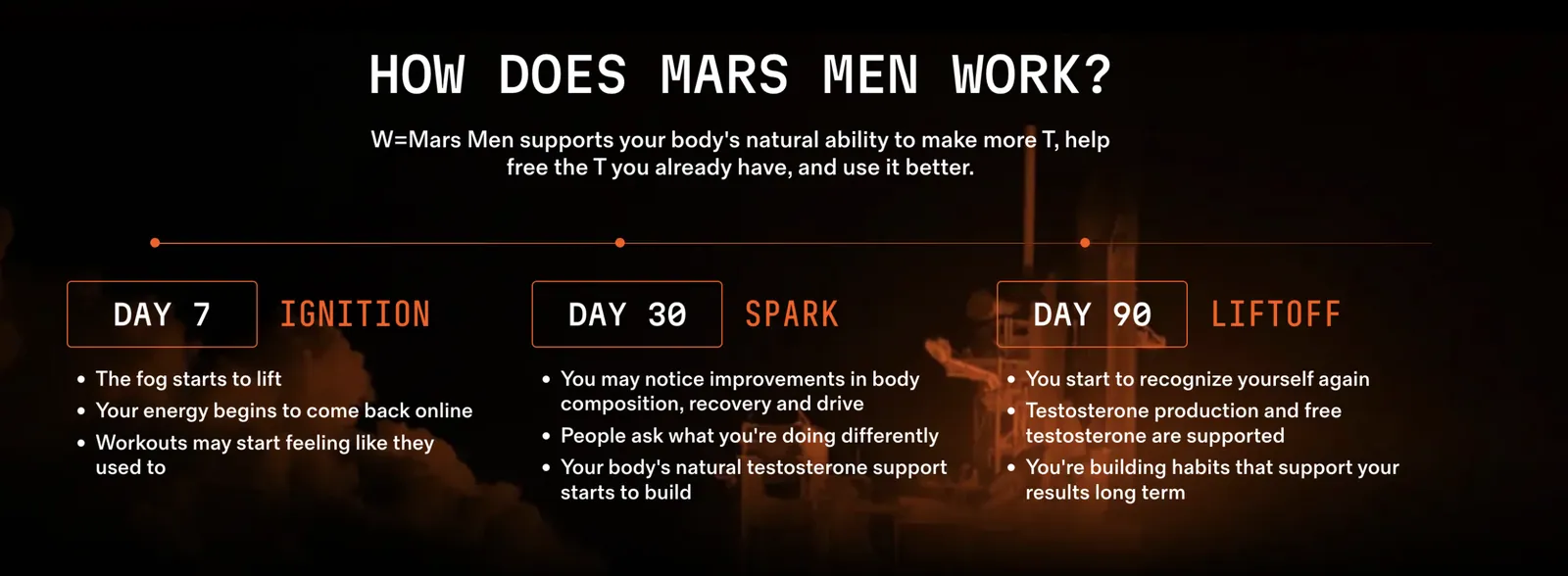
A subscriber who knows what day 30 should feel like does not quit in week three. Keep month one on the hero product, too. No cross-sell until the first renewal lands. The day-by-day table and the exit rules are in the month-one onboarding email schedule.
SunMed, a CBD supplement brand on Skio, runs five onboarding emails across the first weeks. "You've locked in your routine." "Wellness is a journey." The third names skip, pause and adjust, so someone with too much product changes the plan instead of cancelling it. Put the next charge date and the last day to edit the order in that email too. Blue Stout, a Shopify agency, gives billing dates their own email on day 5. Order 1 to order 2 retention went from 90.9% to 94.7%, with every other flow in the build live too, so onboarding does not get all the credit.

Delivery day: give the product a slot in their day
With consumables, every customer has a quiet question you never hear: when do I actually use this?
They bought it. It sits in the cupboard. They are not sure if it is a morning thing, a workout thing, or an every-day thing. So they use it twice, lose the thread, and the reorder never comes. Confusion shows up in your dashboard as churn, a few weeks later.
And habits take around 66 days, not 21. That runs past the first charge. A subscriber who takes it every morning through the first bottle renews without thinking about it. One who takes it four times and leaves it on the shelf is already gone, whether the charge comes at day 30 or day 90. The cancel just arrives later.
In one skincare brand's cohorts, about 70% of reorders happened before day 60, then reorders flatlined. One brand's data, not a law. Once it is on the shelf it never comes back, because they stopped taking it, not liking it.
Ride a habit they already have
"Take it daily" is easy to drop. "Stir it into the coffee you already make" is a habit.
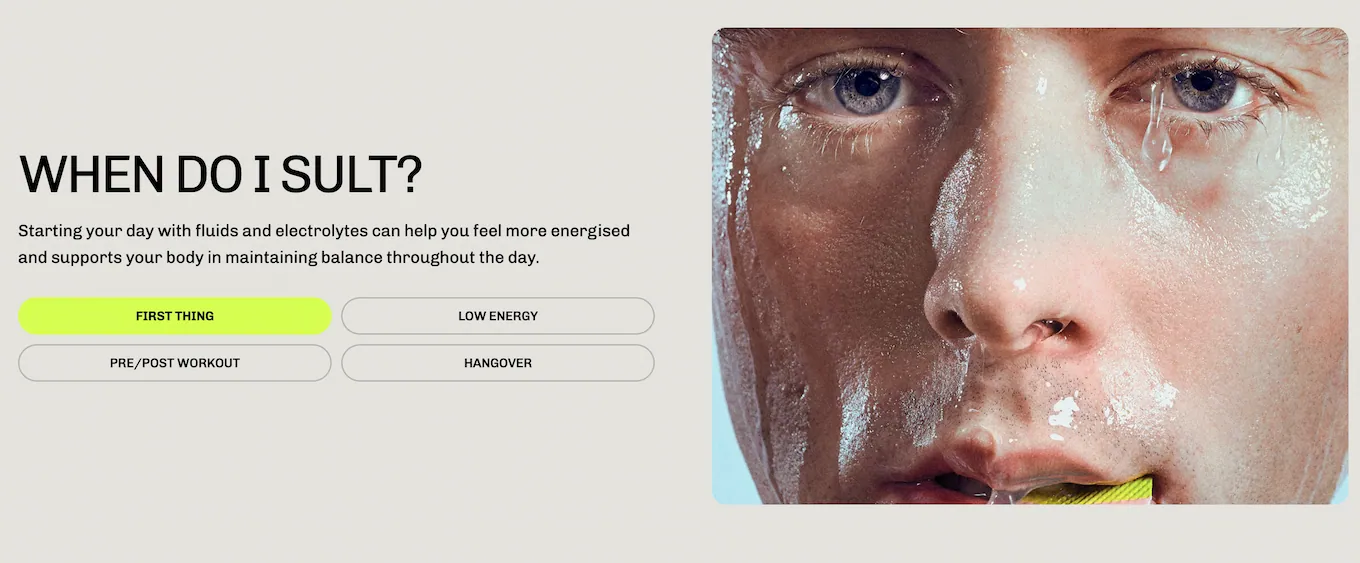
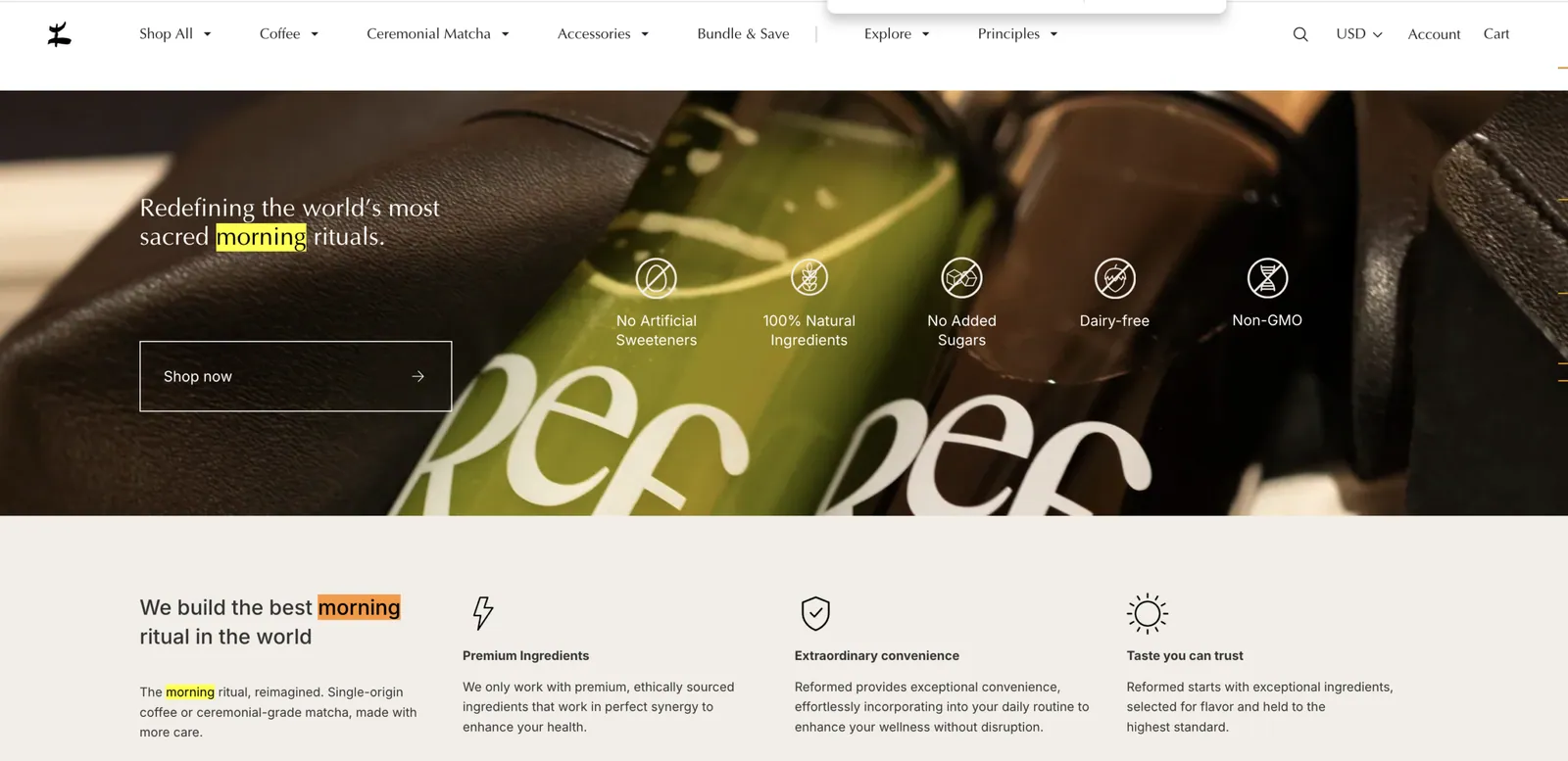
SULT, an electrolyte brand, asks "When do I SULT?" on its product page and gives four answers: first thing, the midday slump when you reach for another coffee, pre and post workout, and hangover. Every answer pins the product to a moment that already exists. Reformed puts collagen and creatine inside the coffee and matcha you already drink. AG1 rides the first glass of water.
None of them added a step. They rode one already there.
Format and price do part of the work
A tub and a scoop ask for a decision every morning. A gummy asks for nothing. Grüns put a greens powder into a gummy and never had to teach anyone how to take it.
Then the price. $90 a month feels expensive. $3 a day does not. AG1 puts the daily cost on the product page, in onboarding and in ads, next to a cup of coffee. The customer stops seeing a monthly charge and starts seeing a morning.
So trigger the delivery email on delivered. Never on a timer. Send one SMS beside it. When to take it, how to take it, where it sits in their day. Then repeat it in the day-3 email, before the customer has decided to quit. We ran that shape with a skincare brand: day 0 welcome, day 3 stack the routine, day 14 progress, day 21 nudge. Their 90-day repeat purchase rate went from 22% to 35%, one brand and one flow. More anchors are in building the habit with routine anchors.
Day 14: ask how they use it
Most brands hear from a new subscriber twice. Once at checkout. And once in the cancel survey, when it is too late to do anything with the answer.
A satisfied customer still stops using it. Then cancels for "too much product". Orestis Iliou puts it plainly. Satisfaction doesn't predict retention. Use does. Someone can give you a 9 out of 10 and still have four sachets left in the drawer when the second charge lands.
Two listening points in month one
The first is the thank-you page. Everyone who buys sees it, at the moment their excitement is highest, and around 45% of customers fill out a post-purchase survey, per KnoCommerce. Very cheap research. Ask "Why did you buy this product?" The answer decides which version of onboarding they get, because someone who bought for sleep should not get the same week-one emails as someone who bought for energy.
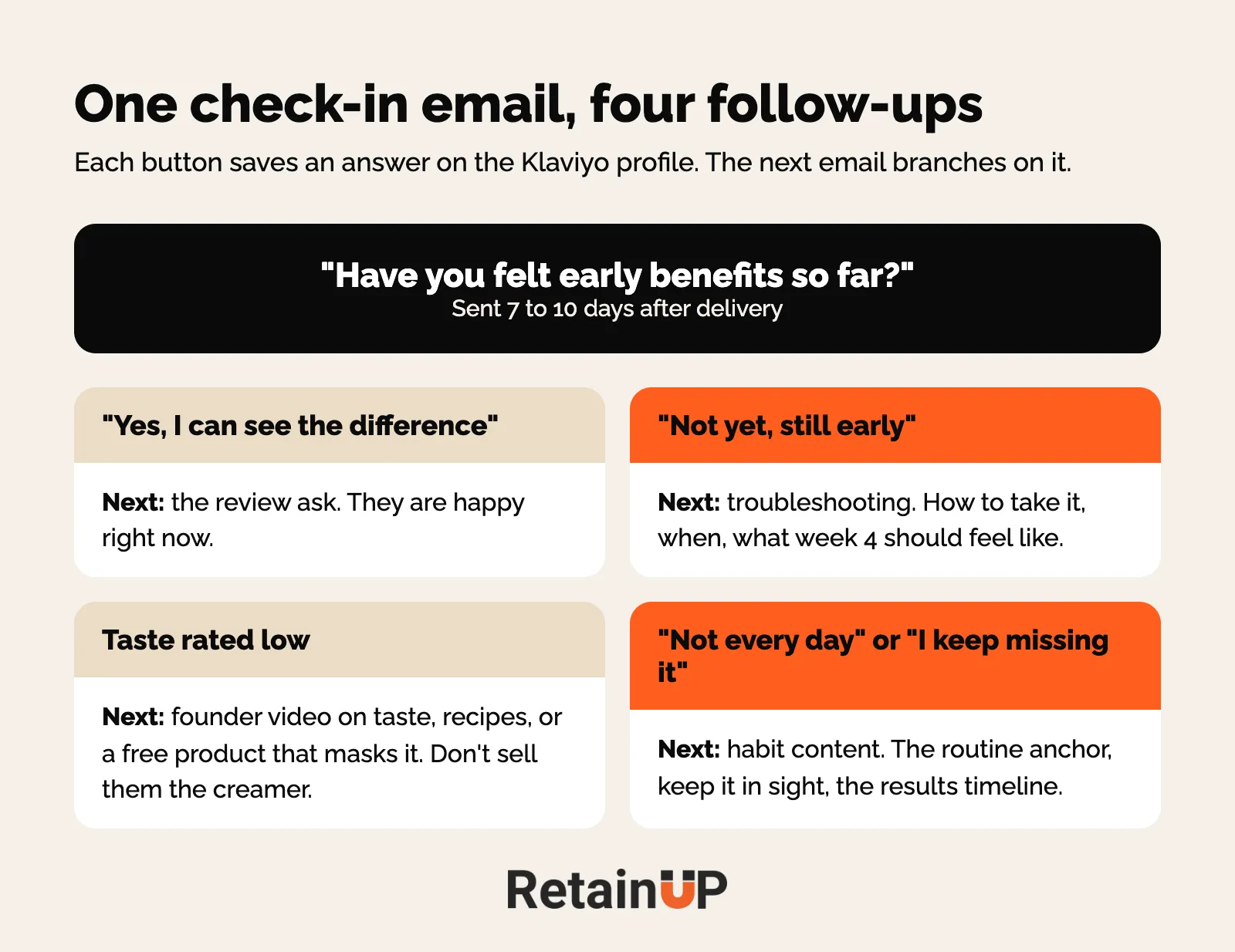
The second is a check-in 7 to 10 days after delivery, just before the flat part. Thomas Lalas asks "Have you felt early benefits to your well-being so far?" Two answers. "Yes, I feel early benefits" or "I still need time to evaluate". Never a no, because a no gives them a word for quitting and puts it in writing.
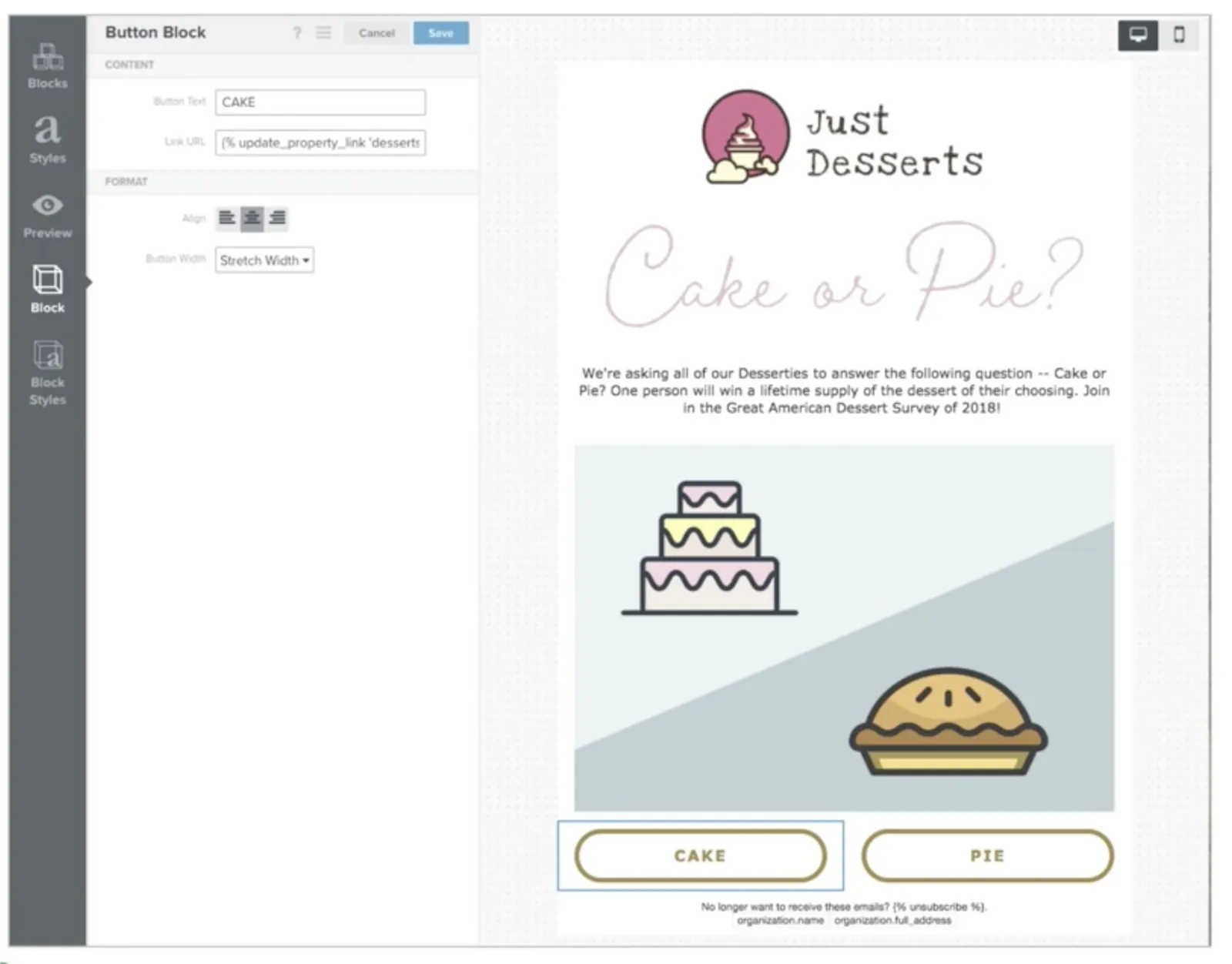
In Klaviyo each button gets an update property link. One click saves the answer on the profile, and the next email branches on it. Yes gets the review ask. Not yet gets troubleshooting: how to take it, when, what week 4 should feel like. "I keep missing it" gets the routine anchor. That last branch is the one most brands never build.
Usage questions sound boring. Good. "Where do you keep it?" is my favourite, because a tub in the pantry gets ignored. A tub next to the kettle gets used. Simple. Only 1 in 26 unhappy customers complain. The rest just leave. The full question list is in usage check-ins and surveys.
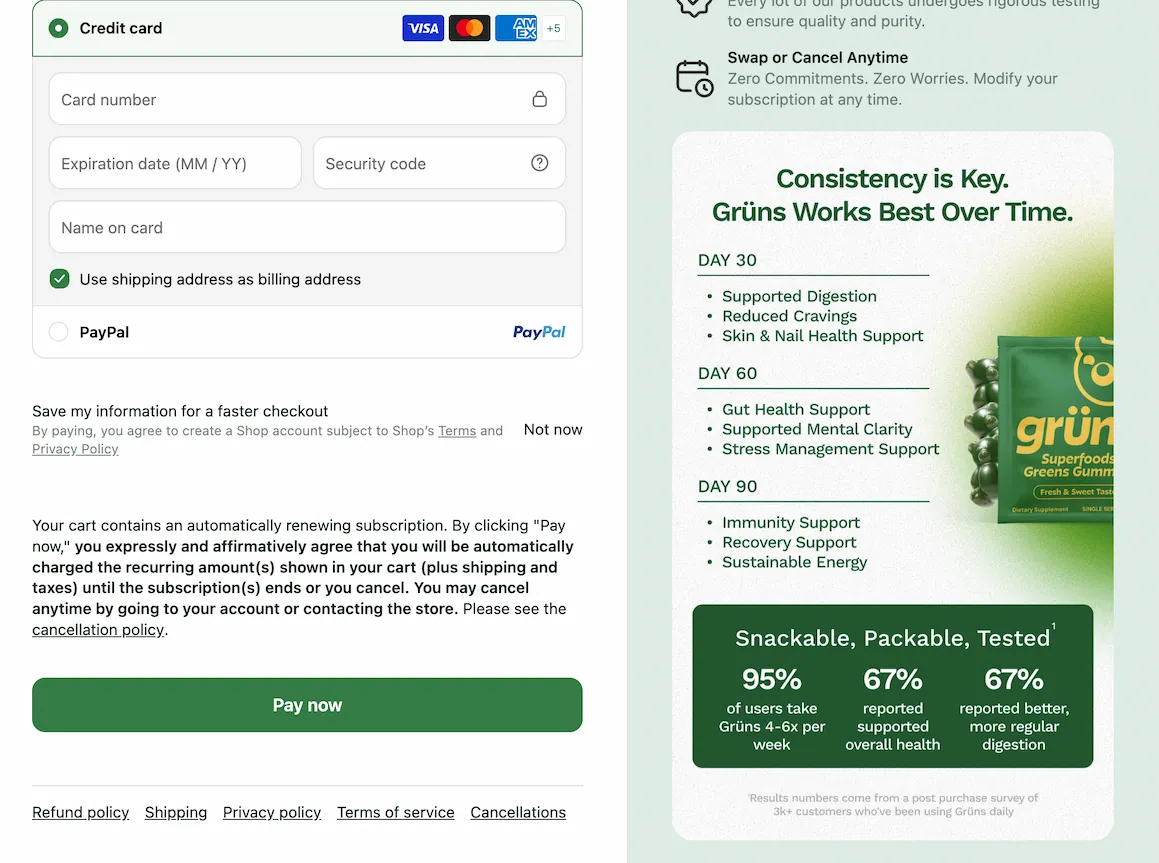
The reminder before order 2
Around day 23, or 3 to 5 days before the charge, the reminder goes out. It is the most opened email you have in month one. For a lot of brands it is also one of the biggest cancellation days of the month.
At one brand the day it went out had more than three times the cancels of the day before. Behaviour does not do that, because behaviour is smooth. A spike with two quiet days around it is a send. And the charge day was still the biggest day, which is the surprise charge the reminder is there to prevent. So keep the email. Change what it says.
If you write "You're about to be charged", do not be surprised when people cancel. You have written a bill and attached a cancel button. Lead with a reason to stay and what the product is doing for them. Skip and reschedule are the main buttons, cancel stays available, and the amount and date go at the bottom. Mars Men's subject line is "You're in your activation phase." Lalas goes further. Put a free gift in order 2 and make the reminder about the surprise on its way, with the charge underneath. He says that can halve reminder-day churn. The announcement does the work. A hidden gift does nothing.
And most brands send the same reminder before every order. Someone on their second order needs reassurance, and someone on their sixth needs a reward. In Klaviyo that is one flow on the app's upcoming order event, split on orders paid. Turn the app's own reminder off first. Otherwise they get two. For Boka, the reminder put skip, pause and swap under "Need to make an adjustment?", and churn went down 18% in 90 days. The full build, with one reminder per order number, is in the upcoming billing reminder, and the three cancel days are mapped in cancellation day spikes.
Order 2 and order 3: where the floor gives way
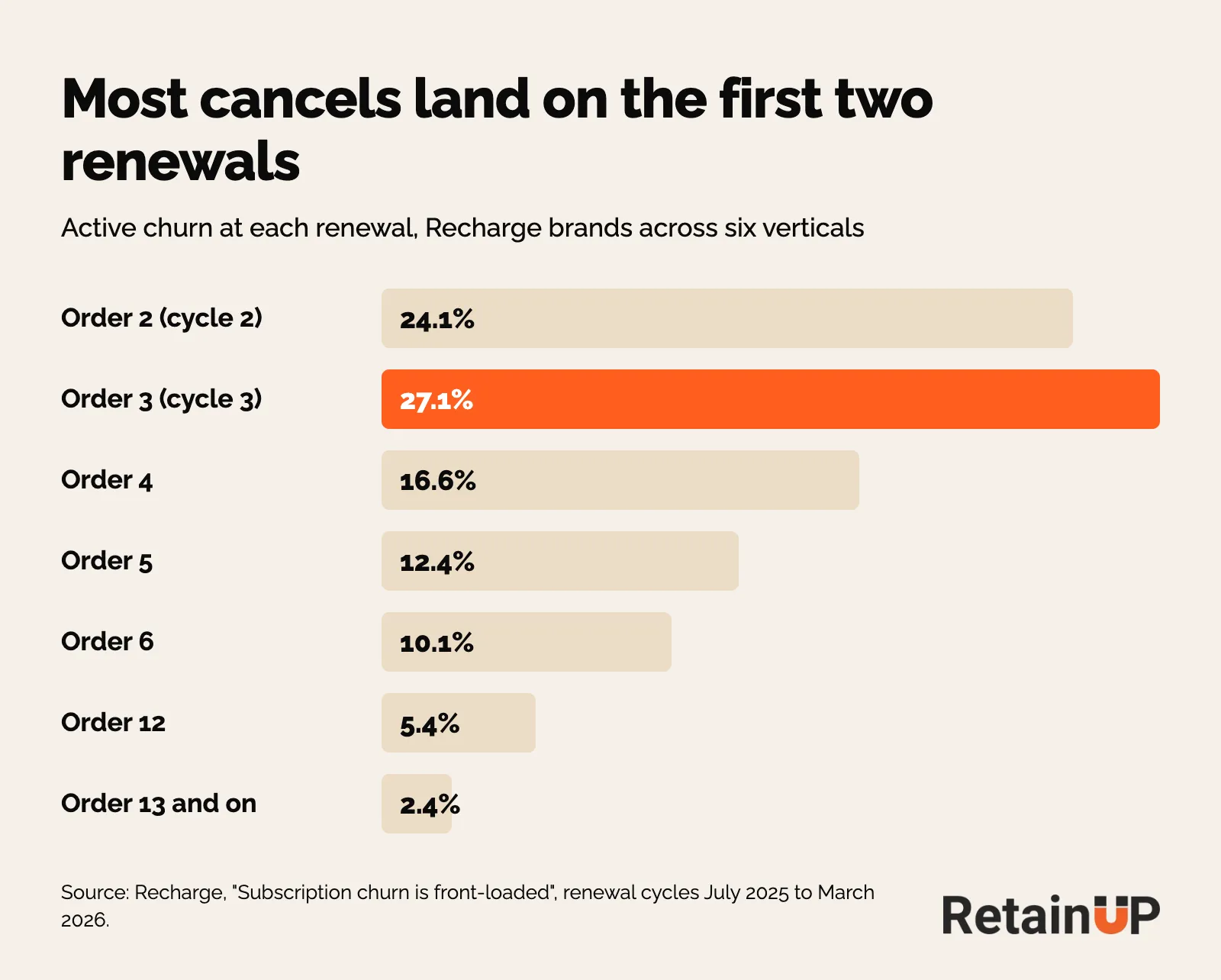
Open a cohort table and look at the first three columns. Order 1 is 100%. Order 2 takes the first hit. Order 3 takes another one about the same size, and half the cohort is gone.
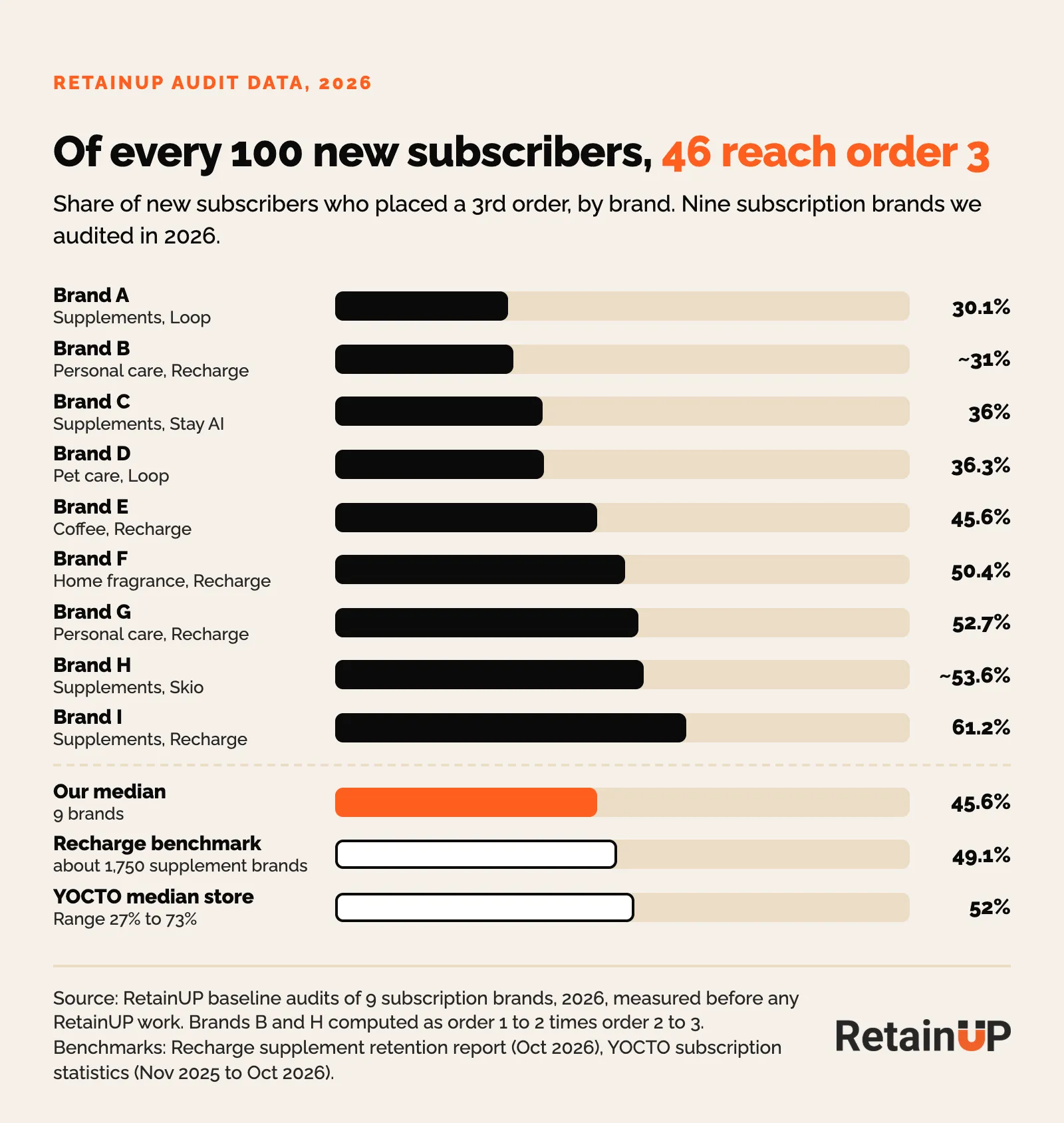
Across the 9 brands, order 3 ranged from 30.1% to 61.2%. Recharge puts supplements at 49.1% and YOCTO's median store at 52%. At order 2 the sample matched the benchmarks. The gap opens after it. They lose the third.
Recharge sees the same shape across its brands. In its renewal-cycle data, active churn peaks at the third cycle, about 27%, then falls to about 5% by the twelfth. About 61% of voluntary cancels land on the first two renewals. Food and drink, pets, wellness and beauty all lose 26% to 28% at those first renewals. Skio's guide to early churn puts 40% to 60% of subscribers gone before their third order. So those two charges are where your effort goes.
The bands we rate against sit on the subscription benchmarks page.
Order 2 sets the ceiling
In this sample, every brand that kept under 70% to order 2 finished between 30% and 36% at order 3. Every brand above 70% finished between 46% and 61%. A brand that loses 4 in 10 before the second box cannot make it up later.
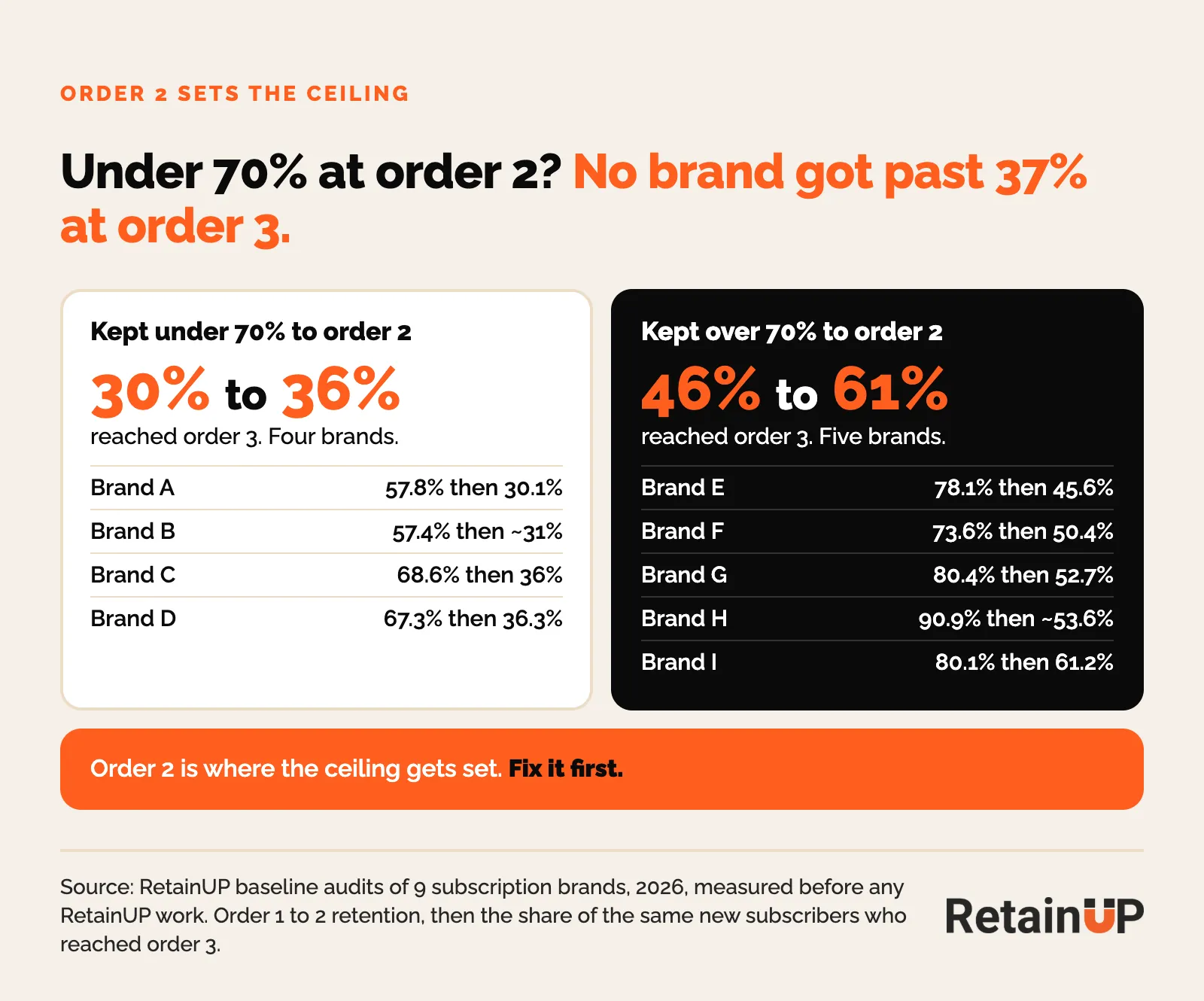
But the split is nowhere near even. One brand lost 42 of every 100 before the second order. Another lost 9, then lost 37 before the third. Same problem on paper, opposite fixes. So read your own split before you pick a project, and count it by order, not by month. A monthly subscriber has paid three times by month three. A quarterly one has paid once.
Why they leave before order 3
Order 2 can be an accident. They never knew they subscribed. Order 3 is the first charge nobody has an excuse for. By then the discount has worn off, the second box is still half full, and the product has had time to either work or not. At SunMed, "too much product" was the top cancel reason, a third of all cancel sessions. They did not dislike it. They had three of it.
And the cancel page will not catch it. Across 8 brands we audited, the median cancel flow saved 10.8% of people who tried to cancel. By then the decision is mostly made. So find the order where your cohort drops hardest and send one email 5 to 10 days before it. No discount. A value reminder.
Or turn two decisions into one. Grüns shows one frequency on the product page and offers the quarterly plan on the thank-you page, after the card is charged. Recharge's quarterly upgrade data says the average monthly subscriber who churns is gone by about day 77, so a 90-day plan carries them past it.
Put the gift on order 2
A gift on order 1 pays people to subscribe and leave. Move the value to orders 2 and 3, and say so before the charge. Everyday Dose shows the whole ladder before checkout, a canister at order 2 and a tumbler at order 3, each with a dollar value on it. Announce it at the wrong moment, though, and it backfires. One brand announced the gift right after the first order, which reminded customers they had a subscription, and they cancelled before it shipped.
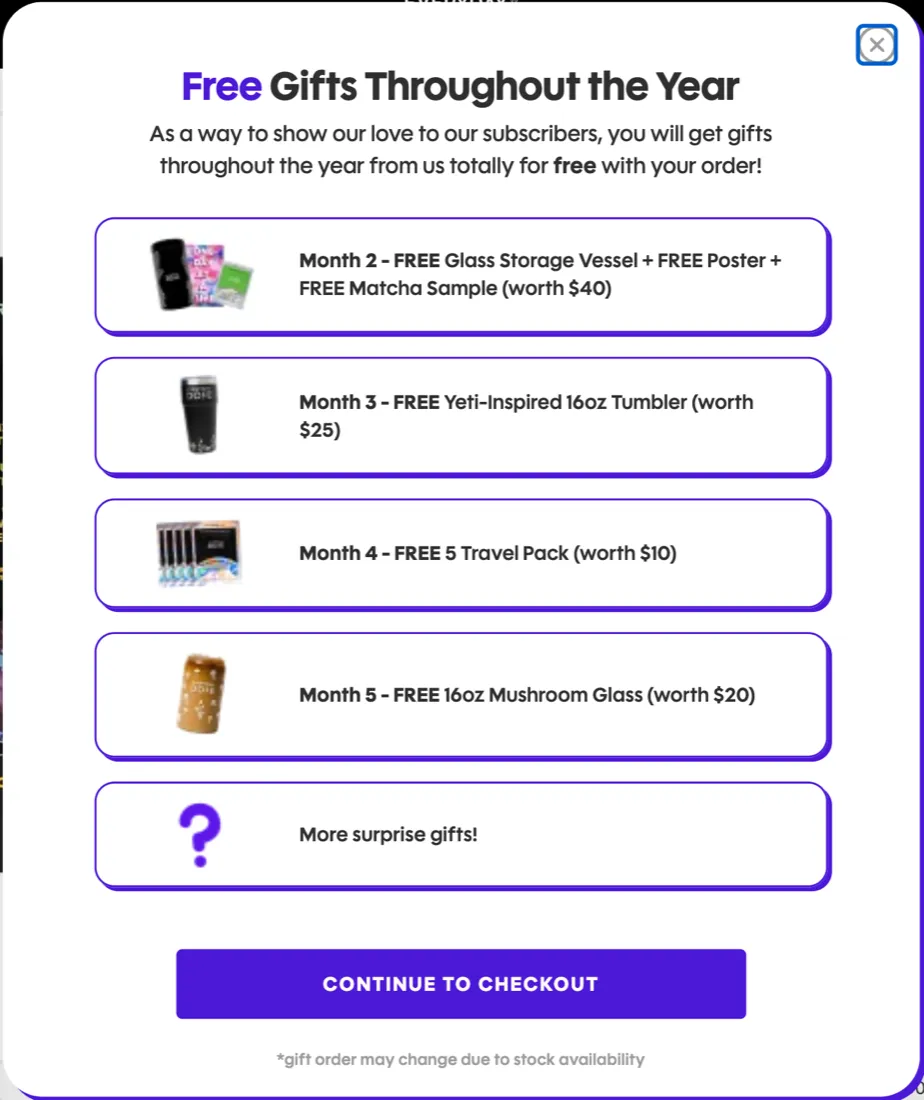
SunMed went from 61.46% and 62.98% at month 3 to 71.69% and 73.24% for later cohorts, with no new standing discount. Boka, an oral care brand on Recharge, went from 41% to 63%. Both builds are in getting past order 2 and order 3. The number we track for it is Order 3 retention, and the full gift schedule after order 3 is in subscription rewards.
The box itself: box 1, then the refills
Every email in month one fights an inbox. The box doesn't. Thomas Lalas puts it at a 100% open rate, and his line I keep coming back to is "People need to be reminded more than they need to be taught." The card in the box is the first reminder. The emails repeat it.
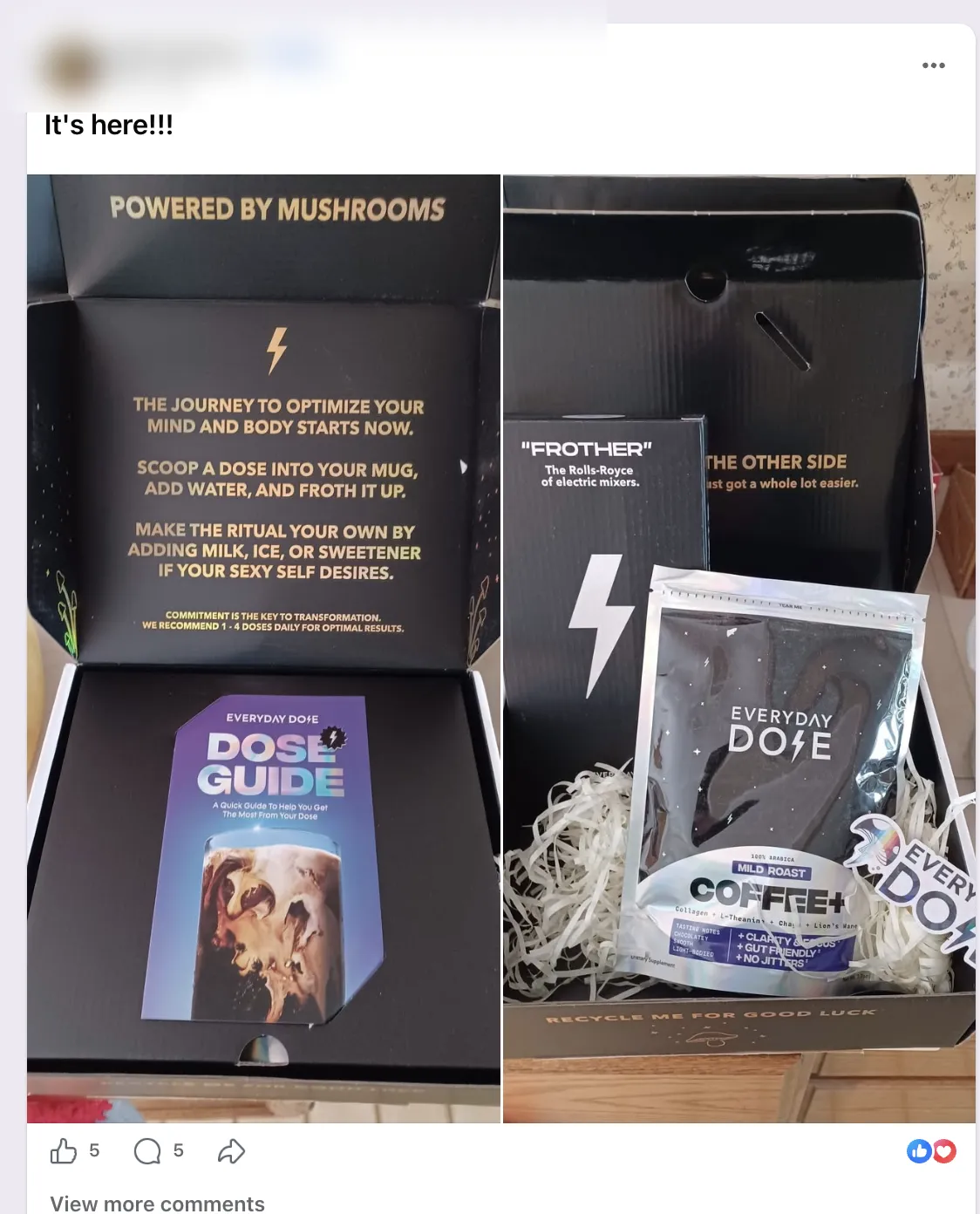
One card. The timeline of benefits, how to use it, who takes one dose and who takes two, and one QR code. Everyday Dose prints the instructions inside the lid and puts the frother in the box, so the first cup is made the way it's meant to be made.
Space Goods surveyed customers on how they were preparing its mushroom coffee, then looked at LTV by preparation method. Warm milk won. Customers who made it that way stayed longest. That finding is now on the product page, in the onboarding email and on the insert. So the order of work is: survey usage, find the pattern with the highest LTV, print it on the card.
Starter tools and the gift in box 2
Lalas's rule for starter tools: gift what people would buy anyway to use alongside the product. For coffee, a frother, a spoon, a tumbler. For a dog supplement, a pill crusher. If it has your logo and nothing else, it's an ad.

IM8's US$123 welcome kit passes on most of it. The bottle and the mixer get used every morning. The cap is merch.
Box 1 starts the habit. Hero product only. The refills keep it going. The next physical gift belongs in box 2 or 3, and Obvi's test shows why. They told subscribers a free gift was coming, by email and SMS before the order processed. Order 2 retention rose 85%. Order 3, 15%. Order 4, nothing measurable. Timing beat value.
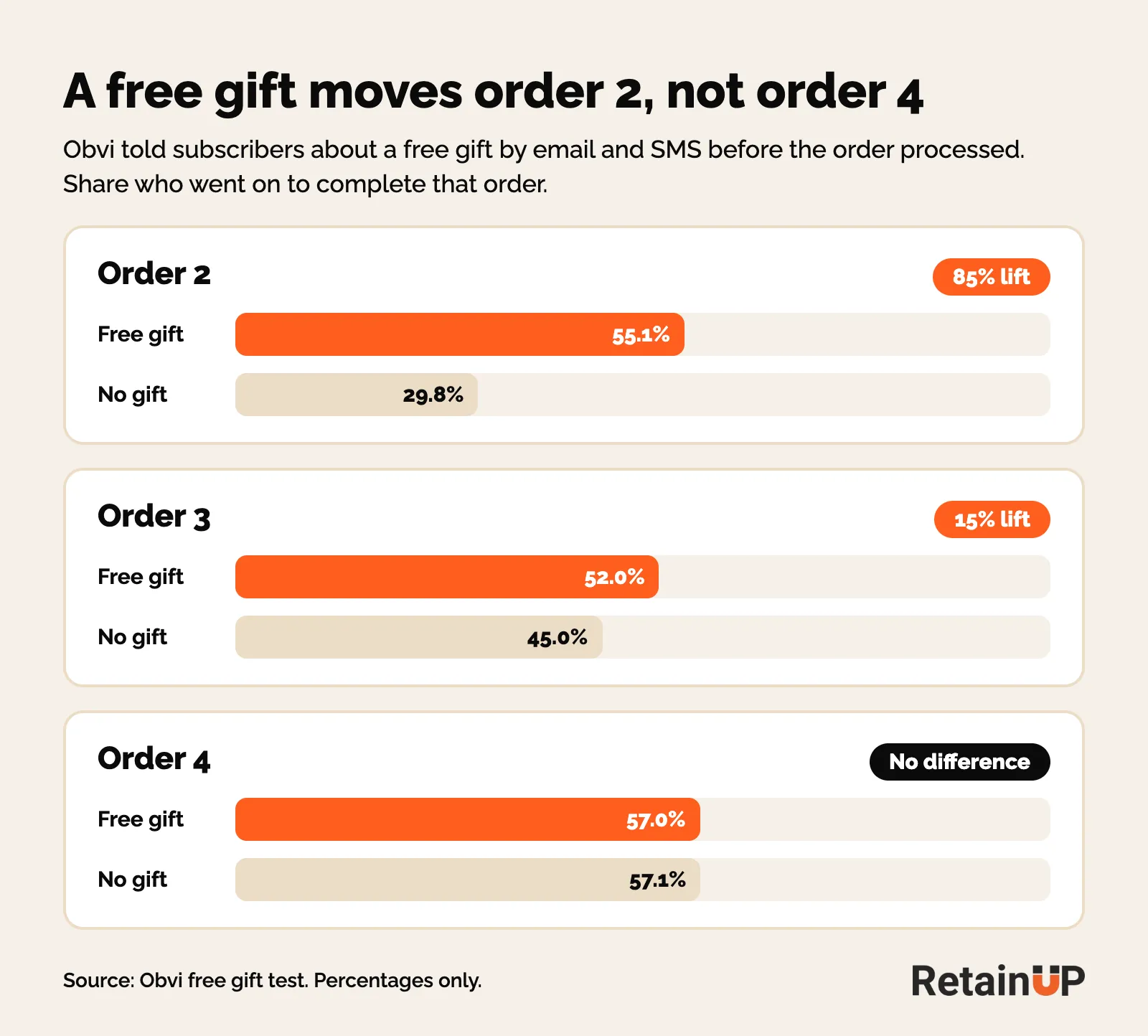
The vulnerable stretch is between order 1 and 2, while the subscriber is still deciding whether it works. By order 4 they've either committed or not. More on the card and the tools is in the first box and the card in it. Pricing a welcome kit so it lifts take rate belongs to subscription perks, gifts and welcome kits.
Which part of the first 90 days to build first
Loop puts 68% of churn in the first three orders. Those come first. Build first whatever sits just before the order where most of your subscribers cancel:
- Cancelling on signup day: the day-zero cancel path, and gifts moved off order 1.
- Cancelling before order 2: onboarding emails, the delivery email and the order 2 gift.
- Cancelling on the charge day: the pre-renewal reminder.
- Cancelling between order 2 and order 3: the lapse-point email and a default frequency that matches how fast the product gets used.
Brands running a real onboarding flow cut month one churn by up to 25%. The KPI is second month retention, the 60-day repeat rate. Lalas calls it the first number to fix. In his example, lifting it from 60% to 75% with nothing else changed cuts payback from 3 months to 2. Read it on like-aged cohorts from before and after launch, at 30, 60 and 90 days. If month 2 retention is below 70%, stop scaling acquisition and fix onboarding and the second charge first.
Then check what your app is sending. Most brands assume the reminder lives in Klaviyo. Very often Recharge, Skio or Stay AI sends it, and nobody has looked at it since the app was installed. A live message with zero sends in the last 7 days is broken. Where onboarding sits next to the other flows is in the core subscription email flows, and what happens after day 90 is in the subscription retention guide.
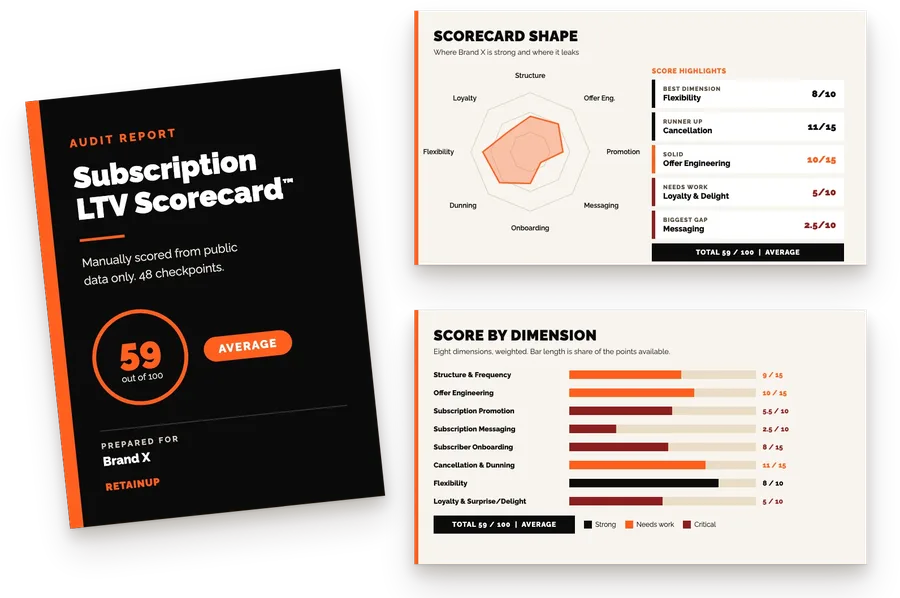
If you are not sure which of these days costs you the most, the free subscription audit checks 48 checkpoints and sends your top 3 leaks in 24 hours. If you are deciding who to hire, here is how subscription retention experts compare and what a subscription retention agency costs.
Most of the first 90 days gets built once and then left alone. The Subscription LTV Maximizer™ builds the offer, widget, cancel flow, portal, payment recovery, pause and skip in Recharge, Skio, Stay AI or Loop, plus the onboarding emails, the reminder and the SMS around them, live in 30 days for $5,000.
FAQ
What is subscriber onboarding?
Subscriber onboarding is the set of emails, texts, box inserts and offers a new subscriber gets between signup and their third order. In month one its job is use, getting the product into their day before the first renewal. After that it carries them through order 2 and order 3, where most subscribers decide to stay or leave.
How long should a subscription onboarding sequence run?
At least from signup to the first renewal, with offers planned through order 3. Habits take around 66 days to form, so a sequence that stops after the shipping notice ends well before the habit does. Send two emails in transit, one a day in week one, then one a week. On a quarterly plan, carry the weekly emails on to the next charge.
When do new subscribers usually cancel?
Mostly on three days: the day they sign up, the day the pre-charge reminder goes out, and the charge day itself. At one brand, day zero alone held 5.6% to 8.4% of cancellations at every billing frequency. Each needs its own fix. So count your cancels by day since signup before you build anything.
What percentage of subscribers should reach order 3?
Across 9 subscription brands audited in 2026, the median was 45.6%, with a range from 30.1% to 61.2%. Recharge puts supplement brands at 49.1% and YOCTO's median store at 52%. Every brand in the sample that kept under 70% to order 2 finished between 30% and 36% at order 3, so read your order 2 number first.
Should new subscribers get a bigger discount or a free gift?
A free gift on order 2 or 3 usually does more, because a competitor can match a discount tomorrow and a gift gives the subscriber something to wait for. In Obvi's test, telling subscribers a gift was coming lifted order 2 retention 85% and order 3 by 15%, with nothing at order 4. Announce it before the charge, not after.
Does a pre-charge reminder cause more cancellations?
It moves some cancellations earlier, but it also cuts surprise cancels on the charge day, which is still the biggest day. Keep the email and change what it says. Lead with a reason to stay, make skip and reschedule the main buttons, and put the amount and date at the bottom. Judge it on the whole week around renewal.
One email a week on subscription retention: the numbers, the strategy, and what to fix first.

Rahi Jain
Rahi Jain is a subscription LTV specialist who helps $1M to $10M DTC brands reduce subscription churn and maximize LTV on Recharge, Skio, Stay AI and Loop.
More about Rahi