Key takeaways
- Around 45% of customers fill out a post-purchase survey (KnoCommerce), so the thank-you page is the cheapest research you will ever run.
- The day-14 check-in gives two answers and never a no: "Yes, I feel early benefits" or "I still need time to evaluate" (Thomas Lalas).
- Satisfaction does not predict retention. Use does. Ask where they keep it and whether they take it every day.
Most brands hear from a new subscriber twice. Once at checkout. And once in the cancel survey, when it is too late to do anything with the answer.
Everything in between is silence. So the reasons people leave, "too much product", "didn't feel the benefits", "too expensive", show up months later as a cancel reason you can only read. This article is the listening part of subscriber onboarding: what to ask in the first 30 days, where to ask it, and what each answer should trigger.
Short version. Ask how they use it, not how satisfied they are.
Why satisfaction scores miss the subscribers who leave
A satisfied customer still stops using it. Then cancels for "too much product".
Orestis Iliou puts it plainly on LinkedIn. Satisfaction doesn't predict retention. Use does. Someone can love the taste, love the brand, give you a 9 out of 10, and still have four sachets left in the drawer when the second charge lands.
And that subscriber is already gone, whether the charge comes at day 30 or day 90. No discount brings them back, because they stopped taking it, not stopped liking it.
So the three cancel reasons you see most are usage problems that surfaced late:
- Too much product. They are taking it less often than the label says, so the shelf fills up.
- Didn't feel the benefits. They took it four times, or took it the wrong way, and never reached the point where it works.
- Too expensive. The price did not change. What changed is that they stopped getting anything for it.
Each of these can be caught in week two with one question. By the time it shows up in the cancel flow, you are in cancel reason territory and the habit is long gone.
One supplement brand we worked with had 60-tablet bottles with "Take 2 daily" on the label. Most customers took 1. The bottle lasted 60 days, not 30, and every email was timed for the wrong month. A single "how often do you take it?" question would have shown that on day 14.
Ask why they bought, on the thank-you page
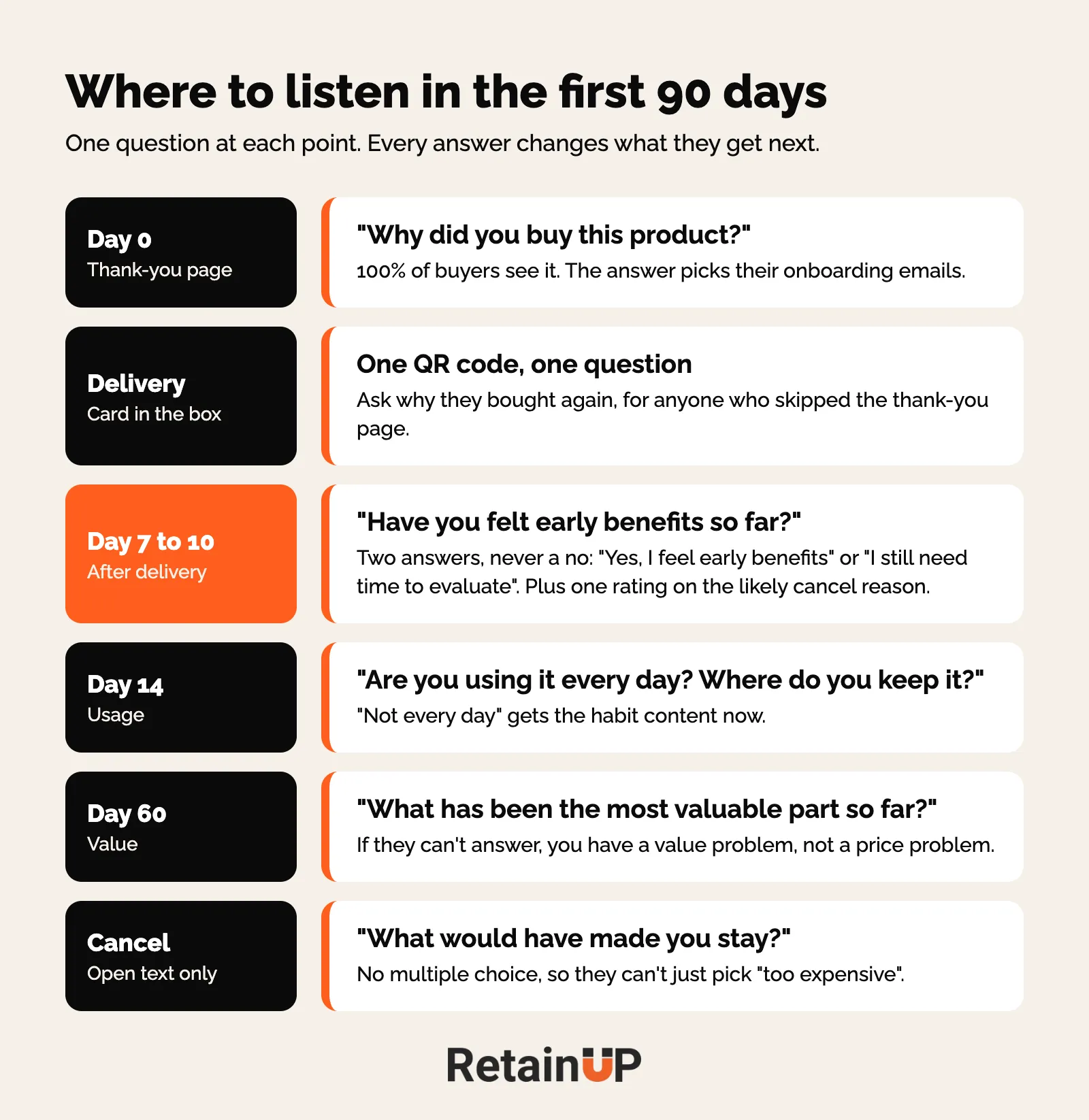
The thank-you page has a 100% open rate. Everyone who buys sees it, and they see it at the moment their excitement is highest.
So ask there: "Why did you buy this product?" Thomas Lalas makes this the first listening point in his onboarding, then asks again on the card in the box. The answer decides which version of onboarding they get. Someone who bought for sleep should not get the same week-one emails as someone who bought for energy.
It is also cheap. Very cheap. Around 45% of customers fill out a post-purchase survey (KnoCommerce, cited in Lunar Solar Group's Subscription Tech Playbook 2025). And KnoCommerce's own guide puts email surveys at 10 to 15%. So the big question goes on the thank-you page, not in an email two weeks later.
Questions worth the space
Keep it to a few. For a subscription brand these earn their place:
- "Why did you buy this product?" or "What problem are you hoping it solves?"
- "What made you consider a subscription?"
- "How often do you use our products?"
- "What other products would you be interested in purchasing from us?"
The first three feed onboarding. The last one feeds the offer and, later, cross-sell to existing subscribers. If the buyer did not subscribe, the same answers tell you what to say in the follow-up that tries to turn a one-time buyer into a subscriber.
Keep it short, and multiple choice first
Five or six questions is the ceiling. KnoCommerce's own guide reports about 90% completion at that length, against 41% for a 25-question survey. Put the multiple choice first so the first tap is easy, and save open text for the end.
Two more questions earn a spot for a subscription brand. "Did you buy this for yourself or as a gift?" from KnoCommerce, because a gift buyer needs a different follow-up and will not reorder the same way. And "How are you planning to use the product?", which Zettler Digital uses to branch Klaviyo emails by intent (Fairing).
One setup check. KnoCommerce flags that thank-you page surveys now need an app built on Shopify's Checkout UI Extensions, or they stop rendering.
Ask a second time in the first box. The insert or card gets read by everyone too, and a QR code to one question is the only call to action it needs.
Post-purchase questions sit inside the Klaviyo ecosystem better than in a separate Typeform. The answer lands on the profile as a property, and a flow can branch on it the same day.
The day-14 usage check-in
This is the one email in month one built to listen. Keep it short.
Lalas sends it 7 to 10 days after delivery, as one short form. The question: "Have you felt early benefits to your well-being so far?"
Two answers. That is all.
- "Yes, I feel early benefits"
- "I still need time to evaluate"
Never a no. Why? A no gives them a word for quitting, and puts it in writing. "Not yet" keeps the door open and tells you exactly who needs help. People who say yes tend to stay way longer. So the answer is also an early read on who is likely to leave.
Day 14 is progress. Day 21 is the flat part, where effort runs ahead of results. The check-in lands just before that dip, while you can still do something about it.
Add one rating for the likely cancel reason
Every product has one reason people quit. For a greens powder it is taste. For a sleep supplement it is "didn't work". Put that reason in the form as a rating, taste out of 5 for example.
A low score gets recipes, or a free product that masks the taste. Lalas has a line for this: "Don't sell them the creamer." Give it. The point is to get them through the first bottle, not to make a sale on day 14.
A rating on another problem works the other way. Ask about sleep out of 5 on an energy product and the low scores are your cross-sell candidates, for after the first renewal, not before.
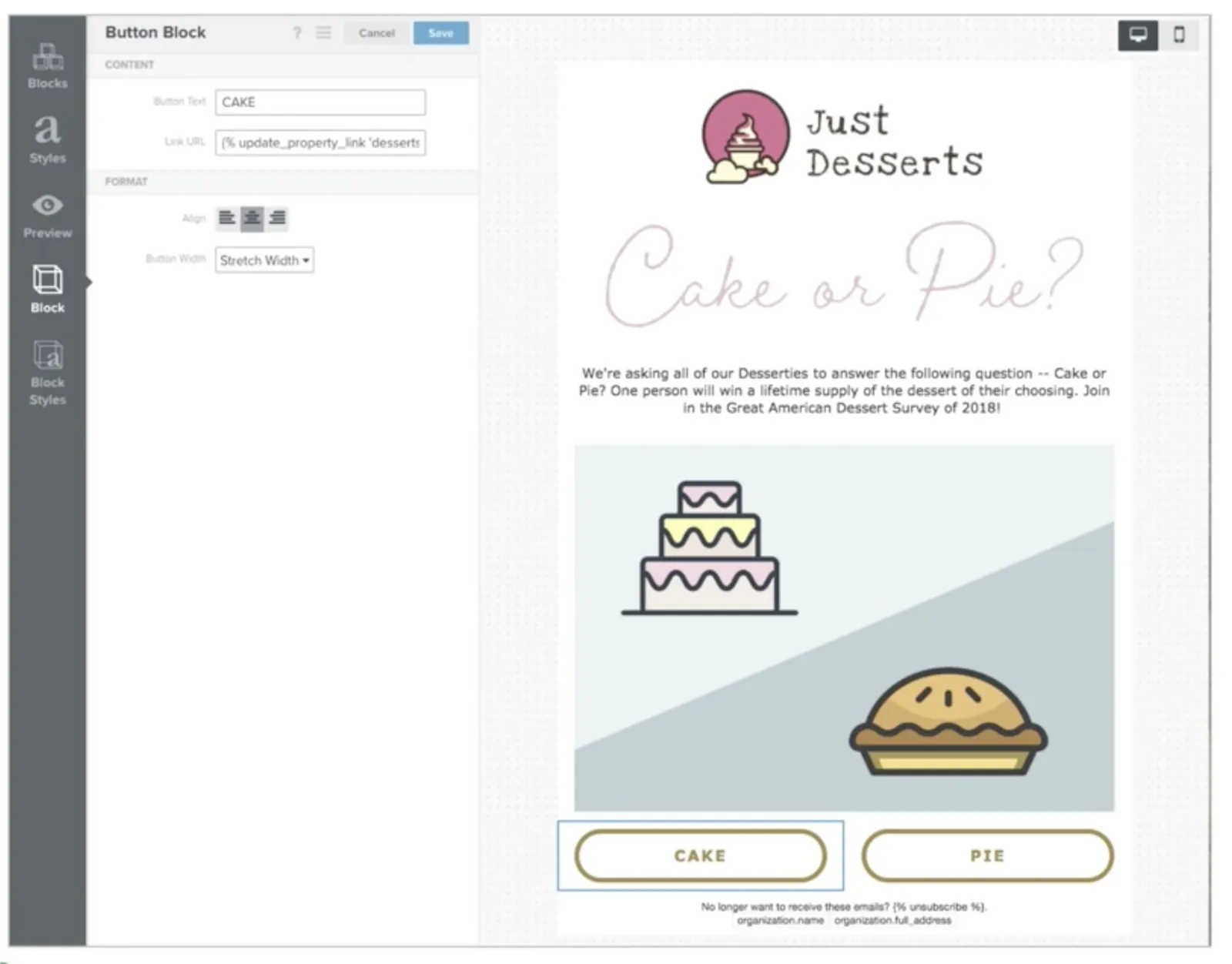
The build is simple in Klaviyo. Each button gets an update property link. One click saves the answer on the profile, no form page, and the next email branches on it.
Two buttons, two different follow-ups
The check-in is only worth sending if the answers lead somewhere different. Same email, two outcomes instead of one.
The pattern we use in onboarding emails:
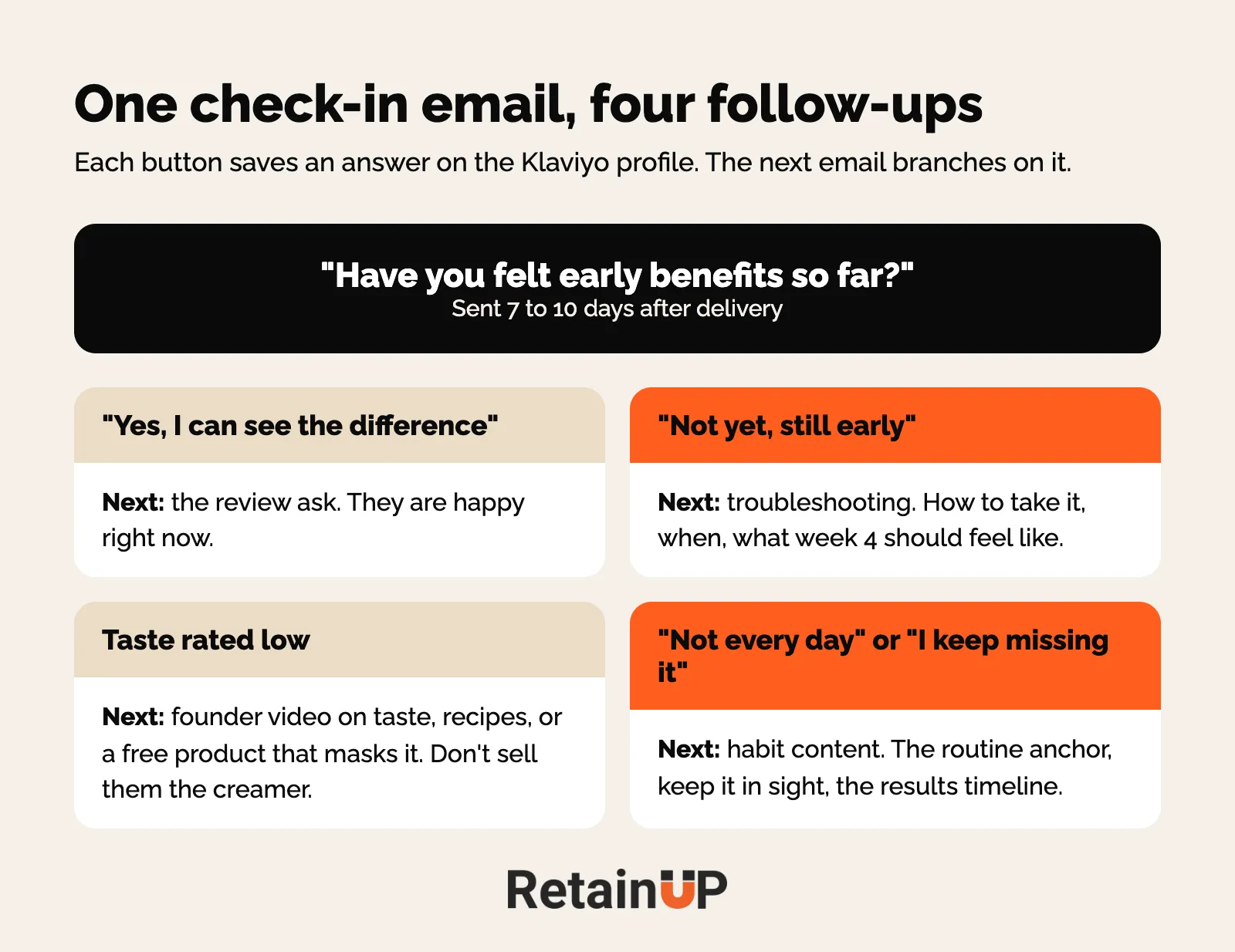
| Answer | What they get next |
|---|---|
| "Yes, I can see the difference" | The review ask. They are happy right now, so this is the best moment for a review or UGC. |
| "Not yet, still early" | A troubleshooting email. How to take it, when, what week 4 should feel like. |
| "Do you like the taste?" No | A founder video on taste, plus recipes or a free product that masks it. |
| "Not every day" or "I keep missing it" | Habit content now: the routine anchor, keep it in sight, the results timeline. |
The "I keep missing it" branch is the one most brands never build. And it is the one that matters. That subscriber gets the routine anchor: tie it to something they already do, keep the tub on the counter, tell them what day 30 should feel like.
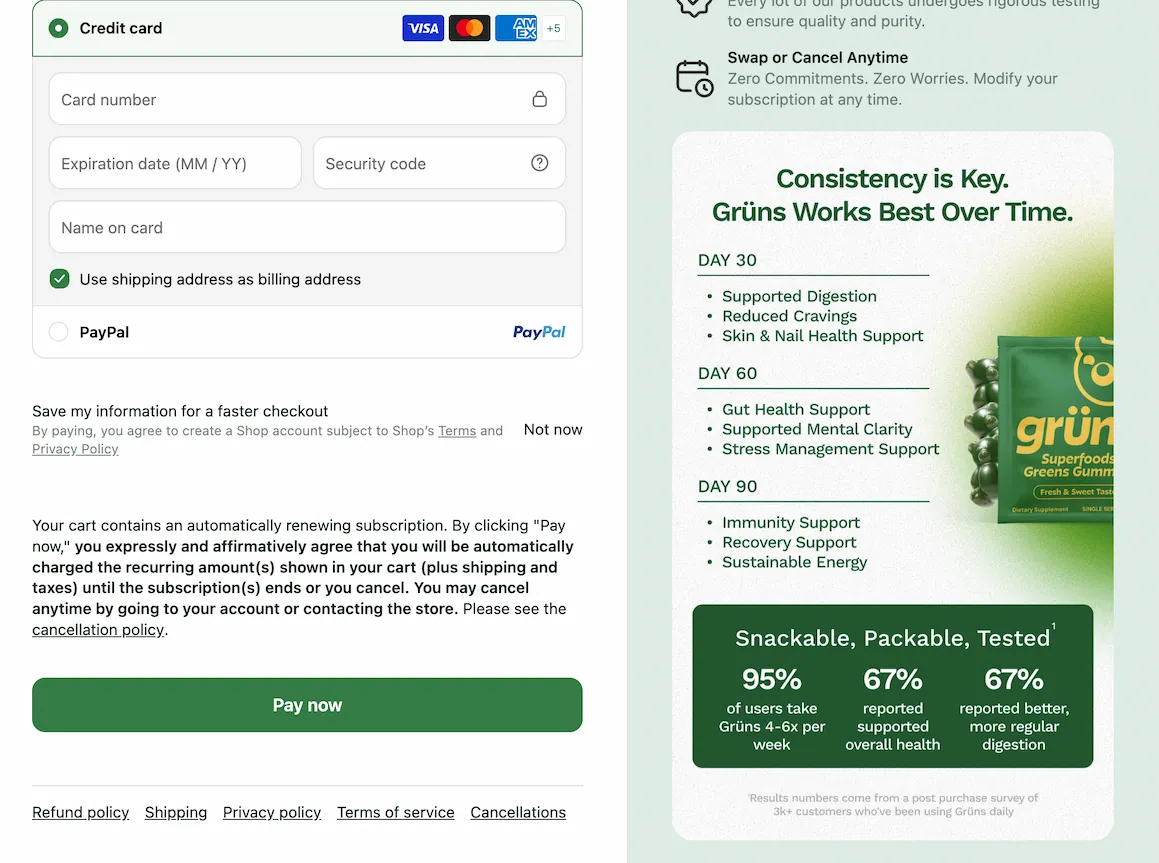
Grüns puts the day 30, 60 and 90 results right on the checkout page. That timeline is what a "not yet" subscriber needs to hear again in week two, because it pins each change to a specific day.
Usage questions to ask, and the ones to drop
Usage questions sound boring. Good. That is why they work.
From Orestis Iliou's list:
- How does it fit your routine?
- Are you using it every day?
- Where do you keep it?
"Where do you keep it" does the most work. A tub in the pantry gets ignored. A tub next to the kettle gets used.
Now look at what most post-purchase emails ask.

"How did we do?" from Debenhams. It measures the shopping experience. For a subscription it tells you nothing about whether the second box will be wanted.
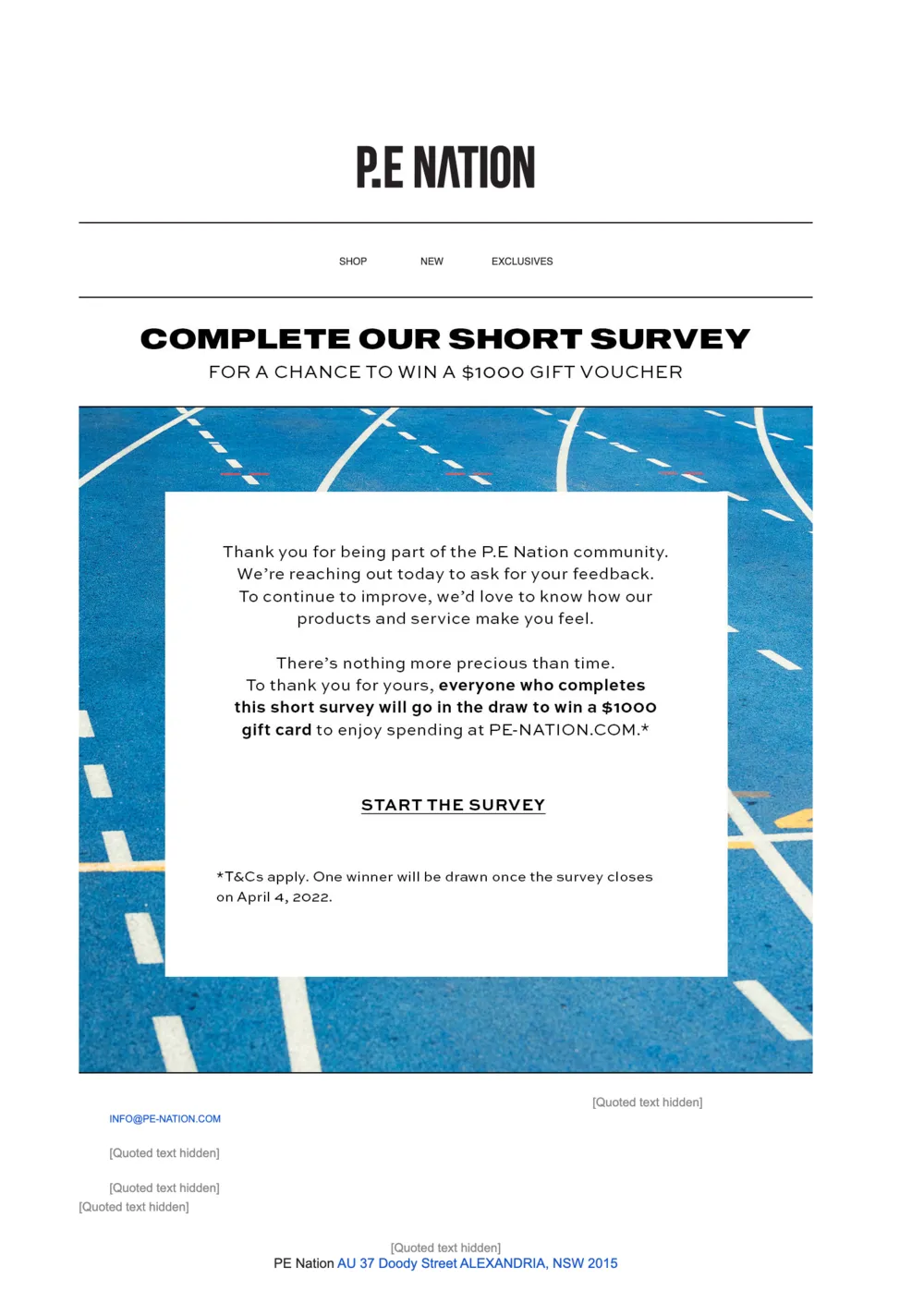
P.E Nation offers a draw for a $1,000 gift card to get a feedback survey filled. A prize does lift answers. But the questions are about how "products and service make you feel", which is a satisfaction question again.
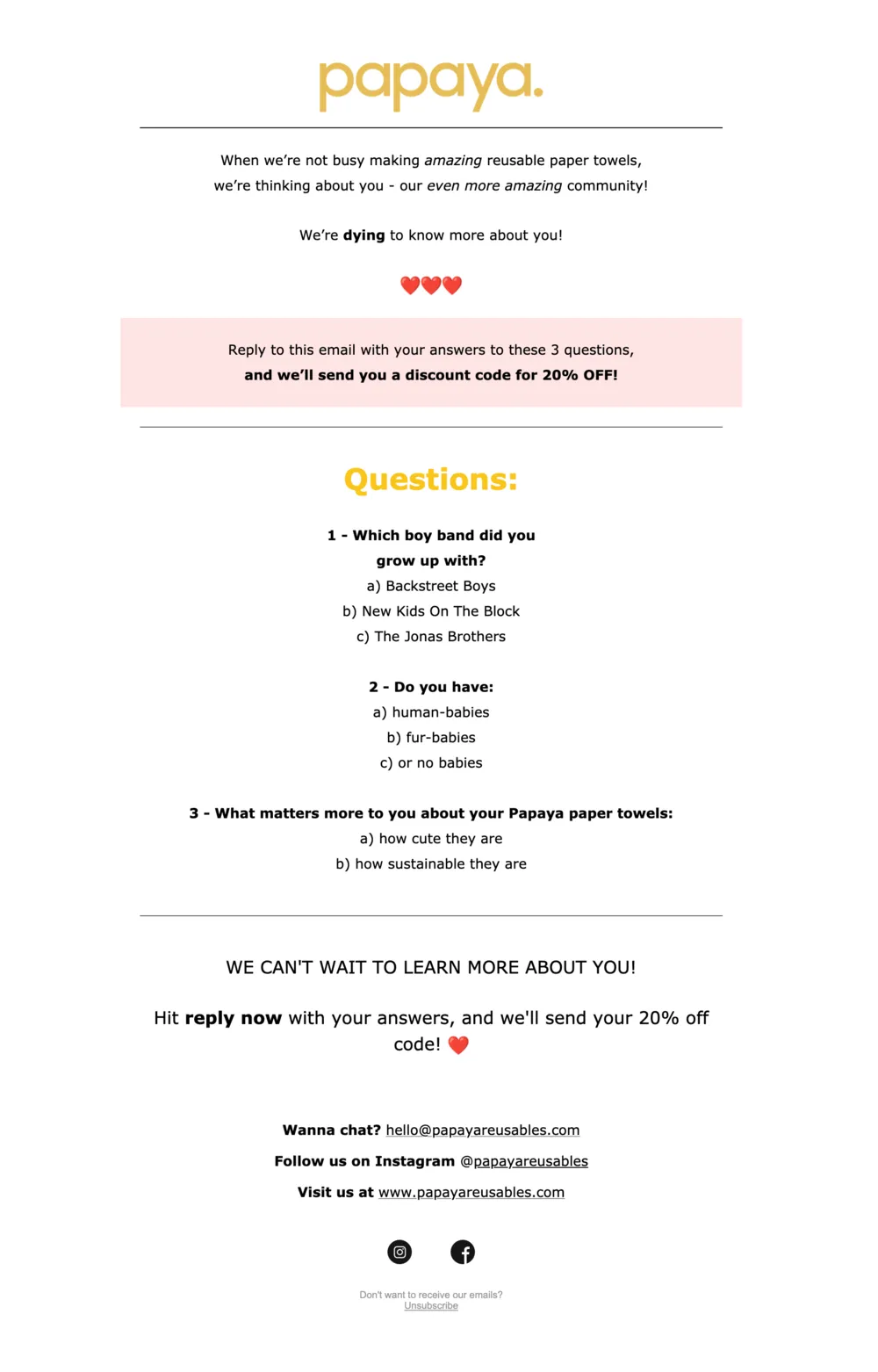
Papaya gets closer. Three playful questions, and the third one, cute or sustainable, tells them which message to send next. Swap one of the fun questions for "how many rolls are you going through a week?" and it becomes a usage survey.
Careful with the reward, though. Papaya pays 20% off for the answers. KnoCommerce's own guide warns that discounts skew your sample toward deal seekers, and suggests a sample, early access or a prize-draw entry instead. For a subscription brand, take the prize draw.
The day-60 question, and why the cancel survey lies
Most brands ask why at the worst moment. The customer is already gone in their head. They want out fast, they pick the first option on the list, and you record it as a pricing problem.
Price is the exit. Not the reason.
When a customer says price, they usually mean they never felt the value match the cost, or lost track of why they signed up, or something in month 2 or 3 made them doubt the product. So we ask three questions at three times instead:
- Day 14: "Aside from price, what almost stopped you from buying?" It catches the doubt before it compounds.
- Day 60: "What has been the most valuable part of your experience so far?" If they can't answer, you have a value problem, not a pricing problem.
- At cancellation, open text only: "What would have made you stay?" No multiple choice, so they have to tell you.
Your exit survey is not wrong. It is asking the right question at the wrong time. How to read and route the answers you do get at cancel is in cancel reasons and the fix for each.
Find the usage pattern that keeps people, then teach it
The best use of usage data changes what every new subscriber is taught.
Space Goods surveyed customers on how they prepared its mushroom coffee, then looked at LTV by method. Warm milk won. Now every new subscriber is taught it. The full story is in building the habit with routine anchors.
Grüns has the other end of this. Their own survey of 3,000+ customers says 80% take it every single day and 95% take it at least 4 to 6 times a week. In supplements those numbers are rare, and they only know because they asked.
So survey use, find the pattern with the highest LTV, teach it to everyone.
Where the answers go
A survey that fills a dashboard and changes no email is wasted.
Every answer should land somewhere. Four places:
- On the profile. A property in Klaviyo, so flows and segments can use it.
- In the next email. The reason they bought picks the version of the month-one onboarding emails they get.
- In the product and offer. If half your buyers take one capsule instead of two, the frequency or the pack size is wrong, not the customer.
- In the cancel flow. A subscriber who said "not yet" on day 14 and is now cancelling needs a different screen from one who said yes. See getting past order 2 and order 3 for where those drops cluster.
Plain text helps here too. A short note from the founder or from support, "Need help? Everything good?", gets replies that a designed survey never will. A reply to the value email at day 7 to 10 is a data point. If they say it is not working, you can step in before they hit the cancel button.
Only 1 in 26 unhappy customers complain. The rest just leave. The check-in is how you hear from the other 25.
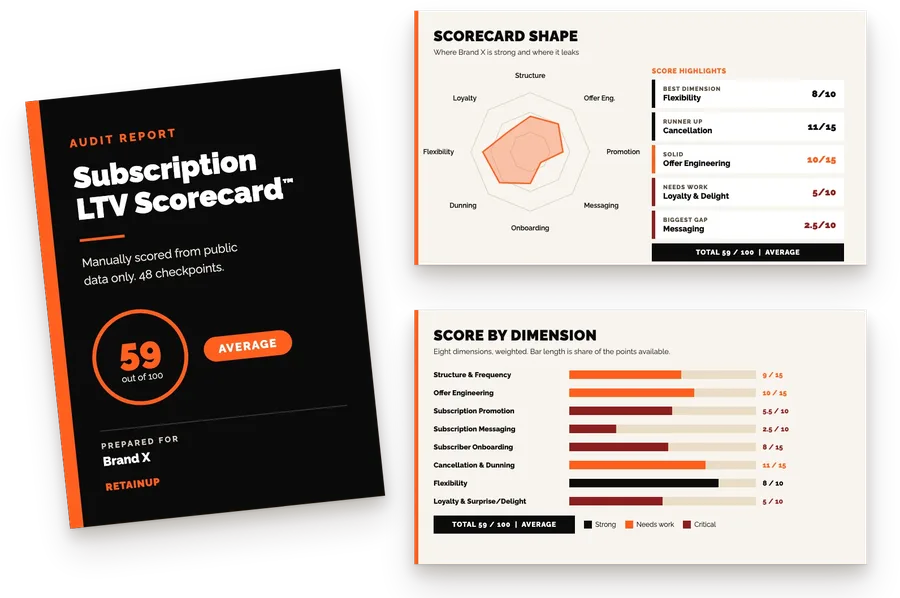
The day-14 check-in, the two-button branches and the thank-you page question are part of the onboarding we build in the Subscription LTV Maximizer™: offer, widget, cancel flow, portal, payment recovery, pause and skip in Recharge, Skio, Stay AI or Loop, plus email and SMS, live in 30 days for $5,000. If you want to see where your month one leaks first, the free subscription audit checks 48 points and sends the top 3 leaks in 24 hours.
FAQ
When should I send a survey to new subscribers?
Send two: one on the thank-you page at purchase, and one usage check-in 7 to 10 days after delivery. The thank-you page catches why they bought while excitement is high. The check-in lands just before day 21, the flat part where effort runs ahead of results, so you still have time to send help before the second charge.
What questions should I ask in a post-purchase survey?
Ask why they bought, what made them consider a subscription, and how often they use the product. Add one question on what almost stopped them buying. Keep it short. Each answer should change what they receive next, so skip anything you will not act on.
Is NPS useful for subscription brands?
NPS is useful for spotting promoters, but it will not tell you who is about to cancel. Satisfaction does not predict retention, use does. A subscriber can rate you highly and still have product piling up on the shelf. Pair any score with a usage question such as how often they take it. Then route the answers: detractors get a quick fix or a small bonus, promoters get the review ask.
Why should a check-in never offer a no option?
A no gives the subscriber a word for quitting and puts it in writing. Two positive answers, yes I feel early benefits or I still need time to evaluate, keep the door open. The second answer tells you exactly who needs a troubleshooting email, while the first tells you who to ask for a review.
What response rate should I expect from a post-purchase survey?
Around 45% of customers fill out a post-purchase survey, according to KnoCommerce data cited in a 2025 subscription playbook. Email surveys sent later get far less, around 10 to 15% by KnoCommerce's own estimate. The thank-you page wins because every buyer sees it, at the moment they are most excited about the purchase.
One email a week on subscription retention: the numbers, the strategy, and what to fix first.

Rahi Jain
Rahi Jain is a subscription LTV specialist who helps $1M to $10M DTC brands reduce subscription churn and maximize LTV on Recharge, Skio, Stay AI and Loop.
More about Rahi