Key takeaways
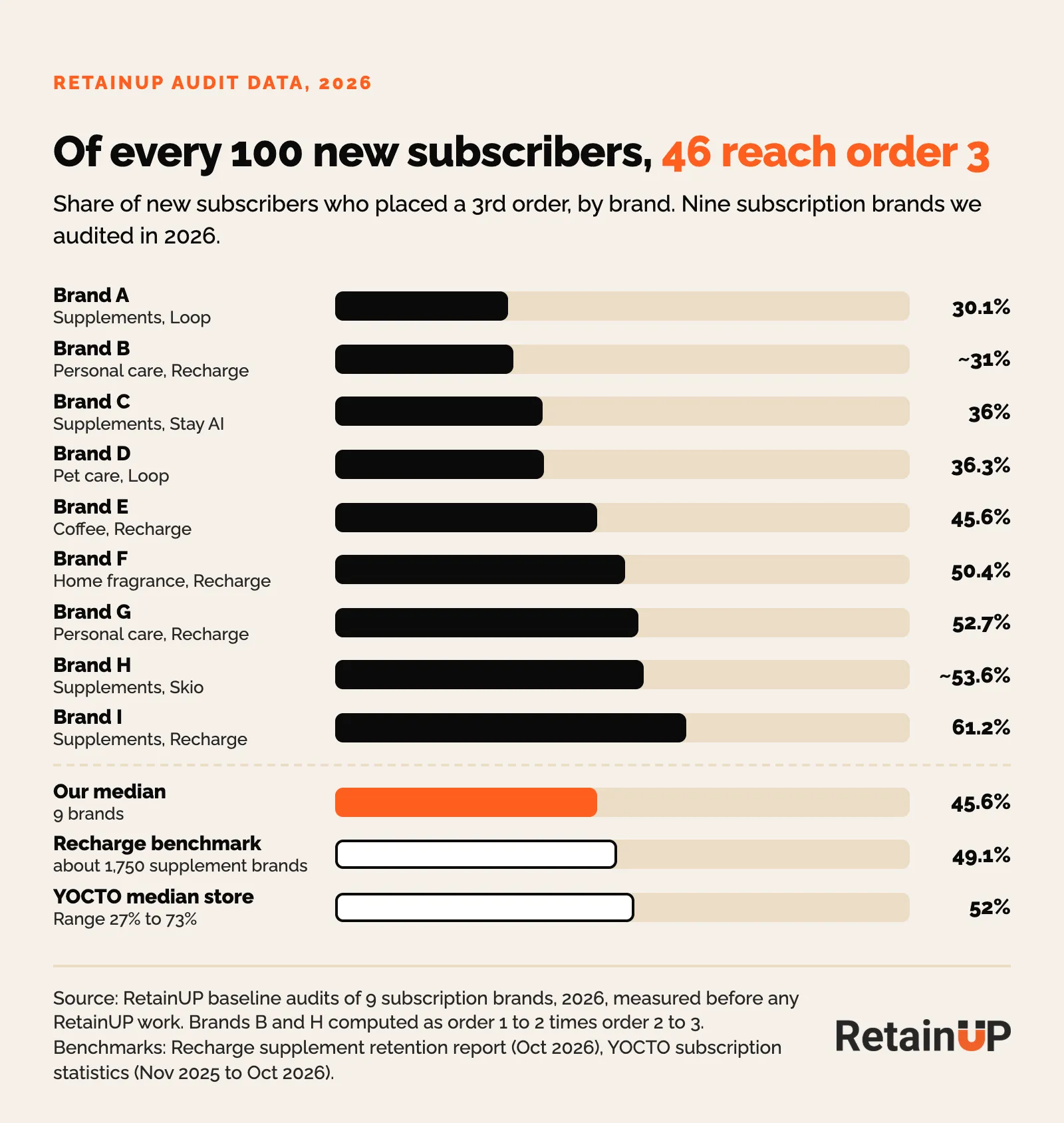
- Across 9 subscription brands RetainUP audited in 2026, a median 45.6% of new subscribers reached their third order.
- Every brand in the sample that kept under 70% of subscribers to order 2 finished between 30% and 36% at order 3.
- Obvi data puts the lift from a gift at 85% on order 2, 15% on order 3 and nothing by order 4.
This is one part of the subscriber onboarding guide, which walks the first 90 days in order.
Open a cohort table and look at the first three columns. Order 1 is 100%. Order 2 takes a hit. Order 3 takes another one about the same size, and half the cohort is gone.
The cliff is predictable. That means it is preventable. So two questions. Where do your subscribers drop, and what do you build for each drop.
How many new subscribers reach order 2 and order 3?
Across the 9 brands, a median 73.6% of new subscribers placed a second order and 45.6% placed a third, with order 3 ranging from 30.1% to 61.2%. Every brand was measured before we changed anything, counted the same way: by order, from the first paid order. Every brand is anonymised.
| Brand | Category | App | Order 1 to 2 | Reached order 3 | Order 2 to 3 step |
|---|---|---|---|---|---|
| Brand A | Supplements | Loop | 57.8% | 30.1% | 52.1% |
| Brand B | Personal care | Recharge | 57.4% | ~31% | 54% |
| Brand C | Supplements | Stay AI | 68.6% | 36% | 52.5% |
| Brand D | Pet care | Loop | 67.3% | 36.3% | 53.9% |
| Brand E | Coffee | Recharge | 78.1% | 45.6% | 58.4% |
| Brand F | Home fragrance | Recharge | 73.6% | 50.4% | 68.5% |
| Brand G | Personal care | Recharge | 80.4% | 52.7% | 65.5% |
| Brand H | Supplements | Skio | 90.9% | ~53.6% | 59% |
| Brand I | Supplements | Recharge | 80.1% | 61.2% | 76.4% |
| Median, 9 brands | 73.6% | 45.6% | 58.4% | ||
| Recharge, ~1,750 supplement brands | Supplements | Recharge | 75.2% | 49.1% | about 65% |
| YOCTO, median store | Mixed | Mixed | 72% | 52% | about 72% |
Four of the nine sit at 36% or below. At order 2 the sample matched the benchmarks. The gap opens after: of the subscribers who placed order 2, the median brand kept 58.4% to order 3, against about 65% implied by Recharge's supplement data and about 72% by YOCTO. These brands get a second order as often as anyone. They lose the third. The bands we rate against are on the subscription benchmarks page.
Nine brands is a small sample. Brands that hire a retention consultant often have a problem, so it may run low. Brands B and H are estimates from their two step rates. Drop both and the median stays at 45.6%.
Before order 2 or after: split your own loss first
The median brand lost about 26 of every 100 new subscribers before order 2 and about 28 more between order 2 and order 3. At individual brands the split is nowhere near even.
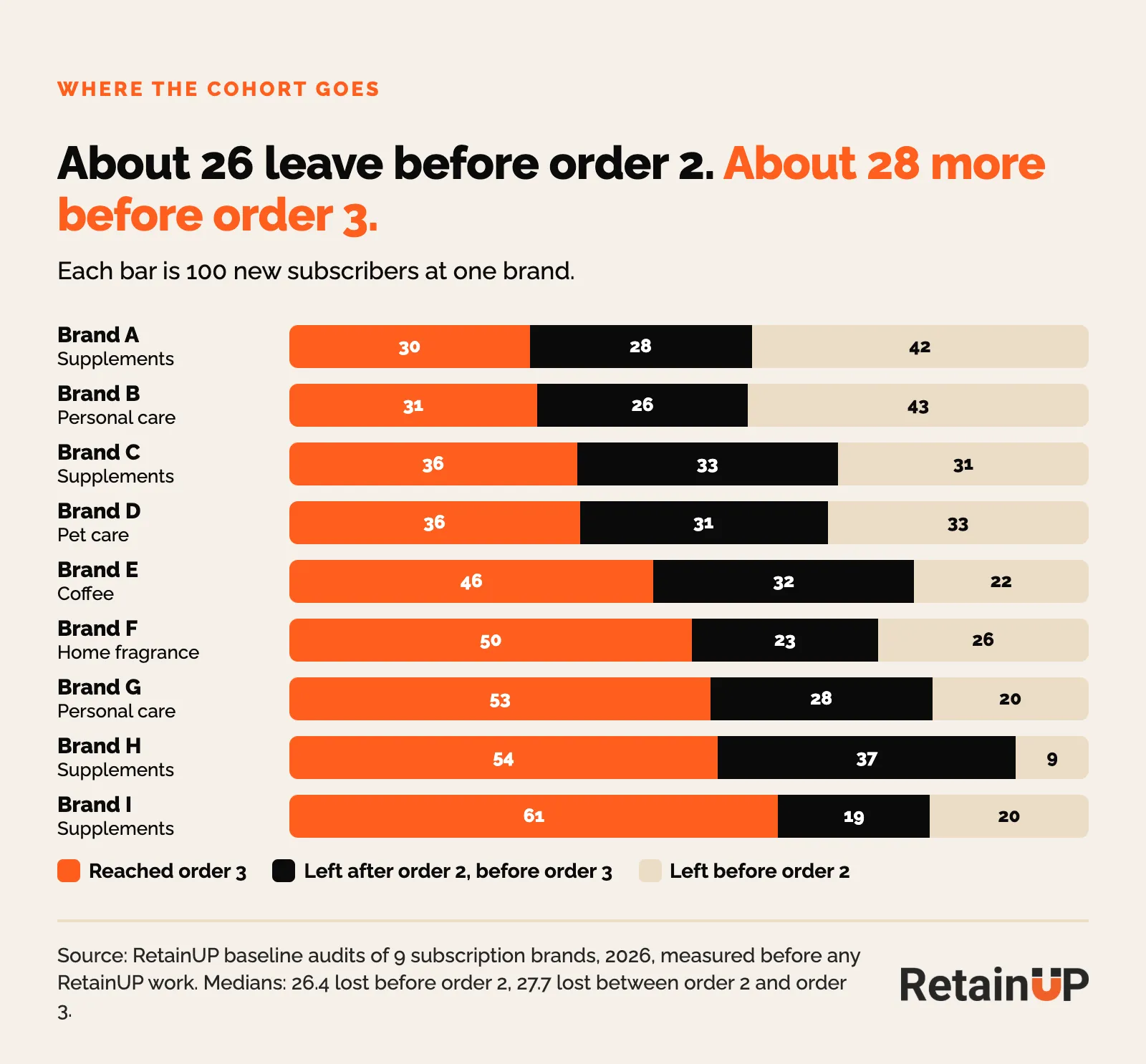
Brand A lost 42 of every 100 before the second order. Brand H lost 9, then lost 37 before the third. Same problem on paper. Two different fixes. "Fix order 2" is right for one and wrong for the other, so read your own split before you pick a project.
So count it by order, not by month. A monthly subscriber has paid three times by month three. A quarterly one, once. Filter to one frequency before you read the column, or the number means nothing. The method is in subscription cohort analysis, and the formula we track is Order 3 retention.
Order 2 sets the ceiling for order 3
In this sample, every brand that kept under 70% to order 2 finished between 30% and 36% at order 3. Every brand above 70% finished between 46% and 61%.
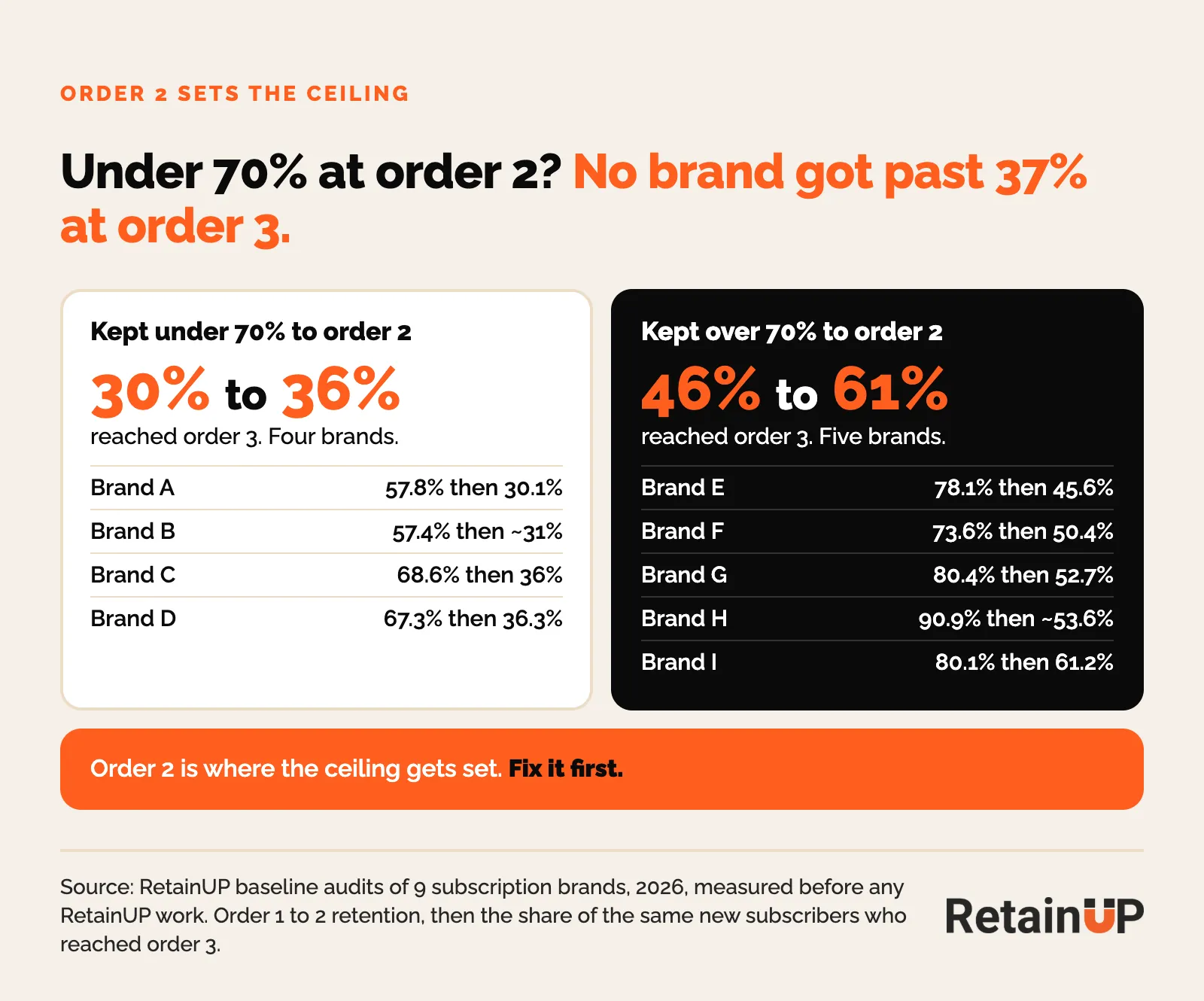
So a brand that loses 4 in 10 before the second box can't make it up later. Above the line, the order 2 to 3 step decides the rank. Brand H kept 90.9% to order 2, the best in the sample, and still finished below Brand I, which held 76% of its second-order subscribers to order 3.
Order 2 can be an accident. They never knew they subscribed. Order 3 is different. It is the first real decision, paid by someone who knew what they bought and used it. It is also often the payback order for supplement brands, so a subscriber lost before order 3 was a marketing expense.
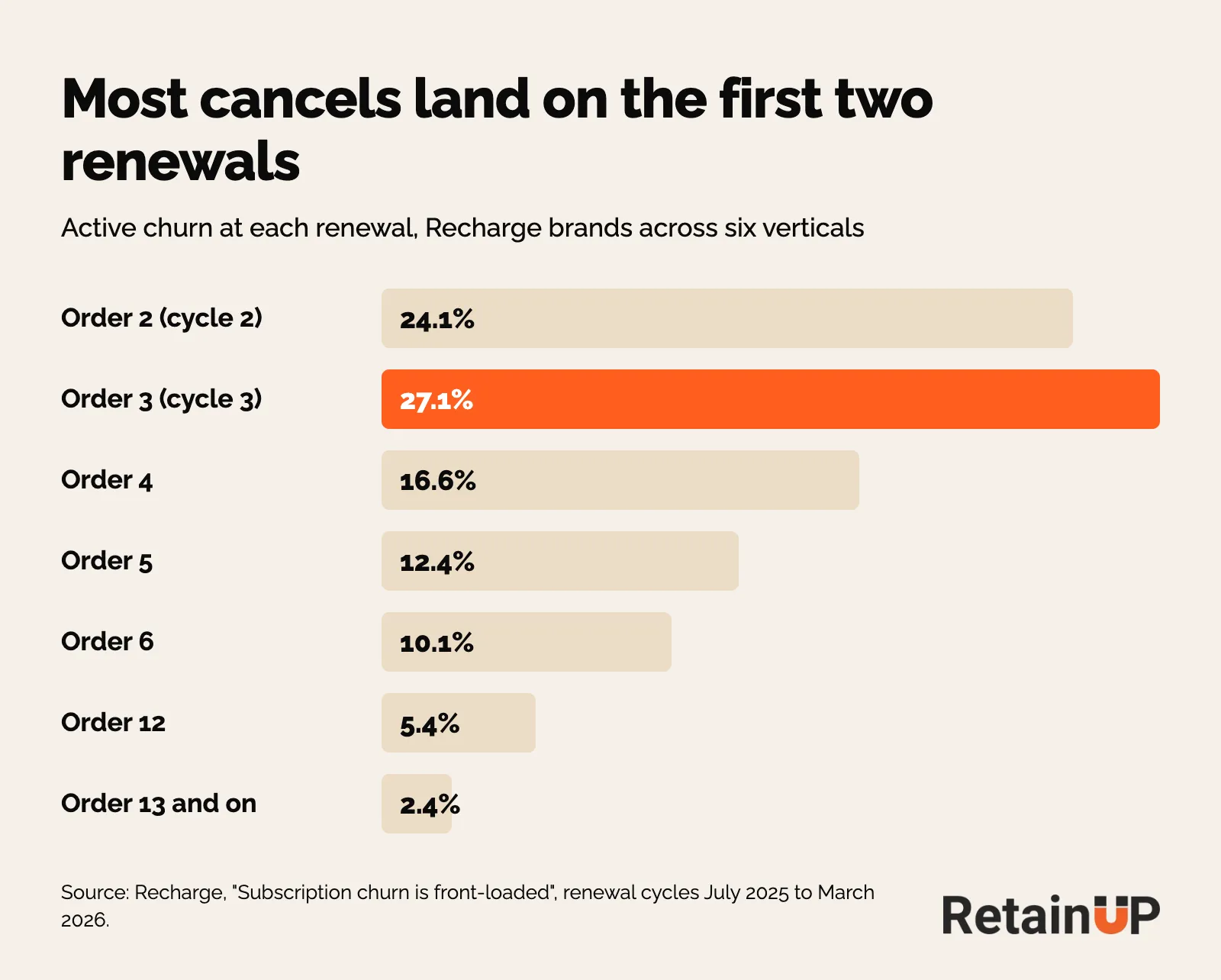
Recharge sees the same shape across its brands. Active churn peaks at the third renewal cycle, at about 27%, then falls to about 5% by the twelfth. About 61% of voluntary cancels happen at the first two renewals, per Recharge's renewal-cycle data. So those two charges are where your effort goes.
Why subscribers leave before order 2
Most of the loss before order 2 comes from people who did not mean to subscribe, did not feel a result in the first weeks, or were surprised by the first charge. At one brand, 24.4% of cancellations came from people who never meant to subscribe. At another, 37.6% of all cancellations came in the first 30 days.
Most don't hate the product. They haven't seen value yet. We worked with a brand where cancellations spiked right after the first box and most complaints were about results. But not instant results. They wanted a plan, progress and assurance. That is the job of the month-one onboarding emails and of a routine anchor the product hangs on.
Same-day cancels are checkout problems, so they live on stopping day-zero cancellations.
Why subscribers leave between order 2 and order 3
Because order 3 is the first charge nobody has an excuse for. By then the discount has worn off, the second box is still half full, and the product has had time to either work or not. Usually one of three things.
The benefit has not shown up
Supplements take weeks. So does skin care. And if nobody told the subscriber how long, this is when they decide it was a waste.
The boxes arrive faster than they get used
At SunMed, "too much product" was the top cancel reason, a third of all cancel sessions. They like the product. They have three of it. A 30-day product on 3-month billing goes the other way: it runs out, sits in the pantry for 6 weeks, and by month 3 they don't remember why they subscribed. Match the default to how fast the product gets used.
Your cancel flow can tell you if this is the problem. Ask how many days a week they take it. Under 5, offer a longer cadence. 5 to 7, treat it as price or results.
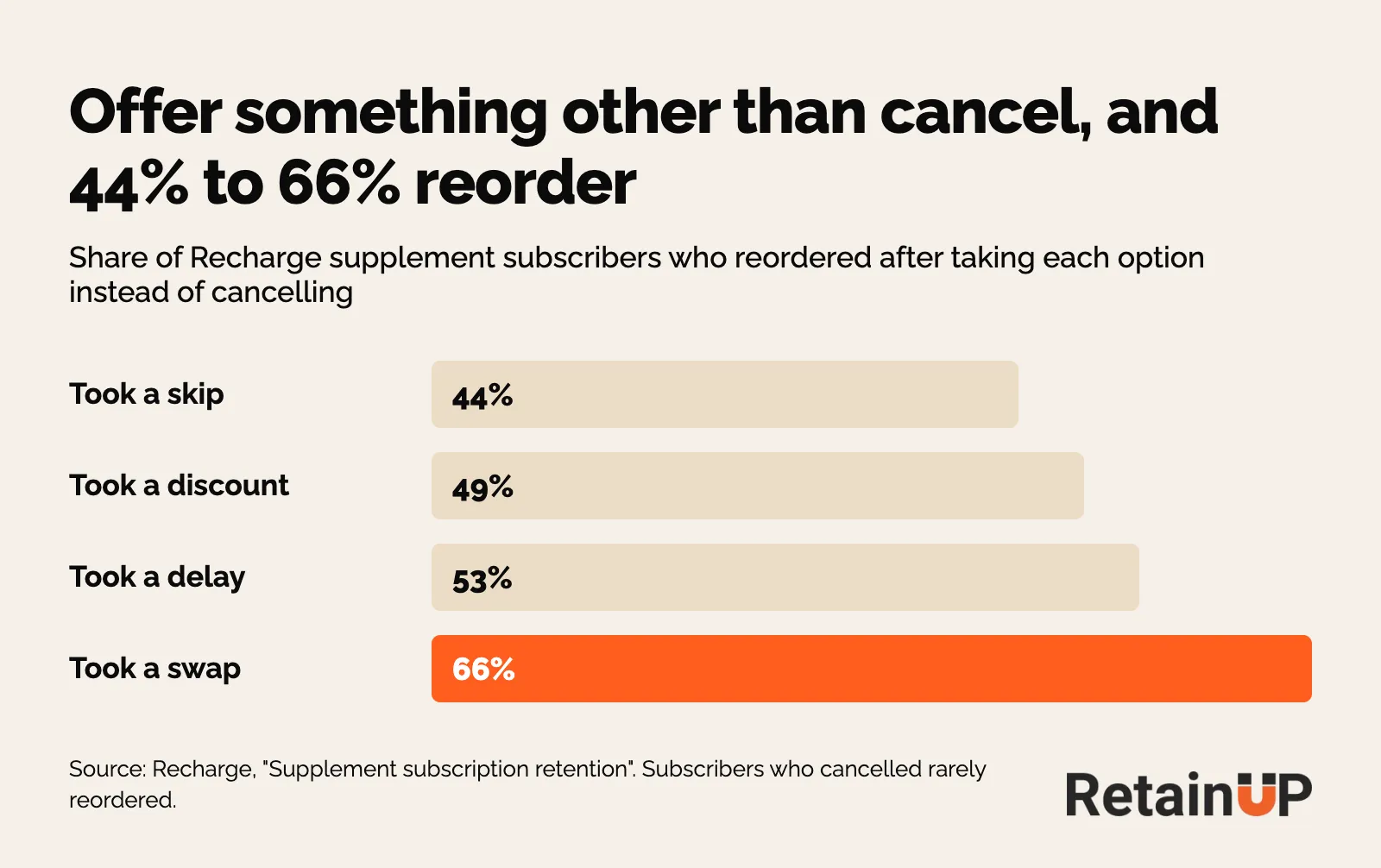
And give them a way out that keeps the subscription. In Recharge's supplement data, subscribers who cancelled rarely reordered. Those who took a skip reordered at 44%, a discount 49%, a delay 53% and a swap 66%. The order to offer them in is on the flexibility ladder.
The price steps up
A welcome discount on order 1 means order 2 or order 3 is the first one at full price. Nothing changed about the product. The bill changed.
Starter kit first, refills after
Big brands sell the first order as a kit and every order after as a refill. Everyday Dose's starter kit page has no one-time option: $49 today, $142 of gifts in the picture, then "Renews at $66/mo" in small print under the button. AG1 ships a welcome kit with both plans. IM8 puts a welcome kit on the quarterly plan.

Then they pay for refills. So check the second box price. With Everyday Dose, the renewal is where people get surprised. Keep one price and give the welcome value as gifts. If the price does step up, say so next to the button and again before the first refill ships.
What goes in box 1 versus the refills, and the card in the box, is on the first box page.
Offer the longer plan on the thank-you page
Grüns shows one frequency on the product page. The quarterly plan shows up on the thank-you page, after the card is already charged. Take it, and the order 2 and order 3 decisions become one charge. Recharge's quarterly upgrade data says the average monthly subscriber who churns is gone by about day 77, so a 90-day plan carries them past it. How to price the longer plan is on prepaid and longer plans.
Put the gift on order 2
A gift on order 1 pays people to subscribe and leave. The first-order stack is worth so much more than the one-time price that some subscribe, take the gifts and cancel the same day. Move the gift value to order 2 and order 3, and gate it on the second order shipping.
Obvi's data says the gift works better at order 2 anyway: an 85% retention lift at order 2, 15% at order 3, nothing by order 4. So moving it fixes the day-zero spike and lifts order 2 at the same time. Cann announced an order-3 reward, shown in the portal and the upcoming-order email, and doubled order-3 retention while cutting same-day cancels 48%. The full gift ladder lives in subscription rewards.
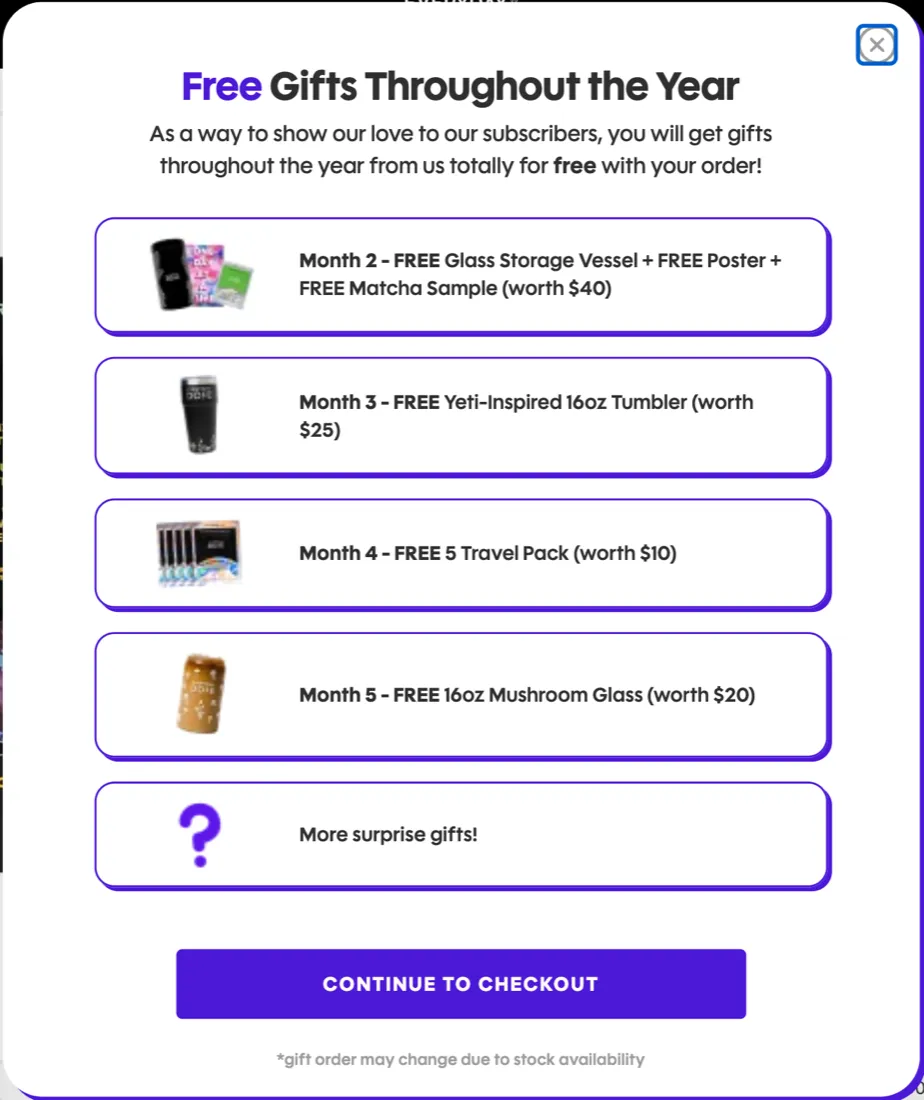
So show the ladder before they buy, like Everyday Dose does, then again on the cancel screen: "Your free gift ships with order 2." And watch the timing. One brand announced the gift right after the first order. Customers were reminded they had a subscription, and cancelled before the gift shipped.
Reset expectations before the first full-price charge
Re-commit them before order 2 ships with a results timeline: what to expect and by when. Hims shows what to expect at day 30, 60 and 90, so expectations are managed before they are tested.
Then the pre-renewal email. Not a billing reminder. A value reminder. What has the product done for them this first month, what is coming next, then the charge date and the new price at the bottom. The rewrite is on the upcoming billing reminder.
Send a lapse-point email 5 to 10 days before the usual cancel
Every brand has a month when subscribers cancel. Most never identify it. The subscribers who were going to leave at month 3 did not get an email at day 75. Nobody reached them in time.
So find the order where your cohort drops hardest, then send one email 5 to 10 days before it. No discount. A value reminder: what the product has done for them, what is coming next. The cheapest winback is the one sent before they cancel.
Don't lean on the cancel page. Across 8 brands we audited, the median cancel flow saved 10.8% of people who tried to cancel. By the time someone opens that page, the decision is mostly made. The offers that do work are in cancel offers that work.
Use cancel-day buckets to choose which email to build
Cancel-day buckets tell you which moment they leave at, and each moment points at a different email. Take every cancelled subscription and bucket the days since start around the charge day. For a 28-day cycle we use 0 to 6, 7 to 20, 21 to 34, 35 to 62, 63 to 90 and 90+. One table per frequency, with the count in every cell next to the rate.
| Bucket | What it points at | What to build |
|---|---|---|
| 0 to 6 days | Immediate regret, subscribed by mistake | Checkout clarity and the order confirmation |
| Mid cycle | Product experience against expectation | Habit and results-timeline emails |
| The charge window | Price shock, no warning | The pre-renewal reminder |
| Later cycles | Frequency and oversupply | Skip before cancel, a frequency check |
When I pulled every cancelled subscription from one brand, monthly cancels clustered on signup day, the reminder day and the charge day. Day 30 alone held 9.11% of them, the biggest single day. The day-by-day is on cancellation day spikes.
What moved order 3 at two brands
SunMed sells CBD supplements on Skio. Order 2 retention was already strong at 90.9%, so order 3 was the whole job. Month 3 retention was 61.46% and 62.98% for the September and October 2025 cohorts. After eight Klaviyo flows, a rebuilt cancel flow and two-phase retries went live in February 2026, the January and February cohorts came in at 71.69% and 73.24%. No new standing discount. Order 1 to 2 rose to 94.7%. The build is in the SunMed case study.
Boka sells oral care on Recharge, with month 3 retention at 41%. We rebuilt the renewal, the failed card and the cancel, with skip, pause and swap in the reminder. Month 3 retention reached 63%, and churn fell 18% in 90 days. The write-up is in the Boka case study.
Failed cards show up in the same column. Across 8 brands we audited, a median 38% of failed payments came back. More on failed payment recovery.
The product is usually fine. The system between box 1 and box 3 is what fails. If you want that system set up in Recharge, Skio, Stay AI or Loop, with the email and SMS around it, that is the Subscription LTV Maximizer™, live in 30 days for $5,000. If you only want your own order 2 and order 3 split first, the free subscription audit shows the top 3 leaks in 24 hours.
FAQ
What percentage of subscribers make it to the third order?
In 9 subscription brands we audited in 2026, a median 45.6%, ranging from 30.1% to 61.2%. Recharge's data on about 1,750 supplement brands puts it at 49.1%, and YOCTO's median store at 52%. Count it by order number from the first paid order, and only read cohorts that have all passed their order 3 date.
What is a good second order retention rate for a subscription?
Above 70% is the line in our audit data. The median brand kept 73.6% to order 2, and every brand under 70% finished under 37% at order 3. Recharge reports 75.2% for supplements and YOCTO 72% at its median store.
Why do subscribers cancel after the second order?
Results, routine and price. The benefit has not shown up yet, the next box arrives before the last one is used, or the welcome discount has ended and the charge is bigger than they remember. Read your cancel reasons and cancel days before you pick a fix.
Should the free gift go on the first order or the second?
The second. A gift on order 1 invites people to subscribe, take it and cancel the same day. Obvi's data shows an 85% retention lift when the gift lands on order 2, 15% on order 3 and nothing by order 4. Gate it on the second order shipping, and show the ladder before purchase.
Is month 3 churn the same as order 3 churn?
Only on a monthly plan, and only roughly. A quarterly subscriber has paid once by month three. A monthly one has paid three times. Filter your cohort table to one billing frequency before you compare month 3 to any order 3 benchmark, or mixed plans blur the number.
One email a week on subscription retention: the numbers, the strategy, and what to fix first.

Rahi Jain
Rahi Jain is a subscription LTV specialist who helps $1M to $10M DTC brands reduce subscription churn and maximize LTV on Recharge, Skio, Stay AI and Loop.
More about Rahi