Key takeaways
- Units per container divided by daily dose gives days to finish. That number is your minimum billing frequency and your default.
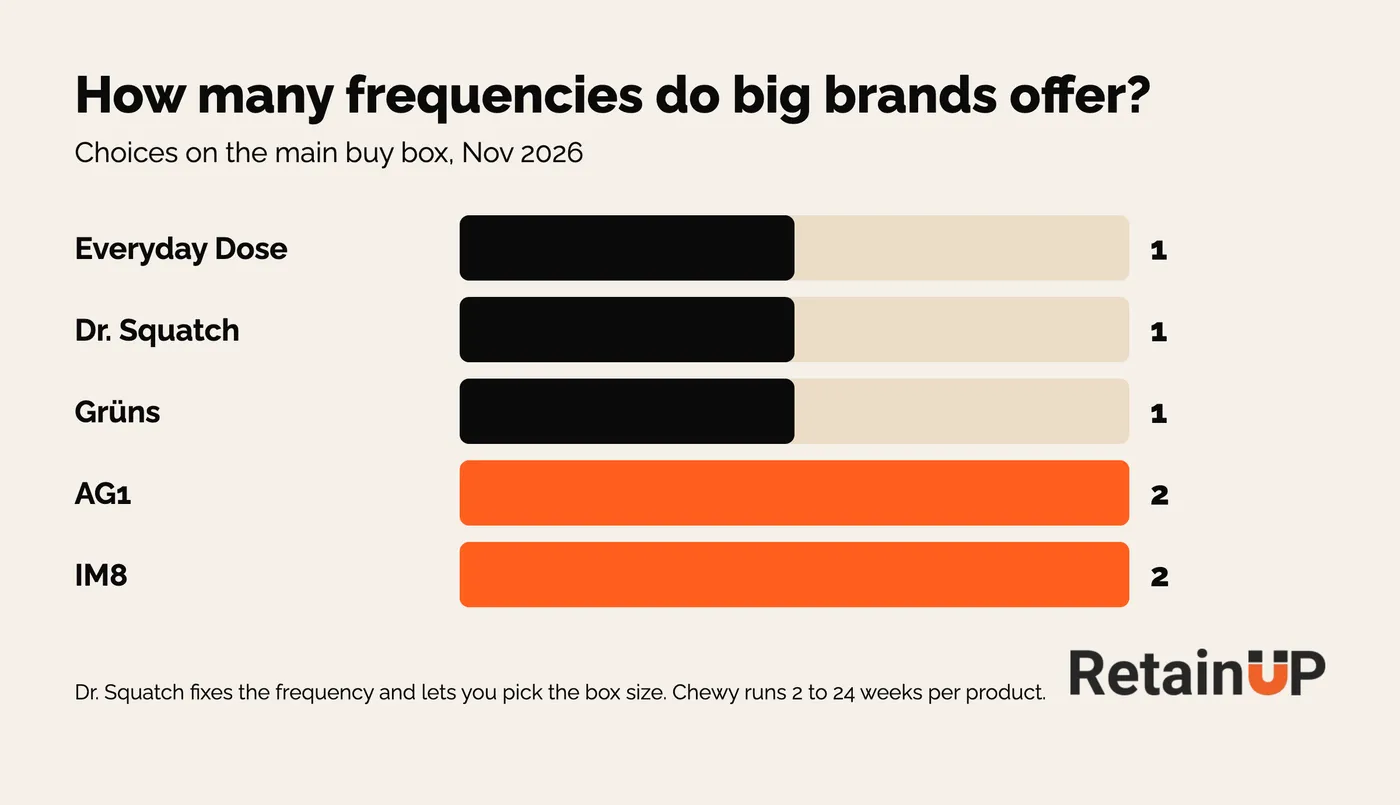
- AG1, IM8, Dr. Squatch, Grüns and Everyday Dose each show one or two frequencies on the product page. Chewy is the exception.
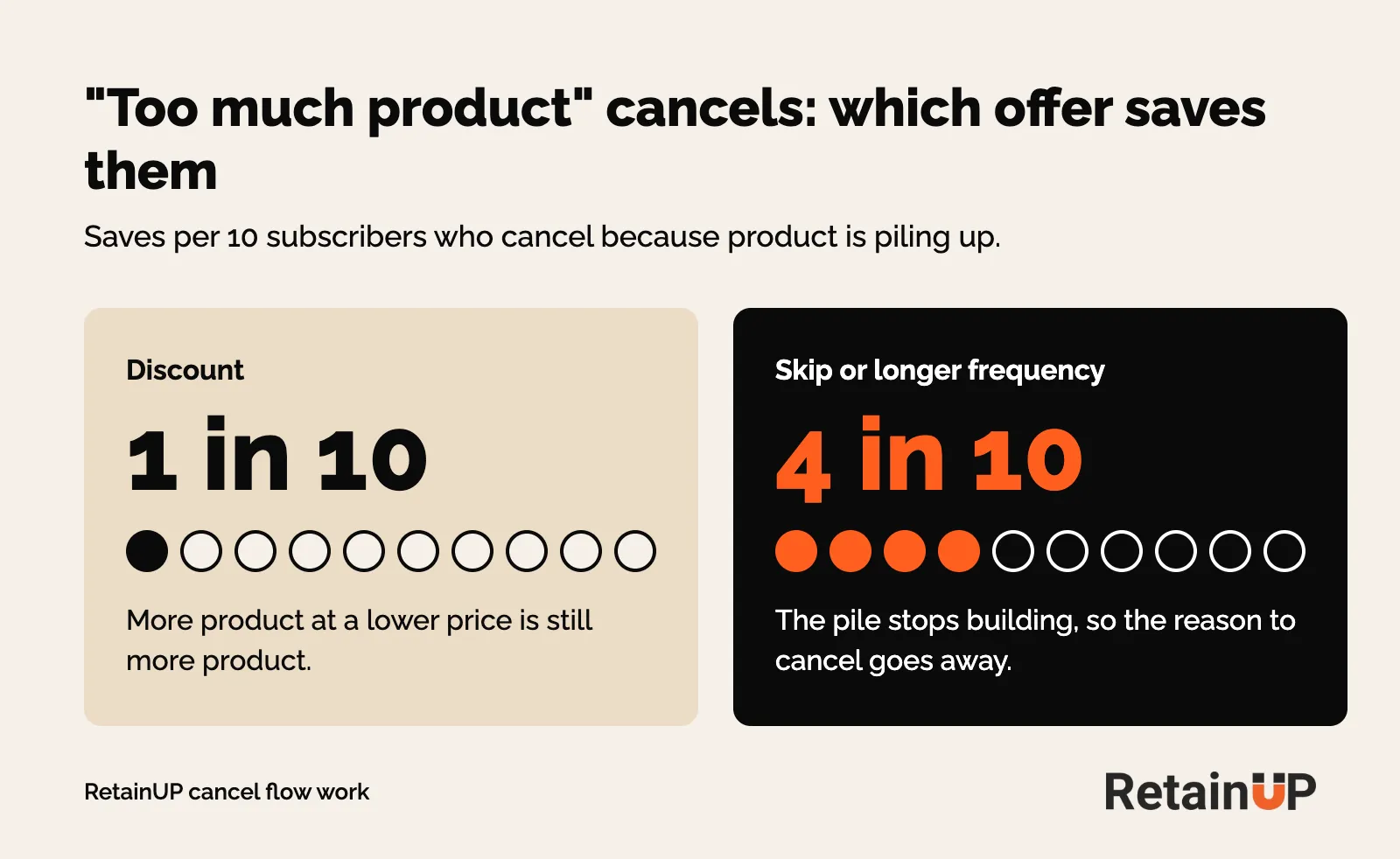
- A discount saves about 1 in 10 "too much product" cancels. A skip or a longer frequency saves about 4 in 10.
This is one part of the subscription offer guide, which walks the whole offer in order. Frequency comes first there, as Rule 0, because everything else sits on top of it.
I've audited 100+ subscription brands. One mistake shows up every time.
Not in the email flow. Not in the cancel sequence.
On the product page. Before the subscriber commits.
The billing frequency doesn't match the consumption rate.
You're charging before the container is empty. Or you're not giving them enough supply. 30 days' supply on a 90-day subscription, or 3 months' supply on a monthly one. And most brands leave the dropdown open and let the customer pick. But the customer doesn't know what to pick. They've never used it.
The formula: units per container divided by daily dose
Units per container divided by daily dose equals days to finish.
That number is your minimum billing frequency.
So a 30-unit bottle taken once a day runs out in 30 days. That is a 4-week subscription, and you would never default it to 90 days. But brands do it all the time, because they think a longer interval means fewer cancellations. What actually happens is the subscriber ends up with too much product sitting around. They skip. Then they cancel.
The math takes a minute. There's no excuse for guessing.
Three things have to line up: usage, how much a person takes in a day; quantity, how much is in the pack; and billing, how often they are charged. One pill a day, 30 pills in the box, billed every 30 days. All three aligned. Thomas Lalas said it plainly on his podcast: no matter how good the retention system or the onboarding is, people will churn just because the offer is not aligned.
Here is the mapping we use when we set a default.
| Units | Daily use | Default frequency | Longest option to offer |
|---|---|---|---|
| 30 | 1 a day | 4 weeks | 6 weeks |
| 30 | 2 a day | 2 weeks | 3 weeks |
| 60 | 1 a day | 8 weeks | 10 weeks |
| 90 | 1 a day | 12 weeks | 12 weeks |
| 30 | As needed | 6 to 8 weeks | 3 months |
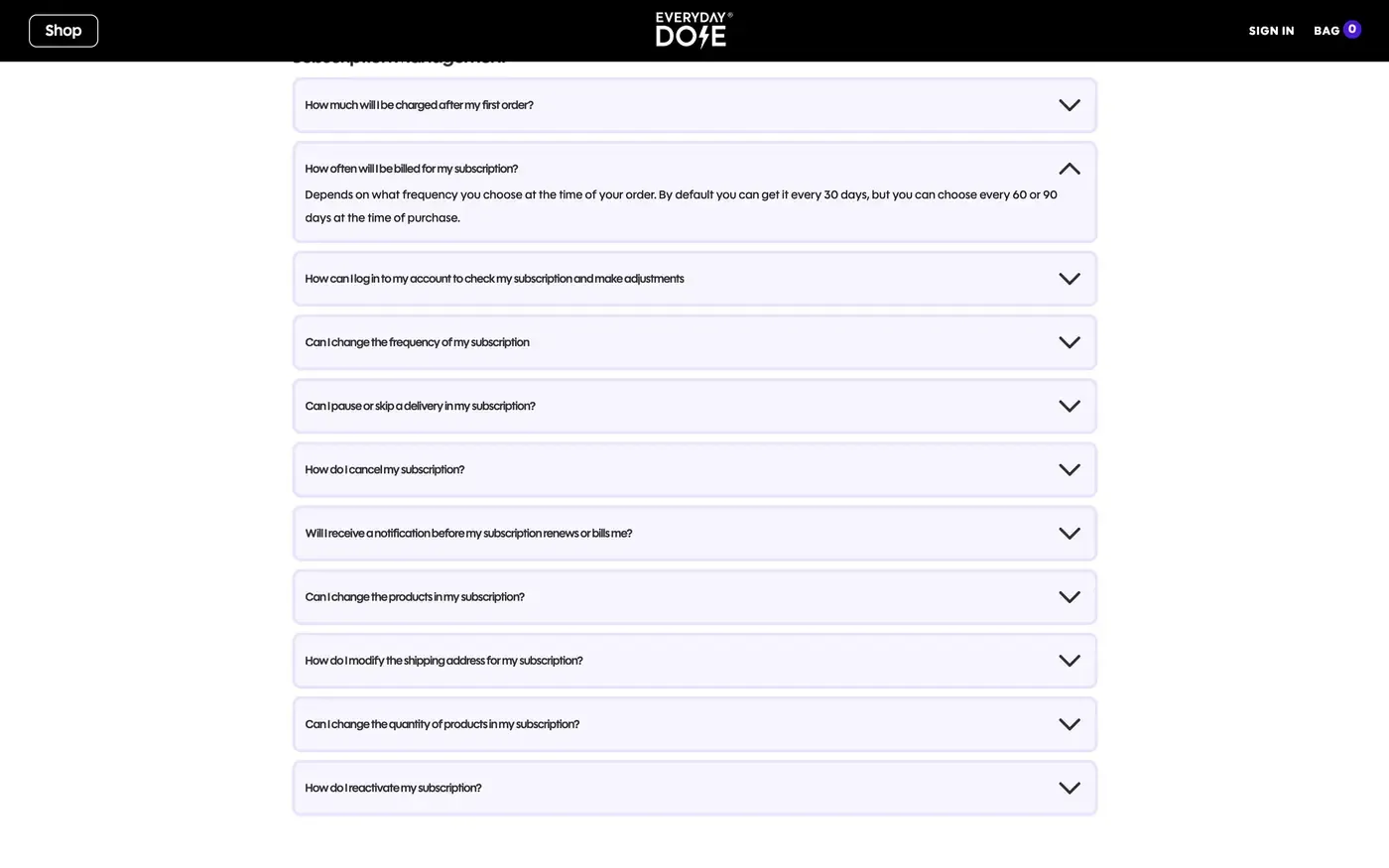
And watch the second row. 30 servings at two a day ships every 15 days, not every 30. Everyday Dose is the live example: the product page shows one option, 60 servings delivered monthly, for a coffee people drink 1 to 4 times a day. Someone drinking two cups a day runs out on day 30. Someone drinking one has a month of coffee left when the next bag lands.
So one more input, if you have it. Set the default to the median real replenishment window, which is often 45 to 60 days, not 30 because 30 looks clean. Your reorder data tells you that. If someone buys a 60-day supply, don't default them to 30.
Three options at most, and the default does the work
Two options is enough for most single-product brands. Three is the ceiling. Don't give 10 options to choose from. Past that the list makes the decision harder without making the delivery any better.
Recharge says the same in its program setup guide: one or two delivery frequencies is usually enough at launch.
So look at what the big brands show on the product page.
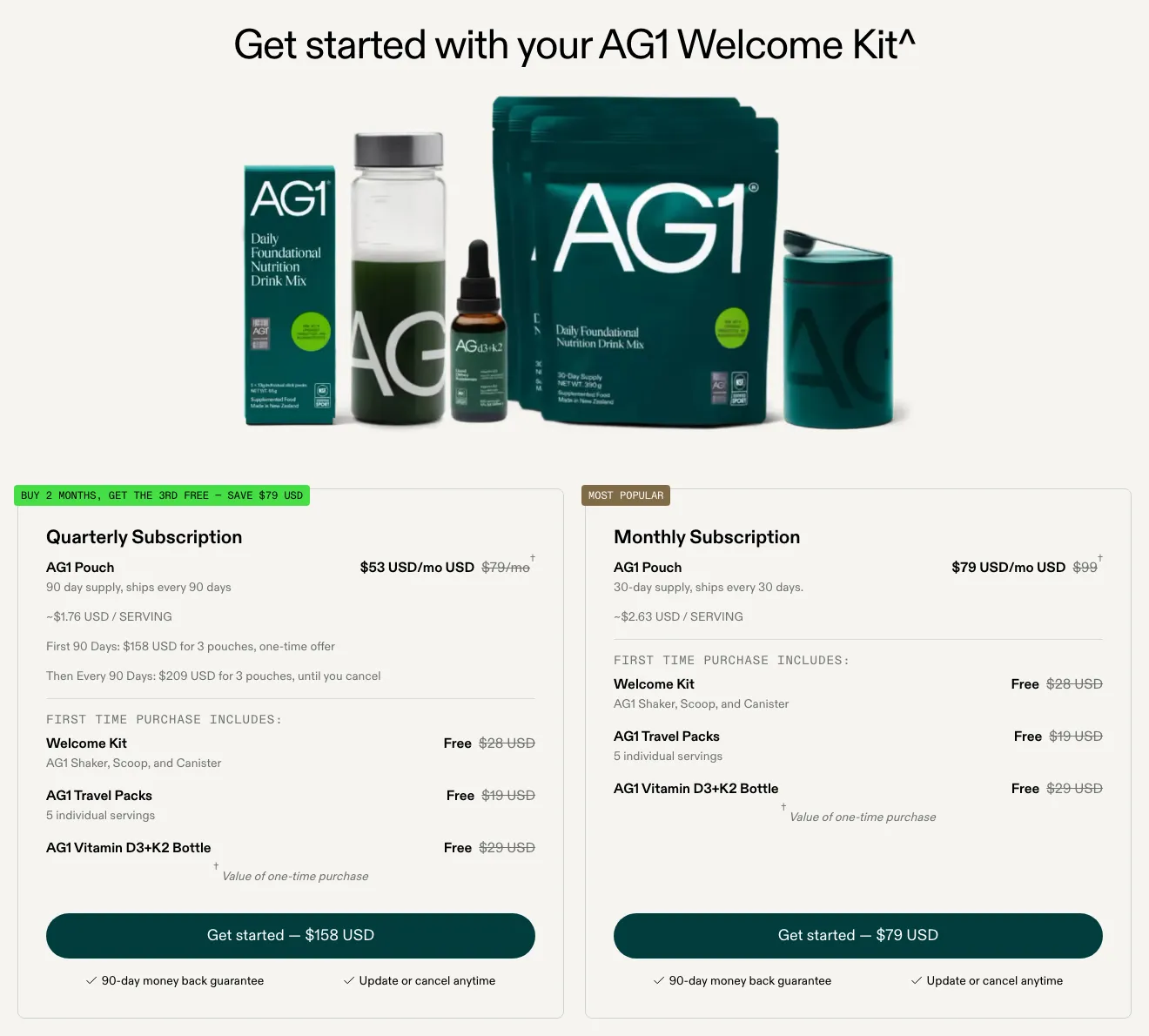
AG1: two plans, quarterly first
Quarterly or monthly. Nothing else. There is no one-time option on the main offer at all. Two choices is easy. And the cheaper per month option is the one that commits for three months.
IM8: 90 days by default
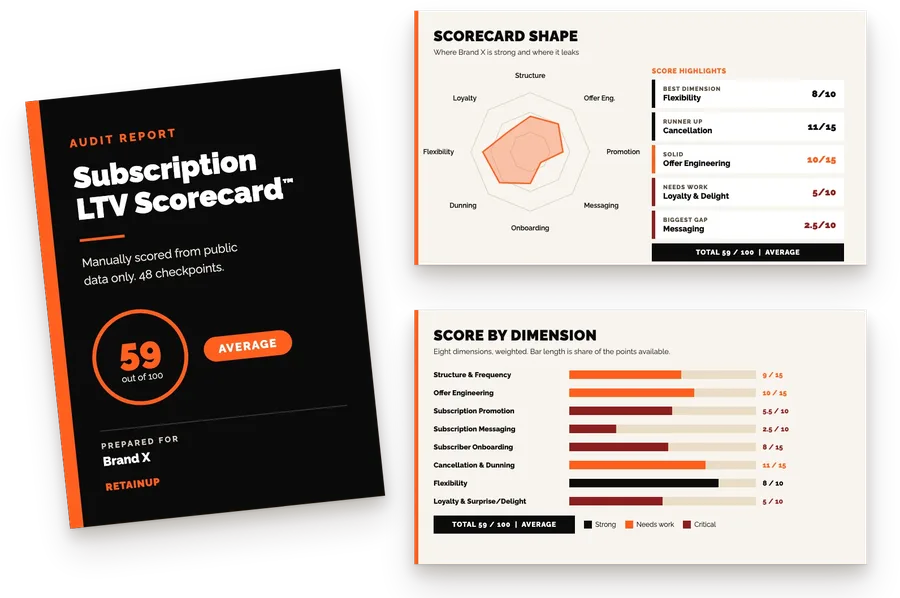
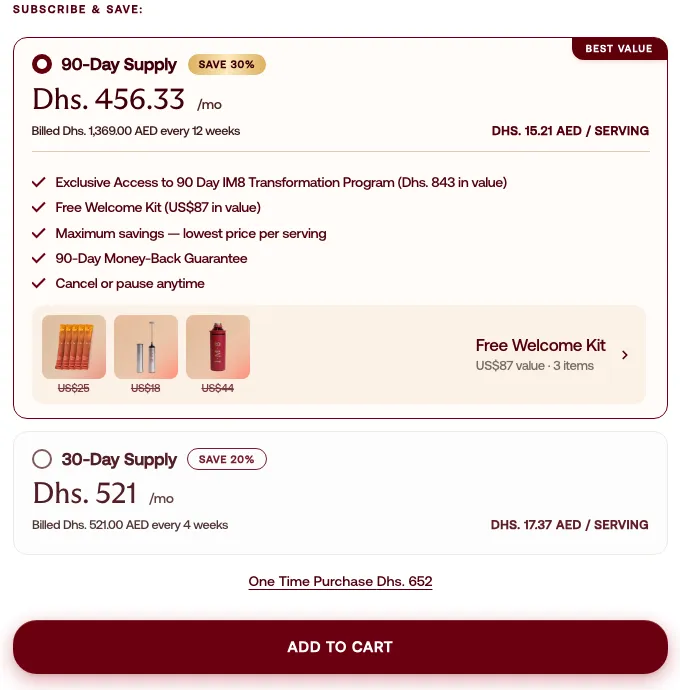
Two options again. A 90-day supply at 30% off, billed every 12 weeks, is selected when the page loads. A 30-day supply at 20% off sits underneath. One-time purchase is a single text link at the bottom. The default does the selling. Most people never change it. More on how IM8 built the rest of its program in our scorecard.
Grüns: one cadence upfront
Grüns sells one cadence on the product page. Quarterly is offered on the thank-you page, after you have already paid. The four-week cadence also fits their flavour drops. A new flavour comes out, you get a text, you reply, your next box is swapped. A quarterly subscriber would sleep through every drop.
Chewy: the other end
Every product runs on its own schedule, from every 2 weeks to every 24. Chewy suggests the cadence from the size of the bag, and the customer confirms. And that only works because Chewy knows the consumption rate. A bag of food has a weight, a dog has a feeding guide, and the maths is reliable. Copying Chewy's list without Chewy's suggestion engine leaves the subscriber to guess.
Even Chewy gets it wrong for some people. Paul Chambers, co-founder of SubSummit, wrote to them: he loved Autoship, but they never figured out his perfect frequency. He loved the product. He eventually left over the frequency.
So the number of options matters far less than which one is selected when the page loads. One brand I looked at had no frequency options at all, and its top cancel reason was "too much product". Another gave four. Same problem. Most subscribers keep whatever you set. How the default looks on the page, what is preselected and how big the one-time option is, sits in the subscription widget guide.
So if you sell supplements, 30, 45 and 60 days covers it. Coffee, 14, 30 and 45. Pet food, 30, 45 and 60.
The longest option: no more than 2x the consumption window
Never offer a frequency longer than twice the time it takes to finish one container. Past that, the second box lands on a full shelf.
The common advice pushes 90 days because it looks good for AOV. And it does help AOV. But three months is long enough for the habit to fade, and long enough to find an alternative.
A 3-month frequency is fine only when the product meets at least one of these:
- 90+ units with daily dosing.
- An as-needed product, not a daily one.
- The customer moved down from a shorter cycle themselves, after at least 2 orders.
Even then, never as the preselected option for a product that lasts 30 days. If you want people on a longer plan, sell a bigger supply on a longer plan and price the commitment. That is how prepaid and longer plans work, and it is the next point.
Frequency moves with pack size
A 90-day plan ships 90 pills, not 30. The content and the usage still align. IM8's 90-day supply billed every 12 weeks is this rule done right.
The common mistake runs the other way. 1 bag every 30 days. Or 2 bags plus 1 free every 30 days. Or 3 bags plus 2 free every 30 days. People get rebilled when they have a ton of product left and can't physically use it.
And Lalas has a simple test for this. Can a person use more than one dose a day? Coffee, yes. Two or three cups a day, so 60 or 90 servings every 30 days works. A daily pill, no. One a day is the limit, so more than 30 in 30 days becomes backstock.
Naked Paper used a checkout upsell to move new subscribers to a larger pack, and the delivery frequency adjusted to match the larger supply automatically. First orders came in 63% higher on AOV, with CAC recovered 20% faster. Bigger pack, longer gap, same daily use.
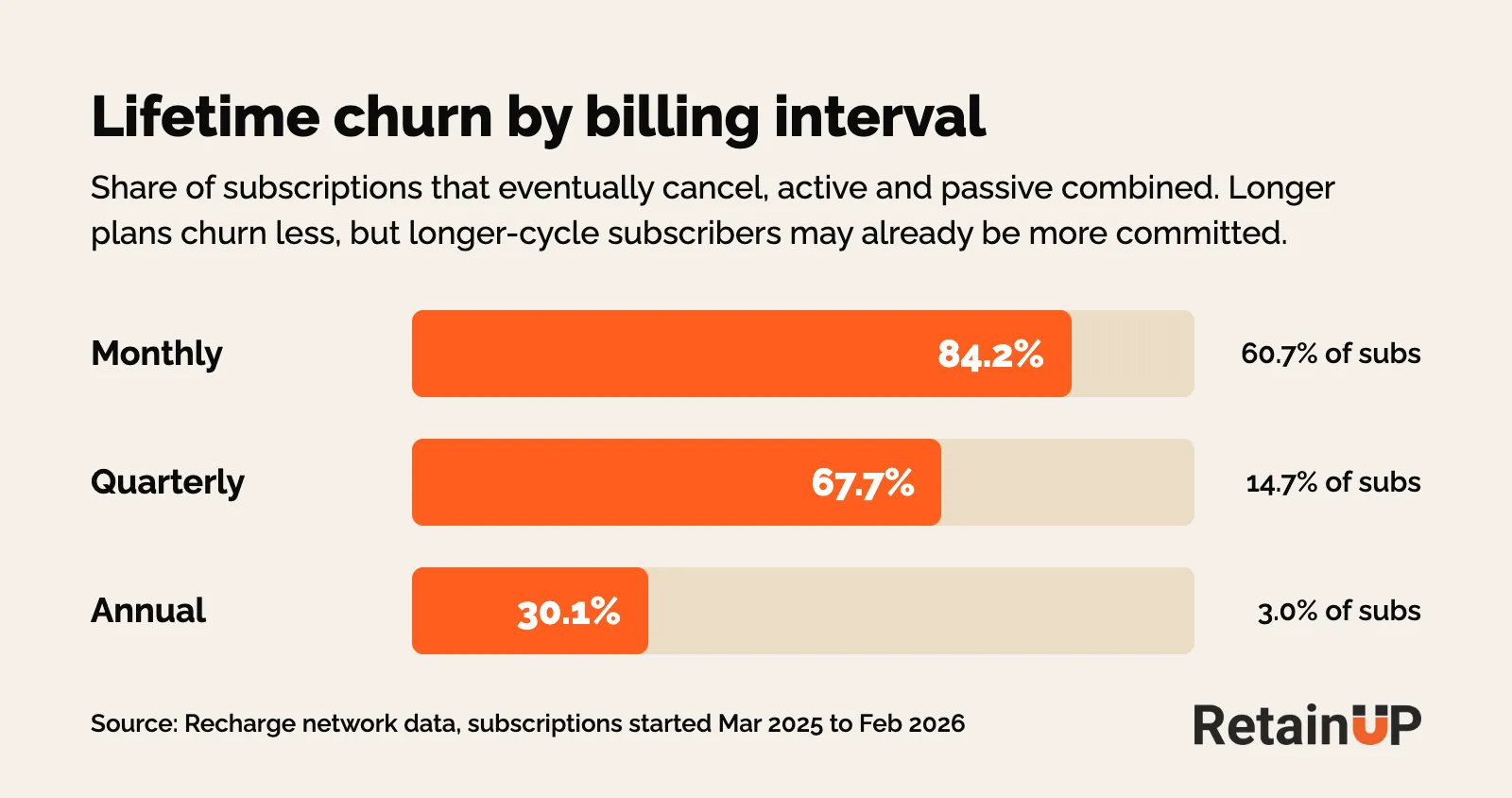
And longer plans do hold on longer when the supply matches. Recharge looked at 65.1 million subscriptions started between March 2025 and February 2026. 84.2% of monthly plans eventually cancelled, against 67.7% of quarterly and 30.1% of annual. Part of that is who picks a longer plan, since they were more committed to start with. So sell the bigger supply on the longer plan.
If the product goes off before a 3-month supply is used, bill quarterly and ship monthly. Recharge keeps charge frequency and delivery frequency as two separate settings.
One fixed frequency, the customer picks the supply
Dr. Squatch flips the question. Everything ships every 3 months. What changes is how many bars come in the box: 4, 6 or 10.
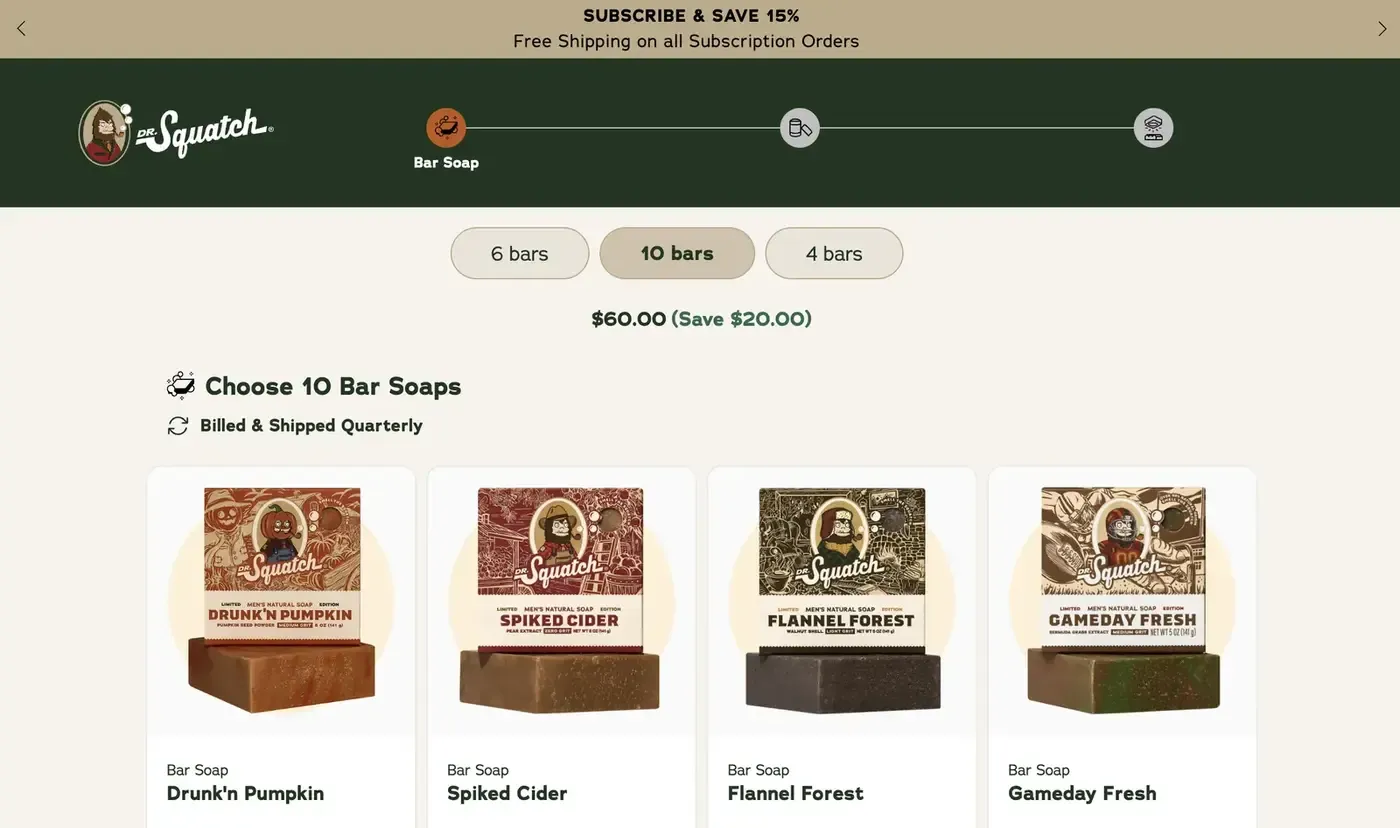
A fixed date has a side effect. Everyone knows when the box is coming, so they open the dashboard and swap scents before it ships. Their subscribers actually use swap. The box itself, and why a $6 bar needs one, is covered in subscription bundles and build-a-box.
This works best when you can't predict how fast people use it. So you hold the interval and let them size the box.
Shipping too early shows up as skips and "too much product" cancels
"Too much product" is the most stupid reason to cancel a subscription. And the brand caused it.
The customer didn't buy too much. You shipped too much. It comes from one of two places. The habit broke and they stopped using it, or the frequency was wrong from day one. Most of the time it's the frequency.
Ordergroove found overstock behind 27% of subscription cancellations across its merchants, 2023 to 2024. OLIPOP has named backstock as its number one historical churn reason.
And you see it in the data before you see it in the cancel survey:
- 2 skips in a row from the same subscriber. The cadence is wrong, not the timing.
- 3+ consecutive skips on more than 5% of your active base. That is a frequency mismatch across the program, not a few busy customers.
- 90% of subscribers who change their frequency stretch it longer, per No Limit Email across 6 brands. Usually they like the product, they just aren't using enough of it.
- Subscribers who push every order back by 5 to 7 days, which Appstle reads as the moment to offer the longer interval, before the skips start.
When it does reach the cancel survey, don't send a discount. A discount saves about 1 in 10. More product at a lower price is still more product. A skip or a longer frequency saves about 4 in 10. Four times the save. The full set of fixes per reason is in cancel reasons and the fix for each, and the order of skip, delay and frequency change for active subscribers is in the flexibility ladder.
I agree, LTV will be lower on the longer cycle. But it's better than a cancellation. A longer cadence ships fewer boxes a year. But it keeps more people, and it often makes more profit.
The 6-point frequency audit
In this video I run a live audit on AG1, IM8, Obvi, Native and Dr. Squatch, each scored against how fast a subscriber actually finishes the product.

So here are the six checks. You can run every one of them on your own widget today in about 10 minutes.
- Do you offer more than 2 frequency options?
- Does your default match how fast a subscriber actually finishes the product?
- Is there a mid-range option between your shortest and longest cycle?
- Is your 3-month option optional, or pushed as the default?
- Does your page explain why the cadence is what it is?
- Is the subscription widget more prominent than the one-time option?
On check 5, no brand in the audit showed the math. None.
Check your defaults against cohort data
The formula gives you a starting point. Your reorder data tells you if it holds. Export cohort numbers by frequency segment from your subscription app, every 1 month, every 2 months, every 3 months, and compare survival rate, order count and LTV. And divide LTV by days active, because longer-cycle subscribers stay active longer in days but order less. The method is in subscription cohort analysis.
None of this is a platform limit. Shopify's selling plans support as many intervals as you want, and every major subscription app exposes them. The constraint is not the tool.
So set the default per product, because the formula gives each product its own number. Ordergroove, for one, has a program-wide default and a product-level default that overrides it. A 30-count bottle and a 90-count bottle should never share one.
So if you cannot predict consumption at all, give people skip and reschedule instead of more intervals. A subscriber who can push one delivery does not need twelve frequencies.
The default gets set on the product page, before anyone subscribes, so that's where I'd start. Subscription LTV Maximizer™ builds the offer and widget with the right defaults, plus the cancel flow, portal, payment recovery and pause and skip in Recharge, Skio, Stay AI or Loop, with email and SMS, live in 30 days for $5,000. If you want to see where your frequency stands first, the free subscription audit checks it among 48 checkpoints in 24 hours.
FAQ
How many subscription delivery frequencies should I offer?
Two is enough for most single-product brands, and three is the ceiling. AG1, IM8, Dr. Squatch, Grüns and Everyday Dose each show one or two on the product page. Add intervals only when your catalogue really is used at different rates, as pet food is. Otherwise a longer list makes the decision harder without making the delivery any better, and most subscribers keep the default anyway.
How do I work out the right subscription frequency for my product?
Divide the units per container by the daily dose to get days to finish, and set the default there. A 30-unit bottle taken once a day is a 4-week subscription. A 30-serving coffee at two cups a day ships every 15 days. Then check it against your reorder data, since the real replenishment window is often 45 to 60 days for products people do not take every day.
Is a 90-day subscription better than monthly?
A 90-day subscription is better only when it ships 90 days of product. IM8 does this well: a 90-day supply billed every 12 weeks. Shipping a 30-day bottle every 90 days, or 90 days of product every month, breaks the match between usage and billing. Keep 3 months for 90+ unit packs, as-needed products, or subscribers who chose to slow down after two orders.
Why do subscribers cancel with too much product?
Subscribers cancel with too much product because the brand shipped faster than they could use it, or because the habit broke. Most of the time it is the frequency. Ordergroove tied 27% of cancellations to overstock. A discount saves about 1 in 10 of these subscribers, while a skip or a longer frequency saves about 4 in 10, so offer those first.
One email a week on subscription retention: the numbers, the strategy, and what to fix first.

Rahi Jain
Rahi Jain is a subscription LTV specialist who helps $1M to $10M DTC brands reduce subscription churn and maximize LTV on Recharge, Skio, Stay AI and Loop.
More about Rahi