Key takeaways
- At one subscription brand, reminder day (day 27) had almost 4 times the cancellations of the day before it.
- Reframing the billing reminder took one brand's pre-rebill cancel rate from 10 to 12% down to about 3%.
- Boka's reminder, with skip and swap options and four add-ons, cut churn 18% in 90 days.
This is one part of the subscription retention guide, which walks what keeps subscribers after month three.
In a hurry? Watch the tutorial.
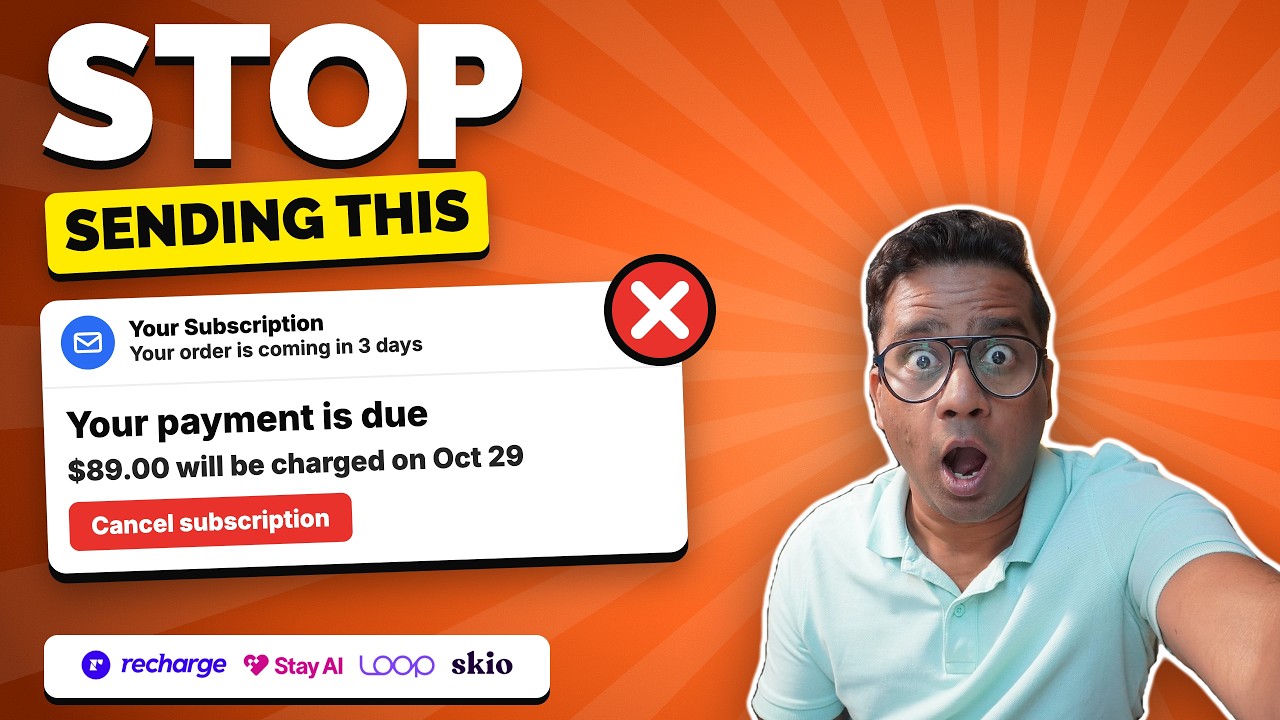
The upcoming billing reminder is the email your subscriber gets a few days before every charge. It is one of the most opened emails in your whole program. In month one, usually the most opened.
It is also the most misunderstood. Most brands treat it like a legal chore. Many don't even want to send it, because they feel it reminds people to cancel.
They are partly right. For a lot of brands, the day this email goes out is one of the biggest cancellation days of the month. I have rebuilt it across 80+ subscription brands, and the fix is the same every time: change what it says, and what it asks people to do.
Why the billing reminder causes cancellations
The reminder causes cancellations because most versions read like a bill with a cancel button. You send it so nobody gets surprised, and it does that job. But it also moves a chunk of cancellations three days earlier.
Here is the data. These are monthly cancellations at one brand, by day since signup. Day 27 has almost four times the cancellations of day 26. Day 28 drops back down to less than half of day 27.
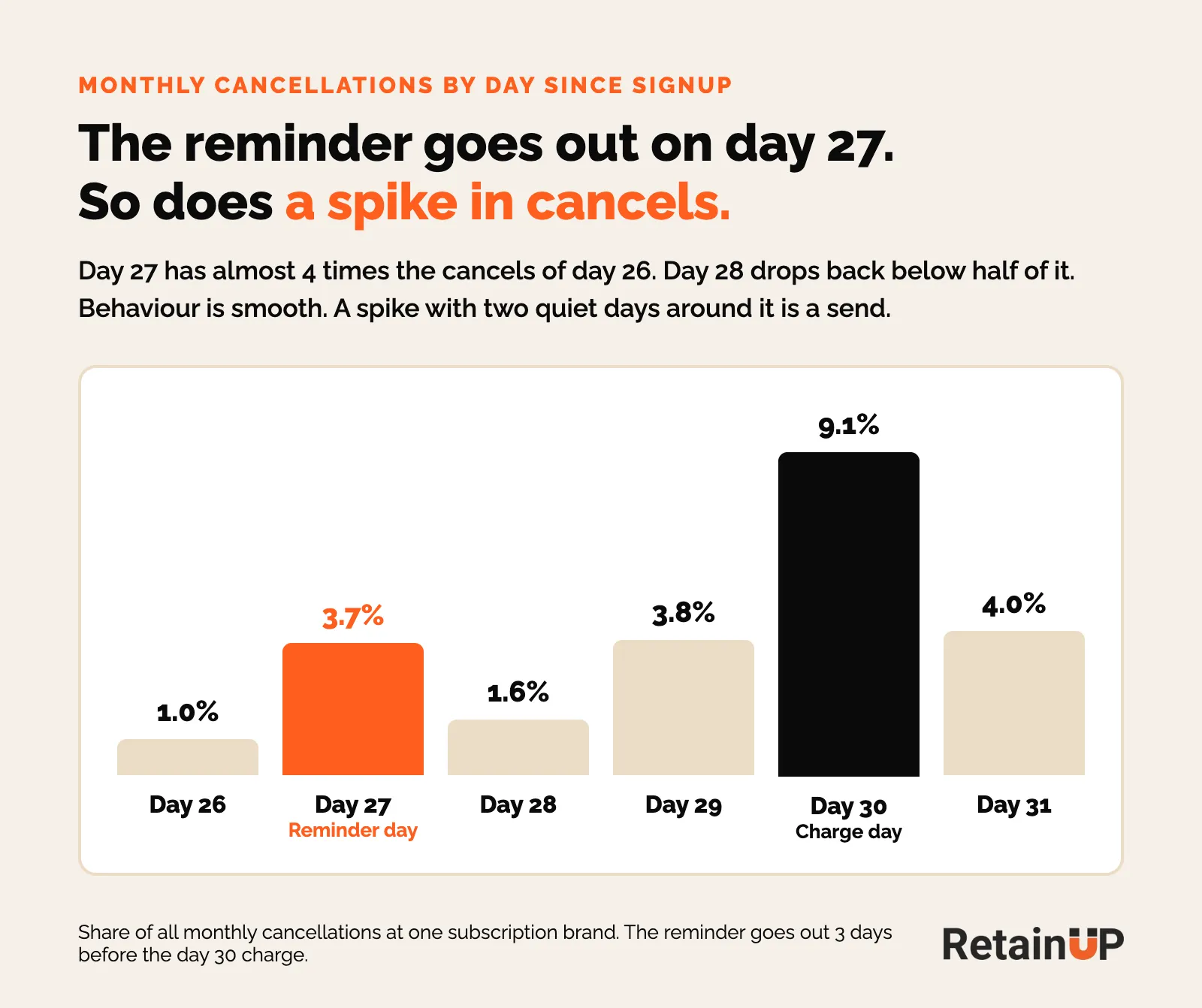
Behaviour doesn't do that. It's smooth. A spike like that is a send. And day 27 is exactly when this brand's reminder goes out, three days before the charge on day 30.
So the answer is not to delete it. Day 30 is still the biggest day, with 9.1% of every monthly cancellation, and that is the day of surprise charges. Max Sturtevant sees the same thing: billing day runs 50 to 100% higher than reminder day. All three spikes are in when subscribers cancel. Keep the email. Change what it says.
Find where your reminder comes from, and read it
First, find out which tool sends it. Most brands assume Klaviyo. Very often it is sent by Recharge, Skio or Stay AI, and nobody has looked at it since the app was installed.
So go and read it. Like a subscriber would. Most open with a charge amount and a date. The most obvious link? Cancel.
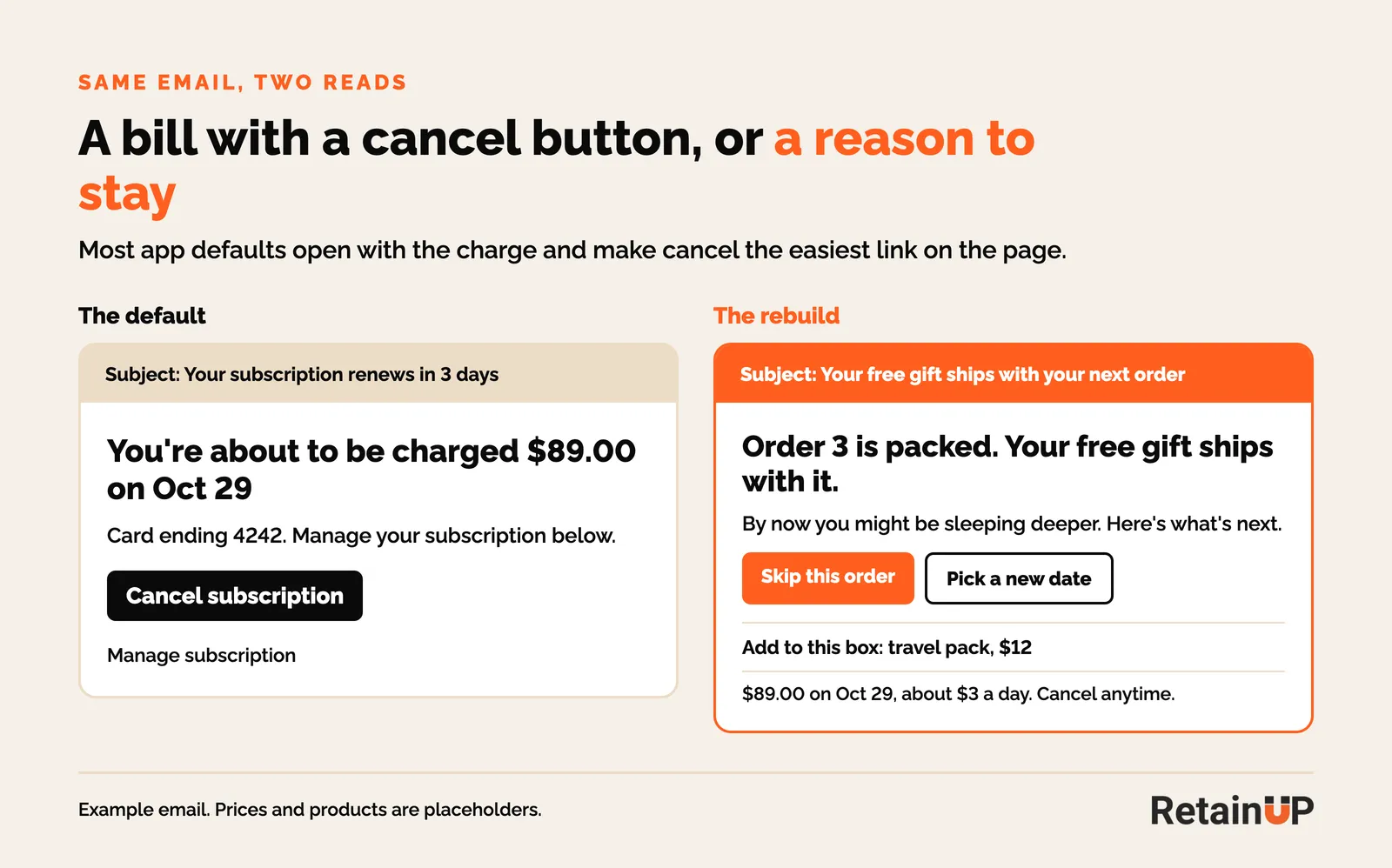
If you say "You're about to be charged", don't be surprised when people cancel. You have written a bill and attached a cancel button.
What to put in the upcoming billing reminder
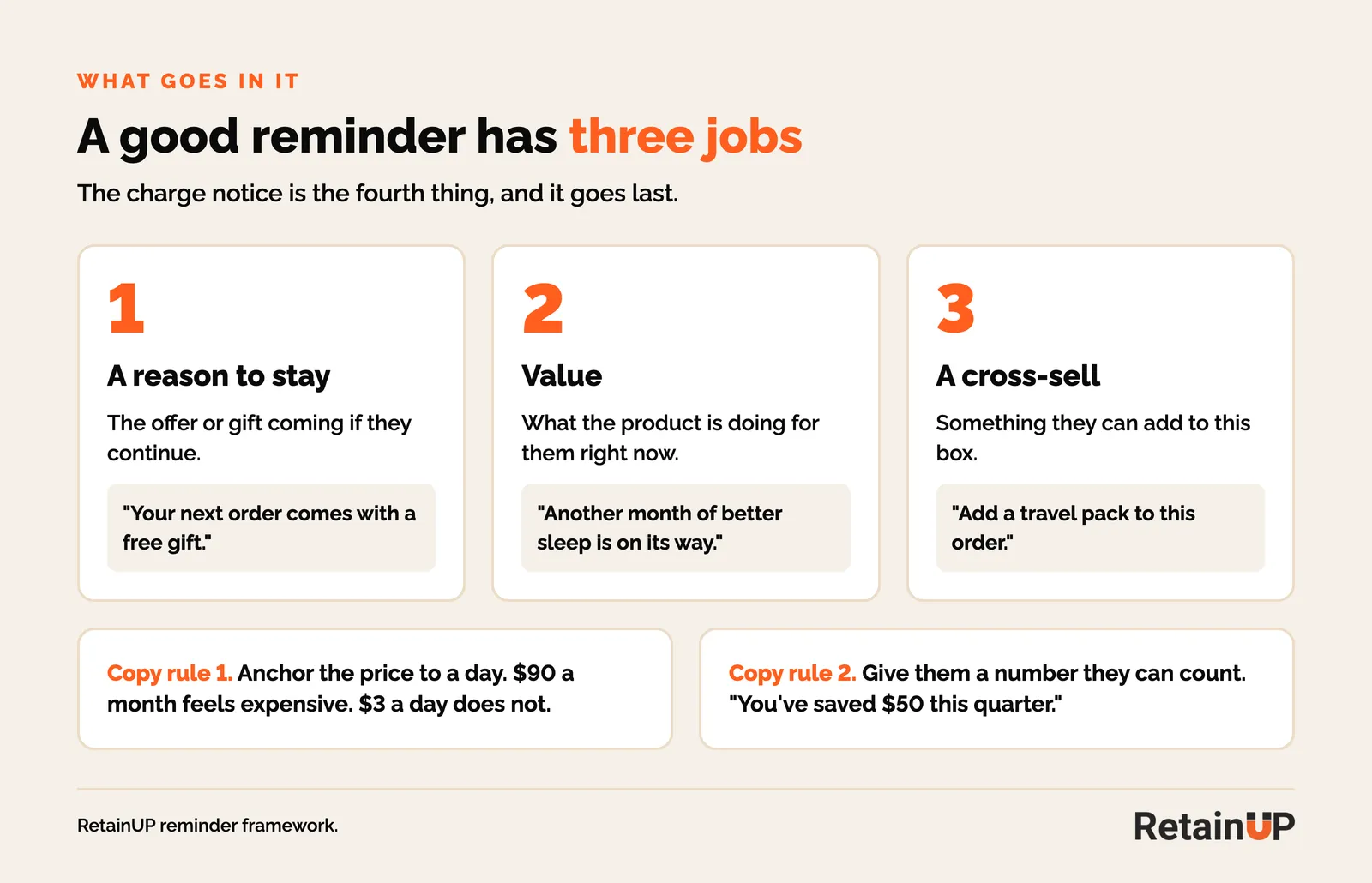
A good billing reminder has three jobs: a reason to stay, value, and a cross-sell. A reason to stay, so the offer or gift coming if they continue. Value, so what the product is doing for them. And a cross-sell, so something they can add. The amount and the date go at the bottom.
Reframe the whole email
Reframe the whole email around what is coming in the order. Instead of "Your order renews in 3 days", say "Your next freebie is on its way", or "Your order is ready, here's what's inside."
Tie it to the outcome. "Another month of better sleep is on its way" lands very differently from a renewal notice. Matthew Holman at The Cancel Page adds one more: look at your cancel reasons and answer the biggest one before the charge. If people leave on price, frame the value. If they say it does nothing, reset the timeline.
Mars Men does this really well. Their subject line is "You're in your activation phase." The email reminds you what you might be noticing right now, like feeling stronger and recovering faster. It tells you when the effects build up. And at the bottom there is an option to move from monthly to a 90-day plan. More in the Mars Men scorecard.
Obvi frames it as a moment of progress. It shows what is coming in the next box, adds an optional bonus product they can add in one click, and ties it back to why they signed up. So it becomes something to look forward to.
Nick Shackelford at Brez ties a giveaway to the cutoff: "Stay subscribed past the 27th, and get entered to win free cases." It costs them nothing.
Battlebox sends no three-day reminder at all. Before every renewal they tease the next box over email and SMS. The charge is never a surprise. The excitement gets there first.
Two copy rules I use on every client
- Anchor the price to a day, not a month. $90 a month feels expensive. $3 a day does not.
- Give them a number they can count. "You've saved $50 this quarter with your subscription." How much they saved, how many orders they've had.
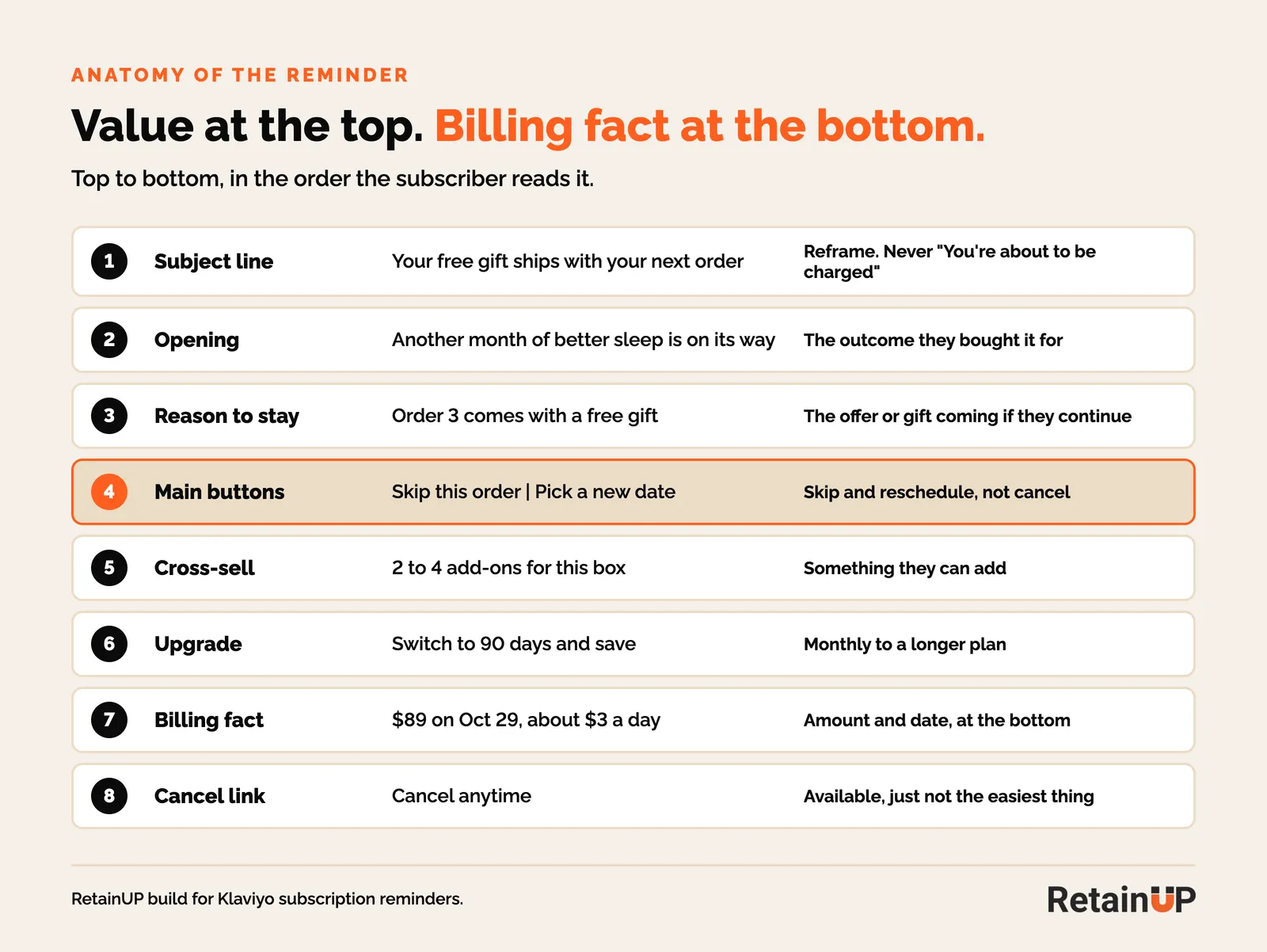
The billing fact, the amount and the date, goes at the bottom. That is where it belongs legally, and nowhere else. Put the card on file and an update link there too, as Omnisend suggests, so an expired card gets fixed before the charge fails. Cornbread Hemp does this with Skio's Quick Actions. The rest is in the card update flow.
Skip and reschedule: make them the main buttons
Skip and reschedule should be the main buttons on the page. Cancel stays available. Hiding it is unlawful in some places. And it doesn't work. It just stops being the easiest thing on the page.
Every app has one-click links for this. Recharge has Quick Actions for Klaviyo emails. Loop has Quick Actions too, magic links that skip, delay or swap without a login. Skio has its own quick action links. A subscriber who only wants to push one box back should never have to log in, find the portal and walk past a cancel button. Which option to offer first is in the flexibility ladder.
Cornbread Hemp put Skio's Quick Actions in its billing reminders. 25% of subscribers who click one take a real action. No portal needed.
Put the actions inside the email
If you can, put the actions inside the email itself, with a tool like Zaymo. The subscriber can skip, delay, add a product or upgrade without opening the portal. Enhancd does this on its billing reminder, with the delay capped at four weeks on a 90-day plan.
The numbers here are strong, and they are Zaymo's own. On its site, a subscriber who delayed their upcoming order was 60% less likely to cancel. In the Subscription Tech Playbook 2025 (Lunar Solar Group), about 80% renew again after delaying one to four weeks inside the email. Variant swaps in the email cut churn about 20%. And forms inside the email get twice the response of a link to a form.
Two build notes from Zaymo's own reminder guide. Keep a plain fallback version in Klaviyo for inboxes that can't show interactive blocks. And put 4 to 5 products in the add-on grid, so there is still something to show when they already hold one.
What we built for Boka
For Boka, the reminder goes out three days before renewal with a simple "your subscription is due" line. Right under it sit the options to skip, pause or swap products. We didn't call them that. We wrote "Need to make an adjustment?" Below that, four cross-sell blocks: mouthwash, tongue cleaner, toothpaste packs and bundles.
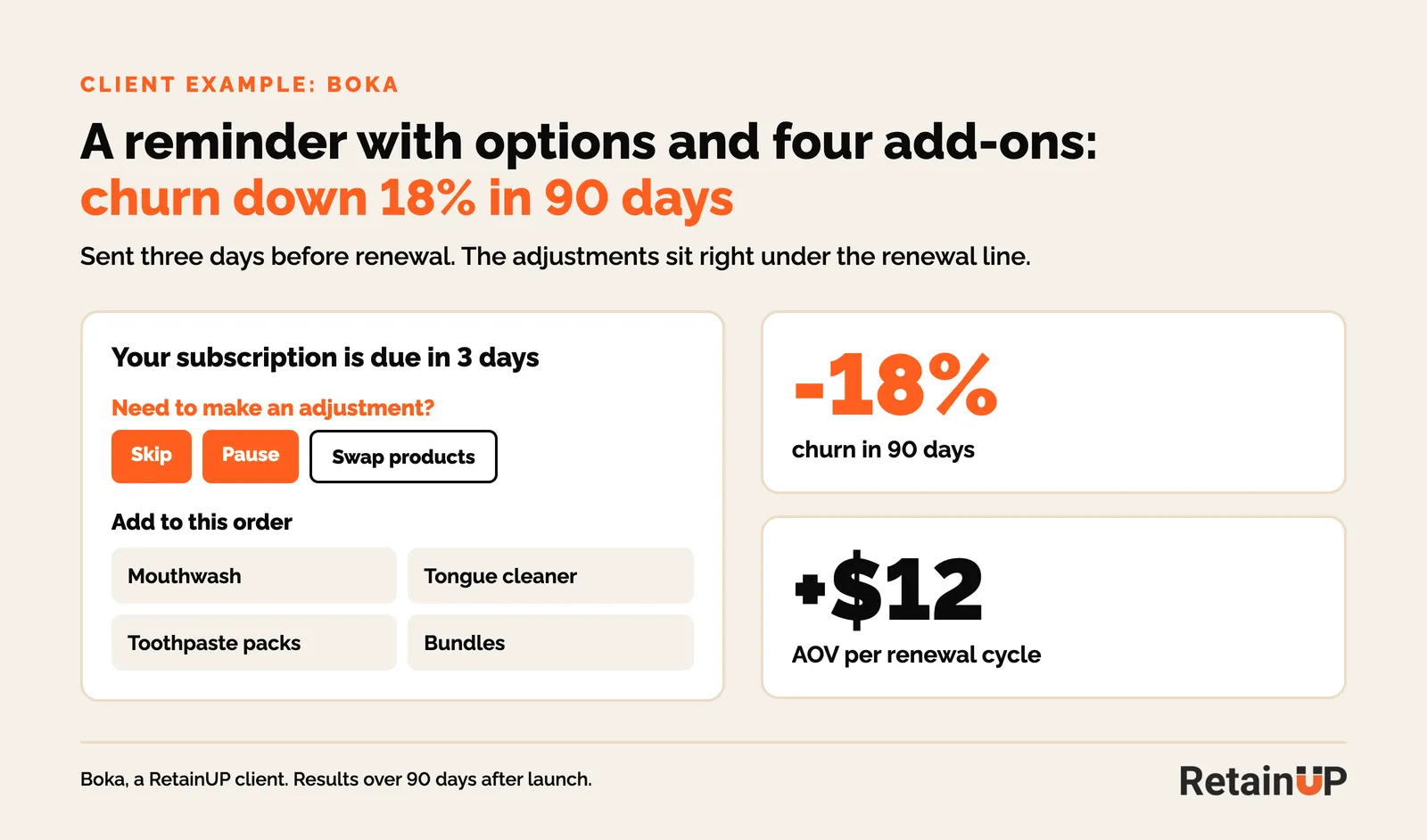
Churn went down 18% in 90 days. AOV went up $12 per renewal cycle. Today I would leave pause out. Skip and delay do the same job with less risk.
When to send the renewal reminder
Send it 3 to 5 days before the charge. Then test. Earlier than 7 days and it slips their mind. Under 48 hours and a reschedule can collide with the charge batch.
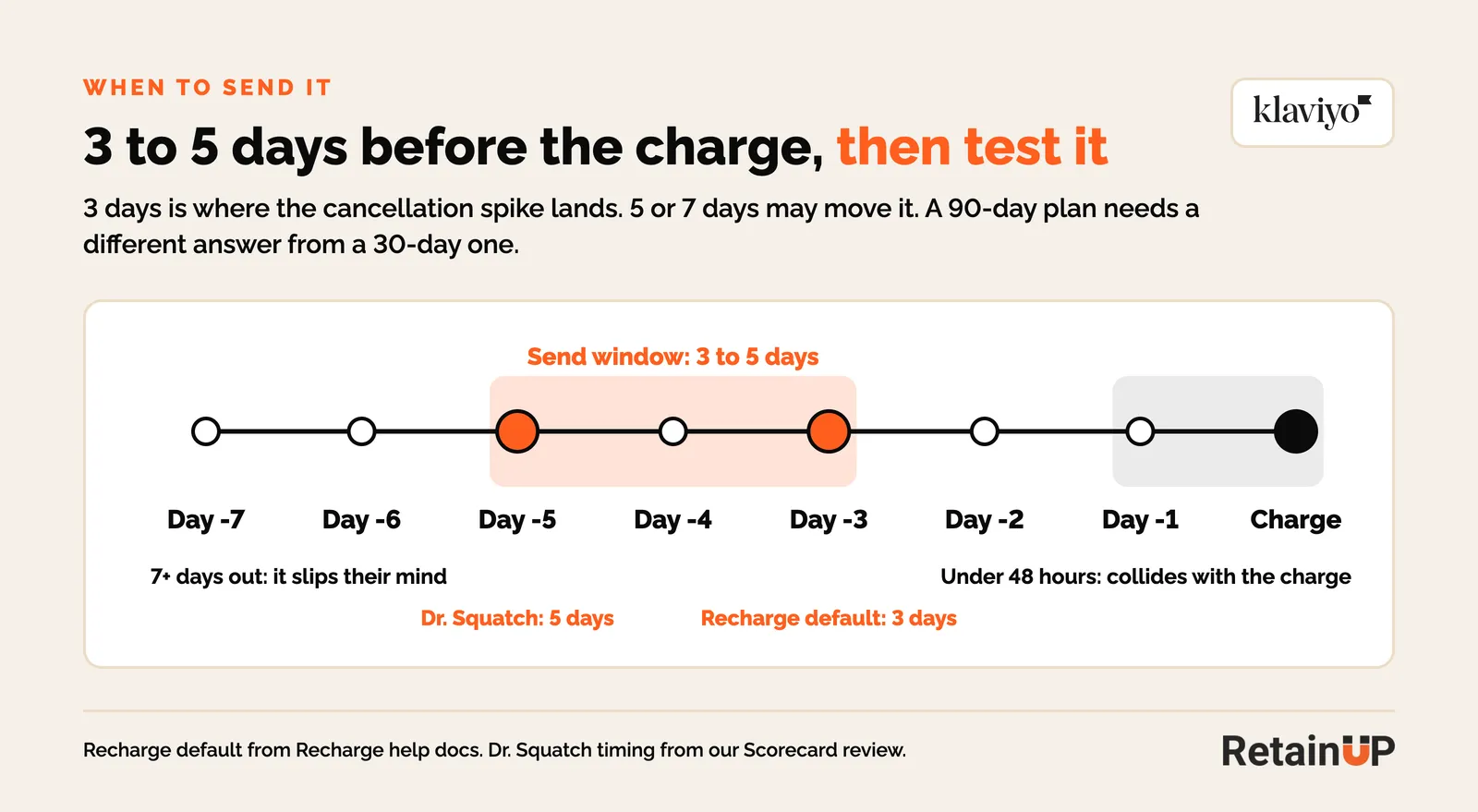
Recharge sends its upcoming charge event 3 days before by default, and you can change it in Recharge. Skio and Loop also default to 3 days, and Skio sends it before prepaid renewals too. Dr. Squatch sends its reminder 5 days before every charge. Three days is where the cancellation spike lands, so 5 or 7 days may move it. A 30-day plan will give a different answer from a 90-day one, so test each cadence on its own. Whatever you pick, put it in your subscription FAQ too.
A different reminder for order 2, order 3 and order 6
Write to the order number, not the person. Order 2 is the most vulnerable point, and by order 4 most people are settled in. Most brands send the same one every time. Order 2 needs reassurance. Order 6 needs a reward.
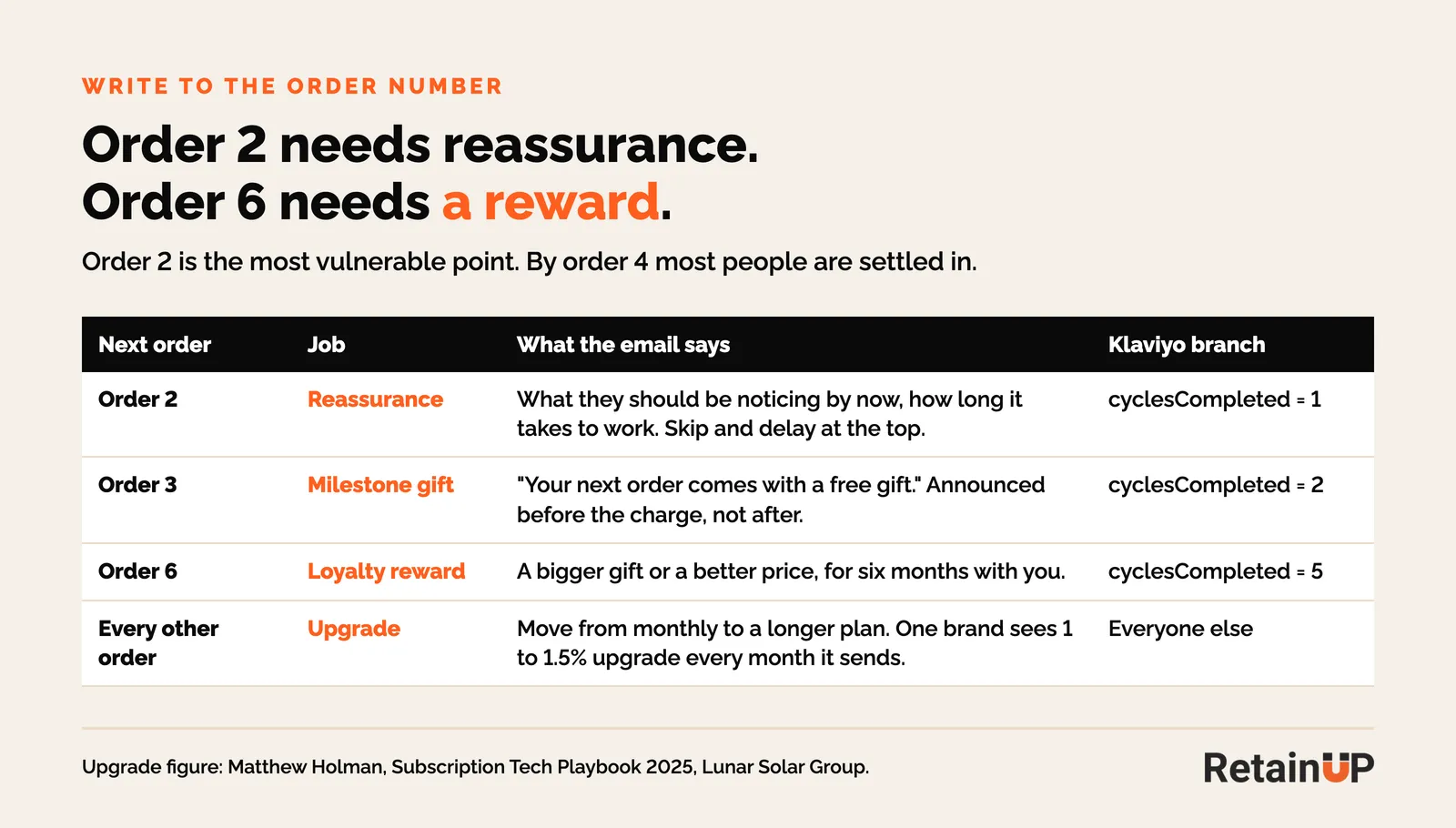
- Order 2: reassurance. What they should be noticing by now, how long it takes to work, and the skip and delay options right at the top.
- Order 3: the milestone gift. "Your next order comes with a free gift." So they have a reason to stay for order 3, and it is announced before the charge, not after.
- Order 6: the loyalty reward. A bigger gift, or a better price, for six months with you.
- Every other order: the upgrade. One recurring reminder with the move to a longer plan. Learning with Kelsey offers every monthly subscriber a quarterly upgrade in this email, and 1 to 1.5% upgrade every month it sends (Matthew Holman, Subscription Tech Playbook 2025).
We built an order 2, an order 3 and a recurring reminder as separate emails for K9Clean Pets, TANIT botanics and Awesome Aminos. The gift in the order 3 email is the same one in your milestone rewards. Promote it in the reminder before that order, then confirm it after the renewal.
How to build the reminder flow in Klaviyo
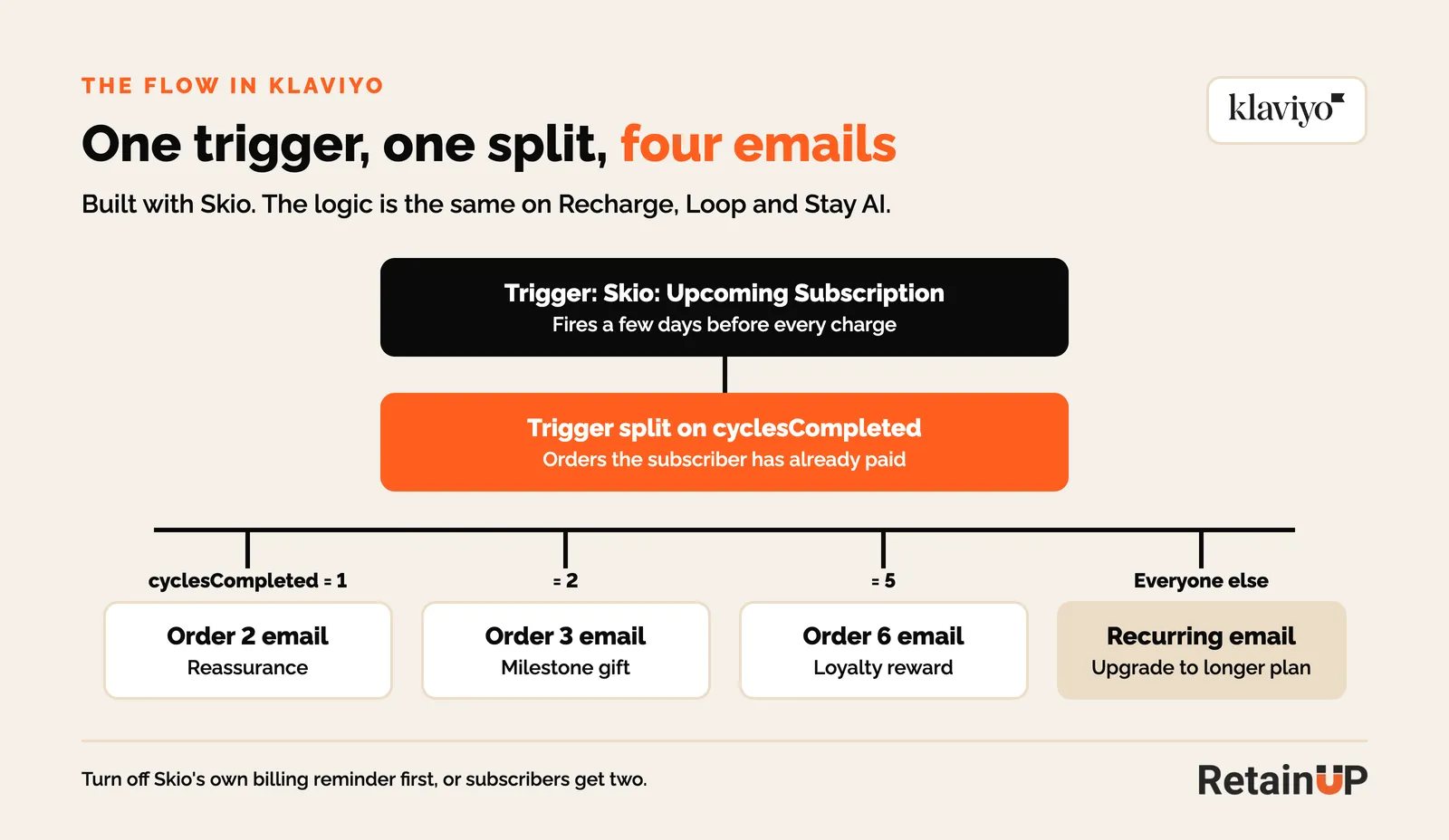
One flow. The build is the app's upcoming order event as the trigger, one split on the number of orders paid, and four emails. I am using Skio here. The logic is the same for Recharge, Loop and Stay AI.
- Turn off the app's own reminder. In Skio, switch off the billing reminder notification. In Recharge, open the upcoming charge notification under Email and deactivate it. Otherwise your subscriber gets two.
- Create the flow. In Klaviyo, go to Flows, Create flow, Build your own. For the trigger, pick "Skio: Upcoming Subscription". It fires a few days before every charge.
- Leave out the time delay. The lead time is set in the app, not in Klaviyo, so the email lands when the event fires.
- Turn Smart Sending off. If the subscriber got a campaign that morning, Smart Sending would skip the one email that tells them about the charge.
- Split on cyclesCompleted. That is the number of orders already paid. 1 goes to the order 2 email, 2 to the order 3 gift email, 5 to the order 6 loyalty email. Everyone else gets the recurring email.
- Show the order count.
{{ event.cyclesCompleted|default:'' }}tells the subscriber how many orders they have had. - Test every branch before you turn it on.
Each app names the event and the order count differently. Recharge sends "Order upcoming", Skio passes cyclesCompleted, and Loop sends loop_upcoming_order with $loop_processed_order_count on the profile. Check Analytics, Metrics in Klaviyo before you build. And note Recharge sends its events between 1 and 4 PM ET, so your send time can move from the Recharge email it replaces.
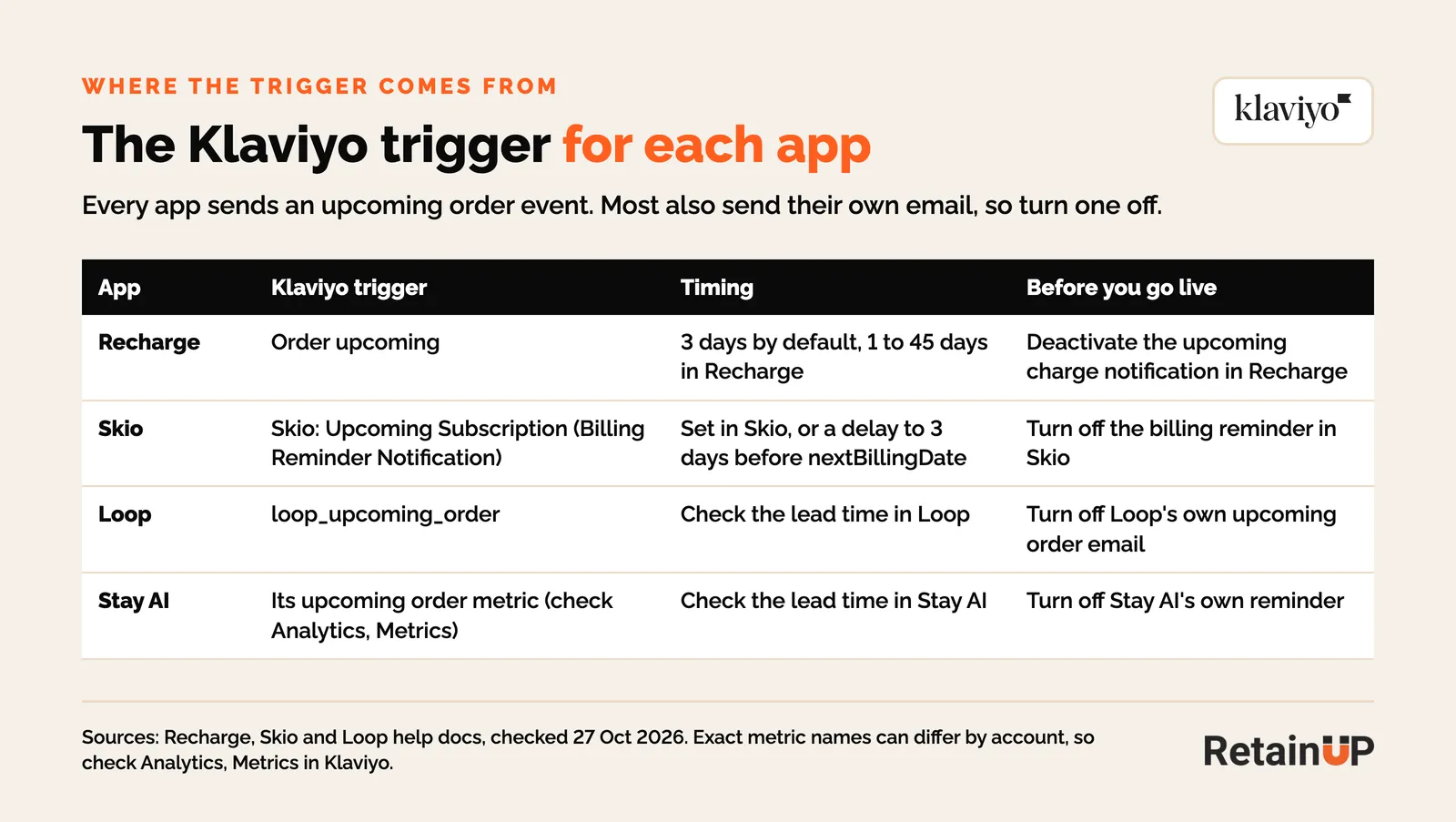
The full list is in subscription app events in Klaviyo, and the app settings are in the Recharge, Skio, Loop and Stay AI setup guides. Where this flow sits next to the others is in the core subscription email flows.
One thing to check with your own counsel. A reminder with cross-sells is promotional, so Klaviyo sends it as marketing, and anyone unsubscribed from marketing won't get it. Decide how those subscribers get their charge notice before you switch the app's version off.
How to measure the billing reminder
Measure the whole seven-day window around the renewal, with the new email and with the old one. Never judge it by the day it goes out. You will always see a spike there, because the email creates a cancellation day. But it also prevents a different one, on the charge day.
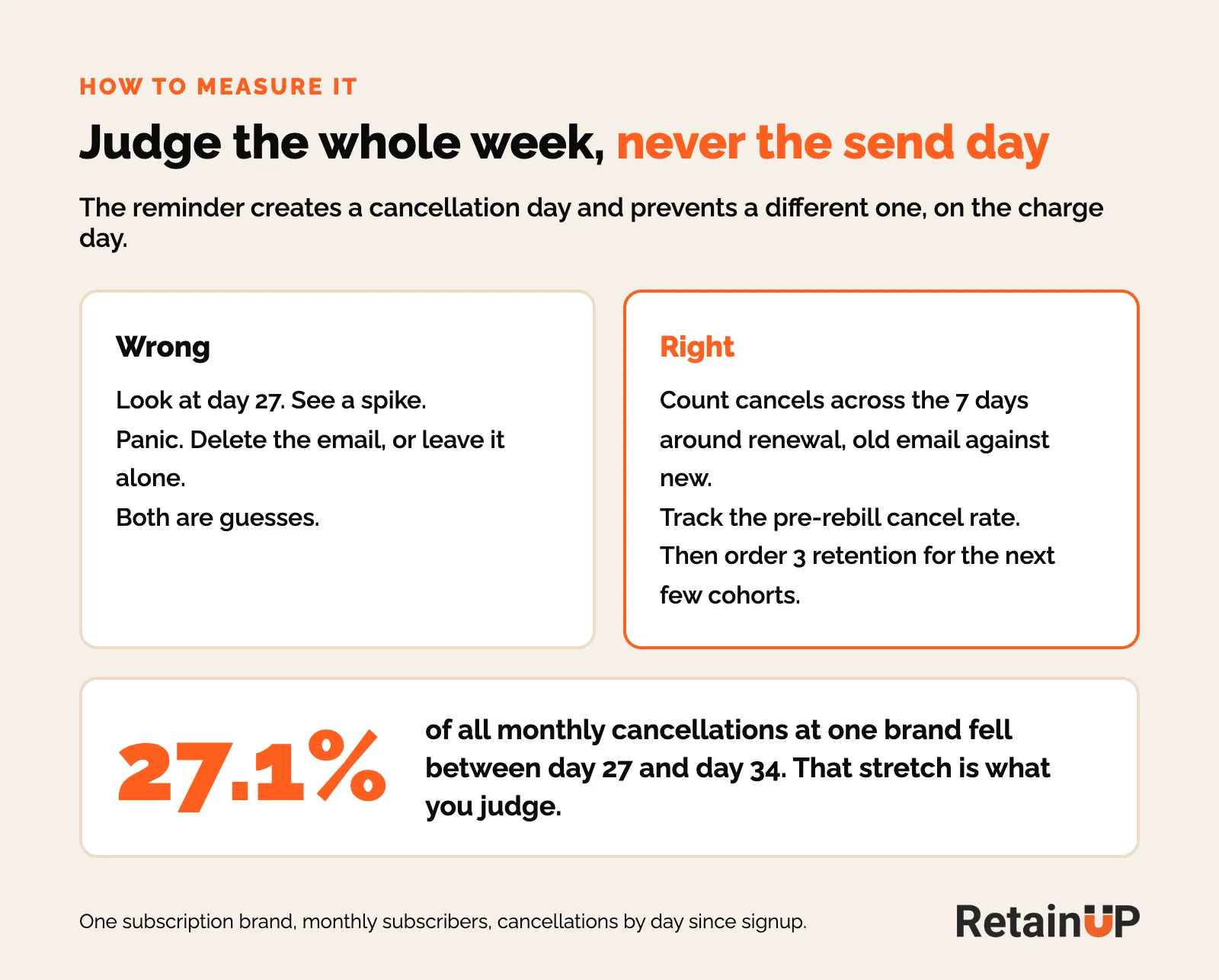
At the brand above, days 27 to 34 held 27.1% of every monthly cancellation. That week is the number to move. Not day 27.
The pre-rebill cancel rate
Max Sturtevant uses one number for the reminder. Take every subscription with a rebill scheduled for a given day. The pre-rebill cancel rate is the share that cancelled in the 3 days before, before being charged.
The formula is simple. Cancels in the 3 days before the rebill, divided by rebills due that day. Chart it by scheduled rebill day, with bars for rebills due and a line for the rate. At his client the average was 7.46%, and reframing the reminder took it from 10 to 12% down to about 3%. That last figure is read off his chart, so treat it as a range.
Pair it with the seven-day window. Always. A lower pre-rebill rate means nothing if those cancels just moved to billing day. And to see if the new version kept people, track order 3 retention for the next few cohorts.
The reminder is one of the pieces we rebuild in the Subscription LTV Maximizer™: offer, widget, cancel flow, portal, payment recovery, pause and skip built in Recharge, Skio, Stay AI or Loop, plus the email and SMS around them, live in 30 days for $5,000. If you first want to see how your reminder, cancel flow and portal score, the free subscription audit checks 48 points and sends your top 3 leaks in 24 hours.
FAQ
How many days before renewal should I send a subscription reminder email?
Send it three to five days before the charge. Recharge sends its upcoming charge event three days before by default, and Dr. Squatch sends five days before. Three days is where the cancellation spike usually lands, so test five and seven days against it. Test each plan length on its own, since a 90-day plan behaves differently from a monthly one.
Does a subscription renewal reminder increase cancellations?
It moves some cancellations earlier. At one brand, reminder day had almost four times the cancellations of the day before. It also cuts surprise cancellations on the charge day, which is still the biggest day. So judge the full week around renewal, and the pre-rebill cancel rate, before you decide the email is hurting you.
Should I send the billing reminder from Recharge or Skio, or from Klaviyo?
Send it from Klaviyo, so you can split by order number, add products and match your brand. Turn off the app's own reminder first, or subscribers get two. Keep Smart Sending off on the flow, so a campaign that morning never blocks the charge notice.
What should an upcoming billing reminder say?
Lead with value and a reason to stay, like the gift coming in the next order. Make skip and reschedule the main buttons, add two to four products they can add, and put the amount and the date at the bottom. Write a different version for order 2, order 3 and order 6.
One email a week on subscription retention: the numbers, the strategy, and what to fix first.

Rahi Jain
Rahi Jain is a subscription LTV specialist who helps $1M to $10M DTC brands reduce subscription churn and maximize LTV on Recharge, Skio, Stay AI and Loop.
More about Rahi