Key takeaways
- 15% off the one-time price is the default subscribe and save discount. 10% if you sell on Amazon, 20% only as a push.
- One brand raised its one-time price and shipping instead of cutting the subscription price, and take rate went from 25-30% to 57%.
- Past 20% off you sell a coupon with extra steps, and no cancel flow saves a customer who joined to save $30.
Should it be 10%, 20% or 30%? Every founder asks this one first. Pricing is never easy. Add subscription on top of it, and it gets harder.
Subscribe and save is the simplest subscription offer there is. The customer agrees to repeat deliveries, and pays less than the one-time price on every order. The only question is how much less.
And it matters more than it looks. The discount on the widget sets the expectation for the whole relationship. Go too low and there is no reason to subscribe. Go too high and you attract buyers who came for the deal, not the product.
This is the first evergreen decision in Subscription Offer Engineering, right after you match frequency to how fast the product gets used. So here are the bands we use, and the ways to widen the gap without cutting price.
The four discount bands
The evergreen discount applies at the product level. Same percentage whatever bottle size or frequency the subscriber picks, and its one job is to make one-time the worse deal.
| Discount | When to use it |
|---|---|
| 10% | Amazon-safe floor. The brand sells on Amazon and cannot undercut Amazon pricing. The lowest incentive that still works. |
| 15% | The standard default. Protects margin and the retail channel. Where most brands should sit. |
| 20% | Subscription push. Your main goal is to move one-time buyers over fast. Acceptable, but not the default. |
| Over 20% | Avoid. You attract price-sensitive buyers who churn at the first renewal. |
Most brands should start at 15%.
Below 10% people still subscribe, by the way. Ordergroove says even a small 5% discount can lift subscription enrolment by as much as 104%. That is their own number from a retention guide, so read it as a ceiling. Still, having a discount at all does a lot of the work. The size matters less than founders think.
When you can skip the discount
Some brands never discount. SUBTA points to Dry Farm Wines, which never discounts and sells on the product instead. That works when nothing on the market compares. On a unique product, a discount can even suggest it is cheaper somewhere else.
Most replenishment products have ten look-alikes. So the discount stays. Just keep it in proportion. Coupons don't create desire. They convert it. And every time you discount, you teach your customer that your full price is wrong.
Why 20% is the ceiling
Above 20%, the economics break before you start. The subscriber who came in at 25% off has a price anchor you cannot sustain. When the offer normalises or a competitor goes higher, they leave.
Take rate bought with a deeper discount is a different number from take rate earned with a clearer offer. Only the cohort tells them apart.
What each point of discount costs you
A discount comes straight off revenue. Your costs don't move.
Take a $100 order. Say $30 goes to marketing, $30 to the product, shipping and payment, and $20 to running the business. That leaves $20 of profit. Now give 10% off. Every cost stays. Profit drops to $10. To make the same profit you need twice the orders.
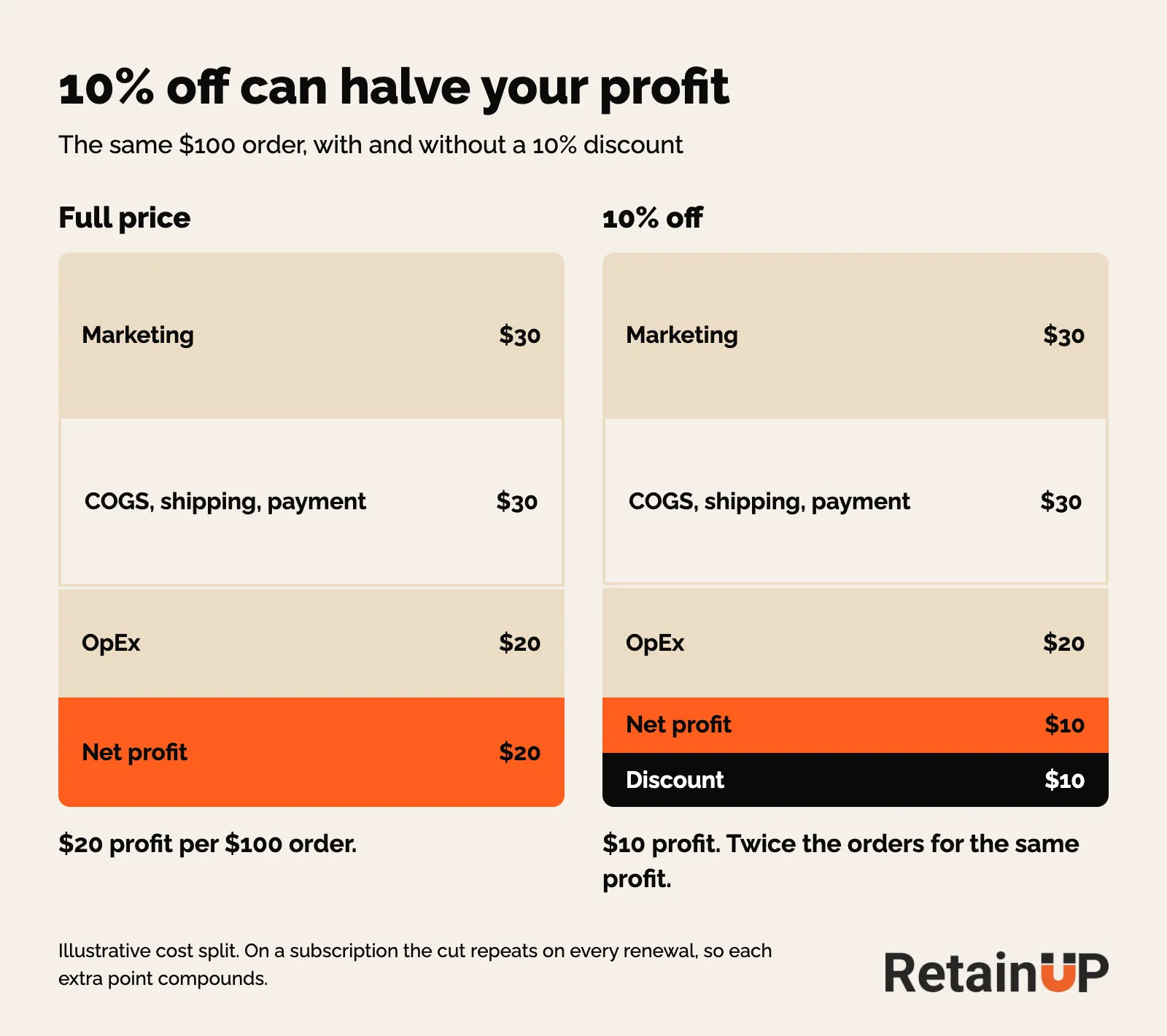
And on a subscription that cut repeats on every renewal. Intelligems runs the maths on a $50 monthly plan where subscribers stay 10 months. If 10% and 15% convert the same, the extra 5 points cost $25 per subscriber. For nothing.
So look for the smallest discount that still gets people to subscribe. Intelligems suggests testing your current rate against one 5 points lower and one 5 points higher, for at least 4 to 6 weeks. Judge each by how long those subscribers stay. First-order conversion alone will always pick the bigger discount.
What 30% off looks like from the customer side
Retail is for suckers. Why pay full price when you can take 30% off on subscription and cancel five minutes later?
That is your subscriber doing maths. Not me. Brands call this Month Zero churn. It feels like cheating.
On a $100 ticket, 30% off is $30, and that is too good to pass up. Once he sees it, paying full price starts to feel stupid, so he subscribes to buy once and cancel once. He is taking the deal you built. More on that pattern in day zero cancellations.
I felt cheated the first time a subscriber cancelled before month 2. They took the discount, used the product, and left. 10 to 20% of subscribers do this. Every subscription brand. Every month.
Anything above 20% and you stop selling a subscription. You sell a coupon with extra steps, and no amount of retention work fixes a customer who came for the coupon. So load the offer with gifts instead.
One rule worth keeping: keep the subscription discount within 15 to 20% of the one-time price. A 40% gap fills your list with deal hunters. A 15% gap fills it with buyers.
Measure the gap against one-time, not the struck-through price
MRP is the struck-through price on the product page. Nobody actually pays it. So the incentive that matters is the gap between the one-time price and the subscription price on the same page.
Here is the sample we use in our offer work, a mix of supplement brands we have worked with. A 30-serving daily supplement has an MRP of $75 and a one-time price of $60. Monthly subscription is $51, which is 15% off one-time. Three months prepaid is $117, which is $39 a month and 35% off.
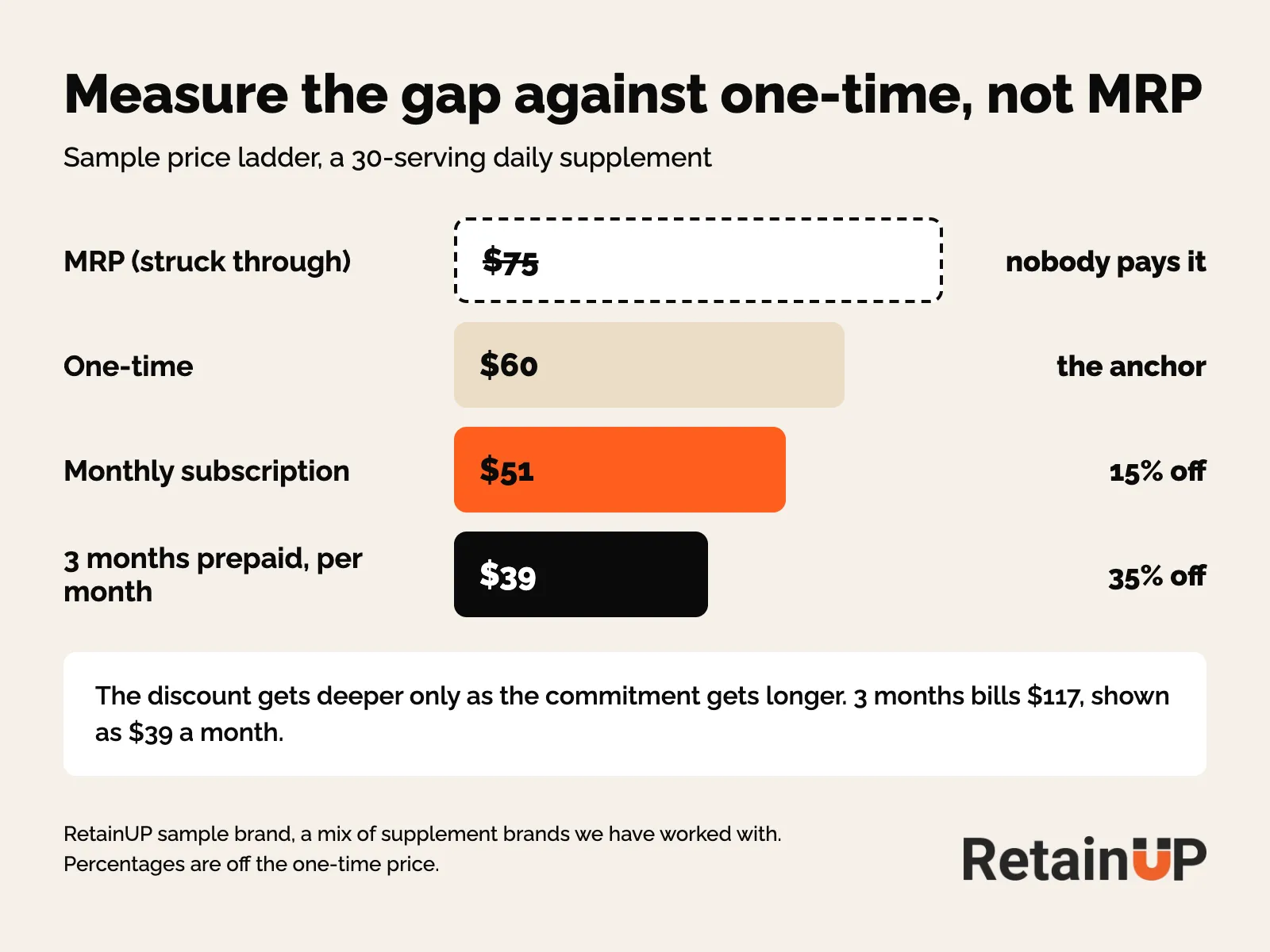
Monthly sits at 15%. The discount gets deeper only as the commitment gets longer, because commitment is what you are buying. That deeper rate belongs to the term, and the prepaid and longer plans page covers how far to take it.
We saw why this matters at one of our brands. The product page advertised 40% to 64% off MRP. Then we pulled what people actually paid after codes, and subscribers were paying slightly more on average than one-time buyers. So there was no subscription incentive at all, only a subscription label. You cannot see that from list prices, only from the order export.
Check every pack size too. At another brand, the one-time volume deals beat the subscription rate by up to 15 points. So the bigger the order, the worse subscribing looked.
Raise the one-time price instead of cutting the subscription
There is another way to create that gap. Few founders try it.
In one case study from another agency, the brand raised their one-time price and shipping instead of cutting the subscription price. If you go for one-time, you pay a higher ticket plus shipping. Take rate went from around 25 to 30% up to 57%. One case, and not ours.
The gap sells the subscription. And only one side of that gap costs you margin. Everyone reaches for the discount because the other lever feels like a price rise.
Look at IM8. One-time is $112 and sits as a small text link under two subscription cards: $89 on the 30-day supply at 20% off, $78 a month on the 90-day supply at 30% off. The one-time option is there. It just looks like the worse choice, which it is.
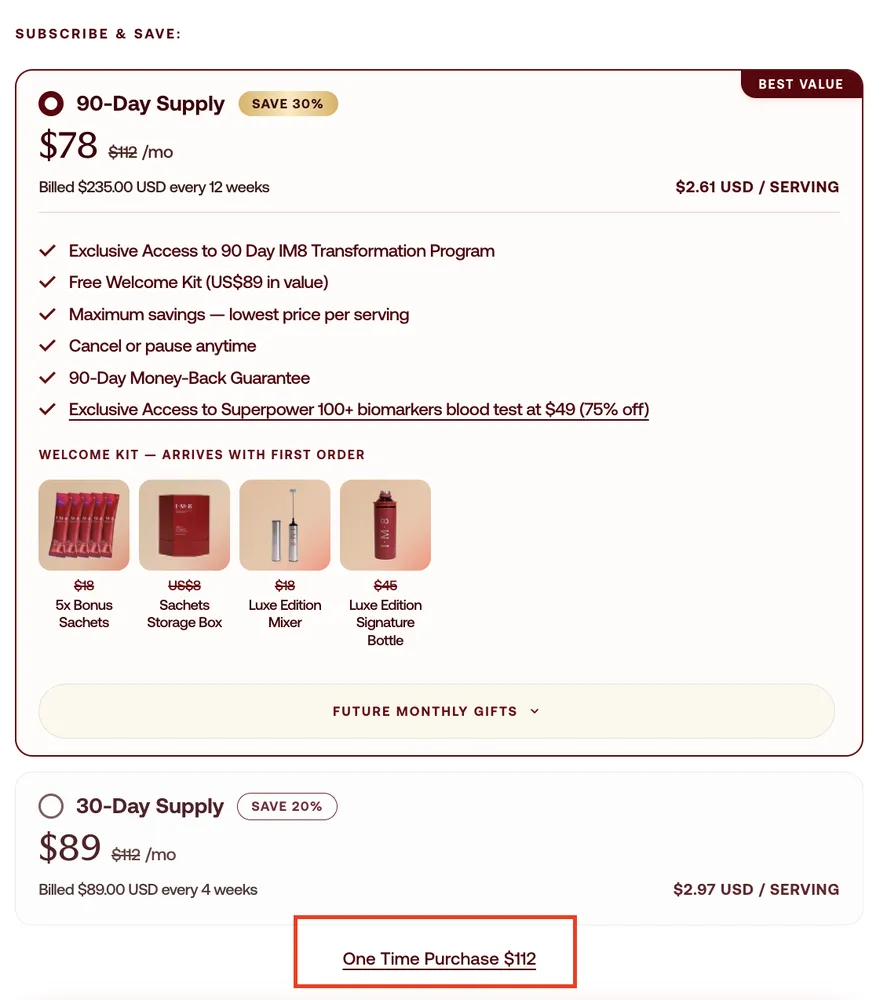
IM8 converts 79% of new customers to subscription on the first order. Most health brands treat 40 to 50% as a win. The full set of fixes for that number lives in subscription take rate.
One caution from our own work. Never remove the one-time option to force the switch. One of our brands tried it, and take rate went from 42 to 58%. I was happy for about a day. Then the rest came in. Conversion fell from 6% to under 4%. About 9 one-time buyers left for every 1 who switched. Move them with the price gap and with gifts kept for subscribers, and leave the door open.
One flat percentage on every size is the common mistake
Most brands we see look like this. 15% off on subscription, on every size. So one pack gets 15% and three packs also get 15%. Nobody has a reason to commit for longer.
Native does this. Subscribe and save is 25% on a $14 deodorant, and the frequency dropdown says save 25% at 1 month, 2 months, 3 months, all the way to 6.
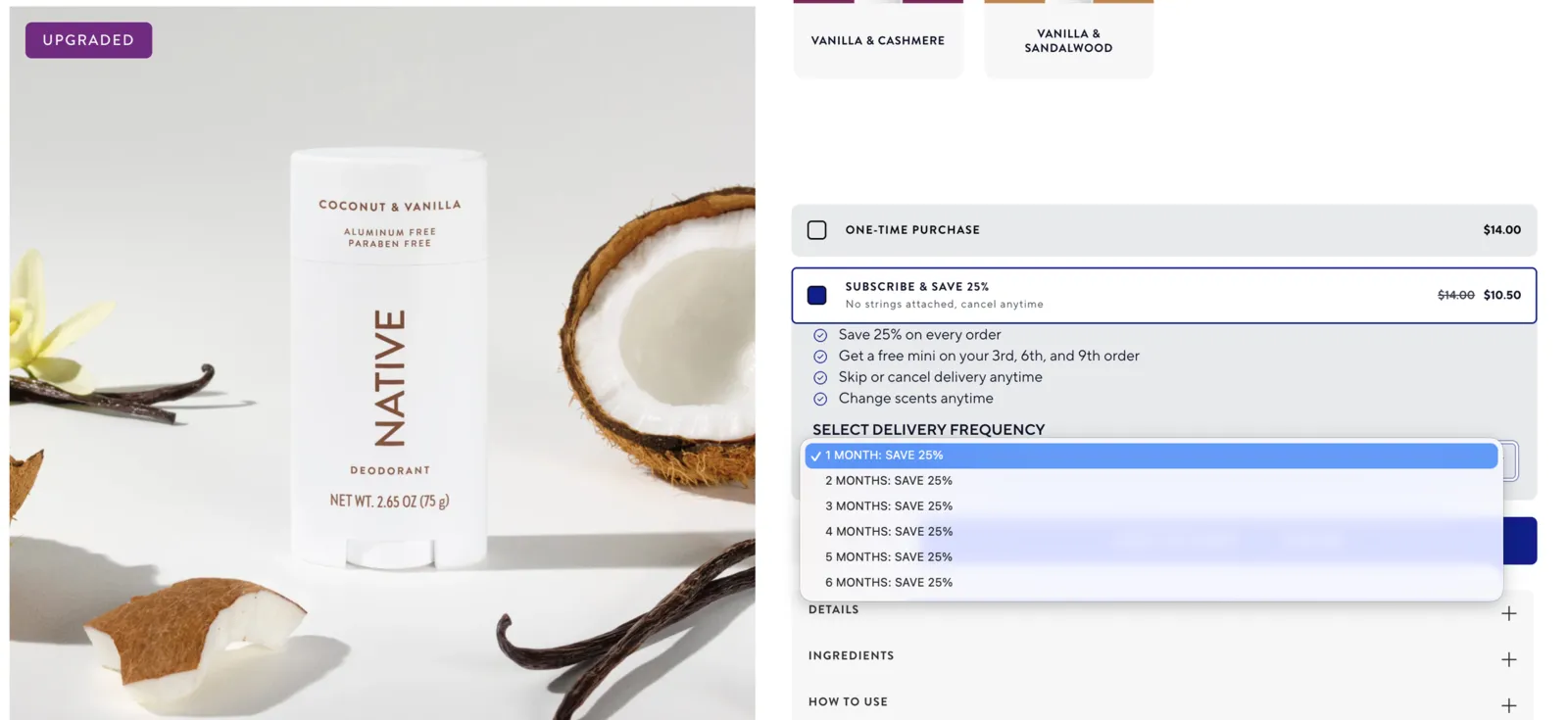
To be fair, Native adds a free mini on the 3rd, 6th and 9th order, which is a good move. The discount itself does nothing for the longer term.
Now look at Cured. 20% off the 30 count, 28% on the 60, 30% on the 90, with the price per serving under each one. Plus a free gift. Much better.
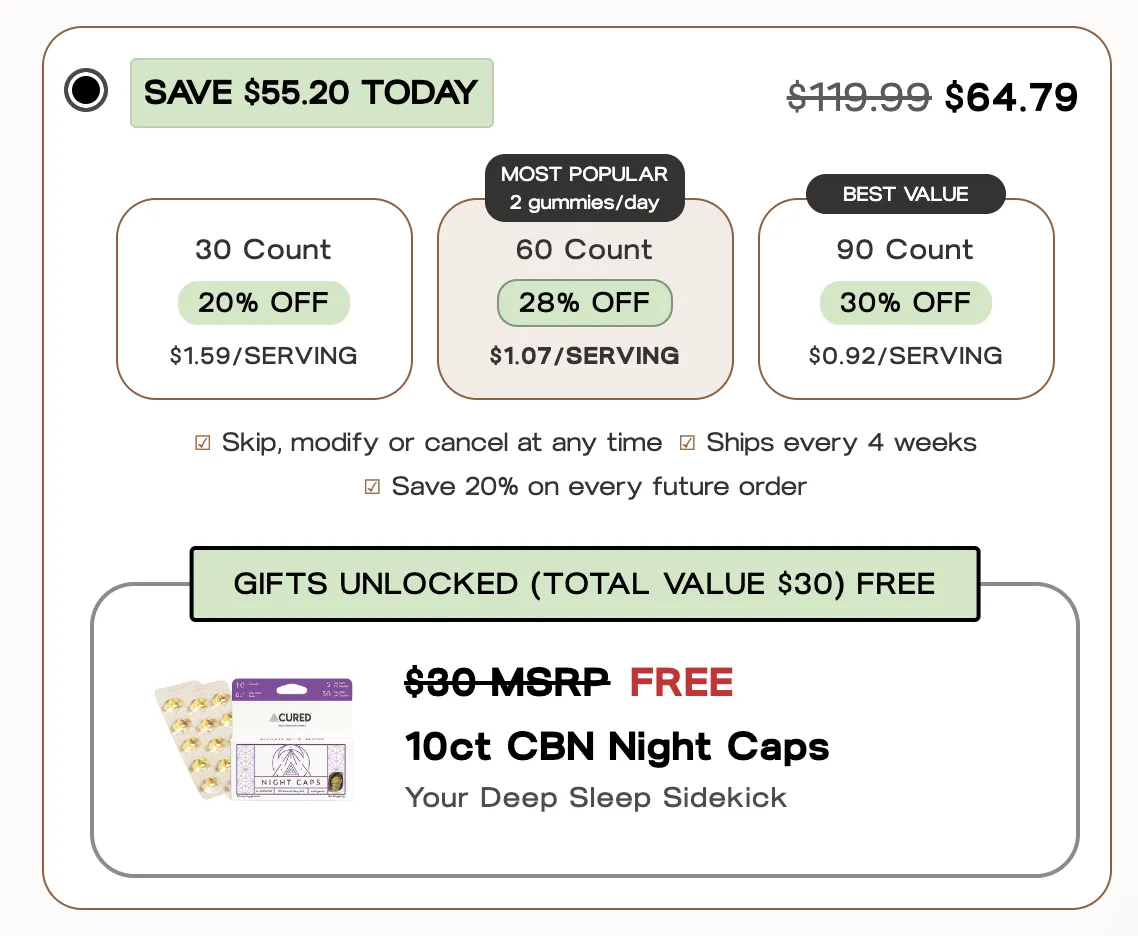
Skio says the same in its volume discount guide: a flat 15% is table stakes. Their example is 10% off a 3-pack and 18% off a 6-pack. That averages out close to a flat 15%, but it pulls people toward the bigger order.
So keep the evergreen rate the same for the base plan, then let volume and term earn more. If more products go on one subscription, that is a bundle discount, and the rule there is simple: the bundle should never beat your longest term. More on that in subscription bundles.
Say free, not a percentage
Thomas Lalas put it plainly on a podcast: "Every time I've tested a dollar amount versus a discount amount versus free, free every single time wins."
So do the maths and rename it. 33% off on 90 servings is 30 free servings.
- Say "1 bag free" instead of 33% off a 3-bag plan
- Say "2 weeks free" on a smaller plan
- For an annual plan, say "3 months free"
Same discount. It reads bigger. In his testing it hurt neither conversion nor retention down the line. Recharge has started letting brands set the subscribe and save discount as a fixed dollar amount, if you want to test that version too.
And on a low ticket, a percentage barely registers. On a $50 item, 10% is five dollars, and nobody subscribes for five dollars. It is easy to walk away from a five dollar discount. It is tough to walk away from a free gift. That is the job of subscription perks and welcome kits: load the offer with gifts instead of pushing the percentage up.
Keep one price after the first order
I am not a big fan of the first-month subscription discount. It increases churn. People miss the renewal amount.
Everyday Dose shows how it looks at checkout. 60 servings with a starter kit, $49 today. The recurring line underneath says $66 every 30 days. Plenty of people read the first number and never see the second.
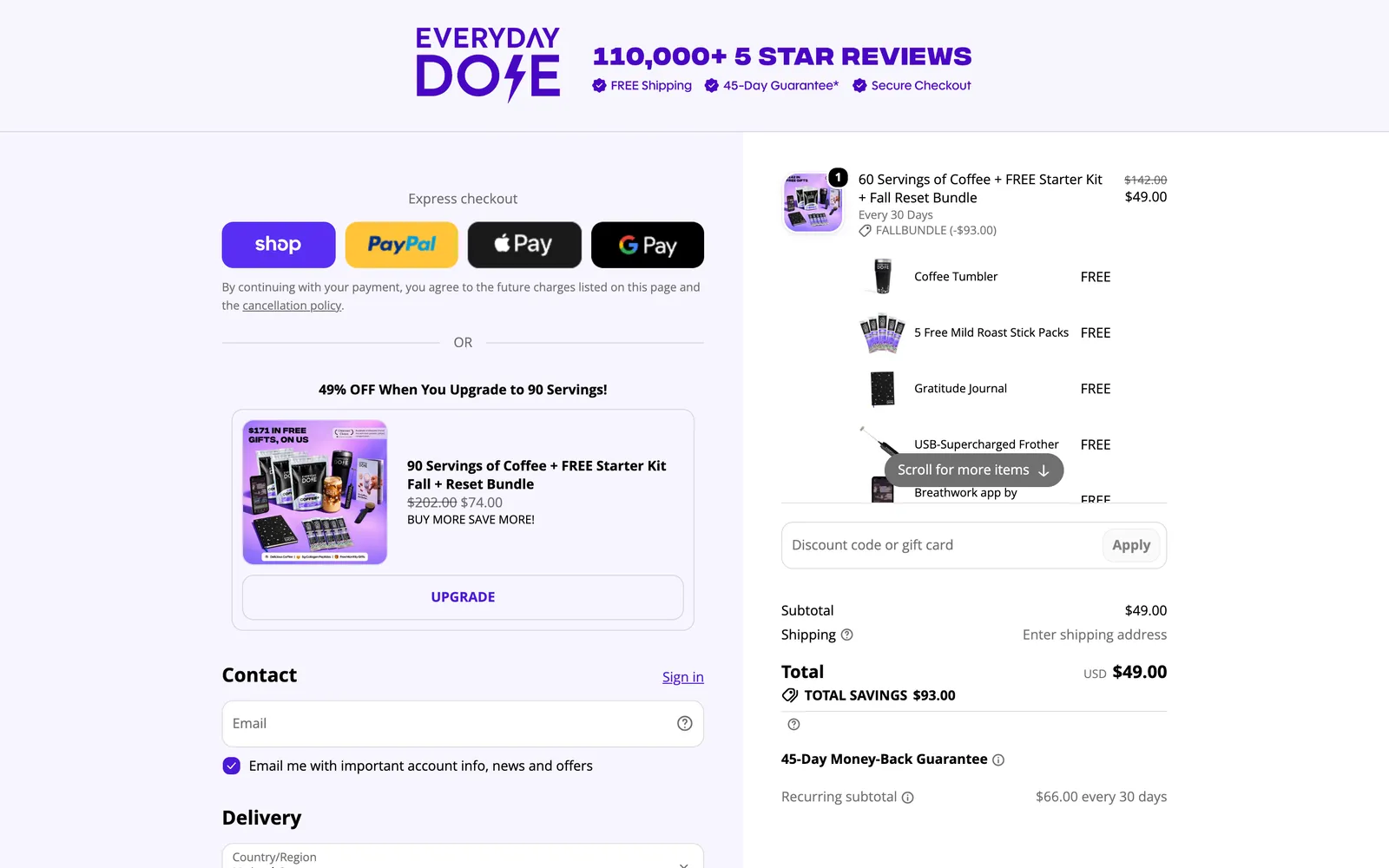
Reformed, Space Goods and DIRTEA keep one price, and they give the welcome value as gifts. If you do want a bigger first-order hook, read first-order offers before you set it.
Use the same rate everywhere the customer sees it
The customer sees your popup, ads, emails and Amazon listing too. If the popup says 20%, the ad says 25% and the widget says 15%, the customer takes the biggest number as the real price. Then the widget looks like a downgrade. One of our brands stated 20%, 30%, 64%, 15% and 35% across its pages, for one 20% saving.
So pick one evergreen rate. Repeat it. The 10% Amazon-safe floor exists for exactly this reason, so you never undercut your own Amazon price on the site. And keep it to one discount per order. Eightx, a finance firm for DTC brands, puts it well: a subscription discount stacked on a bundle discount and a sitewide promo is what breaks margin. Stacked codes on existing subscribers are covered in the subscriber discount leak.
One more link in the chain. Save offers in the cancel flow have to be equal to or higher than the best offer the subscriber has already seen. If your evergreen rate is 15%, a 10% save offer has no pull. The ladder for that sits in cancel flow offers.
How to pick your number
- Sell on Amazon? Start at 10% and use gifts to make the subscription worth more.
- No Amazon, normal margin? 15% off the one-time price.
- Take rate stuck under 40% and margin to spare? Raise the one-time price and shipping first, then try 20%.
- Tempted by 25% or 30%? Look at how many subscribers you lose before order 2. That is the cost.
Then wait. Judge it on the cohort, not on the first week. Acquisition reports instantly. Retention reports in 60 to 90 days.
If you want the discount, the term ladder, the widget and the save offers set together and built in Recharge, Skio, Stay AI or Loop, that is the Subscription LTV Maximizer™: offer, widget, cancel flow, portal, payment recovery, pause and skip, plus email and SMS, live in 30 days for $5,000. If you only want to see where your current offer leaks, the free subscription audit checks 48 points and sends your top 3 leaks in 24 hours.
FAQ
What is subscribe and save?
Subscribe and save is an offer where the customer signs up for repeat deliveries and pays less than the one-time price on every order. Most brands set it at 10 to 20% off. The customer gets a lower price and never runs out mid-routine. The brand gets a repeat order it can plan for. Apps like Recharge, Skio, Stay AI and Loop run it, and let subscribers skip, pause or cancel from a portal.
What is a good subscribe and save discount?
15% off the one-time price is the right default for most brands. Drop to 10% if you sell on Amazon and cannot undercut Amazon pricing. Go to 20% only when moving one-time buyers onto subscription is the main goal and the margin holds. Above 20%, you attract price-sensitive buyers who tend to cancel at the first renewal, so the extra take rate costs you later.
Is 30% off too much for a subscription discount?
Yes, for a standard monthly plan. At 30% off, a $100 order saves $30, which makes subscribing to buy once and cancel the smart move for the customer. A deeper rate can make sense on a 3-month prepaid plan, because there the discount buys a real commitment. On the monthly plan, keep it at 20% or below and add gifts instead.
Should I show the discount as a percentage or as free product?
Free product usually wins. Thomas Lalas found that in his testing "free" beat both a dollar amount and a percentage every time. So 33% off a 90-serving plan becomes 30 servings free, and an annual plan becomes 3 months free. The cost to you is the same and the offer reads bigger.
One email a week on subscription retention: the numbers, the strategy, and what to fix first.

Rahi Jain
Rahi Jain is a subscription LTV specialist who helps $1M to $10M DTC brands reduce subscription churn and maximize LTV on Recharge, Skio, Stay AI and Loop.
More about Rahi