Key takeaways
- 15% off the one-time price is the default subscription discount. 10% if you sell on Amazon, 20% only as a push.
- In one supplement brand we audited, 68% of quarterly subscribers were still active at day 95, against 54% on monthly.
- In Recharge data, a $0 first order reaches order 2 at 25.6%, against 61.2% across all subscriptions.
Pricing is never easy.
Add subscription on top of it. And rewards. And cancellation offers. And AOV offers. So most founders cannot say for sure why and how they price.
After working with 80+ subscription brands, one thing I can tell you for sure: your offer can make or break your subscription program. IM8 moved new customers onto a three-month plan, and new customer order value went from $110 to $240. Grüns sells to the whole household to increase its AOV. One of our clients took first-to-third order retention from 61% to 73%. None of them changed the product.
Most brands we see run the same offer. 15% off every size, 10% off the first order, nothing for bundles, no gifts, and 10% off to save a cancel. And even when there is a gift or a discount, nobody knows about it.
So this guide walks the offer one decision at a time: what you sell and at what price. Each section gives you the rule and links to the article that goes further.
What a subscription offer is made of
Subscribe and save is the simplest subscription offer there is. The customer agrees to repeat deliveries, and pays less than the one-time price on every order. The only question is how much less.
But a full subscription offer is every price, gift and save offer you run, decided together. Three parts to the puzzle: acquisition, retention, and recovery. All three are separate problems. They need separate tools.
Trouble starts when each piece gets decided on its own. Then the bundle beats your three-month plan. Or the cancel offer is smaller than a gift they already got.
So we built Subscription Offer Engineering. It is a set of rules, always applied in the same order, because each one sets the limit for the next.
| Rule | What it decides | Where it lives |
|---|---|---|
| Rule 0 | Usage, quantity and billing line up | Frequency and plan length |
| Rule 1 | The evergreen discount, subscription against one-time | Discount, perks, widget |
| Rule 2 | Milestone offers tied to order number | Rewards |
| Rule 3 | Special cases: save offers, bulk at acquisition, first orders, seasonal offers | Prepaid, first-order offer, cancel flow |
| Rule 4 | AOV: one hero bundle, plus add-ons | Bundles and build-a-box |
Offer engineering is easily the highest ROI activity you can do. It is the first thing we fix. I broke the framework down in a video, step by step.

The evergreen discount: 15% is the default
Should it be 10%, 20% or 30%? Every founder asks this one first.
And it matters more than it looks. The discount on the widget sets the expectation for the whole relationship. Go too low and there is no reason to subscribe. Go too high and you attract buyers who came for the deal, not the product.
| Discount | When to use it |
|---|---|
| 10% | Amazon-safe floor. You sell on Amazon and cannot undercut it |
| 15% | Standard default for most brands |
| 20% | Subscription push only |
| 20%+ | Avoid. You attract price-sensitive buyers who churn at first renewal |
The evergreen discount applies at the product level. Same percentage whatever bottle size or frequency the subscriber picks, and its one job is to make one-time the worse deal. Then let volume and term earn more. Skio calls a flat 15% table stakes, and its example is 10% off a 3-pack and 18% off a 6-pack. Close to 15% on average, but it pulls people to the bigger order. Below 10% people still subscribe, by the way. Ordergroove says even 5% can lift enrolment by as much as 104%. Their number. Read it as a ceiling.
Above 20%, the economics break. On a $100 ticket, 30% off is $30. Paying full price starts to feel stupid. So he subscribes to buy once and cancel once. Across the brands we work with, 10 to 20% of subscribers do this. You stop selling a subscription and sell a coupon with extra steps.
Raise the one-time price instead
There is another way to create the gap. Few founders try it. In one case study from another agency, the brand raised its one-time price and shipping instead of cutting the subscription price. Take rate went from around 25 to 30% up to 57%. Only one side of that gap costs you margin.
Measure the gap against one-time, never the struck-through price. At one of our brands the product page advertised 40% to 64% off MRP. Then we pulled what people actually paid after codes, and subscribers were paying slightly more on average than one-time buyers. There was no subscription incentive at all. Only a label.
Three more rules. Say free instead of a percentage, because 33% off on 90 servings is 30 free servings and "free every single time wins", as Thomas Lalas puts it. Keep one price after the first order. And use the same rate on the widget, the popup, the ads and Amazon. If the popup says 20% and the widget says 15%, the widget looks like a downgrade.
The bands and how to pick your number are in how much to discount a subscription.
Frequency: units per container divided by daily dose
Under the discount sits Rule 0. In almost every audit we run, one mistake shows up. The billing frequency does not match the consumption rate.
You are charging before the container is empty. Or not sending enough. Both hurt.
The maths takes a minute. Units per container divided by daily dose gives the days to finish. 30 servings at one a day gives you a 30-day window, and that number is your minimum billing frequency. Three things have to line up: usage, quantity and billing. Lalas said it plainly: no matter how good the retention system or the onboarding is, people will churn just because the offer is not aligned.
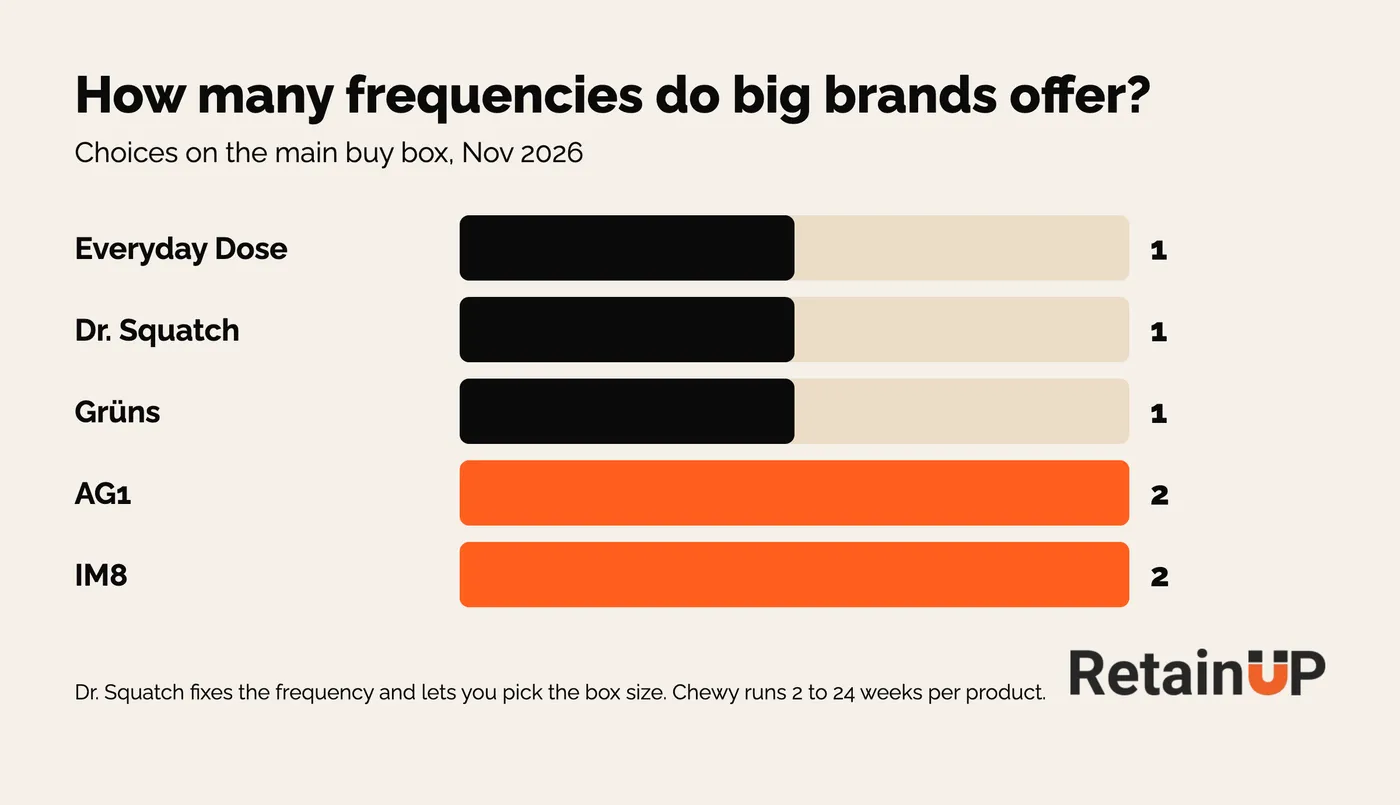
Take Everyday Dose. One option, 60 servings monthly, for a coffee people drink 1 to 4 times a day. Two cups a day runs out on day 30. One cup still has a month left when the next bag lands. Both show up as churn at order 2 and 3. And it gets blamed on onboarding.
Two options, and the default does the work
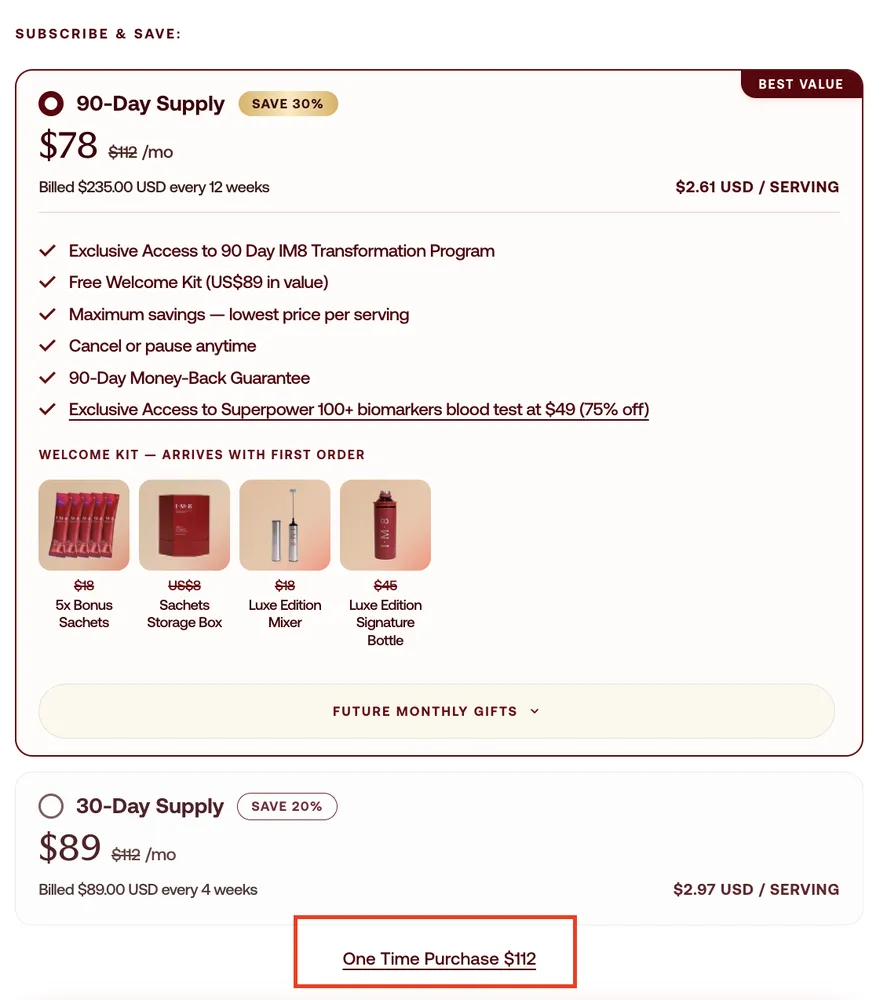
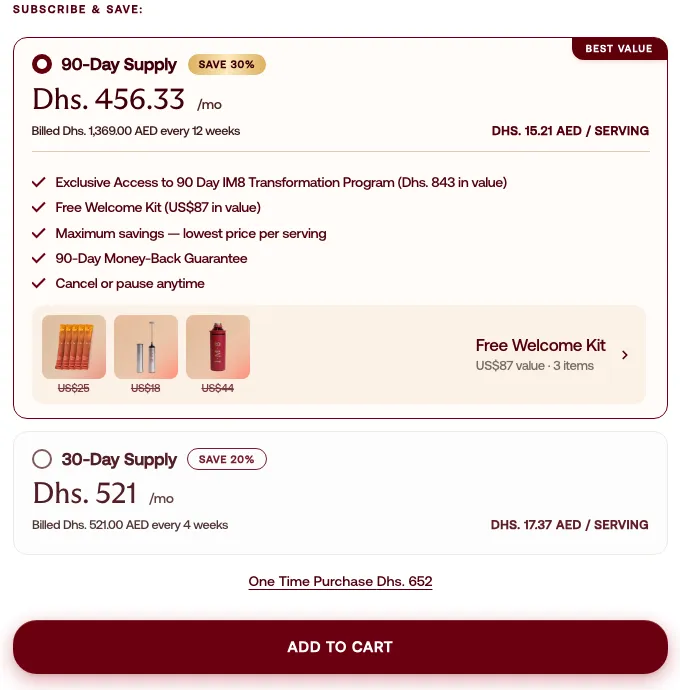
AG1 offers quarterly or monthly. IM8 preselects a 90-day supply at 30% off and puts a 30-day supply underneath. Dr. Squatch ships everything every 3 months and lets you pick 4, 6 or 10 bars.
So the default matters more than the number of options. Most subscribers keep whatever you set. Never go past 2x the consumption window. And when the cancel survey says "too much product", do not send a discount. A discount saves about 1 in 10. A skip or a longer frequency saves about 4 in 10.
The formula table, the 6-point audit and the live widget scores for five brands are in how to set subscription frequency.
Prepaid and longer plans: discount the commitment
A 3-month plan keeps more subscribers than monthly. In almost every set of numbers I have seen, it holds more people at month 3 and month 12.
We audited a supplement brand on Recharge running monthly, quarterly and annual plans side by side. Same product, same funnel.
- Still active at day 95: 68% on quarterly, 54% on monthly.
- Still active at day 365: 21% against 16%.
- Monthly churn: 11.4% on quarterly, 17.5% on monthly.
- Annual was under 1% of plans. Nobody wanted it.
The network numbers point the same way. Recharge looked at 65.1 million subscriptions started between March 2025 and February 2026. 84.2% of monthly plans eventually cancelled, against 67.7% of quarterly and 30.1% of annual.
One warning. The people who pick a longer plan were already more committed, so some of the lift is the plan and some is who chose it. Treat it as the ceiling.
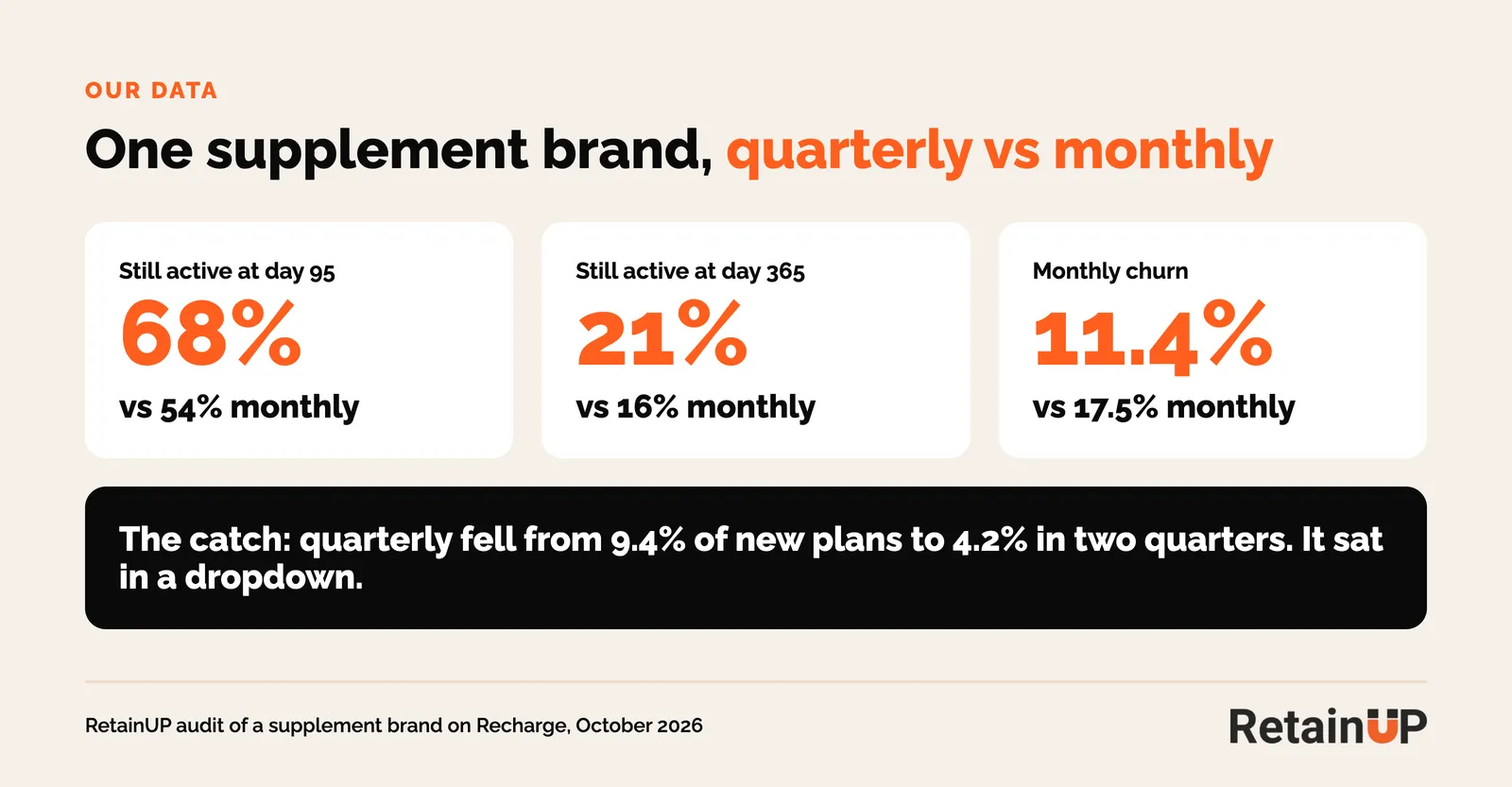
The gap comes from fewer chances to leave. A monthly subscriber decides 12 times a year. A quarterly one, 4 times. Most supplement benefits take 60 to 90 days to feel, but monthly asks for money again at day 30. A 3-month subscriber skips that decision, and the window where most cohorts lose 30 to 40%. You do not need everyone on it either. Getting 10 to 15% of new subscribers onto a 2 or 3 month supply already changes the cohort math.
Price each plan length differently
Give the 3-month plan about 10% on top of your normal subscription discount. Less than that and nobody moves. A worked example: one-time $50, subscription at 15% off is $42.50 a month, and the 3-month plan at another 10% off is $114.75 against $127.50. That is $1.28 a day against $1.42. When Good Protein grew the discount with the plan length, 60% of subscribers picked the longer plan, according to Loop.
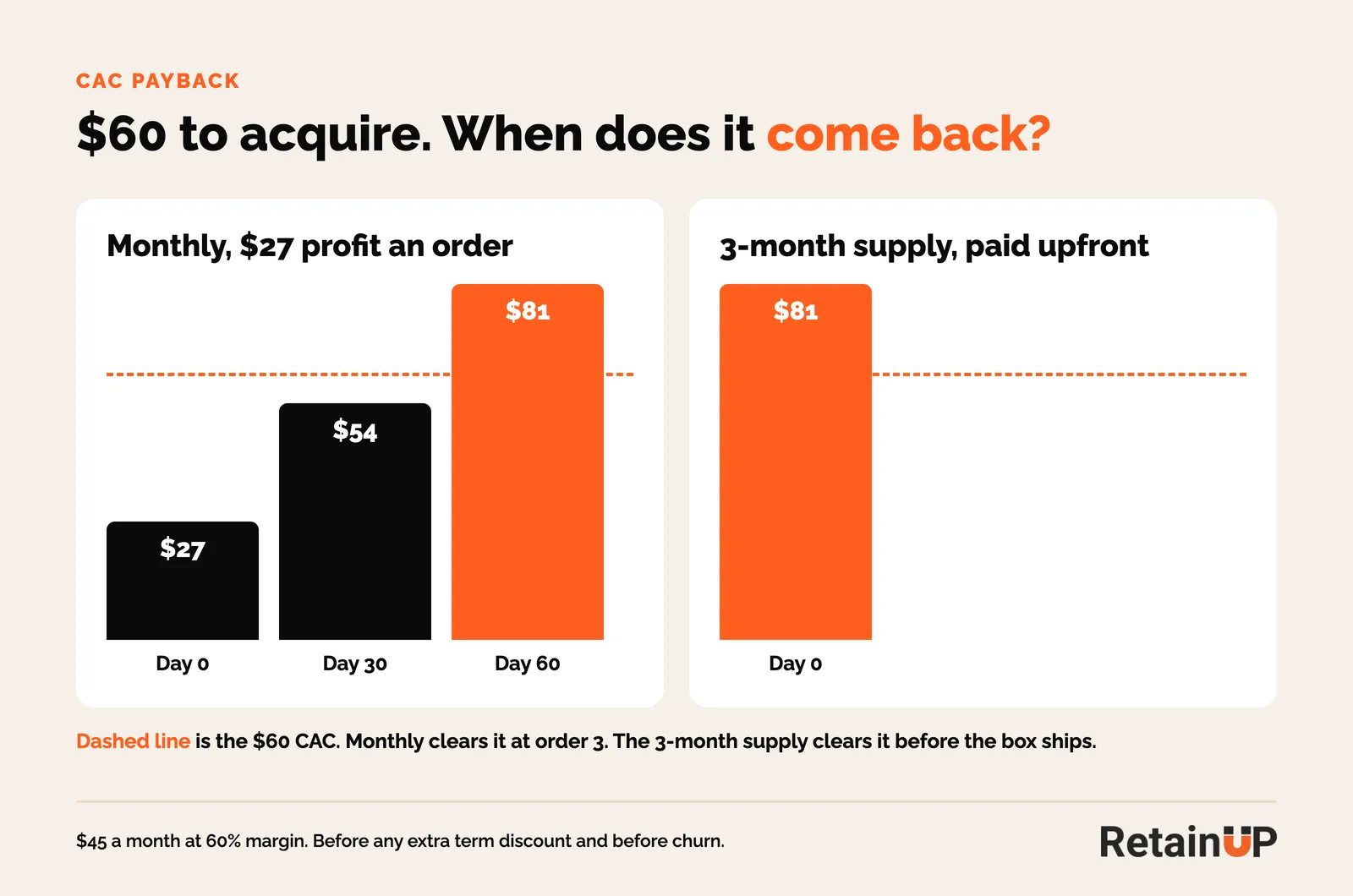
Then there is cash. A $45 a month subscriber at 60% margin brings $27 of gross profit an order. You paid $60 to get them. Monthly pays back at order 3, around day 60. A 3-month supply brings $81 at checkout and is paid back before the box ships.
Every 3-month term ends in one big charge. IM8 collects 97% of its quarterly charges, so 3% fail, each on a $324 charge. Get dunning ready first. And when a 3-month subscriber reaches the cancel flow, offer monthly before any discount. On one supplement brand, that switch was worth $148 more in lifetime value.
The renewal cliff, the auto-renewal rules and the Recharge and Loop setup notes are in prepaid vs monthly subscription.
Perks, gifts and welcome kits: what goes on top of the discount
"Why would I give away product when I am already giving 20% off?" Every founder asks me this on the first call.
Because 20% off is the one offer your competitor can match tomorrow. A gift they can't.
Sleep gummies at 10% off against 20% off is apples to apples. The customer picks 20% in two seconds. Now put 20% off against 15% off plus a free eye mask. Nothing to compare. On a $50 item, 10% is five dollars, and nobody subscribes for five dollars. It is easy to walk away from a five dollar discount. It is tough to walk away from a free gift. Recharge even suggests testing the button itself: "Subscribe & save" against "Subscribe for exclusive perks".
A gift costs less than it looks. One of our clients gives away a mouthwash tablet pack that costs them $1.44. The customer sees $18.70.
The welcome kit, and gifts that grow with the plan
Two rules for the welcome kit. It comes only with subscription, and it stacks on the evergreen rate, so the subscriber gets the 15% and the kit. IM8 puts a US$123 welcome kit on the first order of its quarterly subscription. One-time buyers get none of it.
Then let gifts sell the bigger supply. One month of sleep gummies gets one free gift. Two months gets three. Three months gets five. And show the future gifts on the product page before they buy, with the dollar value next to each, the way IM8 and Everyday Dose do.
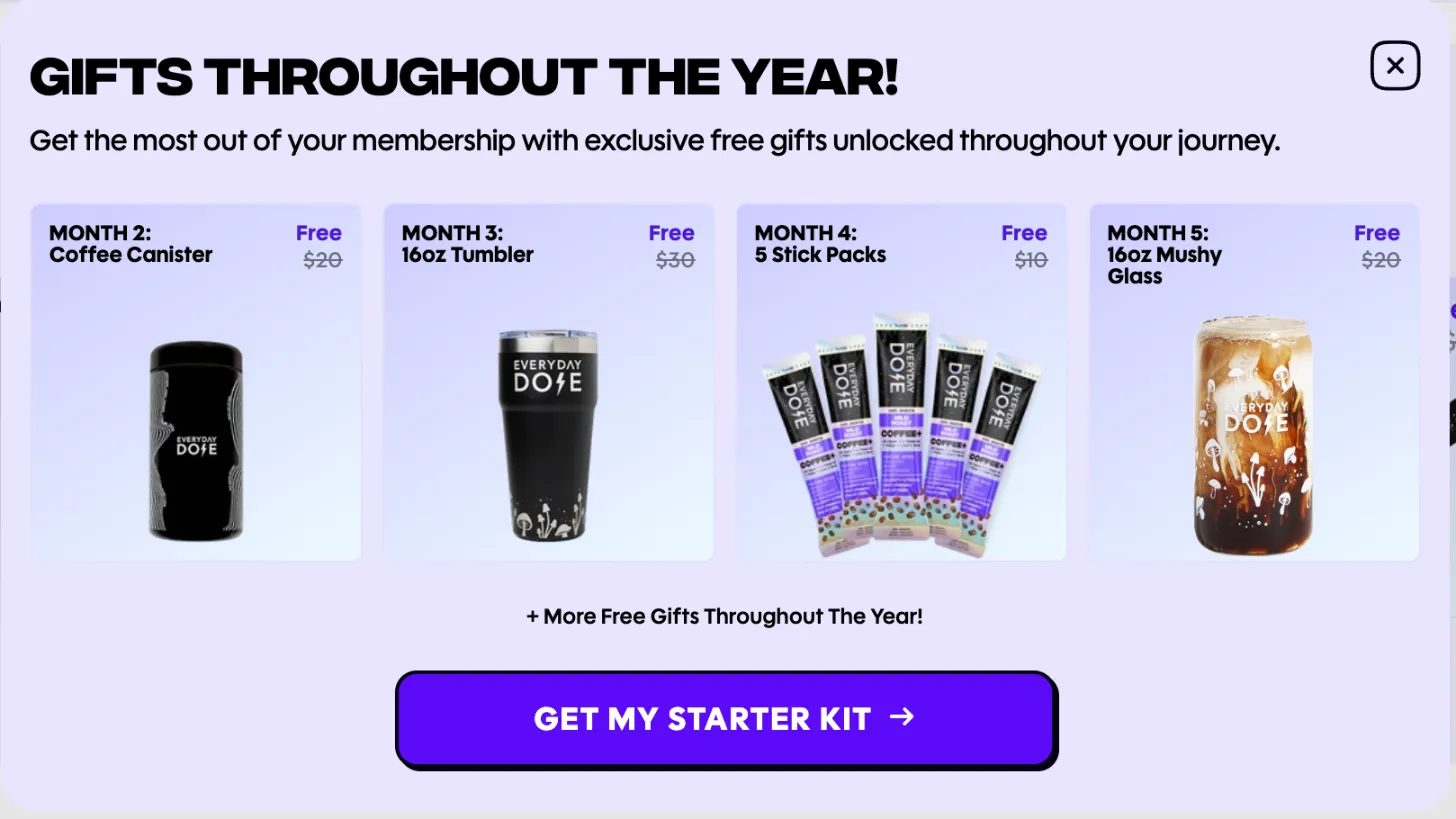
Keep free shipping for subscribers only, and charge it on one-time. A benefit everyone gets cannot be a gift for anyone. Early access works the same way: new launches 2 to 3 days before anyone else. It costs nothing to run. Shopify's list of subscription perks adds priority support and member-only products. Same rule. One-time buyers don't get them.
Make gifts functional, not merchandise. Sleep gummies get an eye mask, a powder gets a scoop, a daily drink gets a shaker. Not a hat. Not a tote. How to price them, and the two ways a welcome kit backfires, are in subscription perks, gifts and welcome kits.
The first-order offer: no $0 starts
The first-order offer is the easiest number in the business to move. Make it bigger and CPA drops. Take rate goes up. Everyone is happy.
And then the cohort comes in.
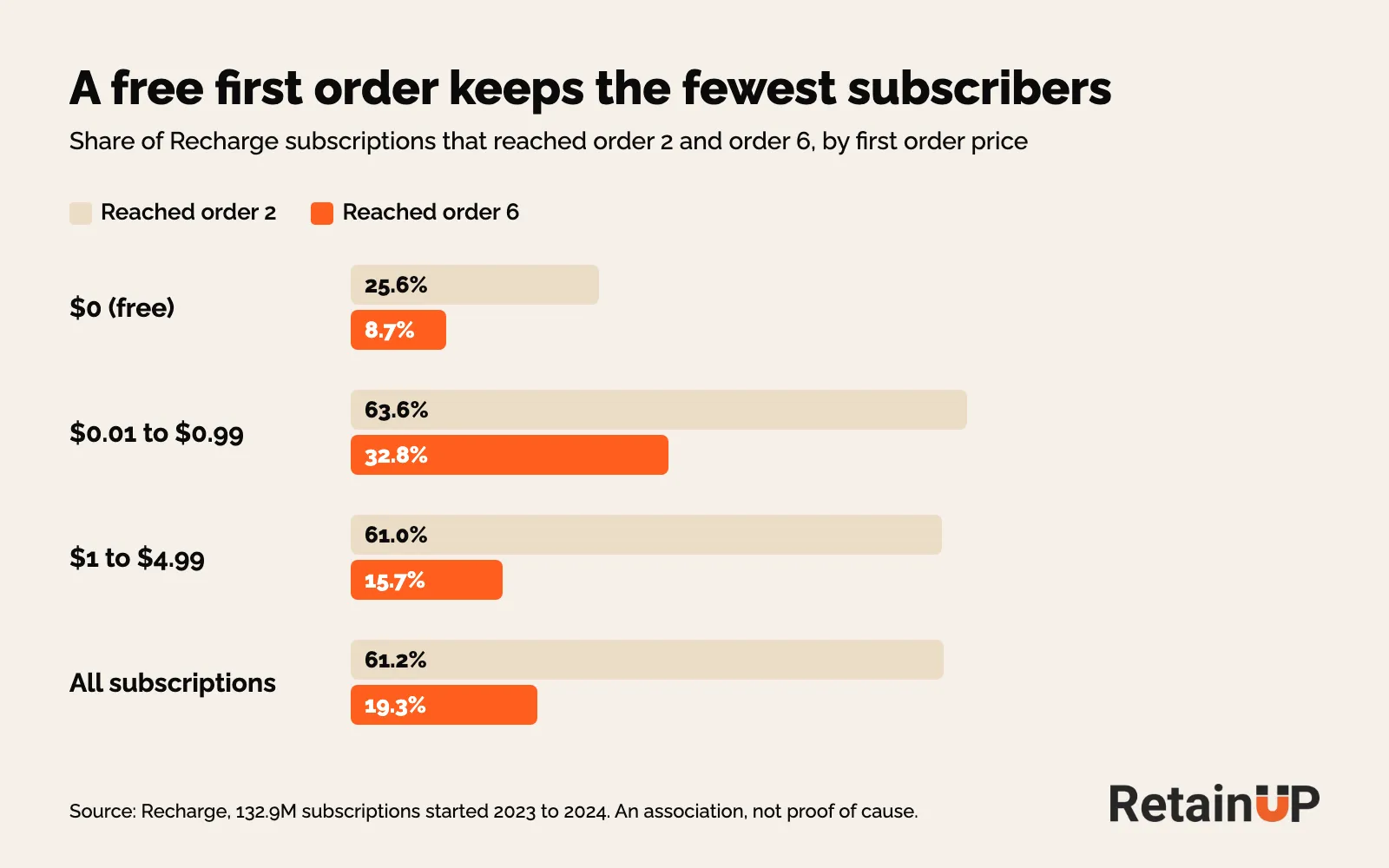
Recharge looked at 132.9M subscriptions started in 2023 and 2024 and split them by what the customer paid for the first order.
| First order price | Reach order 2 | Reach order 6 |
|---|---|---|
| $0 (free) | 25.6% | 8.7% |
| $0.01 to $0.99 | 63.6% | 32.8% |
| All subscriptions | 61.2% | 19.3% |
So free loses three quarters of the cohort before the first real charge. Recharge calls this a strong association, not proof of cause. Still, paying is a decision. A 99-cent order is a purchase. Small, but chosen.
Keep seasonal offers seasonal
A Lalas client, 9-figure brand, ran a seasonal freebie in its acquisition offer. Best campaign in the brand's history. So they made it sitewide. Then the cohort data came in. Retention dropped massively.
"Acquisition reports instantly. Proper retention reports in 60 to 90 days." So judge every offer at order 3.
And put the extra first-order money on orders 2 and 3. Peace Coffee swapped 40% off one order for 26% off each of the first three, per a Loop customer story. Day-zero cancels went from 7.14% of all cancellations to 1.56%. A 78% drop. Same total discount, roughly.
Every main app can price the first order apart from the renewals. In Skio it is a recurring pricing policy with "After cycle" set to 1. In Recharge it is dynamic pricing on the plan. In Ordergroove, an Initial Order Incentive. Test your popup codes on top, because in Skio they stack.
The five rules for reading that cohort, and what to use instead of free, are in first-order offers that keep the cohort.
Bundles and build-a-box: a big order that keeps renewing
First order: $100. Every renewal after that: $40.
I call it the bundle downgrade. The bundle was sold one time only, and the subscription went on a single product. Sell a bundle alone, and you lose the renewals. Sell a subscription alone, and you lose the AOV.
Some products are too small to subscribe to. A $6 bar cannot carry a subscription. A $36 box can. So Dr. Squatch sells a box of 4, 6 or 10 bars, shipped quarterly.
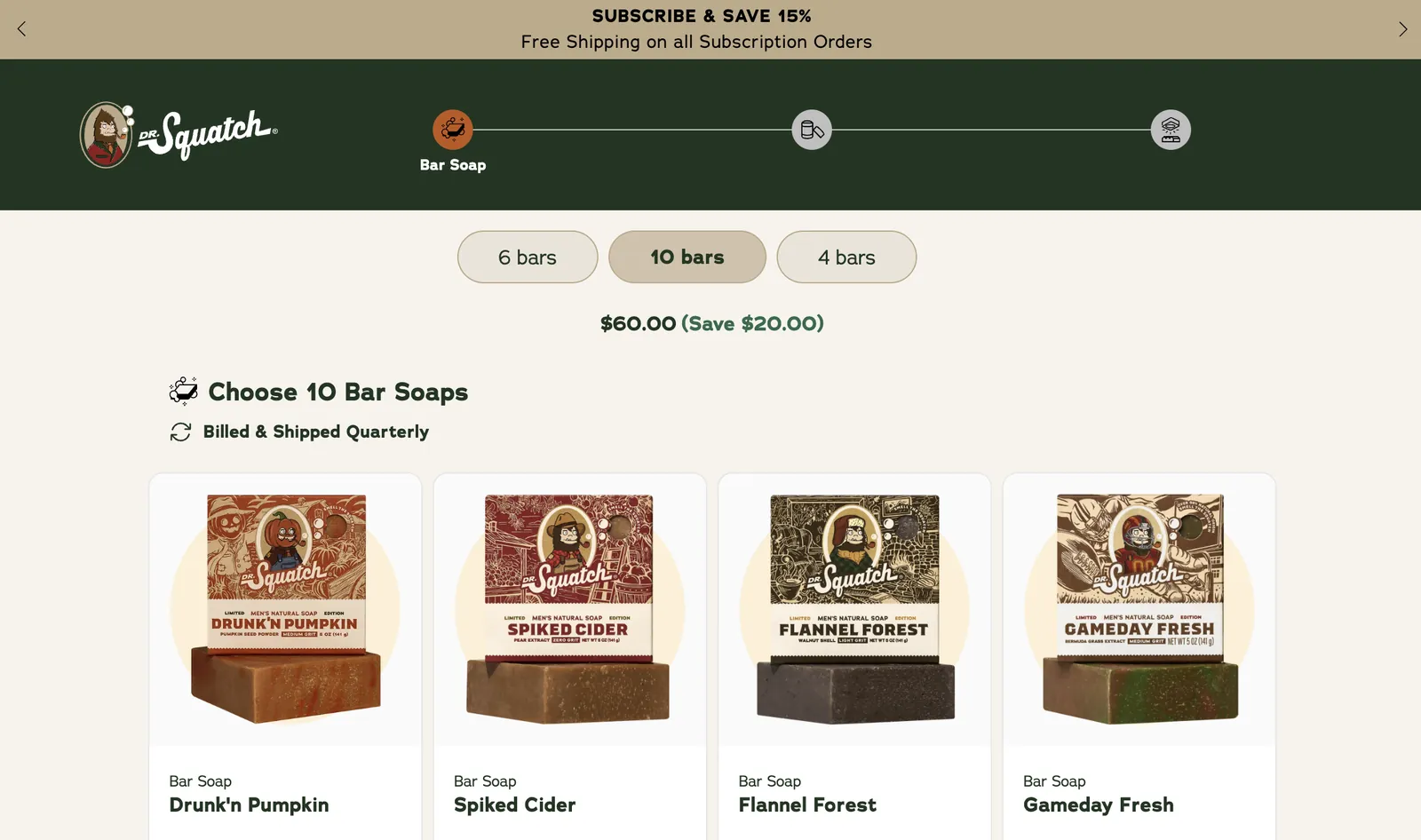
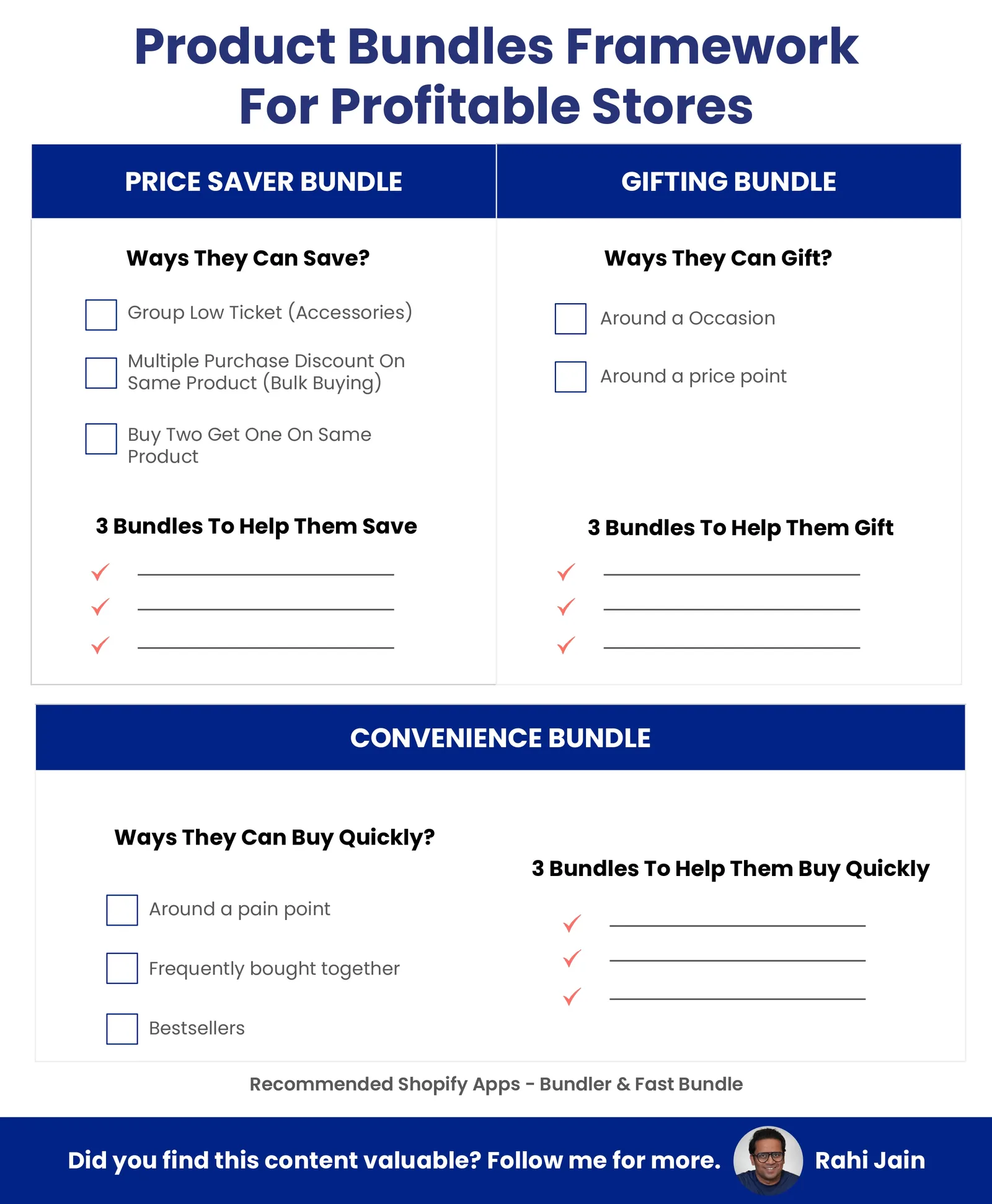
Single-product brands can skip this step. For everyone else, keep bundles on one subscription, never two, and push one hero bundle or one build-a-box. Too many bundles are confusing to run and confusing to sell.
Look at your order items report. Often 10 to 20% of customers already buy two or three items together. They built the bundle for you. Then reward a bigger box with one ladder: 15% off for 3 items, 20% for 5, 25% for 7 or more. And the bundle never beats the three-month term.
Watch the bundles you already sell. At one of our brands, a $118 bundle already sold at 25% off landed near $70 once the 20% subscription discount stacked on top. Unprofitable.
Family subscription pricing works the same way. If two people in the house use it, sell a family pack, and price it per person. One brand showed $64.80 a month for two kids against $36 for one, so adding a kid looked like a price rise. $32.40 per kid made it feel fair. Same money.
Under about 20 SKUs, a static box with fixed sizes is enough, per Skio's build-a-box guide. So start static. The ladder fixes, and the swap limits on an editable box, are in subscription bundles and build-a-box.
How the widget presents the price
The same prices can win or lose on how the widget shows them.
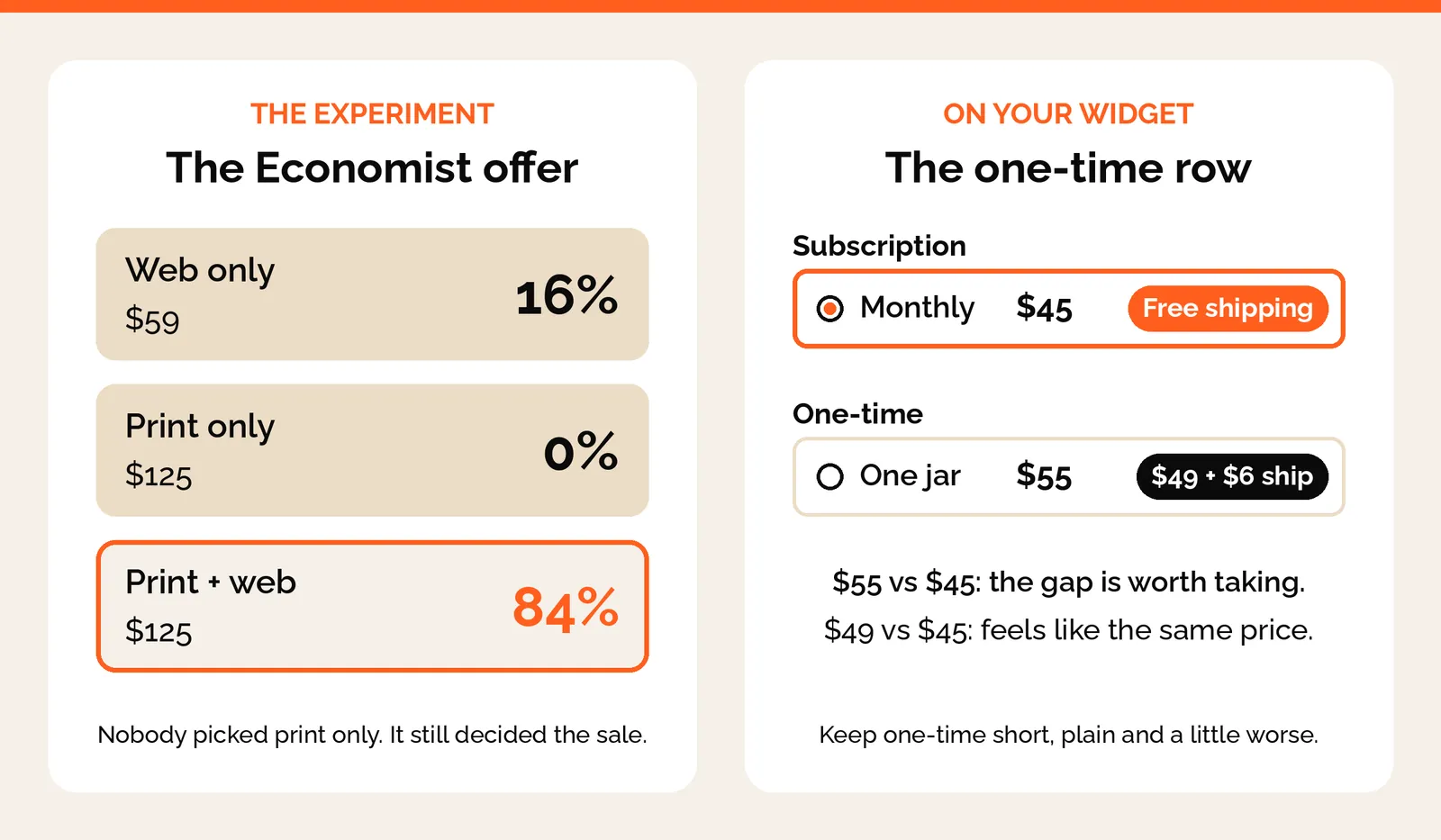
The Economist once sold web only for $59, print only for $125, and print and web for $125. 84 of 100 students picked print and web. Take away print only, and just 32 did. Print only was never there to sell.
Your one-time price works the same way. It is there so the subscription looks like the obvious deal. One brand we work with wanted to drop the $6 shipping on one-time. We kept it. With shipping, one-time is $55 against $45 on subscription. Without it, $49 against $45 feels the same. So why commit?
- Fewer choices. With 24 jams on a tasting table, 3% of people bought. With 6 jams, 30% bought. Keep it to three subscription options and one one-time, at most.
- The default. Pre-select subscription. IM8 made quarterly its default, and its Jan 2026 cohort reached $587 by order 4. Put the frequency and price right next to it, or you will see "I didn't know I signed up" in your reviews. Skio's checklist goes further: what they pay today, what they pay next, and when. And add one line under the plan, "Pause, skip or cancel anytime", which Loop also recommends.
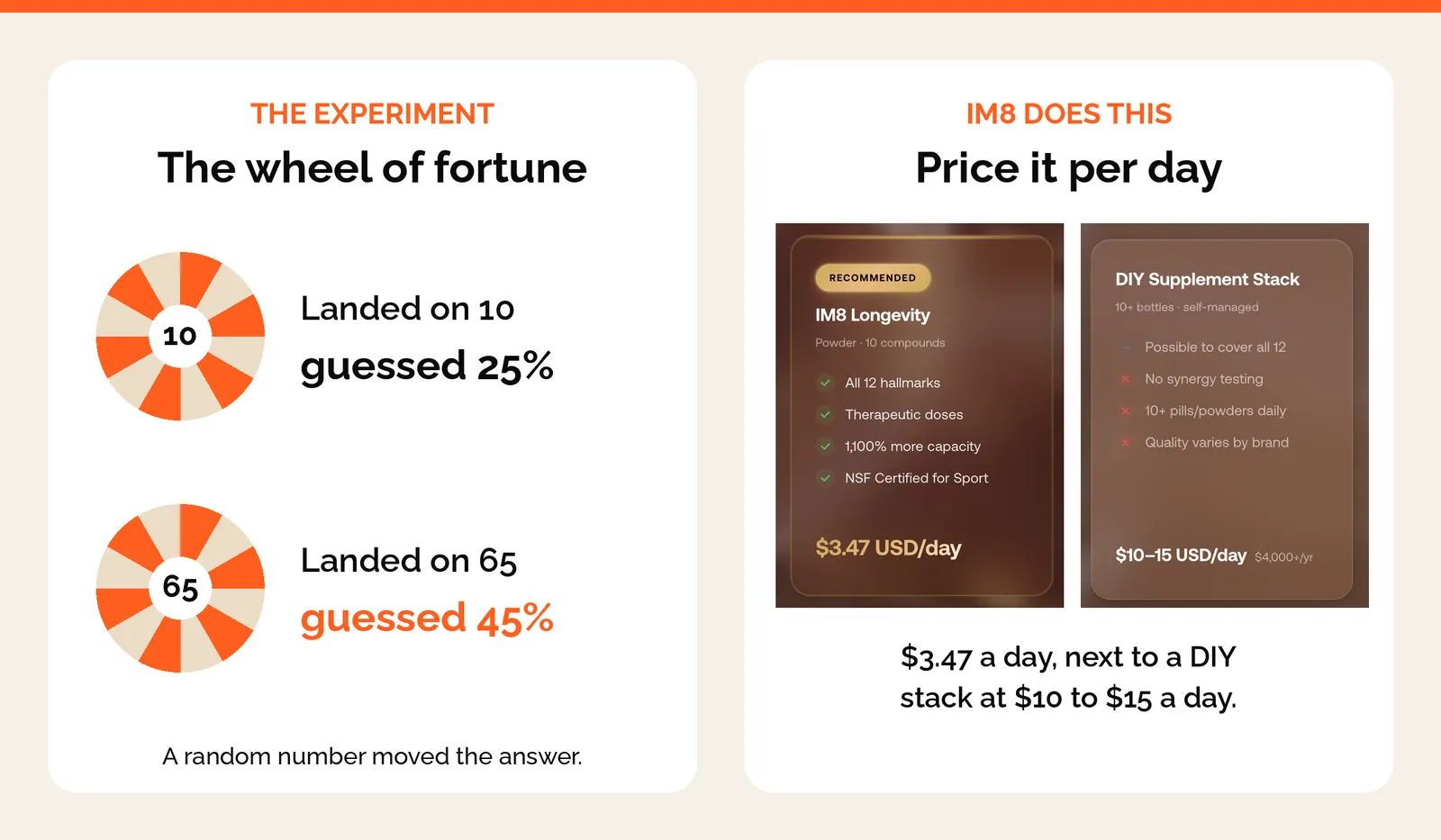
- The anchor. Show the biggest pack first. Then break the price down to a day. $90 a month looks expensive. $3 a day does not.
- The frame. "3 months" sounds like a contract. "3 months supply" sounds like a box arriving at your door.
The studies and the widget fixes are in subscription offer psychology, and the row-by-row layout sits in the subscription widget guide.
Pick the model before the offer
Every subscription program starts with one call. What is the customer actually signing up for?
Three answers. The same product on a schedule. A box someone else picks. Or a paid membership with better prices on everything. Pick wrong and every other decision on this page gets harder.
If you sell supplements, coffee, skincare, pet food or anything else that runs out, start with replenishment. Curation needs a new product every month. Membership needs a catalog big enough for the fee to pay off. And you do not need every SKU on subscription. Recharge's launch guide says start with one or two products that run out.
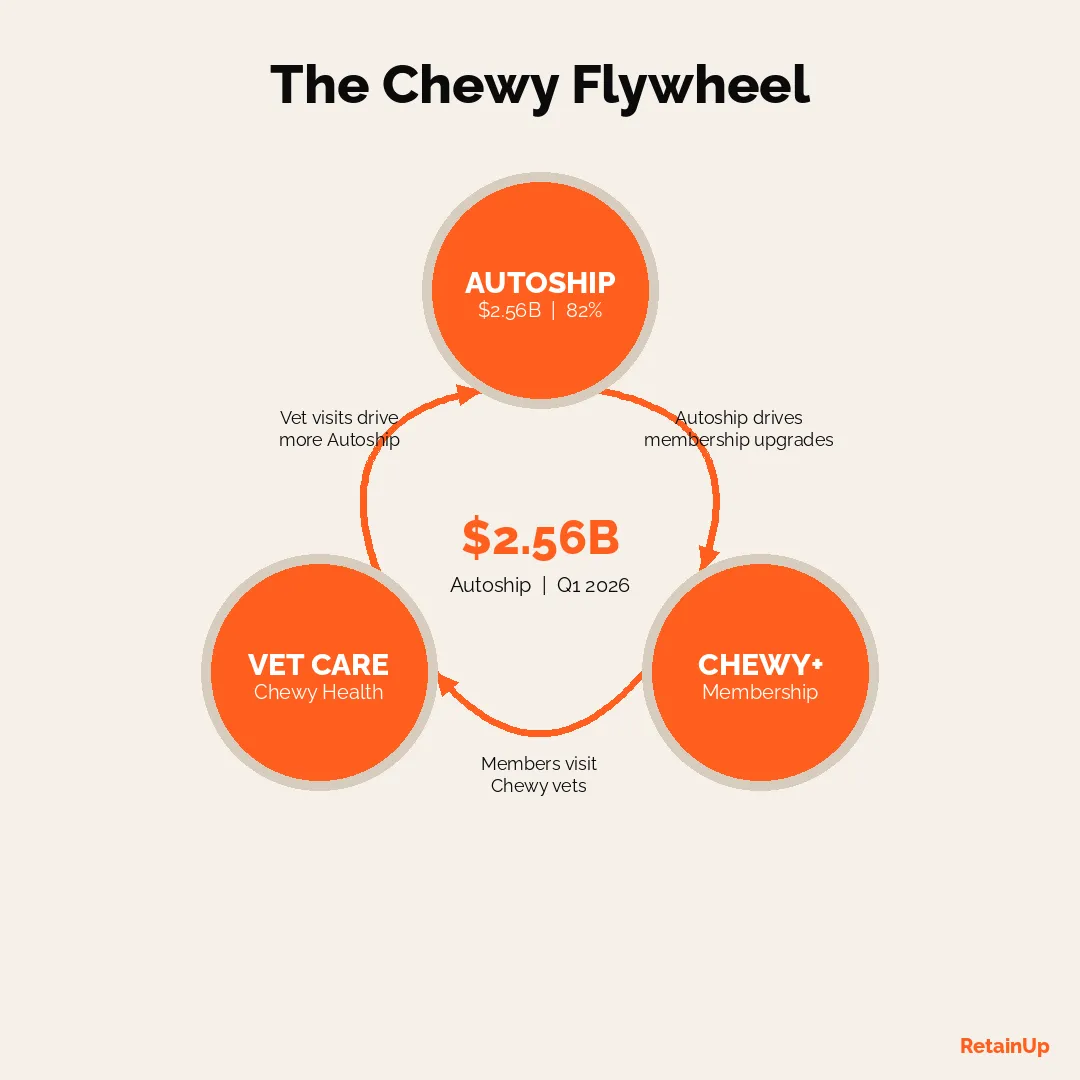
Costco renews 93% of its memberships with a $1.50 hot dog and gas that saves members $300 or more a year. So the $65 fee feels like a bargain. Chewy runs both models. Autoship builds the habit, and Chewy+ at $79 a year sits on top. Each layer has one job.
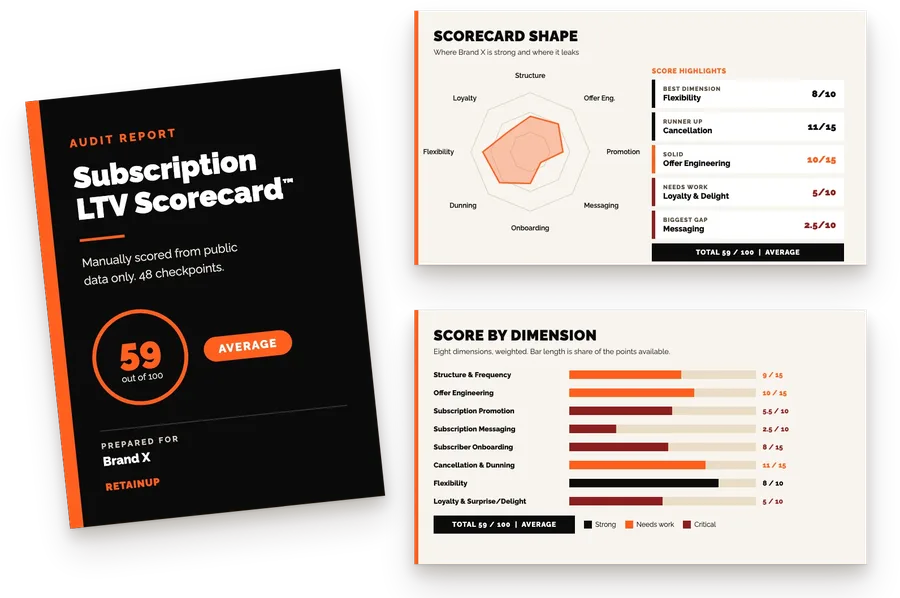
Savage X Fenty auto-added a membership at checkout, got sued in California, and scores 27/80 on our scorecard. The three models and how to pick yours are in subscription models: replenishment, curation and membership.
Milestones and save offers: set them against the evergreen offer
Rules 2 and 3 run after the subscriber is in, so they live in the retention and churn guides. They still belong on the same sheet, because each is priced against what came before.
Most brands do nothing between acquisition and cancellation. Subscribers drift out in silence. Milestone offers fix that, and the rule is to alternate discount and gift, never two discounts in a row.
| Order | Offer | Why |
|---|---|---|
| 2 | 10% discount | Biggest lapse window |
| 3 | Free gift | Reciprocity, not price |
| 4 and 5 | Nothing | Habit formation needs room |
| 6 | 15% or free product | Loyalty anchor |
| 12 | 20% or free product | Anniversary |
Those order numbers are a starting point. Put milestones where your own cohort drops, usually order two or three. More in subscription rewards and milestone gifts.
Special cases come last. A save offer has to match or beat the best offer the subscriber has already seen. A 10% cancel save on someone who got 10% at order 2 has no pull. So dunning gets 10% max, a regular cancel 10% and a VIP 20%, winback 20% and 30%. Offer pause and skip before any discount. And spread the save, since 20% off the next three orders beats 30% off one.
The full ladder is in cancel flow offers. Black Friday is where most offers break, because one-time gets the best deal of the year, and the fixes are in BFCM for subscription brands.
Put the whole offer on one page
Most brands do not have any of this written down in one place. So start with a sheet. Frequency and why. The widget discount and the 3-month discount. The welcome kit and the gifts. The first-order offer. The bundle. What happens at order 2, 3, 6 and 12. The save offers by regular and VIP. If two lines contradict each other, the subscriber will find it first.
Test one line at a time. Recharge's own test is your current discount against one 5 points higher, for at least two weeks, judged on opt-in rate, revenue and conversion. That tells you about take rate. Then read the result by order, not by date, and give it until order 3. Quarterly subscribers look like churn on a monthly chart. If you want a second pair of eyes, the free subscription audit scores frequency and offer structure on 48 checkpoints and sends your top 3 retention leaks in 24 hours.
If you are deciding who to hire for this, I compared the subscription retention experts and what a subscription retention agency costs.
Every offer in this guide gets built in the Subscription LTV Maximizer™: the offer, PDP widget, cancel flow, customer portal, payment recovery and pause and skip, in Recharge, Skio, Stay AI or Loop, plus email and SMS, live in 30 days for $5,000. The offer comes first, because everything else is set against it.
FAQ
What discount should a subscription get over one-time purchase?
15% off the one-time price is the standard subscription discount for most consumable brands. 10% is the Amazon-safe floor and 20% is for a subscription push only. Above that you attract price-sensitive buyers who churn at first renewal, because the price they came in at is one you cannot keep. On a low-ticket item, add a gift instead of pushing the percentage up.
How do I work out the right delivery frequency for my product?
Divide the units in one container by the daily dose, and that gives the days to finish. That number is your minimum billing frequency and your default. A 30-serving pack used once a day gives a 30-day window. Offer two options, three at most, and never ship further apart than twice that window.
Should I offer a 3-month subscription plan?
Yes, if your product is used every day at a fixed dose and results take weeks to show. Give it about 10% on top of your base subscription discount. In one supplement audit, 68% of quarterly subscribers were still active at day 95 against 54% on monthly, though some of that lift comes from who picks the longer plan.
Is a free gift better than a discount for subscribers?
A gift usually holds subscribers better than a deeper discount. A competitor can match 20% off tomorrow, but a gift turns the comparison from apples to apples into apples to oranges. It also costs less than it looks: one gift pack costs a brand $1.44 and reads as $18.70 to the customer.
Should I give new subscribers their first order free?
No. In Recharge data on 132.9M subscriptions, a $0 first order reached order 2 at 25.6%, against 61.2% across all subscriptions. A 99-cent start kept subscribers almost 4x better by order 6. Use a nominal fee, a modest discount or free shipping, and judge the offer by the cohort at order 3.
What save offers work best for replenishment subscriptions?
Pause, skip and a longer frequency work best, and they go before any discount. On "too much product" cancels, a discount saves about 1 in 10 while a skip or a longer frequency saves about 4 in 10. When you do offer money, match or beat the best offer the subscriber has already seen: 10% for a regular cancel, 20% for a VIP, and spread it across the next three orders.
Should I bundle products on one subscription?
Yes, if you sell more than one product. Keep the bundle on one subscription, never two, so the big first order keeps renewing. Push one hero bundle or one build-a-box, reward a bigger box with one discount ladder, and never let the bundle discount beat your three-month term.
One email a week on subscription retention: the numbers, the strategy, and what to fix first.

Rahi Jain
Rahi Jain is a subscription LTV specialist who helps $1M to $10M DTC brands reduce subscription churn and maximize LTV on Recharge, Skio, Stay AI and Loop.
More about Rahi