Key takeaways
- In Recharge data, a $0 first order reaches order 2 at 25.6%, against 61.2% across all subscriptions.
- A 99-cent start keeps subscribers almost 4x better than a free one by order 6 (32.8% vs 8.7%).
- Acquisition reports on day 0. Judge a first-order offer by its cohort at order 3, 60 to 90 days later.
The first-order offer is the easiest number in the business to move. Make it bigger and CPA drops. Take rate goes up. Everyone in the meeting is happy.
And then the cohort comes in.
This page covers one rule from Subscription Offer Engineering. What to put on the first order. What never to put there. And how to tell if your offer pulls in subscribers or deal-seekers. The everyday subscribe-and-save rate has its own page. This one is order 1 only.
Why a big first-order offer looks great and still loses money
Acquisition and retention report on different clocks. Thomas Lalas put it in one line: "Acquisition reports instantly. Proper retention reports in 60 to 90 days."
So the ad dashboard tells you the offer worked on the day it goes live. The cohort table only tells you who you actually bought two or three months later. By then the budget is spent. Maybe the offer is sitewide too.
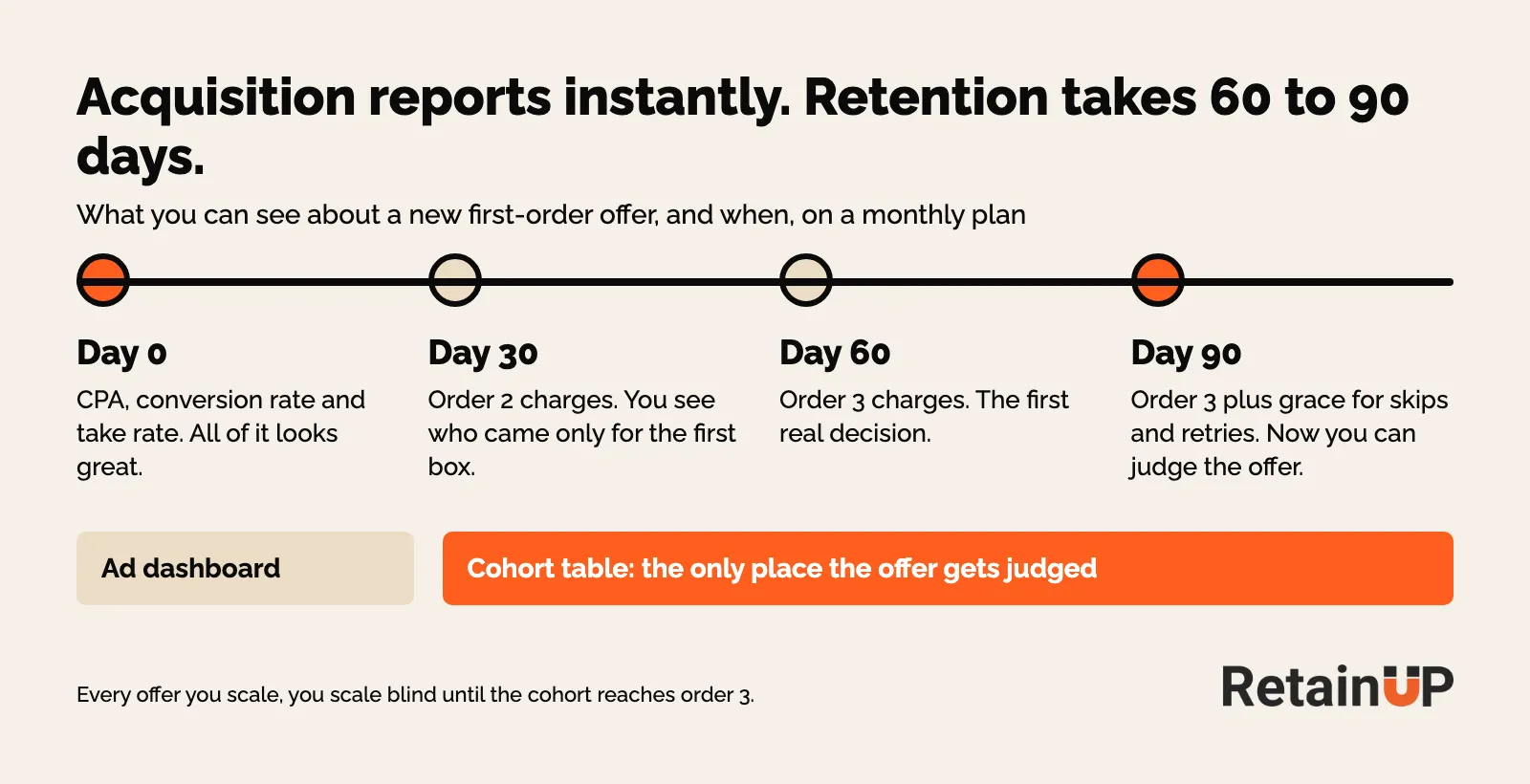
Lalas again: "Every offer you scale, you scale blind. You're committing to a buyer profile months before you find out who you actually attracted." That is the whole problem with first-order offers. The bigger the offer, the more the buyer profile shifts toward people who want the offer, not the product.
A subscription founder showed me his dashboard. 40% subscriber growth. Record signups.
I asked one question. What is your average subscriber LTV? He didn't know. Here is the math he was missing.
$60 to acquire a subscriber. 30% off just to get the yes. First order margin: minus $10. Payback needs 3 orders. And the average subscriber cancels at month 2. That's 2 orders.
So every subscriber who leaves at month 2 is a $20 to $40 loss. Cash you already spent to get them. This is why subscription brands with record growth still run out of cash.
So count the first-order discount as part of your CAC. Eightx makes the same split: 20% to 30% offers are first-order acquisition offers, and the recurring price is a separate number. If the cohort leaves before it pays that discount back, the offer cost more than the ad.
No $0 first orders: what the Recharge data shows
Recharge looked at 132.9M subscriptions started in 2023 and 2024 and split them by what the customer paid for the first order.
| First order price | Reach order 2 | Reach order 6 |
|---|---|---|
| $0 (free) | 25.6% | 8.7% |
| $0.01 to $0.99 | 63.6% | 32.8% |
| $1 to $4.99 | 61.0% | 15.7% |
| All subscriptions | 61.2% | 19.3% |
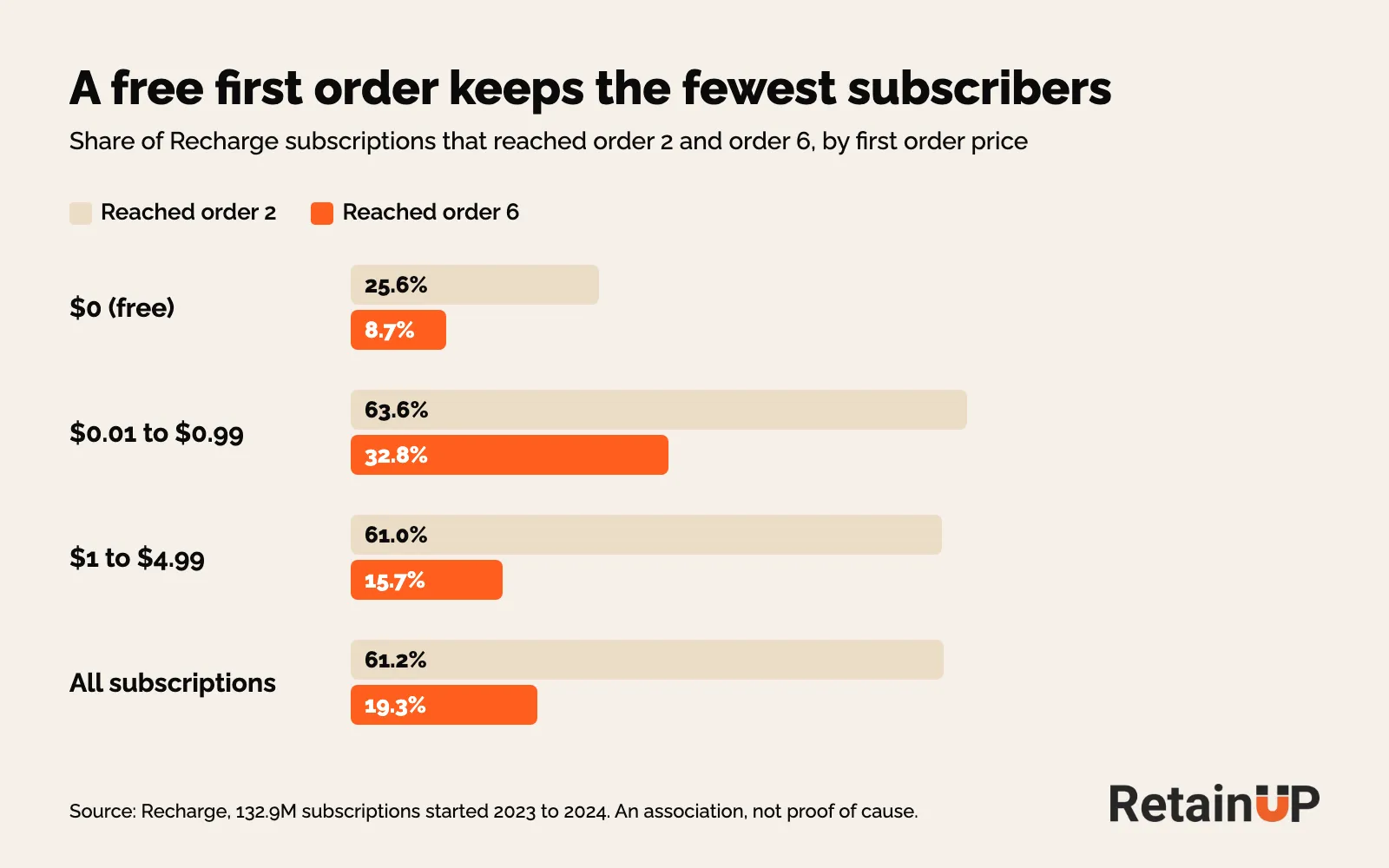
So free loses three quarters of the cohort before the first real charge. A 99-cent start keeps subscribers almost 4x better than a free one by order 6.
Recharge calls this a strong association, not proof of cause. Brands that run 99-cent starts may be different brands. Still, the gap is too big to ignore, and it matches what we see in cancellation data.
So why would one cent matter so much? Paying is a decision. A free order asks for an email and a card on file, and plenty of people treat that as a sample. A 99-cent order is a purchase. Small. But chosen.
What to use instead of free
- A nominal fee, like 99 cents, when you want a sampling offer.
- A modest discount on the first order, inside your normal subscription band.
- Free shipping on the first order.
If you do run a $0 or sample start, count Order 3 retention from the first paid order. Otherwise your order 2 is really order 1 and every number after it looks better than it is. How to set the everyday rate lives in how much to discount a subscription. For most brands it is 15%.
Deep first-box discounts pick deal-seekers
HelloFresh is the public example. Average discounts of 20% and up. About 50% of customers cancel by month 1. 85% by month 6. 90% by month 12. That is Bernstein and Second Measure data, not HelloFresh's own.
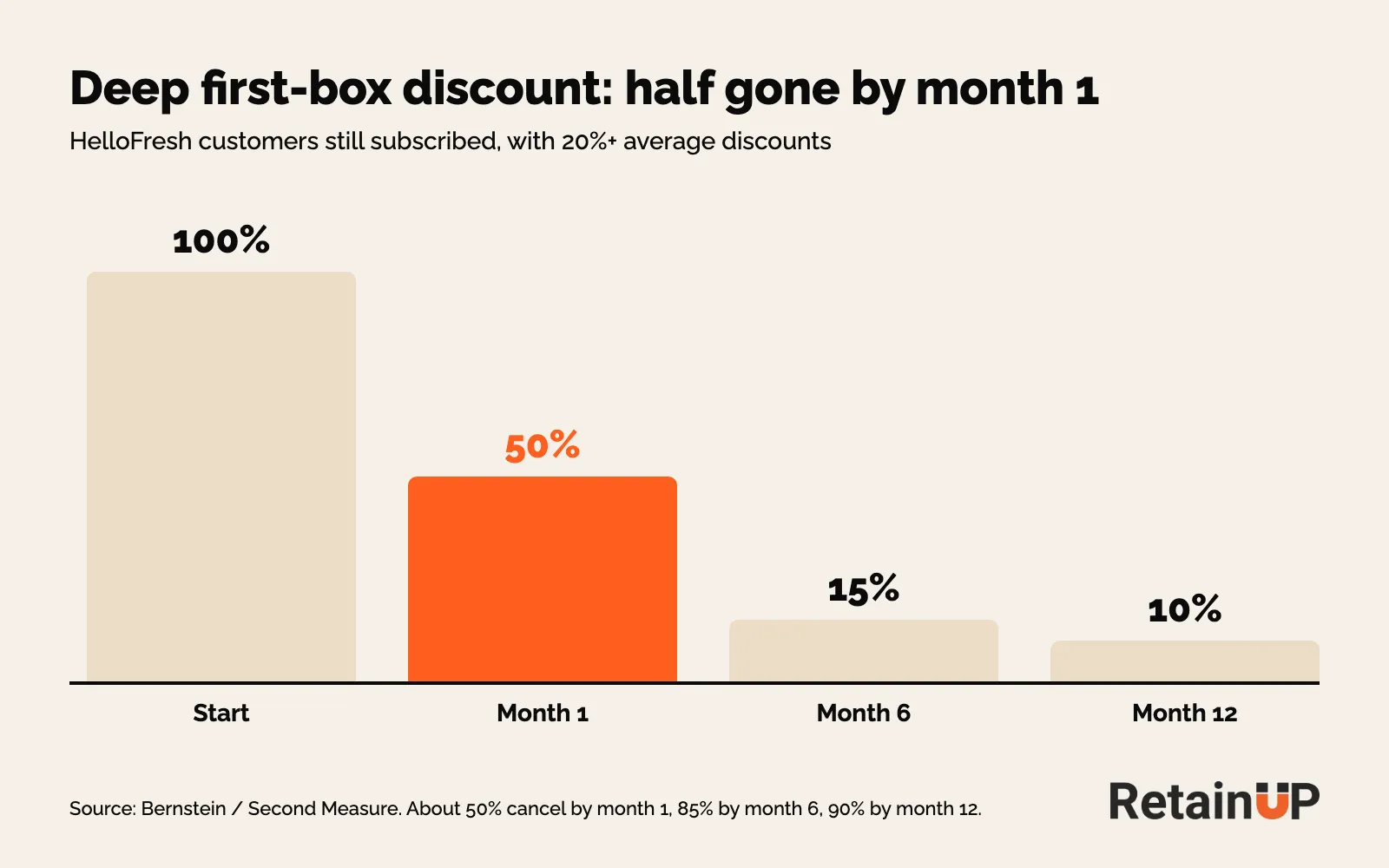
So run the arithmetic on your own version. If your first-box discount is 50% off and your second-shipment retention is 40%, you paid for 60% of them to take a discounted product and leave.
Meal kits are not supplements, so treat the exact numbers with care. But the shape is the one we see on smaller brands too: a deep first-order offer fills month 0 and empties month 1.
Day zero is your offer
The fastest place to see this is the cancellation date. In cancellation data from one of our brands, day zero held 5.6% to 8.4% of cancellations at every billing frequency. It barely moves when the billing changes. So it is not billing.
Somebody landed on your product page, saw the subscription was worth more than buying once, took the discount and the free gift, and cancelled before they closed the tab. Offer arbitrage.
If subscribing saves 30%, ships free and comes with a free gift, and buying once does none of that, taking it and leaving is the smart move. Your customer did the maths correctly.
Narrow that gap. If the difference between subscribing and buying once is worth more than 2 orders of margin, you are buying day 0 cancellations on purpose. And check that one-time purchase is still easy to find. Hide it and take rate goes up. Day 0 goes up with it. The cancel flow side of this is in stopping day-zero cancellations.
A useful check in the cohort table: month 0 below about 95% is an offer or disclosure problem, not a product problem.
Keep seasonal offers seasonal
A Lalas client. 9-figure brand.
They ran a seasonal freebie inside their acquisition offer. It was the best campaign in the brand's history. CPA down, volume up. So the founder and CMO made it the sitewide offer.
And then the cohort data came in. Retention dropped. Massively. The new buyers wanted the seasonal freebie more than the actual product.
In a cohort table it looks like a run of rows sitting well below the rows above. It starts the month the offer changed.
So during the season or a holiday, a seasonal freebie makes sense. The rest of the year, it doesn't. Keep it off the sitewide offer. Same thinking for sales: run your best deal on a 3-month prepaid plan or a sale-only bundle, not on the first box. The holiday side of this is in BFCM for subscription brands.
Where the first-order money should go instead
You still need a reason to subscribe on order 1. It can be small. The question is where the extra budget sits.
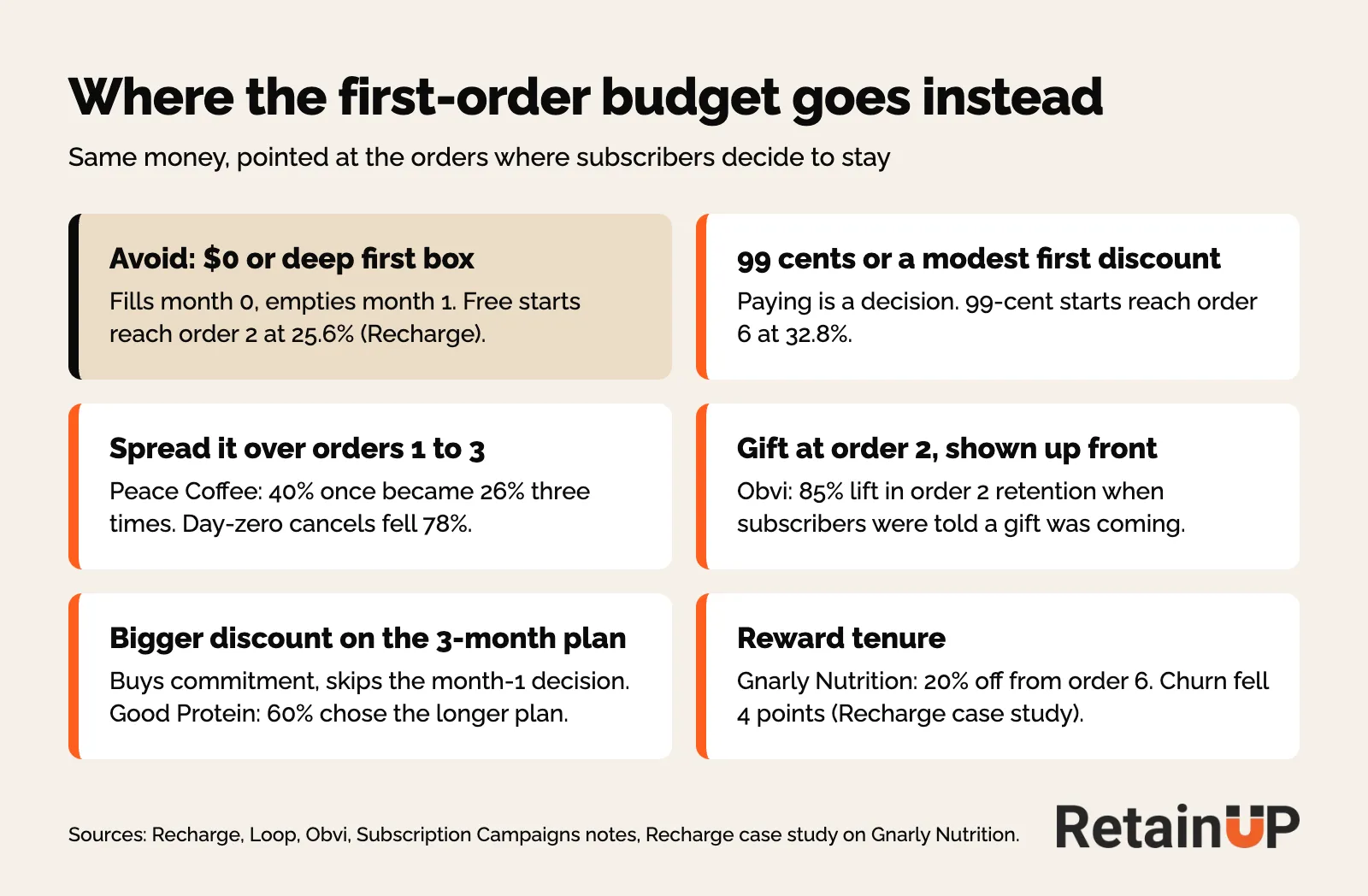
Spread the offer over the first three orders
Peace Coffee is the cleanest example. In a Loop customer story, it swapped 40% off one order for 26% off each of the first three orders. Day-zero cancels went from 7.14% of all cancellations in January 2025 to 1.56% in June. A 78% drop. Overall churn stayed in the same band, so the offer change did it.
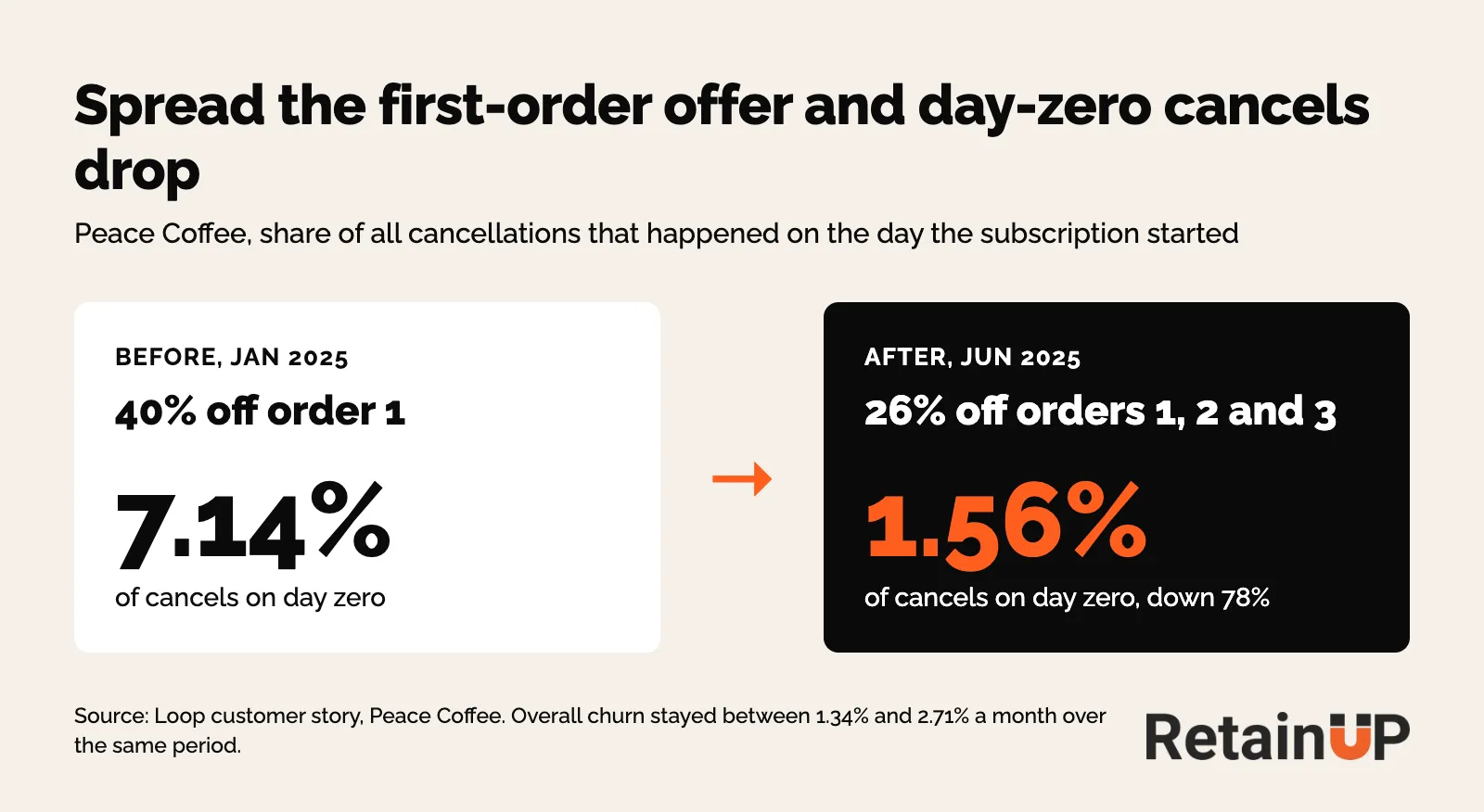
Same total discount, roughly. But now the customer has a reason to be there for order 2 and order 3. That is where the decision gets made.
Move gift value to orders 2 and 3
If everything valuable sits on the first order, there is no reason to stay for the second. Move the gift to order 2 or 3 and show it before checkout. The gift works harder there. It kills the day-zero spike and lifts order 2 at the same time. Obvi tested a free gift at orders 2, 3 and 4, and told subscribers by email and SMS before the order processed. Order 2 retention lifted 85%. Order 3 lifted 15%. Order 4 did nothing. The gift ladder and welcome kit options are in subscription perks, gifts and welcome kits.
Put the bigger discount on the longer plan
A bigger offer on a 3-month supply buys commitment. No trial. The subscriber skips the month-1 decision entirely. When Good Protein's discount grew with the plan length, 60% of subscribers picked the longer plan. The full trade-off, including the renewal cliff at term end, is in prepaid and longer plans.
Reward tenure, not the first order
Gnarly Nutrition built a tiered discount that grows with order count. In a Recharge case study, vendor-reported, 25%+ of subscribers reached the 6-order, 20%-off tier and churn fell 4 points. Same discount budget, pointed at the people who stay.
Store credit they can spend later
Skio suggests another version: give store credit on the first order that can only be spent after 60 days, sized at about 20% to 30% of AOV. A discount pays out on day 0, stay or not. Credit only costs you if they are still there to spend it. And cancelling means losing it, so show the balance in the portal and in the cancel flow.
How to set a first-order price in your subscription app
Every big app lets the first order carry a different price from the recurring ones. Check which one you have before you build the offer.
| App | Where the setting lives |
|---|---|
| Skio | Products, Selling Plans, Billing and pricing tab, Add recurring pricing policy. "After cycle" set to 1 changes the price after the first order. Skio docs |
| Recharge | Dynamic pricing on the subscription plan: one initial discount, one recurring discount. Recharge docs |
| Ordergroove | Initial Order Incentive for the first order, Recurring Order Incentive for the rest. Ordergroove docs |
One thing to test before launch: discount codes. In Skio they stack on top of the recurring price. So a 20% popup code on a 30% first order is 50% off, and that is the deal-seeker offer again.
How to judge a first-order offer: read the cohort at order 3
Every first-order test ends in one place. Order 3 retention: subscribers who paid order 3 divided by subscribers who paid order 1, same acquisition cohort.
Why not order 2? Order 2 can be an accident. The customer forgot they subscribed, or took the offer and never meant to stay. Order 3 is paid by someone who knew what they bought and used it. And at supplement CAC, order 3 is often the break-even order, so a subscriber lost before it was a marketing expense.
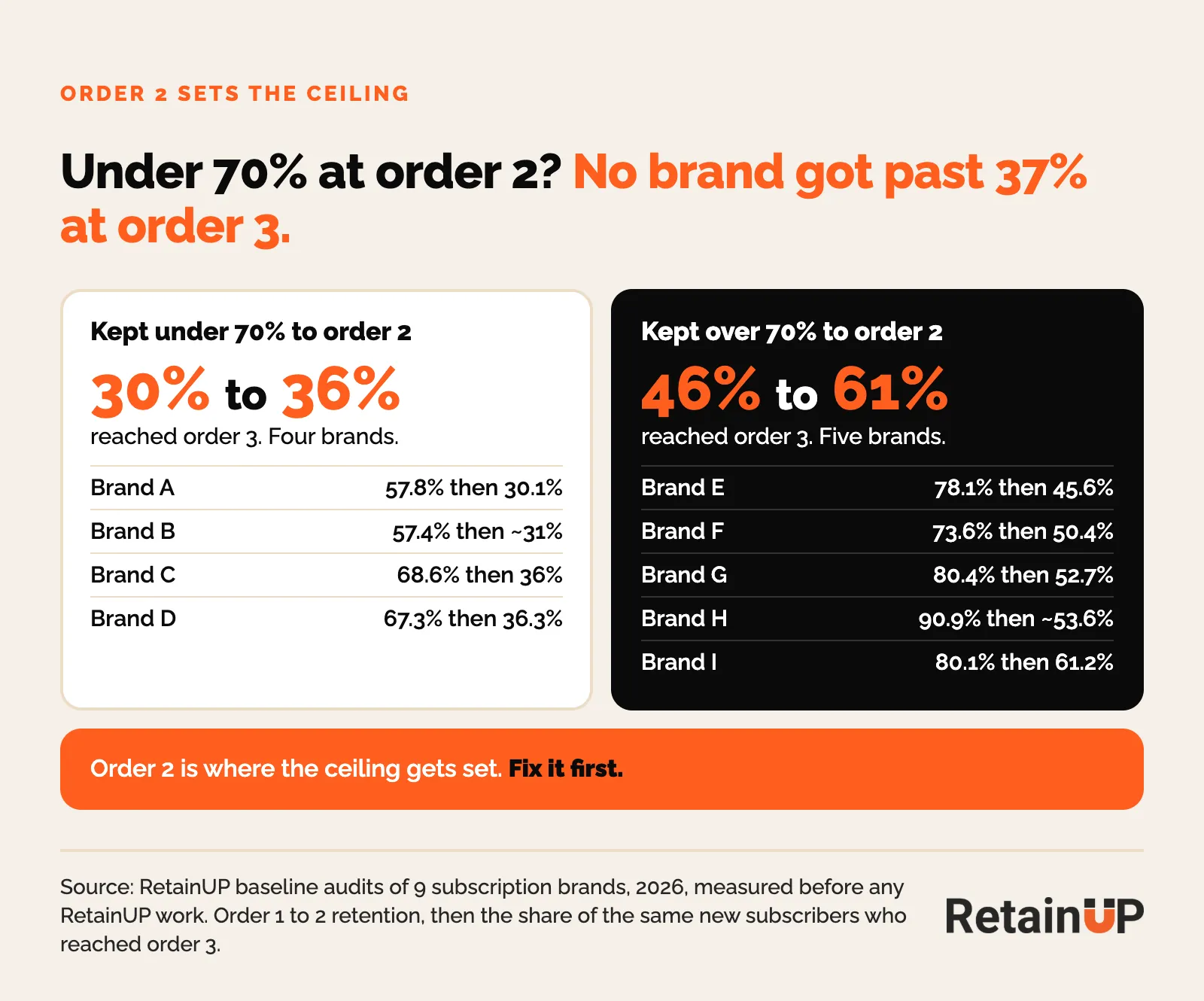
Across 9 brands we audited, the ones that kept under 70% to order 2 reached only 30% to 36% at order 3. Order 2 is the gate. And the first-order offer is one of the things that decides who gets through it.
Five rules for the read
- Write the offer change next to the cohort month. Six months later nobody remembers what ran in March.
- Mature cohorts only. On a monthly plan, wait about 4 months after the cohort month closes, so everyone has passed order 3 plus 30 days for skips and retries
- Read down the column. Newer cohorts against older ones tell you if the offer change helped.
- Count from the first paid order if you run $0 or sample starts
- Compare one frequency at a time. Monthly and quarterly cohorts mixed together hide the change
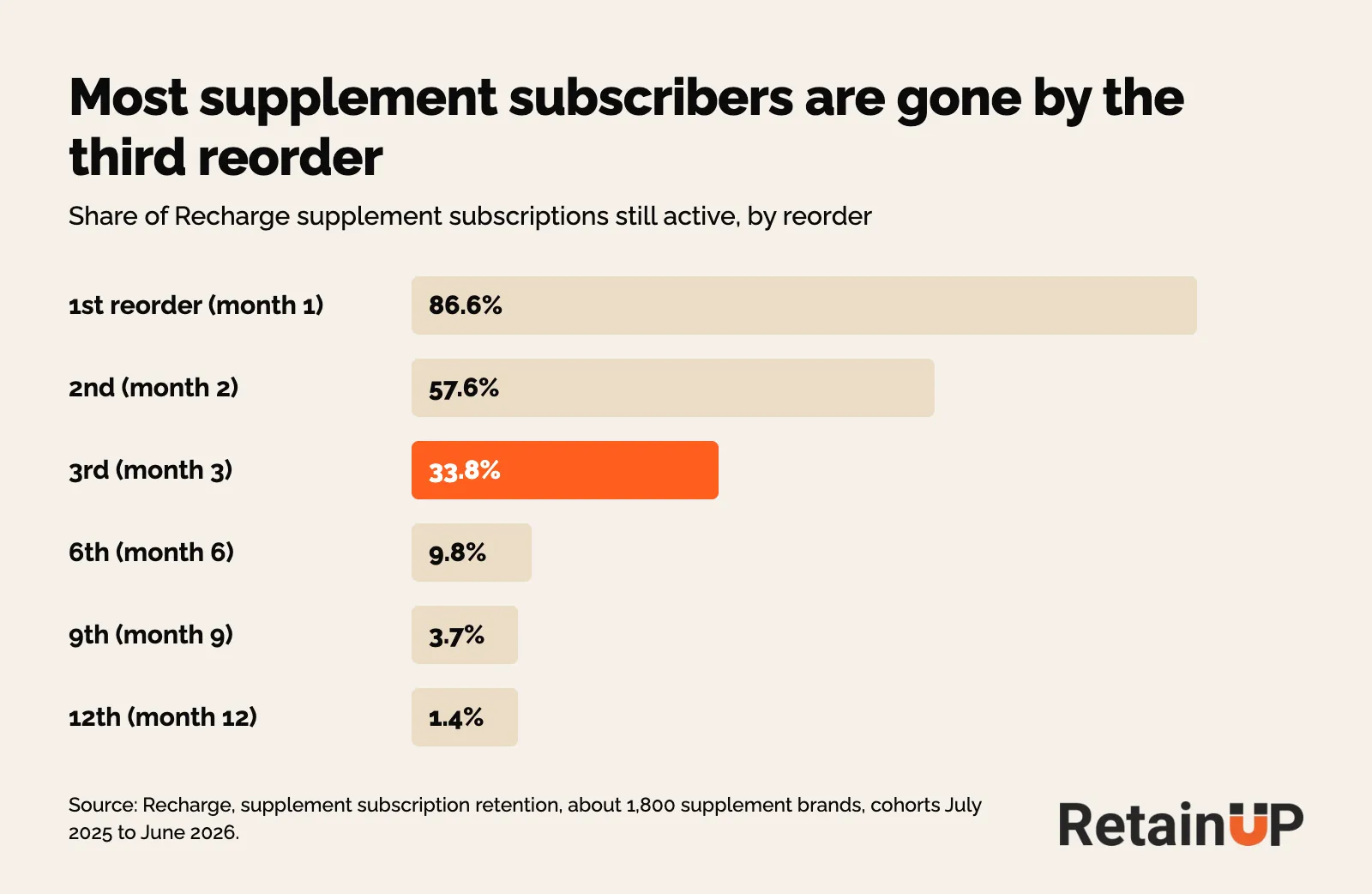
For a baseline, Recharge's supplement curve across about 1,800 brands sits above. Our own bands by order are on the subscription benchmarks page. The table layout is in how to read a subscription cohort chart. Simple test. If a new offer lifts take rate and drops order 3, it lost. Even if the ad account says otherwise, and it usually will for a few months.
The Subscription LTV Maximizer™ sets your first-order offer, evergreen discount and gift ladder in Recharge, Skio, Stay AI or Loop, along with the widget, cancel flow, portal, payment recovery, email and SMS, live in 30 days for $5,000. To see first where your offer leaks, the free subscription audit checks 48 points and sends your top 3 leaks in 24 hours.
FAQ
Should I offer a free first order on my subscription?
No, a free first order keeps the fewest subscribers. In Recharge data on 132.9M subscriptions, $0 first orders reached order 2 at 25.6%, against 61.2% across all subscriptions, and only 8.7% reached order 6. A 99-cent start reached order 6 at 32.8%. Recharge calls it an association, not proof of cause. Still, the gap is big. A nominal fee or a modest discount is the safer choice.
How big should a first order discount be for a subscription?
Keep it inside your normal subscription band, usually 15%, and put any extra budget somewhere else. Deep first-box discounts select for deal-seekers. HelloFresh, at 20%+ average discounts, loses about half its customers by month 1. A bigger discount works better on a 3-month plan, where it buys commitment, or as a gift on order 2 or 3, where it rewards people who stayed.
Should the first subscription order get a bigger discount than recurring orders?
A little bigger is fine, a lot bigger buys cancellations. Skio, Recharge and Ordergroove all let the first order carry its own price. But a big gap between order 1 and order 2 is the day-zero pattern. Peace Coffee moved from 40% off one order to 26% off each of the first three, and day-zero cancels fell 78%. Spread the money over orders 1 to 3, or move it to a gift at order 2.
How long does it take to know if a first order offer works?
About 60 to 90 days on a monthly plan. CPA and take rate show up on day 0. Retention needs the cohort to reach order 3, plus around 30 days of grace for skips and payment retries. Until then you only know the offer converts, not who it brought in. Note the offer change next to the cohort month so you can compare later.
Why do subscribers cancel right after the first order?
Mostly because the first order was worth more than the product. When the subscription stacks a discount, free shipping and a gift well above the one-time price, some people subscribe for the offer and cancel the same day. In data from one brand, day zero held 5.6% to 8.4% of all cancellations at every billing frequency. That points to the offer at signup. Billing has little to do with it.
One email a week on subscription retention: the numbers, the strategy, and what to fix first.

Rahi Jain
Rahi Jain is a subscription LTV specialist who helps $1M to $10M DTC brands reduce subscription churn and maximize LTV on Recharge, Skio, Stay AI and Loop.
More about Rahi