Key takeaways
- A $6 bar cannot carry a subscription on its own. A $36 box can. Dr. Squatch sells a box, not a bar.
- Build-your-own-bundle subscriptions lift average order value by up to 24%, per Ordergroove's 2024 retention guide.
- Reward a bigger box with one ladder: 15% off for 3 items, 20% for 5, 25% for 7 or more.
First order: $100. Every renewal after that: $40.
I call it the bundle downgrade. The bundle was sold one time only. And the subscription went on a single product.
Sell a bundle alone, and you lose the renewals. Sell a subscription alone, and you lose the AOV. High LTV needs both, a big order that keeps renewing. So this article is about putting more than one product into a single subscription, so the big first order keeps coming back. It is one piece of Subscription Offer Engineering, the order of decisions that sets what you sell and at what price.
When a product needs a box to carry the subscription
Some products are too small to subscribe to. Dr. Squatch is the clearest case I have scored.
A $6 item cannot carry a subscription on its own. A $36 box can. So they sell a box, not a bar. Pick your scents, add deodorant, hair care or toothpaste, and edit it later. Even a single-bar product page pushes you into the box builder.
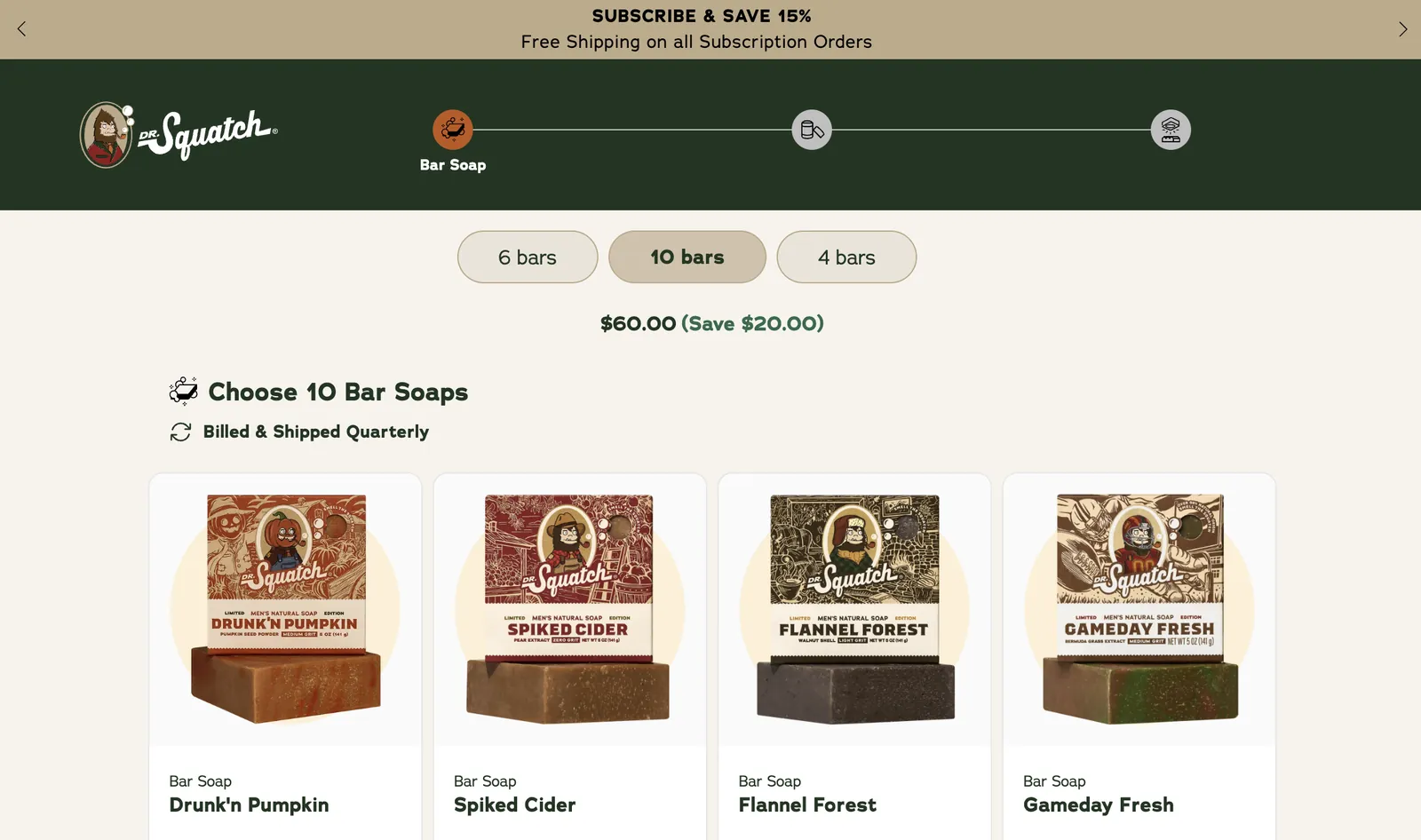
The builder runs at 4, 6 and 10 bars, billed and shipped quarterly. Dr. Squatch had 75,000 people on subscription by early 2022, and Unilever later paid a reported $1.5 billion for the brand. All of it built on a $6 bar of soap.
If you sell small-ticket products, copy this one. The same logic works the other way too. Mars Men sells one product, so there is nothing to bundle, nothing to swap into and nothing to add. Four checkpoints on our scorecard went to zero for that single reason.
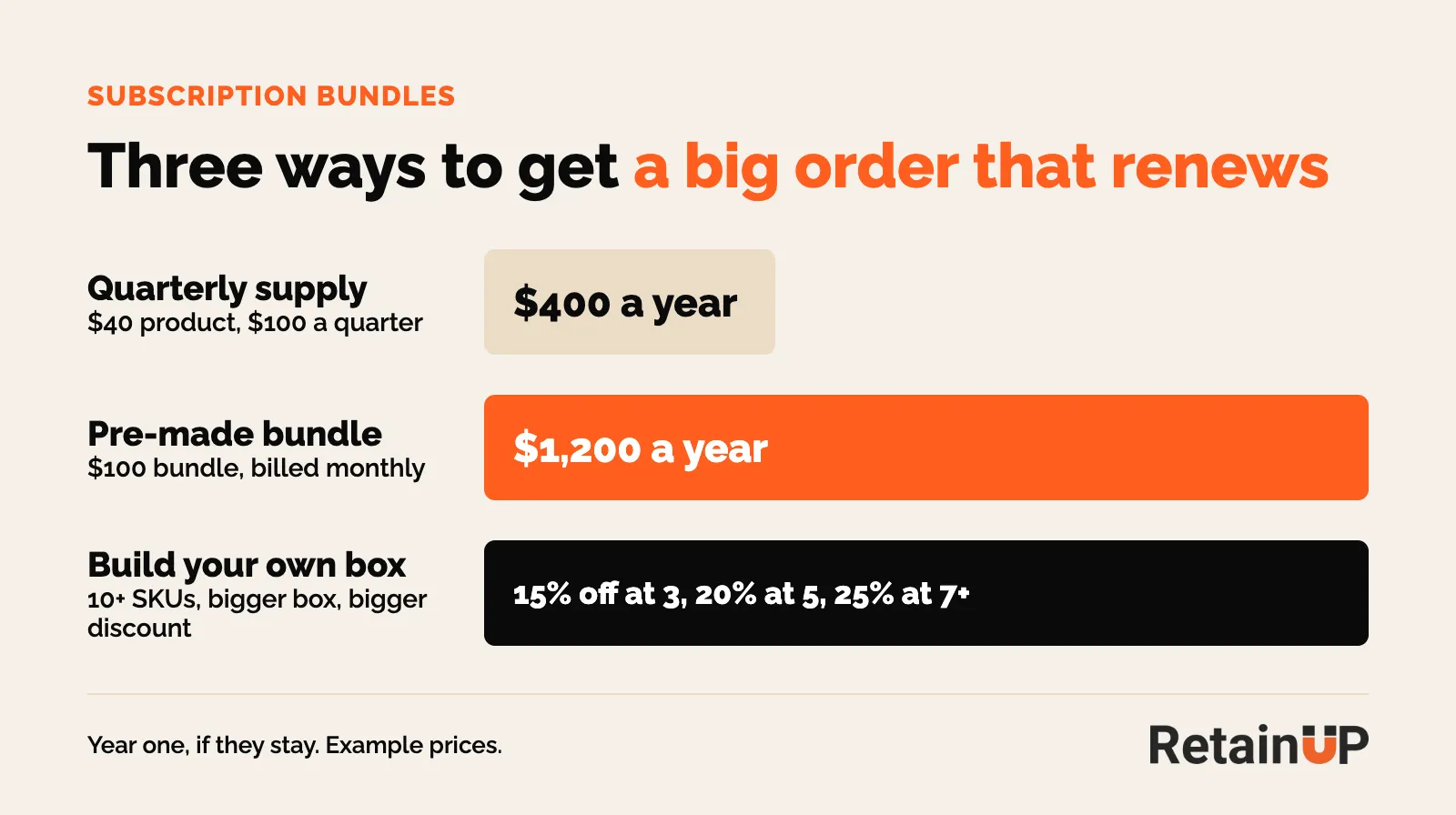
Three ways to get a big order that renews
There are three ways to get a bigger order onto the subscription. They stack in this order of effort.
1. Quarterly supply
Three months go in one box, so a $40 product becomes $100 a quarter. Four renewals make $400 a year. That's better than one-off orders, but still low. The trade-offs between a monthly and a 3-month plan live in prepaid and longer plans.
2. Pre-made bundle
A $100 bundle billed monthly is $1,200 a year if they stay. Same customer, same acquisition cost, three times the yearly order value of the quarterly box.
3. Build your own box
If you have 10+ SKUs, let them pick, and reward a bigger box. This is the Dr. Squatch model.
Build-a-box vs pre-made bundles
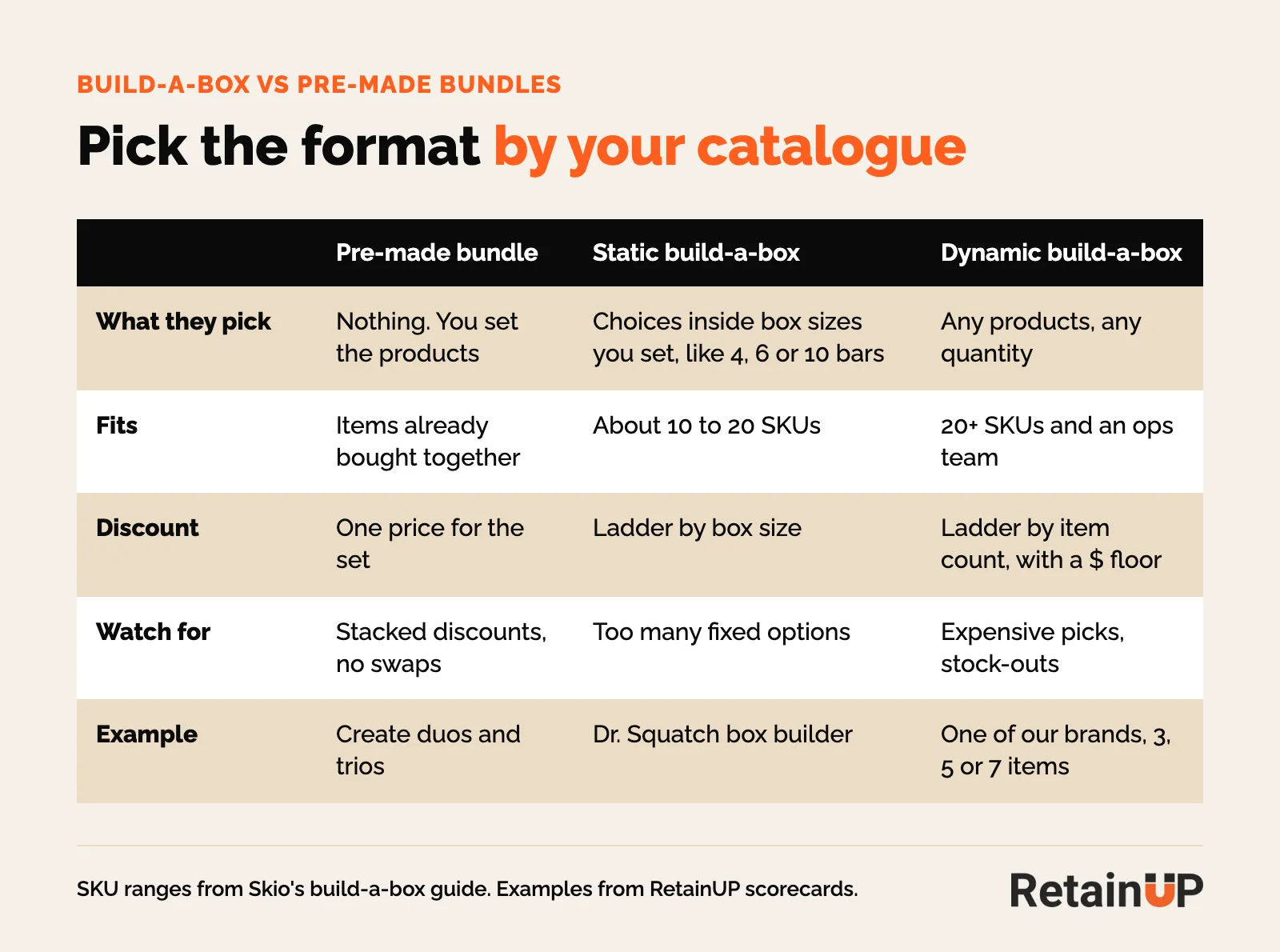
Pre-made bundles are a subscription with a discount on a fixed set of products. In a custom build-a-box, subscribers choose the items they want. Both work. Pick by catalogue.
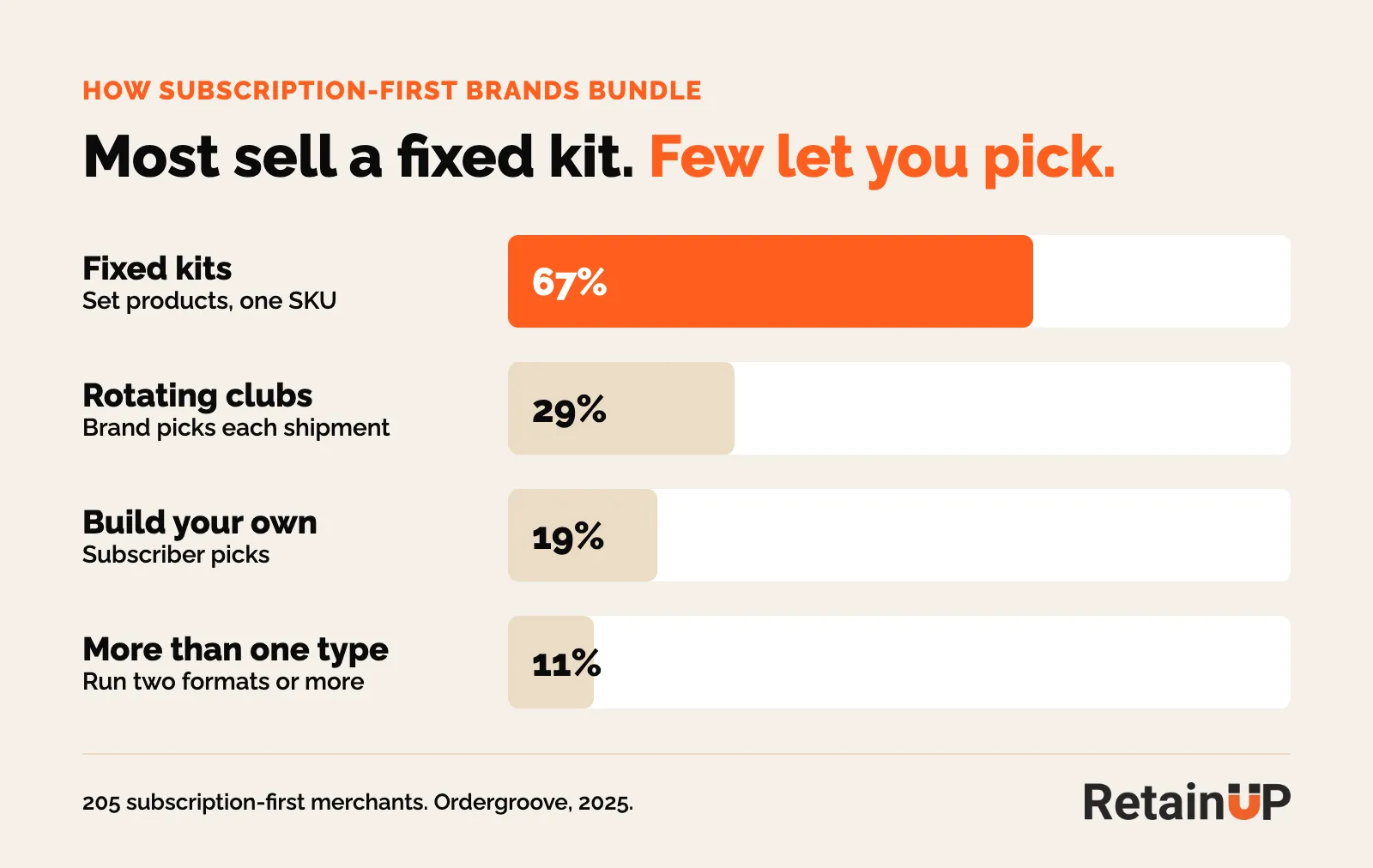
Most brands only ever try the first one. In Ordergroove's 2025 survey of 205 subscription-first merchants, 67% sold fixed kits, 29% ran rotating clubs where the brand picks each shipment, and 19% let subscribers build their own. Only 11% ran more than one type. Rotating clubs are a curation model, which is a different business. See subscription models for that one.
Build-your-own-bundle subscriptions can lift average order value by up to 24% (Ordergroove, A Guide to Retention Marketing, 2024). And that's one guide's number, not a promise. They let subscribers pick the products they need while keeping shipping costs down, and they make "subscribe more, save more" possible. Stay AI's Subscription Tech Playbook 2025 adds the retention side: building their own bundle keeps customers engaged, and protects AOV because they swap out products they don't like for ones they want to try.
Bundles can keep people longer too. In the same Ordergroove guide, Peet's Coffee says its bundle subscribers placed 30% more orders than single-product subscribers over their time on the plan. That's one brand's own number, so treat it as a hint. But more than one product does give them more than one reason to stay.
There is a variety angle as well. In one case shared by rePete by Bold, customers who reorder freely and rotate flavours stay loyal longer than customers locked to one flavour. One case. Treat it as a hint.
Static or dynamic build-a-box
Build-a-box comes in two kinds. A static box gives fixed sizes you set up, like 4, 6 or 10 bars, and the subscriber picks what goes in. A dynamic box lets them add any product in any quantity. Skio's own guide puts static at under about 20 SKUs and dynamic at 20 or more, with an ops team that can handle the picking. So start static. Dr. Squatch is a static box, and it works.
Too many pre-made bundles
Create, the creatine gummy brand, shows what happens when pre-made bundles multiply. On the bundle page there are eleven bundles to choose from. Duos, trios, juice bundles, each on its own plan. Where it could be a plus and minus picker, they give you five or six options. Not great UX.
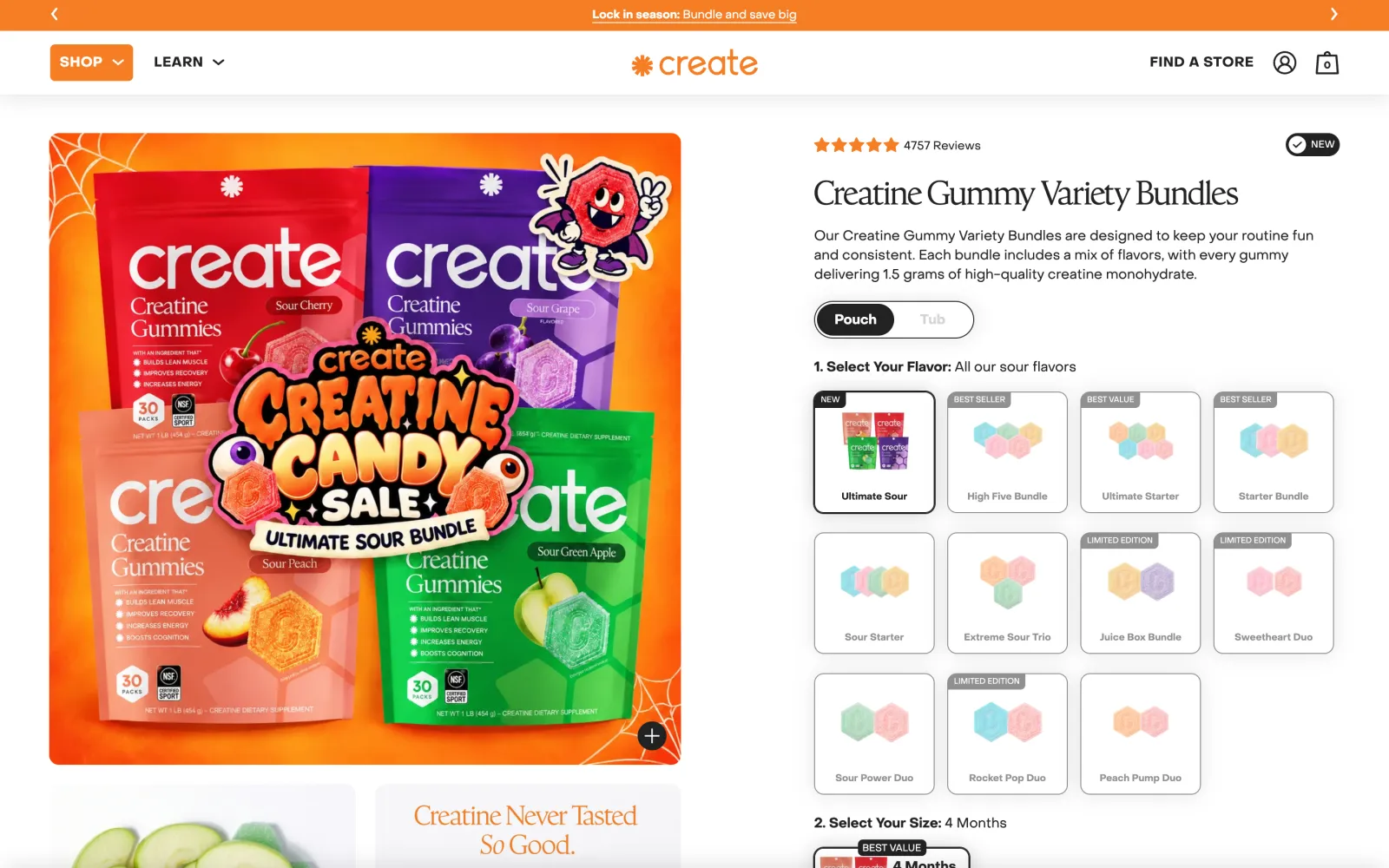
Let people pick their own flavours instead, the way Dr. Squatch builds a box. More in the Create scorecard.
How to find your pre-made bundles
Give your order items report to Claude. You'll often see 10-20% of customers already buying two or three items together. They built the bundle for you. Put a good offer on it and put it on subscription.
If two people in the house use it, sell a family pack. Grüns stacks "Buy 2, Save 5%" on top of its subscription price, and adds a kid supply from the cart to raise AOV without a bundle.
When you plan the set, think in three kinds of bundle around your bestseller: one that helps them save, one that helps them gift, and one that helps them buy quickly. Frequently bought together goes in the last group.
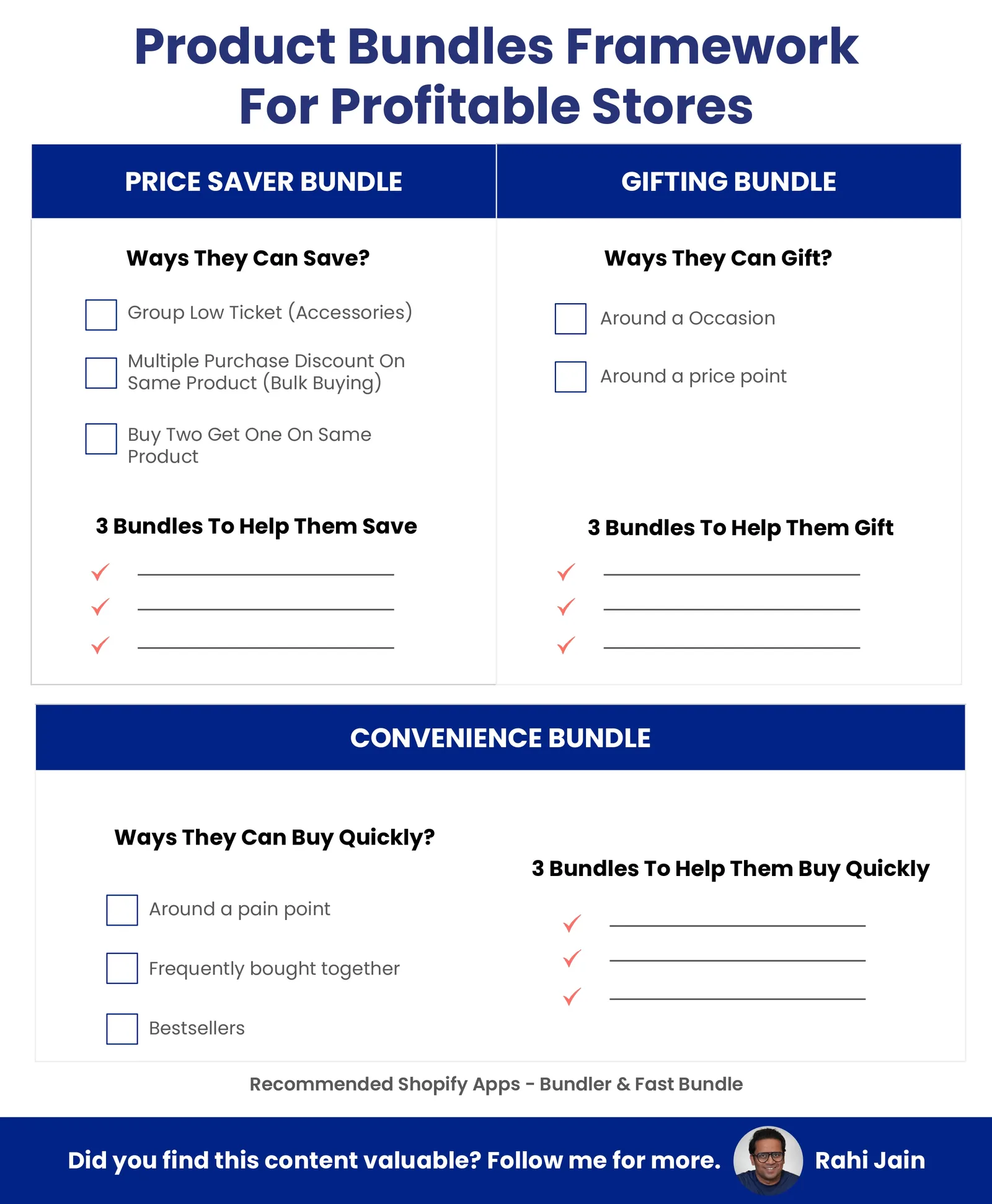
Name each one for what it does for them. "The Morning Routine" tells them what it is for. "Bundle 1" tells them nothing. Same with the photo: show the whole box, not a list of product names.
Then set it up. Pick the products that can be bundled together, and set up a subscription for that bundle in Skio, Recharge, Loop or Stay AI. Bundles should enter the cart as single SKUs, so customers can swap and skip each item.
Volume tiers and the discount ladder
Reward a bigger box. Here is the ladder we start from:
| Items in the box | Discount |
|---|---|
| 3 | 15% off |
| 5 | 20% off |
| 7 or more | 25% off |
Put the next tier on the screen. A customer at 3 items should see what 5 gets them, right there in the builder. Dr. Squatch shows a percentage on every box size too. But the label hides the real price.
Every 3-month bar costs $6, whether you take 2 bars or 20. The only thing that moves is the crossed-out price, which switches between $7 and $8 a bar depending on the box size. So pick 3 bars and it says 25% off. Pick 4 and it says 14% off. Same $6 bar.
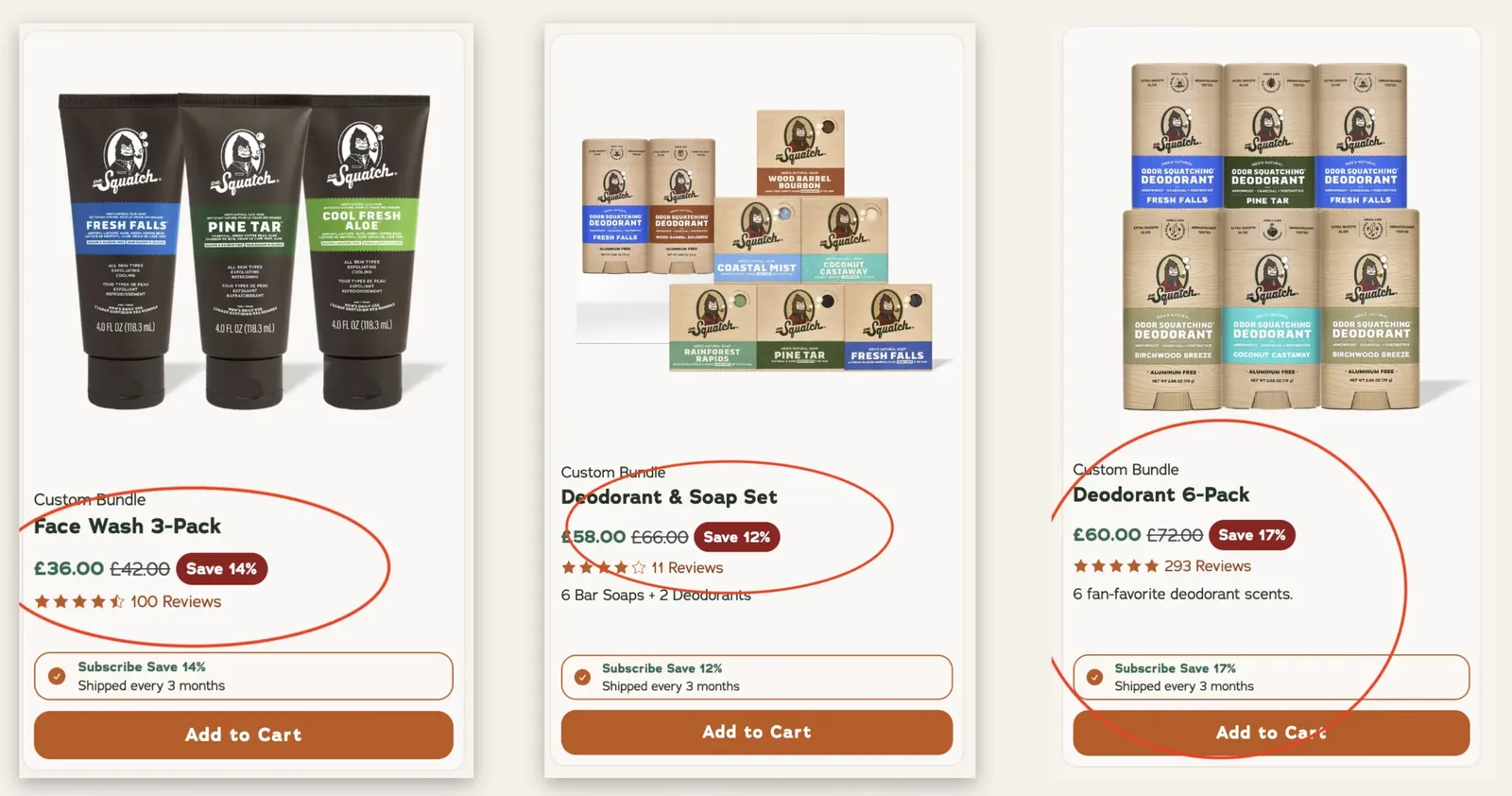
Show the real price per item. Always. And keep one ladder for the customer, whichever route they take.
One ladder, not two
One of our brands ran two. Product pages gave 10/15/20 by pack count, while the box gave 20/25/30 at 3, 5 and 7 products. Same customer, two different deals. We reconciled them to a single ladder so the customer gets the same deal either way, and folded everything into one customisable box. The split between the box and single-product subscriptions went away.
The stacked discount
Watch the bundles you already sell. At that same brand, a $118 bundle sold at $89, already 25% off, landed near $70 once the 20% subscription discount stacked on top. Unprofitable. Pre-made bundles carried permanent discounts up to 35%, which undercut the ladder and confused the customer. So they were repriced to line up with the box. How deep the base rate should go sits in how much to discount a subscription.
The expensive-pick problem
A flat discount on any mix gets gamed. People fill the box with your most expensive items and skip the cheap ones. Skio makes this point in its piece on build-a-box margins: 25% off a box of $12 items costs you more than 25% off a box of $8 items. So tie the discount to the item count, cap it on your highest-cost SKUs, and check the margin per box with pick and pack included.
The bundles stayed, and that was deliberate. People who do not convert on subscription pages convert on non-subscription pages. Subscription becomes the better option, never the only one.
Swap limits on a build-a-box subscription
A box people can edit needs a floor. A price floor. That brand put a $50 minimum on every new box. It clears the profitability line and qualifies every box for free shipping.
Above the floor, let them move. The portal is where the box gets managed: add, remove, swap items each cycle. If someone has 5-7 items and wants fewer, they should be able to reduce it in the panel, not cancel. That swap is what turns a cancel into a change. The portal side is covered in the subscription customer portal.
Set a limit on swaps into your priciest product. Without one, subscribers work out that swapping to it every cycle costs them nothing extra, a point Skio raises in its build-a-box guide. And the builder should only show what is in stock, so nobody picks a scent that can't ship.
Every brand offers skip and swap. Very few get customers to use it. On Reddit and Trustpilot, Dr. Squatch subscribers talk about swapping scents and adding new ones before the box ships. I rarely see that.
The fixed frequency is why. Everyone knows a box is coming every 3 months, so they get the reminder, open the dashboard and change it. The help centre even shows a screenshot of the dashboard, so you know what you can change before you log in.
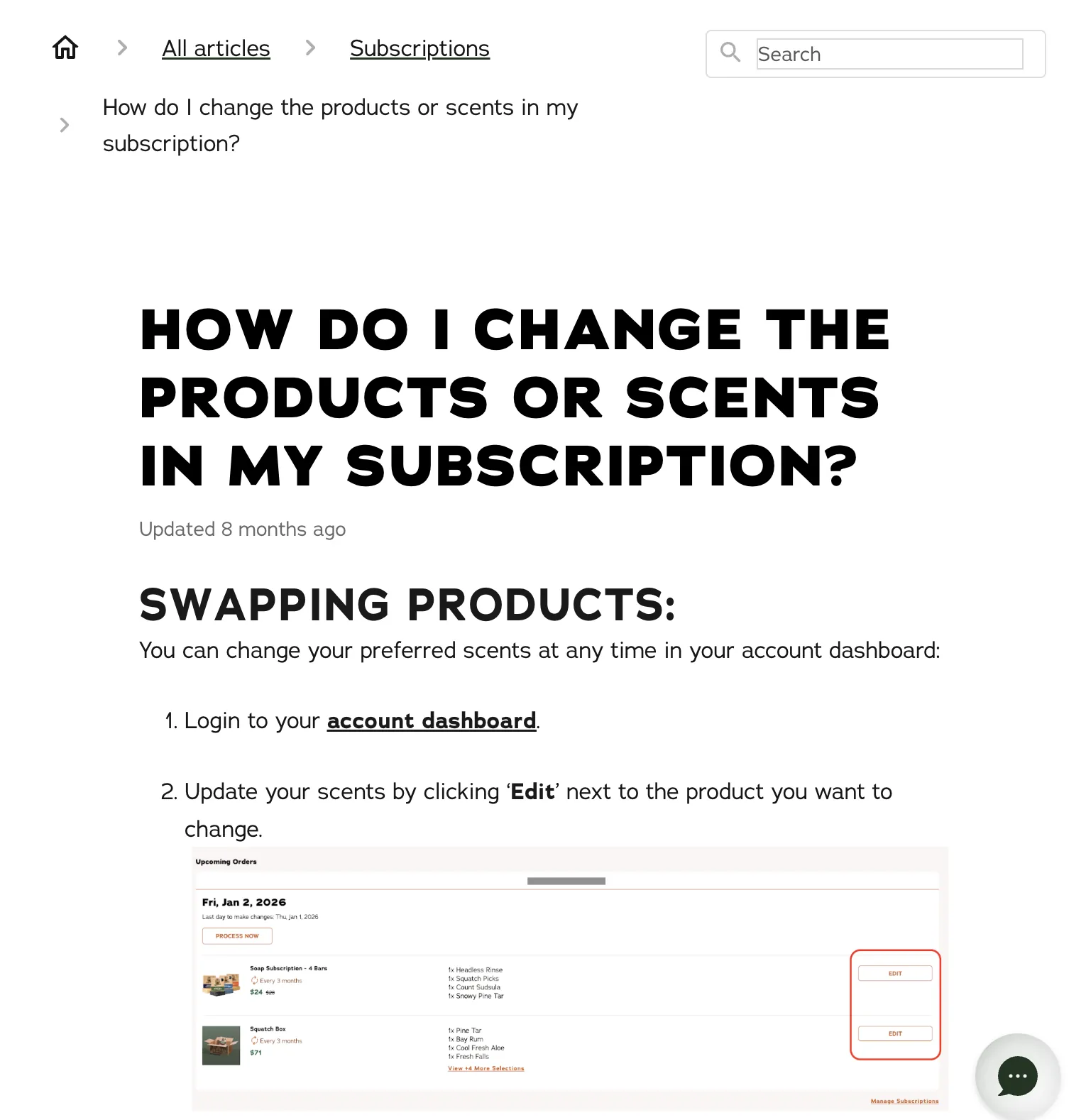
The box you edit is not always the box you get
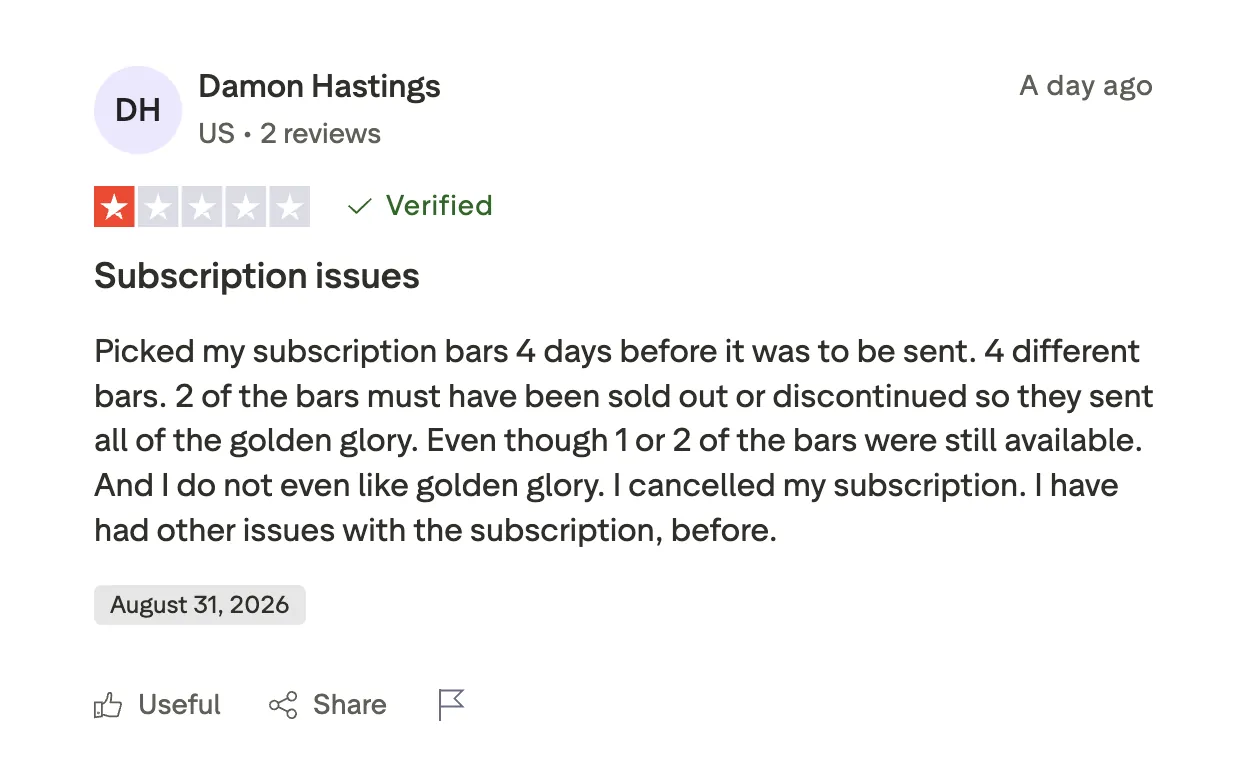
Dr. Squatch's complaints are about stock. Limited scents sell out, and a different bar ships without anyone being asked. People edited the box and still got the wrong one. If a scent is out, tell them and let them pick the next one. Skio now has a backup product setting that does this: the subscriber gets a notice and picks a substitute, with a default if they don't answer. What to do when an item runs out is in subscription out of stock.
Using bundles to introduce new products
A box is the easiest place to put something new in front of a subscriber. Grüns runs its retention on limited flavour launches. When a new flavour drops, roughly every six weeks, subscribers get a text and can swap their next box to it just by replying. That text swap runs on Skio and Postscript.
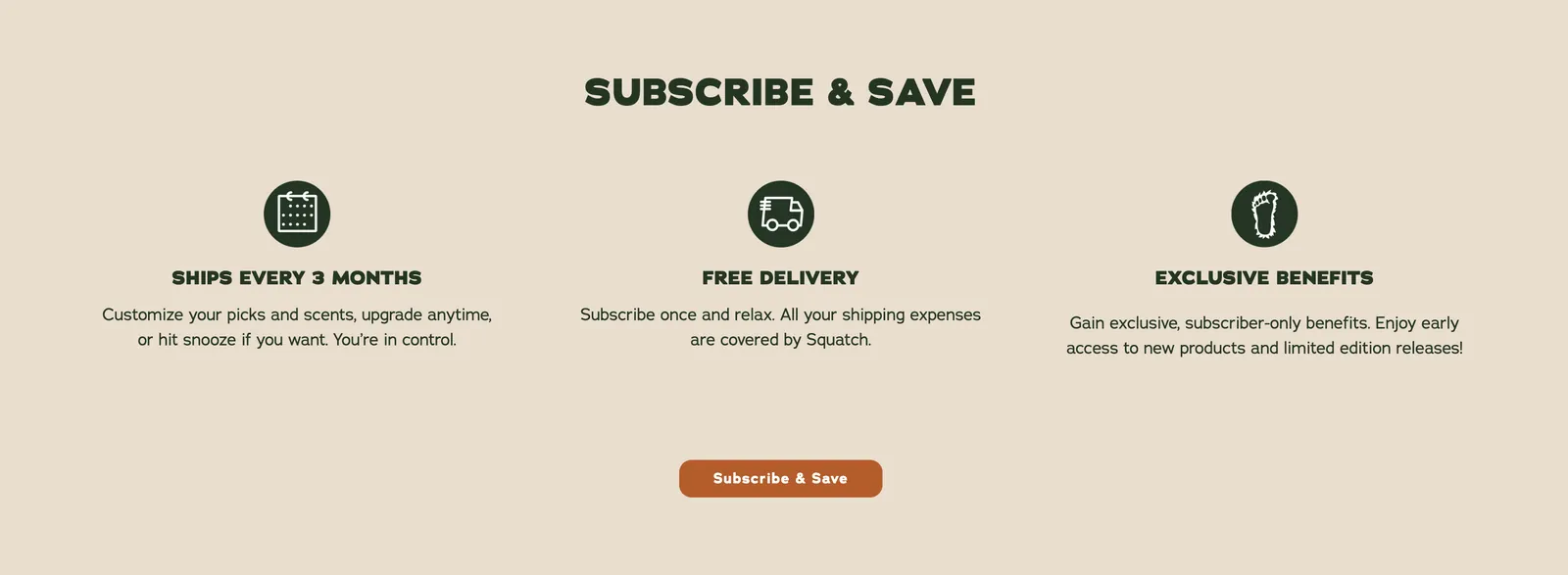
Dr. Squatch lists early access to new products as a subscriber benefit. Then I could not find a single promotional email that says so. Give subscribers early access to new launches, then tell them.
For people already on a subscription, make adding easy so they don't run two subscriptions. 1 additional product on the evergreen discount, 20%. 2 or 3 additional products on evergreen + 5%, so 25%. Pack first, catalogue second. The add-on side of that ladder lives in add-ons, cross-sell and upgrades.
Mistakes we see with subscription bundles
- Selling the bundle once and putting the subscription on a single product.
- Stacking the subscription discount on top of a bundle that is already discounted.
- Two ladders for the same customer, one on the product page and one on the box.
- A flat discount on any mix, so the box fills with your most expensive items.
- Too many bundles. Push one hero bundle or one build-a-box. More is confusing to run and to sell.
- A box that ships something the customer did not pick, with no warning.
Put the bundle on subscription to maximize your LTV.
The Subscription LTV Maximizer™ sets up the offer, including the bundle or build-a-box and its discount ladder, along with the widget, cancel flow, portal, payment recovery, pause and skip in Recharge, Skio, Stay AI or Loop, plus email and SMS, live in 30 days for $5,000. If you want to see where your current offer leaks first, the free subscription audit checks 48 points and sends your top 3 leaks in 24 hours.
FAQ
Should I put a bundle on subscription or a single product?
Put the bundle on subscription if customers already buy those products together. Selling the bundle once and the subscription on one product is the bundle downgrade: a $100 first order, then $40 renewals. Check your order items report first. You'll often find 10-20% of customers already buying two or three items together, and that set is your first subscription bundle.
What is a build-a-box subscription?
A build-a-box subscription lets the subscriber choose which items go in each box, usually with a bigger discount for a bigger box. Dr. Squatch is the best-known example: pick 4, 6 or 10 bars, choose your scents, add deodorant or toothpaste, and edit the box before it ships. It works best when you have 10 or more SKUs to choose from.
How much should I discount a bigger subscription box?
Use one ladder that grows with the box: 15% off for 3 items, 20% for 5, and 25% for 7 or more. Keep the same ladder on product pages and in the box builder, so the customer gets the same deal either way. Don't stack the subscription discount on bundles that already carry their own permanent discount, or the margin disappears.
How do subscription bundles improve customer retention?
Subscription bundles improve retention by giving subscribers more than one product to stay for, and the freedom to change it. Peet's Coffee says its bundle subscribers placed 30% more orders than single-product subscribers. Swaps help too: someone tired of one flavour picks another instead of cancelling. Bundles also raise order value, up to 24% for build-your-own boxes in Ordergroove's 2024 guide. Set a minimum box value, like $50, so every edited box still pays.
Can subscribers swap products in a bundle subscription?
They should, and it should be self-serve in the portal. Let subscribers add, remove and swap items each cycle, and let someone with 7 items drop to 5 instead of cancelling. Bundles need to enter the cart as single SKUs for this to work. And when an item is out of stock, tell them before the box ships and let them choose a replacement.
One email a week on subscription retention: the numbers, the strategy, and what to fix first.

Rahi Jain
Rahi Jain is a subscription LTV specialist who helps $1M to $10M DTC brands reduce subscription churn and maximize LTV on Recharge, Skio, Stay AI and Loop.
More about Rahi