Key takeaways
- Across 8 subscription brands RetainUP audited in 2026, the median cancel flow saved 10.8% of people who tried to cancel. None reached 25%.
- In Loop's data on 441K cancel attempts, the best save rate came from two offers, a discount and a free gift: 14.7%.
- At one of our brands, a 50% off cancel offer converted 1.7%. Skip and pause saved more people than the discount did.
This is one part of the subscription churn guide, which walks the whole topic in order.
Ask what a good cancel flow saves and you will hear 25% to 33%. We have quoted it too, on our own Optimizer page. Then we open a brand's data. And the number is nowhere near it.
Most brands test the save offer the same way. Pick an offer. Show it to everyone. Measure save rate. Try a bigger offer. Measure again. Five tests later, save rate has barely moved. So the offer gets the blame.
So this page is about the offer. What to put on the last screen, how many, how big, and how to tell whether it saved anyone. The screens that come before it are in the cancel flow structure, and the words on them are in cancel flow copy.
What does a save offer actually save?
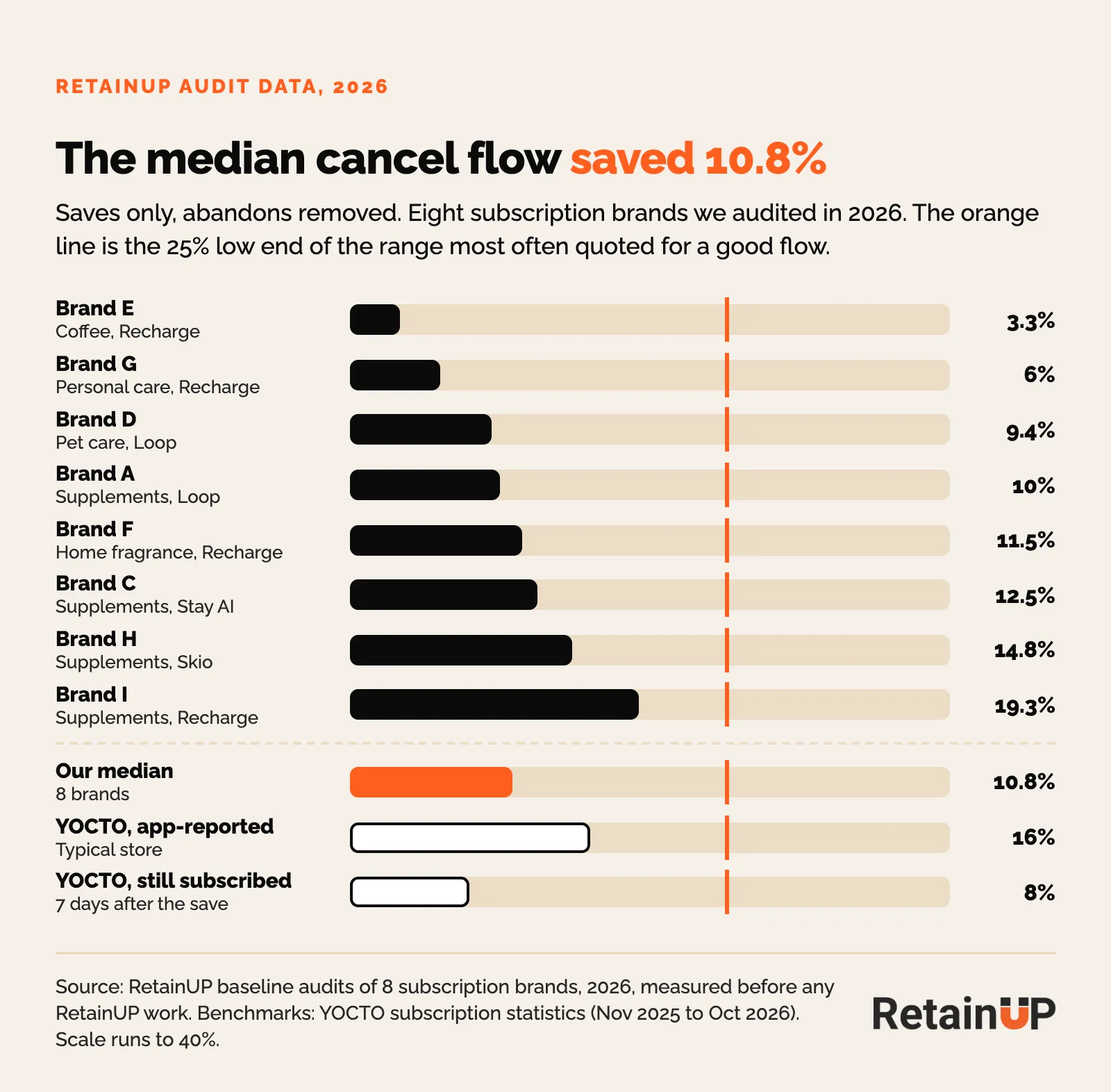
Across 8 subscription brands we audited in 2026, the median cancel flow saved 10.8% of the people who tried to cancel. The range was 3.3% to 19.3%. About 1 in 9. So the other 8 walk out.
We counted the same way at each one, before we changed anything: saves only, with people who simply closed the page taken out.
| Brand | Category | App | Save rate, saves only | Note |
|---|---|---|---|---|
| Brand E | Coffee | Recharge | 3.3% | |
| Brand G | Personal care | Recharge | 6% | |
| Brand D | Pet care | Loop | 9.4% | |
| Brand A | Supplements | Loop | 10% | Most saves cancelled again soon after |
| Brand F | Home fragrance | Recharge | 11.5% | Recharge showed 16.3% |
| Brand C | Supplements | Stay AI | 12.5% | The app showed 62.5% |
| Brand H | Supplements | Skio | 14.8% | Before our rebuild |
| Brand I | Supplements | Recharge | 19.3% | 74% of save code users ordered again |
| Median, 8 brands | 10.8% |
Seven of the eight sat under 15%. None reached 25%. The two lowest, at 3.3% and 6.0%, were both on Recharge. The app did not decide the result, though. Brand I, the best in the sample, was on Recharge too.
Our median sits between YOCTO's two published figures: 16% as the apps report it, and 8% when you count only people still subscribed a week later. We could not find an ecommerce dataset behind 25% to 33%. The closest numbers come from software, where Churnkey reports 21.1% to 36.4%. Cancelling a software tool and cancelling a box of gummies are different decisions. Every other save rate we track, with its source and date, is on the subscription benchmarks page.
Why your app shows a higher save rate than you have
So why the gap? Dashboards. Some count anyone who leaves the flow without cancelling as saved. So closing the tab looks like a save. Others count the save the moment the offer is accepted. Before the next order pays.
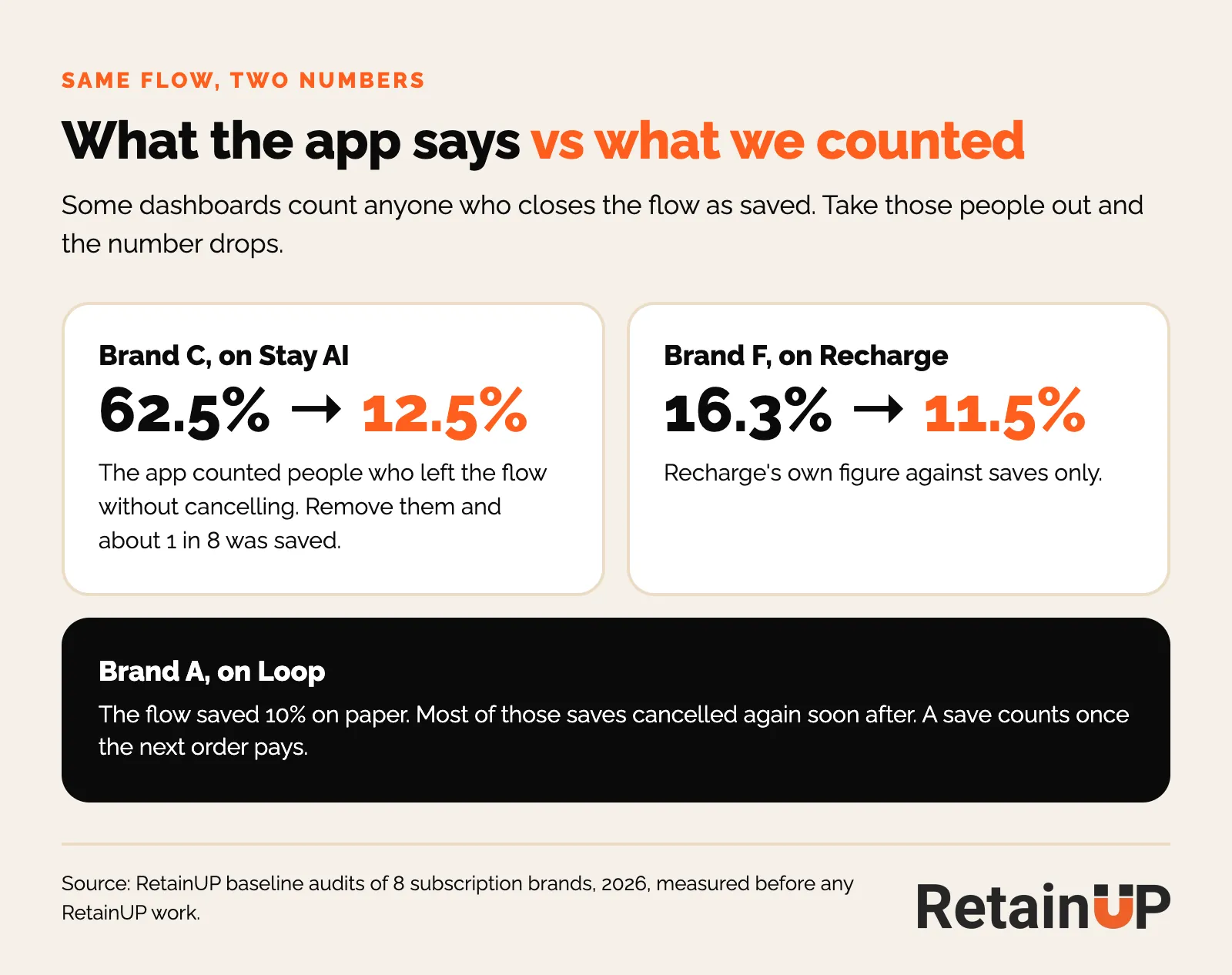
Brand C's Stay AI dashboard showed 62.5%. With abandons removed it was 12.5%. Brand F's Recharge figure was 16.3% against 11.5% saves only. And at Brand A, most saves cancelled again soon after.
Judge a save by the next order
A save that cancels next month only moved the cancel date. You just delayed the inevitable. So count the next order.
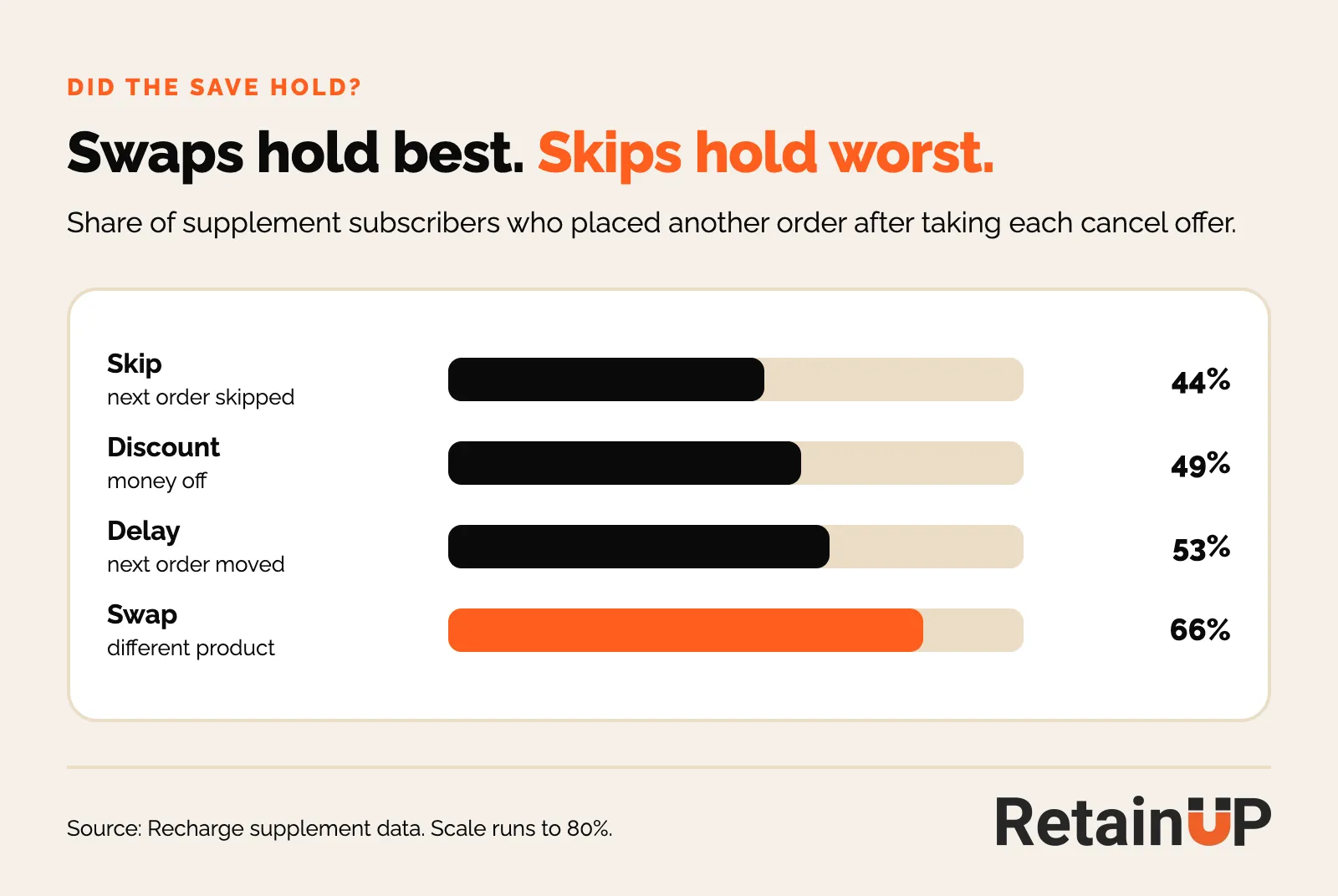
Recharge's supplement data shows how much the offer type matters here. Subscribers who took an offer placed another order 44% of the time after a skip, 49% after a discount, 53% after a delay and 66% after a swap. That is a range of 22 points from the same cancel screen.
So track two numbers per offer, every month. The save rate. And the share of saved subscribers who pay the next order. Loop puts a working bar at 70% or more of saved subscribers still active 90 days later (Loop, why subscribers cancel). Loop also breaks saves into three buckets per reason, benefits page, treatment and offer, and shows average orders after each treatment. In Recharge, Skio or Stay AI you build that read yourself from the export.
Credit each save to the screen that made it
This one trips a lot of brands. The usual read divides total saves by the people who saw the offer. That credits the offer with saves it did not produce.
So split the people who entered the flow into two groups. Those who reached the offer screen, and those who stopped earlier and stayed. And work out a save rate for each.
At one of our brands, the first read gave the offer 15.9%. Done properly, the offer converted 1.4%. The people who never reached it saved at 12.3%, on the benefits page before it. So the benefits page outperformed the discount nine to one. The opposite of the first reading.
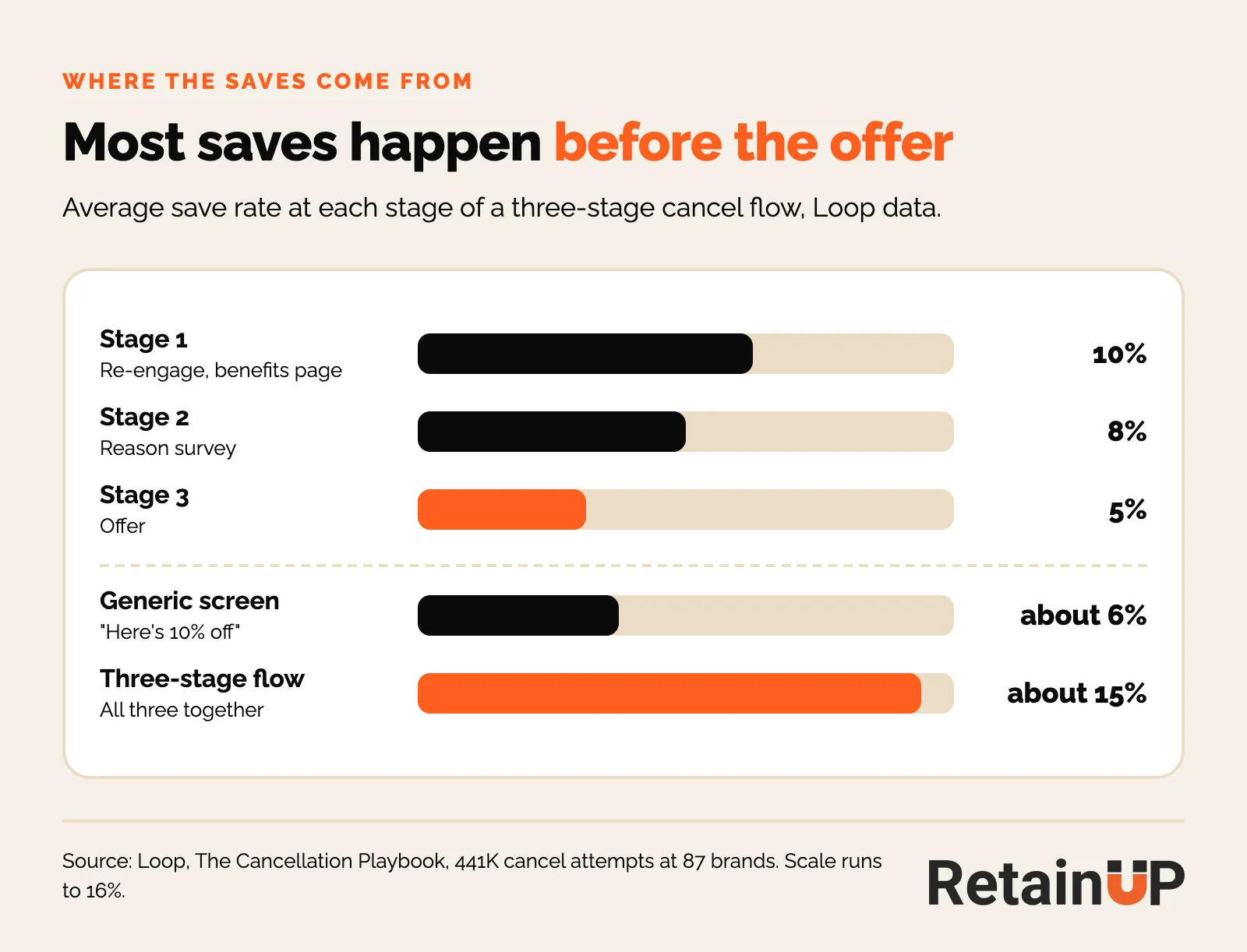
Loop sees the same pattern across 441K cancel attempts at 87 brands. A re-engage screen saves 10% on average, the reason survey 8%, the offer 5%. A generic "here's 10% off" screen saves about 6%. Most saves happen before any offer shows up.
Expensive offers that convert under 2%
At another of our brands, the 50% off cancel offer converted 1.7%. Skip next order and Pause, between them, saved more people than the discount did.
Half price. The most expensive lever was the least effective one.
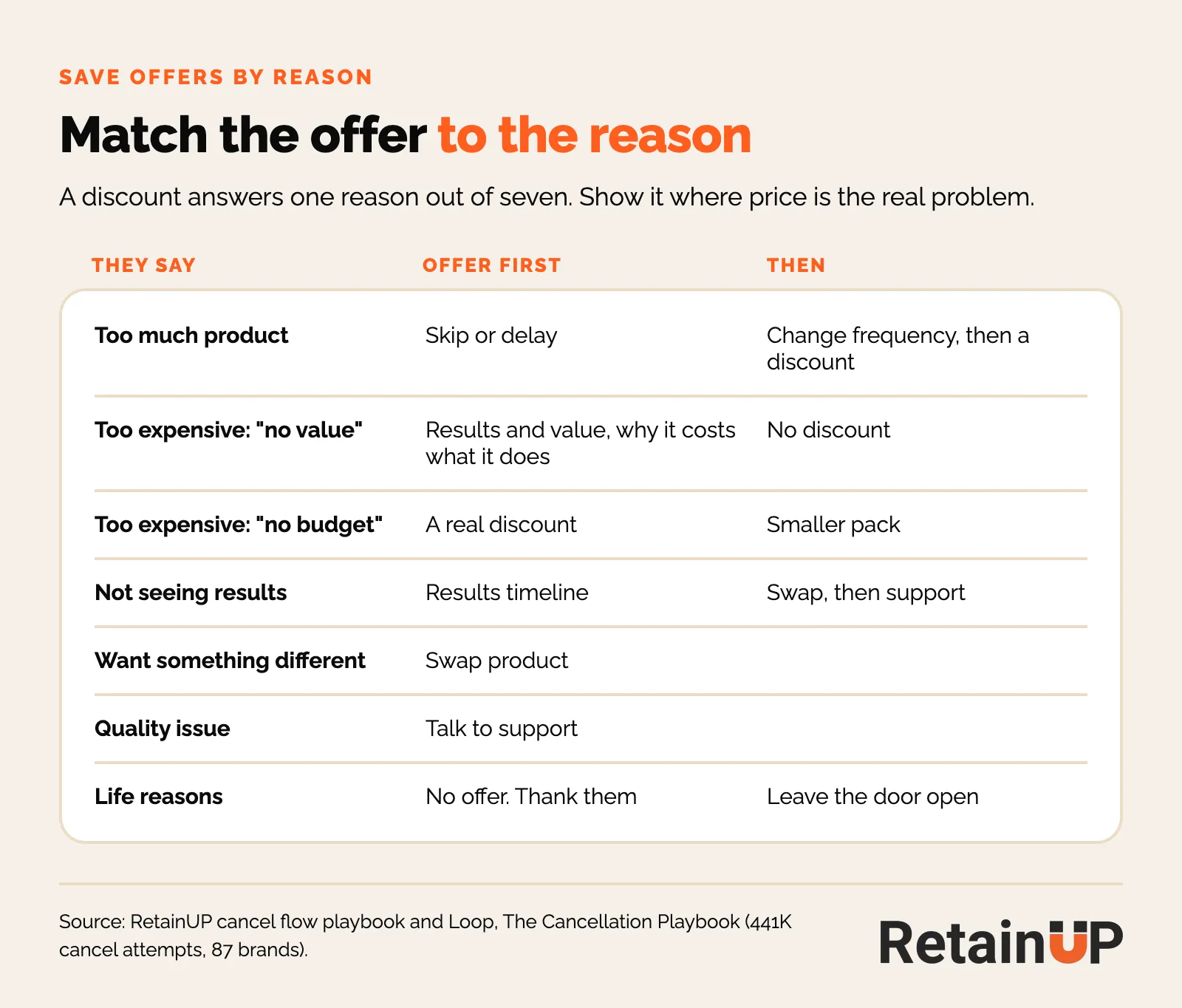
A discount does nothing for the subscriber with three unopened boxes under the sink. "Too much product" needs a skip or a new frequency. "Didn't work" needs a results timeline or a swap. A discount solves neither. Price is never price. It's value and cost. The full map is in cancel reasons and the fix for each, and the order for skip, delay and swap is in the flexibility ladder.
A flow that identifies the reason before it responds recovers 17% to 33% of cancellations. A flow that skips the reason and leads with a discount saves under 5%. Top class saves 1 in 3. Underperforming saves 1 in 20.
Skip, delay, swap or pause before a discount
Lead with the cheap options. Skip or delay first. Then a swap. The discount goes last, only for people who said price. Skio's own guide puts it in the same order: frequency changes or skips first, then swaps or pausing, then discounts or gifts as the last resort.
We leave pause out, or cap it at 90 days. Between 40% and 60% of paused customers churn within 90 days. Pause is rehearsed churn. Loop's reason map lists it. We still leave it out. And if a brand keeps it, every pause gets a hard end date.
Two offers: a discount and a gift
Two. Not five. On the last screen, show two offers at most. One discount, one gift. For example "25% off your next 3 orders" and "Get a free gift".
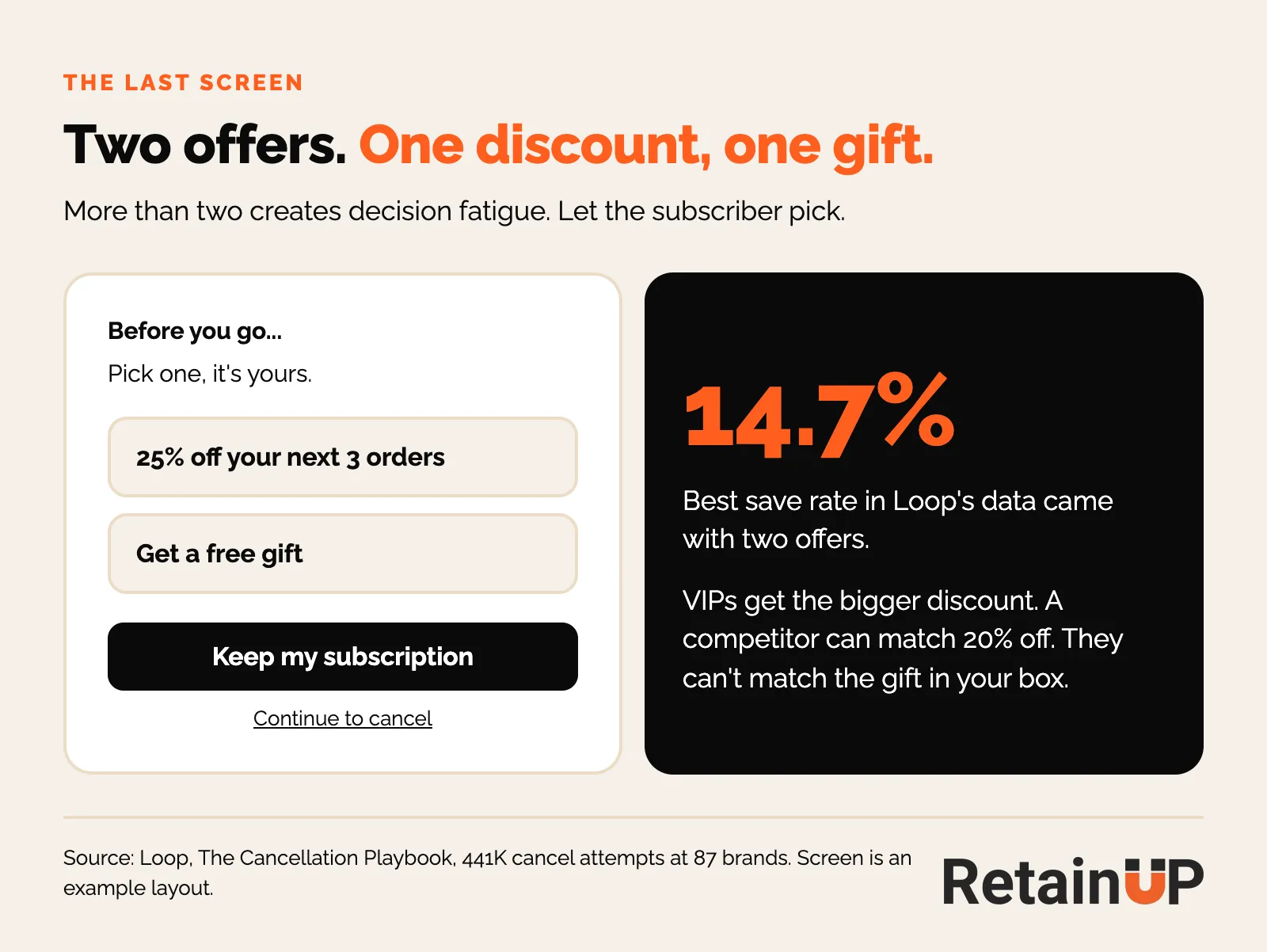
Loop's best save rate with two offers was 14.7%. More than two creates decision fatigue. Let subscribers choose, not just accept.
Spread the discount over more than one order. "25% off your next 3 orders" keeps the subscriber through three charges. A steep one-time cut buys one box. Say 50% off, once. So test them against each other.
Size the offer to the person
VIPs get the bigger discount. Price-sensitive subscribers get the steeper savings. Don't treat a veteran who has spent $1,000 the same as someone who just purchased. Veterans: cut them some slack. Just don't annoy them. New subscribers get the more aggressive offer, because they need more time with the product.
Why the gift matters
And a gift is apples to oranges with a discount. A competitor can match 20% off. They can't match the thing in your box. And it costs less than it looks. One of our clients gives away a mouthwash tablet pack that costs them $1.44. The customer sees $18.70. How to pick the gift is in subscription perks and gifts.
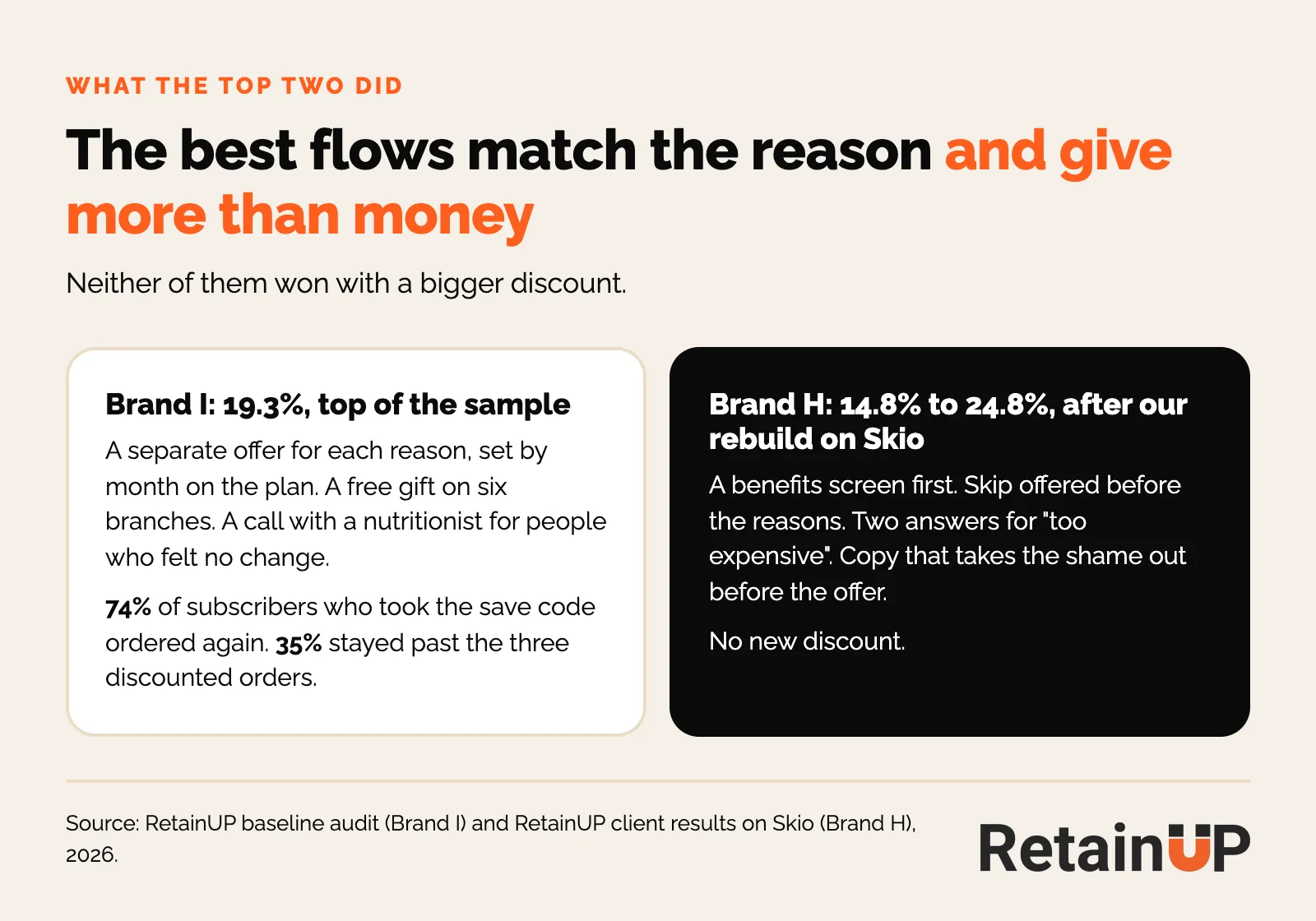
Brand I saved 19.3%, the top of our sample. It set a separate offer for each reason and month on the plan, put a free gift on six branches, and offered a call with a nutritionist to people who felt no change. The saves held: 74% of subscribers who took the save code ordered again, and 35% stayed past the three discounted orders.
Brand H sat at 14.8% when we audited it. After our rebuild on Skio it saves 24.8%. A benefits screen comes first, skip comes before the reasons, and "too expensive" gets two answers. No new discount. That 24.8% came after our work, so the median leaves it out.
The cancel offer must beat the welcome offer
Easy to miss. If your welcome offer is 30% off and your cancel offer is 15%, the smart move is to cancel. Then come back next month as a new customer, with a new email, for the welcome deal.
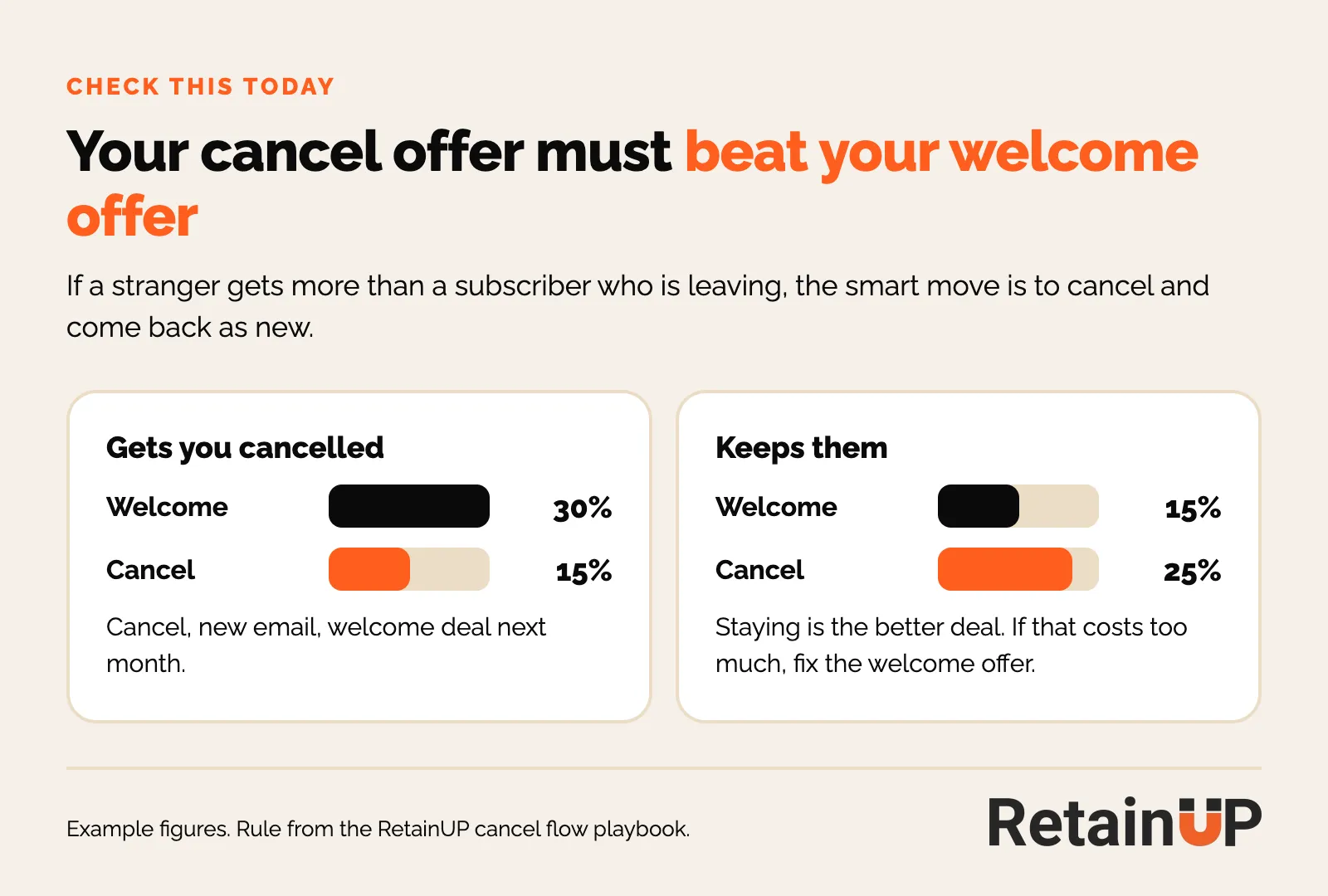
So check the two side by side. The cancel offer has to be at least as good as what a stranger gets on your popup. If that costs too much, the welcome offer is the problem, and how much to discount a subscription covers where to set it.
Stop people cancelling for the deal
Discount everyone who clicks cancel and you teach people to click cancel. Recurpay flags the same risk with blanket offers. Recharge's cancellation prevention has a gaming prevention field for this: a time limit on how often one customer can receive a monetary offer (Recharge help centre). Set it. On other apps, build the same rule as a segment.
Loop's partner team goes further for anyone who tried to cancel in the last 30 days. One offer only, skip or pause, with a short video. No second discount.
No extra discount for a sale-acquired cohort
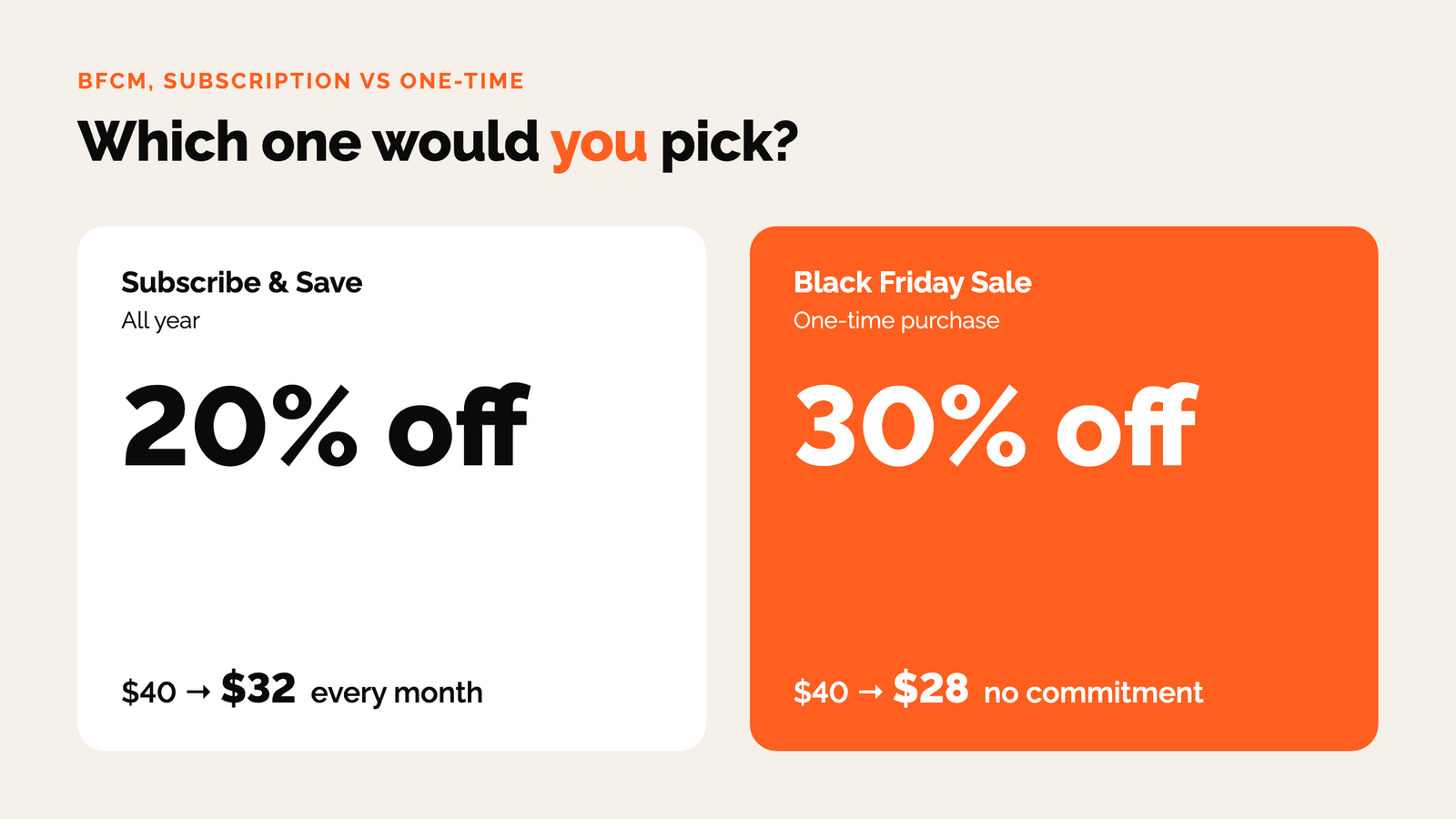
Subscribers who joined at Black Friday already got your best price of the year. Another discount on the way out teaches them to wait for the next one. So don't.
So the BFCM cohort gets its own cancel profile, with no discount before order 2. Loop's partner team suggests six profiles, and they cover almost every BFCM cancel reason.
| Segment | Offers, in order |
|---|---|
| BFCM cohort before order 2 | No discount. Delay, change frequency, skip next payment |
| Loyal subscribers | Redeem loyalty points, swap or downgrade, support chat |
| Payment failed | Update card with an offer, skip next payment |
| Multi-item or multi-subscription | Swap or drop one item, change frequency |
| Tried to cancel in the last 30 days | One offer only (skip or pause), with a short video |
| Everyone else | Skip, change frequency, pause, learn more |
A BFCM subscriber with high lifetime value goes to the loyal profile, not the BFCM one. The video line for the BFCM cohort can be as plain as "You got our best price of the year. It won't come back until next BFCM." How to build the segments is in segmenting subscribers by value, and the rest of the sale plan is in BFCM for subscription brands.
The instant winback offer on the confirmation screen
The last screen gets wasted. Most flows end at "Your subscription has been cancelled." And every person who left still sees it.
An instant winback offer shows right after the subscriber confirms the cancel. It is time-limited. Anywhere from 5 minutes to 24 hours, with a countdown. Something like "35% off your next 2 orders". Big text, the discount and the button large, little imagery.
It adds up to 5% extra saves. Low conversion. But it keeps the door open for next time. Leave on good terms. Give the highest discount here. They already said no to everything else. Attach the founder video if you have one. Thank them for their time. In December it matters more, because winback emails get buried. The emails that follow later are in subscription winback.
How we measured the save rates
- Sample: 8 Shopify subscription brands audited in 2026, data from the months before each audit. Four supplement brands, plus coffee, pet care, home fragrance and personal care. Apps: Recharge (4), Loop (2), Skio (1), Stay AI (1).
- Save rate: subscribers who accepted an offer in the cancel flow (skip, pause, swap, delay, discount or gift), divided by subscribers who started the flow. People who left without choosing count as not saved.
- Re-counts: where the app counted abandons as saves, we re-counted from the session export.
- Caveats: eight brands is small. Some saves here later cancelled. Brands that hire us may run low.
Change one offer at a time and read it properly. The A/B testing guide has the sample sizes.
If your cancel offers are the same ones you set up at launch, the Subscription LTV Optimizer™ checks your store, app and Klaviyo every month and ships the fixes, offers included, for brands with 5,000+ active subscribers, at $3,000 a month. Smaller, or not sure yet? The free subscription audit finds your top 3 leaks in 24 hours.
FAQ
What is a good cancel flow save rate?
Counted as saves only, the median in our 2026 audit data was 10.8% and the best was 19.3%. Above 15% beat seven of the eight brands we measured. Then check how many saved subscribers pay the next order, because a save that cancels again a month later only delayed the loss. Dashboards that count abandons as saves will show you a much higher figure than this.
What save offers work best for replenishment subscriptions?
The one that matches the cancel reason. Too much product needs a skip or a new frequency, and a discount does nothing for it. In Recharge's supplement data, 66% of subscribers who took a swap placed another order, against 44% after a skip. On the final screen, two offers work best: one discount and one free gift, which saved 14.7% in Loop's data.
Should a subscription brand offer a pause or a discount when customers cancel?
Neither first. Offer a skip, a delay or a frequency change, then a swap, and keep the discount for people who said price. We leave pause out, or cap it at 90 days, because 40% to 60% of paused customers churn within 90 days. At one of our brands a 50% off offer converted 1.7% while skip and pause saved more people.
How many offers should a cancel flow show?
Two at most on the offer screen: one discount and one gift. More than two creates decision fatigue, and Loop's best save rate across 441K cancel attempts came with two. Before that screen, the benefits page and the reason survey do most of the saving, so keep the offer as the last step rather than the first.
What is an instant winback offer?
An offer shown on the cancel confirmation screen, right after the subscriber confirms. It runs for 5 minutes to 24 hours with a countdown, uses large text and a large button, and carries your highest discount. It adds up to 5% extra saves and keeps the door open for later winback emails.
One email a week on subscription retention: the numbers, the strategy, and what to fix first.

Rahi Jain
Rahi Jain is a subscription LTV specialist who helps $1M to $10M DTC brands reduce subscription churn and maximize LTV on Recharge, Skio, Stay AI and Loop.
More about Rahi