Key takeaways
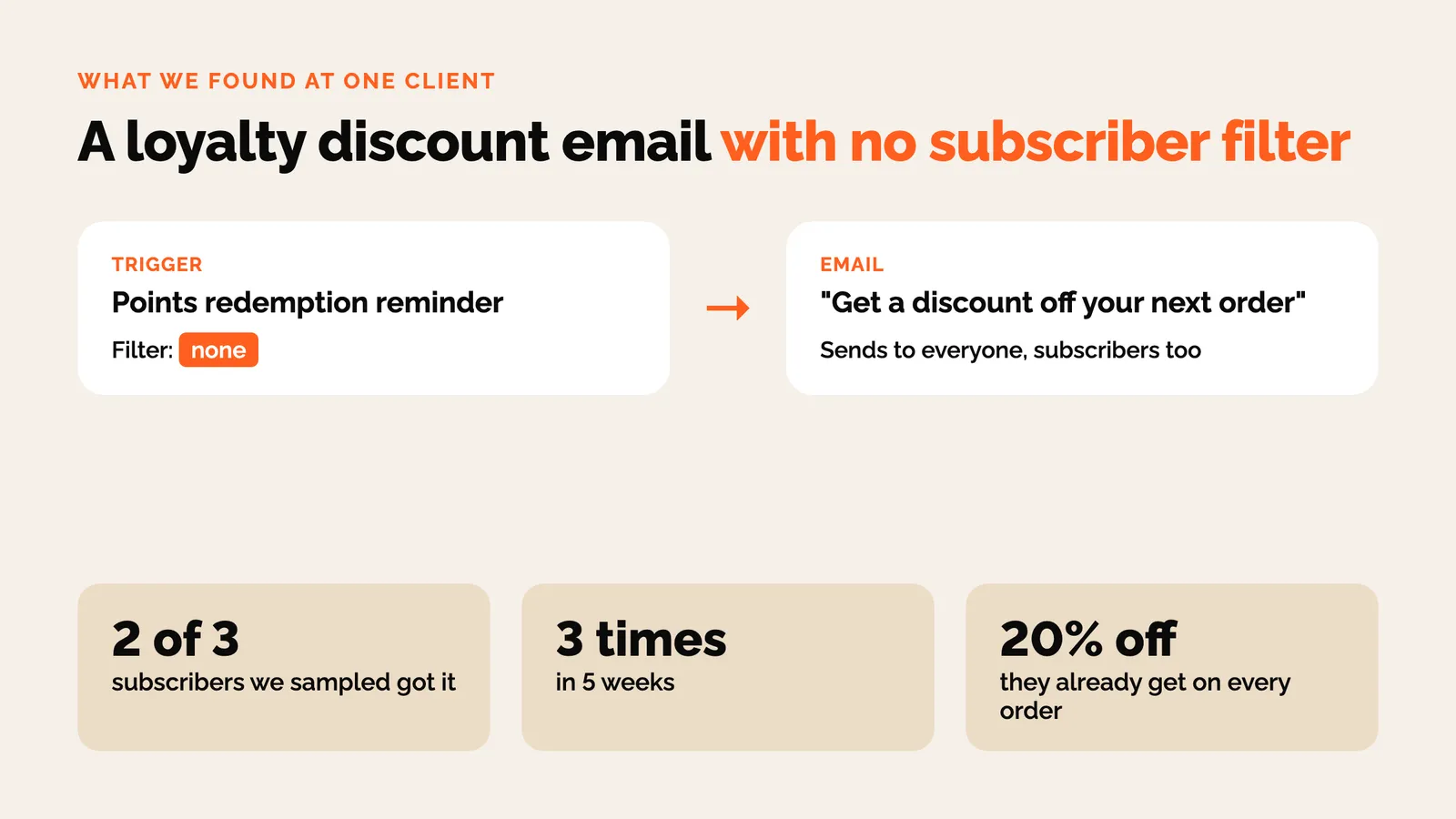
- At one of our brands, a loyalty discount email reached 2 of 3 sampled subscribers 3 times in 5 weeks, on top of 20% off.
- One rule covers every send: no promo, sale or loyalty offer should give a subscriber a better price than their subscription.
- You can suppress subscribers from Klaviyo emails, not from the site, Instagram or ads. So the subscriber hears about the sale first.
Your subscriber pays 20% less on every order. Then the loyalty app emails them 15% off for their points. And in November a sale email offers 30% off a one-time order.
Each of those emails was set up by someone, for a good reason, for a different customer. Nobody told them who was already on subscription. Nobody checked. So your best customers, the ones already paying you every month without being asked, get a steady stream of reasons to wait for a better deal and cancel when it shows up.
This is one of the quiet causes in subscription churn. You won't find it in your cancel reasons. Nobody picks "your loyalty app emailed me".
Where discounts reach your subscribers
We check for this in every audit, and the leak is almost never the obvious campaign. Campaigns, cart emails and browse emails are usually already suppressed. The leak is in the sends nobody owns. Usually the loyalty app.
Loyalty and points flows
Loyalty apps like Yotpo, Smile and Swell send their own flows. Points reminders, reward available, double points this week, points expiring. Most carry a discount. Few have a subscriber filter.
At one of our brands, we pulled the email history of a few active subscribers. They were not getting campaigns, cart emails or browse emails. But 2 of 3 sampled subscribers got the loyalty discount reminder 3 times in 5 weeks, on top of their 20% subscription discount. Small sample. But the fix was one filter, and the brand signed off on it in October.
The loyalty side of this, from points that can't pay for a renewal to the email that blocks your order emails, is in subscription vs loyalty programs.
Sitewide sale codes and sale emails
Subscribe and save runs at 20 to 25% all year. Then November hits and the brand goes 40, 50, 60% off sitewide. As Matthew Holman put it: "Your 50% off sitewide sale will cancel your best customers."
The subscriber does the maths. Cancel, grab the sale, maybe come back later. Your most profitable segment walks out the door to take your least profitable offer.
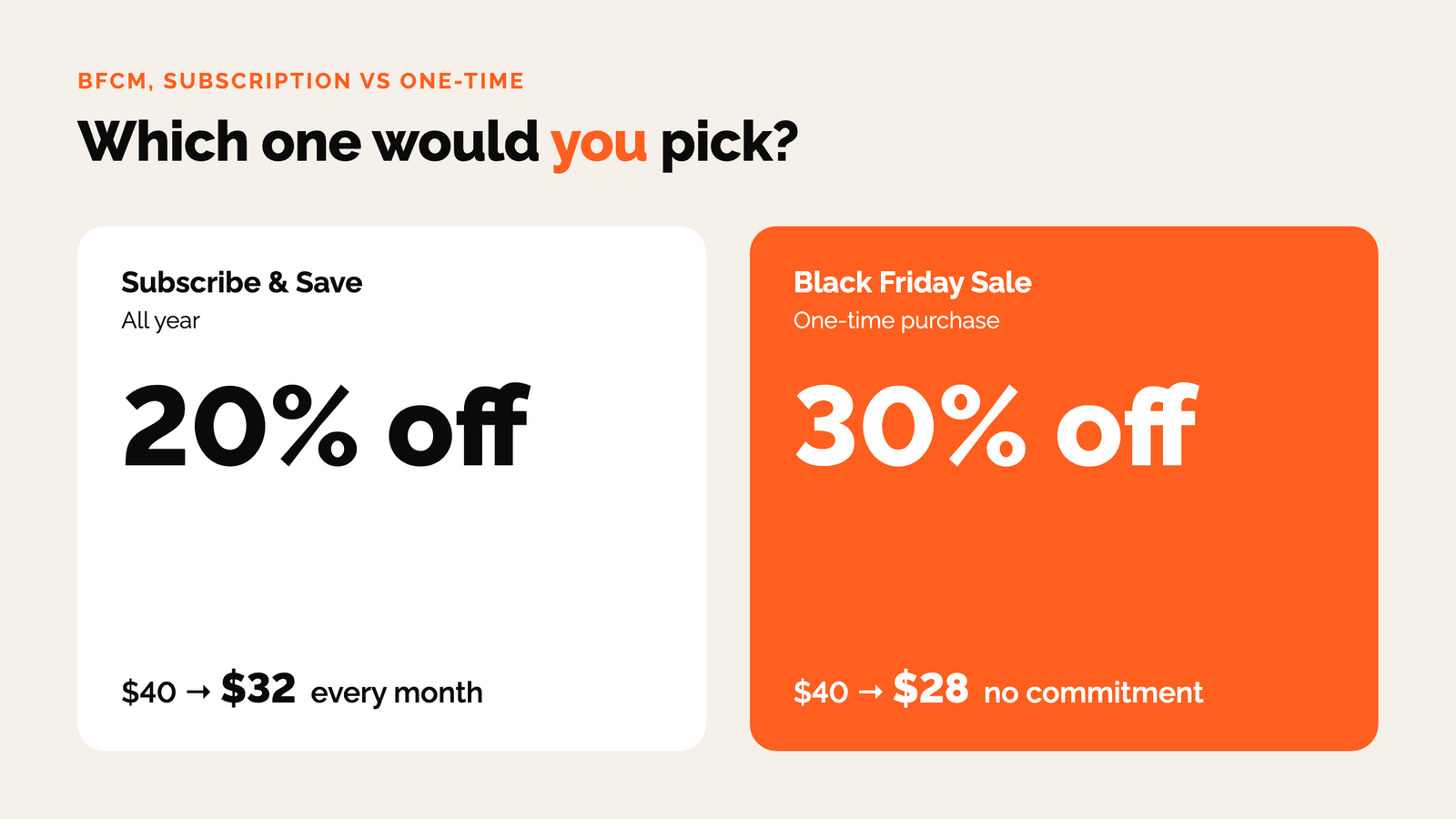
Smaller sales do it too. One brand ran BFCM at 30% on one-time against 20% on subscription. So the subscriber learns the price they pay is not the real price.
Welcome, popup and abandonment offers
First-order codes are built for people who have never bought. They tend to be the deepest offers in the account. At one brand the welcome offer went up to 47% off, so a 20% offer anywhere in the subscriber journey looked small next to it.
Cart and browse abandonment emails are the usual way a subscriber sees one. They log in to change their order, look at a new product, leave, and get 15% off by the evening. From you.
The discount code field in the portal
Some portals have a coupon field. It invites the subscriber to go find a code. They will. One of our brands on Loop removed it in a portal redesign. More on what the portal should hold is in the subscription customer portal.
Codes that carry into every renewal
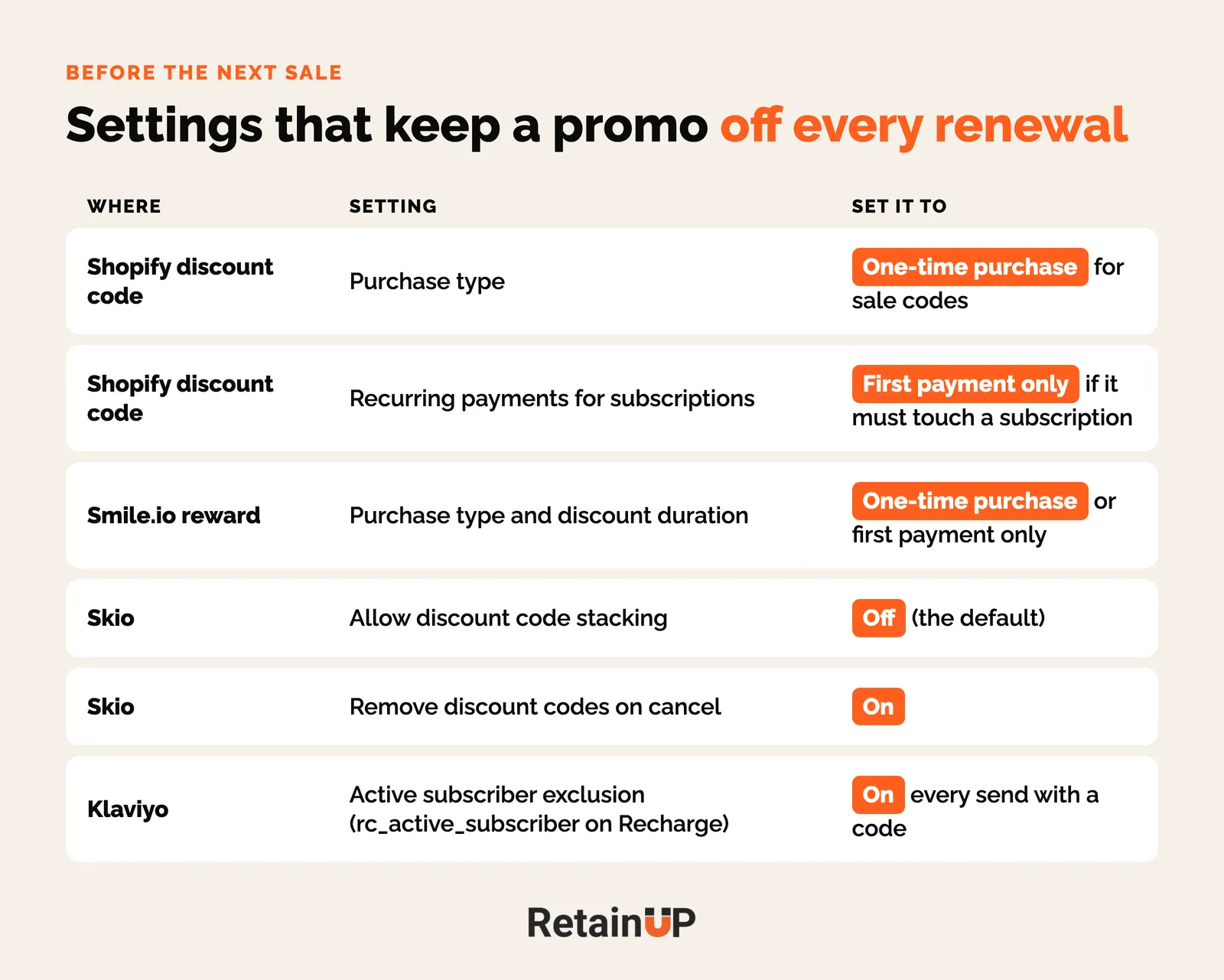
Some leaks skip the inbox. A code used on a subscription order can stay on the subscription. In Shopify, a code that applies to subscriptions has a recurring payments setting: first payment only, a set number of payments, or every payment. Set it to every payment. Now a one-off sale code is a second permanent discount on top of the subscription rate.
Loyalty rewards can too. Smile.io's help doc lists the same three choices for its rewards, plus a purchase type of one-time, subscription or both. And Skio has a setting called Allow discount code stacking. It's off by default. Keep it off. Skio can also remove discount codes when a subscription cancels, so an old code doesn't come back with a reactivation.
Why a stray code costs more than the discount
The lost margin is the small part. Every one of those emails tells a subscriber there is another discount somewhere, and teaches them to wait for it.
And subscribers don't do maths on two rates. One brand ran its loyalty app, Smile.io, at 15% while the subscription was 20%. Two different rates, two names, on the same product. The customer assumes one of them is the real deal, usually whichever one showed up in the last email.
Discounts delay churn. They don't fix it. And once a subscriber has seen 30% in their inbox, a 20% save offer in the cancel flow has no pull. The cancel offer has to beat the best price they've already seen, which is covered in cancel offers that work.
What you can suppress and what you can't
You can suppress subscribers from the email. You cannot stop them seeing the Instagram post or the site.
Your subscription app won't do this for you. Recharge and Skio handle billing. Not retention. So there are two jobs. Both matter. Inside Klaviyo, every send with a discount gets a subscriber exclusion. Outside Klaviyo, where you can't filter by segment, the subscriber has to hear the offer first and get a version that keeps them subscribed.
Suppression rules for every flow and campaign
These are the rules we set at go-live. Minimum communication. Exclude active subscribers from campaigns and from cart and browse abandonment, and keep them out of loyalty and points discount flows. They already get the subscription discount on every order.
| Send | Active subscribers | Why |
|---|---|---|
| Sale and promo campaigns | Excluded | They get the sale first, as an add-on to their next order |
| Subscription launch and promotion campaigns | Excluded | They already subscribe |
| Cart and browse abandonment | Excluded | Built for people who have not bought |
| Welcome, popup and quiz flows with first-order codes | Excluded | Deepest offers in the account |
| Loyalty and points flows with a discount (Yotpo, Smile, Swell) | Excluded | A second rate next to the subscription rate |
| Newsletters and launches with no discount | Included, sparingly | About one email a month, kept tight for the first 6 months |
| Early access and add-on offers | Subscribers only | Rewards staying |
| Winback | Cancelled only | One planned offer, not every first-order code |
Magnet Monster's 3-bucket framework is a simple way to hold the whole list in your head. Prospects, one-timers and lapsed subscribers get all content. Active subscribers on orders 1 to 3 get onboarding only. Active subscribers with 3 or more orders get curated offers. The money's in bucket 3.
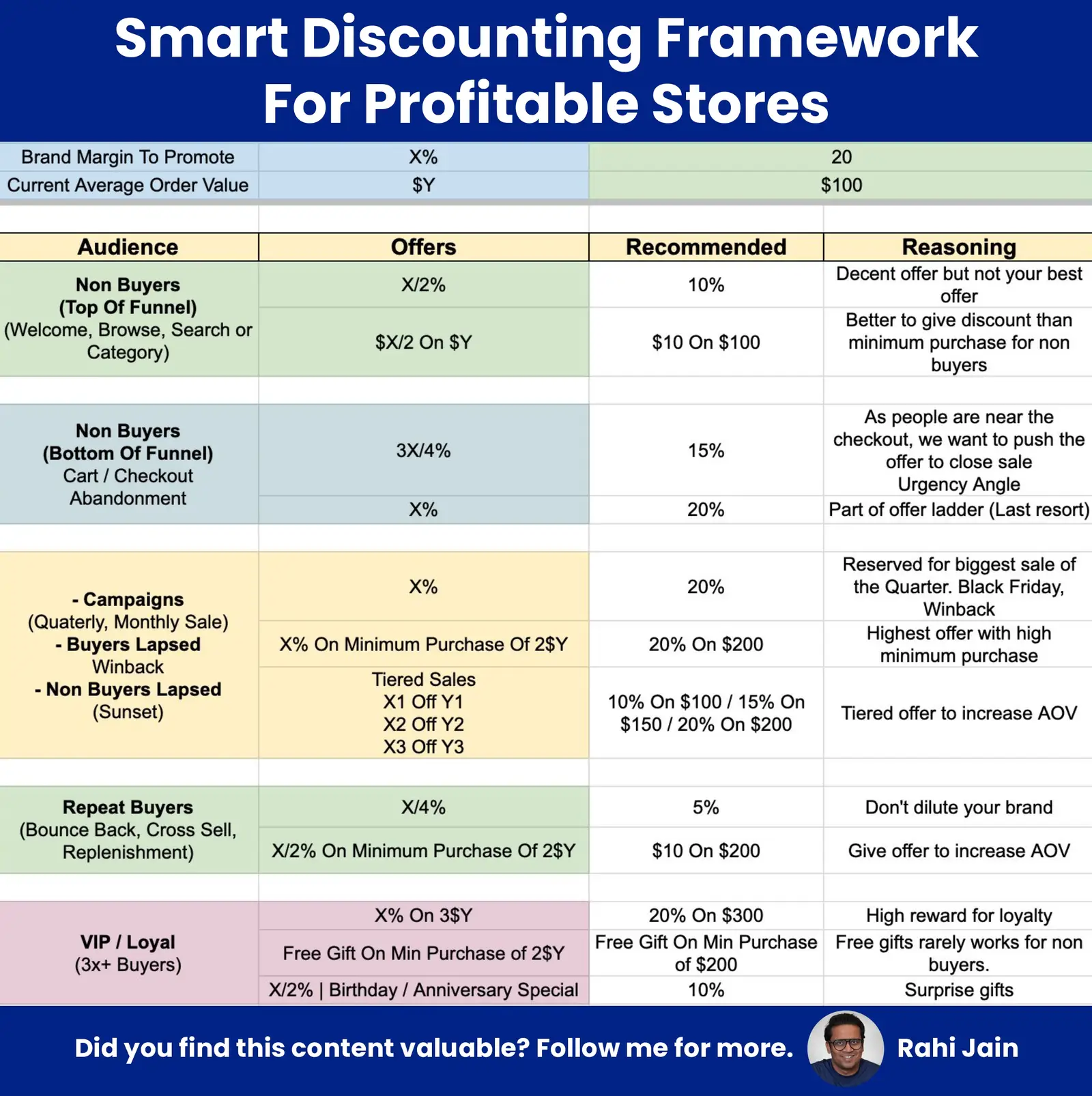
This is the framework I use to map discounts by audience. It was built for one-time stores, so there's no subscriber row. If you run subscriptions, your subscribers sit above the VIP row. They already have their rate, so they get gifts and early access, never another code.
How to build the exclusion
- One Klaviyo segment for active subscribers, fed by your subscription app. On Recharge, that's the rc_active_subscriber profile property.
- Add it as an exclusion on every campaign that carries a discount, and as a flow filter on every flow that does.
- Check how your app marks paused subscribers. They are still yours, so keep them out of discount sends too.
- Check it the week of every sale, before the first send goes out.
One brand got it right. Its standard campaign audience excluded an Active Subscribers segment built on that Recharge property, and every campaign with a discount in the subject or preheader excluded active subscribers and recent buyers. In a sample of June subscribers, discount campaigns reached a subscriber zero times before their first cancel. After the cancel, the exclusion dropped, and they got first-month offers of 30% and 20% on top of the 25% winback offer. Fine. But decide it on purpose. The planned version is in subscription winback.
If you split subscribers further, by tenure or by the sale they joined in, that's segmenting subscribers by value.
The site and ads: get to subscribers first
For the sale you can't hide, two fixes. Both come from Holman's post and from how we run BFCM with clients.
Hit subscribers first, as their own segment. Reward loyalty first. Always. The first release of the sale goes to subscribers only. "Add any item to your next order at 50% off", or "new catalog, 50% off for existing subscribers". They stock up before the public offers land, so by the time the Instagram post and the sitewide banner go live, the subscriber has already had their deal and has no reason to cancel for it. No sitewide code should beat what subscribers already pay, and the add-on can be tiered by tenure. Long-time subscribers get the bigger deal, for example 50% off the first add-on, then 20%.
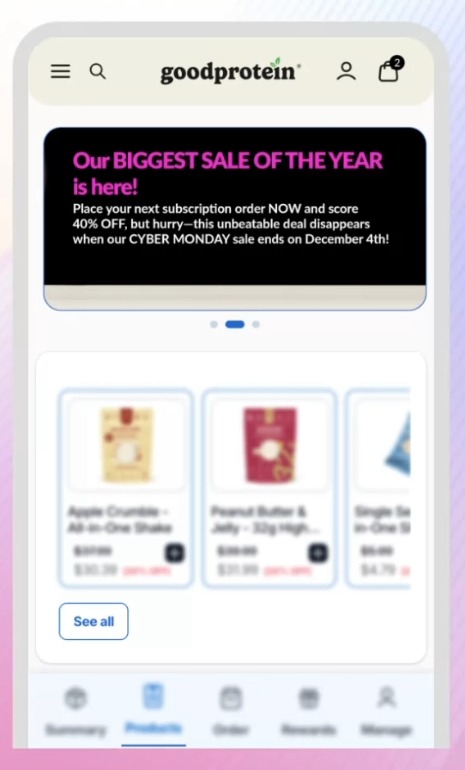
Good Protein ran it through the portal, and add-ons went from 18% to 25% of subscription revenue in its BFCM month. Then add a cancel reason that only lives during the sale, "I wanted the sitewide discount", and match the sale on their next order.
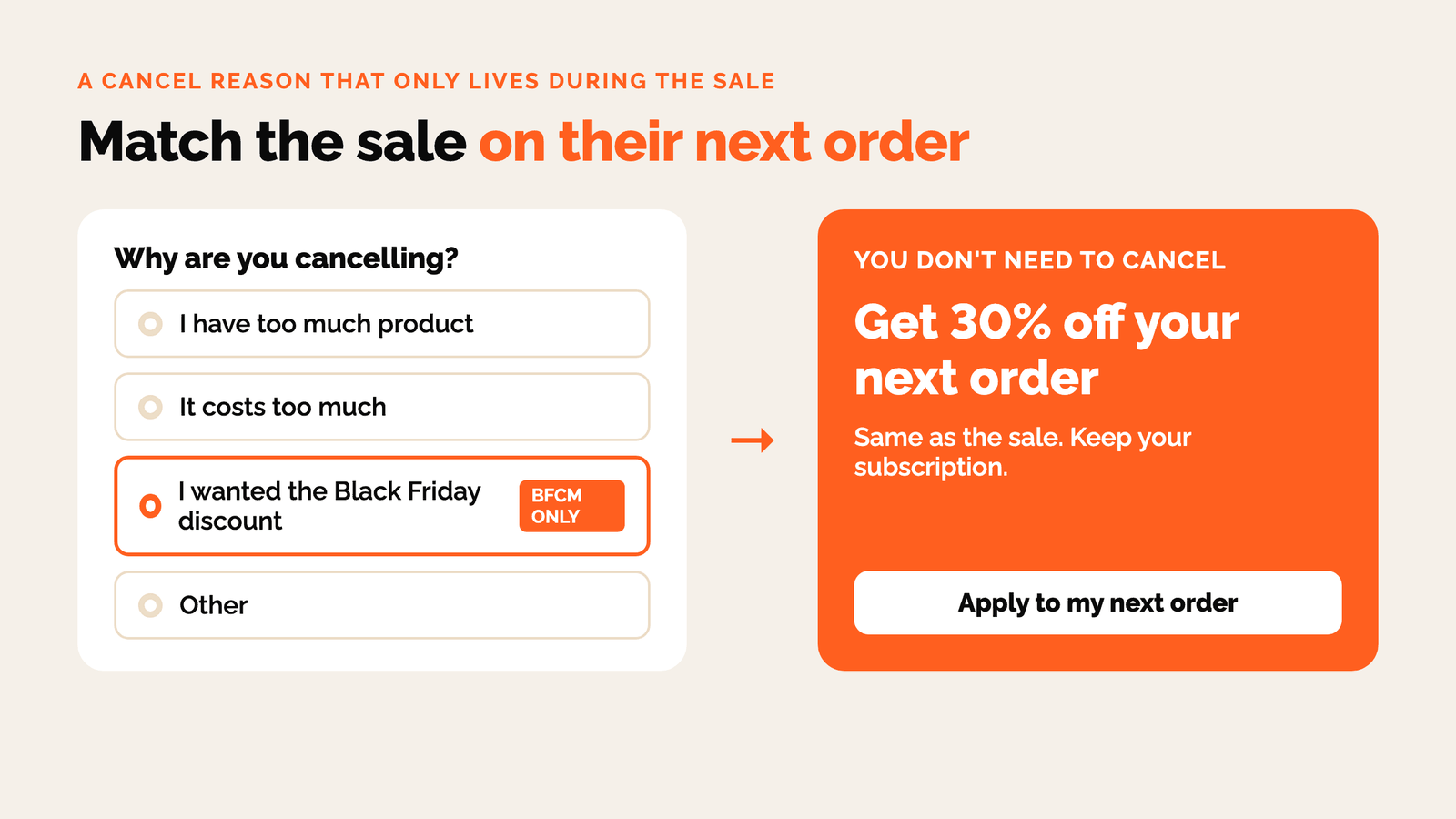
The dates, the add-on tiers and the rest of the sale plan are in BFCM for subscription brands, and the add-on side is in add-ons, cross-sell and upgrades.
One rate everywhere
Every fix above comes back to one rule. Make sure no promo, sale or loyalty offer gives a subscriber a better price than their subscription. The simplest test: does a renewal cost more than a one-time buy with a promo? If yes, you have a leak. Fix that first.
So pick one subscription rate and use it everywhere. The widget, the popup, the ads, the emails. How to pick the number is in how much to discount a subscription.
Running subscriptions and loyalty programs together? Overkill for most CPG brands. Unless your product cycle isn't subscription-friendly or you have a large catalogue, skip the points and tiers. Keep it simple. If a loyalty program stays, run rewards through the subscription. Points that can be used on renewals, milestones on the subscription itself, not a separate track with its own rate. And if the tiers stay, give them non-cash perks, with an effective value of 10 to 20% back.
How to check your account in an hour
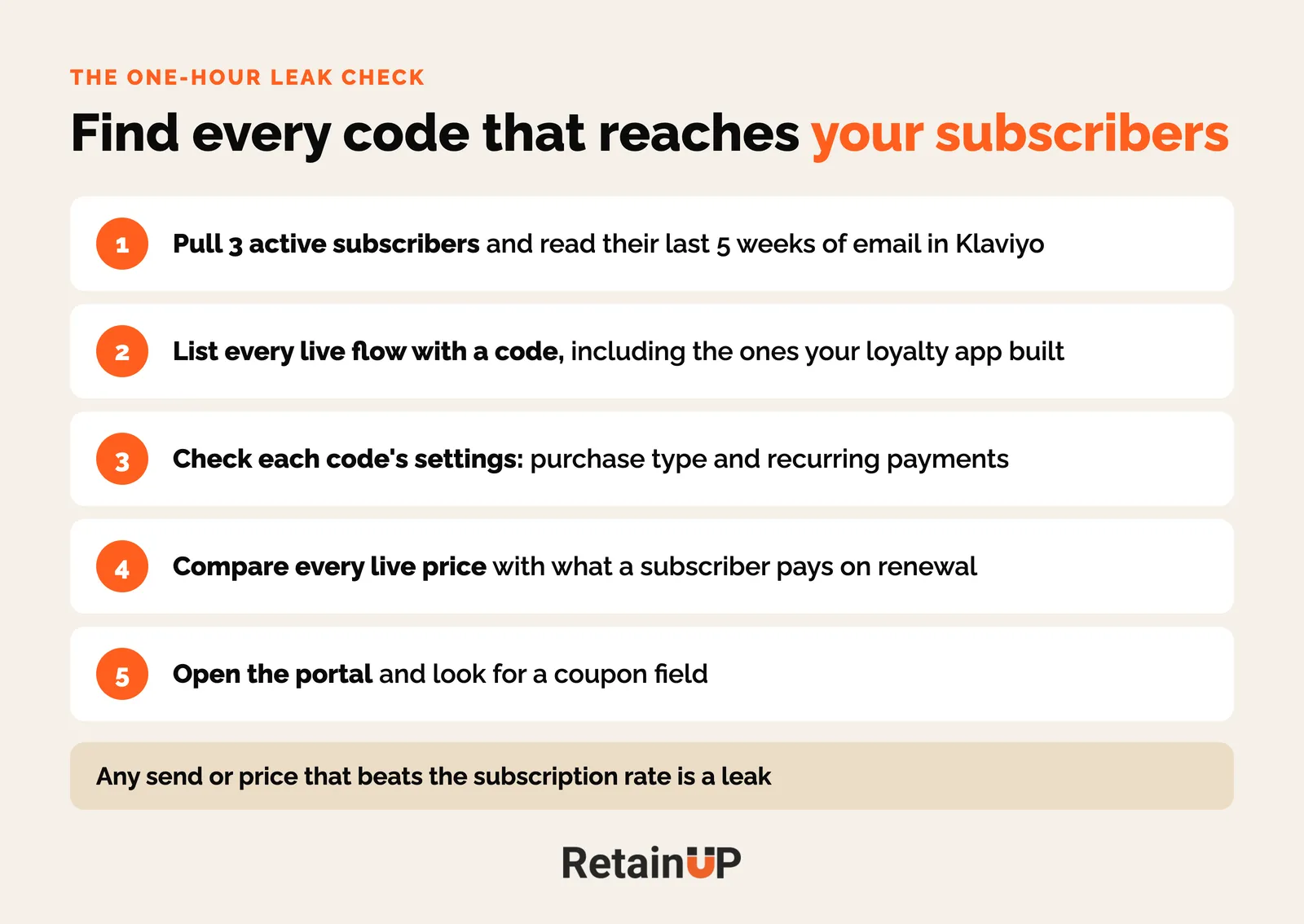
- Pick 3 active subscribers and pull their last 5 weeks of email in Klaviyo. Anything with a code is a leak.
- List every live flow that carries a discount, including the ones your loyalty app built. Check each one for a subscriber filter.
- Write down every live code and sale price, and compare each with what a subscriber pays on renewal.
- Open every live code in Shopify and check its purchase type and recurring payments setting.
- Open the customer portal and look for a coupon field.
- Before the next sale, check the exclusion on every send in the calendar.
Three is a small sample. I know. It was enough to find the loyalty leak at that brand, though, because the flow had no filter at all.
In the Subscription LTV Optimizer™, we check your store, subscription app and Klaviyo every month, including every send that can reach a subscriber with a discount, and ship the fixes. It's for brands with 5,000+ active subscribers, at $3,000 a month. If you want the top leaks first, the free subscription audit covers 48 checkpoints and comes back in 24 hours.
FAQ
Should I send discount emails to my subscribers?
No, not the ones built for other customers. Your subscribers already get the subscription discount on every order, so a sale, loyalty or abandonment code only tells them there is a better price somewhere. Exclude active subscribers from every send with a discount. Give them early access and add-ons to their next order instead, so they get something before the public offer lands.
How do I exclude subscribers from Klaviyo campaigns?
Build one segment of active subscribers from your subscription app's data and add it as an exclusion. On Recharge, the rc_active_subscriber profile property works. Add the same condition as a filter on every flow that carries a discount, including loyalty app flows. Keep paused and skipped subscribers in the segment, and check it before every sale.
Will a Black Friday sale make my subscribers cancel?
It can, when the sale beats the subscription price. A subscriber on 20% off who sees 40 or 50% sitewide can cancel, buy at the sale price and maybe come back later. Send subscribers their own offer first, as an add-on to their next order, and add a sale-only cancel reason that matches the sale on their next order.
Should loyalty points work on subscription orders?
Yes, if you run both. Points that can't be used on renewals push subscribers to buy one-time to spend them, and a separate loyalty rate sits next to the subscription rate as a second price. Run rewards through the subscription where you can, and keep loyalty discount emails away from active subscribers.
Do discount codes apply to subscription renewals?
They can. In Shopify, a code that applies to subscriptions has a recurring payments setting, and if it's set to every payment, the code stays on each renewal on top of the subscription discount. For sale codes, set the purchase type to one-time purchase. If a code has to touch a subscription, limit it to the first payment. Loyalty apps like Smile.io have the same setting on their rewards.
One email a week on subscription retention: the numbers, the strategy, and what to fix first.

Rahi Jain
Rahi Jain is a subscription LTV specialist who helps $1M to $10M DTC brands reduce subscription churn and maximize LTV on Recharge, Skio, Stay AI and Loop.
More about Rahi