Key takeaways
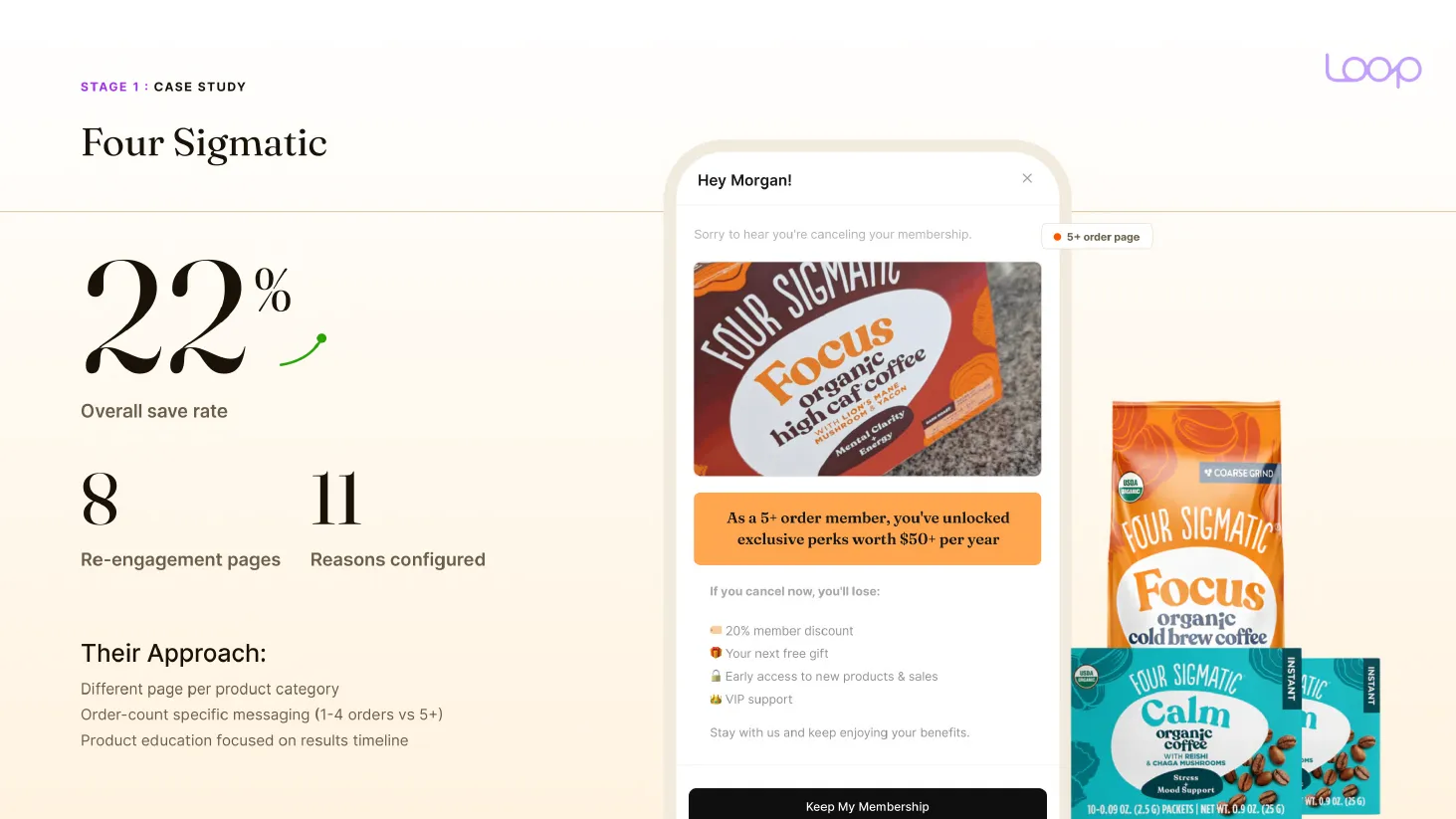
- Four Sigmatic split cancel screens by order count, 1 to 4 orders vs 5+, and saved 22% of cancel attempts overall.
- A BFCM subscriber with high lifetime value goes to the loyal cancel profile, not the BFCM one. Value overrides the sale tag.
- Cancel offers by segment: 10% for regular subscribers, 20% for VIPs. Winback: 20% regular, 30% VIP.
A subscriber who has been with you for ten months and one who joined last Friday at the Black Friday price both show up in your app as "active". Same status. Same reminder email. Same cancel flow.
They are not the same customer. And treating them the same costs you on both ends.
So this article is about splitting your active subscribers by what they are worth to you, then giving each group its own cancel profile, offer and payment rules. It sits in the subscription retention hub. The cancel flow itself, the winback and the retry schedule each have their own page. Here you only decide who gets which version.
Why most segmentation never pays
After working with 100+ brands, I realized segmentation is a story that sells. But rarely delivers. Brands love to obsess over it. 5, 10, 15 segments. It feels smart, but rarely works.
Recently we started working with a brand that had built over 20 segments. They were sending every single campaign to all 20. Same offer, same subject line. That doesn't make any sense. What's the point? You don't need ten segments if you're sending one story.
Before you build a segment, ask three things:
- Message. What will I say to them that's different from everyone else?
- Bandwidth. Can my team support it? Each segment needs new creative, new logic and new reports.
- Data. Is the data accurate enough to matter? Most segmentation is guesswork dressed up as data.
Any of those a no? Don't segment.
For subscribers, the bar is easier to clear. The message really is different. A new subscriber needs to hear that results take time. A ten-month subscriber needs to hear that you noticed. And the stakes per person are higher, because the card is already on file.

The subscriber segments worth building
You need a handful. Unless you have a huge base. These are the ones that change what a subscriber sees.
New subscribers, orders 1 and 2
Still deciding if the product works. Someone who cancels in the first 30 or 90 days rarely reactivates. So the save has to happen here, or earlier in onboarding. Be more aggressive with this group. They need more time with the product.
Loyal subscribers and VIPs
The general VIP rule we start from: at least 3 orders in the last 16 weeks and a revenue total of at least 3x AOV. For subscribers, order count does most of the work. Loop and Four Sigmatic both draw the line at order 5.
Thomas Lalas put it simply. Don't treat a veteran who has spent $1,000 the same as someone who just purchased. Cut veterans some slack. Just don't annoy them.
Deal seekers and the BFCM cohort
Deep first-order discounts bring deal seekers. They take the discount and cancel the same day. BFCM buyers tend to be your lowest-retention audience, so track that cohort on its own. Compare it to an October cohort at day 30, 60 and 90.
Payment failed
A subscriber whose card failed never chose to leave. They're interrupted, not gone. They get their own rules, covered below.
Product and plan
Four Sigmatic runs a different cancel page per product category. That's a segment too. And so is the plan: a prepaid subscriber and a monthly one are at different decisions, which is why Skio lets a cancel flow check whether the subscription is a prepaid renewal. Recharge also sends the frequency of each active subscription into Klaviyo, so you can find people whose interval is too long or too short for how fast the product runs out (Recharge changelog). Those get a frequency change, not a discount. How to set the right one is in subscription frequency.
Known exploiters
Coupon hunters, trial cyclers and refund abusers. They should not receive winback offers at all. Suppress them. Or route them to stricter terms.
Lifetime value overrides the sale tag
This is the rule people miss. So a tag says how someone joined. Their order history says what they are worth now.
Take a subscriber who has been with you for ten months and bought a bundle during BFCM. Your app tags them as BFCM. If your cancel flow reads that tag, they get the deal-seeker treatment: no discount, a delay button, a video saying the price won't come back until next year.
A 10-month subscriber who bought during BFCM is not a deal seeker. Let unit economics decide. So a BFCM subscriber with high lifetime value goes to the loyal profile.
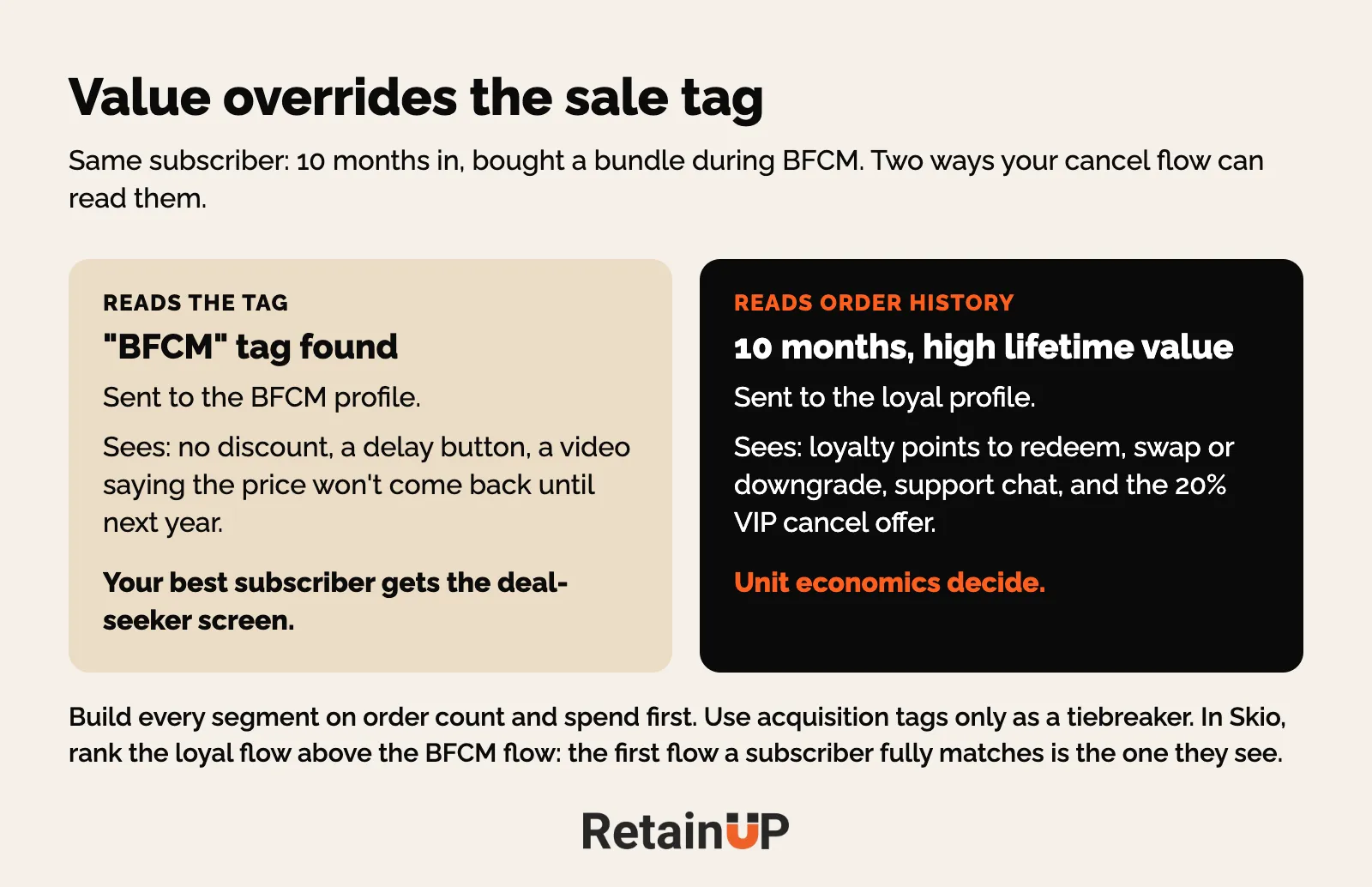
And the same logic works the other way round. Someone who joined at full price in March and cancels before order 2 belongs with the new subscribers, whatever their tag says. Build every segment on order count and spend first, and use acquisition tags only as a tiebreaker.
Cancel profiles by segment
One cancel profile per segment. Six cover almost every BFCM cancel reason, and you build the BFCM cohort first. This comes from Loop's partner BFCM webinar in October 2026. The screens, copy and offers inside each profile are in the subscription cancel flow.
| Segment | Offers, in order |
|---|---|
| BFCM cohort before order 2 | No discount. Delay, change frequency, skip next payment |
| Loyal subscribers | Redeem loyalty points, swap or downgrade, support chat |
| Payment failed | Update card with an offer, skip next payment |
| Multi-item or multi-subscription | Swap or drop one item, change frequency |
| Tried to cancel in the last 30 days | One offer only (skip or pause), with a short video |
| Everyone else | Skip, change frequency, pause, learn more |
The BFCM cohort gets no extra discount because they already paid the sale price. The video on their cancel screen says it plainly: "You got our best price of the year. It won't come back until next BFCM."
Different subscribers see different content
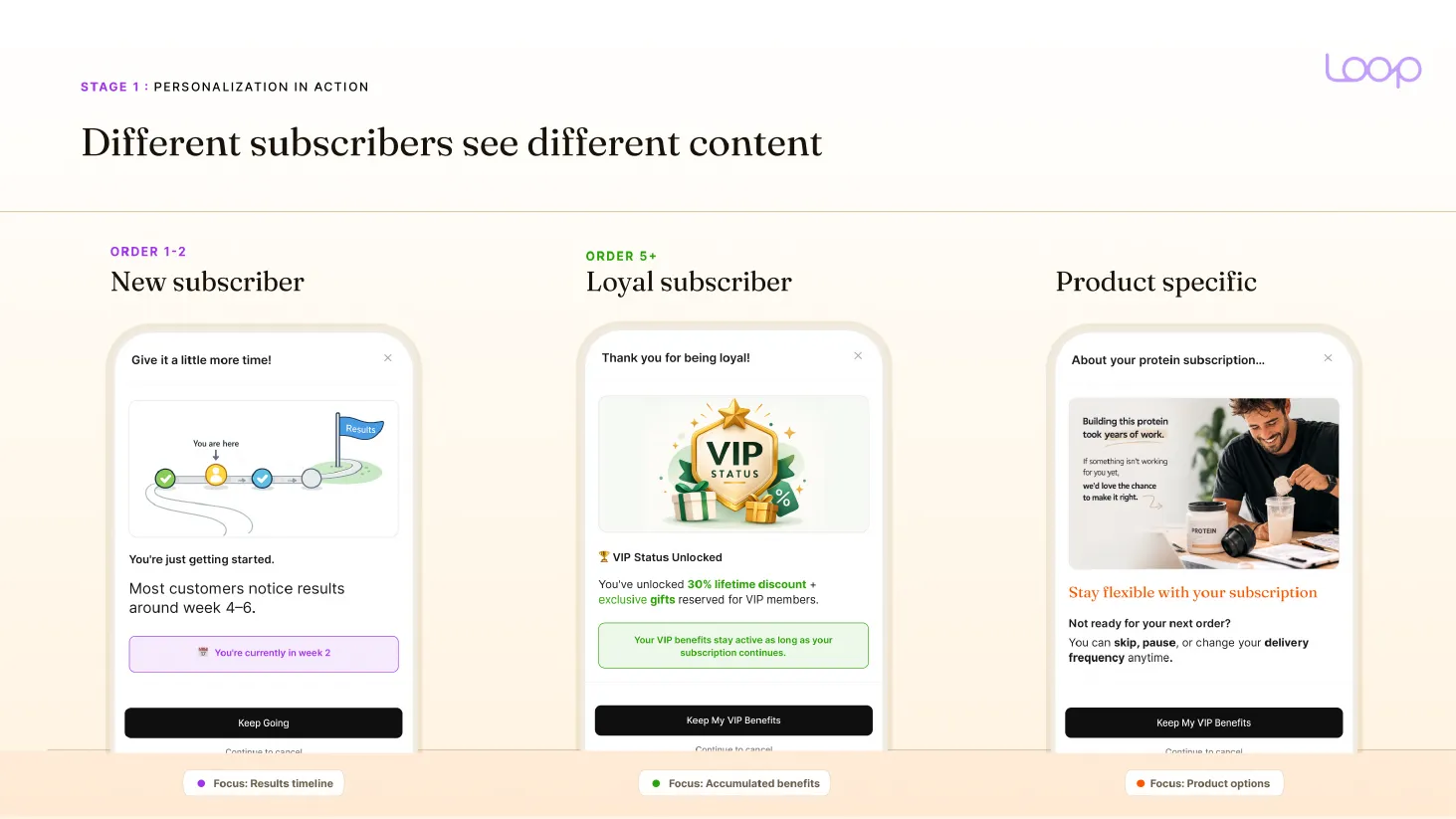
Inside the flow, the content changes with tenure too. Orders 1 and 2 see the results timeline: "Most customers notice results around week 4-6. You're currently in week 2." And orders 5 and up see what they have built up, their VIP status and the perks that go with it.
Four Sigmatic runs this on Loop. 8 re-engagement pages, 11 reasons configured, a different page per product category, and order-count messaging split at 1 to 4 orders vs 5+. The 5+ page lists what they lose by leaving, perks worth $50+ a year. Overall save rate, 22%.
Offers and payment rules by segment
VIPs get bigger discounts. Price-sensitive subscribers get steeper savings. That part is easy to agree with. Where brands slip is the order of offers across the year, so here are the ceilings we use.
| Moment | Regular subscriber | VIP |
|---|---|---|
| Payment failed or pause | 10% max | 10% max |
| Cancel flow | 10% | 20% |
| Winback | 20% | 30% |
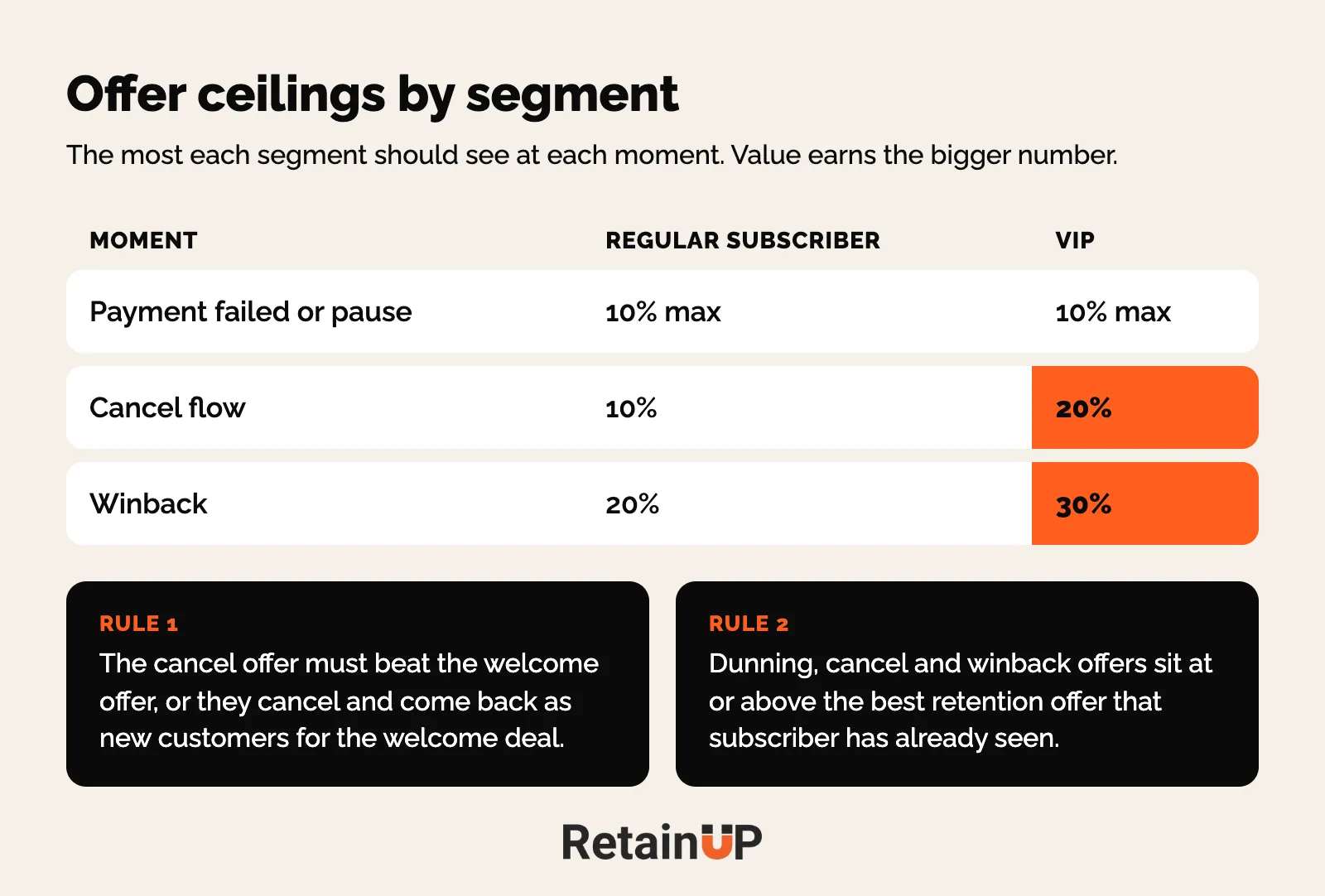
So two rules sit on top. The cancel offer must beat the welcome offer, or they cancel and come back as new customers for the welcome deal. And any special-case offer, dunning, cancel or winback, should be equal to or above the best retention offer that subscriber has already seen. More on that in cancel offers that work.
Retry rules are a segment too
Split failed payments by reason before you split by value. Insufficient funds: retry silently first, and around the holidays save some retries for January. Hard declines: skip the retries and send a card-update link right away. Discount last: silent retries, then a reminder, then a discount, then a bigger discount. The schedules per app are in payment retry schedules that work.
And value decides how hard you chase. A long-tenured subscriber with a dead card is worth an SMS and a personal note. A first-order deal seeker usually isn't.
Add-ons and upgrades by tenure
Tier the add-on by tenure. Long-time subscribers get the bigger deal, for example 50% off the first add-on, then 20%. For the longest-tenured subscribers, 10+ orders, offer to prepay for a bigger discount. And send no upgrade offers to subscribers already at the top tier.
RFM for winback
Once a subscriber has cancelled, order count alone stops being enough. You need to know how recently they bought, how often, and how much. That's RFM. The full Excel method is in how to do RFM analysis.
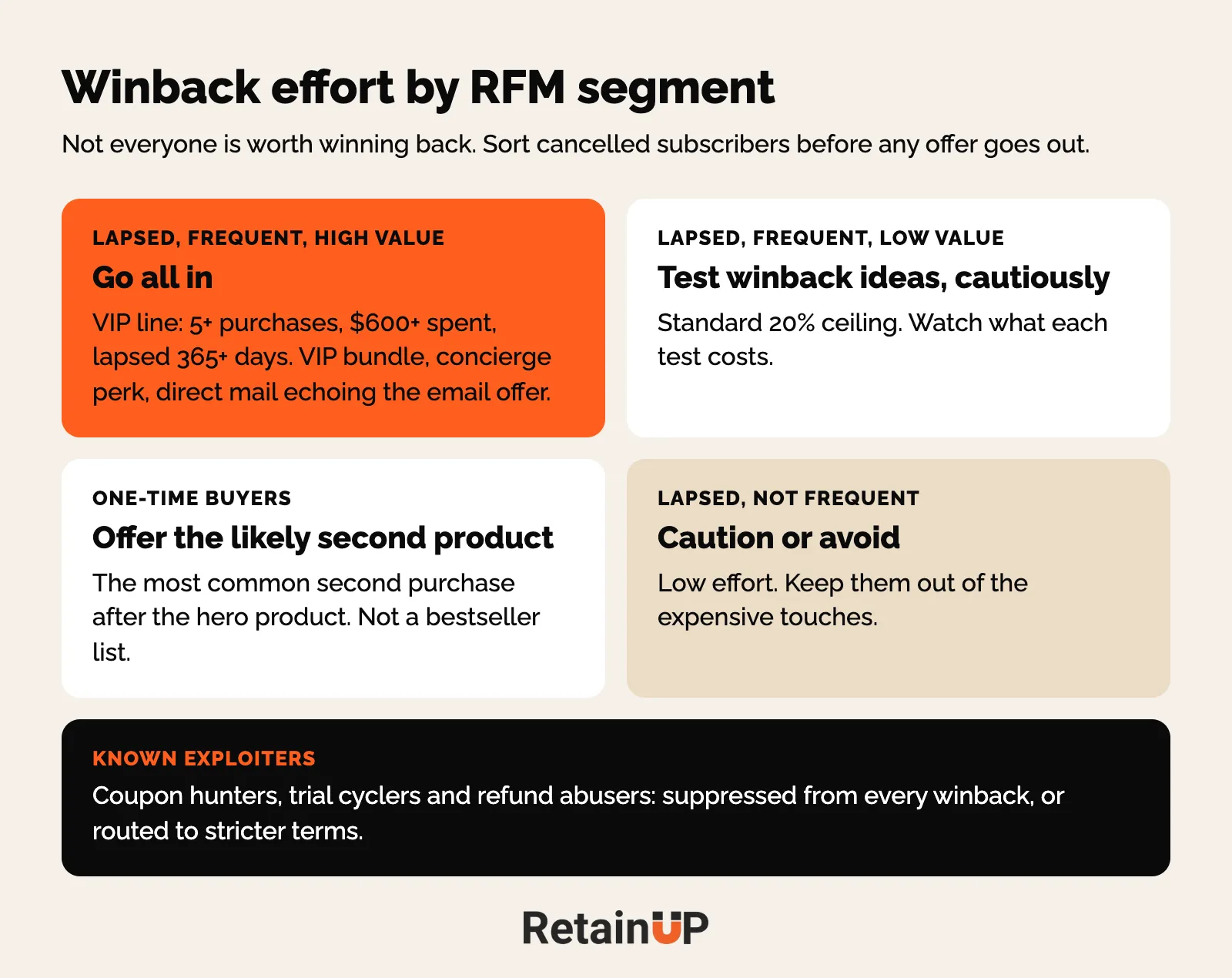
Not everyone is worth winning back. For a subscription winback, start with three buckets. 2+ orders, 1 order, 0 orders. Then add value on top.
- VIP segment, hit hardest. 5+ purchases, $600+ spent, lapsed 365+ days. Best offer: a VIP bundle, a concierge perk, and direct mail echoing the email offer. A 120-day postcard returned 8.2x ROAS in PostPilot's data, a 180-day one 6.9x.
- One-time buyers. Find the most common second purchase after the hero product. The winback offer is that product. Not a generic bestseller list. Brands commonly see a 5% topline lift from this one offer.
- Known exploiters. Suppressed.
Lapsed, frequent, high value: go all in to win them back. Lapsed, frequent, low value: test winback ideas. Cautiously. Lapsed and not frequent sits in caution or avoid.
When one of them comes back, give them a 14-day temporary VIP tier: free shipping, early access, bonus points. The flow itself, timing and touches are in subscription winback.
Catch them before they cancel
A subscriber who referred three people last quarter and has gone silent for 60 days is pre-churn, not post-churn. Because referral activity drops before the cancel does. Build a cooling-off segment for that. When referral activity goes quiet, send a real question about their experience. Not a discount. And if they cancel later? Keep them in the referral program anyway.
How to build the segments in Klaviyo and your subscription app
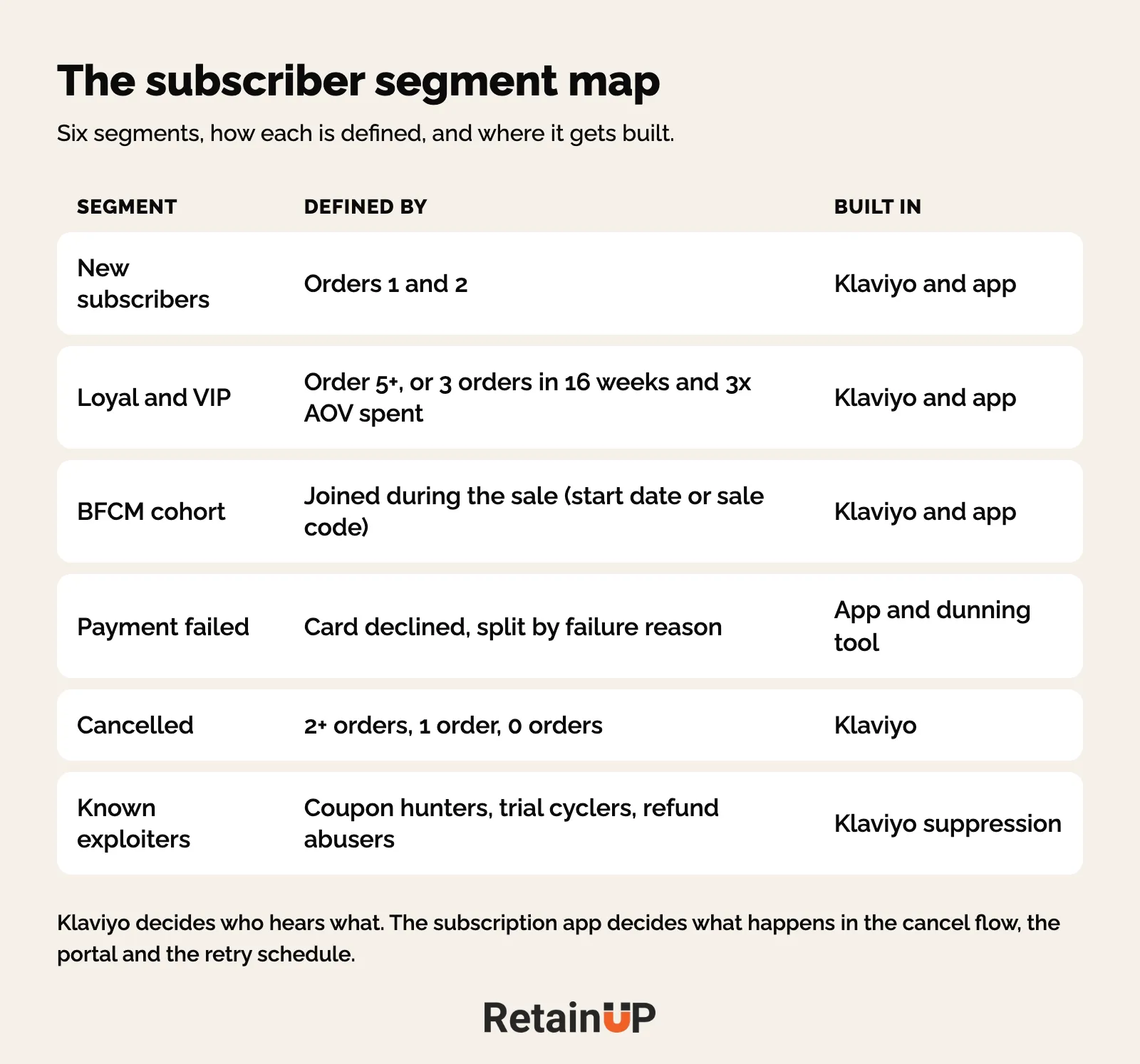
Two places, two jobs. Klaviyo decides who hears what. The subscription app decides what happens in the cancel flow, the portal and the retry schedule.
In Klaviyo
Always work with segments, not lists. Segments update on their own as people order or lapse. Lists are static. So use them only for imports. Your subscription app sends its events and profile data into Klaviyo, and that is what the segments are built on. Which app sends what is in subscription app events in Klaviyo.
- Active subscribers, excluded from campaigns and from cart and browse abandonment flows
- New subscribers, orders 1 and 2
- Loyal subscribers, order 5 and up, or past your VIP spend line
- BFCM cohort, joined during the sale
- Cancelled, split into 2+ orders, 1 order and 0 orders
- Known exploiters, suppressed from every winback
For the active subscriber exclusion, Recharge writes rc_active_subscriber to each profile and Skio writes skio_hasActiveSubscription. Both can lag. Users on the Klaviyo community report profiles still showing true after a cancel, so check the segment size against the active count in your app before you trust it.
Keep loyalty and sitewide discount emails away from active subscribers. We once found a brand sending them three times in five weeks on top of the subscription discount. That leak has its own page, keeping discounts away from your subscribers.
In the subscription app
The app is where the cancel profiles live, and each one targets segments a little differently.
- Loop calls them cancellation profiles. You can target by number of orders, subscription content, customer tags and subscription spend (Loop product update).
- Skio runs several cancel flows with entry conditions: order number, total value, creation date, discount code, loyalty tier, customer tag and product, among others. More specific flows are checked before broader ones, and anyone who matches nothing falls to the default flow (Skio help centre).
- Recharge leans on Shopify customer tags. Tag your VIPs so the cancellation flow can give them the more generous offer.
So the BFCM cohort can be a creation date or the sale's discount code, and the loyal profile an order number. Set one per segment from the table above, then check which profile each test subscriber actually lands in. A ten-month subscriber with a BFCM tag is the one to test first.
And if you want segments built for you, apps like Peel Insights, Tresl Segments and Stay AI do it. You don't need one to start. Order count and total spent get you most of the way.
Check it monthly
So look at the MRR of cancelled vs saved, not only the save rate. The session count can look fine while high-value subscribers walk. Then compare month 1 to 3 against month 4+. Different cohorts need different treatments, and the cohort table shows you which.
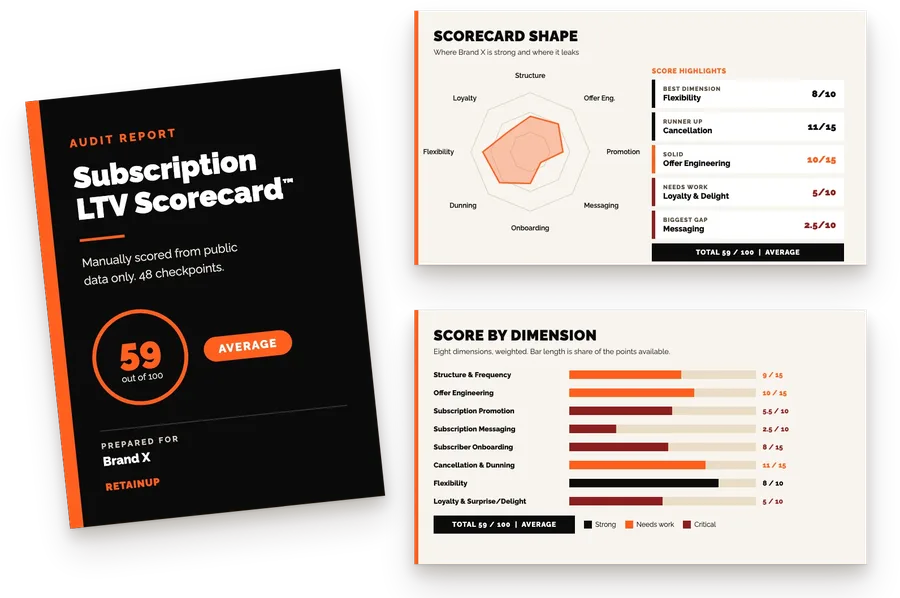
We build the segments, cancel profiles, offers and payment rules for subscription brands in the Subscription LTV Maximizer™, on Recharge, Skio, Stay AI or Loop, with email and SMS, live in 30 days for $5,000. If you want to see first where your segments leak, the free subscription audit checks 48 points and sends your top 3 leaks in 24 hours.
FAQ
How do I segment subscribers by value?
Segment subscribers by order count and total spent first, then by how they joined. New subscribers on orders 1 and 2, loyal subscribers from order 5 or past three times your AOV, a BFCM cohort, failed payments and known exploiters. Each group gets its own cancel profile, offer ceiling and winback. Keep it to a handful you can actually run.
Should VIP subscribers get a bigger cancel discount?
Yes. VIP subscribers should get a bigger cancel discount than regular subscribers. We use 10% for regular subscribers and 20% for VIPs in the cancel flow, and 20% vs 30% in winback. A veteran who has spent $1,000 is worth more than a first-order buyer, and the offer should say so. Keep the cancel offer above the welcome offer.
How should I treat subscribers who joined on Black Friday?
Subscribers who joined on Black Friday should get no extra discount in the cancel flow before order 2. They already paid the sale price. Offer delay, frequency change and skip instead. The exception is a BFCM subscriber with high lifetime value, such as a ten-month subscriber who bought during the sale. They go to the loyal profile.
What is RFM segmentation for subscription winback?
RFM segmentation scores cancelled subscribers on recency, frequency and money spent, so the winback effort goes where it pays. Start with 2+ orders, 1 order and 0 orders. Hit the VIP group hardest, for example 5+ purchases and $600+ spent. Offer one-time buyers their most likely second product. Suppress coupon hunters and refund abusers entirely.
How many subscriber segments do I need?
Most subscription brands need five or six subscriber segments, not twenty. If you can't say something different to a segment, or your team can't run it, don't build it. New, loyal, BFCM cohort, payment failed, cancelled by order count and exploiters cover almost every decision in the cancel flow, offers and winback.
One email a week on subscription retention: the numbers, the strategy, and what to fix first.

Rahi Jain
Rahi Jain is a subscription LTV specialist who helps $1M to $10M DTC brands reduce subscription churn and maximize LTV on Recharge, Skio, Stay AI and Loop.
More about Rahi