Key takeaways
- Good Protein lifted add-ons from 18% to 25% of subscription revenue in its BFCM month by selling to subscribers first.
- Boka put four add-ons under the renewal reminder. Their churn went down 18% in the next 90 days.
- On a ladder priced $45, $79 and $99, an upgrade delta of $34 or $20 lands exactly on the next tier and costs nothing.
Your best customer for a second product is the one already paying you every month. The card is on file and the next box ships anyway, so an add-on costs you no ad spend at all.
And most brands do nothing with it. The subscriber gets a reminder, a charge and a tracking link. Then the same thing again next month.
So this is the subscriber half of the Subscription Recommendation Journey™, part of the subscription retention hub. The non-subscriber half, cart, checkout and the post-purchase page, is in cart, checkout and post-purchase upsell.
Two things get mapped: the tier ladder and the product map
The goal: every customer sees exactly one offer that moves them one rung up, at the moment they are most likely to take it. For subscribers, two things get mapped.
- The tier ladder. What a subscriber holds against where they are in the journey. Pack size, plan length and volume.
- The product map. Which product recommends which. One row per product, up to fifteen or twenty, so every meaningful SKU has a named next purchase, not a generic "you may also like".
A single-SKU brand only needs the first. Most brands need both.
Pack first, catalogue second. Because a second SKU is more exciting to write and converts worse than a bigger pack of the thing they already chose.
The tier ladder for current subscribers
Draw the matrix before writing a single offer. Customer states down the side, journey stages across the top. Every cell gets an answer, including "nothing".
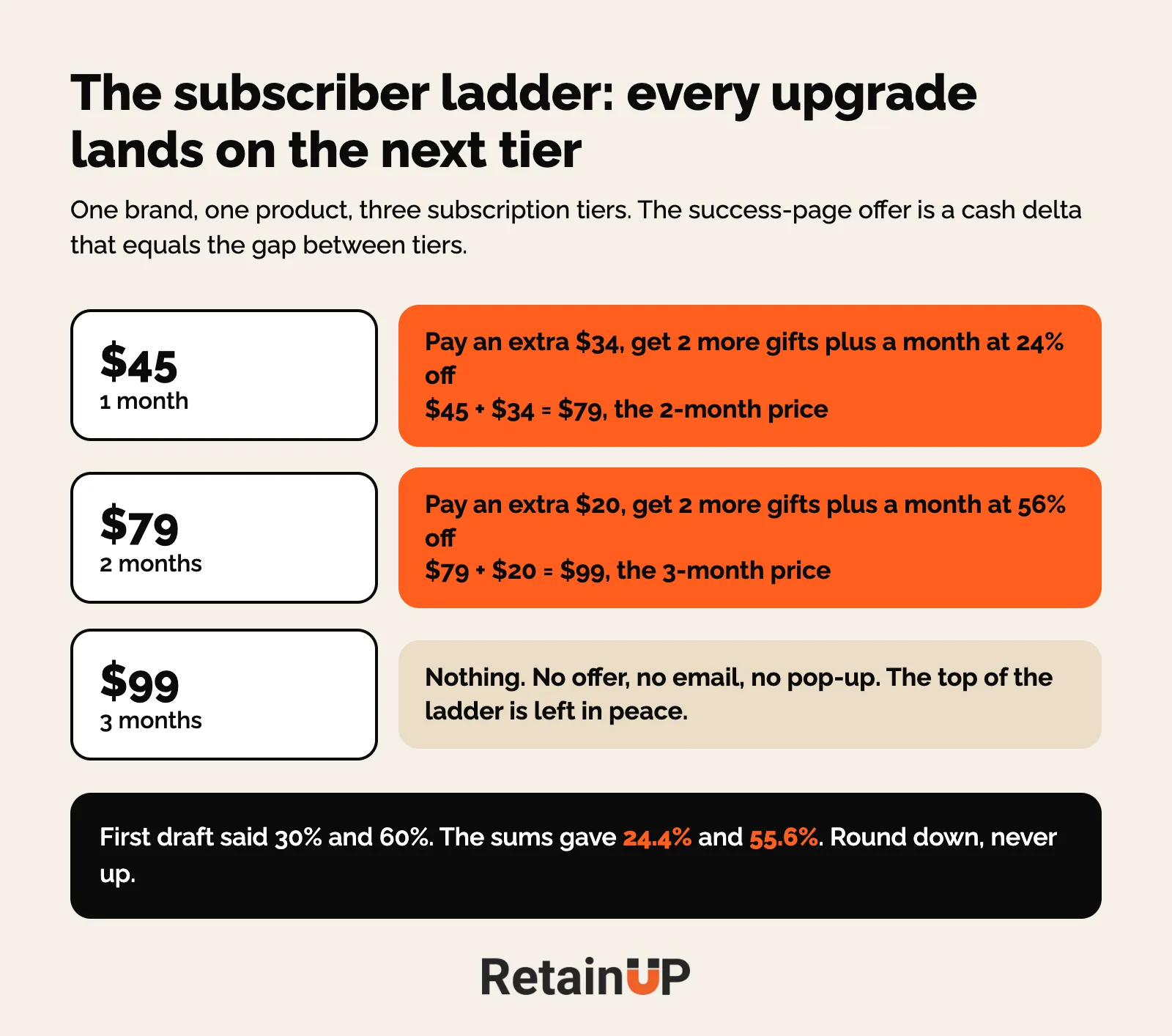
Here are the subscriber rows for one of our brands. Single product. Three subscription tiers: $45 for one month, $79 for two, $99 for three.
| Subscriber holds | Cart | Checkout | Success page | 30 days after |
|---|---|---|---|---|
| 1 month, $45 | Upgrade to 3 months, save up to 33% | Get 4 more gifts with 3 months | Pay an extra $34, get 2 more gifts plus a month at 24% off | Suppressed |
| 2 months, $79 | Upgrade to 3 months, save up to 33% | Get 2 more gifts with 3 months | Pay an extra $20, get 2 more gifts plus a month at 56% off | Suppressed |
| 3 months, $99 | Nothing | Nothing | Nothing | Nothing |
Three things to notice.
The deltas fund themselves
$45 plus $34 is $79. $79 plus $20 is $99. Both land exactly on the published tier price. So the upgrade costs nothing beyond the ladder already in place, and the extra month still reads as 24% and 56% off.
If the delta does not equal the gap between tiers, you are funding a discount on top of a ladder that already discounts. Paying twice for the same upgrade.
And check every percentage with a calculator. Our first draft on this brand claimed 30% and 60%. The sums gave 24.4% and 55.6%. So both were restated down. Round down, never up.
The 30-day column is empty on purpose
A subscriber mid-cycle already has an upgrade moment coming: the upcoming billing reminder. It converts better than a cold cross-sell. So those cells stay empty and the reminder does the work.
The top row says nothing
Fill the ceiling row first, with nothing. Writing N/A across it before anything else stops the whole build from quietly harassing your best customers.
Longer plans and tenure upgrades
The rungs do not have to be pack sizes. For a lot of brands the next rung is plan length, monthly to a 3-month supply. That trade-off has its own page, prepaid and longer plans.
The third kind of rung is a better version of the same product. Loop calls these upgrade profiles, a basic protein to the performance one at the same price per serving. Same box. One step up.
Tenure is the last one. Subscribers with 10 or more orders have shown you they stay. Offer them a prepay at a bigger discount. Good Protein saw 60% of subscribers choose a longer plan when the discount grew with the commitment.
The product map: one named next purchase per product
Once a subscriber is on the top pack, or has bought the same product twice, the ladder is done. That is when cross-sell starts.
Scope the catalogue before mapping it. Rank products by revenue and take the ones covering roughly 80% of it, capped at fifteen to twenty. A map of the full catalogue is never finished and never maintained. A map of the top twenty is both.
| Product | Revenue rank | Pack upsell | Cross-sell 1 | Cross-sell 2 | Bundle | Bought together |
|---|---|---|---|---|---|---|
| Best seller | 1 | Next pack size up | Highest co-purchase partner | Second partner | Hero bundle | n orders |
| Second product | 2 | Next pack size up | Highest co-purchase partner | Second partner | Hero bundle | n orders |
Pairings come from order data. Pull the Shopify line-item export and count what appears in the same order, and what appears in the next order within ninety days. The pairs that look obvious on a shelf are often not the pairs people buy.
Put the count in the sheet next to the pairing. So the reasoning survives after everyone has forgotten it.
The bundle column names the hero bundle a product belongs to, so the bundle offer and the cross-sell never contradict each other in the same week. Building those is in subscription bundles and build-a-box.
A soft cross-sell is the easy start. Someone buys protein powder. You recommend a shaker bottle. Grüns does it at household level: you can add a kid supply right from the cart, because kids are 90% more likely to stick with it when the parents take it too.
Keep the add-on small. Our rule is under half the price of the core product. Skio puts it at 30 to 50% of the subscription price. A $60 add-on on a $40 subscription is a second purchase decision.
And match the frequency. A 30-day supply added to a subscriber on a 60-day cycle piles up in the cupboard, and "too much product" is a cancel reason you created yourself.
Who never gets an offer
Greedy journeys break. Three rules keep this one from feeling like farming.
- Nobody is offered what they already hold. A 3-month subscriber does not see "switch to 3 months".
- Nobody at the top of the ladder is pestered. No offer, no email, no pop-up. The reward for reaching the top is being left in peace.
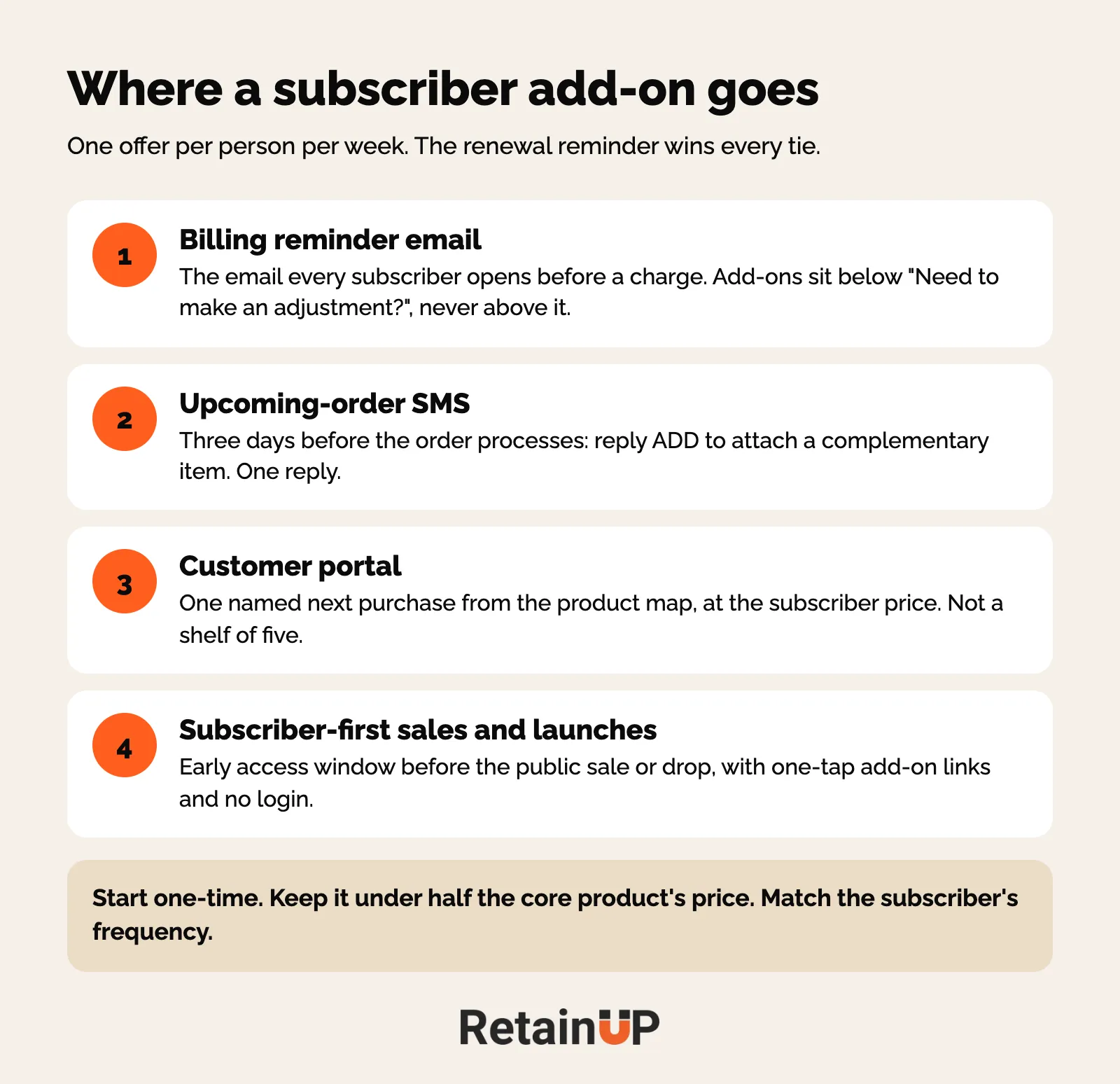
- Nobody gets two flows in the same week. One message per person per week, and the renewal reminder wins every tie.
Offering an upgrade to somebody already on the top tier is the fastest way to make a good customer feel farmed.
Build in tier-mix order. The row holding the most customers ships first. Everything else is a backlog. And keep subscribers out of the sale emails that undercut what they pay, which is its own job in keeping discounts away from your subscribers.
Add-ons and upgrades in the customer portal
The portal is where add-ons attach to the next order at zero acquisition cost. The catch? Most people only log in to cancel. Making the customer portal something they open earlier is its own job.
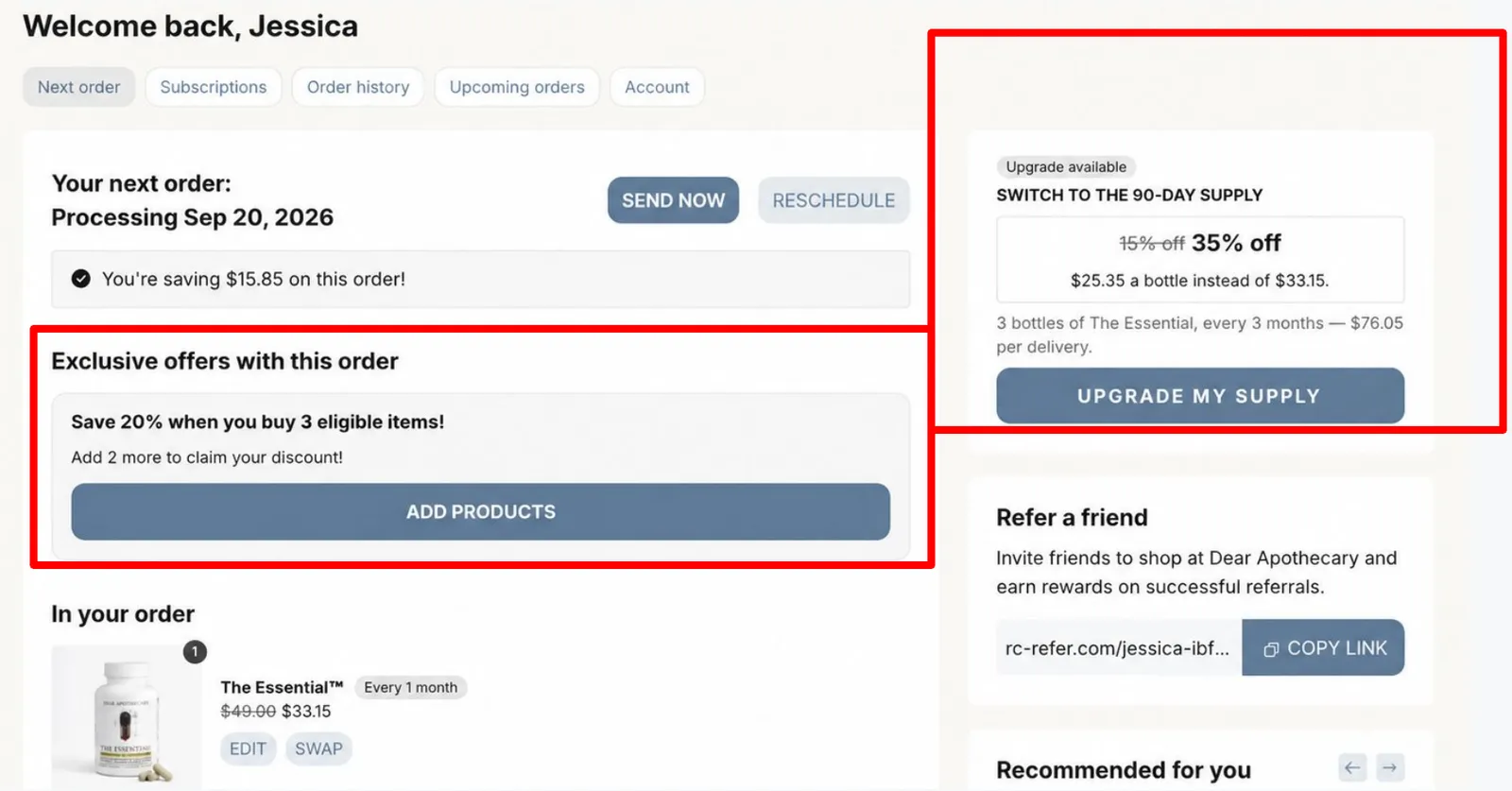
This one is from Recharge's "Upsell with Recharge" deck. Two offers, both one rung. "Switch to the 90-day supply", 35% off replacing 15% off, priced per bottle so the gap is easy to read. Below it, save 20% when you buy 3 eligible items, add 2 more to claim it.
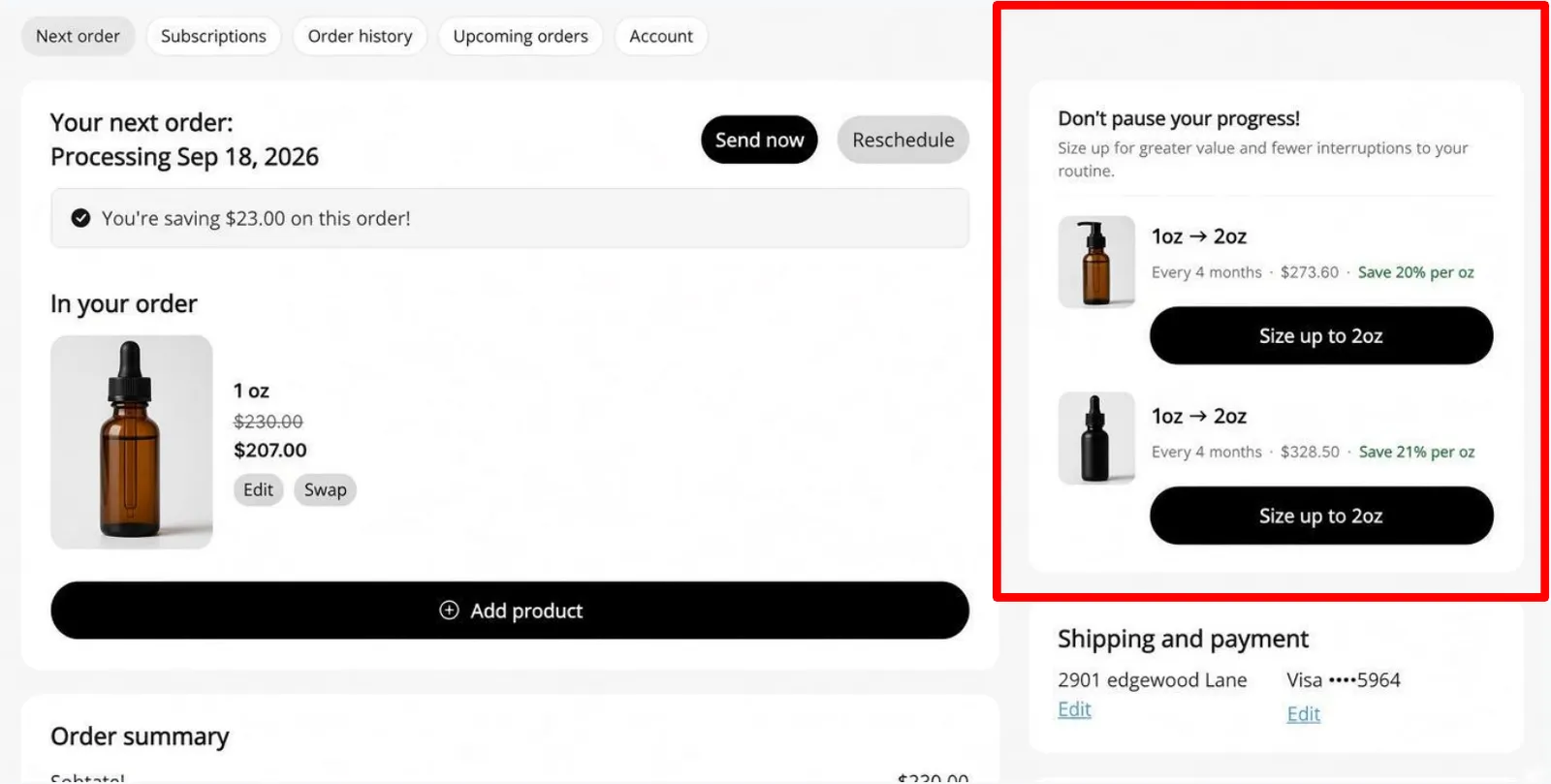
Same deck, different product. 1oz to 2oz, save 20% per oz. It sells the bigger pack as "fewer interruptions to your routine", which is the honest reason to buy it.
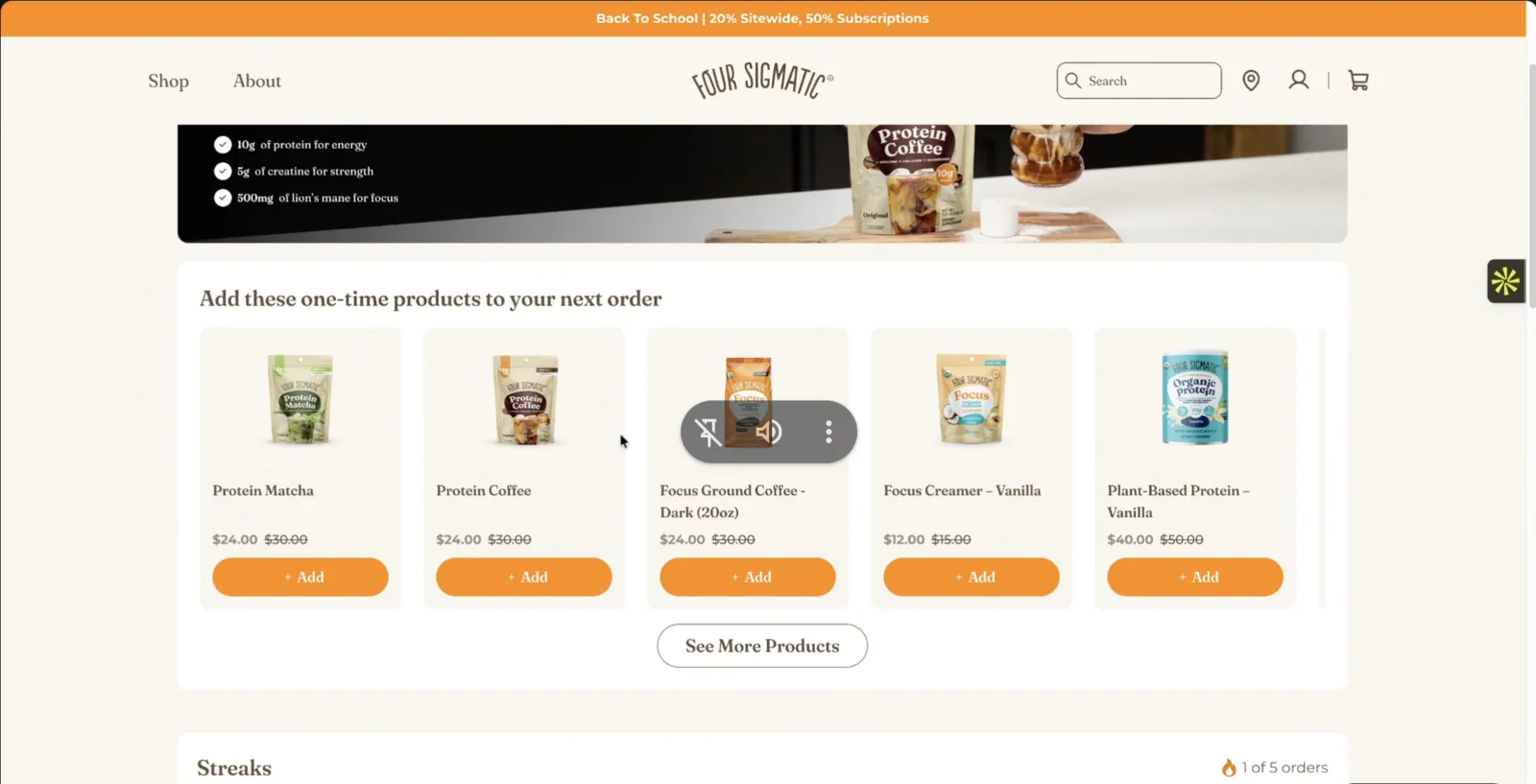
Four Sigmatic puts an add-on carousel right in the portal, "Add these one-time products to your next order", every item at the subscriber price. Under it sits a streaks tracker, 1 of 5 orders. Progress and the next thing to try on one screen. Streaks get their own section in subscription rewards.
One change I would make? Trim the carousel. Five options is a shelf. A journey names the one thing, and the product map tells you which one.
What each app supports
Recharge has an order-centric page with quantity change and send now. Loop has a Product of the Month carousel. Skio has one-time upsells, Smart Upsell and curated Swap Recommendations. Pick the one placement your app does well and build that first.
One-time add-ons first, recurring later
Start every add-on as one-time. The subscriber tries it once without changing the monthly box. Recharge and Skio both say the same, and Skio maps the path as one-time, then a repeat, then recurring. So when someone adds the same item twice, offer it on the subscription.
One Shopify catch. A post-purchase upsell can't add a second subscription to an order that already has one. AfterSell creates it in Recharge, Skio or Loop instead. Check this first.
Add-ons in the reminder email and SMS
The billing reminder is the one email every subscriber opens before a charge. They are already thinking about the next order. So that is where the add-on goes.
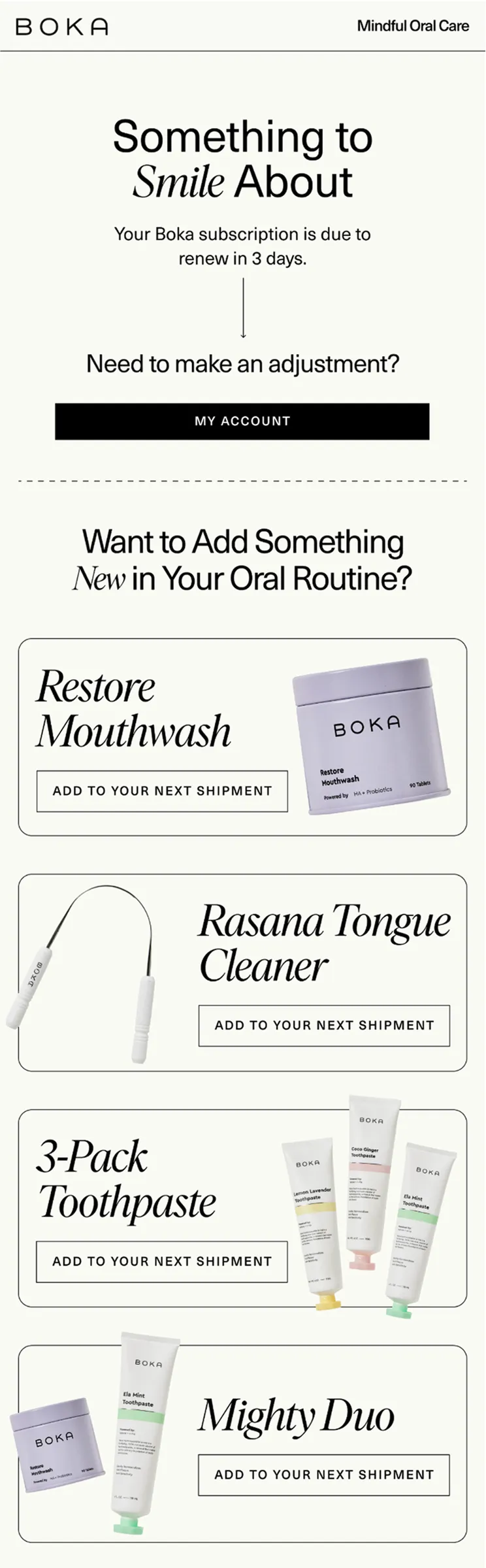
What we built for Boka. "Need to make an adjustment?" sits right under the due date, linked to their account, with snooze for 1 or 2 weeks in the footer. Below that, four add-ons: mouthwash, tongue cleaner, toothpaste packs and bundles. Churn went down 18% in 90 days, and order value per renewal went up too.
The add-ons sit below the adjustment, never above it. And when you can, put the action in the email itself. With Zaymo the subscriber upgrades inside the email, without logging into the portal.
SMS does the same with fewer words. Three days before order 2 processes, the upcoming-order text lets them reply ADD to attach a $20 complementary item. One reply.
Why order 2 is the place to start
In one model we ran, that $20 add-on took order 2 profit from $27 to $41 and moved breakeven from order 3 to order 2. A rough model. But the direction holds. An add-on early pulls payback forward, which is the whole argument in CAC payback.
Just keep it to the same product family in month one. AG1 doesn't pitch other products in week one. Ritual doesn't push extra products until the habit forms.
Subscriber-first early access add-ons
Every launch and every sale is an add-on moment, if subscribers hear about it first.
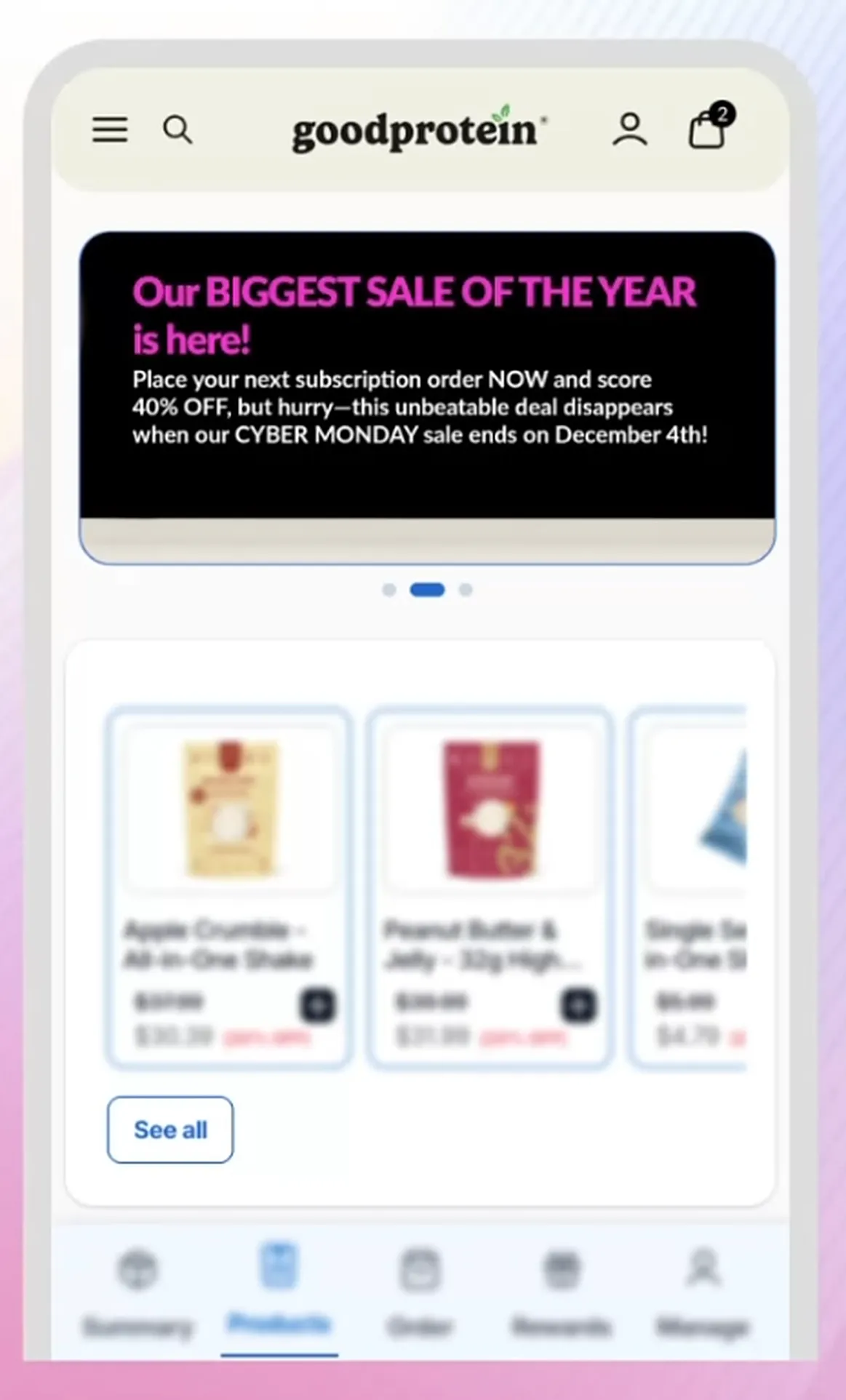
Good Protein ran a subscriber-only window before its sitewide BFCM sale. A portal banner, "Place your next subscription order NOW and score 40% OFF", with products to add right below it. Add-ons went from 18% to 25% of subscription revenue in that BFCM month, as Loop reported it.
The way they built it, from the Loop partner webinar in October 2026:
- Subscribers only, Nov 16 to 25, before the sitewide sale opens.
- A portal banner announces it in early November. Live on the 16th, down Dec 1.
- One-tap add-on links by email or SMS. No login.
- Bigger deal for longer tenure, for example 50% off the first add-on, then 20%.
The rest of the sale plan, and why a sitewide code cancels your best customers, is in BFCM for subscription brands.
Launches work the same way. Sell a limited edition to your subscribers first, as "add this to your next delivery". Dr. Squatch gives its subscribers early access to limited edition scents. Grüns drops a new limited flavour every few weeks and subscribers swap their next box to it by replying to a text.
Send that campaign 2 to 3 days before the public launch, with a subject line that makes the exclusivity clear. "You get it first."
Volume discounts on the next order
The last lever is the simplest. Reward a bigger next order.
"Save 20% when you buy 3 eligible items. Add 2 more to claim your discount." That line from the Recharge portal above names the threshold. And it shows how close the subscriber already is.
Keep the tier prices on the offer sheet, not typed into the portal by hand. The moment the portal holds its own copy of a price, the two drift apart and the customer finds the gap.
How to measure add-on revenue
Track one headline number: add-on revenue as a share of subscription revenue. That is the number Good Protein moved from 18% to 25%. Under it, watch the attach rate, the share of renewals that carry an add-on, and the average add-on value.
Skio puts most brands at 1 to 3% of subscription revenue from cross-sell, and calls 5% the point where it starts to matter. That is their own merchant base. And if lots of people attach but the share stays flat, the add-on is too cheap.
Judge it at order 3 too. An add-on that lifts the order and raises cancels the month after has cost you money. The cohort read is in Order 3 retention.
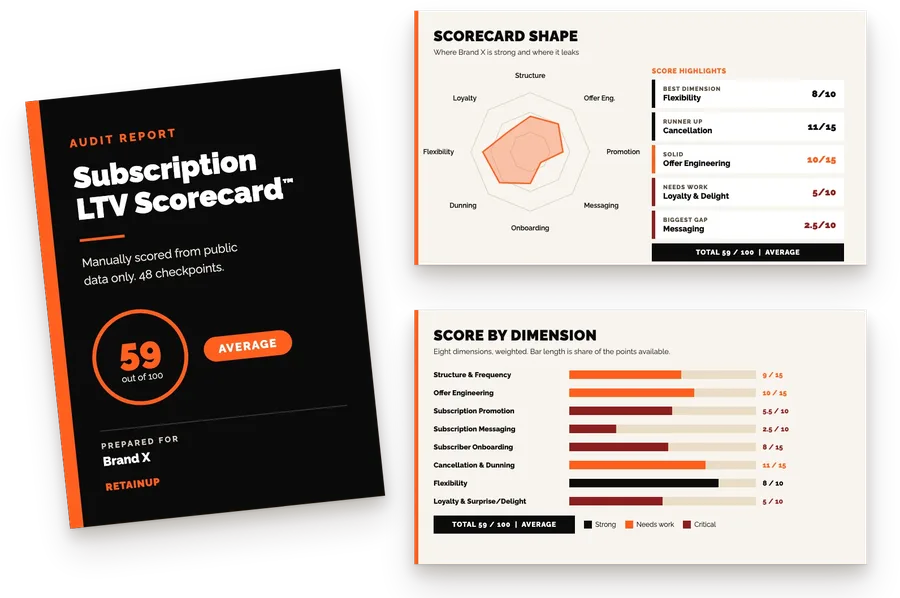
We build the subscriber ladder, portal add-ons and reminder add-ons in the Subscription LTV Maximizer™: offer, widget, cancel flow, portal, payment recovery, pause and skip in Recharge, Skio, Stay AI or Loop, plus email and SMS, live in 30 days for $5,000. Or start with the free subscription audit, 48 checkpoints and your top 3 leaks in 24 hours.
FAQ
How do I upsell existing subscribers?
Offer one rung up, once, at the moment they already think about the next order. For most brands that is a bigger pack or a longer plan in the billing reminder and the customer portal. Price the upgrade so it lands exactly on the next tier, so you fund no new discount. Leave top-tier subscribers alone, and send one message per person per week at most.
What is a subscription add-on?
A subscription add-on is a one-time product attached to a subscriber's next scheduled order. It ships in the same box, on the card already on file, so there is no acquisition cost and no separate shipment. Brands offer them in the customer portal, under the renewal reminder email, by SMS reply, and in subscriber-first launch and sale windows.
Should I cross-sell or upsell subscribers first?
Upsell the pack first, then cross-sell the catalogue. A bigger pack of the product they already chose converts better than a second product, even though the second product is more exciting to write about. Cross-sell starts once the subscriber is on the top pack or has bought the same product twice, and the pairing should come from your own order data.
What is cross-selling in ecommerce?
Cross-selling in ecommerce is recommending a different product that goes with what the customer already bought, like a shaker bottle with protein powder. An upsell is a bigger or better version of the same product. For a subscription brand, cross-sell works best as a one-time add-on to the next order, picked from what your customers actually buy together.
Which subscription apps support add-ons in the portal?
Recharge, Loop and Skio all let subscribers add one-time products to the next order from the portal. Loop adds a Product of the Month carousel and one-tap Quick Actions. Skio adds Smart Upsell and Swap Recommendations. Zaymo puts add-ons and upgrades inside the email on top of Recharge, Skio and Loop.
One email a week on subscription retention: the numbers, the strategy, and what to fix first.

Rahi Jain
Rahi Jain is a subscription LTV specialist who helps $1M to $10M DTC brands reduce subscription churn and maximize LTV on Recharge, Skio, Stay AI and Loop.
More about Rahi