Key takeaways
- At 5,000 subscribers, lifting take rate from 50% to 70% grows the base to about 7,000. Lifting Order 3 retention from 40% to 70% gets about 6,500.
- Take rate applies to every buyer. Order 3 retention applies only to subscribers who got that far.
- In the acquisition trap, lifting ad spend from $100K to $150K a month takes CAC from $50 to $80, and the profit disappears.
This page is part of the subscription metrics guide, which covers the formulas, the benchmarks and how to read them.
Every subscription founder opens with the same question. "Why are people cancelling?"
Almost nobody asks the other one. "Why are so few people subscribing in the first place?"
Churn gets all the attention. Take rate pays faster.
At 5,000 subscribers and ten months old, the second question pays more. And past a certain ad budget, a third question shows up: should you buy more customers at all? So this page puts take rate, retention and acquisition side by side, and gives the order I would fix them in for a brand doing $1M to $10M.
Acquisition vs retention: two different questions
Most of what ranks for "acquisition vs retention" compares two things. Buying a new customer, and keeping one you have.
The line you see everywhere is that a new customer costs five to 25 times more than keeping an existing one. Harvard Business Review gives that range and says it depends on which study you believe. The same piece credits Frederick Reichheld of Bain with the other famous one: lift retention by 5% and profit goes up 25% to 95%.
Those numbers are old. Fine as a direction. But they skip the step a subscription brand has in the middle.
Because there's a third lever. Take rate. Getting the buyers you already paid for to choose subscription at checkout. And for a young brand, that is usually the cheapest of the three.
Take rate touches every buyer, retention only those who stay
Here is why. Take rate applies to every single person who buys. Order 3 retention applies only to the people who got that far.
In a young base most of your subscribers are still sitting on orders one and two. So a retention fix touches a slice, while a take rate fix touches everyone who walks in.
If you need the definitions first: take rate is the share of buyers who choose subscription at checkout (the take rate formula has both cuts), and Order 3 retention is the share of a cohort that pays a third order.
If you run Skio, you no longer need a spreadsheet for the first one. Since March 2026 it shows Subscription Checkout Take Rate on the Overview dashboard, with a daily trend line.
The math at 5,000 subscribers
Let's run some numbers. 5,000 active subscriptions, a 50% take rate, and 40% still there at order three.
| Change | From | To | Active base after | Work it takes |
|---|---|---|---|---|
| Raise take rate | 50% | 70% | About 7,000 | A widget, a product page and a checkout |
| Raise Order 3 retention | 40% | 70% | About 6,500 | Rebuilt onboarding, a working cancel flow, payment recovery and a milestone map |
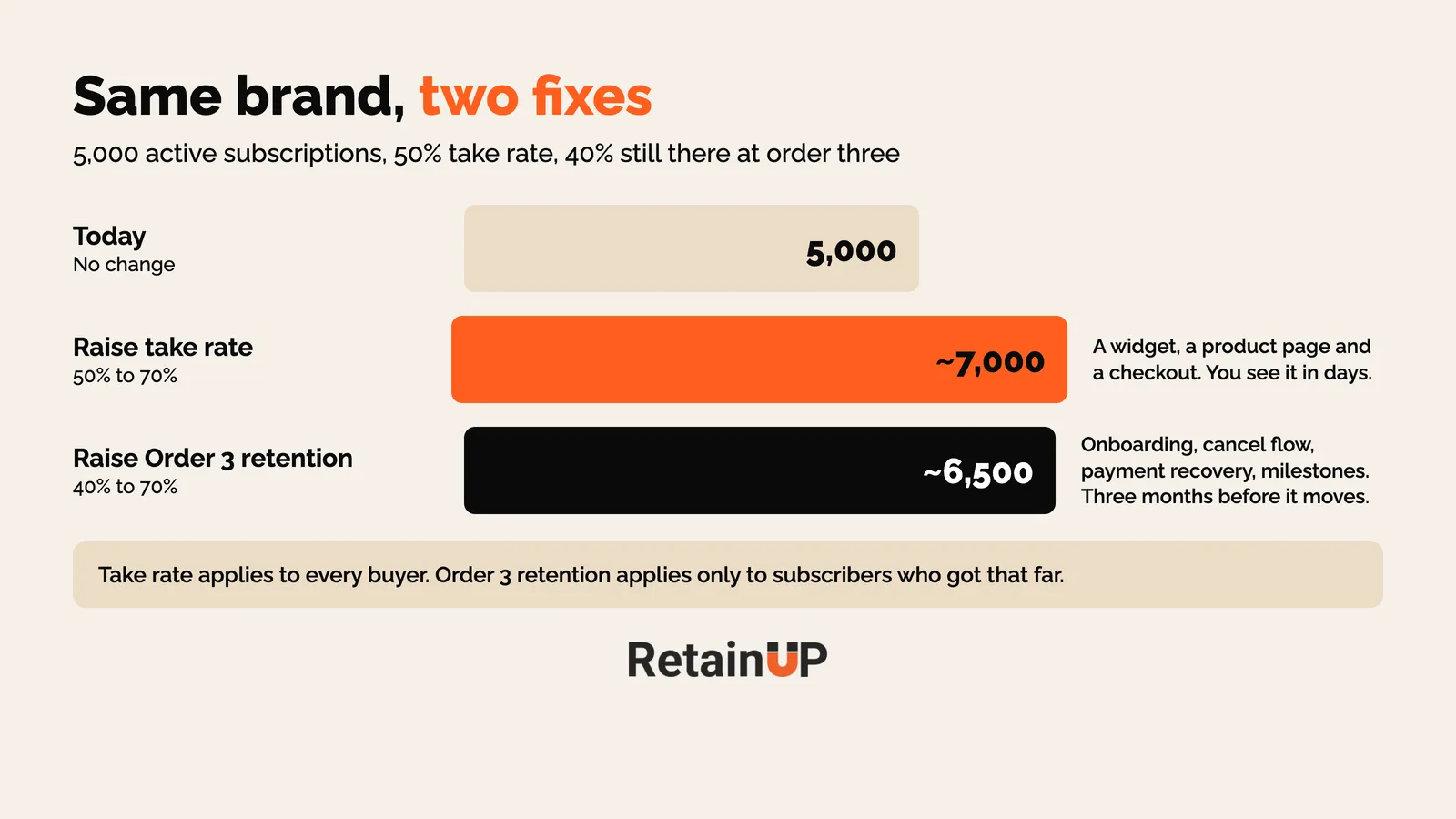
Less growth, and far harder to earn.
Three months of work before the number moves. You have to wait for a cohort to reach order three. Take rate is a widget, a product page and a checkout. You see it in days.
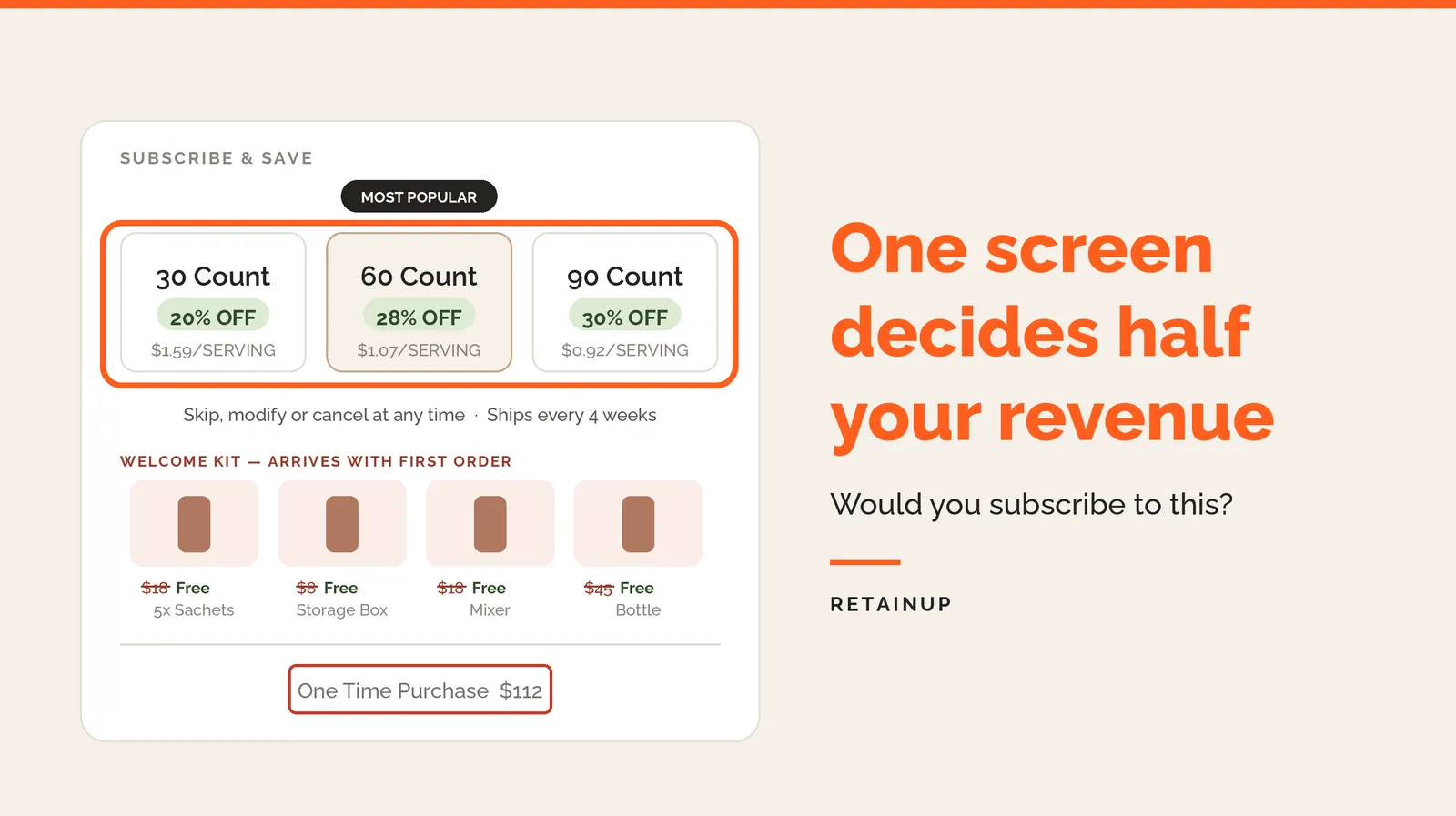
Same 17 subscribers, two routes
Most brands go to retention first. Wrong order.
Here is a smaller version. Start with 100 subscribers at 85% month-one retention. By month four you have 55 left.
To get 17 more subscribers through retention, you would need to push monthly retention from 85% into the low 90s. Months of testing. Murky feedback. Waiting on cohort data.
To get the same 17 through the front door, raise opt-in conversion from 35% to 45%. Ten points. You see the result in days, not months.
Acquisition gives you immediate feedback. Retention makes you wait. Most brands optimise in the wrong order.
Below $20m, subscription growth beats retention
This is one of the twelve things I believe about subscription growth. Twelve hills I will die on.
On a small base, acquisition moves the number and retention moves a slice of it.
Fix the leaks on the page and take rate moves this quarter. Churn moves next year. You cannot compound a base you have not built.
Take rate bought vs take rate earned
One caution before you go raise the number. Take rate bought with a deeper discount is a different number from take rate earned with a clearer offer.
Past 20% off, you are buying a price anchor you cannot sustain. So the fixes that count are the ones on the page: a case for subscription, one-time shown smaller, more than one frequency, the 3-month supply visible. Getting more buyers to subscribe walks through all six leaks.
For a sense of the range, IM8 converts 79% of new customers to subscription on the first order, and most health brands treat 40 to 50% as a win. Below 40% you are not serious about subscription. You are running a store with a checkbox. The rest of the numbers sit on the benchmarks page.
When acquisition stops paying: the acquisition trap
There is a second meaning of "acquisition", and it pulls the other way. Getting more of your buyers to subscribe is cheap. Buying more buyers gets expensive fast.
You raise the ad budget and watch your CAC jump. The sales you expected do not show up, and your margin shrinks. Paid ads are built this way. I call it the acquisition trap, and I have seen it stall more brands than anything else.

Say you spend $100K a month on ads. Your CAC is fine and your MER looks healthy.
You want to grow, so you lift the budget to $150K. CAC goes from $50 to $80. MER drops and profit disappears.
So you pull back. Now you have no new growth, just a bigger ad bill.
That is the trap: a stage where more budget stops driving profitable growth. You change creatives and test more hooks, but the numbers stay flat. Like running on a treadmill.
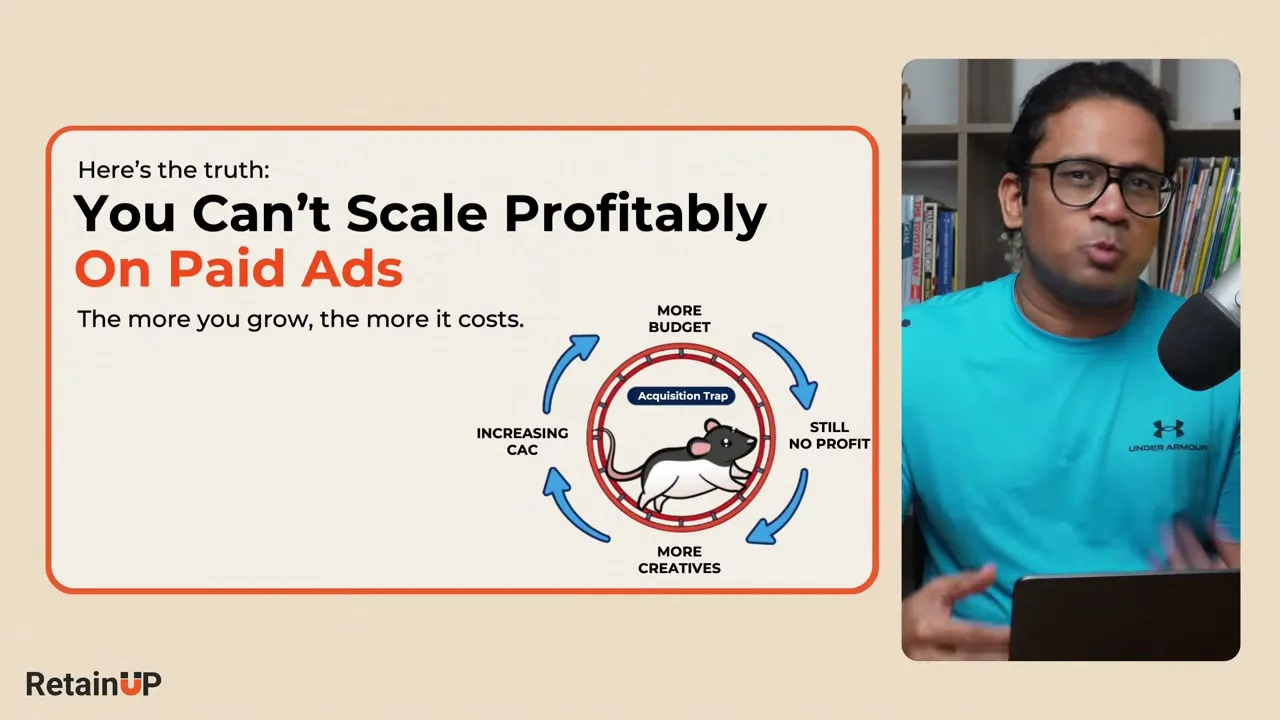
Why every brand hits the wall
Many brands grow fast on paid ads for the first one or two years. Then they hit a wall.
At some point there are no new customers left at your target CAC. The low-hanging fruit in your market is gone.
On the market adoption curve, innovators and early adopters cost the least to win. The early majority is next. As you reach for the late majority, CAC keeps climbing. That happens to every brand. The question is whether you can afford the higher CAC.
Most brands cannot. So they run a loop: raise the budget, watch CAC break, pull back, raise it again. Every extra purchase costs more than it returns. You lose money on each new order. That is the acquisition peak. Past it, you burn cash.
What retention buys you at the same CAC
Ads are fine. Ads as your only engine is the problem.
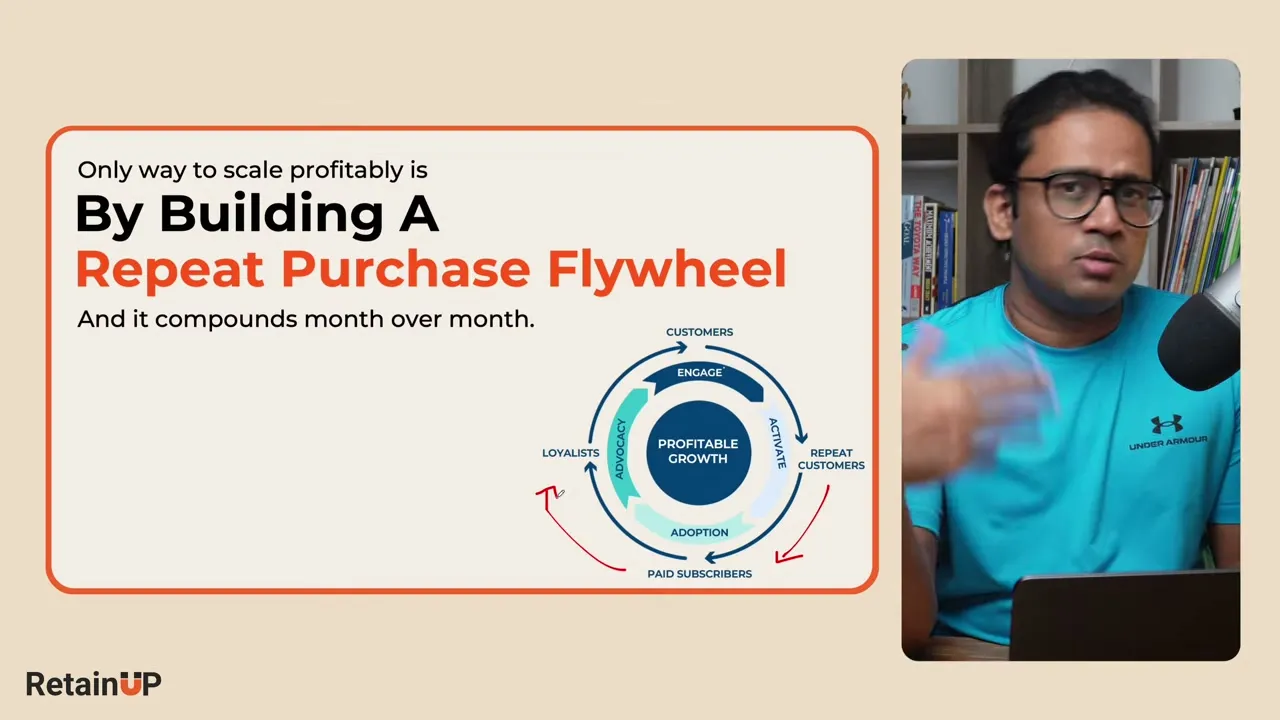
More customers does not mean more growth. More from every customer does. Most brands think scale means more new buyers. Scale comes from compounding retention.
Take two brands that each pay $50 to win a customer, with a $100 first order.
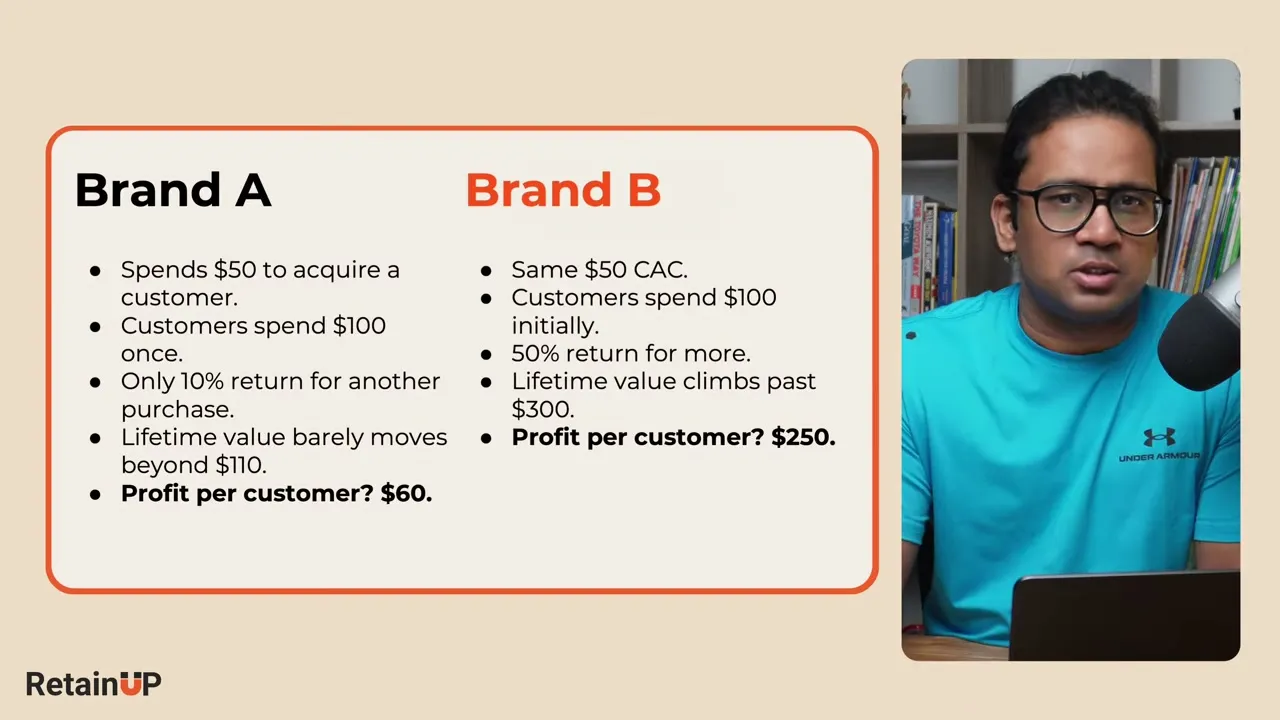
| Brand A | Brand B | |
|---|---|---|
| CAC | $50 | $50 |
| First order | $100 | $100 |
| Buy again | 10% | 50% |
| Lifetime value | Barely past $110 | Past $300 |
| Profit per customer | About $60 | About $250 |
Same ad spend. Brand B got about three times the value from each buyer.
And now Brand B can pay more to acquire. It can go after the top-of-funnel customers that break Brand A. CAC payback and LTV to CAC has the math on how much you can afford to pay, and what a good LTV to CAC ratio looks like. Shopify's own guide puts the ideal near three times CAC.
Retention compounds like interest
You acquire once and sell many times. Each repeat order costs no CAC and adds margin.
One brand shows it clearly. After COVID they held new customer acquisition on a flat curve, and it rose only slowly. Their returning customers passed that line, then kept going until they placed roughly four to five times as many orders as new customers.
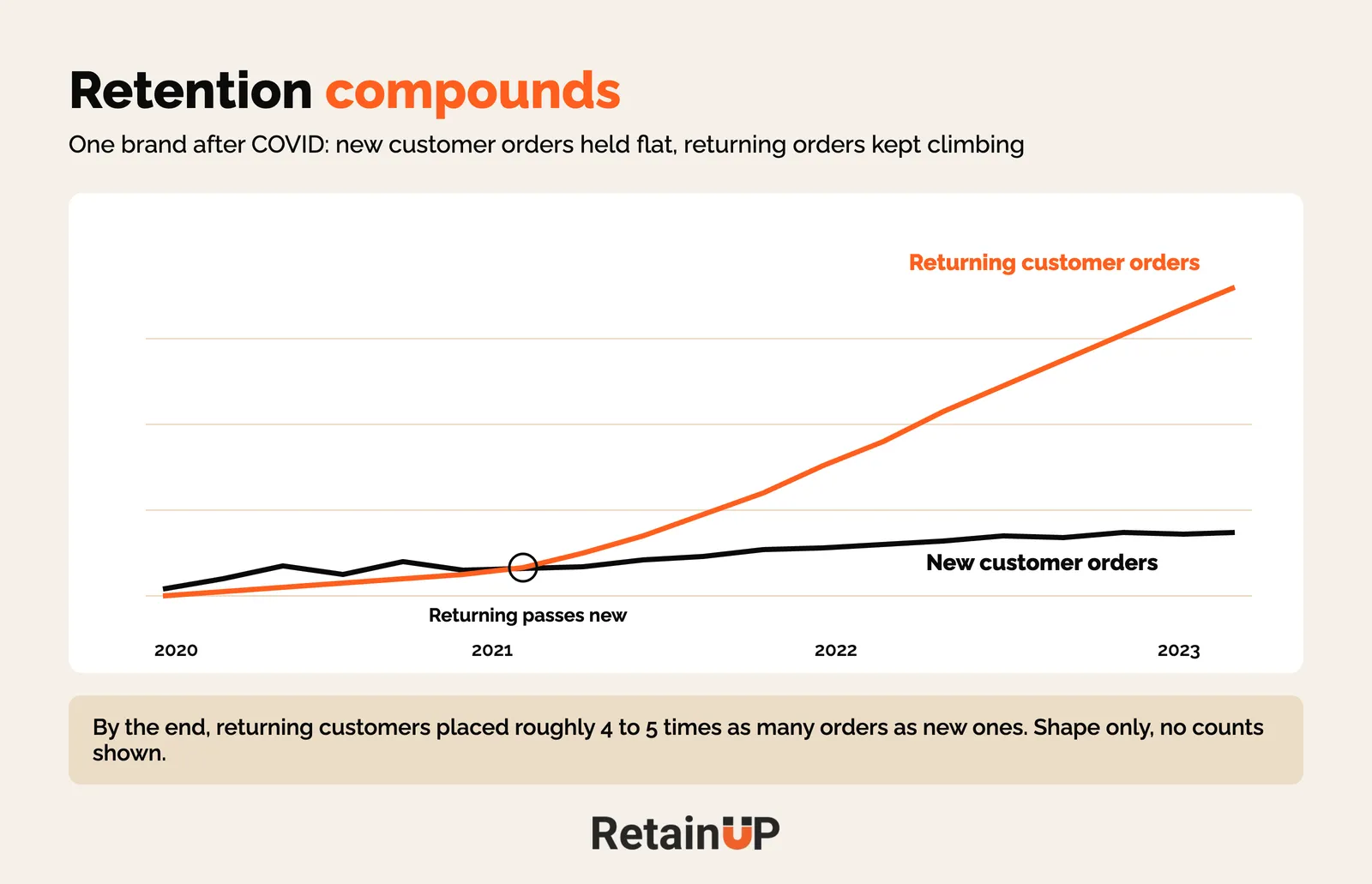
They could still afford more acquisition. But the growth came from the customers they already had. Acquisition and retention work together.
How to tell which one is your problem
You do not need a model to start. Three numbers will tell you where you are: take rate, Order 3 retention, and what CAC did the last time you raised spend.
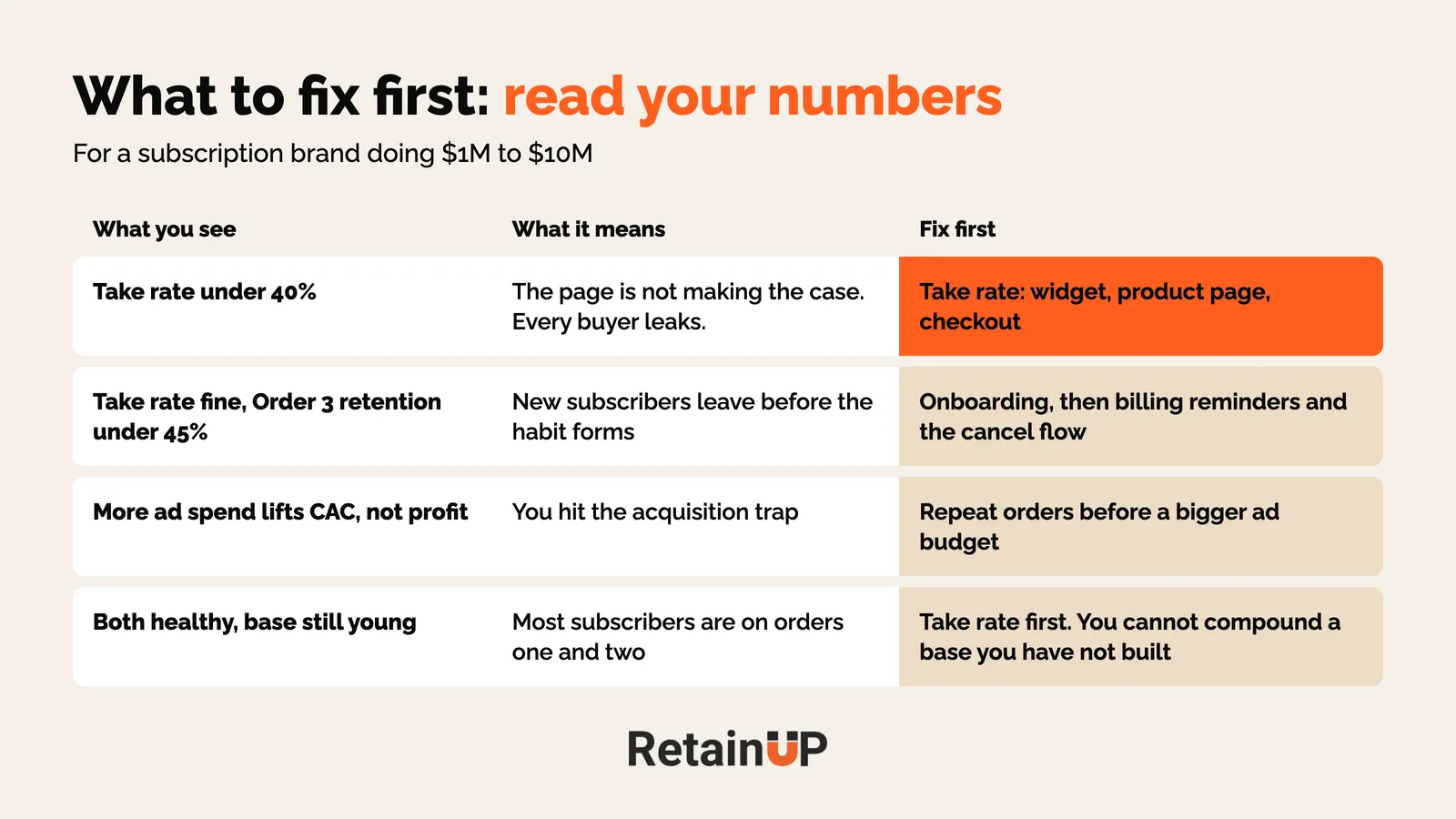
| What you see | Fix first |
|---|---|
| Take rate under 40% | Take rate. The widget, the product page, the checkout. |
| Take rate fine, Order 3 retention under 45% | Onboarding, then billing reminders and the cancel flow. |
| More ad spend lifts CAC, not profit | Repeat orders before a bigger ad budget. |
| Both healthy, base still young | Take rate. Retention compounds once the base is built. |
Under 45% at order three is poor on our bands for supplements, and 62 to 72% is good. Those bands are our own synthesis, not an outside study, and they assume a monthly, pay-as-you-go plan.
One more check before you raise paid spend. Read LTV to CAC on 12-month numbers, not lifetime. ATTN Agency treats anything under 1.5 to 1 at month 12 as a sign to fix CAC or retention before you scale. And most brands sit below the 3 to 1 people aim for. Across the Shopify brands in AMP's 2025 DTC report, median CAC was $54 and median LTV to CAC was 2.4 to 1.
The fix order for a $1M to $10M subscription brand
Put the two together and you get an order. Here is mine.
- Take rate. Immediate feedback. Highest leverage. The widget, the product page, the checkout.
- Onboarding. The first two weeks decide whether the subscriber finds value before they find friction.
- Communications. Billing reminders, how-to-use emails, subscription campaigns.
- Cancellation. A monthly check-in on the cancel flow, not daily management.
- Winbacks. Long feedback loops, high variance. Optimise last.
Steps two to four are where Order 3 retention comes from. And that is where the cancels are. Recharge's renewal data puts about 61% of voluntary cancels on the first two renewals, which are orders two and three. Subscriber onboarding and the cancel flow each have their own guide.
When acquisition comes first
Acquisition in the take rate sense comes first whenever the base is young or small. Ten months old, a few thousand subscribers, most of them on orders one and two.
Paid acquisition is different. Push it harder only when the base already retains. If Order 3 retention is weak, every subscriber you buy leaks out of the same holes.
Retention should shorten payback
Retention's job is to shorten payback, not to lengthen lifetime. A subscriber who stays six months and clears CAC at month four gives you two months of profit. One who stays three months and clears at month one gives you the same, and frees the cash three months sooner.
So judge every change on 12-month LTV. Cancel rate, save rate, take rate and retention rate can each be won while the business gets worse. The P&L is the scoreboard. Everything else is an input.
Growth and retention have to talk
In most brands nobody owns subscription. The founder or the email agency carries the revenue. CRO owns the widget. Nobody owns the whole thing.
Email won't touch the widget. CRO won't touch the communication. So the offer, the portal, the cancel page and the retry logic sit in the gap between them.
The acquisition side should know which subscriber types retain longest. The retention side should know which campaigns bring the best cohorts. And winback offers that work should get tested at acquisition too. Running these two teams separately is one of the most common and expensive structural problems in a subscription business.
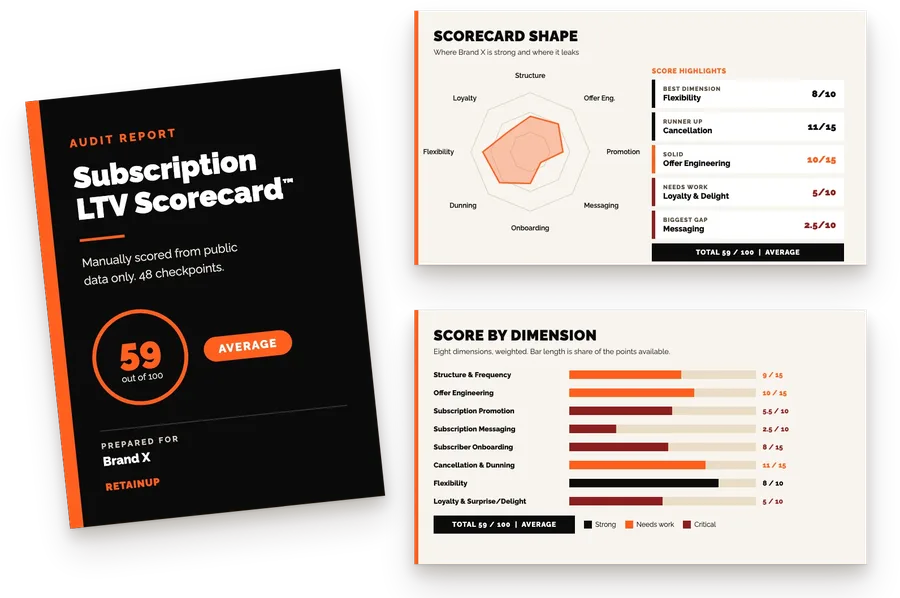
If you want the order worked out on your own numbers, the Subscription LTV Roadmap™ reads your subscription data and gives you a 90-day plan of 30 to 50 changes in order, in 3 working days, for $1,000. Or start with the free subscription audit: 48 checkpoints and your top 3 leaks in 24 hours.
FAQ
Should a subscription brand focus on acquisition or retention first?
For most brands under $20m, fix take rate first. It applies to every buyer, while Order 3 retention applies only to subscribers who reached order three. At 5,000 subscribers, a 20-point lift in take rate grows the base to about 7,000, and a 30-point lift in Order 3 retention gets about 6,500. And take rate shows results in days, retention in months.
Is retention really 5 times cheaper than acquisition?
It depends on the study, and the range quoted runs from five to 25 times. That figure compares buying a stranger with keeping a customer you have. For a subscription brand there is a cheaper step in between: getting buyers you already paid for to subscribe at checkout. So treat the old ratio as a direction, then check your own take rate, Order 3 retention and CAC.
Why does CAC go up when I increase ad spend?
Because past a point there are no new customers left at your target CAC. Innovators and early adopters cost the least to win. As you reach for the late majority, CAC keeps climbing. In one example, lifting spend from $100K to $150K a month took CAC from $50 to $80, and the profit disappeared.
What is a good LTV to CAC ratio for a subscription brand?
About 3 to 1, read on 12-month gross profit rather than lifetime. Under 1.5 to 1 at month 12, fix CAC or retention before you raise spend. And repeat orders move the ratio fast. At the same $50 CAC and a $100 first order, a brand where 10% buy again makes about $60 profit per customer. One where 50% buy again makes about $250, so it can afford a higher CAC.
When should a subscription brand focus on retention?
Once take rate is healthy and the base is big enough for retention to compound, and before you push paid spend harder. If Order 3 retention is weak, every subscriber you buy leaks out the same holes. So onboarding, communications and the cancel flow come right after take rate, with winbacks last.
One email a week on subscription retention: the numbers, the strategy, and what to fix first.

Rahi Jain
Rahi Jain is a subscription LTV specialist who helps $1M to $10M DTC brands reduce subscription churn and maximize LTV on Recharge, Skio, Stay AI and Loop.
More about Rahi