
Key takeaways
- Order 3 retention is subscribers who paid order 3 divided by subscribers who paid order 1, from the same cohort.
- For supplements on a monthly plan, RetainUP rates order 3 retention under 45% as poor and over 72% as excellent.
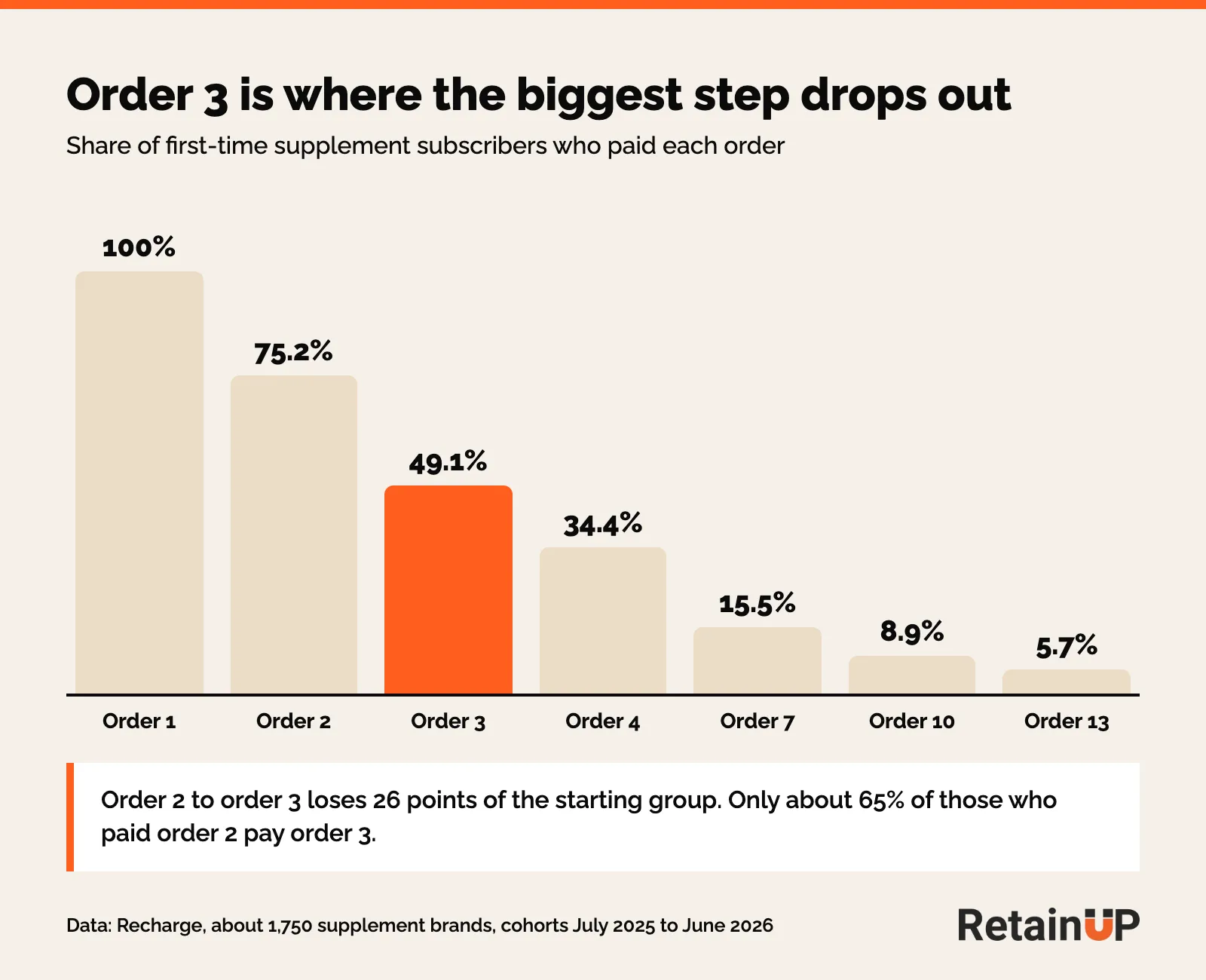
- In Recharge data on about 1,750 supplement brands, 75.2% of subscribers pay order 2 and 49.1% pay order 3.
Ask your subscription app how retention is going and you get a number. Ask Shopify and you get a different one.
None of them are lying. They just count different things.
So I track one number for every brand we work with: order 3 retention. It sits at the centre of the subscription metrics we watch, and if you could only watch one subscription retention rate, this is the one. Here is how to count it, the rules that keep it honest, the bands we use, and why the month-based numbers in your dashboard mislead you.
In a hurry? Watch the breakdown.

What order 3 retention is
Order 3 retention is the subscribers who paid order 3, divided by the subscribers who paid order 1, in the same cohort. A cohort is everyone whose first order landed in the same month.
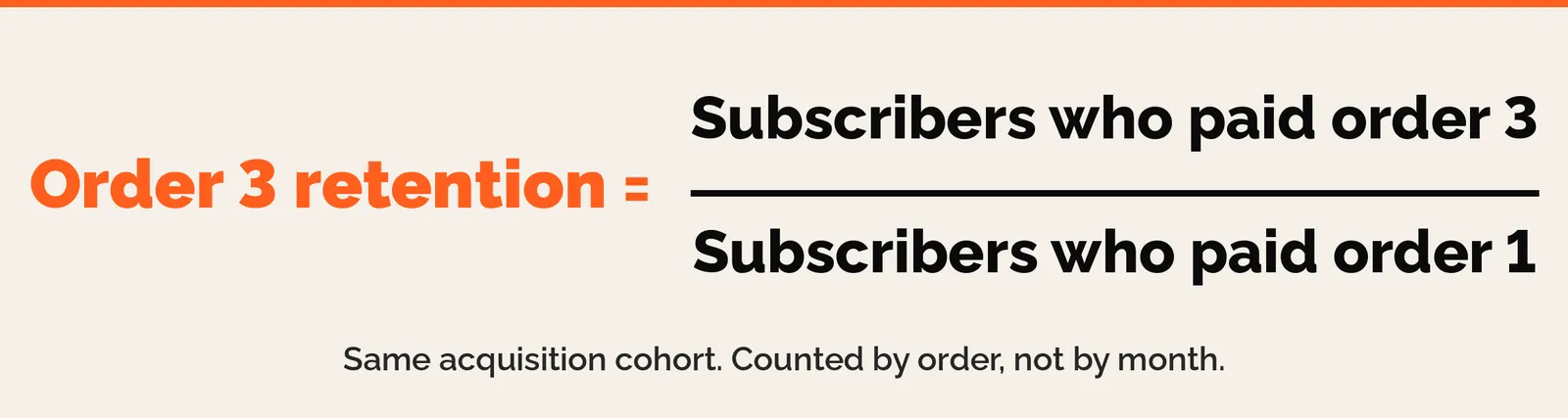
Order 3 retention = paid order 3 ÷ paid order 1 × 100
Example: 400 subscribers paid their first order in March. 236 of them paid order 3. 236 ÷ 400 = 59%. That sits in our average band for supplements.
Three things in that definition matter, and each one is there because a popular number gets it wrong.
It is cumulative
You divide by order 1, every time. Never by order 2.
The order 2 to order 3 rate (paid order 3 ÷ paid order 2) looks similar and hides everyone you lost before order 2. A brand can look good on that number while losing 30% at order 2. And it is the number some dashboards show by default. Skio's guide to supplement churn even makes it the north star. It helps you find the step that leaks, so keep it as a diagnostic. As the headline, it flatters you.
Order 1 is the denominator
Every cohort starts at order 1, and every tool can show it. Nobody gets left out.
The one catch is $0 and sample first orders. If you run free trials, count from the first paid order. Otherwise your order 2 is really order 1, and the number flatters you.
It counts by order, not by month
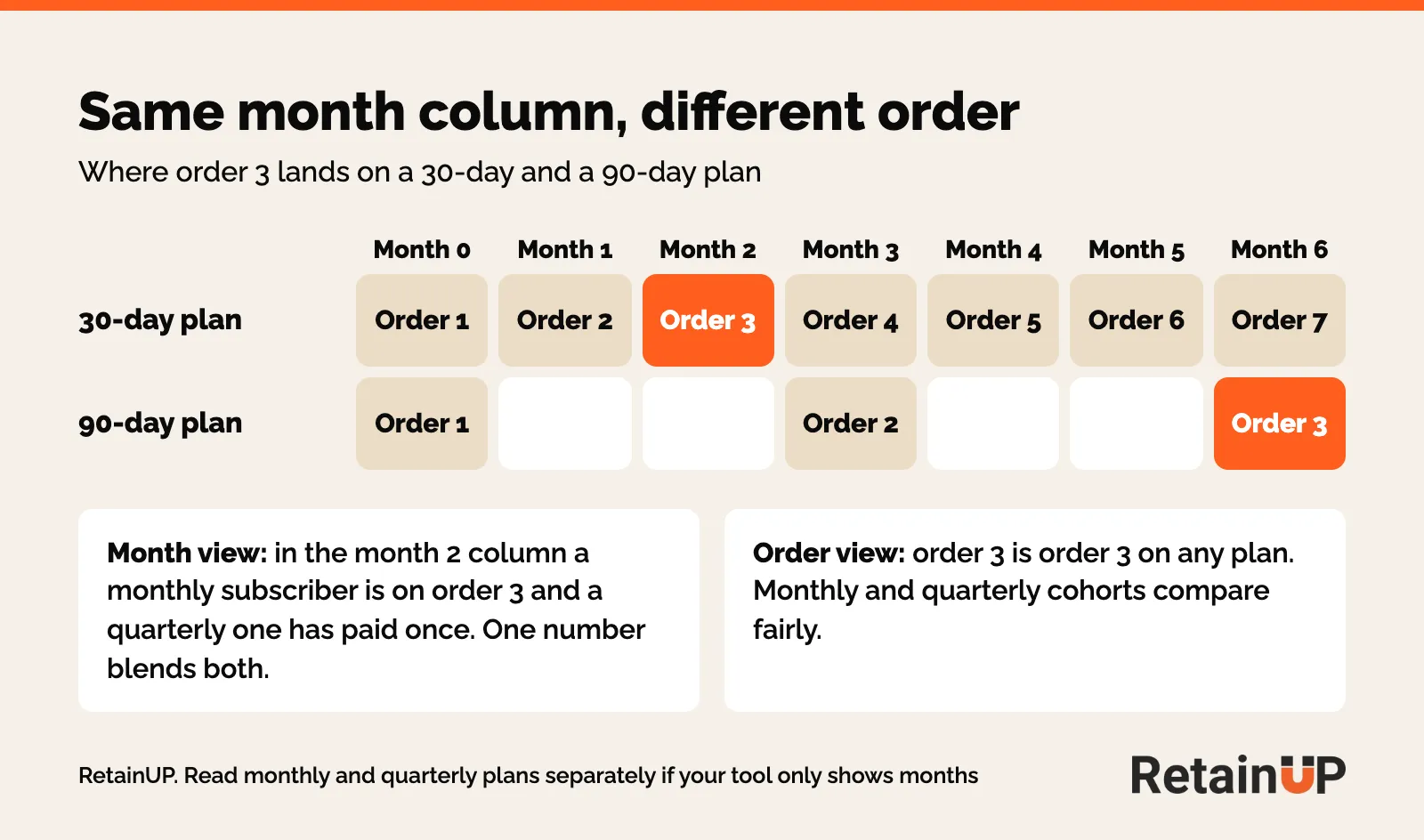
At month three, a monthly subscriber has paid three times and a quarterly one once. Order sequence fixes that. Order 3 is order 3, whatever the plan, so monthly and quarterly cohorts compare fairly.
Why order 3 and not order 2 or month 12
Order 2 can be an accident. They forgot they subscribed, or never knew. Order 3 is paid by someone who knew what they bought and used it.
So that is the first reason. And there are four more.
- Most churn has already happened. About 61% of voluntary cancellations land in the first two renewals and about 72% in the first four, per Recharge. Loop puts it at 68% of all churn in the first three orders.
- It decides payback. At supplement CAC, order 3 is often the break-even order. A subscriber lost before order 3 was a marketing expense. More on that in CAC payback.
- It predicts 12-month LTV early. You read it in month 3 for a monthly brand, nine months before 12-month LTV is visible.
- It works for a young brand. Half-life and lifetime numbers need years of history before you can read them at all. Order 3 needs about four months.
Recharge's 2026 supplement data shows where it bites. Across about 1,750 brands, 75.2% of first-time subscribers paid order 2 and 49.1% paid order 3. So only about 65% of the people who paid order 2 came back for order 3. That is the weakest step on the whole curve. Further down the curve, roughly one in five leaves at each order.
And order 2 retention still matters, as a diagnostic. More on that below.
Why month-based retention misleads
Everyone has a retention number. Most of them measure something else.
Most are built on calendar time. Your subscribers decide on their order date.
Take the textbook formula: end count minus new subscribers, divided by the start count. Fine for SaaS. Weak for subscriptions. New subscribers land in the same period and hide the ones you lost.
So that gap breaks almost every number in your dashboard. Here is what each one hides.
| Metric | Where you see it | What is wrong with it |
|---|---|---|
| Returning customer rate | Shopify dashboard | Counts anyone who ever came back, even after five years. Swings when you change the date range |
| 30 / 60 / 90 day retention | Subscription app dashboards | At day 90 a monthly subscriber is on order 3 and a quarterly one is still on order 2. Mixed cadences blend into one number |
| Month 1 / 2 / 3 retention | Cohort tables in every tool | Same calendar problem. Skipped and paused subscribers count as retained |
| Monthly churn rate | Recharge, Skio, Loop home dashboards | Partly measures billing frequency. New subscribers also hide old ones leaving |
| Revenue retention | Public company reports | Upsells and price rises hide subscriber loss. Hims & Hers reports 88%, which says nothing about how many people stayed |
| Average number of months | Klaviyo | One average blends day-0 cancels and 3-year loyalists. Points at nothing. |
Monthly churn is the one founders quote most. And it partly measures how often you bill. A weekly biller faces the stay-or-go decision 50 times a year, a quarterly biller 4.
The plans also behave differently. Recharge looked at 65.1 million subscriptions and found lifetime churn of 84.2% on monthly plans and 67.7% on quarterly ones. Some of that gap is who picks a longer plan in the first place. So one blended number tells you little about either.
Month 1 retention has its own trap. Thomas Lalas wrote about a founder whose "90% month one" was active subscribers, not people who paid. A third of the "active" ones had skipped their last three orders. That is the same overcount that sits under true active subscribers.
The full list of formulas, and what each one hides, lives in how to calculate subscription retention rate.
Six rules before you trust the number
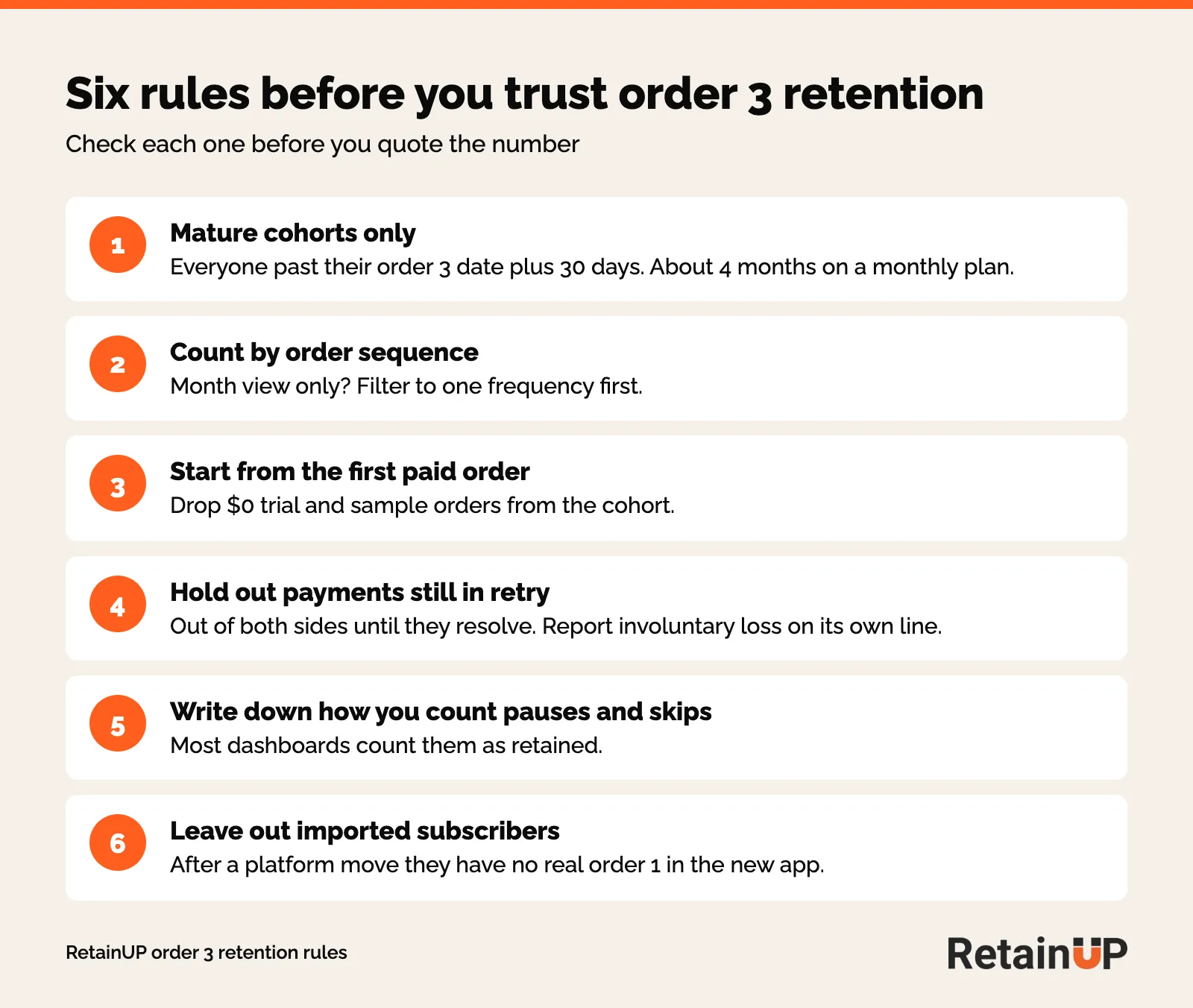
Trust your order 3 retention only when you use mature cohorts, count by order, start from the first paid order, leave out failed payments in retry, set a rule for pauses and skips, and leave out imported subscribers.
1. Mature cohorts only
A cohort counts once everyone in it has passed their order 3 date, plus 30 days for skips and payment retries. On a monthly plan, that is about 4 months after the cohort month closes.
And never count an immature cohort as churned. Leave it out.
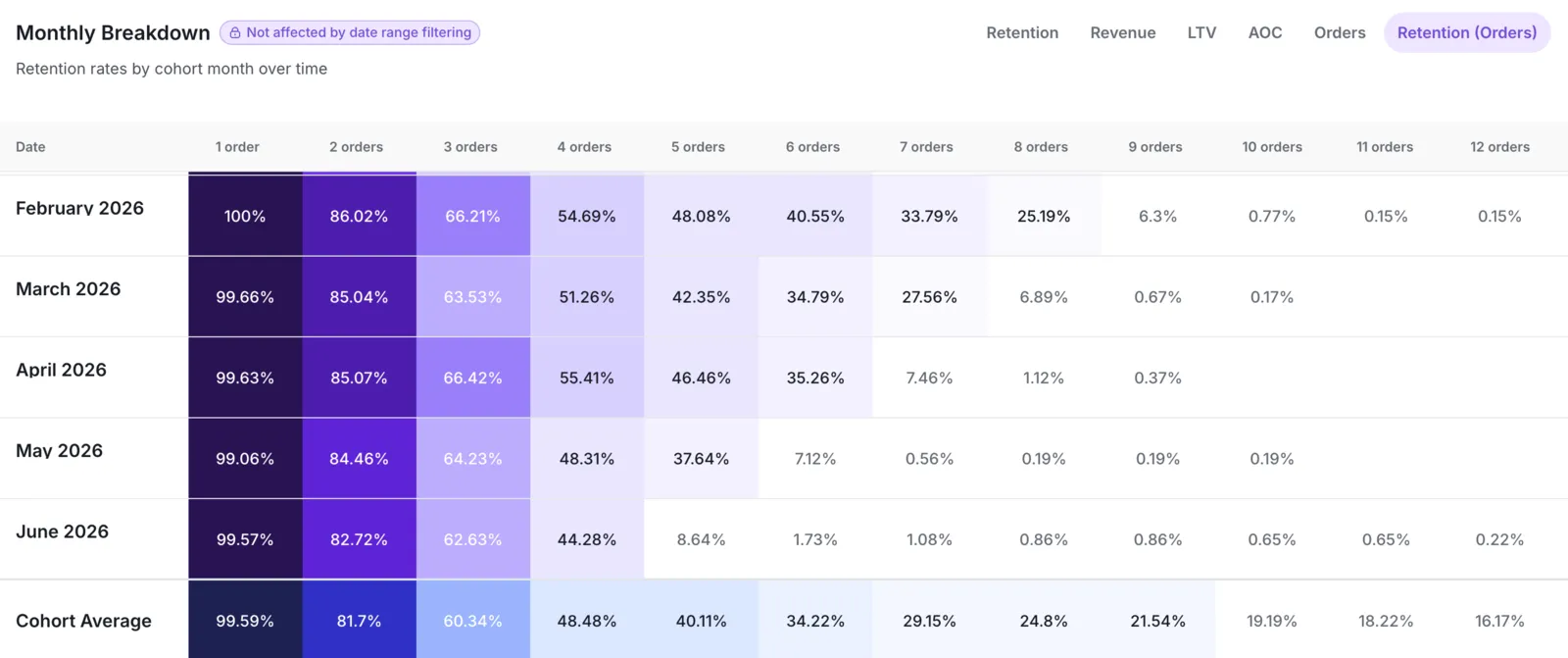
Here is an order-level table from one of our brands. Read the 3 orders column: 62 to 66% in every cohort, about 60% on the average row. Now look at the right edge of each row. June drops to 8.64% at order 5. Nobody churned there. Those subscribers have not reached order 5 yet. If you average that in, you report a crash that never happened. Reading these tables row by row is its own skill, covered in subscription cohort analysis.
This one also counts subscriptions, not subscribers. One customer with two products is two subscriptions. Check which your tool shows.
2. Count by order sequence
If your tool only shows months, filter to one frequency first. On a 30-day plan, order 1 is month 0, order 2 is month 1, order 3 is month 2. On a 90-day plan, order 3 lands at month 6. Never convert a mixed-frequency cohort.
3. Start from the first paid order
Drop $0 orders if you run free trials. They change the denominator, and they change the cohort too. See first-order offers for what $0 starts do to order 2.
4. Hold out failed payments in retry
Leave them out of the numerator and the denominator until they resolve. And then report involuntary loss as its own line.
5. Write down how you count pauses and skips
Most dashboards count a paused subscriber as retained. That flatters the result. Decide your rule and write it next to the number.
Skips need the same care. In Recharge's supplement data, 59% of skips were followed by another order, against 78% after a processed order. So a serial skipper is a weaker subscriber than the dashboard says. Skip and pause analysis covers the rates to watch.
6. Leave out imported subscribers
After a platform move, migrated subscribers arrive mid-life. Their real order 1 happened in the old app. Recharge drops any store cohort where fewer than half the subscribers had their first order on Recharge, for that reason. Do the same. Read only cohorts that started on the platform you are reading. The migration checklist has what else breaks that week.
Order 3 retention bands for supplements
These are the bands we use for supplements on a monthly, pay-as-you-go plan with a paid first order.
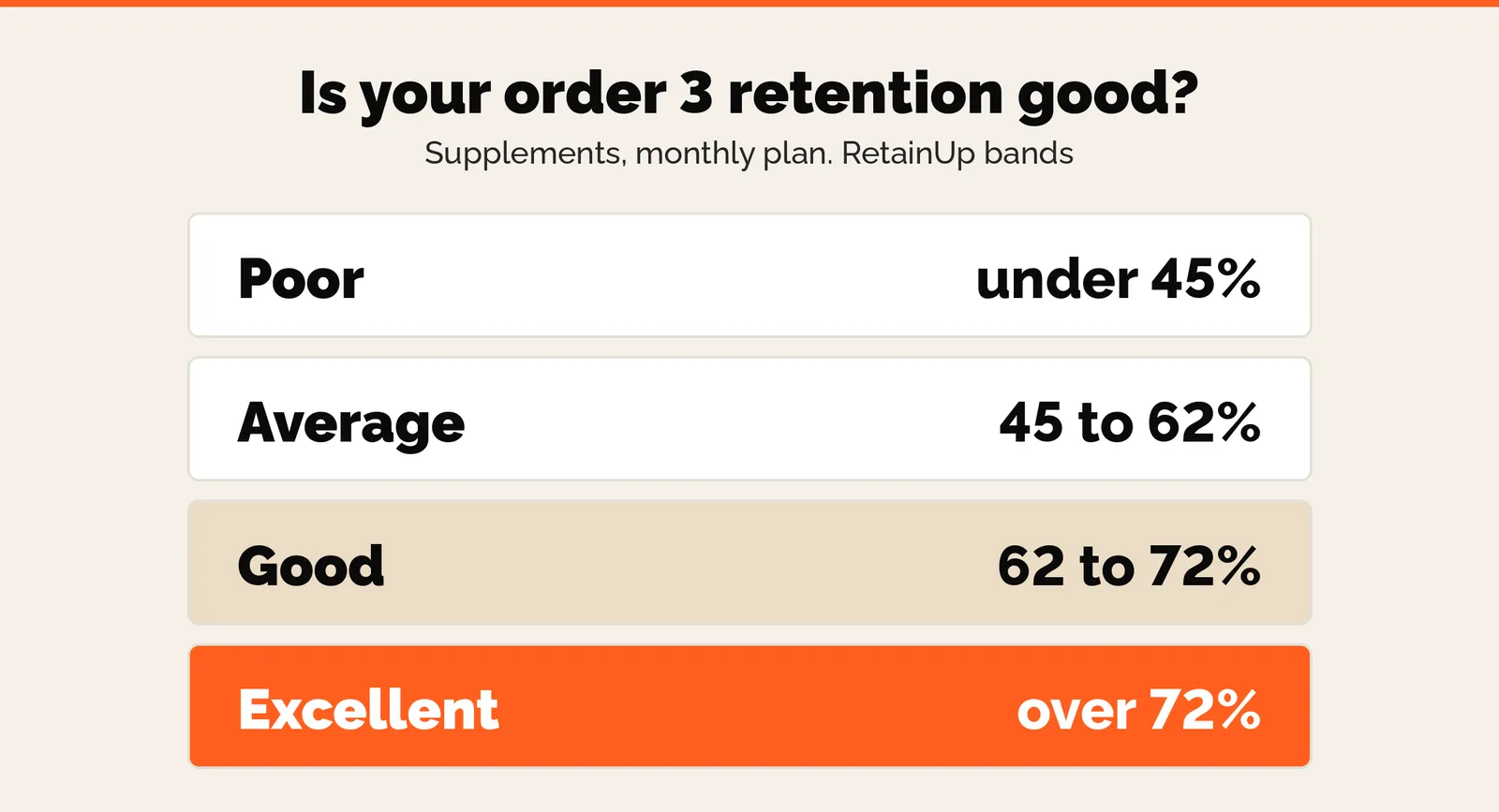
| Rating | Order 3 retention | Order 2 retention |
|---|---|---|
| Poor | under 45% | under 80% |
| Average | 45 to 62% | 80 to 90% |
| Good | 62 to 72% | 90 to 95% |
| Excellent | over 72% | over 95% |
These are our bands. Nobody has published an industry standard on a clear definition yet. We built them from the Recharge and YOCTO reports and the cohorts we see at clients, and we will recalibrate once we have 30 or more client cohorts on one definition. For reference, Recharge data on about 1,750 supplement brands puts the average at 49.1% at order 3. Every other source, with its date, is on the subscription benchmarks page.
Why do sources disagree so much? Skio says 70 to 80% of supplement subscribers churn before order 3, so 20 to 30% are left. Same category, same order. The answers sit twice apart. Some count subscriptions and some count subscribers. Some count a paused subscriber as retained. And every source sells retention software or services, us included. Use them as ranges, not targets.
Where does yours sit?
- Under 45%: there is real room to improve.
- 45 to 72%: you are doing well, and there is still room.
- Above 72%: excellent.
Numbers to read next to order 3
If order 3 is low, check order 2 first.
If order 2 is weak, look at onboarding and the offer. If order 2 is fine and order 3 drops, look at results, routine and the price step after the first discount.
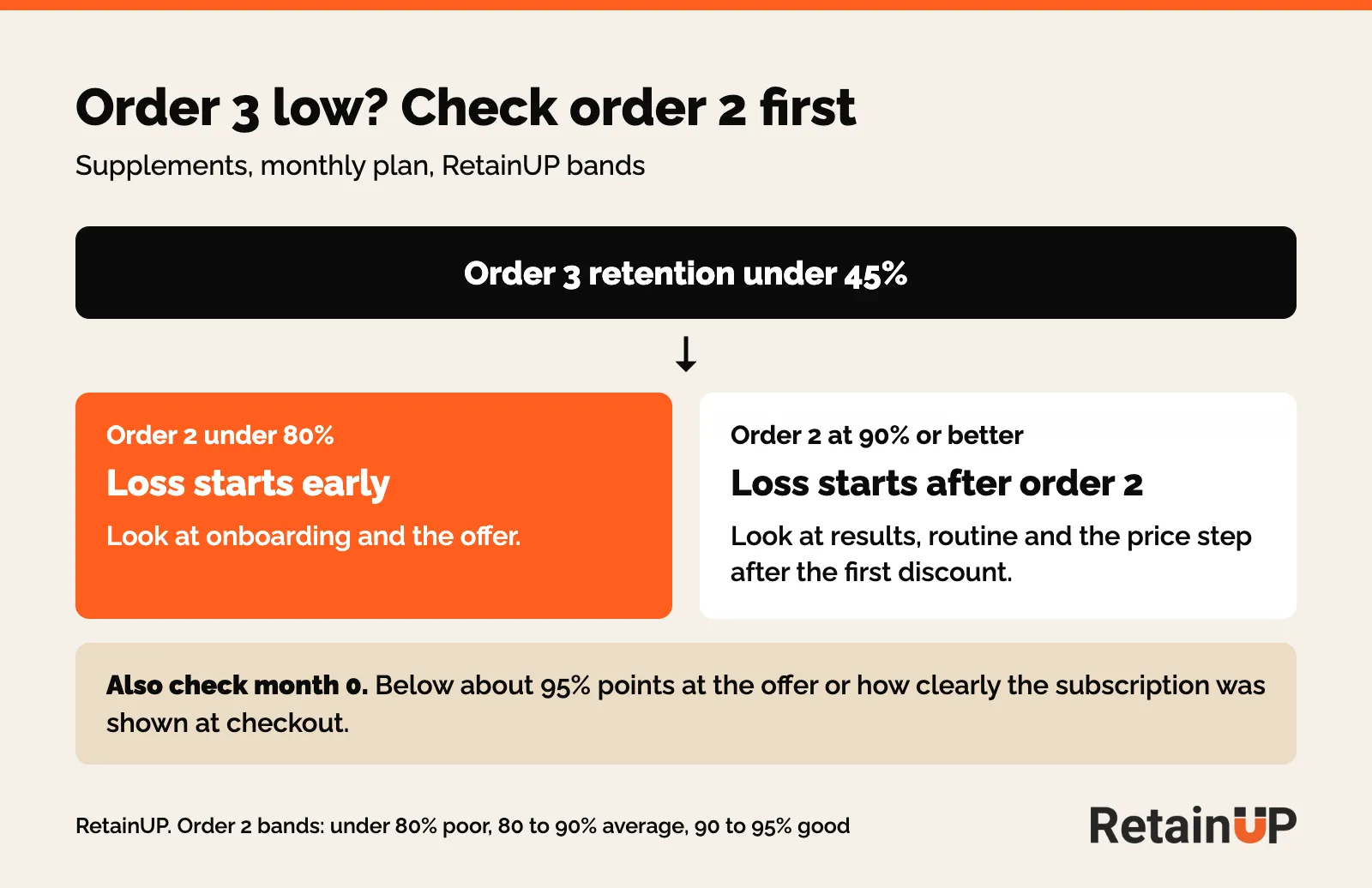
Check month 0 too. Most apps count subscriptions still active at the end of the month, so month 0 often sits below 100%. In our data, 5.6% of monthly plan cancellations and 7.4% of quarterly plan cancellations happen on day 0. A month 0 below about 95% points at the offer, or at how clearly the subscription was shown at checkout. Cancellation day spikes shows where in the cycle the rest land.
Skio adds two quick reads. If the average subscriber cancels before 3 orders, the problem sits before order 3. If the first cancel attempt comes inside 60 days, look at onboarding.
This page is about the number. The fixes, order by order, are in getting past order 2 and order 3.
Where to find order 3 retention in your app
Skio, Loop and Recharge each show it. Shopify and Triple Whale do not.
- Skio: Analytics, Cohort Dashboard, Retention by order count. The denominator is the original cohort. That matches our definition. Switch the toggle to Subscribers.
- Loop: Analytics, Cohorts, Order-Level view. Filter by delivery frequency and read monthly and quarterly plans separately.
- Recharge: Analytics, Subscription Journey, Subscription Retention by Order Number. Check it shows survival from order 1, not step rates like order 2 to order 3.
- Lifetimely: Lifetime Value Report, Customers who purchased X times. Filter to subscription customers first, or one-time buyers get mixed in.
- Triple Whale and Shopify: month-based only, no order-number view. Good for repeat rate, not for order 3.
No report? Do it by hand
- Export subscription orders from Shopify or your subscription app: customer ID, order date, order total, subscription tag.
- Drop $0 orders if you run free trials.
- Number each customer's orders by date: 1, 2, 3.
- Group customers by the month of order 1.
- For each mature cohort, divide customers with an order 3 by customers with an order 1.
So lay the cohorts as rows and the order numbers as columns. That is your order-level cohort table.
If you want someone to pull this number for you, the Subscription LTV Roadmap™ reads your subscription data, order 3 retention by cohort included, and turns it into a 90-day plan of 30 to 50 changes in order, in 3 working days, for $1,000. Or start with the free subscription audit: 48 checkpoints and your top 3 leaks in 24 hours.
FAQ
What is a good subscription retention rate?
For supplements on a monthly plan, we rate order 3 retention under 45% as poor, 45 to 62% as average, 62 to 72% as good and over 72% as excellent. These are RetainUP's bands, built from published reports and client cohorts. They are not an industry standard, because nobody has published one on a clear definition yet. Always check how a source counts before you compare your number to it.
How do I calculate order 3 retention?
Take one cohort, everyone whose first paid order landed in the same month. Divide the subscribers who paid order 3 by the subscribers who paid order 1, then multiply by 100. If 236 of 400 paid order 3, that is 59%. Only use cohorts where everyone has passed their order 3 date plus 30 days, or you count people as lost who simply have not reached order 3 yet.
Why not just use monthly churn rate?
Monthly churn counts who left in a calendar month across every cohort, so new subscribers can hide the ones you lost. It also partly measures billing frequency. A weekly biller faces the cancel decision far more often than a quarterly one. Order 3 retention follows one cohort by order, so monthly and quarterly plans compare fairly and new sign-ups cannot mask the loss.
Why do Recharge and Skio give such different retention numbers?
They count differently. Recharge data on about 1,750 supplement brands puts order 3 at 49.1%, while Skio says only 20 to 30% are left by then. Some tools count subscriptions and some count subscribers, some count paused subscribers as retained, and some include $0 trial starts in the denominator. A retention number without its definition cannot be compared to anything.
Should I track order 2 retention as well?
Yes, as a diagnostic next to order 3. Order 2 is full of accidental subscribers and $0 trial starts, so it tells you about onboarding and the offer more than the product. If order 2 is weak, look at onboarding and the offer. If order 2 is fine and order 3 drops, look at results, routine and the price step after the first discount.
One email a week on subscription retention: the numbers, the strategy, and what to fix first.

Rahi Jain
Rahi Jain is a subscription LTV specialist who helps $1M to $10M DTC brands reduce subscription churn and maximize LTV on Recharge, Skio, Stay AI and Loop.
More about Rahi