Key takeaways
- When a BFCM sale gives 30% off one-time against a 20% subscription discount, most new customers pick one-time and take rate drops.
- Good Protein gave subscribers the sale first in their portal. Add-ons went from 18% to 25% of subscription revenue that month (via Loop).
- Subscription churn runs at 3.2% a month in November and 4.1 to 4.3% in December and January, per Churned’s 2026 benchmark report.
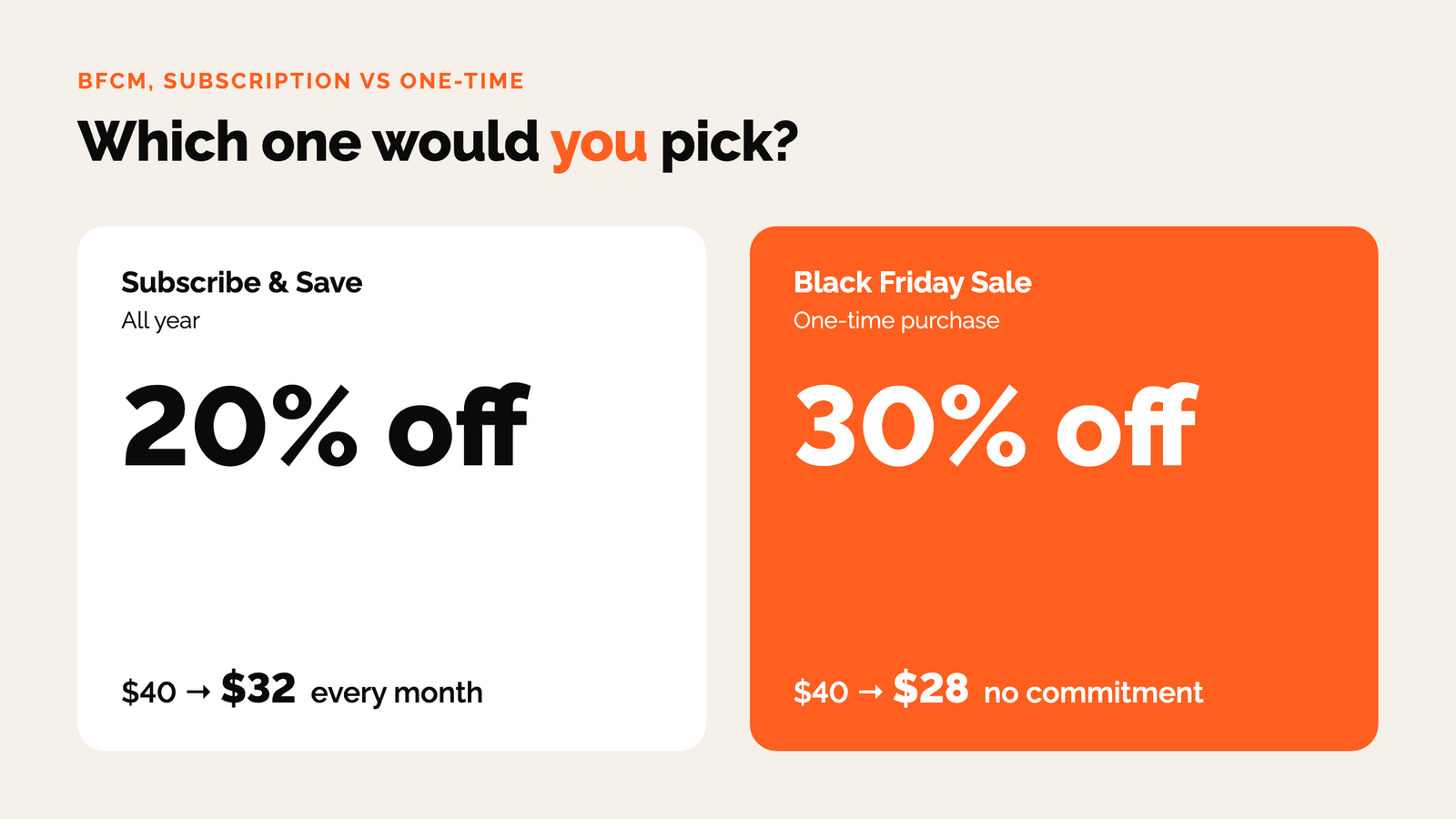
Your subscription is 20% off all year.
Your Black Friday sale is 30% off one-time.
Which one would you pick?
Most of your new customers pick one-time. You buy your biggest cohort of the year at your lowest margin, and most of them never order again.
Then January comes, the BFCM buyers are gone, and the brand wonders why revenue fell off.
You can’t be a subscription-first brand if one-time gets your best deal of the year. And most of the damage shows up later, as subscription churn in December and January: cancels, failed charges and gift buyers who never meant to stay.
BFCM breaks your subscription in two places:
1. New subscribers skip it.
2. Old subscribers cancel.
Below: the 2 mistakes, the fixes for each, a calendar, and what to do in December and January. Loop covered a lot of this in their partner BFCM webinar in October 2026. Worth the hour.
Why BFCM hits a subscription brand harder
Q4 gets you the lowest quality customers at the highest discount, and from a retention view they are the first to cancel in January, as soon as the cohort matures. Some bought a gift. Some bought on impulse.
If you sell gift subscriptions, sell them prepaid, and make renewal something the recipient opts into. A silent rollover on a gift is a January chargeback (Swell says the same).
Pauses also rise from October through January, and unpause rates only climb again from February to April (Recurly, 2026 State of Subscriptions).
Yet most brands leave the subscription and the loyalty program out of their BFCM planning. The plan is one sitewide number, and the subscription just has to live with it.
Some brands skip the sale. I worked with an 8-figure brand for 2 years that skipped BFCM entirely. No discounts. No flash sales. Nothing. I even pleaded with the founder to run one.
But their customers never bought because of discounts. They bought because they wanted the product, and a sale would have trained them to wait. BFCM is powerful if your game is volume. It’s harmful if your game is positioning.
Mistake 1: New buyers skip the subscription
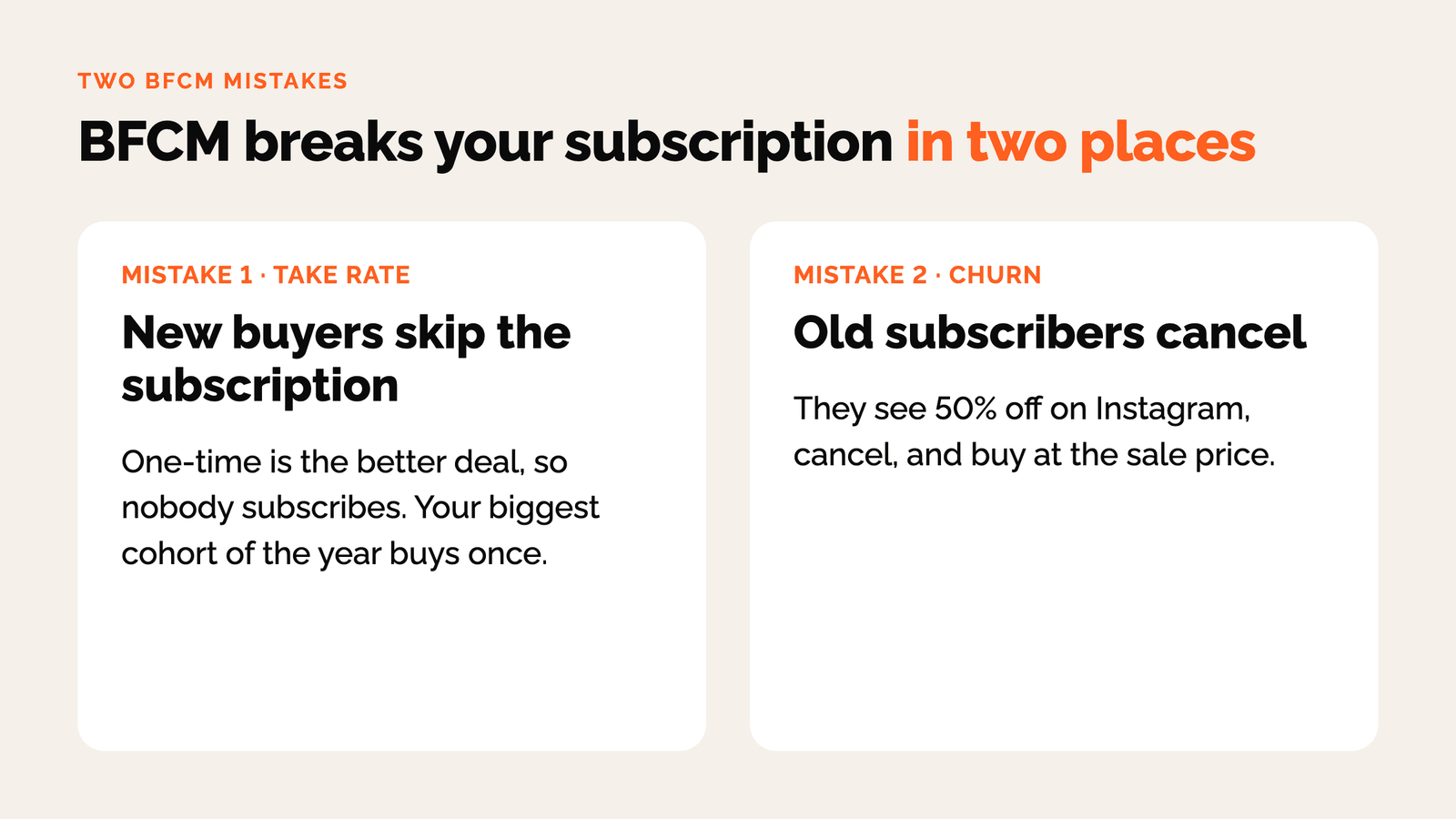
New BFCM buyers skip the subscription when one-time is the better deal, so your take rate drops in the biggest month of the year.
Every one-time buyer is a customer you paid full CAC for. You get one order back.
A subscriber at a deeper discount still pays you again in December and January. A one-time buyer usually doesn’t.
Keep subscription the better deal
If one-time gets 30%, subscription gets more. Or it gets something one-time can’t.
And keep subscription pre-selected on the product page widget through the sale. Ordergroove says defaulting to subscription can lift enrolment by as much as 200% (their BFCM guide). That’s their best case. Treat it as a ceiling.
Don’t raise the discount mid-weekend. Or go deeper than last year. Both train people to wait. Then last week’s buyers write in. They want the difference. Loop flags the same in their BFCM guide.
Discount the commitment, not the first box
Deep first-order discounts bring deal seekers. They take the discount. Then they cancel the same day.
So run your best deal on a 3-month prepaid plan or a BFCM-only bundle, not on the first box. A bundle at a deeper discount than buying the items one by one works. So do volume tiers that show the shopper how close they are to the next tier.
When Good Protein’s discount grew with the plan length, 60% of subscribers picked the longer plan (via Loop).
IM8 pushes its quarterly plan hard. A quarterly order collects $324 on day one against $128 for a monthly cycle. Grüns shows its quarterly plan on the thank-you page, after the card is already charged.
Streaming has data on this too. Antenna found people who signed up on Black Friday 2024 deals that ran for several months kept 57% after nine months, against 43% for all signups (via Swell). Streaming, so not your category. But the direction matches.
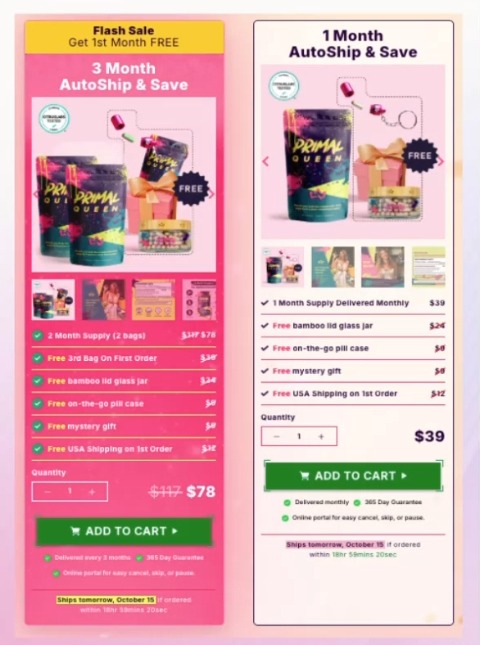
Primal Queen ran a flash sale on a 3-month autoship, with the first month free and gifts, and listed the extras right next to the 1-month plan. You see the gap at once.
Your longest-tenured subscribers, 10+ orders, can get the same idea as an upgrade: prepay for a bigger discount. Build all of these offers by Nov 13. Then test them.
Give a welcome kit only with subscription
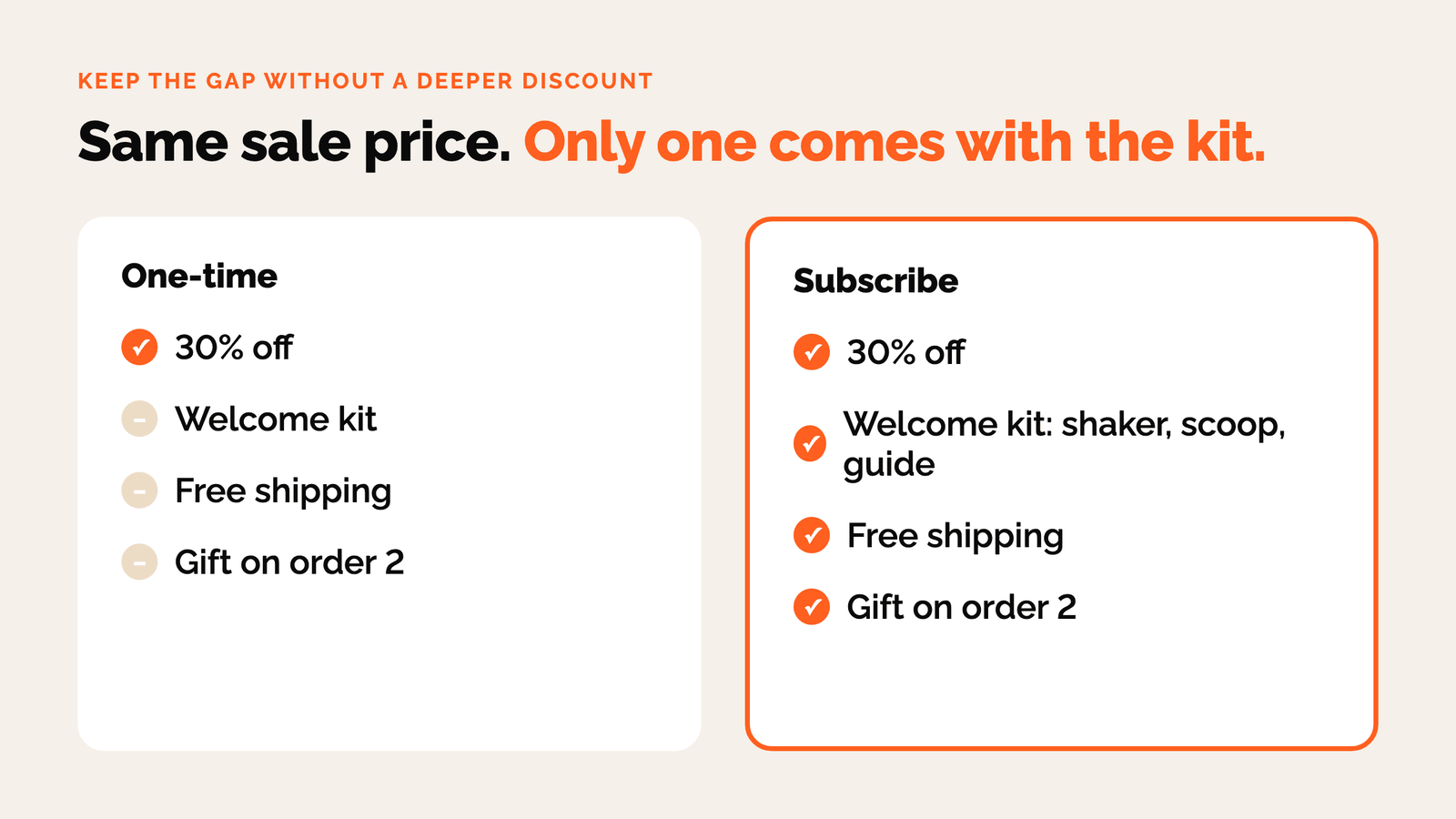
One-time gets the sale price. Subscription gets the sale price plus the kit. It keeps the gap without a deeper discount.
A welcome kit on the first subscription order isn’t a deep discount. So keep it, stacked on the evergreen rate.
Ask again after they pay
Anyone who bought one-time gets a one-click post-purchase offer to switch to subscription. They already paid. No risk to the sale. On Shopify Plus you can also offer the switch at checkout. The order of those offers is in cart, checkout and post-purchase upsells.
Mistake 2: Old subscribers cancel
Old subscribers cancel during BFCM because they see the sale. Subscribe and save runs at 20 to 25% all year. Then November hits and the brand goes 40, 50, 60% off sitewide.
You can take subscribers off the sale email. You can’t hide the site. Or the Instagram ad.
They see 50% off, cancel, buy at the sale price, and maybe come back. Your most profitable segment walks out to take your least profitable offer. Nothing spikes cancels faster than giving new customers a better deal.
As Matthew Holman put it: “Your 50% off sitewide sale will cancel your best customers.”
Arrae saw it happen. Loyal subscribers cancelled to rejoin on the BFCM promo, so now current subscribers get extra credits for staying (Recharge).
Give subscribers the sale first
Give subscribers first access in a subscriber-only window, Nov 16 to 25, before the sitewide sale opens. They stock up early. The public offer comes later. Reward loyalty first. Always.
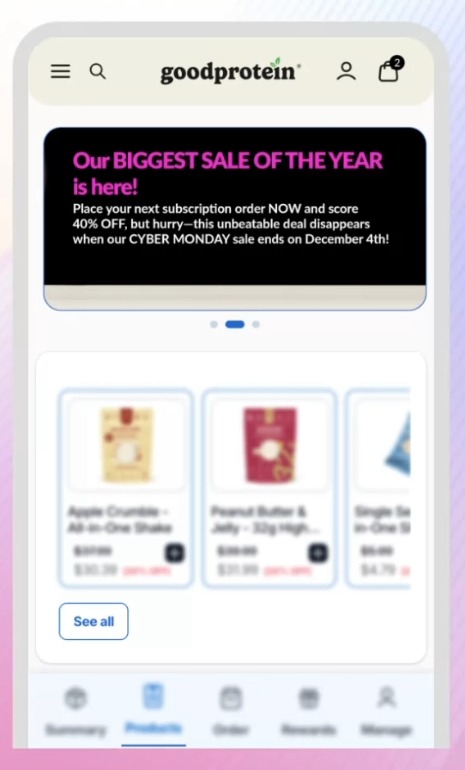
Make it about their next order. “Add anything to your next box at 40% off.” One tap from the email or SMS, no login. Zaymo does this. So do Loop Quick Actions.
Announce it in early November with a portal banner, “Early access opens Nov 16.” Flip it live on the 16th and take it down Dec 1. And tier the add-on by tenure, so long-time subscribers get the bigger deal. For example 50% off the first add-on, then 20%.
Good Protein did this in their portal. Add-ons went from 18% to 25% of subscription revenue in their BFCM month (via Loop). Which product to offer to whom is in add-ons and cross-sell for subscribers. Those add-ons come out of the same stock as the public sale. So hold units for renewals first.
Add a cancel reason that only lives during the sale
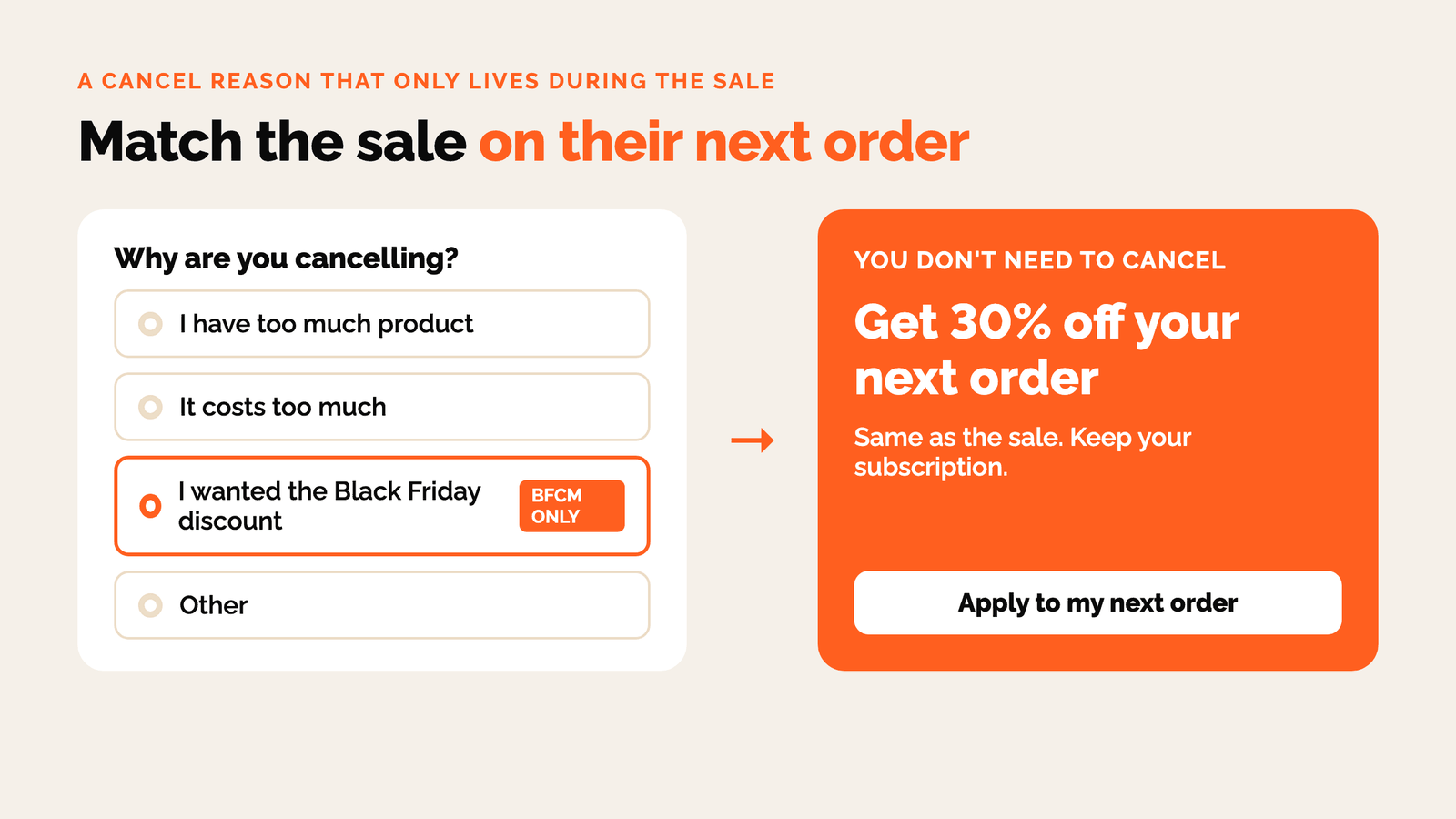
Add “I wanted the sitewide discount” as a cancel reason, and match the sale on their next order, right there.
Not ideal. Some people grab it who would have stayed anyway. But it flattens a huge cancel spike in your biggest revenue week, and the reason comes out again when the sale ends.
Take subscribers off every discount email
Subscribers already get a discount on every order. These are your most loyal customers. Don’t teach them to wait for a code.
Exclude them from every discount send, loyalty and points flows included. No sitewide code should beat what a subscriber already pays. The full suppression list is in keeping discounts away from your subscribers.
If you run a loyalty program too, reward subscribers for staying active instead. Bonus points, an exclusive gift or an early-access bundle work better than a code. Give double points with a 3-month expiry. Now you have a reason to email them in January. How the two programs fit together is in subscription vs loyalty programs.
Your subscription BFCM calendar
Most of this gets built before November. Dates are for 2026.
Decide the discount before you build the selling plan. Change it later and you’re editing live contracts. And keep the window short. A long sale spreads first renewals across all of December, right when cards bounce.
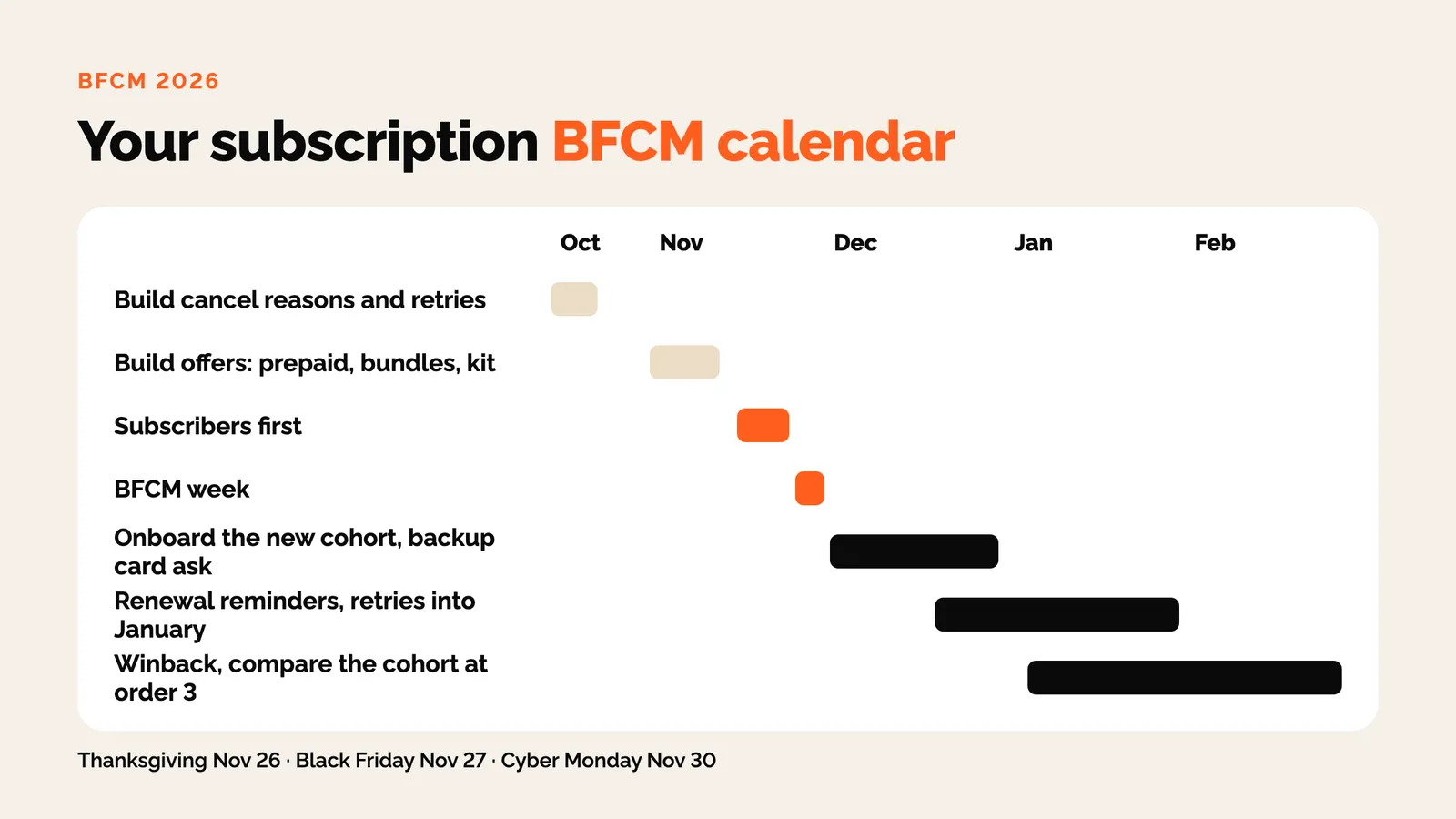
| When | What |
|---|---|
| October | Build the BFCM cancel reason and the holiday retry rules |
| Early November | Portal banner: “Early access opens Nov 16” |
| By Nov 13 | Prepaid plans, BFCM bundles and the welcome kit built and tested |
| Nov 16 to 25 | Subscriber-only window, add-ons on the next order |
| Nov 26 to 30 | Thanksgiving, Black Friday Nov 27, Cyber Monday Nov 30 |
| Dec 1 | Banner down, sale-only cancel reason off |
| Early December | Onboard the new cohort, ask for a backup card |
| December to January | Renewal reminders, retries saved for January |
| January to February | Winback, compare the cohort at order 3 |
After BFCM: December and January
Subscription churn jumps from 3.2% a month in November to 4.1 to 4.3% in December and January (Churned, 2026 benchmark report).
Tag the new cohort, and give them nothing extra
Tag everyone who subscribed during the sale, so every flow and report can split them out.
When they try to cancel, offer a delay, a new frequency or a skip. No new discount. They already paid the sale price. That was the deal. The cancel screen can say it plainly, even as a short video: “You got our best price of the year. It won’t come back until next November.” The full offer list per profile is in cancel offers that work.
One exception. A 10-month subscriber who bought again during BFCM is no deal seeker. Lifetime value overrides the sale tag. They get the loyal profile. How to build those segments is in segmenting subscribers by value.
Matching the sale and giving nothing extra don’t clash, because the match is for existing subscribers tempted by the public sale and the no-discount rule is for the cohort that joined at the sale price.
Put an instant winback offer on the cancel confirmation screen too. Why? Because in December, winback emails get buried.
Save payment retries for January, and ask for a backup card
December spending empties accounts. Cards bounce. And the first full-price renewal of a sale cohort is the riskiest charge you have. Expect cancels, chargebacks and “I didn’t know it would renew” tickets.
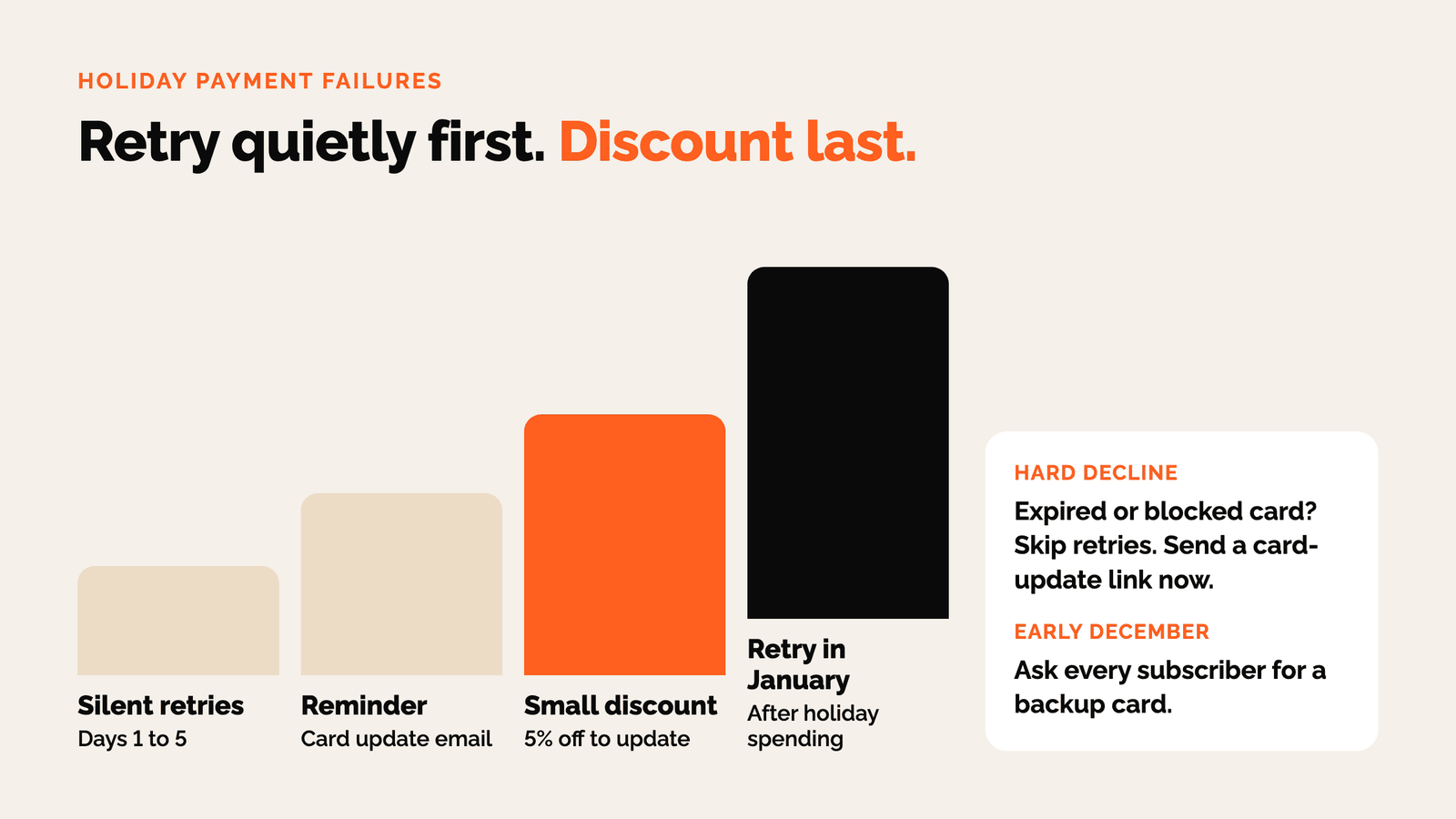
- Insufficient funds: retry quietly first, then save some retries for January.
- Hard declines: skip the retries and send a card update link right away.
- Discount last: silent retries, then a reminder, then a small discount, then a bigger one.
- Ask every subscriber for a backup card in early December.
- When retries run out, skip or pause. Don’t cancel.
The timing for each app is in payment retry schedules that work.
Use the sale to win back past cancels
BFCM is a good week for winback. Lapsed one-time buyers and cancelled subscribers see the same sale everyone else does, and they already know the product. So send them their own version, framed as “Your best deal to come back,” not “Please return.” Then plan the January recovery before November starts. Most brands go silent in January. Don’t. The flows behind it are in subscription winback.
Judge BFCM at order 3, not the weekend
BFCM buyers tend to be your lowest-retention audience. Watch them. Track their cohort and its Order 3 retention separately.
Compare the BFCM cohort to an October cohort at day 30, 60 and 90. Then look again in March, when most of it has reached order 3 or 4. That shows you what the sale actually bought.
Order 2 well below October? The discount was too deep, or it found the wrong buyers. Go shallower next year.
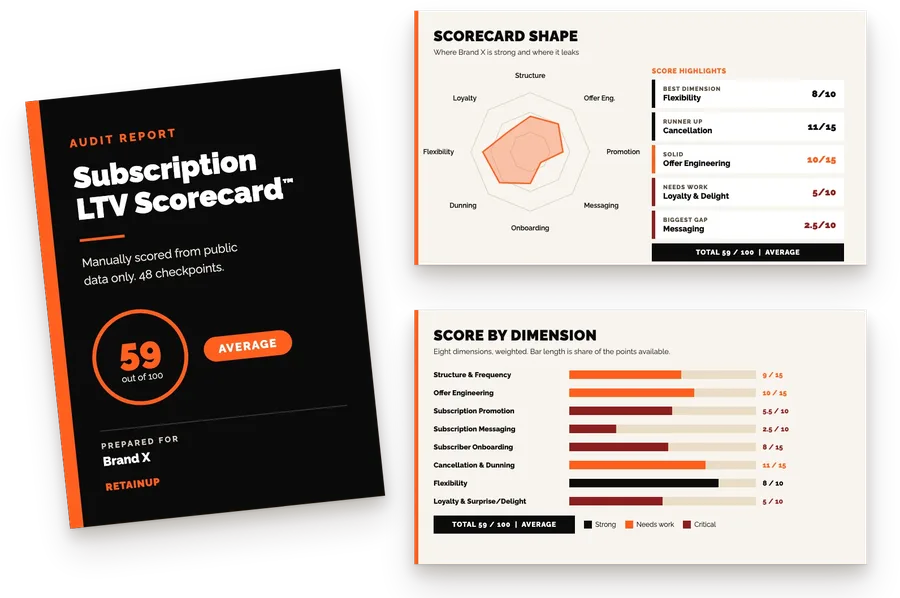
Most brands set this up once, in a rush, and find in January that a loyalty flow was still mailing subscribers or the sale cancel reason never came down. The Subscription LTV Optimizer™ checks your store, subscription app and Klaviyo every month and ships the fixes, for brands with 5,000+ active subscribers, at $3,000 a month. If you want a quick read first, the free subscription audit checks 48 points and sends your top 3 leaks in 24 hours.
FAQ
Should my Black Friday discount be bigger on subscription or one-time?
Subscription should always be the better deal. If one-time gets 30%, subscription gets more, or it gets something one-time cannot, like a welcome kit. Otherwise most new customers pick one-time. You buy your biggest cohort of the year at your lowest margin, and most of them never order again. Better still, put the deepest deal on a 3-month prepaid plan or a bundle, not the first box.
How do I stop subscribers cancelling during a Black Friday sale?
Give them the sale first, in a subscriber-only window, Nov 16 to 25, as an add-on to their next order. Then add “I wanted the sitewide discount” as a cancel reason and match the sale right there. And take subscribers off every discount email, loyalty and points flows included. They still see the site and the ads, so the cancel reason does the rest.
Does subscription churn go up after Black Friday?
Yes. Churn runs at 3.2% a month in November and 4.1 to 4.3% in December and January, per Churned’s 2026 benchmark report. December spending empties accounts too, and the first full-price renewal of the sale cohort is the riskiest charge. So retry failed payments quietly first, save some retries for January, and ask every subscriber for a backup card in early December.
Should I give BFCM subscribers a discount when they try to cancel?
No. They already got your best price of the year. Offer a delay, a frequency change or a skip instead, and tell them the price will not come back until next November. The exception is a long-time subscriber who happened to order during the sale. Lifetime value overrides the sale tag, so they get the loyal cancel profile.
How should I judge whether BFCM worked for subscriptions?
Judge it at order 3, not the weekend. BFCM buyers tend to be your lowest-retention audience. Tag everyone who subscribed during the sale, track that cohort separately, and compare it to an October cohort at day 30, 60 and 90. That shows you what the sale actually bought.
One email a week on subscription retention: the numbers, the strategy, and what to fix first.

Rahi Jain
Rahi Jain is a subscription LTV specialist who helps $1M to $10M DTC brands reduce subscription churn and maximize LTV on Recharge, Skio, Stay AI and Loop.
More about Rahi