Key takeaways
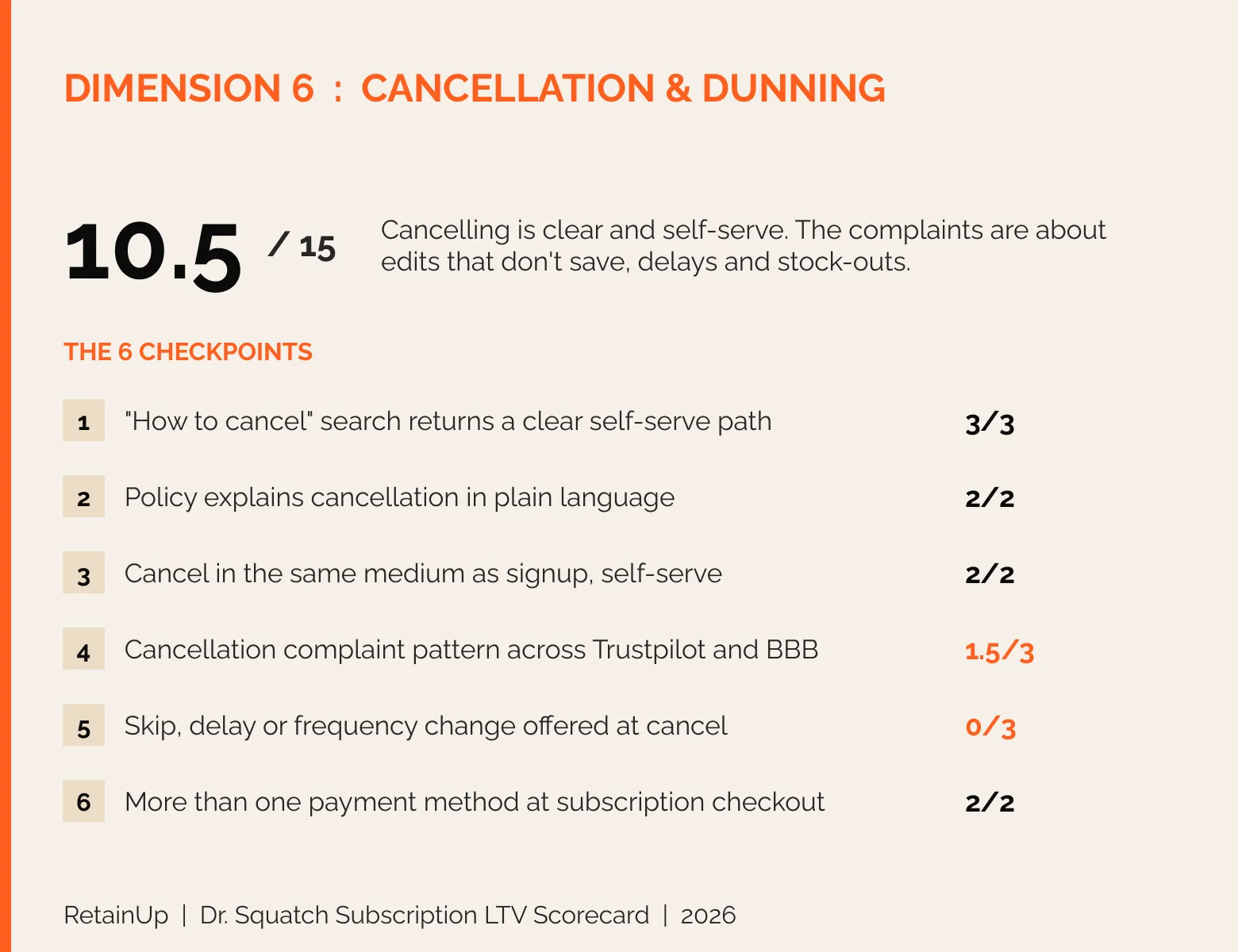
- Dr. Squatch scored 1.5 of 3 on cancel complaints in our scorecard. The complaints were edits that did not save, delays and stock-outs.
- Subscribers last 71% longer when they can swap a product, and in-email variant swaps cut churn about 20% (Zaymo).
- Skio sends a "Subscription Item Out of Stock" event to Klaviyo. Use it to tell the subscriber before the charge, not after the box lands.
Nobody picks "you were out of stock" in a cancel survey. They pick "other", or "not what I expected", or they just leave. So stock problems rarely show up as a churn cause, even when they are one.
This page covers the stock side of subscription retention: the scent that sold out, the box that shipped with the wrong item, the gift that dropped off the order, and the BFCM week where subscribers and the public sale fight over the same units. And then the good side. Swaps, used well, are one of the better reasons people stay.
Why stock-outs are a quiet churn cause
I scored Dr. Squatch on 48 checkpoints. Cancelling is clean. Their own help article comes up first, the steps are numbered, and a reminder goes out 5 days before every charge. No phone call, no email. Sign up online, cancel online.
The complaints are about stock. People edit their subscription and nothing happens. A lot of the issues are product related, like delays, and a lot of products going out of stock. So the cancel complaint checkpoint scored 1.5 out of 3.
That is the pattern with stock. The cancel flow can be fine. The portal can be fine. And still the subscriber leaves. The product they chose was not the product they got.
It also hides in your data. A stock problem gets filed under a vague reason, or under support tickets, or nowhere. Read the "Other" answers every month, and split cancel reasons by product. If one SKU keeps showing up next to "not what I ordered", check its stock history before you touch the offer.
The box you edit is not always the box you get
Dr. Squatch sells a box, not a bar. You pick 4, 6 or 10 bars, choose your scents, add deodorant or toothpaste, and edit it later. Everything ships every 3 months. A lot of the scents on the builder are limited editions.
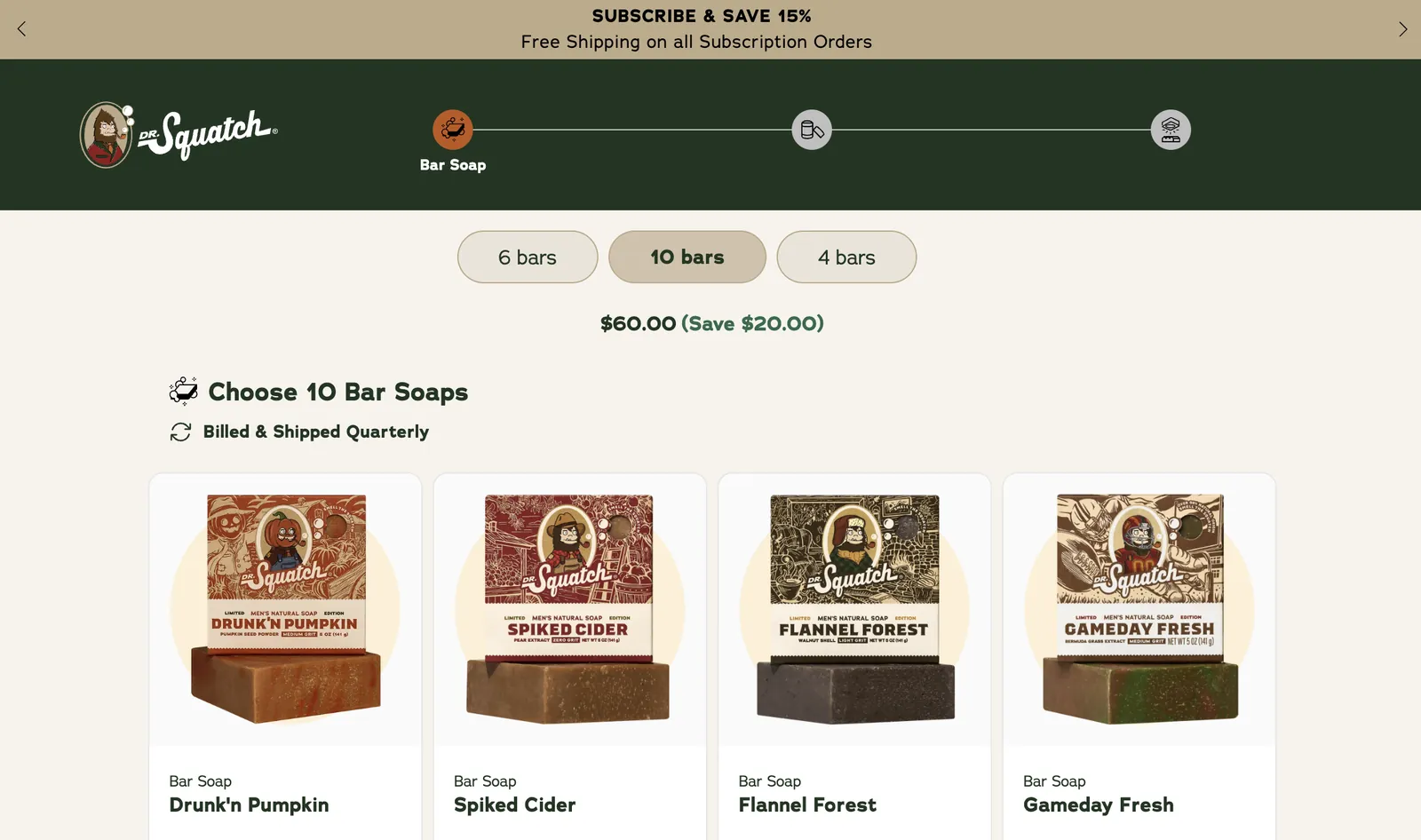
Limited scents sell out. And a different bar ships without anyone being asked.
One verified Trustpilot review says it plainly. The subscriber picked 4 different bars, 4 days before the box was due to ship. Two were sold out or discontinued, so the box came with all Golden Glory. Even though 1 or 2 of the bars he picked were still available. He did not even like Golden Glory. He cancelled.
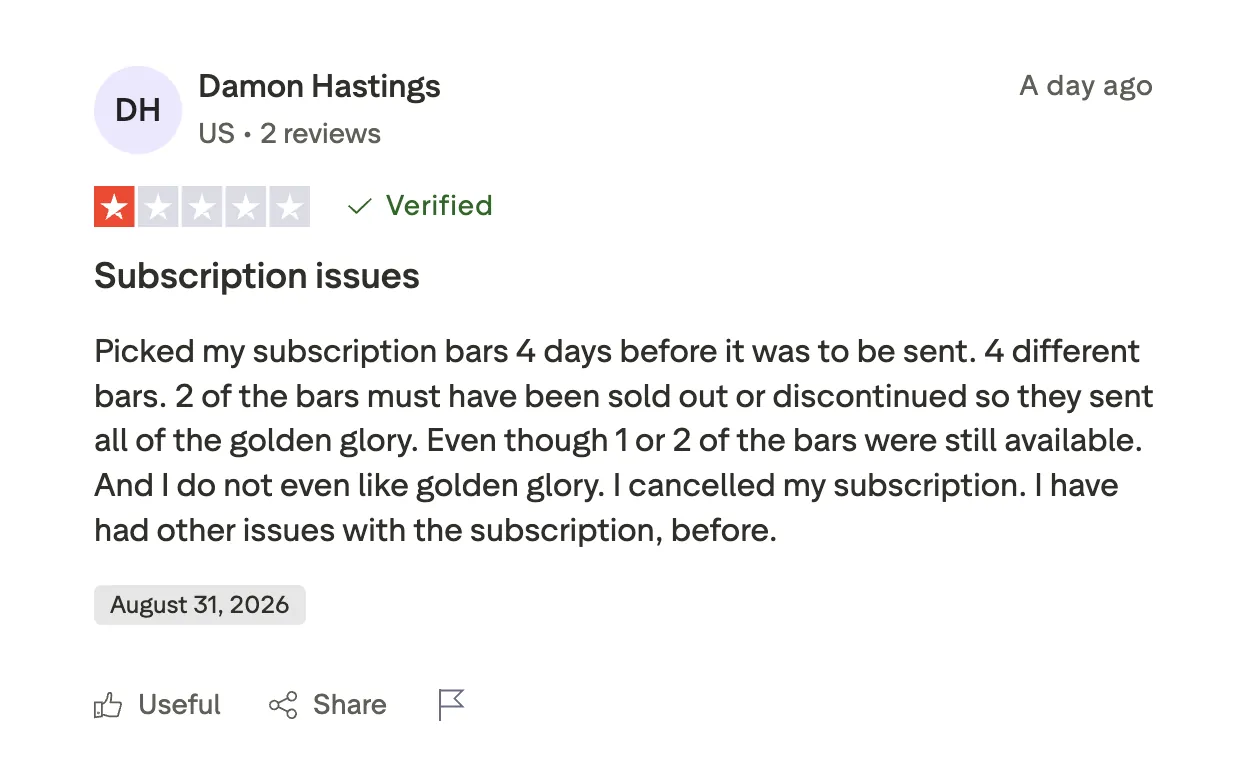
People edited the box and still got the wrong one. That is the worst version of a stock-out, because the subscriber did everything right. They used the portal. They made the change before the cut-off. The brand quietly overruled them.
So the fix is small. Fix Edit Box so changes save. If a scent is out, tell them early and let them pick the next one. And keep cancel self-serve.
Tell them before the charge
Timing matters most. The time to say "this is out" is before you take the money. The natural place is the upcoming billing reminder, since it already shows what is in the box and goes out a few days before the charge. Dr. Squatch sends theirs 5 days before. If an item in that box is short, the reminder should say so at the top.
Some apps give you a separate trigger too. Skio sends a "Subscription Item Out of Stock" event into Klaviyo, next to its upcoming subscription and billing reminder events. Build a short flow on it. Skio also has a Backup Products setting: the subscriber picks a substitute for that one order, and the reminder can carry a link to pick it (Skio help centre). It does not work on prepaid plans. The full list of what each app sends is in subscription app events in Klaviyo.
What the out-of-stock message should say
- Which item is out, by name. "Golden Glory is out" beats "an item in your order is unavailable"
- What you will send instead if they do nothing, and that it is their call
- One button to pick a different item, one to delay the order until it is back
- The cut-off date for changes, the same one the portal shows
Make the change possible without a login. Zaymo puts skip, delay and swap inside the email, and in-email variant swaps (flavor, size, color) cut churn about 20%, per Zaymo's own data. Loop has Quick Actions for the same job. More on the tool in Zaymo for subscription brands.
And if you cannot tell them in time, at least do not pretend. A note in the box saying what was swapped and why costs nothing.
What your subscription app does when an item is out of stock
Before you write any rule, check what already happens. It starts with one Shopify setting. The apps only see stock when the product tracks quantity and "Continue selling when out of stock" is off. With it on, the order goes through and the warehouse sorts it out.
| App | By default | What to set |
|---|---|---|
| Recharge | No order is created. The charge gets an "insufficient inventory" error and retries daily for up to 60 days | Partial order fulfillment, so the in-stock items still ship |
| Skio | Follows your inventory policy. It needs "Only order items in stock" to catch stock-outs | Backup Products, picked by the subscriber for one order |
| Loop | You pick: complete order, partial billing, delay or skip | Partial billing or delay, plus the Product Out of Stock notification |
| Ordergroove | Splits the order. The held item retries daily for 30 days, then cancels | Its out-of-stock emails go on day 1 and day 15. Put a swap link in both |
Those are from each app's help centre (Recharge, Loop, Ordergroove), as of November 2026. Settings change.
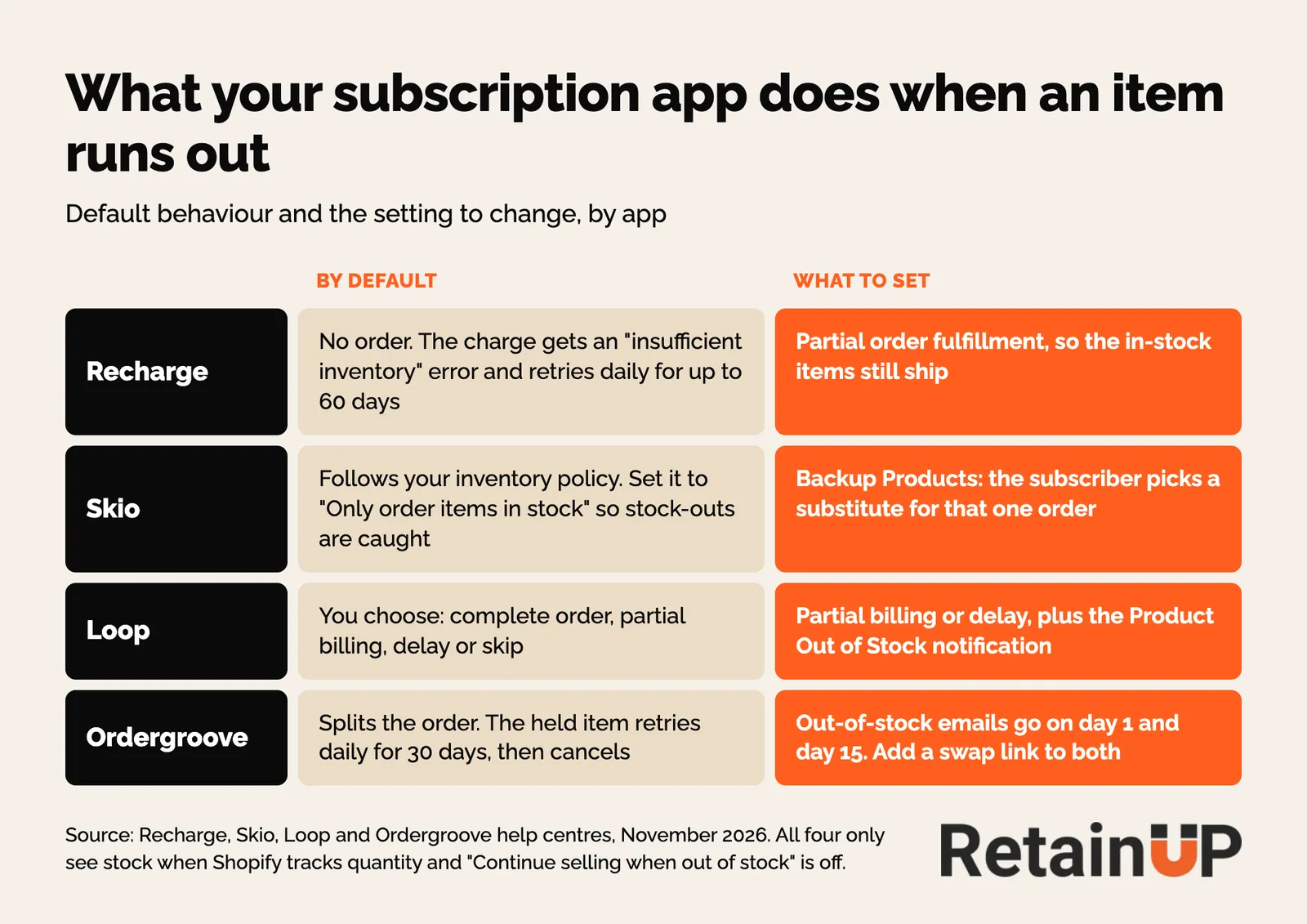
A 60-day silent retry is the one to watch. No charge, no box, no email. So to the subscriber it looks like the subscription broke. For a box with several items, partial shipping is usually better. Check yours. Loop lets you recalculate shipping on a partial order, so a half box does not go out free by mistake.
Auto-swap rules: decide the fallback before it runs out
Every brand that sells variants will run out of something. Fine. The question is what the system does when it happens, and most brands have never written that down. The warehouse picks whatever is on the shelf.
Some apps let you set a predefined swap, where one product is replaced by a named alternative. Skio has it inside its cancel flow. Whatever your tool calls it, the rule should exist before the stock-out, not on the day.
Rules we would set
- One named fallback per SKU, close to the original. Same product line, same size, same price
- Never a variant the subscriber removed from the box. If they swapped it out, they told you they did not want it
- Never fill the whole box with one item to cover two gaps. That is the Golden Glory review
- Tell them before the charge, with the fallback named, and let them change it
- If there is no good fallback, delay that item or that order instead of guessing
- When it is back, swap the original back in and tell them it is on the next order. Skio does this on its own for a backup; on Recharge you swap it back
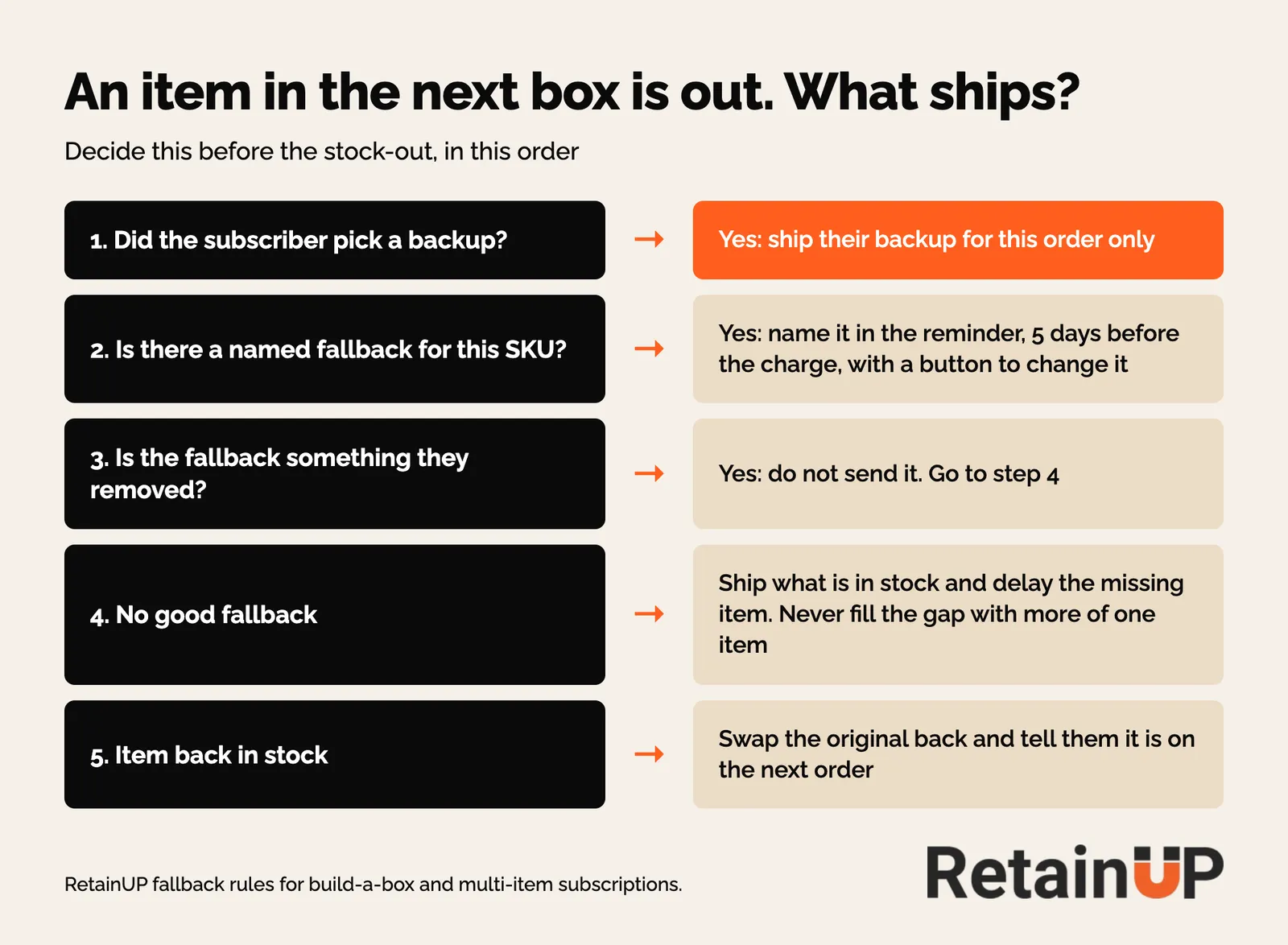
Build-a-box needs extra care here. On Skio, product swaps in the cancel flow are not available for Build-a-Box subscriptions, so the fallback has to live somewhere else: the portal and the reminder. The box rules themselves are in subscription bundles and build-a-box.
Gifts and rewards run out too
Stock problems are not only about the product they pay for. The free gift on order 2 is a stock item as well.
On one of our brands on Loop, the order-2 streak gift and the sticker gifts were set to 0 stock with "deny when out of stock". We caught it in a setup check. The first order-2 gifts were still weeks away. We changed all three to continue selling and moved the draft product to unlisted. Gift products have to be unlisted (not draft) with continue selling on, or Loop's gift line can drop off the order.
That is the one gift a new subscriber was promised before they signed up. If it silently disappears from box 2, you just broke the reason they stayed past order 1. The warehouse still needs real units before the first gifts ship, so check stock against the date the first milestone falls due. How those milestones are planned is in subscription rewards.
BFCM: hold stock for renewals first
You do not want to run out of stock during the peak season. And you do not want to overstock either, which ties up cash.
For a subscription brand, November has two kinds of demand on the same shelf. The public sale, and the renewals that were already scheduled. Then there is a third if you run subscribers-first early access with add-ons on the next order, which we recommend. Good Protein's add-ons went from 18% to 25% of subscription revenue in its BFCM month. That is great. It also comes out of the same stock.
My view is simple. Renewal orders get their units first. A new buyer who misses a sold-out bundle will buy something else. A subscriber who gets the wrong box in December is one of the people who cancels in January, when churn already peaks. Your upcoming charges are already a demand forecast. Ordergroove's stockout guide makes the same point, plus safety stock and a smaller catalogue. So pull scheduled renewals by SKU for the sale weeks before you set sale quantities. Sync with whoever plans promotions, new launches and clearance before the sale, and never promote a product you cannot ship to the people already paying for it. The rest of the plan is in BFCM for subscription brands.
Variety and swaps as a reason to stay
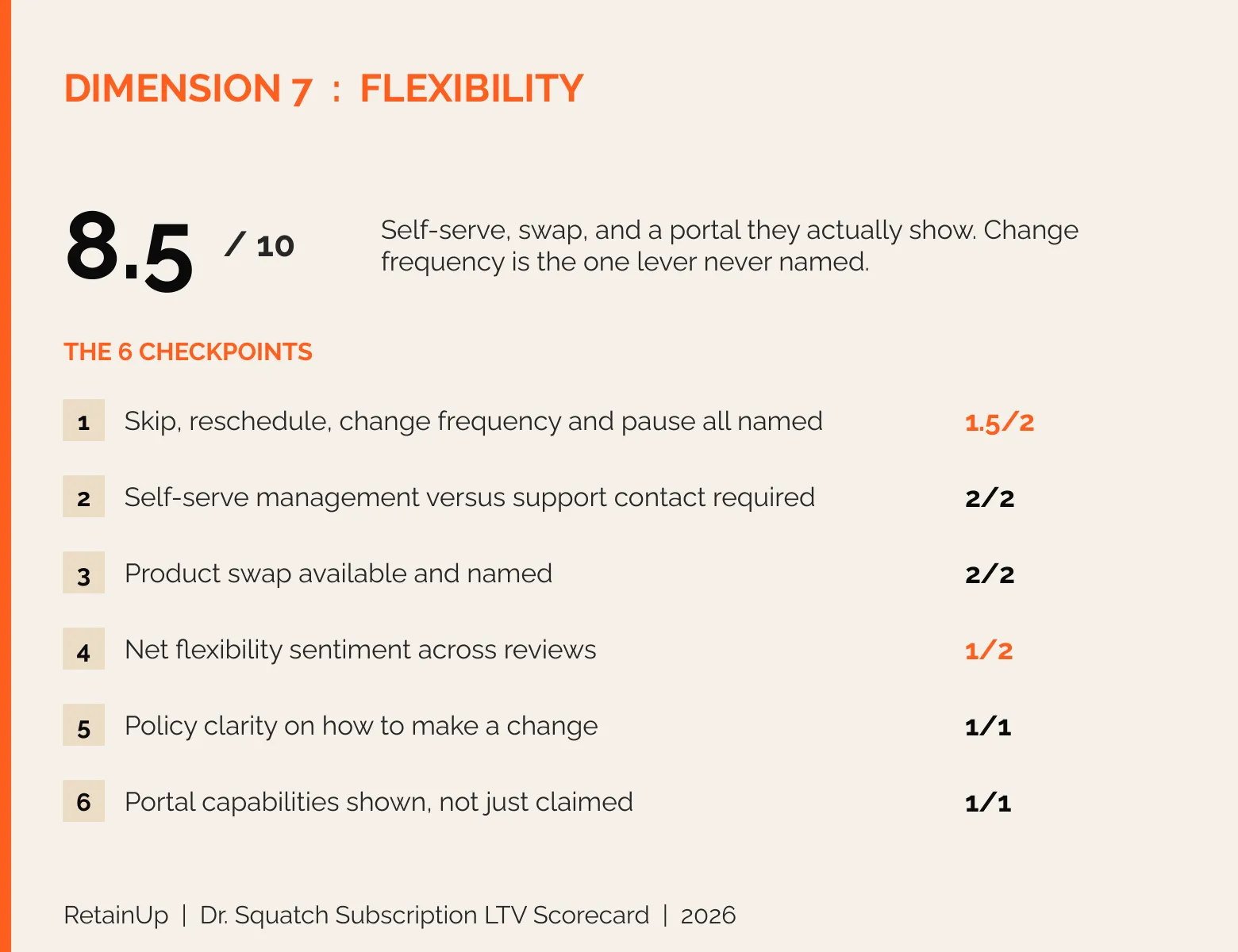
Now the other side. Swaps help. Self-service is there at Dr. Squatch, swap is there, and people use it. Subscribers last 71% longer when they can swap a product. And swap behaviour is an engagement signal: when someone starts swapping, they are exploring, which is the right moment to show them a complementary product.
Every brand offers skip and swap. Very few get customers to use it. On Reddit and Trustpilot, Dr. Squatch subscribers talk about swapping scents and adding new ones before the box ships. I rarely see that.
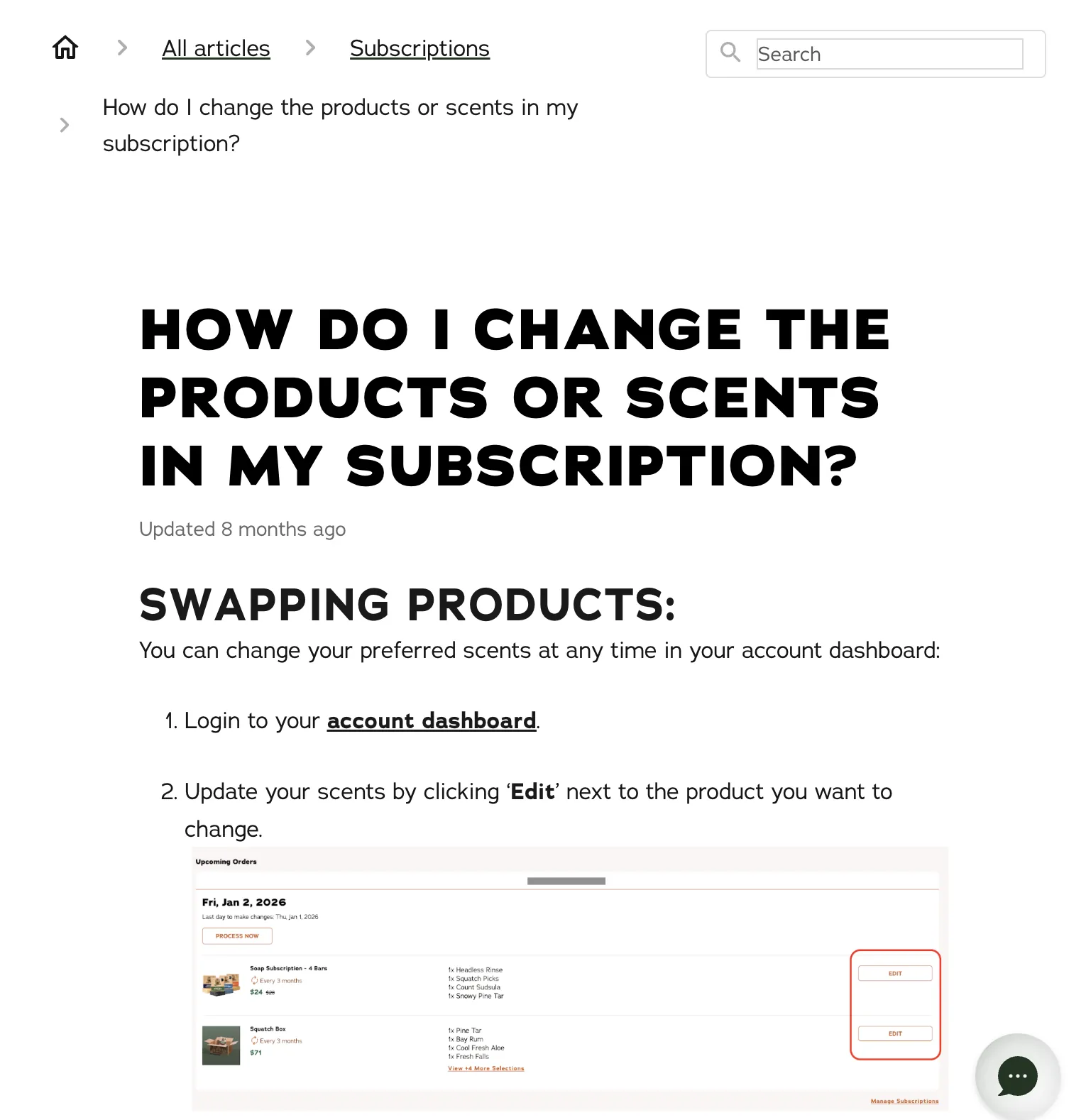
The fixed frequency is why. Everyone knows a box is coming every 3 months, so they get the reminder, open the dashboard and change it. The help centre even shows a screenshot of the dashboard, so you know what you can change before you log in.
Grüns does it with novelty. A new limited flavour lands roughly every six weeks, and customers can swap their next box to it by replying to a text. They kept the box monthly partly for that. A 90-day box cannot receive a six-week drop.
Food and beverage subscribers place the most orders and leave the soonest. Variety and swaps are the fix there. One brand's data said the same thing in fewer words: customers who rotate flavours stay longer than customers locked to one. That is one case. Still worth noting.
Make swap easy to find, and short
- Swap lives in the customer portal and the reminder, not behind the cancel button
- Offer a short list of good swaps, not the whole catalogue. Skio calls its curated Swap Recommendations one of its most effective retention tools on high-churn products
- In the cancel flow, "didn't love it" or "want something different" goes to a flavour or variant they have not tried
There is a stock problem on the customer side too. Overstock caused 27% of subscription cancellations in Ordergroove's 2023 to 2024 data. That one is fixed with skip and frequency, not swaps. See the flexibility ladder for the order to offer them in.
If you want the swap rules, the out-of-stock message and the reminder built for you, the Subscription LTV Maximizer™ sets up the offer, widget, cancel flow, portal, payment recovery, pause and skip in Recharge, Skio, Stay AI or Loop, plus the email and SMS around them, live in 30 days for $5,000. Or start with the free subscription audit: 48 checkpoints and your top 3 leaks in 24 hours.
FAQ
What happens to a subscription order when an item is out of stock?
It depends on your app and one Shopify setting. With "Continue selling when out of stock" on, the order goes through and the warehouse picks a substitute. With it off, Recharge holds the charge and retries daily for up to 60 days, Loop does what you chose (partial billing, delay or skip), and Ordergroove splits the order. Set one named fallback per SKU and tell the subscriber before the charge.
How do I tell subscribers an item is out of stock?
Put it at the top of the upcoming billing reminder, which already lists what is in the box a few days before the charge. If your app sends an out-of-stock event, like Skio does into Klaviyo, build a short flow on it. Name the item, say what ships instead, and give one button to swap and one to delay.
Should subscribers be able to swap products?
Yes. And it should be self-serve in the portal and the reminder email. Subscribers last 71% longer when they can swap a product, and in-email variant swaps cut churn about 20% according to Zaymo. Offer a short list of good alternatives rather than the full catalogue, so the choice is quick.
Do stock-outs cause subscription churn?
Yes. But it rarely shows up as a stated cancel reason. People pick "other" or "not what I expected", or leave without a reason. In our Dr. Squatch scorecard the cancel complaints were about edits that did not save, delays and stock-outs. Split cancel reasons by product to see which SKU is behind it.
One email a week on subscription retention: the numbers, the strategy, and what to fix first.

Rahi Jain
Rahi Jain is a subscription LTV specialist who helps $1M to $10M DTC brands reduce subscription churn and maximize LTV on Recharge, Skio, Stay AI and Loop.
More about Rahi