Key takeaways
- Skio puts a full migration at 4 to 5 weeks. Loop and Stay AI quote about 2 weeks, and a gateway change adds 7 to 14 business days.
- On one Loop brand, 35% of failed payments were dead cards, so subscribers mid-dunning should move over paused, never active.
- After one Appstle to Loop move, raw data showed more than twice the real cancels for three months, because the migration cancelled its own records.
"Can I switch subscription apps with active subscribers?" It comes up on the Shopify forums every few weeks. The answer is yes. Most brands switch without a single customer typing in a card again.
So the data move is rarely the problem. Every big app runs a migration team, and they move subscriptions, charge dates and, in most cases, payment tokens. They don't move your setup. Selling plans, portal links, Klaviyo events, the cancel flow and the reminders are yours to check. I've seen every one of them go wrong on a live store.
This is the checklist we run for every move, part of our guide to subscription apps for Shopify.
When a switch is worth it
You have outgrown your subscription app when there is a setting you need and it can't make, whatever your size. One sign is not on the list: a rival telling you to switch.
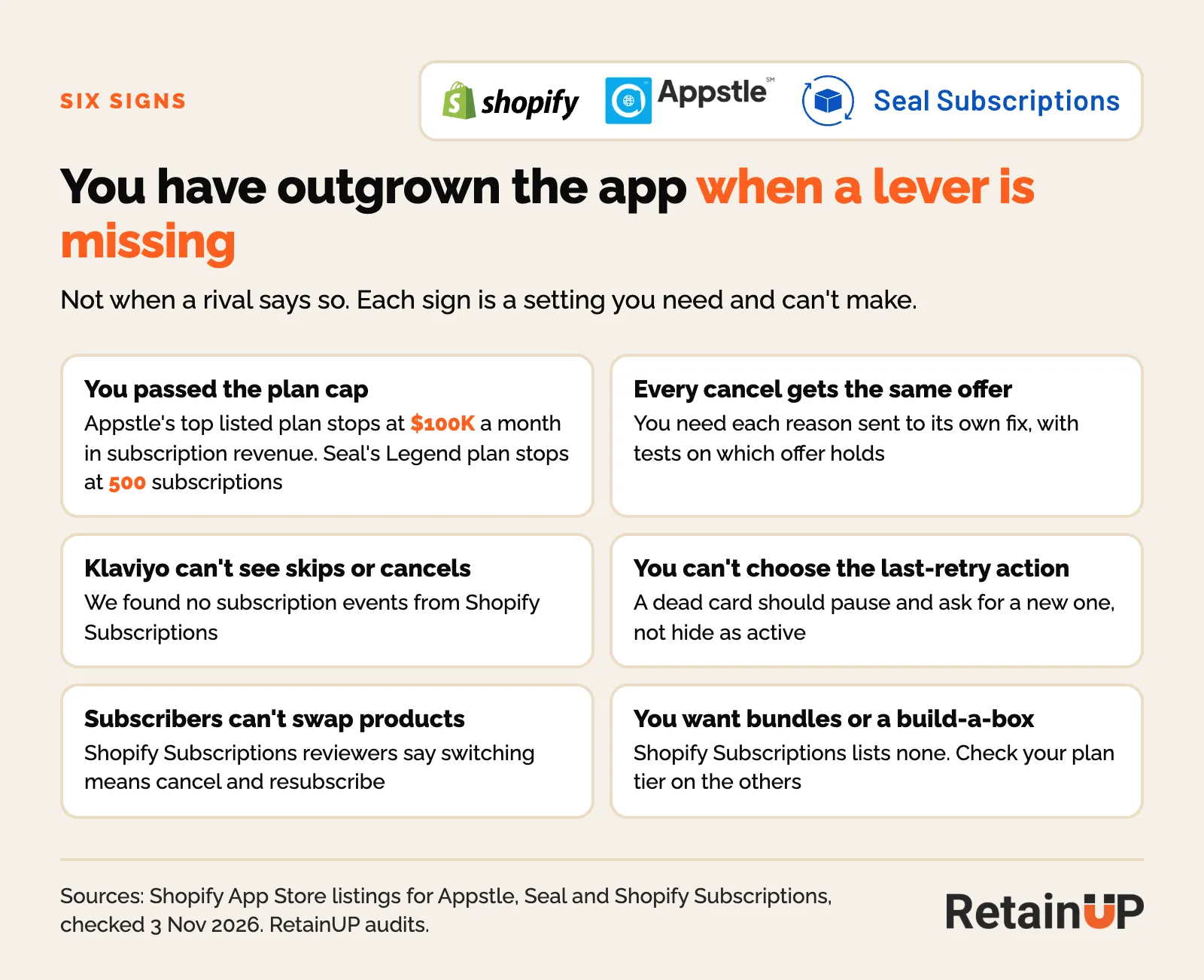
- You passed the plan cap. Appstle's top listed plan covers up to $100K a month in subscription revenue. Seal's Legend plan covers 500 subscriptions.
- Every cancel gets the same offer. You need "too much product" sent to a skip and "too expensive" sent to a cheaper plan.
- Klaviyo can't see skips or cancels. We found no subscription events from Shopify Subscriptions.
Price matters too. At 2,000 subscribers and a $50 order, Loop Starter costs about $1,099 a month against $100 on Appstle's top plan. So a move has to buy a lever worth more than that gap. And most of what we find in audits is setup, which moves with you. Which app to pick is in best Shopify subscription app.
How long a subscription app migration takes
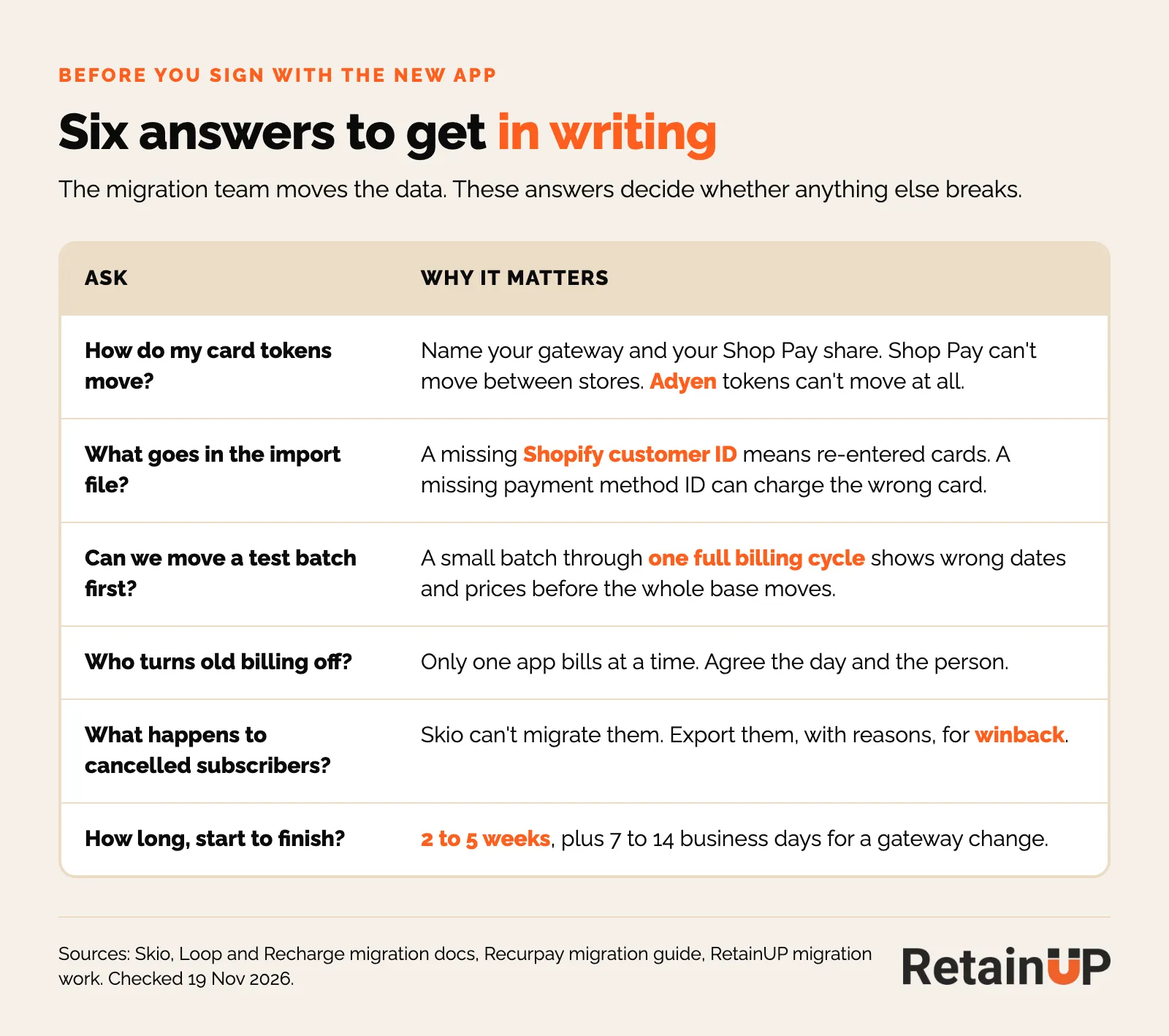
Two to five weeks. It depends on the app and your gateway. Skio's migrations guide puts the full integration and migration at 4 to 5 weeks. Loop says about two weeks, runs the move free on every paid plan, and names Seal in its process doc. Stay AI says up to two weeks. It has no public migration doc. Get the plan in writing. Recharge's managed migration sits on Scale and Custom, not Starter, with a lead time of 2 to 8 weeks.
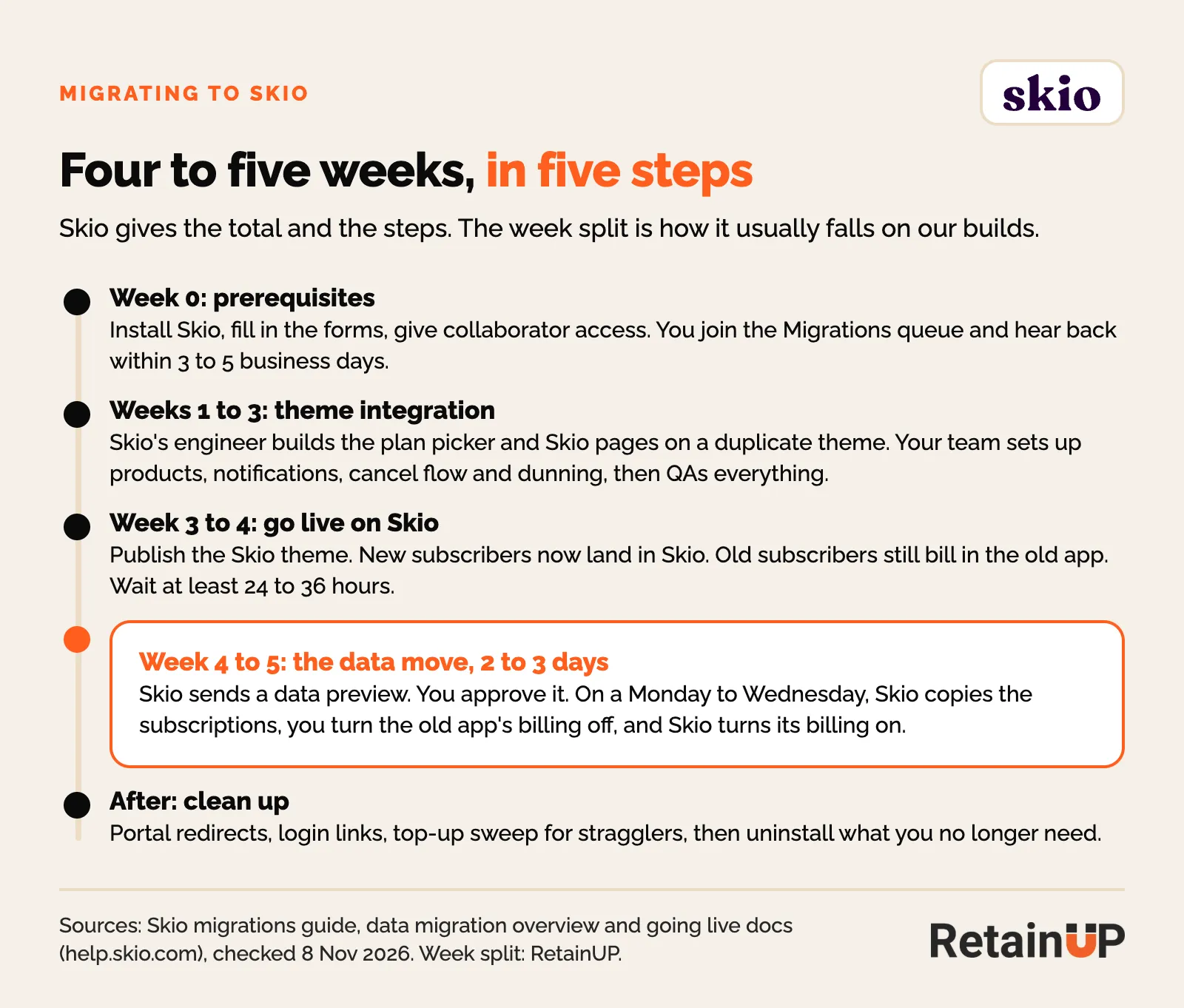
Plan around your billing calendar, not the vendor's. Mid-season, or with many cards in retry? Wait for a quiet month.
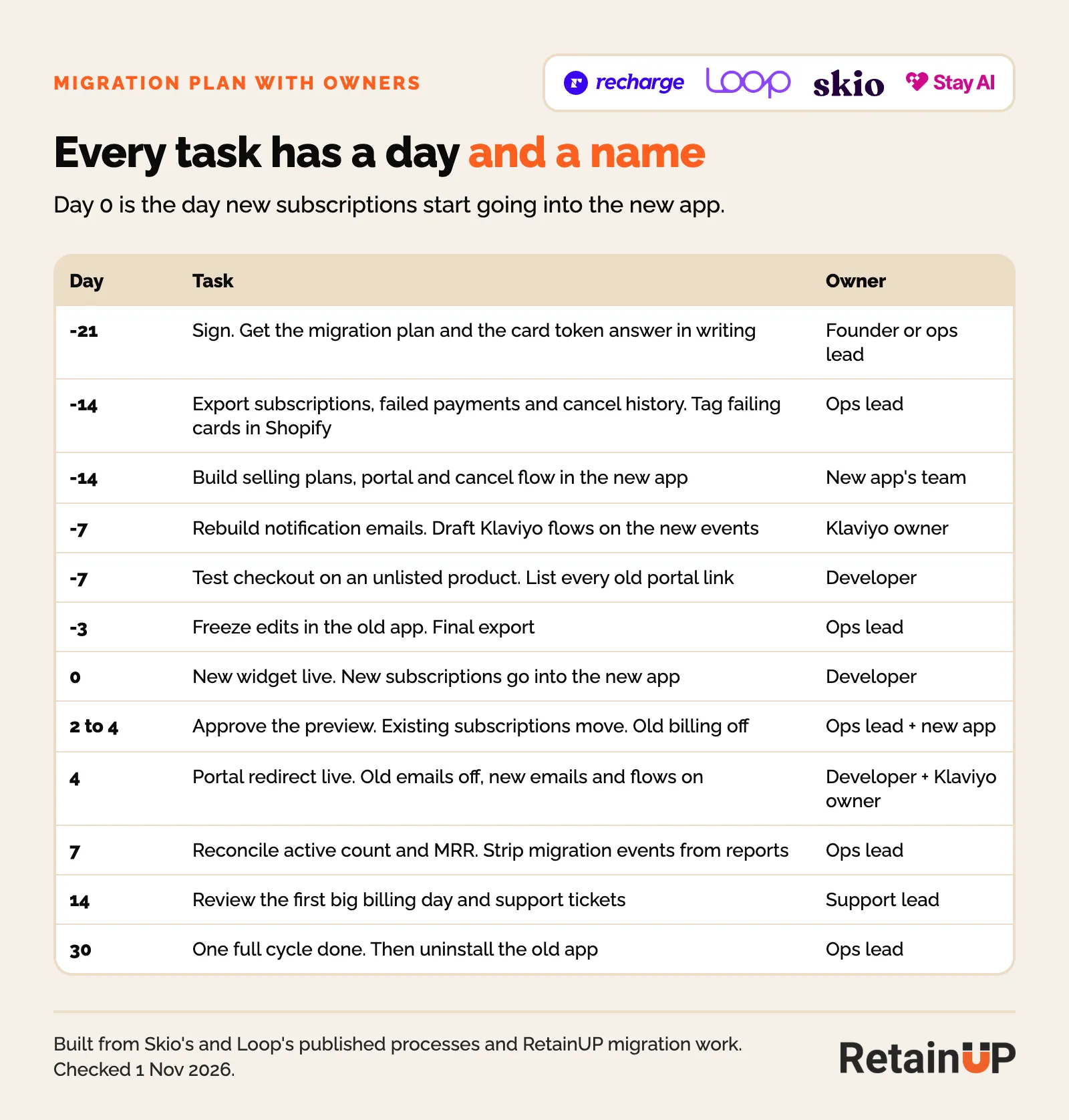
The plan, day by day
Day 0 is the day new subscriptions start going into the new app. Name a person for each row before you sign. "The app's team handles it" covers the data move and nothing else.
What moves and what stays behind
Subscriptions, products, prices, discounts and next charge dates move. Retry position, email settings, Klaviyo event names and old portal links don't, or only partly.
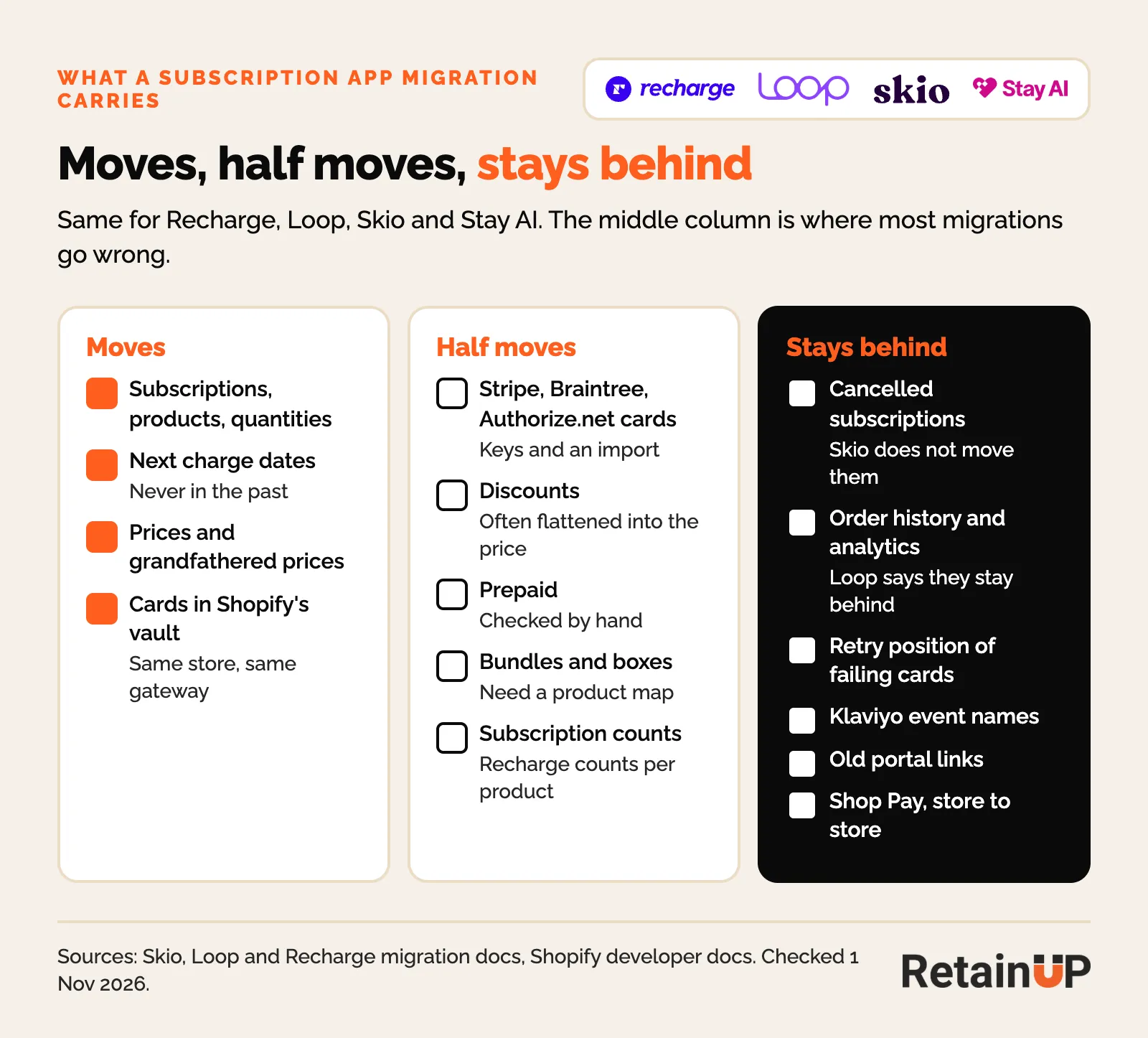
| Item | Moves? | What to do |
|---|---|---|
| Subscriptions, products, quantities | Yes | Check the variant mapping file line by line |
| Selling plans and discounts | Yes, if recreated first | Recreate discount codes and plans before import. Keep grandfathered prices |
| Next charge dates | Yes | Freeze edits in the old app. Spot-check 20 records |
| Saved cards | Usually | Depends on where the card lives |
| Dunning position | No | Tag and export failed-payment subscribers first |
| Order count | Usually | Check it, or order 3 gifts fire on the wrong order |
| Portal links | No | Redirect the old portal URL, update every email and help page |
| Notification emails and Klaviyo events | No | Rebuild, turn on and test each one |
Selling plans: check the interval, not the name
On one Loop store, a plan called 3 months was set to deliver every month. The last line at checkout, "Recurring subtotal every 84 days", is the proof. Check every plan. And recreate delivery settings, tax rules and discounts before import, as Shopify's migration guide says.
Things that never move
Skio cannot migrate cancelled subscriptions. Loop's FAQ says order history and analytics stay behind. So export them first. Past cancels are your winback list, and Recharge's migration guide moves inactive subscribers after the active ones. And expect your subscription count to change. Recharge counts each product as a subscription. Skio groups products with the same date, frequency and address.
Saved cards and payment tokens
Saved cards survive a migration when the payment gateway stays the same, because a saved card is a token held by the gateway, not by the subscription app. Three cases cover most brands.
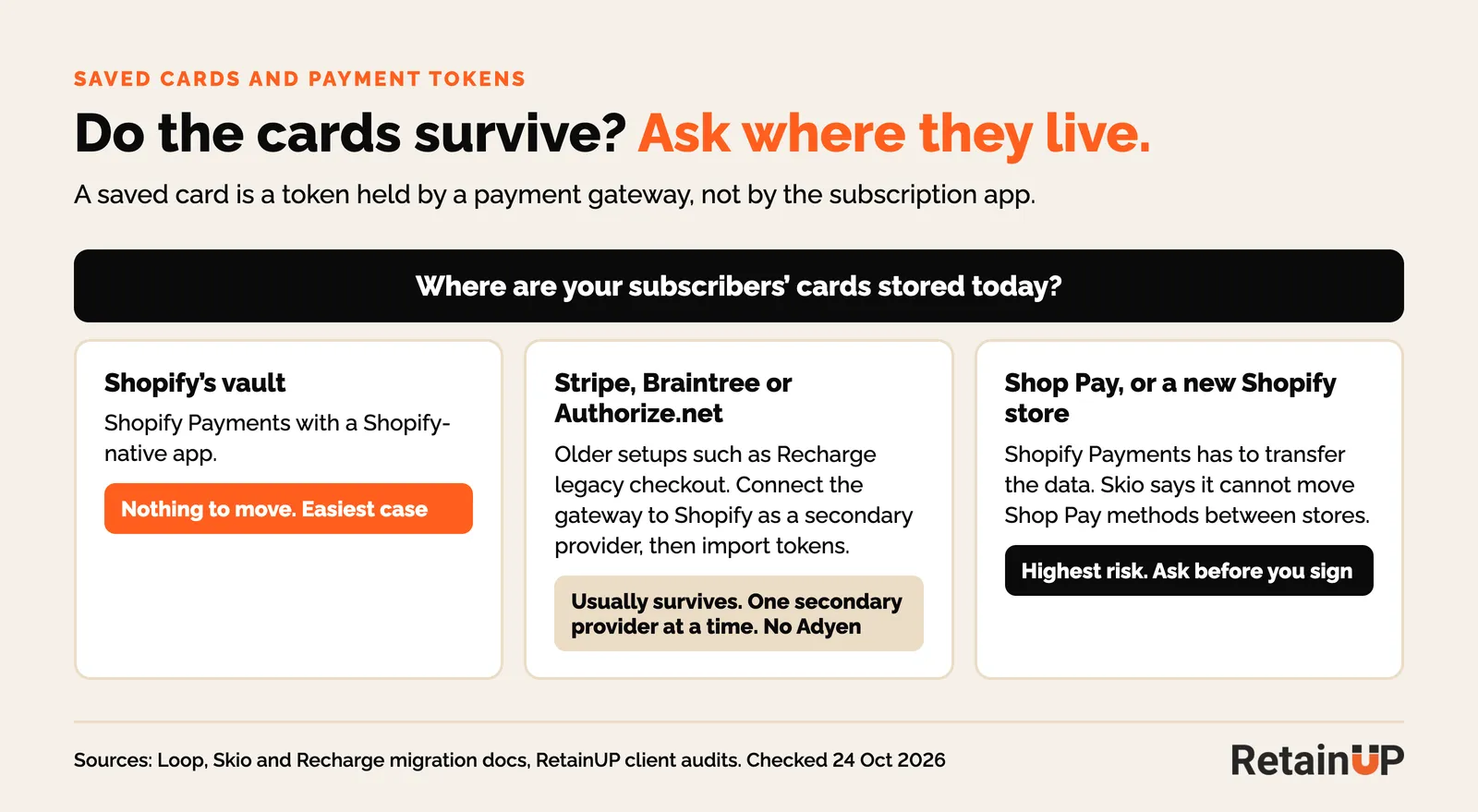
- Cards in Shopify's vault. On Shopify Payments with a Shopify-native app, there is no payment data to move. This is the easy one.
- Cards at Stripe, Braintree or Authorize.net. The gateway gets connected to Shopify as a secondary provider and the tokens are imported. Shopify allows one secondary provider at a time, and Loop says Adyen tokens can't be migrated.
- Shop Pay and store-to-store moves. Skio says it cannot migrate Shop Pay methods from one store to another. On one Loop brand we audited, Shop Pay carried 64% of payment attempts. Ask about it before you sign.
Moving from Braintree to Stripe first? Recharge says that transfer takes 7 to 14 business days, and charges for existing customers are blocked until it finishes. Move any charge dates out of that window.
Then check the import file itself. Recurpay's switching guide names two columns that cause most card problems. A missing Shopify customer ID means subscribers get asked for their card again. A missing payment method ID can charge a customer's other saved card. Ask the new app to move a small test batch first and let it bill once, if it can.
Dunning in migration week
Subscribers who are mid-dunning usually arrive in the new app looking healthy. The retry schedule lives in the old app's billing engine, so the new app treats a failing subscriber as a normal active one. The next charge fails. A fresh retry ladder starts from zero.
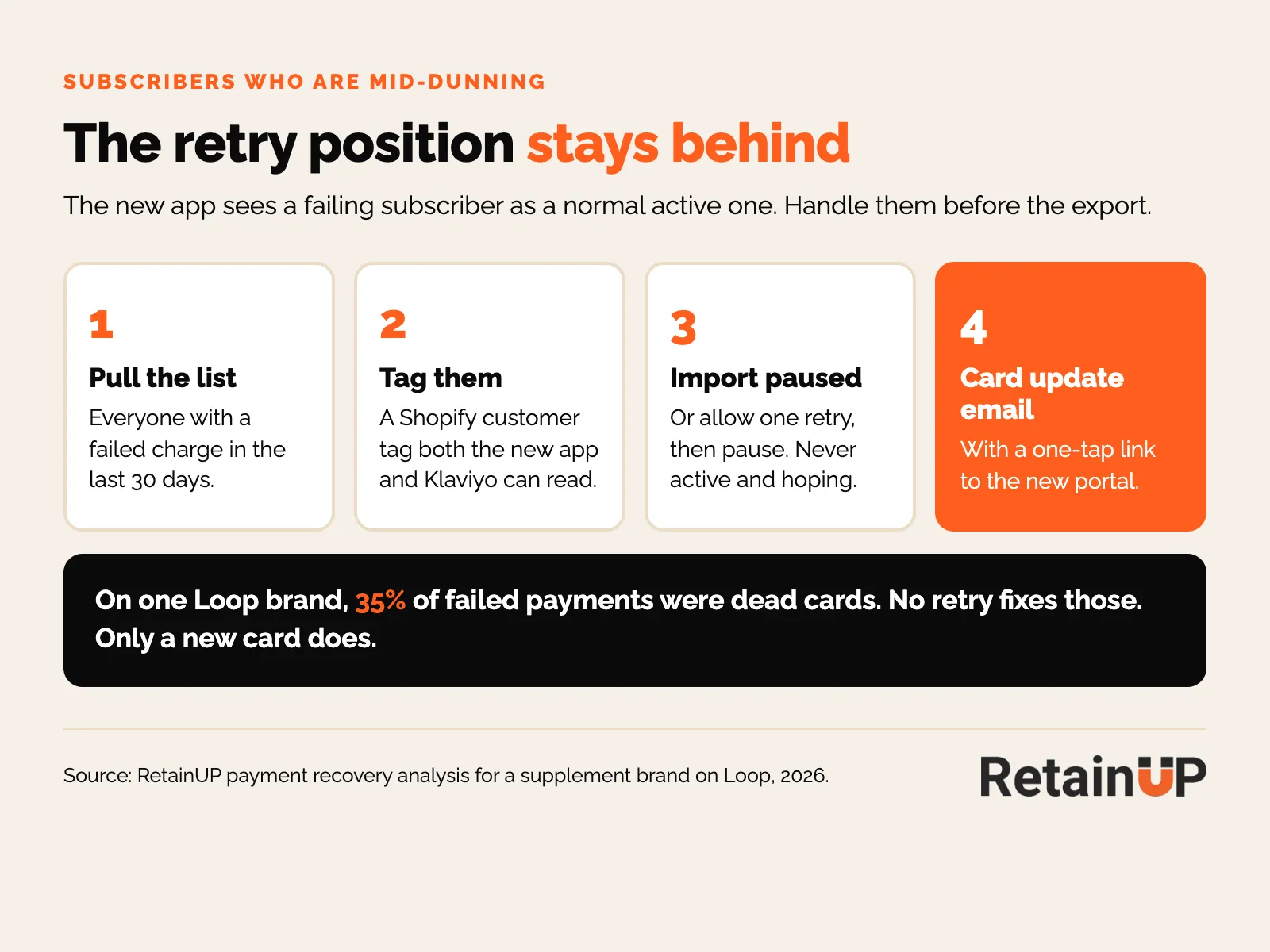
So before the export, pull everyone with a failed charge in the last 30 days and tag them in Shopify. Import them paused with a card update email, or allow one retry and then pause. Don't import them active and hope.
On one Loop brand, 35% of failed payments were dead cards that no retry can fix. Only a new card brings those back, which is the job of the card update flow. Rebuild it before cutover, with the rest of failed payment recovery.
Cutover: one app bills at a time
Keep next charge dates exactly the same. The new app should bill each subscriber on the day the old one would have. And a shifted date reads as a surprise charge. Then a cancel.
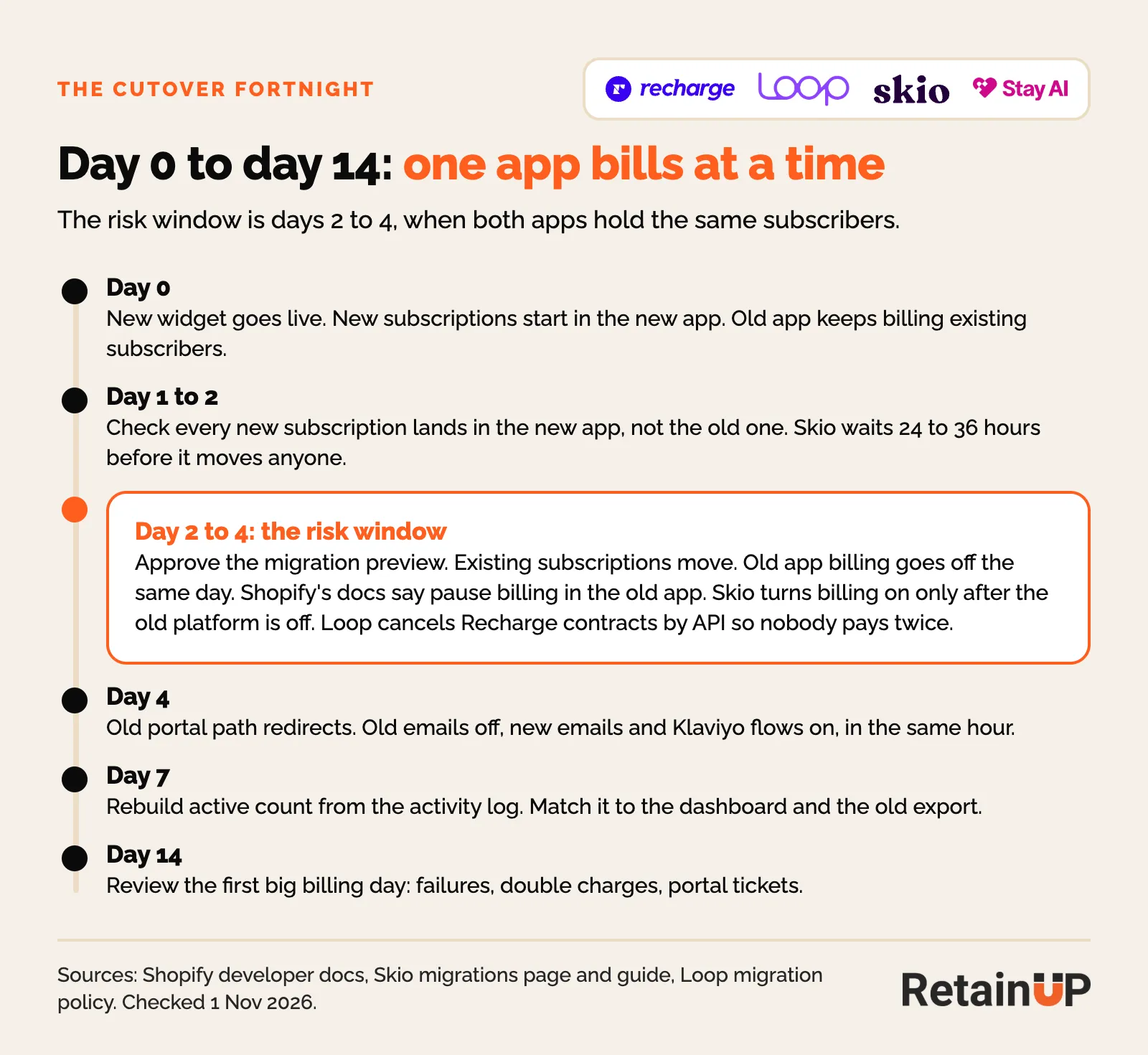
Days 2 to 4 are the risk window, because the data move is a copy, not a transfer. Shopify subscription contracts made by one app cannot be taken over by another, so for a short time both apps hold the same subscribers. The order matters. Shopify's developer docs say to pause billing in the old app while you migrate, Skio does not turn billing on until the old platform is confirmed off, and Loop, moving a brand off Recharge, cancels the Recharge contracts by API so nobody is charged twice.
Stragglers who still subscribe in the old app, through an old link or an app like Tapcart or Rebuy, get a top-up migration.
Then tell subscribers. They will notice a new portal and new emails, even if charge dates and prices don't change. Send a note a week before, with the new portal link, so the first email from the new app is expected.
Portal links break on cutover day
Every old portal link breaks. They live in more places than you think. Reminder emails, order confirmations, the account page, help center articles, SMS flows and saved bookmarks.
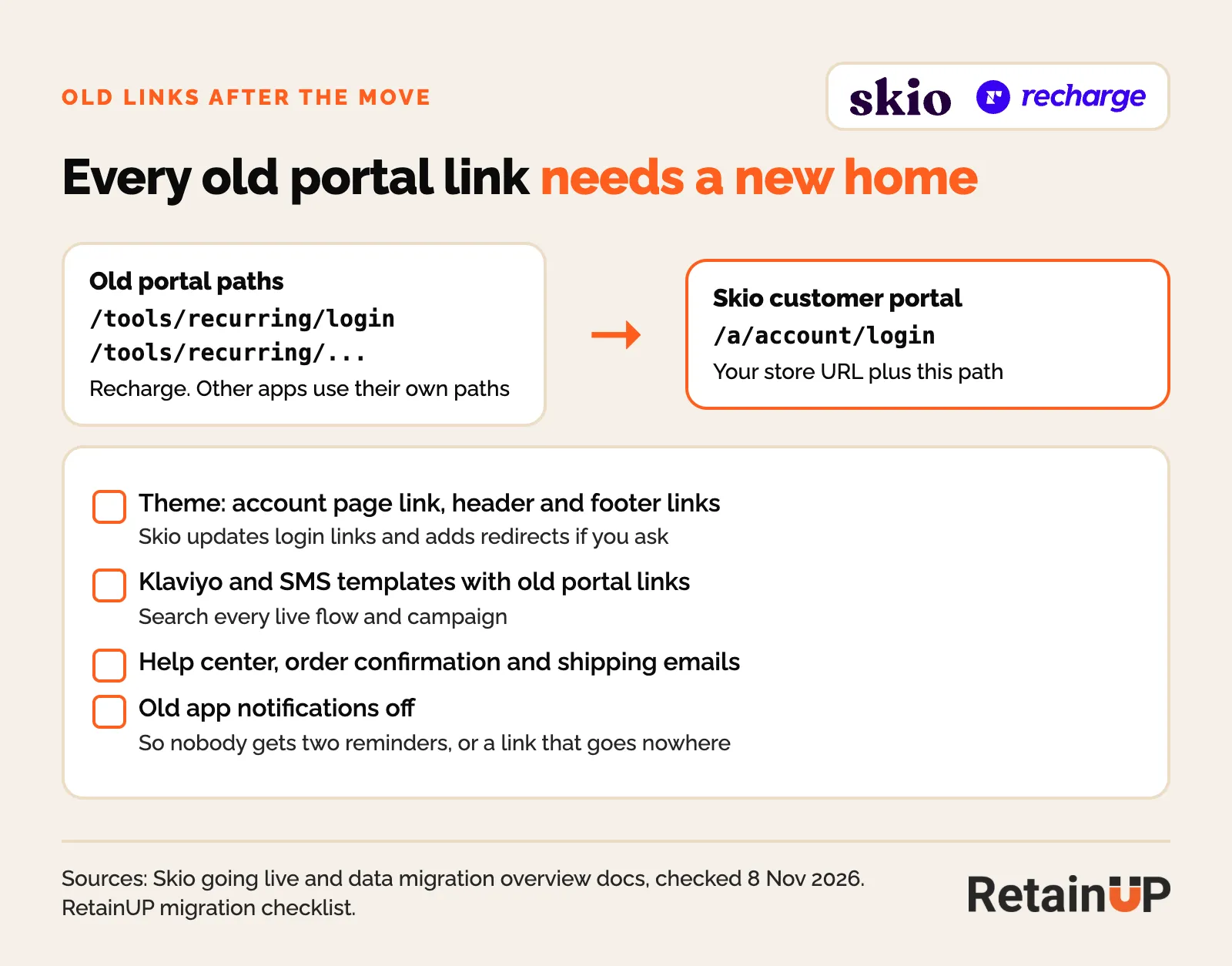
- Redirect the old portal path. On Recharge that is /tools/recurring. Skio's team adds redirects if you ask. Ask on the kickoff call.
- Search every live Klaviyo flow, campaign template, SMS and help page for the old path.
- Click every link from a real subscriber account, on a phone.
And a subscriber who can't find skip will find cancel, or email support to do it. The customer portal is where they look first.
Klaviyo events, cancel flow and reminders
Every Klaviyo flow triggered by the old app stops on cutover day, because the new app sends its own events, with its own names, into your Klaviyo account. The old metrics stay in Klaviyo, so the flows look fine. They just never trigger again.
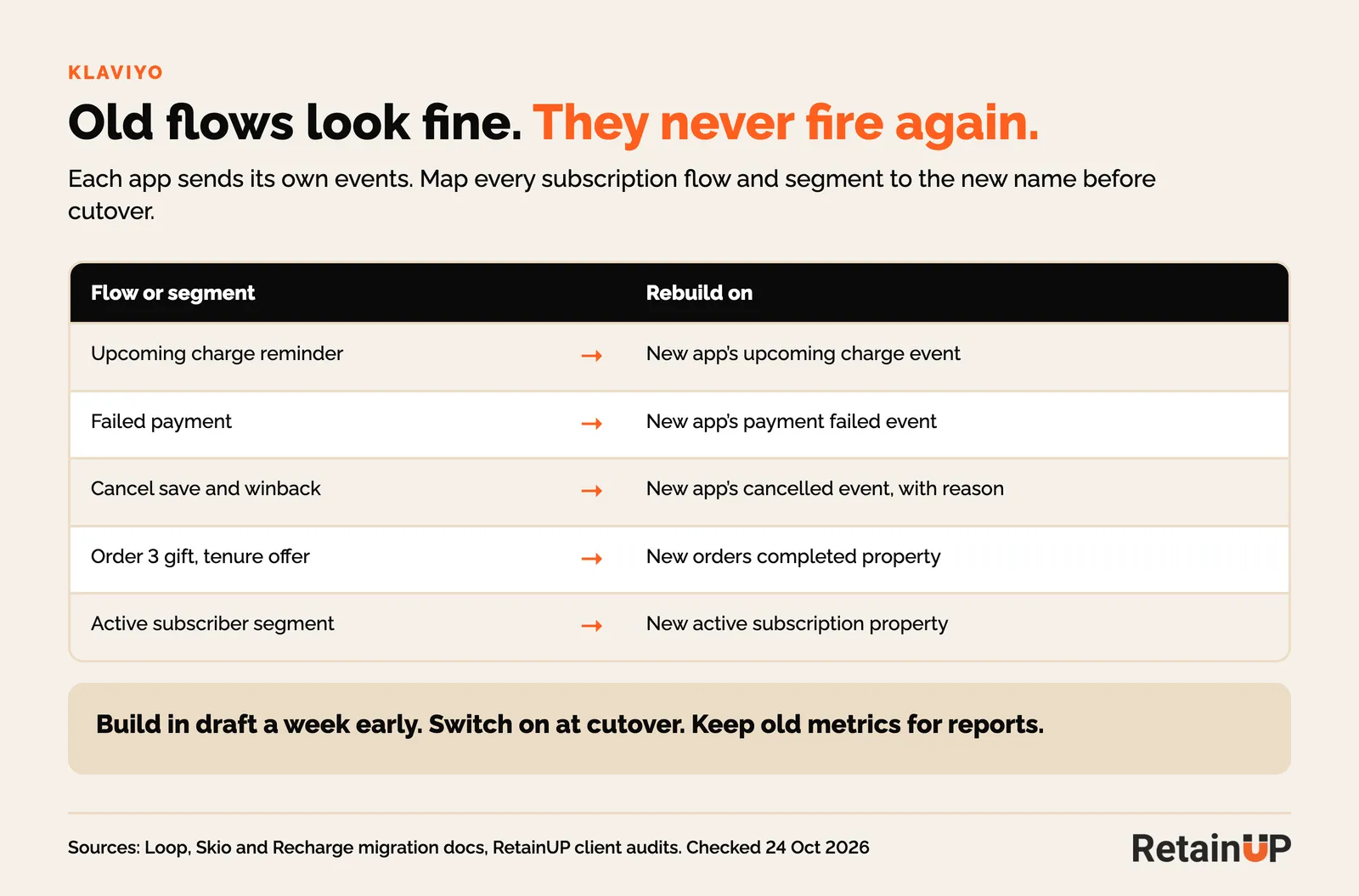
A week before cutover, list every flow and segment that uses a subscription metric or profile property. Map each one to the new event. Build in draft. Switch on at cutover. The exact names for Recharge, Loop, Skio and Stay AI are in our Klaviyo event map. And a Skio metric only shows in Klaviyo after it has fired once, so send a test event first.
Migrated subscribers can land in a welcome flow meant for new ones, which one Skio merchant reported in an App Store review. Filter the welcome flow by start date before migration day.
Rebuild and read each notification email: the upcoming charge reminder, payment failed, card expiring, skip and cancel confirmations. Turn the old app's emails off the same day. Or subscribers get two. Then check they are on, not just built. On one Loop brand, the payment emails stopped in September, and a full month of retries went out with no email. Nobody noticed. Nothing errors when an email doesn't send.
None of your cancel flow, offers or portal layout comes across. Build them again. Moving email tools at the same time? Import each list into a new Klaviyo list with double opt-in off. Bring 180 days of engagement data for warmup, and put unsubscribed and suppressed profiles straight onto the suppression list.
Clean the data after cutover
A migration leaves debris in your numbers. Take it out before you read a single chart.
One supplement brand we moved from Appstle to Loop went live on 29 June 2026. On that day the migration created a batch of subscriptions and cancelled about two thirds of them, all tagged "migrated from appstle". Counted raw, cancels for the next three months came to more than twice the real number. Another 3% of the live base was created paused and never billed, and sat in the paused count for three months.
Old prices came across too. Many still paid the legacy $44. Fine, if you know before you test a price. Then watch for ghosts. About 6% of active subscriptions had skipped and never placed an order in Loop. One skipped every month since the move and still counted as active. So rebuild the active count from the activity log in week one. Match it to the dashboard. Loop's count matched. The rebuild held. Filter migration events out of churn, cohort and save rate reports. Cohort charts get a break at the migration date, so read them as we describe in subscription cohort analysis.
Checklist before the switch
Work through this before you book a cutover date. Most of it is exports.
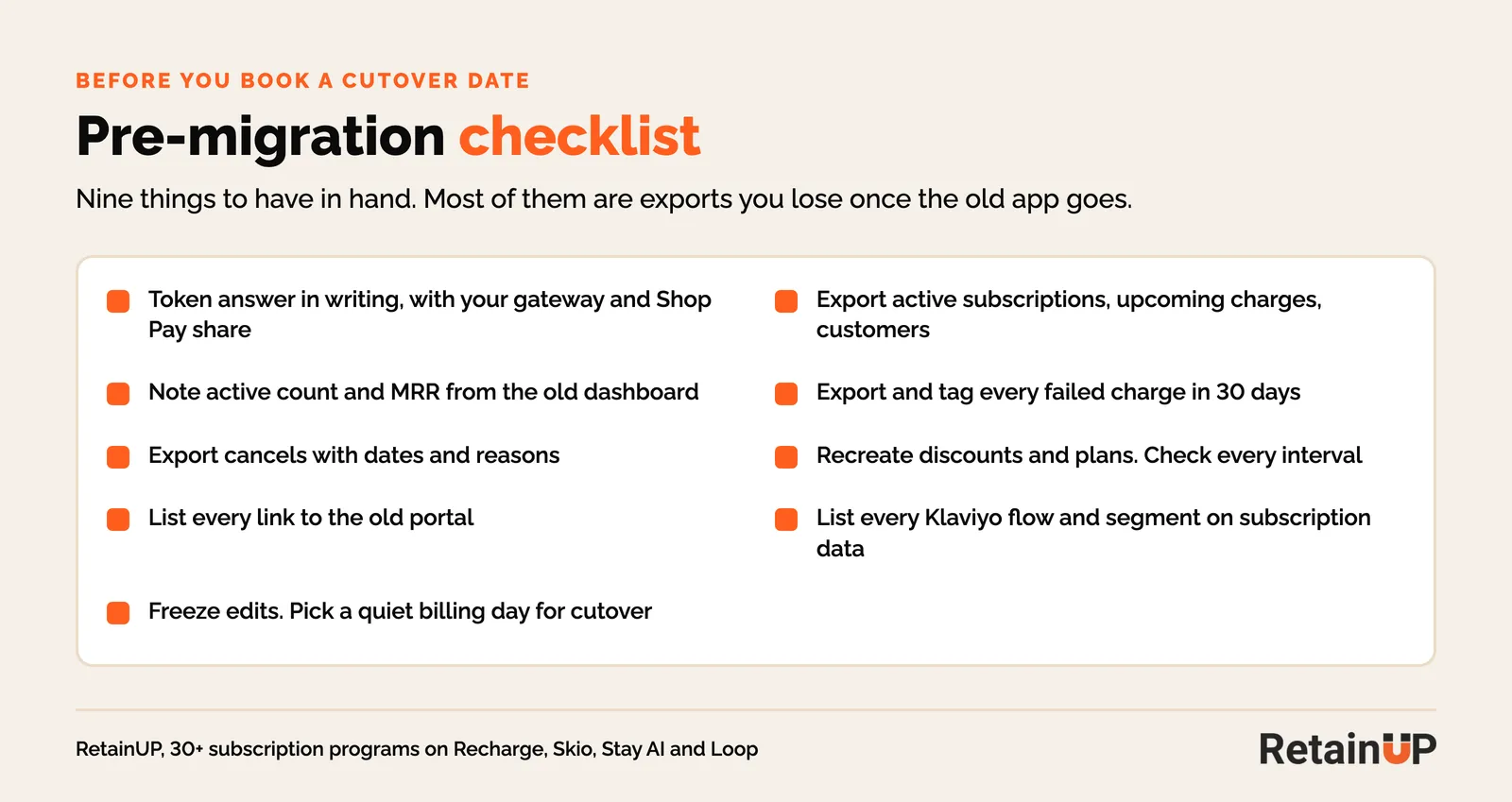
- Ask the new app, in writing, how your card tokens move. Name your gateway and your Shop Pay share.
- Export active subscriptions, upcoming charges and customers. Note the active count and MRR on the old dashboard.
- Export everyone with a failed charge in the last 30 days. Tag them in Shopify.
- Export cancels with dates and reasons.
- Recreate discount codes and selling plans in the new app. Check every interval.
- List every email, help page, SMS and theme link that points at the old portal.
- List every Klaviyo flow and segment that uses a subscription metric or property.
- Agree a freeze: no manual edits in the old app from export to cutover.
- Pick a cutover day away from your biggest billing day.
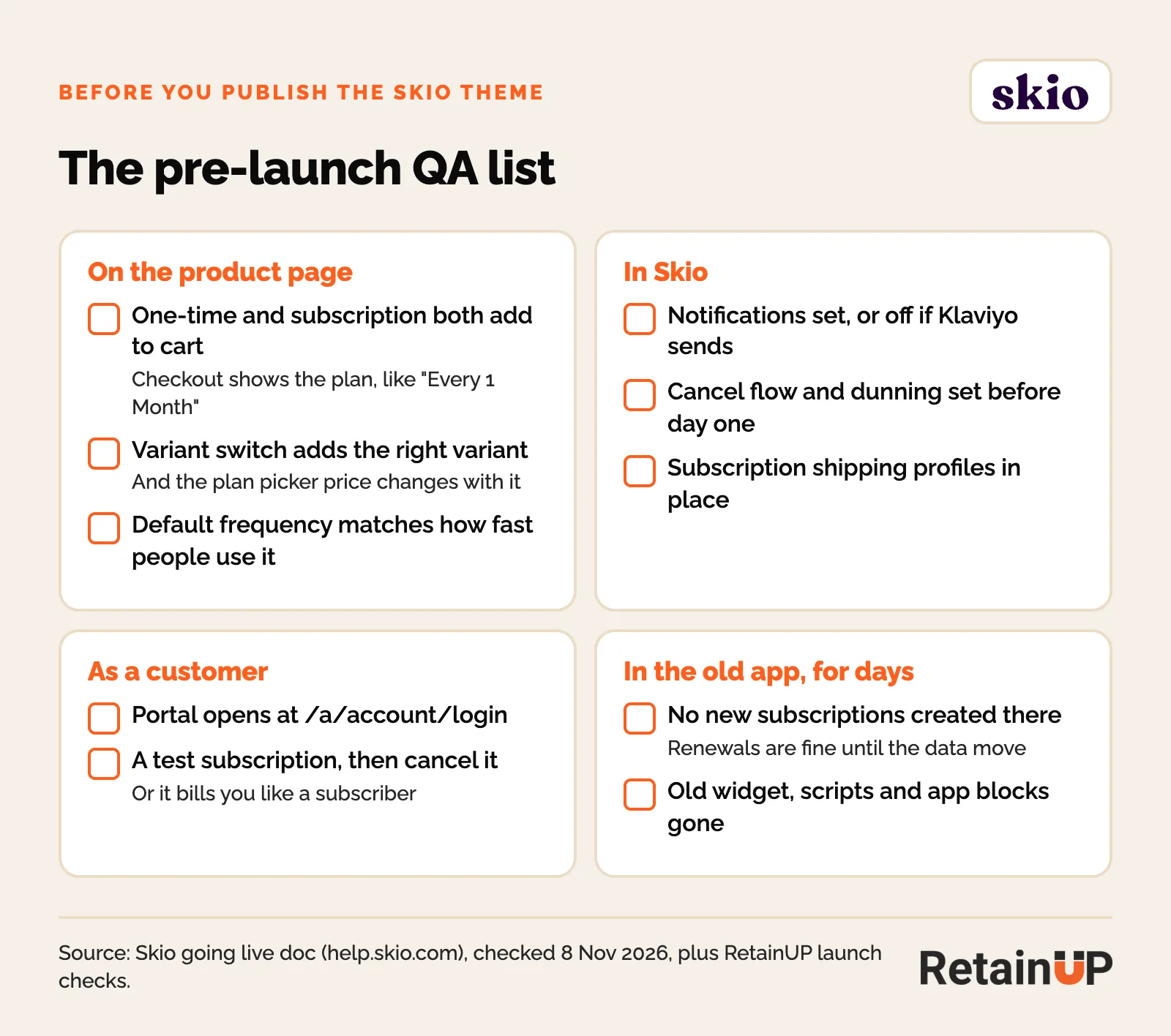
Before you publish the new theme, run the QA list from Skio's going live doc, which works on any app. One-time and subscription both add to cart, and checkout shows the plan. Switching variants changes the price. The default frequency matches how fast people use the product. Shipping profiles are in place. A test subscription goes through. Cancel it afterwards, or it bills you like a subscriber.
Checklist after the switch
Uninstall the old app last. Some exports only work while it is still installed.
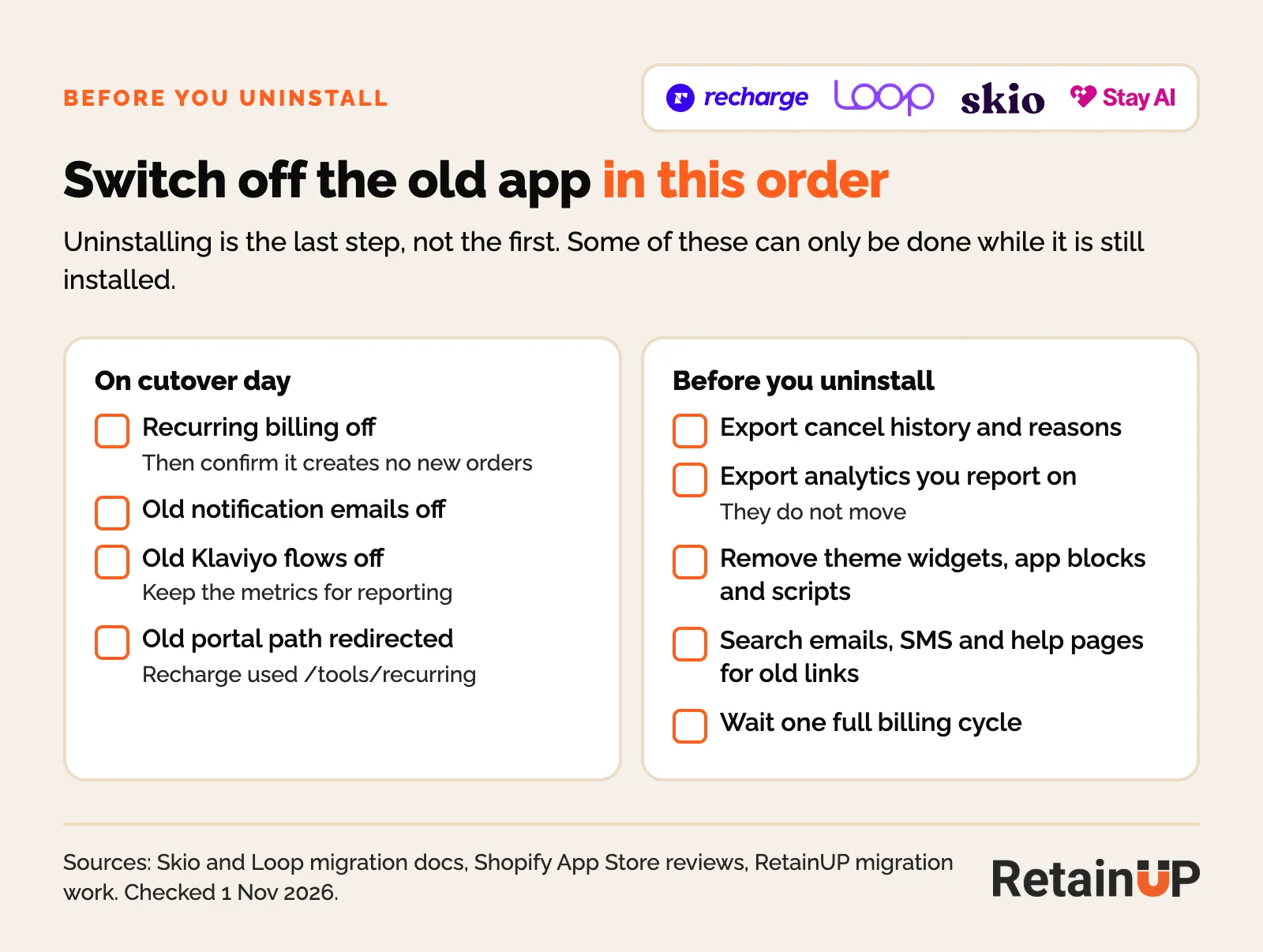
- Cutover day: recurring billing off in the old app, then confirm it creates no new orders.
- Cutover day: old notification emails and old Klaviyo flows off, new ones on.
- Before uninstalling: export cancel history, cancel reasons and any analytics you report on.
- Before uninstalling: remove theme widgets, app blocks and scripts.
- Then wait one full billing cycle, and uninstall.
Every day of the first week, check active subscriptions against the old export and MRR against the old dashboard. Double charges should be zero. So should new subscriptions in the old app, or an old widget or link is still live. Watch failed payments, portal tickets and flow entries too.
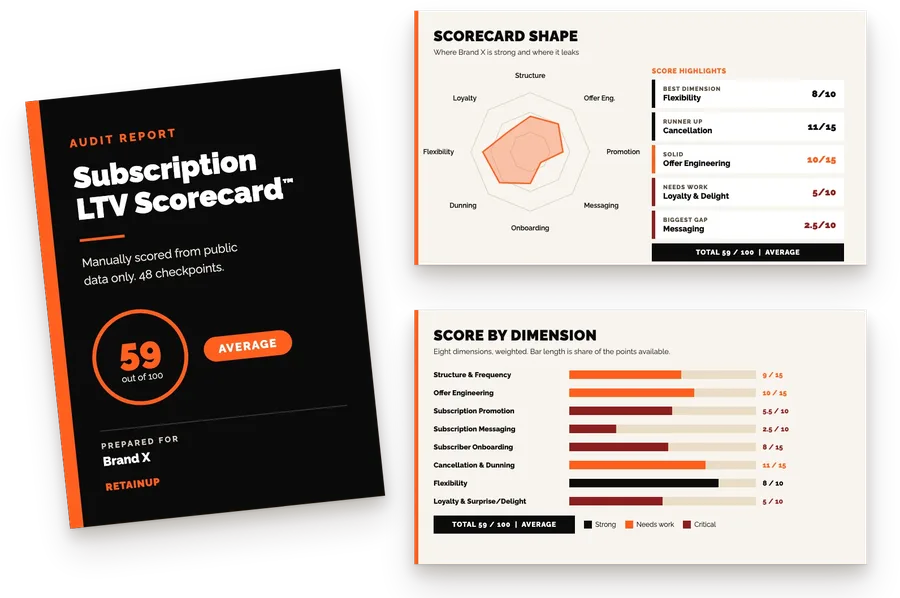
A migration is the cheapest moment to rebuild the program, because every flow, offer and cancel path is open anyway. The Subscription LTV Maximizer™ builds the offer, widget, cancel flow, portal, payment recovery, pause and skip in Recharge, Skio, Stay AI or Loop, plus email and SMS, live in 30 days for $5,000. The free subscription audit finds your top 3 leaks across 48 checkpoints in 24 hours.
FAQ
Will my subscribers have to re-enter their cards?
Not if your payment gateway stays the same or its tokens can be imported into Shopify. Cards already in Shopify's vault have nothing to move. They may have to if you change gateway or move to a new Shopify store. Shop Pay methods are the hardest to move between stores.
How long does it take to migrate a subscription platform?
Two to five weeks end to end, with about a week of cutover. Skio puts its process at 4 to 5 weeks. Loop and Stay AI say about two weeks. Recharge's managed migration has a lead time of 2 to 8 weeks by plan.
What happens to subscribers in failed payment retries during a migration?
Their retry position stays behind in the old app. The new app sees them as normal active subscribers, the next charge fails, and the retry ladder starts from zero. Export everyone with a failed charge in the last 30 days, tag them, and import them paused with a card update email.
Should I migrate to Skio now that Recharge owns it?
Only if Skio has a lever you need, such as Build-a-Box on one self-serve plan. Skio says nothing changes operationally until the combined product is ready, and your contact stays the same. Price is no longer a reason to pick it over Recharge, because on the $499 plans the fee line is now the same. From Appstle or Seal, it fits once you are past about $1M a year.
Should I uninstall the old subscription app straight away?
No. Turn its billing, emails and flows off on cutover day, but keep it installed for one full billing cycle. Export cancel history, cancel reasons and analytics first, because cancelled subscriptions and order history do not move to the new app.
One email a week on subscription retention: the numbers, the strategy, and what to fix first.

Rahi Jain
Rahi Jain is a subscription LTV specialist who helps $1M to $10M DTC brands reduce subscription churn and maximize LTV on Recharge, Skio, Stay AI and Loop.
More about Rahi