Key takeaways
- Across 8 subscription brands RetainUP audited in 2026, a median 38% of failed payments came back, from 17.3% to 61.3%.
- At one Loop brand, retries recovered 36.5% of bank declines and 5.8% of dead cards, which were 44.1% of all failures.
- One Loop brand recovered 17.3% of failed orders on the retry log, while the app showed 41.2% by revenue.
Your subscriber didn't cancel. They didn't click anything. Their card failed, and the money stopped.
Across the brands we work with, 7 to 12% of renewals fail every month. Only about half of that money ever comes back. And it stings more than a cancel, because nobody chose to leave.
This page is one part of the subscription churn guide. The retry timing has its own page, and so do the emails that get a new card.
A subscriber's renewal fails. The app retries it nine times over three weeks. Nothing comes back, the order is skipped, and next month it fails again. I've seen that exact loop in two Loop audits this year. The retry count was never the problem. Most of those cards were dead.
How much churn failed payments cause
Failed payments are passive churn. The subscriber didn't decide to leave. Most brands lose them silently, because nothing in the dashboard says a card failed rather than a person quitting.
Involuntary churn is 20 to 40% of total churn, per Paddle and ProfitWell. Recurly's 2026 State of Subscriptions puts it at roughly 9 declines out of every 100 renewal attempts. Baremetrics puts the loss at about 9% of MRR. Those are cross-industry numbers, so read them as a range, not a target. And the customer rarely caused it. A 2023 PYMNTS and FlexPay survey of 200 executives found 80% of failed subscription payments weren't the customer's fault. The full set lives on the subscription benchmarks page.
And it hits cheaper products hardest. Stripe's data on involuntary churn by order value:
| Order value | Involuntary churn |
|---|---|
| Under $10 | 14% |
| $10 to $100 | 9% |
| $100 to $1,000 | 6% |
| Over $1,000 | 4% |
Most consumable brands sit in that middle row. Low order value? Start here. Every point recovered is revenue you already earned. No product change. No discount.
Recovered subscribers stay, too. Stripe found recovered subscribers keep paying for an average of seven more months, and Recurly says 38% of a recovered subscriber's total lifetime comes after the recovery. The split between the two kinds of churn is in active vs passive churn.
Soft declines and hard declines: why payments fail
Every failed payment falls into one of three buckets. Read the failure reason first. Always. Each bucket needs a different fix.
- Bank declines (soft): insufficient funds, do not honor, card declined, fraud suspected. The card works. The bank said no this time. Retries have a real chance.
- Dead cards (hard): expired, revoked, incorrect number, invalid payment method. Only a new card fixes these.
- Setup faults: card type not supported, gateway errors. These are yours to fix in Shopify Payments.
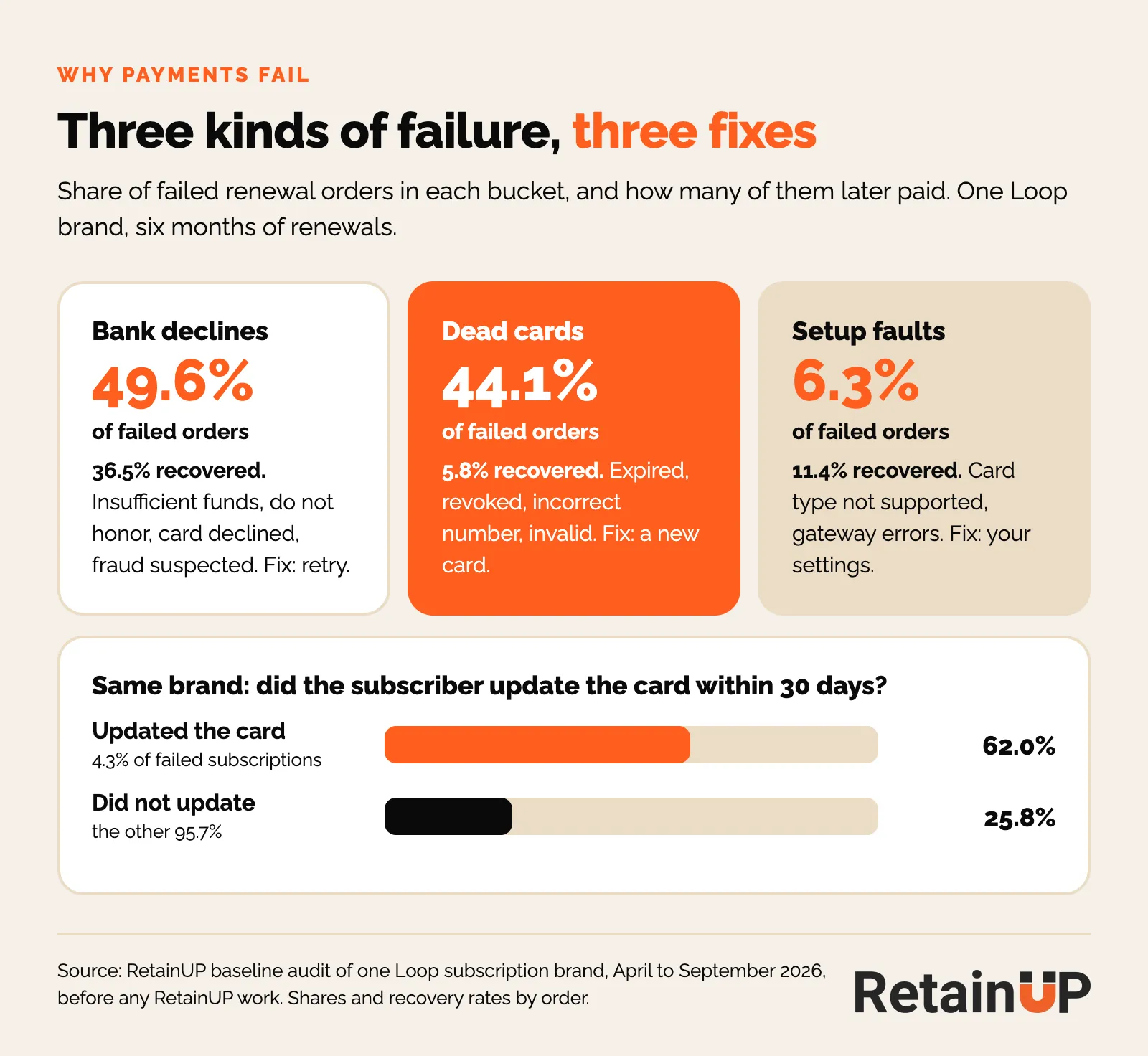
At one Loop brand we audited, 16.8% of renewal orders failed on the first attempt. Bank declines were 49.6% of those failures and recovered 36.5%. Dead cards were 44.1% and recovered 5.8%. Setup faults were 6.3% and recovered 11.4%.
A supplement brand on Loop, much smaller, showed the same shape. 35% of failures were dead cards. Another of our brands had 51.8% of failures from invalid or expired cards, with no card update flow at all.
Getting the new card is what moves it. At the bigger Loop brand, only 4.3% of failed subscriptions updated a card within 30 days. They recovered 62.0% of the time. Everyone else recovered 25.8%.
So close to half of failed payments can't be retried back. That's why adding more retries rarely moves the number. The customer has to act.
What each bucket needs
Bank declines need timing. Front-load the retries. Stop by day 14. The schedule we set, and the settings on each app, are in payment retry schedules that work.
Dead cards need a new card. That's it. Skip the retries. Send the update link the same day, by email and SMS. The emails and the logged-in link are in the card update flow. Before any of that, check the card updater is on in Shopify Payments or your gateway. About 30% of cards change every year, and per Recurly and Stripe, card updaters cut hard declines by 30 to 50%.
Setup faults are free money. Card type not supported and gateway errors recover at almost nothing until someone fixes the setting. Nobody on the retention side looks.
Payment method revoked, and why Shop Pay cards stick
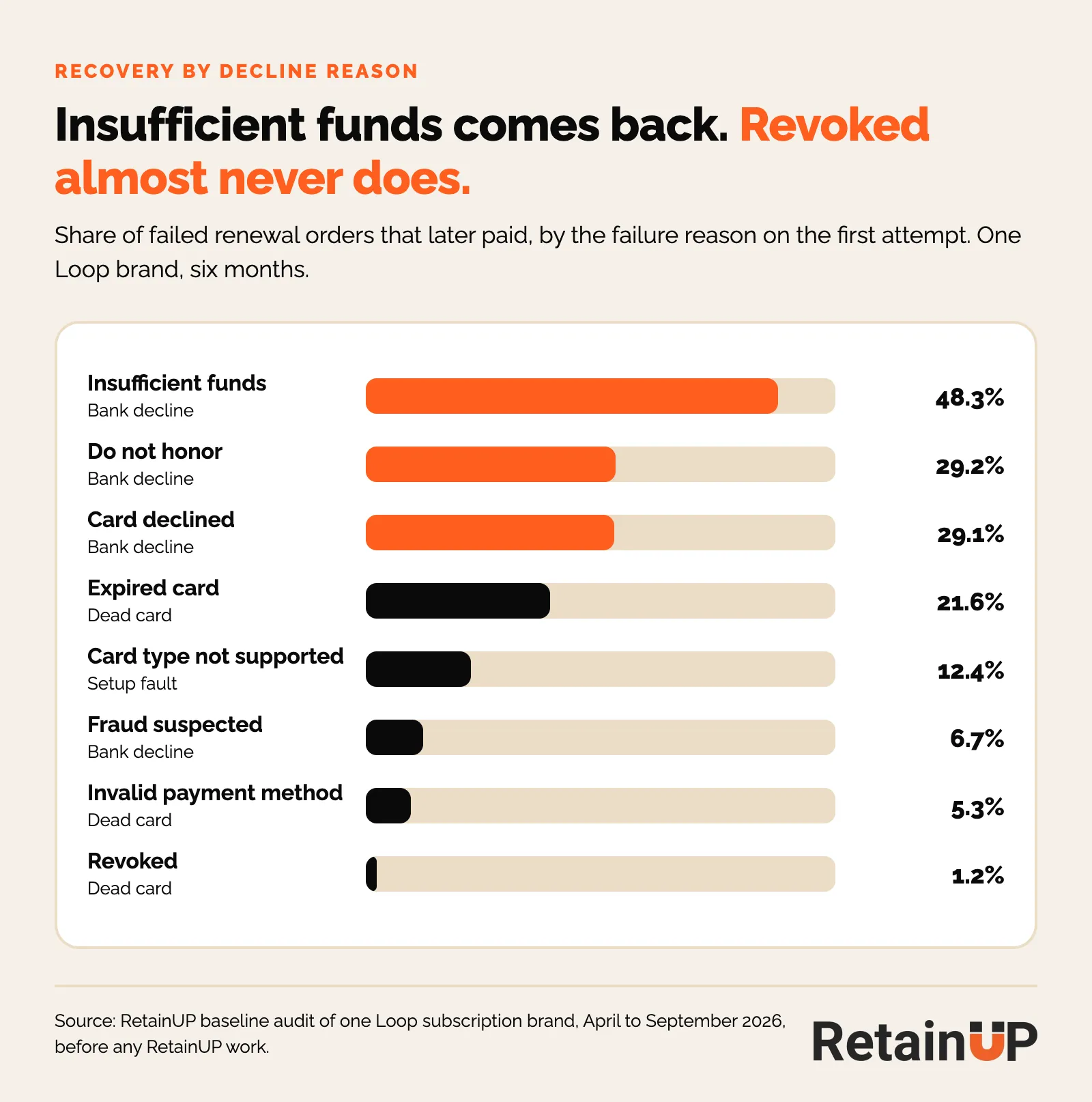
Revoked is the worst reason on the list. At the bigger Loop brand it recovered 1.2% of the time. It means Shopify has withdrawn the saved payment method, so there is nothing left to charge or retry. Often the customer removed the card from Shop Pay.
And Shop Pay catches people out. Shop Pay holds the card, so your subscription app can't edit it. When a customer changes the default card in the Shop Pay wallet, existing subscriptions stay on the old card. So the customer thinks they fixed it. The next charge fails anyway. They decide the brand is broken.
Send Shopify's own update link. In the Shopify admin, open the customer, then Payment methods, then Send link to update card. It expires after 48 hours. Or point them to shop.app in a browser: Account, Subscriptions, Update payment method. Most customers have never seen that screen.
The video walks through the whole recovery setup in Recharge and Klaviyo.
How to measure failed payment recovery
Count orders, not attempts. Your dunning rate is orders that failed on the first attempt over orders due. Recovery is orders that later succeeded over orders that failed, monthly.
That sounds obvious. Almost no app reports it that way. For a yardstick on the first number, YOCTO found the typical store gets 86% of scheduled charges through on the first attempt, with the middle half between 84% and 89%.
Three things throw the number off.
Don't quote the app's blended success rate
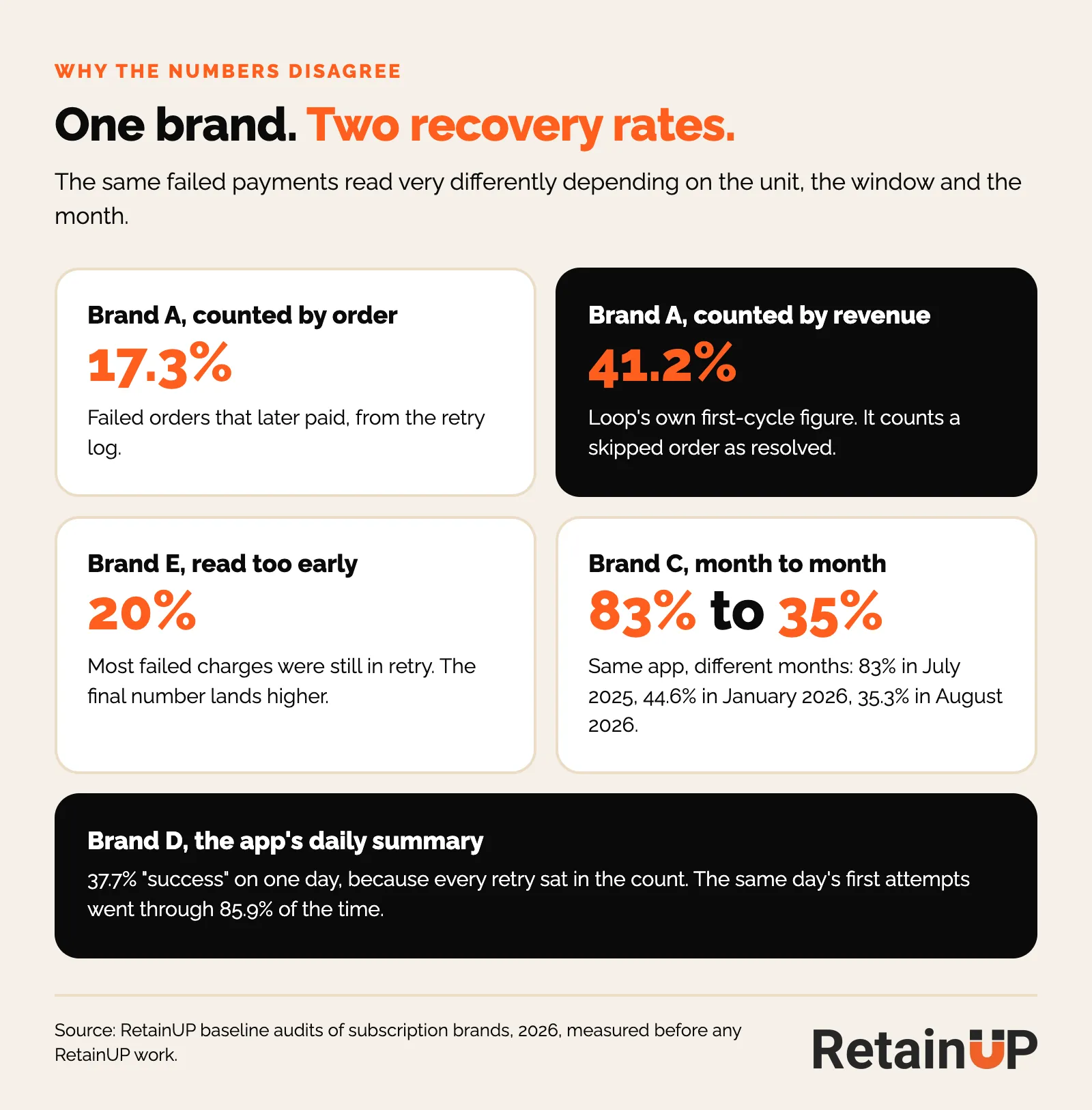
On one day, Loop's transaction summary showed a 37.7% success rate, because every retry sat in the count. The same day's first attempts succeeded 85.9% of the time. One failed order can appear nine times in the log.
Count by order, not by revenue
At a supplement brand on Loop, the app's first-cycle recovery read 41.2% by revenue. The retry log read 17.3% by order. Loop counts a skipped order as resolved. So an order that will fail again next month shows up as a win.
Read it at the end of the window, for three months
One Recharge brand read 20% with most of its failed charges still in retry. Too early. Another brand, on Stay AI, read 83% in July 2025, 44.6% in January 2026 and 35.3% in August 2026. Same app. One month tells you little.
Split it by payment method and order number
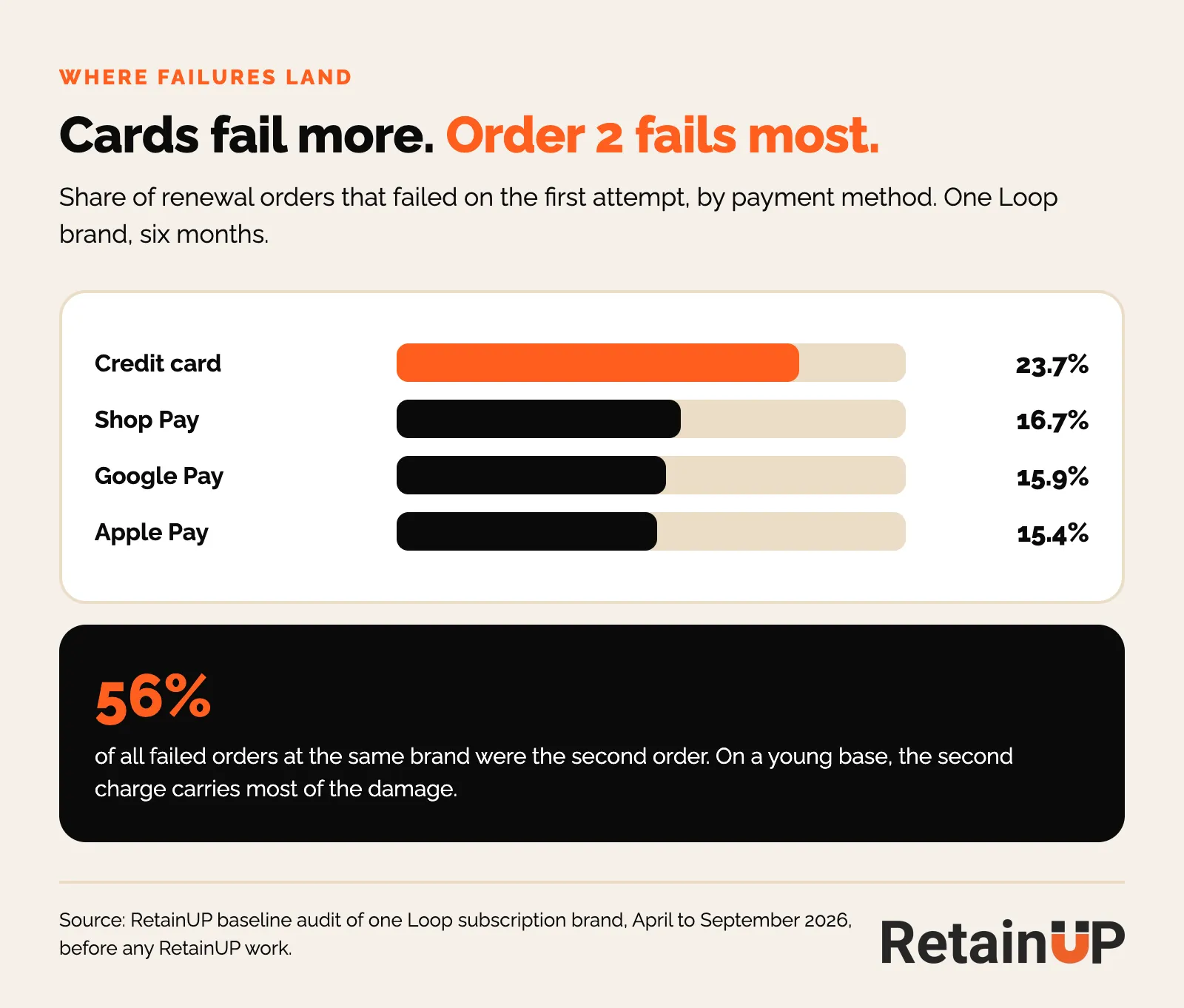
Cards fail more than wallets. At the bigger Loop brand, credit cards failed on 23.7% of renewal orders, Shop Pay on 16.7% and Apple Pay on 15.4%. And order 2 carried 56% of all failed orders. On a young base, the second order is where recovery pays most.
Track two more next to it: card updates per month, and how many subscriptions failed more than one order. Repeat failures rarely recover and they drag the average.
After the last retry: pause, don't skip
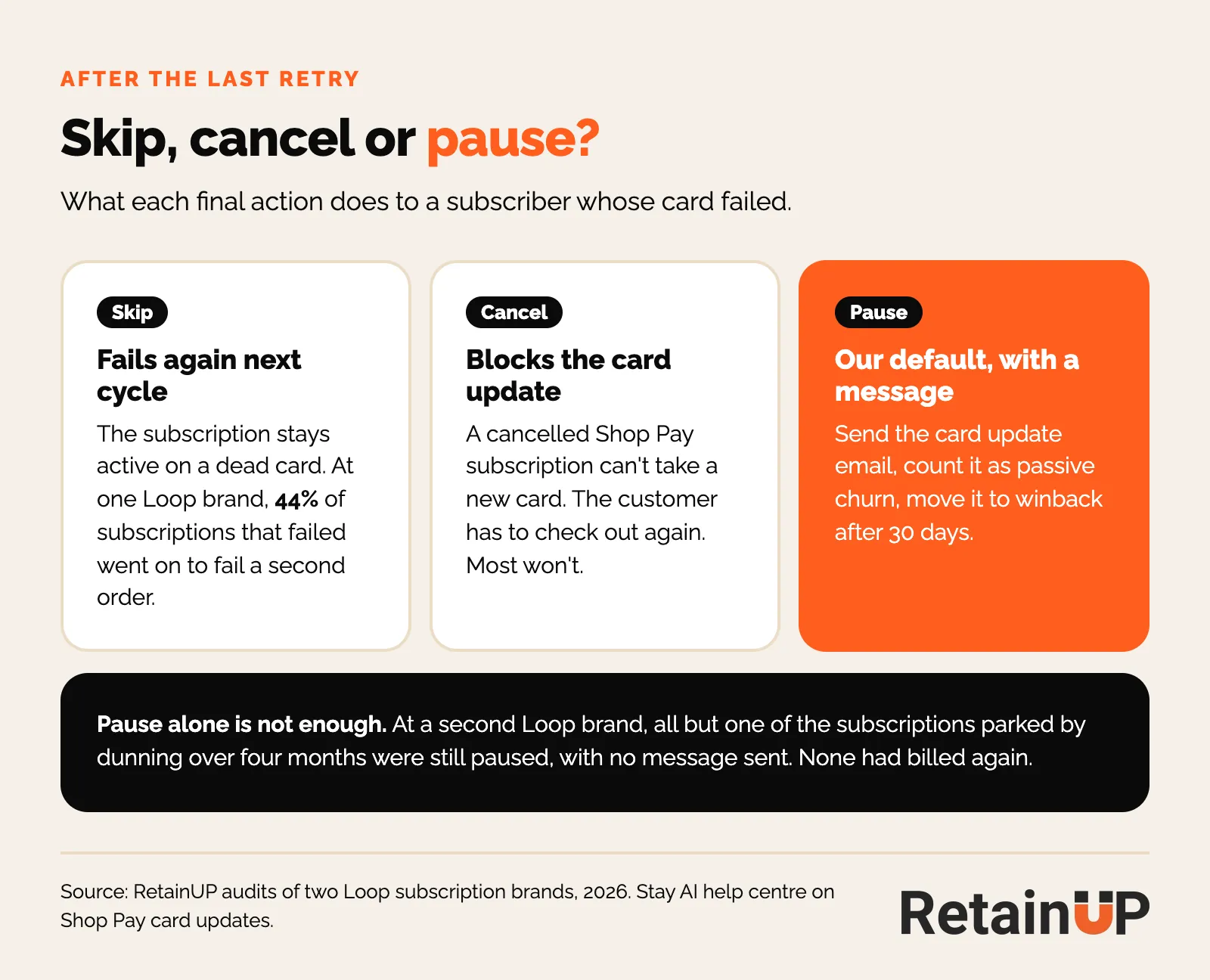
When retries run out, pause the subscription and send the card update email. Don't cancel and don't skip. A cancel blocks the Shop Pay update. A skip keeps a dead card billing every cycle.
The skip trap
Loop can end dunning with a skip. The order is skipped. The subscription stays active. Next cycle it fails again. At the smaller Loop brand, 44% of subscriptions that failed went on to fail a second order. They sat in the active count the whole time.
The cancel trap
A cancelled Shop Pay subscription can't take a new card. Stay AI only lets active or paused subscriptions update one. So if your app cancels when retries run out, the customer has to buy again. Most won't.
The silent pause
Pause has its own trap. At the bigger Loop brand, all but one of the subscriptions parked by dunning over four months were still paused. None had billed again. A pause with no message is a cancel that still looks active. So pair it with the card update email. Then count it as passive churn and move it to winback after 30 days.
So check what your app does today. Recharge cancels the subscription, with no pause option. Stay AI cancels by default. Loop lets you pick skip, pause or cancel, and calls pause the best default.
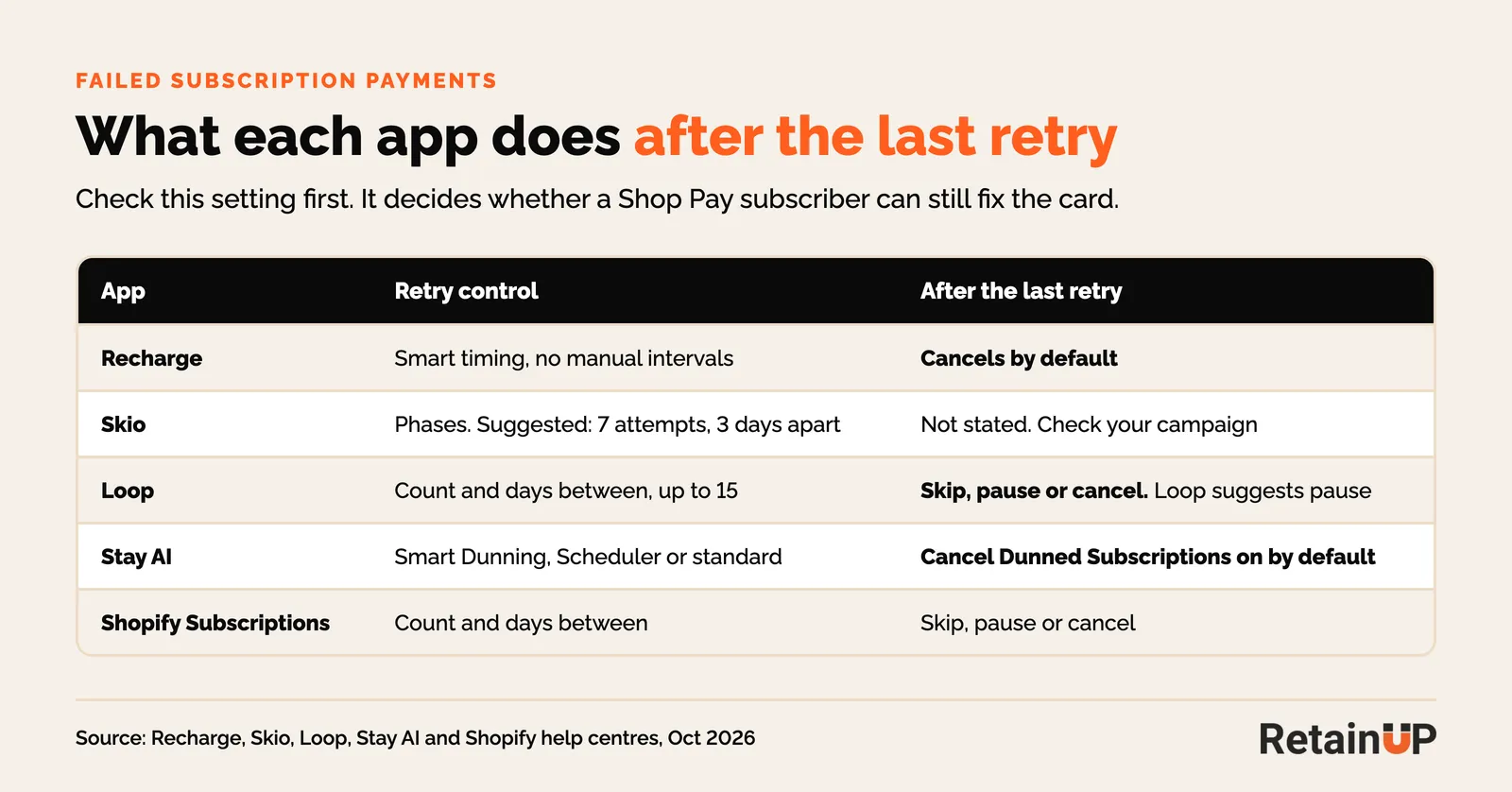
On Recharge, the card update has to land before the last retry, and the cancels go straight to winback. Where each setting sits in the app is covered in the Recharge and Loop setup guides.
Holiday dunning
The first full-price renewal in December fails most, mostly on insufficient funds after holiday spending.
Loop laid out a holiday plan at their partner BFCM webinar in October 2026. It matches what we set:
- Insufficient funds: retry quietly first. Save some retries for January, after holiday spending.
- Hard declines: skip retries. Send a card update link right away, with a small offer for updating.
- Discount last. Quiet retries, then a reminder, then a discount, then a bigger one.
- Ask for a backup card in early December.
Loop's number: 60% of recoveries landed in the first 3 retries. A 5% discount on the later retries lifted recovery about 16%. That's Loop's own data, so treat it as a direction.
The rest of the season, from the take rate mistake to January churn, is in BFCM for subscription brands.
Failed payment recovery benchmarks
Every subscription app reports a recovery rate. No two count it the same way. So when a brand asks whether its 40% is good, the first answer is a question: 40% of what?
Across 8 subscription brands we audited in 2026, before we changed anything, the median brand recovered 38% of failed payments. The range ran from 17.3% to 61.3%. The best got back more than three times the share the weakest did.
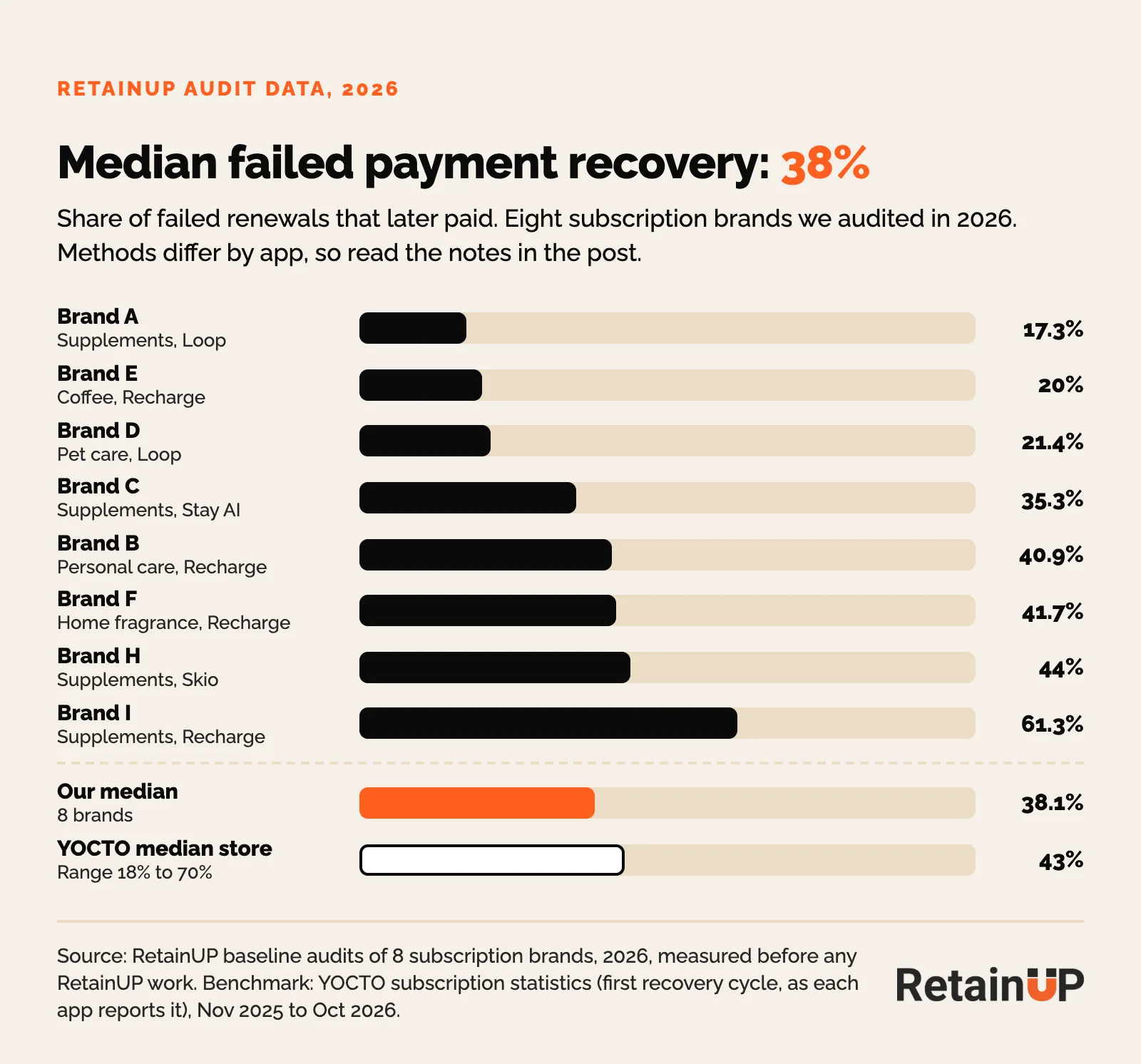
| Brand | Category | App | Recovered | How it was counted |
|---|---|---|---|---|
| Brand A | Supplements | Loop | 17.3% | Retry log, by order. Loop showed 41.2% by revenue |
| Brand E | Coffee | Recharge | 20% | Failed charges, most still in retry |
| Brand D | Pet care | Loop | 21.4% | Failed orders over six months |
| Brand C | Supplements | Stay AI | 35.3% | One month (Aug 2026). Earlier months read 83% and 44.6% |
| Brand B | Personal care | Recharge | 40.9% | Failed charges |
| Brand F | Home fragrance | Recharge | 41.7% | One month (Sep). August read 47.4% |
| Brand H | Supplements | Skio | 44% | Skio dunning report |
| Brand I | Supplements | Recharge | 61.3% | 12 months of data |
| Median, 8 brands | 38.1% | |||
| YOCTO, median store | Mixed | Mixed | 43% | Range 18% to 70% |
YOCTO put the median store at 43% in the first recovery cycle, with the middle half between 34% and 56%. Four of our eight sit inside that band. The two Loop brands sit below it. We counted their orders from the retry log, which runs far below the app's figure.
Eight brands is small and the methods are mixed, so read the median as a rough middle. Brands that hire us may run low, too. Compare against your own trend first.
What moves it? The split, then the follow-up. When we rebuilt one brand's sequence, recovery went from 44% to 68%. It was 7 emails over two weeks, with the 10% off only on the last two. Persistence did the work, not the discount. Recurly published one retailer where better retry timing alone lifted recovery from about 53% to 71% on the same failed transactions.
The monthly check
Most of the gaps we find are settings and broken emails. Rarely a missing tool. Three checks we run on every audit:
- Are the payment emails still going out? At both Loop brands, the app's payment emails stopped on their own. One sent none after June. The other sent none in September, against a full month of retries. Nobody noticed, because the flows still existed.
- Is anyone clicking? Measure clicks, not opens. At the bigger Loop brand, the Klaviyo failed payment flow got clicks from 0.5% to 1.6%, and the final recovery email got 0.0%. It asked people to log in.
- Does a card update charge right away? On some setups the order waits for the next scheduled retry. Ordergroove now retries the moment a card is updated. Test yours.
Do you need a dunning tool?
Start with your app's own settings, the reason split and the card update emails. A dedicated tool like Churn Buster is worth testing once you pass about 5,000 active subscribers and the native recovery has stalled. Read vendor numbers as a ceiling. Recharge says merchants who moved from its standard dunning to Failed Payment Recovery saw up to 23% higher recovery. That's Recharge's own figure.
Switching apps resets the retry position of failing cards, so check this again after any platform migration. And if failures cluster on the charge date, they can look like cancels in your cancellation day report.
This monthly check is what the Subscription LTV Optimizer™ does: your store, app and Klaviyo checked every month, with the payment recovery fixes shipped, for brands with 5,000+ active subscribers at $3,000 a month. If you want to see where you stand first, the free subscription audit scores dunning and card update coverage among its 48 checkpoints.
FAQ
What percentage of subscription churn is failed payments?
Involuntary churn from failed payments is 20 to 40% of total churn, per Paddle and ProfitWell. It runs higher on cheap products. Stripe puts involuntary churn at 14% for orders under $10 and 9% between $10 and $100. Across the brands we work with, 7 to 12% of renewals fail every month. Only about half of that money comes back.
What does "payment method revoked" mean on a Shopify subscription?
It means Shopify has withdrawn the saved payment method, often because the customer removed the card from Shop Pay. There is nothing left to retry. The customer has to add a new method through Shopify's update link, and if the subscription was already cancelled, they usually need to check out again.
How do I calculate my failed payment recovery rate?
Divide the orders that later paid by the orders that failed on their first attempt, monthly. Count orders, not attempts, because one order can appear nine times in a retry log. Read it at the end of the retry window, for at least three months. Ignore the app's blended success rate.
What is a good failed payment recovery rate?
Above 44% beat seven of the eight subscription brands we audited in 2026. The median was 38% and the best was 61.3%. YOCTO's median store recovers 43%, and its best 70%. Methods differ by app, so check how your number is counted before you compare it with anyone else's.
Should a subscription cancel or skip after the last failed payment?
Neither. Pause it and send the card update email. A cancelled Shop Pay subscription can't take a new card, so the customer has to buy again. A skip keeps the subscription active on a dead card, and it fails again next cycle. Move the pause to winback after 30 days.
One email a week on subscription retention: the numbers, the strategy, and what to fix first.

Rahi Jain
Rahi Jain is a subscription LTV specialist who helps $1M to $10M DTC brands reduce subscription churn and maximize LTV on Recharge, Skio, Stay AI and Loop.
More about Rahi