Key takeaways
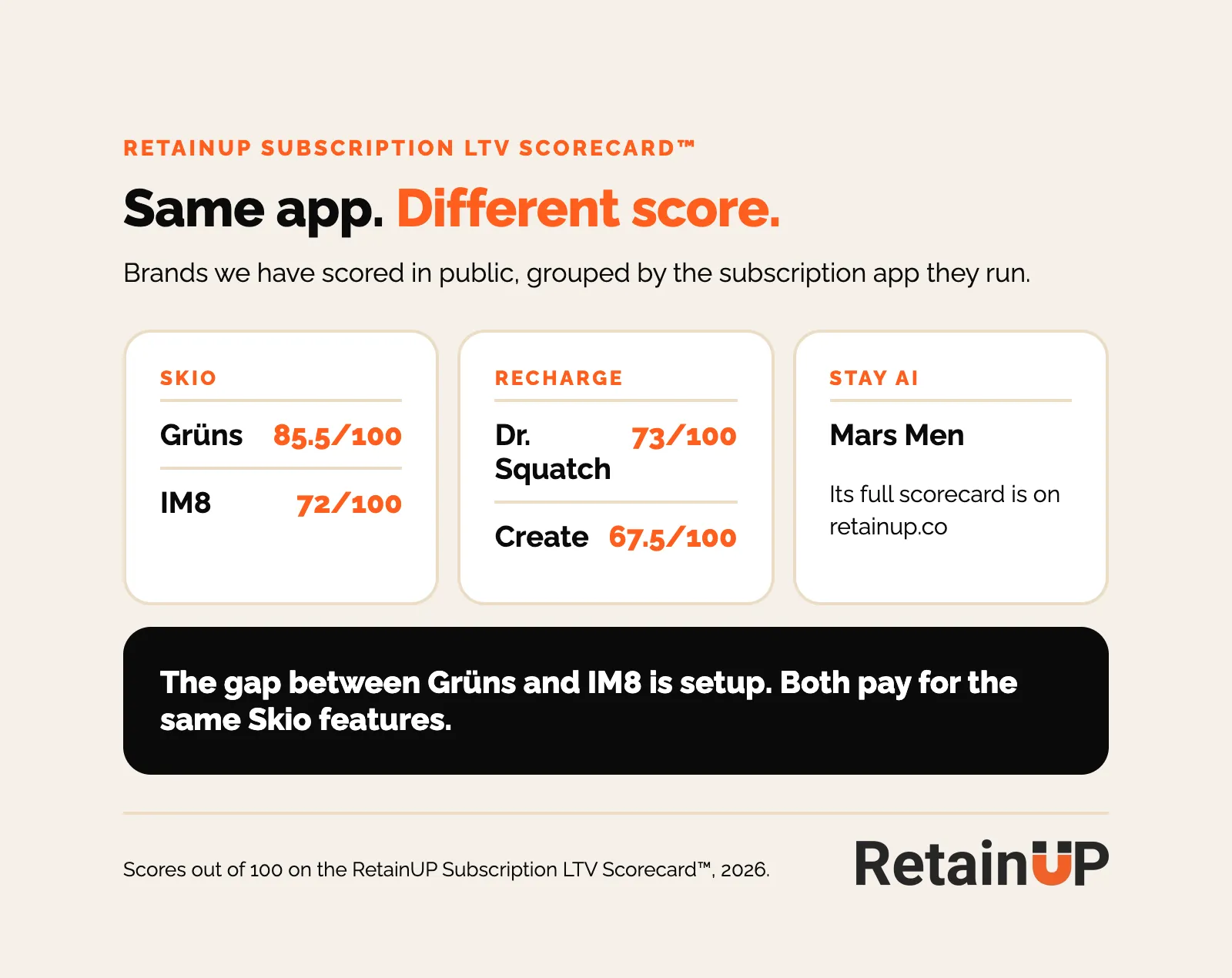
- Grüns scored 85.5 out of 100 on Skio and Dr. Squatch 73 on Recharge, so the setup moves the score more than the app.
- At $1M a year in subscription revenue, list-price app fees run from about $11,188 on Loop Starter to $22,488 on Skio Scale.
- Skio puts a full migration at 4 to 5 weeks, Loop and Stay AI about 2, and every Klaviyo flow trigger changes name.
Search for a Shopify subscription app and every list you find is written by someone selling one. Loop's guide puts Loop first. Most of them don't say so.
We don't sell an app. We work inside them. RetainUP has set up and audited subscription programs on Recharge, Skio, Loop and Stay AI for 80+ subscription brands, and the same thing comes up on almost every account.
The app is rarely the problem. The settings are.
So this hub walks the app side in the order you meet it, and stays on tool choice and tool settings. Why a cancel flow routes by reason, or what the offer should be, lives in the other hubs, starting with subscription offer engineering.
Recharge vs Loop vs Skio vs Stay AI: which app to pick
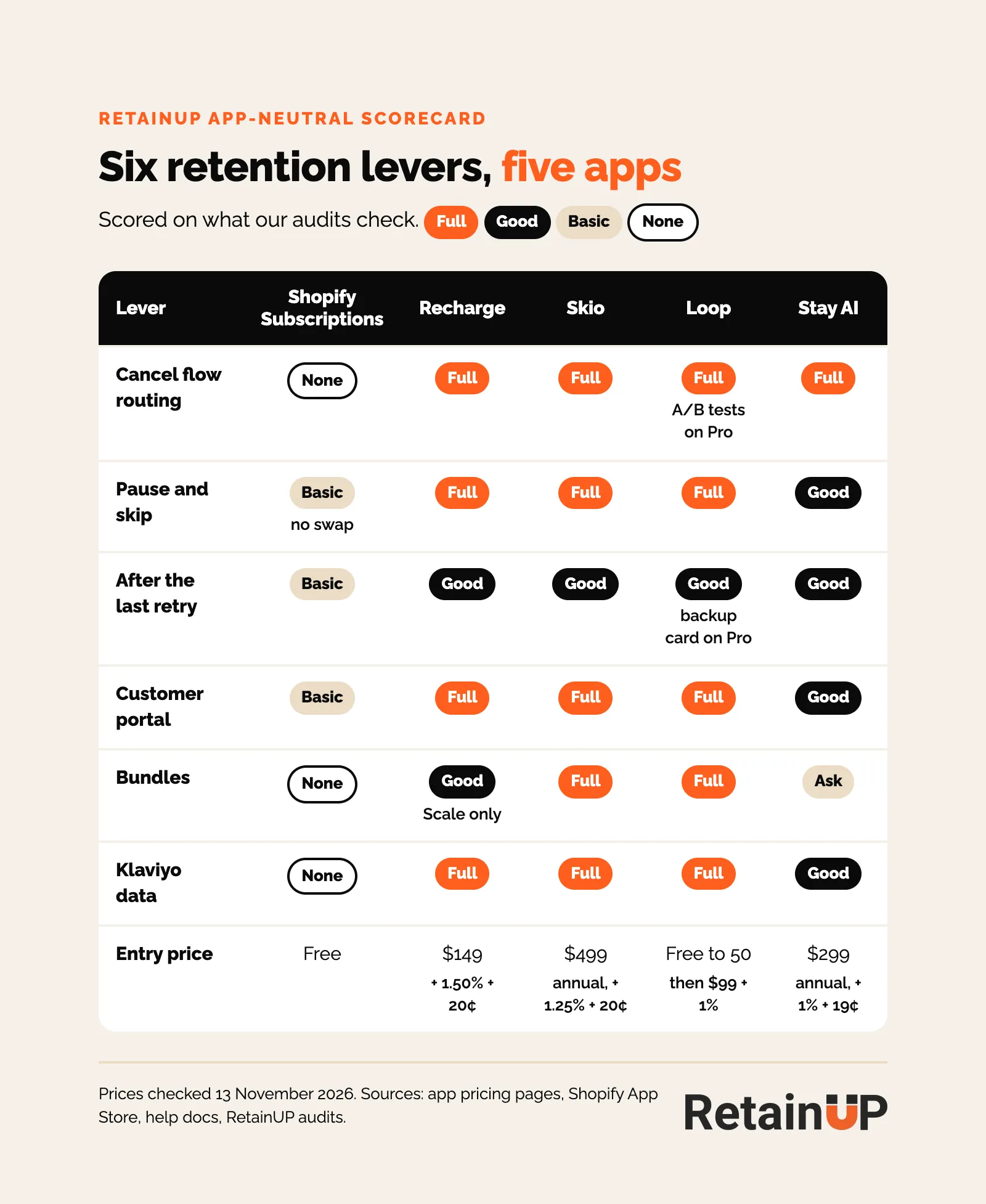
For most brands between $1M and $10M, Recharge, Skio, Loop and Stay AI can all run a good program. The free Shopify Subscriptions app can't, because it has no cancel flow. Then pick a paid app. Judge it on three things: bundles, what happens after the last failed payment, and the fee at your size.
The same app can score very differently on two stores. Grüns runs on Skio and scored 85.5 out of 100, the highest we have given. IM8 also runs on Skio and scored 72. Dr. Squatch runs on Recharge and scored 73, and Create, also on Recharge, 67.5. The app sets what you can do. The setup sets what you get.
The fee at your size
Fees look small as percentages. At a $50 average order, turned into a year, they are not. At $1M a year in subscription revenue, list price comes to about $11,188 on Loop Starter, $17,388 on Stay AI, $20,788 on Recharge Starter and $22,488 on Skio. At $3M the gap between the cheapest and the dearest is about $28,000. And above $5M, nobody pays list. Negotiate.
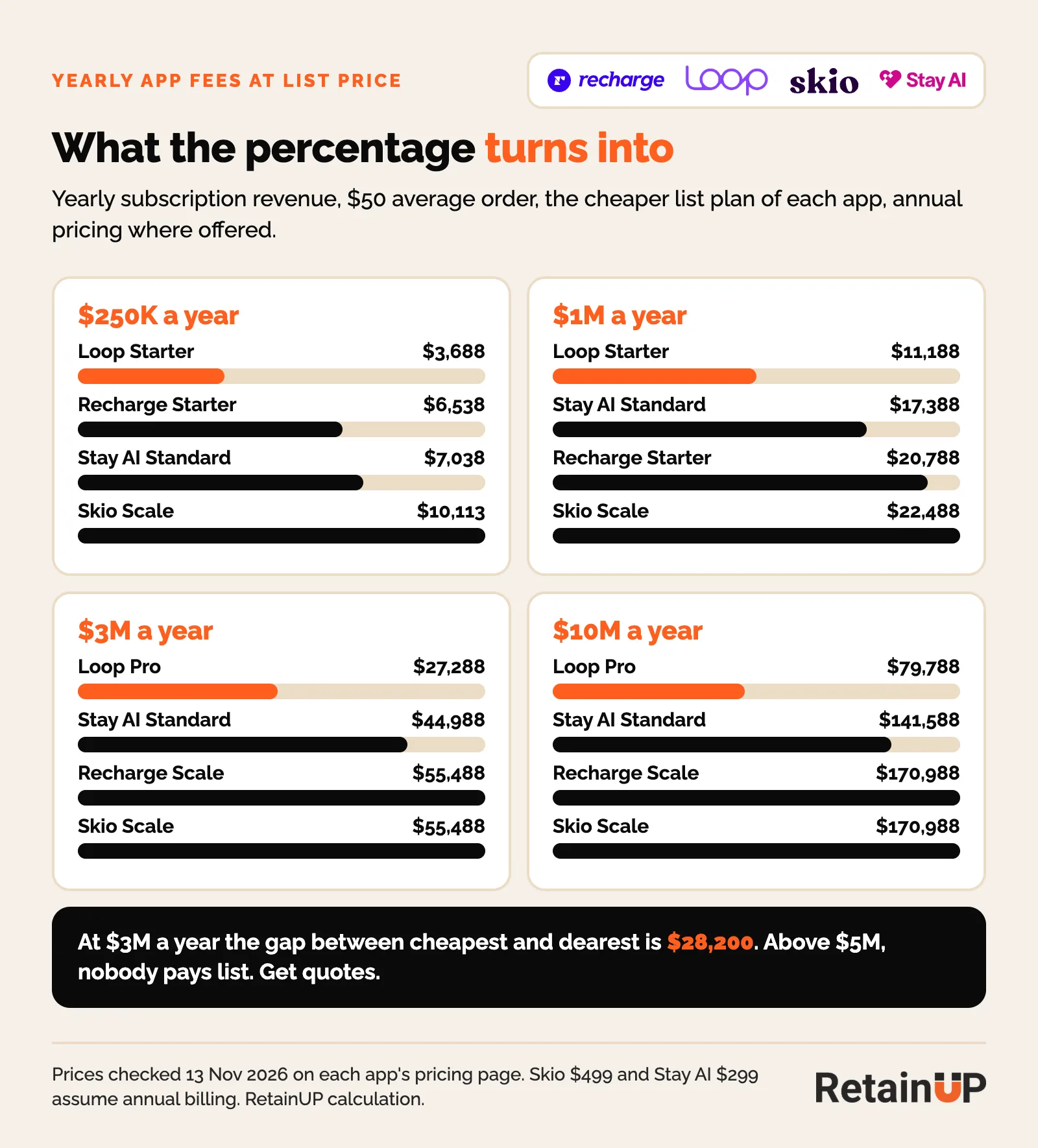
Is the free app enough? Yes. Until you have something to save. It bills, lets subscribers pause and skip, and retries cards. Say 10% of subscribers click cancel in a month and each save is worth one more $50 order. At an average 1 in 6 save rate, Loop Starter pays for itself at about 300 subscribers, and at 1 in 3, about 85. That is the cautious version, since a save is usually worth more than one order.
What about Appstle, Seal and the cheaper apps?
Shopify's own guide to subscription apps lists ten, from Seal and Bold up to Ordergroove and Recharge, and sorts them by how complex your model is. The cheaper ones are fine early. They have ceilings. Appstle's top listed plan covers up to $100K a month in subscription revenue, and Seal's Legend plan covers 500 subscriptions.
Price still matters. At 2,000 subscribers and a $50 order, Loop Starter costs about $1,099 a month against $100 on Appstle's top plan. So a move has to buy a lever worth more than that gap.
Which app fits which stage
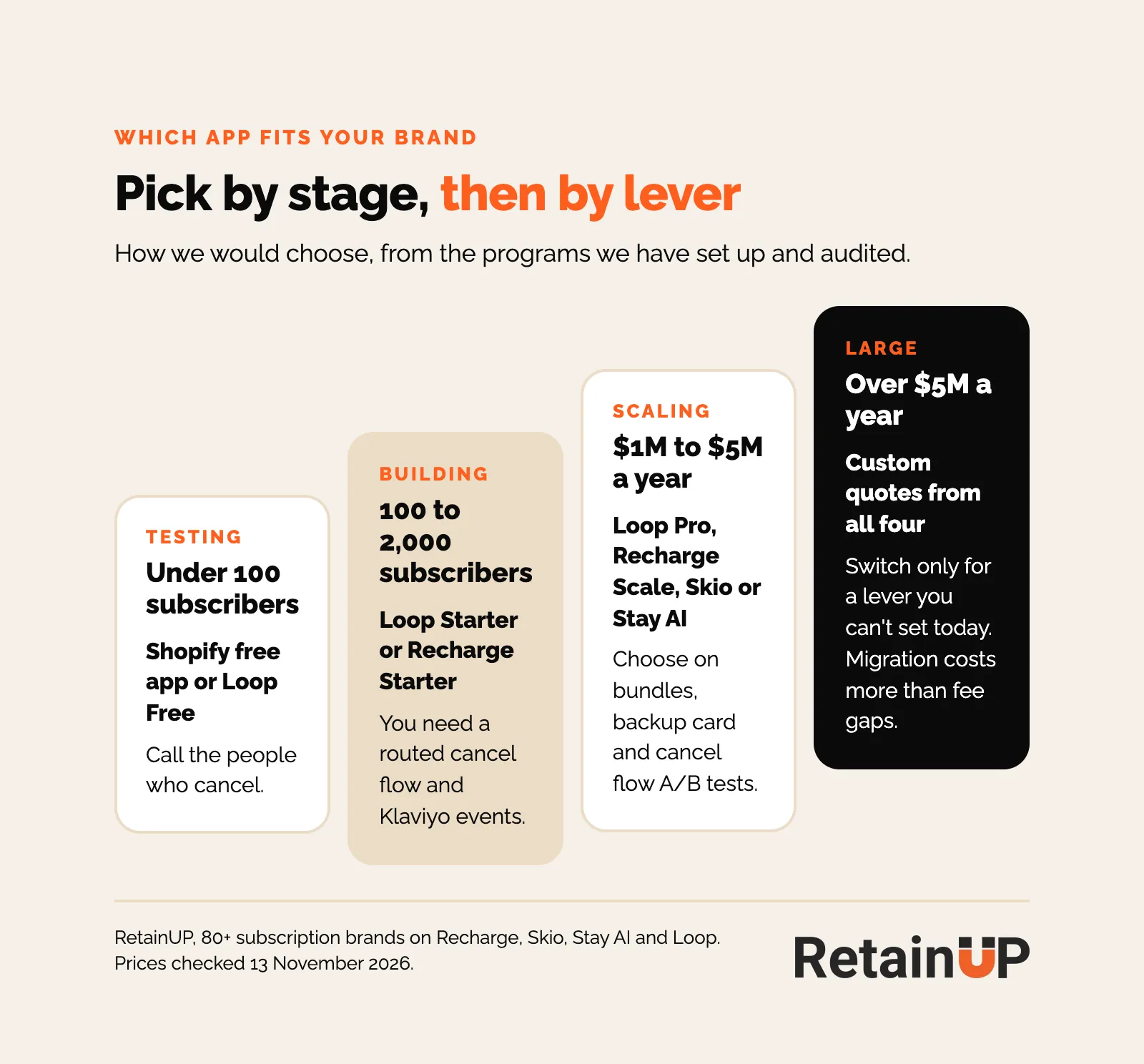
Your stage decides more than the feature list. Under 100 subscribers, use the free Shopify app or Loop's free plan, and call the people who cancel. You will learn more than any flow can tell you. From 100 to 2,000, pick Loop Starter or Recharge Starter, because now you need a routed cancel flow and Klaviyo events. Between $1M and $5M all four fit, and the lever you need picks the app.
How to test an app before you sign
Test it yourself first. Recharge Starter's 60-day trial starts the day you install. Not the day you launch. Run one full test order, widget to portal. Then skip an order on your phone. Loop's own buying guide says if that takes more than 10 seconds, subscribers write to support instead. Ask what happens to your data if you leave. Fudge calls moving a big base off Recharge a project brands keep putting off.
Ask one question on every demo. What happens after the last retry? That one setting decides whether a dead card shows up as churn or hides as an active subscriber. The full scoring, lever by lever, with prices checked on 13 November 2026, is in our best Shopify subscription app comparison of Recharge, Skio, Loop and Stay AI.
Recharge vs Skio after the acquisition
Recharge bought Skio in April 2026. Skio's App Store listing now reads "Skio, a Recharge Company", and Skio says the combined product takes about 12 months. Both apps keep running until then.
So you are no longer picking a side. You are picking between two products with one owner, and deciding whether to move, stay or wait.
Price no longer splits them at scale. On 3 November 2026, Recharge Scale and Skio Scale both listed $499 a month plus 1.25% and 20 cents per order. Below about $1.7M a year, Recharge Starter, at $149 a month plus 1.50% and 20 cents, is still the cheaper of the two. Bundles are the one exception: Skio has Build-a-Box on its one self-serve plan, and Recharge keeps bundles on Scale.
Reporting still splits them. Skio's cancel flow dashboard shows orders after and revenue after for each save, so you can see which saves paid again. Few brands read it. A founder on Skio told me, "We have a 43% save rate." Almost none of those saved subscribers paid him again. Recharge lists no save event in Klaviyo, but its Benchmarks page and Lifetime revenue dashboard give you the wider view.
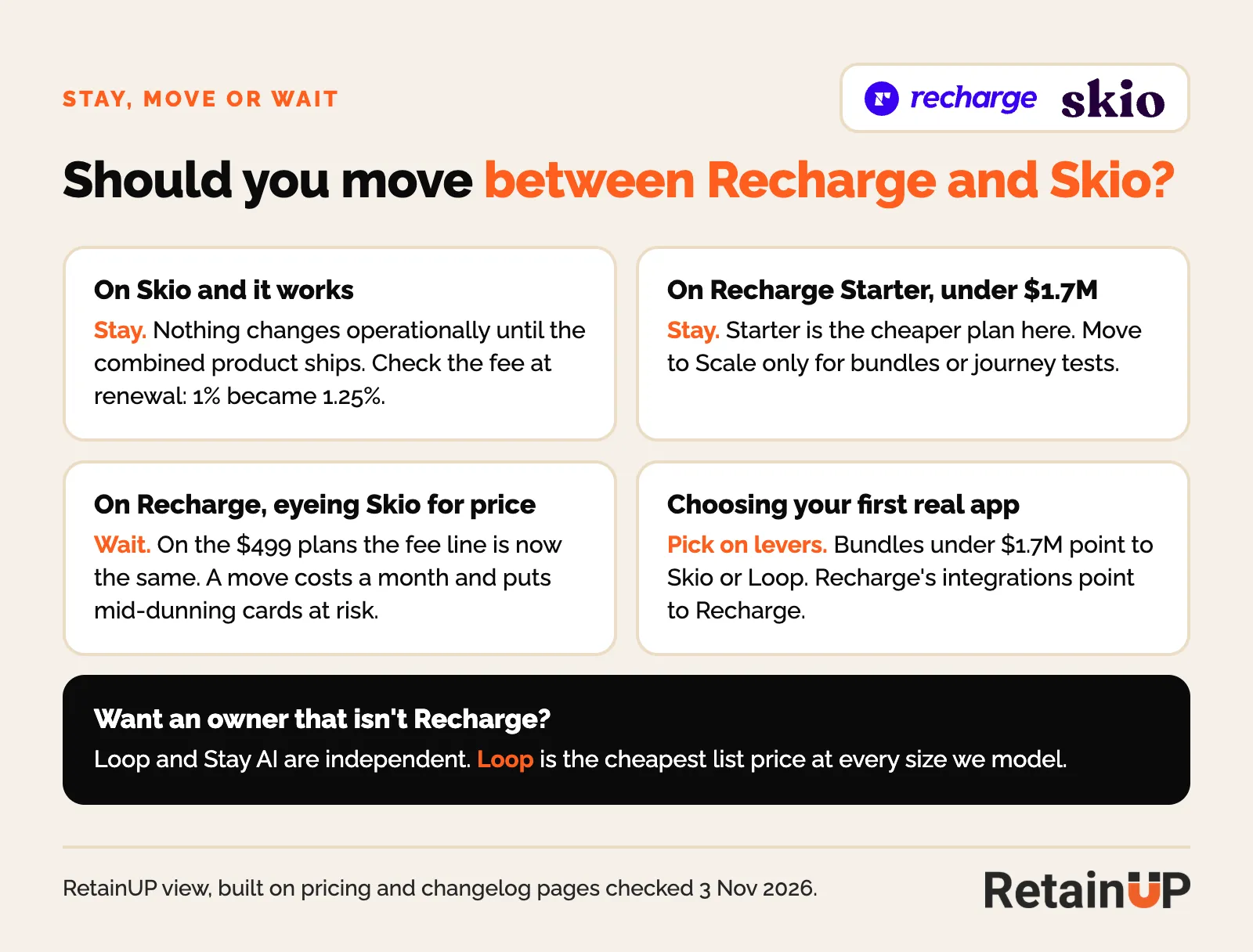
Our call? On Skio and it works: stay. On Recharge and looking at Skio for price: wait, because the fee line on the $499 plans is now the same, and a move costs a month and puts mid-dunning cards at risk. The pricing at four store sizes, the feature lines and the migration effort between the two are in Recharge vs Skio.
Loop vs Recharge for brands under 5,000 subscribers
Loop vs Recharge is the comparison we get asked about most by brands between 100 and 5,000 subscribers.
Loop costs less at every size we model, from about $2,850 a year less at $250K to about $28,000 at $3M. Most of that is the per-order fee. Loop charges none, and Recharge adds 20 cents to every order on top of its percentage. Loop also puts bundles on its first paid plan. Recharge has the bigger set of integrations and a cancel flow on Starter.
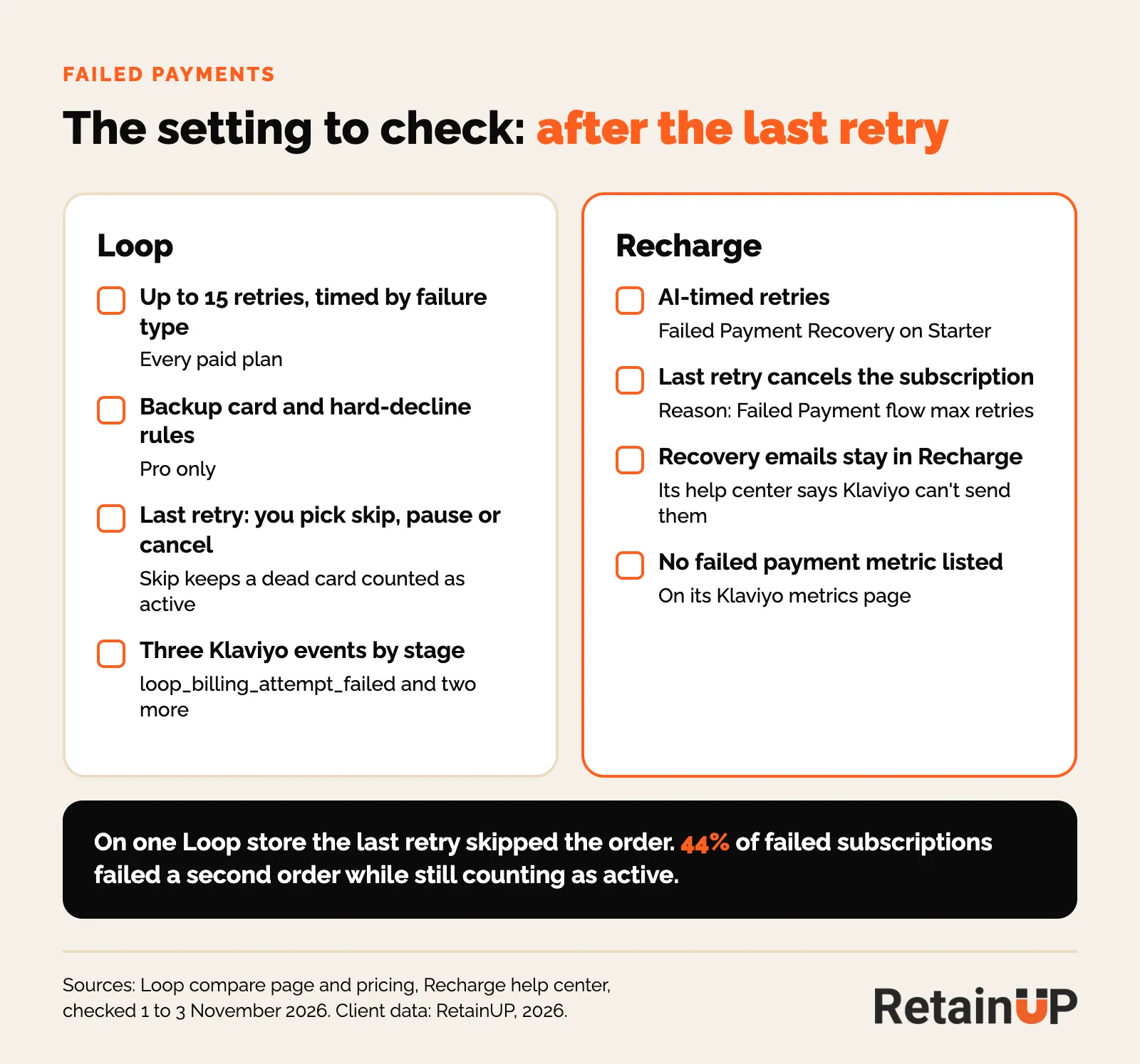
The setting that matters most is failed payments. After the last retry, Loop lets you pick skip, pause or cancel. Recharge cancels the subscription, with the reason "Failed Payment flow max retries". Loop's choice is better. If you make it. On one Loop store the last retry was set to skip, and 44% of failed subscriptions failed a second order while still counting as active.
If you rely on a tool that only plugs into Recharge, that decides it. If not, Loop is the better value. Provided someone sets it up. Plan by plan, with what a Recharge to Loop move leaves behind: Loop vs Recharge, compared on fees, cancel flow and failed payments.
Setting up retention on the app you picked
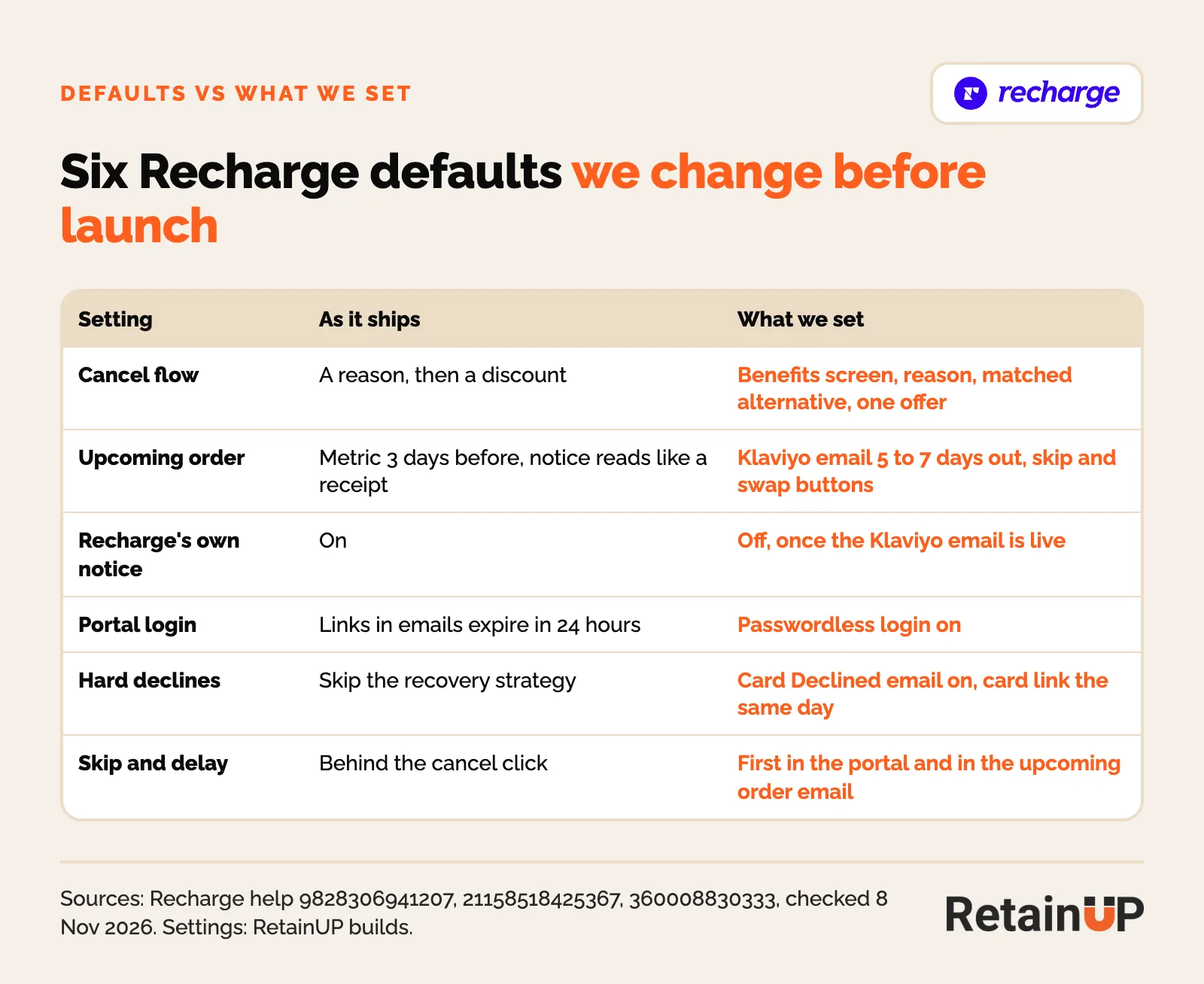
Most stores I open still run the settings they launched with. Cancel flow on the default reasons. One failed payment email. A billing notice that reads like a receipt. And a Klaviyo account full of subscription events with no flow on them.
Nothing looks broken. But the defaults were built to run billing, and billing is not retention. On every app we set up the same seven levers: the offer and selling plans, the cancel flow, pause and skip, payment recovery, the portal, bundles and gifts, and the Klaviyo events. The menus differ from app to app.
How Recharge handles retention tools
Recharge gives you five tools: Cancellation Prevention, Failed Payment Recovery, Win Back, a portal and a Klaviyo integration. Where it stops is the save offer. You get one per cancel reason, and no way to test two against each other, as eCommerce Fastlane's Recharge review points out. Skio can show two or three on one screen.
The cancel flow lives under Churn tools. Build it. Then check it is firing. Read Experiences delivered for the last 30 days. In November 2026 we found a Recharge flow marked Active with 0 delivered in the last 30 days. Nobody had noticed. Not the brand. Not Recharge.
Then move the reminder earlier. Recharge sends Order upcoming to Klaviyo 3 days before a charge by default. We build the Klaviyo version, test 5 to 7 days out, and switch Recharge's own notice off only once Klaviyo is live, so nobody gets two. Passwordless login and order merging go on in week one. The rest, in the order we change it, is in our Recharge retention setup guide.
Skio
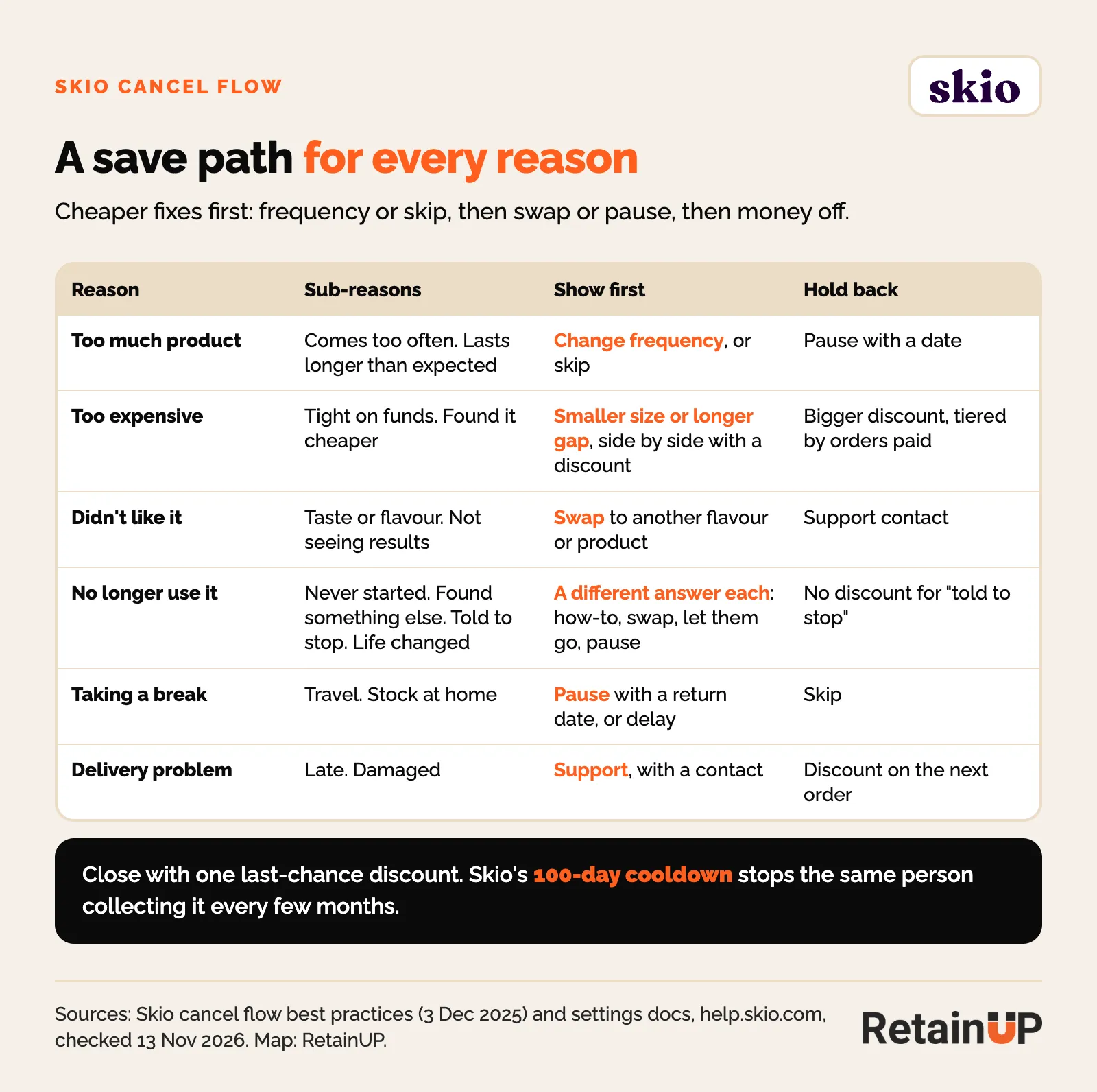
Skio has one of the best cancel flow builders on Shopify. A splash screen, reasons and sub-reasons, two or three offers on one screen, and separate flows by order number, value, product or customer tag. We give every cancel reason its own save path. That is how one Skio client's save rate went from 14.8% to 24.8%, with no new discount.
Skio also lets you set the retry phases yourself, unlike Recharge. Older accounts were moved to one phase of 14 daily retries. Check yours. Front-load them. Stop after about two weeks. And read the orders after each save, from sessions at least 60 days old, so saved subscribers have had time to pay again. Every setting is in Skio retention setup: cancel flow, dunning, portal and reminders.
Loop
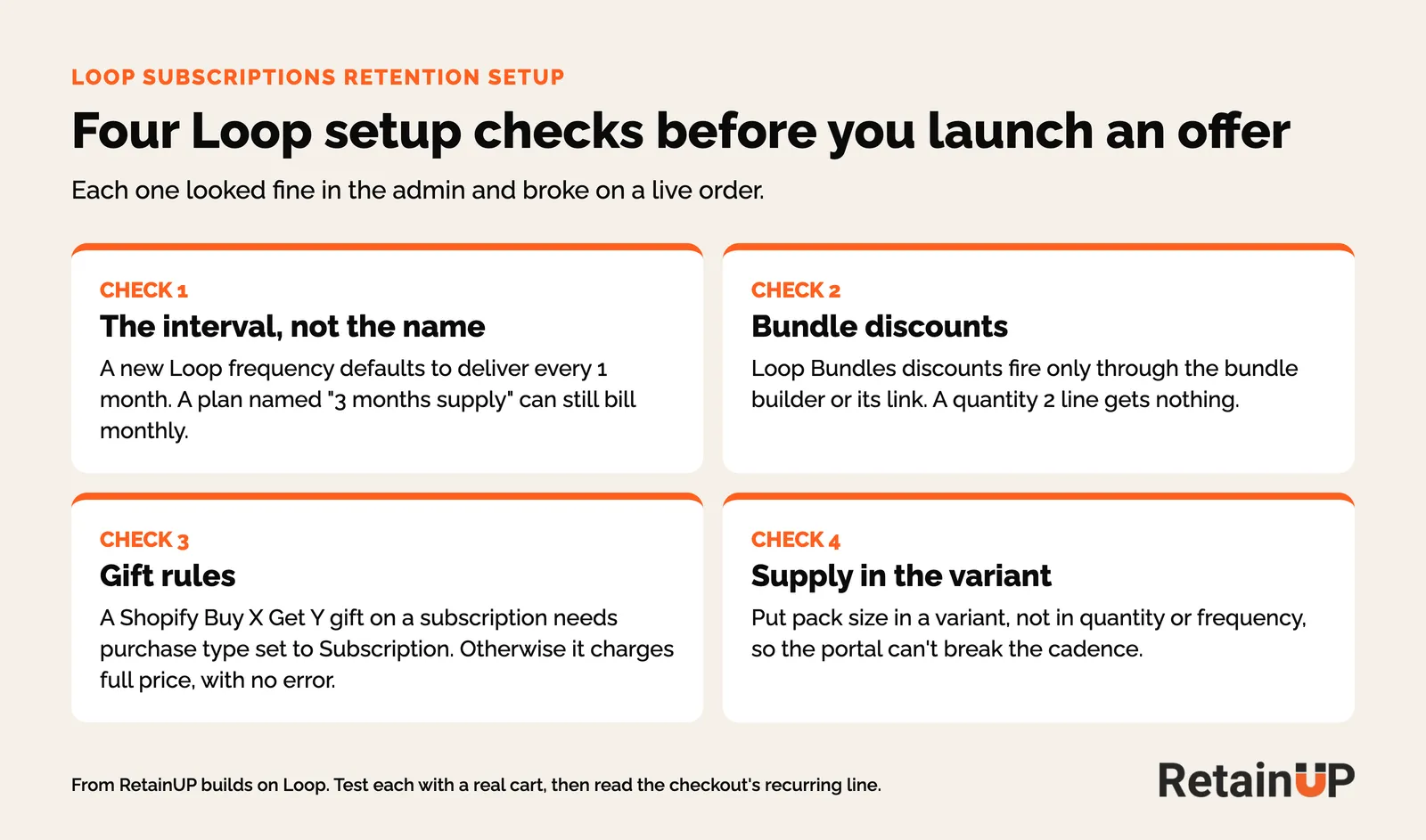
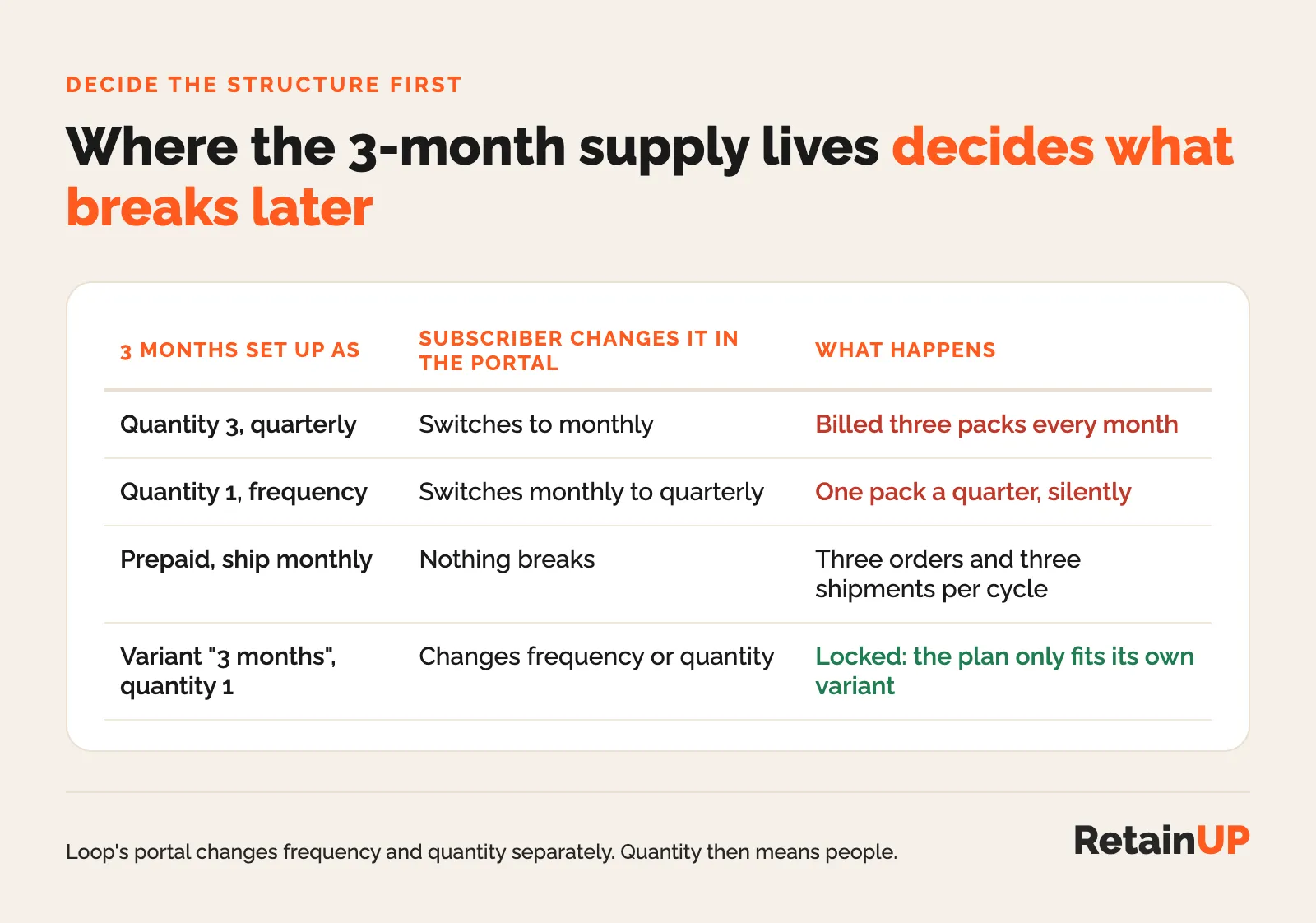
On Loop, test what the app charges before you touch a cancel flow. A new Loop frequency defaults to deliver every 1 month. So a plan named 3 months supply can bill monthly until you read the interval at checkout, which is exactly what we found on a supplement brand.
Then read the recovery rate yourself. Always. On one store Loop's first-cycle recovery read 41.2% by revenue, and 17.3% by order in the activity log, because Loop counts a skipped order as recovered from the cycle. Same failures, two numbers. Cancellation profiles, retry timing and the portal build are in our Loop retention setup.
Stay AI
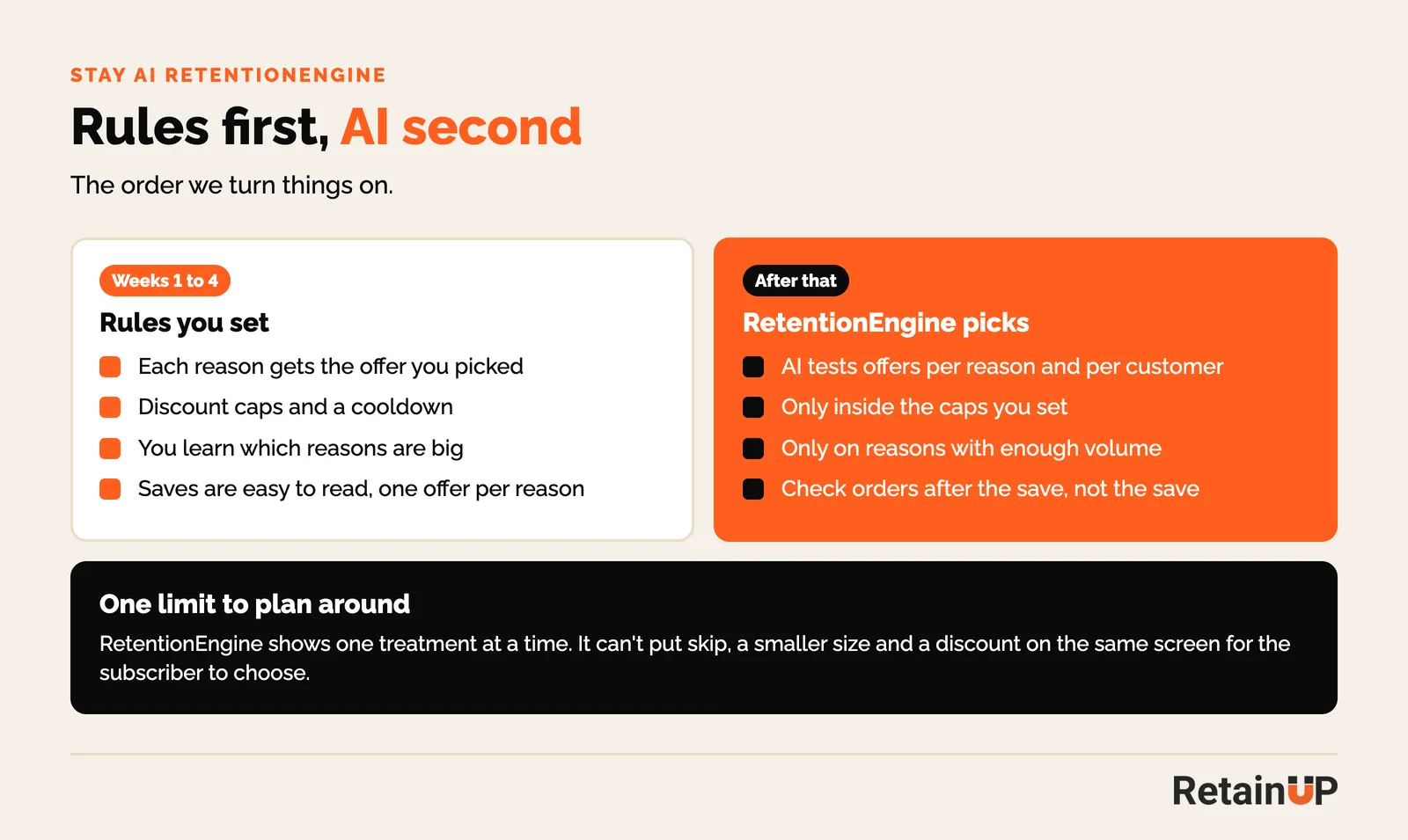
Stay AI sells itself on AI. The AI is real. It still works inside rules somebody has to set, and on most accounts nobody did. We set the RetentionEngine rules by hand for four weeks, then turn the AI on inside discount caps. An AI with no cap learns fast that 40% off saves people. It is right. It is also expensive.
Two settings catch brands out. "Cancel Dunned Subscriptions" ends a subscription when retries run out, so we turn it off and pause instead. And the save count flatters: Stay AI's own case figures show Lifeboost saving 29.6% of subscribers but 24.2% of the revenue that tried to leave. On a French supplement brand on Stay AI, order 2 retention went from 64% to 78% after the setup. The seven levers are in Stay AI retention setup.
Switching apps without losing subscribers
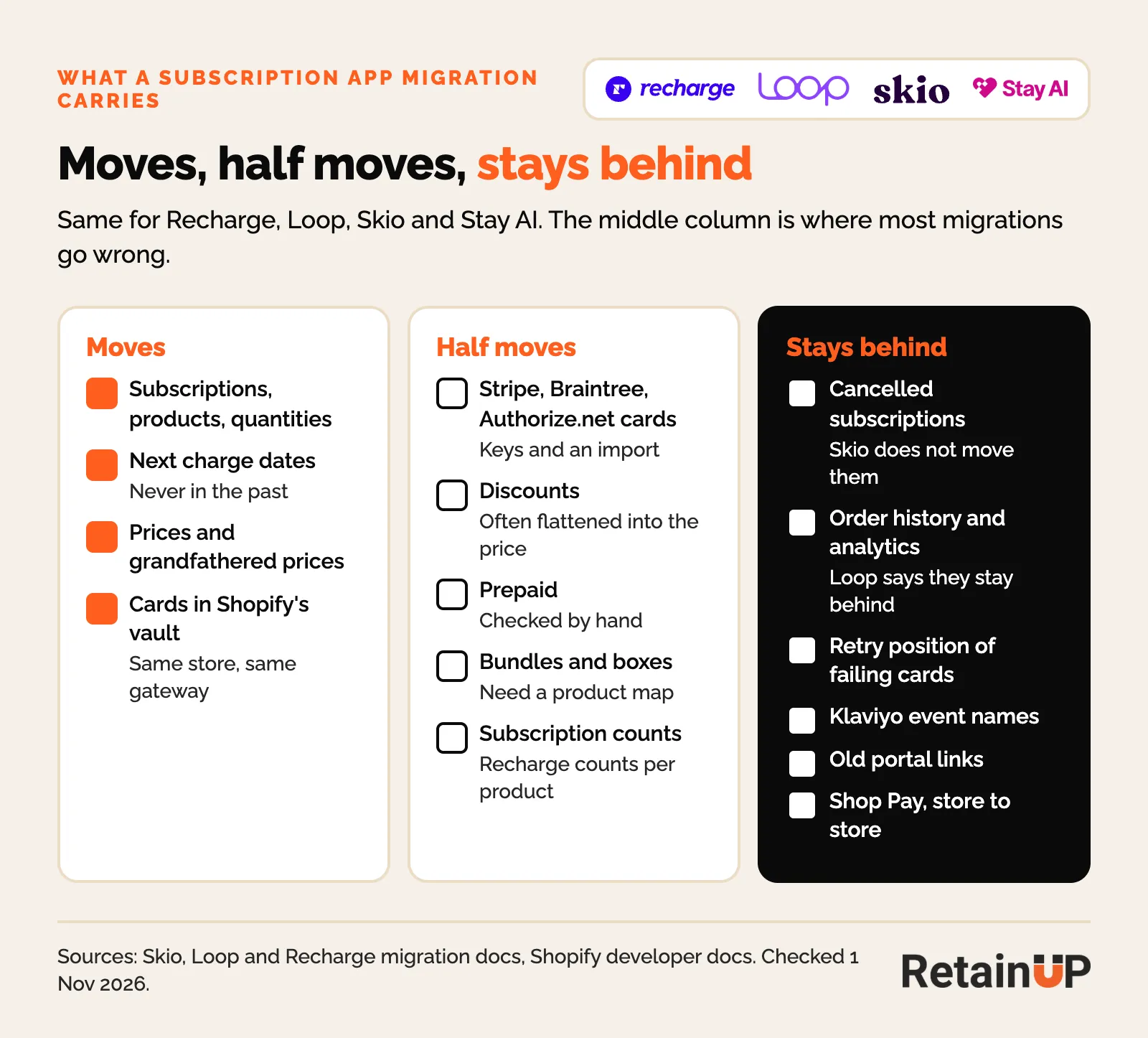
"Can I switch subscription apps with active subscribers?" It comes up on the Shopify forums every few weeks. Yes, you can. Most brands switch without a single customer typing in a card again, because every big app runs a migration team that moves subscriptions, charge dates and, in most cases, payment tokens.
They don't move your setup. Retry position, email settings, Klaviyo event names and old portal links don't come across, or only partly. I've seen every one of them go wrong on a live store.
Switch for a lever. Not for a feeling. You have outgrown your app when there is a setting you need and it can't make it: a cancel flow that routes by reason, a choice after the last retry, Klaviyo events for skips and cancels. A rival telling you to switch is not on the list. Most of what we find in audits is setup, and setup moves with you.
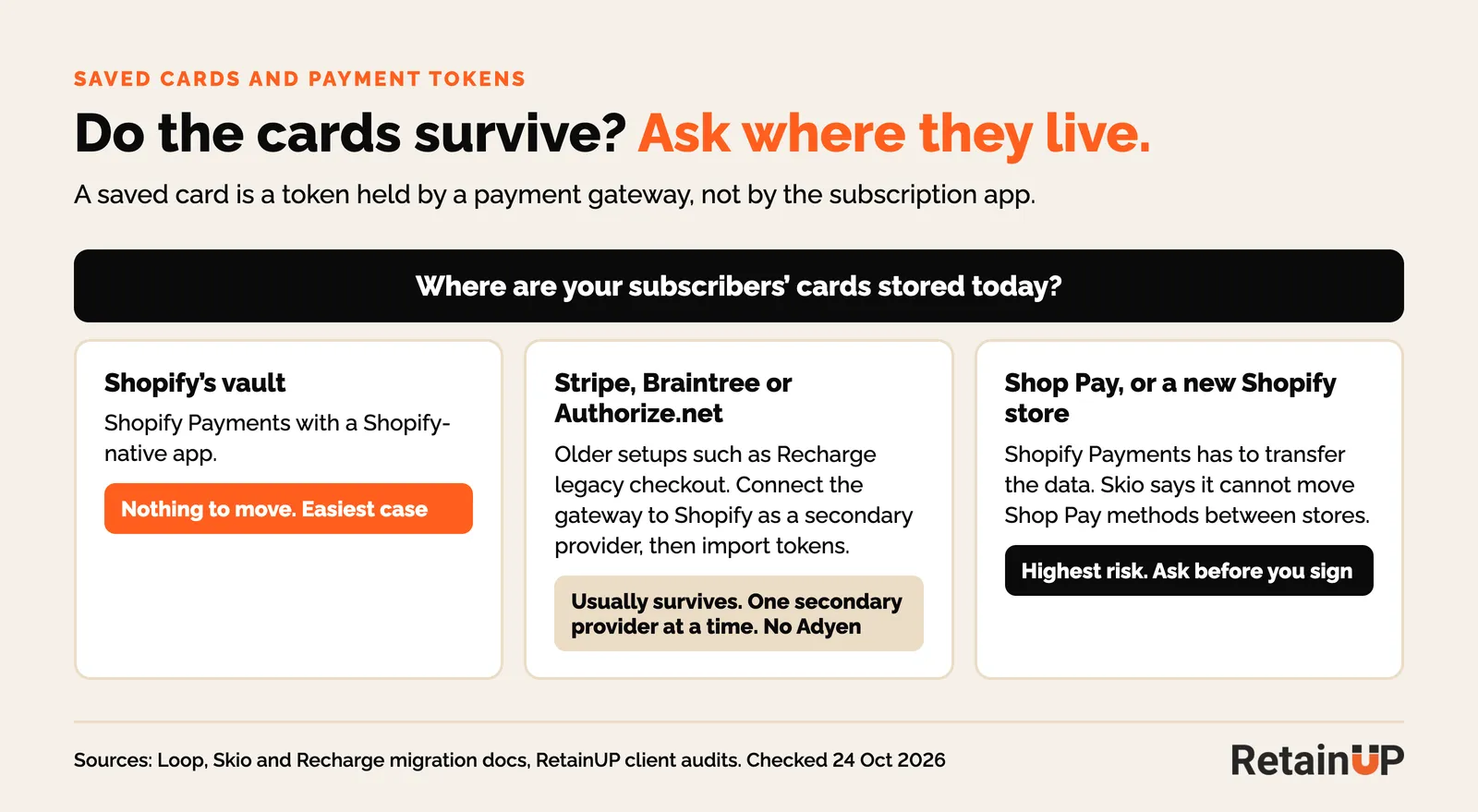
Plan for two to five weeks. Skio puts a full migration at 4 to 5 weeks. Loop and Stay AI quote about 2, and a gateway change adds 7 to 14 business days. Saved cards survive when the gateway stays the same. Shop Pay is the risk on a store-to-store move: Skio says it cannot migrate Shop Pay methods between stores, and on one Loop brand we audited Shop Pay carried 64% of payment attempts. Ask about it before you sign.
Mid-dunning subscribers are the quiet loss. They arrive in the new app looking healthy, the next charge fails, and the retry ladder restarts at zero. On one Loop brand, 35% of failed payments were dead cards. So pull everyone with a failed charge in the last 30 days, tag them, and import them paused with a card update email. Don't import them active and hope.
And never move everyone at once. Ordergroove's migration guide suggests a dry run first: one subscriber, through export, clean-up and import, with a test charge you refund. Then 100 to 1,000. Then the rest.
Then clean the data before you read a chart. After one Appstle to Loop move, raw data showed more than twice the real cancels for three months, because the migration cancelled its own records. The day-by-day plan, with a checklist for before and after the switch, is in our subscription migration checklist.
Klaviyo events: where flows quietly stop
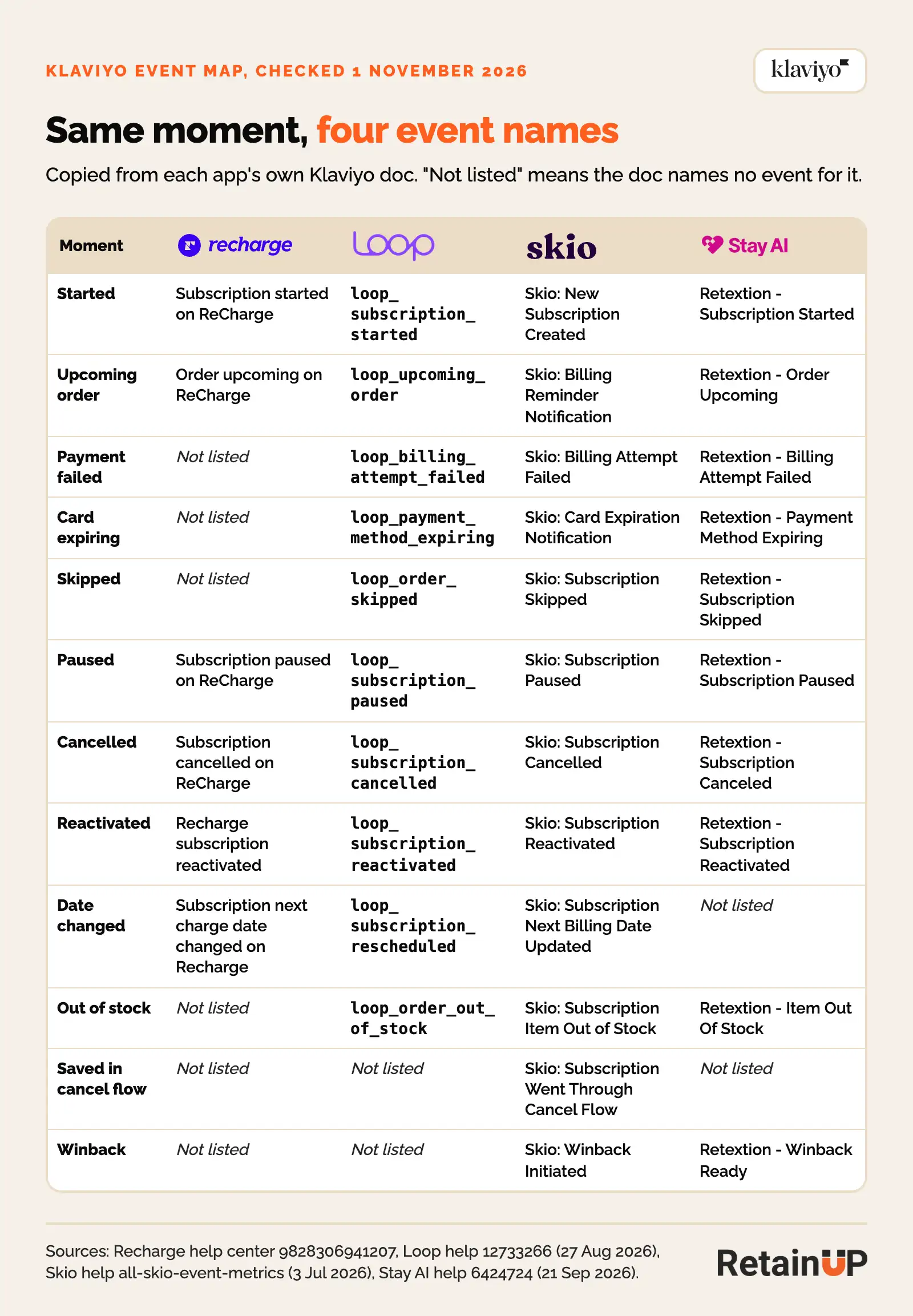
Every subscription flow in Klaviyo hangs off one event the app sends. Get the name wrong and the flow sits there, Live, with no entries. Nothing errors.
And the four apps name the same moment four ways. A new subscription is "Subscription started on ReCharge" on Recharge, loop_subscription_started on Loop, "Skio: New Subscription Created" on Skio and "Retextion - Subscription Started" on Stay AI, which still uses its old company name. Search "Stay" in Klaviyo and you only find the profile properties. The Recharge Klaviyo integration needs its latest version. After the upgrade, its metrics sit under a Recharge filter and can take a day to show.
Two things stop sends without any error. The first is the handover between the app's own emails and Klaviyo: leave both on and subscribers get two, switch the wrong one off and nobody gets any. After a supplement brand we moved from Appstle to Loop went live, Loop's payment emails had stopped in September, and every retry that month went out with no email. Nobody noticed. The second is smart sending. At one of our brands, a loyalty points email fired a minute after every order, so smart sending skipped the order email for most qualifying orders.
Skio is also the only one of the four that tells Klaviyo about a save, which gives you a thanks-for-staying email and a way to count saves that cancel again. Every event name side by side, and which flow runs on which, is in subscription app events in Klaviyo.
The tools that sit on top of your subscription app
Your subscription app runs billing, the portal and the cancel flow. A few tools each do one job better. Each one earns its place only after the app's own settings are right.
Zaymo: skip, swap and reactivate inside the email
Every change a subscriber wants to make normally starts with a login. A lot of people give up halfway, and the easiest thing left on the page is cancel. Zaymo puts skip, delay, swap, add-on and reactivate buttons inside a Klaviyo email. In one of our A/B tests on Recharge, the Zaymo half cut order 2 cancels from 35.2% to 32.4%, and order 4 from 17.9% to 14.1%. Early numbers. One brand.
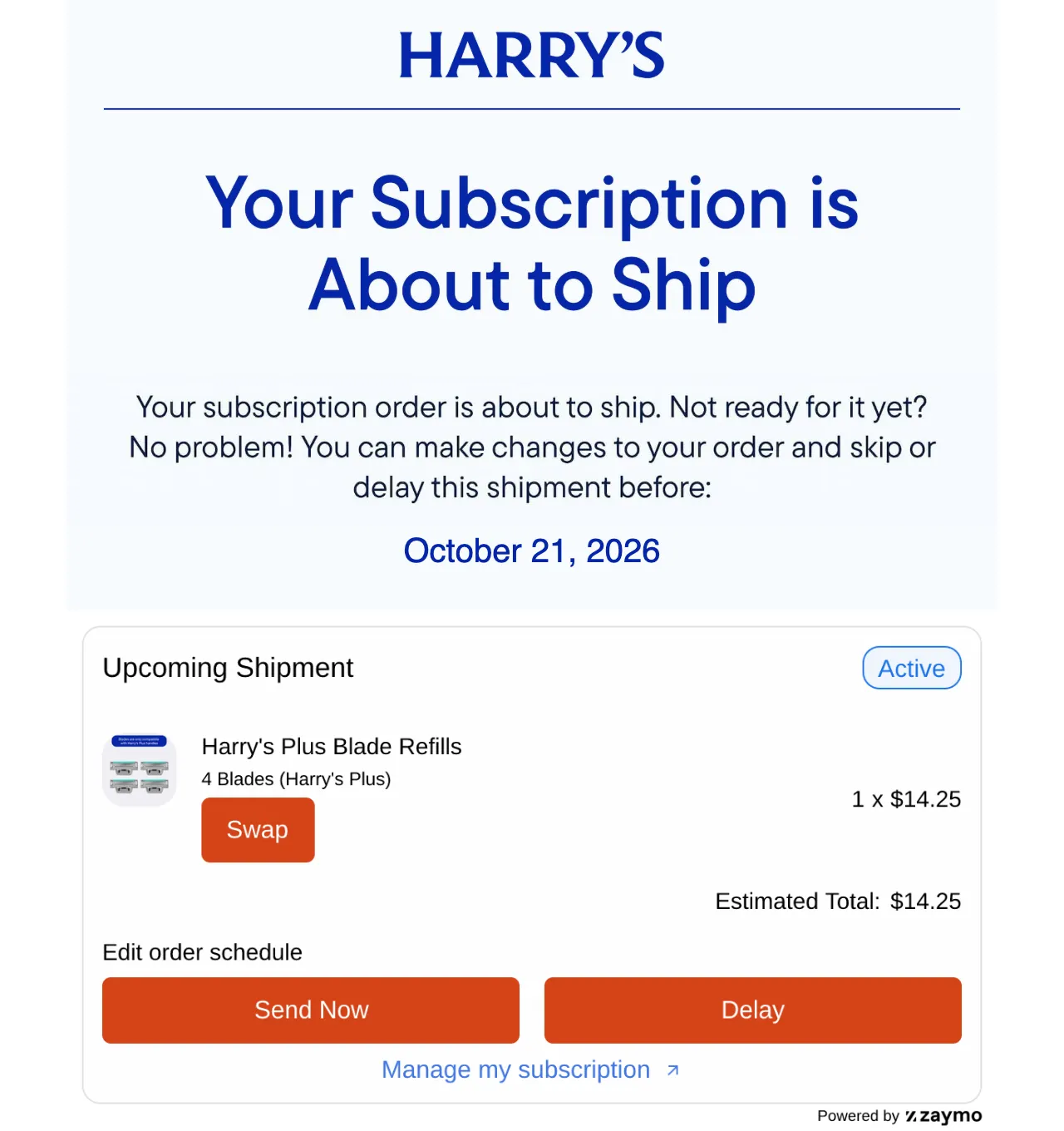
Skio and Loop ship their own one-click links, so on those two Zaymo is the upgrade, not the starting point. Build the core emails first. A block on an email nobody gets does nothing. Where it pays, and the Recharge rate limit to fix before a big send, is in Zaymo for subscription brands.
AfterSell: one more chance for the one-time buyer
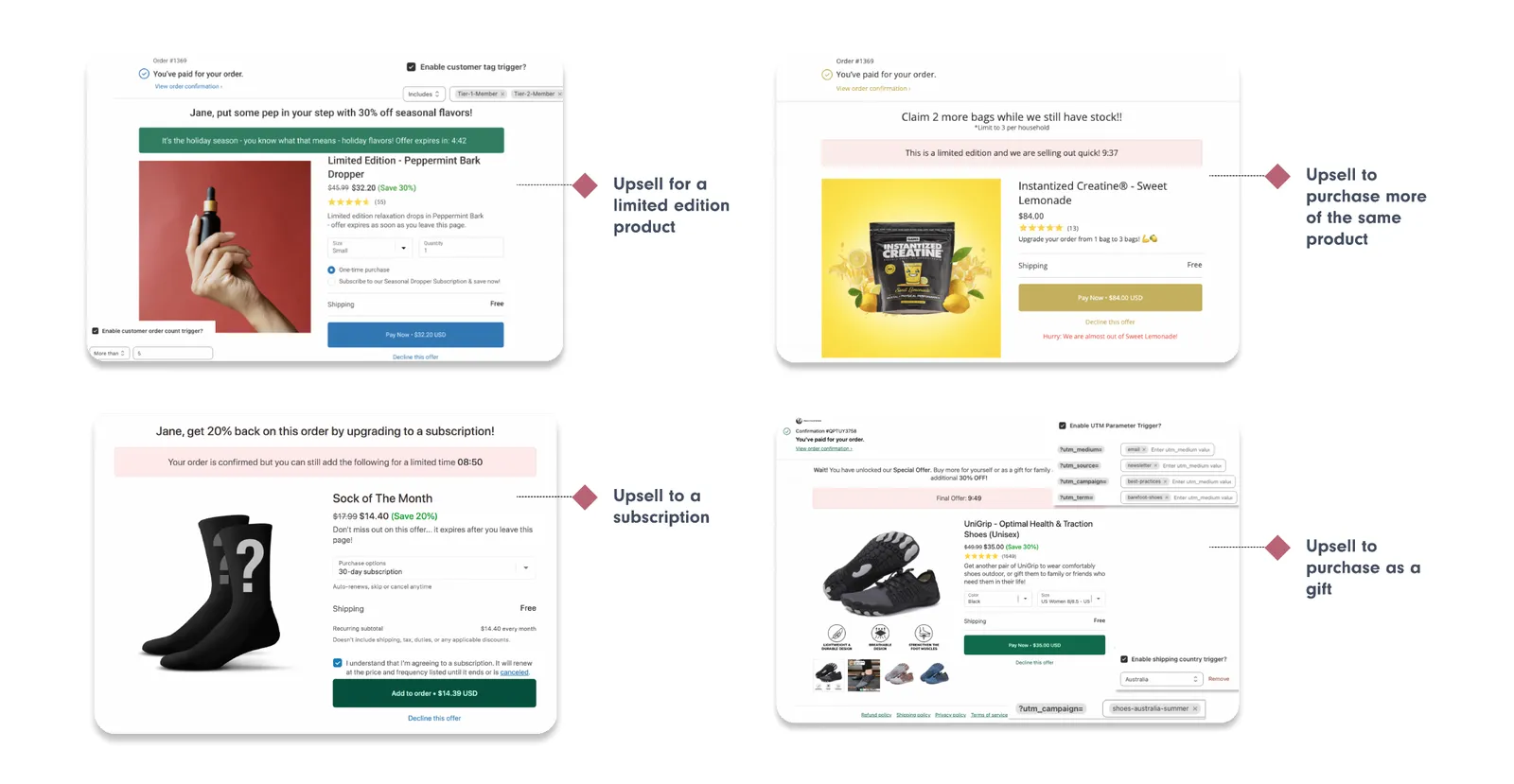
AfterSell covers two places your subscription app does not cover well: the cart drawer, and the page right after payment. Its post-purchase subscription upsell is native with Skio, Loop and Recharge. With Stay AI it adds a new subscription after checkout, but it cannot switch the paid order yet.
Post-purchase offers work because the customer has just bought. They trust you. So price the offer as cash. One of our brands offers a $49 one-time buyer two months for $24 more, plus 3 free gifts. After the sale the buyer is not comparing prices anymore. Funnel setup, targeting and the timer are in AfterSell for subscription upsells.
Churn Buster: payment recovery on top of the app
Churn Buster takes over failed payments: the retries, the dunning emails, one SMS, the card update. It sets its own retry timing by decline reason and ends the campaign in a cancel, with no pause option. At a home care brand on Churn Buster, 52% to 65% opened every dunning email. Only 2.3% to 8.3% updated their card.
People open failed payment emails. They just don't act on them.
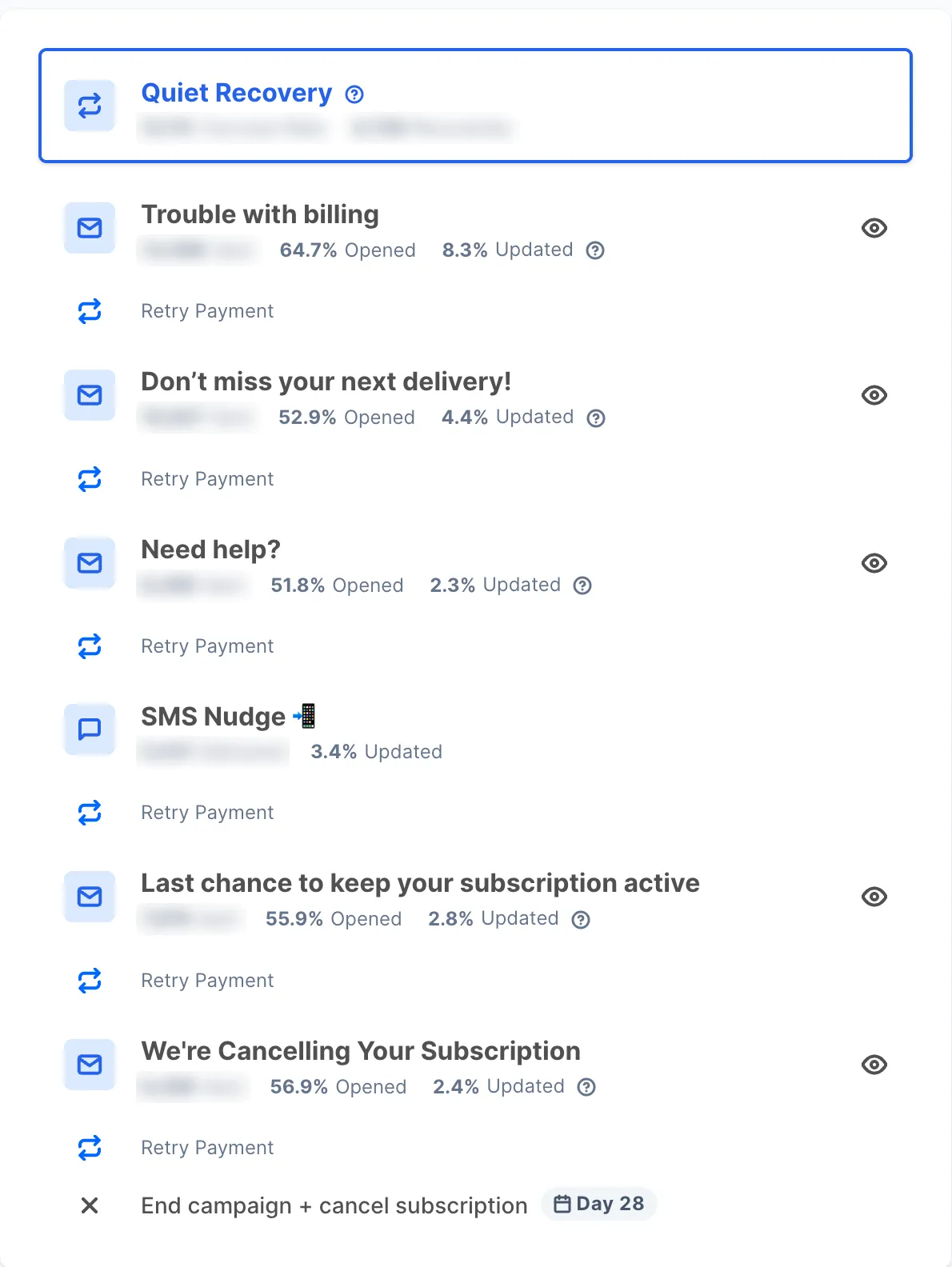
On failed renewals it recovered 41.7% there, against a Recharge platform median of about 44.9%. A small edge at best. So start with the app's own recovery settings, and add a tool once you still have a gap. What to change after install, and how to check it every month, is in Churn Buster for subscription brands.
Launching a subscription program from zero
Most subscription launches go wrong before anyone writes a line of copy. The plan is set up on the live product, the frequency says one thing and bills another, and one subscription gets five free gifts.
Our order comes from a real launch: Awesome Aminos, a kids and adults amino acid gummy on Loop, adding a 3-month supply next to the monthly plan. Make the supply length a variant, not a quantity or a frequency, or the portal lets subscribers break it. Build on a test product. Never the live one. Then test the cart before anyone sees it. Awesome Aminos' checkout read "every month" on a 3-month plan until we read the last checkout line.
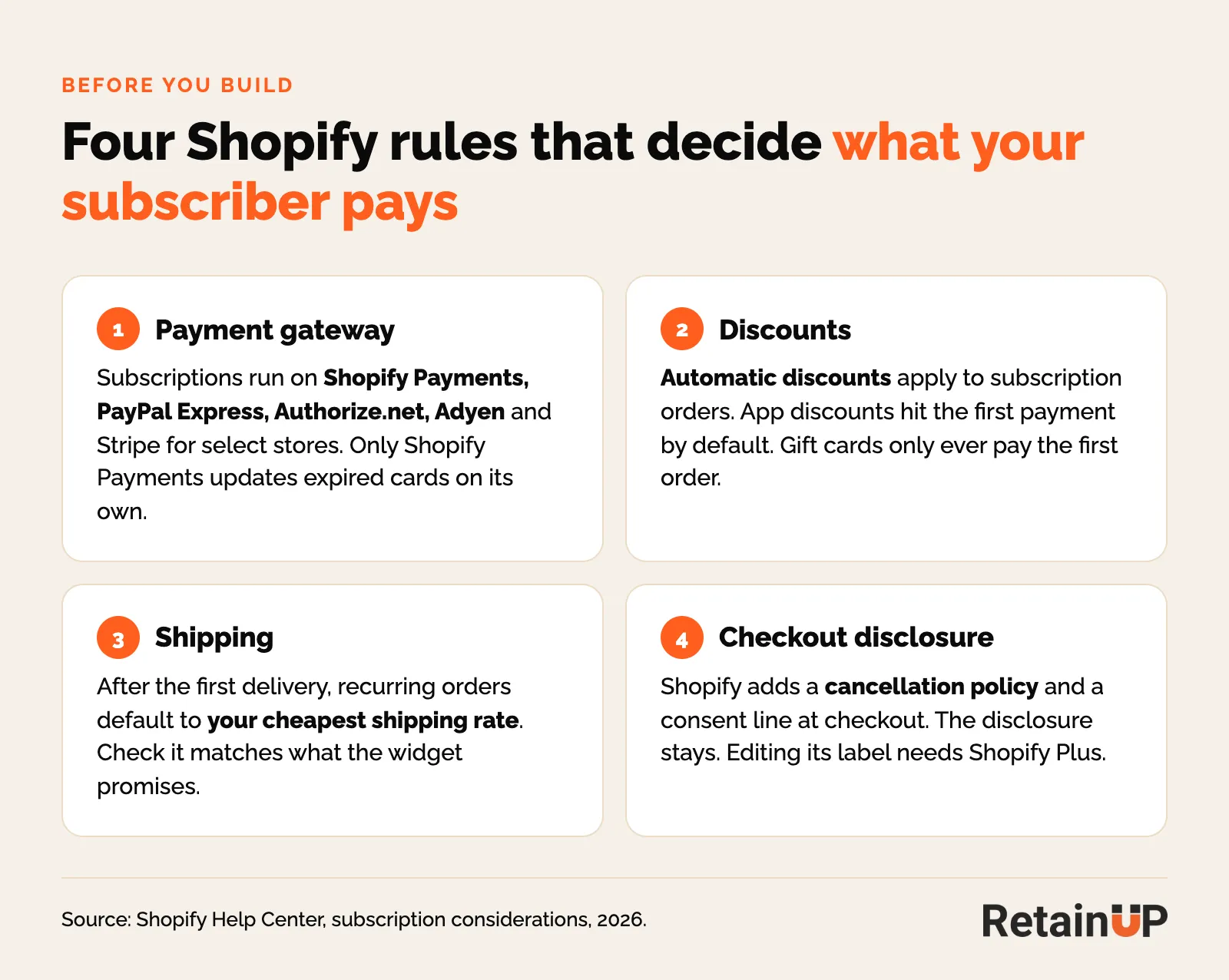
Every subscription app sits on Shopify's checkout. So a few of Shopify's own rules apply whichever app you pick. Subscriptions run on Shopify Payments, PayPal Express, Authorize.net, Adyen, and Stripe for select stores. Only Shopify Payments updates expired cards on its own. On anything else, more renewals fail on dead cards.
And launch as a split test, not a switch. One of our brands saw take rate rise from 42% to 58% while revenue per day fell 42%. On a take rate report alone it looked like a win. All eight steps, each with the check that proves it worked, are in launching a subscription program: the setup checklist.
Not sure which of these settings is leaking on your store? The free subscription audit checks 48 points and gives you the top 3 leaks in 24 hours.
Whichever app you are on, the defaults will not hold subscribers on their own. The Subscription LTV Maximizer™ builds the offer, widget, cancel flow, portal, payment recovery, pause and skip in Recharge, Skio, Stay AI or Loop, plus email and SMS, live in 30 days, for $5,000.
Looking for a consultancy that specialises in subscription retention inside these apps? Here is how to pick subscription retention experts, and what a subscription retention agency costs.
FAQ
What is the best subscription app for Shopify?
There is no single best app. For most brands between $1M and $10M, Recharge, Skio, Loop and Stay AI can all run a good subscription program, and the setup moves results more than the app does. Pick on three things: whether you need bundles, what the app does after the last failed payment, and the fee at your size. Loop has the lowest list fee at every size we model. Recharge has the most integrations.
How does Recharge compare to Loop?
Loop costs less at every size we model, mostly because it charges no per-order fee and Recharge adds 20 cents to every order. At $1M a year that is about $11,188 on Loop Starter against $20,788 on Recharge Starter. Loop puts bundles on its first paid plan and lets you choose what happens after the last failed payment. Recharge has the bigger set of integrations. If a tool you rely on only plugs into Recharge, pick Recharge.
Is the free Shopify Subscriptions app enough?
It is enough until you have subscribers worth saving. The free app bills, lets subscribers pause and skip, and retries failed cards, but it has no cancel flow, no bundles and no subscription events we could find in Klaviyo. At an average save rate, a paid app like Loop Starter pays for its fees at roughly 300 subscribers, and sooner if your cancel flow saves more.
How much do Shopify subscription apps cost?
At $1M a year in subscription revenue and a $50 average order, list-price fees come to about $11,188 a year on Loop Starter, $17,388 on Stay AI, $20,788 on Recharge Starter and $22,488 on Skio. Shopify's own payment fees sit on top. The gap grows with you, to about $28,000 at $3M. Above $5M, nobody pays list price, so get quotes.
Can I switch subscription apps without losing subscribers?
Yes. Every big app runs a migration team that moves subscriptions, next charge dates and, in most cases, saved cards, as long as the payment gateway stays the same. What breaks is your setup: retry position, portal links, notification emails and every Klaviyo flow trigger. Tag subscribers who are mid-dunning before the export and import them paused. Plan for two to five weeks.
Did Recharge buy Skio?
Yes. Recharge bought Skio in April 2026, and Skio's App Store listing now reads "Skio, a Recharge Company". Skio says the combined product will take about 12 months, and both apps keep running until then. In November 2026 their $499 plans listed the same fee of 1.25% plus 20 cents per order. Loop and Stay AI are still independent.
Do I need Zaymo, AfterSell or Churn Buster on top of my subscription app?
Not on day one. Each one does a single job better than the app: Zaymo puts skip, swap and reactivate inside the email, AfterSell offers subscription to one-time buyers after payment, and Churn Buster runs failed payment recovery. Set up the app's own cancel flow, recovery and reminder emails first. Add a tool once those are right and you still see a gap.
One email a week on subscription retention: the numbers, the strategy, and what to fix first.

Rahi Jain
Rahi Jain is a subscription LTV specialist who helps $1M to $10M DTC brands reduce subscription churn and maximize LTV on Recharge, Skio, Stay AI and Loop.
More about Rahi