Key takeaways
- At one pet care brand on Loop, attempt two recovered 6.3% of failed orders. Attempts four to nine brought back 2% to 3% each.
- We set six retries over 14 days, on day 1, 3, 5, 7, 10 and 14. A supplement brand running up to 19 got nothing from attempts 12 to 19.
- Retries only reach bank declines. Dead cards were 44.1% of failures at one brand and came back 5.8% of the time.
This is one part of the subscription churn guide, which walks the whole topic in order.
A subscriber’s renewal fails. The app retries it nine times over three weeks. Nothing comes back, the order is skipped, and next month it fails again.
I’ve seen that loop in two Loop audits this year. The retry count was never the problem. Most of those cards were dead, and no retry reaches a dead card. And for the cards that still work, when you retry matters more than how many times.
This page is only the retry side: how many, how far apart, and what to change on Recharge, Skio, Loop and Stay AI. The full picture of failed payment recovery, and how to measure it, has its own page.
Read the failure reason before you touch the schedule
A retry only works when the card still works. So split your failures first. Bank declines can come back on a retry. Dead cards can’t, and setup faults are a Shopify Payments setting. The three buckets are laid out in failed payment recovery.
At one pet care brand on Loop, bank declines were 49.6% of first failures and recovered 36.5%. Dead cards were 44.1% and recovered 5.8%. You can retry a dead card a hundred times. It will still fail.
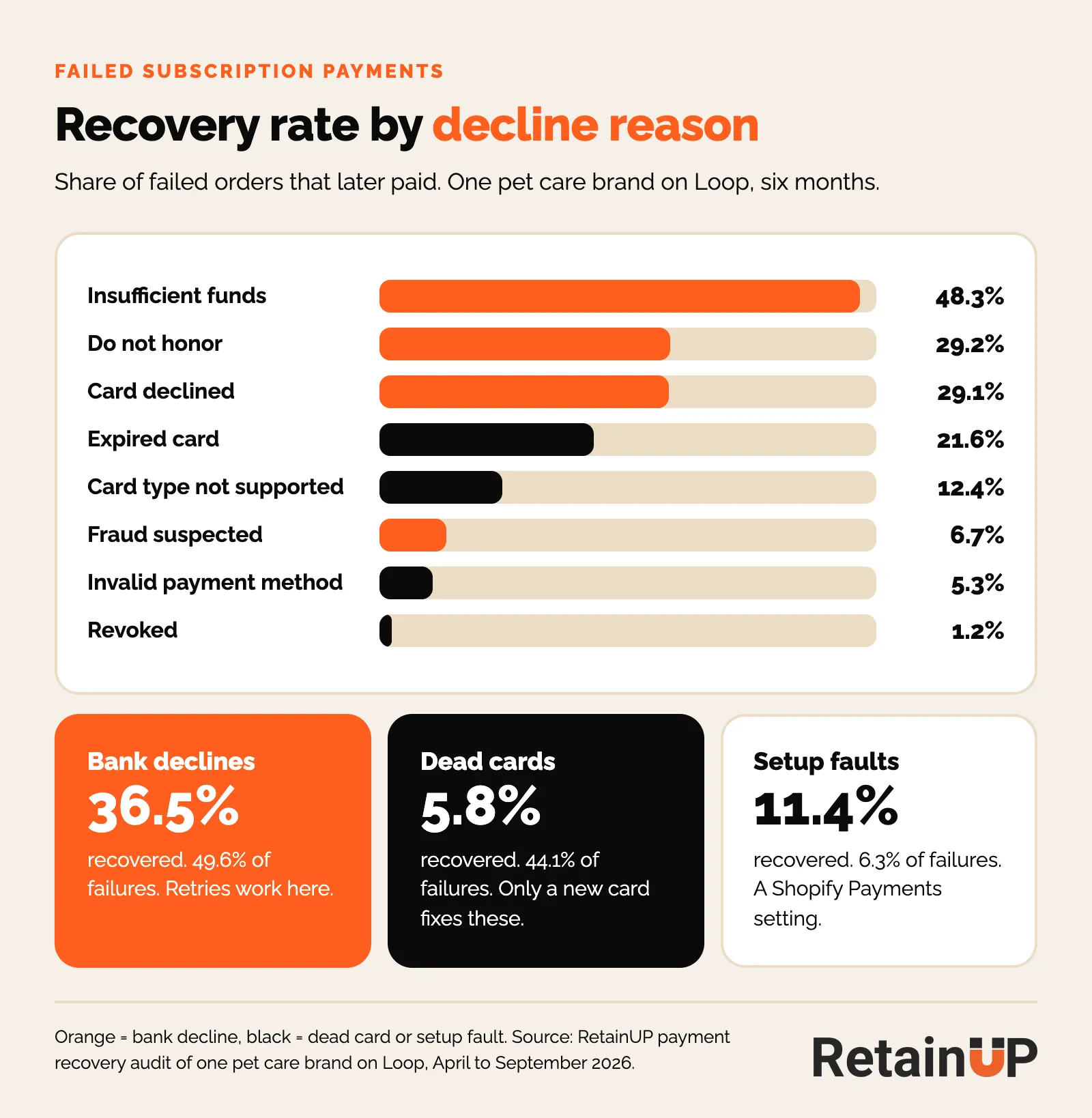
The reason also tells you if the schedule itself is wrong. If "declined retry" is your top failure reason, you're retrying too hard and the bank is pushing back. If insufficient funds tops the list, the timing matters more than the count, and that's the payday section below.
So you need two fixes. Retries for the first kind. A card update for the second. This page is the retries. Dead cards go straight to the card update flow, with the link sent the same day.
Front-load the first 48 hours
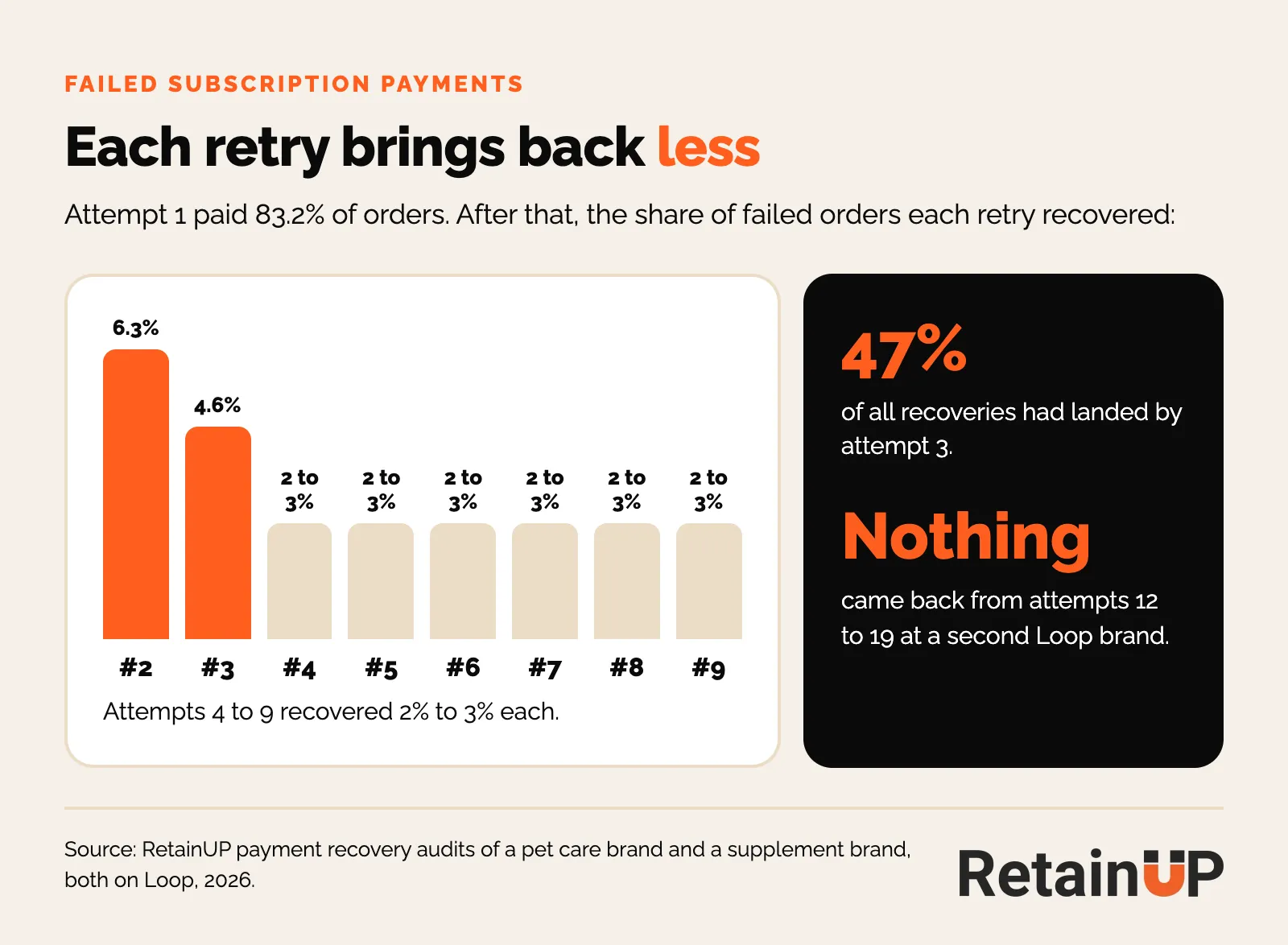
The first retry has the best chance. The second less. The third less again.
At the pet care brand, attempt one paid 83.2% of orders. Of what failed, attempt two recovered 6.3% and attempt three 4.6%. Then 2% to 3% on every attempt after. All the way to attempt nine. About 47% of all recoveries had landed by attempt three.
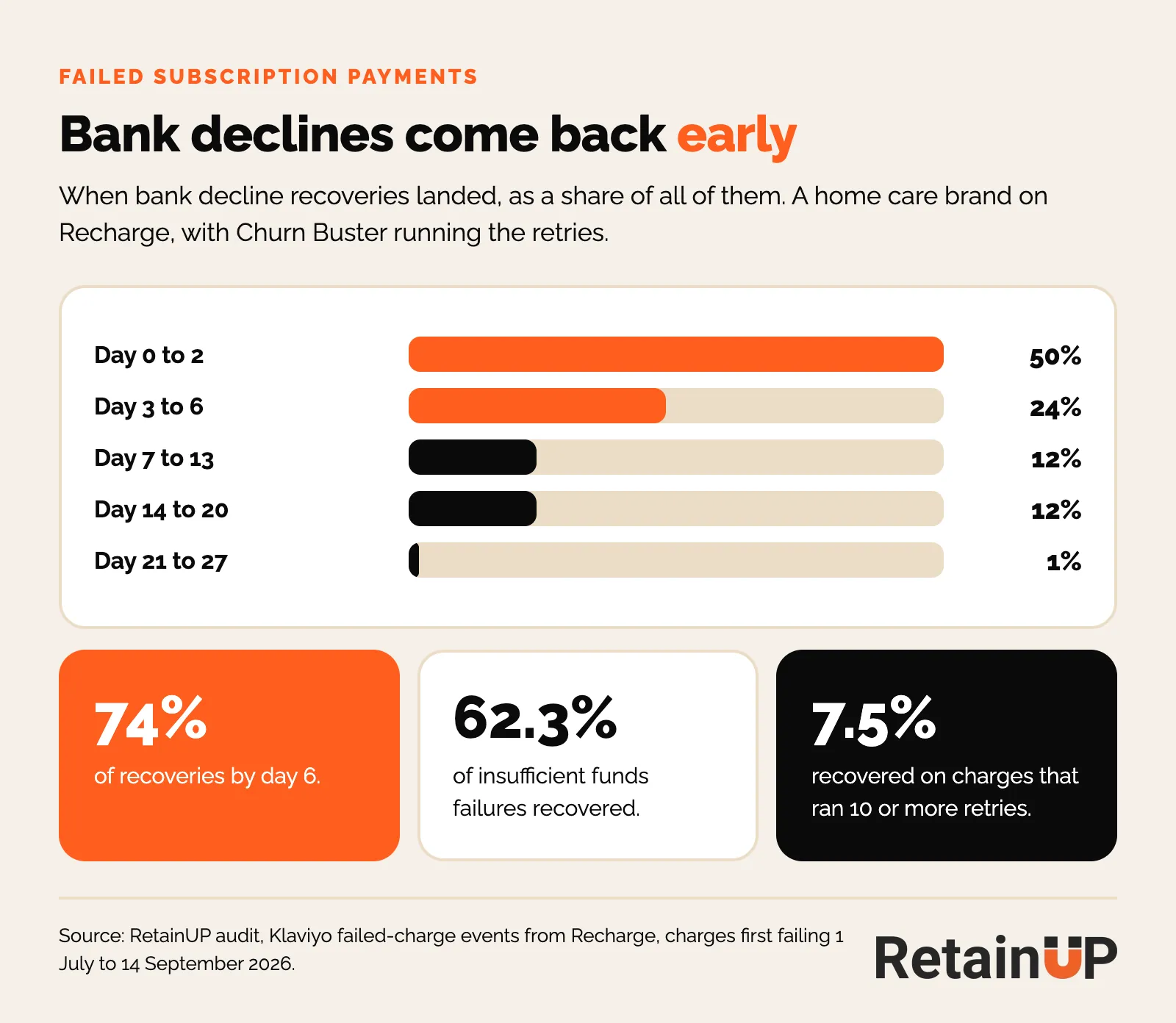
A home care brand on Recharge, with Churn Buster running the retries, showed the same curve by day. Half of all bank decline recoveries came back in the first two days. Three quarters by day 6. Only 1% landed between day 21 and day 27.
Not just us. The outside data agrees. Recurly looked at 40 million subscription transactions and found a day 1, 3, 5 and 7 schedule recovers 58% of failed payments with no customer message at all. Loop told its partners that 60% of what it recovers comes in the first 3 retries.
Tight early. Spaced late. Not evenly distributed.
Six attempts over 14 days beats 19
Here is what we set for bank declines. Six retries. Front-load them, then stop.
| Retry | Day | Why |
|---|---|---|
| 1 | Day 1 | The highest chance of any retry |
| 2 | Day 3 | Still inside the window where half the recoveries land |
| 3 | Day 5 | Last of the tight ones |
| 4 | Day 7 | A week out, often past a payday |
| 5 | Day 10 | Spacing out |
| 6 | Day 14 | Last retry, then pause and hand over to the card update emails |
A supplement brand on Loop came to us retrying up to 19 times, 48 hours apart, for about three weeks. The recoveries were scattered across attempts 3 to 11, with no early cluster, and attempts 12 to 19 brought back nothing. Each of those extra attempts is one more failed transaction in your reports and one more decline the bank sees. We moved it to six over 14 days. Done by day 14.
At the home care brand, charges that ran 10 or more retries recovered 7.5% of the time. Stripe sets up to 8 retries within 2 weeks by default, and never retries codes like incorrect number, lost or stolen card, or revoked authorization without a new card. Recurly found most recovery lands 2 to 12 days after the decline. Different sources, same shape: almost nothing comes back past two weeks.
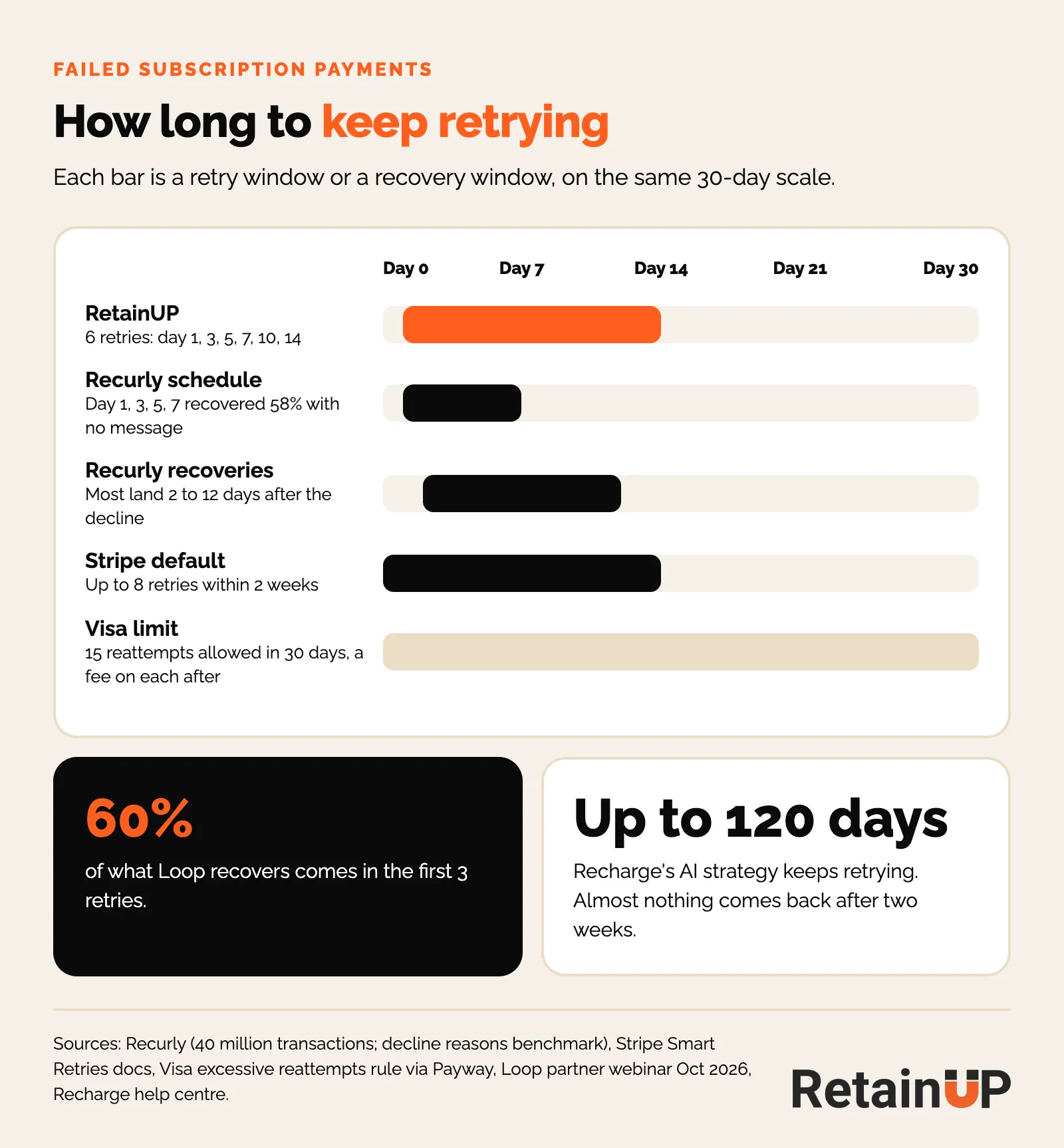
There’s also a ceiling you don’t set. Visa allows up to 15 reattempts on a card in 30 days for most soft declines, and charges a fee on each one after that. For codes like lost or stolen card, any retry at all is billed. Payway explains the rule. So the brand running 19 retries was paying fees on attempts that brought back nothing.
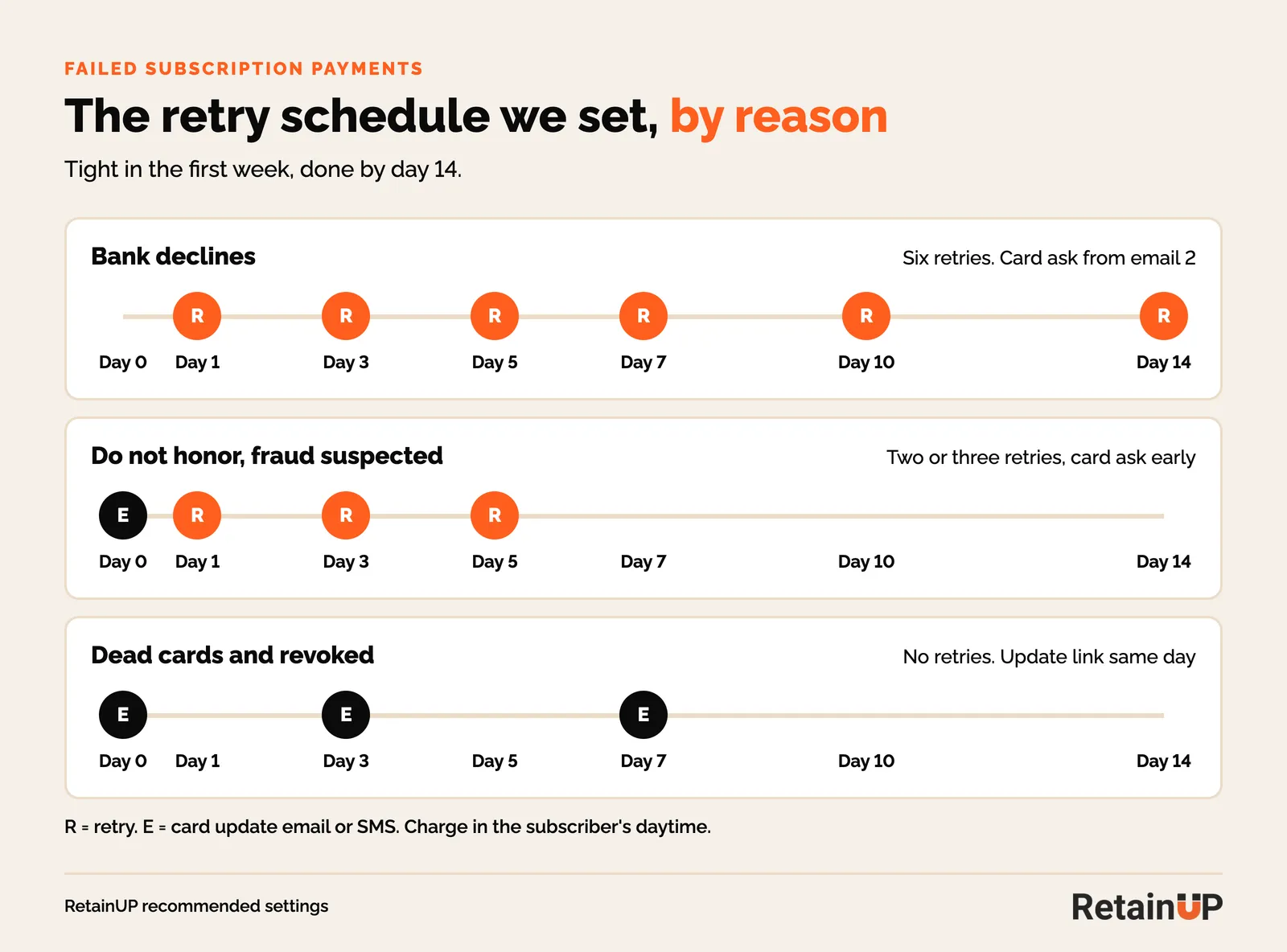
Not every bank decline gets the full six. Do not honor and fraud suspected recovered 29.2% and 6.7% at the pet care brand. The bank may never clear those. So two or three retries, and ask for a new card early.
Here is the full split we use, by the reason the app gives you.
| Decline reason | Bucket | Retries | What else to do |
|---|---|---|---|
| Insufficient funds | Bank decline | Day 1, 3, 5, 7, 10, 14. Land some near paydays | Card or backup card ask from email 2 |
| Card declined, temporary hold | Bank decline | Day 1, 3, 5, 7, 10, 14 | Card ask from email 2 |
| Do not honor, fraud suspected | Bank decline | 2 or 3 retries | Ask for a new card early. The bank may never clear it |
| Expired, incorrect number, invalid | Dead card | None, or one after the update | Update link same day, email plus SMS |
| Revoked (Shop Pay) | Dead card | None | Shopify update link, step-by-step shop.app instructions |
| Card type not supported | Setup fault | None | Fix accepted card types in Shopify Payments |
Insufficient funds: paydays, Fridays and January
Insufficient funds is the best reason you can get. It recovered 48.3% at the pet care brand, 62.3% at the home care brand and 73% at the supplement brand, mostly by retry alone.
The card is fine. The money just wasn't there that day. So when will it be?
- Retry on Fridays and around paydays. That’s Redux Payments’ advice for insufficient funds, and it fits the day 7 and day 14 slots. In the US the 1st and the 15th are common paydays, so a charge that fails on the 5th has a better chance on the 15th than on the 8th. Chargeblast walks through payday timing.
- If insufficient funds failures bunch up on the same dates, let subscribers pick their billing day. Loop’s dunning guide suggests the same.
- Charge in the subscriber's daytime. If you process at 5am Eastern, that's 2am in California. Banks flag odd hours, and you lose a payment that would have gone through.
- Keep it silent at first. No email for the first retry or two on insufficient funds, the card will probably clear. Loop lets you switch the email off per retry, so the early ones run quietly.
Holiday failures
December is when the first full-price renewal fails most. Treat a failed holiday payment as a timing problem, not a lost subscriber. Retry silently first, and save some retries for January, after the holiday spending. Hard declines skip the retries and get the card update link straight away.
Loop also found a 5% discount on the later retries lifted recovery about 16%. Discount last, never first. The rest of the season is in BFCM for subscription brands.
What happens after the last retry
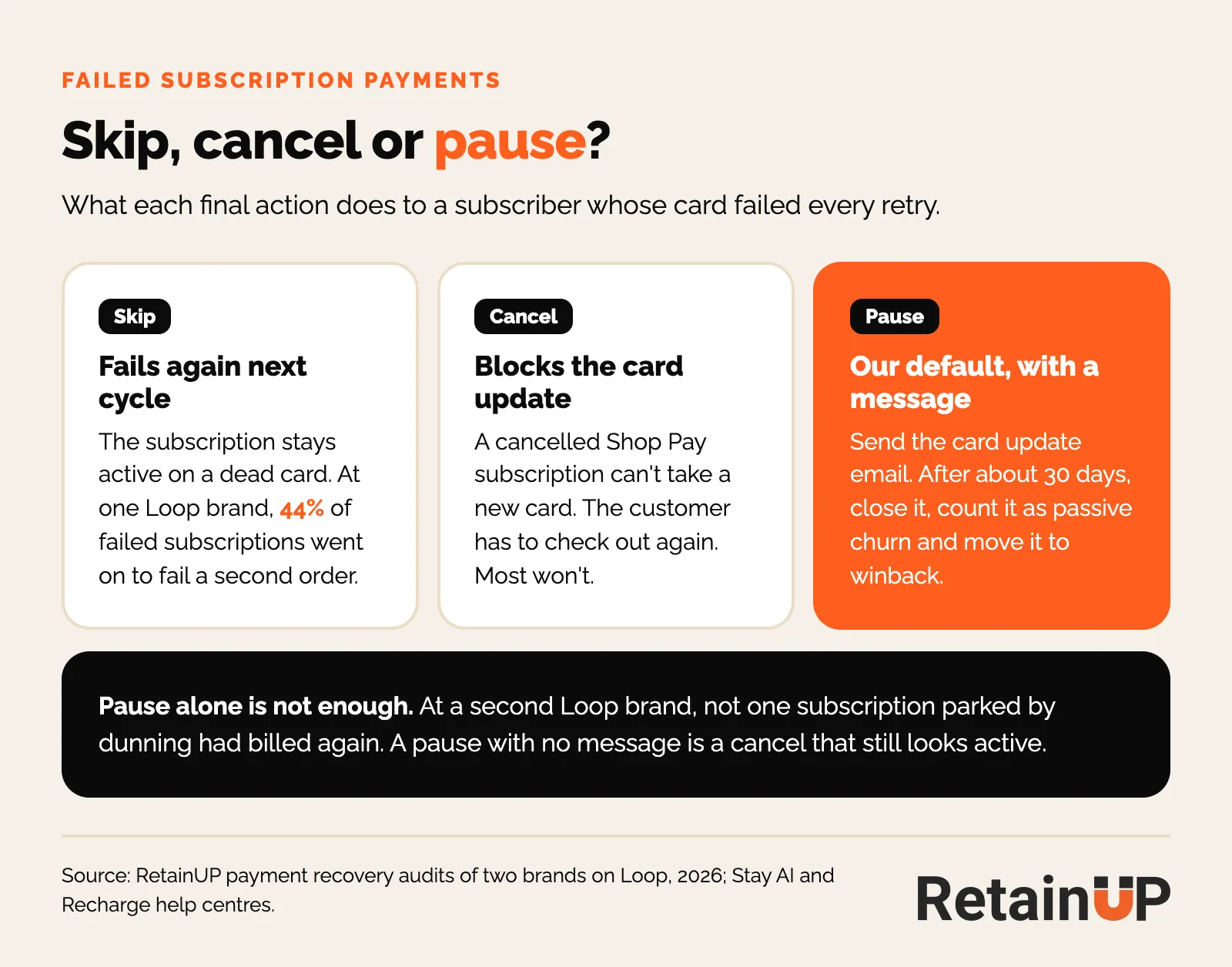
Pause it. Then send the card update email. Don't cancel, and don't skip.
A skip keeps a dead card billing every cycle, and a cancelled Shop Pay subscription can’t take a new card. They have to buy again. Most won’t. And a pause with no end just sits there. So after about 30 days, close them, count them as passive churn, and send them to winback. The traps behind each option are in failed payment recovery.
Retry settings on Recharge, Skio, Loop and Stay AI
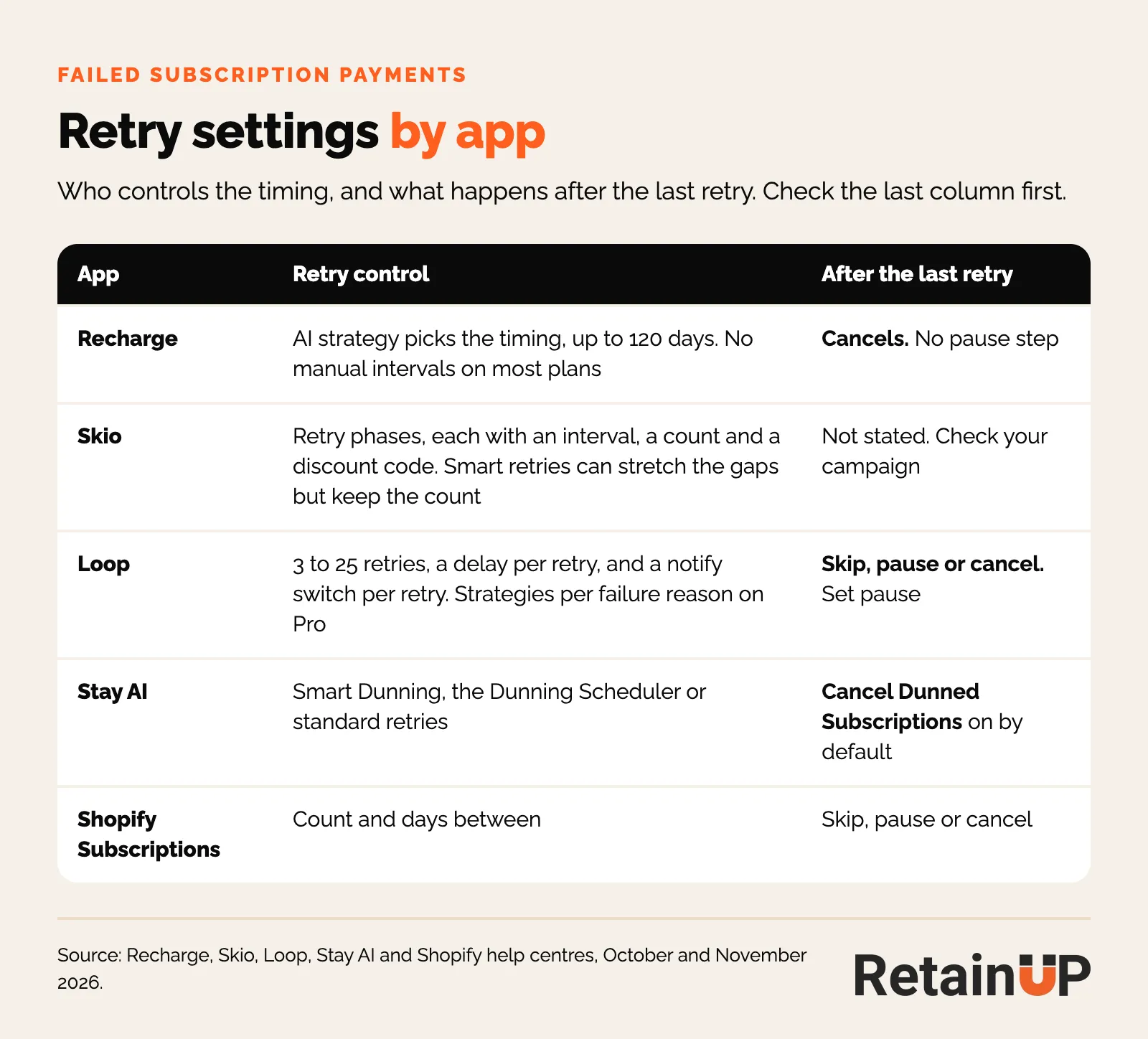
Every app does this differently. Annoying, but fixable. Two settings matter on each: who controls the timing, and what happens after the last attempt.
Recharge
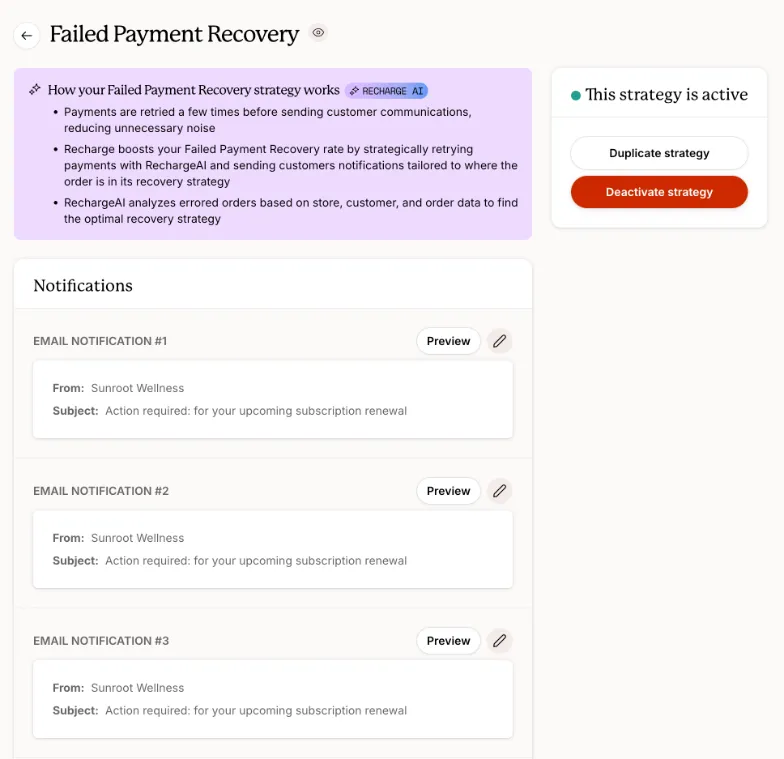
Churn tools, Failed Payment Recovery. Recharge's AI strategy picks the retry timing and keeps trying for up to 120 days. It retries a few times before it sends the customer anything. On most plans you can't change those intervals, and for cards that still work, we leave Recharge to it.
What you do set: backup payment methods on, so Recharge charges another card on file, and the hard decline email on, because hard declines skip the strategy. When every retry fails, Recharge cancels. There's no pause step, so the card update has to land before then. The rest is in the Recharge retention setup.
Skio
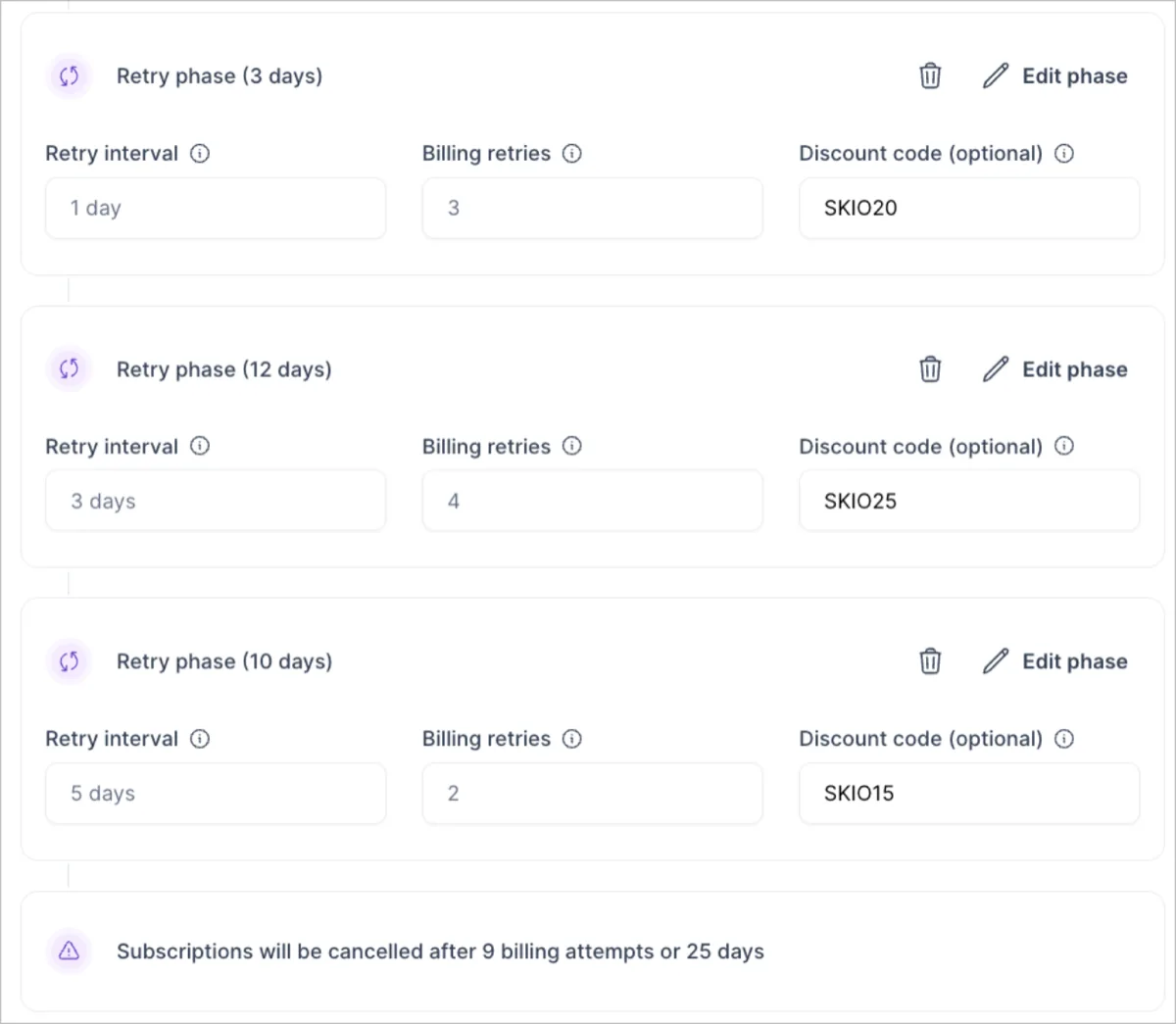
Retain, Payment Recovery. You build retry phases, each with its own interval, number of retries and an optional discount code, and you can turn on smart retries. Those keep your retry count but can stretch the gaps: a phase set to every day for 3 attempts might run after 2, 3 and 4 days, per Skio’s help centre. Skio’s suggested first phase is 7 attempts, 3 days apart. Too slow for week one. Make the first phase short and tight, and put any discount on the last phase. More in the Skio retention setup.
Loop
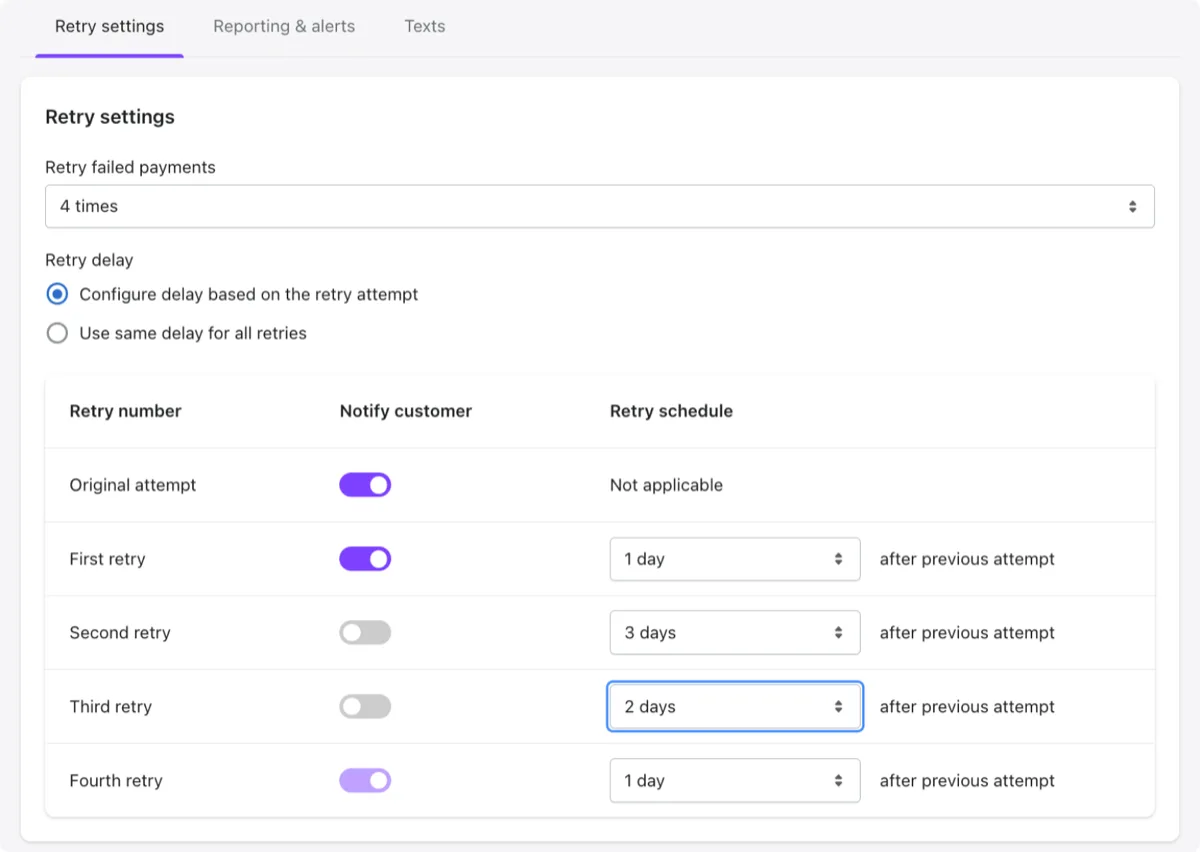
Retain, Payment recovery, Retry settings. You pick how many retries, from 3 to 25, and the delay for each attempt, counted from the previous one. Each retry has its own notify switch, and on the Pro plan you can build a separate strategy per failure reason, so dead cards skip the retries. So day 1, 3, 5, 7, 10 and 14 is a delay of 1, 2, 2, 2, 3 and 4 days. Set the step after the last retry to pause, not skip. Then check Loop's payment emails are still going out: at both Loop brands we audited, they stopped on their own. The Loop retention setup has the rest.
Stay AI
Subscription Setup, Customer Billing. You choose Smart Dunning, the Dunning Scheduler or standard retries. Cancel Dunned Subscriptions is on by default. Check it first. Today. See the Stay AI retention setup.
Churn Buster and other retry tools
Churn Buster sets the retry timing itself, by decline reason, and its team changes campaign length on request. No custom schedule. Butter Payments, FlyCode and Redux work across many merchants to find the best retry window per bank. They're worth a test once you have 5,000+ active subscribers and the app's own settings are already right. More in Churn Buster for subscription brands.
The video walkthrough
This one builds the whole recovery setup in Recharge and Klaviyo, with the Skio and Loop retry screens at the end.

If you want someone to check your retry settings, your emails and your app every month and ship the fixes, that's the Subscription LTV Optimizer™, for brands with 5,000+ active subscribers, at $3,000 a month. Or start with the free subscription audit: 48 checkpoints, payment recovery among them, and your top 3 leaks in 24 hours.
FAQ
How many times should I retry a failed subscription payment?
Six times over 14 days is what we set for bank declines: day 1, 3, 5, 7, 10 and 14. At one Loop brand, attempts four to nine brought back only 2% to 3% each, and another brand running 19 retries got nothing after attempt 11. For expired, revoked or invalid cards, skip the retries and send the card update link the same day.
What is the best time to retry a failed payment?
Early, and in the subscriber's daytime. Half of bank decline recoveries came back in the first two days at one brand we work with. For insufficient funds, land retries on Fridays and around paydays. And avoid a billing run at 5am Eastern, which is 2am in California, because banks flag charges at odd hours.
Should I retry a card that was declined for insufficient funds?
Yes, insufficient funds recovers better than any other reason. At one supplement brand it came back 73% of the time, mostly by retry with no customer action. Keep the first retries silent, time them around paydays, and in December save a few for January, after the holiday spending is over.
What should happen after the last failed retry?
Pause the subscription and send the card update email. A skip keeps a dead card billing every cycle, and a cancel loses the subscriber outright. Then set an end. After about 30 days, close the paused ones, count them as passive churn and move them into your winback flow.
Can I change the retry schedule in Recharge?
On most plans, no. Recharge's AI strategy picks the retry timing and keeps trying for up to 120 days. For cards that still work, we leave it alone. What you can set is backup payment methods and the hard decline email, and you should check both are on, because hard declines skip the strategy.
One email a week on subscription retention: the numbers, the strategy, and what to fix first.

Rahi Jain
Rahi Jain is a subscription LTV specialist who helps $1M to $10M DTC brands reduce subscription churn and maximize LTV on Recharge, Skio, Stay AI and Loop.
More about Rahi