Key takeaways
- Churn is two numbers, active cancellations and passive card failures, and most subscription brands only fix one.
- Across 8 brands we audited in 2026, before any changes, the median cancel flow saved 10.8% of people who tried to cancel.
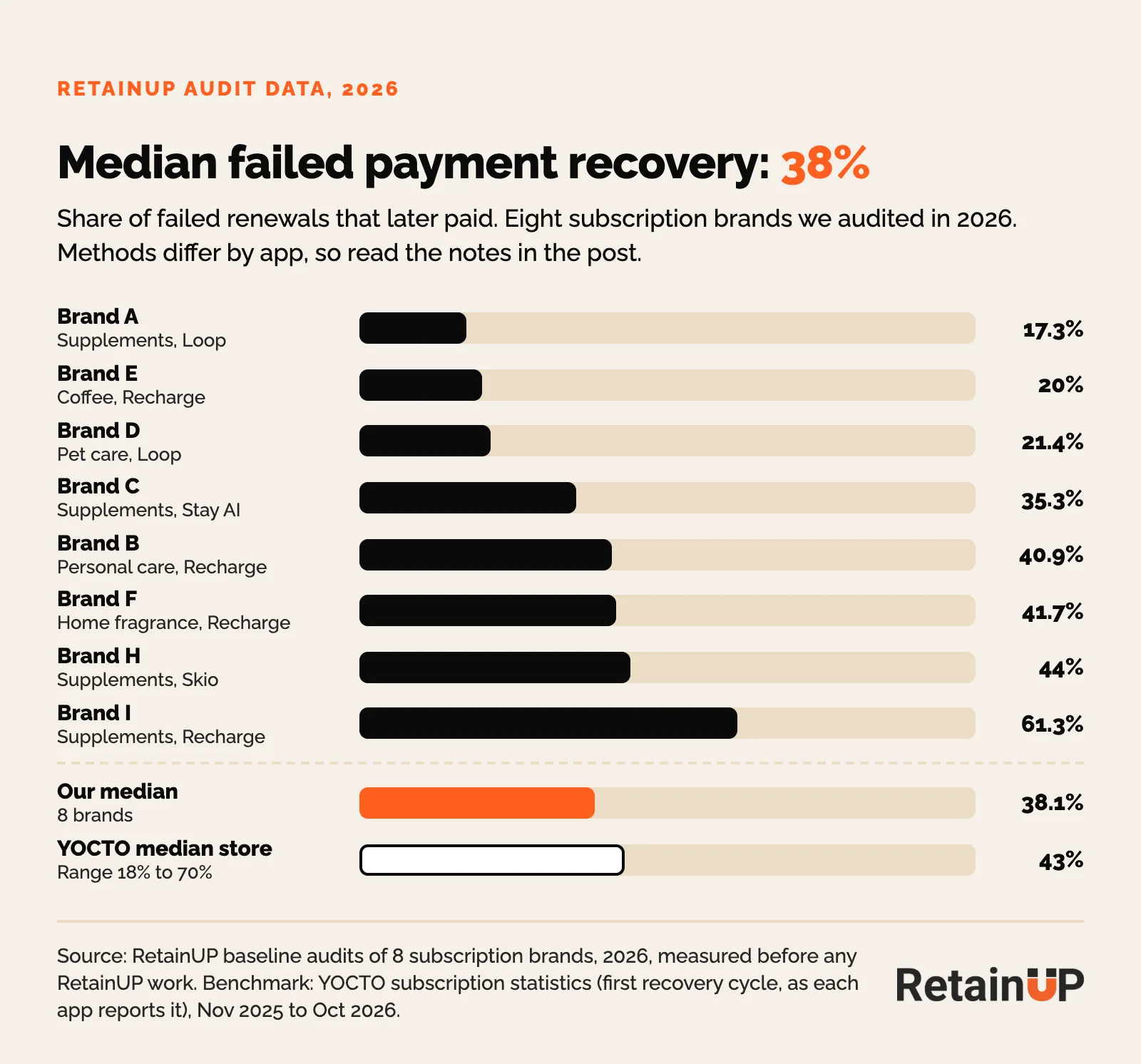
- The same 8 brands recovered a median 38% of failed payments, with a range of 17.3% to 61.3%.
Every subscription founder I talk to is watching the same number. Monthly churn rate.
And most of them are fixing the wrong thing.
Recharge puts subscription churn at 5% to 8% a month, and wellness runs highest at 8.8%. But monthly churn hides the leak, because new subscribers cover the ones you lost. Take a subscription business doing $2M a month. 5% churn is $100K of monthly recurring revenue gone every month, before any growth, and acquisition has to fill that hole first.
This guide walks churn in the order a founder meets it. The cancel click first. Then the card that fails. Then winback, and the two places discounts quietly cause cancels: Black Friday and your own email list.
Two kinds of churn need two different fixes
Subscription churn is every subscriber who stops paying. Active churn is a subscriber who cancels. Passive churn is a payment that fails and never recovers.
Most brands never separate them. One dunning sequence. One exit survey. So the retention effort goes to the cancel button, and the failed cards drift out quietly.
Active churn is a decision. So you read it from cancel reasons. Passive churn is a card that failed. Nobody decided to leave, and an expired card gets logged as a cancellation at most brands anyway. Paddle and ProfitWell put failed payments at 20 to 40% of all churn, and Recurly's ecommerce benchmarks land at about a third. It falls as order value rises, so low-AOV brands feel it most. The full split, with benchmarks, is in active vs passive churn.
It also comes early. Loop puts 68% of all churn in the first three orders, and Recharge's 2026 data has the average monthly subscriber who churns gone by about day 77, and inside those months it bunches up on the signup day, the reminder and the charge day, as the cancellation day spikes show. Skip, pause and frequency changes belong before the cancel click. That is retention work, in the flexibility ladder. This hub starts where it ends: a subscriber has pressed cancel, or a charge has failed.
The cancel flow: a structure that saves before the offer
The cancel flow is everything a customer sees when they are actively trying to cancel. It is the cheapest revenue in the subscription business, and the last thing anyone touches.
Loop looked at 441K cancel attempts across 87 brands. A generic "here's 10% off" screen saved about 6%. A three-stage conversation saved about 15%: re-engage, ask the reason, then make an offer. Re-engage saves 10% on average, the reason survey 8%, the offer 5%. So most saves happen before you give anything away.
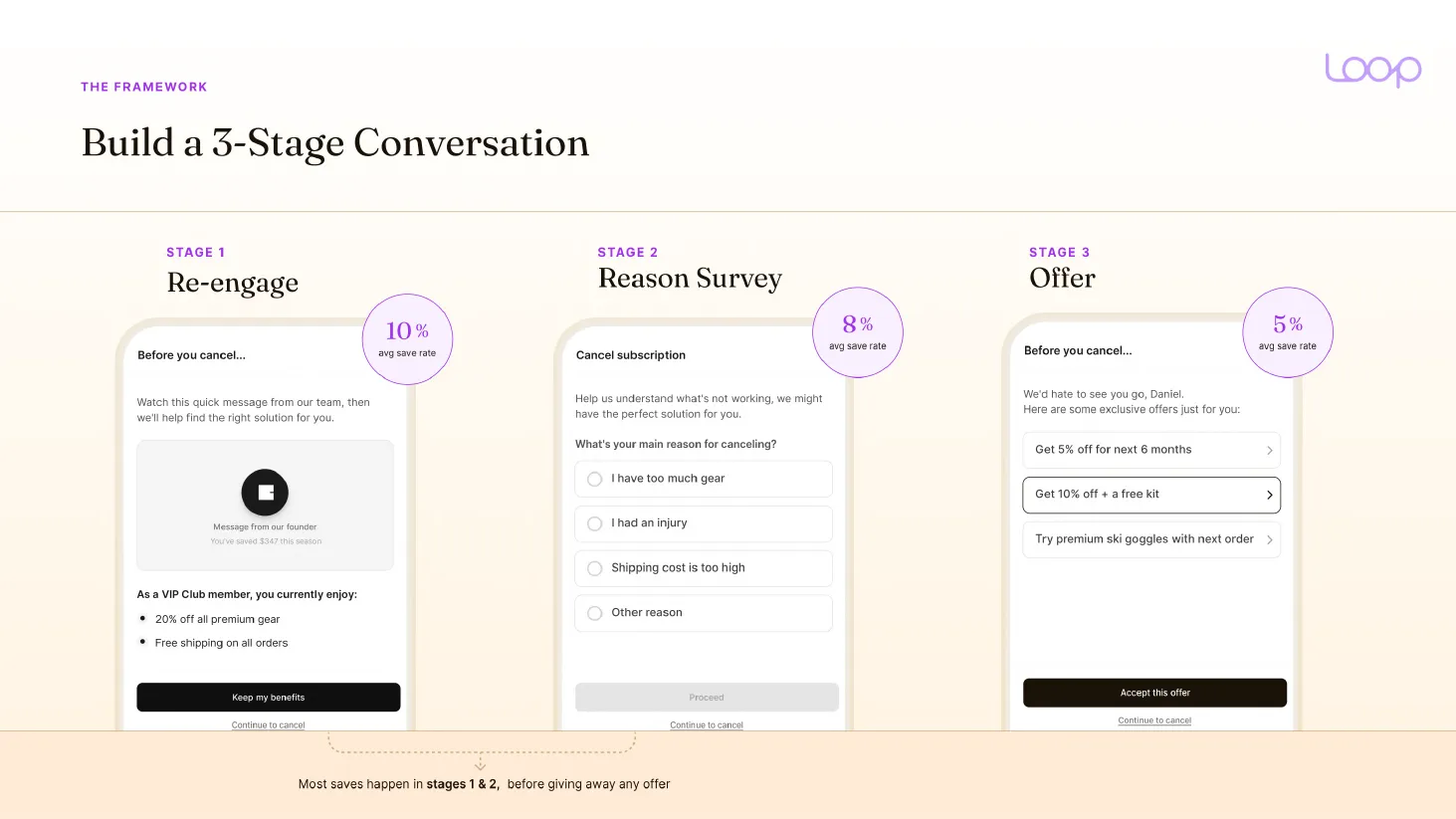
The order is the same in every app. A blocker screen first. Value reminder, founder video, and a line saying they can always skip. Then the reason. Then the fix matched to that reason, one last offer, and a confirmation that actually finishes the cancel. Three versions by tenure, and only three: before the first order arrives, before the first renewal, and the loyal subscriber.
The founder video is the biggest lever on the screen. By a distance. Cornbread Hemp went from a 9.5% to a 25.6% save rate after adding the splash screen alone. And one of our brands added a 45-second founder video, shot on a phone, and went from 12% to 24%.
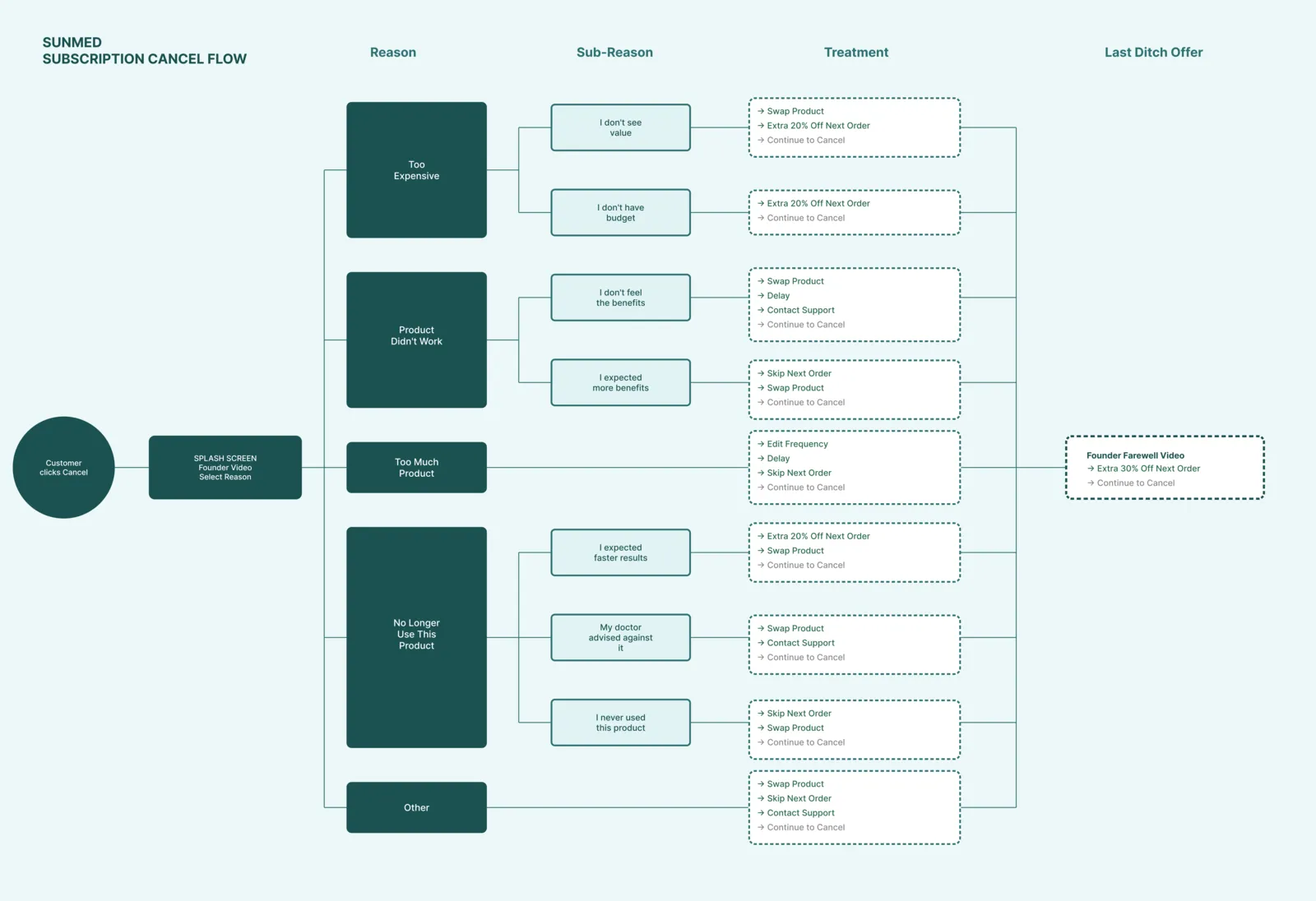
For SunMed on Skio, that structure took the flow from 14.8% to 24.8%, with no new discount. People ask for a Klaviyo "pause instead of cancel" email. Klaviyo cannot stop a cancel. The cancel flow in your subscription app does. Klaviyo puts skip and delay in the reminder before it. Every screen is in the subscription cancel flow structure.
Coverage: the cancels that never see the flow
A cancel flow works only on the people who reach it.
Coverage is the share of cancellations that actually reached the flow. A customer emails "please cancel", someone on the team opens the subscription app and clicks cancel for them. No benefit screen, no skip, no offer. Just gone.
At one of our brands, only 39.3% of cancellations reached the flow. Staff keyed in 17% of cancels in April and 82% by August. Nobody decided that. Nobody was counting it either.
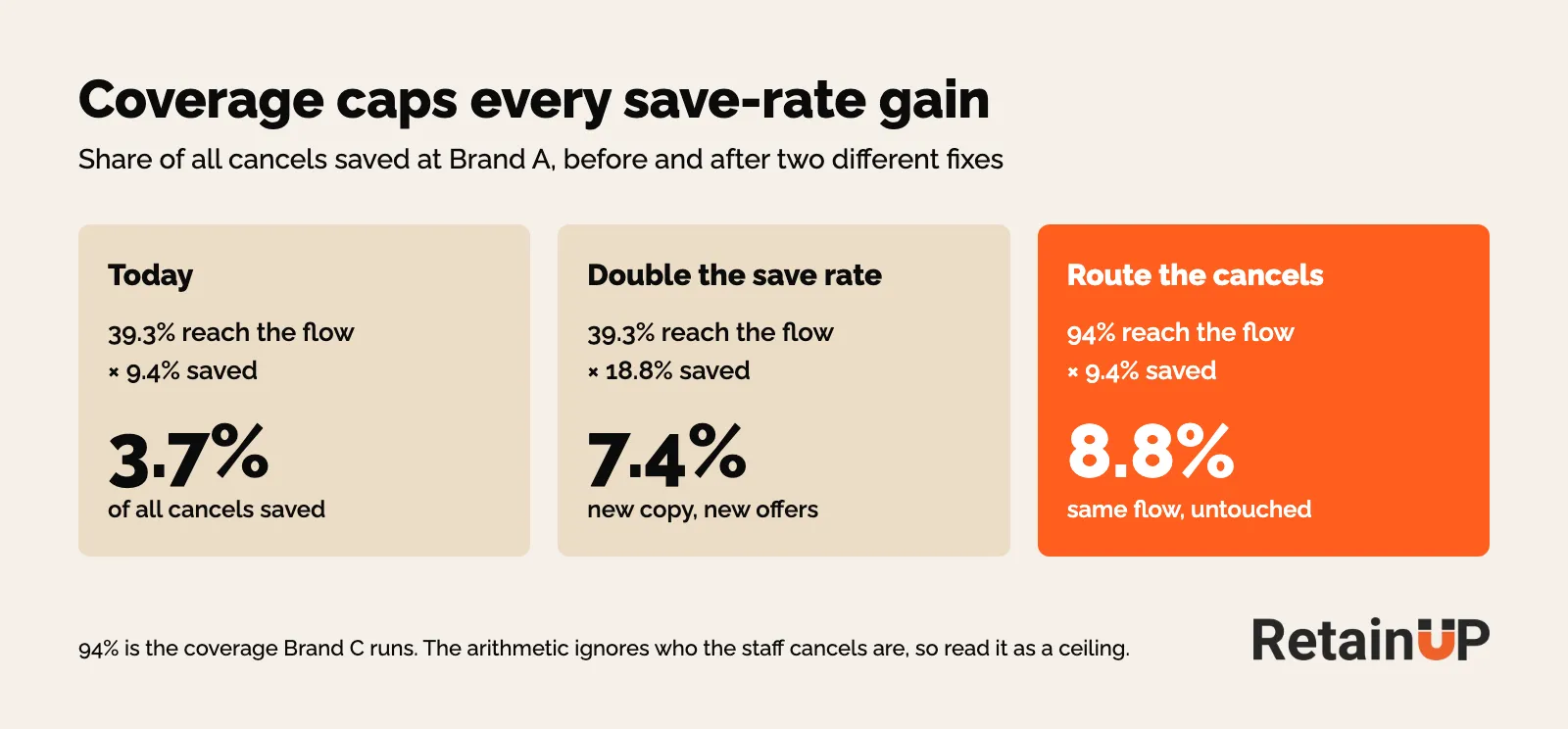
The arithmetic should decide where you start. That flow saved 9.4% of the people it saw, so 3.7% of all cancels. Double the save rate and you land at 7.4%. Route 94% of cancels into the same flow, which another of our brands runs, and it saves 8.8%.
And check the flow is firing at all. In Recharge, read Experiences delivered for the last 30 days. We found one marked Active with zero delivered in the last month. Counting by source, and the saved reply for support, are in cancel flow coverage.
Day-zero cancellations start at checkout
Someone places a subscription order on your site. Ten minutes later, they cancel. The box has not shipped.
At one brand, day zero held 5.6% to 8.4% of cancellations at every billing frequency. It barely moves across monthly, two-month and quarterly plans, so billing is not the cause. The offer is. If subscribing gets you 30% off and a free kit, people subscribe, take the kit and cancel the same day. Others were taught by other brands that subscriptions are traps, so they cancel just in case.
So the fix starts before anyone sees a cancel button. Name the subscription next to the button, and put the next charge date on the thank-you page and in the order confirmation, the one email every subscriber opens. Then give day zero its own cancel profile. Four Sigmatic does.
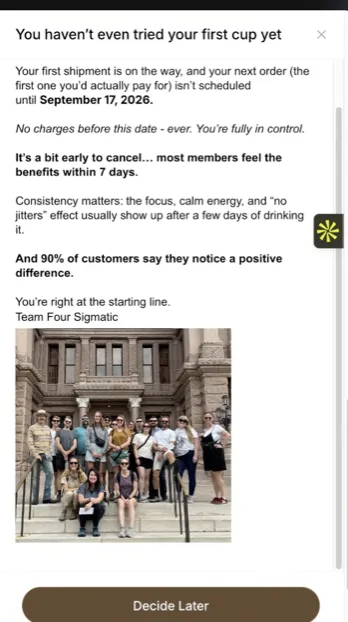
Cancel before your first order arrives and you get "You haven't even tried your first cup yet", the first charge date and a Decide Later button. Cancel is still there. No discount on that screen, because someone who just bought at the welcome price can cancel to take a bigger one.
And move gift value to orders 2 and 3. Obvi found the gift lifted retention 85% at order 2, 15% at order 3, and nothing by order 4. Even with all of it in place, plan for around 10% of new subscribers leaving before the first renewal. The Recharge, Skio and Loop builds are in stopping day-zero cancellations.
Cancel reasons, and one fix for each
You asked them why they left. They picked the easiest answer. "Too expensive." So you offered a discount at cancel, cut the price, and watched churn stay the same.
The subscriber who says "too expensive" and the one who says "I have too much product" are different problems. One needs a price reframe. The other needs a skip. A discount solves neither. A flow that identifies the reason before it responds recovers 17 to 33% of cancellations, and one that leads with a discount saves under 5%.
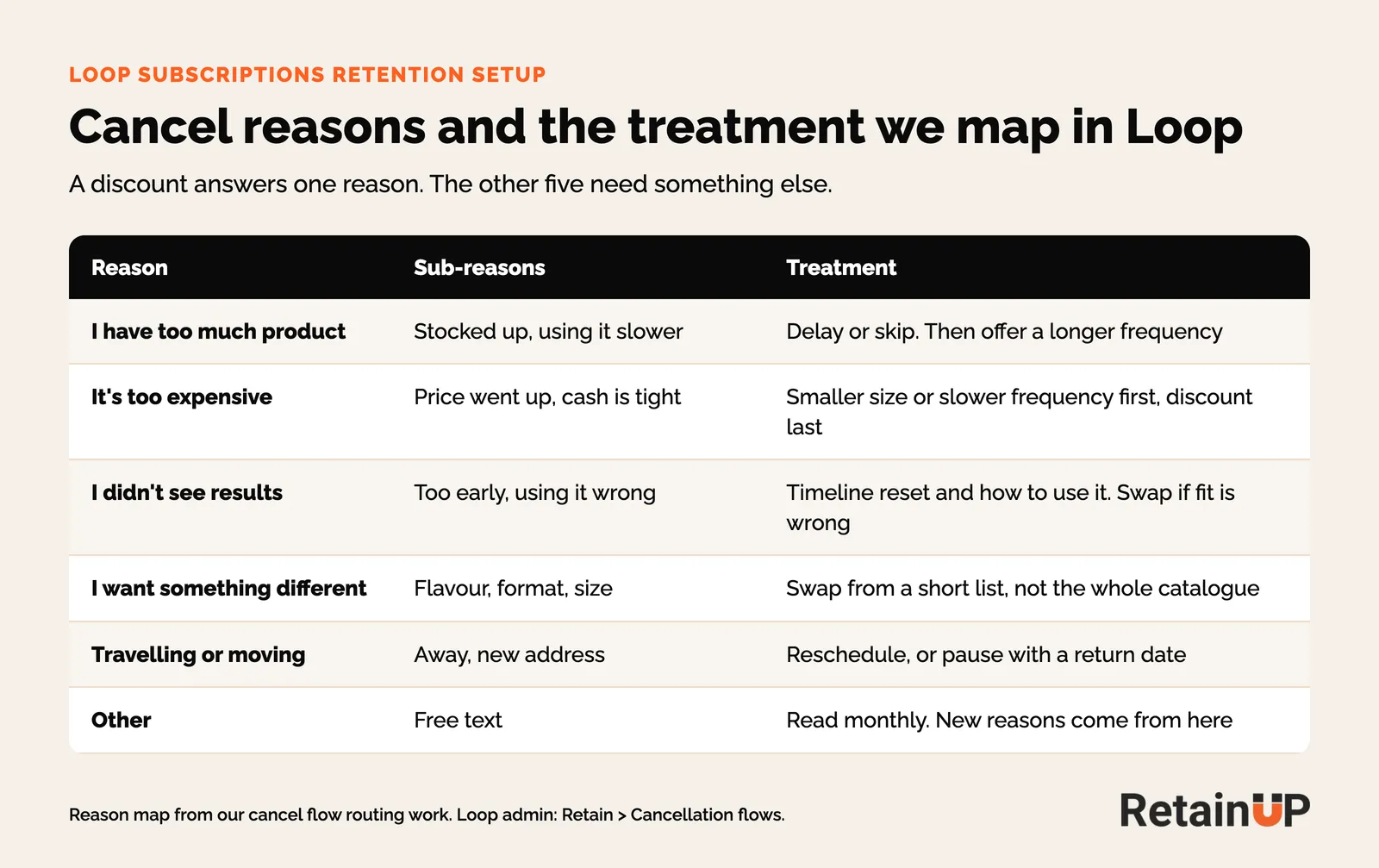
Price is never price. It's value against cost. Split it. "I don't see the value" gets education and no discount. "I don't have the budget" gets a longer frequency or a smaller pack, then a real discount.
Too much product is the most stupid reason to cancel a subscription, and the brand caused it. A discount saves about 1 in 10 of them. A skip or a longer frequency saves about 4 in 10. So for replenishment products, the best save offers fix the timing. Skip first. Then a longer frequency.
Some reasons are product feedback. At one of our brands on Loop, taste and quality were 68% of the named reasons and price was 10%, yet every reason got the same "extra 10% off". The full map, and why you read "Other" monthly, is in cancel reasons and the fix for each.
What a cancel offer actually saves
Ask what a good cancel flow saves and you will hear 25% to 33%. We have quoted it too. Then we open a brand's data, and the number is nowhere near it.
Across 8 brands we audited in 2026, before we changed anything, the median flow saved 10.8%. About 1 in 9. Seven of the eight sat under 15%. The app did not decide it: the two lowest were on Recharge, and so was the best.
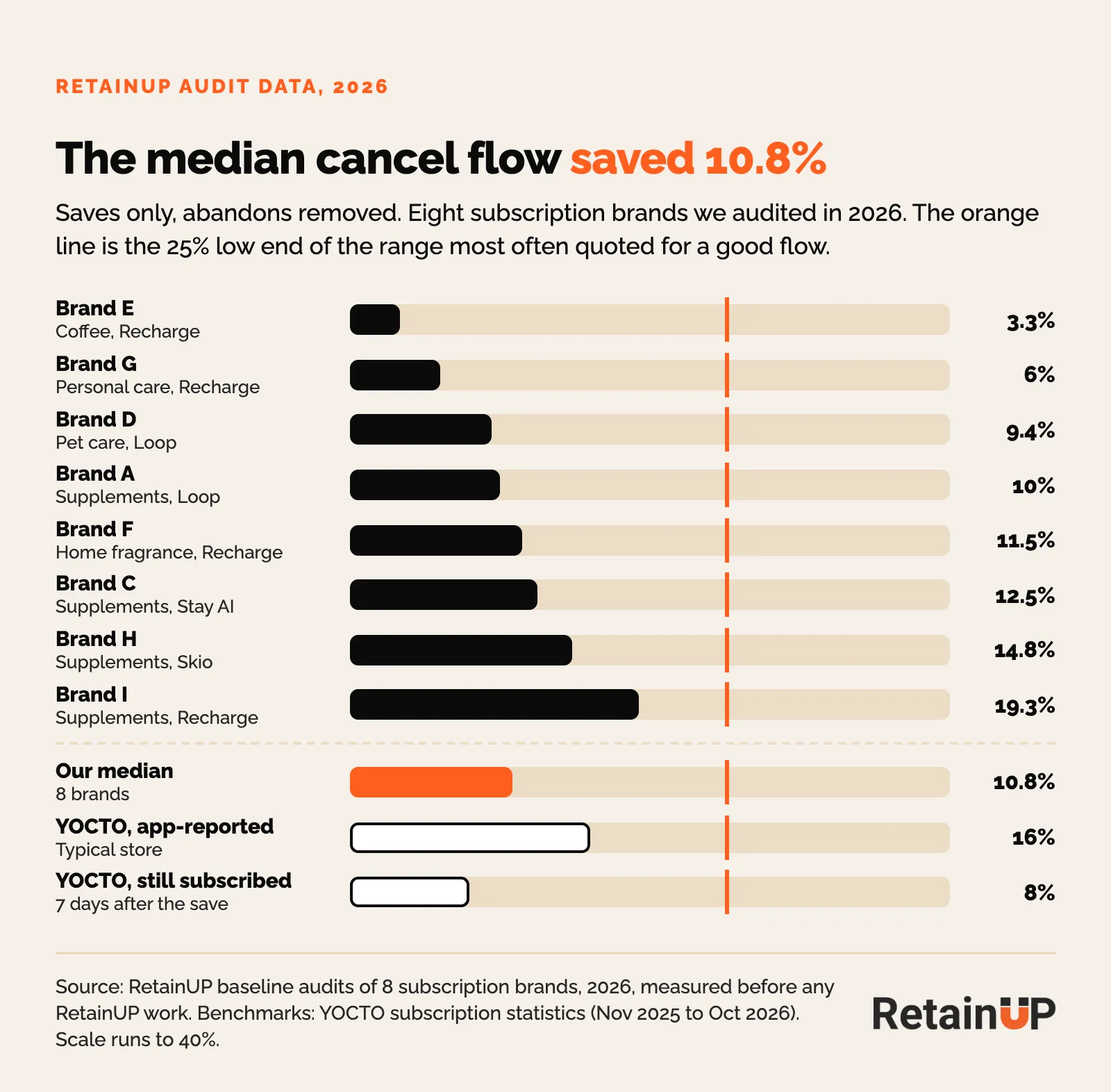
Dashboards overstate it, because closing the tab can count as a save. One Stay AI brand showed 62.5% in the app and 12.5% with abandons removed. A save counts once the next order pays.
On the last screen, two offers at most, a discount and a gift. Loop's best save rate with two offers was 14.7%. And the cancel offer must beat the welcome offer, or the smart move is to cancel and come back next month as a new customer. Bigger rarely helps. At one of our brands, a 50% off cancel offer converted 1.7%, and skip and pause between them saved more people. And cap how often one subscriber can claim it, as Churn Buster advises. Otherwise the cancel button becomes a coupon. The full table, and how to credit each save to the screen that made it, is in cancel offers that work.
Cancel flow copy: under 50 words a screen
Most cancel flows get built once. Someone picks the reasons, drops in a 10% off code, writes "We're sorry to see you go" and never opens it again. The screens are fine. The words are the problem.
Every screen follows the same shape. A one-line heading with empathy, a connector line that points to the fix, two or three options, and one button that keeps them, with a plain link to continue cancelling. People read at most 28% of the words on a page in normal browsing. At the cancel moment they skim harder.
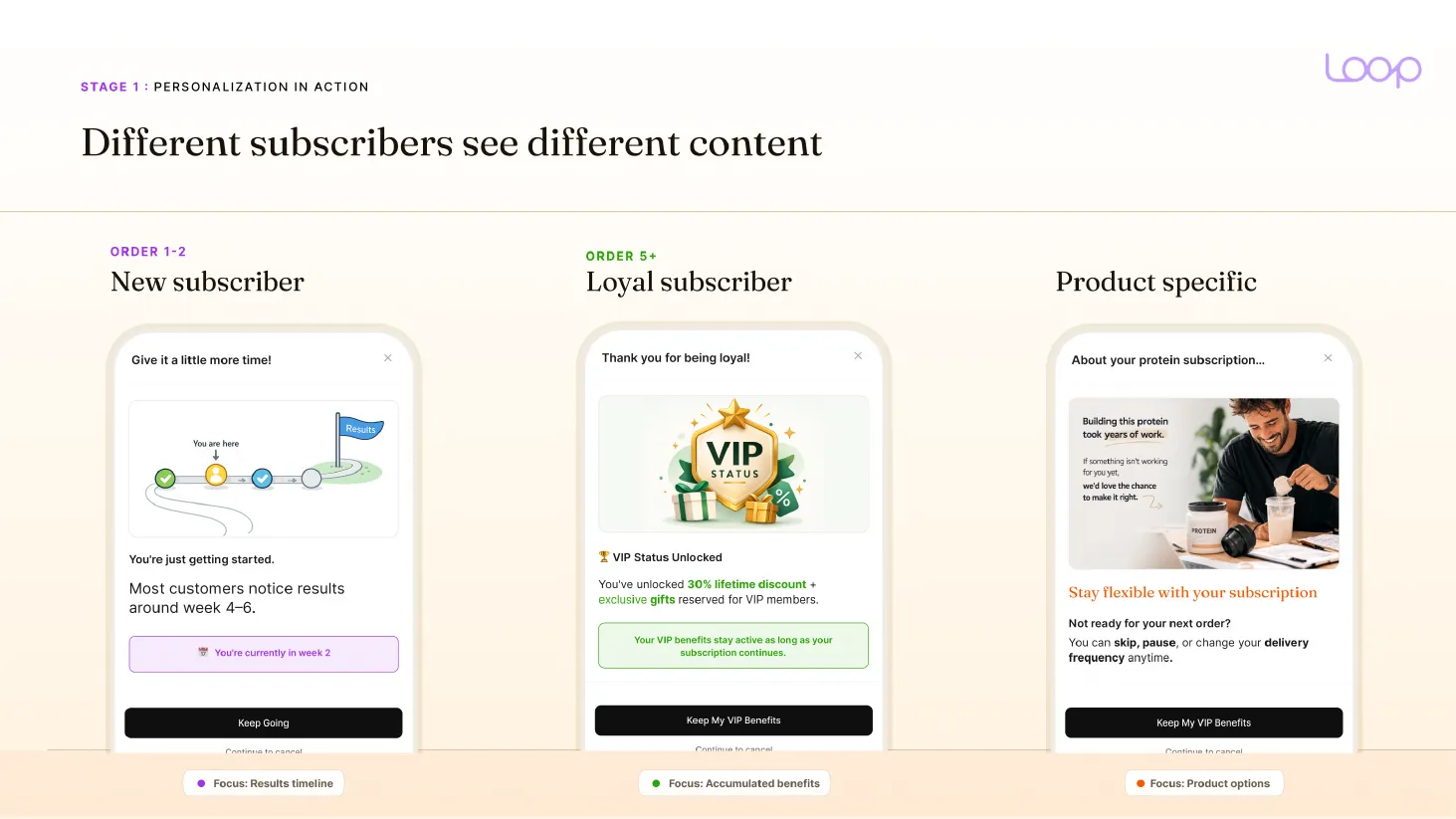
Remove shame before you make an offer. Create Wellness follows "Nothing's hitting yet" with "That's exactly how this is supposed to go." They are just early.
And some reasons get no offer at all. Some subscribers cancel because their dog died, and most cancel flows offer them 20% off. Say sorry, refund what hasn't shipped, and let them go. The lines by tenure, the two answers for "too expensive" and the copy tests worth running are in writing cancel flow copy.
Cancellation rules and dark patterns
"They will not allow it without charging a fee of $20." That's a customer who tried to cancel a subscription after her first order. She had to pay to leave.
The brand does about $50 million and runs a 2-order minimum. Its widget says "Skip or pause anytime", and the minimum sits in small grey print underneath.
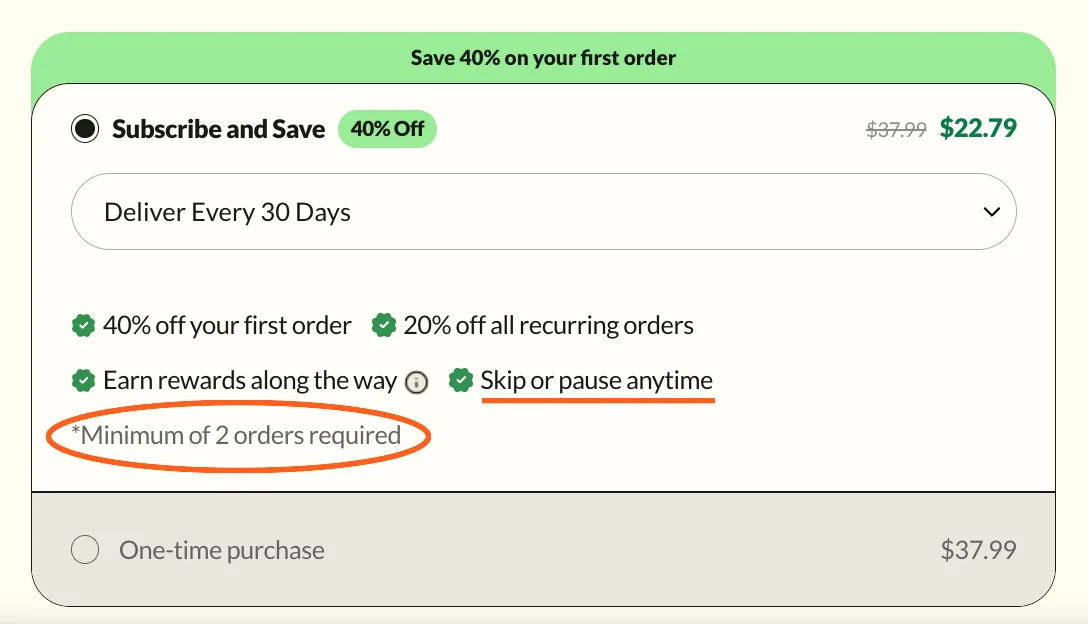
A forced second order might work for enterprise software. But a consumer brand has a hundred competitors. The brand gets one more order, and the customer still leaves, angry this time. We never build it for clients. Recharge has a setting that only lets customers cancel after a set number of charges, and Skio has a cancel lock. Switch both off.
The rule we hold is simple: cancel the way they signed up. Dr. Squatch does it, sign up online and cancel online. The federal click-to-cancel rule was vacated in July 2025. Colorado's SB25-145 still wants a one-step online cancel link, and save offers are allowed only with a direct link to finish cancelling on screen. So keep the survey skippable, never make the save offer a wall, and keep the route out as short as the route in. Laws change, so check your own states with a lawyer.
And make sure the cancel finishes. Mars Men sits at 3.7 on Trustpilot, and the pattern is charges after cancelling. So how does a subscriber know the cancellation is complete? A confirmation screen, then a confirmation email with the date of the last charge. More, from owning the "how to cancel" search to hidden terms, is in cancellation rules and dark patterns.
Failed payments: the churn nobody chose
Your subscriber didn't cancel. Their card failed, and the money stopped.
Across the brands we work with, 7 to 12% of renewals fail every month. Only about half of that money ever comes back. Every failed payment falls into one of three buckets, and each needs a different fix.
- Bank declines: insufficient funds, do not honor, card declined. The card works and the bank said no this time, so retries have a real chance.
- Dead cards: expired, revoked, incorrect number, invalid. Only a new card fixes these.
- Setup faults: card type not supported, gateway errors. These are yours to fix in Shopify Payments. Then challenged charges, which Shero Commerce tracks as a fourth outcome on Shopify. The bank asks for 3D Secure. The renewal waits on an email nobody clicks.
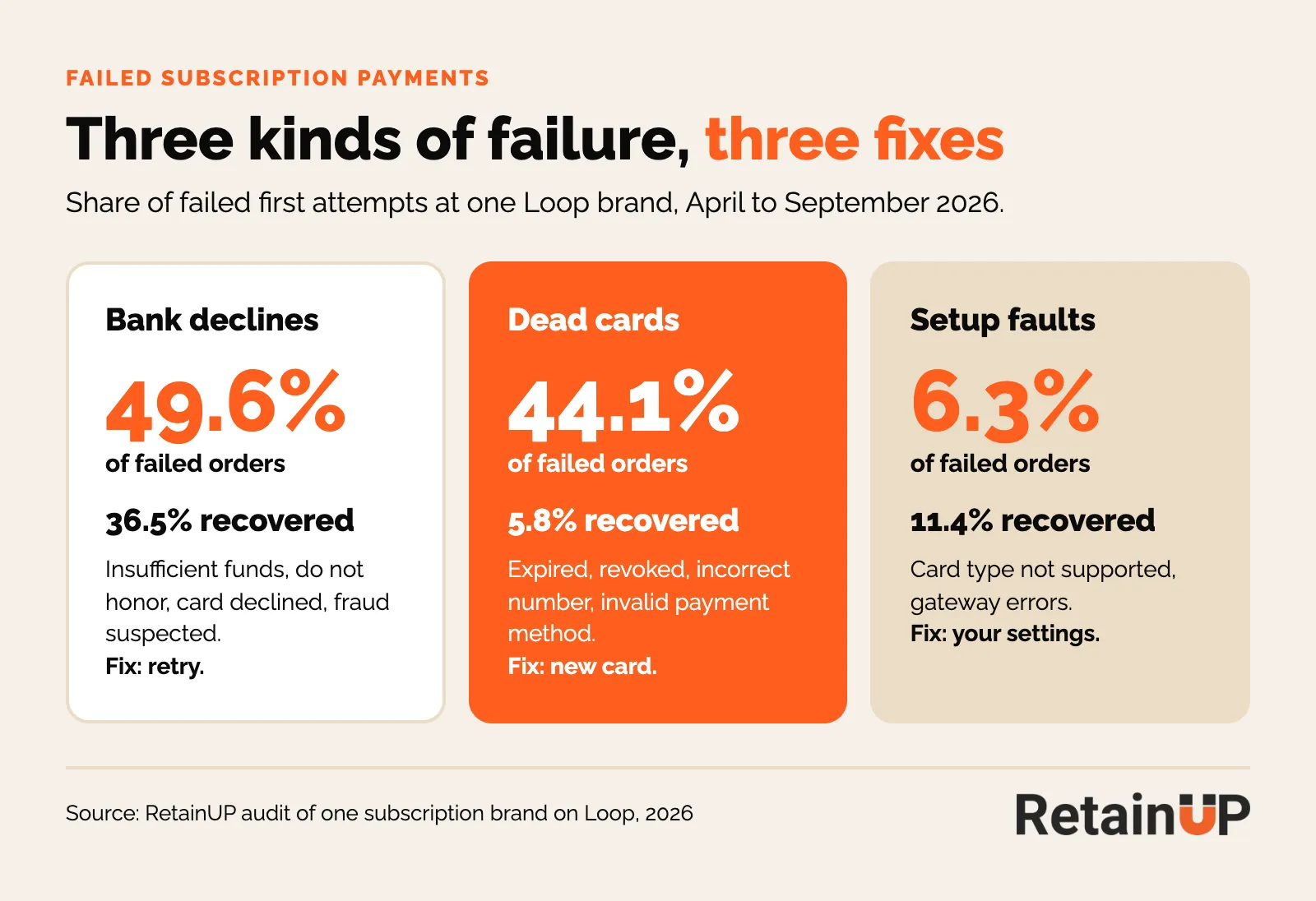
At one Loop brand, bank declines were 49.6% of failures and came back 36.5% of the time. Dead cards were 44.1% and came back 5.8%. So close to half of failed payments can't be retried back, which is why adding more retries rarely moves the number.
So count it by order. Not by attempt, not by revenue. One Loop brand recovered 17.3% of its failed orders on the retry log while the app showed 41.2% by revenue, because Loop counts a skipped order as resolved. Across our 8 audited brands the median recovered 38%, from 17.3% to 61.3%, with methods mixed by app. YOCTO puts the median store at 43%, as each app reports it.
When retries run out, pause the subscription and send the card update email. Don't cancel. Don't skip. A cancelled Shop Pay subscription can't take a new card, and a skip keeps a dead card billing every cycle. Recharge cancels at that point with no pause option, so there the card update ask has to land before the last retry. Holiday dunning and the monthly check are in failed payment recovery for subscriptions.
The retry schedule: front-load it, stop by day 14
A renewal fails. The app retries it nine times over three weeks. Nothing comes back, the order gets skipped, and next month it fails again. I've seen it twice this year. Both on Loop.
The first retry has the best chance. At one pet care brand on Loop, attempt two recovered 6.3% of failed orders and attempt three 4.6%. Then 2% to 3% on every attempt after, all the way to nine. Churnkey's data shows the same curve, with 61.2% of recoveries in week one.
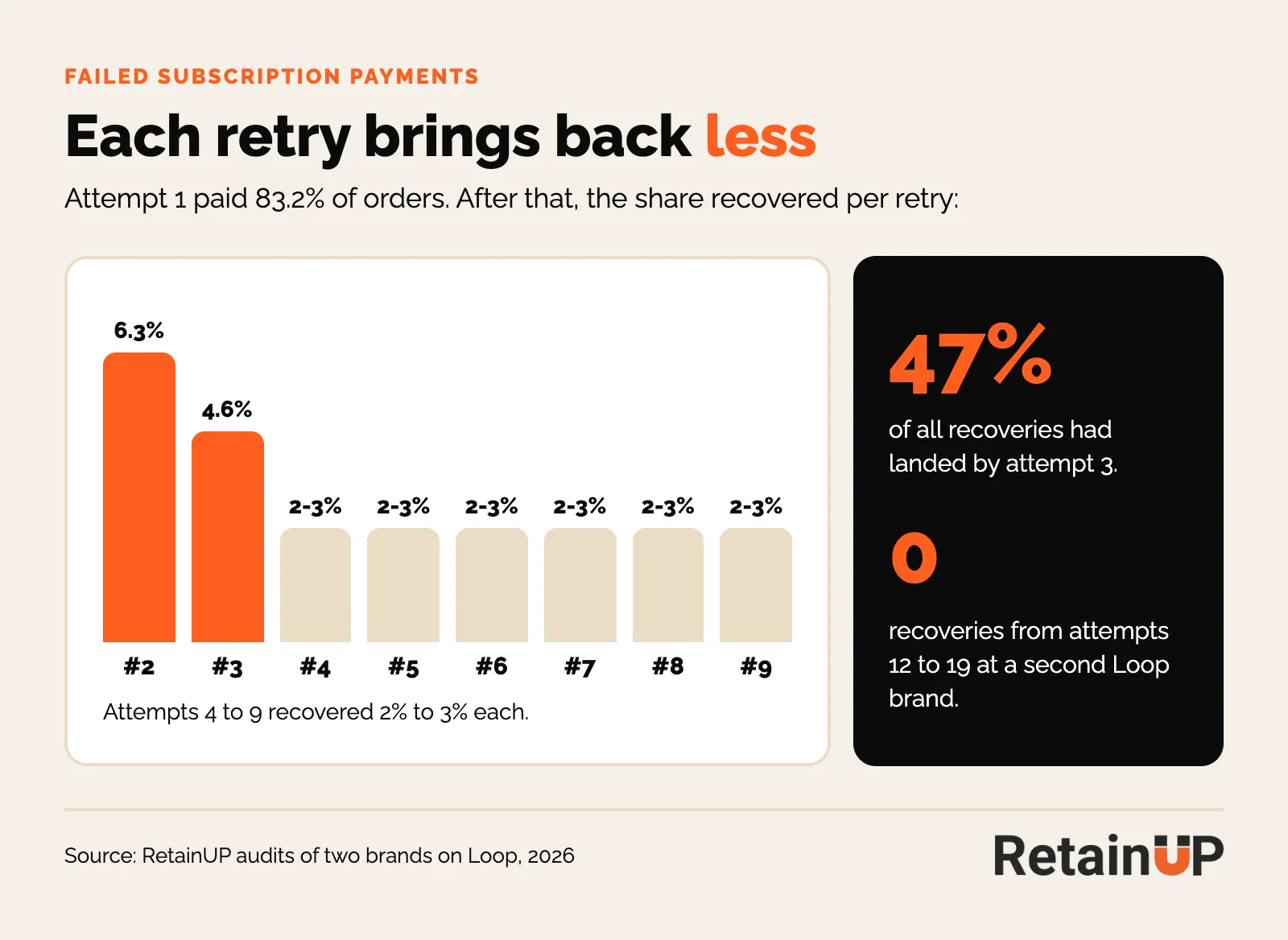
So for bank declines we set six retries, on day 1, 3, 5, 7, 10 and 14. Then stop. A supplement brand came to us retrying up to 19 times, and attempts 12 to 19 brought back nothing. The card networks cap it too: Visa allows 15 retries on one card in a rolling 30 days and Mastercard 35, with fines past that, per Churnkey. Insufficient funds is the best reason you can get, so retry it on Fridays and around paydays. Dead cards skip the retries and go straight to the card update link.
Recharge's AI strategy picks the timing for you, Skio builds retry phases, Loop takes a delay per attempt, and Stay AI cancels dunned subscriptions by default. The settings on each are in payment retry schedules that work.
The card update flow gets the new card
A third to a half of failed subscription payments are dead cards. No retry reaches them. Only a new card does. So the whole job is making that one step easy.
One brand's failed payment email asked people to log in to the portal to update their card. It got zero clicks. Nobody remembers a password for a subscription they set up six months ago. When the link opens straight on the card form, it works: at a pet care brand, subscribers who updated their card came back 62% of the time, against 26% for those who did not.
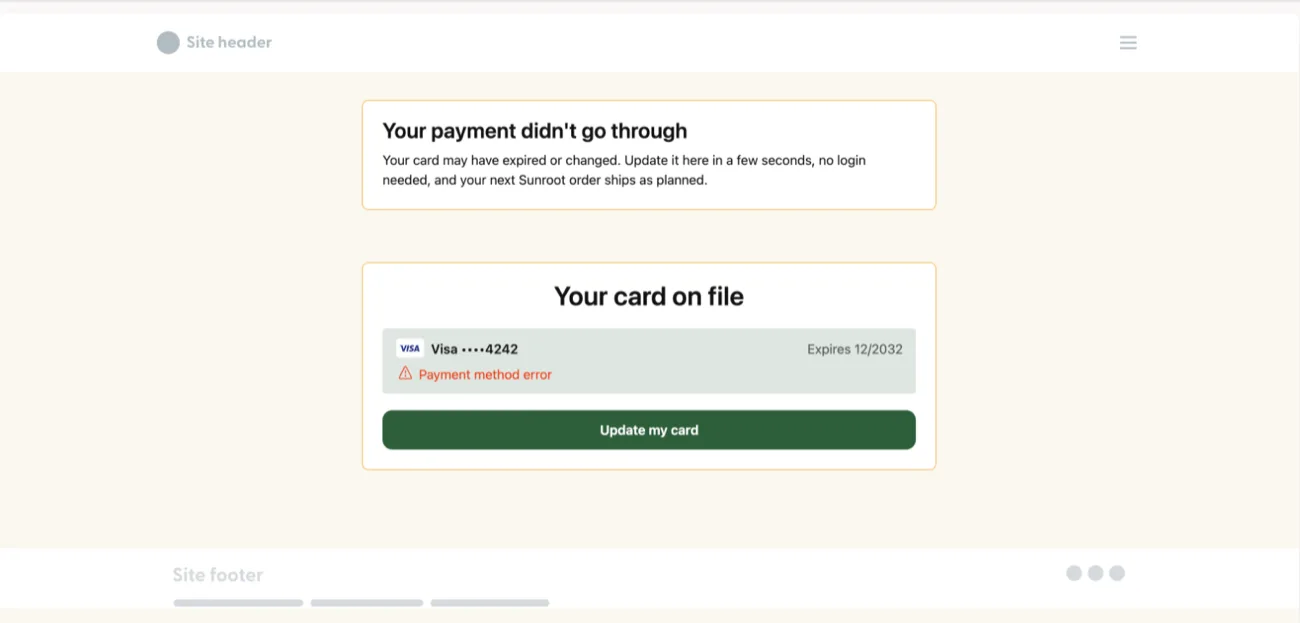
We send three emails and an SMS. "Your order is on hold" within the hour, then what they lose, then an offer for updating, and last "we've paused your subscription." The discount goes at the end, never the start.
And the cheapest card update happens before the charge. Check your gateway runs a card account updater. It pulls the new number when a bank reissues a card. Then send a card expiring email 30 days and 7 days out, and ask for a backup card once. George Lindh has seen that one ask lift payment recovery by 40% or more. The Klaviyo build is in the card update flow.
Winback comes last
Subscription winback is a waste of time for most brands. I built those flows for years, and it never worked out for me.
Volume first. Say 1,500 people cancel in a month. Getting even 2 to 5% of them back is hard, and that's 30 to 75 subscribers. They already said no to skip, pause and a discount on the cancel page.

So take rate first, because that's where a small brand gains the most. Then the cancel flow. Winback starts to make sense around $50 million and above. Start 60 to 120 days after the cancel, with three touches: an SMS with no offer, a value email, then a clear offer with an end date. Split it by cancel reason. And never offer a cancelled subscriber less than the best offer they have already seen.
Lapsed one-time buyers are a different job, and that one pays. One brand moved its winback from day 90 to day 45, changed nothing else, and reorders rose 22%. Both halves are in subscription winback flows and campaigns.
BFCM: where good subscribers cancel
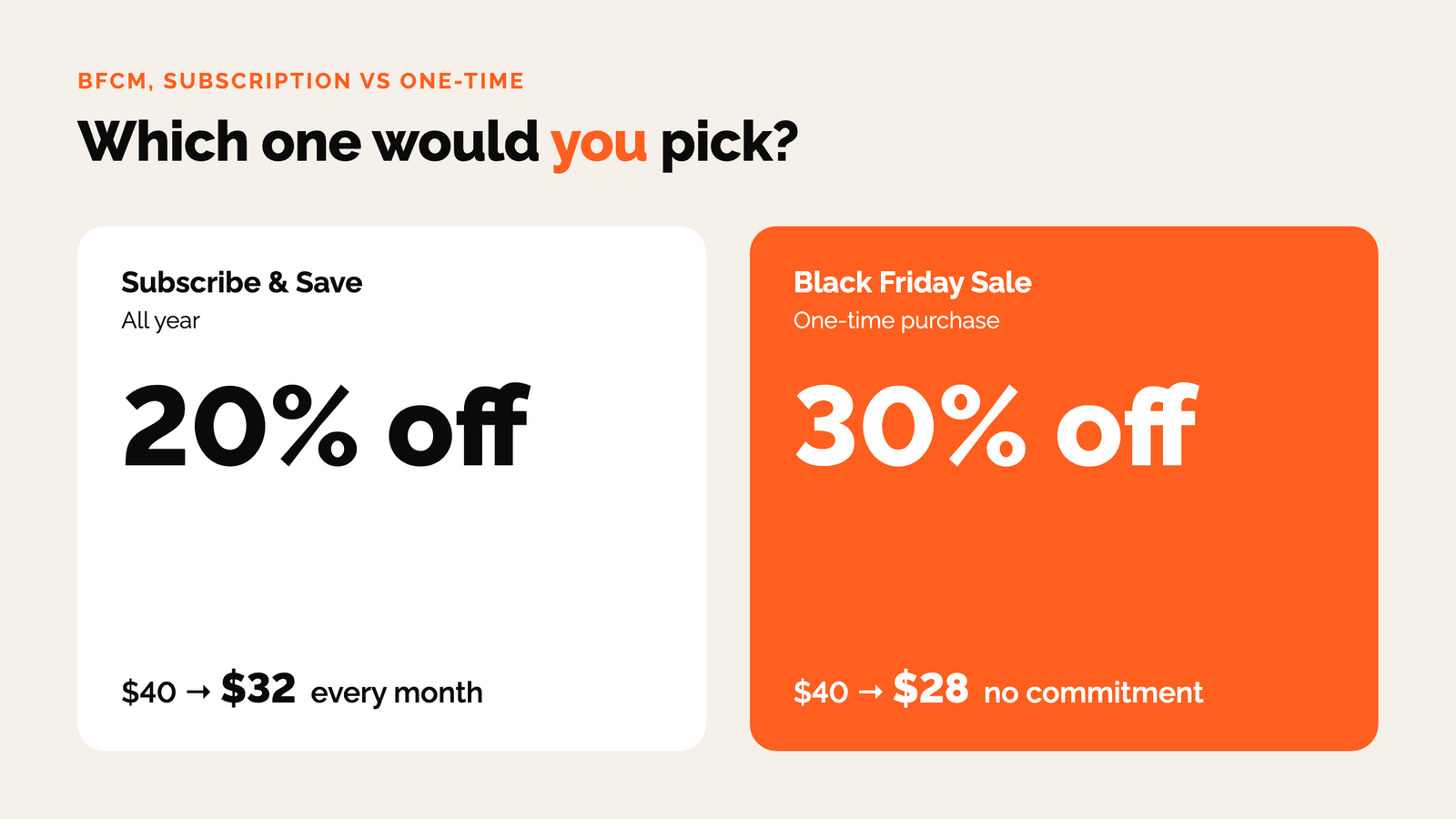
Your subscription is 20% off all year. Your Black Friday sale is 30% off one-time. Which one would you pick?
BFCM breaks a subscription in two places. New buyers skip it, because one-time is the better deal. Old subscribers cancel, because they see the sale. As Matthew Holman put it: "Your 50% off sitewide sale will cancel your best customers."
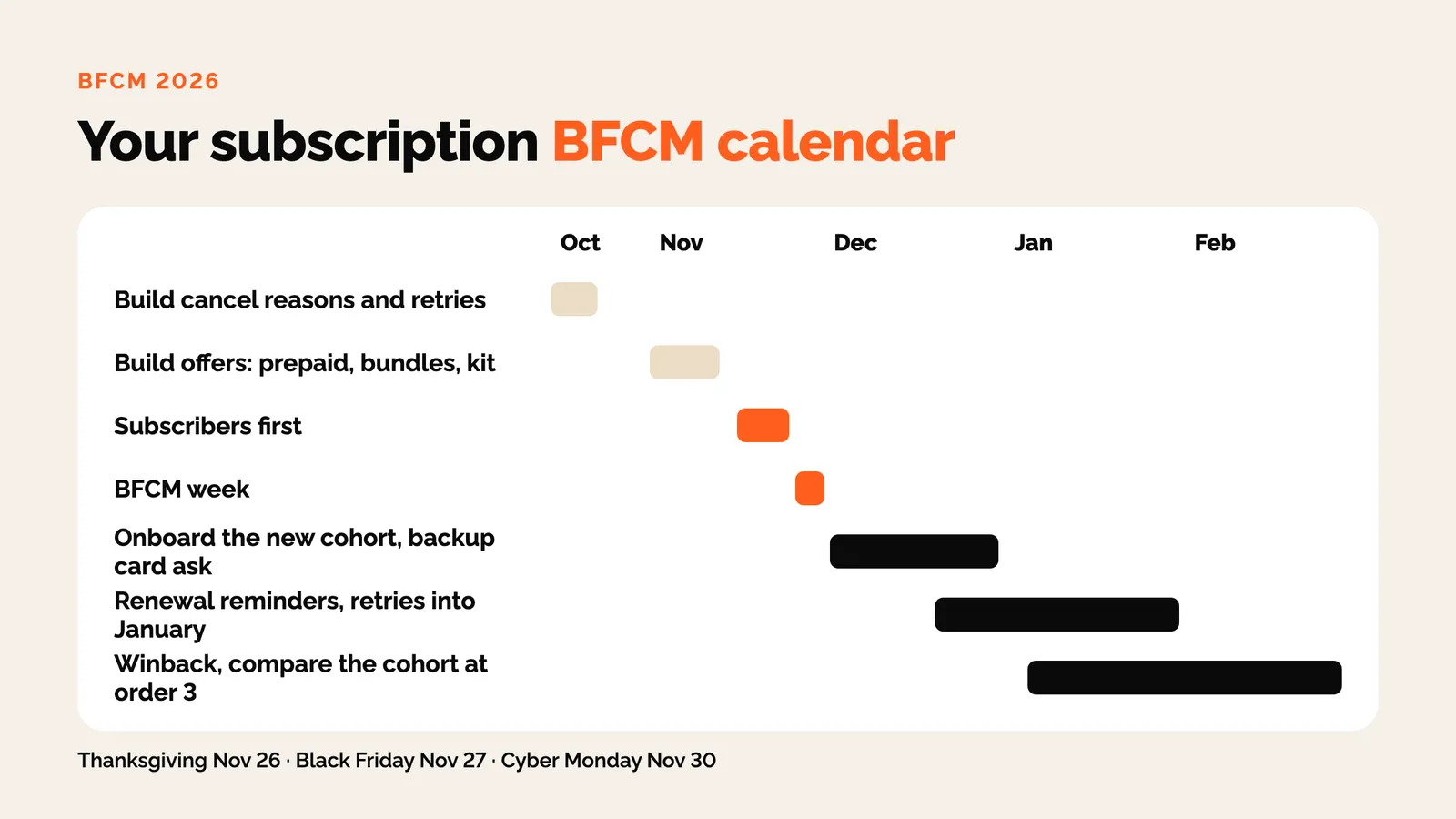
So keep subscription the better deal, and give subscribers the sale first, as an add-on to their next order, before the public sale opens. Good Protein did this in its portal, and add-ons went from 18% to 25% of subscription revenue that month (via Loop). Add "I wanted the sitewide discount" as a cancel reason for the sale weeks only.
So watch December and January. Churn runs at 3.2% a month in November and 4.1 to 4.3% in December and January, per Churned's 2026 benchmark report. The calendar and the January plan are in BFCM for subscription brands.
Keep discounts away from your subscribers
Your subscriber pays 20% less on every order. Then an email lands. 15% off with your points.
Each of those emails was set up for a different customer. Nobody checked who was already on subscription. The leak is rarely the obvious campaign. Usually it's the loyalty app.
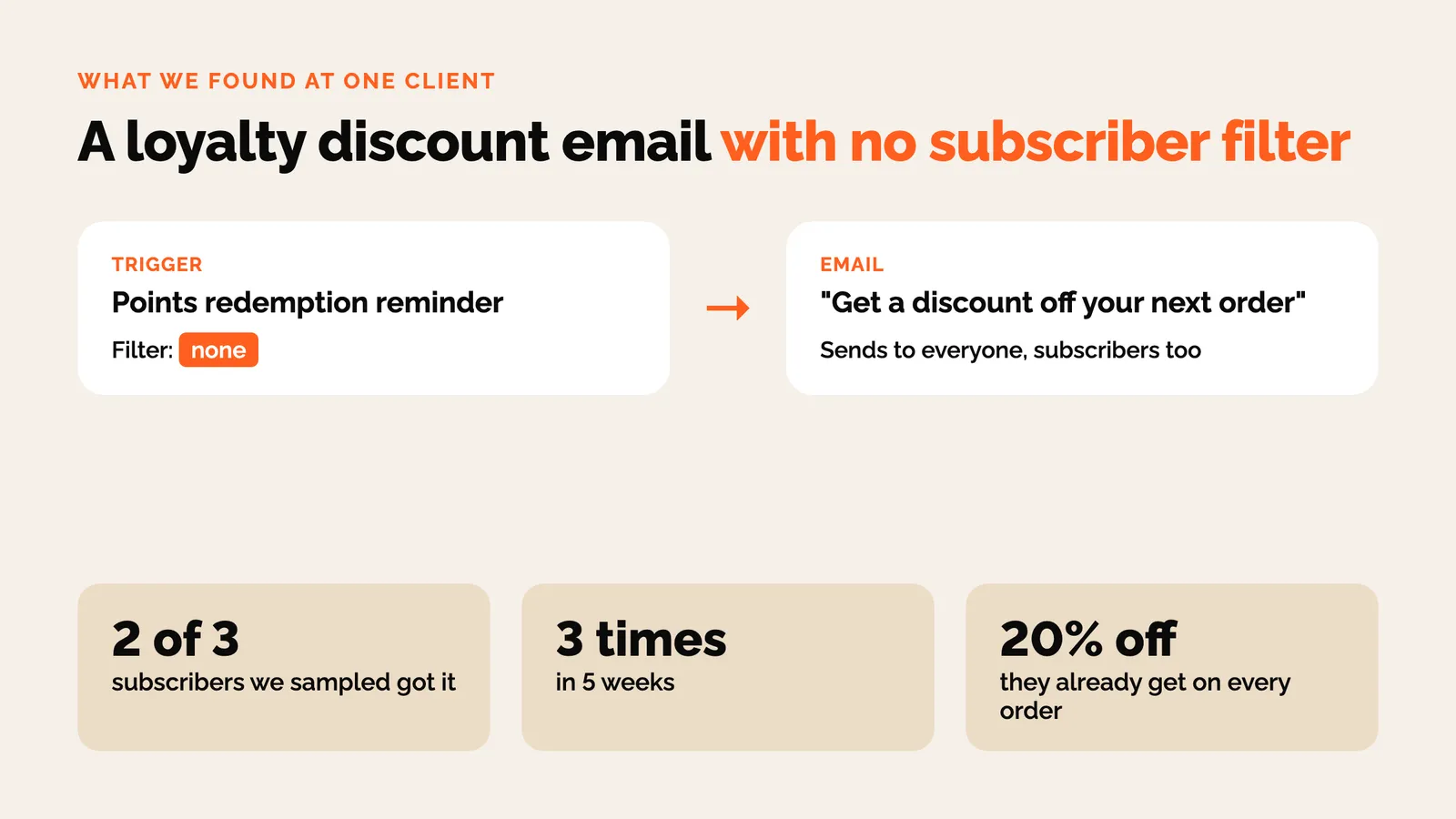
At one of our brands, 2 of 3 sampled subscribers got the loyalty discount reminder 3 times in 5 weeks, on top of their 20% subscription discount. No cancel reason says "your loyalty app emailed me", so it shows up as "too expensive" instead.
One rule covers every send: no promo, sale or loyalty offer should give a subscriber a better price than their subscription. Build one Klaviyo segment for active subscribers and exclude it from every send with a discount. You can't filter the site or Instagram, so the subscriber hears about the sale first. The full suppression table is in keeping discounts away from your subscribers.
Where to start
Two checks. One afternoon each. Count last month's cancels by source. Read the failure reasons on last month's failed payments. The first tells you if anyone sees your cancel flow. The second tells you whether retries or the card update link matter more.
And read save rate by reason and recovery rate by decline bucket every month. Both drift. At both Loop brands in our sample, the payment emails had stopped on their own, and nobody noticed.
If you are deciding who to hire for this, there is a list of subscription retention experts and a breakdown of what a subscription retention agency costs.
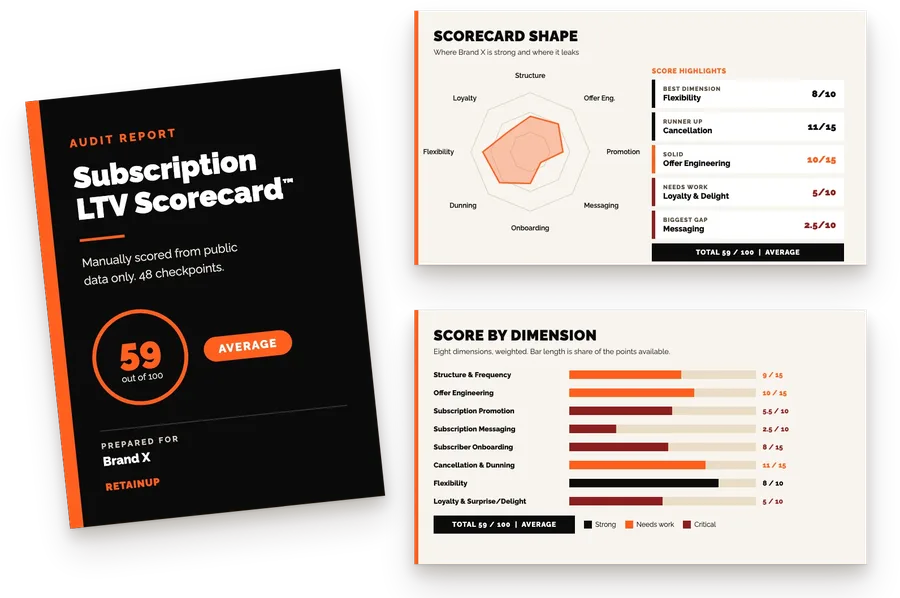
If you have 5,000 or more active subscribers, this is the work the Subscription LTV Optimizer™ does each month: your store, subscription app and Klaviyo checked, from cancel flow coverage to the retry schedule, and the fixes shipped, for $3,000 a month. To see where your own churn leaks first, the free subscription audit scores 48 checkpoints, cancel flow and dunning among them, and sends your top 3 leaks in 24 hours.
FAQ
What is a good cancel flow save rate?
A cancel flow that saves 10% to 15% of people who start it is normal for an ecommerce subscription brand. Across 8 brands we audited in 2026, the median saved 10.8%. Count saves only, with people who closed the page taken out, and treat a save as real once the next order pays.
Why is my cancel flow not saving anyone?
Often the cancels never reach it. When staff cancel by hand in the admin portal, or a custom portal cancels through the API, the subscriber sees no skip, no reason screen and no offer. At one of our brands only 39.3% of cancellations went through the flow. Count cancels by source each month, check the flow is still firing.
Should a subscription brand offer a pause or a discount when customers cancel?
Neither first. Offer a skip, a delay or a frequency change, then a swap, and keep the discount for people who said price. We leave pause out, or cap it at 90 days, because 40% to 60% of paused customers churn within 90 days. At one of our brands a 50% off cancel offer converted 1.7%, and skip and pause between them saved more people.
Will more retries recover more failed payments?
More retries only help bank declines, and close to half of failed payments are dead cards that no retry can reach. At one Loop brand, dead cards were 44.1% of failures and recovered 5.8% of the time. Run about six retries over 14 days for bank declines, front-loaded into the first week, and send dead cards a card update link the same day.
Can Klaviyo prevent subscription churn?
Klaviyo can prevent some churn, but it cannot stop a cancel. The cancel flow lives in your subscription app, Recharge, Skio, Loop or Stay AI. Klaviyo does the work around it: skip and delay links in the order reminder, the card expiring and card update emails, and the winback sends. And it keeps your active subscribers out of every discount email.
Is subscription winback worth it for a small brand?
For most small subscription brands, winback is the last thing to build. If 1,500 subscribers cancel in a month, winning back 2 to 5% is only 30 to 75 people, and they already turned down skip, pause and a discount on the cancel page. Take rate and the cancel flow return more first. Winback starts to make sense around $50 million and above.
One email a week on subscription retention: the numbers, the strategy, and what to fix first.

Rahi Jain
Rahi Jain is a subscription LTV specialist who helps $1M to $10M DTC brands reduce subscription churn and maximize LTV on Recharge, Skio, Stay AI and Loop.
More about Rahi