Key takeaways
- One $50 million brand with a 2-order minimum charged a customer a $20 fee to cancel after her first order.
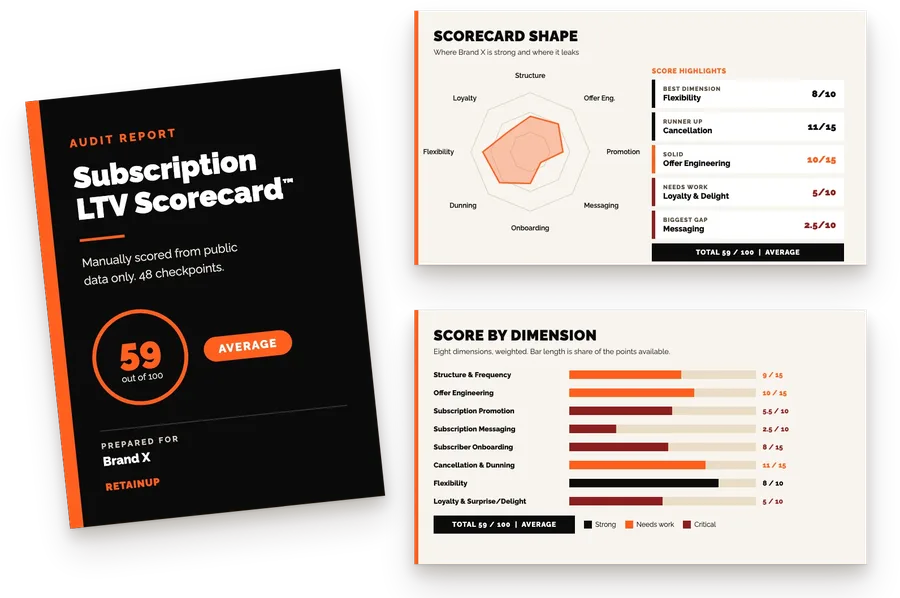
- A minimum-order lock scores zero on cancellation in the Subscription LTV Scorecard™. Policy text alone, with no self-serve button, caps at half.
- The federal click-to-cancel rule was vacated in July 2025. Colorado’s SB25-145 still requires a one-step online cancel link.
“They will not allow it without charging a fee of $20.”
That’s a customer who tried to cancel a subscription after her first order.
She had to pay to leave.
This page covers the rules around the cancel button: what you never build, and what the law now expects. It sits inside the subscription churn guide, which walks the whole topic in order.
The one rule: cancel the way they signed up
If someone signed up online, they should be able to cancel online. Self-serve. No phone call, no email to support, no minimum number of orders first.
That is checkpoint 6.3 in our Subscription LTV Scorecard™, worth 2 points. A screenshot of a working self-serve cancel button gets full marks. Policy language alone caps it at half, because a policy can say anything. And a minimum number of orders before you can cancel scores zero.
Dr. Squatch gets full marks. Sign up online, cancel online, no phone or email required. Grüns too, through the Skio portal.
Savage X Fenty used to make members phone in to cancel. Miss the skip deadline on the 5th and you are charged $59.95. The BBB complaints run into the thousands.
Own the “how to cancel” search
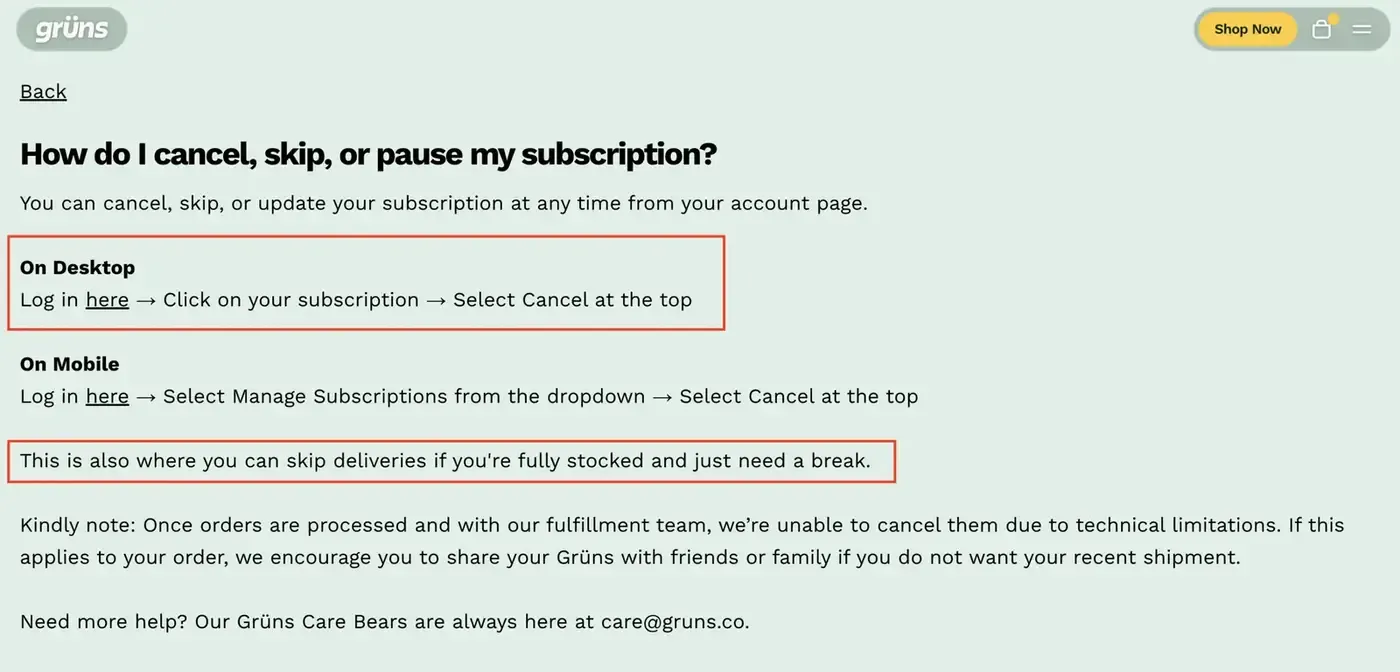
Search “how to cancel Grüns” and you land on their own page, not Reddit. Desktop and mobile steps, click by click. And one line that saves people: “This is also where you can skip deliveries if you’re fully stocked and just need a break.”
Search the same for Mars Men and third-party “how to cancel” guides come up first, next to complaints that the path fails. So own it. The cancel steps belong on your subscription FAQ and how to cancel page, in plain words, with a link straight into the portal.
Even good brands slip here. Create’s help article on editing your subscription has comments underneath. “I need to cancel my subscription.” “I need to cancel.” “Trying to cancel, yet no way to.”
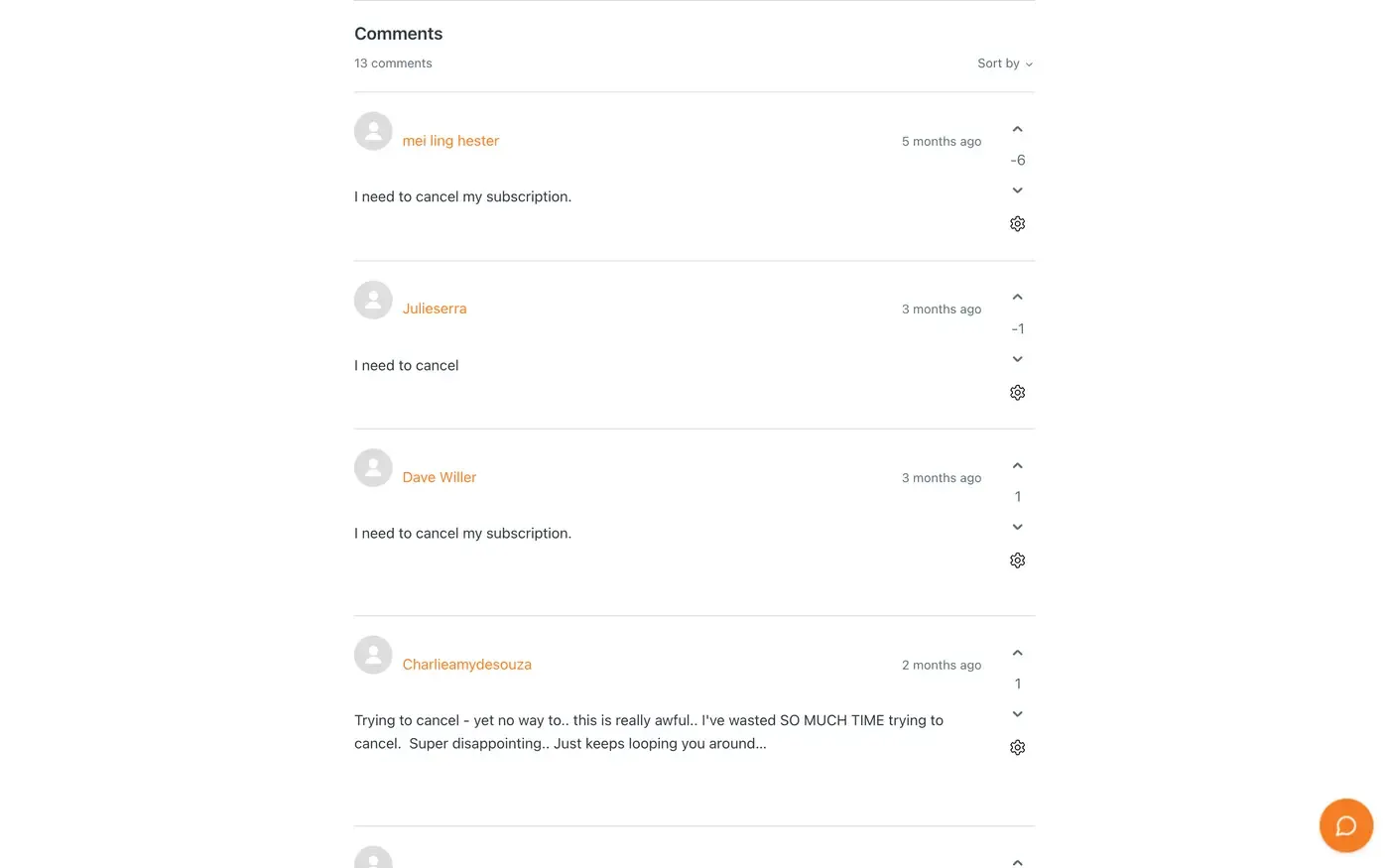
Best cancel screen in the category. People still can’t find it.
Minimum-order locks, and why we never build them
The subscribe widget reads “Save 40% on your first order.” Then “Skip or pause anytime.”
Then, in small grey print, “*Minimum of 2 orders required.”
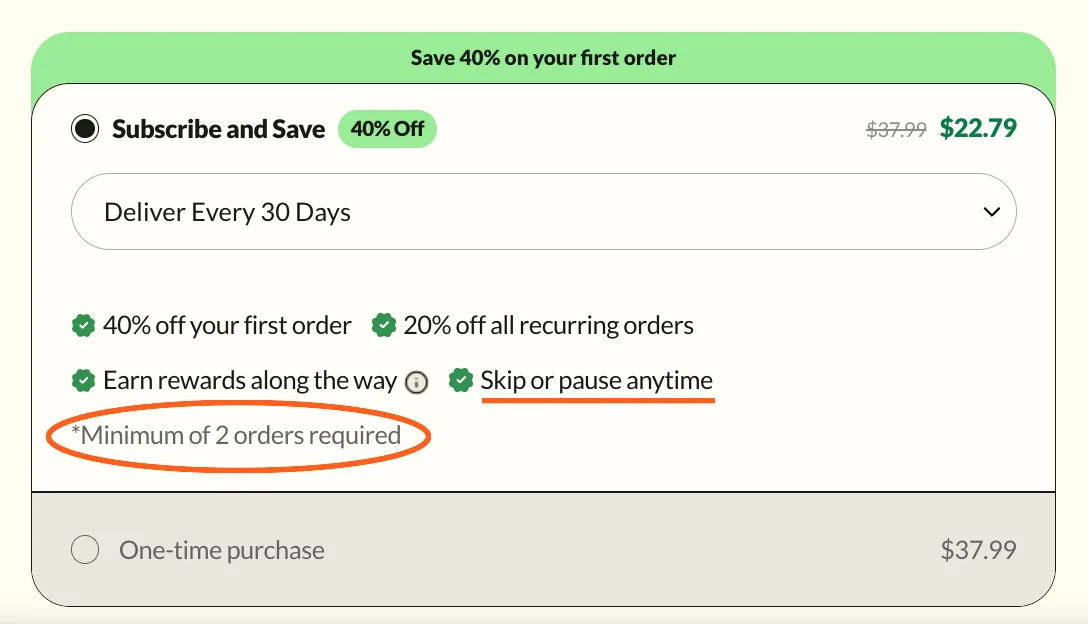
The rule is disclosed on the page. The $20 fee is the part reviewers say is not written anywhere. One of them put it this way: “This is not even written anywhere.”
Another customer of the same brand wrote, “I was still told that I had to pay for the third order.” She had asked to cancel after the first.
This is a $50 million brand. Its rule is a minimum of two orders, and if you want out early, you pay a fee.
Smaller brands are copying it
I found one with the rule in its written policy: “Your subscription cannot normally be cancelled before the minimum 2 deliveries have been completed.” Early cancellation is “reviewed on a case-by-case basis.”
Another blocks it right on the cancel screen.
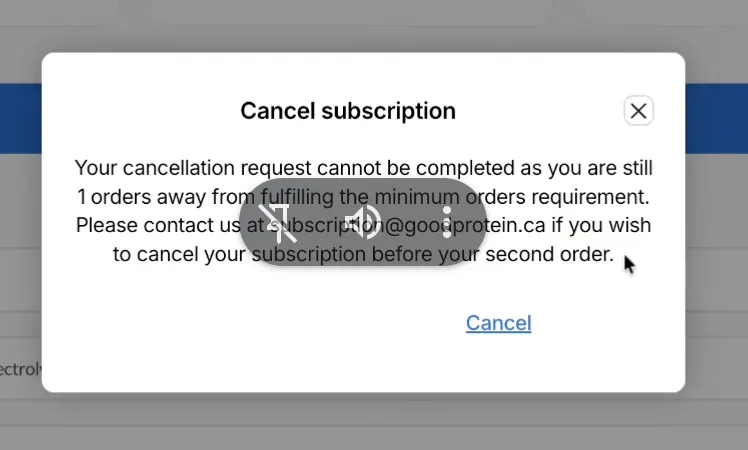
“Your cancellation request cannot be completed as you are still 1 orders away from fulfilling the minimum orders requirement.” You cannot cancel till you pay up.
Why a forced second order backfires
A forced second order is not retention. It might work for enterprise software.
But a consumer brand has a hundred competitors, and in the long run this can be fatal. The cons are way bigger than the benefit.
The brand gets one more order. The customer still leaves.
We never advise this for clients. If someone wants to cancel, let them.
Check your app settings
The lock is often just a setting. Someone switched it on years ago. In Recharge it is “Allow cancellation after X charges”. Leave it on no restrictions. Skio can block cancelling for a set number of days. Switch it off. It takes a minute. Loop’s minimum-charge setting defaults to “no restrictions”, and Loop’s own help article recommends keeping it there.
Blocking cancellation with minimum order rules is not lawful in California. And it feeds the fear of being stuck that drives day-zero cancellations in the first place.
The apps also carry state settings. Recharge has one-click cancellation regions with Colorado preset. Loop turns on its auto-renewal-law flow for California and Colorado by default, and makes the reason survey optional for New York. Leave those defaults alone. Add states, never remove them.
Everyday Dose shows the fix is quick. Our research found a 20-day cancel lock in their policy. By 28 October it was gone from the policy page and the FAQ, and they scored full marks on 6.3.
Hidden commitment terms
Adobe sold a plan that looked monthly. It was a 12-month contract, and cancelling in year one cost an early termination fee. The FTC took Adobe to court in June 2024. In March 2026 Adobe moved to settle, with $75 million in penalties and $75 million in free services, according to Subscription Insider.
Extreme case. The softer version is two pages that disagree. IM8’s product page says “cancel anytime with one click, no penalties, no hoops.” Their Terms of Service say you cancel by emailing [email protected]. Both are live. Same website.
They run on Skio, which supports one-click self-serve cancellation natively. So the capability is already paid for, and the policy page describes something slower than what the platform does. That is a mismatch between two pages, not a dark pattern, and it is a half-day fix. It still costs points twice, on flexibility and on cancellation, in our IM8 scorecard.
So read your terms next to your product page once a quarter. Whatever the widget promises, the policy should say the same thing.
A cancel link that does not cancel
A Trustpilot review was titled “I Asked to Cancel. Instead, I Had to Cancel My Credit Card.”
The renewal reminder had a cancellation link. The page it opened only allowed a change of delivery frequency. There was no way to cancel. An earlier email to customer service got no response. So the customer cancelled the card and left a one-star review.
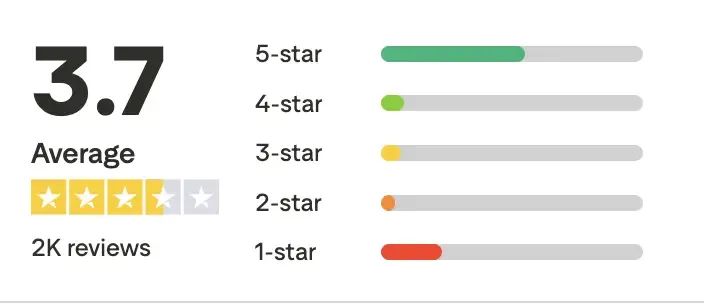
Mars Men has a version of this. A self-serve portal exists. Many reviews say it fails and forces an email. They sit at 3.7 on Trustpilot from about 2,000 reviews, and the complaints are about being charged after cancelling and pauses that do not work.
Sometimes the cancel never finished. Recharge counts a closed tab on a save screen as a save, so that subscriber is still active and still gets charged. A confirmation screen and a confirmation email with the date of the last charge end most of those complaints. And a cancel link should open the cancel flow, every time. Skip and a new date sit right above the cancel button in the customer portal, never instead of it.
Signing people up without telling them
“They tricked me into a subscription.” “They signed me up without telling me.”
First week working with a new brand, I pulled their Trustpilot. Filtered by 1-star and subscription. Same complaint. Different customers. Every time.
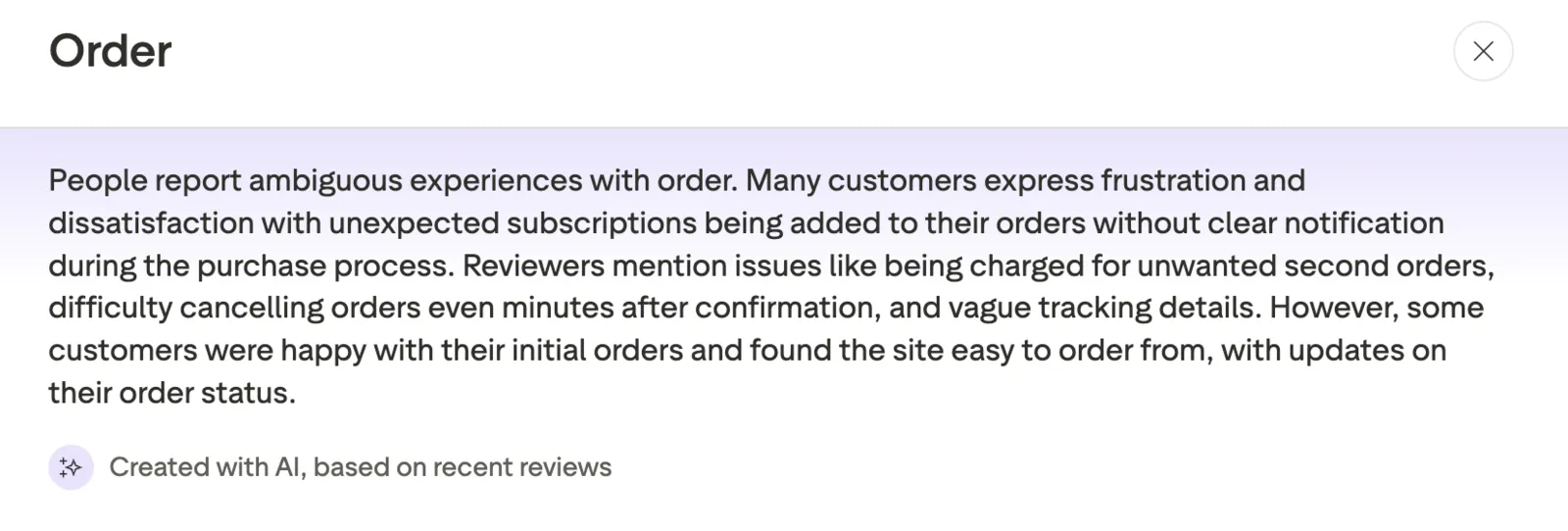
Most founders call this conversion optimization. The customer calls it fraud. It juices day 1 numbers. Then day 30 arrives. When the second charge hits, the customer files a chargeback, leaves a 1-star review, and tells their friends you are a scam.
AG1 hit a $5M class action, filed February 3, 2026, for enrolling customers into subscriptions without consent. In California, charges taken without consent become “unconditional gifts”. The customer keeps the product. For free.
So consent has to be something the customer does. A pre-checked box does not count, and the price, frequency and how to cancel go above the buy button, as Loop’s summary of the state laws lays out. Make one-time and subscription look different on the product page widget, and send a “manage your subscription” email straight after the order. Then remind them before the next charge.
It is better to lose the sale at checkout than lose your reputation at the first renewal.
Subscription auto-renewal laws by state
Hiding the button is now a legal question too. This is where things stand in November 2026, from what we have read. Laws change, so check your own states with a lawyer before you rely on any line here.
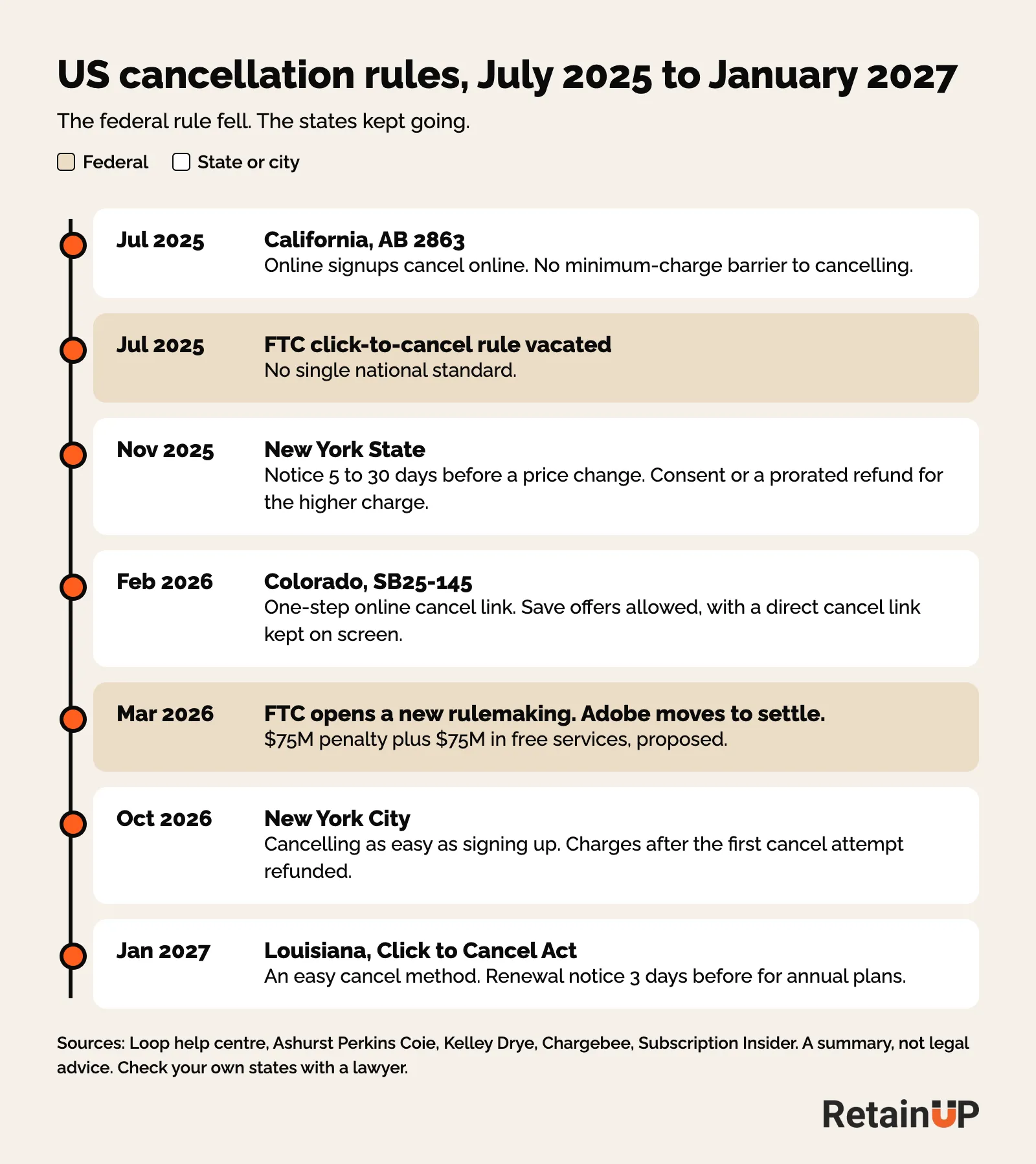
| Rule | Where it stands | What it means for your cancel flow |
|---|---|---|
| Federal click-to-cancel rule (FTC) | Vacated in July 2025. The FTC opened a new rulemaking in March 2026 (Chargebee) | No single national standard today |
| California auto-renewal law, updated by AB 2863 | In force since July 1, 2025 (Loop) | Online cancel for online signups. No minimum number of charges before cancelling |
| Colorado SB25-145 | In force since February 16, 2026 (Ashurst Perkins Coie) | A one-step online cancel link. Save offers are allowed, but a direct link to finish cancelling stays on screen |
| New York State | Amended November 5, 2025 (Ashurst Perkins Coie) | Notice 5 to 30 days before a price change, then consent or a prorated refund on the higher charge |
| New York City | In force since October 1, 2026 (Kelley Drye) | Cancelling as easy as signing up. Charges after the first cancel attempt get refunded |
| Minnesota | State law (Churnkey) | Limits on save offers shown without the subscriber’s permission |
| Louisiana Click to Cancel Act | From January 1, 2027 (Kelley Drye) | An easy cancel method, and a renewal notice 3 days before for annual plans |
Build to the strictest one anyway. More are coming. In practice that means a skippable survey and a cancel link that stays on every save screen. And the route out should be as short as the route in.
If you raise prices on live subscribers, tell them first. One brand changed shipping on live subscribers without notice and got complaints.
Then test it yourself, from the portal and from the reminder email. Decline every offer, skip the survey, and check the next charge is gone in your subscription app. Chargebee’s audit list runs the same test.
What it costs every subscription brand
“No subscription needed” is now a selling point. Humantra is spending money to tell people they don’t have to subscribe.
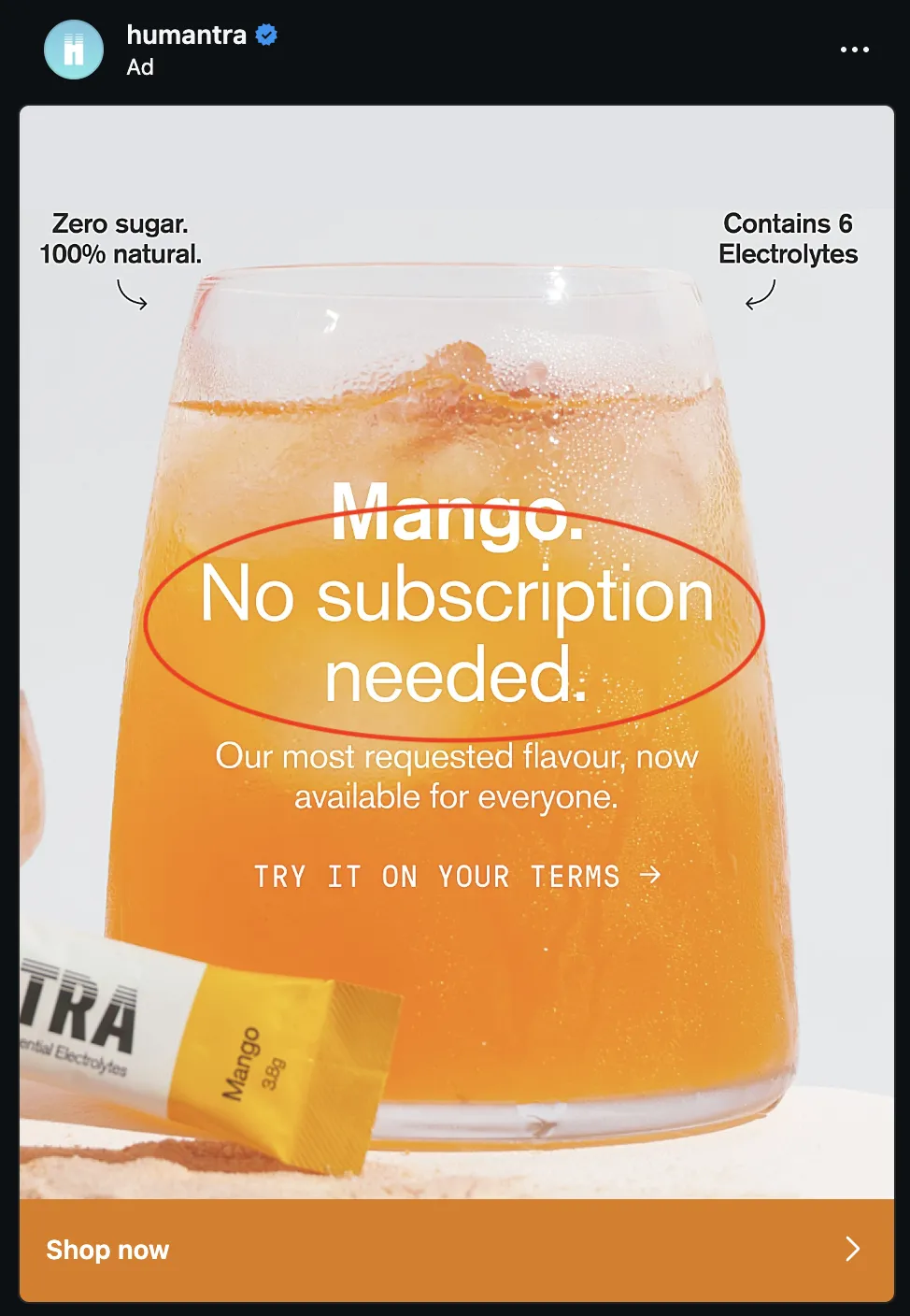
Subscribe used to mean convenience. Now it means a trap you have to fight your way out of: three confirmation emails to cancel, forced exit surveys, and retention offers nobody asked for.
Dropping the subscription is not the fix. It’s still the best economics a CPG brand can build. But it has to be worth it for the customer too, and quitting has to be a single click.
What we do instead
Saving people is still fine. A flow that asks the reason first and routes on it recovers 17 to 33% of cancellations, without charging anyone to leave. Leading with a discount saves under 5%. One brand I wrote about saves 1 in 4.
| Dark pattern | What we build instead |
|---|---|
| Minimum-order lock or cancel fee | Cancel any time, self-serve, with a save screen first |
| Phone or email only | Cancel in the portal, in the same medium as signup |
| Cancel link that opens a frequency page | Cancel link opens the cancel flow, with skip and delay offered inside it |
| Survey you cannot skip, offer as a wall | One reason screen, one fix per reason, two offers at most, cancel link always visible |
| No confirmation | Confirmation screen and email, with the door left open |
| Subscription hidden at checkout | Subscription named on the widget, the checkout and the order email |
The screens are in the cancel flow structure. The fix for each reason is in cancel reasons and the fix for each, and what to offer is in cancel offers that work.
Netflix goes further. Much further. It asks inactive members whether they still want to pay, and cancels the ones who don’t answer.
A cancel route drifts. An app update brings back a lock, or the help article in front of it breaks, and nobody notices until the reviews pile up. The Subscription LTV Optimizer™ checks your store, subscription app and Klaviyo every month and ships the fixes, for brands with 5,000+ active subscribers, at $3,000 a month. If you want to know how hard it is to cancel your own subscription first, start with a free subscription audit.
FAQ
Can a subscription brand charge a fee to cancel?
Some do, and it costs them more than the fee brings in. One $50 million brand with a two-order minimum charged a customer $20 to cancel after her first order. The minimum sits in small grey print on the widget. The fee, according to reviewers, is not written anywhere. The brand gets one more order, then a one-star review and a customer who never comes back.
Is it legal to require a minimum number of orders before cancelling?
Not in California, where blocking cancellation with minimum order rules is not lawful. Colorado wants a one-step online cancel link. The federal click-to-cancel rule was vacated in 2025, but state rules keep arriving, and they change often. So check your states with a lawyer. A short, findable cancel route is the safe build.
Do minimum order requirements reduce subscription churn?
No. A forced second order buys one more shipment and loses the customer for good. It might work for enterprise software, but a consumer brand has a hundred competitors, and the cons are way bigger than the benefit. The customer still leaves, now angry, often with a chargeback and a one-star review. A cancel flow that routes on the reason saves 17 to 33% without a lock.
How do I turn off the minimum order cancel lock in Recharge, Skio or Loop?
In Recharge, set “Allow cancellation after X charges” to no restrictions. Skio has a cancel lock that blocks cancelling for a set number of days, so switch it off. Loop defaults to no restrictions. Then test the route yourself from the portal and from the reminder email, and update your policy page and FAQ in the same week.
How will I know when my subscription cancellation is complete?
A finished cancel should show a confirmation screen and send a confirmation email, ideally with the date of the last charge. If neither arrives, the cancel probably did not go through. Many charged-after-cancelling complaints come from a subscriber who closed the tab on a save screen, which some apps count as a save. Brands should send that email every time, so nobody has to guess.
One email a week on subscription retention: the numbers, the strategy, and what to fix first.

Rahi Jain
Rahi Jain is a subscription LTV specialist who helps $1M to $10M DTC brands reduce subscription churn and maximize LTV on Recharge, Skio, Stay AI and Loop.
More about Rahi