Key takeaways
- Dr. Squatch gives 50 points for $5 off, but points cannot be used on the subscription, the one thing subscribers pay for every 3 months.
- At one of our brands, a loyalty discount reminder reached 2 of 3 sampled subscribers 3 times in 5 weeks, on top of their 20% off.
- One beauty brand we worked with had a loyalty redemption rate under 1%. Repeat rate went up 40% in 90 days after we killed the program.
Subscription programs killed loyalty programs. Brands just haven't realised it yet.
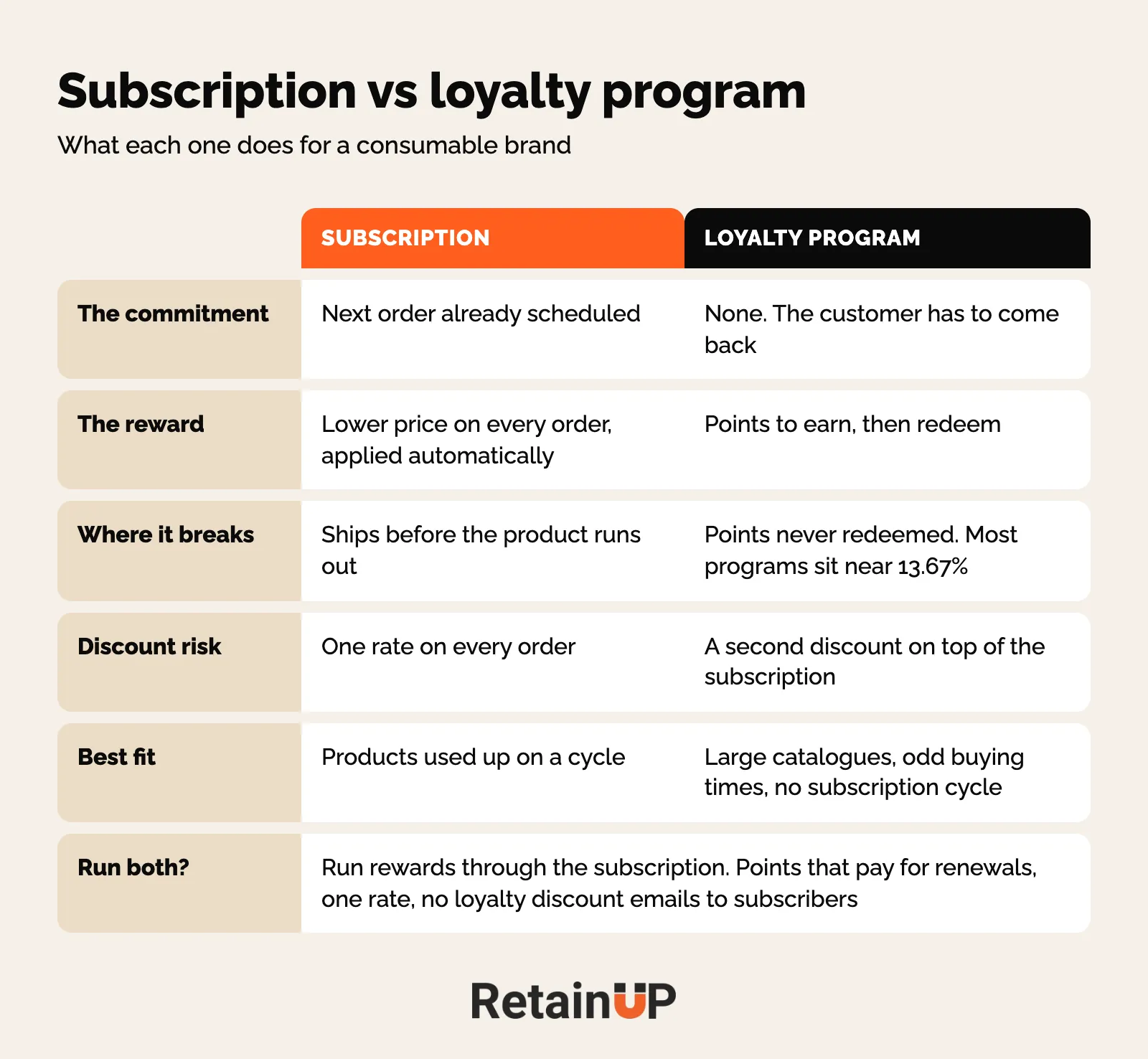
If your customer subscribes, they have already committed to repeat purchases. So loyalty programs become redundant. Or worse, a distraction. And when both run side by side, they start to fight: two discount rates, two sets of emails, and points that can't touch the order the customer actually pays for.
This sits in the subscription retention hub, for brands that already have subscribers and are wondering whether points belong on top.
Why a subscription does the loyalty job better
Subscriptions are loyalty on autopilot. The habit is built in, the repeat revenue is predictable, and every renewal is a chance to add or upgrade.
A loyalty program can't do any of that on its own. Loyalty programs don't create loyalty. They reward loyal customers. I have always said businesses don't use loyalty programs to fix loyalty problems, they use them to fix experience and product problems.
Look at how points behave across the industry. The figure that gets quoted is that 70% of loyalty points are never redeemed, across hotels, airlines and retail. Redemption rate for most programs sits around 13.67%, and below 20% is the line where a program is not working. Earning feels good. Redeeming is friction. So people hoard.
Even Recharge says this on its own blog: points are abstract for a subscriber, and store credit they can see and spend on the next order works better. Their worked example lands a $5 to $10 balance by the second or third order, which is exactly where new subscribers drop.
And a subscription skips that problem. The reward is the price on every order, applied automatically, with nothing to redeem. Amazon Prime is the big example of a paid subscription doing the loyalty job: the commonly quoted figure is that 91% of first-year members renew for a second year.
So for most CPG brands, running subscriptions and a loyalty program together is overkill. Skip the points and tiers. Keep it simple. Put the effort into delighting customers every subscription cycle instead, with milestone rewards that land on the orders that matter.
When a loyalty program still makes sense
There are two cases where I would keep one. Your product cycle isn't subscription-friendly, so most buyers will never subscribe. Or you have a large catalogue, and people buy across many products at odd times.
Starbucks is the extreme version. Small, frequent purchases. Nothing to put on a schedule. Redemption is small and frequent too. 40% of total sales were attributed to the loyalty program, per the 2019 figures. That model fits a coffee shop. It fits a $40 tub of protein much less.
Paid memberships are a third thing, where the customer pays a fee for perks (Savage X Fenty runs one). That is a different model, covered in subscription models.
When to avoid one
- Tight margins. Points are a second discount on top of the subscription discount.
- A low repeat purchase category. You can't reward what isn't there.
- A new brand. The focus should be on getting customers, and on building the first 30 days.
A loyalty program on top of no habit
We worked with a celebrity beauty brand in the Middle East. 20M Instagram followers. Six months after the store launched, they added points and tiers.
One year later, the redemption rate was under 1%. Repeat purchase rate was flat. Only discounts moved. You can't reward what isn't there.
So we killed the program. We put everything into the first 30 days: post-purchase emails that taught product usage, replenishment reminders based on actual usage cycles, education over promotion. 90 days later, repeat rate was up 40%, with no points and no tiers. A loyalty program is a multiplier, not a foundation. Build the habit first, then reward the behaviour that is already there. Fix retention first. Add points later.
Brands like CeraVe and The Ordinary built repeat first and layered loyalty on later. One founder we work with ran a loyalty programme 10 years ago and swore never again.
Retention metrics for a loyalty program
If you already run one, check four numbers before you decide to keep it. Redemption rate is rewards redeemed over rewards issued, and under 20% means it is not working. Repeat purchase rate is repeat customers over total customers. Participation rate is members over total customers. A low one usually means the terms put people off. And revenue per user, which you should read for members and for subscribers side by side.
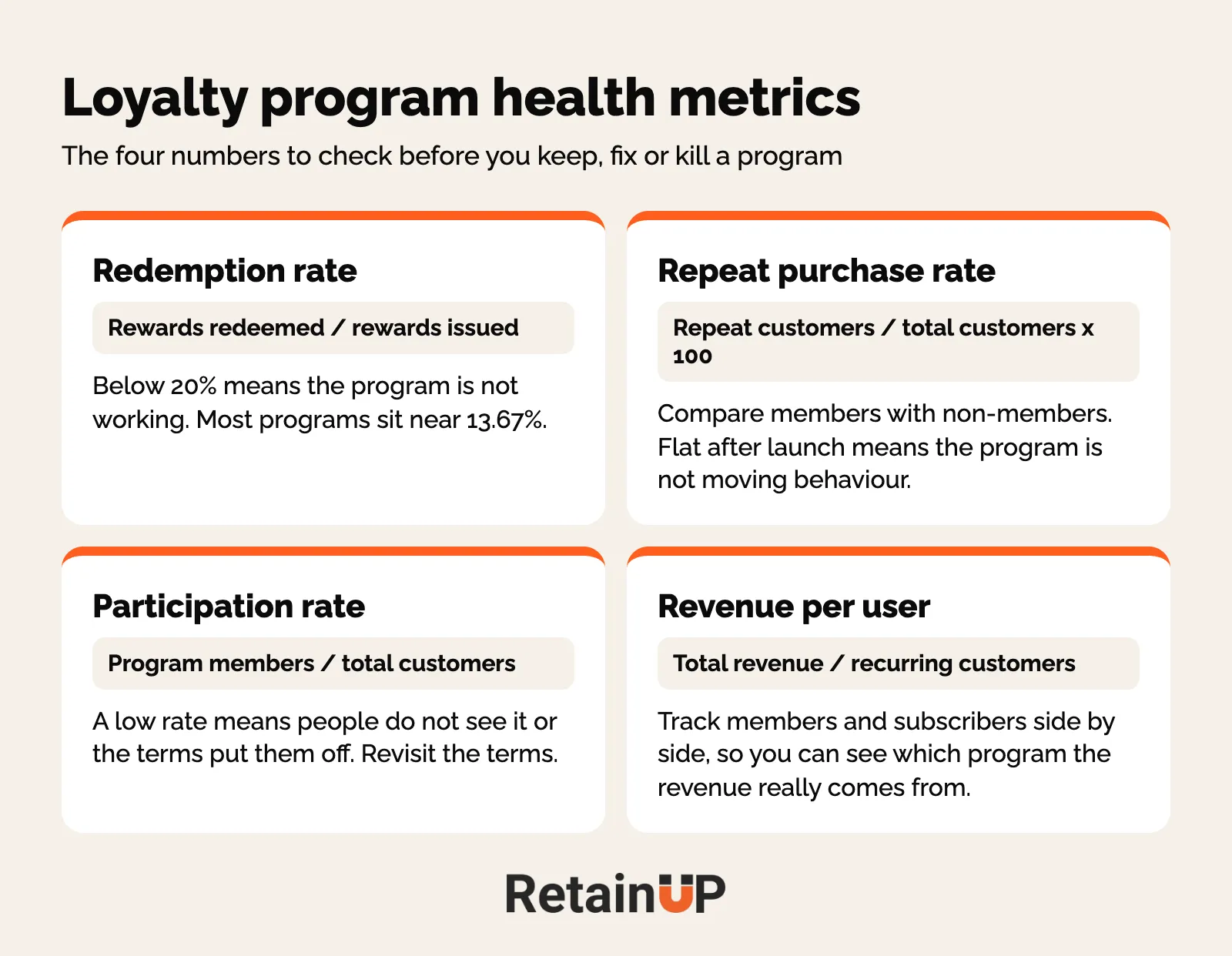
So the beauty brand above failed on two of them at once. Redemption under 1%, repeat rate flat. For subscriber numbers like Order 3 retention, the bands are on subscription benchmarks.
Dr. Squatch: points that cannot pay for the subscription
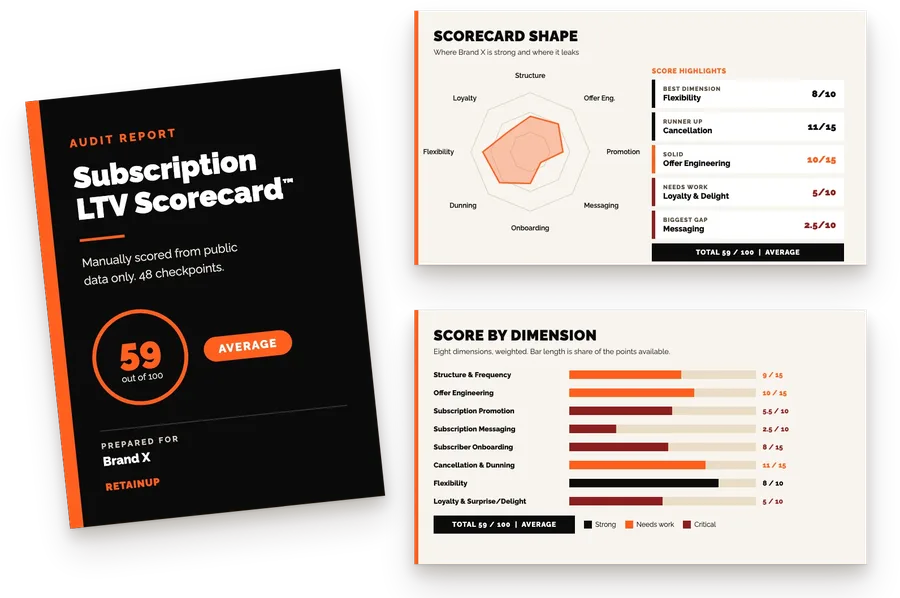
Dr. Squatch is the best example I have of the two programs fighting. I scored their subscription on 48 checkpoints in August 2026, and they got 8 out of 10 on loyalty and surprise/delight. They have a real rewards program, on Rivo. The tiers are public, the value is in dollars, 50 points is $5 off up to 300 points for $30 off, and you can track your points in your account. The full scorecard is in the Dr. Squatch subscription breakdown.
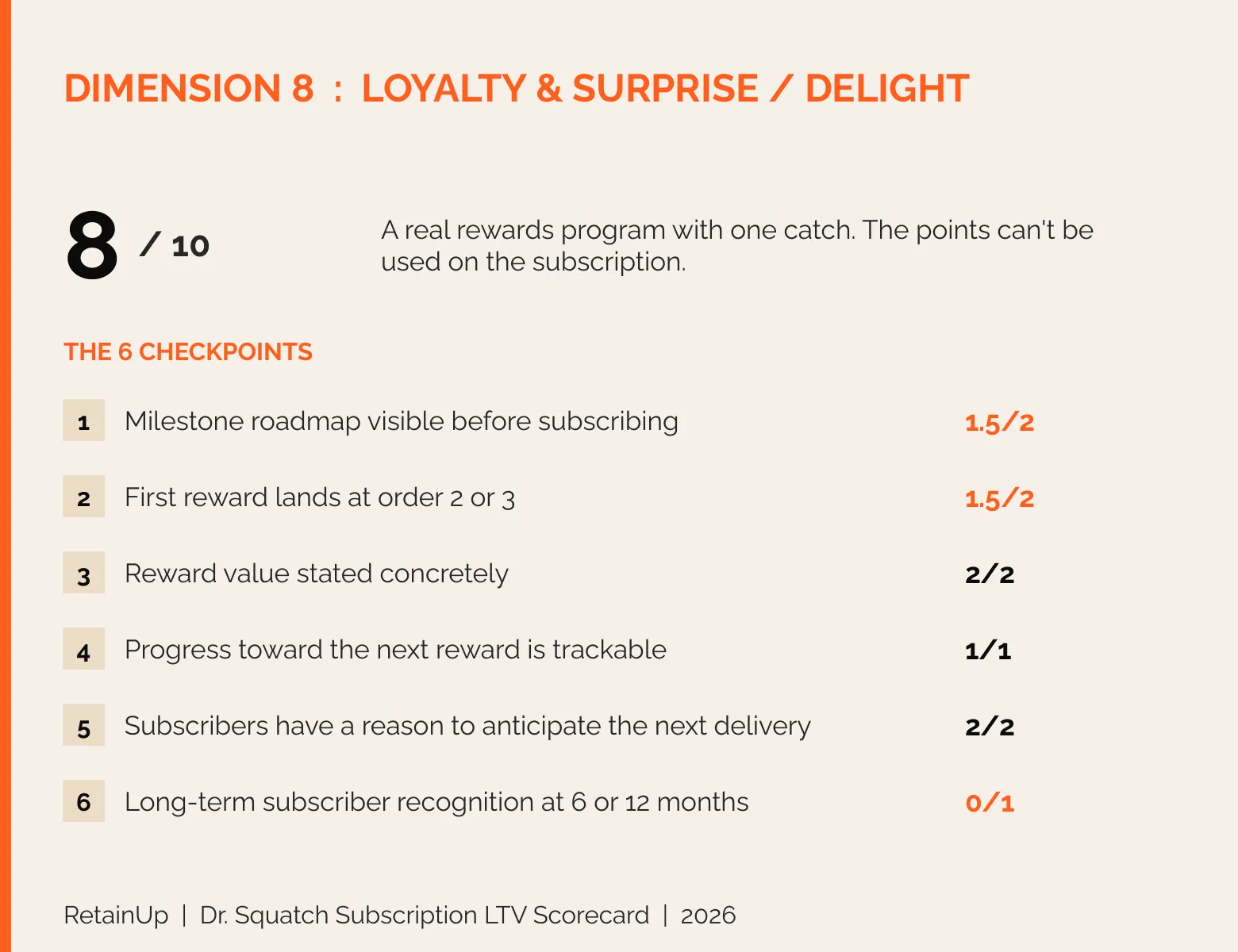
And then the help centre says points can't be used on subscription orders. That is the one thing a subscriber pays for every 3 months, and the one place a reward would keep them longest.
Redeem points on the site and the sale price goes back to full price. One subscriber wrote that he "should be allowed to redeem them on the sale price." Another lost 650 points to expiry and said he would cancel over it.
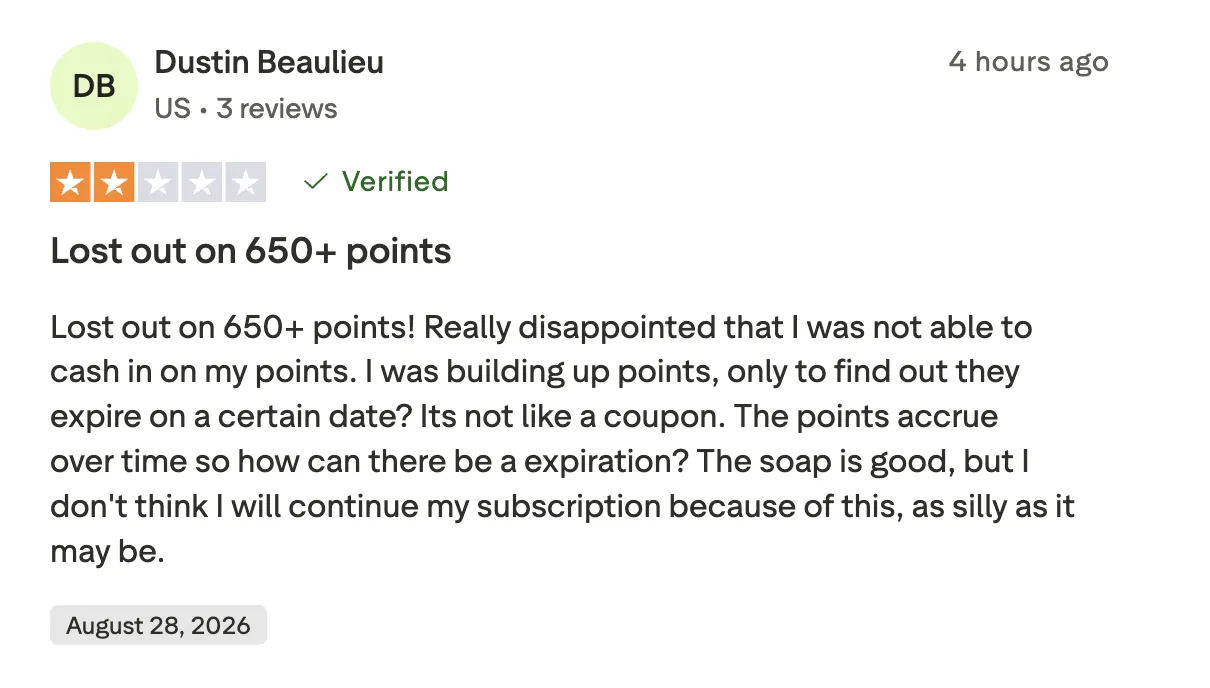
We see this in client data too. People cancel the subscription to spend their points, then subscribe again.
Four boxes is a year of soap. By box eight, a subscriber has paid $400 to $500. A free bar at that point costs almost nothing.
What I would change? Let points pay for the subscription. Put a reward on the second and third box for every subscriber, not only points. Recognise subscribers at 6 months.
Loyalty discount emails that reach your subscribers
The second fight happens in Klaviyo. Loyalty apps like Yotpo, Smile and Swell send their own flows: points reminders, reward available, double points this week, points expiring. Nobody tells those flows who is on subscription.
At one of our brands, we pulled the email history of a few active subscribers. They were not getting campaigns, cart emails or browse emails. Those were already suppressed. But they were getting the loyalty emails. 2 of 3 sampled subscribers got the loyalty discount reminder 3 times in 5 weeks, on top of their 20% subscription discount.
It looks minor. It is one filter. But every one of those emails tells a subscriber there is another discount somewhere, and teaches them to wait for it.
The fix is to exclude active subscribers from loyalty and points discount flows. They already get the subscription discount on every order. The full suppression list for flows, campaigns and sale emails is in keeping discounts away from your subscribers.
When the loyalty email blocks the order emails
At another brand, a loyalty points email fired a minute after every order. Smart Sending was on for the order-triggered flow, so Klaviyo treated the subscriber as already emailed and skipped the real one. That flow sent to under 3% of the orders that qualified.
So if an order or subscription flow is sending far less than it should, check Smart Sending first, and check what the loyalty app sends right after an order. Smart Sending stays off on subscription flows. The rest of the setup is in the core subscription email flows.
Two programs, two discount rates
The third fight is the number itself. One brand ran its loyalty app at 15% while the subscription was 20%. Two different rates, two different names, on the same product.
So subscribers don't do maths on that. They see two discounts and assume one of them is the real deal, usually whichever one showed up in the last email. Dr. Squatch has the same problem on the subscription side, where the discount shows anywhere from 7% to 50% depending on the page.
If a loyalty program runs, give the tiers non-cash perks and an effective value of 10 to 20% back. Under 10% is too small to change behaviour. Over the subscription rate and it beats the subscription. And keep one subscription discount everywhere.
How to run both without them fighting
If you keep both, the rule is simple. Run rewards through the subscription, not as a separate loyalty track beside it.
- Let points pay for subscription orders. If they can't, subscribers will cancel to spend them.
- Exclude active subscribers from loyalty discount flows in Klaviyo. Keep the points balance email if you like, drop the discount nudges.
- Check that no loyalty reward gives a subscriber a better price than their subscription.
- State rewards in dollars. 50 points is $5 off.
- Show the subscription benefits and the rewards on the same page, under one name.
- Give subscribers non-cash perks: early access to new launches, limited drops, gated community.
- Turn Smart Sending off on subscription and order-triggered flows.
Check how your apps handle the discount
Before you promise points on renewals, test it. Friendbuy notes that Recharge allows one discount on a subscription at a time, so if your subscribe-and-save rate takes that slot, a points discount has nowhere to go. Their workaround is a free product added to the next order instead. And that fits better anyway, because a gift does not cut the rate you trained people on.
Skio, Loop and the loyalty apps (Rivo, Yotpo, LoyaltyLion) all have their own version of this. Some can apply credit to the upcoming charge, some cannot. If you do run earn rates, give subscribers the higher one. Skio shows it as 2% back for one-time buyers and 5% for subscribers in the same tier, so the gap does the selling. A credit balance can also sit on the cancel screen, next to the cancel offer.
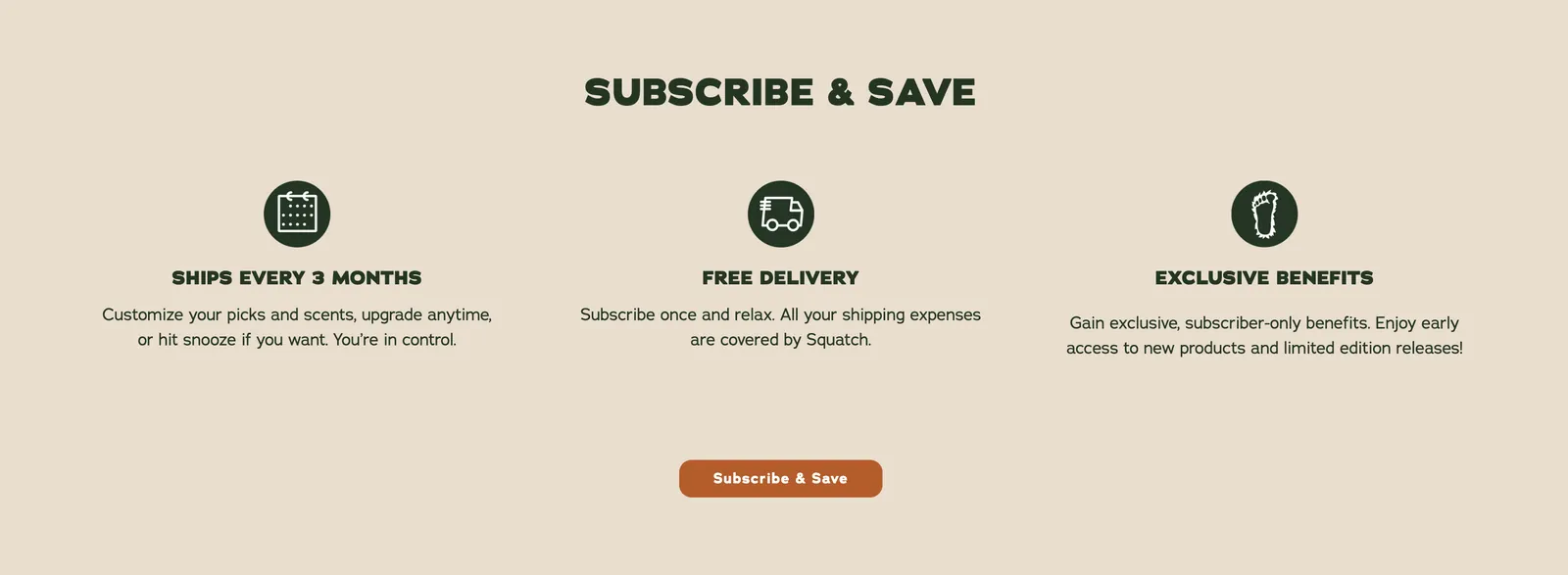
Dr. Squatch already lists early access to new products and limited edition releases as a subscriber benefit. I could not find a single promotional email that says so. Marketing the perks is the part a loyalty program usually does well, so give that job to the subscription.
One brand we work with now runs Recharge rewards for the products and is moving its loyalty app toward the milestone side, so the two point the same way. Long-term loyalty is more emotional than value-based. Community, recognition at 6 and 12 months, things you can't get by buying once. Those are covered in subscription perks and gifts and the customer portal, where the milestone timeline should be visible.
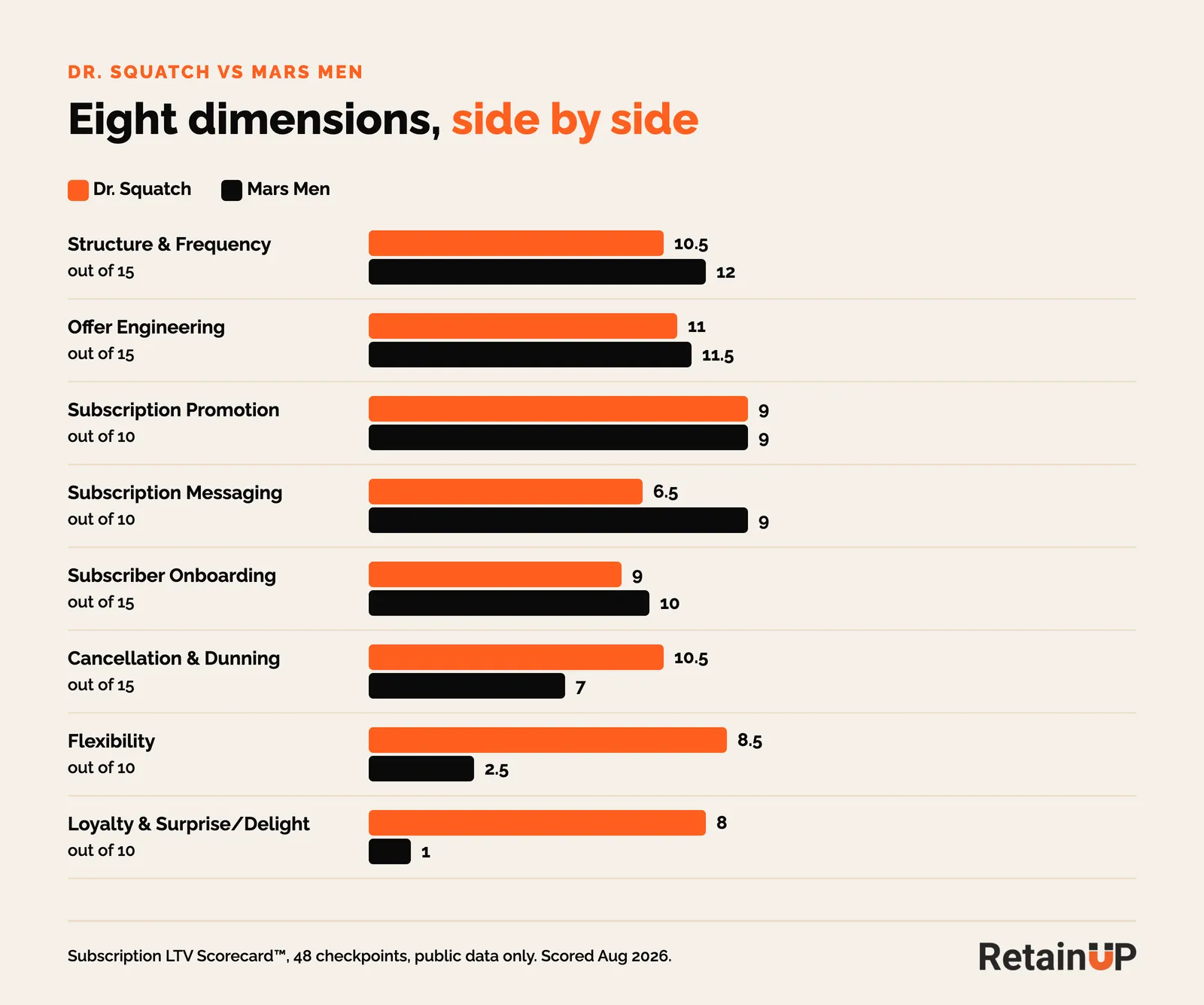
Mars Men is the opposite case. Loyalty is the widest gap on the board between the two, 8 against 1.
The Subscription LTV Maximizer™ builds rewards that run on the subscription in Recharge, Skio, Stay AI or Loop, along with the offer, widget, cancel flow, portal, payment recovery and the email and SMS, live in 30 days for $5,000. If you want to see first whether loyalty emails are reaching your subscribers, the free subscription audit checks 48 checkpoints and sends your top 3 leaks in 24 hours.
FAQ
Do I need a loyalty program if I have a subscription?
For most consumable brands, no. A subscription already builds the habit and gives a better price on every order, with nothing to redeem. A loyalty program makes sense when your product cycle does not suit a subscription or you sell a large catalogue bought at odd times. Under $1M in revenue, most brands do not need one at all.
Should subscribers be able to use loyalty points on subscription orders?
Yes. The subscription is the one thing they pay for on a schedule, so it is the place a reward keeps them longest. Dr. Squatch does not allow it, and subscribers have posted that they lost points or would cancel over it. Some cancel the subscription just to spend their points, then subscribe again.
Should I send loyalty program emails to active subscribers?
Not the discount ones. Exclude active subscribers from points reminders, reward available and double points emails in Klaviyo. They already get the subscription discount on every order. At one brand, a loyalty discount reminder reached 2 of 3 sampled subscribers 3 times in 5 weeks, on top of 20% off, which teaches them to wait for a deal.
What is the difference between a subscription and a loyalty program?
A subscription schedules the next order and gives a lower price on every one, with nothing to redeem. A loyalty program rewards a customer after they choose to come back, usually with points they have to earn and then spend. A paid membership is a third model, where the customer pays a fee for perks. For a consumable product, the subscription does the loyalty job with less friction.
What retention metrics matter for an ecommerce loyalty program?
Four numbers. Redemption rate, which is rewards redeemed over rewards issued, where under 20% means the program is not working and most programs sit around 13.67%. Repeat purchase rate, members against non-members. Participation rate, members over total customers. And revenue per user, read for members and subscribers side by side. One beauty brand we worked with had redemption under 1% a year after launch.
One email a week on subscription retention: the numbers, the strategy, and what to fix first.

Rahi Jain
Rahi Jain is a subscription LTV specialist who helps $1M to $10M DTC brands reduce subscription churn and maximize LTV on Recharge, Skio, Stay AI and Loop.
More about Rahi