Key takeaways
- Each non-subscriber sees one offer, one rung up: a percentage at the cart, gifts at checkout, a cash delta after the sale.
- Asking for card details again on a post-purchase offer cuts conversion by about 78%, so the offer has to be one click.
- One of our brands offers a $49 one-time buyer two months for $24 more. It is the only offer in the journey that costs margin.
Most of the work on getting more buyers to subscribe happens on the product page. But plenty of people still check out with one-time selected. Then they pass the cart, the checkout, the thank-you page and your inbox before they think about a second order.
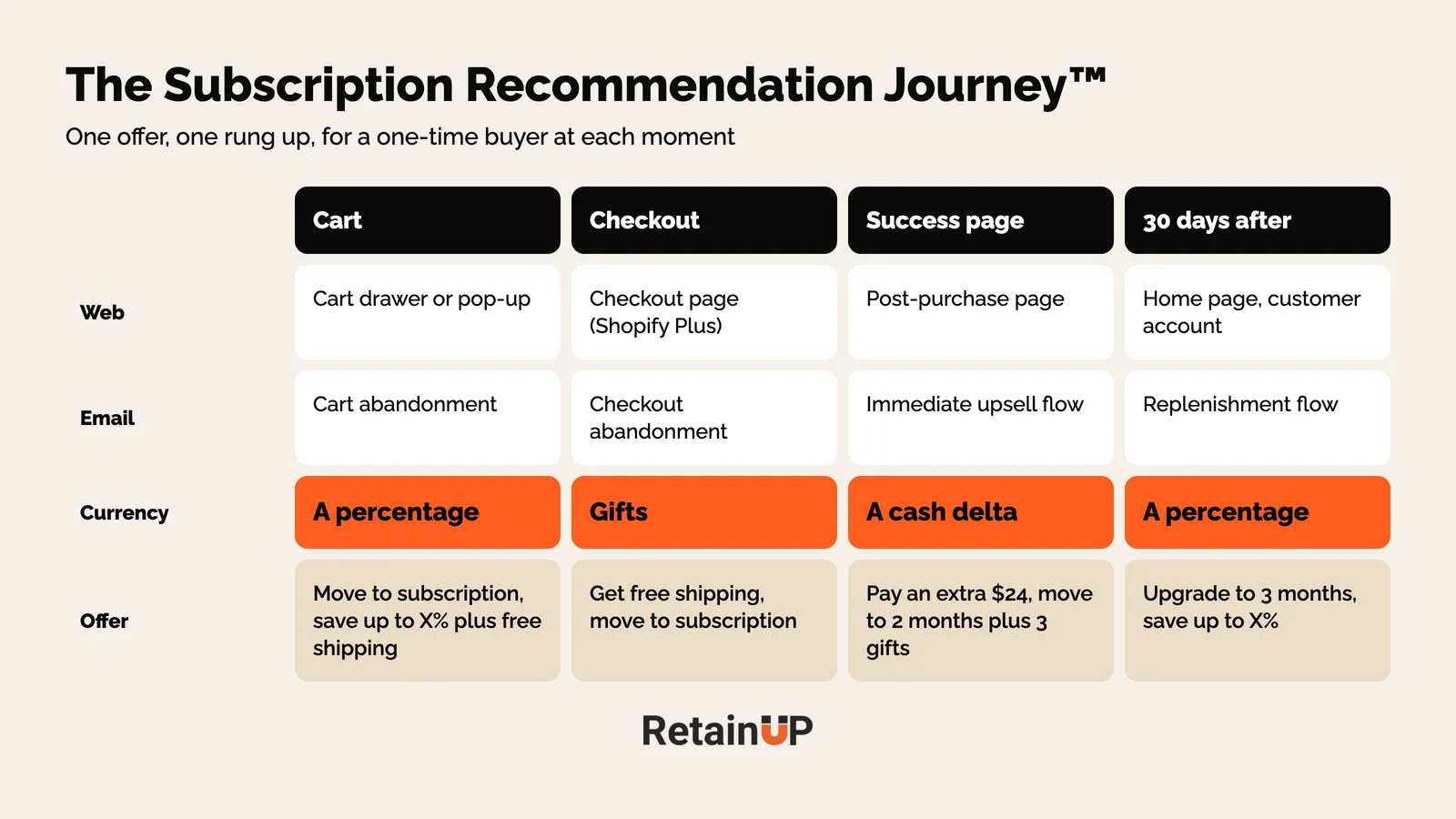
So each of those spots gets a job. We call the map the Subscription Recommendation Journey™. It is the upsell map for a subscription brand.
This article covers the non-subscriber half. The subscriber half lives in add-ons, cross-sell and upgrades for existing subscribers.
The three rules behind the Recommendation Journey™
Every customer sees exactly one offer that moves them one rung up, at the moment they are most likely to take it.
- One offer. Not a carousel of five. "You may also like" with five options is a shelf. A journey names the one thing.
- One rung. A one-time buyer is offered a subscription, not the three-month plan. Convert the behaviour first, then ladder the volume. Two rungs in one ask converts worse than two asks.
- The right moment. Nobody gets two flows in the same week, and nobody is offered what they already hold.
And there are four moments: the cart, the checkout, the success page and 30 days after. Each one has a web touchpoint and an email touchpoint, both shown in the grid below.
Every live cell gets both. A cell with only one of the two is half a build. And a cell with an email but no web touchpoint ships as a flow nobody sees.
One currency per stage: percentage, gifts, cash
The common mistake is one "save 15%" line running at the cart, the checkout and the thank-you page. They are not interchangeable.
| Stage | Currency | Why |
|---|---|---|
| Cart and pop-up | A percentage | The buyer is still comparing, so the saving has to be legible against the price they are looking at |
| Checkout | Gifts, not money | A discount offered at checkout teaches people to abandon and hunt for a code. A gift count does not |
| Post-purchase and success page | A cash delta | "Pay an extra $20" converts where "save 20%" does not, because the card is already charged and the number is small and concrete |
Mixing them trains the wrong behaviour at the wrong moment.
The cart: sell the subscription with a percentage
The cart is the last place the buyer is still shopping. The product is picked. The price is not, yet.
So the cart offer is simple. Move to subscription, save up to X% plus free shipping. Same rate as the product page. If the cart says 20% and the widget said 15%, the buyer starts looking for a better deal.
We usually build this in the cart drawer with AfterSell, targeted by the products in the cart. Recharge's own cart drawer does the same job, with a subscribe option on each one-time line (Recharge Cart setup). The email side of this cell is cart abandonment. It gets one subscription block, on top of whatever discount the flow already gives.
Use "up to" wording when the same message travels across flows whose discounts differ. State the ceiling. Round down, never up.
The checkout: gifts, and the checkout upgrade on Shopify Plus
Offers inside the checkout page itself need Shopify Plus. Recharge's Checkout Upsell, which lets a shopper switch a one-time item to subscription right there, is a Shopify Plus feature (Recharge help centre). On other plans, the cart and the post-purchase page carry this work.
If you are on Plus, the checkout offer for a one-time buyer is free shipping and the move to subscription. For someone who already picked subscription, it is more gifts on the bigger plan.
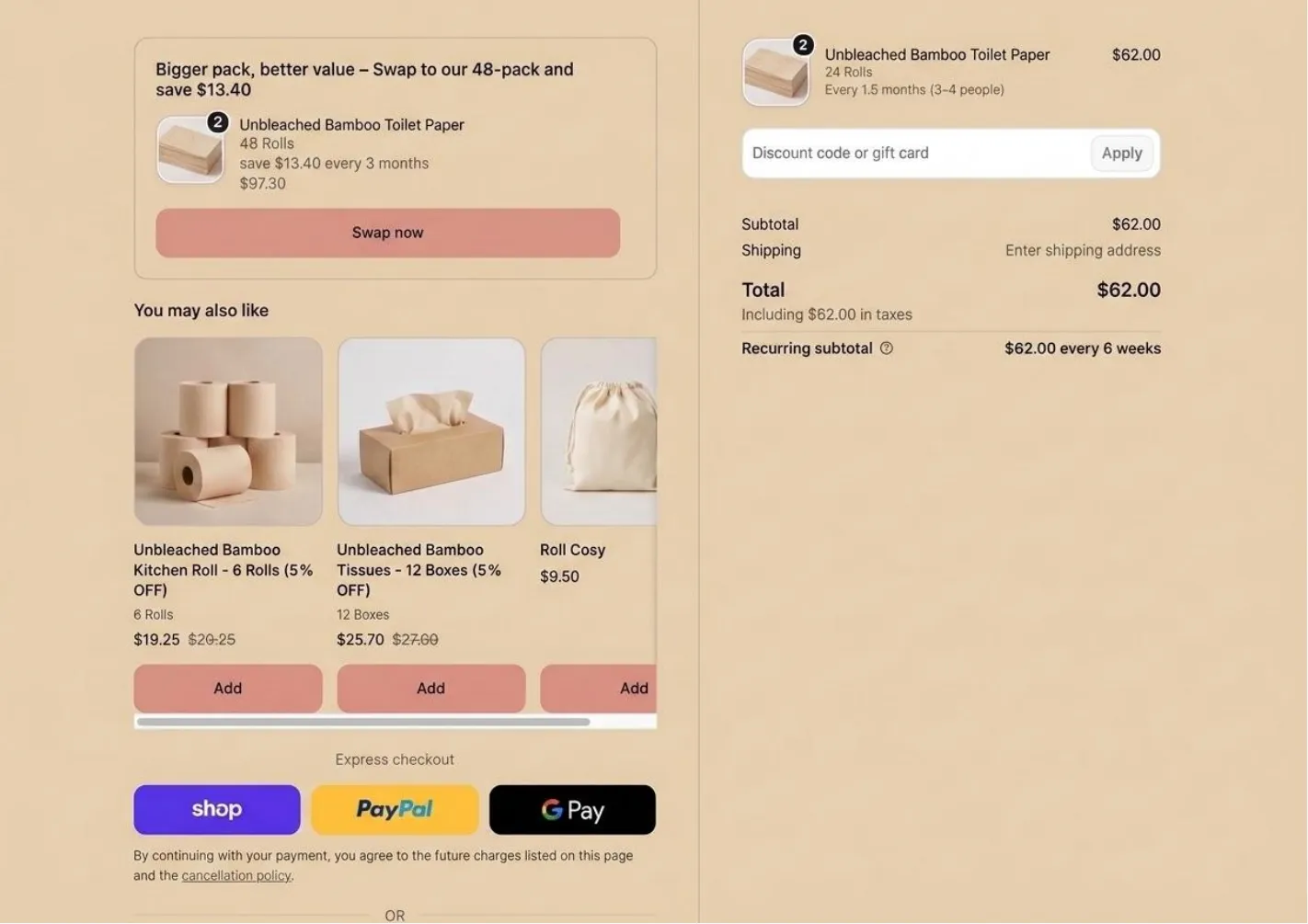
The screen above is from Recharge's "Upsell with Recharge" deck. A 24-roll subscription in the cart, the 48-pack one button away. The frequency is written for humans too: "Every 1.5 months (3-4 people)".
Naked Paper did exactly this. New subscribers were offered a larger pack at checkout, and the delivery frequency adjusted to match. First-order AOV went up 63% and CAC came back 20% faster. Churn never moved. But the business got healthier anyway. Bulk at acquisition also removes the month-one cliff, which is the whole case for longer plans.
One thing I would cut from that screen. The "You may also like" row. Pack first, catalogue second. A second SKU is more exciting to write and converts worse than a bigger pack of the thing they already chose.
After the sale: a cash delta with no checkout risk
The post-purchase page is my favourite spot for the subscription ask. The order is done. Nothing you show here can lose that sale.
And the buyer is at peak trust. They just gave you money. They are in the market, trying to solve the problem that made them buy, and they have already given you their order details.
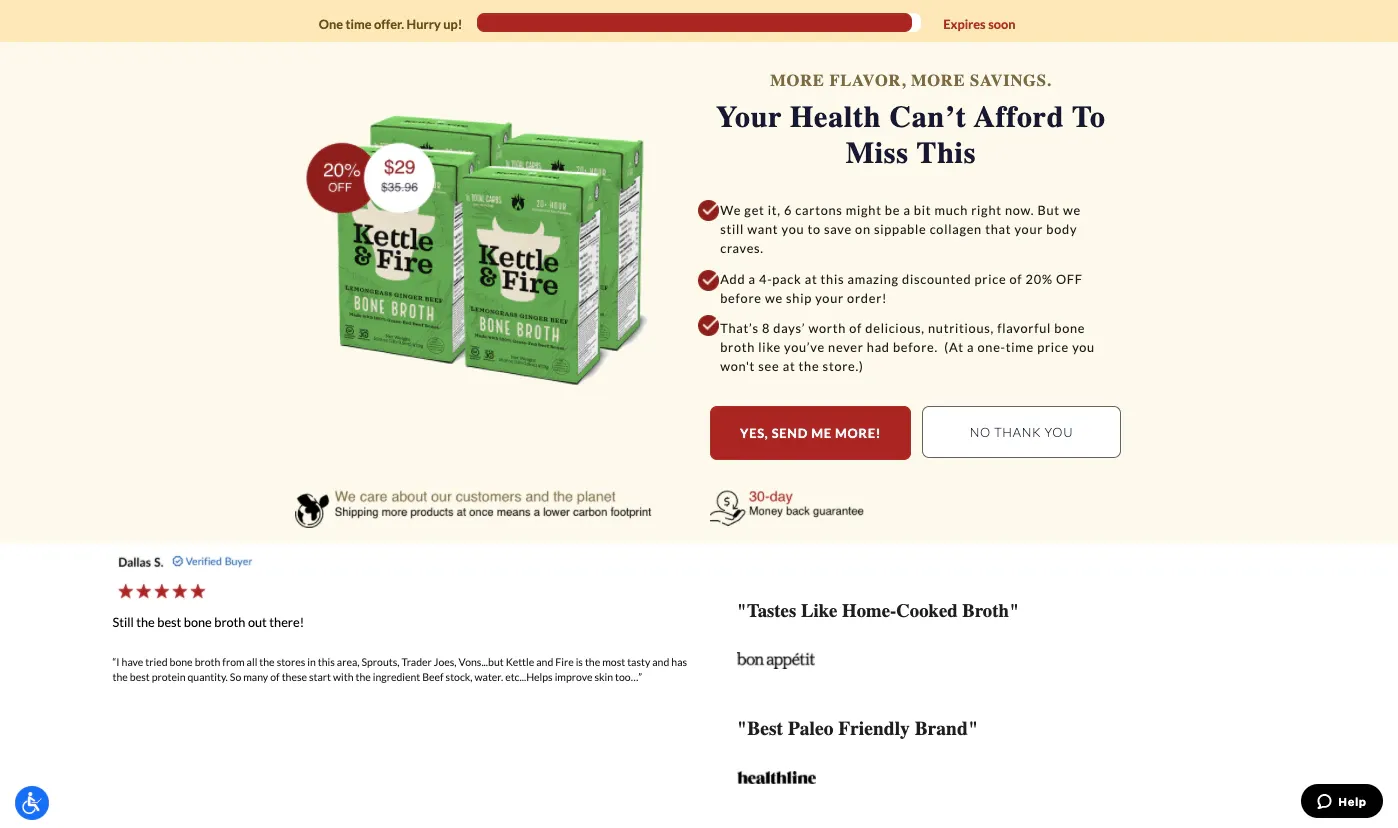
Kettle & Fire runs it as a one-time offer. The bar on top reads "One time offer. Hurry up!" Then the ask: add a 4-pack at 20% off before we ship your order. It reads as part of the same order.
Why a cash delta beats a percentage here
After the sale, the buyer is not comparing prices anymore. They are deciding whether to add one small number to a payment they already made. "Pay an extra $24 and get two months" is easy to say yes to. "Save 20%" makes them do maths on a thank-you page.
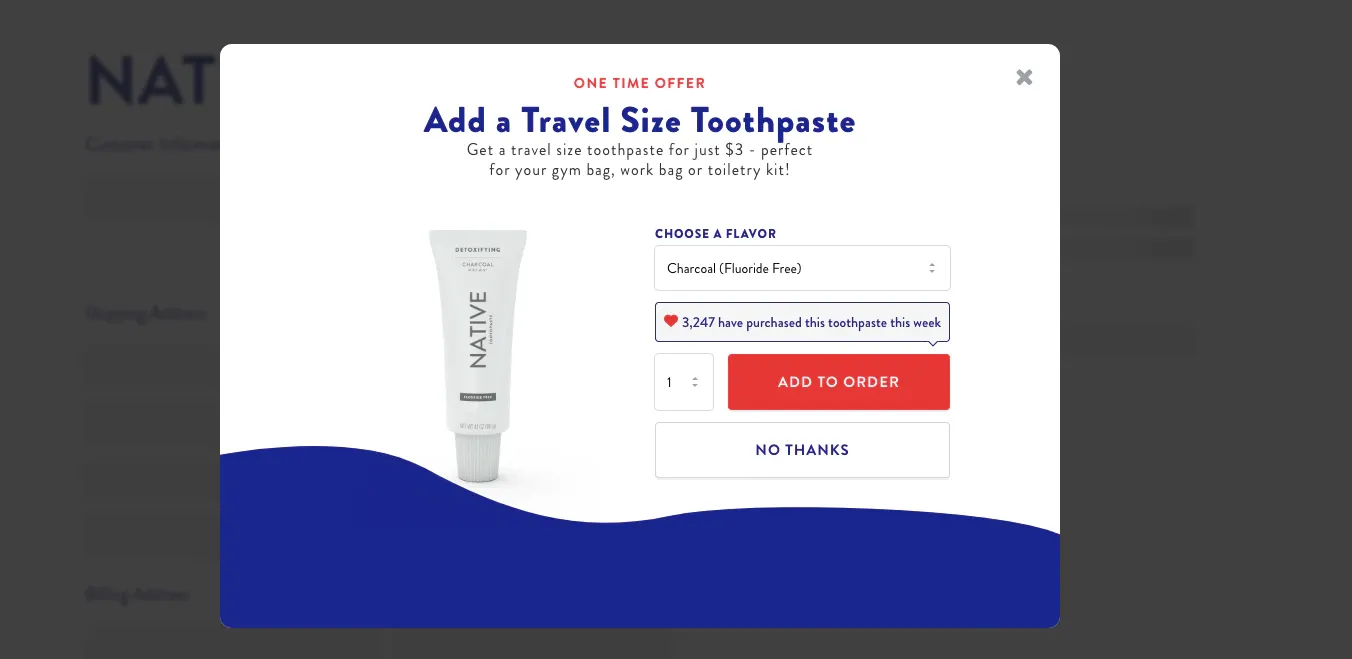
Native does the small version. A travel size toothpaste for $3, one button, labelled one time offer. Nobody needs a calculator for that.
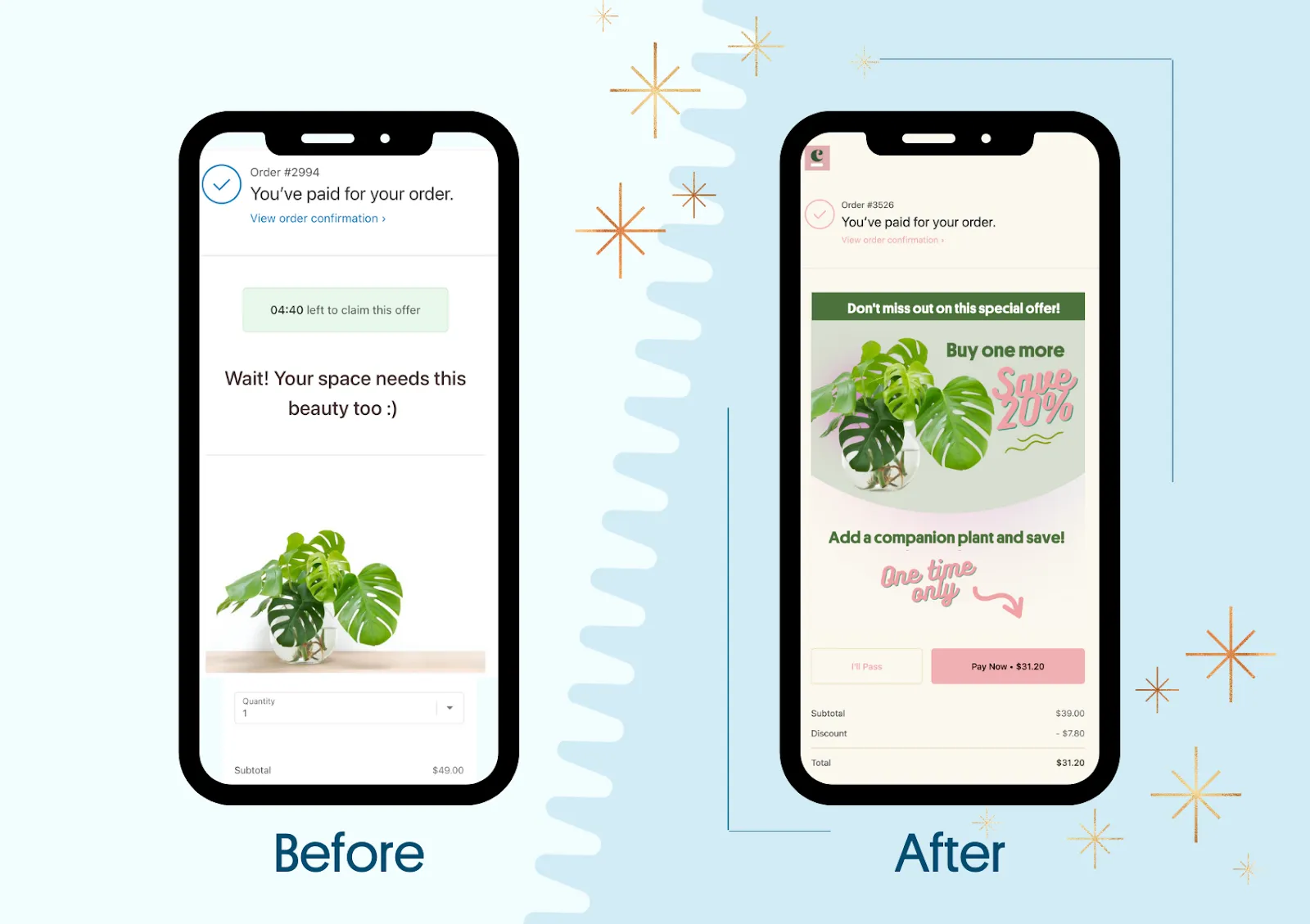
How we set it up
- Go for a specific offer. Give an exact deal, not dynamic recommendations. Move to subscription, a bigger pack of the same thing, or the next tier.
- Make it one click. Requiring payment re-entry cuts conversion by about 78%. ReConvert, Rebuy and AfterSell all do one-click post-purchase.
- Make it time sensitive. We have tested timers up to 10 minutes. 2 minutes worked best for us.
- Test the offers. It takes time to find the best offer. Don't settle on your first one. I always go in with 3 offers and test them.
- Line up more if more than 30% converts. You don't need only one upsell. If 30% of customers take the first, line up another in the next stage.
As a baseline, ReConvert's data across 40,000+ merchants shows about a 4.7% take rate and a 5.6% AOV lift on one-click post-purchase upsells. Zipify says its OneClickUpsell merchants average 16.2% (Zipify), and that is a vendor figure. So aim between the two. Done well, post-purchase upsells can add up to 15% more revenue.
Can a post-purchase offer add a subscription on Shopify?
Yes, with an app. There is one limit. Shopify allows one subscription per order. So a post-purchase offer cannot add a subscription to an order that already holds one, unless the app is connected to Recharge, Skio, Loop or Stay AI (AfterSell docs).
There are two builds. The subscription line sits next to the one-time line, charged on the spot. Or a replacement upsell refunds the one-time line and swaps in the subscription. Either way, show a consent checkbox and a link to your subscription policy before the subscription is added. The AfterSell setup covers the settings.
When the post-purchase offer is patching the product page
Mars Men sells a 30-day supply, and the next screen after checkout offers 90 days for $82.60. Small decision at checkout. Bigger decision once you have already said yes. But their guarantee and results promise are both 90 days. So the 90-day supply should be on the product page, and everyone who declines the post-purchase offer goes back on the 30-day clock.
What not to sell after the sale
I always hated post-purchase upsells. But they work. That's the problem.
The easy pitch on the success page is "buy more for faster results" or a different product altogether. And that is exactly why it hurts retention. The first 14 days aren't for selling. They're for delivering on the promise they just paid for.
AG1 doesn't pitch their greens alternatives in week one. Ritual doesn't push extra products until the habit forms. Why? Because selling too early signals "I care more about the next sale than this one." So the post-purchase offer moves them up the same product, one rung. Cross-sell on the product page. Upsell on the cart. But once they buy? Earn the right to sell again.
The 30-day follow-up
Some people decline everything. That's fine. They come back when the product runs out. That is the next moment.
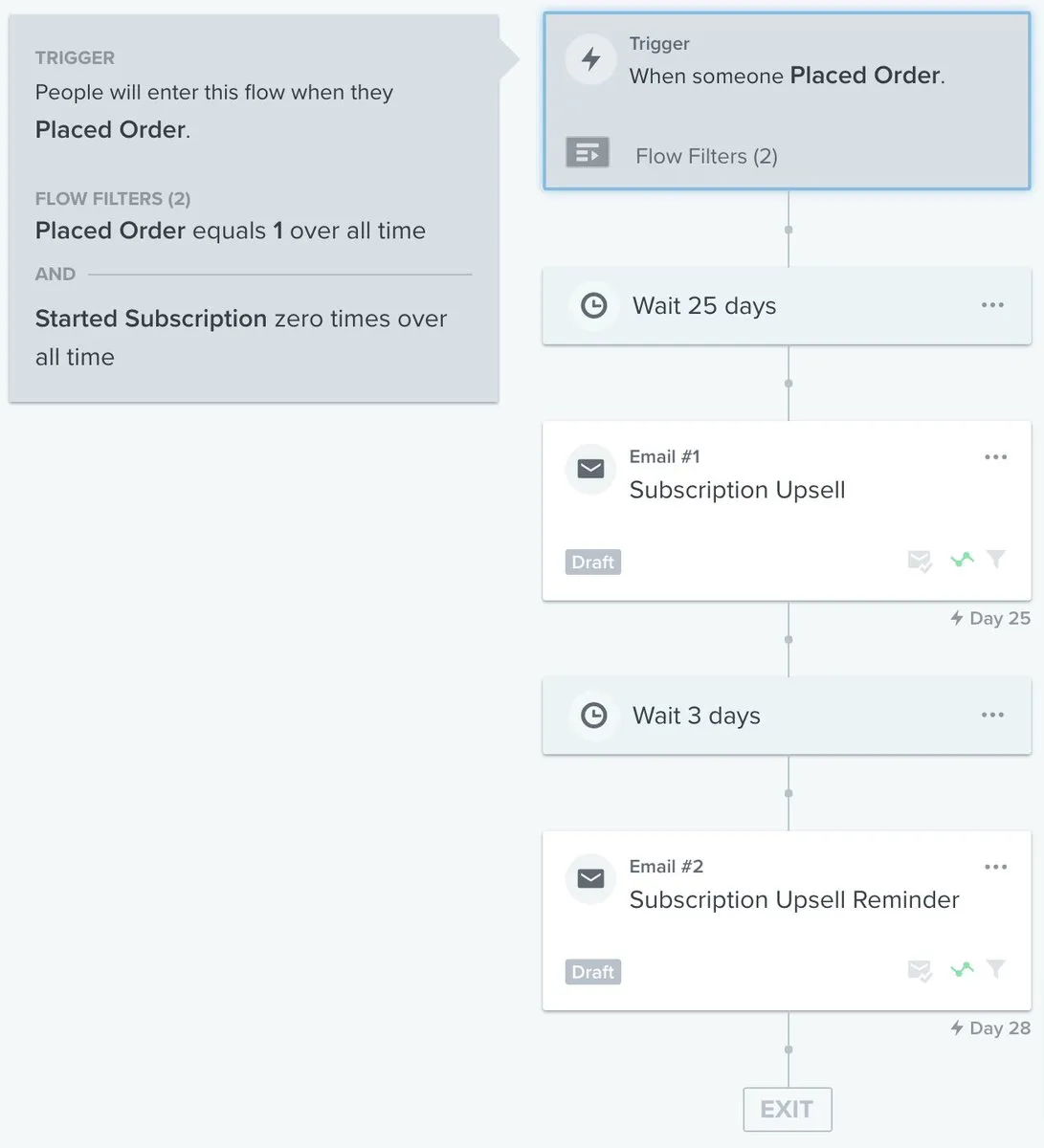
The flow above is the plain version. One order, never subscribed. Wait 25 days, send the upsell, wait 3 days, send a reminder. On the web side, the same buyer sees the upgrade on the home page and in their account.
And watch the people who keep reordering on their own. When someone reorders five times at a steady rhythm, invite them into a subscription with the frequency you now know is right. The pattern tells you when.
One brand we worked with had both of its replenishment emails going out almost straight after the first order. Immediately, it will not work. It needs to go about 30 days after the order, when they are in the market to repurchase.
The immediate upsell flow is the email twin of the success page. Add the winning offer via email. Send one 2 hours after the purchase, then follow up 2 days later. Remember, trust is highest after purchase. Everything after that, the replenishment timing, the welcome and browse flows and the subscription banners, is in turning one-time buyers into subscribers.
Self-funding deltas: a worked example
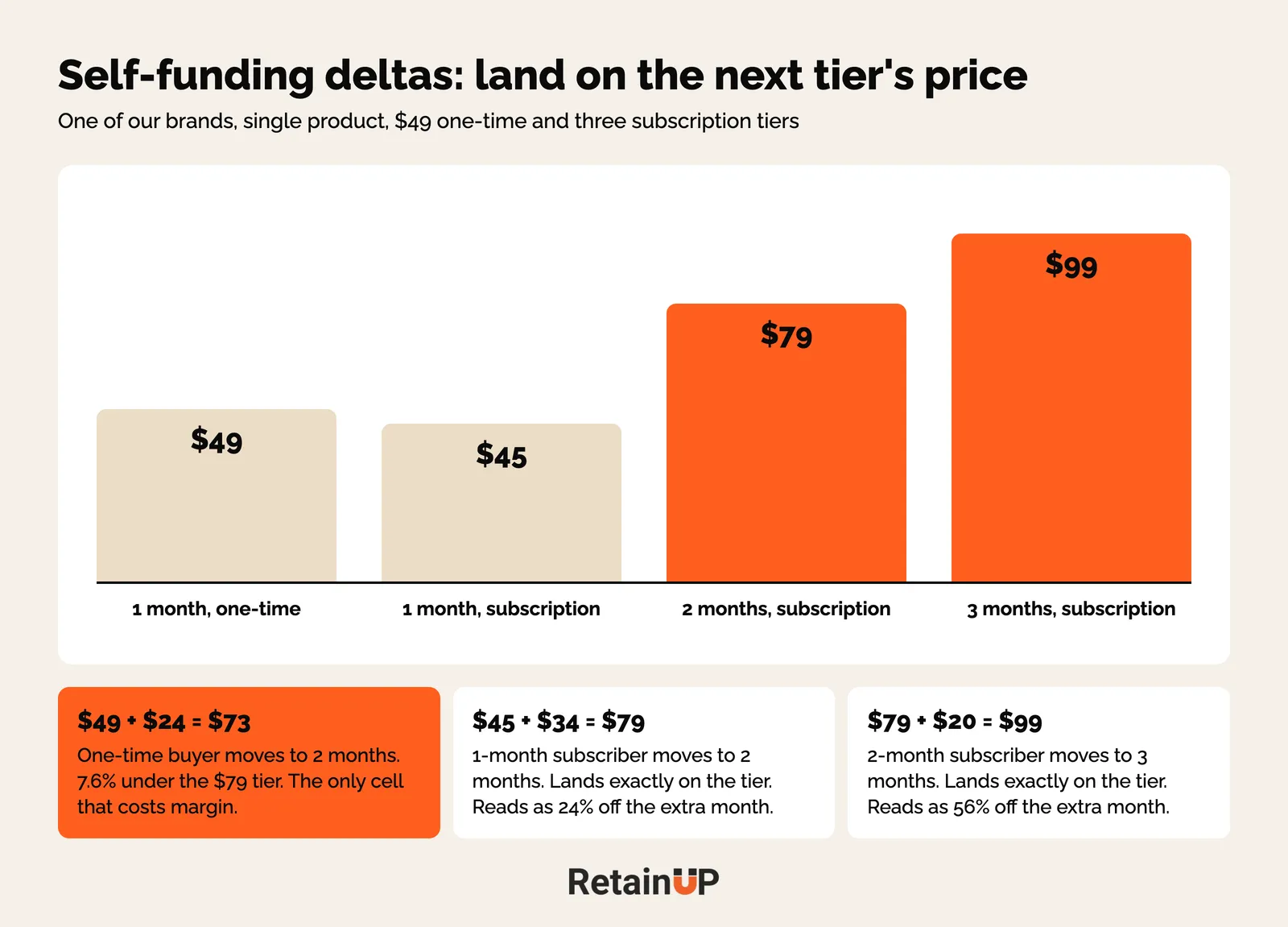
This is the rule that makes the whole journey free. Set the post-purchase delta so it lands exactly on the next tier's published price. The ladder already discounts volume, so you fund nothing new.
Here is the non-subscriber row for one of our brands. Single product, three subscription tiers plus one-time. The ladder: $49 one-time, $45 for one month on subscription, $79 for two months, $99 for three.
| Customer | Cart | Checkout | Success page | 30 days |
|---|---|---|---|---|
| 1 month one-time, $49 | Move to subscription, save up to 33% plus free shipping | Get free shipping, move to subscription | Pay an extra $24, move to 2 months plus 3 free gifts | Upgrade to 3 months, save up to 33% |
The success page cell moves them one rung, to two months, with gifts and a cash delta. And it is the only cell in the journey that costs margin. $49 plus $24 is $73, against a $79 two-month subscription, so it sits 7.6% below the ladder. That is defensible as the price of a new subscriber. But make it on purpose.
The subscriber rows land exactly on tier prices. $45 plus $34 is $79. $79 plus $20 is $99. The full matrix is in the subscriber half of the journey.
Check every percentage with a calculator
The delta produces a percentage whether you mean it to or not, and someone will do the arithmetic. Our first draft on this brand claimed 30% and 60% off the extra month. The sums gave 24.4% and 55.6%. Both were restated down.
Every number reads off the signed-off offer sheet and the gift ladder. The moment the journey holds its own copy of a price, the customer finds the gap.
Never two offers in the same week
Greedy journeys break like this.
- Two flows landing on the same person in the same week, usually a cross-sell colliding with a renewal reminder.
- A subscription offer shown to someone already subscribed.
- Building the row with the fewest customers first because it was the most interesting offer to write.
One message per person per week, and the upcoming billing reminder wins every tie. Build in tier-mix order, so the row holding the most customers ships first. For most brands that is the one-time buyer row on this page.
How to tell if the upsell is working
Track the take rate of each offer first, the share of people who saw it and said yes. That tells you which of your 3 offers wins.
Then check who it brought in. Because a cheap ask can fill the subscription with people who cancel before the second charge. Compare Order 3 retention for buyers who took the post-purchase subscription against buyers who subscribed on the product page. If the upsell cohort drops off much faster, change the offer. Loop tracks retention of upsold subscribers for the same reason.
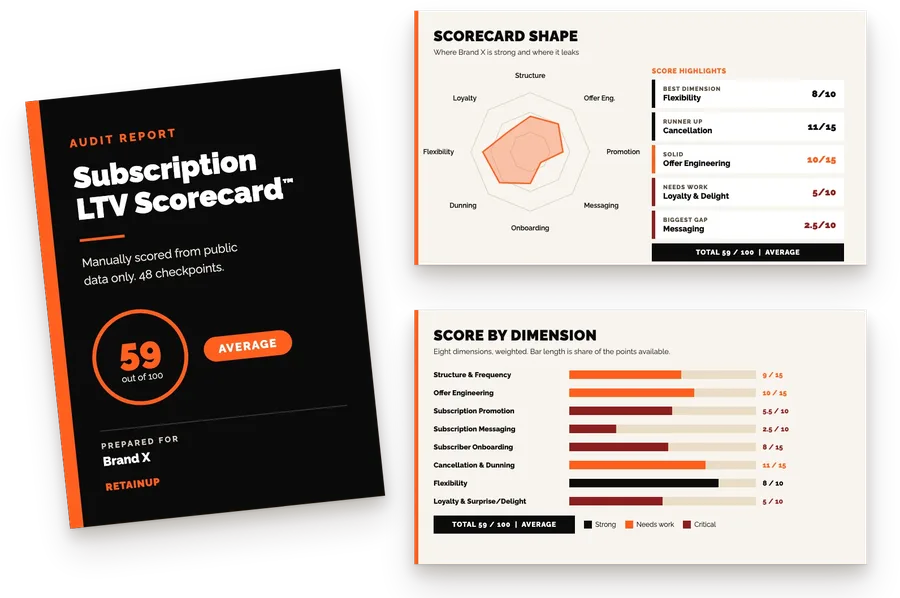
We build this journey as part of the Subscription LTV Maximizer™, alongside the offer, widget, cancel flow, portal and payment recovery in Recharge, Skio, Stay AI or Loop. It goes live in 30 days for $5,000. To see where your journey leaks first, the free subscription audit checks 48 points and sends your top 3 leaks in 24 hours.
FAQ
What is a post-purchase upsell on Shopify?
A post-purchase upsell is an offer shown on the page right after the customer pays, before the order confirmation. The order has already gone through, so the offer cannot lose the sale. For a subscription brand the best use is moving a one-time buyer onto the subscription, or onto the next tier, with one click and a small cash amount like "pay an extra $24 for two months".
Do I need Shopify Plus to upsell at checkout?
Yes. Offers inside the checkout page itself need Shopify Plus. On other plans, use the cart drawer and the post-purchase page. On Plus, keep the checkout offer to gifts and free shipping rather than a discount, because a discount at checkout teaches buyers to leave and search for a code.
Should I offer a discount or a free gift to upsell subscriptions?
It depends on the stage. At the cart, use a percentage, because the buyer is still comparing prices. At checkout, use gifts, because a discount sends people hunting for codes. After the sale, use a cash delta, a small fixed amount to pay on top of the order. Keep the cart percentage the same as on the product page.
Do post-purchase upsells hurt retention?
Yes, if you sell the wrong thing. Pitching a different product or "buy more for faster results" right after the first order tells the customer you care more about the next sale. The first 14 days are for delivering what they paid for. Moving them one rung up the same product, onto subscription or a bigger pack, gives them more time with the product.
What is the difference between upsell and cross-sell in ecommerce?
An upsell sells more of what the customer already chose: a bigger pack, a longer plan, or the subscription instead of one-time. A cross-sell adds a different product, like a toner with a cleanser. For a subscription brand, upsell first. A second product converts worse than a bigger pack of the thing they already picked. Cross-sell once the first product has done its job.
One email a week on subscription retention: the numbers, the strategy, and what to fix first.

Rahi Jain
Rahi Jain is a subscription LTV specialist who helps $1M to $10M DTC brands reduce subscription churn and maximize LTV on Recharge, Skio, Stay AI and Loop.
More about Rahi