Key takeaways
- In McKinsey's survey, financial incentive scores 24 as a reason to start a replenishment subscription. Flexibility to cancel scores 12.
- 49% of non-subscribers say they prefer to buy when they need it, and 46% see no meaningful value in subscribing.
- Fewer than 20% of product subscription cancellations happen because the customer no longer wants the product, per Bold.
Most founders guess why people subscribe. And they usually guess wrong. They put "cancel anytime" in the biggest font on the page, because they think fear of commitment is what stops people. It does stop some of them. But it is rarely why anyone says yes.
This page is the buyer research. Why people subscribe, why they don't, and what the subscription fatigue surveys actually say about a supplement or coffee brand. The page work lives in Why Subscribe: Making the Case on the Product Page, and the whole take rate picture lives in the subscription take rate hub.
The reasons people subscribe
Financial incentive comes first. Then convenience and access to better offers. That order comes from research by McKinsey and Deloitte.
So the discount matters. A lot. Ordergroove found that even a 5% discount can lift subscription enrolment by as much as 104%. And in their 2022 survey of 1,000 US adults, 26% named discounts as what got them to subscribe and 27% named convenience.
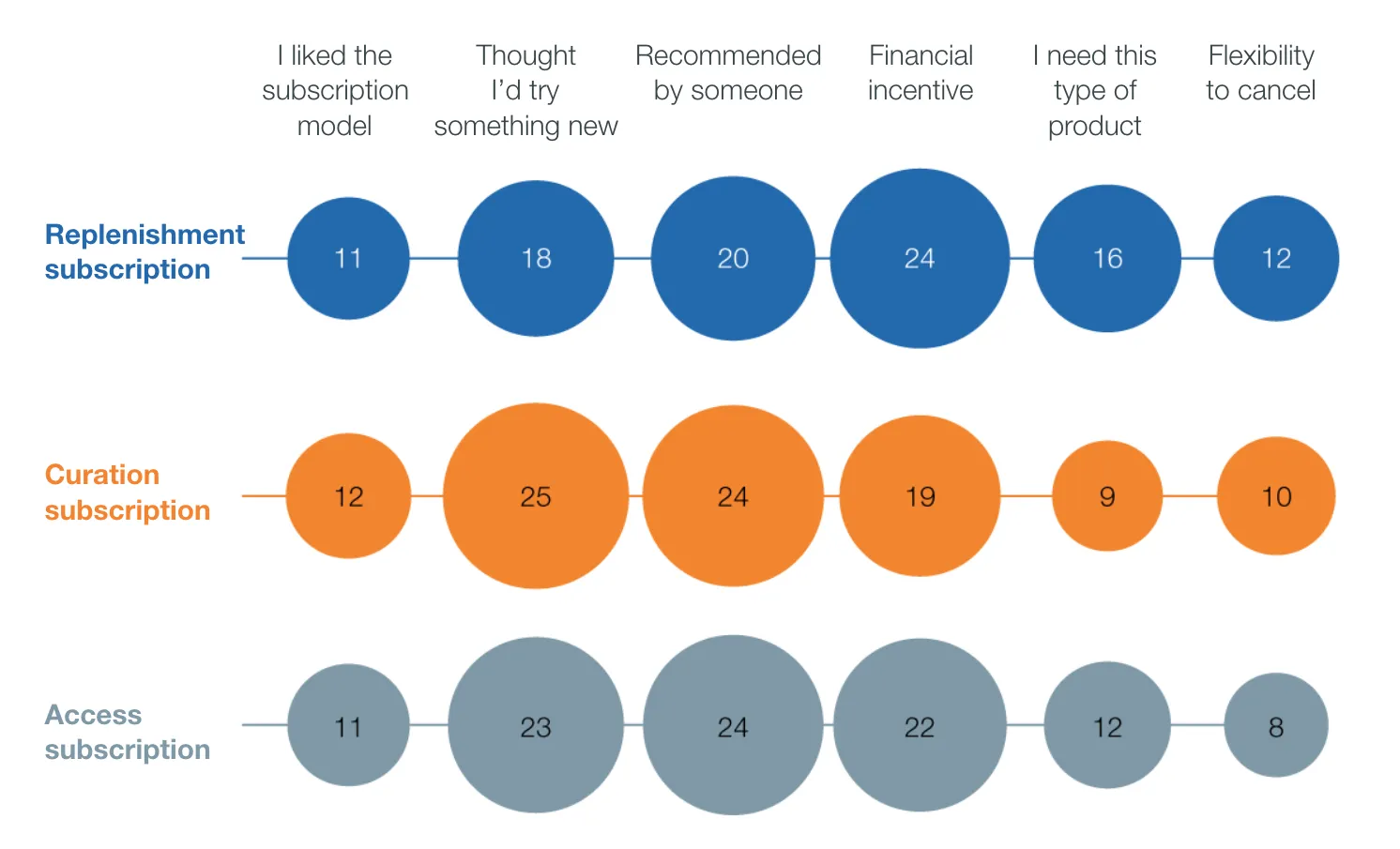
The split by model is the useful part. For a replenishment subscription, the kind most consumable brands run, financial incentive leads at 24. Recommended by someone is 20. Thought I'd try something new is 18. I need this type of product is 16.
Flexibility to cancel? 12. Second from the bottom.
Curation and access boxes look different. There, trying something new and a friend's recommendation lead, and money drops to third. If you are not sure which model you run, Subscription Models walks through the three.
Replenishment also converts best. In McKinsey's survey of 5,093 US consumers, reported by Retail Dive, 65% of people who considered a replenishment subscription went on to sign up, against 52% for curation and 51% for access. And 45% of replenishment subscribers stayed at least a year. That data is from late 2017, so read it as the shape, not today's number. Their line still holds: "Consumers do not have an inherent love of subscriptions." They subscribe for what it saves them.
What the order means for a replenishment brand
People subscribe to save money and to stop thinking about reordering. They do not subscribe because cancelling is easy. Easy cancelling is a reason not to say no, which is different. So lead with the saving and the convenience, and keep control as the last line of reassurance. How big the saving should be is its own question, answered in How Much to Discount a Subscription.
I've done the other side of it myself. I bought protein powder on subscription, took the discount, and cancelled after.
The reasons people don't subscribe
Two barriers carry most of the weight in the survey data:
- They prefer to buy when they need it (49%)
- They do not see any meaningful value in subscribing (46%)
Behind both sits the fear of being trapped. They don't want the commitment.
"I'd rather buy when I need it"
This is the big one, and it is a timing problem. A subscription asks for two things: a commitment and a fixed calendar. Some customers reject exactly those two things, even when they love the product.
Bold sorts these repeat buyers into three types:
- The self-driven returner. Buys again and again on their own rhythm. Never wants a plan.
- The lapsed-then-back buyer. Disappears for months, then reorders like nothing happened.
- The casual repeater. No real pattern. Stocks up before a trip, skips a quarter, tries a new flavour.
And there are a lot of them. Bold's analysis of Shopify stores puts only about 20% of repeat customers on a subscription for most replenishable brands, while 55 to 60% reorder on their own with nothing managing them. No sample size given, so treat it as a direction. Still, that is a big pool of people who already buy on repeat. The way to reach them is in Turning One-Time Buyers Into Subscribers.
"I don't see the value"
46% say this. Usually it means the page offered a discount and nothing else, so the subscription looks like the same product with a coupon. And if your product takes weeks to work, nobody told them that either.
Mixers is the clean example. They explained the gap between starting the supplement and seeing results, and churn dropped 40%. Gifts and welcome kits help here too, see Subscription Perks, Gifts and Welcome Kits.
"What if I can't get out?"
The trapped feeling is real. So answer it plainly. Mars Men handles it inside the FAQ. The question is the one buyers type: do I have to sign up?
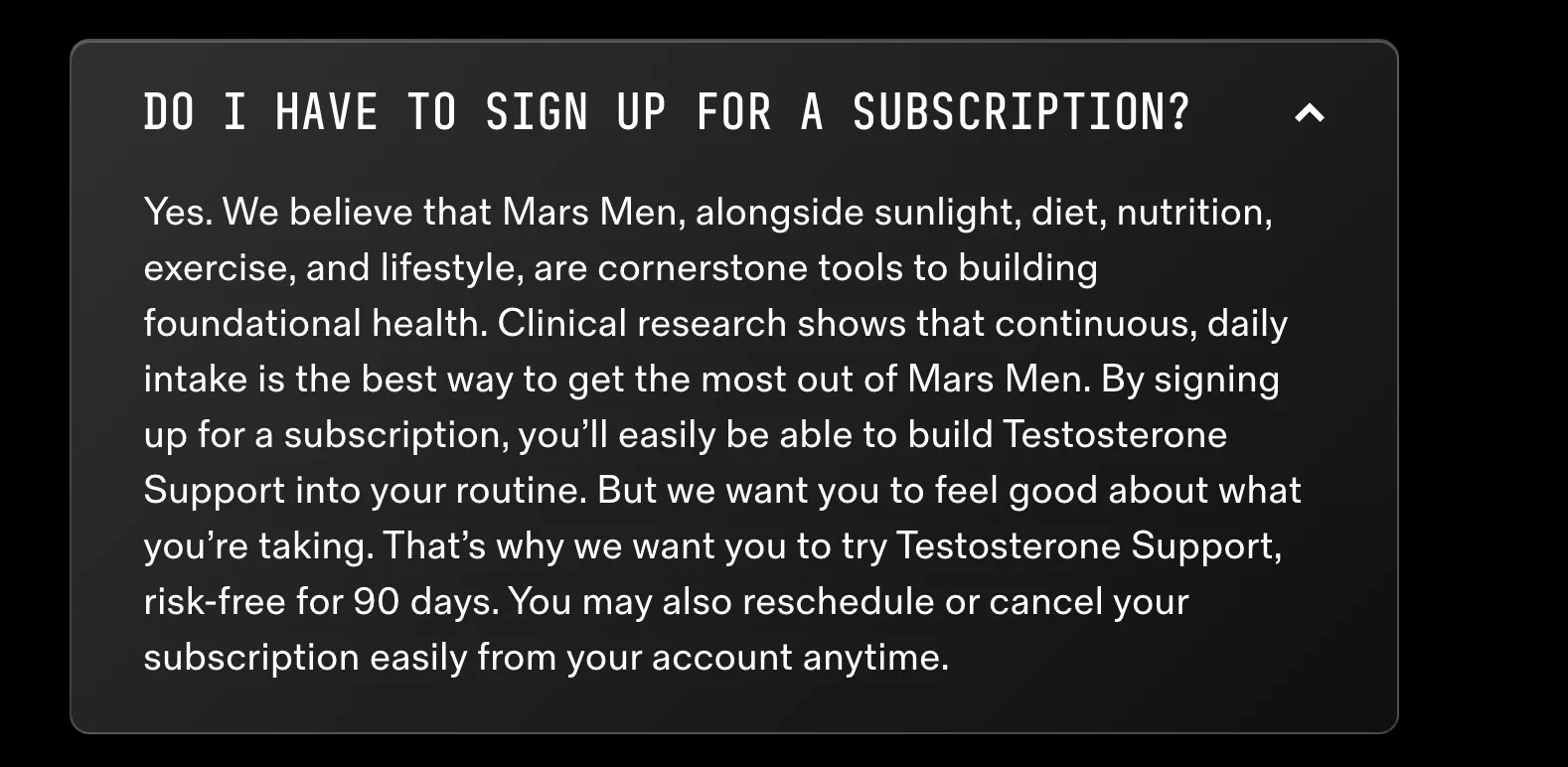
The reason comes first and control comes last.
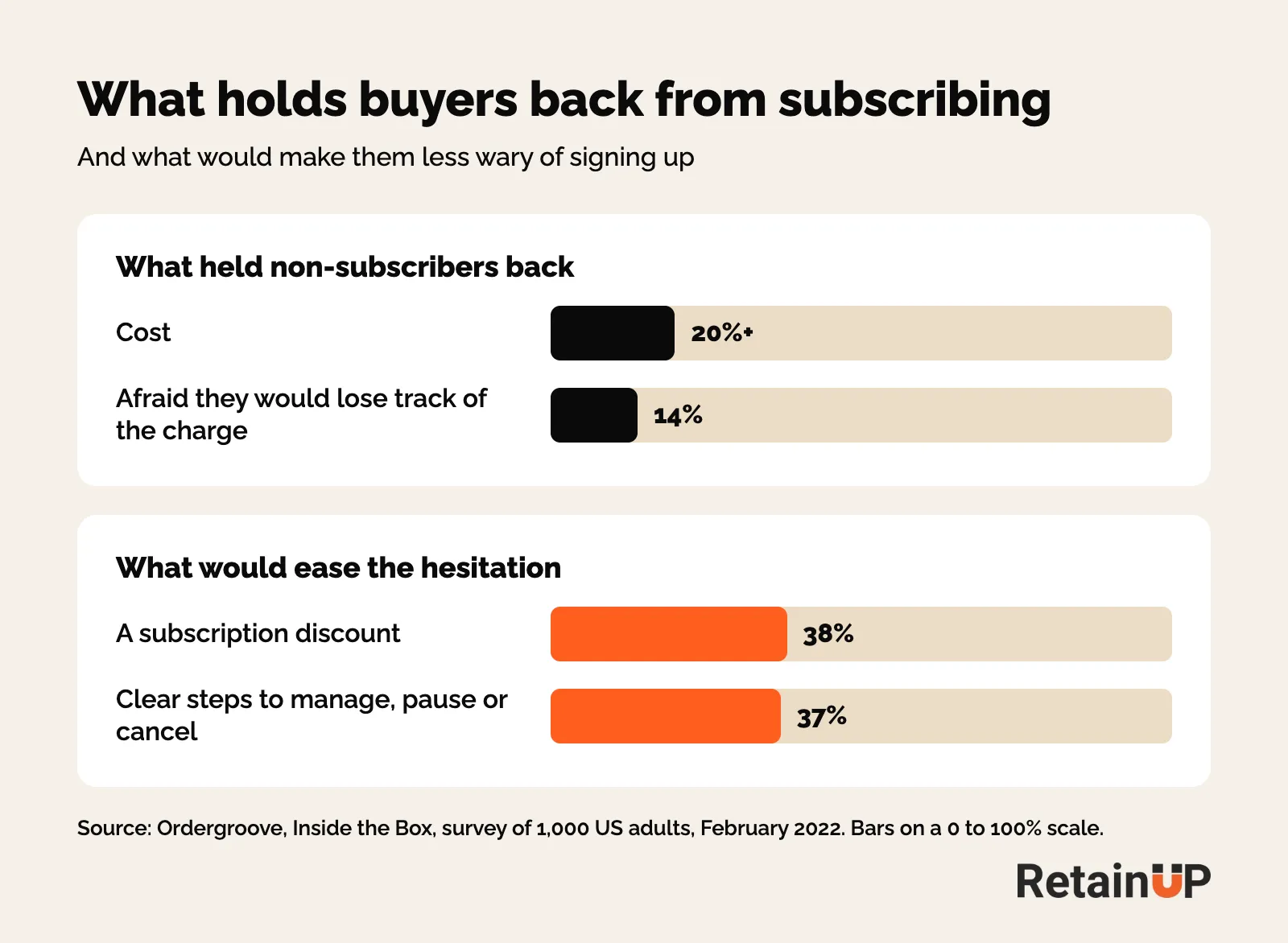
This is where control earns its place. Ordergroove's Inside the Box survey asked non-subscribers what held them back. Cost, for more than 20%. And 14% were afraid they would lose track of the charge. Asked what would make them less wary, 38% said a subscription discount and 37% said clear instructions on how to manage, pause or cancel. Almost a tie.
Chargebee's 2025 consumer survey of 1,454 people pushes it further: 82% say they need easy cancellation to even consider subscribing. So easy cancelling is the entry ticket, and the saving is still what sells it. Spell out how to skip and cancel in the FAQ, where the hesitant buyer goes looking. The full FAQ and the How to Cancel page are in The Subscription FAQ and How to Cancel Page.
Subscription fatigue: what the surveys say
You will hear that people are tired of subscriptions. The claim goes like this. People are saturated, they've lost track, and they don't cancel one subscription at a breaking point. They audit everything and cancel in bulk.
Bold's write-up calls it the Netflix effect. One price increase, even a dollar, and the customer steps back and looks at everything they pay for. Their line: "Netflix goes up, and suddenly your collagen subscription is on trial for a crime it didn't commit."
The numbers behind the claim, from the same Bold report:
| Finding | Number |
|---|---|
| Average American monthly spend on subscriptions, 2021 | $273, up 15% in 3 years |
| People asked what they spend who knew the answer | 0 out of 2,500 |
| Average guess vs itemized reality | $86 vs $219, about 2.5x |
| Say recurring charges are easy to lose track of | 74% |
| Still paying for a subscription they no longer knew they had | 42% |
| Plan to reduce their subscriptions this year | 55% |
But these surveys cover streaming, software and apps as well as products. The $273 is mostly not protein powder.
The counter-evidence
Recurly's 2026 State of Subscriptions reads the other way. It covers 2,200 merchants and 76M subscribers, plus a consumer survey.
- 67% of consumers keep 1 to 4 subscriptions, and 77% say they have the right amount
- 52% cancelled at least one subscription in the past 12 months, typically 1 or 2 services priced $5 to $19.99
- The top reason for cancelling was "I was not using it enough" at 51%. Price came second at 45%
- Nearly 1 in 4 new subscriptions comes from a previously cancelled customer
Their summary: "Subscribers aren't overwhelmed. They're intentional." One caveat. Recurly's data is heavy on streaming and software too.
Why fatigue hits streaming harder than consumables
A streaming service you don't open is pure waste. A bottle of supplements you don't finish is a different problem. You still want it. You just have too much of it.
Bold has run cancel surveys since 2014. Fewer than 20% of cancellations happen because the customer no longer wants the product. Over 80% is timing and friction, not demand.
Jay Myers, Bold's co-founder, put it well: "When I canceled my protein subscription, I didn't cancel the demand for it. I canceled the friction of how I was ordering it." He still bought protein. At Costco.
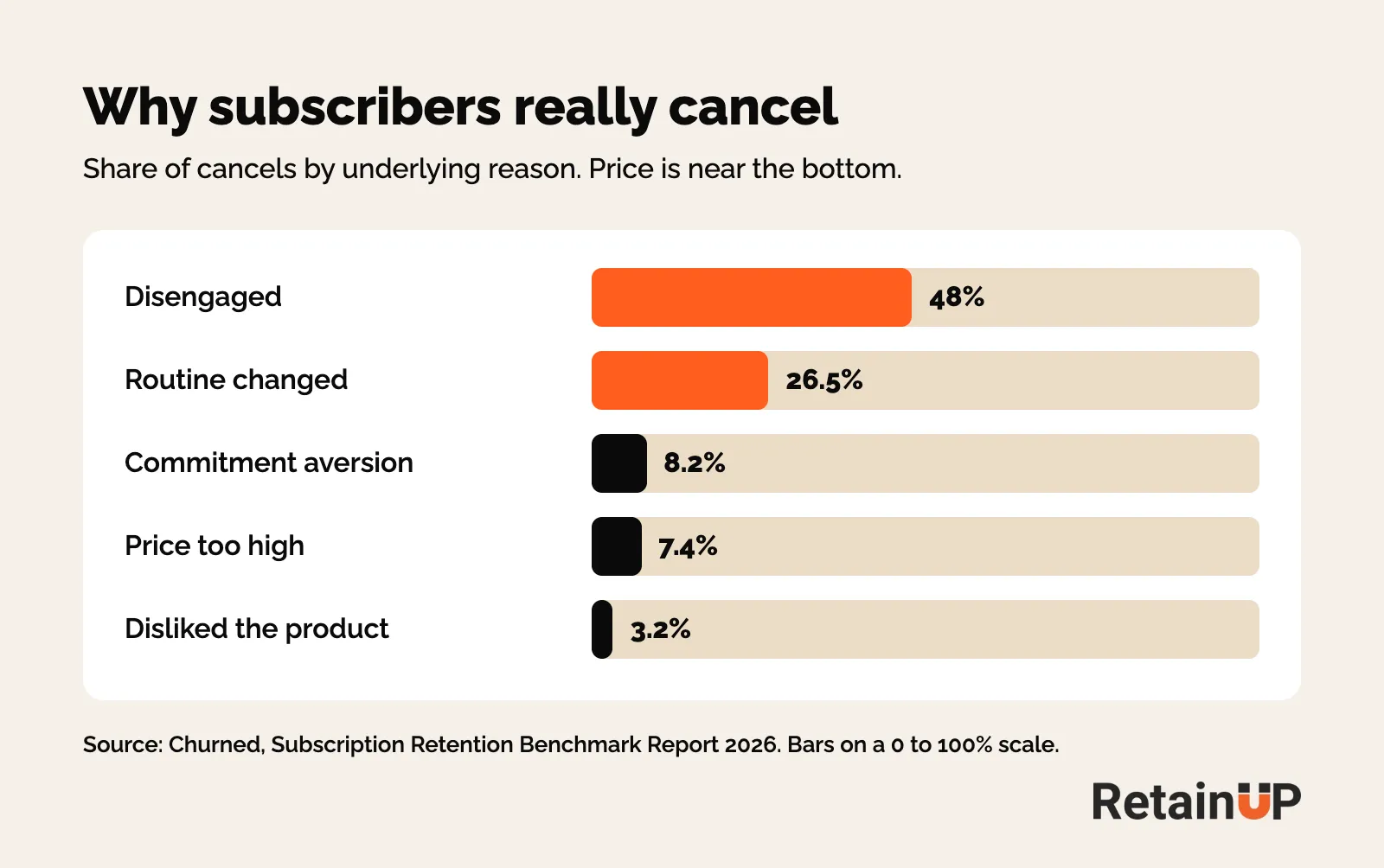
Churned's 2026 benchmark report lands in the same place. Price is rarely the reason.
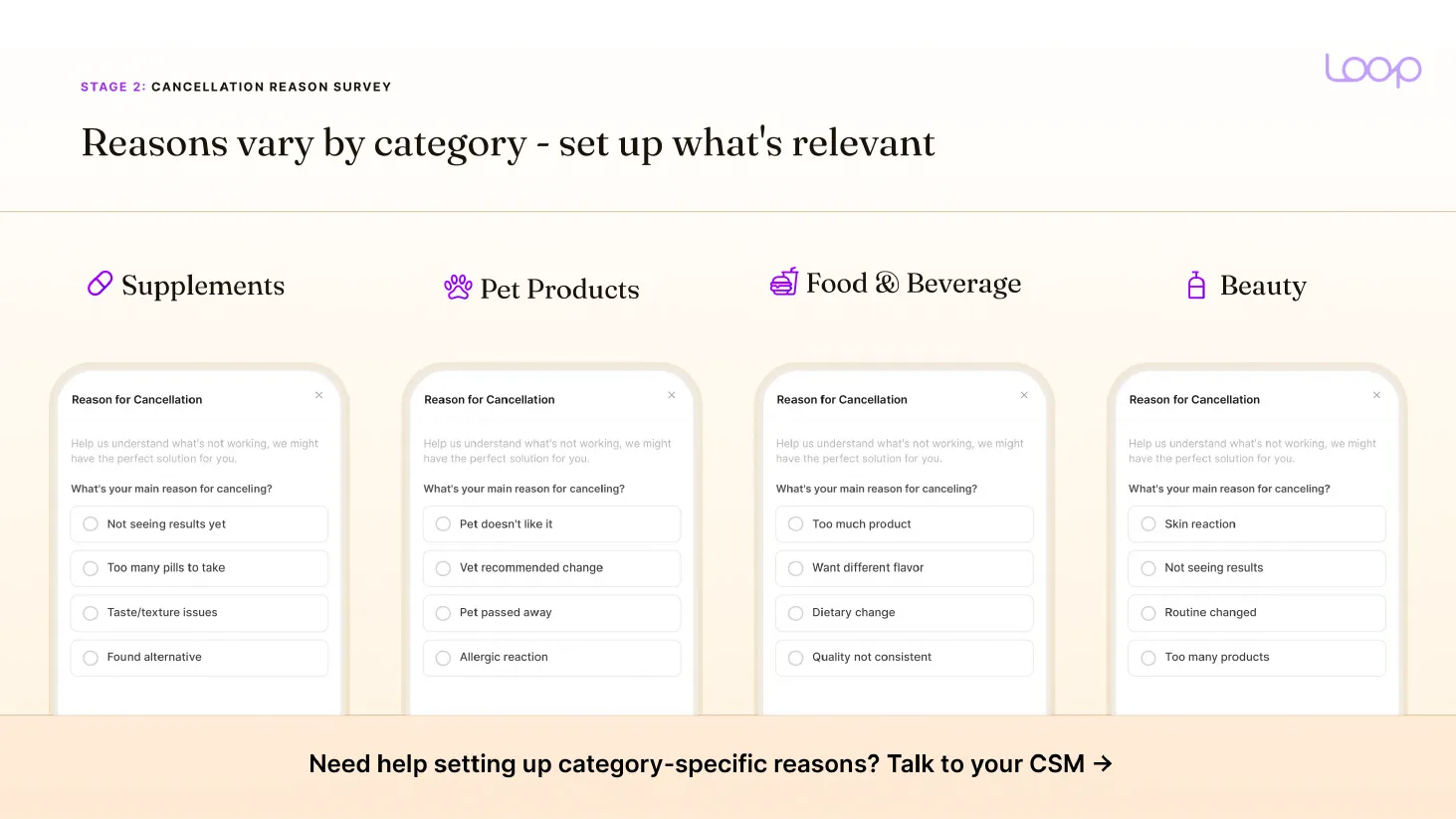
Loop's cancel surveys by category tell the same story. Supplements get "not seeing results yet", food and drink get "too much product". Almost none of it is "I hate this."
So what's dying? Ronak Shah, CEO of Obvi, says it is "people needing to over-consume to keep up with their subscription." Thomas Lalas goes further and predicts people will cancel 5 or 10 subscriptions at a time to cut the bill, whatever the product quality. Maybe. For a consumable brand, the fatigue that matters is the box of product piling up in the cupboard.
What each barrier means for the offer and the page
Every barrier has a fix, and most of them live on a sibling page. Here is the map.
| Barrier | What it really means | Where the fix lives |
|---|---|---|
| Buy when I need it | The cadence doesn't match their usage | Frequency matched to the bottle, skip and delay |
| No meaningful value | The discount is the only reason on offer | Perks, a results timeline, the why subscribe section |
| Fear of being trapped | They can't see how to get out | A plain FAQ answer and a How to Cancel page |
| Fatigue, too much product | Shipments arrive faster than they use it | Skip, delay and swap before cancel |
| Lost track of the charge | The charge comes as a surprise | A billing reminder with value first |
Match the cadence to the bottle
If customers say they'd rather buy when they need it, the subscription is probably shipping on the wrong clock. Set the default frequency from how fast the product gets used. The method is in Subscription Frequency. A 3-month supply also takes the month-one decision off the table, covered in Prepaid and Longer Plans.
Give them a way to skip
Subscribers last 135% longer when they can skip an order. And a skip is rarely a cancel in waiting.
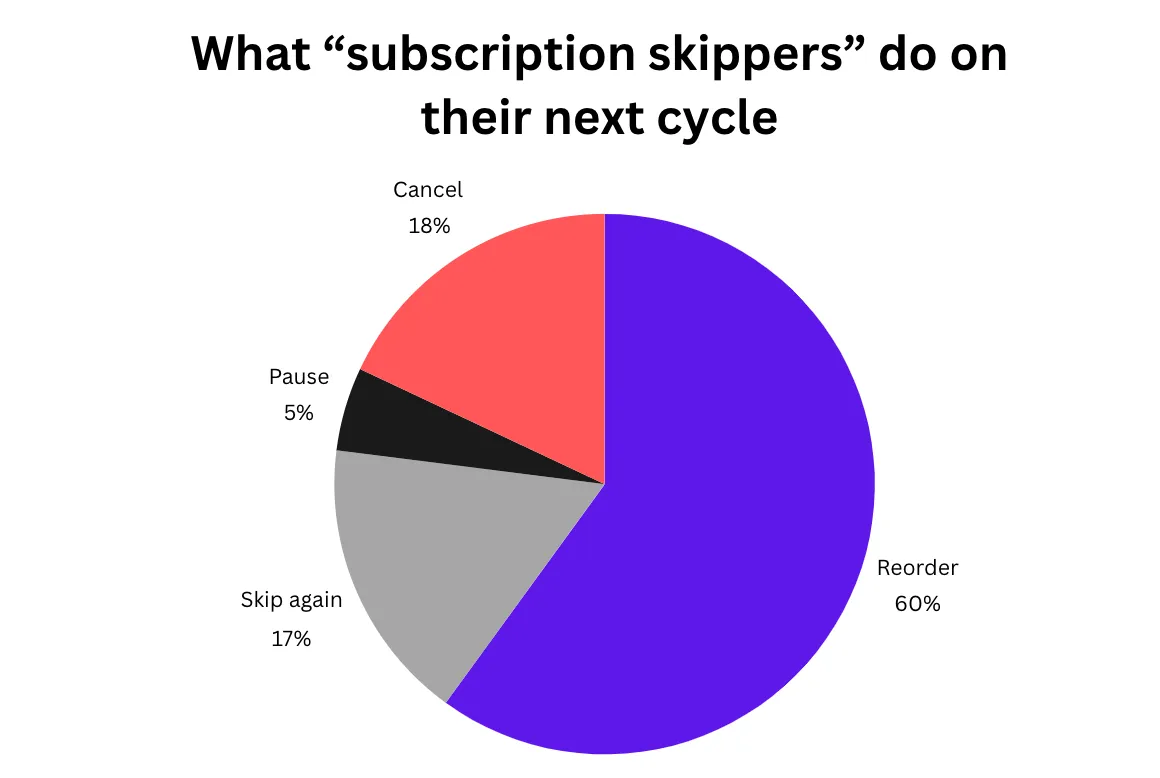
No Limit Email's data: 60% of skippers reorder on the next cycle. 18% cancel. The ladder of skip, delay, frequency and swap is in The Flexibility Ladder.
Tell them before every charge
74% say recurring charges are easy to lose track of. So send a reminder before every charge, with what the product is doing for them first and the billing fact at the bottom. How to write it is in The Upcoming Billing Reminder.
Keep "cancel anytime" out of the headline
Flexibility to cancel scored 12 on replenishment, fifth of six reasons. Never open with it. You are reminding people to cancel before they have a reason to. Put it next to the button and in the FAQ.
When they leave, leave the door open
When a subscriber cancels, offer one-click reorders, not a goodbye. They still want the product. Paul Chambers of SubSummit: "The brands winning now are the ones giving customers a way to come back without a commitment." How to bring them back is in Subscription Winback.
For context on where you stand, IM8 converts 79% of new customers to subscription on the first order, and most health brands treat 40 to 50% as a win. The rest of the numbers are on Subscription Benchmarks.
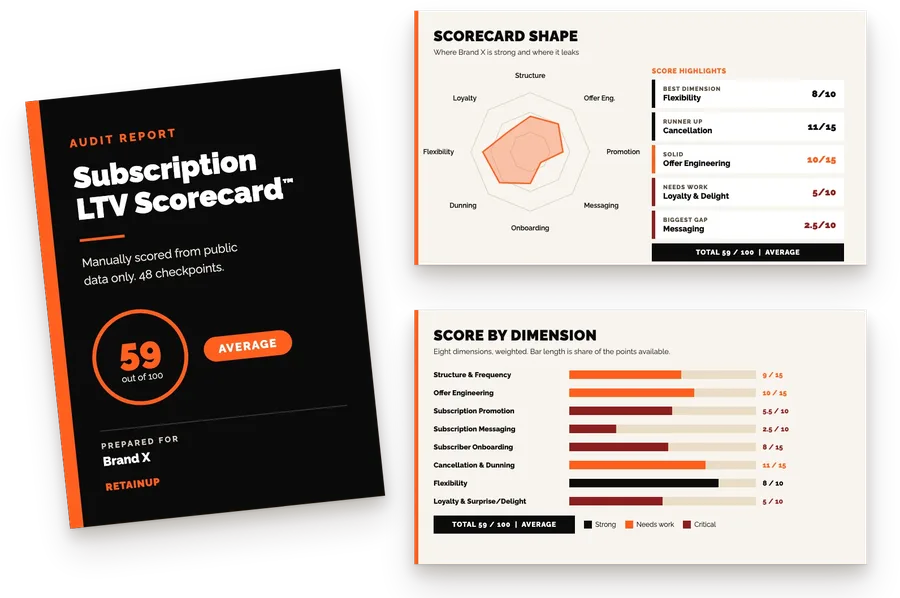
If you want these barriers answered on your own store, the Subscription LTV Maximizer™ builds the offer, the widget, the cancel flow, the portal, payment recovery and pause and skip in Recharge, Skio, Stay AI or Loop, plus email and SMS, live in 30 days for $5,000. Or start with the free subscription audit: 48 checkpoints and your top 3 leaks in 24 hours.
FAQ
Why do customers subscribe to a product?
Money comes first. Financial incentive is the top reason people give for a replenishment subscription, followed by convenience and access to better offers. A friend's recommendation and wanting to try something new matter more for curation boxes. Flexibility to cancel ranks near the bottom, so it reassures people but rarely sells the subscription on its own. Even a small 5% discount can lift enrolment by as much as 104%, per Ordergroove.
Why don't customers want to subscribe?
Most prefer to buy when they need it. In survey data 49% give that reason and 46% say they see no meaningful value in subscribing. Behind both sits the fear of being locked in. A subscription asks for a commitment and a fixed calendar, and many loyal repeat buyers reject exactly those two things while still loving the product. Matching the cadence to real usage removes most of the first objection.
Is subscription fatigue real?
Partly, and mostly outside consumables. Surveys show people underestimate their subscription spend by about 2.5x and 55% plan to cut back, but those surveys include streaming and software. Recurly's 2026 data shows 77% of consumers say they have the right number of subscriptions. For product brands, fewer than 20% of cancellations happen because the customer no longer wants the product.
Does "cancel anytime" increase subscriptions?
It helps a little, but it should not lead. Flexibility to cancel ranks second from the bottom of the reasons people subscribe to a replenishment product. Leading with it reminds buyers to cancel before they have a reason to. Put the saving and the convenience first, and place cancel anytime next to the button as a plain line of reassurance.
Why do people cancel a subscription they still like?
Usually timing and friction. Too much product piles up, the routine changes, or results haven't shown yet. Churned's 2026 report puts disengagement at 48% and changed routines at 26.5%, with price at just 7.4%. Recurly found "not using it enough" was the top cancel reason at 51%. Skip, delay and frequency changes fix most of this before the cancel button.
One email a week on subscription retention: the numbers, the strategy, and what to fix first.

Rahi Jain
Rahi Jain is a subscription LTV specialist who helps $1M to $10M DTC brands reduce subscription churn and maximize LTV on Recharge, Skio, Stay AI and Loop.
More about Rahi