Key takeaways
- Across 6 subscription brands, 60% of skippers reorder next cycle and 18% cancel, so every skip deserves its own email.
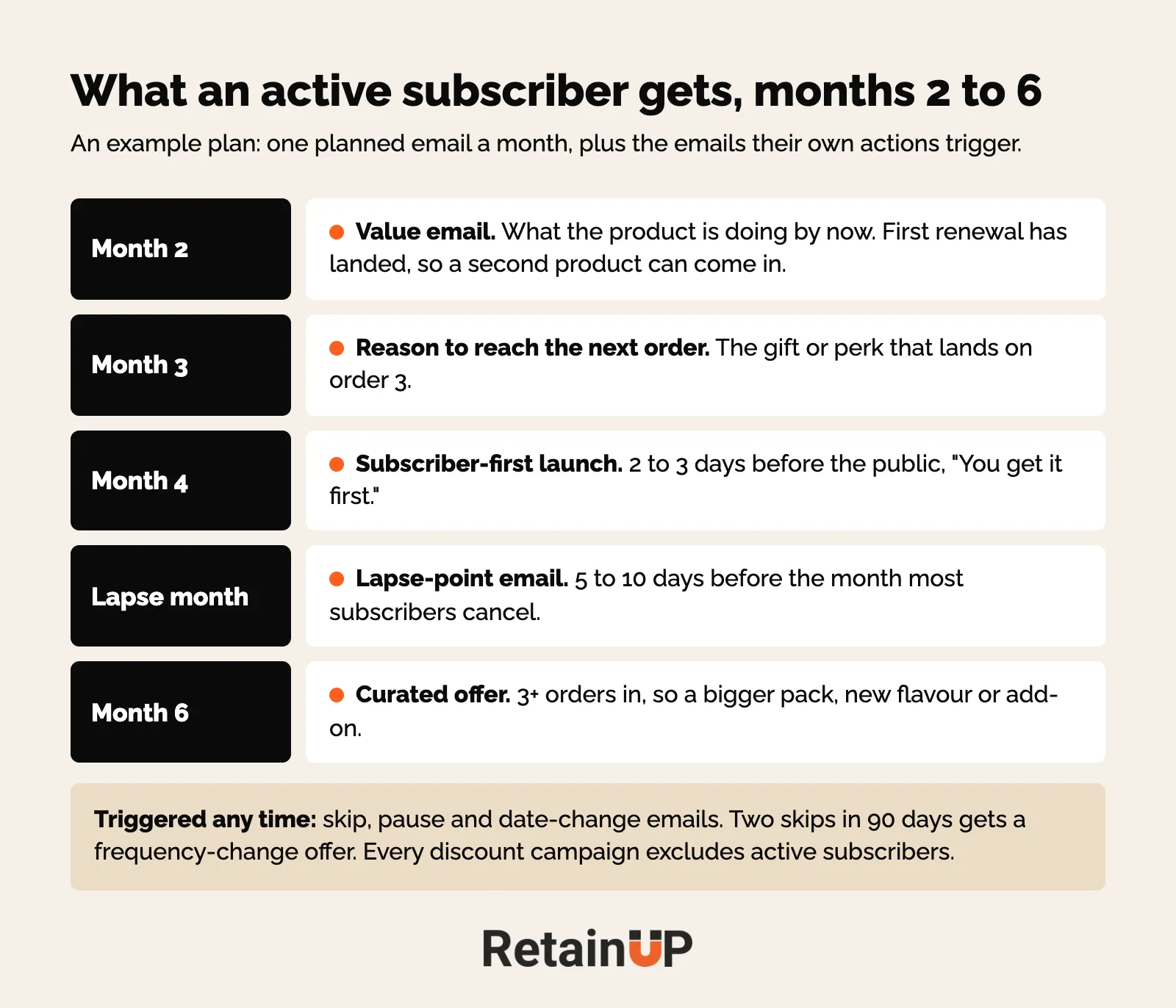
- Active subscribers need about one email a month after onboarding: value, one new product, or a reason to stay for the next order.
- SMS costs 10 to 20 times an email, so use it where speed matters: failed payment day 1, the renewal reminder, winback.
Onboarding ends. The welcome emails stop. And then nothing happens for months, apart from a charge and a billing reminder.
That gap is where cancels build. Nobody complains. The subscriber just has three bottles in the cupboard and a card statement they've started to notice. This article is part of the subscription retention hub, and it covers what to send a subscriber between month 2 and month 6, how often, and when a text does the job better than an email.
Why months 2 to 6 are where cancels build
Open any cohort table. The first renewal is the biggest single drop, and that's where 30 to 40% of a cohort usually goes. By order 3, about half is gone. After that the curve flattens. The survivors tend to stay. The order-by-order view is in getting past order 2 and order 3.
So the middle months decide the shape of the whole curve. And it's exactly when most brands go quiet. Onboarding covered month one. The billing reminder covers the three days before a charge. Everything in between is silence, or worse, the same sale emails the rest of the list gets.
Recharge and Skio handle billing. Not retention. The lifecycle around the charge is your job.
How often to email an active subscriber
I'll be upfront, I still go back and forth on this one. But my view is you should not email existing subscribers much. They already buy every month. Every extra send is one more chance to remind them they could stop.
For an active, paying subscriber, I keep it to the minimum. Exclude them from everything else, and send about one email a month. Each one does one of three jobs:
- Value realisation. What the product is doing for them by now, and why it's worth carrying on.
- Cross-sell. One product to add, never in month one.
- A paid reason to continue. The gift or perk that lands if they reach the next order.
And control it tightly for the first 6 months. That's where the cancels are.
The value email is the one brands struggle to fill. It doesn't need a product in it. In Klaviyo's write-up on subscription brands, Universal Yums sends recipes and music picks tied to the country in that month's box. For a supplement, it's the routine, the results they should notice by now, or a customer who has been on it for a year.
Magnet Monster splits the list into three buckets, and it's the cleanest way I've seen to say who gets what:
| Bucket | What they get |
|---|---|
| Prospects, one-time buyers, lapsed subscribers | All your content and campaigns |
| Active subscribers, orders 1 to 3 | Onboarding only |
| Active subscribers with 3+ orders | Curated offers |
The money's in bucket 3. Somebody on their 6th order has stopped asking whether it works. They'll take a new flavour, a bigger pack or an add-on. How to pick that next product for each SKU is in add-ons, cross-sell and upgrades.
Write to the order number
Order 2 is the most vulnerable point. Order 4 is mostly locked in. So the email to someone on their 2nd renewal should read differently from the one on their 6th. One needs reassurance. The other needs reward.
The same Klaviyo piece has Universal Yums sending its upgrade email, a bigger box or a longer plan, between the first and second renewal. That fits the hero-product rule. Nothing new in month one, then the upgrade once the first renewal lands.
Acknowledge every skip, pause and date change
A skip is the moment a subscriber tells you something. Too much product, a holiday, money is tight this month. Most brands answer with a system confirmation and nothing else.
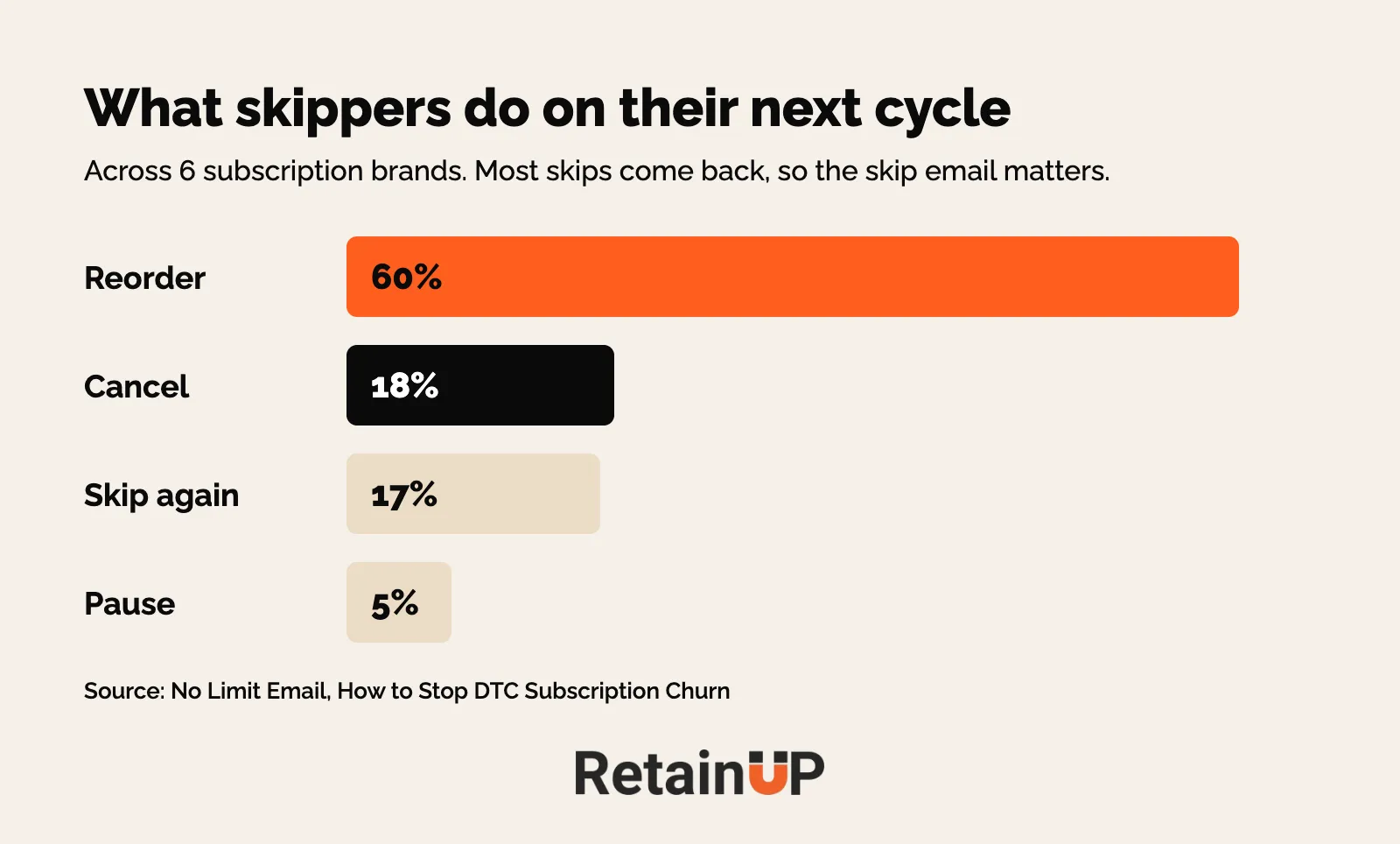
No Limit Email looked at what skippers do on their next cycle across 6 subscription brands. 60% reorder. 18% cancel. 17% skip again, and 5% pause. So a skip is mostly a save, if it was easy. Subscribers who can skip last 135% longer than those who can't. And the 18% who cancel next time are the ones your skip email can still reach.
The skip email
Write it as loyalty, not escape. "Take a month off, your subscription stays active." Then show the new ship date, and one line on what's coming in the next box. Put the portal link and a support contact in it too. Skio's own best-practice list asks for both on every subscriber notice, and it's the easiest way to make people find the portal.
Don't add a discount to a skip. It trains people to skip for a deal. A frequency offer works better: "Skip this one, want us to ship every 6 weeks instead of 4?" That turns a one-time skip into a fix.
Two skips in 90 days is the trigger I use. Build a segment for it and send a one-click frequency change, before they get anywhere near the cancel button. The full ladder of skip, delay, frequency, swap and pause is in the flexibility ladder.
The pause email
Our recommendation is no pause at all, since skip and delay already cover it. If a brand keeps it, cap it at 90 days. 40 to 60% of paused customers churn within 90 days (Buyology), so treat a pause as an early warning.
If you do allow it, the emails do most of the work:
- A confirmation with the resume date as the biggest thing on the page.
- A check-in halfway, around day 30 of a 60-day pause: "Confirming you're still planning to resume on [date]."
- A reminder 3 days before it resumes, with one click to edit or extend.
Of the three, the 3-day pre-resume reminder is the one that keeps the most people.
Date and frequency changes
A reschedule needs a short confirmation and the new date. That's it.
One thing to check on all of these. If Recharge or Skio still sends its own skip and pause notices, turn them off once your Klaviyo flows are live. Both apps say so in their Klaviyo guides, and otherwise the subscriber gets two emails for one click. Which event triggers which flow is in subscription app events in Klaviyo.
A frequency change is different. No Limit Email found 90% of subscribers who update their frequency stretch it out. That usually means they like the product and aren't using enough of it. So within a week of the change, it's a good time to show a second product they could add to the same box.
The lapse-point email
Every brand has a month when subscribers typically cancel. Find yours in the cohort table. Then send one email 5 to 10 days before it, with a free gift, a perk or a strong reminder of what they get by staying.
Most brands never build it. It's a single trigger. A reward at the right time beats any win-back campaign after they've already gone. If you run milestone gifts, this is where the next one gets announced. Some brands count them by shipment instead of month. Swanky's Recharge and Klaviyo guide uses the 5th, 10th and 20th shipment. The gift schedule itself is in subscription rewards.
Two copy habits help here. Sell years, not weeks. AG1 uses testimonials like "I've been taking AG1 since 2012", not "I felt better in a week", because fast-result copy attracts people who try and cancel. And anchor the price to a day. $90 a month feels expensive. $3 a day does not.
New launches and perks go to subscribers first
Month one is hero product only. Every email drives use of what they already bought. After the first renewal lands, you can start introducing other products.
From there, launches are the easiest monthly email you'll write. Send subscribers a campaign 2 to 3 days before any public launch or promotion, with a subject line that makes it clear, like "You get it first." Grüns does the best version I've scored. A new limited flavour lands roughly every 6 weeks, and subscribers can swap their next box to it. That gives people a reason to want the next delivery. How to build and pitch these subscriber-only sends is in subscription promotion campaigns.
Plain-text check-ins from a real person
Not every monthly email needs a product in it. Nick Shackelford's team at BREZ sends plain-text emails from the founder, from support and from product. One went out from their brand manager as a teaser for an offer about to drop. You couldn't even buy anything in it. It did $40K.
We do a version of this with our brands. Create two personas, the straight-shooting founder and the over-concerned support person. Give each a name, an email address and a photo. Then automate short, two-line emails like "Need help? Everything good?"
They open conversations. And replies help your spam rate. BREZ fixed theirs by asking people to send in their favourite mocktails to be scored.
Keep subscribers out of your discount campaigns
As Matthew Holman put it: "Your 50% off sitewide sale will cancel your best customers." Subscribe and save runs at 20 to 25% all year. Then a sitewide 40% lands in the inbox of someone already paying full subscription price.
So exclude active subscribers from every discount send. Loyalty and points flows too, because that's where a points code slips through to someone already on 20% off. You can suppress the email, though not the site or the ads, so the subscriber should hear about the sale first, as an add-on to their next order. The suppression rules for every flow are in keeping discounts away from your subscribers.
Where SMS beats email for subscribers
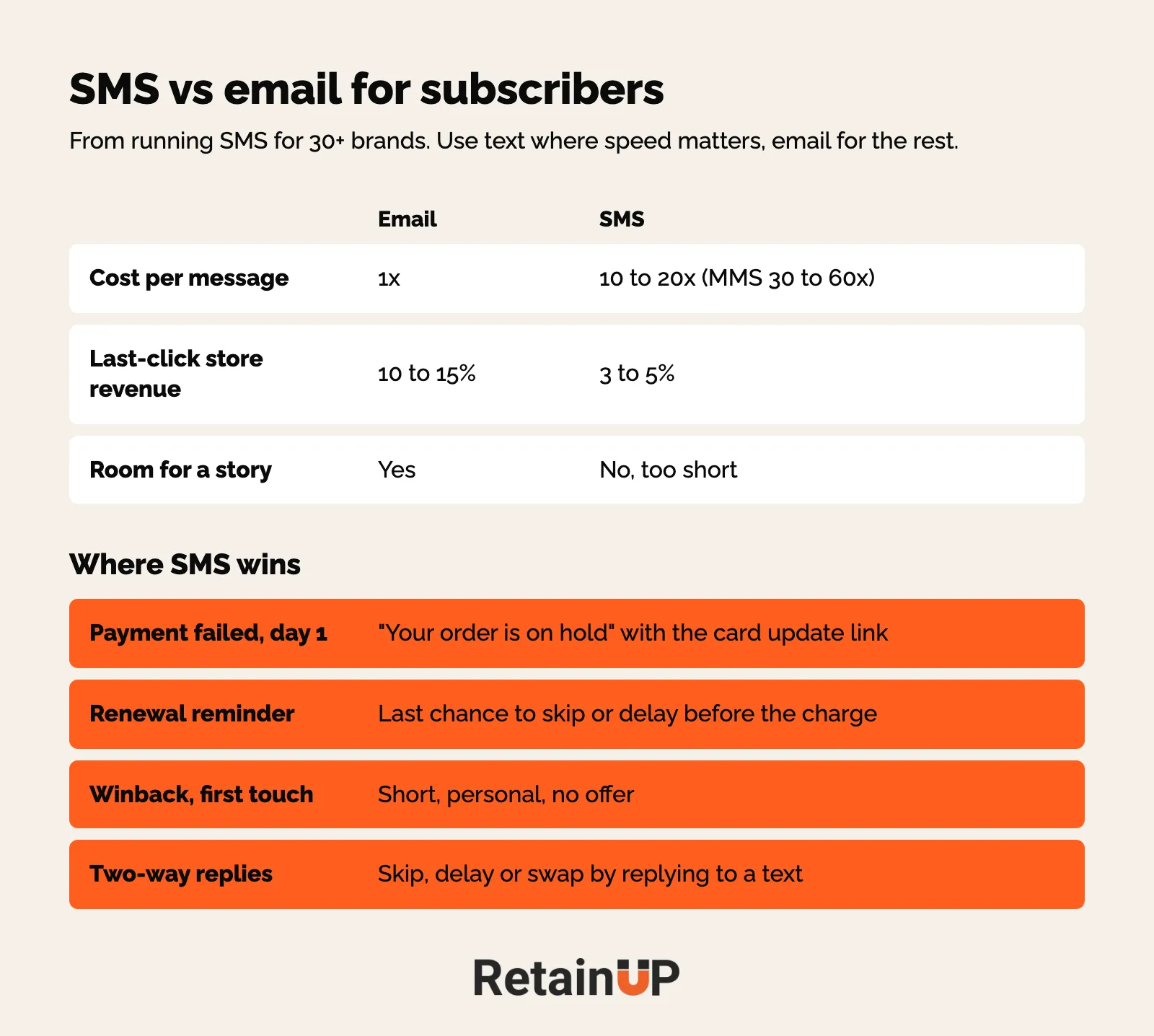
I've run SMS for 30+ brands, and for most marketing it underwhelms me. It's the costliest one-to-one channel. An SMS costs 10 to 20 times an email, an MMS 30 to 60 times. It's too short to tell a story. In my experience it brings 3 to 5% of last-click store revenue, where email brings 10 to 15%.
But it wins when the message is urgent or important, and the audience is small and targeted. For a subscription brand that means three places. Day 1 of a failed payment, when the order is on hold. The renewal reminder, the last chance to skip or delay before the charge. And the first touch of a winback, because plenty of people who unsubscribe from email still read their texts.
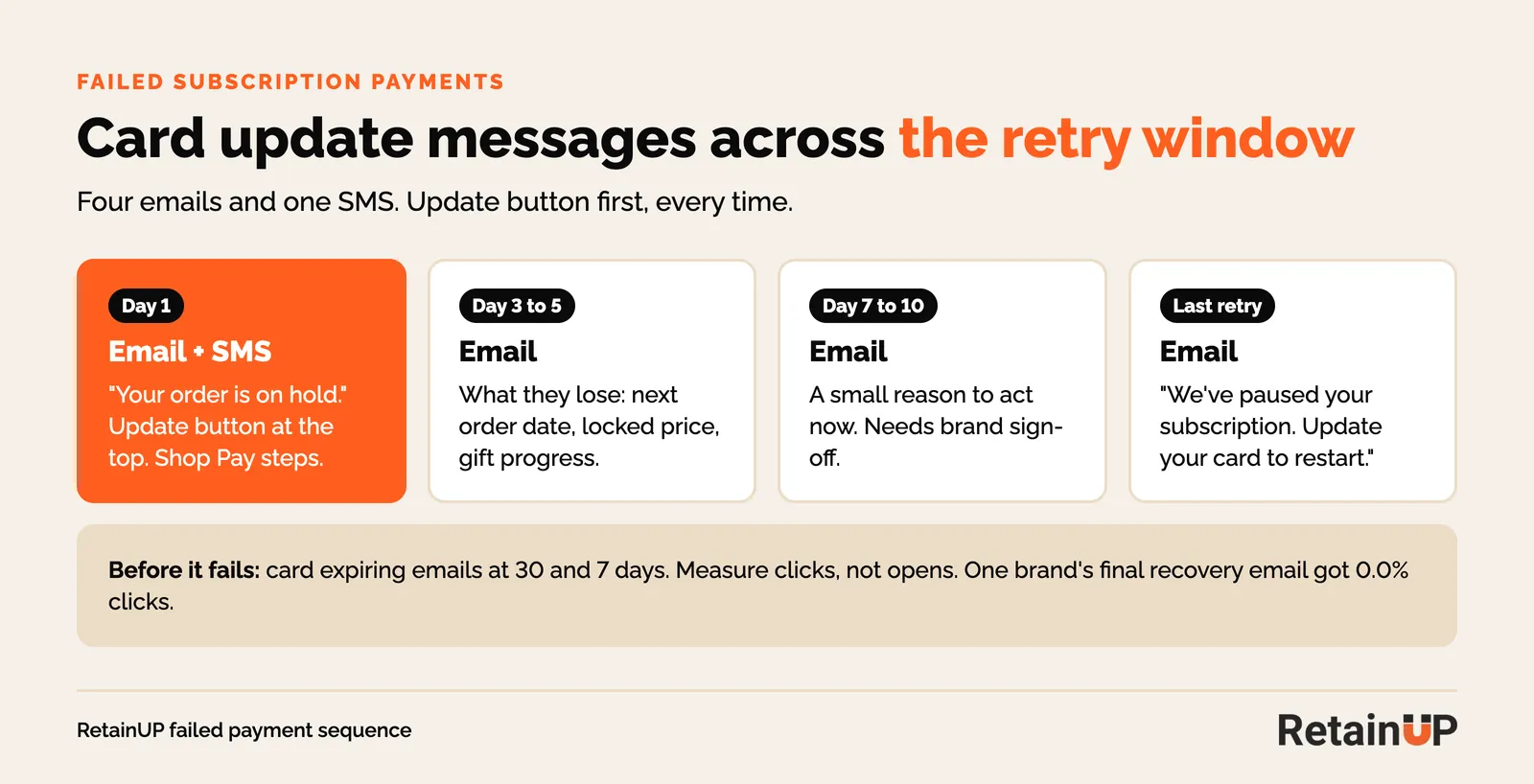
On a failed payment, we send four emails and one SMS across the retry window, with the update button at the top of every one. The SMS goes on day 1, next to the first email. Short and plain. The rest is in failed payment recovery.
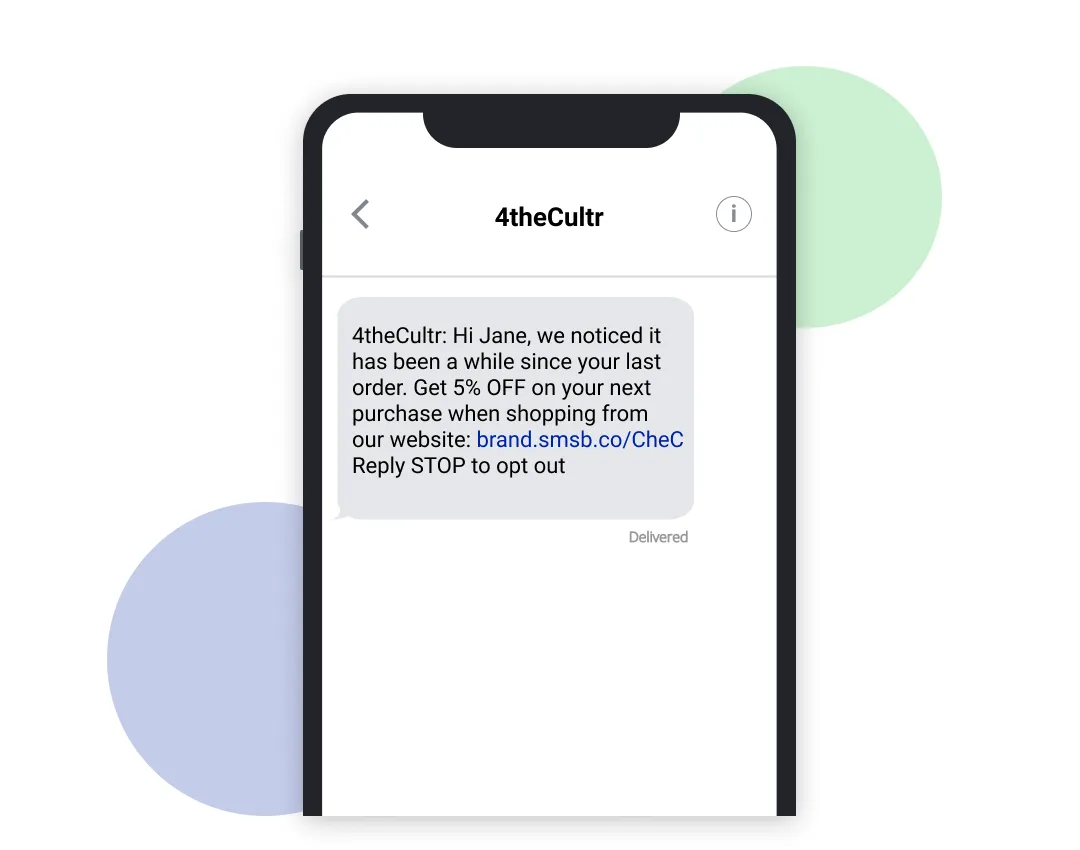
For winback, our order is SMS, then an email on value with no offer, then an email with a time-bound incentive. Customers live on email, SMS, social and apps. Plenty unsubscribe from marketing email and still buy. The rest of the winback build is in subscription winback.
Two-way replies to skip, delay or swap
SMS is a two-way channel. And that's where it does something email can't. Grüns runs Skio with Postscript, and subscribers can swap their next box to a limited flavour by replying to a text. No login, no portal.
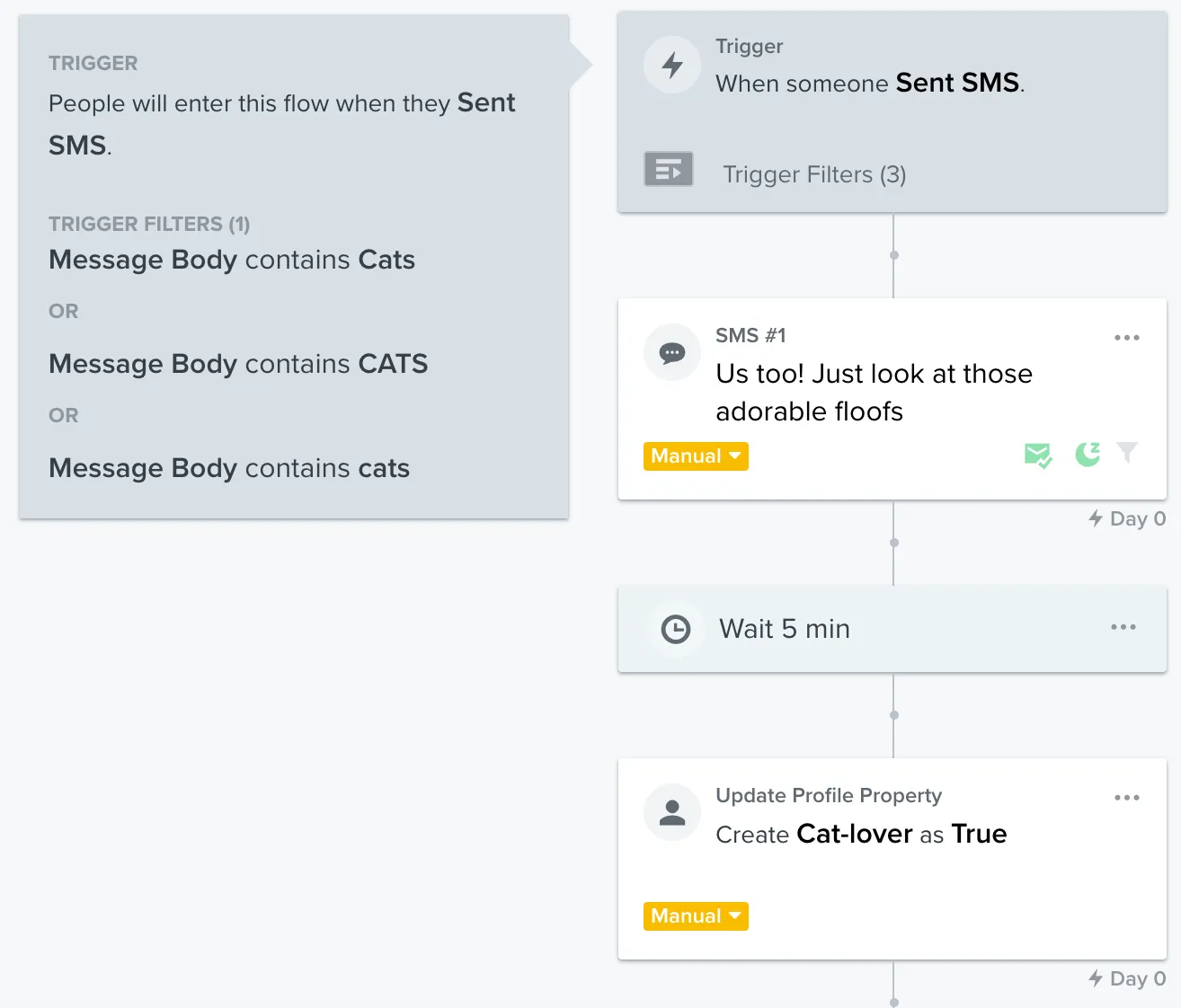
The same keyword logic works for skip and delay. A reply triggers a flow, the flow updates the subscription. Plan for the replies that don't match a keyword, though. People will text back. Route them into your helpdesk, answer fast, and don't let it sound like a chatbot.
Email can do part of this too. Recharge Quick Actions and Zaymo put skip, swap and add-on buttons inside the email, so nobody logs in. More on that in Zaymo for subscription brands.
Keep SMS and email from stacking
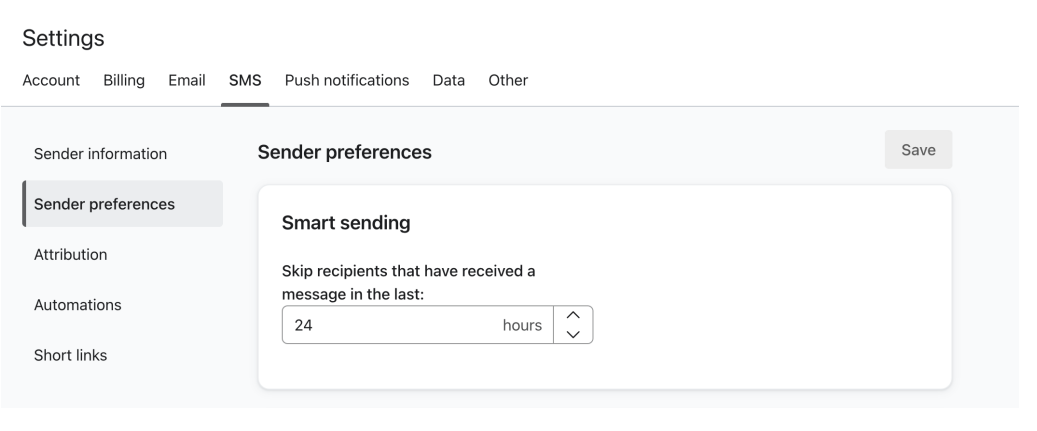
Klaviyo's SMS Smart Sending defaults to 24 hours. Fine for campaigns. On subscription flows it can quietly skip the one text you needed sent, like the day-1 payment message. So stagger the two channels, or turn Smart Sending off on subscription flows.
If you'd rather have this built than build it, the Subscription LTV Maximizer™ sets up the offer, widget, cancel flow, portal, payment recovery, pause and skip in Recharge, Skio, Stay AI or Loop, plus the email and SMS around them, the skip and pause emails included. It goes live in 30 days for $5,000.
FAQ
How many emails should I send active subscribers?
About one email a month once onboarding ends, plus the billing reminder and the emails triggered by a skip, pause or date change. Keep subscribers out of your general campaigns. Each monthly email should do one job: show the value they are getting, introduce one product to add, or give them a reason to reach the next order, like a gift or perk. Control the cadence tightly for the first 6 months, because that is when most cancels happen.
What should a subscription skip confirmation email say?
It should confirm the skip as a normal part of the subscription and show the new ship date clearly. Write it as "Take a month off, your subscription stays active" rather than a system notice. Add one line about what is coming in the next box. Leave discounts out, since they teach people to skip for a deal. If someone has skipped twice in 90 days, offer a longer frequency instead.
Should subscription brands use SMS?
Yes. But only where speed matters. SMS costs 10 to 20 times more than an email per message and is too short for storytelling, so it rarely pays as a general marketing channel. For subscribers it works best on day 1 of a failed payment, on the renewal reminder before a charge, and as the first touch of a winback. Two-way replies for skip, delay or swap are where it beats email outright.
Which Klaviyo flows prevent churn for active subscribers?
The skip, pause and date-change flows, plus a lapse-point email and a two-skips-in-90-days flow. Each one runs off an event your subscription app sends to Klaviyo, like Subscription Skipped in Skio. The skip email confirms the new date, the pause flow reminds people 3 days before they resume, and the lapse-point email lands 5 to 10 days before the month most subscribers cancel. Exclude active subscribers from discount campaigns in the same setup.
One email a week on subscription retention: the numbers, the strategy, and what to fix first.

Rahi Jain
Rahi Jain is a subscription LTV specialist who helps $1M to $10M DTC brands reduce subscription churn and maximize LTV on Recharge, Skio, Stay AI and Loop.
More about Rahi