Key takeaways
- Across 9 brands audited in 2026, a median 73.6% of subscribers reached order 2 and only 45.6% reached order 3.
- Subscribers last 135% longer when they can skip and 71% longer when they can swap, so both belong before the cancel button.
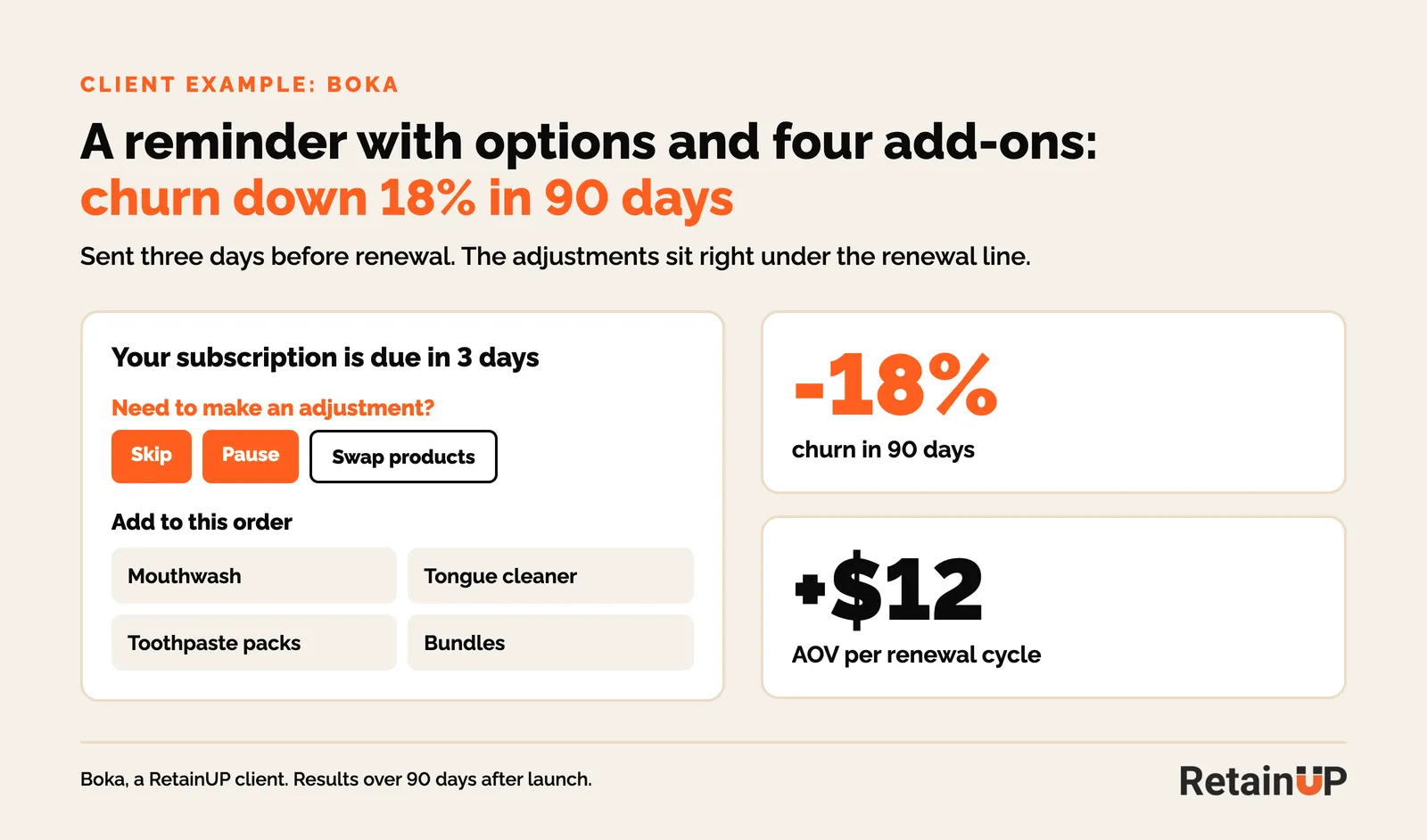
- Boka's billing reminder, with skip and swap options and four add-ons, cut churn 18% in 90 days.
Onboarding ends. The welcome emails stop. And then, at most brands, nothing happens for months apart from a charge and a billing reminder.
That gap is where cancels build. Nobody complains. The subscriber just has three bottles in the cupboard and a card statement they've started to notice.
This hub covers what keeps a subscriber once month one is behind them: the renewal moment, the small exits before the big one, the portal, rewards, more value per order and the emails in between. It picks up where subscriber onboarding leaves off. And it stops at the cancel button. Everything from the cancel click onward, plus failed cards, lives in reduce subscription churn.
Order 3 retention is the number this hub moves
Risk changes with every charge, not every week. Two March signups are in different places if one is monthly and the other quarterly. Recharge looked at 65.1 million subscriptions. Lifetime churn was 84.2% on monthly plans. On quarterly ones, 67.7%.
Across 9 subscription brands audited in 2026, a median 73.6% of new subscribers reached order 2 and only 45.6% reached order 3. Most of the loss happens at the second and third charge. No habit exists yet. Recharge's 2026 supplement data, about 1,750 brands, lands in the same place. 75.2% paid order 2. 49.1% paid order 3.
Open any cohort table and you see the same thing by month. Month 1 to month 2 is the biggest single drop. Month 2 to month 3 is the second biggest. After that the curve flattens. The survivors tend to stay.
So the target for everything on this page is order 3 retention. By order 4, the habit is either formed or it is not. What good looks like is on subscription benchmarks. Where your own drop lands is in getting past order 2 and order 3.
Count it one way. Subscribers who paid order 3, divided by subscribers who paid order 1, same cohort. Not the returning customer rate on your Shopify dashboard. Polar Analytics shows one brand at 85% on a 12-month lookback and 41% all-time. Same customers. Every formula and what it hides is in how to calculate subscription retention rate.
One rule runs through every section below. Write to the order number, not the calendar. Order 2 needs reassurance. Order 6 needs a reward.
The renewal moment: the upcoming billing reminder
The upcoming billing reminder is the email your subscriber gets a few days before every charge. It is one of the most opened emails in your whole program. In month one, usually the most opened.
It is also the most misunderstood. Many brands don't even want to send it, because they feel it reminds people to cancel. They are partly right. At one brand, day 27, reminder day, had almost four times the cancellations of day 26.
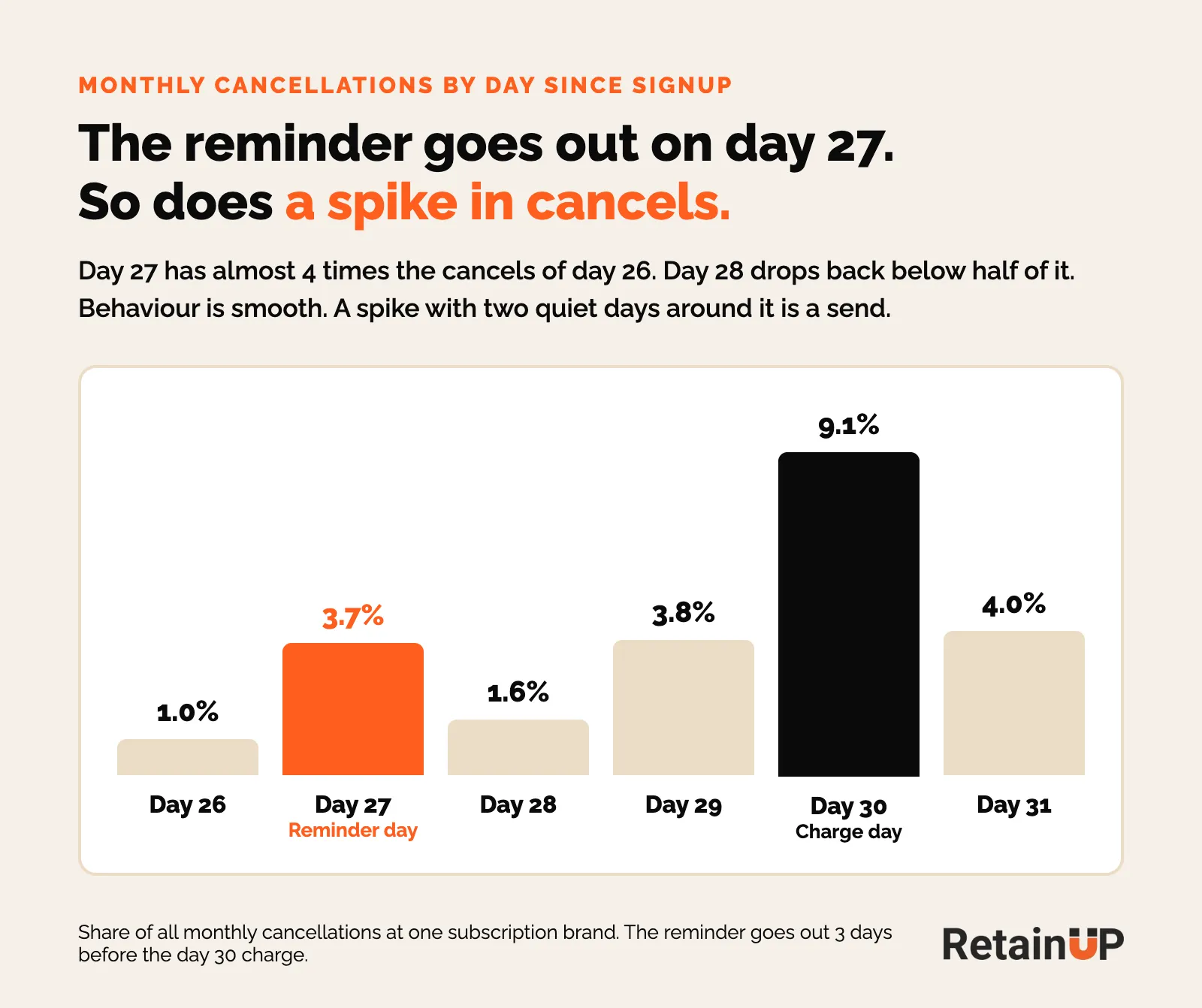
Behaviour doesn't do that. It's smooth. A spike like that is a send.
So the answer is not to delete it. Day 30, the charge day, was still the biggest day, with 9.1% of every monthly cancellation, and that is the day of surprise charges. Keep the email. Change what it says.
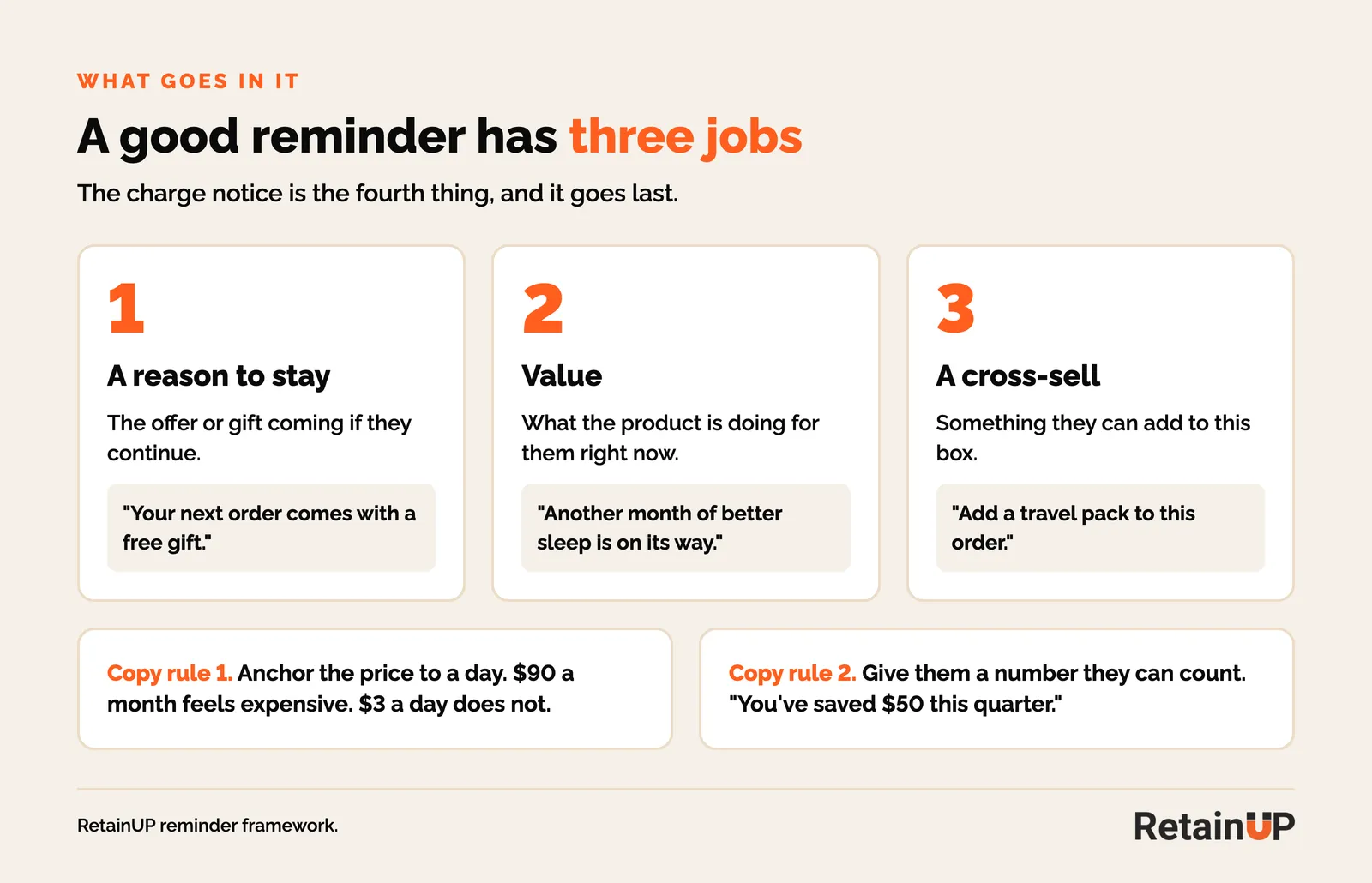
A good billing reminder has three jobs: a reason to stay, value, and a cross-sell. The amount, the date and a card update link go at the bottom, as Omnisend suggests. An expired card gets fixed before the charge fails. If you say "You're about to be charged", don't be surprised when people cancel. You have written a bill and attached a cancel button.
Skip and reschedule should be the main buttons on the page. Cancel stays available. It just stops being the easiest thing on the page. For Boka, the reminder goes out three days before renewal, and right under the due date we wrote "Need to make an adjustment?" Below that sit four add-ons: mouthwash, tongue cleaner, toothpaste packs and bundles. Churn went down 18% in 90 days, and AOV went up $12 per renewal cycle.
Send it 3 to 5 days before the charge. Then test. And never judge it by the day it goes out. At the brand above, days 27 to 34 held 27.1% of every monthly cancellation, and that week is the number to move. Max Sturtevant tracks the pre-rebill cancel rate. At his client, a reframed reminder took it from 10 to 12% to about 3%.
The versions for order 2, 3 and 6, the Klaviyo build and both measures are in the upcoming billing reminder.
Small exits before the big one: the flexibility ladder
Run this test on your own program. It takes a minute. Open your upcoming-order email and count the clicks to skip the order. Now count the clicks to cancel.
Most brands come out at four or five clicks to skip and one to cancel. Cancel gets a link in the footer, and skip is buried two screens into the portal.
Jeremy Horowitz has the other half: 60% of subscriber churn isn't real. The customer wanted to skip. You gave them a cancel button.
So the options go in order. Cheapest first. Reschedule when the timing is wrong. Skip when there is too much product. Change frequency after two skips. Swap when the product is the wrong fit. Pause last, if at all, then discount, then cancel.
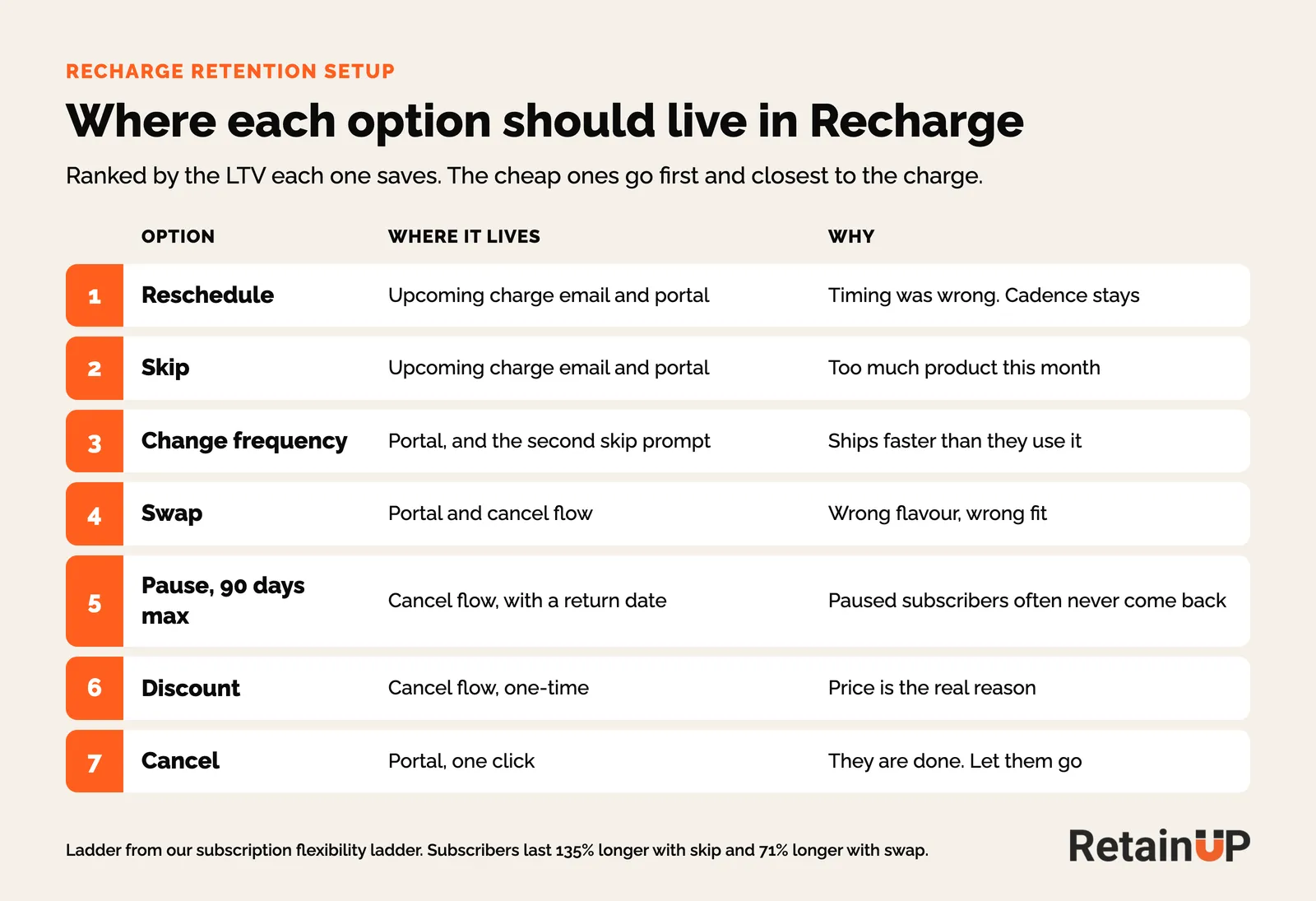
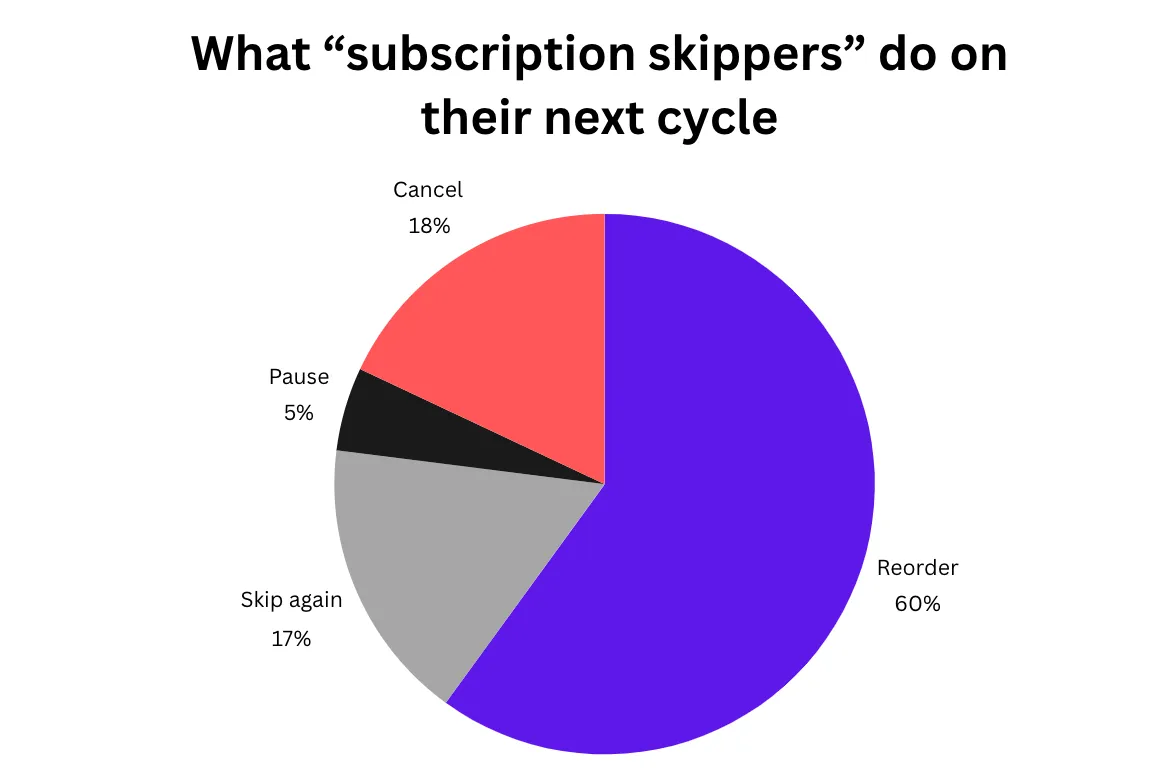
The numbers are not close. Subscribers last 135% longer when they can skip an order. 71% longer when they can swap. And a skip is a decent outcome. Across six subscription brands, No Limit Email found 60% of skippers reordered on their next cycle, 17% skipped again, 5% paused and 18% cancelled. Recharge's supplement data is close: 59% of skips were followed by another order, against 78% after a processed order. So a serial skipper is weaker than the dashboard says.
Pause is where we part ways with most brands. Our recommendation is no pause. Skip and delay already do the job. 40 to 60% of paused subscribers are gone within 90 days. If the brand wants to keep it, the maximum is 90 days, always with a resume date.
Two skips in 90 days means the cadence is wrong, not the timing. Trigger a frequency-change offer then, not in the cancel flow. Overstock is big. Ordergroove found it caused 27% of subscription cancellations across its merchants from 2023 to 2024.
Every rung, its guardrails and where each one should live are in the flexibility ladder. Whether your own skip and pause rates are healthy is a diagnosis question, answered in skip and pause analysis.
The customer portal people only open to cancel
Most people visit the customer portal to cancel. That's the only reason they log in.
So they never see the skip, the swap, the milestone or the add-ons until the exact moment they have already decided to leave. A subscriber who knows the skip button exists before they need it will use it. One who finds it while cancelling is already halfway out.
Ordergroove cites McKinsey research here: up to 19% of cancellations come from subscribers who didn't know they could change the timing, the product or the frequency.
Get them in early
One email around day 14 saying you can skip anytime, swap anytime, change frequency anytime. The portal link in every shipping and renewal email. Magic link login switched on. A forgotten password is the biggest reason people never open the portal, and the one time they push through it, they are angry and on their way out.
Show progress before the exit
Order matters. Milestone first, then perks that cost you nothing, then cross-sell, then something about the brand, and only then the options. Skio's layout settings let you drag Reward Milestones, Subscription Savings and Products above Shipping and Billing. Most brands leave the default. Moving three blocks is the cheapest portal fix there is.
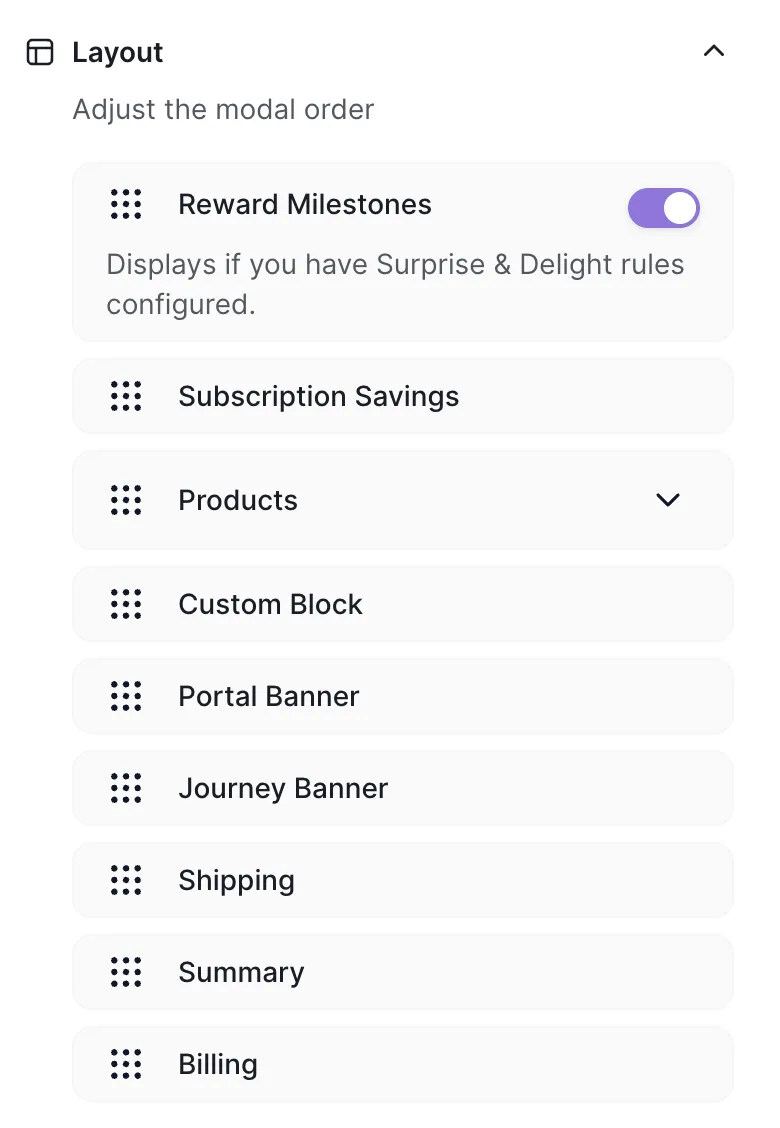
The brands that rebuilt it saw it in churn. A Pup Above added a punch card, and month-over-month churn fell over 20%. Auri built milestone gifts from order 3 into the portal, and active churn fell 21.4%.
Then count the buttons. On one brand we found four that lead out (Skip Order, Re-Schedule, Delay, Cancel) against one real value action, Order Now. If out beats in, the page is a cancel page with extra steps. An upgrade banner is one of the better things to put back in, like the one Dear Apothecary runs for its 90-day supply.
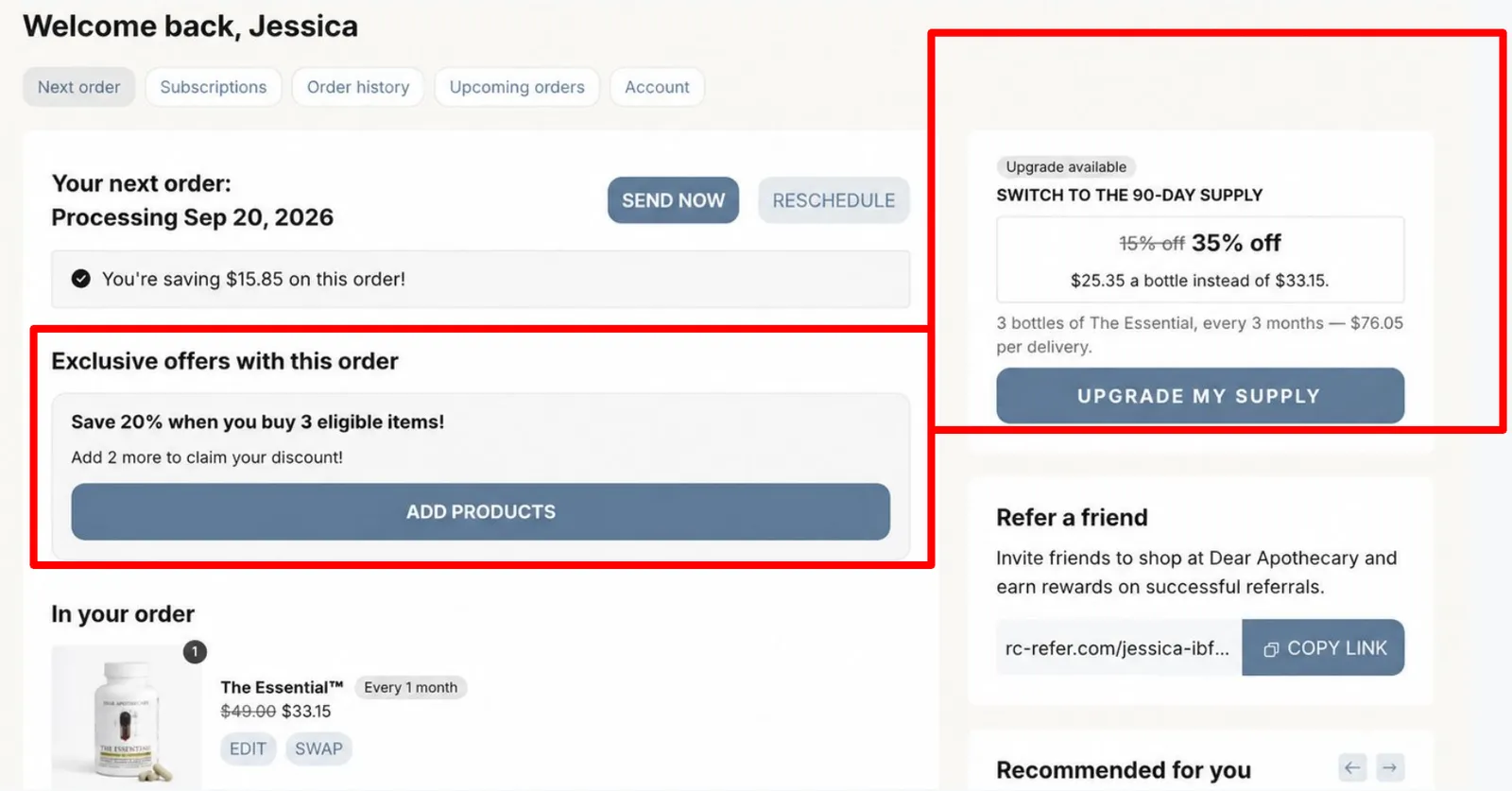
The Home tab layout we use, what to remove, where social proof helps and what Recharge, Loop and Skio let you build are in the subscription customer portal.
Rewards that land on the right order
Most retention offers are sent on a calendar. The right ones are sent on an order number.
We tested it at a supplement brand. Subscribers with an order due within 5 days were split in two. One group was told, by email and SMS before the order processed, that a free gift would be in their next box. No discount. No price change. That group converted 85% more than the group told nothing.
At order 3 the lift was 15%. At order 4 there was no measurable difference. It is one brand and one test, so run your own split before you roll it out.
So the gifts go where the decision happens: order 2, order 3, then 6 and 12. Nothing at orders 4 and 5, because the habit is forming and a reward in every box creates discount dependency in your most loyal cohort. Your own cohort table can move a rung. Skio's rule of thumb: wherever retention drops more than 10% from the order before, that order gets an announced reward.

And show the roadmap before they subscribe. A surprise can't keep anyone, because they didn't know it was coming. Everyday Dose lists its gifts by month on the product page, each with the price it would cost.
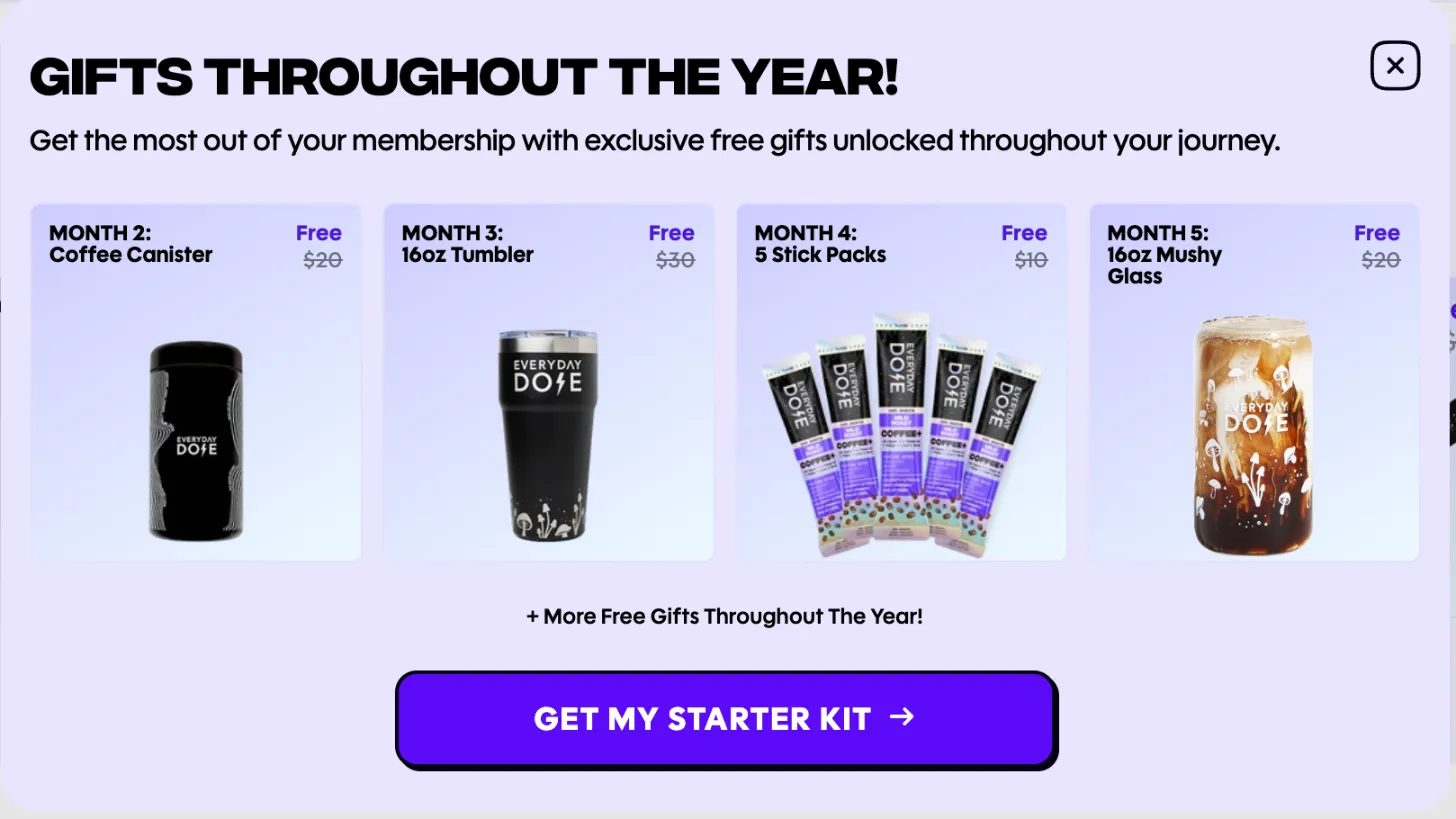
When we fixed onboarding, gifts and milestones for one supplement client, order 1 to order 3 retention went from 61% to 73%. That was the whole package, not the gifts alone.
Streaks, limited drops, where rewards backfire and the setup per app are in subscription rewards: milestones, gifts and streaks.
Loyalty programs that fight the subscription
Subscription programs killed loyalty programs. Brands just haven't realised it yet.
If your customer subscribes, they have already committed to repeat purchases. A points program on top is redundant for most of them. And when both run side by side, they fight in three places.
Points that cannot pay for the subscription
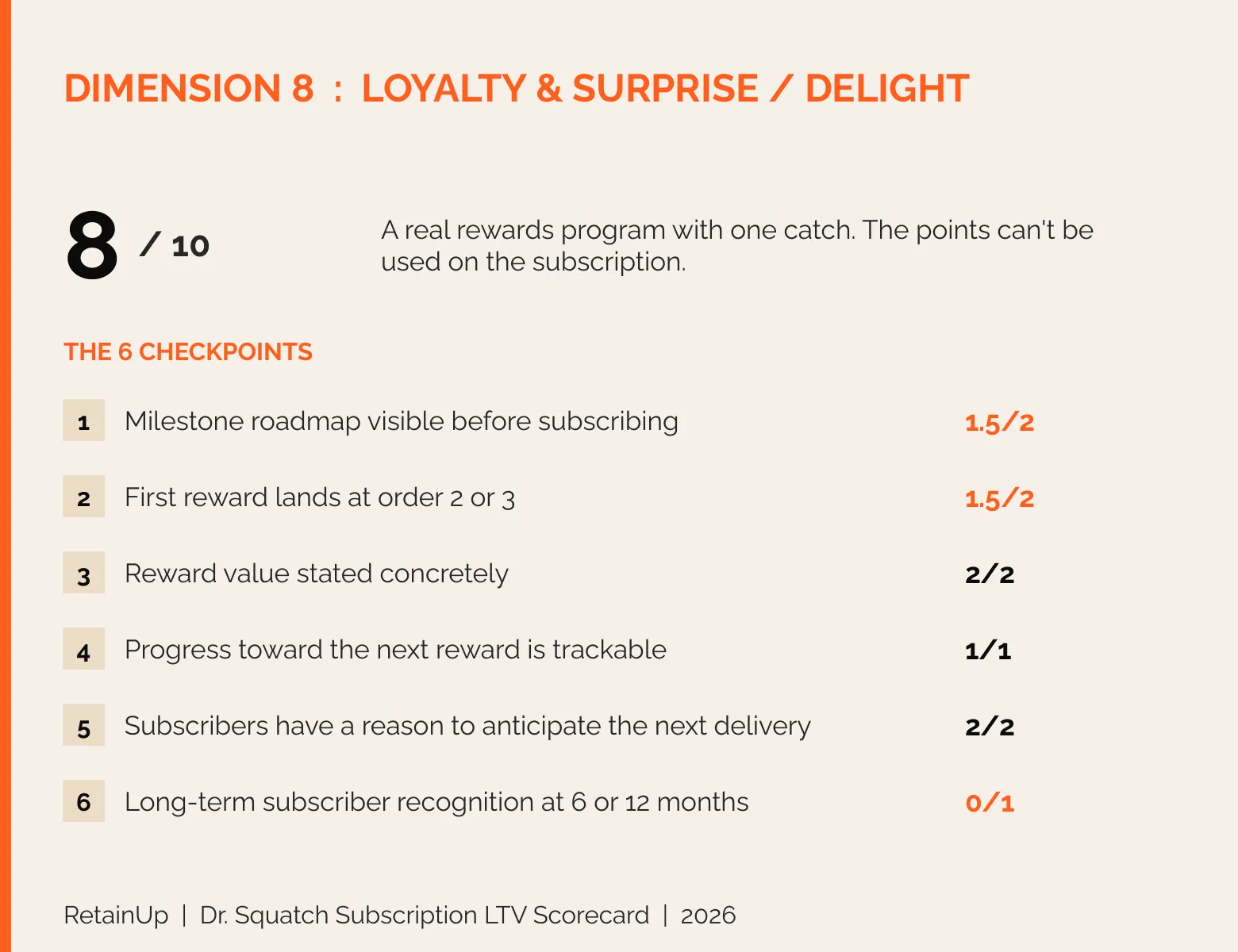
Dr. Squatch has a real rewards program. 50 points is $5 off, up to 300 points for $30 off. And then the help centre says points can't be used on subscription orders, the one thing a subscriber pays for every 3 months. We see the result in client data too: people cancel the subscription to spend their points, then subscribe again.
Loyalty emails and a second discount rate
At one of our brands, 2 of 3 sampled subscribers got the loyalty discount reminder 3 times in 5 weeks, on top of their 20% subscription discount. It is one filter in Klaviyo. At another, the loyalty app ran at 15% while the subscription was 20%. Subscribers don't do maths on that. They see two discounts and assume one of them is the real deal.
If you keep both, run rewards through the subscription, not as a separate track beside it. Running both now? Check four loyalty program retention metrics first. Redemption rate is rewards redeemed over rewards issued. Under 20% means it is not working. Then repeat purchase rate, participation rate and revenue per user, members and subscribers side by side.
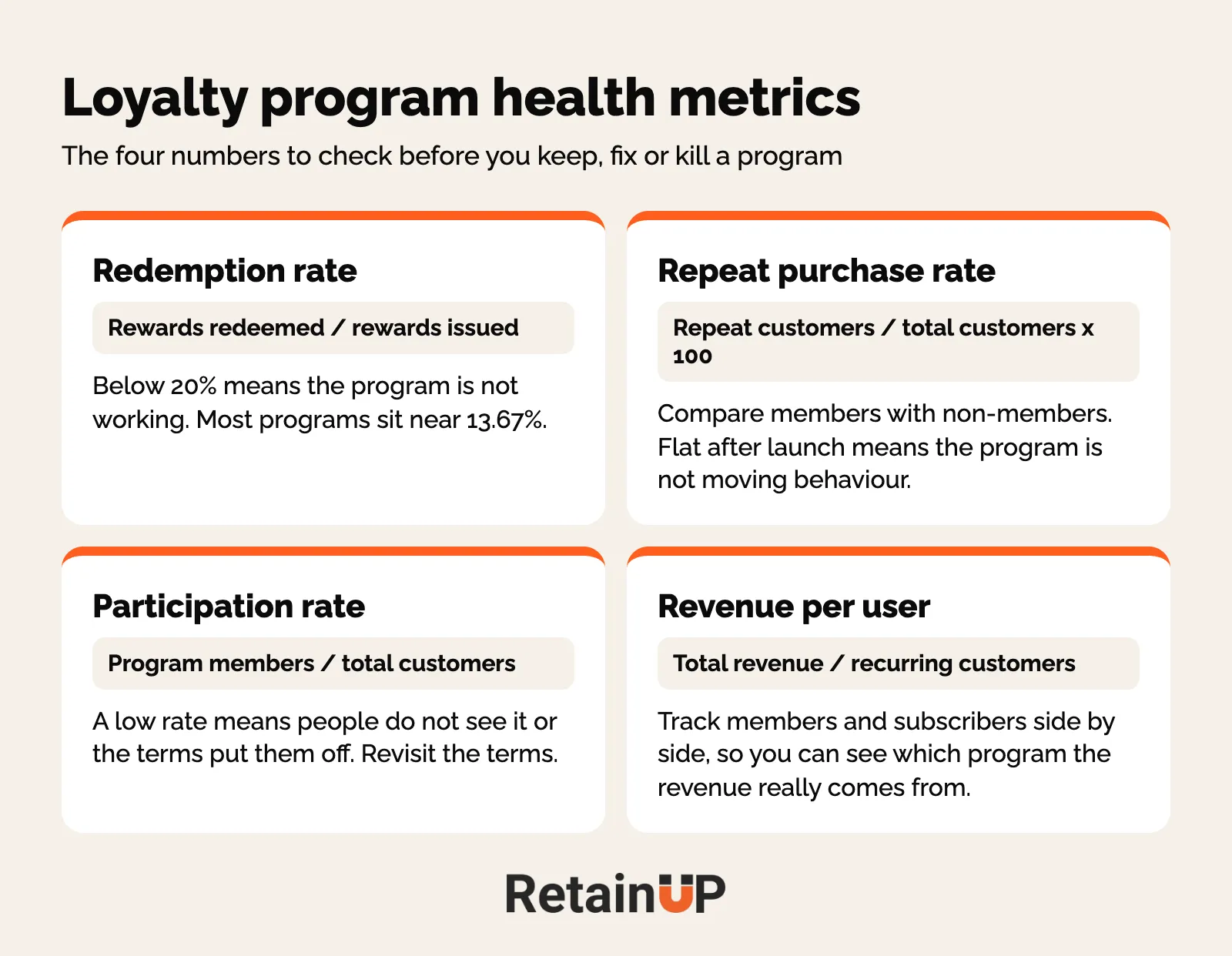
When a points program still earns its place, and the checklist for running the two together, are in subscription vs loyalty programs.
More value per order: add-ons, cross-sell and upgrades
Your best customer for a second product is the one already paying you every month. No ad. No acquisition cost. The box ships anyway.
And most brands send a reminder, a charge and a tracking link. Then the same again next month.
Pack first, catalogue second. A second SKU is more exciting to write and converts worse than a bigger pack of the thing they already chose. So map the tier ladder first, what each subscriber holds and the one rung above it. Then a product map, one named next purchase per product, built from what actually shows up in the same order in your Shopify data.
Three rules keep it from feeling like farming. Nobody is offered what they already hold. Nobody at the top of the ladder is pestered. And nobody gets two flows in the same week; the renewal reminder wins every tie.
Where it goes: the portal, and the billing reminder, where they are already thinking about the next order. In one model we ran, a $20 add-on took order 2 profit from $27 to $41 and moved breakeven from order 3 to order 2. A rough model. But the direction holds. Keep it to the same product family in month one. And under half the price of the core product. Skio puts most brands at 1 to 3% of subscription revenue from cross-sell. It calls 5% the point where it starts to matter.
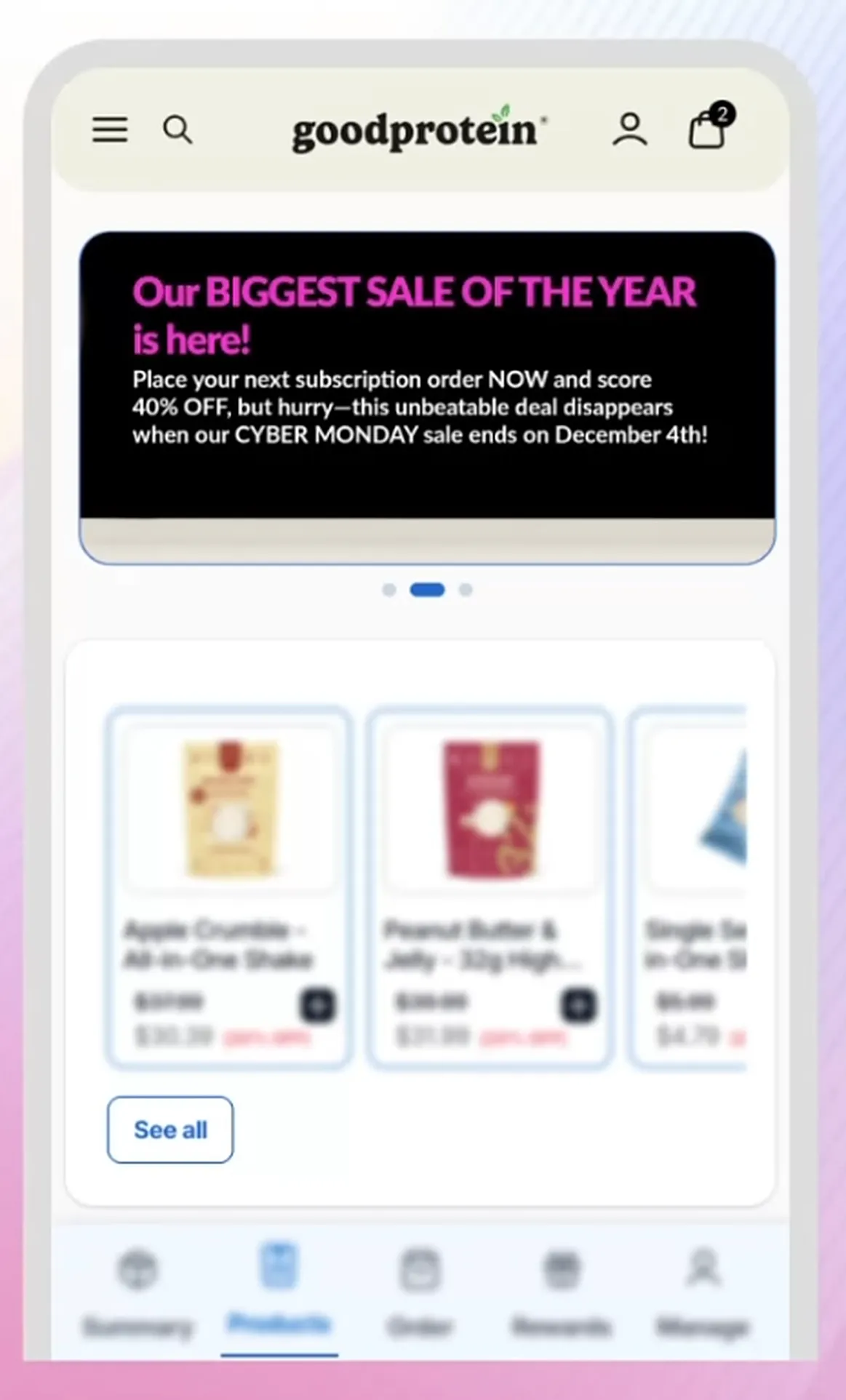
Launches and sales are add-on moments too, if subscribers hear first. Good Protein ran a subscriber-only window before its sitewide BFCM sale, and add-ons went from 18% to 25% of subscription revenue in that month.
The ladder, the product map and the portal, email and SMS placements are in add-ons, cross-sell and upgrades for existing subscribers.
Steady communication between charges
I still go back and forth on this one. But my view is you should not email existing subscribers much. They already buy every month. Every extra send is one more chance to remind them they could stop.
So for an active, paying subscriber, keep it to about one email a month and exclude them from everything else. Each one does one job: what the product is doing for them by now, one product to add, or the gift that lands if they reach the next order.
Magnet Monster splits the list in a way I like. Prospects, one-time buyers and lapsed subscribers get all your campaigns. Active subscribers on orders 1 to 3 get onboarding only. Active subscribers with 3+ orders get curated offers. The money's in bucket 3.
Answer every skip and find your lapse point
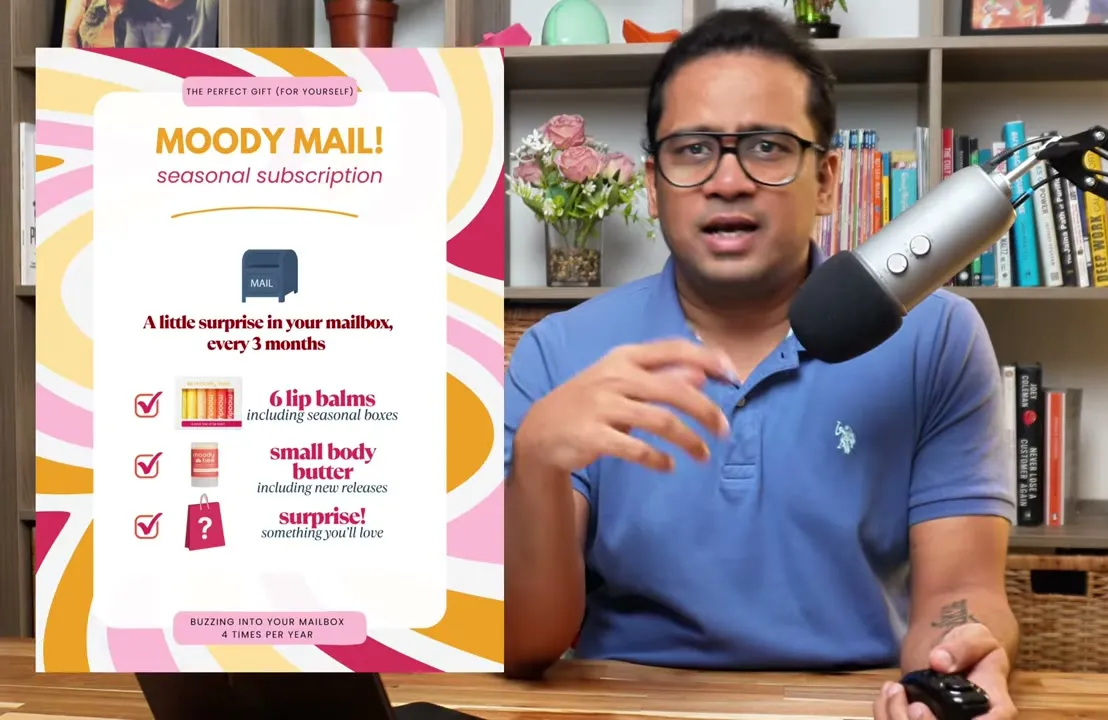
A skip is the moment a subscriber tells you something. Too much product, a holiday, money is tight this month. Most brands answer with a system confirmation and nothing else. Write it as loyalty, show the new date, and leave the discount out.
Every brand also has a month when subscribers typically cancel. Find yours in the cohort table, then send one email 5 to 10 days before it with a free gift, a perk or a strong reminder of what they get by staying. Most brands never build it. It's a single trigger.
Spot the drift before the cancel click
Subscribers signal weeks before they cancel. They stop opening. They skip twice. They write to support about too much product. A charge fails. They visit the cancel page and leave without cancelling. Flowium's list of early signals is close to the same five.
Most already reach Klaviyo as app events. So build one at-risk segment and send it your lapse-point email early.
Where SMS earns its cost
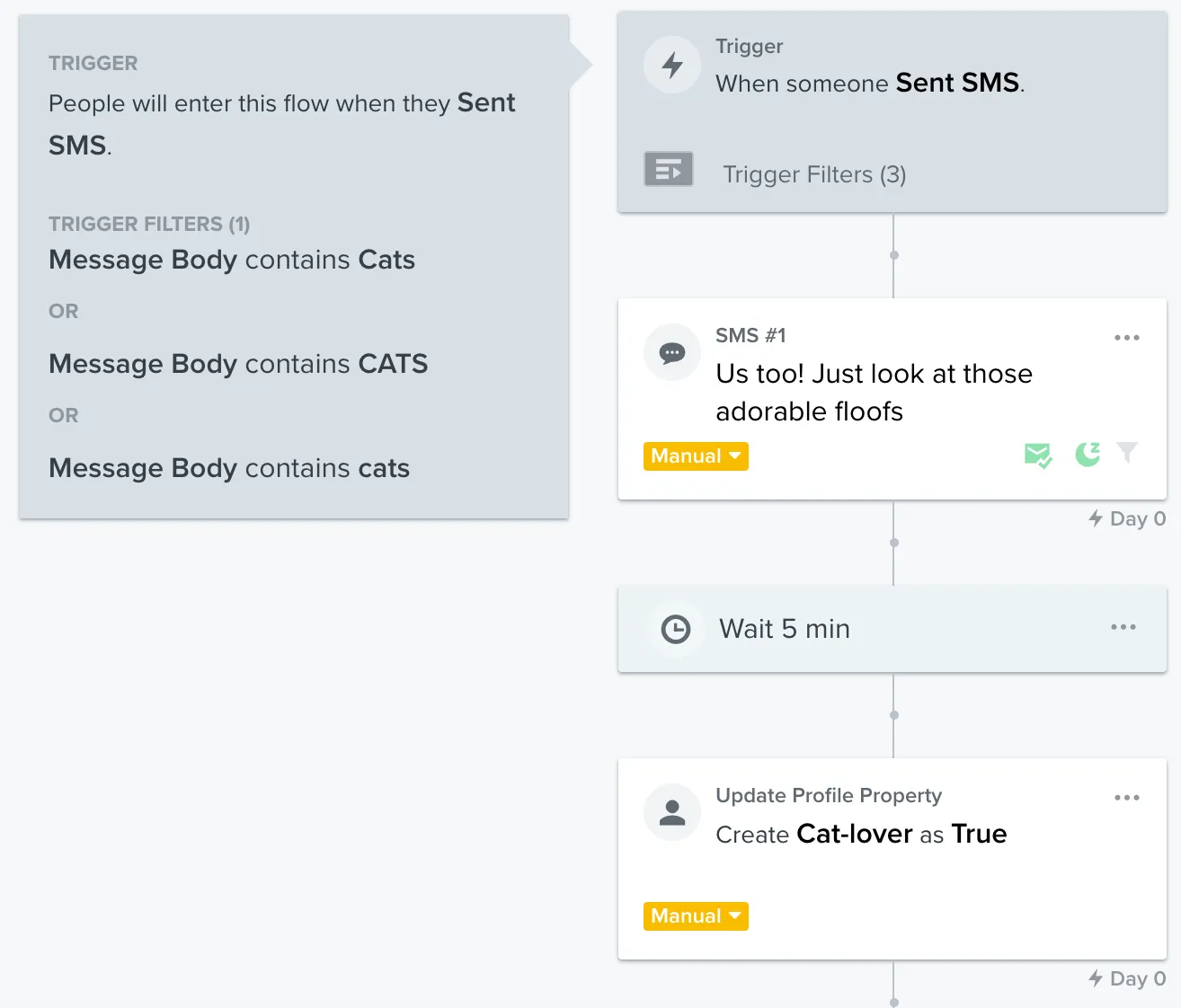
An SMS costs 10 to 20 times an email. So use it where speed matters: payment failed on day 1, the renewal reminder, and the first winback touch. And for two-way replies: Grüns subscribers swap their next box to a limited flavour by replying to a text.
What to send in months 2 to 6, plain-text check-ins included, is in emails for active subscribers. Keeping sale emails and loyalty codes away from people who already pay the subscription price is in keeping discounts away from your subscribers.
The nine flows that run underneath
Most subscribers do not leave in a rage. They drift out because nobody gave them a reason to stay at the moment it mattered.
Nine flows cover those moments. Most brands run two. Onboarding, nurture, the upcoming order reminder, renewal, paused, skipped, change date, cancellation and winback, each triggered by an event the subscription app sends into Klaviyo. One of our brands came to us with 7 of the 9 missing, and 15% of its cancels landed on day zero.
The quiet ones get skipped. Five of the brands we have audited sent nothing after a successful renewal. Nothing. That email is where a milestone gift gets confirmed.
And a skip looks harmless until you watch what follows. At one brand, 47.1% of subscribers ended after a skip, against 12.1% of those who moved their order earlier.
Flows break in the setup more often than in the copy. At one brand, the reminder flow made 93.5% of all subscription flow revenue. It was in Draft. Turn Smart Sending off on subscription flows, and check each month that every live message still sends.
All nine flows, their triggers and KPIs, the setup rules and which to build first are in the core subscription email flows.
Not every subscriber is worth the same
A subscriber who has been with you for ten months and one who joined last Friday at the Black Friday price both show up as "active". Same status. Same reminder email. Same cancel flow.
After working with 100+ brands, I realized segmentation is a story that sells. But rarely delivers.
For subscribers the bar is easier to clear. The message really is different. A handful of segments earns its keep: new subscribers on orders 1 and 2, loyal subscribers from order 5, the BFCM cohort, payment failed, and known exploiters. Lifetime value overrides the sale tag. A 10-month subscriber who bought during BFCM is not a deal seeker.
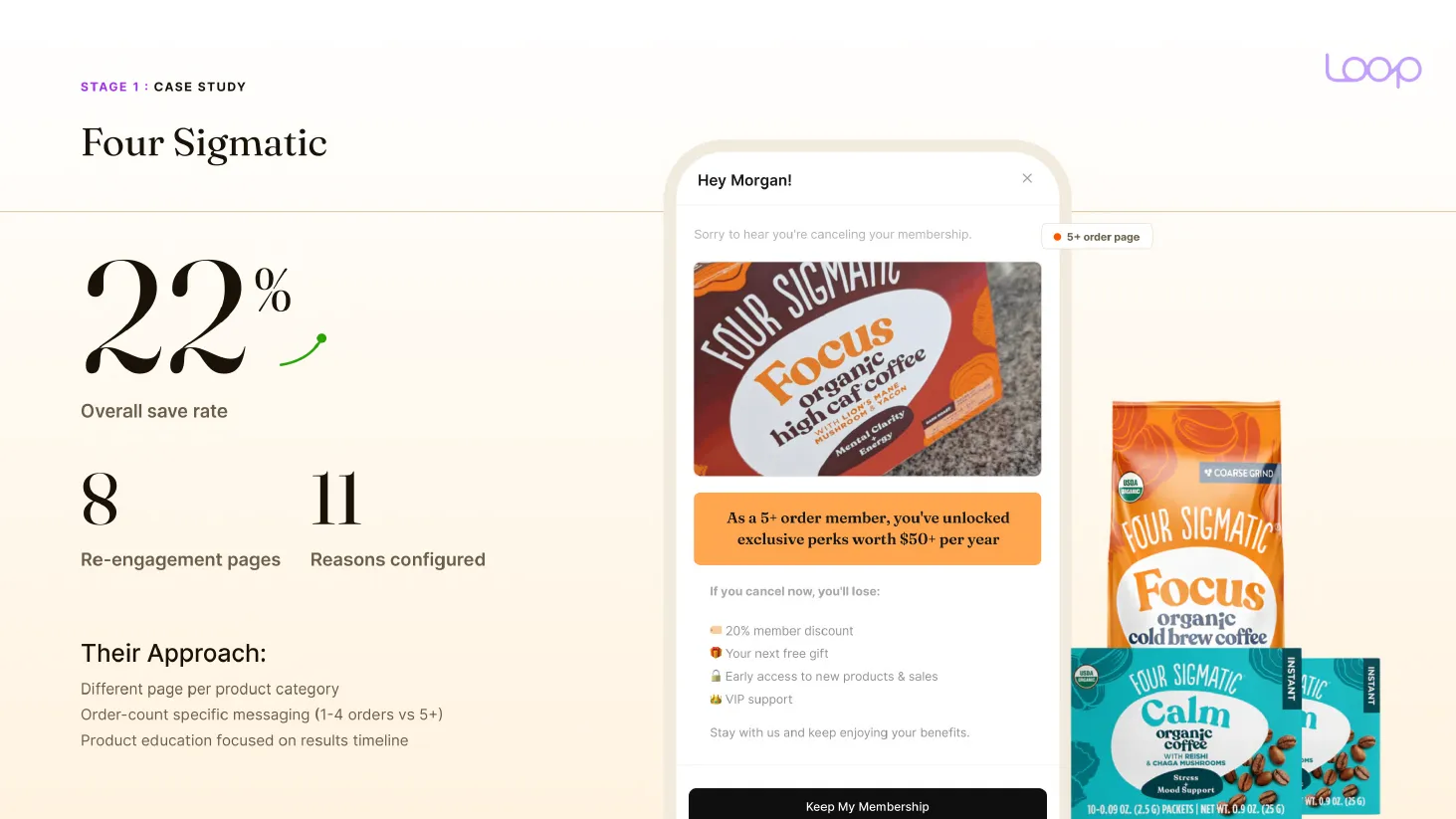
Four Sigmatic split its cancel screens on Loop at 1 to 4 orders vs 5+. The 5+ page lists what they lose by leaving, perks worth $50+ a year. Overall save rate, 22%.
The segments, cancel profiles, offer ceilings and RFM for winback are in segmenting subscribers by value.
Stock-outs, wrong items and swaps
Nobody picks "you were out of stock" in a cancel survey. They pick "other", or "not what I expected", or they just leave. So stock rarely shows up as a churn cause, even when it is one.
When I scored Dr. Squatch on 48 checkpoints, cancelling was clean. The complaints were somewhere else. One verified Trustpilot review says it plainly: the subscriber picked 4 different bars, two were sold out, and the box came with all Golden Glory. He did not even like Golden Glory. He cancelled.
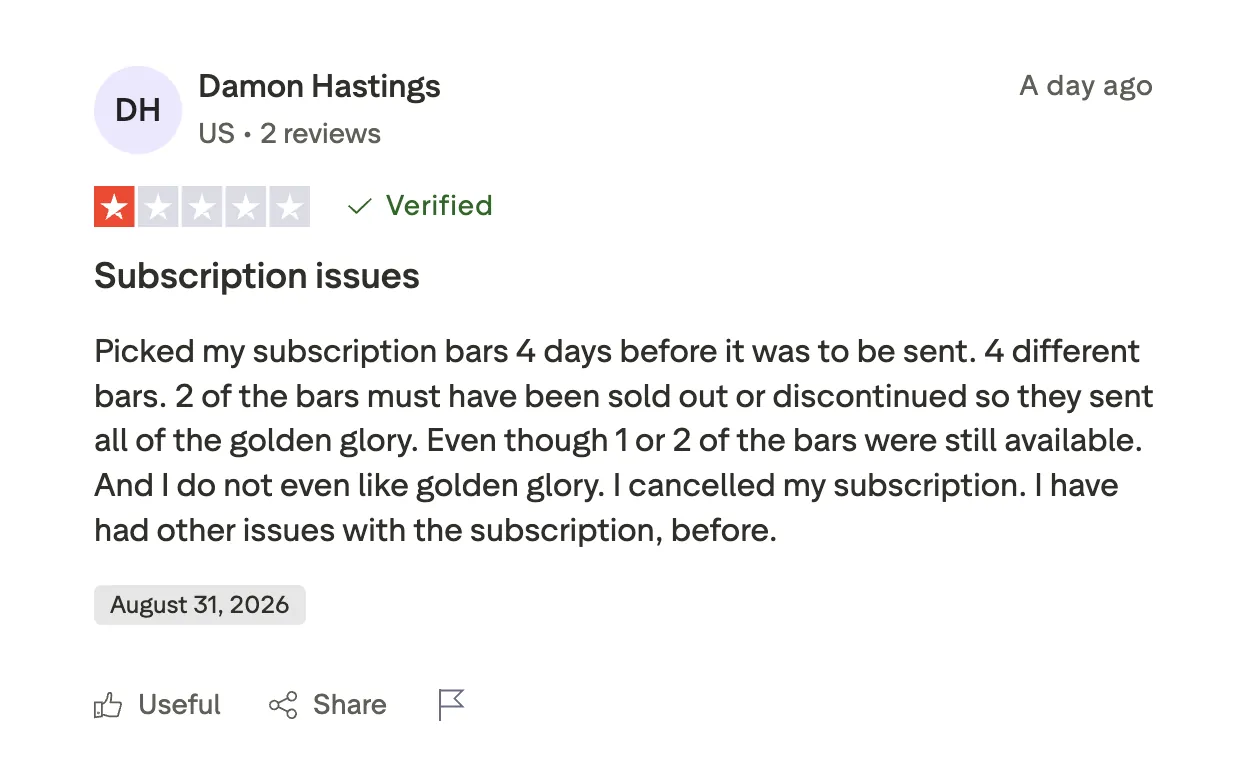
So the fix is small. If an item is out, tell them before the charge and let them pick the next one. Skio even sends a "Subscription Item Out of Stock" event into Klaviyo. Build a short flow on it. Set one named fallback per SKU before it runs out, not on the day.
Then the good side. Swaps, used well, are a reason to stay. Grüns keeps a 4-week cadence partly so subscribers can swap into a new limited flavour roughly every six weeks. The auto-swap rules, the out-of-stock message and holding stock for renewals at BFCM are in out-of-stock, wrong items and product swaps.
Subscription retention strategies: which to fix first
Don't build all of it at once. Start with the piece that sits just before the order where most of your subscribers cancel. Cancel-day spikes show you where that is.
- Most cancels before order 2: onboarding, which has its own hub.
- A spike on reminder day or charge day: the billing reminder.
- Skips and delays, then gone: the flexibility ladder, and the skipped and change date flows.
- Nobody opens the portal: the day-14 email and magic link login.
- Order 3 retention holding, revenue per subscriber flat: add-ons and the upgrade to a longer plan.
- No idea why they leave: ask early, with usage check-ins and surveys.
Then judge each change on order 3 retention for the next few cohorts. Not the open rate. Not the save rate. Change one thing at a time, so you know which one moved it. And keep reactivated subscribers out of the cohort, or a winback month flatters retention.
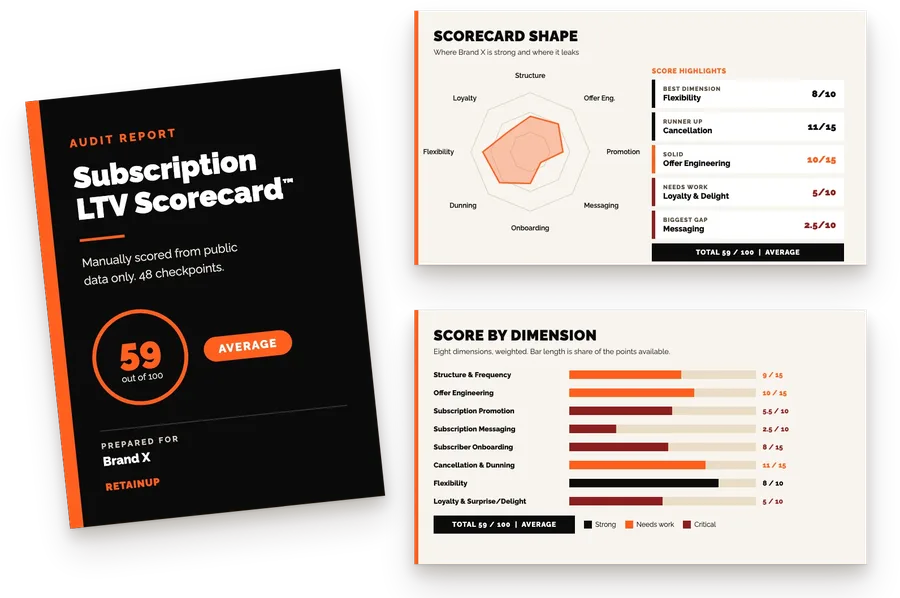
If you would rather see your leaks before picking, the free subscription audit checks 48 points and sends your top 3 leaks in 24 hours.
If you are deciding who should do this work, here is how to choose subscription retention experts and what a subscription retention agency costs.
Most of this hub is what we build in the Subscription LTV Maximizer™: the offer, widget, cancel flow, portal, payment recovery, pause and skip in Recharge, Skio, Stay AI or Loop, plus the email and SMS around them. Live in 30 days, for $5,000.
FAQ
What is a good subscription retention rate?
Measure it at order 3, not by month. For supplements on a monthly plan, under 45% of subscribers reaching order 3 is poor, 45 to 62% is average, 62 to 72% is good and over 72% is excellent. Count it cumulatively, with order 1 as the denominator, and only on cohorts old enough to have reached order 3. Across 9 brands audited in 2026, the median was 45.6%, so most programs sit at the line between poor and average.
How do you calculate subscription retention rate?
Divide the subscribers who paid a given order by the subscribers who paid order 1, from the same signup cohort. For order 3 retention, that is paid order 3 over paid order 1. Only count cohorts old enough to have reached order 3. Skip the returning customer rate on your Shopify dashboard, because it counts anyone who ever came back and swings with the date range you pick.
How do I stop subscribers cancelling after the first few months?
Put your effort on the second and third charge, where most of the loss happens. Rewrite the billing reminder so skip and reschedule are the main buttons, announce a gift before order 2 and order 3, and get subscribers into the portal before they want out. Then keep sending about one useful email a month.
What are the best subscription retention strategies?
The best one is the fix that sits just before the order where most of your subscribers cancel. A spike on reminder day points to the billing reminder. Skips followed by cancels point to the flexibility ladder. A portal nobody opens points to a day-14 email and magic link login. Build one, then judge it on order 3 retention for the next few cohorts.
Should I let subscribers pause their subscription?
We recommend no pause. Skip and delay already do the same job with less risk. 40 to 60% of paused subscribers are gone within 90 days. If you keep pause, cap it at 90 days, always require a resume date, and remind them before it restarts.
Do I need a loyalty program if I already have a subscription?
For most consumable brands, no. A subscription already does the loyalty job, with the reward applied on every order and nothing to redeem. A points program makes sense when most buyers will never subscribe or you sell a large catalogue bought at odd times. If you run both, let points pay for subscription orders and keep loyalty discount emails away from active subscribers.
When should the subscription renewal reminder go out?
Send it 3 to 5 days before the charge, then test. Earlier than 7 days and it slips their mind. Under 48 hours and a reschedule can collide with the charge batch. Recharge, Skio and Loop all send their upcoming charge event 3 days before by default, and Dr. Squatch sends its reminder 5 days before.
One email a week on subscription retention: the numbers, the strategy, and what to fix first.

Rahi Jain
Rahi Jain is a subscription LTV specialist who helps $1M to $10M DTC brands reduce subscription churn and maximize LTV on Recharge, Skio, Stay AI and Loop.
More about Rahi